Shared posts

19 Mar 20:02

Philadelphia skyscraper to transform into world’s largest game of tetris #gaming

by Jessica

NewImage

Philadelphia Tech Week is adding the world’s largest game of tetris to their lineup this year and it sounds awesome! Via WTSP.

The world’s largest video game “screen” is coming back. It’s actually the facade of the Cira Centre, next to 30th Street Station, where the Guinness record was set last year with ‘Pong.’ Next month, there will be a new game and even more playable real estate, as KYW tech editor Ian Bush reports.

Tetris is growing to new heights on the 29-story skyscraper.

“We’re going to have two games, one on each side, going at the same time. People playing against each other, people playing cooperatively. Cooperative Tetris is done by having one player control the lateral movement, left and right, and the other controlling rotation. So you and I have to work together to place that block,” says Frank Lee.

Lee, the world recordholder and associate professor of digital media in the Westphal College of Media Arts and Design at Drexel University says he’s using Cira’s north and south-facing LEDs to create the blocks and rows with more game information displayed on the narrower east and west sides. Pong, by comparison, was played on just the north facade.

“Technology seems to have made us more isolated from each other, but I wanted to use technology in games to bring us together – to create an aesthetic of a shared moment where we’re sharing in the experience. The entire city is sharing in the experience.”

Read more.

Thanks to Chuck Slotter for sending this in!

19 Mar 20:00

Teaching Calculus to 5 year-olds Might Not be as Crazy as it Sounds #makereducation

by Kelly

Lead

Some educators are calling for reform in the way mathematics are taught in our schools. The goal? To capture a progression truer to how children think; to grow the big concepts throughout their education, rather than introducing them after most students have already abandoned an interest in mathematics as a subject, via The Atlantic.

But this progression actually “has nothing to do with how people think, how children grow and learn, or how mathematics is built,” says pioneering math educator and curriculum designer Maria Droujkova. She echoes a number of voices from around the world that want to revolutionize the way math is taught, bringing it more in line with these principles.

The current sequence is merely an entrenched historical accident that strips much of the fun out of what she describes as the “playful universe” of mathematics, with its more than 60 top-level disciplines, and its manifestations in everything from weaving to building, nature, music and art. Worse, the standard curriculum starts with arithmetic, which Droujkova says is much harder for young children than playful activities based on supposedly more advanced fields of mathematics.

“Calculations kids are forced to do are often so developmentally inappropriate, the experience amounts to torture,” she says. They also miss the essential point—that mathematics is fundamentally about patterns and structures, rather than “little manipulations of numbers,” as she puts it. It’s akin to budding filmmakers learning first about costumes, lighting and other technical aspects, rather than about crafting meaningful stories…

The idea isn’t to create a generation of baby geniuses but to layer the learning in a more integrated, natural way:

“You can take any branch of mathematics and find things that are both complex and easy in it,” Droujkova says. “My quest, with several colleagues around the world, is to take the treasure of mathematics and find the accessible ways into all of it.”

She started with algebra and calculus, because they’re “pattern-drafter tools, designer tools, maker tools—they support cool free play.” So “Moebius Noodles” includes activities such as making fractals (to foster an appreciation of the ideas of recursion and infinitesimals) and “mirror books” (mirrors that are taped to each other like the covers of a book and can be angled in different ways around an object to introduce the concepts of infinity and transformations). (Another book in this genre is “Calculus by and for Young People,” by Don Cohen.)

“It’s not the subject of calculus as formally taught in college,” Droujkova notes. “But before we get there, we want to have hands-on, grounded, metaphoric play. At the free play level, you are learning in a very fundamental way—you really own your concept, mentally, physically, emotionally, culturally.” This approach “gives you deep roots, so the canopy of the high abstraction does not wither. What is learned without play is qualitatively different. It helps with test taking and mundane exercises, but it does nothing for logical thinking and problem solving. These things are separate, and you can’t get here from there.”

Read more.


Adafruit_Learning_SystemEach Tuesday is EducationTuesday here at Adafruit! Be sure to check out our posts about educators and all things STEM. Adafruit supports our educators and loves to spread the good word about educational STEM innovations!

19 Mar 19:59

Forge Your Own Crysknife #Dune

by Amy Ratcliffe

crysknife 1

You don’t have to travel to Arrakis and take down a sandworm to create a crysknife, but you do need to be willing to put in the time if you want it to look realistic. Instructables user Ginton Forge made a replica of the prop based on the design seen in David Lynch’s Dune from 1984 and won a medal in Instructables’ Makerlympics. He enjoyed making the weapon and wrote up a detailed how-to so we can all arm ourselves in the fashion of the Fremen. He used a crysknife mold carved from a soft wood, silcone rubber, resin, ivory toner, and plaster of paris. Here’s how he cast a rubber mold from the master one:

Casting a rubber mould out of a master mould (also called the “male mould” or the “plug”) may be tedious and messy and time-consuming, but it’s certainly an important part of the process. You basically have to let the rubber capture the likeness of your plug (the wooden mould/model of a crysknife). The silicone rubber is initially liquid so it will flow over and around the plug and around into all its details.

When the rubber sets and when you remove the plug you’ll then have a negative imprint of your plug made out of rubber. That’s why it’s critical that you do the rubber moulding process properly or you won’t get the details right and mistakes you make at this point will show up on your subsequent casts.

I used a two part-mould for the crysknife, with each half backed with plaster of Paris for the rubber mould to retain its shape when the resin is poured in. Apply the same process for the sheath cast!

crysknife in progress

Read more at Instructables.

19 Mar 19:49

Marketing the Moon: How NASA Sold Space to Earth

by Michelle Legro

When the mission became the message and NASA undertook the monumental task of explaining rocket science to an audience looking to the stars.
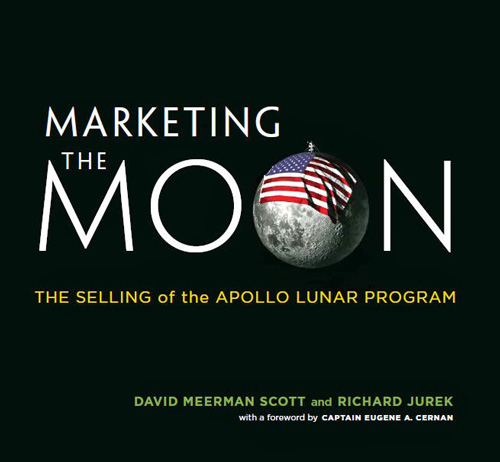
It wasn’t until the soft beep…beep…beep of the Sputnik satellite reached Earth on October 4, 1957 that the Soviet Union could declare the first unequivocal success of their space program. The Soviets had launched Sputnik in secret, and the news took the United States by surprise. It was Soviet policy that every launch would be kept secret unless it was successful, and that its public would only be fed propaganda. The Soviet government would deny ever having attempted a manned lunar landing until 1990, and cosmonauts who died in the line of duty were erased from the public record. (The details of the training-accident death of Yuri Gagarin, the first cosmonaut to orbit the earth, were covered up until 2013.)

One year after the surprise launch of Sputnik, the National Aeronautics and Space Administration (NASA) was founded. The U.S. space program was determined to be markedly different from the Soviets — it would be an “open program” in which facts and data would flow freely between the agency and the public using an extensive public relations program, explain authors David Meerman Scott and Richard Jurek in Marketing the Moon: The Selling of the Apollo Lunar Program (public library). It was a radical proposition: NASA, not the military, would release information and information would be released before, not after, a mission — an antithesis to the typical military strategy of confidentially. Tragedy would be reported alongside success.

Despite the somewhat cynical title, Marketing the Moon is not simply a story of the “selling” of the space program or the “spinning” of the NASA public relations machine — rather, it’s a rigorous and unvarnished look at one of the largest and most successful disseminations of science education in the twentieth century.

Reporters at Cape Canaveral during the launch of one of the Mercury missions

How could rocket physics, geology, astronomy, and more be explained to the lay person? How could the chain of information — from the lab to the Public Affairs Office to the TV producer to the host to the viewer at home — retain accuracy and clarity? Using rare press materials from the early days of NASA as well as the Apollo program — press releases, reference material, news bulletins, and photographs of reporters at work — Scott and Jurek show that the launch of a fact was as precarious as the launch of a missile: both could spectacularly fail to reach their targets.
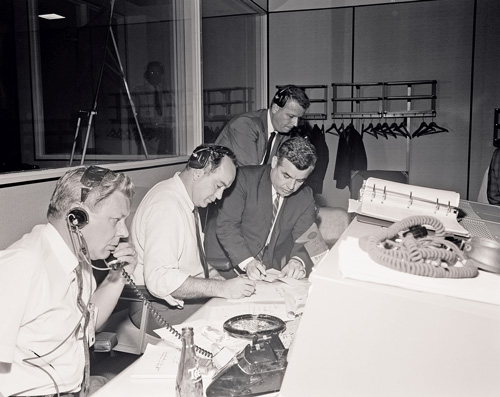
The staff of the Public Affairs Office at Mission Control in Houston, 1965

The Public Affairs Office would control the consistency of the information, not its message. From the beginning, the office hired ex-newsmen to work as reporters inside the agency, determining which stories the public should know and in language that would be accessible — reporters knew what reporters would need. It was a move that today might be labeled “brand journalism,” but at the time was a revolutionary step for a government agency that needed its story told accurately and efficiently.
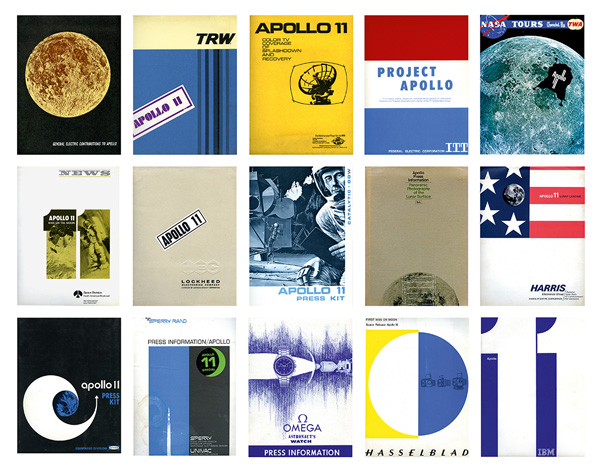
Press kits prepared for the major contractors in the Apollo programs, including IBM and Omega watches (Courtesy Richard Jurek)

Control, however, became the topic of one of the most controversial media relationships set up by NASA: the LIFE magazine / World Book contracts, which paid $500,000 to the Mercury 7 astronauts and their wives in 1959 (because then, decades before women took to the stars, women’s role in space exploration amounted to being astronaut wives), as well as a $100,000 life insurance policy that wasn’t provided by the government. It was easy to see the contract as “cashing in” on a project funded by taxpayers, but NASA had perhaps naively understood the contract as protecting the astronauts from being hounded or exploited by the media. The astronauts could only talk about their personal lives, not the missions.
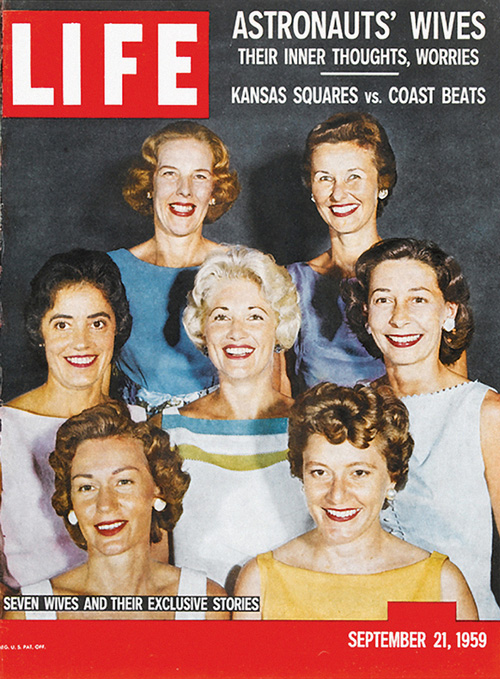
The exclusive LIFE magazine coverage of the wives of the Mercury 7 astronauts

NASA created materials that addressed reporters’ needs in press releases, bylined articles, background materials, sponsored media symposiums, television newsreels, and fully produced radio broadcasts complete with interviews and sound effects. Every mission was explained pre-launch by the Public Affairs Office and reported with text and visuals far more elaborate than any press kit.

Before the Apollo 11 launch, journalists received The Apollo Spacecraft News Reference, a thick, three-ring binder with tabbed pages for easy thumbing. It included detailed diagrams of the command module, oxygen tanks, the spacesuit, and much more. It was an encyclopedia of technical information that would have been considered high-treason to release under the Soviets, but NASA considered the reference book an essential “classroom handout” for a proverbial public of fascinated students.
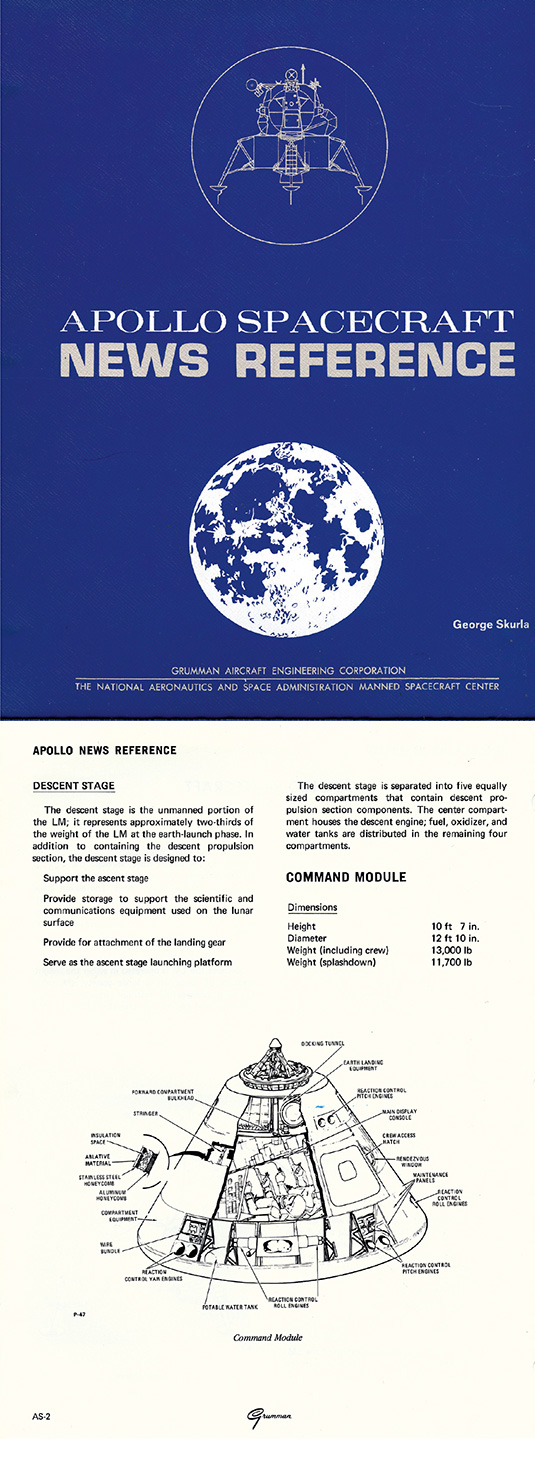
A series of books several hundred pages in length, that detailed technical concepts and vocabulary for reporters covering the Apollo 11 launch (Courtesy Richard Jurek)

Any advertisement that mentioned the space program had to be submitted to NASA in order to both maintain both factual accuracy and ensure that no product was directly endorsed. Contractors could advertise that their product had traveled to the moon, but not that it had been used. No astronauts could be shown in an ad, only their anonymous suited counterparts. Photographs taken in space were government-produced and therefore were in the public domain.
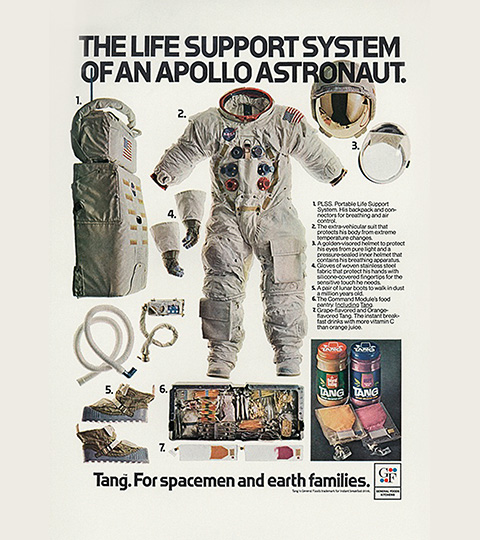
Advertisements couldn’t show the face of any astronaut, nor suggest the product had actually been used on a mission. This ad for Tang would have been vetted for accuracy by the Public Affairs Office.

Television proved to be one of the hardest and most important outlets for NASA to tell its story. The Public Affairs Office made sure that the producers had access to model spacecraft, maps, graphs, charts, as well as interviews with scientists and guidance about the right questions to ask. The mission was the message; the concept was easy to explain, the execution much harder. Walter Cronkite, who would propel CBS into the pole position during the Apollo 11 broadcast, relied on information from the Public Affairs Office as a much-needed crash course:

Covering the space program presented a challenge to us all… There was a great deal we had to learn about the mechanics of space flight and the idiosyncrasies of the physics of moving bodies in the weightlessness and atmosphere-free environment of space.
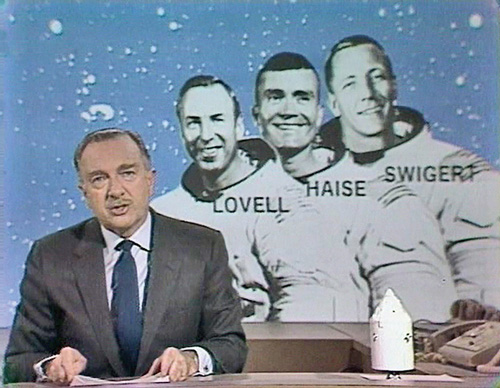
The CBS Evening News with Walter Cronkite during the tense coverage of the Apollo 13 mission. (Courtesy Richard Jurek)

The Public Affairs Office considered itself a champion of accurate scientific information, created to “furnish Congress and the media with the facts — unvarnished facts — about the progress of NASA programs,” explained its founder in 1959. Congress was just as important an audience, and it is an unfortunate reality that space education falls in and out of fashion with the budget of each new session. Public affairs was more than a perception, it was the life and death of the space program. When the lunar module of Apollo 11 began its fifty state tour, public relations was taken over by local affiliates, and the effect was more sideshow than science fair.
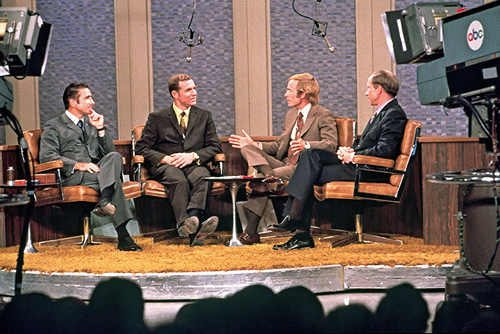
Dick Cavett interviews the Apollo 15 astronauts, 1971. (Courtesy Richard Jurek)

However, this is only the story of the public perception of NASA and the space program, not the public’s appetite for space, which has thrived for decades on the ecstatic visions of Carl Sagan, and has been reinvigorated with Neil deGrasse Tyson’s relaunch, and loving tribute, to Sagan’s Cosmos. With his clear yet poetic communication of complex scientific ideas, Tyson has championed science on all platforms and has mastered the art of the soundbite:

A soundbite is useful because it triggers interest in someone, who then goes and puts in the effort to learn more…

Communication of the work is as important as the work itself, something that Wernher von Braun knew as he stood to address the reporters at NASA’s Manned Spacecraft Center after the Apollo 11 astronauts were headed back to earth aboard the command module Columbia:

I would like to thank all of you for the fine support you have always given the program. Because without public relations and good presentations of these programs to the public, we would have been unable to do it.

For a bittersweet complement to Marketing the Moon, see Space Chronicles: Facing the Ultimate Frontier, Neil deGrasse Tyson’s urgent and poetic antidote to the precarious fate of space exploration today.

Michelle Legro is an associate editor at Lapham’s Quarterly. You can find her on Twitter.

Donating = Loving

Bringing you (ad-free) Brain Pickings takes hundreds of hours each month. If you find any joy and stimulation here, please consider becoming a Supporting Member with a recurring monthly donation of your choosing, between a cup of tea and a good dinner.


♥ $7 / month♥ $3 / month♥ $10 / month♥ $25 / month


You can also become a one-time patron with a single donation in any amount.


Brain Pickings has a free weekly newsletter. It comes out on Sundays and offers the week’s best articles. Here’s what to expect. Like? Sign up.

Brain Pickings takes 450+ hours a month to curate and edit across the different platforms, and remains banner-free. If it brings you any joy and inspiration, please consider a modest donation – it lets me know I'm doing something right. Holstee

19 Mar 19:48

1902: Hot Air Therapy

by Amanda

Hot Air Therapy 1

“Dry heat is a powerful pain reliever without any of the depressant effects common to drugs. In common with constitutional and medicinal treatment we have in dry heat a positive curative agent. It is a stimulant to rapid repair and absorption. It is one of the most valuable eliminative agents we possess. Where indicated, it possesses a sedative action on the nervous system obtained by no other means”

- Studies in Hot Air Therapy

Hot Air Therapy 2 Hot Air Therapy 3 Hot Air Therapy 4 Hot Air Therapy 5 Hot Air Therapy 6 Hot Air Therapy 7 Hot Air Therapy 8 Hot Air Therapy 9 Hot Air Therapy 10 Hot Air Therapy 11 Hot Air Therapy 12 Hot Air Therapy 13 Hot Air Therapy 14 Hot Air Therapy 15
19 Mar 19:36

Water Droplets Flow Uphill through a Superheated Maze Thanks to the Leidenfrost Effect

by Christopher Jobson

Water Droplets Flow Uphill through a Superheated Maze Thanks to the Leidenfrost Effect water science mazes

Water Droplets Flow Uphill through a Superheated Maze Thanks to the Leidenfrost Effect water science mazes

Water Droplets Flow Uphill through a Superheated Maze Thanks to the Leidenfrost Effect water science mazes

The folks over at Science Friday made this fascinating video about the Leidenfrost Effect, where water dropped on an extremely hot surface is capable of floating instead of immediately evaporating. While studying the bizarre effect, physicists at the University of Bath realized that not only does the water float, but under the right conditions and temperatures it can actually climb upward. The playful experiments lead to the creation of an incredible superheated maze. (via The Awesomer)

19 Mar 19:31

ARM-based Robot smashes Rubik’s Cube world record by more than two seconds

by Chris Wood

The Cubestormer 3 robot used ARM technology to set the new record

A specially designed robot known as Cubestormer 3 has been used to break the world record for solving a Rubik’s Cube. The robot, which broke the previous record by more than two seconds, is powered by an octa-core Samsung Galaxy S4 smartphone... Continue Reading ARM-based Robot smashes Rubik’s Cube world record by more than two seconds

Section: Robotics

Tags: Lego, Puzzles, Robots, Samsung Galaxy S4, World Records

Related Articles:
19 Mar 19:30

Where Art Meets Gif: The Hypnotic Animated Gifs of David Szakaly

by Christopher Jobson

Where Art Meets Gif: The Hypnotic Animated Gifs of David Szakaly gifs animation

Since 2008 Hungarian/German graphic designer David Szakaly has been churning out some of the most dizzying, hypnotic and wholly original gifs on the web under the name Davidope. His blend of twisting organic forms, flashes of black and white, and forays into pulsing technicolor shapes have inspired legions of others to experiment with the medium, many of whom have been featured here on Colossal. It’s hard to determine the scale of Szakaly’s influence online, but a simple Google image search for “animated gif” brings up dozens of his images that have been shared around Tumblr hundreds of thousands of times.

Szakaly began experimenting with the vector animation program Macromedia Flash back in 1999 where he used the software to create presentations, banners, and other creatives for clients. It was nearly a decade later when he decided to dedicate more time to experimenting with motion graphics and found that Tumblr was a great platform to share his quirky gifs. While he still works in the corporate world on other digital projects, he has also found commercial success making animations for clients around the world. Though it’s his personal work that really stands out. If or when gifs end up on gallery walls, it will be hard to deny Szakaly’s role in getting them there.

Where Art Meets Gif: The Hypnotic Animated Gifs of David Szakaly gifs animation

Where Art Meets Gif: The Hypnotic Animated Gifs of David Szakaly gifs animation

Where Art Meets Gif: The Hypnotic Animated Gifs of David Szakaly gifs animation

Where Art Meets Gif: The Hypnotic Animated Gifs of David Szakaly gifs animation

Where Art Meets Gif: The Hypnotic Animated Gifs of David Szakaly gifs animation

Where Art Meets Gif: The Hypnotic Animated Gifs of David Szakaly gifs animation

Where Art Meets Gif: The Hypnotic Animated Gifs of David Szakaly gifs animation

19 Mar 19:28

New Cut Paper Illustrations from Zim & Zou

by Christopher Jobson

New Cut Paper Illustrations from Zim & Zou paper illustration

New Cut Paper Illustrations from Zim & Zou paper illustration

New Cut Paper Illustrations from Zim & Zou paper illustration

New Cut Paper Illustrations from Zim & Zou paper illustration

New Cut Paper Illustrations from Zim & Zou paper illustration

New Cut Paper Illustrations from Zim & Zou paper illustration

New Cut Paper Illustrations from Zim & Zou paper illustration

New Cut Paper Illustrations from Zim & Zou paper illustration

New Cut Paper Illustrations from Zim & Zou paper illustration

It’s been over two years since we last featured the work of French duo Lucie Thomas and Thibault Zimmermann of Zim&Zou (previously here and here). The pair of graphic designers create paper sculpture, installations, and illustrations for leading luxury brands, books, magazines as well as their own edification. Collected here are a number of works from the last few years and you can explore much more over on their website and on Behance.

19 Mar 19:27

Quiet Treehouse offers visitors the chance to get away from it all

by Adam Williams

The Quiet Treehouse is currently installed at this year's Ideal Home Show in Earl's Court,...

Luxury treehouse manufacturer Blue Forest has teamed up with noise abatement specialist Quiet Mark and UK retailer John Lewis to produce the Quiet Treehouse. Constructed for this year's Ideal Home Show, the cosy retreat packed with noise-reduction technology and low-noise home appliances. Once the show is over, it will be installed in the Chestnut Tree House Children’s Hospice, West Sussex. .. Continue Reading Quiet Treehouse offers visitors the chance to get away from it all

Section: Architecture

Tags: Construction, Environmentally-friendly, London, Materials, Recycling, Treehouse, Wood

Related Articles:
19 Mar 19:17

A Supercut of Centered Shots in Wes Anderson Films

by Christopher Jobson

A Supercut of Centered Shots in Wes Anderson Films movies

Watching any film by Wes Anderson it’s impossible to ignore the director’s obsessive visual aesthetic. From his harmonizing use of color to impeccably constructed sets, every minute detail is considered and designed. Korean filmmaker Kogonada just released this supercut of one particular Anderson hallmark: the use of perfectly centered shots. Kogonada has become well-known for his videos that isolate the visual tools of directors including pieces on Kubrick, Malick, and Tarantino. (via Coudal)

19 Mar 19:15

King's College London develops skinsuit to prevent muscle and bone loss in space

by Anthony Wood

King's College London students sporting the gravity loading countermeasure skinsuit (Photo...

Researchers from King's College London working with the Massachusetts Institute of Technology (MIT) have produced a skinsuit which, if worn by astronauts in outer space, could counteract the degradation of bone and muscle mass during long term exposure to microgravity... Continue Reading King's College London develops skinsuit to prevent muscle and bone loss in space

Section: Space

Tags: Astronauts, Bones, ESA, International Space Station, Kings College, MIT, Muscle

Related Articles:
19 Mar 19:11

NASA releases 680-gigapixel interactive mosaic of Lunar North Pole

by Anthony Wood

NASA has released a 680-gigapixel interactive mosaic of the Moon's north polar region that...

NASA, using images taken from its Lunar Reconnaissance Orbiter (LRO) has released a 680-gigapixel interactive mosaic of the Moon's north polar region. The resolution of the image is one pixel to 6.5 ft (2 m) with the area imaged being the equivalent of slightly more than the land mass of the states of Alaska and Texas combined... Continue Reading NASA releases 680-gigapixel interactive mosaic of Lunar North Pole

Section: Space

Tags: Image, Interactive, LNPM, Lunar, Lunar Reconnaissance Orbiter, Moon, Mosaic, NASA, Pole

Related Articles:
18 Mar 22:25

Polymakr launches three new 3D printing materials on Kickstarter

One of the things holding 3D printing back is the limitation of the material used to print objects. A Chinese company, Polymakr, has developed three new printing materials that aren’t just regular plastic, but re-engineered plastic to be used as an "ink" with 3-D printers.

This article Polymakr launches three new 3D printing materials on Kickstarter is first published at 3ders.org.

18 Mar 19:33

MakerBot’s Ever-So-Slight Proprietary Move

by Site Admin
Bunker.jordan

Hmmmm... I think that the author is being a *bit* paranoid, as this seems more likely to be an aesthetic design choice rather than a functional limitation. That being said, it could be a passive aggressive move towards proprietary filaments. Stratasys is known for *insanely* expensive cartridge prices (~$300 for a cartridge that contains ~$30 in plastic), and I wouldn't be surprised if MakerBot is under pressure to move in that direction as well...

With the release of their fifth-generation Replicator personal 3D printer, we noticed a feature that may portend a future move to proprietary filament. 

There are two kinds of personal 3D printers on the market today: those that insist on purchasing expensive, proprietary plastic filament and those that permit use of any generic plastic filament. 

MakerBot has long been a member of the latter. You could (and people often do) attach any kind of filament to their MakerBot machines. You’d simply drop the generic filament spool onto the holder at the back of the machine. 

But MakerBot’s most recent machine, the fifth-generation Replicator, the spool is stored inside the machine at the back in a precisely-sized cavity. This makes for a very tidy looking machine without stray spools visible and might keep contaminating dust down a bit. Of course, MakerBot’s own spools fit perfectly.

But generic spools may not. 

Unless the generic spool somehow fits into the MakerBot cavity, you’d be faced with re-spooling filament from generic to MakerBot spools. (This is a fun exercise, two-person exercise we’ve done with clamps and a hand drill.) 

So, no, MakerBot is not and has not moved to proprietary spools. But they have erected a minor barrier to generics that a portion of their customers may not wish to jump. Will they make more dramatic moves in the future, considering they’re now owned by Stratasys?

Meanwhile, MakerBot’s excellent filament isn’t that much more expensive anyway.

18 Mar 00:50

1975: The first Millennium Falcon

by Chris

The first Millennium Falcom

“According to Star Wars creator George Lucas, the Millennium Falcon’s design was inspired by a hamburger, with the cockpit being an olive on the side. The ship originally had a more elongated appearance, but the similarity to the Eagle Transporters in Space: 1999 prompted Lucas to change the Falcon’s design. The original model was modified, re-scaled, and used as Princess Leia’s ship, Tantive IV.”

- Wikipedia

The first Millennium Falcon The first Millennium Falcon The first Millennium Falcon

18 Mar 00:02

March 17, 2014

Bunker.jordan

Unfortunately, blackouts *never* end this way...


One of my favorite comics I've done is over at The Nib for your perusal. If you go through my posts there, there's also a lot of exclusive content. Enjoy!
18 Mar 00:01

1923: Floating Mooring Mast Proposed as Way Station for Airships

by Amanda

Floating Mooring Mast Airship

17 Mar 23:48

1964: New York World’s Fair

by Amanda

Worlds Fair 1 Worlds Fair 2 Worlds Fair 3 Worlds Fair 4 Worlds Fair 5 Worlds Fair 6 Worlds Fair 7 Worlds Fair 8 Worlds Fair 9 Worlds Fair 10 Worlds Fair 11 Worlds Fair 12 Worlds Fair 13 Worlds Fair 14 Worlds Fair 15 Worlds Fair 16 Worlds Fair 17 Worlds Fair 18

17 Mar 23:48

Famous and talented painter Georgia O’Keefe hitching a...


Famous and talented painter Georgia O’Keefe hitching a ride on her land, Ghost Ranch in Abiquiu, NM with Maurice Grosser on his 1938 Harley Davidson Knucklehead. Photographed by Maria Cabot circa 1944.

Fun fact- when I was in Primary School, fifth grade, we did a huge project for an event called, “Night of the Notables” wherein we would dress up as our chosen historical figure. We had to create a large display board of our work and talk about it as if we were the person we were portraying. My choice? Georgia O’Keefe. It was fantastic being able to hang her paintings of flowers and skulls as a child. 

[ source: TSY - Women Who Rode Away | more history ]

17 Mar 23:48

Lolana Motorcycles cafe racer girl illustration! [ source:...


Lolana Motorcycles cafe racer girl illustration!

[ source: Lolana Motos blog | more motorcycle art ]

17 Mar 23:48

c. 1863-1868: The Five Stages of Inebriation by Charles Percy Pickering

by Amanda

Five Stages Inebriation 1 Five Stages Inebriation 2 Five Stages Inebriation 3 Five Stages Inebriation 5 Five Stages Inebriation 4

The photographs illustrate drunkenness in five stages, played by a male subject in a studio.
Possibly commissioned by a local temperance group for educative purposes, the photographs may also have been used by an engraver for illustrations.  The penultimate frame of the drunk in a wheelbarrow resembles S.T. Gill’s watercolour ‘Ease without Opulence’, 1863.

In 1866, NSW Premier James Martin introduced the Drunkard’s Punishment Bill.

17 Mar 23:47

1897: Costume ball

by Amanda

Costume Ball 1Costume Ball 19 Costume Ball 2 Costume Ball 3 Costume Ball 4 Costume Ball 5 Costume Ball 6 Costume Ball 7 Costume Ball 8 Costume Ball 9 Costume Ball 10 Costume Ball 11 Costume Ball 12 Costume Ball 14 Costume Ball 15 Costume Ball 16 Costume Ball 17 Costume Ball 18

15 Mar 04:04

Badass of the Week: Trieu Thi Trinh

Bunker.jordan

"Trieu Thi Trinh was a hardcore Vietnamese battle-queen who tried to liberate her people from Chinese imperial aggression by thundering into combat mounted on the back of a colossal war elephant while clad in golden armor and carrying a blood-soaked sword in each hand."

Woah I finally remembered to update my RSS Feed.
14 Mar 22:13

Foldscope Promises Microscopes for Everyone!

by James Hobson

aquascope

The folks over at PrakashLab at Standford University have come up with an amazingly simple microscope design called the Foldscope, which could make microscopes feasible in even the most remote areas.

The Foldscope is an optical microscope that can be made out of paper and printed components, much like a piece of origami. It can magnify up to 2,000X, costs less than a dollar to manufacture, and can provide a sub-micron resolution of 800nm. It requires no external power, fits in a pocket, and could survive being dropped off the top of a 3 story building!

It takes advantage of new technologies that make it possible to print micro-optics, micro-electronics, micro-flexures, and even micro-fluidics. Just take a look at the following bill of materials and diagram explaining the mechanism.

Figure4-Foldscope-cross-section

The team is looking for 10,000 beta testers, and all you have to do is sign up and then with your Foldscope, develop a single page science experiment or protocol — the goal? To write an open-source, question-driven, biology and microscopy lab manual! Now that is cool.

[Thanks Karl!]


Filed under: tool hacks
14 Mar 22:03

Shelfie saddles up for bike storage

by Nick Lavars

With Shelfie, US-based inventor Jurgen Beneke aims to cater to the many reasons people mig...

There are various reasons why people might want to mount bikes on their walls, whether its for maintenance, to showcase a treasured racer or purely to save space. US-based inventor Jurgen Beneke aims to cater to all types with Shelfie... Continue Reading Shelfie saddles up for bike storage

Section: Bicycles

Tags: Bikes, Furniture, Kickstarter, Storage, Wall-mounted

Related Articles:
14 Mar 21:29

Anatomical Collages by Travis Bedel

by Christopher Jobson

Anatomical Collages by Travis Bedel mixed media collage anatomy

Anatomical Collages by Travis Bedel mixed media collage anatomy

Anatomical Collages by Travis Bedel mixed media collage anatomy

Anatomical Collages by Travis Bedel mixed media collage anatomy

Anatomical Collages by Travis Bedel mixed media collage anatomy

Anatomical Collages by Travis Bedel mixed media collage anatomy

Anatomical Collages by Travis Bedel mixed media collage anatomy

Anatomical Collages by Travis Bedel mixed media collage anatomy

Anatomical Collages by Travis Bedel mixed media collage anatomy

Mixed media artist Travis Bedel creates stunning collages that merge anatomical imagery with illustrations from science guides and textbooks. You can see much more of his work over on Tumblr, and he has prints for sale on Society6 and Etsy.

14 Mar 21:21

Open-Source Sentry Gun Plans Promise the Next Level of Office Warfare

by James Hobson

FAxfsmc

We admit it, we were browsing Reddit when we found this beautifully hacked together Nerf Sentry turret. But are we ever glad we did — as it turns out, it was built based off of the totally awesome, open-source Project Sentry Gun.

We have actually covered a project that used this system before, but it looks like it has evolved a bit more since then. It’s just too cool not to share.

The system itself is quite simple and easy to build. You’re going to need three servo motors, an Arduino, a webcam, and assorted wires, nuts and bolts, etc etc. Grab a copy of the code, slap it all together, and you’re ready for business!

Just take a look at the following video of the Gladiator II Paintball Sentry Gun — we know you’re going to want to build one now.

Though we must say… this double barreled version (not based off of Project Sentry Gun) is a bit more intimidating.

[via Reddit]


Filed under: toy hacks
14 Mar 21:10

c. 1991: Tony Benn’s secret suffragette plaque in the Houses of Parliament

by Chris

“This plaque to Emily Wilding Davison was put up in the Chapel of St Mary Undercroft by Tony Benn MP.

Tony Benn said in the House of Commons in 2001: “I have put up several plaques—quite illegally, without permission; I screwed them up myself. One was in the broom cupboard to commemorate Emily Wilding Davison, and another celebrated the people who fought for democracy and those who run the House. If one walks around this place, one sees statues of people, not one of whom believed in democracy, votes for women or anything else. We have to be sure that we are a workshop and not a museum”

- Parliament.uk

Plaque

14 Mar 16:02

Too cool… an Aprilia split in twine at the Boijmans...


Too cool… an Aprilia split in twine at the Boijmans Rotterdam Museum in the Netherlands, photographed in 3D by Alexandra Bircken.

[ source: flickr | more aprilia ]