It was right there in the instructions.
Submitted by: (via romain jantot)

Watermelon Bread, this colorful bread got its start at a Taiwanese establishment called Jimmy’s Bakery.(Read...)

For today’s edition of Deal of the Day, Amazon has the Estes Syncro X Nano R/C Quadcopter for just $25.20. That’s 58% off the quadcopter’s regular list price of $59.99.
Introducing the Estes Syncro! The smallest Quadcopter in the World that’s ready for action right out of the box. It’s so small, it fits easily in the palm of your hand. It’s so versatile, it can roll forward and backward and side to side. The included 2.4GHz radio gives you total control. The powerful LiPo battery lets you fly for an extra-long time and charging is easy. Just plug the included USB charger into your computer and you’ll be flying in no time.
–Estes 4609 Syncro X Nano R/C Quadcopter – $59.99 $25.20 (58% Off)
The post Amazon Deal of the Day: 58% Off Estes Syncro X Nano R/C Quadcopter – $25.20 appeared first on Geeks are Sexy Technology News.

What you don’t see are the 14 swimsuit models with moist panties behind him in line. Bitches be lovin’ hexagons…
Texas
The post Hexagon Hal appeared first on People Of Walmart.

An accident can happen in a split second when you’re driving, but studies have shown that half the time the human body is still able to quickly take defensive action before the impact. So Toyota has upgraded its crash test simulation software with improved virtual muscles to take this into account.

(Steve)
The recently enacted neutrality rules require broadband providers to treat all legal content equally — which means no blocking or throttling access to sites and online services that an ISP competes with or doesn’t like, and no prioritizing of access to sites and services that are willing to pay ISPs.
These are the same conditions required by the 2010 Open Internet Order, but Verizon successfully convinced a court in 2014 that, because of the way in which broadband was classified by the FCC, the Commission lacked authority to enforce these rules.
So in order to make the conditions stick, the 2015 version of the Open Internet Order reclassified broadband as a Title II common carrier — like landline phone service — giving itself the authority to enact the neutrality regulations.
Opponents of this reclassification have repeatedly stated that the increased regulatory oversight will be a burden that will reduce their ability to invest and innovate.
“Fortunately, there is a disconnect between what is said in Washington advocacy and what happens in the market,” said Wheeler in his prepared remarks for an audience at the Brookings Institution this morning. “While a few Big Dogs are threatening to starve investment, others are stepping up.”
The Chair points to recent public statements from CEOs at Internet and wireless biggies like Sprint, T-Mobile, Cablevision, Charter, that Title II reclassification will not harm investment. Execs from Comcast and Time Warner Cable have expressed similar sentiments.
Even AT&T, which is a plaintiff in one lawsuit to overturn neutrality, has continued to invest in spite of the new regulations. Of course, the company claims that it’s only doing so because it believes it will ultimately prevail in court.
Wheeler voices concern that ISPs think that the shift from sending information over analog phone lines to digital networks somehow absolves telecoms of their obligations to consumers.
“Here is a simple statement of fact. Broadband is the most powerful and pervasive network in the history of the planet,” says the Chair. “Suggestions that it be without fully effective oversight are unthinkable.”
Those against Title II reclassification have painted vivid tableaux of micromanaging bureaucrats, hampered innovators, and billions in taxes for consumers.
In his remarks, Wheeler likens his regulatory plan to a “referee on the field who can throw the flag,” noting that “the best referees do not make themselves part of the game unnecessarily… I believe the players should be allowed to play. Referees make sure the game is played fairly, they don’t call the plays.”
The FCC won’t be there to meddle in negotiations with competing companies, says Wheeler.
“Our job isn’t to substitute the FCC for what should be hard-fought negotiation and tough competition,” he explains. “It’s up to the players to compete hard against their opponents. But, make no mistake, if they violate the rules, we will blow the whistle.”
He describes the Commission as “arbiters of last resort… We will not micromanage networks as was done in the pre-broadband days. This means no retail rate regulation, no network unbundling, and no tariffs. In short, no ‘utility style regulation.’”
Wheeler stresses the crucial role of competition in getting companies to innovate.
“[A]t a time when consumers are demanding better broadband, why would a rational broadband provider not make the investment to give it to them?” he asks. “Only if competition is lacking, only if consumer demand is artificially limited. Companies invest to win the race of competition…if there is a race.”
While the FCC has recently worked to maintain the competitive playing field by defeating the Comcast/Time Warner Cable merger, and by expressing early skepticism about a possible Sprint/T-Mobile tie-up, Wheeler says that protecting competition is only half the equation.
“Our job is to promote competition as well,” he says, pointing to cities like Kansas City, Austin, Lafayette, Atlanta, and Chattanooga, where Google Fiber and other new high-speed broadband competitors have caused existing providers to increase speeds and roll out new technologies.
“[T]he job of the FCC is to exercise its authority with both discretion and determination so that technology, competition, investment and consumer empowerment are able to work together to reach our nation’s broadband goals,” said Wheeler.


Developers are starting to imagine more inventive ways of using the Apple Watch.
Indian game company Rolocule has teased an update to its bowling game for the Apple TV that lets the Apple Watch act as a Wii-like motion controller.
The game runs on a paired iPhone and uses Apple's AirPlay technology to display the experience on a nearby Apple TV. Players had to previously hold the iPhone as the controller, but thanks to an update to the Apple Watch's software due later this year, Rolocule can tap into the Watch's accelerometer for motion tracking.
Called Bowling Central, the game will be updated with Apple Watch controller support alongside Apple's watchOS 2 software update later this year. For now, Rolocule has discounted its price from $2.99 to free, added dozens of new levels, and included local multiplayer support for up to four players in the same room.
Join the conversation about this story »
NOW WATCH: This 50-year-old theory is the reason we all use iPhones and iPads


(ajruck)
The new policy takes effect on Tuesday at Disney World, and will be enforced during bag checks at the entry to Disney’s various parks in Orlando. That includes Disney World water parks and DisneyQuest, reports the Orlando Sentinel (warning: link has video that autoplays). Guests can either leave their selfie sticks at the gate and pick them up later or take them back to their cars or hotel rooms.
“We strive to provide a great experience for the entire family, and unfortunately selfie-sticks have become a growing safety concern for both our guests and cast,” a Disney World spokeswoman said.
Previously, selfie sticks were only banned from individual attractions, but guests could wander with them at will in other parts of the park. But after an incident earlier this week where a park visitor pulled out a selfie stick mid-ride at Disneyland, that theme park will also be putting the kibosh on the poles as of June 30. Disney’s parks in Paris and Hong Kong will ban them starting July 1.
The new rules will be posted for visitors at the entryways to each theme park, and Disney will update its rules for its attractions on its site soon as well.
Disney World will ban selfie-sticks from its theme parks [Orlando Sentinel]

 You’ve spotted a hot music torrent in the top 100 most popular downloads on The Pirate Bay. You’re keen to obtain it but if you grab it now, the chances are that several anti-piracy companies will monitor the transaction.
Whether that decision will result in a strike on your ISP account, a $3,000 lawsuit, a $20 fine, or absolutely nothing at all, depends largely on a combination of luck and a collision of circumstances. However, a project currently in beta aims to better inform users whether the torrent they’re about to grab is of interest to anti-piracy companies.
Created by a team of Australian software developers in response to tougher anti-piracy legislation, TorrentTags is currently building a user-searchable database which aims to provide a level of ‘risk’ advice on any given torrent while helping to reduce piracy.
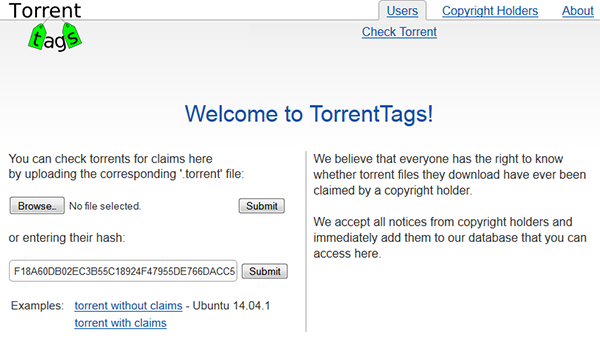
TorrentTags obtains its data in two ways. Firstly, it uses the Chilling Effects database to import the details of torrents that have already been subjected to a DMCA notice on feeder sites including Google search, Twitter and Facebook.
Second, and more controversially, the site is calling on rightsholders to submit details and hashes of content they do not want freely shared on BitTorrent. These can then be added to the TorrentTags database so that when people search for content, warnings are clearly displayed.
“Rightsholders can inform torrent users about copyrighted torrents by sending claims to our database. This is likely to lead to a decrease in the number of downloads of those torrents,” the team informs TF.
However, the team also views the problem from another angle. Concerned by companies such as Dallas Buyers Club LLC using downloaders as a cash-settlement revenue stream, TorrentTags would like to see public declarations placed on their site to warn potential targets in advance.
“Without a public claim [by copyright holders] the monitoring of users’ activity with the goal of suing would be equivalent to ‘honeypot’ strategies. This is because, from a user’s perspective, any torrent without a public claim is indistinguishable from a torrent created by a copyright owner with the aim of operating a ‘honeypot’,” the team explain.
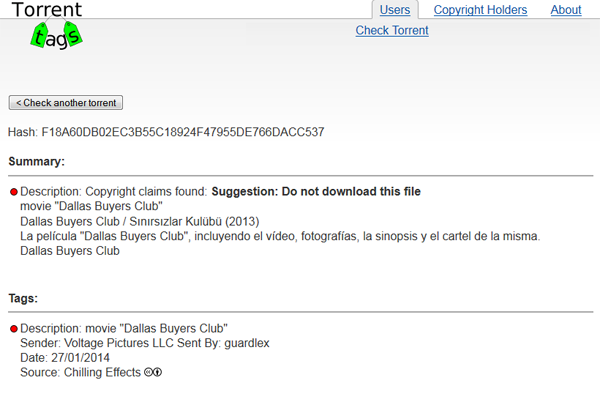
And herein lies a problem. While it seems unlikely that companies like DBC are operating their own ‘honeypots’, copyright trolls do rely on users sharing their content on BitTorrent in order to track and eventually demand settlement from them. It is therefore unlikely that the most ‘dangerous’ torrents would be voluntarily submitted to TorrentTags by those monitoring them.
It’s certainly possible for information to be added to the database once a lawsuit is made public, but by this time many downloaders will have already been caught. Of course, it may serve as assistance for the future, but it’s also worth noting that Dallas Buyers Club have been suing people publicly for years and still people continue to download the movie.
On the other hand, for companies that simply don’t want their content shared in public, submitting data to a site like TorrentTags might be a way to deter at least some people from downloading their content without permission. Whether they could be encouraged to do so in large volumes remains to be seen – a strong level of participation from a broad range of rightsholders will be required in order to maximize the value of the resource.
While certainly an interesting concept, the TorrentTags team have significant hurdles to overcome to ensure that users of the site aren’t inadvertently misled. Although the importation of millions of notices from Chilling Effects is a good start, the existence of a DMCA notice doesn’t necessarily mean that a torrent is being monitored by trolls. Equally, just because a torrent isn’t listed as ‘dangerous’ it shouldn’t automatically be presumed that it’s safe to download.
In some ways TorrentTags faces some of the same challenges presented to blocklist providers. Although some users swear by them, IP blockers are well-known for not only overblocking, but also letting through a significant number of IP addresses that they should’ve blocked. Time will tell how the balance will be achieved.
Nevertheless, if TorrentTags indeed develops in the manner envisioned by its creators, it could turn into a fascinating resource, not only for BitTorrent users but also those researching anti-piracy methods.
“We hope that TorrentTags will be able to serve as a comprehensive and easily accessible claim database for users. We also hope that TorrentTags will help dissolve the social stigma unjustly associated with Torrents and allow them to be widely used by society for file sharing purposes,” the team conclude.
Source: TorrentFreak, for the latest info on copyright, file-sharing, torrent sites and the best VPN services.
This article has been published at RLSLOG.net - visit our site for full content.

Description: Social Justice Warriors expresses frustration with how people use divisive labels – like “SJW” and “troll” – to discredit and silence each other. No matter what social values you have, attacking and ridiculing other people not only fails to achieve progress but has an additional effect of escalating the conflict while exhausting your patience and eroding your reputation.

Features:

Genre: Casual, Indie, RPG, Simulation
Developer: Nonadecimal Creative
Publisher: Nonadecimal Creative
Release Name: Social.Justice.Warriors.v3.0-TE
Size: 19,57 MB
Links: STEAM | NFO | NTi
Download: UPLOADED – RAPIDGATOR
more at RLSLOG.net






3D printing might be quicker with less of a mess but for those who like to work with their hands, this is an interesting tool. It’s not solely for gun stocks. With the different attachments you can replicate anything in wood; from guitar bodies to airplane propellers to human skulls. (GRH)
The Philadelphia Phillies took on the St. Louis Cardinals Friday night at Citizens Bank Park, but another type of animal also decided to pay a visit and ended up causing quite a scene.
During the second inning, a squirrel crawled up the netting behind home plate and performed a high wire act that captivated both the fans and announcers.
The camera focused on the animal as it scurried across a cable and eventually took a dive straight into the Phillies’ dugout.
Watch in the video above as it plops down on Phillies second baseman Chase Utley before running away unharmed.
“Well it’s definitely not a flying squirrel,” said one of the announcers.
The Phillies later joked on Twitter that the Cardinals were responsible for the squirrel attack.
Hey @Cardinals,
Keep the squirrel at home next time.
Thanks,
@Phillies pic.twitter.com/ZmXNaDAivu
— Phillies (@Phillies) June 20, 2015
And apparently it’s not the first time a “rally squirrel” has interrupted a Phillies-Cardinals game either. One scurried across home plate back in 2011, according to MLB.com.
This has been quite an exciting week for baseball fans, at least in terms of entertaining distractions.
On Wednesday, a man at a Washington Nationals game became an Internet star when he couldn’t figure out how to put on his rain poncho.
Now it’s this furry little guy’s time to shine.
Here’s another shot from a different angle of the squirrel’s big dive.
The post Animal of the Day: Squirrel Dives Into Dugout at Phillies Game, Steals the Show appeared first on The Daily What.



 |
submitted by itisjabob [link] [458 comments] |
 Blade Runner | Image: Warner Bros.
Often it appears as if mainstream Hollywood filmmakers are out of fresh ideas. Between all of the reboots, comics brought to life, sequels and other new presentations of largely unoriginal content, one has cause to wonder. While the subject has been prior cause for debate, there are always new takes on the not-so-new premise pool in film. Care to opine? Before you do, take a look at this list of 139 movie sequels currently in the works and see if it feeds your thought process. 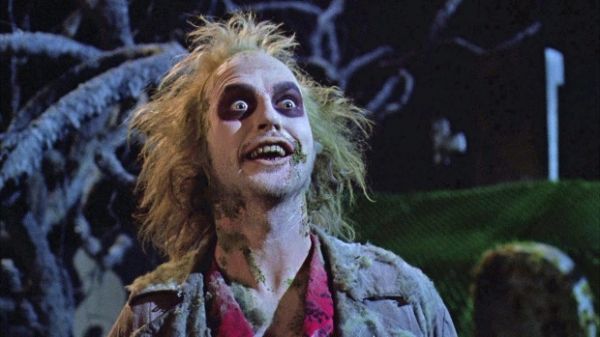 Beetlejuice | Image: Geffen Films







![[link]](http://i.imgur.com/aoaYSB8.jpg)

![[link]](http://i.imgur.com/P6oVeHG.gif)