Shared posts

19 Jun 23:03

Tagger Arrested for Tagging Courtroom While Awaiting Prosecution for Tagging

by Kevin

Is it worth doing jail time to become a legendary tagger at the ripe old age of 18? Francisco Canseco is probably about to find out.

"Tagging" is sometimes used to mean "graffiti" in general, but more specifically refers to a form of graffiti in which the person identifies himself or herself by writing a personal "tag." While a tagger doesn't use a real name, obviously the tag is associated with an individual and so once the association becomes known to authorities, continued use of the tag may be risky.

I suppose if you tag the inside of a courtroom while waiting for a hearing on 31 counts of vandalism based on your prior use of that same tag, you probably don't care much about that risk.

According to the San Diego Union-Tribune, Canseco was at a downtown courthouse on April 24 awaiting just such a hearing when he used a paint pen to tag benches in the hallway and on the backs of chairs in the courtroom itself. A detective was quoted as saying that Canseco "wrote it while he was waiting," and if true then he somehow got through the hearing itself without anyone noticing, or at least without anyone recognizing the tag. The report says that the "fresh graffiti" was only noticed the next day.

Turns out there is a web service called Graffiti Tracker that, according to its website, "provides clients with GPS-enabled digital cameras to use to photograph incidents of graffiti," which are then uploaded and reviewed by "trained analysts." Presumably court records are used to associate tags with particular taggers or groups, though it's not clear from the website. The service says it's primarily used by law enforcement and public-works agencies, and claims to have analyzed over 4 million photos, helped in the arrest of 3,733 people, and helped collect over $8.2 million in restitution (about $2215 per arrestee).

Graffiti_tag_sticker_bozidar_by_chabo93-d4oy4pu
Well, not if it's just a name tag
(Picture by ChAbO93)

I suppose Graffiti Tracker evidence would be admissible, depending on the reliability of the process and assuming there were valid expert testimony supporting that. It was apparently considered good enough to provide probable cause for a warrant to search Canseco's home, where deputies allegedly found Canseco's tag tagged all over the place. They also found "graffiti paraphernalia," though the report wasn't specific. Seems like anything you can write with might qualify as "graffiti paraphernalia."

And, in fact, it is illegal in California just to possess a felt-tip marker "or any other marking substance" (among other things) "with the intent to commit vandalism or graffiti." While the breadth of that might be troubling in other circumstances, here the suspect's tag appeared inside a courtroom in which the tagging suspect is known to have been awaiting a hearing on tagging charges (a hearing to which he brought a paint pen), and said courtroom is almost certainly subject to video surveillance that actually shows the suspect doing the tagging. So this one does not especially trouble me.

While the previous 31 counts were misdemeanors, the five new ones are said to be felonies on the grounds that the damage cost more than $400 to repair. Probably the charging decision was influenced by the fact that he tagged a courtroom, but I'm just guessing.

Canseco pleaded not guilty to the new charges on Monday. Apparently he didn't tag anything else while he was there.

19 Jun 23:01

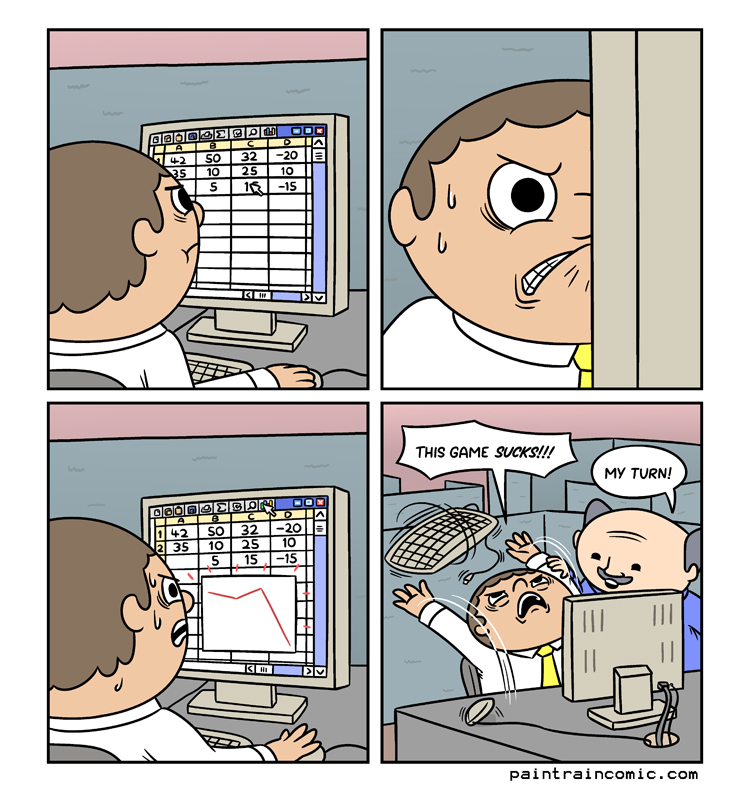
High Score

by Mark

2014-06-20-Highscore

Here’s a fun thing for you! KC Green and Anthony Clark’s new comic “Back” launched on Wednesday!! Read the first update here and let’s all share in this experience from the ground floor!

19 Jun 14:08

An apology for that time a left-winger somewhere on the internet was mean to you.

by Ampersand

sad

On another thread, “lseter” wrote:

What I find funny on certain websites is that they will go to great pains to outdo one another in showing their sensitivity. They provide detailed triggering warnings for any possible thing that anyone could be sensitive to, they only use politically correct words and they otherwise go overboard in showing they they are truly good, kind people.

Until someone says something that goes against their ideology. That person is then targeted with vile abuse and smears. Anything and everything they can try to do to hurt that person on-line.

I experienced that way back when the first news reports came out about the Duke “rape” case years ago. I didn’t go with the flow (and most rational people today agree that was correct), but I was clearly a rapist defending the right of entitled, privileged white boys to go around raping anyone they wanted. No holds barred as to the abuse.

I feel awful about your bad experience with left-wingers somewhere on the internet, both recently, and back in 2006 when the Duke false rape accusation was in the news and no one in the entire world other than you expressed any skepticism about the accusations. Thank you for taking your complaint to me here, on this blog, on a thread where your story of woe was entirely off-topic.

I have been honored to hear from many conservatives over the years about times they have been treated badly by liberals merely for asking sensible questions or bringing a bit of logic into the discussion. I tremble with shame to think that unnamed left-wingers on the internet have sometimes been rude while disagreeing about politics. If only everyone could be as kind, polite and considerate in disagreement as conservatives always are, without fail, no exceptions ever.

And now, I will start to make things right. Speaking for all left-wingers everywhere, I humbly apologize for your bad experience.

A few minutes ago, I tore holes in all my clothing to symbolize my abject regret for the rudeness you experienced. I then whipped myself bloody with a rolled-up copy of The National Review dipped in vinegar, before placing my laptop on the floor so I could crawl to it on my belly and type this post. I sincerely hope my rather over-the-top groveling has brought you enough satisfaction so that you can finally put being disagreed with in 2006 behind you, and will no longer feel the impulse to bring it up out of the blue on random liberal blogs.

If any left-winger somewhere on the internet is ever mean to you again, I hope you will once again bring a report of the incident to my blog, even if it is five or ten years from now. This is what I’m here for.

19 Jun 14:06

Out of the Cold At Last

by syrbal-labrys

About thirteen months before I was born, 52 families had a great grief to deal with right before the Thanksgiving holiday.

On Nov. 22, 1952, a C-124 Globemaster aircraft crashed while en route to Elmendorf Air Force Base, Alaska, from McChord Air Force Base, Washington. There were 11 crewmen and 41 passengers on board.

Two years ago,  a Blackhawk helicopter on a training mission over a glacier spotted wreckage.  They marked the location for future recovery efforts…and those efforts are ongoing.  But…

DoD scientists from the Armed Forces DNA Identification Laboratory (AFDIL) used forensic tools and circumstantial evidence in the identification of 17 service members. The remaining personnel have yet to be recovered and the crash site will continued to be monitored for future possible recovery.

So, seventeen families will get some closure, perhaps…more than 60 years later.  Why was the wreckage visible now?  I wonder if the global climate change revealed it, as the glacier melted?  Those lost so long ago will be returned to their families for burial with full military honors.  Military life — and death, stretches time and suffering.  These are people  most Americans forget five minutes after the news flash.  Who is left, I wonder, to cry over their names…

ArmyU.S. Army:

Lt. Col. Lawrence S. Singleton,

Pvt. James Green, Jr.

Pvt. Leonard A. Kittle


MarineU.S. Marine Corps:

Maj. Earl J. Stearns


NavyU.S. Navy:

Cmdr. Albert J. Seeboth


AirforceU.S. Air Force:

Col. Noel E. Hoblit,

Col. Eugene Smith,

Capt. Robert W. Turnbull,

1st Lt. Donald Sheda,

1st Lt. William L. Turner,

Tech. Sgt. Engolf W. Hagen,

Staff Sgt. James H. Ray,

Airman 1st Class Marion E. Hooton,

Airman 2nd Class Carroll R. Dyer,

Airman 2nd Class Thomas S. Lyons,

Airman 2nd Class Thomas C. Thigpen,

Airman 3rd Class Howard E. Martin


Tagged: death, global climate change, military life
19 Jun 11:42

The animation makes this so awesome and adorable. <3


The animation makes this so awesome and adorable.

19 Jun 11:35

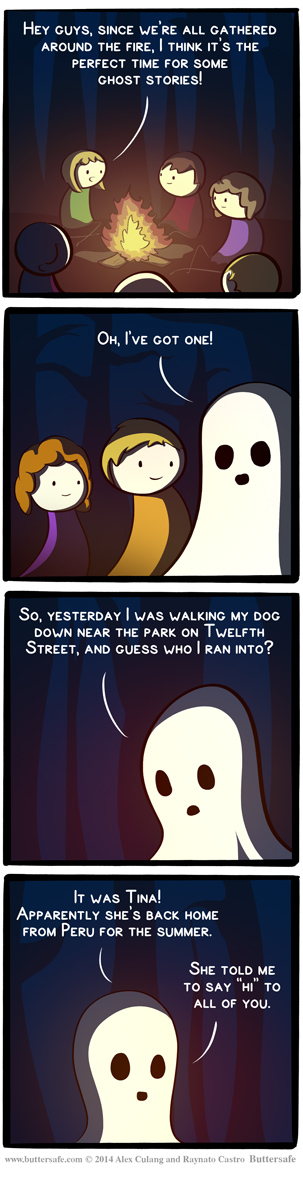
Ghost Stories

Ghost Stories
19 Jun 00:07

Drug-Me-Insensible Hump Day

by syrbal-labrys

1i medI avoid going out much.  This is because I hate the color orange…such is worn in prison. I once read that as men age, they become more conservative in opinions and action; while women grow more radical.  So, this means, it is normal that shit I read every day makes me want to “smack” several people per hour into a coma?  People like these:

The ones the diagnosed a little girl helplessly laughing as having “misbehavior”?  Apparently, that is a medical condition if you are female?  When she grows up a bit, I’m sure someone will accuse her of hysteria.

The asshats at a classy restaurant tawdry fried chicken joint who told a little girl to leave because she was too ugly?  Too scarred to be seen in public and presumably ruining appetites?

Is it still “smacking” if I do it with a safe or piano like the cartoons? Because Rep. Larry Lockman needs something that usually only happens to Wiley Coyotes — he thinks if women can have legal abortions, rape should be legal, too — as a male “right” to sexual freedom. But he “regrets” his comments, so its all ok, especially if you are a Rethuglican.


And gimme a ball bat to slap those whose Hobby is apparently Lobby’ing to control women’s reproductive lives.  After all, they have wiffle-balls for brains….one assumes.

And line ‘em up at GM, because I’d like to bitch-slap the lot of them wearing a metal gauntlet; because a woman is a convicted felon for what THEY did not fix in their cars.

Those who bury scientific history in a welter of political slogging? Including what might have happened to an unknown first woman in space?  Normally, conspiracy stories don’t engage me much — but the Soviet mind set of the ’60′s was to hide all that was not successful.

And then, perhaps it is a virulent case of sour grapes; but where, oh WHERE, are all the evangelistic televised preachers shouting about punishment “by GAWD” when tornadoes eat up little white enclaves of Christians? I mean, when Katrina pounded New Orleans, they were ALL about the sin being washed away by hurricane waters….but they are curiously silent, for instance, about de-roofed Baptist Churches of non-African American congregants.  Is it wrong of me to snarkily wonder where the consistency went? (Old bitches like me still remember bad rhymes about Pepsodent Toothpaste reworked into racist political slogans.)

Damn..it is only Wednesday and I am THIS sick of the world?  The weeks are far too long, getting over the “hump” takes it all out of me.


Tagged: abortion, asshattery, contraception, corporate thuggery, disaster, feminism, global climate change, misogyny, racism, rape, rape culture, religious discrimination, religious fanaticism, rethuglicans, space
19 Jun 00:03

Prison Labor Can Do All The Work

by Erik Loomis

In yesterday’s post on prison labor and cheese making, Happy Jack left this amazing powerpoint presentation by Colorado Correctional Industries, the private prison mafia. Entitled, “Motivating Prisoners to Become Business Partners,” you can see all the great work you can get prison labor to do for 60 cents a day. You can have them make furniture for the governor’s office (really John Hickenlooper? Really?). You can have them make bear proof trash cans. You can

And there are outstanding benefits for the prisoners. They get job training for work that is now done by prisoners, so that’s pretty helpful when they get out. The pool for bonuses in the Panel Shop is .007314% of the monthly revenue. That seven-thousandth of a percent is pretty generous.

In all seriousness, when I read this, I think of how so many of these industries were once union jobs. Or if they weren’t union, they probably at least paid OK. Now they are undercut by prison labor. I see some of the historically most exploitative industries like apparel and agriculture taking full advantage of this situation. I almost laugh at CCI marketing prisoners to farmers as a replacement for all too rare migrant laborers from Latin America. I think of the cost argument made by CCI to the taxpayers, when of course the real cost argument is not leading the developed world in imprisoning people, mostly for nonviolent crime. I think of the future of a nation increasingly committed to labor at near-slave conditions.

And of course there’s the fire fighting. If the workers die, it’s even less money the taxpayers to fork over. But if they live, CCI gets more profit. It’s such a dilemma! As for training wild horses, that just seems bloody dangerous for anyone. So why not make prisoners do it?

There is nothing about a document like this that should surprise you except that it’s readily available on the internet. This sort of exploitation is at the core of the 21st century economy and it contributes to lack of good, dignified labor in the United States.


19 Jun 00:01

If Your Dealership Initials are R and L, and You Sell Cars on South Tacoma Way…

by syrbal-labrys

KissIt…you suck hairy bull balls for quarters.  And you may kiss my ass!  If I am bringing in a vehicle for servicing that will last ALL day and I was told I would be given a loan car and when I call the morning of the service and am told “NO, no loaner,”??

Well, yes, you may expect me to enter wrathfully and verbally savage the first human being employed there who falls into my pathway.  You may expect me to do so at a volume range sure to be heard by customers thinking of buying your cars; but not actually shouting.  You may expect to have the car key dropped in your hand as I curtly walk out promising my next vehicular purchase will be ANYWHERE else.

We had not purchased a vehicle or taken one there for service since they pissed me off with similar nonsense back in about 1991.  I made sure to point out that since nothing apparently had changed in their service department ‘bait and switch’ tactics, they would not be seeing me again.

And yes, I am having fantasies out of “A Fish Called Wanda” wherein the comic relief “Otto” is hanging a man out a window upside down saying “Apologize!”  Only this time, it is a woman in the service department.  Oh, dear, I hope she wore slacks today.
Edit: Contrition is a pretty thing.  First they promised to deliver our car home tonight.  But then, alas, they discovered the work will not be done tonight — so no car tomorrow either.  When the Minotaur has TWO early appointments AND work.  So, they will now be delivering a loaner car to our home TONIGHT, and picking up their loaner when they deliver OUR car tomorrow.

I must make a better “bad cop” than a good one.  I always said that being nice never got me anything I wanted….


Tagged: asshattery, corporate thuggery, she-loses-her-temper
18 Jun 23:49

Jargon Users Need to Circle Back and Get All Their Ducks in a Row

by Kevin

Boing Boing linked the other day to use sparingly, a tumblr that is sort of like a "Devil's Dictionary" of modern business jargon. For example:

Circle back

There's also mockery of terms like "pain points," "mindshare," "ecosystem" (when not used to mean a real ecosystem), "brand agnostic," and "move the needle," among others.

I can vouch for the fact that some of this business-speak is infiltrating the legal world, unfortunately. "Circle back," apparently meaning "to meet/communicate again later," is definitely in use. And what's the difference, if any, between "circle back" and "touch base" (also on the list)? "Circle back" sounds a little like I'm supposed to try to make sure I'm not followed. "Out of pocket," "drill down," "circle the wagons," and "get our ducks in a row" are also creeping in. Maybe most horrible of all is the term "deliverable," which apparently means "what the client will get after we finish the project." Well, hopefully you know when you're doing the project what the end result is supposed to be. Is it a problem to use the actual word for it?

Also, I don't think clients want projects to end with something that's "deliverable." I think they want you to actually deliver it.

Not to suggest the jargon only flows one way. For example, "utilize" is on the list (correctly defined as "a three-syllable version of 'use'"), and I'd call that classic legalese. My sense, though, is that it's probably easier for business-speak to get into the law than for legalese to go the other way. Legal language tends to be more archaic, probably because lawyers think in terms of precedent so they tend to preserve old Latin terms and outdated forms like "hereinafter." Business-speak, on the other hand, can be more forward-looking, which is why you get terms like "mindshare." Lawyers also have an interest in giving the impression they have come up with something new and super-great, so we might pick up stuff like that. But legalese wouldn't seem to help businesspeople much.

Don't get me wrong, one is not better than the other. That'd be like arguing about which invasive species is worse, kudzu or the sea lamprey. Both are disgusting, they just thrive in different environments.

Okay, this sort of language is irritating, but does it really matter? Hell yes it matters. It matters because for the most part it doesn't mean anything, and so it doesn't communicate anything. Worse, it often prevents communication.

Not necessarily endorsing the conclusion of the report itself (which I haven't read yet), but news reports about the General Motors ignition-switch investigation, like this one in the Washington Post, have said that "corporate speak" may have played a role:

[A]s the Valukas report shows, these idioms and corporate cliches are more than just buzzwords that threaten our linguistic sanity. At GM they stood to mask real meaning, obscured leaders' responsibilities, and created labels that hindered the critical thinking needed to keep real problems from getting worse. 

Instead of putting someone "in charge" of finding the "cause" of the problem, apparently, they asked the executive to "champion" the investigation into the "non-deployment." Turns out the "champion" didn't actually understand what "champion" meant, or what the person who asked him—a lawyer, by the way—meant by it. So he claimed, at least, that he would have acted differently if he understood the urgency of the issue and that his team was expected to find the actual cause.

I don't, by the way, agree with the reports (like this one) that blame PowerPoint for communication problems like this. Slides don't make themselves. If you put jargon on one, or cram it full of text (which is not what it's for), that's your fault, in my view.

The foregoing conclusions were not influenced by the fact that my firm doesn't represent GM but does represent Microsoft. I'm brand agnostic on this. If that's what that means.


18 Jun 23:46

http://ami-angelwings.tumblr.com/post/89135358524/brigidkeely-mallelis-that-moment-when-you

http://ami-angelwings.tumblr.com/post/89135358524/brigidkeely-mallelis-that-moment-when-you:

julian-level23incantatrix:

ami-angelwings:

brigidkeely:

mallelis:

that moment when you leave a dinner party and your perception of events shifts from “that seemed fun and normal” to “Christ, I was an asshole

Also known as “every single time I interact with other people.”

This is pretty much me. :( Once I leave or end a…

I think if friends or anyone really were sick of listening to you you wouldn’t have enjoyed the conversation so much. Their discomfort would have been pretty clear especially if the convo went on for a while. There’s a magnetism to people when they’re passionate or really enjoying themselves that’s infectious.

I’m always scared that I’m not noticing it, and I’m enjoying the convo because I’m a selfish jerk of a person who takes and takes from others and gives nothing back. :\  And it builds resentment in them.

18 Jun 23:46

gunpowder-tea: quietly-creeping: pandorasprings: a whole...


gunpowder-tea:

quietly-creeping:

pandorasprings:

a whole study asking the important questions

(transcription of the abstract)

Despite the popular belief that feminists dislike men, few studies have actually examined the empirical accuracy of this stereotype. The present study examined self-identified feminists’ and nonfeminists’ attitudes toward men. An ethnically diverse sample (N = 488) of college students responded to statements from the Ambivalence toward Men Inventory (AMI; Glick & Fiske, 1999). Contrary to popular beliefs, feminists reported lower levels of hostility toward men than did nonfeminists. The persistence of the myth of the man-hating feminist is explored.

*places hands on chin* Hmm, would you look at that.

i find it really sad that there has to be an empirical study “proving” that feminists do not, in fact, hate men

wonder how long it’ll like for mras and anti-feminists to start nitpicking at methodology or rant about how social sciences are a joke anyway

Why would this surprise people?

I mean, I get why people THINK it, but it’s not really thinking through what’s going on very clearly.  Like, they assume that feminists invented all the stuff men do to women or something, and non-feminists either don’t notice it, or like it, or it doesn’t happen to them.  But it still does, and I don’t think they like it any more than we do.  But if you don’t deconstruct it, it ends up festering as this resentment that men are giant jerks to you but you don’t know why and you can’t do anything about it and you can’t say anything about it.  It’s not like street harassment or assault or threats of rape only happen to feminists.  It’s not like sexist jokes or judgement of bodies only happen to feminists.  But I think talking about it and analyzing it helps a lot in seeing it as being a societal problem and a problem with how men are taught and raised and how society privileges them, rather than just feeling like your feelings are invalid and have no place and just building up this frustration at men.  Also, that you realize you can have spaces without this, that this is not the default way people HAVE to function, and you can have safe spaces, and spaces with men who are aware of their male privilege, and make friends with those men, rather than the “that’s just the way men are and we have to live with it *sigh*” attitude that a lot of the rest of society teaches us.

18 Jun 23:45

rakatakat: alright but FFX as a spunky teen comedy (ILL DO THE...


rakatakat:

alright but FFX as a spunky teen comedy

(ILL DO THE REST OF THE GANG LATER)

A spunky teen comedy where they’re dating right? :D

18 Jun 23:45

Is anybody else ever like “I’m so lonely, I want company so badly” and also...

Is anybody else ever like “I’m so lonely, I want company so badly” and also “leave me alone!” at the same time? >_>

18 Jun 23:45

sylvanburningcenter: reaill: yeffyaboyuice: manwaifu: >:I the frog nuggets are back...

sylvanburningcenter:

reaill:

yeffyaboyuice:

manwaifu:

image

image

>:I

image

the frog nuggets are back omfg

"I’m supposed to be camouflaged!  Stop poking me!"

18 Jun 12:31

Stuffed With Rubbish

by Maggie McNeill

An empty head is not really empty; it is stuffed with rubbish.  Hence the difficulty of forcing anything into an empty head.  -  Eric Hoffer

shouting at a brick wallI often get questions from readers asking if I’d like to school some ignoramus who has written a prohibitionist screed packed with disinformation, either in the news media or on a blog.  When I first started activism four years ago, I nearly always said “yes”; it was a chance to be heard by people who didn’t yet know me, and to draw more attention to this blog.  But as I explained in “Something Has To Give”, I just don’t have time for that kind of unpaid work any longer; from my point of view I can spend my afternoon writing a blog post that will be read by many thousands, or a commissioned article that may be read by tens of thousands, or a futile attempt to convert a true believer that will be read by dozens (hundreds at best) of other true believers.  And I’m much too pragmatic a woman to choose the latter when the first two options are so much more sensible.  Lest you think this is a recent decision on my part, allow me to quote a two-year-old column:

For any given issue there are three positions:  Those who are strongly for it, those who are strongly against it, and those who don’t have a strong opinion either way.  And no matter what fanatics and demagogues may tell you, the third is nearly always the largest group on any issue.  When trying to sway public opinion, therefore, the wise writer or speaker targets that middle group, the “silent majority”.  It’s silly to waste energy in trying to convince those who are already convinced (“preaching to the choir”), and pointless to argue with those who are dogmatically committed to the opposite view (one can’t reason a person out of a position he didn’t reason himself into).  But the members of that third group, if they can be won, will decide the way the wheel turns.  They are the ones who took it for granted that black and white people couldn’t live together peacefully, but now abhor racism; they’re the ones who accepted the claim that homosexuals were perverts, yet now agree with equal conviction that they shouldn’t be mistreated.  And they’re the ones that in the United States believe that whores are pathetic losers, degraded victims or depraved criminals, but in most other Western nations disagree with that notion.  They’re the ones the “trafficking” fetishists have drawn into their moral panic, and the ones who will drop that panic like yesterday’s fad once the majority recognize it as a lie.

The problem with debating true believers is succinctly explained in today’s epigram; Jefferson covered the same ground with, “Ignorance is preferable to error; and he is less remote from the truth who believes nothing, than he who believes what is wrong.”  Consider creationists, for example; they live in a society where the soundness of the scientific method is evident every single waking moment of the day, and where there is a mass of biological and geological information at their fingertips.  Debunkings of every single creationist talking point are a mouse-click away, and creationists are exposed in passing to evidence supporting the great age of the Earth at least a couple of times per week.  But does any of it have any effect?  Not on your life, because it’s impossible to force something into a space that’s already occupied by something else.  The mind of a true believer is not empty; it is so stuffed with the reality-denying rubbish of his belief system that there is no room for facts, at least in those areas occupied by his beliefs.

Anti-sex beliefs are not mere ignorance; they are religious beliefs like any other, accepted on faith and requiring the denial of all information to the contrary.  There is never any profit in attempting to engage such a person on her own ground; it’s merely a waste of time and energy that could be better employed elsewhere, such as in speaking to people whose minds are not already closed.  That’s what I do in my writing, both on-blog and off; it’s also what I did a few weeks ago in guest-teaching two sections of a human sexuality class at Oklahoma State University.  It’s possible that some people who come to my blog, many who encounter my articles on mainstream sites and a few of the students I spoke to in person remain unconvincedofficial residence of Charles Mader or even shut their minds to my information, but the majority don’t.  Even debating a prohibitionist in a public venue can be productive, as long as one is reasonably certain that a sizeable fraction of the audience are receptive to fact and reason.  But when one argues with a “true believer”, either alone or surrounded by other “true believers”, one might as well be arguing with a dumpster.

(Have a question of your own?  Please consult this page to see if I’ve answered it in a previous column, and if not just click here to ask me via email.)


18 Jun 09:28

Back to the Beginning: Why I Write

by Micah Perks

“All writers are vain, selfish, and lazy…” George Orwell

In the beginning the words flowed like honey, like maple syrup, like corn syrup; yes, the metaphors flowed just like that. Flowed so easily down the page I barely had time to sprinkle a few periods about. It flowed like the Madonna song that I used to listen to on my Sony Walkman while I ran: “Come on girls, express yourself, hey, hey, hey, hey” (not exactly like that, but close, who cares!).  I was up and coming, a prodigy, a genius probably. The words flowed from me to page to awestruck reader.

Yes, people were amazed. First my mother, who stapled my poems into a pink and orange construction paper book, then my middle school teacher who gave me a prize for my essay and read it aloud to the whole school, then high school teachers, college teachers, professors in grad school, literary magazine editors, all urging me on, giving me the green light—get out there and express yourself girl, hey, hey, hey.

Okay, true, there was that one professor, an elderly gentleman with lovely thick white hair, who tried to rain a little on my parade: after I graced the workshop he was leading with one of my stories, a worried look crinkled onto his kindly face. “Maybe we read this story for the language,” he said, “since I have no idea what it’s about.”

Pshaw. It was beautiful wasn’t it? Who cares what it means? And so it flowed until I finished grad school and tried to publish my first book.

*

“Ambition and a little luck are good things for a writer to have going for him. Too much ambition and bad luck, or no luck at all, can be killing.”  Raymond Carver

I was saving this expensive bottle of champagne to open when my first book was taken by a publisher. This was right after I finished grad school and I was still in my mid-twenties. I had a fancy agent, and every time she called my boyfriend and I went out to dinner to celebrate at a restaurant we couldn’t afford. Then something untoward happened. The agent failed to find a publisher for the book.

But I kept my sunny side up. I knew it would all work out. I started sending the book out myself to contests, then to small presses, then to smaller presses. Over a year went by. One morning I received a letter from some tiny press in somewhere like Never, Never North Dakota with a name something like Not Going To Happen Press. backToTheBeginning_2The rejection was typed on thick grey paper: Dear Micah Perks, we only publish two books a year and though we admired your novel, we have decided to publish two others this year instead. We are sure you will soon find a publisher for this lovely, lyrical work. Then, a handwritten P.S.: If you ever learn how to tell a story you’ll be a great writer.

This was probably my thirtieth rejection. This was western New York in February, and I was in my baggy pajamas and a wool hat inside my apartment at one in the afternoon. I tore up the letter, threw it on the floor. I grabbed up the dusty bottle of champagne, ran out the back door—slipping and skidding on icy back steps in my bare feet into the small backyard covered in snow and dog shit, bare branches of the quince bush still months from budding. I let out a furious sob and threw that champagne bottle as hard as I could.

It bounced off the snow.

Didn’t break.

I heard a noise. I looked to my side. The two neighbor kids, skinny boys in hats with pom poms and puffy down jackets, were staring at me from their yard. I waved. They did not wave back.

I tiptoed my way through the dirty, crusty snow, picked up the champagne bottle, and went back inside.

Pretty soon I started to write another book to try to teach myself how to write a story.

But this isn’t a story about whether I learned to write a story. Maybe I did and maybe I didn’t. What is a story, anyway? This is a story about why I keep trying to write stories. I started out with surge of ambition and luck, and after that my luck came in fits and starts, like a faulty circuit, a light humming and buzzing, blinking on and off.  Sometimes I find myself writing in the dark. Raymond Carver said this could be killing to a writer, so why do I keep writing?

*

“My wars are laid away in books.”  Emily Dickinson

In the beginning, before there was writing, there was reading. I grew up on a commune and went to a school with thirteen kids. We all loved story hour. During story hour, chapter by chapter, day by day, our two teachers Carol and Sandy read aloud all the Little House on the Prairie books to us. Then they started the Narnia books. backToTheBeginning_1When we got to The Last Battle, the last Narnia book of all, and the hour was over, we begged them to keep reading. While we sprawled about on the rug and the couches, the teachers did keep reading, taking turns; against all social conventions and rules of behavior, they read and read for the entire day, maybe six hours. Carol croaked out the last sentence: “All their life in Narnia had only been the cover and the title page: now at last they were beginning Chapter One of the Great Story which no one on earth has read: which goes on forever: in which every chapter is better than the one before.”

We just lay there, stunned. Because I’m pretty sure Carol and Sandy changed our neurons that day, created new pathways, chemically addicted us to reading. We rose up with new brains hardwired to believe a doorway to another world was possible.

And then pretty soon after that a door opened to a new world and I fell through. The commune collapsed and everyone scattered, including my father. My mother, my sister, and I moved to another state where I went to public school for the first time. The teacher in my fifth grade classroom put our names up on the wall. He told us to write down the books we read on 3 x 5 cards and put them up next to our names. I hardly spoke that entire year, but by the end of it my list of books wrapped around and around the room, cocooning me in words.

At first I hid away in books, let them speak for me, but then I began to see that books helped me make meaning. Writing became a way to join that great conversation.

How should we live?

What is possible?

Whose story gets told? Whose is left out?

Stories are containers that catch the ineffable before it drifts away. Smoke in a jar. Champagne in a bottle.

*

“All writers are vain, selfish, and lazy…And yet it is also true that one can write nothing readable unless one constantly struggles to efface one’s own personality. Good prose is like a windowpane.”  George Orwell

Since I tried and failed to break that champagne bottle it’s been almost twenty years, and I’m still writing. It still flows sometimes. I still want to be part of the conversation. I still find meaning in the word.

But why do I write?

Maybe because it brings me hope. It’s a transaction. I put in hope and the writing gives it back to me. Isak Dinesen wrote, “I write a little each day, without hope and without despair.” backToTheBeginning_3I myself write a little some days accompanied by an anxious slide whistle—sliding tinnily down to despair, then shrilly up up, up to hope, then back down again. It can be grating on the nerves. That’s why I love Isak Dinesen’s quote; it fills me with such longing, and with such hope and such despair.

But so far, the hope always wins out. Hope that it will be easy this time, hope I’ll write something great, hope I’ll be part of the conversation, hope I’ll find meaning in the word. Hope that through the windowpane I’ll glimpse George Orwell, I’ll see you and you’ll see me.

Here’s a good example of why I write: when I started writing this piece about why I write, I didn’t realize the role that hope played in my writing. Now I do. Something small but miraculous happened. A little bit of meaning born.

In the beginning was the word. And the word gave us hope that there would be another word, and maybe that word would be amazing.

***

Rumpus original art by Jim Gill.

Related Posts:

18 Jun 06:37

jei-shepard: WE ARE (NOT) SOLDIERS This is so perfect.


jei-shepard:

WE ARE (NOT) SOLDIERS

This is so perfect.

17 Jun 13:15

#309714

<bizzy> i just made an ec2 ami of android gingerbread
<bizzy> now i can run my telephone in the cloud
<bizzy> its a new world of mobile data and adaptive architecture as code
<danh> i think you're joking but im not sure
<bizzy> my saas-model android will disrupt the existing mobile space
<bizzy> simply access your telephone over any standard web browser (including mobile)
<bizzy> now you can make calls even on the go right from your smartphone
15 Jun 01:37

Hunting for the Little Prince

by Sigal Samuel

For as long as I can remember, I’ve been obsessed with a most extraordinary little boy. A boy who laughs, has golden hair, and refuses to answer questions. You know who I mean.

My obsession has made me into a thief, a collector, and a bit of a stalker. In third grade, I stole a copy of The Little Prince from my school library; the slip on its back cover reads “Date Due: Aug ’96.” After high school, I started seeking out editions in various languages—Hebrew, Spanish, Arabic—plus biographies of the author, Antoine de Saint-Exupéry, and plays and novels about his life. By the time I reached grad school, I was staying up late into the night, hunched over my laptop, researching, trying to track down the answer to a question that had gripped my imagination and refused to let me go: The real-life boy who inspired the character of the little prince—who was he, and where could I find him?

Internet research yielded three different possibilities. The first was a Parisian politician named Pierre Sudreau. As a 12-year-old boy, Sudreau had coped with the misery of boarding school by escaping into Saint-Ex’s books, and he wrote to the author to tell him that. The two struck up a correspondence that moved them both deeply. The articles I skimmed cited Sudreau’s boyhood friendship with the writer as proof that the prince was based on him. I looked closer. Not articles. Obituaries. Sudreau had died just a few months earlier. My heart sank.

Luckily, I found a second candidate in Land Morrow Lindbergh, son of famous New York aviator Charles Lindbergh. Saint-Ex had visited the Lindbergh home in 1939, with the goal of convincing his fellow pilot—who might, in turn, convince the Americans—to enter the war against Nazi Germany. Instead the author found himself captivated by Charles’s golden-haired boy; soon after, he wrote The Little Prince. Yet Land, today a 76-year-old Montana rancher, couldn’t be reached, no matter how many phone numbers I tried.

The third candidate was Thomas De Koninck. Google told me he was a philosophy professor in Québec. As a philosophy major who hails from Québec, I felt a shiver of excitement. I learned that Saint-Ex had stayed at the De Koninck house in 1942, where he met Thomas, then a precocious eight-year-old with curly blonde hair. I leaned over my keyboard, clicking and scrolling, until I found his name on Laval University’s faculty webpage. That site confirmed not only that he was still alive, but that he could easily be reached at the email address provided. I dashed off an email to him, requesting an interview, and fell asleep.

LP1

My obsession with The Little Prince started when my dad pressed his French-language edition into my nine-year-old hands. Opening the paperback, I saw that he had penciled in footnotes at the bottom of each page, noting the meaning of words he’d had to look up in his dictionary. One jumped out at me: apprivoiser, to tame. He had used this book to teach himself French, I realized. And, growing up in Montreal, I began to do the same.

So it seemed only natural that, as I moved from city to city to city, I would use this same book to learn the language of whatever new place I found myself in. When I landed in Jerusalem, my first move was not to pick up one of the free tourist maps on offer, but to buy a Hebrew-language copy of The Little Prince from the airport bookstore.

The book also oriented me in other ways: I used it to suss out people in my new surroundings. In Vancouver, on the graph paper of a schoolmate’s notebook, I drew what looked like an old-fashioned hat. When he thanked me for my picture of a boa constrictor digesting an elephant, I smiled at him, knowing we’d get along.

Later, when I started dating a girl who had never read The Little Prince, I gave her the book as a gift. “To you, I am nothing more than a fox like a hundred thousand other foxes,” I read to her in her apartment. “But if you tame me, then we shall need each other. To me, you will be unique in all the world. Please—tame me!” She took the hint and kissed me.

LP2

The more I researched, the more I realized that I was not the only one who felt a special sense of ownership over The Little Prince: Not just individual readers but entire cities had tried to make the book their own. Pierre Sudreau, Thomas De Koninck, and Land Morrow Lindbergh had all been co-opted by their respective hometowns, each of which claimed the book as part of its regional mythology.

The Parisian papers, in their obituaries for Sudreau, seemed less interested in eulogizing the dead man than in emphasizing his boyhood correspondence with Saint-Ex—a fellow Frenchman—and in situating The Little Prince as a distinctly French creation. They took it for granted that the prince was based on Sudreau, glossing over the fact that the book was written years later in New York and that it was published there two years before it ever saw the light of day in France.

As for Québec, in 1999 the local government had an official plaque mounted on De Koninck’s house. Under the words “the people of Québec remember,” it said: “Here sojourned—in 1942, with the De Koninck family—Antoine de Saint-Exupéry, author of The Little Prince.” Featuring the province’s iconic fleur-de-lys, the plaque’s implicit message was clear: It was the De Koninck boy who had inspired the prince; the book was basically Québecois. That message was backed up by a local legend: Apparently Saint-Ex had told De Koninck’s father—in a letter that was, sadly, lost—that he completed his portrait of the prince while drawing inspiration from Thomas.

And then, of course, there was New York City. The place I now call home was equally convinced that Saint-Ex and his prince were native New Yorkers. In a 1989 New York Times article, a guide offering a walking tour of Saint-Ex’s favorite haunts suggested that the author saw “the prototype of the Little Prince in the Lindberghs’ young, golden-haired son Land” before asserting, “He’s a New York author, crazy as it sounds.”

This spring, Manhattan’s Morgan Library & Museum took pains to back up this claim in an exhibit called “The Little Prince: A New York Story.” Its stated goal was to focus on “the story’s American origins.” It noted that Saint-Ex cited New York, Manhattan, or Long Island six times in his draft of The Little Prince. And that he mentioned New York landmarks like Rockefeller Center. And that his New York editor’s wife was the one who recommended he write a children’s book. And that the Dictaphone he used to revise the book was bought for $683 in, you guessed it, New York.

LP3

When it finally came time for my phone interview with Thomas De Koninck, I was almost painfully excited. The philosopher, speaking in a mix of English and French, began by telling me about Saint-Ex’s stay with his family in 1942.

“I recall his visit quite well,” De Koninck said, “because he was l’Aviateur, the Pilot—he was a hero for us. He made us paper planes, showed us drawings. We had other guests, but he was much closer to us, the children, than to the other people. He seemed bored with the adults.”

I smiled. That sounded like Saint-Ex, all right. Then the philosopher said something that made my heart skip a beat.

“I used to ask a lot of questions, as a child. He would listen and pay attention to them, and try to answer as best he could.”

I thought, then, of a certain little boy who was always asking questions but refusing to answer them. I asked De Koninck straight out: “What do you think of the local legend that you were Saint-Ex’s inspiration for the prince?”

“Well, he may have been stimulated by me,” he mused. “I did ask those questions, and there’s a coincidence in time there. I mean, it was the year before the book came out in New York.”

Now I was really excited. “And the letter that Saint-Ex wrote to your father, confirming that he based the prince on you—do you have any memory of that?”

“I have heard this often, but I have never seen that letter myself,” he said. “I haven’t been able to verify that.”

“Oh,” I said, feeling a bit deflated.

Casually, De Koninck added, “Anyway, I have always answered that to me, le petit prince is Saint-Exupéry himself. This comes from him, from his own experience of being a human being. Now, he may have drawn inspiration from children whom he met…”

He cited a passage I hadn’t heard of—something about le Mozart assassiné. A quick Google search told me it was something Saint-Ex had written on a train. I brought it up on my screen:

I sat down [facing a sleeping] couple. Between the man and the woman a child had hollowed himself out a place and fallen asleep. He turned in his slumber, and in the dim lamplight I saw his face. What an adorable face! A golden fruit had been born of these two peasants… This is a musician’s face, I told myself. This is the child Mozart. Little princes in legends are not different from this. Protected, sheltered, cultivated, what could not this child become? When by mutation a new rose is born in a garden, all gardeners rejoice. They isolate the rose, tend it, foster it. But there is no gardener for men. This little Mozart will be shaped like the rest by the common stamping machine… This little Mozart is condemned.

I stared at the passage. It mentioned a golden little prince, a rose in need of shelter—and it was written in 1935. Seven years before Saint-Ex ever met De Koninck.

I felt gutted. All along, I’d known that the prince bore some resemblance to the young Saint-Ex—as a kid, he’d been called le Roi-Soleil (the Sun King) thanks to his golden curls. But, having embarked on my treasure hunt, obsessed with finding the prince’s real-life inspiration, I hadn’t wanted to consider that he might be just an amalgam of random kids—the sons of friends, a sleeping boy on a train—with a little bit of Saint-Ex thrown in.

I’d wanted a boa constrictor digesting an elephant. Instead, I’d found a hat.

LP4

Why was I so disappointed?

For weeks afterward, I asked myself this question—though only intermittently. It was a busy time for me: grad school was wrapping up, and I was getting ready to move to a new city again.

Then, paging through the book, past the prince’s visits to various planets, I found the part where he tells the pilot not to be sad about his impending departure. “It’s too small, where I live, for me to show you where my star is. It’s better that way. My star will be… one of the stars, for you. So you’ll like looking at all of them.” He laughs, then says, “You’ll have stars that can laugh!”

That’s when I realized how badly I’d misunderstood the little prince—and how misguided my hunt for him had been. All these years, I’d been projecting my search for the perfect home onto this fictional boy, assuming he had to have one true source—one real-life person in one real-life place that gave rise to him in the author’s mind, and to which I could trace him back. But like Saint-Ex, the prince was a wanderer, impossible to pin down. And his homelessness was exactly what had made me—like millions of readers around the world—fall in love with him. Ironically, it’s what made us want to pin him down as our mythology, our story, our home.

I closed the book. Part of me thought: I’ve failed to find him. And another part thought: I’ve found him by failing. Now, no matter where I go, the little prince will be there waiting, laughing and asking questions he refuses to answer.

Related Posts:

15 Jun 01:34

You Kids Get Off My Lawn: Old Activist Edition

by Erik Loomis

Amy Merrick wrote a piece in The New Yorker about the terrible conditions in the sweatshops that make clothing for Forever 21, a department store focusing on low cost clothing for college-aged women. She wonders why the kids aren’t protesting Forever 21, suggesting the decline in labor unions and their own economic instability as reasons. I’ll get back to this in a minute because it’s problematic, but it then led to a more unfortunate Lindy West piece entitled “Why Don’t College Students Give a Shit About Sweatshops Anymore” that does little but compare today’s students unfavorably to her own activism in college.

But somehow, in the late ’90s, the anti-sweatshop movement managed to get a real brand going. “Not wearing clothes made by slave labor” was the “normcore” of 1999.

I wasn’t even a particularly consistent or well-informed young revolutionary, but for years I had a kneejerk aversion to anything too cheap to be true. Someone was paying a price for those clothes, somewhere. So I thrifted a lot, I avoided the big-name no-nos like GAP and Old Navy and Nike and Walmart, and I justified my few mainstream purchases with a combination of selective ignorance (I don’t know for sure that a child made these $30 jeans) and shruggy pragmatism (I can’t just not wear pants).

It was literally the least I could do; given my level of privilege, it was almost nothing at all. I was lucky to be able to choose where I shopped (plus, it wasn’t like GAP made clothes in my size anyway). I didn’t have a family to support or significant consequences if I exceeded my budget.

But my point is that I’m impressed, in retrospect, by how effective the messaging was in that moment. “Pay attention to where your clothes come from” somehow got through to me and every other dumb kid I knew. And, according to labor activists in 2014, that’s no longer the case.

These articles are not helpful for a number of reasons. First, they are another edition of “Why Don’t You Kids Fight the Power in the Exact Same Way I Did in College,” a line of lecturing pioneering by ex-60s radicals at least by the 1980s and something that many of you have probably run into at some point.

This reeks of romanticizing the past actions through a carefully remembered history that excludes the second problem with these articles. In 1999, there were some college aged students that cared about sweatshop labor. The majority of college students did not care. In 2014, there are some college aged students that care about sweatshop labor. The majority of college students do not care. Now, there were probably a few more students caring in 1999, but not only are college students working today on other issues that students weren’t fifteen years ago, but there are lots of students still fighting sweatshop labor. If anything, this has increased in the past year since the Rana Plaza collapse and sweatshop conditions have again returned to the nation’s attention. Plus let’s not forget why students turned away from this as a key issue–9/11 and the Iraq War turned their attention to American imperialism. Can’t just handwave this away. Students didn’t stop caring about sweatshops. They started caring about a horrible war.

Again, the third problem here, particularly with West’s piece (at least Merrick mentions it), is that there are actually a lot of great stuff going on in the anti-sweatshop movement. United Students Against Sweatshops is a vibrant organization with activists on a lot of campuses doing great work. I talked a bit about actions at USC this spring and other campuses are involved in a wide range of activities against sweatshop labor and exploitation. Sure, there should be more students involved–but it was the same in 1999.

The fourth problem here is that some of the strategies of 1999 West talks about favorably actually aren’t helpful. Telling people to buy second-hand clothing so they don’t support sweatshops does absolutely nothing to help workers. Plus it’s not scalable. Bangladeshi sweatshop labor activist Kalpona Akter has urged developed world activists not to boycott these factories because it just hurts the workers who need jobs. Cheap and easy feel-good activism does not solve problems, nor build solidarity with those fighting for a better life for themselves.

The fifth problem, and West at least nods at this, is that why are we demanding college students go protest for us? Do it yourself! We (including myself) can all do more to fight the terrible labor conditions in the products that we consume. A woman named Liz Parker started her own protest in front of the British chain Matalan because it wouldn’t sign onto a plant to compensate the victims of the Rana Plaza collapse. Everyone can do these things. Quit blaming college kids and go start your own protest.

Sixth, and most important for those who are serious about thinking about how to create actual change as opposed to vague protests, is that the articles ignore why students focused on the creation of apparel for their own institutions and not random department stores–because they have leverage to do so. As students, college administrators have to at least pretend to listen to them and potentially respond. The students have a clear and targeted objective–getting their schools to agree to responsible sourcing. The implementation is always tricky, but the point is that it’s an achievable, clearly defined goal with an endpoint and a group of people in power who have to be at least somewhat accountable to them. It’s a strategic choice that makes sense.

If you want to go protest Forever 21, print off some flyers, stand in front of their stores, and pass them out until you get escorted off the premises. Call the media and let them know what you are going to do. Have a friend take pictures and put them on Facebook and Twitter. Don’t tell college students to do it. Do it yourself.


14 Jun 11:22

Pepperdine U Sues AddictionMyth’s Ass Off!

by AddictionMyth

Pepperdine University today filed papers to “sue the ass off” AddictionMyth for “all he’s worth” for impersonating and plagiarizing Public Policy Assistant Professor Angela Hawken.  Said Pepperdine President Andrew K. Benton, “That despicable troll committed the crimes of Impersonating a Revered University Official and then Plagiarizing Sacred Academic Texts when he copied her research wholesale and passed it off as her own.  I mean, I believe in academic freedom.  But crediting ideas to their rightful owner?  That’s just outrageous!”

Said Marc P. Goodman, Pepperdine General Counsel: “I haven’t seen such a blatant forgery since The Protocols of the Elders of Zion.  The work is an almost verbatim copy of her book.  For example:

  • AM: there is nothing mysterious about drug addiction.  It’s just a bad habit, and like mother always told you, bad habits are hard to break.
  • Page 5: Drug taking can develop into a bad habit– that is, a behavior pattern that is difficult to break…. Our mothers warned us about developing bad habits, and they were right to do so…. There’s nothing mysterious about drug addiction
  • AM: Addiction is a complicated behavioral phenomenon
  • Page 213: Addiction is a complicated behavioral phenomenon
  • AM: If alcohol didn’t make you feel quite so rotten the next day, there might be fewer alcoholics, not more.
  • P. 214: If alcohol didn’t make you feel quite so rotten the next day, there might be fewer alcoholics, not more.

And it goes on and on like that.  Plagiarism is not protected by the First Amendment even if properly cited!”

Said Jonathan Caulkins, Professor at CMU, and co-author of the book: “AddictionMyth is trying to implicate us in a vast conspiracy to medicalize and legitimize demon possession as ‘drug addiction’ and then foist government sponsored ‘treatment’ on unsuspecting young people, which according to him actually increases crime and mortality all to justify a drinking club’s mischief.  Well that is just psychotic paranoid nonsense even if we don’t have any science to prove it!  The government is good!  I’m certain of that!!”

Added Mark Kleiman, UCLA professor and resident Bloviating Ass: “I’m just an expert on speaking about things I know nothing about.  But I once took a class in abnormal psychology, and I would say it’s a clear case of ‘Borderline Personality Disorder’.  First they assume your identity and then they steal your thoughts.  Which I will admit he does impressively.  I actually thought it was her own post.  Especially when I got to the part about the donuts.  That’s just so Angela!  But I hope he does not attempt to emulate her flatulence.  For his own sake.  And as a matter of public policy.”

Addiction Guru Aaron White, PhD, NIH scientist and past victim of AddictionMyth’s ruthless satire added: “Angela, I will gladly produce any scientific result that will support your case against this monster.  He destroyed my reputation.  I cannot get a latte in this town without enduring muffled snickering all around.  Sue his ass off!  Do not give up!  I’m with you!  OK who’s ready for a cocktail!!”

Said Angela Hawken, the alleged victim of the savage impersonation, “I worked really hard on that book.  For AddictionMyth to point out its twisted logic and flawed science is just warped and ill-headed.  Does he not know that free speech is protected in this country?  Maybe he thinks he’s funny, but I didn’t laugh once.  Actually I cried.  He can’t get away with this!  He deserves to be punished!  I’m from South Africa, and in my country spouting lies in the name of social justice could earn you a 20 year prison sentence on Robbins Island.  You yanks could stand to learn a thing or two from us!”

A university lawyer, who refused to give his name for fear of being made AddictionMyth’s next bitch, added: “Based on his pattern of contact with University employees, we are also preparing charges of harassment, cyberbullying, cyberthreats, criminal threats, terrorist threats, interstate drug trafficking, unwanted contact, inciting desire of sexual contact, corrupting the morals of a bloated female, corrupting the morals of a bloated female with aggravating circumstances (menses), refusal to obey the polite request of a University Official (3 counts), mocking a University Official (7 counts), challenging the Divine Infallibility of a University Official (5 counts), insubordination, hooliganism, public indecency, intentional infliction of emotional distress, intentional infliction of emotional distress with aggravating circumstances (menopause), libel, criminal libel, slander, defamation, defamation with intent, deceitful claiming, consciousness of guilt, and aggravated douche-baggery in the first degree with extreme prejudice.  We are working closely with the nurturing leaders at the School of Public Policy to effect successful implementation and real change required to ensure conviction on all counts in the Jurisdictional Fiefdom of Malibu.  We have also petitioned funds from the bursar for a one way ticket to Robbins Island, where Angela has agreed to personally supervise an extended program of ‘swift but certain’ discipline on his sorry ass.”

Hawken added: “And he’s a liar and has treatment-resistant scabies.”

AddictionMyth could not be reached for comment.  He was later found cowering in a storage bin beneath his trailer, as his cats circled the hideout meowing plaintively, even as he pondered their true motivation.

14 Jun 09:15

Katie Surrence: Hedwig and the Angry Inch

by Scott Lemieux

We’re pleased to offer this post from longtime friend of LGM Katie Surrence. I have been impressed by her views of the legitimate thee-yater since she saw through the ludicrously overrated Spring Awakening, and she writes interestingly about many other topics as well. Give her a a nice LGM welcome and hopefully we will see her work again! –SL

Hello all!

I’d like to introduce myself: I’m a friend of Scott L.’s from past blogging-related program activities. He reads my informal Facebook accounts of the plays I see in NYC, where I live, and he invited me to write some guest posts for LGM about theater, and possibly other things that occur to me (I work in psychology/neuroscience and might be tempted to cover that beat). I was both flattered and nervous—I don’t have the kind of formal education that would qualify me to write about theater the way SEK does for film and television. But I was also excited about the opportunity to explore my values about what makes good theater, and when I see a show I love, to be able to have a small part in promoting it. Some warnings: I obviously can’t cover theater around the country! But even if you don’t live in NYC, I hope it might be interesting to read about shows that might have touring productions or what you might want to see if you visit. I’m going to have a strong bias toward musicals, because that’s what I best love to go see. I won’t be able to be opening-night timely; I’m a time- and cash-poor student/researcher and sometimes don’t see shows till far into their run.

I at least have a news hook for my first review! Hedwig and the Angry Inch just won a bunch of Tonys, and Neil Patrick Harris took home Best Actor in a Musical. I never saw the original Hedwig on stage, but I’m a fan of the movie, and in many ways it was hard to avoid having a good time. I saw a 10 pm Saturday show, dressed up in a very short poofy pink dress and very tall pink heels and mouthed all the words with a crowd that also eating it up just as much. Someone—I guess John Cameron Mitchell? He has the only credit for the book—wrote updated patter for Hedwig that in my abundant goodwill for the show I laughed at even as I recognized how cheap it was (Hedwig is playing at the Belasco Theater after the close of the ill-fated run of Hurt Locker: The Musical). I wished many times that we were at a concert instead of a theater performance so I could move around, dance, even sometimes sing along.

But the fact that I would really rather have been dancing around and interacting more with the people around me rather than watching the show very closely is also a sign of what was wrong with the show. I’m a dissenter on the merits of Neil Patrick Harris’s performance. John Cameron Mitchell’s Hedwig shows you how she’s suffered. He plays depressed convincingly, sympathetically, and charismatically even while singing an uptempo rock song like “Wig in a Box”. And he gives her intelligence and irony, warmth and creative spark that she wouldn’t let be trapped behind the wall of sadness—you can see it breaking out over the course of the song. NPH’s Hedwig doesn’t let you see that she’s suffered at all. It’s a common remark about the Hedwig revival that it was originally a cabaret show, and it’s better designed for small venues, but I don’t think that was the only problem. A great stage performer should be able to make a huge theater into an intimate space. But NPH doesn’t give the audience pain or soul. His Hedwig is cold underneath a heavy mask of makeup. She’s funny and campy, but she never seems vulnerable. Hedwig abuses her bandmate and husband, Yitzhak (played in the revival by Lena Hall), and in the absence of a sense of her vulnerability, she just comes off as a bully. JCM is sexy as Hedwig, partly as a result of that intelligence and vulnerability, partly physical grace, and partly delicate oddball beauty. NPH didn’t have any real heat; his glam femme was a little stiff and awkward. I wondered if that was a deliberate choice, but if so I don’t think I liked it. I like Hedwig as brilliant in her role. He even looked wrong. He’s too cut to play Hedwig, who was presumably was not spending hours in the gym during her supermarket checkout/rocker-in-training years. That let him climb and leap impressively about the stage, but it was also yet another way he couldn’t bring vulnerability to the character. Lena Hall was a bright spot in the show, and in spite of having 10% of NPH’s time in the spotlight, she had more charisma and feeling. I did get a little piece of feeling from him at the very end, when he strips to his underwear, sheds his wig, and walks downstage, no longer stomping about, now supple in his movements, bending his body like a reed, singing, “You’re shining/Like the brightest star/A transmission/On the midnight radio.” But it wasn’t one of those shows that sneaks up on you at the end. It wasn’t enough for me to make her a character I cared about.

This video of NPH performing “Sugar Daddy” at the Tonys illustrates all the problems I saw. Of course this particular example is a little unfair: “Sugar Daddy” is supposed to be a big, silly, sexy number, but it’s what there is in video, and I still think it’s telling that even with the intimacy of close-ups, NPH is basically expressionless, athletic but awkward, pushing himself a little robotically through a routine: I must give lapdance … to Sting! The casting of Andrew Rannells has just been announced for the extended run. Maybe he’ll bring some heart back to the role.


14 Jun 09:12

Working Comfort Eagle

by Big Bad Bald Bastard
I just read about the bizarre case of a Long Island company pressuring employees to participate in quasi-religious practices of an organization called Harnessing Happiness. As part of the "Harnessing Happiness" regimen, the employees were exhorted to join prayer circles, thank God for their jobs and greet co-workers by saying, "I love you."

Upon reading that the central figure in "Harnessing Happiness" is a figure called "Onionhead", it finally hit me... this workplace was modeled on Cake's song Comfort Eagle.


We are building a religion
We are building it bigger
We are widening the corridors
And adding more lanes

We are building a religion
A limited edition
We are now accepting callers
For these pendant key chains


The final piece of the puzzle that fell into place was this verse:


Doesn't matter if you're skinny
Doesn't matter if you're fat
You can dress up like a sultan
In your onion head hat.


Tragically, the "Cake based" workplace seems like it sucked, when it should have ROCKED HARD!!!


If my employers told me that I had to engage in any particular relgious practices, I would have told them to stuff it. Only two of my co-workers can demand worship. If I'm going to work in a Cake-based workplace, it had better be based on Short Skirt/Long Jacket:


14 Jun 09:10

Consent Culture Briefs

by Kitty Stryker

-Art history – 500 years of women ignoring men. Good for a bit of a laugh!

-Angelina Jolie, who just starred in Maleficent (which has its own rape metaphor), opened the Global Summit to End Sexual Violence in Conflict. A worthy goal, for sure, and I appreciate that she makes a point to say that rape is about power, not sex. I find the idea of training peacekeepers interesting, though, as peacekeepers and soldiers are often the perpetrators of rape in conflicted areas. I think it’s going to be difficult to change things as long as rape isn’t really prosecuted even in times of peace. 

-High profile sex trafficking cases are having a PR nightmare. With Somaly Mam being exposed as a fraud and Chong Kim’s story unraveling, the “not for sale” crew are scrabbling to show themselves as helping women rather than lining their own pockets.  Never mind that trafficking actually exists and is horrific enough without making shit up. Why would you base a project on lying about your experience? I suppose if it’s about ego rather than actually helping people, and god knows trafficking isn’t the only charity that’s had these issues. I hope there will be some writing on how these trafficking narratives are used, even with consent, in exploitative fashions, further harming those the projects are meant to help.

-An anonymous post on Black Girl Dangerous underlines issues of abuse, activism, and where personal accountability intersects with “the cause”.

Reflecting back on that night, I now understand this heinous act within the kaleidoscope of his insecurity, anxiety and fear that I would eventually leave him.  I realize that our early conversations were exclusively concerned with systemic forms of patriarchy.  He was never interested in how his personal actions were misogynistic.

As I’ve had similar experiences, and know several “feminist activists” who are also serial abusers, this is an important topic and one I think that will need to be addressed at more length.

-A report was posted last week on street harassment numbers in America. Surprising no one, it’s a massive fucking problem. 65% of women and 25% of men said they had experienced street harassment, though as usual the numbers may be greater due to how we’re taught to tune it out and what we define as “harassment”. Also not surprising,  men were overwhelmingly the harassers, whether the victim was a woman or a man (I don’t know if they identified trans or genderqueer people in this). Additionally people of color and LGBT people were a lot more likely to say they’d been harassed than white or straight people were. I think the fact that PHYSICAL harassment is so widespread is also notable, as we’re so often told catcalling isn’t a big deal because it’s just words.

-“Professionalism” is taken to task by genderqueer person Jacob Tobia, and I think it speaks to an interesting way in which we establish and enforce whiteness, cissexism, and masculinity as norms without really thinking about it.  This is where coercion begins to rear its ugly head.

Professionalism is a funny term, because it masquerades as neutral despite being loaded with immense oppression. As a concept, professionalism is racist, sexist, homophobic, transphobic, classist, imperialist and so much more — and yet people act like professionalism is non-political. Bosses across the country constantly tell their employees to ‘act professionally’ without a second thought. Wear a garment that represents your non-Western culture to work? Your boss may tell you it’s unprofessional. Wear your hair in braids or dreadlocks instead of straightened? That’s probably unprofessional too. Wear shoes that are slightly scuffed because you can’t yet afford new ones? People may not think you’re being professional either.


For years, professionalism has been my enemy, because it requires that my gender identity is constantly and unrepentantly erased. In the workplace, the gender binary can be absolute, unfaltering and infallible. If you dare to step out of line, you risk being mistreated by coworkers, losing promotions or even losing your job. And if you are discriminated against for being transgender or genderqueer, you may not even have access to legal recourse, because in many states it is still perfectly legal to discriminate against gender non-conforming employees.

-PS: we have a twitter account and will be using it more! @consentculture

The post Consent Culture Briefs appeared first on Consent Culture.

14 Jun 00:44

bisexual-community: ciaraobreen: 30 movies and miniseries...


bisexual-community:

ciaraobreen:

30 movies and miniseries about women loving women that have happy endings, from this list by sapphostication

when night is falling (1995), show me love (1998), better than chocolate (1999), the secret diaries of miss anne lister (2010), fire (1996), bound (1996), bye bye blondie (2011), d.e.b.s. (2004), room in rome (2010), gray matters (2006), puccini for beginners (2006), the incredibly true adventure of two girls in love (1995), the four faced liar (2010), desert hearts (1985), spider lilies (2007)

concussion (2013), imagine me & you (2005), nina’s heavenly delights (2006), yes or no (2012), itty bitty titty committee (2007), but i’m a cheerleader (1999), saving face (2004), elena undone (2010), if these walls could talk 2 (2000), love my life (2006), tipping the velvet (2002), girl play (2004), fingersmith (2005), kiss me (2011), i can’t think straight (2008)

This is important because historically, movies about gays and Lesbians always ended with them dying of suicide, going insane, murdering someone and ending up in jail, or being murdered. The only happy ending was if they “went straight.” Now they are being allowed their happy endings, but media portrayals of bisexuals are still mostly showing us as murderers, insanely evil, or cheaters, with again the only happy ending for us being “going monosexual.” And the “B” word is never used.

I haven’t watched many of these, but I wanted to put in a word for Love My Life (one of my favourite queer movies) that it’s not just about a lesbian relationship that ends happily, but that the movie isn’t about the struggles of being gay.  They start off the movie together, and pretty much everybody is okay with them being gay (in fact pretty much everybody turns out to be gay themselves.)  There’s tension about them being apart, but it’s because one of the girl’s father wants her to focus on law school, they’re not kept apart for being gay.  And that’s pretty cool, because it’s nice to see a movie where people are just gay and it’s okay, and they can fall in love and the tension isn’t about one of them not wanting to be in a gay relationship, but about other things.  That’s not to say homophobia, unaccepting families, etc don’t happen IRL, it’s just so many movies already deal with that, it’s nice to see some that don’t. :)

14 Jun 00:42

Pagan Blog Project: “L” Is For Labrys And Labyrinth

by syrbal-labrys

axeThis post feels a bit like a twisted AA-flavored Pagans Not-Anonymous meeting: “Hi, my name is Labrys and I married a Minotaur and keep a Labyrinth.” But sometimes, it does seem just that simple.  The “Big L” in my life is my labyrinth.  I’m not a terribly ritualistic sort; after the 90′s spent trying on various neo-pagan rites such as drawing down the moon and so forth?  I decided those things were not for my solitary non-Wiccan self.

Yet, the primary question — for me, the constant question remained: “What was I for?”  Now, if I was capable of being a really proper existentialist, I should be able to answer “I am ‘for’ what the fuck ever I WANT.”  Well, if I was emphasizing the Nietzschean side a bit, anyhow.  But that deontological Kant keeps putting his Prussian fingers in my philosophical pie — I almost always have to be ‘for’ something duteous.  And what a pain in the neck THAT is….but there I am! (Eastern-thought inclined friends have suggested it is my dharma.  They may be onto something there!)

As I’ve said before in posts, the legend of the Minotaur and the Labyrinth always fascinated me.  A misbegotten child — blamed as myth loves to do — on a misbehaving god, is incarcerated to contain his violence.  And sacrifice to this being’s savagery ensues…though, as some versions have it, as retribution for a murder.  And a man, finally, decides to undo this cycle of sacrifice.  Of course, blood and betrayal play large roles in the resultant story.  But for me, the story of the Labyrinth always was more existential:  what do all of us lock away of ourselves?  What disowned bits do we label “savage” and what do we sacrifice of our own lives and loves to that which we cannot look upon and acknowledge?

Studying images of what is called Minoan Crete — where the double headed labrys and beautiful images of beautiful youths of both genders leaping ‘twixt the horns of bulls — does NOT evoke thoughts of subterranean terrors and slaughter, however.  The images created by the people presumed to have lived atop the legendary terror suggest an altogether more playful, joyous approach to the challenges of life.  And that always made me think that the story of Theseus and the bull-man hybrid needed a different telling.  If someone is treated as a monster, does that lonely creature not BECOME a monster?  What if what the story highlighted was not the savage bull, but the damaged man?

This question became part of my personal myth, my “what am a for”…for the man I married, nicknaming him the “Minotaur” because he did look like a bull and he WAS lost in a labyrinth of his own past traumas, seemed the emblem of that existential question.  Do we kill monsters, or seek the human within? It became my goal to be the girl in the labyrinth who did not run away.  But, in truth, I DID run away, time after time  – broken in my own suffering and triggering, lost in my own labyrinth of terrors.  But I always came back.  I did not stay lost.

DedicationphotoWhat I needed, apparently, was a literal labyrinth on the very ground at my feet.  And in 2003, I  built the Walk of the Fallen Memorial Labyrinth (visible on Google Earth) and it defined my life, becoming really my only sustained ritual.  I built it in anger and grief as men and women died in a misbegotten pair of wars that flogged the fears of America into a savagery that accomplished nothing good for anyone but the rich.  I walked there, feeling an imperative from much more than Kant — carrying the names of the dead and fearing for the living.  A book on symbols calls a labyrinth a “practice for walking the paths of the dead.”  But practicing for death teaches you how to live life, and so it was for me.  Pouring oblations for those lost to their loved ones reminded me of priorities in my own life.

1broken stuffMy MInotaur did not have to be killed by the sword-wielding “hero”; I led, pushed, tricked, and loved him out of his dark circling prison, the labyrinth of PTSD, that was robbing him of life.  I used my axe to cut us both free of what society says “has” to happen to broken, damaged people.  I finally found the strength to stop running even temporarily, to insist that the “savage breast” had within it a human heart.  I am Labrys and I keep a Labyrinth and love the Minotaur.

BTW, as the Pagan Blog Project goes on, it dawns on me that I forgot to link all at the PBP site.  To find all of them, for I’ve not missed a week — navigate down the right hand column of this blog to the “Tag Cloud” — click that!  All of the pagan blog project posts will be arrayed for easy access by date.


Tagged: feminism, labrys, labyrinth, mythology, pagan blog project, psychology, ptsd, symbols
14 Jun 00:36

Let’s Ask Jenna

by bspencer

Scrolling through my “Thin Veneer” thread, I found this comment:

One of the things that I want in a game is the option to play as a woman. I really want a female avatar as an option. I have been playing games since Everquest (I started after Velious, but, before Luclin) and I really want a female avatar. I can get a little picky on the art and animations, but, I, personally, prefer my female avatars more on the realistic side, rather than the wasp waisted, big boobed, sex on the hoof versions that I sometimes have to put up with as the only game in town.
I loved Portal.
A couple of the WoW human female animations really turned me off.
Aion was pretty.
I miss City of Heroes like crazy. I miss the character customization, and the pick up teams, and the running around with speed boost on.
There are good avatar options in The Secret World.
Wildstar is a bit over the top on the wasp waist look, but, I’ll put up with the aesthetic for the gameplay. I’m having fun so far.
Titanfall…..
My disclaimer is that I am BIASED on Titanfall. I have a friend at Respawn. However, I only ever barely glanced at first person shooters before this game and I love it. I love the movement, I love the HUGE robots, and I love the female avatars. The female pilots are armored up practically, just like the guys. There are just as many playable female pilot options as there are male options. They look like they have been fighting all day, not sitting around keeping their makeup pristine. They look like their job is to fight, rather than look pretty, and so I love them.
I live in a world where i am often reminded that part of my role as a woman is to be attractive. I appreciate a game where it is clear that the women are not there as eye candy.

A.)Loved the comment, because I’m not a gamer and it gives me insight into the gaming world and B.)It gave me the idea to do a gaming thread.

GAMERS, WEIGH IN–I HAVE QUESTIONS:

1.) What are your thoughts on the “Assassin’s Creed” dust-up?

2.) What are you looking for so far as diversity in avatars? Is this an issue for you or no?

3.) What are your favorite games to play? Do you enjoy them just because you enjoy them and/ or because you feel like you’re a welcome participant in its world?

4.) Which games do you think do the best job catering to a diverse player fanbase?


14 Jun 00:18

curiousbadger: I thought I might line them up This is the best...


curiousbadger:

I thought I might line them up

This is the best thing ever.

14 Jun 00:18

summer-of-supervillainy: snailchimera: geekgirlsmash: kissthul...


summer-of-supervillainy:

snailchimera:

geekgirlsmash:

kissthulu:

morganosaurus:

beardycoxmilkshakeman:

aamporas:

the power of consistently failed attempts at seduction

The power to make good milkshakes and have a beard?

In case I already am the superhero I am destined to be.

The power to mercilessly crush my prey in my powerful jaws! …But be unable to do pushups due to my short armspan.

I am the elder god of osculation…FEAR ME!!! I mean…KISS ME!!!

My name was inspired by The Hulk…so, um, I turn into a shorter giant green rage monster that throws giant d20’s at people?

Depending on which definition of chimera you go with, I could be:

1. a snail whose back end is a snake and whose snail head is accompanied by a goat head and lion head, all dripping with burning acid/breathing fire

2. a gene-spliced monstrous mostly-gastropod with an impenetrable shell and any number of other extraordinary traits

3. a shapeshifter of incredible power (and possibly insatiable appetite) who may or may not also fall into categories 1 and 2.

Hello there, superheroes.

I hear you’re looking for a nemesis.

*flexes doomsday device*

Hi nemesis. :D

I’m here to foil your plans while trading witty totally platonic banter and occasional moments of teaming up and tender moments and stuff which the networks will be fine with and we’re totally not gay together or anything okay.  >_>