Shared posts

06 Jul 00:28

Eden, Is It? Not My Garden, No Thank You (Edited for extra WTF)

by syrbal-labrys

1jon quoteWell, they can take their Eden brand organic fruit and shove it — if their owner prefers to think of contraceptives as “lifestyle drugs”.  The ONLY way to show these religion imposing asshats the door is BANKRUPT them.  So stop buying this brand, boycott Hobby Lobby and others who claim their tender little pro-fetal, anti-woman policies trump a woman’s freedom to NOT be a walking incubator.  Do not be fooled by their evasive replies to questions about why they sue to avoid paying insurance that covers contraception – or when they call Obama a “dictator” as they presume to dictate to women. Say, let’s ‘make it so’ ok?  Tell Obama to executive order a solution!

1gov religionDon’t get me wrong, although I am just about on my way OUT all religious doors at this point, I will not tell others how to believe or not.  BUT they do not get to tell me or anyone else how to believe and thereby live by THEIR rules, either.  And yes, I will doubtless come across as very antagonistic to Christianity at this juncture — when I hear so many Christians of the “normal” (whatever that is) types celebrating how their “religious freedom” is protected by the Hobby Lobby ruling.  Really?  Is that how it is?  You deem it YOUR freedom to impede the lives and religious liberties of others?  Well, isn’t that special?

Frankly, I don’t GET it.  If you don’t believe in birth control, play spermy Russian Roulette all you want, ok?  Just don’t insist that every sex act in the country be forced to play your game by your rules!   If you don’t believe abortion is a moral act, don’t HAVE one — and furthermore? Maybe make abortion less of a necessity for women pushed to the economic and mental edge by too many children! After all, the Party of No certainly doesn’t much care what happens AFTER all those kids are saved from abortion, do they?

And BTW, many aren’t even paying attention to whether the Hobby Lobby sorts really ARE “good” Christians - if by “good” you mean “consistent” with Christian rules.  Oh, and Christians could inform themselves, perhaps, of the entirety of their own religious history: in the Old Testament (the Torah, as it was originally known) women could be sent to the TEMPLE to get abortion-inducing herbal mixtures because a fetus was not considered a person till it was emerging from the birth canal. So hey, if they want to talk Jesus to me, let me remind them that he was Jewish and thus his moral ancestry IS Christianity’s to a point.   Christians applauding the forced-birth crowd are acting like cherry-picking illiterates!  Because even that monotheistic Yaweh had a feminine side that was holy and to be revered.  (So, fuck the misogynists and Hail Spock!)

imagesI’m sick of religion being used to enable men to treat women less than human.  And Christians whining “But it’s the Bible,” only make me more angry.  “Jokes” like the  one at left* do NOT amuse me.  I’ve walked away from the monotheistic and patriarchal “faiths” — one, because the all-male, all-the-time routine pisses me off, and two? Because I don’t have ANY faith. I believe only in experience. No deity ever expressed to me any condemnation on birth control or abortion.

This SCOTUS ruling for Hobby Lobby reasserts a patriarchal standard of women as property of males — male employers in the main. So, worse than merely ‘belonging’ to father or husband, now even employers own power over female bodies. What about women’s religious rights? Or do we females even qualify with them as having souls? Or if we do, are we all to submissively assume it is right to entrust them (like our bodies?) to the nearest male?

And not only women will feel the religious power of Christians — it seems emboldened encouraged by the Hobby Lobby ruling, they now want Obama to use executive action to help them go on picking on gays and lesbians — to show deference for religious prerogatives.”  Wow.  Yeah, my friend PJ is right, it is like hashtag notallmen, only for the Jesus fandom. No crystal ball required to read the near future.

EDIT: I see comments from men and women about the Hobby Lobby ruling saying stuff like “So, what is the big deal, religious rights were NOT taken away, but unheld.  Women can just spring for $30 a month for pills.” Right.  A bit short-sighted that, I’d say.  What about when companies realize they can defer more and more of the expense of insurance onto consumers by claiming a religious reason.  What if some religious group wants to go all “will of God” about it and say something like “This is usually fatal — why fight God’s will, that is unhumble. Let the poor soul die in peaceful accord with the will of God.” — say, something afflicting both genders, like pancreatic cancer. Yeah, it is usually fatal.  I know LOTS of people get pissed when insurers don’t pay for damage caused by “acts of God”.  This ruling COULD open the gates to declaring a number of dire health threats to be the same thing.  So hey, yeah, whats the big deal, pay for your own cancer treatment if you can’t bow to the “will of God.”

I feel a Lysistrata SEASON coming on, myself. They only want women forced into birth so they have enough grown male babies to send to their eternal wars! I am gratefully past the age of child bearing. For those women who are not? Take over NASA, please? And send all the “men from Mars” BACK there….

*This image was manufactured to put on the tailgate of a truck — as if there is something “cool” about having a woman tied up and tossed in your truck.


Tagged: contraceptives, divine feminine, feminism, food, freedom-from-religion, misogyny
06 Jul 00:26

Should Liberals Be Applauding Hobby Lobby? (SPOILER: No.)

by Scott Lemieux

You will be highly unsurprised that Damon Linker has once again done his “liberalism, properly understood, compels agreeing with conservatives” routine:

The Supreme Court’s 5–4 decision in the Hobby Lobby case — giving certain corporations an exemption under the Religious Freedom Restoration Act to the Affordable Care Act’s contraception mandate — is a travesty, an outrage, a monumental setback for the rights and reproductive health of women.

At least that’s what many liberals are saying.

Which is unfortunate. Because liberals should be cheering the decision on.

Um, why?

Yes, liberals should uphold individual rights, but they should also uphold the freedom of private entities like churches and businesses to maintain their religiously based identities, even when part of that identity clashes with the rights of individuals.

But wait! Isn’t that contradictory?

Of course it is. Just like life itself.

As everyone except children and ideologues understand, goods sometimes conflict with one another. Liberalism’s greatest virtue and strength as a political philosophy is its effort to adjudicate those conflicts, to allow people on various sides of moral and theological clashes to reach peaceful settlements that, on the whole, maximize human freedom.

This mode of argument — “this case presents a clash between potentially legitimate interests, so in conclusion, I win” — is, to put it mildly, unsatisfying. So there’s a clash of interests — why should we favor the company’s position when the logic applies equally the other way? Since Linker doesn’t actually use any discernible criteria to reach his conclusion, I thought it would be useful to try to actually think through this problem. It seems to me that there are three major things liberals should be thinking about when presented with this kind of problem:

Would this alleviate or reinforce domination? Democratic values should seek to increase individual liberty by attenuating power relations, private as well as public. In this case (since state power is implicated either way) this would compel siding with the workers, not the employers who wish to deny them something they have a right to based on religious values they don’t share. Linker, conversely, seems to side with Alito’s illiberal “kiss up, kick down” assumption.

Who would bear the greatest burden of the accommodation? This is both possibly the most important question and where the case for Hobby Lobby really collapses. I agree that liberals should in some cases accommodate religious belief where doing so doesn’t burden third parties. If there are two people working in pharmacy and one opposes Plan B on religious grounds, having the employee who doesn’t object fill the prescription makes sense. If this creates a de minimis burden on a third party — say, waiting an extra five minutes — that’s fine. If this means a substantial burden for the customer — say, waiting until tomorrow — then the employee should fulfill the prescription irrespective of her religious conscience.

In the case of the contraceptive requirement, the burden on third parties is clear, direct, and material. Employees will be denied a something they worked for and are entitled to under federal law without being compensated for the denial. The burden on employers, conversely, is so abstract and attenuated it’s hard to even explain what it is. The Greens are not required to use contraception or advocate the use of contraception. They are not making the decision about what insurance should cover, and they are not making any employee’s decision to use contraceptives (which, as Ginsburg’s dissent observed, is an autonomous choice of a woman and her doctor.)

When a clash of interests presents a substantial burden against a trivial one, it seems obvious that all things being equal the claims of the former should prevail. Combining points 1 and 2, Linker’s resolution of the problem produces a net diminution of religious freedom, rather strongly suggesting that he’s reached the wrong answer.

Is the Standard Workable? This this involves legal decisions that will apply to future cases, we also have to ask whether the standard created will lead to perverse consequences going forward. Alito’s Bush v. Gore-style attempt to make Hobby Lobby good for this day and train only notwithstanding, the decision logically gives employers who want to engage in various forms of discrimination a strong argument. Linker attempts to respond:

Which leads, inevitably, to another objection: Couldn’t racist business owners use the reasoning in the Hobby Lobby case to claim religious exemption from statutes that ban discrimination against African-Americans?

Answer: They can try, but they will fail.

Beyond the meticulous narrowness of Justice Samuel Alito’s majority opinion, there’s the fact that racism is much less deeply woven into the fabric of Judeo-Christian scripture, doctrine, and theology than are traditionalist teachings on sex and gender. For that reason it is far more difficult to craft a religiously grounded case for racial discrimination.

This distinction — between what is truly fundamental to a faith and what isn’t — is one that the courts absolutely cannot make. They might be able to inquire into whether a belief is sincere, and they can certainly inquire into whether a burden is substantial, but it would not merely be wrong but would also violate the Establishment Clause for judges to make inquiries into what “really” counts as a religious tenet and what doesn’t. I also note that the claim that opposition to contraceptives is “deeply woven” into the Greens’ Protestant faith is…highly questionable, a point Linker neatly elides by raising the question to the higher level of abstraction of “traditionalist teachings on sex and gender.” At any rate, if this is Linker’s limiting principle, the answer is that there is no limiting principle; the conflicts will be resolved by judges determining which litigants they take seriously and which they don’t.

There are cases where religious freedom might pose a difficult problem for liberalism. Hobby Lobby isn’t one of those; its claims plainly should have been rejected.


06 Jul 00:25

Whippersnappers

by syrbal-labrys

1inner bitchI have a daughter. We are estranged for very good reasons. But one of the reasons came about because, oh my gods, I called her on the phone before noon once. (Mind you, it was to try saving her possessions from eviction from her apartment.) She told me NEVER to call her ‘that’ early. I had no idea 10:30 a.m. was ‘that early.’ My idea of sleeping late is about 8:00 a.m. Apparently, I have compatriots in China — older women who want to start their day around that time.

They start it by dancing. And the young whippersnappers don’t like it. Tough cookies, you little youthful wussies! When I am back in the Big House at summer’s end, one thing I relish the thought of is enough room to do yoga in the morning AND to DANCE in big floor space again!


Tagged: aging, feminisim, women
06 Jul 00:23

Scariest Animal Wears A Gold Cross

by Bette Noir

If you don’t already know something about Laura Ingraham, you’re on your own.  I’m not going to do the dirty work of introducing you to her.  The Google has more than enough material for you to familiarize yourself with Laura Ingraham’s overflowing fountain of hate.

Feel the hate . . .

Laura is a hater of such epic proportions that Bill O’Reilly was forced to describe her most recent flight of immigration policy fancy as—wait for it!—draconian.  And if BillO thinks it’s draconian, I’d say that Laura’s skating dangerously close to Nazi-caliber social engineering.

But Laura’s hate is not reserved for uninvited guests from south of the border.  Laura Ingraham is an equal opportunity hater—she hates gays-who-aren’t-her-brother, African-Americans, Muslims, “illegal aliens,” feminists, The Left, Hillary Clinton and, basically, anyone who isn’t a young, Aryan-American, Dartmouth-educated lawyer.

Besides, what would Laura Ingraham do for a living if she suddenly stopped hating everyone?  How would she support her three adopted immigrant children?  Oh, you didn’t know?  Why yes, Laura adopted a Guatemalan girl, who, I’m assuming is far superior to the generic Guatemalan children streaming across our borders to flee extreme violence in their homeland,

Ingraham also adopted two Russian boys.  I’m assuming that she will want all of her children to be classified as US citizens, however much she doesn’t want to allow any more birthright citizenship to take place.  Which is an interesting perspective for someone whose maternal grandparents were newly-arrived Polish immigrants—and, later, naturalized Americans.  Doing away with birthright citizenship would have left Laura’s mother and millions of other “American” offspring of immigrant parents in a bit of a pickle.

I’m also assuming that Ingraham was, for some reason, not interested in adopting American orphans despite the fact that she doesn’t hesitate to urge young American women to eschew abortion under any circumstance.

But Laura Ingraham has a track record of spewing one thing and doing another because she is a member of an exclusive American Club who embrace an “Only In My Backyard” mentality about social justice.

It’s OK for Laura Ingraham to bring immigrant children into the country but it’s not okay for them to arrive here with their own families, under their own steam, without Laura Ingraham on the selection committee.

Ditto, her “evolving” views regarding homosexuals.

In the late ‘80s, while a coed at Dartmouth, Ingraham became the first female Editor-in-Chief of the Dartmouth Review and promptly used that position to express her contempt for gays.

She allegedly secretly taped meetings of a Dartmouth LGBT student group, later publishing the transcripts and the names of the officers in The Review.  Jeffrey Hart, the faculty adviser for The Dartmouth Review described Ingraham as having “the most extreme anti-homosexual views imaginable”, claiming “she went so far as to avoid a local eatery where she feared the waiters were homosexual.”

That’s some serious sociopathy for a teenage undergrad but that ugly episode evidently didn’t tarnish Ingraham’s memory of her tenure there.  In a 2006 anniversary article extolling the virtues of The Review after 25 years, Ingraham crowed:

The Review made me who I am.

But when gayness came knocking at her own backdoor in the person of brother Curtis and his partner? that was different.

In 1997, Ingraham wrote an essay published by The Washington Post in which she stated that she changed her views after witnessing “the dignity, fidelity and courage” with which her gay brother Curtis and his late companion coped with AIDS. Ingraham said that she regrets the “callous rhetoric” of her youth, and now supports some legal protections for homosexuals.

“Some” being the operative term . . .  [In 2009, with a packed field, GLAAD voted Ingraham one of the top-ten most anti-gay pundits in America.]

Ingraham said that until her brother’s ordeal she didn’t understand the urgency for AIDS funding, the problems gay couples face with insurance and the emotional strain of continuing discrimination.

Fair enough—but what’s wrong with this picture?  Ingraham is being paid by national media outlets to investigate, cogitate and comment on just such issues . . . to be a thought leader, to take her audience on a deeper dive beneath the surface of the news.  Doesn’t journalistic integrity demand that people like Ingraham fully investigate all aspects of those subjects that she takes on? or is her world view so myopic that she can only respond positively to those things that touch her directly? and cavalierly dismiss all of the myriad things that happen to “other people”?

If that’s the case, that strikes me as a significant failure of empathy which, of course, is the hallmark of the narcissist.  And, unfortunately, the musings of a narcissist have extremely limited practical applications.

So, I think I’ll just go back to ignoring Laura Ingraham . . . but that doesn’t mean I don’t empathize with her.  Especially with her efforts to hasten the GOP’s extinction.

06 Jul 00:21

Plan A: Balancing commitment and flexibility in solo polyamory

by aggiesez

When people consider what qualifies an intimate relationship as “serious” or “significant,” one of the most common themes is “commitment.” That sounds so concrete, but it’s a surprisingly slippery concept.

What can commitment look like in a relationship that’s completely off the relationship escalator? Where partners are not heading toward enmeshing their lives, resources, and identities? Is commitment even necessary for a relationship to feel significant to the people involved? And do commitments always need to be a big deal, or intended to be permanent/indefinite?

There are many ways to do commitment. This is where solo poly relationships get hard for most people to understand.

As a solo poly person, I don’t have (and don’t want) a primary-style partner. I prefer to maintain substantial flexibility in my life, and I prioritize autonomy. Most of my commitments I have regarding relationships are commitments I’ve made to myself. I don’t generally correlate the significance of my relationships with specific types of commitments. However, I’m also not opposed to making some clear commitments with my partners, when situations warrant. I just try to make sure these commitments meet a real need, and are open to renegotiation and adaptation.

Personally, I prefer to intimate relationships that are deeply emotionally invested and long-term, with lots of room to grow and evolve freely. That usually doesn’t just pop out of thin air; it typically requires conscious effort. That’s because the very nature of how I structure my relationships stands in stark opposition to most standard hallmarks of “commitment” — exclusivity, marriage, sharing a home/finances, presenting more as a couple than as an individual, etc. Such socially ingrained tokens can be hard for anyone to shake — even people with lots of poly experience.

Currently I’m in only one intimate relationship. It’s fairly new, just a few months old. And of course, it’s poly. In a short time we’ve developed a remarkably strong and wonderful mutual bond that appears to have staying power, and we intend to nurture it.

A big change is approaching us, soon. Sometime this summer, after his current work project concludes, my sweetie IO will switch from spending about half his time in my town, to mostly living on his rural mountain property about five hours away. OK, it’s not Mars, but this move will make the logistics of our relationship more challenging. Spending time together is important to us both, and so far we’ve been lucky that it’s been pretty easy to arrange.

This week I was feeling some anxiety about IO’s upcoming relocation. In the last few years I’ve moved several times, and almost every time a move has coincided with a breakup.

We’ve known this change is coming, and we’ve discussed our mutual intent to keep seeing each other and otherwise connecting after his move. But the “how” of this we deliberately left hazy. We don’t know how our lives will evolve, and we treasure our ability to be flexible with each other, and in general. We definitely don’t want to control each other. We prefer connecting out of desire and willingness, not obligation and schedule.

I thought this vagueness would work for me; I was surprised when it didn’t. My own personal baggage intervened. I’ve just had too many life experiences where people I cared deeply about dropped out of my life with no explanation or warning. Too often, total vagueness about future plans has prefaced such disappearances.

So yeah, abandonment issues? I have them. Welcome to the human race. Plus I feel shame about fearing abandonment, which makes it hard for me to ask for support. Since I tend to be highly self sufficient, I often chicken out by not asking for support or reassurance when I need it. Consequently, I may run a greater risk of losing relationships I value because I’m too scared or proud to request some structure to our connection when needed, even temporarily.

Last night I screwed together my courage and asked IO if we could collaborate on a “Plan A” for how often we’ll aim to visit after he moves. Despite the pressure of my initial anxiety, it was a calm, easy discussion — reminding me of why I so value him.

Plan A: We agreed to try visiting in a pattern that should be comfortable and doable for us both: a long weekend together, approximately monthlyish (every 4-6 weeks). This should give us enough time together to feel like our connection is active and vital, without becoming a problem for either of us (nor, hopefully, for IO’s wife Cora, who shares his mountain home). And we’ll share, as much as possible, the effort and expense of travel.

These visits, plus our asynchronous online communication, should give IO and me enough connection to feel satisfied with (but not burdened or shortchanged by) our relationship, and give it room to grow and evolve.

We’re calling our basic commitment “Plan A” because it’s a starting point. We’ll try it awhile and see how it works. We’ll revisit it and adapt as needed. It’s more about navigating a transition than locking down the future.

Having such a moderate but meaningful commitment, something we created together willingly, today has me feeling much calmer about IO’s move. And that’s the point: creating a little added sense of security when needed.

IO is rather different from me. He generally tends to be less concerned about distance, since he easily feels connected to people even when he’s long out of contact with them. Still, he was happy to offer me emotional support through a minor commitment, in a way that’s comfortable for him, sufficiently flexible and does not compromise his autonomy. He enjoys contributing to the well being of people he loves. And he really likes seeing me, too.

Plan A will undoubtedly evolve once IO moves. That’s ok. Right from the moment we made it, this commitment began serving its purpose of providing me with some emotional security. This shows that a given commitment need not hold the same meaning or value to everyone involved — just that everyone should get some direct benefit from the commitment.

Yes, I know I’m fine no matter what happens with our relationship. I provide my own core stability, which is why I’m good at being solo. This particular commitment is not about avoiding risk in our relationship. Shit can — and will — still happen. Ultimately, Plan A may prove to be more about intent than reality, who knows. But intent matters, too.

We’ll see how it works out.

This kind of situational, specific collaborative, near-term commitment works well for me. However, ongoing requirements such as always calling at a certain time, or always having dates on certain days, needing permission to date others, or anything resembling rules that might impinge on anyone’s autonomy, would not work for me at all. I’m also personally not much for showy symbolism like big commitment ceremonies — although I do enjoy small, private gestures or tokens to commemorate a shared bond that exists.

That’s just my take; your mileage may vary, of course.

If you’re solo poly, or in a relationship with a solo poly person, what does commitment look like in your relationships? What form does it take, what purpose does it serve? Why is it meaningful to you? Do your commitments achieve their goals? Have they backfired or fizzled? Does this concept seem irrelevant to your relationships, or do you struggle with it? Please comment below.


05 Jul 03:13

JC Penney wins Supreme Court victory, may sacrifice employees to Cthulhu.

by Cory Doctorow

You knew this was coming, right?

Citing the newly-established precedent of corporate-religious exemption, the U.S. Supreme Court ruled Tuesday in favor of JCPenney, upholding the company's right to sacrifice pure-hearted employees in order to assuage the Dread Lord Cthulhu, Bringer of Madness.

The Penney estate, devout cultists and owners of the multibillion-dollar chain of mid-range department stores, joined by CEO Mike Ullman, sued the government in 2012 when new federal employee protections made it illegal for them to hire virgin maidens for the sole purpose of spilling their blood on the Altar of the Cosmos, with the hope that such an offering will prolong the Great Old One's slumber in the sunken city of R'lyeh.

Supreme Court Rules JCPenney Allowed to Sacrifice Employees to Appease Cthulhu [Moonmont Chronicle]

(via JWZ)

05 Jul 03:12

July 03, 2014


Welp, th
Welp, that was the biggest project we've ever done. Thank you all so much for participating. I promise the next big thing will be a new SMBC book!
02 Jul 23:19

The Past Has a Hold On the Tiger-Top Desk

by syrbal-labrys

It is still deep refinish season here.  Several pieces of the household furniture need, as used furniture and antique dealers like to say, some “love.”  I don’t like refinishing.  I used to do it for my mother, while a teen.  I got to do all the sanding and grubby bits, often revealing lovely wood.  Then she painted over it with opaque paint and then put on faked woodgrain with a brush and darker pigment.  And took whatever credit there was…

As with most things that make me sweat and swear, if I do it long enough I kind of get into the Zen of it all.  I find bare little moments of enjoyment amidst the sweating, the splinters, the ruined clothing and spilled solvents.  And that is where I get into REAL trouble.  Because then, bits of the past — and not even necessarily my own past — get a grip on me. It reminds me how much it sucks to refinish furniture because I never quite get the job done.

This morning, I put tung oil finish on a piece we constructed out of some ugly old 80′s nightstands.  After stripping them, and the Minotaur sanded them; we tore the base off one of them and stacked them to make one tall piece.  In the top half, we put pull-out shelves for electronics like scanners and record players.  We’ll put the doors back on the bottom. It will be dry and in the house awaiting placement in the new office soon.

After that, I sanded both tops of the very old roll-top desk that I bought for the Minotaur’s Fathers’ Day gift.  I did not want to refinish this almost century old piece of massive furniture, but someone had spilled a solvent of some kind of the very top piece (from which the rolling top comes down) and the finish was destroyed.  The larger normal desktop was a mass of very dirty finish, marred by some peculiar black stains (ink?) and cigarette burns. When I reluctantly applied stripper, I was surprised to see the finish lifting within mere minutes.  And when the wax, dirty torn-up finish came off, even more damage was apparent.  Thus, the sanding.  But unless I wanted to use a power tool, it became apparent I could not get deep enough to eliminate every mark I found.

tiger-top

I began to wax nostalgic and curious — what had made these peculiar marks?  Some looked as if an invisible narrow ribbon was laid against the wood, turned to metal and hammered IN, and them pulled out leaving its mark behind!  The cigarette burns were reduced to small dusky spots barely visible.  The desk had been in one family since 1950; but it had been a used purchase then — possibly from an office since it is an extra massive desk with its one-time locking mechanisms removed.  The stories it could likely tell!

I finally got out a can of stain and applied it to both pieces….and lo!  The cigarette burns, so faint, blossomed as if freshly scorched!  More of the peculiar ‘bent ribbon’ marks that had been invisible before….stories I could never know (but might make up for myself?) revealed themselves on the old oak.  And the topmost piece?  Its matched heavy planks had been carefully paired — the swooping curves of dark grain, freshly stained, now looked striped like a tiger’s back.

So, yes, the Tiger-top desk will keep some history, some marks of the previous owners.  I will let the past hold onto this remnant of the many lives of its history!


Tagged: antiques, history, memory
02 Jul 23:04

Burglar Succumbs to Facebook Addiction

by Kevin

Seriously? You couldn't wait to check Facebook until after you left the place you were burglarizing?

Rhetorical question. He couldn't.

I was just looking through previous posts that include the word "Facebook" and wow, it doesn't appear to have ever been associated with a positive outcome for the subject. I guess I've probably skewed the results there, to be honest. I guess the closest case to this one is the 2011 post noting that you shouldn't "friend" somebody you've just stolen from, thus enabling them to identify you. There was also this 2007 post involving a case in which somebody forgot to erase his search history, which was important there because he had been researching how to rob a bank. That didn't involve Facebook, though.

Neither of those miscreants were as stupid as this one. Not by a long shot.

WCCO in Minneapolis reported the other day that a 26-year-old man who broke into a home in St. Paul had checked his Facebook profile, for some inexplicable reason, using the homeowner's computer. The owner came home to find the place ransacked and his valuables gone, including his watch. "I started to panic," he said. "But then I noticed [the burglar] had pulled up his Facebook profile. And had forgotten to log out, obviously.

For some further inexplicable reason, the burglar had also left behind a pair of shoes, a pair of jeans, and a belt. (The report didn't say if he had other clothes with him, stole some from the homeowner, or departed pantless.) These items, plus the burglar's stupidity, gave the victim a chance to set a trap.

He posted about the burglary on Facebook, using the burglar's profile. He also posted his phone number, probably hoping some not-too-friendly friend of the burglar would turn him in. Amazingly, the burglar himself texted later that day. "I replied, you left a few things at my house last night [when you broke in and robbed me]. How can I get them back to you?" The burglar agreed to meet with him, apparently thinking he would get his clothes back in exchange for a stolen cellphone.

As it turned out, that meeting never happened, because while the victim was driving back to his house he saw the burglar walking down the street, and called police. He recognized the guy, of course, from the Facebook profile. (The ears are pretty distinctive.)

The burglar was wearing the victim's watch when he was arrested, just to make 100% sure he would be convicted.

02 Jul 23:02

Wednesday’s Woman-Child IS Full of Woe

by syrbal-labrys

IMG_0361Being a woman anyplace outside of Europe and America has pretty much sucked forever.  American women consider themselves largely above the fray in shitholes like Afghanistan.  That may have been a premature decision on our part.  I’ve cut back somewhat on my news reading because taking in too much of the toxic and tragic news about women just about renders me incapable of body control — I do a female Cuchulain battle fury * imitation and then need to clean the blood off the ceiling.  It ain’t pretty.  But then, neither is the news, we females ARE being crucified out there…and it is getting close to being literal.

In a war on a woman from religious motivation, we are STILL wondering when a woman in Sudan will get the hell OUT of there.  She is no longer in prison (holed up in the US Embassy now) for marrying a Christian; for though she was raised Christian by her Christian mother after her Islamic father abandoned the family, her father’s faith is the legal determinant of how she should believe by Islamic law in Sudan.  Choosing another faith is ‘apostasy’ and punishable by death. If the Christian fanatics here want to bitch about a ‘war on Christmasians’ and discrimination and persecution? Let them set out for Sudan to go kick some ass, ok?  They want to be happy Christian warriors…go for it.  Because the crazy there just does not stop a-rolling.  The wrong marriage is also fatal in Afghanistan.  Why do I bring up these gruesome tales?  Because once upon a time, not so long ago, the stories about AMERICAN women being told what to do with their bodies and finding ordinary life-actions ruled illegal would have been viewed as similarly third-worldish. But this is changing, so we all might to take an ugly close-up look at where the female-stocked handbasket could be going!

1vote1Because here in America?  The Supremely Corporate-cock-sucking Opaque To Understanding-democracy Shitheels ruled for Hobby Lobby.  The Hobby Lobby Hypocrites won because the Supreme Court only needs a one vote lead to launch the hand grenade to fuck over, not only American women, but ANY American a corporation wants to screw into the ground with Right Wing “family values” fraud.  What’s next — refusal to cover insurance for any possible alcohol, tobacco, coffee or tea caused ailment by Mormon companies?  Can Hindu business owners claim heart disease is caused by Americans devouring the holy cow and write that off next?  (Oh, I know, THAT is silly — we’d never bend over backwards for a religion made largely of brown people, would we?  But that does raise the question, does religious solidarity trump racism??)  Oh, and don’t get me wrong; I don’t think the SCOTUS bastardly Five gives a good rats-ass about REAL freedom of religion, especially whatever religion the WOMEN needing contraception might practice; they love kissing corporate ass, but what REALLY makes them happy is screwing Obama’s Affordable Care Act to a wall.  Echidna has several more succinct posts up on the possibilities set in motion by this ruling. Because yes, after two days, I am still raving…

So, if more “closely held” companies looking to save bucks on the Affordable Care Act can now be expected to “come to Jesus” and more and more American women cannot get affordable birth control, then what?  And no, I am NOT reassured by Alito saying this is not a free-for-all for every corporation to get out of insurance costs; it reassures me not one whit that he claims it is for ‘family’ companies who actually brought the suit. Ninety percent of American businesses could fall into possible use of this ruling.

I am getting a really clear picture of how the SCOTUS views women’s rights to control their reproductive lives, what with the earlier ruling letting the loud and often violent “pro-lifefetus” protestors get as close to abortion clinics as they want, and this one letting women be told “No contraception we don’t approve of, you sluts!”  Letting OTHER people — employers — determine what medical coverage women can get surely is a patriarchal free-for-all.

Since the Rethuglican Party of rape-enablers has already crippled abortion services, what’s a woman to do? Become the ultimate do-it-yourselver?  And along those lines?  The fetal-tissue-lovers, as usual, don’t give a good damn what happens to ACTUAL children.  And then, I really would like to call this religious pandering what it is — PANDERING to idiots.  Nobody really cares, in government if religious principles are ALWAYS catered to, do they?  If they did, the Quakers, famous as being anti-war, would not have to pay income taxes due to a major portion of it being used to pay FOR wars.  So if Christian patriarchal assholes don’t have to pay for women having a choice of how their reproductive life unfolds, why doesn’t EVERY religious person get to tell the government “no” as well?

All I see is women in America, not to mention elsewhere, being kicked in the face from every side.  Don’t tell yourselves you are safe, Ladies.  Even Obama is set to do stupid shit trying to appease the nutjobs of the religious right.  Stop him!  Five old white farts are voting Americans down a religious pike.  Talk about the highway to hell…

As the white hot rage burns off, shock is what I feel now.  The religious freedom of every working woman is invalidated by this ruling.  So, regardless of what religion one follows — only your boss can tell you how to ACT and live now?  Religious serfs, are we?  Our religion to be determined by our employers; that is certainly not religious freedom.  But perhaps Alito & Co. don’t think women really have souls — are we like the animals to him now, soulless? (I don’t think animals are soulless, as we are animals, too and if we females have no souls, what does Alito have buzzing about his skullcap?)

Oh, and last Sunday? An exercise in surreal while trapped in traffic in the form of about thirty folks on the sidewalk trooping past all the stopped cars, waving signs and hands and smiling like lunatics on some really good meds — signs about how “Jesus Loves YOU,” and advising me to “Embrace joy and believe.”

I have just GOT to get to a craft store (NOT a Hobby Lobby).  I need to have on hand a small hand sign on a extra-large popsicle stick that reads, “NO, Athena loves me — Jesus and his followers fucked me OVER.”   I think it could be worth doing it up right in glitter to see their facial expressions change, right? More tomorrow on how this continues to piss me OFF.

*Oh, wait…we are going to PAINT that ceiling next month anyhow, never mind scrubbing. ::::smiles:::


Tagged: abortion, contraception, hypocrisy, judiciary, misogyny, religious discrimination, religious fanaticism, religious folly, SCOTUS, we're-so-fucked
02 Jul 22:56

How One Photographer Made the Nazis Look Ridiculous

by Jillian Steinhauer
Hessy Taft as an adult and as a baby on the cover of a Nazi magazine (screenshots via YouTube: 1, 2)

Hessy Taft as an adult and as a baby on the cover of a Nazi magazine (screenshots via YouTube: 1, 2)

The Nazis were obsessed with purity and perfection, especially of the Aryan race; they didn’t want the Jews, gypsies, and Slavs around in part because they didn’t want those “inferior races” contaminating the gene pool. But it turns out that the baby the Nazis chose as the ultimate representation of the Aryan race was Jewish.

The poster child was a woman named Hessy Taft, born to Jewish parents in Berlin in 1934. As the Telegraph reported, her mother took her to have her picture taken at six months old by a photographer named Hans Ballin; not long after, Taft’s picture showed up on the cover of Sonne ins Hause, a major Nazi family magazine. When Taft’s mother asked Ballins what had happened, he said he’d purposefully submitted the photo to a contest to find the most beautiful Aryan baby. “I wanted to allow myself the pleasure of this joke,” Taft recounts him saying in a video testimony on YouTube.

He succeeded: the Nazis plastered Taft’s face all over propaganda posters, postcards, and magazines, never realizing that she wasn’t their ideal Aryan. “I feel a little revenge,” Taft said in a recent ceremony at Yad Vashem Holocaust Memorial — although that revenge would be even sweeter if we could tell it to Joseph Goebbels himself.

02 Jul 22:54

Sharp Teeth

by Yumi Sakugawa
02 Jul 22:51

A Parable in the Desert

by Casey Dayan

McSweeney’s gives us another weighty parable, “We Can Argue about What Makes Mirages after We Get out of the Desert.” Apply to ISIS, Ukraine, or forehead.

Tim, it’s not that I don’t believe you watched a documentary on mirages, that’s not something I feel like a person would lie about, but the diagrams you’re drawing in the sand take too much time to explain and the math isn’t all there.

Related Posts:

  • No related posts…
02 Jul 22:51

Further Facebook Follies

by Kevin

Following up on yesterday's post about the burglar who felt the need to check Facebook on his victim's computer, but not to log out, here are a couple more such incidents. (Thanks, "Dancing Taco.")

This 2009 report mentions a burglar caught in exactly the same way as yesterday's genius—he checked Facebook on the victim's computer and forgot to log out. The only other detail is that one of the burglar's friends said the burglar had asked him to help break into the same house the night before. That friend was quickly unfriended, I imagine.

More amusing was this 2011 incident in Atlanta. And if you thought yesterday's tale was a comedy of errors (thinking of you, guy who described it on Twitter as a "comedy of errors"), this one is more so.

The Atlanta Journal-Constitution reported that a woman returned home one day to find a car in her driveway. This concerned her because it wasn't her car, which she was in at the time, nor did she recognize it. She got out to check and noticed that the engine was running, that the car was not locked, and that a wallet was inside.

"I just had that blink moment when your gut tells you to do something and you do it," she told a reporter. What her gut told her to do in this case was to open the door, turn off the car, take the wallet and keys, and then drive off and park in a place she could safely watch her front door. Good call, gut.

Would have been slightly funnier if she had driven the burglar's car away—which has also happened, although in that case it was by accident. See "Fleeing Customer Takes Bank Robbers' Getaway Car," Lowering the Bar (June 7, 2012). But here she had her own car to worry about, so I won't criticize.

Sure enough, before too long she saw someone come out of her house with some of her stuff. He put the stuff in the car, "then ran away after realizing somebody had taken his keys." The victim—although "victim" seems like the wrong word here—called police at some point during this, probably after she stopped laughing. Police then began searching for the burglar.

You haven't seen a reference to Facebook so far because the guy wasn't done yet.

Later the same day, one of the woman's neighbors came home to find that "someone had entered her home and left puddles of water throughout." Police said they surmised that the suspect had tried to hide from them in what they described as "a small lake in the neighborhood," but which I prefer to think of as a "pond." He eventually broke into the second woman's home, apparently having decided that would be a better place to hide.

He tried to hide in a pond. To be fair, it is a lot easier to break into a pond if you're in a hurry, though I'm still surprised this guy managed it, but it's just not practical to hide in one for any length of time.

Pond
Plus they might mistake you for a gator

The second woman noticed that her laptop had been moved, and upon checking it, "she discovered that an unknown person had logged into Facebook." What compels a person to do this? Was he just killing time? Trying to contact an accomplice? Asking whether it's dangerous to hide in ponds? No idea. Anyway, as her discovery shows, he had also failed to log out. So I guess he wasn't "unknown" for long.

"Upon receiving this information," said a spokesman, "detectives determined that the vehicle [at the first house], wallet [in the first victim's possession] and Facebook account [still logged in on the second victim's computer] all belonged to one person: Trevor Jones." Probably not the most difficult determination they made that day.


02 Jul 00:40

Statutory Rights Are Not A Luxury Good

by Scott Lemieux

Megan McArdle believes she has a gotcha with respect to yesterday’s egregious Hobby Lobby decision:

Logically, this is incoherent, unless you actually believe that it is impossible to buy birth control without a side payment from your employer. (If you are under this tragic misimpression, then be of good cheer! Generic birth control pills are available from the drugstore for about $25 a month.)

Otherwise, according to the reasoning of that tweet, I am being denied something every time my employer refuses to buy it for me: cars, homes, Hummel collectible figurines. And don’t I have a First Amendment right to express my love of round-faced Bavarian children doing adorable things?

The answer is that yes, of course, I have a right to buy Hummel figurines, or automobiles, or a slightly-falling-apart row house within convenient walking distance of the Capitol. But that does not mean that the government should compel my employer to purchase them for me, particularly if my employer is a rabid environmentalist who thinks that everyone should bike to work. Why is birth control different?

Let’s leave aside McArdle’s assumptions that 1)if $25 a month is no big deal for her it’s no big deal for anyone and 2)that birth control bills are equally as effective as more expensive IUDs and get to the real howler. Oddly, McArdle seems to think that she’s posing a rhetorical question in her last sentence. But there’s a perfectly obvious response. Your employer does not receive any tax benefits for compensating you with Hummel figurines or automobiles instead of wages. It does, however, get tax benefits for compensating you with health insurance instead of wages. (It would be nice if health insurance were decoupled from employment entirely, but needless to say this isn’t the alternative preferred by conservatives like McArdle.) Because of this, the insurance provided in lieu of wages actually has to cover things. After the ACA was enacted, contraception for women became one of those things. Women compensated by employers, in other words, have a statutory right to have contraception covered if they choose to use it. This is not, as McArdle suggests, a “side payment.” It’s part of an employee’s compensation package. What Hobby Lobby wants is to pocket the tax benefits for compensating their employees in health insurance but not to provide the full benefits to their female employees. (Mr. Plow remains very influential among contemporary Republicans.)

So, in other words, critics of the decision are correct to note that yesterday’s opinion denies employees something they’re entitled to. Does McArdle have any defense for the Court’s proposition that Congress intended any bare assertion of religious conflict to trigger strict scrutiny for every federal regulation? Of course not; the decision reaches a pro-employer, anti-employee outcome that feels right to her, and that’s good enough. (She actually seems to think that this was a 1st Amendment rather than a statutory case, although this isn’t entirely clear.) And, in fairness, since that was also good enough for the Court I’m not sure why she should bother actually mounting a defense of the opinion.


02 Jul 00:36

Homeless Fonts Are a Feel-Good Fail

by Jillian Steinhauer
Loraine's page on Homeless Fonts, with her typeface in use on the right (via homelessfonts.org)

Loraine’s page on Homeless Fonts, with her typeface in use on the right (via homelessfonts.org)

In recent years, homeless people have been put to an impressively creative, and deeply problematic, range of uses: as wifi hot spots, as subjects for police training, as publicly minded art, and now, a new one — as typography.

Homeless Fonts is a project by the Barcelona-based Arrels Foundation that turns homeless people’s handwriting into typefaces. The typefaces are offered for sale on the Homeless Fonts website, with the idea being that individuals and companies (especially the latter) will purchase and use them in advertising. The companies get a more interesting, ‘unique’ look for their brand, and the money they spend goes to help the homeless. Everybody wins, right?

Sort of.

The first red flag is that it’s unclear where the money raised from the Homeless Fonts project actually goes. On the Homeless Fonts front page, it merely says, “All the proceeds go to the Arrels Foundation.” What about the individuals whose handwriting is being purchased? On the About page the explanation is more precise and promising: “The money raised goes to the author of the font through the Arrels Foundation.” But then, on the Press page, we again get the idea that the money is just going to the foundation, not to the writers: “The funds collected through Homelessfonts.org will be used to finance the work of the Arrels foundation for homeless people in Barcelona.” Is this a fundraiser for the foundation itself, or does it directly benefit the homeless participants (and if so, how)? This is a fundamental question that needs to be answered clearly.

Even if the money’s not an issue, the whole project seems suspect, with its saccharine videos and cheerleading press. Homeless Fonts is built around the kind of benevolent branding that lets everyone feel warm and fuzzy about “helping people” without actually forcing them to think about (let alone change) the structural forces that leave people living on the streets. In the case of the “big brands” Arrels is aiming for, this is especially, painfully ironic: the ruthless business practices and large profits of corporations may contribute to increasing economic stratification — but don’t worry, they’re watching out for the little guys.

What’s disturbing, too, is how the Arrels Foundation’s presentation of the project buys so completely into the status quo: the organization promises “dignity” for the participants through this bizarre branding exercise. Consider this anecdote they offer:

“I never thought my typeface could be worth anything,” says Loraine, one of the participants in the scheme. “Thanks for the project, I’ve discovered that my writing is nice enough for a brand like Valonga to take an interest in it and use it on their products.”

This is the teaching of self-worth through commodification — not exactly a lesson anyone needs in 2014. It’s also an endorsement for a product, not a discussion of how said product helped Loraine in practical or concrete terms.

And of course, the efforts of the brands that participate in Homeless Fonts will be rewarded with “a quality seal identifying the project and so demonstrating their social commitment.” More ways to promote your image through laughably minimal action! I thought homeless chic was bad, but this is homeless corporate, and it might be worse.

02 Jul 00:35

Painter Charged in $1.9 Million Pollock Fraud

by Claire Voon
3143931469_d6ec28192b_z

Jackson Pollock, “Number 1, 1950 (Lavender Mist)” (photo by Cliff, via Flickr)

An artist has been charged with selling $1.9 million worth of Jackson Pollock paintings, all of which turned out to be counterfeits, the New York Post reported. New York painter John Re has allegedly been deceiving collectors since 2005, telling them a complex backstory of how he stumbled upon the paintings while cleaning out the East Hampton basement of a woman whose late husband restored antiques.

One collector picked up 58 paintings for $519,890 and another bought 12 for $894,500. Upon inspection of one of the works, however, an expert noted that certain materials in the artwork did not even exist when Pollock was alive and that some of the paint was “too fresh to have been applied by Jackson Pollock, who died on August 11, 1956,” according to one report.

ABC News also reports that Re sent one collector a series of threatening emails upon learning that he had submitted numerous paintings for scrutiny by experts at the International Foundation for Art Research. Re also allegedly asked the other buyer to lend him money and also demanded that he return the fakes.

When the FBI questioned Re in May, he allegedly argued that he presented the paintings without total confirmation of their provenance; online listings, however, labelled them as “real” or “authentic” works. Regardless of how Re may have marketed the Pollocks, we at least hope he spell-checked the signatures before selling them off.

30 Jun 12:04

Gay Pride—A Reminder

by Marty Klein, Ph.D.

Today is Gay Pride Day. Across the U.S. and many other countries, colorful parades mark the 45th anniversary of the riots around New York’s Stonewall Inn, credited with launching the gay rights movement.

The riots were a series of violent reactions to yet another then-completely-legal police raid on gay bars. Today it’s almost impossible to imagine that only four decades ago, being gay was grounds for harassment, arrest, and jail time. And, of course, losing one’s job, one’s apartment, and custody of one’s children.

A lot has changed since then.

And a lot hasn’t.

A huge number of Americans still think that gay people choose to be gay—that it’s the expression of a defiant personality, or a hostile statement to Dad, or a pathetic decision to look for fun in perverse places.

That idea, frankly, makes absolutely no sense. As long-time gay equality activist Brian McNaught said over thirty years ago, “When did I DECIDE to be gay? When I decided it would be fun to have my car trashed, my religion throw me out, my apartment taken away, and some of my loved ones turn their backs on me.”

And yet the issue of sexual orientation “choice” is now a crucial public policy issue. Anti-discrimination policies are aimed at protecting classes of people with features that are inborn (like race or gender) or biologically thrust upon (like age or dis/ability). If sexual orientation is a choice, like poor hygiene or wearing shorts in wintertime, it’s easy to argue that gay people just have to deal with the results of their choices—such as not getting jobs or rentals from people they discomfit.

If sexual orientation is as inborn as eye color, however, gay people have the legal expectation of being treated exactly like non-gay people in public life.

An issue that gay people face even more now than they did in 1969 is the idea that they are responsible for social problems in America. Today, very powerful voices blame “homosexuality” for the decline in childrens’ school performance, for the increase in out-of-wedlock births, for the tenacity of the abortion rights movement, and for the alleged increase in both child molestation and divorce (neither of which has actually increased in over a decade).

This would, if true, represent a tremendous influence by a group of less than nine million adults—who have no army, no church, no senators, no political party, and no TV stations.

But the fundamental, excruciating issue that non-heterosexuals face is the idea that they are different from heterosexuals in some meaningful way: that their relationships are different, their parenting is different, their fear of death is different, their love of ice cream is different, their disdain for slow drivers in the left lane is different, their boredom with flossing is different, or their creativity on their income taxes is different.

If anything makes gay people different than heterosexuals, it’s dealing with that common belief day after day, year after year. It has to be a corrosive, embittering experience, an experience that makes it hard to feel normal.

Your average Gay Pride parade features lots of half-clothed people, men wearing dresses, leather lesbians on motorcycles, and rainbow-faced people smooching far too enthusiastically. And yet ironically, the Gay Pride movement isn’t about showing how different gay people are. It’s about reminding gay people that they’re normal. That Broadway or Main Street are just as much theirs as anyone else’s.

Every gay adult in America grew up with a profoundly shameful, confusing secret. They desired, but could not share their yearning; they loved, but could expect no support; they lost, but could expect no sympathy. Many gay adults have spent 10, 20, 30 years closeted from employers, friends, and family, attempting to craft meaningful relationships out of sight from almost everyone who mattered.

Think for a second what that must be like. And what it must be like for a few million gay teens, young adults, and middle-aged men and women living lives of secrecy.

Gay Pride? The Straight world’s shame.


30 Jun 12:03

Vetos are for assholes

by stabbity

Or, this one’s sure going to make me popular :D

First, definitions. In this context a ‘veto’ agreement is when polyamorous people (often a couple who’ve decided to open their relationship) agree that if they are uncomfortable with their partner’s new relationship, they can tell their partner to dump the new partner, who gets no say in the matter.

Vetos are for assholes. Why? Because secondaries are people! It is not okay to break some innocent person’s heart because you feel insecure. Isn’t the entire point of polyamory loving more than one person? Hurting people so you don’t have to face your demons is the opposite of loving. It’s cruel, and it’s cowardly. If you aren’t ready to work through jealousy and insecurity without treating people like they’re disposable, you’re not ready to explore polyamory. And there’s nothing wrong with not being ready! But if you’re not, admit that you’re not and don’t hurt yourself and others by pretending you are ready.

Cruelty to secondaries alone is plenty of proof that vetos are for assholes, but wait, there’s more!

Using a veto is also cruel to your primary partner. You know, that person you supposedly love and trust? How are they going to feel about having to suddenly dump their other partner? Putting a partner through a breakup so you don’t have to work on your insecurities is basically saying that if someone has to be in pain you want it to be them, not you. Again, how exactly is that a loving thing to do?

And if that doesn’t suck enough, like Mistress Matisse says in her article Poly Power of Veto, actually using a veto is going to damage your partner’s trust in you. Here they were thinking you two were partners in this poly adventure, and now they discover that you’d rather force them to dump their other partner than work through the underlying issue. They’re going to ask themselves whether you’re really supportive of them having other partners or if you’re just grudgingly tolerating it. They’re going to wonder what’s going to happen the next time they get really excited about someone, and they may even start to wonder if they ended the right relationship.

So not only are vetos cruel to secondaries, they’re cruel to primaries too.

They’re also harmful to the relationship. If you don’t trust your partner to take it extremely seriously if you came to them with a concern about one of their other partners, you have a much bigger problem than whatever your partner’s other partner is doing that makes you so unhappy. If you trust your partner and respect their judgement, why on earth would you need a special rule allow you to unilaterally end their relationship with someone else? I mean, would you ever in a million years consider making a rule that your partner can’t invite people who are openly rude to you to your shared home? No, anyone who would do that would undoubtedly be a terrible partner for a multitude of reasons, so there’s really no point making a special rule for someone you should just dump.

If you need to be able to end your partner’s other relationships to feel secure, you’re not ready for poly. Ending one relationship is just a bandaid on a larger problem, as Matisse also said in her article. Outside of situations where your partner’s other partner really is the problem – if that other partner is trying to disrupt your partner’s relationship with you or is constantly having crises that affect you and your partner’s lives, for example – the underlying problem is either your own insecurity or a weakness in your relationship. How is a veto going to fix that?

That’s a concept it took me a while to wrap my head around, so a non-poly example might help. Here is a quote from a ridiculous blog post titled My Husband Doesn’t Need to See Your Boobs:

When your bare shoulders and stretchmark-less bellies and tanned legs pop up, I not only worry if my husband will linger over your picture. I worry how he will compare me to you.

And then the insecurity monster comes back to bite at our relationship again…me, begging for affirmation, and him tiring from saying the same thing over and over.

Asking your partner for a little extra reassurance is absolutely fine, but asking complete strangers to change their behaviour (by not posting revealing pictures of themselves, if you couldn’t make it through that post) so that you don’t have to face your own insecurities is completely unreasonable. It’s also a total waste of time. Even if all conventionally attractive women did stop posting revealing photos, her insecurities would just find another target. Maybe she’d start worrying that her husband wishes she was a better cook, maybe she would worry that she’s not pious enough or doesn’t work hard enough. If nothing else she would, without a shadow of a doubt, start worrying about getting wrinkles and her husband wishing for a partner who didn’t have crows feet or smile lines. Then what? Would she start asking young women with smooth faces to cover those up too?

Just like a lack of boobs on social media wouldn’t do anything to fix this woman’s insecurities, kicking another partner out of your partner’s life won’t fix whatever you feel insecure about. The same problems will come up the next time your partner finds another partner, and the next, and the next, until you finally deal with the underlying problem or (more likely) the relationship crumbles under the strain. Even if the problem is that you’re just not poly (not everyone is!), it’s not the other partner who’s the problem, it’s you and your partner needing incompatible things.

So, vetos are cruel to secondaries, they’re cruel to primaries, and they don’t solve underlying problems. Like I said in the beginning, vetos are for assholes.

30 Jun 11:58

06.29.2014

Cyanide and Happiness, a daily webcomic

Copy this into your blog, website, etc.
<a href="http://explosm.net/comics/3603/"><img alt="Cyanide and Happiness, a daily webcomic" src="http://www.flashasylum.com/db/files/Comics/Kris/club2.png" border=0></a><br />Cyanide & Happiness @ <a href="http://explosm.net">Explosm.net</a>

...or into a forum
[URL="http://explosm.net/comics/3603/"]
[IMG]http://www.flashasylum.com/db/files/Comics/Kris/club2.png[/IMG][/URL]
Cyanide & Happiness @ [URL="http://explosm.net/"]Explosm.net[/URL]
<—- Share this comic!

30 Jun 11:58

I’m not really into Dilbert, but Wally has always been a...


I’m not really into Dilbert, but Wally has always been a bit of a hero to me.

30 Jun 11:58

Shellcast

by admin

Comic

30 Jun 11:58

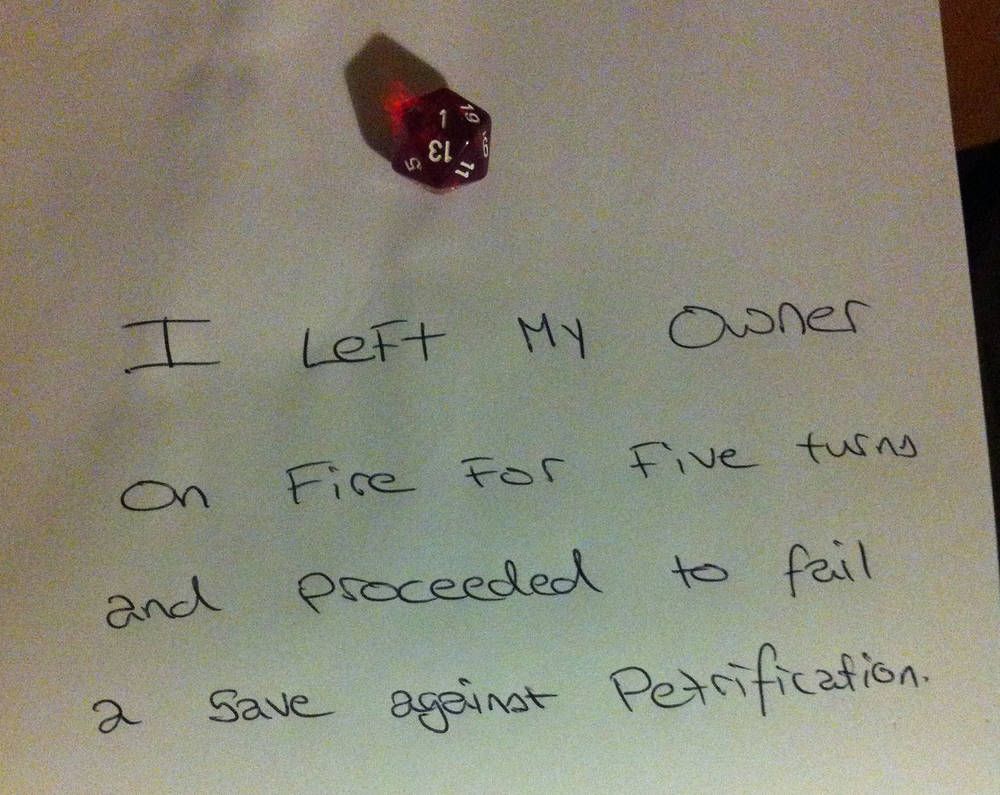
Dice shaming for disloyal D20s

by Cory Doctorow


Dice-shaming: for when your stubborn, disloyal polyhedra refuse to behave (see also). Dang, I hope this becomes a thing! (via Seanan)

30 Jun 11:57

Tumblr | 551.png

551.png
30 Jun 11:57

If anyone remembers, a while ago I got sent an ask as to why...


If anyone remembers, a while ago I got sent an ask as to why Elrond didn’t have the Eagles fly the ring to Mordor. And my friend wilypixel deemed my answer hilarious enough to merit a comic. 

You’re welcome.

27 Jun 22:54

Friday Fury

by syrbal-labrys

1fun7I am very pissed off.  I am one of those boringly conventional people who believes putting your money where your mouth is counts for something.  So, I budget in bucks to speak for me every month, even though this frequently cramps my style life in some pretty uncomfortable ways.

One of the things I had been sending money to every month was “Wounded Warrior Project”.  That is what I am pissed off about  - well, it is part of what I am pissed off about today.  This month’s little envelope came with a flag-embellished card for my signature to send TO a “wounded warrior.”  The front reads, “Thank you for my freedom.”  (The inside bore a little rhyming ditty that made me want to beat myself unconscious.)

Yeah….the blue and the white fell right out of my line of sight.  Nothing left but red.  Such CRAP.  Such LIES.  The soldiers and Marines being mangled in the wars begun by George the Younger and Stupider had fuck-all to do with our freedom.  I GET that charities have to appeal to a lot of people.  But holy hells, (by which I mean war zones) must we keep mouthing a lot of phony “patriotic” militaristic tripe instead of appealing to the simple humanity of keeping promises made to soldiers?

So, yeah, Wounded Warrior Project will get a check AND a letter this month, explaining why I will find OTHER ways to support wounded men where they don’t give me a load of propaganda based on lies.  Because, yeah, I am just a mite bad-tempered just now.


Tagged: war-what-is-it-good-for
27 Jun 22:52

Is a Contract Written on Toilet Paper Enforceable?

by Kevin

Sure! Why wouldn't it be? All you need in order to have a binding contract is a mutual agreement by which each party agrees to do something in exchange for some consideration. (An example from Ohio.) Generally they don't have to be in writing at all (although written ones are easier to prove), so it shouldn't matter what you write them on.

Or what you write them inSee, e.g., "Contract Written in Blood Still Not Binding, Says Court,Lowering the Bar (Mar. 20, 2009).

This is not to say writing a contract on toilet paper would be a good idea. For one thing, the ink would bleed, which might cause problems if interpretation was needed later. Also, a pen would likely tear up the paper pretty badly, although I guess you could run the paper through a manual typewriter, if you can find one. And if this contract involved something important, you wouldn't want to leave it lying around someplace where your contract might be used for some other purpose.

The other problem, as the CBC reported this week (thanks, Tom), is that using toilet paper could be seen as disrespectful. To whom, you may be asking, and one answer is "to a hearing officer who has asked you for a copy of the retainer agreement between you and your client."

well you better let him outAccording to a decision by the Law Society of Saskatchewan (the equivalent of a state-bar ethics committee in the U.S.), such a request was made during a 2011 hearing in Prince Albert, the province's third-largest city. The adjudicator presiding over the hearing made the request so that she could rule on a request for legal fees. A court order cited in the opinion seems to require retainer agreements to be provided, but the lawyer involved took offense at this, saying that he "did not do" written retainer agreements. Oral agreements are fine in general, but oral retainer agreements between lawyer and client are a terrible idea, and in fact legal-ethics rules often require them to be in writing. That did not seem to be the case here, however.

After checking with a supervisor, the adjudicator brought this issue up again with the lawyer in a later hearing. He "became very upset and angry," questioning the adjudicator's experience, and suggested that she could tell her supervisor to "shove [his opinion about fee agreements] up his ass." Further discussion was had on the record, after which the lawyer met separately with his client.

When he returned, the adjudicator said, he "seemed kind of smug and happy." He produced a piece of paper which she saw "was a piece of toilet paper with handwriting on it." (Although the decision says a photocopy of said paper is attached, the exhibits sadly don't appear to be online.) Based on the quoted language, it looks like a perfectly good contract to me. The parties agree that the lawyer will be paid a certain amount, and both parties signed the document. But in context, the Law Society decided that the intent had been to humiliate the adjudicator (generally not a good idea), which it found to be "conduct unbecoming" a member of the legal profession.

The lawyer maintained that the incident was a "stupid joke" and said he had apologized later, but it wasn't a personal apology and so this did not sway the Law Society. It reprimanded him, fined him $500, and ordered him to pay the costs of the proceeding which it fixed at no less than $10,000. Tip: apologizing may be difficult but not apologizing can be expensive.

I think this kind of result is entirely possible in the U.S., but may be more likely in Canada. I infer that from the facts of a case the Law Society cited, in which a lawyer was reprimanded for calling another one "clueless." I guess I should be glad the rules aren't that strict down here.

27 Jun 22:49

The Lost Beauty of Book Endpapers

by Allison Meier
Unicorn and bird antique book pattern (1890-1930) (all images courtesy Bergen Public Library)

Unicorn and bird antique book pattern (1890–1930) (all images courtesy Bergen Public Library)

Bookbinding developed gradually, with the availability of materials and prevailing tastes dictating the details. One of the more overlooked aspects of book design was the creation of endpapers, when what was long a blank space or slice of vellum was replaced by exuberant patterns.

Norway’s Bergen Public Library has a lovely Flickr album of antique book paper patterns dating from 1890 to 1930, brought to our attention by Slate Vault. While there are plenty of geometric shapes and floral touches, there are also unique designs like a grid of unicorns and fantastic birds, as well as marbled paper.

According to the Salem Athenaeum, marbled endpapers were the first decorated ones of their kind, although by the 1930s most of the artisans were already gone and it was all done by machine. In this way the Bergen Public Library collection also represents the last stage of decorated endpapers, just before they became unnecessary thanks to the industrialization of the book-making process and the arrival of trade paperbacks. But anyone with a library of old books or who’s flipped through some vintage tomes has likely caught a view of these bookbinding details. Here are some our favorites from the Bergen Public Library Flickr collection.

Red and black pattern (1890-1930)

Red and black pattern (1890–1930)

Greenish foliage pattern (1890-1930)

Dandelion pattern (1890–1930)

Geometric red pattern (1890-1930)

Geometric red pattern (1890–1930)

Branch pattern (1890-1930)

Branch pattern (1890–1930)

Damask pattern (1890-1930)

Damask pattern (1890–1930)

Et ars labor pattern (1890-1930)

Ars et labor (art and labor) pattern (1890–1930)

Greenish blue pattern (1890–1930)

Greenish blue pattern (1890–1930)

Lattice pattern (1890-1930)

Lattice pattern (1890–1930)

Orange pattern (1890-1930)

Orange pattern (1890–1930)

Brown and red pattern (1890-1930)

Brown and red pattern (1890–1930)

Whorled pattern (1890-1930)

Whorled pattern (1890–1930)

View more antique book patterns on the Bergen Public Library’s Flickr

27 Jun 08:46

Supreme Hypocrisy

by syrbal-labrys

1a kissIn saying that they are protecting free speech on “public sidewalks” by letting anti-abortion sorts beleaguer women going to abortion clinics, the “Justices” of the Court should get a gold medal for hypocrisy. Women undergoing one of the most difficult times in their lives do NOT need to have to endure a bunch of religiously motivated assholes in their faces.

I don’t recall them protecting public protest when allowing numerous municipalities from requiring permits for marches or even standing and holding a sign.  I don’t recall them protecting protest when anti-war protestors were forced to stay out of sight of motorcades.  I don’t recall them protecting protest when THEY themselves have to face protest — THEY have their own little “buffer zone” that keeps people from getting in their faces to discuss “something that they care deeply about.”

Hypocrites.  I’m going to exercise some free speech here, too.  Kiss my ass, SCOTUS, and tell that anti-abortion Grandmother that if she got in MY face to try changing my mind, she might find I have the fully enabled vocabulary of a pissed off sailor. I think it would be good for that crowd if we played by their new rules.

I wish our Court followed some European models — more justices and a random selection for any given case.  For example if there are 15 or 16 justices and 7 or 8 are selected by drawing for any given case — imagine the difference that could ensue.  No more ideological arm lock on given topics!


Tagged: abortion, freedom-from-religion, hypocrisy, misogyny
27 Jun 08:45

:::Bowing Head::::

by syrbal-labrys

1iraqI was finally getting my head around letting it go here. Getting more involved in my own life and such…and letting go of a lot of the futile political shit that others do better than me.
Was thinking this might be the last year of an annual journal full of names of the young men and women killed in war in Afghanistan and Iraq.  That will teach me to think.

:::Shhhhhh!::::: You did not hear it here. But I am going to get very, very drunk now, because I think I will be walking that Walk in the picture a LOT more often very soon.

I am going to publish every name those blood-sucking chicken-hawk sonsofbitches in Washington D.C. sacrifice on Round Two, right here.  But this time, folks?  If we go back?  We will be there forever….


Filed under: Life, War & No Peace Tagged: fuck-it-all, fucking-again?, Iraq