Shared posts

14 Sep 23:52

Petitions I Do Not Sign – Omnipotence Not Just For God Anymore

by syrbal-labrys

1a kissI am going to piss off some feminists, ok?  And no fuck will be given when I do, either.  Here is the turd-bombshell in their punchbowl:

Parenting, and particularly motherhood, is the most bitchily difficult and under-appreciated job on the fucking planet.

And no, I am not talking about the newest fad of uber-involved moms over-scheduling their infants and toddlers so they can vicariously exist in a “perfect” childhood of their own. (Oops, I just pissed off the Uber-moms, too.)

I’ve seem far too many of the arguments on both sides of the line – from childrearing being as hard as rocket science and seriously less well funded, to the good old misogynistic “anyone can pop out and rear a kid” opinions.  I grew up in the era of feminism where women like me who married (after having slept with the enemy and NOT left him in his cold bed) and had kids were treated as if we had betrayed the sisterhood to the patriarchy.  Then I saw it through the era where women had to be superwomen without capes OR wonder-women with no airplane, visible or invisible.  My generation was expected to do it all and do it perfectly without batting an eyelash.

Let me tell you, anyone who is honest and has tried that shit on for size?  They’d like to bat more than eyelashes before it is over with, trust me.  It leaves one feeling more than a bit like a scaled down Eleanor of Aquitaine: “bad queen feminist/woman, bad wife, bad mother.”  I feel horrible, for instance, having told a student I tutored that sure, she could do it all.  It doesn’t show up all at once right there when one is doing it all, you see.  Sometimes way down the road, where the rubber meets it, you see how it didn’t quite all get done as you would have liked after all.

And what, you wonder, has this to do with petitions?  Well, this poor guy’s daughter was murdered by a neighbor boy not much older than the poor girl, and the grieving dad had a petition to punish the killer’s PARENTS.  Wow.  Gee, all that omnipotence as parents must make one giddy, eh?  To me, as much as I feel bad for the guy whose daughter was murdered by a messed up kid; it makes as much sense to punish HIM as the parent of a murder victim.

The killer’s mom and his school officials WERE trying to get the boy helped.  Much like the seriously messed up young man who killed in that Sandy Hook school, or the crazed misogynistic shooter in California — the parents WERE trying to get issues addressed.  Thing is, even if parents KNOW something is wrong, and by the way, especially MOTHERS trying to convince someone to listen to their worries; they are often dismissed.

I brought three children into this world.  Two boys and one girl.  My two younger children both have some issues.  My daughter began acting out in distressing ways at age four; but telling her pediatrician got me patted on the shoulder with a condescending “Oh, now don’t be a nervous mom, ok?”  At age six, she tried to kill her new baby brother because she didn’t want a brother — I’d been told to deliver a sister, you see.

I got her a psychiatrist.  “Sibling rivalry,” he announced, and “it will wear off.”  Between ages 8 and 10, she stole things so relentlessly that I demanded more counseling.  A counselor came to the house to treat her “in situ” so to speak, for six months.  He told me he loved my house; it was his favorite jobsite — no drugs, no drunkeness, no abuse; yes, some frustrated yelling, but we were good parents and she would “grow out of it.”

She did not grow out of it.  In her teens she became completely secretive and good at lying and manipulation.  She sneaked out of a sleep over to go to a party and was raped, and the mental health issue almost got out of the bag then.  But in the end, she doubled down and laughed on car rides back from therapy about how she “played that silly bitch like a violin.” Her counselor was sure the rest of us were horrible people and my daughter a poor misunderstood little artist. The therapist had it half right, my daughter was a great actress.

In adulthood, she abuses prescription drugs and alcohol.  She lies and manipulates people till they catch on and run.  She is alienated from us because her constant mental bad-check writing ended up bouncing on our reality.  She is dangerous, she attacked me once physically and tried it on her father.  Had we been older, weaker, and less afraid of her — it might have availed her something.  We tried on four separate occasions to get the issue handled.  We even called the police.  We were told to stop over-reacting EVERY time.  Luckily?  She doesn’t own guns.  But she is fond of knives and not above using her fists.  If I had to guess, though she was once tentatively diagnosed (after legal age) as bi-polar, I’d say she may have some sort of personality disorder.  She openly says what is wrong with others who act like she does, but says she doesn’t follow those rules for ‘other people’ because she doesn’t WANT to do so.

My youngest son was much her disciple, especially when his idolized older brother went off to military service.  She fucked with his head.  He ran away at age 14; at age 16 she took him out of state against my will and abandoned him in Southern California.  I will doubtless never know what traumas he endured on the streets.  He joined the military and added PTSD to his issues.  He is still far away, and doing his best and he means well.  He has none of her malice and narcissism; but I know he struggles.  He is thirty years old this month.

I spent more than 20 years trying to get help for my children.  If my runaway had committed a serious crime (he was once jailed for vandalism), would it have done any good to punish me?  I was not even allowed to have him forcibly picked up and brought home by the cops while he WAS in state — nor allowed to lock him in his room, etc to try preventing his running off.  I had NO rights to keep him from running, but I was legally and financially responsible for ANY of his actions until he was 18.  And after 18?  For both him and his sister, it did me no good at all to argue that they might be a risk to themselves or others — I was just a nervous mother.

So yeah, being a parent is NOT being omnipotent.  I didn’t sign that poor grief-stricken man’s petition.  Even the most well-intentioned parent cannot always control a child.  Punishing parents, who even as bad parents (like my own) are often doing the very best they can in impossible situations is not a solution.  Punishing neglect and abuse, early on?  Yes, that — but even there, normal childhoods still produce abnormal, even horrifying results at times.  I don’t know what the answer to these sorts of problems are — I’m no Wonder Woman, nor Superwoman, nor omnipotent.

What I am IS a woman, frustrated and furious and in my own jungle of grief and guilt for the children I tried SO hard to bring up to be happy, healthy, productive people.  Hear me roar, and yes, if you think it is all so damned Wonder Book simple?  Kiss my ass.


Filed under: Life, Media Morons, PTSD Journals, War on Women, WTUnholyF? Tagged: child abuse, children, mental-health, murder, neglect, omnipotence, parenthood
14 Sep 08:11

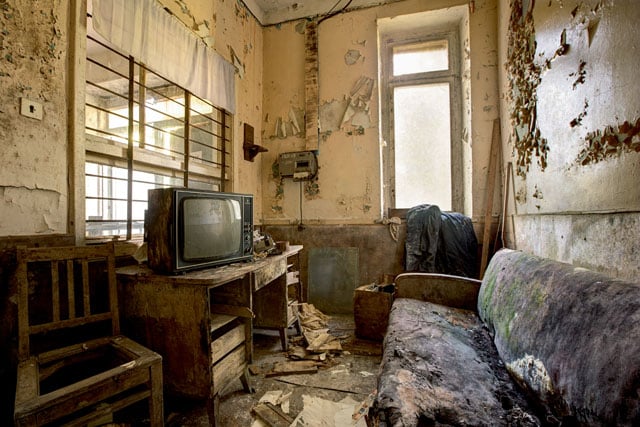
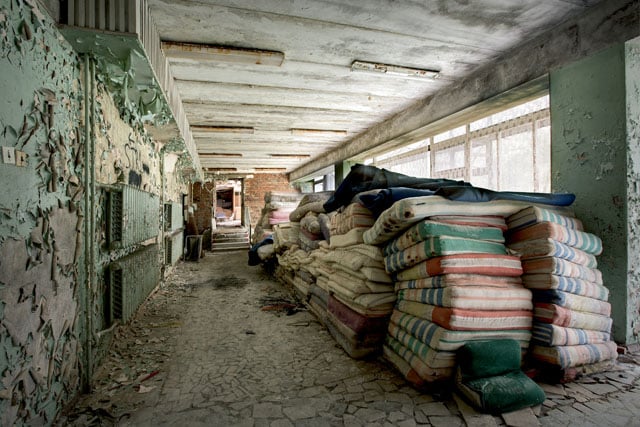
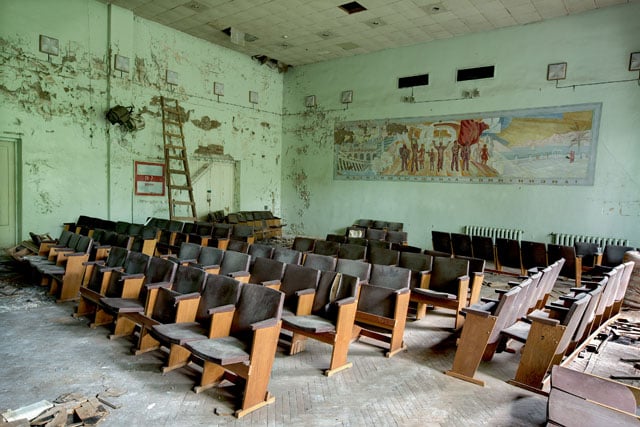
‘Soviet Ghosts’ Captures Post-Apocalyptic Scenes Left Behind by the Fall of the USSR

by Gannon Burgett

BULGARIA -Buzludzha 09

Rebecca Litchfield is a photographer who has faced radiation exposure risks, arrest and interrogations, and even accusations of espionage… all for the sake of her project “Soviet Ghosts.”

You see, Litchfield is an avid urban explorer who has been fascinated by scenes of decay found in countries that were formerly part of the USSR and the Eastern Bloc.

Photographing and exploring the old Iron Curtain isn’t the easiest thing to turn into a project, she says:

Not many explorers travel to Russia, where the rules are very different, locations are heavily guarded and a strong military presence exists everywhere. There are serious consequences for getting caught. We managed to stay hidden for all of the trip, we maximised our stealthiness, ducking and diving into bushes and sneaking past sleeping security. But on day three our good fortune ran out as we visited a top secret radar installation. After walking through the forest, mosquitos attacking us from all directions, we saw the radar and made our way towards it, but just metres away suddenly we were joined by military and they weren’t happy…

Fortunately for Litchfield, she was able to wiggle out of that tricky situation and continue her adventure through more than 10 different countries.

She says that her goal is to capture the scenes as they are, highlighting their beauty in decay, “like a memory hanging on that will soon be lost in a breeze, a museum that no one gets to see.”

Here are some of the haunting photographs in the project:

BULGARIA - Soviet Friendship Monument

BULGARIA -Buzludzha 01

BULGARIA -Buzludzha 10

ESTONIA - PATAREI PRISON 02

ESTONIA - THEATRE

GERMANY - Miltary Barracks

GERMANY - Soviet HeadQuarters 01

HUNGARY - MAV 424 Steam Train

LATVIA - IRBENE 02

LATVIA - IRBENE 03

LATVIA - SCHOOL

RUSSIA - Chemical Laboratory

RUSSIA - Cinema

RUSSIA - Sanatorium 01

RUSSIA - Sanatorium 03

RUSSIA - Tuberculosis Hospital

RUSSIA - Young Pioneer Camp 02

RUSSIA - Young Pioneer Camp 04

UKRAINE - Chernobyl Hospital 02

UKRAINE - Chernobyl Kindergarten

UKRAINE - Chernobyl Sports Centre 01

UKRAINE - Chernobyl Sports Centre 02

The photos in the project have also been published in a book that’s available from $28 over on Amazon. You can also find more of Litchfield’s work over on her website.


Image credits: Photographs by Rebecca Litchfield and used with permission

14 Sep 08:09

owlturdcomix: Okay, maybe not #4.


owlturdcomix:

Okay, maybe not #4.

14 Sep 07:44

Sledge Hammer

by Erik Loomis

One of the first TV shows I ever remember liking was Sledge Hammer, the 80s Dirty Harry spoof that lasted only a season and a half before being cancelled. I don’t know why I liked it then, certainly not because I understood all the jokes, but I remembered some funny stuff all these years later. I figured though that watching it today wouldn’t really pay off. But my brother, who reviews DVDs on the side, watched the series again and immediately said I had to watch it.

And you know what? It holds up pretty well. It has some of the problems of an 80s comedy. Too many episodes per season for one, leading to some bad ones. After the opening episode, at least they didn’t use a laugh track. But for the most part, this isn’t bad at all and some episodes are down right hilarious. It’s really a show ahead of its time. It really trusted its audience with all sorts of movie references, some of which that wouldn’t be all that super obvious to the average schlub watching ABC at 8 pm on a weekday night. Told political jokes. Made fun of other ABC shows. Comedies didn’t do these things in the 80s.

But most of all, it just told jokes that worked pretty well. Such as in “Comrade Hammer,” an episode you should watch. Hammer has to escort a Soviet dissident scientist to a conference. That means lots of Cold War jokes.


14 Sep 00:12

Lock me up

by Molly Moore

Lock me up

Pushing lock gate open naked

My Scavenger Hunt week continues with day 5 which is also Sinful Sunday and some pictures that I believe will make yet another new location on Curvaceous Dee’s list; Lock Gates. The UK has an extensive system of man-made canals some of which date back to the 16th Century although the biggest growth in the…
13 Sep 22:08

That Was the Week That Was (#437)

by Maggie McNeill

To believe that we can eliminate sex work…without…affecting other industries…operates on the assumption that sex work happens in isolation—that what happens on the back page doesn’t affect the front, when, in fact, it’s financing the whole operation.  –  Alexandra Kimball

Think of the Children!

The Telegraph‘s headline writer obviously doesn’t know the meaning of the term “graphic novel”:

A council worker who wrote a “raunchy” novel was sacked from her job at a children’s centre after complaints from parents who compared the book to Fifty Shades of Grey.  Bettina Bunte…was…told…that her book damaged the reputation of the…centre…

Five Women in Whitechapel Russell Edwards with supposed Ripper shawl

You’ve probably heard all the hubbub about Jack the Ripper being “definitely” identified by DNA testing of a shawl supposedly found next to the mutilated body of Catherine Eddowes (cue Maggie’s goose pimples).  Unfortunately, we’ll still have to put up with the endless speculation for a while yet:

…Leaving aside…the claim that the shawl was never washed or cleaned at any time during the past 126 years, the biggest problem in carrying out such sensitive DNA analysis is the question of cross contamination…When other labs have worked on the ancient DNA of important samples…they have gone to extraordinary lengths to avoid the possibility…They have also worked…“blind”…to ensure they do know which sample they are analysing in order to avoid unwitting prejudice…None of this, as far we know, has been done in this case.  Dr Louhelainen may be satisfied that he has found the culprit, but many other scientists are not, including Professor Sir Alec Jeffreys, the man who invented the DNA fingerprint technique…“An interesting but remarkable claim that needs to be subjected to peer review, with detailed analysis of the provenance of the shawl and the nature of the claimed DNA match with the perpetrator’s descendants”…Sir Alec [said, adding]…“Kosminski was long regarded as by far the most likely perpetrator.”

Do As I Say, Not As I Do 

[Florida cop James Yacobellis, who was]…busted in a…sting of a Boca Raton Asian massage parlor…isn’t a stranger to trouble…in one instance…he…[threatened] a suspect by putting him in a bathtub, turning on the faucet, and pointing his taser…between October 2011 and February 2013, Yacobellis was on paid leave while [other] allegations were being investigated.  He was still drawing a $87,000 a year salary…In nine years, Yacobellis was involved in six …internal affairs investigations.

Perquisites

Funny how the truth doesn’t get as much press as silly lies about sports:

…So far there are about 13,000 delegates lined up to attend 18 events when the Nova Centre opens in 2016.  Local sex workers expect that will make business busier than usual.  “A lot of businessmen have an entertainment allowance”…said one Halifax-based sex worker.  “Out-of-town clients are about 60 percent of the business right now.”  Business travellers are why one local sex worker allows clients to pay by credit card—with the nature of the transaction concealed.  “A lot of them will use [their company credit card] or write it off as a business expense,” she says…

The Law of Averages 

It’s good to see this in as mainstream a publication as The Atlantic:

There is little basis for the claim that 13…is the age that most sex workers begin working in prostitution.  It’s hard to pin down where exactly the…claim originated, partly because it’s so often repeated without a citation or context…Most organizations, if they refer to a source at all, reference [the Estes & Weiner] study…Most current government and nonprofit policies on sex work define their goals as “rescue,” which makes perfect sense if the age-of-entry statistic is central to your understanding of the sex industry…But…in reality, many sex workers come into the industry as adults and without coercion…

StruwwelpeterAuthor Chris Hall does discuss the Silbert & Pines study, but does not mention Melissa Farley’s distortion of their data.

Presents, Presents, Presents! 

Daz sent two presents while I was on the road, so I only saw them after I got home last week!  One was Acolytes of Cthulhu, and the other Struwwelpeter (in English).  Thank you so much!

Confined and Controlled

Another idiot who doesn’t understand the bottleneck effect and thinks women are too stupid and weak to be allowed to manage our own sexuality:

A mayoral candidate says he wants Ottawa to be the “test city” for legalizing prostitution and is in favour of legalized bordellos.  Darren W. Wood…says he wants prostitution to be “tightly controlled and highly taxed” as a means of protecting sex workers and generating revenue…Under his proposal, sex workers would be…regularly checked for sexually transmitted infections, protected from pimps and johns via an onsite security system and fined or jailed if they are working without a license…

The Last Thirteen for Fourteen

Here’s another excellent column from Marijke Vonk; this one’s on how to be a good ally to sex workers:

…By vocally supporting sex workers we can challenge the  assumptions of the people around us…As professionals, academics, social workers, educators or people in a position of social power we can…even influence legislative reform…It can be scary to openly disagree with the current discourse of sex workers as either victims or dirty whores who were asking for it, but as a non-sex worker you have the privilege of staying relatively safe as you speak out about these injustices…

The Public Eye

Pop singer Lowell spent some time as a stripper in Canada…[but while] a lot of singers might cover up that past…it became immediately obvious that she has nothing to hide…She’s been [drawing on her stripping and bisexuality]…since her brilliant 2013 EP, I Killed Sarah V(Sarah Victoria was her name when she was a dancer).  She told Rolling Stone, “There can be something really empowering about [stripping]…by making it taboo, we alienate these girls and allow…victimization to happen.”  It’s important to bring those kinds of ideas into the mainstream…


Feminine Pragmatism (TW3 #133)

You’d almost think reporters were historical ignoramuses who didn’t know that up until a century ago, the professions of actress and whore were indistinguishable:

Shweta Prasad, one of India’s best known former Bollywood child stars, has been arrested for prostitution…she said…she and many other actresses had been lured into prostitution when Bollywood roles dried up and the money ran out.  She had not found a film role in eight years…Inspector P Murali Krishna…said…“We are treating her as a victim and she’s been sent to a rehabilitation home.  We have arrested the person who exploited her”…

A 23-year-old woman voluntarily doing productive work is an “exploited victim”, but she wasn’t at all exploited when others pimped her in movies at the age of 11.  But in India, unlike the US, some are willing to point out the truth:

…the law clearly says that the practice of selling…sexual service is…not a crime…the actress…had not been coerced, kidnapped or tricked…but had chosen this from among the options available to her…the media [should] refrain from gleefully jumping in with police stings that are unauthorised and illegal…it wasn’t the activities of the actress that were illegal but the actions of the police…

Buttons, Bags & Banknotes

Canadians feminists prove themselves just as obsessed with trivia as their sisters in the mother country:

A Vancouver catering company that offers sushi served on women’s naked bodies is sparking controversy among feminists who call the practice disgusting and degrading…“We’re not hijacked into doing this,” [said] Vancouver model Jessica Perry…Naked Sushi…offers nyotaimori— the Japanese practice of serving sashimi or sushi on a naked female body adorned with strategically-placed flowers and leaves…women’s rights activists are asking health officials to shut [it] down…the health authority does not have jurisdiction over the catering company as it serves its sushi after the food is prepared in an approved kitchen…

My First Million (TW3 #343)

I reached a total of three million page views soon after 2:30 PM CDT Thursday.  Thanks so much to all the readers who have helped make this blog a success! 3,000,000

O, Canada! (TW3 #405) 

Cop gets in trouble for unofficially doing the same thing other cops do officially:

Six guilty verdicts…against an Ottawa [cop] who…repeatedly…[accessed] confidential police records for personal reasons could result in dismissal.  Sgt. Rohan Beebakhee…took it upon himself to book dates with escorts, showing up in full uniform and having what he called a “safety briefing” with sex trade workers…He would often bring along junior officers…An internal affairs investigator…ordered in 2011 that Beebakhee stop all contact with escorts.  He didn’t…Beebakhee…was charged with sexual assault…in 2007 [but the] charge was withdrawn in 2009…

Property of the State

Note that at 12 weeks abortion is totally legal:

A [Montana] woman…is now facing a felony criminal endangerment charge for putting her unborn child at risk by taking illegal drugs.  Casey Gloria Allen, 21…[tested] positive for the presence of benzodiazapines, THC, and opiates…Allen is 12 weeks pregnant…

Whither Canada? (TW3 #423) 

Excerpt from a press release by Terri-Jean Bedford:

This afternoon I testified before the Senate Committee on Justice and Constitutional Affairs.  I gave my speech and then was ejected from the question and answer session for failing to stop speaking when the Chair asked me to.  I apologize for losing my temper.  I was barely able to read my speech because I was so angry at the government for parading victims with repeated irrelevant information and then organizations who were shilling for government handouts on which they are dependent.  The shameful use of victims by the government in this process, and their disregard for life by ignoring court findings, refusing to listen to their own legal staff and refusing to answer questions from legitimate sources made me snap…

If Men Were Angels

So now joining a cult is “sex trafficking” too?

Four members of [an Israeli] messianic group have been arrested on charges of kidnapping young women and forcing them into prostitution …the group would control women with a combinations of drugs, alcohol and heavy brainwashing techniques and convince them to have sex in exchange for money…Police allege that the girls were taught that “lying with non-Jews would hasten the redemption” of the Jewish people and that by having sex with non-Jews, the girls would purify them and bring back their “holy sparks” to Israel…

Divided We Fall (TW3 #427)

Another good call for Canadian queers to oppose criminalization:

The government…[has] a…history of criminalizing consensual sex to promote the majority’s sexual morality.  Think of the ban against gay sex, lifted in 1969.  Nobody suggests that ban really changed people’s desire to engage in gay sex or reduced its incidence.  Instead, it cast a stigma and criminal status over a class of individuals [and]…impaired their ability to participate as full and equal members of society.  It also made people who had gay sex vulnerable to blackmail and less able to seek police protection when threatened…If you are a trans person…many obstacles still face you in Canada.  But if you are gay or lesbian…it’s a good place to be…[because] of political and legal struggles over past decades.  The beneficiaries of these reforms have a responsibility to fight a law that flies in the face of our experience…the commitment to sexual justice that underlay our earlier struggles entails fully decriminalizing adult sex work.

Bait and Switch

You can bet that “minor child” in this context actually means “young woman above the age of consent but below 18″:

…Timothy S. Griesemer was found guilty of attempted sex trafficking of a minor and…faces up to life in prison…he sent a text message to a female acquaintance indicating he was looking for a minor child.  The woman contacted…police who…[called] the U.S. Secret Service…

Another Fine Mess

More about the long pre-internet history of sex work advertising:

…There is no question that online advertising has transformed the sex industry, but in fact, ads for sexual services are far from endangeredWhile most sex workers are online…many also use free dailies and weeklies to reach markets that aren’t as amenable to the Internet…online ad sites [are also more] vulnerable to government shutdowns…and…clients who are wary of online transactions are liable to see escorts with print ads as less likely to cheat or scam them…


13 Sep 22:02

The Prisoner

by Molly Moore

The Prisoner

Showing pussy in prison cell

We took these pictures last summer whilst we were Philadelphia visiting friends and family. The Eastern State Penitentiary was opened in October 25, 1829 and considered to be the world’s first true penitentiary. Eastern State’s revolutionary system of incarceration, dubbed the “Pennsylvania System” was based on the idea that true penance and therefore reform from…
13 Sep 22:02

Corrections

by Grant Snider

Corrections-rumpus

Related Posts:

  • No related posts…
13 Sep 22:01

“Sometimes you think things can’t get worse, but they do,”

by syrbal-labrys

1church and state.I’m not a babe in the woods.  I know the world is full of horrors.  And “first world issues” may hurt and trouble, but they are like a paper cut compared to a traumatic amputation compared to what happens in some of the hellholes of the world.  So, seeing a profile in courage both encourages and discourages me.

You know, one of the odd things I recall from my days as a beekeeper, is that bees have a limit.  They literally can only eat so much honey — the food that sustains them — before their bodies just go “Nope, not one more drop,” and stop digesting it.

I must be some kind of wuss, because I feel like I have a limit, too.  A limit on witnessing horror, hatred, and cruelty.  I’m only sixty, but now even fictional horrors make me flinch.  Reading the news is a bit like being in a vat of salt with no skin.


Filed under: PTSD Journals, Religious Nuts & Bolts, War & No Peace Tagged: fanaticism, Iran, torture
13 Sep 21:59

The NFL’s Domestic Violence Equation

by Erik Loomis

The NFL and its teams have a simple equation it calculates when players commit domestic violence. If the player is marginal, he’s cut and the NFL can say it doesn’t tolerate domestic violence. If the player is a star, he can do anything short of killing a woman or getting caught on tape beating her. Thus Greg Hardy and Ray McDonald will be playing on Sunday.


13 Sep 01:44

Watches

Old people used to write obnoxious thinkpieces about how people these days always wear watches and are slaves to the clock, but now they've switched to writing thinkpieces about how kids these days don't appreciate the benefits of an old-fashioned watch. My position is: The word 'thinkpiece' sounds like a word made up by someone who didn't know about the word 'brain'.
12 Sep 19:50

Men With Women; Women With Men: Fight Club, 15 Years Later

by Arielle Bernstein

While I know a lot of men from my generation who love Fight Club, it was always the girls with the posters featuring Brad Pitt, half-naked and bloody. The fights throughout the film are all vaguely pornographic, too, with piles of sweaty, beautiful male bodies cheering and slamming into one another, all close up images of fist and mouth. The ubiquity of these posters among the women I went to school with always felt a little shocking to me, even though I appreciated that there was something sexy about the film.

When I learned to play Texas Hold ‘Em poker, which was incredibly popular my freshman and sophomore year of college, I was deeply intrigued by the fact that I would often be one of the only girls in the room. Even though I was welcomed to play, the world I entered always seemed to be a solidly “male” space—there would be foldout chairs and half-empty beer bottles, and cheap cigars, potato chips, dirty laundry, and dirty magazines, only partially hidden. I loved the silent, masculine energy in those games, the wide-legged posturing, the sarcastic jokes, the dares. I won a lot, mostly because the guys often took for granted that a girl wouldn’t be a very good player, but also because I was good at it. In a world where I often felt I wasn’t big enough or physically strong enough to be aggressive, poker was a psychologically aggressive sport where being quiet and unreadable didn’t make you vulnerable. It gave you tremendous edge.

When re-watching David Fincher’s Fight Club for its 15th anniversary, I thought a lot about the late ’90s and early 2000s and how little the gender landscape has changed since then. In a world where gender studies still often only relates to women’s experiences, Fight Club dares to ask questions about what maleness actually means. It doesn’t offer pat or simplistic answers to that question either. Is masculinity best represented by Tyler Durden’s [Brad Pitt] cheap fortune cookie aphorisms that often contradict, but are delivered with enough cojones to seem genuinely seductive? Does the film’s critique of consumer culture push a decidedly “men’s rights” agenda? In her essay for VICE, “15 Years Later Fight Club Still Sucks” Megan Koester makes the argument that Fight Club is an inherently sexist film, an “ode to alpha malehood.”

But Fight Club was never a fairytale. It’s a painful howl into a night that probably isn’t listening and that is more a cry of pain than a drive to hurt. When a bunch of confused, angry, and sad men bond together, first to fight one another, then to indiscriminately terrorize an entire city, we are meant to feel uncomfortable. We are also meant to feel uncomfortable by the fact that, for a little while, Tyler Durden’s diatribes did seem interesting and seductive.

In some ways, Fight Club is about having sympathy for a dying animal, and I think for some people who aren’t teenagers or young or suffering from depression or rage or deep-seated ennui, that must be hard as hell to do. After all, Tyler Durden often acts like a complete and total jerk. He is basically the poster child for young male dissatisfaction and rage. In contrast, Marla Singer [Helena Bonham Carter] is the female version of this same pervasive sense of ennui, and in true female rage fashion, her depression turns inwards. She is constantly trying to off herself. Her brand of “acting out” is more quiet and gentle than the narrator’s [Edward Norton]. She steals things and smokes and goes to places where she is obviously not wanted like the testicular cancer support group where she first meets the narrator, who hasn’t yet realized he has a multiple personality disorder.

One of the reasons I’m probably sympathetic to Fight Club is that I’ve always been intrigued by male-only spaces. Sometimes I’ve had the experience of being welcomed and included in these spaces. At other times, I have felt like an outsider, an anthropologist looking at a world I can never have complete and total access to.

Maybe it sounds like I’m exoticizing men when I say that. I’ve always hated when people try to sum up what it means to be a woman by presenting a laundry list of stereotypes. I don’t know if womanhood has made me especially kind or gentle or nurturing or maternal. Though I’ve identified as very feminine since I was a little girl, if you were to press me I’m still not sure exactly what about my nature is decidedly feminine, and how much of that is based on how I look versus who I really am. I think it’s because of this that the best explorations of gender make the audience ask a lot of questions and aren’t afraid to make the viewer or reader feel uncomfortable or unsettled. And clearly the image of masculinity presented in Fight Club is both alluring and troubling. Brad Pitt’s Tyler Durden, all hot and cocky, is everything we love and hate about machismo. And the narrator who is seduced by Tyler encompasses everything we worry about beta males, who want access to the doors that open with that kind of slick power. Who wouldn’t? Feminists can criticize machismo ’til the cows come home, but our culture still values competence over kindness, and made-up answers over genuine questions. It’s one of the reasons that Tyler’s drive to take down consumer culture is ridiculously ironic. He destroys franchises by putting up his own violent version of them. In every city where there was a McDonald’s or a Starbucks, he instates his own little sad sack fight club.

Today, male camaraderie is often depicted as violent and awful: the male party-goers who rape a teen girl, the gamers who hurl obscenities at a female player, the man who beats his wife and the men who defend him afterwards. While I think violence in “male” culture is worthy of critique, I also think this story of “maleness” in our culture is strangely one-sided and fails to consider the myriad ways that men today have embraced feminism in a way that previous generations have not.

Maybe what we need is not less Fight Club, as Koester suggests, but more varied depictions of what masculinity can and does mean in today’s world. After all, most of the men I grew up with are not reflected at all in the media images of men I’m likely to see when I watch a movie or TV show. The men of my generation may have played violent video games and listened to misogynistic songs, but I did too. Sometimes we did fail at understanding each other’s perspectives. Sometimes, we made rash judgments or got defensive or pissed off. Sometimes it still felt like we were living in different worlds, with different rules. And sometimes we really were. At times, the barriers between our experiences as men and women seemed insurmountable. The social pressures we faced were intrinsically different; the bodies we had were completely unique and sometimes unintelligible to one another. Once I asked a male friend what sex felt like for a man and he rolled his hand into a barely open fist and proceeded to move his index finger in and out of the hole.

“Like this,” he said, “Only it feels really good.”

“That’s kind of what it’s like for women, too,” I replied.

Kind of, but maybe not quite. Not only do our unique experiences of gender alienate us from understanding one another, our individual experiences of the world, and our bodies, do too. If identity politics teach us one thing, it is that we can never fully understand a person from a different group’s experience. Maybe at some fundamental level that is absolutely true—I’m never going to know what sex feels like for a man, but I’m also never going to know what exactly it feels like for other women, either. And I don’t think we need to relate completely in order to try to understand one another. I don’t think the fact that we experience the world in different ways means there is a wedge between us that can never be crossed.

In Fight Club, Tyler Durden is obsessed with annihilation, with the idea that we are not all the unique snowflakes consumer culture says we can be when we purchase some empty, meaningless products. But while the narrator spends a great deal of the film walking around clean, elegant IKEA furniture and bleeding all over everything, it’s the film’s last image that resonates strongest: when the narrator kills off Tyler and reaches for Marla’s hand instead. Their silhouettes seem small, but also hopeful, as they reach for one another, even as the world literally collapses around them.

Related Posts:

12 Sep 18:18

What do you do when your student tells you her father threatened her life?

by Richard Jeffrey Newman

Well, if you’re a K–12 teacher and you believe the student is at all credible (or maybe her credibility doesn’t matter), you have very specific reporting requirements, and there are protocols for that reporting that you have to follow, and there are individuals and agencies that will–all else being equal–respond to what you report, and, if all goes well, all the different components of this protective infrastructure will work together seamlessly so that student ends up safe and sound. If you’re a college teacher like I am, however, that infrastructure is not available to you. All you can do is what I did: talk with the student, find out as much as you can, be as supportive as you can, and try to persuade her to go to the counseling center, where she can talk to people who are trained to handle, and who have access to relevant resources in, situations like this. That last part doesn’t always work, but, thankfully, this time it did, because I have every reason to believe that the threat my student’s father made was credible.

For just that reason, obviously, and for others that will become clear in a minute, I don’t want to give here any potentially identifying details, and those details I do give are at least blurred, if not changed outright. So I will just say that this student is not enrolled in any of my classes this semester and that, when she was in my class several semesters ago, she told me enough of her story for me to know that her father’s threat fit a pattern of abuse that she’d been dealing with for years. In this particular instance, the way she described it, her father became enraged because he found out she’d been (non-sexually, non-romantically, not even as part of an ongoing friendship) alone in an enclosed space with a young male acquaintance. When her father found out about this, he started beating her, and it was during that beating that he made his death threat. I have to leave the specific details of the threat unstated because they could be used to identify her, so I will simply say that this woman comes from a country where so-called “honor killings”–a misnomer if there ever was one, since there is nothing honorable about them–are all too common, and that her father made clear to her that he was perfectly willing to murder her under that pretext.

Once the student had calmed down enough that she could talk about something other than the specifics of what she had been through, I suggested she go to counseling and she agreed. I walked her over with her and then went about the rest of my day, going to meetings, teaching my classes, and somehow it all seemed not exactly trivial, but a little bit beside the point. When I got back to my office, there was a voicemail from my student. She and the counselors, she said, had figured the situation out. She thanked me for my help and hung up. That’s it. I have neither seen nor heard from her since. I hope that means she and the counselors figured out a way for her not to go back home and that it is better, therefore, for me not to know anything that might give even the slightest hint about where she is. I hope, but there’s no way I can know for sure.

This is not the first time I’ve written about students of mine in similar, or potentially similar situations. In one case, I helped a woman escape from her husband and, in another, a student confided in me that she was thinking of running away so that she wouldn’t have to marry the man, or the kind of man, her parents wanted her to marry, but she wanted to go in such a way that her parents would think she was dead. What struck me in this case, however, was the way my student’s father openly used a network of other men to try to “keep his daughter in line.” She told me about one instance from a while back when she and a young man from her neighborhood were sitting together in a nearby park. The situation was, again, according to her, absolutely non-romantic and non-sexual, but a male acquaintance of the family saw them, took a picture with his phone, and sent it to her father. When she got home, her father confronted her with it and would not let her leave the house for two weeks. On this more recent occasion, when he threatened her life, he told her there would be people watching her every move, that he would know if she did anything “inappropriate.”

Those other people, the watchers, the informants, put me in mind of these lines from Sa’di’s Golestan:

To please the king who eats a single apple
from a subject’s garden, his slaves will pull
the tree up whole to plant in the palace yard;
and if he lets five eggs be taken by force,
his army will put to the spit a thousand birds.

There’s always someone willing to ride the coattails of someone else’s power and authority, but it’s the text that precedes these lines that gives them their real significance: “When the world began, oppression was a small hut that few people entered, but as more and more people chose to go inside, they built it up, and look how high it reaches now.” People choose, in ways both big and small, to become oppressors. Next week, I want to share with you the story these lines come from and talk about what it means to make that choice, or not.

Cross-posted.

12 Sep 18:15

A series of Rorschach – part one

by Gideon

no-turn-on-red

You know those “no turn on red” signs that hang from wires next to traffic signals? Some of them have holes in them. Do you know why? One theory I’ve heard is that it’s done to prevent homeless people from stealing them and using them as cover. The holes make them an ineffective blanket.

Now imagine the “no turn on red” sign at your local intersection goes missing and the cops go searching for it. It’s found in the possession of the local homeless drunk/drug addict, who sleeps on the town green and was using it to cover himself at night.

It’s theft of town property, so should he be arrested and charged? If so, what sentence should he get?

Imagine now that the police don’t find it on the town drunk, but rather it’s spotted in the bedroom of a local teenage kid, who took it as a prank late one night with some friends. Should he be arrested and charged? If so, what sentence should he get?

If your answers for both are different, explain why.

11 Sep 22:40

09.11.14

by driftglass
This is what I wrote back in 2006.

09.11.06


Five Years.

For all the now-forgotten Y2K prattle over when exactly it is that a century actually ends, there is no doubt anymore anywhere when the 21st Century began.

It began five years ago, roaring out of our nightmares and down out of the sky.

Everyone has their memories of that day. Private memories of smells and stares and sobs, and tribal, national memories that fused us all-too-briefly together in a way unlike anything I had ever experienced before.

There is no need for fancy writing to retell a story that has already become as familiar to us as the faces of our families. You saw three thousand people murdered same as me. Some of you saw it in an airport lounge. Some crowded around a television in a break room. Some at home, with three phones going.

Some of you had to sweep the ashes of the dead out of your homes, or wash it out of your hair. I can’t image what that must have been like, which is why ornate words fail.

This generation is not going off to fight a Nazi horde who have conquered Europe, or a Great Depression that has beaten us down into poverty and despair. Instead, living though these times is our destiny, and the outcome is not fixed in the stars or fated in our genes.

We can each choose to stand and fight where we can as best we can, or we can choose to lie down and let this beautiful, consensual hallucination called America die, but never doubt the choice is ours.

Five years ago the specific job of taking point on that mission -- of guiding us through our particular, bewildering tangle of culture, rage, modernity, technology, faith and globalization -- fell to George W. Bush.

And he has failed us.

He has failed this country in ways so numerous, comprehensive and catastrophic they would have been incomprehensible to us on September 10, 2001.

In a backwater era of threatened only by 11% inflation and small, faraway wars, Bush would have come and gone as another forgettable, one-term chief executive, like the whiskered what’s-their-names who pad out the 19th Century White House rolls. He would have been remembered primarily for the historical quirk of being the second man to follow his father by name and title into the White House, and he would have faded into the substrate of historical trivia, a relatively harmless nobody.

But instead he was here -- foisted on us by a minority of voters and a slim majority of judges -- in our hour of need, and for the last five years he has failed every test.

Every test of manhood and bravery.

Of competence and of compassion.

Of seriousness.

Of focus.

Of clarity.

Of leadership.

Of statecraft.

He stands tall today only among a hard core minority of hardwired acolytes and bigots and their panic-peddling media because only in the dark AntiAmerica of their imaginations does a creature like George Bush shine.

Only in their nightmare vision of a nation kept intentionally terrified and on its knees can a man like George Bush have stature.

He has -- in the space of five years -- lost American cities, treasure, credibility, armies and wars. Outside of Jefferson Davis in the last days of the Confederacy, how many American leaders can match a record of failure that spectacular?

Not since Gorbachev presided over the annihilation of Chernobyl, the bloody defeat of the Soviets in Afghanistan and the collapse of his empire, has one human being been so present at the destruction of his nation’s institutions.

However the comparison with Gorbachev falls tragically short in two particulars.

First, Gorbachev inherited a decrepit system that was almost fully necroted and ready for the grave. Bush, on the other hand, inherited a nation that was prosperous, at relative peace, and which enjoyed a bottom-line of respect -- grudging or otherwise -- from most of the community of nations. Bush, on the other hand, has been instrumental in our downfall: it has been on his watch and with his wholehearted and energetic support that America was driven off the cliff and into cataclysm.

Second, I delighted in the fall of the Soviet Empire: the implosion of that stifling tyranny was all to the good. But I miss America. The America that could have been. The America whose ideals I adore. The America who, by drags and stumbles and sometimes at the point of a rifle, tried to move a little closer to a more perfect union.

George Bush is an insult to that America.

A living insult to our honored dead.

It has been an awful five years. Awful. Awful for the terrible losses of that day, and for the arrogant squandering of the rare opportunities those terrible losses bequeathed to us. And since fancy words fail, I fall back on music like I often do.

On this film of David Bowie in concert


for the words and music that most fit the way my heart feels when I see these images and think about the history of these last five years.


Pushing thru the market square,

so many mothers sighing


News had just come over,

we had five years left to cry in


News guy wept and told us,

Earth was really dying


Cried so much his face was wet,

then I knew he was not lying


I heard telephones, opera house,

favourite melodies


I saw boys, toys

electric irons and T.V.'s


My brain hurt like a warehouse,

it had no room to spare


I had to cram so many things

to store everything in there


And all the fat-skinny people,


and all the tall-short people


And all the nobody people,


and all the somebody people


I never thought I'd need so many people


A girl my age went off her head,

hit some tiny children


If the black hadn't a-pulled her off,

I think she would have killed them


A soldier with a broken arm,


fixed his stare to the wheels of a Cadillac


A cop knelt and kissed the feet of a priest,


and a queer threw up

at the sight of that


I think I saw you in an ice-cream parlour,


drinking milk shakes cold and long


Smiling and waving and looking so fine


don't think you knew

you were in this song


And it was cold and it rained

so I felt like an actor


And I thought of Ma

and I wanted to get back there


Your face, your race,

the way that you talk


I kiss you, you're beautiful,

I want you to walk


We've got five years,

stuck on my eyes


Five years,

what a surprise


We've got five years,

my brain hurts a lot


Five years,

that's all we've got

We've got five years, what a surprise

Five years, stuck on my eyes

We've got five years, my brain hurts a lot

Five years, that's all we've got

Five years
Five years
Five years
Five years
driftglass
11 Sep 22:34

The Quality of Mercy Is Not Strained, But It May Have A Litmus Test

by Ken White

Back in January I wrote about the indictment of Dinesh D'Souza and how difficult it would be for him to defend himself based on his assertion that he was selectively prosecuted based on his political views.

D'Souza did eventually file a motion seeking discovery into the government's reasons for charging him. The government opposed the motion and the court denied it. That result is not surprising — it's incredibly difficult to make a showing that specific "similarly situated" people not sharing your protected characteristics have not been prosecuted.13

So D'Souza pled guilty, and now faces sentencing. The felony conviction itself is the harshest consequence he faces. The recommended sentencing range under the United States Sentencing Guidelines is between 10 and 16 months, and is in a "zone" of the sentencing chart explicitly allowing the court to split that sentence in half and make him serve half in custody and half in home detention. That's based on a very straightforward application of the Guidelines that both the government and the defense agree upon.

D'Souza's attorneys are asking the court to exercise its discretion to go below the Guidelines and impose a non-custodial sentence — not to send him to jail, in other words. That's not even a little surprising. I would do the same thing. So would any competent defense attorney. Given D'Souza's lack of record and his background, it's a reasonable and achievable goal. It's no sure thing, but many judges would do it. (If anything D'Souza's privileges work against him on this issue — the "rich and famous people shouldn't get special treatment" narrative will be powerful. With some judges he'd have a better shot at the break if he were an obscure middle manager.) The government is opposing that request and suggesting that the court should sentence D'Souza within the guideline range — in part because of things he's been saying in the media that, in the government's mind, show lack of remorse.14

As is standard with federal sentencing issues, some wrong things are being written about this. (Example: Salon says prosecutors "rejected" D'Souza's plea for lenience, which makes it sound like it's their call. They argued against his request, and the judge will decide the matter.) I'm used to that. What bothers me is the reaction to a letter written to the judge in D'Souza's favor by Michael Shermer, a prominent skeptic.

Shermer, who has debated D'Souza, says he has known him for twenty years and finds him forthright, honest, polite, and courteous. Shermer expresses his admiration and respect for D'Souza. To anyone who practices federal law, there's nothing at all remarkable about the letter. It's concise (which is good), specific about how the writer knows the defendant (also good), and combines general statements with at least one specific example (also good). It's not perfect — it's a touch too general for my armchair-quarterback tastes — but it's a fine letter, and the type of one I submit for clients all the time.

But the mild letter has provoked outrage, because of Shermer's and D'Souza's opposite ideological positions. This blogger screams "TRAITOR." Ophelia Benson characterizes it as "Important Guys gotta stick together." ""WTF?" asks P.Z. Myers. "Let D'Souza's fellow Christians and conservatives defend him. Shermer by doing this has betrayed most of the skeptical community," says someone on Twitter. "No one deserving of the title 'skeptic' could possibly believe that D'Souza is forthright and honest, or that he is an 'important voice in our national conversation,'" says skeptic Ed Brayton. I'll spare you the quotes from Twitter.

I don't know Dinesh D'Souza personally. In his public persona I find him to be totalitarian, polemical, occasionally (and probably deliberately) offensive, and frequently ridiculous. But in my experience, people are not the sum of their public statements. People who are nice in public can be awful in private, and some people who are terrifying in public can be incredibly gracious in private. It's entirely plausible to me that, despite his rather trollish stage persona, D'Souza can be kind, decent, and charitable in person. It certainly doesn't surprise me that two people of very different ideologies can respect each other. I cherish friendships with people significantly to my left and right, and have learned from them.

The reaction to Shermer's letter disappoints me. It depresses me. It doesn't make me feel that way because of how I feel about D'Souza. It makes me feel that way as a defense lawyer, and as a citizen. This scorn for appeals for mercy is an old story; I've condemned it before when someone on the opposite side of the political spectrum was sentenced. But it troubles me every time it repeats. It would be a better nation if people could recognize the good qualities of people they vehemently oppose. It would be a better nation if we were wary of the justice system no matter what the ideology of today's defendant. It would be a better nation if we didn't promote the narrative that wrongthinkers get what they deserve. Ultimately, what these critics have done is lend credence — perhaps unjustified credence — to D'Souza's claim that his prosecution is political.

The Quality of Mercy Is Not Strained, But It May Have A Litmus Test © 2007-2014 by the authors of Popehat. This feed is for personal, non-commercial use only. Using this feed on any other site is a copyright violation. No scraping.

11 Sep 21:20

Yes, Thank You, I Know What Day It Is

by syrbal-labrys

1a kissI got an acid comment I deleted.  How dare I “blither” on about my petty little life on this day of “terror and tragedy”.

Well, happy little right wing ‘patriot’ sort?  Fuck off and die, ok?  Yes, I fucking well know “what day it is”, thank you very much.

I watched my nation, over the last dozen years or so become nigh unrecognizable thanks to what damned day it is.  More than twice as many American military members are dead as died on Sept. 11, 2001, ok?  My sons are both now disabled veterans, thank you very fucking much; I know what day it is.

Here’s the thing, by 2005 I had quit flying because I thought four years of fear flogging and taking American rights away out of fear was more than bloody sufficient.  And today?  Yeah, initially I wasn’t going to write a sanctimonious 9-11 post at all.  Because, for pity’s sake, how long do we live in the shadow of hate and dread?  When did America become so crippled as to  choose nothing besides venerating victims (mind you, those innocent dead deserve sympathy and their families support) instead of remembering WHY they died and preventing more of the same by conscious choice of WHO to be as a nation?

It seems to me that America became much of what we hated in those who attacked us after that day, we gave the haters a sort of victory in so doing.  We warped our nation out of shape and purpose in fear.  In FEAR.  Those bastards wanted us to stop being America, and hey, we did in oh so many ways.  We became something else, and I am more afraid of my own government, and our own police, than I am of Al Queda OR ISIL.  And I HATE that so much that you will just HAVE to excuse me not writing up any syrupy tributes to what damned day it is.


Filed under: Life, Media Morons, War & No Peace Tagged: 9-11, bullshit, fear-flogging
11 Sep 09:05

About those walking dead…

by SEK

wd00161

A dead Facebook friend literally went zombie today — a mile-walking app hijacked his account and started posting how far he’d traveled and how many calories he’d burned doing so.

I would’ve been deeply saddened if I didn’t think he’d find it damn hilarious.

But it brings up an interesting question — how would you like to be memorialized online?

For the record, when I die, I encourage everyone to treat it in the spirit I would. Bad jokes aren’t merely welcomed, they’re required. Remember me at my worst best and best worst, is how I’d like it.

If y’all sit shiva and don’t swap “SEK was a world-class dumb-ass” stories, I’d be very disappointed, you know, if I wasn’t dead.


11 Sep 08:58

Hopper

by Erik Loomis

Dennis Hopper’s personal journey may have brought him to Taos. But according to my New Mexico people who know Taos well, locals are furious that Hopper was buried there because now their little cemetery where they remembered their dead now has a bunch of hippies leaving joints and booze and smoking and drinking some of that weed and booze in it. And it’s hard to blame them since from Mabel Dodge Luhan and Georgia O’Keefe to Dennis Hopper and the thousands of recent arrivals to these places today, bohemian whites have been co-opting the cultures of non-white New Mexico for their own purposes. Stories like Hopper’s never have the local people in them except as a quaint backdrop. And in the end, that’s really wrong.


11 Sep 08:57

Real-Life Katamari Terrorizes a Beach

by Brian Ashcraft

Grab the kids, and run. Because there's a new king of the beach. Or should I say, Prince?

Read more...


09 Sep 17:28

Entering an existing relationship: What’s the problem?

by aggiesez

square_peg_round_holeIt’s quite common for poly folk to talk about “entering an existing relationship.” I used to say that too. I don’t anymore. Here’s why I think that phrase is pretty problematic.

Whenever a new intimate relationship begins, it’s almost always that: a NEW relationship.

The context for that new relationship may include that one or more of the partners also has other pre-existing relationships, of any depth, duration, or level of commitment. Or they also may have a job, kid, health condition, or other important commitments or issues which affect how they approach a new relationship, what they can offer, and what they need — and who else might need to be considered or communicated with.

But still: That new relationship is its own thing.

…Unless it’s a situation where everyone is involved with everyone (triad, etc.). Or where there’s explicitly a heavy and mutual emphasis on family-style polyamory. (For instance, Cunning Minx, host of Polyamory Weekly, has voiced a strong preference for family-style polyamory — and she’s had a ton of experience as a non-primary partner.) And even in these situations, each dyad is its own relationship within the context of a meta-relationship, and warrants space and attention as such.

But aside from those circumstances, I don’t think anyone really ever “enters” anyone else’s existing relationship.

Networks: the real deal

In fact, what’s happening is the formation (or extension) of a network of overlapping relationships. Therefore, it usually is more accurate to say that people in a pre-existing couple are “entering” a network.

That kinda turns the tables — for the better, I think.

The network perspective becomes especially useful when one or more partners, metamours, or dyads in a relationship network has significant issues. Because that always, always happens. In life, the squeaky wheel tends to get the grease — so problems in one person or dyad tend to consume attention in a network. Everybody’s attention.

Every relationship needs its own space, to itself, to grow. Therefore, unless people make a conscious and consistent effort to see that their networks comprise separate and equally valid relationships, it’s too easy for the bandwidth for healthy relationships to get consumed by unhealthy ones — which doesn’t really help any of the relationships.

When relationship troubles “bleed”

Sometimes troubles in one relationship bleed out across the network. I’ve been in some situations where way, way too much of what my partner and I ended up talking about were his other partner’s issues, or problems in their relationship. Worse: if their relationship had been around a long time, with a lot of commitment and entanglements (like a marriage, shared home, kids, financial dependence, etc.), chances are good that whatever problems they have are pretty deep and thorny. Certainly nothing I can do much about.

But, being a caring person who generally tries to foster compassion and be supportive of partners and metamours, I’ll often lend an ear to my partners and metamours, and sometimes try to offer helpful information or context. For minor or temporary issues involving people who generally act like grownups, that’s a not a bad thing. When people have been long mired in a problem, it can be difficult to see all your options. A nudge from a new direction can help. (This is a superpower of polyamory.)

Also, sometimes genuine crises arise in a partner’s other relationship. Sometimes they’re making hard choices or big changes, and they need time and space to do that. It’s not all drama.

However, sometimes my efforts to support my partners’ other partners and relationships not only haven’t worked or weren’t appreciated — they totally backfired. Offering context or advice about your partner’s other relationships always carries that risk.

Another negative effect of “bleedover” I’ve experienced is self-squelching. When trying to respect that my partner has other pressing matters to attend to, I may start to chronically downplay (to my partner, and even to myself) my needs for attention, affection, communication and support within my own relationship. And I may start resenting metamours who are consuming most of my partners’ current bandwidth.

Now, I’m pretty damn self-sufficient. But even I have needs in my intimate relationships — regardless of what’s happening in my partners’ other relationships.

I do believe in being flexible, and in not needing to turn to any one person or relationship all the time. So when a partner is less available for awhile, for whatever reason, I’m usually able to draw on other internal and external resources. To a point. However, if I do this too much, eventually I end up running on low voltage in that relationship and become deeply dissatisfied.

It took me way too long to learn that ALL relationships in a network matter, including newer ones. They all need nourishment and space.

Also, if I too often feel it’s unsafe or unreasonable for me to voice my needs to my own partner, something’s deeply awry with the relationship I’m in. So I’ve been working hard to learn to speak up for what I need, when I need it. I can take no for an answer — but I think it’s only fair to at least give my partners the chance to be there for me. After all, they’re probably not any better at telepathy than I am.

Ultimately, there’s this: If you’re in a relationship with someone whose existing relationship has deep, persistent problems, or where metamours consistently fail to manage themselves well, you’re really much better off not “entering” those existing relationships — conceptually, linguistically or otherwise.

“Alongside” offers more room to maneuver than “inside.”

If you do happen to love someone who’s also in a troubled relationship, it may still be worth fostering an intimate relationship with them. Or not. If you’re well grounded in yourself and your own life, it’s easier to be patient, to give them time to work their own stuff out, to give them a chance to demonstrate their character and grow. That’s your choice to make — but that’s really a choice about your relationship, not theirs.

Sneaky couple privilege

Being a word geek, I also have a linguistic quibble with the phrase “entering a relationship.” It may sound nitpicky, but I think it’s important.

When someone says you’re “entering their relationship,” that wording belies some problematic assumptions about power:

  1. There’s only one truly “real” or “important” relationship — and it’s not the one that just got formed. (The newer relationship is seen as a mere appendage, not its own thing.)
  2. Who really holds power in that allegedly expanded existing relationship? It’s probably not the newer partner, since “the relationship” (there is only one) is “theirs” (belonging to the partners in the established relationship).

Ick. Can you spell couple privilege? Yeah, it’s insidious.

That’s OK — couple privilege is so ingrained, it happens to the best of us. Sometimes even to people with lots of experience with solo polyamory or being a non-primary partner. It took me well over a decade after I began having poly relationships to figure that out, to identify and unlearn deep assumptions which have proven toxic to me and my relationships.

Putting it in perspective

While everything I said is worth keeping in mind, it’s not absolute. There are indeed circumstances where it is correct to say someone is “entering an existing relationship.” That’s great — and in my experience, that’s true for only a very small fraction of what usually happens in poly relationship networks.

The often-unconscious presumptions that are signaled by verbal tropes like “entering an existing relationship” are a big reason why I personally prefer to have fellow solo poly people as intimate partners. However, solo-solo poly relationships tend to be less common, even for me, since most poly people are already coupled-up (or seeking to ride the relationship escalator toward couplehood).

So I don’t obsess over this. I let my heart go where it will, and I often do land in relationships with partners who also have existing, longstanding, deeply committed relationships. They may even call those relationships primary, especially if they don’t have a lot of poly experience.

However, other people’s labels don’t define my relationships. I’ve learned to be very clear with my partners and metamours, right up front, that my relationship with my partner is its own thing. I’m neither “entering” their existing relationship, nor am I “subject” to it. Even if they consider each other “primary,” I’m never “secondary” — and I won’t tolerate being treated as such. If they can roll with that, we’re cool.

It helps that I am very interested in, and skilled at, nurturing healthy relationship networks — including metamour relationships. It helps that I am secure enough to be patient. I just try to never lose sight of which relationships are mine; where I begin and my partners and metamours end. In that way we give each other room to grow.


09 Sep 14:29

Change Is

by Maggie McNeill

…changes aren’t permanent, but change is.  –  Pye Dubois and Neil Peart, “Tom Sawyer”

hamster on wheelThough I’m a creature of habit and tend to keep doing things the same way for long stretches of time, that doesn’t mean I never change; if you look back at my columns for 2010 and 2011 you’ll see that my procedures have shifted substantially since then.  Originally, days of the week had no significance, though holidays and months did; over time some features became fixed, and at the beginning of 2012 I started my first weekly feature, “That Was the Week That Was”.  After July I added the “Links” feature on Sundays, then in 2013 I fixed Q&A columns on Wednesdays and reprints of my Sunday Cliterati essays on Fridays.  Harlotographies now appear every fifth Thursday, and guest columns on the second Monday of every month (though this month was an exception due to tour-related scheduling difficulties); as of this May I started featuring my tour diaries every Tuesday.  You might think all this self-imposed structure would create more work for me, but you’d be wrong; it actually makes the Herculean task of keeping up a daily blog all by myself (even the guest columns take editing) easier because it eliminates the need for figuring out what sort of thing I’m going to write for most days.

Needless to say, this summer’s tour made it far more difficult to keep up my usual pace; though I prepublished everything but Saturday, Sunday and Tuesday columns for all of June and July (and a part of August) before I left, that still meant a lot of time sitting in hotel rooms between speaking gigs and driving.  And though I did manage it, there were a few times I didn’t hit “schedule” until just a few hours before publication time (and once when a column actually posted in an unfinished state).  Given that my travel and speaking schedule is only likely to get busier, this shows me a need to once again adjust my procedures to give myself more breathing space.  Fortunately, there’s an easy way to do it:  I discovered a couple of tricks to make writing the “TW3″ and “Links” columns quicker and more efficient, and I also found that the tour diaries were really easy and fast to write.  Given that I will be doing more outside projects, travelling, speaking and the like, I think y’all would welcome a regular Tuesday feature discussing what I’ve done and what I’m about to do, including videos, links to podcasts and all that sort of thing.  It will not only save me writing time, but will also save trouble fitting such events and features into the TW3 column; to win, that’s a win all around.  So for now, that will be the new schedule…until things change again, and I have to change with them.


09 Sep 14:27

CSI Is A Television Show, Folks

by syrbal-labrys

1fuci word up witht truthI AM feeling snarky. Mind you, I like a mystery as much as the next person, but now and then I wonder where the fucking priorities are in life. Like when every fucking third yahoo in line has to solve the Jack the Ripper murders. And the media just goes NUTS every time.

Here’s the thing. Who the hell ever it was killing unfortunate women in London in the 19th century? Both HE and his victims are dead, it is bloody irrelevant, ok? People are killing and raping women here and now, hows about some solving THOSE crimes instead of chasing historical ghosts down irrelevant alleyways?

I just get genuinely fed up when people want to mentally masturbate over things in the past instead of focusing some much needed attention on current day to day atrocities. Finding Jack the Ripper is a curiosity; CSI is a fictional television show, and women in the here and now are NOT mere idle bathtub reading. I mean, Hel’s bells, it’s like people WATCHING a movie about fire while someone rolls in the grass, screaming and on fire.


Filed under: Life, Media Morons, Snark, War on Women Tagged: bullshit, irrelevancies, media, murder, rape, rape culture
09 Sep 09:22

ADVISORY: Do Not Attempt to Yank Down the Shorts of a U.S. Marshal

by Kevin

There are exceptions to any rule, of course, but the exceptions here are really quite limited. Perhaps you are also a U.S. marshal and are attending an informal gathering of U.S. marshals during which shorts-yanking horseplay might be expected. Or perhaps you have obtained prior consent (preferably in writing).

Those are really the only two exceptions that come to mind.

Actually, I would suggest similar limitations on this activity under any circumstances, for a couple of reasons: (1) doing this could be rude and/or frightening; and (2) one may not know in advance that the target is a U.S. marshal.

These lessons were learned the hard way by a 19-year-old Pittsburgh man, who yanked down a woman's shorts while she was running on a riverside trail last Tuesday. The trail is reportedly a busy one and there were other people around, plus he ran off right after the yanking, so that seems to be all he was after. He got a lot more than that, though.

The woman is in fact a deputy U.S. marshal, and she was not about to let the assault go unpunished. Yelling for others to call 911, she took off after the assailant, screaming "Federal marshal! Stop!" Although she is only 5' 5" and he is 6' 4", 210 pounds, she not only caught him but also seems to have subdued him pretty easily: "Police said the woman 'feared that [he] was going to assault her again' so she kicked him in the crotch, grabbed him by the shoulder and punched him in the face." Police arrived shortly thereafter.

No one was seriously injured in the incident, although the report says the woman "hurt her left pinkie," presumably while punching the suspect in the face. He faces several charges including, for some reason, "escape," although he didn't.

09 Sep 09:21

Too…much…sarcasm — I dinna think the brain can take it, Captain!

by PZ Myers
09 Sep 09:19

Yep, Bring the Booze

by syrbal-labrys

1serious stupidWow.  So, I want to know how many male students get this treatment.  Or is it just girls being “shamed” in this manner?

Honestly, if schools are going to be all anal asshole about what is worn to school?  Just get some damned uniforms and be the fuck done, ok?


Tagged: bullshit, discrimination, education, slut-shaming
09 Sep 09:18

Off To College Is Too Late For The Consent Talk

by Thomas

I am a fan, and a friend, of both Amanda Hess and Heather Corinna, and it should come as no surprise that I think this piece in Slate is really useful.  However, the preface to Amanda’s interview situates it with college back-to-school season.  From a news standpoint, this makes sense.  The US media is belatedly and rightly focused on colleges mishandling sexual assault (Emma Sulkowics’s performance art activism at Columbia is the latest story to get broad coverage). But from a parenting perspective, it’s an easy, comforting and wrong way to analyze it.

Heather Corinna, who has been down this road more times than I can count with interviewers much less savvy and receptive than Hess, positions consent and bodily autonomy as a lifelong process and a part of parenting that starts in the diaper stage.  Hess had the good sense to let Heather get her ideas out.  In my own parenting, I reached the same conclusion, and I started talking about consent with my own kids as toddlers, something I wrote about in this old post that recently went back into circulation after a Facebook page picked it up.

Good News/Bad News:

  • By the time kids are off to college or college aged, they may have established patterns and expectations for consent and communication that have already shaped their relationships and sexual development.
  • But getting in front of that curve doesn’t have to be uncomfortable, as it’s easy to make a fairly seamless transition from the kind of broad consent-and-autonomy discussion I wrote about in If She’s Not Having Fun You Have To Stop, to the kind of more express advice teens will need to navigate their own needs.

It’s Better To Be Early Than Late

I think it’s fair to say that a lot of young people experience a lot of partnered intimacy, kissing and more, years before they finish high school (though for various reasons big, public studies focus on penetrative sex and it’s hard to find good data on how kids develop to that point).  They’re working out on their own who kisses who, who puts their hands where, and even if they are not having intercourse or oral sex, they are forming expectations and patterns.  If we let them absorb a culture that boys initiate and girls gatekeep (the heteronormativity! The penetrocentrism! Do we even have a pop-culture paradigm for same-sex adolescent partners? For nonpenetrative intimacy that is a goal in itself and not a waystation? And we definitely don’t have pop-culture paradigms for anyone too far outside the mainstream … trans, non-binary, etc.) then it’s just blind luck whether they find the wherewithal to question that.  Of course as a parent I hope my kids will keep developing and changing right into adulthood, so maybe they can make use of things that I say in their late teens and twenties even if those things might have been more useful earlier.  I hope that, but I’d rather be out in front.

I think part of the reason that some parents don’t want to talk about consent and sexuality with their kids, or about reproduction and STIs with their kids, is the view that bringing it up sends the message that the parents think they are ready.  I think that’s a self-fulfilling prophecy — to the extent it sends that message, it means I didn’t start early enough!  Kids are going to hear and see references to things like pregnancy and condoms all through their lives.  If they hear, “you don’t need to know what that’s about” until their mid-teens, and then their parents suddenly say, “okay, I guess you’re old enough to hear this now,” well, they may take that as an indication that they’re the right age to make use of the information. I understand why that becomes fraught for a lot of parents.  If these things are treated as a matter of scientific inquiry, like why the sky is blue and why some birds nest on the ground, suitable for an explanation in age-appropriate detail at any time, then it sends no such message.

Folks with a certain set of cultural leanings seem to be integrating the notion that the one “big talk” model doesn’t work with sex, biology and safety.  Well, it doesn’t work with sexuality, relationships and consent, either.  A “big talk” will never time it right.  It will always be too early, or too late, or both.  I think in the age of the internet, kids less often live in an information vacuum.  Once, if a kid didn’t get an answer from adults, the only other option was friends, who were generally clueless.  Now, there’s an opposite problem: too much information, widely varied in quality and accuracy, slant and agenda.  Parents can’t keep their kids from getting information by refusing to answer questions.  They might as well say, “go look for the answer yourself and don’t tell me what you find,” because it has exactly that effect.

The Shallower the Slope, The Smoother the Ride

The way our children integrate consent into their lives has a learning curve.  I don’t know of anyone who thinks we should start teaching our kids about consent by talking about sex.  As Heather points out in the Slate interview, the first lessons in consent are about kids, privacy, autonomy and their own bodies.  We can teach them that they don’t have to give their uncle a kiss if it makes them uncomfortable, and that they can bathe themselves alone when they’re able.

Our children’s first experiences of negotiation don’t happen in the sheets; they happen over dolls and toys.  It’s a lot better to learn what’s making your needs known and what’s bullying your partner when the question is “do we play school, or alien robot attack.”  It’s a lot better, and it’s highly transferable.  The kid who thinks, “I have to play the space game that I don’t like because the other kid wants to” is not going to suddenly act differently with a prom date, and the kid who thinks, “anything I do to make them play my game is fair, because what I want is all that’s important” will think exactly like that after prom, too.  They will, unless we step up as parents.  I don’t believe it’s “helicopter parenting” to talk to our kids about how they play with each other.  I believe it’s helicopter parenting to jump in and direct them.  That’s counterproductive.  Giving them the solution keeps them from ever developing the skills, and it’s the skills that are the point.  But neither is a “life is tough on the savannah” approach good for all kids, and talking to them and guiding them about how they interact with their peers has always worked for me.

I think the way we can teach this stuff is to think about the big picture early, and start teaching the general principles long before our kids are thinking about dating and intimacy.  It’s easy to connect it back.

Think about what I might want to say to my kids about consent as teens.  Things I want them to know:

  • Yes means yes.  You should affirmatively make sure your partner is good with what you’re doing.
  • You have to be able to communicate about what you and your partner want in order for everyone to be happy and have fun.
  • There is no such thing as “working out a yes.”  Just because you can get someone to say, “okay, I’ll do what you want,” doesn’t mean they are into it or enjoying it, and it’s not fun unless it’s fun for everyone.

I don’t have to wait until they’re having sex to teach those values.  We don’t even have to be talking about sex for me to teach those values.  I can teach those values to kids old enough to ride bikes and play Minecraft.  I told my kids at two,  “it’s not fun unless it’s fun for everyone.”   I’ve already said,  “it’s not right to guilt-trip your friends into playing Minecraft because that’s what you want to do.” The moral principle doesn’t really change, so I’m dealing with the day-to-day of having friends over and having elementary school relationships.  But at the same time, I’m laying the groundwork for the conversations I’m going to have with them as teens:  whatever you do with your partners, it’s not okay unless it’s good for everyone.  If someone’s not having fun, you want to make space for them to say they want to stop, and you have to listen and respect that.  You have to talk to each other about what you want to do so you’re both having fun.  Just because you can get someone to say, “okay, I’ll do what you want” doesn’t mean they’re really into it.  The principles are basic life lessons about being fair to other people, and expecting that people are fair to us.  Only the details change with age.

Values Are Inherited

Our culture makes a big deal about adolescent rebellion, and by doing so convinces people it’s the norm, when in fact people generally adopt their parents’ values to a large extent.   Popular culture focuses on the exceptions mostly to give voice to parents’ fears.  But what usually happens is that your kids pay more attention to what you believe than you appreciate at the time.  They hear everything you say … including “put away your laundry” and “clean your room.”  (Getting them to do it is beyond the scope of this post.  And, sometimes, my capabilities.)  They see what you do, they hear what you say, and they integrate it so much that, whether they adopt it or reject it, it’s part of them.

And there’s the problem.  They see us more clearly sometimes than we see ourselves, and if we’re full of shit, they feel it even if they can’t articulate it.  If the way somebody thinks about sex and consent is that boys will always push for whatever they can get and girls are either the “good kind” or the “bad kind,” they are going to have a hard time communicating something different to their kids.  People who think that “some girls” are “asking for it,” raise daughters who can’t tell their parents if someone does something they didn’t agree to.  People who think that girls say no when they mean yes, at best, will teach their sons to ignore anything that is a soft refusal right up until they’re sure they’ll get in trouble.  Those attitudes pop up in the comments on anything about rape.  Those trolls are not all antisocial teens or loners living in isolation.  Some of those comments are from parents who show up at my school’s PTA meeting; that’s what they say when they don’t have to stand by it, and that’s what their kids will sense, and my kids are going to have to deal with that.

Protect Yourself At All Times

Feminists call out almost any attempt to shift a discussion of rape onto what the survivor could or should or might have done as victim blaming.  Because it is.  And feminists usually jump on every discussion about how women should restrict themselves to “prevent” themselves from getting raped, because it takes the focus off the rapists, and because it’s not effective, and because it’s not fair.  That’s correct.  And people sometimes respond by saying, “are you saying there’s nothing we can do?”  Well, I do know something we can do.  And it’s not teaching my daughter self-defense (though there are other reasons to do that, and the physical confidence that comes with it is a positive, etc.)

The most important thing to teach our kids is to respect their own boundaries as much as they respect others’, and respect others’ as much as they respect their own.  The way the culture works to create victims, the most effective way, is by gradually telling some people that they have to go along with things they don’t want.  There’s more to it, of course.  Abusers have ways of finding kids who lack supportive adults, who are cut off and vulnerable and won’t be listened to; all that is complex and not what this post is about.

This classic from Harriet J. says it best:

[W]omen are raised being told by parents, teachers, media, peers, and all surrounding social strata that:

it is not okay to set solid and distinct boundaries and reinforce them immediately and dramatically when crossed (“mean bitch”)

it is not okay to appear distraught or emotional (“crazy bitch”)

it is not okay to make personal decisions that the adults or other peers in your life do not agree with, and it is not okay to refuse to explain those decisions to others (“stuck-up bitch”)

it is not okay to refuse to agree with somebody, over and over and over again (“angry bitch”)

it is not okay to have (or express) conflicted, fluid, or experimental feelings about yourself, your body, your sexuality, your desires, and your needs (“bitch got daddy issues”)

it is not okay to use your physical strength (if you have it) to set physical boundaries (“dyke bitch”)

it is not okay to raise your voice (“shrill bitch”)

it is not okay to completely and utterly shut down somebody who obviously likes you (“mean dyke/frigid bitch”)

If we teach women that there are only certain ways they may acceptably behave, we should not be surprised when they behave in those ways.

And we should not be surprised when they behave these ways during attempted or completed rapes.

Our culture bombards our girls, especially, with lessons that they can’t set boundaries and expect them to be respected.   We shouldn’t be surprised when many rape survivors say they froze and just tried to shut down and hope it ended soon, or that afterwards they didn’t know what to call it or what to do about it – not making a fuss is the demand so much of our culture makes on girls and women.    Calling it rape, treating it like a violation, when it’s about to happen, or while it happens, or in the immediate aftermath, is an act of will that many survivors can’t just tap into.

Our culture teaches boys some terrible lessons, too, and I don’t just mean the ones about ignoring what their partners say or do.  I mean the ones boys learn about ignoring what they want, about putting the culture’s expectations about how they “should” be ahead of what they themselves want.  I mean the messages that cause people to ignore the sexual abuse of juvenile inmates when the abusers are women, the ones that allow women who molest boys to tell everyone, including probably themselves, that it’s okay because boys always “want it,” I mean the messages that make it hard for grown-ass men to say to their partners that they’re ever not in the mood.  That’s real, too, and it’s really about the same thing, when you get right down to it.  It’s about boundaries and whether we have a right to them.

We can do better with the next generation.  No matter how overwhelming the culture around us seems, there is a time in our kids’ lives when their parents are the most important people in their world and we can teach them — if we believe it, if we commit to it — that their boundaries mean something, that they don’t owe anyone access to their bodies, that if something feels wrong it’s okay to want to stop, it’s okay to need to stop, it’s okay to say stop, and it’s okay to expect to be listened to.  We can teach that.  If we tell them, and if we believe it, they’ll believe us.

The kind of self-defense I can give my kids is the belief that they have a right to set their boundaries, and that so does everyone else.  If they feel wrong, if they have the sudden urge to put their clothes back on and leave, then they should and they absolutely can — that’s real self-defense, the kind that matters.  And the great thing is that if they know that for them, they learn it for their partners, too.  I don’t have to wait until they’re packing for college to have that talk.  I started teaching that in preschool.


Filed under: electric youth, is consent complicated? Tagged: Parenting, rape, Sex Positivity, sexual assault
09 Sep 09:09

Everyone Knows It's Windy

by driftglass


As I have written many times before, to be a Conservative in America is to live like a junkie -- to exist in a perpetual state of enraged frustration suspended between the lie you are telling yourself to make it through today and the lie your are going to have to start telling yourself first thing tomorrow.
...
The last lie a junkie tells himself isn't "I’m not an addict."

The last lie a junkie tells himself is "My being a addict doesn't matter."

And in the Conservative Crack House of Many Doors, Ronald Reagan was that first cocktail. The first line of coke. The first needle. The first "Holy Mother of God!” WOWGASM that shotguns right through the blood/brain barrier, reformats your entire ethical hard drive, and scrimshaws a brand new Prime Directive on the inside of your skull.

Listen to any aging wingnut sighing and jerking sadly off to a tattered photo of Saint Ronnie -- despite the fact that the catastrophes we are now reaping were sown by his ruinous ideology -- and you can hear every addict who ever lived pining for that first Perfect High. The one they spend the rest of their days chasing, regardless of the size of the debts they run up or the ruined lives they leave in their wake.

Clinton? Objectively, Clinton qualifies as the greatest Center/Right President in history, and with balanced budgets, GATT, welfare reform, NAFTA, DOMA, record surpluses, foreign and domestic terrorists brought to book, and an actual military victory, he arguably delivered to the wingnuts more of everything they ever said they wanted than anyone else.

And they hated him for it.

Why?

Because Clinton was mere addiction maintenance delivered in measured doses under adult supervision: all policy-wonk that wasn’t cut with that industrial-waste-grade bigoted, psychotic bloodlust that gives Conservatism its wild, freebasing edge. Clinton was methadone, and for the hardcore lifestyle junkie, that shit is for babies.

And Dubya? Dubya was meth with a ketamine chaser delivered hammer-and-anvil directly to the lizard brain...
And because Conservatism in America can no longer function without a steady supply of lies, as the half-life of individual Conservative lies has gotten shorter and shorter, ever more productive energy must be devoted to the creation and distribution of new Conservative lies.

Which is, I suppose, from the perspective of watching the wingnut Ouroboros swallow itself faster and faster, a form of good news.

The bad news is, as Conservatism has sunk every deeper into a pit if its own filth and depravity, Conservatives have, to quote Jesse Pinkman, become "...the least picky customers ever".  Breeding a species of Conservatives who would willingly wade through a lake of human shit up to their lips for a new Bengahaaaazi fix has made the Fox News/Hate Radio lie production process progressively easier because quality control and consistency are no longer necessary.

The Conservative Brain Caste business model is now (Pinkman again): "We make poison for people who don't care."

And, as Fox News host Andrea Tantaros demonstrates, business is good:
Fox Host On Alleged Ray Rice Video: Why Won't Obama Lead?

Fox News host Andrea Tantaros wasted no time during Monday's episode of "Outnumbered" directing anger at President Obama and the Democrats over a video reportedly showing NFL star Ray Rice punching his then-fiancee in an elevator.

"I wanna know, where is the President on this one?" Tantaros asked, after a brief throat-clearing about the NFL's obligation to react to the tape.

"My question is — and not to bring it back to politics but — this is a White House that seems to bring up a 'war on women' every other week. A White House that's very concerned about the NFL, concussions, etc., prescription drugs in locker rooms," she said.

Tantaros went on to demand action from Democratic National Committee Chair Debbie Wasserman-Schultz (D-FL). The host also used the chance to blast Wasserman-Schultz for recently saying that Wisconsin Gov. Scott Walker (R) has given women "the back of his hand," a remark for which the DNC chair later apologized.

"Debbie Wasserman-Schultz should come out and condemn this, and if she doesn't, she's an apologist for domestic violence," the Fox host said...
People who already control the House of Representatives and are poised to turn the United States Senate into Ted Cruz's 3D House of Impeachment in two months are the same brainwashed meatsticks who think inflatable news pleasure modules like Andrea Tantaros  make damn good sense.

And everyone knows it.

driftglass
09 Sep 09:05

The Lost Art of Speed Reading

by driftglass

First, I read the headline:
Does Obama Remember He's President?
Then I read the lede:
More and more, Obama seems like a passive observer of events who dismisses criticism as superficial. Not a good combination.
Then I glance at the author's CV:
Stuart Stevens was the chief strategist for Mitt Romney's presidential campaign...
Then I stop reading.
driftglass
09 Sep 09:02

British Museum Wants Someone to Update Its Website for Free [UPDATED]

by Mostafa Heddaya
britishmuseum_main

The central atrium of the British Museum, London (photo by William Warby/Flickr)

The British Museum is a flagship cultural institution with 2013 expenditures of £115.4 million (~$186.2 million). It is also, according to a current online listing, seeking free help on its website and other “products” from experienced coders in the guise, naturally, of an unpaid internship or “student placement” with its “Digital Team.”

“This is an ideal opportunity for students or recent graduates in Computer Science, Information Technology and Web Development,” the listing writes, enumerating three of the most valuable skills in this benighted post-whatever economy. Not to worry! Trading on prestige should allow the British Museum to break down any barriers of remuneration that might normally exist between such valuable technical labor and its “key digital products and … new digital strategy.”

Bearing in mind that the digital department at the British Museum is not likely to be pedagogically valuable in the same way the institution’s curatorial or conservation departments might be, we turn our eye to the three responsibilities outlined in the ad:

  • “Assisting staff developers with updating the code on the museum’s website”
  • “Researching solutions for technical problems and new web and mobile products”
  • “Participating in brainstorming about new digital products”

The first two are rote tasks (updating and troubleshooting) that clearly replace paid functions within the museum’s staff (which is US labor law’s standard for internship legality, and maybe the UK’s too); the last is so nebulous as to be virtually meaningless.

This isn’t the first time British arts institutions have exhibited an unreasonable penchant for unpaid peons, with the Serpentine Gallery drawing protest from an activist group called Future Interns last December. The objection was successful, however, and the Serpentine instituted a paid program in response; the group also made similar headway with the London Symphony Orchestra.

And although one might argue that the British Museum listing is geared to the British “student placement” system, the ad clearly solicits applications from graduate students and recent graduates, as well as non-EU citizens (“Non-EU citizens must arrange their own visa to stay in the UK”). Anyway, no need to belabor the point: turn your attention to this great editorial illustration from Matt Bors on the whole internship morass.

Update, 9/9 5:52pm EDT: The listing we originally linked to, at Museums and the Web, seems to have been taken down, apparently prematurely — the posting cited an end date of September 10. Here’s a PDF of the British Museum listing as it originally appeared.

Update 2, 9/10 10:26am EDT: In a message from its official Twitter account earlier this morning, the British Museum stated that the listing has been retracted: “We can confirm that this posting has now been removed. The Museum does not support unpaid internships.” (The British Museum did not respond to a direct request for comment sent yesterday, when the listing was originally taken down.) Screenshot follows below.

Update 3, 9/11 11:01am EDT: The British Museum’s Hannah Boulton has responded to Hyperallergic’s September 9 query regarding the disappearance of the listing with the following:

You are correct that the posting has been removed. The Museum has a very firm policy in this area and does not support unpaid internships.

Screen Shot 2014-09-10 at 10.25.38 AM