24 Feb 16:52
Chem. Soc. Rev., 2014, 43,3908-3920
DOI: 10.1039/C3CS60417A, Tutorial Review
Xin Liu, Mark T. Swihart
A new class of plasmonic nanomaterials, based upon heavily-doped semiconductors and metal oxides, is rapidly developing and showing great promise for biomedical and optoelectronic applications.
The content of this RSS Feed (c) The Royal Society of Chemistry

24 Feb 08:58
Nanoscale, 2014, 6,5279-5283
DOI: 10.1039/C3NR05979K, Paper
Jing Zhang, Sina Najmaei, Hong Lin, Jun Lou
The performance of dye-sensitized solar cells with MoS2 counter electrodes could be significantly improved by creating active edge sites.
The content of this RSS Feed (c) The Royal Society of Chemistry

24 Feb 08:57
by Haiyu Fang, Zhiqiang Luo, Haoran Yang and Yue Wu

Nano Letters
DOI: 10.1021/nl403677k

24 Feb 08:56
by Ananth P. Kaushik, Binit Lukose and Paulette Clancy

ACS Nano
DOI: 10.1021/nn405755n

ziyang and -1 others like this
24 Feb 08:55
by Yung-Chang Lin, Dumitru O. Dumcenco, Hannu-Pekka Komsa, Yoshiko Niimi, Arkady V. Krasheninnikov, Ying-Sheng Huang, Kazu Suenaga

Single-layered MoS2 doped with Re (n-type) and Au (p-type) are investigated by in situ scanning transmission electron microscopy. Re atoms substituting Mo sites enhance the local chemical affinity, evidenced by agglomeration of other dopant/impurity atoms. Au atoms exist as adatoms and show larger mobility under the electron beam. These behaviors are consistent with density functional theory calculations.
24 Feb 08:52
by Gi-Hwan Kim, Bright Walker, Hak-Beom Kim, Jin Young Kim, Edward H. Sargent, Jongnam Park, Jin Young Kim

An inverted architecture of quantum dot solar cells is demonstrated by introducing a novel ZnO method on top of the PbS CQD film. Improvements in device characteristics stem from constructive optical interference from the ZnO layer that enhances absorption in the PbS CQD layer. Outstanding diode characteristics arising from a superior PbS/ZnO junction provide a further electronic advantage.
21 Feb 18:01
by Robert L. Z. Hoye, Bruno Ehrler, Marcus L. Böhm, David Muñoz-Rojas, Rashid M. Altamimi, Ahmed Y. Alyamani, Yana Vaynzof, Aditya Sadhanala, Giorgio Ercolano, Neil C. Greenham, Richard H. Friend, Judith L. MacManus-Driscoll, Kevin P. Musselman
Colloidal quantum dot solar cells (CQDSCs) are attracting growing attention owing to significant improvements in efficiency. However, even the best depleted-heterojunction CQDSCs currently display open-circuit voltages (VOCs) at least 0.5 V below the voltage corresponding to the bandgap. We find that the tail of states in the conduction band of the metal oxide layer can limit the achievable device efficiency. By continuously tuning the zinc oxide conduction band position via magnesium doping, we probe this critical loss pathway in ZnO–PbSe CQDSCs and optimize the energetic position of the tail of states, thereby increasing both the VOC (from 408 mV to 608 mV) and the device efficiency.

A fundamental loss mechanism in depleted-heterojunction colloidal quantum dot solar cells (CQDSCs) is identified to arise from the metal oxide conduction band tail. This loss is studied in ZnO–PbSe CQDSCs and minimized by optimizing the ZnO–PbSe conduction band alignment via magnesium-doping of the ZnO. Significant improvements in open-circuit voltage and efficiency are achieved.
21 Feb 14:26
by Qingliang Feng, Yiming Zhu, Jinhua Hong, Mei Zhang, Wenjie Duan, Nannan Mao, Juanxia Wu, Hua Xu, Fengliang Dong, Fang Lin, Chuanhong Jin, Chunming Wang, Jin Zhang, Liming Xie

Semiconducting MoS2(1-x)Se2x
monolayers where x = 0–0.40 are successfully grown over large areas. A random arrangement of the S and Se atoms and a tunable bandgap photoluminescence are observed. Atomically thin, 2D semiconductor alloys with tunable bandgaps have potential applications in nano- and opto-electronics. Field-effect transistors fabricated with the monolayers exhibit high on/off ratios of >105.
21 Feb 12:43
Nanoscale, 2014, 6,5394-5401
DOI: 10.1039/C3NR06906K, Paper
Liangbo Liang, Vincent Meunier
Raman spectra of MoS2, WS2, and their heterostructures are studied by density functional theory.
The content of this RSS Feed (c) The Royal Society of Chemistry

21 Feb 09:55
by Nicholas W. Mszar, Fredrik Haeffner and Amir H. Hoveyda

Journal of the American Chemical Society
DOI: 10.1021/ja500373s

20 Feb 18:22
by Gareth P. Keeley, Niall McEvoy, Hugo Nolan, Michael Holzinger, Serge Cosnier and Georg S. Duesberg

Chemistry of Materials
DOI: 10.1021/cm403501r

20 Feb 09:12
Dalton Trans., 2014, 43,6165-6176
DOI: 10.1039/C4DT00297K, Paper
Brian S. Dolinar, John F. Berry
Reported here are the syntheses and characterization of new Mo2(thioamidate)4 complexes. By varying the [small pi]-system substituent and regioisomerism of these compounds, their electronics are tuned with varying degrees of effect.
The content of this RSS Feed (c) The Royal Society of Chemistry

20 Feb 09:10
J. Mater. Chem. A, 2014, 2,5108-5116
DOI: 10.1039/C4TA00545G, Paper
Nicholas Chadwick, Sanjayan Sathasivam, Andreas Kafizas, Salem M. Bawaked, Abdullah Y. Obaid, Shaeel Al-Thabaiti, Sulaiman N. Basahel, Ivan P. Parkin, Claire J. Carmalt
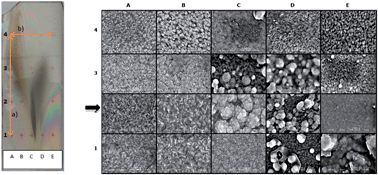
A mixed phase TiO2 and SnO2 film was deposited by combinatorial aerosol assisted CVD and composition was related to photocatalysis, hydrophobicity and microstructure not inherent to TiO2 or SnO2.
The content of this RSS Feed (c) The Royal Society of Chemistry
19 Feb 15:34
by Xingbo Ge, Luyang Chen, Ling Zhang, Yuren Wen, Akihiko Hirata, Mingwei Chen

We fabricated a robust electrocatalyst by chemically depositing an ultrathin layer of amorphous molybdenum sulfide on the internal surface of dealloyed nanoporous gold. The catalyst exhibits superior electrocatalysis toward hydrogen evolution reaction in both acidic and neutral media with 2–6 times improvement in catalytic activies compared to other molybdenum sulfide based materials.
18 Feb 12:10
by Matti B. Alemayehu, Gavin Mitchson, Jeffery Ditto, Ben E. Hanken, Mark Asta and David C. Johnson

Chemistry of Materials
DOI: 10.1021/cm404018a

18 Feb 12:06
Nanoscale, 2014, 6,4486-4490
DOI: 10.1039/C3NR06578B, Communication
Anirban Samanta, Zhengtao Deng, Yan Liu
DNA conjugation of infrared emitting hydrophilic QDs and their organization site specifically onto DNA nanostructure.
The content of this RSS Feed (c) The Royal Society of Chemistry

18 Feb 12:06
by Marion J. L. Sourribes, Ivan Isakov, Marina Panfilova, Huiyun Liu and Paul A. Warburton

Nano Letters
DOI: 10.1021/nl5001554

18 Feb 12:02
by Ying Yu, Xiu-Ming Dou, Bin Wei, Guo-Wei Zha, Xiang-Jun Shang, Li Wang, Dan Su, Jian-Xing Xu, Hai-Yan Wang, Hai-Qiao Ni, Bao-Quan Sun, Yuan Ji, Xiao-Dong Han, Zhi-Chuan Niu

Two types of quantum nanostructures based on self-assembled GaAs quantumdots embedded into GaAs/AlGaAs hexagonal nanowire systems are reported, opening a new avenue to the fabrication of highly efficient single-photon sources, as well as the design of novel quantum optics experiments and robust quantum optoelectronic devices operating at higher temperature, which are required for practical quantum photonics applications.
13 Feb 14:18
J. Mater. Chem. A, 2014, 2,4865-4869
DOI: 10.1039/C4TA00341A, Communication
Sophie L. Benjamin, C. H. (Kees) de Groot, Chitra Gurnani, Andrew L. Hector, Ruomeng Huang, Elena Koukharenko, William Levason, Gillian Reid
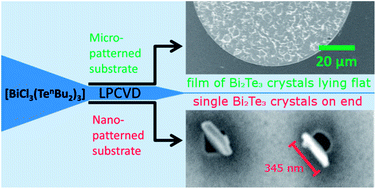
Arrays of individual Bi2Te3 nanocrystals can be positioned selectively on TiN/SiO2 patterned substrates by CVD using [BiCl3(TenBu2)3]. This leads to preferred 〈1 1 0〉 orientation which contrasts with the strongly preferred 〈0 0 1〉 orientation evident when the nanocrystals are contained within micron-scale wells.
The content of this RSS Feed (c) The Royal Society of Chemistry
13 Feb 14:10
by Ergang Wang, Wendimagegn Mammo, Mats R. Andersson
Driven by the potential advantages and promising applications of organic solar cells, donor-acceptor (D-A) polymers have been intensively investigated in the past years. One of the strong electron-withdrawing groups that were widely used as acceptors for the construction of D-A polymers for applications in polymer solar cells and FETs is isoindigo. The isoindigo-based polymer solar cells have reached efficiencies up to ∼7% and hole mobilities as high as 3.62 cm2 V−1 s−1 have been realized by FETs based on isoindigo polymers. Over one hundred isoindigo-based small molecules and polymers have been developed in only three years. This review is an attempt to summarize the structures and properties of the isoindigo-based polymers and small molecules that have been reported in the literature since their inception in 2010. Focus has been given only to the syntheses and device performances of those polymers and small molecules that were designed for use in solar cells and FETs. Attempt has been made to deduce structure-property relationships that would guide the design of isoindigo-based materials. It is expected that this review will present useful guidelines for the design of efficient isoindigo-based materials for applications in solar cells and FETs.

This review summarizes isoindigobased polymers and small molecules for bulk-heterojunction solar cells and field-effect transistors (FETs). The structure-property relationships are deduced based on results from the literature and density functional theory (DFT) calculations. Isoindigo-based materials are anticipated to play an important role in the development of solar cells and FETs due to their appropriate energy levels, high absorption coefficients, and mobility.
12 Feb 18:09
J. Mater. Chem. A, 2014, 2,3325-3331
DOI: 10.1039/C3TA14888B, Paper
Elodie Blanco, Denis Uzio, Gilles Berhault, Pavel Afanasiev
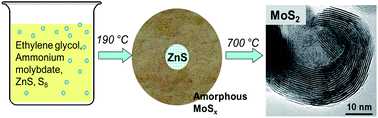
Open 20-50 nm size fullerene-like MoS2 particles having controllable size and wall thickness were prepared with a quantitative yield from the seed-grown core-shell materials MoSx/ZnS (x [similar] 3-4).
The content of this RSS Feed (c) The Royal Society of Chemistry
12 Feb 18:08
by Peng-peng Wang, Hongyu Sun, Yongjun Ji, Wenhai Li, Xun Wang

Assembly of single layers: Three-dimensional assembly of single-layered MoS2 is achieved on a large scale via a solution method. The as-prepared tubular architectures have tunable size and mesopores in the shell, which are desirable for applications. As a example, they exhibit excellent lithium storage properties and are highly active for hydrodesulfurization of thiophene resulting from their structural advantages.
12 Feb 18:00

“My biggest motivation is curiosity. The most exciting thing about my research is not knowing what comes next. …” This and more about Alexander Eychmüller can be found on page 2028.
11 Feb 17:53
by Haiming Zhu, Ye Yang, Kim Hyeon-Deuk, Marco Califano, Nianhui Song, Youwei Wang, Wenqing Zhang, Oleg V. Prezhdo and Tianquan Lian

Nano Letters
DOI: 10.1021/nl4041687

11 Feb 10:18
J. Mater. Chem. C, 2014, 2,2107-2111
DOI: 10.1039/C4TC00037D, Communication
H. Mirzai, M. N. Nordin, R. J. Curry, J.-S. Bouillard, A. V. Zayats, M. Green
In this report, we describe a synthesis of high quality infrared emitting HgSe quantum dots using a variety of room temperature routes, resulting in particles of various morphologies.
The content of this RSS Feed (c) The Royal Society of Chemistry
11 Feb 10:17
by Soong Ju Oh, Nathaniel E. Berry, Ji-Hyuk Choi, E. Ashley Gaulding, Hangfei Lin, Taejong Paik, Benjamin. T. Diroll, Shin Muramoto, Christopher B. Murray and Cherie R. Kagan

Nano Letters
DOI: 10.1021/nl404818z

11 Feb 10:15
by Jannise J. Buckley, Elsa Couderc, Matthew J. Greaney, James Munteanu, Carson T. Riche, Stephen E. Bradforth and Richard L. Brutchey

ACS Nano
DOI: 10.1021/nn406109v

11 Feb 10:14
Chem. Commun., 2014, 50,3464-3466
DOI: 10.1039/C3CC49335K, Communication
Jianheng Luo, Huiyun Wei, Fan Li, Qingli Huang, Dongmei Li, Yanhong Luo, Qingbo Meng
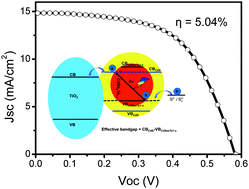
A facile microwave assisted aqueous method has been developed to rapidly prepare stable CdSexTe1-x-CdS quantum dots. Based on this material, a champion efficiency of 5.04% has been obtained for quantum dot sensitized solar cells using core-shell type II CdSexTe1-x-CdS QDs as sensitizers.
The content of this RSS Feed (c) The Royal Society of Chemistry

10 Feb 17:05
Dalton Trans., 2014, 43,5535-5545
DOI: 10.1039/C3DT53095G, Paper
Juan Gallo, Israt S. Alam, Jiefu Jin, Yan-Juan Gu, Eric O. Aboagye, Wing-Tak Wong, Nicholas J. Long
A multimodal imaging platform based on upconversion nanoparticles is proposed. The nanoparticles have been functionalised with targeting peptides and macrocycles, and their application as in vivo cancer imaging probes studied after labelling with 68Ga.
The content of this RSS Feed (c) The Royal Society of Chemistry

07 Feb 10:08
by Yong-Jae Kim, Chul-Hee Cho, Kwanyeol Paek, Mijung Jo, Mi-kyoung Park, Na-Eun Lee, Youn-joong Kim, Bumjoon J. Kim and Eunji Lee

Journal of the American Chemical Society
DOI: 10.1021/ja410165f