26 Mar 15:56
by Gunnar Berghäuser and Ermin Malic
Author(s): Gunnar Berghäuser and Ermin Malic
We present an analytical investigation of the optical absorption spectrum of monolayer molybdenum-disulfide. Based on the density matrix formalism, our approach gives insights into the microscopic origin of excitonic transitions, their relative oscillator strength, and binding energy. We show analyt...
[Phys. Rev. B 89, 125309] Published Thu Mar 20, 2014
26 Mar 12:52
by Nardeep Kumar, Qiannan Cui, Frank Ceballos, Dawei He, Yongsheng Wang, and Hui Zhao
Author(s): Nardeep Kumar, Qiannan Cui, Frank Ceballos, Dawei He, Yongsheng Wang, and Hui Zhao
We investigate the excitonic dynamics in MoSe2 monolayer and bulk samples by femtosecond transient absorption. Excitons are resonantly injected by a 750-nm and 100-fs laser pulse, and are detected by measuring a differential reflection of a probe pulse tuned in the range 790–820 nm. We observe a str...
[Phys. Rev. B 89, 125427] Published Mon Mar 24, 2014
26 Mar 10:34
by Evelyn L. Rosen, April M. Sawvel, Delia J. Milliron and Brett A. Helms

Chemistry of Materials
DOI: 10.1021/cm404149u

24 Mar 13:28
Animal behaviour: Badgers roam many miles
Nature 507, 7492 (2014). doi:10.1038/507276c
Badgers could be travelling much greater distances than previously supposed, a finding that might affect how the animals are culled or vaccinated to prevent the spread of bovine tuberculosis.Andrew Byrne at University College Dublin and his colleagues marked 963 European badgers (Meles meles

19 Mar 14:57
by Stefano Larentis, John R. Tolsma, Babak Fallahazad, David C. Dillen, Kyounghwan Kim, Allan H. MacDonald and Emanuel Tutuc

Nano Letters
DOI: 10.1021/nl500212s

Naktal and -1 others like this
19 Mar 14:47
by S. Ghosh, S. Najmaei, S. Kar, R. Vajtai, J. Lou, N. R. Pradhan, L. Balicas, P. M. Ajayan, and S. Talapatra
Author(s): S. Ghosh, S. Najmaei, S. Kar, R. Vajtai, J. Lou, N. R. Pradhan, L. Balicas, P. M. Ajayan, and S. Talapatra
Here, we report on the ac conductivity [σ′(ω);10mHz<ω<0.1MHz] measurements performed on atomically thin, two-dimensional layers of MoS2 grown by chemical vapor deposition (CVD). σ′(ω) is observed to display a “universal” power law, i.e., σ′(ω)∼ωs measured within a broad range of temperatures, ...
[Phys. Rev. B 89, 125422] Published Wed Mar 19, 2014
18 Mar 16:15
by Feng Gao, Zhe Li, Jianpu Wang, Akshay Rao, Ian A. Howard, Agnese Abrusci, Sylvain Massip, Christopher R. McNeill and Neil C. Greenham

ACS Nano
DOI: 10.1021/nn501185h

18 Mar 15:14
J. Mater. Chem. C, 2014, 2,4974-4979
DOI: 10.1039/C4TC00232F, Paper
Wan Ki Bae, Jaehoon Lim, Matthias Zorn, Jeonghun Kwak, Young-Shin Park, Donggu Lee, Seonghoon Lee, Kookheon Char, Rudolf Zentel, Changhee Lee
Hybridization of colloidal quantum-dots and conducting polymers improves the efficiency roll-off of quantum-dot light-emitting diodes.
The content of this RSS Feed (c) The Royal Society of Chemistry
18 Mar 13:11
by Benjamin J. Coe and Rachel A. Pilkington

The Journal of Physical Chemistry A
DOI: 10.1021/jp4114927

18 Mar 11:43
by De Nyago Tafen, Run Long and Oleg V. Prezhdo

Nano Letters
DOI: 10.1021/nl404352a

18 Mar 10:58
J. Mater. Chem. C, 2014, 2,3868-3872
DOI: 10.1039/C4TC00300D, Communication
Avijit Saha, Soma Chattopadhyay, Tomohiro Shibata, Ranjani Viswanatha
The internal structure can be used to tune the properties of quantum dots.
The content of this RSS Feed (c) The Royal Society of Chemistry
18 Mar 10:57
Nanoscale, 2014, 6,5820-5825
DOI: 10.1039/C4NR00177J, Paper
Alex Kutana, Evgeni S. Penev, Boris I. Yakobson
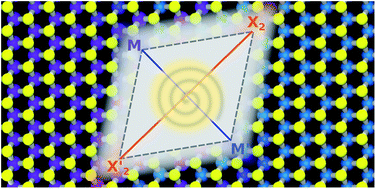
We report thermodynamic and electronic properties of 2D transition metal dichalcogenide alloys beyond the mean field approximation.
The content of this RSS Feed (c) The Royal Society of Chemistry

18 Mar 10:47
Phys. Chem. Chem. Phys., 2014, 16,7672-7676
DOI: 10.1039/C4CP00846D, Communication
M. J. Speirs, B. G. H. M. Groeneveld, L. Protesescu, C. Piliego, M. V. Kovalenko, M. A. Loi
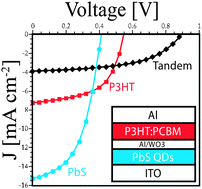
A tandem solar cell is fabricated with one PbS QD and one polymer-fullerene subcell for a broad spectral coverage. Tungsten(VI) oxide is demonstrated as an effective interlayer.
The content of this RSS Feed (c) The Royal Society of Chemistry

17 Mar 14:34
by Hirokazu Nagaoka, Adam E. Colbert, Elisabeth Strein, Eric M. Janke, Michael Salvador, Cody W. Schlenker and David S. Ginger

The Journal of Physical Chemistry C
DOI: 10.1021/jp412545q

17 Mar 14:30
by Wei Zhou, Yanyu Liu, Yuzhe Yang and Ping Wu

The Journal of Physical Chemistry C
DOI: 10.1021/jp500546r

17 Mar 13:29
by Xuesong Yin, Chunhua Tang, Linfeng Sun, Zexiang Shen and Hao Gong

Chemistry of Materials
DOI: 10.1021/cm403423e

17 Mar 11:47
by S. Kumar, E. Zallo, Y. H. Liao, P. Y. Lin, R. Trotta, P. Atkinson, J. D. Plumhof, F. Ding, B. D. Gerardot, S. J. Cheng, A. Rastelli, and O. G. Schmidt
Author(s): S. Kumar, E. Zallo, Y. H. Liao, P. Y. Lin, R. Trotta, P. Atkinson, J. D. Plumhof, F. Ding, B. D. Gerardot, S. J. Cheng, A. Rastelli, and O. G. Schmidt
We study the effects of heavy hole–light hole (HH-LH) mixing on fine-structure and polarization properties of neutral excitons (X0) confined in single GaAs/AlGaAs quantum dots (QDs) under the application of anisotropic biaxial stress. In the large HH-LH mixing regime, these properties are substantia...
[Phys. Rev. B 89, 115309] Published Wed Mar 12, 2014
11 Mar 16:03
by Paul Simon, Lydia Bahrig, Igor A. Baburin, Petr Formanek, Falk Röder, Jan Sickmann, Stephen G. Hickey, Alexander Eychmüller, Hannes Lichte, Rüdiger Kniep, Elena Rosseeva

Make it connected! 2D close-packed layers of inorganic nanoparticles are interconnected by organic fibrils of oleic acid as clearly visualized by electron holography. These fibrils can be mineralised by PbS to transform an organic-inorganic framework to a completely interconnected inorganic semiconducting 2D array.
11 Mar 14:40
by Ke Zhao, Haijing Yu, Hua Zhang and Xinhua Zhong

The Journal of Physical Chemistry C
DOI: 10.1021/jp4118369

10 Mar 15:54
Phys. Chem. Chem. Phys., 2014, 16,8515-8520
DOI: 10.1039/C4CP00395K, Paper
Kaifu Bian, Benjamin T. Richards, Hanqing Yang, William Bassett, Frank W. Wise, Zhongwu Wang, Tobias Hanrath
We investigated pressure-dependent changes in the optical properties of PbS nanocrystal quantum dots (NQD) by combining X-ray scattering and optical absorption spectroscopy in a diamond anvil cell.
The content of this RSS Feed (c) The Royal Society of Chemistry

10 Mar 15:52
by Feng Liu, A. V. Rodina, D. R. Yakovlev, A. Greilich, A. A. Golovatenko, A. S. Susha, A. L. Rogach, Yu. G. Kusrayev, and M. Bayer
Author(s): Feng Liu, A. V. Rodina, D. R. Yakovlev, A. Greilich, A. A. Golovatenko, A. S. Susha, A. L. Rogach, Yu. G. Kusrayev, and M. Bayer
The recombination and spin dynamics of excitons in colloidal CdTe nanocrystals (NCs) are studied by time-resolved photoluminescence in high magnetic fields up to 15 T and at cryogenic temperatures. The recombination decay shows a nonexponential temporal behavior, with the longest component correspon...
[Phys. Rev. B 89, 115306] Published Mon Mar 10, 2014
10 Mar 14:53
by Jianjun Tian, Lili Lv, Xuyang Wang, Chengbin Fei, Xiaoguang Liu, Zhenxuan Zhao, Yajie Wang and Guozhong Cao

The Journal of Physical Chemistry C
DOI: 10.1021/jp412525k

10 Mar 12:20
by Sheng-Han Su, Yu-Te Hsu, Yung-Huang Chang, Ming-Hui Chiu, Chang-Lung Hsu, Wei-Ting Hsu, Wen-Hao Chang, Jr-Hau He, Lain-Jong Li

The optical energy gap of as-grown MoS2 flakes from chemical vapor deposition can be modulated from 1.86 eV (667 nm) to 1.57 eV (790 nm) by a vapor phase selenization process. This approach, replacing one chalcogen by another in the gas phase, is promising in modulating the optical and electronic properties of other transition metal dichalcogenide monolayers.
10 Mar 12:20
by Zongyou Yin, Bo Chen, Michel Bosman, Xiehong Cao, Junze Chen, Bing Zheng, Hua Zhang

The surface plasmon resonance of Au nanoparticle on MoS2 nanosheet is successfully measured by the electron energy-loss spectroscopy. Furthermore, Au-MoS2 composite is developed as the photoanode material in the photoelectronchemical cell (PEC) for water splitting. Compared to the pure MoS2-based PEC, Au-MoS2 based PEC shows the enhanced performance in the photocatalytic water splitting.
10 Mar 12:20
by Lin-Bao Luo, Xiao-Li Huang, Ming-Zheng Wang, Chao Xie, Chun-Yan Wu, Ji-Gang Hu, Li Wang, Jian-An Huang
In this work, a simple strategy is proposed to improve the device performance of photodetector by modifying plasmonic nanoparticles onto the surface of semiconductors nanostructure. Both experimental analysis and theoretical simulation show that the plasmonic metal nanoparticles (AuNPs) exhibits obvious localized surface plasmon resonance (LSPR) which can trap incident light efficiently, leading to enhanced photocurrents and improved performance of photoelectronic devices. It is also observed that the AuNPs modified CdTeNW photodetector exhibit apparent sensitivity to 510 nm light, to which pure CdTeNWs is virtually blind. What is more, after AuNPs decoration, the response speed of the photodetector is increased substantially from 6.12 to 1.92 s. It is believed that this result will open up new doors for manipulating light and further improving the efficiency of semiconductor nanostructures based optoelectronic devices.

The influence of the plasmonic nanoparticles on device performance of individual CdTe nanowire based photodetector is studied. Both theoretical simulation and experimental studies reveal that the modified metal nanoparticles exhibit obvious localized surface plasmon resonance, leading to improved device performance, broadened spectral selectivity, and fastened response speed.
10 Mar 12:17
by Samrana Kazim, Mohammad Khaja Nazeeruddin, Michael Grätzel, Shahzada Ahmad
Abstract
It is not often that the scientific community is blessed with a material, which brings enormous hopes and receives special attention. When it does, it expands at a rapid pace and its every dimension creates curiosity. One such material is perovskite, which has triggered the development of new device architectures in energy conversion. Perovskites are of great interest in photovoltaic devices due to their panchromatic light absorption and ambipolar behavior. Power conversion efficiencies have been doubled in less than a year and over 15 % is being now measured in labs. Every digit increment in efficiency is being celebrated widely in the scientific community and is being discussed in industry. Here we provide a summary on the use of perovskite for inexpensive solar cells fabrication. It will not be unrealistic to speculate that one day perovskite-based solar cells can match the capability and capacity of existing technologies.

Wonder material: The use of perovskites as light absorber in photovoltaic cells has revolutionized the field. Light-to-electricity conversion efficiencies of 15 % have already been achieved, and even without additional hole transport layers efficiencies up to 8 % can be measured. The unique combination of high extinction coefficient along with their ambipolar nature gives perovskites an advantage over quantum-dot- and dye-sensitized solar cells.
10 Mar 12:07
by Man Suk Song and Yong Kim

The Journal of Physical Chemistry C
DOI: 10.1021/jp500696r

10 Mar 12:07
by Youngwoo Choi, Minsu Seol, Wooseok Kim and Kijung Yong

The Journal of Physical Chemistry C
DOI: 10.1021/jp411221q

10 Mar 11:59
by Genrong Shao, Guihuan Chen, Weilai Yang, Tao Ding, Jian Zuo and Qing Yang

Langmuir
DOI: 10.1021/la4042869

10 Mar 11:24
by Ruma Das, Bipul Rakshit, Saikat Debnath, and Priya Mahadevan
Author(s): Ruma Das, Bipul Rakshit, Saikat Debnath, and Priya Mahadevan
At the monolayer limit both MoS2 and the graphitic phase of ZnO have a direct band gap. Biaxial tensile strain has been found to induce a transition into an indirect band-gap semiconductor with the strain percentage required for the transition equal to 0.83% for MoS2 and 8% for ZnO, respectively. A ...
[Phys. Rev. B 89, 115201] Published Thu Mar 06, 2014