Naughty Paul
Shared posts
[News Focus] Making Every Scientist a Research Funder
Defect-Dominated Doping and Contact Resistance in MoS2

Scaling up the Production of Colloidal Nanocrystals: Should We Increase or Decrease the Reaction Volume?
Recent progress in facet-controlled syntheses has started to produce nanocrystals with great promise as the next-generation catalysts for a variety of applications. To move from academic studies to industrial applications, however, one has to address the issue of scaling up a synthesis that has been commonly conducted in a batch format. There are two opposite approaches to scaling up the production of colloidal nanocrystals: increasing and decreasing the reaction volume. Contrary to conventional wisdom, continuous flow synthesis based on droplets is expected to provide a more practical platform for scaling up the synthesis. Here we highlight recent progress in using droplet reactors for the synthesis of colloidal noble-metal nanocrystals with controlled sizes and shapes, with an aim towards high-volume production.

Most people probably would scale up the production of colloidal nanocrystals by increasing the reaction volume. Here we demonstrate that decreasing the reaction volume with the use of a continuous flow of droplet reactors will be a more practical approach.
Acid-Base Control of Hemilabile Proton-Responsive Protecting Devices in Dimolybdenum, Thiolate-Bridged Complexes

Thio-, seleno- and telluro-ether complexes of aluminium(III) halides: synthesis, structures and properties
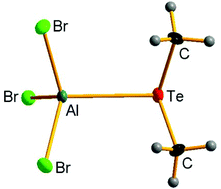
DOI: 10.1039/C3DT52991F, Paper
Four-, five-, and six-coordinate complexes of aluminium halides with chalcogenoethers are described, and compared with gallium and indium analogues.
The content of this RSS Feed (c) The Royal Society of Chemistry
Investigation of Indium Phosphide Quantum Dot Nucleation and Growth Utilizing Triarylsilylphosphine Precursors

Simple Ligand Exchange Reactions Enabling Excellent Dispersibility and Stability of Magnetic Nanoparticles in Polar Organic, Aromatic, and Protic Solvents

One-pot synthesis in liquid paraffin of ternary alloy CdSexS1−x nanocrystals with fluorescence emission covering entire visible region
Abstract
The ternary alloy CdSexS1−x nanocrystals are synthesized in liquid paraffin via one-pot method. The fluorescence emission of the nanocrystals can be altered from violet to green by adjusting the ratio of Se to S without particle size change. By applying subsequent surface modification of the nanocrystals with amine, the fluorescence emission from yellow to red is successfully obtained that is achieved from trap emission enhancement. As a result, the combination of these two approaches makes the fluorescence emission of the ternary alloy CdSexS1−x nanocrystals covering entire visible region from violet to red while their sizes are similar and keep constant.
Emerging Device Applications for Semiconducting Two-Dimensional Transition Metal Dichalcogenides


From lab to fab: how must the polymer solar cell materials design change? - an industrial perspective

DOI: 10.1039/C3EE43460E, Perspective
The design of materials for efficient large-area printed polymer solar modules beyond the lab-scale research is discussed.
The content of this RSS Feed (c) The Royal Society of Chemistry
Large scale deployment of polymer solar cells on land, on sea and in the air

DOI: 10.1039/C3EE43212B, Analysis
With the development of patterns that connect all cells in series, organic photovoltaics have leapt a step forward being ahead of other solar and even other energy technologies in terms of manufacturing speed, installation speed, ease of deployment and energy pay-back time.
The content of this RSS Feed (c) The Royal Society of Chemistry
A new method for separation, characterization, and quantification of natural nanoparticles from soils
Abstract
Properties and distribution dynamics of nanoparticles are pertinent to ecological and human health. Wide variation in particle density confounds their accurate separation for study. The objective of this study was to develop a fine-particle separation protocol requiring no constant density assumption. Six soils with contrasting properties were chosen for study. Size distributions of suspended particles following centrifugation were assessed using dynamic light scattering. Mineralogy was determined by X-ray diffraction. Particle characteristics were examined using transmission electron microscopy. A significant pooled logarithmic relationship was found between centrifugation speed and particle-size distribution. Nanoparticles (<100 nm) became dominant by fractional volume at widely differing separation energies among the six soils. However, relations were strong between separation energies and fractional volume for individual soils. Bi- and tri-modal-size distributions within suspensions were related to density differences of soil components. Re-aggregation at high separation energy was apparent for the tropical soils. Light-scattering, UV–Visible absorbance, and chemical analyses distinguished samples of high hematite content from those without hematite. These results indicate that dynamic light scattering in conjunction with a standard centrifuge regimen provides a practical means of collecting colloidal particles within a targeted size range, compensating for natural variations among the soil samples.
[Editorial] Visa Labyrinth
Reaching quantum yields [dbl greater-than]100% in nanomaterials

DOI: 10.1039/C3TC31662A, Paper
The synthesis of otherwise hardly accessible nanoscale trigonal GdF3:Eu provides a superior capability as a host material for quantum-cutting materials.
The content of this RSS Feed (c) The Royal Society of Chemistry
Role of the Seeding Promoter in MoS2 Growth by Chemical Vapor Deposition

Shell Thickness Modulation in Ultrasmall CdSe/CdSxSe1–x/CdS Core/Shell Quantum Dots via 1-Thioglycerol

Spectroscopy of single nanocrystals
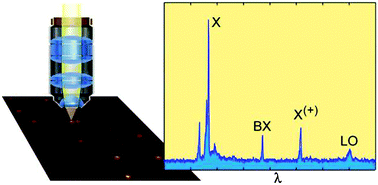
DOI: 10.1039/C3CS60209E, Review Article
Spectroscopic studies of single nanocrystals have been instrumental in unraveling their complex photo-physics.
The content of this RSS Feed (c) The Royal Society of Chemistry
In Situ Live Observation of Nucleation and Dissolution of Sodium Chlorate Nanoparticles by Transmission Electron Microscopy

Removal of Total Organic Carbon from Sewage Wastewater Using Poly(ethylenimine)-Functionalized Magnetic Nanoparticles

Quantum Dots Encapsulated within Phospholipid Membranes: Phase-Dependent Structure, Photostability, and Site-Selective Functionalization

Solution-phase catalytic synthesis, characterization and growth kinetics of Ag2S-CdS matchstick-like heteronanostructures

DOI: 10.1039/C3DT52693C, Paper
Ag2S nanocrystals are catalytically active in the growth of CdS nanorods in oleylamine, and the reaction yields Ag2S-CdS matchstick-like heteronanostructures.
The content of this RSS Feed (c) The Royal Society of Chemistry
Physically Flexible, Rapid-Response Gas Sensor Based on Colloidal Quantum Dot Solids

A gas sensor based on PbS colloidal quantum dots (CQDs) is constructed on a paper substrate, yielding flexible, rapid-response NO2 gas sensors, fabricated from the solution phase. The devices are highly sensitive and fully recoverable at room temperature, which is attributed to the excellent access of gas molecules to the CQD surface, realized by surface ligand removal, combined with the desirable binding energy of NO2 with the PbS CQDs.
Mechanistic Insights into the Role of Alkylamine in the Synthesis of CdSe Nanocrystals

Metal tips on pyramid-shaped PbSe/CdSe/CdS heterostructure nanocrystal photocatalysts: study of Ostwald ripening and core/shell formation

DOI: 10.1039/C3CC48919A, Communication
The Ostwald ripening of metal nanoparticles on pyramid-shaped nanocrystals is elucidated. The controlled overgrowth of the metal shell on existing metal cocatalysts enables the study of the effects of the Fermi level upon photocatalysis using heterostructure nanocrystals.
The content of this RSS Feed (c) The Royal Society of Chemistry
Defect rich seed mediated growth: a novel synthesis method to enhance defect emission in nanocrystals

DOI: 10.1039/C3TC32107J, Paper
Defect rich seed mediated growth is reported for synthesising different sized ZnO QDs with enhanced and size tunable defect emission.
The content of this RSS Feed (c) The Royal Society of Chemistry
Dynamics of Soft Nanomaterials Captured by Transmission Electron Microscopy in Liquid Water

Synthesis, structural characterization, and electrochemical performance of nanocast mesoporous Cu-/Fe-based oxides

DOI: 10.1039/C3TA14111J, Paper
A series of nanocast mesoporous mixed Cu-/Fe-based oxides have been synthesized and their electrochemical properties have been investigated systematically.
The content of this RSS Feed (c) The Royal Society of Chemistry
Purifying Colloidal Nanoparticles through Ultracentrifugation with Implications for Interfaces and Materials

Nearly lattice matched all wurtzite CdSe/ZnTe type II core-shell nanowires with epitaxial interfaces for photovoltaics

DOI: 10.1039/C3NR06137J, Paper
Nearly lattice matched CdSe/ZnTe type-II core-shell nanowires exhibit wurtzite structures and epitaxial interfaces, promising a number of multifunctional nanodevices.
The content of this RSS Feed (c) The Royal Society of Chemistry