25 Apr 11:06
Dalton Trans., 2014, 43,9481-9485
DOI: 10.1039/C4DT00688G, Paper
Chunyu Jin, Parthiban Ramasamy, Jinkwon Kim
CZTSe nanoparticles were synthesized using bis-(triethylsilyl)selenide as the selenium source for the first time. The effect of reaction time and precursor injection order on the formation of stoichiometric CZTSe nanoparticles has been studied by Raman spectroscopy.
The content of this RSS Feed (c) The Royal Society of Chemistry

25 Apr 11:01
Dalton Trans., 2014, 43,8703-8712
DOI: 10.1039/C4DT00610K, Paper
Damian C. Onwudiwe, Christien A. Strydom, Oluwatobi S. Oluwafemi, Eric Hosten, Anine Jordaan
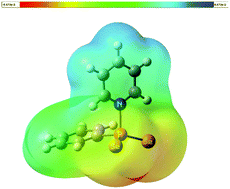
The synthesis and characterization of pyridyl adducts of Zn(II) and Cd(II) dtc: precursors to ZnS and CdS nanoparticles are reported.
The content of this RSS Feed (c) The Royal Society of Chemistry

25 Apr 10:49
by Peter Nørby, Simon Johnsen and Bo B. Iversen

ACS Nano
DOI: 10.1021/nn5010638

ziyang and -1 others like this
25 Apr 10:47
by Quan Ma, Miguel Isarraraz, Chen S. Wang, Edwin Preciado, Velveth Klee, Sarah Bobek, Koichi Yamaguchi, Emily Li, Patrick Michael Odenthal, Ariana Nguyen, David Barroso, Dezheng Sun, Gretel von Son Palacio, Michael Gomez, Andrew Nguyen, Duy Le, Greg Pawin, John Mann, Tony. F. Heinz, Talat Shahnaz Rahman and Ludwig Bartels

ACS Nano
DOI: 10.1021/nn5004327

riel and -1 others like this
24 Apr 15:06
by Hai Li, Jumiati Wu, Zongyou Yin and Hua Zhang

Accounts of Chemical Research
DOI: 10.1021/ar4002312

24 Apr 14:51
by Karthik Ramasamy, Hunter Sims, William H. Butler and Arunava Gupta

Chemistry of Materials
DOI: 10.1021/cm5005642

24 Apr 14:44
Nanoscale, 2014, 6,7553-7559
DOI: 10.1039/C4NR00566J, Paper
Shou-Yi Kuo, Ming-Yang Hsieh
(a) The simulation angular reflectance spectra for a solar cell with (top) bare and (bottom) AZO SWG solar cells. (b) The weighted reflectance of the cells. This shows that the AZO SWG structure is a suitable alternative to omnidirectional AR coating for CZTS solar cells.
The content of this RSS Feed (c) The Royal Society of Chemistry

24 Apr 14:40
by Bent Weber
Nature Nanotechnology.
doi:10.1038/nnano.2014.63
Authors: Bent Weber, Y. H. Matthias Tan, Suddhasatta Mahapatra, Thomas F. Watson, Hoon Ryu, Rajib Rahman, Lloyd C. L. Hollenberg, Gerhard Klimeck & Michelle Y. Simmons

24 Apr 14:39
by Wu Zhou
Nature Nanotechnology.
doi:10.1038/nnano.2014.87
Author: Wu Zhou
The electron beam of a scanning transmission electron microscope can be used to trigger phase transitions in a monolayer of MoS2 and record the dynamics of the process with single-atom resolution.

24 Apr 14:29
Chem. Commun., 2014, 50,5382-5384
DOI: 10.1039/C3CC47912A, Communication
Erik Wachtler, Robert Gericke, Lyuben Zhechkov, Thomas Heine, Thorsten Langer, Birgit Gerke, Rainer Pottgen, Jorg Wagler
Pyridine-2-thiolate tin(IV) compounds were shown to chelate Pd(0) in a pincer-like fashion with formation of penta- and hexacoordinate tin compounds.
The content of this RSS Feed (c) The Royal Society of Chemistry

24 Apr 14:10
Chem. Commun., 2014, 50,6214-6216
DOI: 10.1039/C4CC01073F, Communication
Laura Ascherl, Andreas Nordheider, Kasun S. Athukorala Arachchige, David B. Cordes, Konstantin Karaghiosoff, Michael Buhl, Alexandra M. Z. Slawin, J. Derek Woollins
Reaction of Woollins' reagent (WR) with pyridine yields the P(V) species PhPSe2 stabilised by pyridine coordination. Its potential as a selenation reagent under mild conditions was shown by calculations and an experimental comparison to WR.
The content of this RSS Feed (c) The Royal Society of Chemistry

24 Apr 14:08
Chem. Commun., 2014, 50,5902-5904
DOI: 10.1039/C3CC49207A, Communication
Theodore R. Knutson, Parker J. Hanson, Eray S. Aydil, R. Lee Penn
Copper zinc tin sulfide (CZTS) thin films were deposited from homogeneous solutions of precursors and directly onto conductive films via selective thermolysis by microwave heating.
The content of this RSS Feed (c) The Royal Society of Chemistry

24 Apr 13:54
by Jian-jun Wang, Pai Liu, Colin C. Seaton and Kevin M Ryan

Journal of the American Chemical Society
DOI: 10.1021/ja501591n

24 Apr 13:19
by Rabih Makki, Xin Ji, Hedi Mattoussi and Oliver Steinbock

Journal of the American Chemical Society
DOI: 10.1021/ja501941d

24 Apr 13:19
by Kaibo Zheng, Karel Žídek, Mohamed Abdellah, Nan Zhu, Pavel Chábera, Nils Lenngren, Qijin Chi and Tõnu Pullerits

Journal of the American Chemical Society
DOI: 10.1021/ja411127w

24 Apr 13:18
by Whitney Bryks, Melissa Wette, Nathan Velez, Su-Wen Hsu and Andrea R. Tao

Journal of the American Chemical Society
DOI: 10.1021/ja500786p

24 Apr 13:16
by Dmitry N. Dirin, Sébastien Dreyfuss, Maryna I. Bodnarchuk, Georgian Nedelcu, Paris Papagiorgis, Grigorios Itskos and Maksym V. Kovalenko

Journal of the American Chemical Society
DOI: 10.1021/ja5006288

24 Apr 13:14
by Yuan Gao and Xiaogang Peng

Journal of the American Chemical Society
DOI: 10.1021/ja5020025

10 Apr 14:56
by Benjamin D. Mangum, Feng Wang, Allison M. Dennis, Yongqian Gao, Xuedan Gao, Jennifer A. Hollingsworth, Han Htoon
Performing time-tagged, time-correlated, single-photon-counting studies on individual colloidal nanocrystal quantum dots (NQDs), the evolution of photoluminescence (PL) intensity-fluctuation behaviors in near-infrared (NIR) emitting type II, InP/CdS core-shell NQDs is investigated as a function of shell thickness. It is observed that Auger recombination and hot-carrier trapping compete in defining the PL intensity-fluctuation behavior for NQDs with thin shells, whereas the role of hot-carrier trapping dominates for NQDs with thick shells. These studies further reveal the distinct ramifications of altering either the excitation fluence or repetition rate. Specifically, an increase in laser pump fluence results in the creation of additional hot-carrier traps. Alternately, higher repetition rates cause a saturation in hot-carrier traps, thus activating Auger-related PL fluctuations. Furthermore, it is shown that Auger recombination of negatively charged excitons is suppressed more strongly than that of positively charged excitons because of the asymmetry in the electron-hole confinement in type II NQDs. Thus, this study provides new understanding of how both NQD structure (shell thickness and carrier-separation characteristics) and excitation conditions can be used to tune the PL stability, with important implications for room-temperature single-photon generation. Specifically, the first non-blinking NQD capable of single-photon emission in the near-infrared spectral regime is described.

Single-dot spectroscopy studies of near-infrared emitting type II, InP/CdS core–shell nanocrystals reveal that Auger recombination and hot-carrier trapping compete in defining the PL intensity-fluctuation behavior at thin shells, whereas the role of hot-carrier trapping dominates for thick shells. Additionally, a strong potential is demonstrated for the use of the g-NQDs in room-temperature single-photon generation.
10 Apr 14:52
Nanoscale, 2014, 6,6812-6818
DOI: 10.1039/C4NR00431K, Paper
Cristina Palencia, Koen Lauwaet, Leonor de la Cueva, Maria Acebron, Julio J. Conde, Michaela Meyns, Christian Klinke, Jose M. Gallego, Roberto Otero, Beatriz H. Juarez
In situ generated chloride ions passivate CdSe nanocrystals.
The content of this RSS Feed (c) The Royal Society of Chemistry

10 Apr 14:41
by Andrew Lin, Joshua N. Shapiro, Holger Eisele, Diana L. Huffaker
A thorough study of direct InSb nanocrystal formations on patterned InAs (111)B substrates is provided. These nanostructures are created without the use of Au catalysts or initial InAs segments. Under the growth conditions generally used for selective-area, catalyst-free epitaxy, a wide range of InSb nanocrystal morphologies are observed. This is because the low-energy InSb surfaces, studied by first-principles calculations, are the {111} facets as opposed to the {110} facets. By controlling the V/III ratio during growth, different InSb nanostructures can be achieved. Using low V/III growth conditions, In droplets start to form and InSb nucleation takes place at the droplet–semiconductor interface only, resulting in vertical, self-catalyzed InSb nanopillars.

The morphology of Au-free InSb nanocrystals is extremely sensitive to growth conditions. By controlling the V/III ratio during growth, different InSb nanostructures can be achieved. Using low V/III growth conditions, In droplets start to form and InSb nucleation takes place at the droplet–semiconductor interface only, resulting in vertical, self-catalyzed InSb nanopillars.
10 Apr 14:40
by Bairen Zhu, Hualing Zeng, Junfeng Dai, Xiaodong Cui
In the hunt for ultimately thin electronic devices, atomically thin layers of group VI transition metal dichalcogenides (TMDCs) are recognized as ideal 2D materials after the success of graphene. Monolayer TMDCs feature nonzero but contrasting Berry curvatures and valence-band spin splitting with opposite sign at inequivalent K and K′ valleys located at the corners of the 1st Brillouin zone. These features raise the possibility of manipulating electrons' valley and spin degrees of freedom by optical and electric means, which subsequently makes monolayer TMDCs promising candidates for spintronics and valleytronics applications.

Atomically thin transition metal dichalcogenides (TMDCs) feature degenerate but inequivalent valleys and strong spin-orbit coupling. These features raise the possibility of quantum manipulation of the spin and valley degrees of freedom, which are the focused topics in spintronics and valleytronics. In this Research News article, experimental progress in the field is discussed, including valley polarization by optical pumping and spin-valley coupling.
01 Apr 19:43
J. Mater. Chem. A, 2014, 2,6100-6106
DOI: 10.1039/C3TA14190J, Paper
Alexander Kuhn, Tanja Holzmann, Jurgen Nuss, Bettina V. Lotsch
Stable unilamellar tin sulfide nanosheets are obtained through spontaneous exfoliation of the Li4xSn1-xS2 solid solution in water.
The content of this RSS Feed (c) The Royal Society of Chemistry
01 Apr 19:37
Nanoscale, 2014, 6,6371-6397
DOI: 10.1039/C4NR00868E, Review Article
Jilian N. Freitas, Agnaldo S. Goncalves, Ana F. Nogueira
A comprehensive review of the historical background and state-of-the-art of polymer/quantum dot hybrid solar cells containing metal chalcogenides is presented.
The content of this RSS Feed (c) The Royal Society of Chemistry

01 Apr 18:29
by Duyang Gao, Pengfei Zhang, Zonghai Sheng, Dehong Hu, Ping Gong, Chi Chen, Qian Wan, Guanhui Gao, Lintao Cai
Controlling synthesis of near-infrared emitting quantum rods (QRs) for in vivo imaging is a major challenge in the fabrication of multifunctional nanoprobes. Here, a reliable synthetic approach for CdTex
Se1–x
/ZnS alloy nanocrystals to achieve highly bright (quantum yields up to 80%) with controllable rod-shape and near-infrared (650–870 nm) emission is developed. Aspect ratio and emission of QRs are correlated with composition, which can be easily tuned by changing Te and Se mole ratio. It illustrates that the content of Se plays an important role in maintaining the rod-shape, while Te has a significant impact on emitting of the nanorods. Besides exhibiting great stability over a broad range of pH (4–10) and ion strength (up to 2 mol L-1 NaCl solution), these hydrophilic QRs display good photo stability and storage stability. In particular, the specially absorbing of paramagnetic gadolinium ions on the QRs lead to a versatile method to engineer multimodal imaging nanoprobes, which are applied for in vivo lymph node dual-modal imaging (fluorescence and magnetic resonance imaging). These results suggest a promising strategy for engineering multifunctional imaging nanoprobes with the stable near-infrared QRs.

Near-infrared quantum rods (QRs) with tunable emission and aspect ratio are synthesized as nano-platforms for engineering multifunctional nanoprobes. The as-prepared QRs exhibit great stability and little nonspecific binding. Paramagnetic gadolinium ions can be easily assembled on the QRs to produce multifunctional contrast agents for in vivo lymph node fluorescence and magnetic resonance dual-modal imaging. It provides a general method for designing rod-shape multifunctional nanostructure.
01 Apr 18:27
by Su-Un Lee, Jong Wook Hong, Sang-Il Choi and Sang Woo Han

Journal of the American Chemical Society
DOI: 10.1021/ja500552p

31 Mar 20:38
Publication date: 15 August 2014
Source:Coordination Chemistry Reviews, Volumes 273–274
Author(s): David J. Lewis , Zoe Pikramenou
The use of gold nanoparticles as a scaffold on which to assemble molecular architectures presents a versatile approach to produce nanoprobes with modalities defined by the properties of the capping architectures at the molecular level. Lanthanide ions, with their characteristic magnetic and luminescent properties, are ideal probes for imaging applications. Gold nanoparticles represent an inert, biocompatible and rigid scaffold on which to assemble molecular complexes using clean, facile chemistries. The size of the gold nanoparticles can be easily tuned using robust and established chemistry. The combination of the stable, long-lived luminescence signal or characteristic magnetic properties afforded by the trivalent lanthanide ions with the size-tuneable inert gold core allows the formation of tailored nanoprobes ideally suited to the investigation of biological systems and biomedical applications. In this review the different methods for attachment of lanthanide complexes onto gold nanoparticles are presented for the production of nanoprobes with luminescence and magnetic resonance signal outputs. A short introduction outlining the development of the preparation methods for water-soluble gold nanoparticles is presented, followed by the approaches to the functionalisation of gold nanoparticles with metal-complexes which set the scene for the lanthanide studies. Two approaches of introducing lanthanides onto gold nanoparticles are identified and the systems are grouped in the discussion under the attachment of pre-assembled lanthanide complexes and the employment of ligands on nanoparticles that bind lanthanides. The preparation and properties of lanthanide-coated nanoparticles are then discussed in detail as luminescent visible and near infrared probes. Finally, the development of gold nanoparticles as a platform on which to assemble Gd(III) complexes for magnetic resonance imaging applications is discussed.
28 Mar 11:51
by Tae-Hyun Shin, Jin-sil Choi, Seokhwan Yun, Il-Sun Kim, Ho-Taek Song, Youngmee Kim, Kook In Park and Jinwoo Cheon

ACS Nano
DOI: 10.1021/nn405977t

27 Mar 09:25
J. Mater. Chem. A, 2014, 2,7238-7243
DOI: 10.1039/C4TA01167H, Paper
Sean M. Wood, Kyle C. Klavetter, Adam Heller, C. Buddie Mullins
PbTe as an anode material for lithium-ion batteries was studied and found to exhibit stable cycling performance at high rates. It is believed that the formation of Li2Te is responsible for the improved rate capability.
The content of this RSS Feed (c) The Royal Society of Chemistry
27 Mar 09:24
by Chen Lin, David F. Kelley, Mikaela Rico and Anne Myers Kelley

ACS Nano
DOI: 10.1021/nn5008513