26 Mar 18:02
by Marc-Antoine Langevin, Anna M. Ritcey and Claudine Nì Allen

ACS Nano
DOI: 10.1021/nn406439w

25 Mar 16:49
by Evelyn L. Rosen, April M. Sawvel, Delia J. Milliron and Brett A. Helms

Chemistry of Materials
DOI: 10.1021/cm404149u

25 Mar 15:54
by Alexander Hübner, Andreas M. Diehl, Martin Diefenbach, Burkhard Endeward, Michael Bolte, Hans-Wolfram Lerner, Max C. Holthausen, Matthias Wagner
Abstract
Is one electron sufficient to bring about significant σ bonding between two atoms? The chemist’s view on the chemical bond is usually tied to the concept of shared electron pairs, and not too much experimental evidence exists to challenge this firm belief. Whilst species with the unusual one-electron σ-bonding motif between homonuclear atoms have so far been identified mainly by spectroscopic evidence, we present herein the first crystallographic characterization, augmented by a detailed quantum-chemical validation, for a radical anion featuring a B⋅B one-electron-two-center σ bond.

One is enough: The first structurally characterized radical anion containing a B⋅B one-electron σ bond shows a significantly shorter B⋅⋅⋅B distance than the uncharged starting material, while the boron centers largely maintain their local planarity.
25 Mar 12:13
by Zhaolai Chen, Hao Zhang, Qingsen Zeng, Yan Wang, Dandan Xu, Lei Wang, Haiyu Wang, Bai Yang

Nanoscale CdTe-CdS bulk heterojunctions are constructed in situ by annealing mercaptoethylamine-stabilized CdTe nanocrystals (NCs), which exhibit efficient separation, transport, and injection of photogenerated carriers. Inorganic NC solar cells based on the CdTe-CdS bulk heterojunction exhibit a power conversion efficiency of up to 4% and an internal quantum efficiency approaching 100%.
25 Mar 10:29
Publication date: 15 April 2014
Source:Materials Chemistry and Physics, Volume 144, Issue 3
Author(s): T. Rath , J. Novák , H. Amenitsch , A. Pein , E. Maier , W. Haas , F. Hofer , G. Trimmel
We investigate the growth of ZnS nanoparticles by a real-time simultaneous small and wide angle X-ray scattering (SAXS, WAXS) study using synchrotron radiation. Zinc chloride and elemental sulfur were dissolved in oleylamine. The formation of nanoparticles was induced by heating to 170 °C and 215 °C. The influence of temperature, reaction time, and sulfur concentration was investigated. After a short phase of rapid growth, saturation in size and a slower growth is observed depending on the temperature. The final size of the nanoparticles ranges between 2 and 6 nm for the investigated growth conditions and increases with the reaction temperature and sulfur concentration. SAXS analysis allows for determination of the size of the nanoparticles and proves also the existence of an organized layer of oleylamine molecules covering the nanoparticles' surfaces, which, however, appears only for diameters of the nanoparticles larger than approximately 2.8 nm. The investigation of the measured structure factor of the nanoparticle assemblies showed that the distance of an attractive interaction is 2.5 nm, which was interpreted as a consequence of the ordered oleylamine surface layer.
Graphical abstract

25 Mar 10:24
Phys. Chem. Chem. Phys., 2014, 16,7672-7676
DOI: 10.1039/C4CP00846D, Communication
M. J. Speirs, B. G. H. M. Groeneveld, L. Protesescu, C. Piliego, M. V. Kovalenko, M. A. Loi
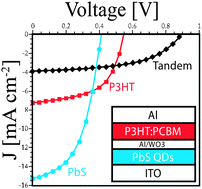
A tandem solar cell is fabricated with one PbS QD and one polymer-fullerene subcell for a broad spectral coverage. Tungsten(VI) oxide is demonstrated as an effective interlayer.
The content of this RSS Feed (c) The Royal Society of Chemistry

25 Mar 09:17
by Deepak Sharma, Matin Amani, Abhishek Motayed, Pankaj B Shah, A Glen Birdwell, Sina Najmaei, Pulickel M Ajayan, Jun Lou, Madan Dubey, Qiliang Li and Albert V Davydov
We have studied temperature-dependent (77–300 K) electrical characteristics and low-frequency noise
(LFN) in chemical vapor deposited (CVD) single-layer molybdenum disulfide (MoS 2 ) based back-gated
field-effect transistors (FETs). Electrical characterization and LFN measurements were conducted on
MoS 2 FETs with Al 2 O 3 top-surface passivation. We also studied the effect of top-surface
passivation etching on the electrical characteristics of the device. Significant decrease in channel
current and transconductance was observed in these devices after the Al 2 O 3 passivation etching.
For passivated devices, the two-terminal resistance variation with temperature showed a good fit to
the activation energy model, whereas for the etched devices the trend indicated a hopping transport
mechanism. A significant increase in the normalized drain current noise power spectral density (PSD)
was observed after the etching of the top pa...
25 Mar 09:16
Publication date: June 2014
Source:Solar Energy Materials and Solar Cells, Volume 125
Author(s): J. Nicholas Alexander , Seiichiro Higashiya , Douglas Caskey Jr , Harry Efstathiadis , Pradeep Haldar
A uniform ultrathin (<30nm) CdS buffer layer was deposited by CBD by utilizing an alternative bath based on N-methylthiourea and was compared with the standard sulfur source. The CdS deposited by this new bath formulation was deposited separately on soda lime glass (SLG), sputtered molybdenum/glass and co-evaporated copper indium gallium di-selenide (CIGS)/Mo/glass substrates. The CdS film properties were investigated by scanning electric microscope (SEM), X-ray diffraction (XRD), X-ray photoelectric spectroscopy (XPS), UV–vis spectroscopy, and quantum efficiency (QE). The films deposited with N-methylthiourea were found to have a similar granular structure, deposit in the same stoichiometry, and have similar device performance as the standard when deposited in the 60–80nm film thickness range. When the CdS layer was deposited ultrathin in the 20–30nm range, it was found to have good surface coverage with no evidence pinholes or device shunting. QE data indicated 40nm thick CdS samples deposited using Thiourea as a sulfur source demonstrated better overall results however depositing a 20nm thick CdS demonstrated N-methylthiourea as a sulfur source could deposit with good quantum efficiency and more consistently. Devices fabricated with ultrathin CdS using N-metyhlthiourea showed better device performance compared with devices fabricated using the standard CdS chemistry.
25 Mar 09:14
Publication date: June 2014
Source:Solar Energy Materials and Solar Cells, Volume 125
Author(s): J.S. de Sousa , G.A. Farias , R.N. Costa Filho
The efficiency of exciton extraction from nanocrystals is defined as the ratio of the number of extracted excitons to the number of absorbed photons. This efficiency is studied here based on a phenomenological model parameterized by recent experimental results in CdSe nanocrystals. Several possibilities of interplay among all possible electronic transition rates (Auger recombination, impact ionization, radiative recombination and electron–hole escape) are explored showing the possibility of obtaining efficiencies above 100% when multiple exciton generation processes are taken into account.
25 Mar 09:05
Dalton Trans., 2014
DOI: 10.1039/C4DT90035A, Editorial
Carole A. Morrison, Eleanor E. B. Campbell
A collection of papers dedicated to the University of Edinburgh School of Chemistry in its tercentenary year.
The content of this RSS Feed (c) The Royal Society of Chemistry

25 Mar 09:01
by Xingchen Ye, Danielle Reifsnyder Hickey, Jiayang Fei, Benjamin T. Diroll, Taejong Paik, Jun Chen and Christopher B. Murray

Journal of the American Chemical Society
DOI: 10.1021/ja500871j

24 Mar 16:35
J. Mater. Chem. C, 2014, 2,2975-2984
DOI: 10.1039/C3TC32577F, Paper
Julian Crespo, Andrea Falqui, Jorge Garcia-Barrasa, Jose M. Lopez-de-Luzuriaga, Miguel Monge, M. Elena Olmos, Maria Rodriguez-Castillo, Matteo Sestu, Katerina Soulantica
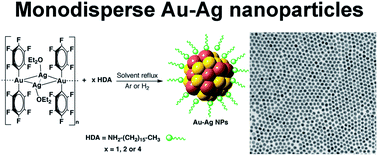
A bimetallic AuAg precursor serves as a single source for the synthesis of composition-controlled spherical Au-Ag nanoparticles displaying plasmonic properties.
The content of this RSS Feed (c) The Royal Society of Chemistry
24 Mar 16:30
Inorg. Chem. Front., 2014, 1,292-301
DOI: 10.1039/C4QI00013G, Review Article
Wei-Wei Xiong, Guodong Zhang, Qichun Zhang
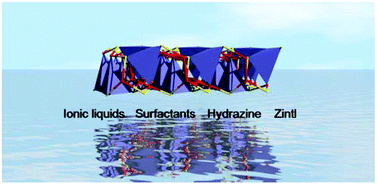
Four new strategies: ionothermal, surfactant-thermal, hydrazine-thermal, and metal Zintl phase usage, have been reviewed.
The content of this RSS Feed (c) The Royal Society of Chemistry
24 Mar 16:25
J. Mater. Chem. B, 2014, 2,2855-2860
DOI: 10.1039/C4TB00196F, Paper
Iman A. Hassan, Ivan P. Parkin, Sean P. Nair, Claire J. Carmalt
High antimicrobial efficacy of Cu and Cu2O films, deposited via aerosol-assisted chemical vapour deposition, was observed against E. coli and S. aureus.
The content of this RSS Feed (c) The Royal Society of Chemistry
24 Mar 16:24
J. Mater. Chem. A, 2014, 2,8215-8222
DOI: 10.1039/C4TA00707G, Paper

Open Access
Georg Bendt, Sebastian Zastrow, Kornelius Nielsch, Partha Sarathi Mandal, Jaime Sanchez-Barriga, Oliver Rader, Stephan Schulz
The surface state dispersion of a MOCVD deposited crystalline Sb2Te3 film gives a Dirac point 30 meV above the Fermi level.
The content of this RSS Feed (c) The Royal Society of Chemistry
24 Mar 11:06
by Xuesong Yin, Chunhua Tang, Linfeng Sun, Zexiang Shen and Hao Gong

Chemistry of Materials
DOI: 10.1021/cm403423e

24 Mar 11:05
by Yuanyuan Wang, Ying Zhang, Fudong Wang, Daryl E. Giblin, Jessica Hoy, Henry W. Rohrs, Richard A. Loomis and William E. Buhro

Chemistry of Materials
DOI: 10.1021/cm404068e

ziyang and -1 others like this
24 Mar 10:55
Nanoscale, 2014, 6,6782-6789
DOI: 10.1039/C4NR00233D, Paper
Tianyu Bai, Chunguang Li, Feifei Li, Lan Zhao, Zhaorui Wang, He Huang, Cailing Chen, Yu Han, Zhan Shi, Shouhua Feng
In this study, we demonstrate that the high-quality AgInSe2 nanocrystals and the alloyed AgIn(S1-xSex)2 nanocrystals (0 [less-than-or-equal] x [less-than-or-equal] 1) with tunable band gaps could be synthesized by a facile solution-phase method.
The content of this RSS Feed (c) The Royal Society of Chemistry

24 Mar 10:53
by Miroslav Kolíbal, Tomáš Vystavěl, Peter Varga and Tomáš Šikola

Nano Letters
DOI: 10.1021/nl404159x

24 Mar 10:47
by Deblina Sarkar, Wei Liu, Xuejun Xie, Aaron C. Anselmo, Samir Mitragotri and Kaustav Banerjee

ACS Nano
DOI: 10.1021/nn5009148

24 Mar 10:45
by Feng Gao, Zhe Li, Jianpu Wang, Akshay Rao, Ian A. Howard, Agnese Abrusci, Sylvain Massip, Christopher R. McNeill and Neil C. Greenham

ACS Nano
DOI: 10.1021/nn501185h

24 Mar 10:00
by Chunyan Liu, Yi Hou, Mingyuan Gao
Rare earth (RE) nanoparticles have attracted considerable attention due to their unique optical and magnetic properties associated with f-electrons. The recent accomplishments in RE nanoparticle synthesis have aroused great interest of scientists to further explore their biomedical applications. This Research News summarizes recent achievements in controlled synthesis of magnetic and luminescent RE nanoparticles, surface modification, and toxicity studies of RE nanomaterials, and highlights state-of-the-art in in vivo applications of RE nanoparticles.

Owing to the unique magnetic and optical properties associated with f-electrons, rare earth (RE) nanoparticles show great potential for versatile in vivo applications, especially sensitive tumor imaging according to animal experiments. Recent achievements in the synthesis, surface modification, in vivo application, and toxicity of RE nanoparticles are summarized, and their perspectives for clinical applications are discussed.
24 Mar 09:55
by Enna Ha, Lawrence Yoon Suk Lee, Jingchuan Wang, Fenghua Li, Kwok-Yin Wong, Shik Chi Edman Tsang

Enhanced photocatalytic activities by Au core Novel Au/Cu2ZnSnS4 core/shell nanoparticles (NPs) are synthesized for the first time via wet chemistry approach. The insertion of Au core into CZTS NPs dramatically enhances light absorption due to surface plasmon resonance effect, especially in the Vis-NIR region. Au/CZTS core/shell NPs show much higher photocatalytic activities for hydrogen evolution compared with other CZTS nanostructures.
24 Mar 09:53
by Zhibin Yang, Jue Deng, Xuemei Sun, Houpu Li, Huisheng Peng

A stretchable, wearable dye-sensitized solar-cell textile is developed from elastic, electrically conducting fiber as a counter electrode and spring-like titanium wire as the working electrode. Dyesensitized solar cells are demonstrated with energy-conversion efficiencies up to 7.13%. The high energy-conversion efficiencies can be well maintained under stretch by 30% and after stretch for 20 cycles.
24 Mar 09:46
by Mingjian Yuan, Kyle W. Kemp, Susanna M. Thon, Jin Young Kim, Kang Wei Chou, Aram Amassian, Edward H. Sargent

An elemental-sulfur-based synthesis is reported, which, combined with processing to improve the size dispersion and passivation, results in a low-cost high-quality platform for small-bandgap PbS-CQD-based devices. Size-selective precipitation and cadmium chloride passivation are used to improve the power conversion efficiency of 1 eV bandgap CQD photovoltaic devices dramatically, which leads to record power conversion efficiency for a 1 eV PbS CQD solar cell of 5.4%.
24 Mar 09:30
by Kartick Tarafder, Yogesh Surendranath, Jacob H. Olshansky, A. Paul Alivisatos and Lin-Wang Wang

Journal of the American Chemical Society
DOI: 10.1021/ja500936n

21 Mar 10:04
by Günther Thiele, Thomas Krüger, Stefanie Dehnen
Abstract
The first inorganic lead(IV) compound without oxygen, nitrogen or halogen ligands attached to the lead atom was obtained as the potassium salt of the tetraselenidoplumbate(IV) anion [PbIVSe4]4−. It is stable under inert conditions which may enable the transfer of the chemistry of chalcogenidogermanate(IV) or chalcogenidostannate(IV) materials, to the lead homologues.

Against all odds: The first inorganic lead(IV) compound without oxygen, nitrogen, or halogen ligands attached to the lead atom was obtained upon solvothermal reaction of a phase with the nominal composition “K2PbSe2” in ethane-1,2-diamine (en). It contains the ortho-selenidoplumbate(IV) anion [PbIVSe4]4−, which, for reasons of relativistic effects on lead, is not intuitive; until now, tetrahedral [TE4]4− units (E=S, Se, Te) were only known for the lighter homologues T=Si, Ge, Sn.
20 Mar 13:34
Faraday Discuss., 2014, 171,275-298
DOI: 10.1039/C4FD00019F, Paper

Open Access
Ben F. Spencer, Matthew J. Cliffe, Darren M. Graham, Samantha J. O. Hardman, Elaine A. Seddon, Karen L. Syres, Andrew G. Thomas, Fausto Sirotti, Mathieu G. Silly, Javeed Akhtar, Paul O'Brien, Simon M. Fairclough, Jason M. Smith, Swapan Chattopadhyay, Wendy R. Flavell
The content of this RSS Feed (c) The Royal Society of Chemistry

20 Mar 13:32
by Barbara K. Hughes, Jeffrey L. Blackburn, Daniel Kroupa, Andrew Shabaev, Steven C. Erwin, Alexander L. Efros, Arthur J. Nozik, Joseph M. Luther and Matthew C. Beard

Journal of the American Chemical Society
DOI: 10.1021/ja413026h

20 Mar 13:21
by Daniel J. Gargas
Nature Nanotechnology.
doi:10.1038/nnano.2014.29
Authors: Daniel J. Gargas, Emory M. Chan, Alexis D. Ostrowski, Shaul Aloni, M. Virginia P. Altoe, Edward S. Barnard, Babak Sanii, Jeffrey J. Urban, Delia J. Milliron, Bruce E. Cohen & P. James Schuck


   This article is licensed under a Creative Commons Attribution-NonCommercial 3.0 Unported Licence.


   This article is licensed under a Creative Commons Attribution 3.0 Unported Licence.