Shared posts

11 Jun 14:52

Core/Shell Quantum Dot Based Luminescent Solar Concentrators with Reduced Reabsorption and Enhanced Efficiency

by Igor Coropceanu and Moungi G. Bawendi

TOC Graphic

Nano Letters
DOI: 10.1021/nl501627e
06 Jun 17:18

Electrochemical Control over Photoinduced Electron Transfer and Trapping in CdSe-CdTe Quantum-Dot Solids

by Simon C. Boehme, T. Ardaan Walvis, Ivan Infante, Ferdinand C. Grozema, Daniël Vanmaekelbergh, Laurens D. A. Siebbeles and Arjan J. Houtepen

TOC Graphic

ACS Nano
DOI: 10.1021/nn501985e
06 Jun 17:12

Perovskite Solar Cells with 12.8% Efficiency by Using Conjugated Quinolizino Acridine Based Hole Transporting Material

by Peng Qin, Sanghyun Paek, M. Ibrahim Dar, Norman Pellet, Jaejung Ko, Michael Grätzel and Mohammad Khaja Nazeeruddin

TOC Graphic

Journal of the American Chemical Society
DOI: 10.1021/ja503272q
05 Jun 17:40

Morphological Control of PbS Grown on Functionalized Self-Assembled Monolayers by Chemical Bath Deposition

by Jing Yang and Amy V. Walker

TOC Graphic

Langmuir
DOI: 10.1021/la500784y
05 Jun 17:07

Remote Trap Passivation in Colloidal Quantum Dot Bulk Nano-heterojunctions and Its Effect in Solution-Processed Solar Cells

by Arup. K. Rath, F. Pelayo Garcia de Arquer, Alexandros Stavrinadis, Tania Lasanta, Maria Bernechea, Silke L. Diedenhofen, Gerasimos Konstantatos
Thumbnail image of graphical abstract

More-efficient charge collection and suppressed trap recombination in colloidal quantum dot (CQD) solar cells is achieved by means of a bulk nano-heterojunction (BNH) structure, in which p-type and n-type materials are blended on the nanometer scale. The improved performance of the BNH devices, compared with that of bilayer devices, is displayed in higher photocurrents and higher open-circuit voltages (resulting from a trap passivation mechanism).

05 Jun 17:07

Effect of Solvent Environment on Colloidal-Quantum-Dot Solar-Cell Manufacturability and Performance

by Ahmad R. Kirmani, Graham H. Carey, Maged Abdelsamie, Buyi Yan, Dongkyu Cha, Lisa R. Rollny, Xiaoyu Cui, Edward H. Sargent, Aram Amassian
Thumbnail image of graphical abstract

The absorbing layer in state-of-the-art colloidal quantum-dot solar cells is fabricated using a tedious layer-by-layer process repeated ten times. It is now shown that methanol, a common exchange solvent, is the main culprit, as extended exposure leaches off the surface halide passivant, creating carrier trap states. Use of a high-dipole-moment aprotic solvent eliminates this problem and is shown to produce state-of-the-art devices in far fewer steps.

05 Jun 17:05

In situ study of the growth of two-dimensional palladium dendritic nanostructures using liquid-cell electron microscopy

Chem. Commun., 2014, 50,9447-9450
DOI: 10.1039/C4CC03500C, Communication
Guomin Zhu, Yingying Jiang, Fang Lin, Hui Zhang, Chuanhong Jin, Jun Yuan, Deren Yang, Ze Zhang
Based on the bubble induced thin water layer technique, we directly probe the growth of 2D palladium dendritic nanostructures using liquid cell microscopy.
The content of this RSS Feed (c) The Royal Society of Chemistry
03 Jun 19:38

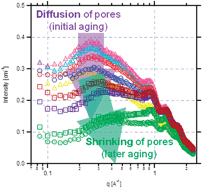
Physical aging of polymers of intrinsic microporosity: a SAXS/WAXS study

Naughty Paul

One for Nixson

J. Mater. Chem. A, 2014, 2,11742-11752
DOI: 10.1039/C4TA02165G, Paper
Amanda G. McDermott, Peter M. Budd, Neil B. McKeown, Coray M. Colina, James Runt
X-ray scattering patterns from these high free-volume polymeric glasses contain a feature strongly associated with porosity; it is sensitive to time, temperature and film thickness in a manner consistent with physical aging, which impacts membrane performance in gas separations.
The content of this RSS Feed (c) The Royal Society of Chemistry
03 Jun 18:37

From MoS2 Microspheres to α-MoO3 Nanoplates: Growth Mechanism and Photocatalytic Activities

by Mianzeng Zhong, Zhongming Wei, Xiuqing Meng, Fengmin Wu, Jingbo Li

Abstract

Flowerlike MoS2 microspheres were synthesized through a hydrothermal method. 2H-MoS2 nanoparticles, MoS2/MoO3 heterojunctions, and α-MoO3 nanoplates were prepared by annealing the MoS2 microspheres under different reaction conditions. The formation and growth mechanism of the samples from flowerlike MoS2 microspheres to α-MoO3 nanoplates is explained in detail. The photocatalytic properties of the four samples for the degradation of rhodamine B (RhB) under visible-light irradiation were studied. The results showed that the flowerlike MoS2 microspheres, MoS2/α-MoO3 heterojunctions, and α-MoO3 nanoplates all have excellent photocatalytic activities. In particular, the flowerlike MoS2 microspheres exhibit the highest photocatalytic activity for the degradation of RhB.

Thumbnail image of graphical abstract

Flowerlike MoS2 microspheres are used as a precursor for the preparation of 2H-MoS2 nanoparticles, MoS2/α-MoO3 heterojunctions, and α-MoO3 nanoplates. The growth mechanism is studied in detail. Among the four samples, the MoS2/α-MoO3 heterojunctions and MoS2 microspheres show excellent photocatalytic activity.

03 Jun 17:32

Role of Organosulfur Compounds in the Growth and Final Surface Chemistry of PbS Quantum Dots

by Martin R. McPhail and Emily A. Weiss

TOC Graphic

Chemistry of Materials
DOI: 10.1021/cm4040819
30 May 11:29

Improved Photoelectrical Properties of MoS2 Films after Laser Micromachining

by Junpeng Lu, Jia Hui Lu, Hongwei Liu, Bo Liu, Kim Xinhui Chan, Jiadan Lin, Wei Chen, Kian Ping Loh and Chorng Haur Sow

TOC Graphic

ACS Nano
DOI: 10.1021/nn501821z
27 May 17:43

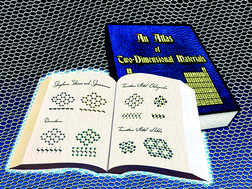
An atlas of two-dimensional materials

Chem. Soc. Rev., 2014, 43,6537-6554
DOI: 10.1039/C4CS00102H, Review Article
Pere Miro, Martha Audiffred, Thomas Heine
The discovery of graphene and other two-dimensional (2D) materials together with recent advances in exfoliation techniques have set the foundations for the manufacturing of single layered sheets from any layered 3D material.
The content of this RSS Feed (c) The Royal Society of Chemistry
27 May 11:38

Cooperative Island Growth of Large-Area Single-Crystal Graphene on Copper Using Chemical Vapor Deposition

by Gyula Eres, Murari Regmi, Christopher M. Rouleau, Jihua Chen, Ilia N. Ivanov, Alexander A. Puretzky and David B. Geohegan

TOC Graphic

ACS Nano
DOI: 10.1021/nn500209d
27 May 11:34

Monodisperse, Air-Stable PbS Nanocrystals via Precursor Stoichiometry Control

by Mark C. Weidman, Megan E. Beck, Rachel S. Hoffman, Ferry Prins and William A. Tisdale

TOC Graphic

ACS Nano
DOI: 10.1021/nn5018654
27 May 11:15

p-i-n Heterojunction Solar Cells with a Colloidal Quantum-Dot Absorber Layer

by Dong-Kyun Ko, Patrick R. Brown, Moungi G. Bawendi, Vladimir Bulović
Thumbnail image of graphical abstract

A quantum-dot (QD) p-i-n heterojunction solar cell with an increased depletion region is demonstrated by depleting the QD layer from both the front and back junctions. Due to a combination of improved charged extraction and increased light absorption, a 120% increase in the short-circuit current is achieved compared with that of conventional ZnO/QD devices.

27 May 09:14

Improved performance and stability in quantum dot solar cells through band alignment engineering

by Chia-Hao M. Chuang

Nature Materials. doi:10.1038/nmat3984

Authors: Chia-Hao M. Chuang, Patrick R. Brown, Vladimir Bulović & Moungi G. Bawendi

Solution processing is a promising route for the realization of low-cost, large-area, flexible and lightweight photovoltaic devices with short energy payback time and high specific power. However, solar cells based on solution-processed organic, inorganic and hybrid materials reported thus far generally suffer from poor air stability, require an inert-atmosphere processing environment or necessitate high-temperature processing, all of which increase manufacturing complexities and costs. Simultaneously fulfilling the goals of high efficiency, low-temperature fabrication conditions and good atmospheric stability remains a major technical challenge, which may be addressed, as we demonstrate here, with the development of room-temperature solution-processed ZnO/PbS quantum dot solar cells. By engineering the band alignment of the quantum dot layers through the use of different ligand treatments, a certified efficiency of 8.55% has been reached. Furthermore, the performance of unencapsulated devices remains unchanged for over 150 days of storage in air. This material system introduces a new approach towards the goal of high-performance air-stable solar cells compatible with simple solution processes and deposition on flexible substrates.

23 May 16:05

Mechanistic Study of the Role of Primary Amines in Precursor Conversions to Semiconductor Nanocrystals at Low Temperature

by Kui Yu, Xiangyang Liu, Queena Y. Chen, Huaqing Yang, Mingli Yang, Xinqin Wang, Xin Wang, Hong Cao, Dennis M. Whitfield, Changwei Hu, Ye Tao

Abstract

Primary alkyl amines (RNH2) have been empirically used to engineer various colloidal semiconductor nanocrystals (NCs). Here, we present a general mechanism in which the amine acts as a hydrogen/proton donor in the precursor conversion to nanocrystals at low temperature, which was assisted by the presence of a secondary phosphine. Our findings introduce the strategy of using a secondary phosphine together with a primary amine as new routes to prepare high-quality NCs at low reaction temperatures but with high particle yields and reproducibility and thus, potentially, low production costs.

Thumbnail image of graphical abstract

Identifying roles: 31P NMR and absorption spectroscopy was used in conjunction with DFT calculations to identify the reaction pathways leading to semiconductor nanocrystals (NCs), together with compounds 14 (see scheme). With Se[DOUBLE BOND]PPh2H as the Se precursor instead of Se[DOUBLE BOND]P(C8H17)3, the conversion takes place at low temperature. The amine contributes to the formation of the two nitrogen compounds 1 and 2.

21 May 13:17

Investigation on photo-induced charge separation in CdS/CdTe nanopencils

Chem. Sci., 2014, 5,3831-3835
DOI: 10.1039/C4SC00635F, Edge Article
Masanori Sakamoto, Koki Inoue, Masaki Saruyama, Yeong-Gi So, Koji Kimoto, Makoto Okano, Yoshihiko Kanemitsu, Toshiharu Teranishi
CdS/CdTe nanopencils were synthesized via anion exchange and the effect of the geometry on the carrier dynamics was investigated.
The content of this RSS Feed (c) The Royal Society of Chemistry
21 May 11:30

A Case of Strong Metal–Support Interactions: Combining Advanced Microscopy and Model Systems to Elucidate the Atomic Structure of Interfaces

by Marc G. Willinger, Wei Zhang, Oleksandr Bondarchuk, Shamil Shaikhutdinov, Hans-Joachim Freund, Robert Schlögl

Abstract

A symbiosis of advanced scanning probe and electron microscopy and a well-defined model system may provide a detailed picture of interfaces on nanostructured catalytic systems. This was demonstrated for Pt nanoparticles supported on iron oxide thin films which undergo encapsulation by supporting oxide as a result of strong metal–support interactions.

Thumbnail image of graphical abstract

A symbiosis of advanced scanning probe and electron microscopy and a well-defined model system may provide a detailed picture of interfaces on nanostructured catalytic systems. This was demonstrated for Pt nanoparticles supported on iron oxide thin films, which undergo encapsulation by supporting oxide as a result of strong metal–support interactions (see picture).

21 May 10:20

[Report] Edge Nonlinear Optics on a MoS2 Atomic Monolayer

by Xiaobo Yin
Second-harmonic generation is used to probe and characterize atomically thin layers of molybdenum disulfide. [Also see Perspective by Neshev and Kivshar] Authors: Xiaobo Yin, Ziliang Ye, Daniel A. Chenet, Yu Ye, Kevin O’Brien, James C. Hone, Xiang Zhang
08 May 16:11

Versatile and Low-Toxic Solution Approach to Binary, Ternary, and Quaternary Metal Sulfide Thin Films and Its Application in Cu2ZnSn(S,Se)4 Solar Cells

by Qingwen Tian, Gang Wang, Wangen Zhao, Yanyan Chen, Yanchun Yang, Lijian Huang and Daocheng Pan

TOC Graphic

Chemistry of Materials
DOI: 10.1021/cm5002412
08 May 16:10

Photoluminescence Quantum Yield and Matrix-Induced Luminescence Enhancement of Colloidal Quantum Dots Embedded in Ionic Crystals

by Marcus Müller, Martin Kaiser, Gordon M. Stachowski, Ute Resch-Genger, Nikolai Gaponik and Alexander Eychmüller

TOC Graphic

Chemistry of Materials
DOI: 10.1021/cm5009043
08 May 16:04

Semiconductors: Growth of Large-Area 2D MoS2(1-x)Se2x Semiconductor Alloys (Adv. Mater. 17/2014)

by Qingliang Feng, Yiming Zhu, Jinhua Hong, Mei Zhang, Wenjie Duan, Nannan Mao, Juanxia Wu, Hua Xu, Fengliang Dong, Fang Lin, Chuanhong Jin, Chunming Wang, Jin Zhang, Liming Xie
Thumbnail image of graphical abstract

Alloying in monolayers enables bandgap tuning in twodimensions. On page 2648, L. Xie, J. Zhang, and co-workers demonstrate that by direct evaporation of two end materials (MoS2 and MoSe2) and deposition at low temperatures, large-area 2D MoS2(1−x)Se2x monolayers are obtained. By changing the S/Se composition, the bandgap of MoS2(1−x)Se2x monolayers can be continuously tuned.

08 May 13:46

High Thermoelectric Performance of p-Type SnTe via a Synergistic Band Engineering and Nanostructuring Approach

by Gangjian Tan, Li-Dong Zhao, Fengyuan Shi, Jeff W. Doak, Shih-Han Lo, Hui Sun, Chris Wolverton, Vinayak P. Dravid, Ctirad Uher and Mercouri G. Kanatzidis

TOC Graphic

Journal of the American Chemical Society
DOI: 10.1021/ja500860m
01 May 10:33

Raman Enhancement Effect on Two-Dimensional Layered Materials: Graphene, h-BN and MoS2

by Xi Ling, Wenjing Fang, Yi-Hsien Lee, Paulo T. Araujo, Xu Zhang, Joaquin F. Rodriguez-Nieva, Yuxuan Lin, Jin Zhang, Jing Kong and Mildred S. Dresselhaus

TOC Graphic

Nano Letters
DOI: 10.1021/nl404610c
01 May 10:24

Organohalide lead perovskites for photovoltaic applications

Energy Environ. Sci., 2014, 7,2448-2463
DOI: 10.1039/C4EE00942H, Review Article
Peng Gao, Michael Gratzel, Mohammad K. Nazeeruddin
This review presents the state-of-the-art organohalide lead perovskites, which are currently making an immense impact across the photovoltaic community.
The content of this RSS Feed (c) The Royal Society of Chemistry
01 May 09:58

Synthesis of a Self-Assembled Hg(II)-Dithiocarbamate Metallomacrocycle

by Edmundo Guzmán-Percástegui, Lev N. Zakharov, José G. Alvarado-Rodríguez, Matthew E. Carnes and Darren W. Johnson

TOC Graphic

Crystal Growth & Design
DOI: 10.1021/cg401894h
28 Apr 11:32

Over 40 cd/A Efficient Green Quantum Dot Electroluminescent Device Comprising Uniquely Large-Sized Quantum Dots

by Ki-Heon Lee, Jeong-Hoon Lee, Hee-Don Kang, Byoungnam Park, Yongwoo Kwon, Heejoo Ko, Changho Lee, Jonghyuk Lee and Heesun Yang

TOC Graphic

ACS Nano
DOI: 10.1021/nn500852g
25 Apr 14:46

Layered materials: Scaling up exfoliation

by James M. Tour

Nature Materials. doi:10.1038/nmat3961

Author: James M. Tour

High-shear mixing is now shown to be an effective approach for the exfoliation of large quantities of graphene and other two-dimensional materials, providing a viable route for the industrial scaling of applications based on these layered crystals.

24 Apr 14:49

Facile Droplet-based Microfluidic Synthesis of Monodisperse IV–VI Semiconductor Nanocrystals with Coupled In-Line NIR Fluorescence Detection

by Ioannis Lignos, Loredana Protesescu, Stavros Stavrakis, Laura Piveteau, Mark J. Speirs, Maria A. Loi, Maksym V. Kovalenko and Andrew J. deMello

TOC Graphic

Chemistry of Materials
DOI: 10.1021/cm500774p