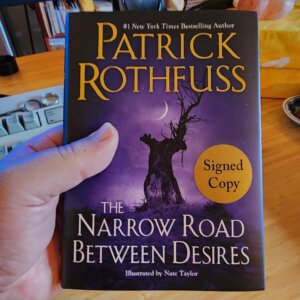
So over the last couple months, I’ve meant to write about two dozen different blogs. The upcoming book got a cover, for example:
(As always, guest starring my thumb.)
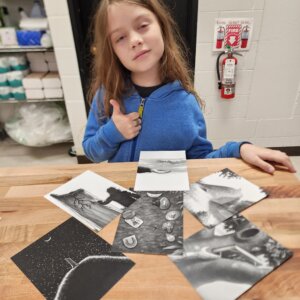
But I’m guessing by now you’ve already seen that. We have a UK cover too. There’s some promotional stuff going on with the book, where if you pre-order The Narrow Road Between Desires, you not only can get a signed copy, but you’ll also get one of the promotional postcards we made to showcase some of the fabulous art Nate Taylor did for the book:
(Sleepy child shown for scale.)
By the way, if you haven’t pre-ordered a copy yet, there’s still time to do that. I signed a *bunch* of books so that they could be available everywhere, B&N, Books-a-Million, as well as a any indie bookstores that would like to prepare. You can pre-order and get a signed book and postcard at the Worldbuilders Marketplace too, of course. But we wanted you to be able to buy from your local bookstores, too. Because we *love* local bookstores around here.
But back to my point, I’ve had a bunch of things to share with you. A lot of things I’d love to talk about…
…but I haven’t posted any of them. Partly because… I’ve signed more than 30,000 books over the last month (some for the US, some for the UK) so that (hopefully) y’all can get copies even though I’m not doing a signing tour. Partly because I’m helping my boys with school and trying to be a good dad, partly because there’s a lot of other stuff in my life that eats a truly unfortunate amount of my time and energy…
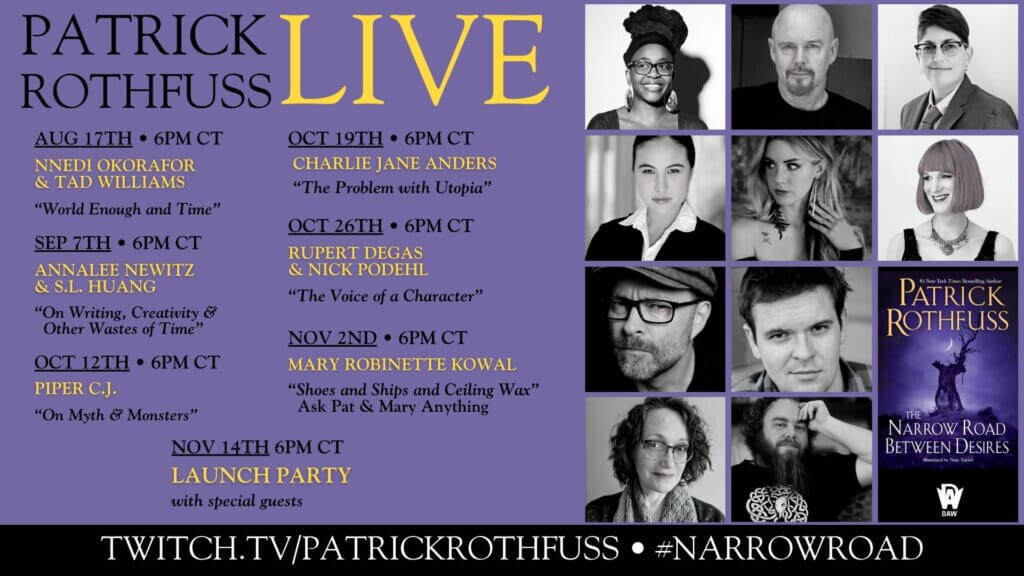
I’ve also been doing interviews, livestreams, and other things to promote the upcoming book, of course:
(I’ve got one of these happening tomorrow, FYI.)
The other reason I haven’t written about a lot of this stuff is that… well… it’s important to me. And if it’s important, I want to do it really well. REALLY well. Perfectly, in fact. And it takes a long time to write a perfect blog… More time that I usually have.
So today I’m trying to change that by writing an imperfect blog. This is it, by the way. It’s a blog where I just tell you some things and try to come to grips with the fact that the blog isn’t as funny, or detailed, or clever as I’d like it to be.
So… with that in mind. Here’s the most recent piece of news I mentioned at the end of last week’s livestream….
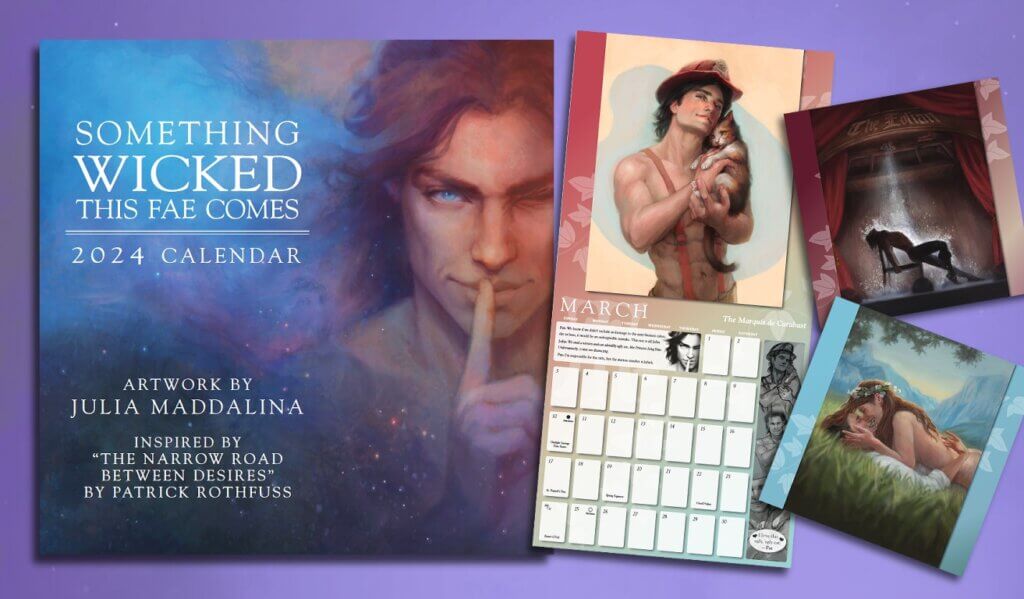
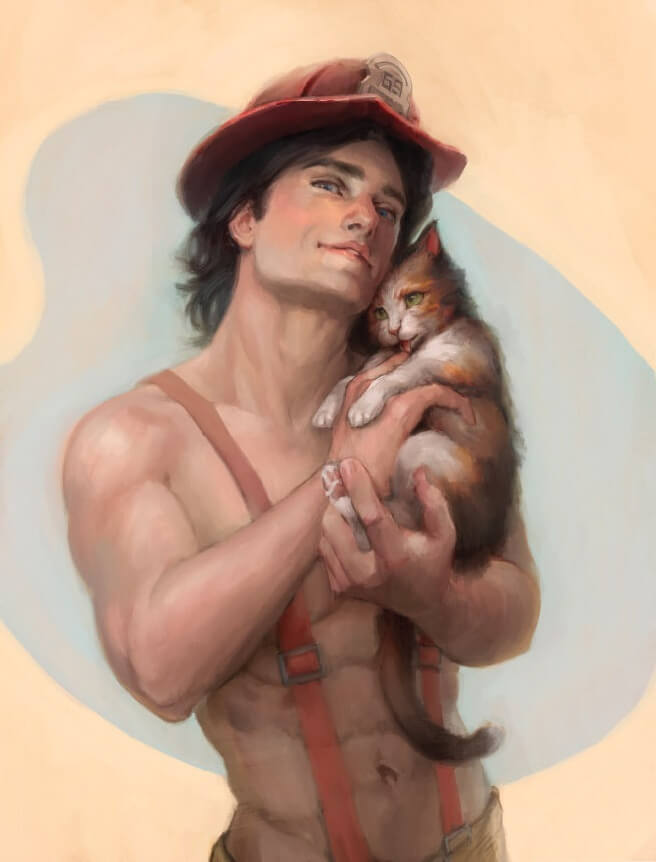
Yeah. It’s a Bast-themed calendar.
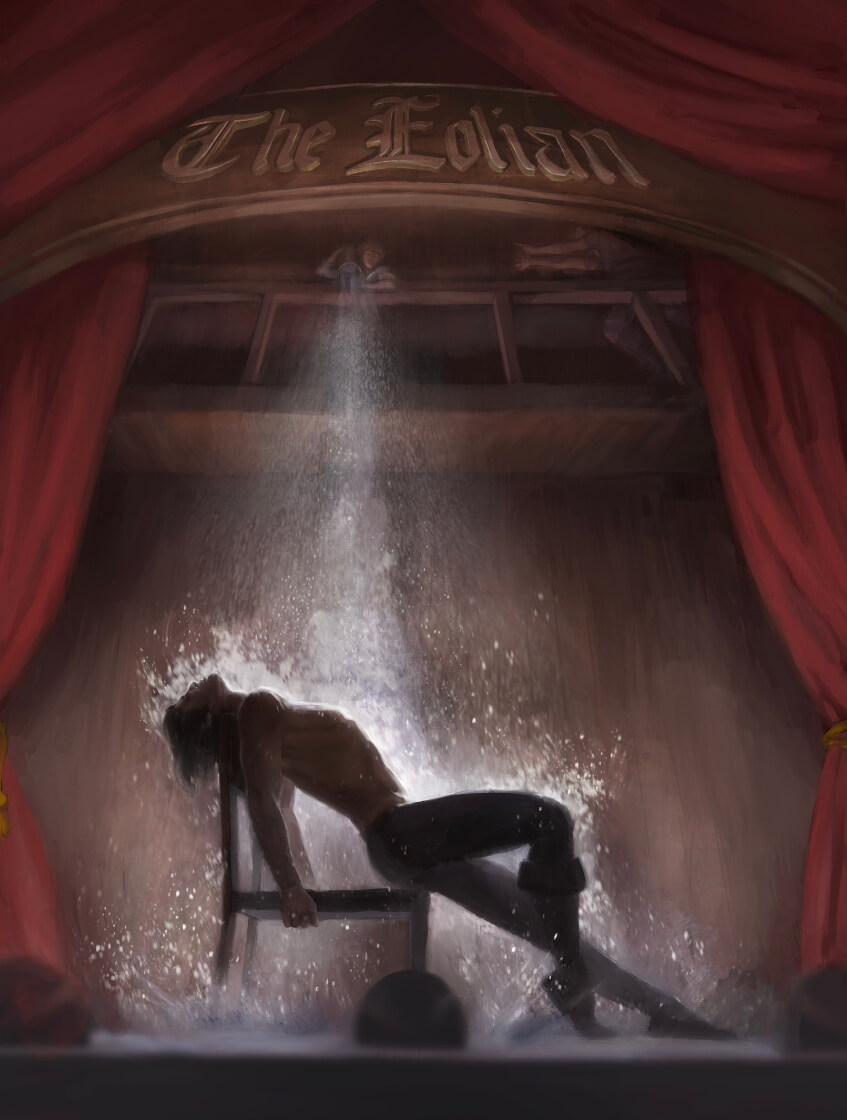
It started as a joke. I was working on the illustrations for Narrow Road, and getting some feedback from Julia Maddalina, (an amazing artist I’ve worked with for years. You’ve seen her work in the worldbuilders store.)
While we’re chatting, I made some comment about Bast being sexy, it’s a shame he doesn’t have a pin-up calendar, etc etc… Then 20 minutes later, Julia sent me a sketch Bast. I honestly can’t remember what the first one was, because we joked about it for weeks, and she sent me sketches of him washing a car in daisy dukes, dressed up as a lumberjack, and just generally being the hot fae he is.
Then eventually, it started seeming less like a joke and more like a fun side project I could release alongside the book to make some money for Worldbuilders.
I hesitate to call it a pin-up calendar. As there’s a lot of baggage that goes along with that term, a lot of sexism and objectification. But we *have* pulled a bit from that tradition for some of the images.
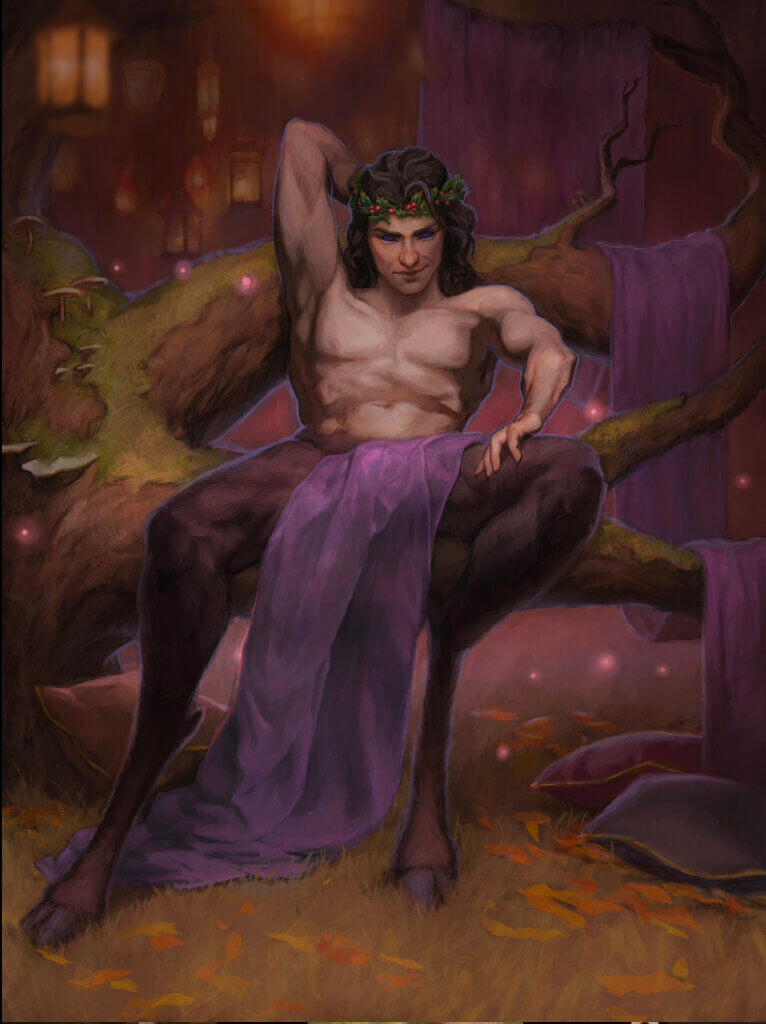
(This is one of my favorites)
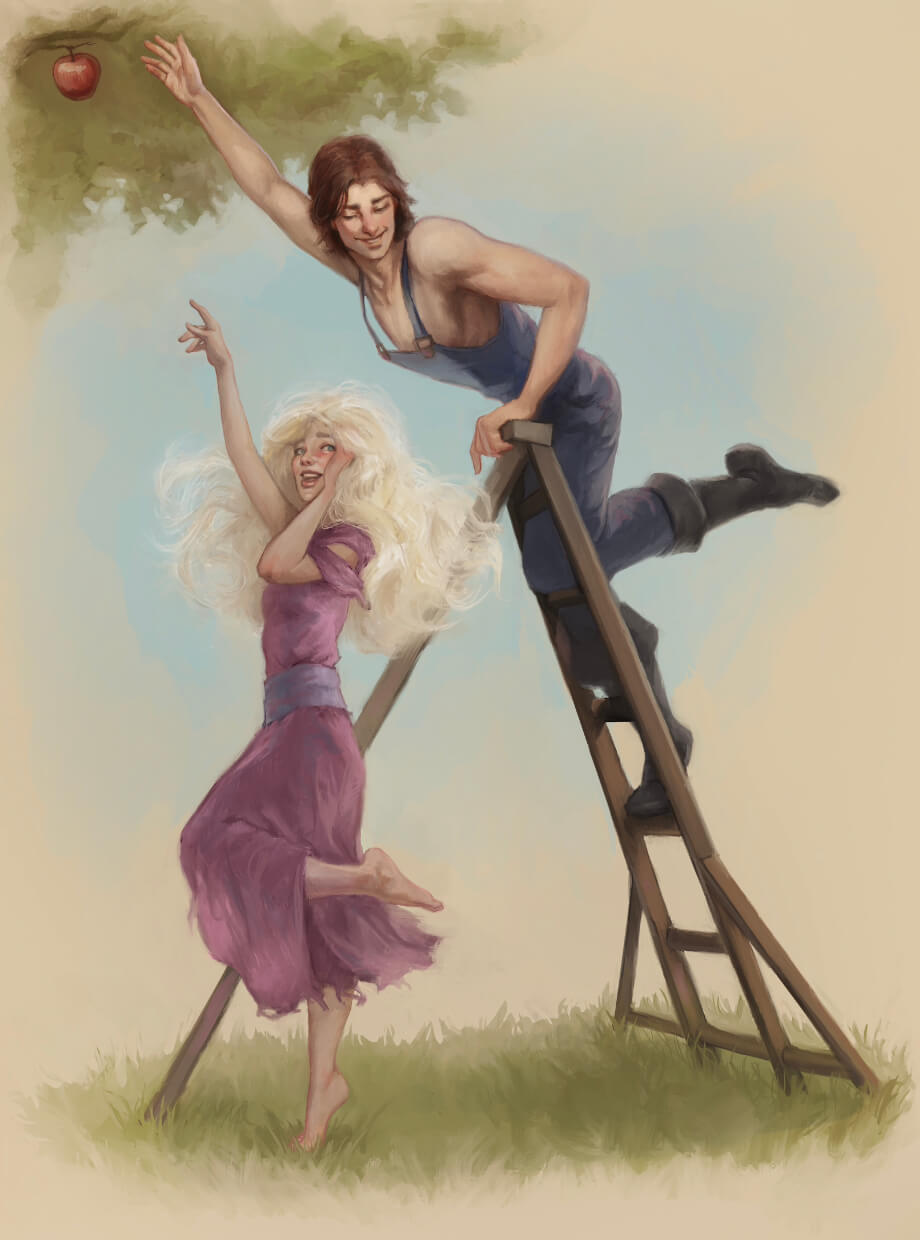
But a lot of the art we developed doesn’t follow in the pin-up tradition. It’s just playful, and silly, and fun…
(Not really a pin-up)
While working on the calendar, I never really talked about it, as I wasn’t sure we’d be able to get it finished this year, and the last thing I wanted to do was get people excited about something and then not be able to deliver it on time. But it’s at the printers now, going through final proofs, and now I wish I *had* been talking about it for months, because Julia’s art is amazing, and this has turned into something I’m really proud of.
(Yeah. That’s Bast as a sexy Mr. Tumnis…. Plus Noir. I don’t know why I’m proud of it. But I am. I’m really, *really* proud of it.)
Last week, I was showing the finished project to a friend who runs a bookstore down in Madison because I was excited about it being finished, and they ended up ordering a hundred copies for their store. It was only then that I realized that some of you were in direct contact with a bunch of people who would love to buy something like this….
Aaaand. That’s it. An imperfect blog. The story of how I accidentally made a Julia draw bast without his shirt off a bunch, for charity.
Here’s the tricky bit. We’ve done calendars in the past and learned the hard way that they’re not an evergreen product. I don’t want to print, like, 150 of these, then run out and have a bunch of people be sad because we ran out and they can’t have one.
On the other hand, I also don’t want to throw away a thousand calendars when February rolls around. It’s a huge waste of money, and feels like an ecological hate-crime.
So right now we’re doing a pre-order sale in Worldbuilders online store. For a couple days, if you buy multiple copies, you can get a big discount. (That sale is going to go away when we put in our final order this week.
You can also put together a bunch of different bundles over there, where people can get a discount by buying a bunch of things at once. Like a copy of the new book, a calendar, and one of the new coins we make with shire post to celebrate the release of Narrow Road.)
(These show up in the book, and I’m *really* happy with how they turned out.)
So… there you go. Many announcements made imperfectly. Hopefully I’ll be able to come back and go into more detail about some of these things later, but at the very least I’ve managed to mention them to y’all.
And now, I’ve got to go make breakfast for my boys.
Later space cowboys,
pat
P.S. If you happen to be a cool indie bookstore, and want to sell some sexy Bast during the holidays, drop us a line over at: sexybastcalendar2024@patrothfuss.com.
Millions of Americans and their doctors are in the dark when it comes to early cognitive decline, according to new research from the University of Southern California. A study out this week suggests that most general physicians vastly under-diagnose mild cognitive impairment among their patients, following another…
Government-backed hackers from Russia and China exploited a known vulnerability in outdated versions of WinRAR, the world’s most popular compression tool with over 500 million users. Google’s Threat Analysis Group (TAG) said Wednesday it observed a number of government-backed hacking campaigns utilizing the WinRAR bug…
Hitting the snooze button on your wake-up alarm might just be fine, new research out this week suggests. In a pair of studies, scientists found evidence that a majority of people regularly hit snooze and that the habit doesn’t seem to noticeably harm our sleep. It could even help make some people more alert in the…
Well, okay. (And no argument about the flaming sword. Not least because they’re hard enough to get working right, and customer service on those is kind of a trial.*)
But now I wish I could see pictures of the members of the Legion, and their costumes, and I’m curious about what their powers are. And I’d really love to know the backstory of how they applied to the Legion of SuperNeils and why they were turned down.
(wanders off) Who knows, maybe someday we’ll find out…
*Tech support always winds up going “have you tried quenching it and then igniting it again?” (eyeroll)
The kids on TikTok think that just because he was a classic country singer, Johnny Cash was conservative??? My babies he covered a Nine Inch Nails song in his seventies.
Classic country singers (the majority of which came from poor roots) were always talking about how much The Man sucked because they were taking money from poor rural folk. You’re gonna tell me that’s conservative?? Get outta here.
And somehow on the opposite side of the scale with the same exact opinion the conservative kids say “I like the old country music, because there’s no politics to it” Woodie Guthrie’s got a “this machine kills fascists” sticker on his guitar? You think there’s no politics in 9 to 5 or Folsom Prison Blues?!
For anyone confused there was a sudden and dramatic shift in the country music genre. It used to be a genre fixated on the experiences of people. Lived or common experiences that resonated with the common people. It was music that you listened to and it thrummed in tune to your soul because you had lived it yourself. And a lot of that was about ordinary people getting ground up in the gears of society.
The hyper patriotism, beer, and trucks chimera we have now didn’t show up until after 9/11 and the world is lesser for it
Allow me to post the entire lyrics to the Johnny Cash song “Man in Black”, released in nineteen goddamn seventy-one and written about why he always wore black onstage:
Well, you wonder why I always dress in black
Why you never see bright colors on my back
And why does my appearance seem to have a somber tone
Well, there’s a reason for the things that I have on
I wear the black for the poor and the beaten down
Livin’ in the hopeless, hungry side of town
I wear it for the prisoner who has long paid for his crime
But is there because he’s a victim of the times
I wear the black for those who’ve never read
Or listened to the words that Jesus said
About the road to happiness through love and charity
Why, you’d think He’s talking straight to you and me
Well, we’re doin’ mighty fine, I do suppose
In our streak of lightnin’ cars and fancy clothes
But just so we’re reminded of the ones who are held back
Up front there ought to be a man in black
I wear it for the sick and lonely old
For the reckless ones whose bad trip left them cold
I wear the black in mournin’ for the lives that could have been
Each week we lose a hundred fine young men
And I wear it for the thousands who have died
Believin’ that the Lord was on their side
I wear it for another hundred-thousand who have died
Believin’ that we all were on their side
Well, there’s things that never will be right, I know
And things need changin’ everywhere you go
But ‘til we start to make a move to make a few things right
You’ll never see me wear a suit of white
Ah, I’d love to wear a rainbow every day
And tell the world that everything’s okay
But I’ll try to carry off a little darkness on my back
'Til things are brighter, I’m the man in black
That right there is an anti-war, anti-bigot, anti-mass-incarceration, anti-war-on-drugs (Cash was an addict in various stages of recovery who was pissed as hell about how this country treats people with substance issues), eat-the-rich protest song. And it was arguably his signature song, his personal manifesto. Notice that even the Jesus reference, which today would be a signal that the song is about to drop some racist dogwhistles, segues immediately into a line about “the road to happiness through love and charity”. As in “Motherfucker, our shared god said love thy neighbor and care for the poor and the outsider, and we both know he didn’t fucking stutter.” He’s throwing shade at self-described Christians who use his religion as a cudgel to beat people with.
Johnny Cash wasn’t a conservative. I’m pretty sure if he were alive and in reasonably good health today, he’d knock Jason Aldean’s teeth out (or, failing that, write a song so devastatingly memetic about how much Aldean sucks that Aldean would never work in music again).
Johnny Cash was punk rock. He just happened to be punk rock in the body of a country singer.
Over the weekend, rumors circulated that Signal, one of the most trusted encrypted chat apps on the web, had a pretty bad zero-day vulnerability. The claims, which have now been all but debunked, swiftly caused a panic in the infosec community.
It is not because of the few thousand francs which would have to be spent to put a roof over the third-class carriages or to upholster the third-class seats that some company or other has open carriages with wooden benches. What the company is trying to do is to prevent the passengers who can pay the second class fare from traveling third class; it hits the poor, not because it wants to hurt them, but to frighten the rich. And it is again for the same reason that the companies, having proved almost cruel to the third-class passengers and mean to the second-class ones, become lavish in dealing with first-class passengers. Having refused the poor what is necessary, they give the rich what is superfluous.
How increasing cruelty and decadence is baked into the economic system.
This is why airlines have kept the “temporary security measures” in place long after 9/11. The more money you give the airlines, the less hassle you have to deal with going through the security theater, so airlines profit off the misery.
LA in 2026 will be a bid for another Worldcon in Anaheim, as revealed by the latest update to the LA in 2026 – Adventure Awaits! website. They have also announced their proposed dates. The Southern California Institute for Fan … Continue reading →
Officiella pressbilder på Oneplus första foldable har hamnat på webben via tyska sajten Winfuture. Telefonen heter Open och erbjuder en inre 7,8-tumsskärm som ska ha ett så gott som osynligt veck i mitten där panelen viks.
Enligt tidigare rykten är den yttre skärmen 6,31 tum. Båda skärmarna påstås erbjuda mycket hög upplösning. Övriga specifikationer som nämns är Snapdragon 8 Gen 2, 16GB LPDDR5X-RAM, samt två 48MP-kameror och en 64MP-kamera. Enhetens kamerasystem presenteras i samarbete med Hasselblad likt i tidigare Oneplus-flaggskepp.
Källan nämner även att Oneplus Fold börjar säljas med start redan 19 oktober. De som hoppats att Oneplus Open kommer bli en foldable-motsvarighet till Oneplus One – det vill säga ett prispressat flaggskepp som gör kraftfull teknik mer lättillgänglig – ser ut att bli besvikna.
Enligt Winfuture ligger nämligen amerikanska priset på strax under 1700 dollar. Om uppgiften stämmer är priset nästan lika högt som för Samsung Galaxy Fold 5.
So this is a little odd. Over the weekend, I saw a new TV spot for The Marvels and was struck by something: it was almost completely devoid of Kamala Khan (Iman Vellani) and Monica Rambeau (Teyonah Parris), both of whom were massive, massive parts of the previous two trailers released for the film. Instead, this clip…
Does anybody else have déjà vu? No, I’m not referring to the recent shifting of Ahsoka’s premiere date, but to the fact that for the second season in a row, Disney has announced one premiere date for Loki, then—a few weeks before the show’s supposed debut—moved the date.
Maybe it’s supposed to be a cutesy little reference to time slippage and timelines and oh hey did you remember that there’s a lot of time hijinks on this show? But mostly it just makes us sigh and update our calendars.
The date change comes with a little featurette in which executive producer Kevin R. Wright makes the debatable statement, “Loki has always been a villain.” He continues, “What we want to explore is also Loki finding what heroicism really looks like.”
Most of the actual show footage here is stuff we’ve seen in trailers, interspersed with a few little cast interviews and some behind-the-scenes action which mostly consists of people hugging each other. It’s very sweet! It also tells us very little about what the second season has in store.
But you haven’t got that long to wait. Loki now returns on October 5th, which is also the date Our Flag Means Death (and Lupin) return for our viewing pleasure. Plan your sofa time accordingly.
This post was written during the 2023 WGA and SAG-AFTRA strikes. Without the labor of the writers and actors currently on strike, the series being covered here wouldn’t exist.
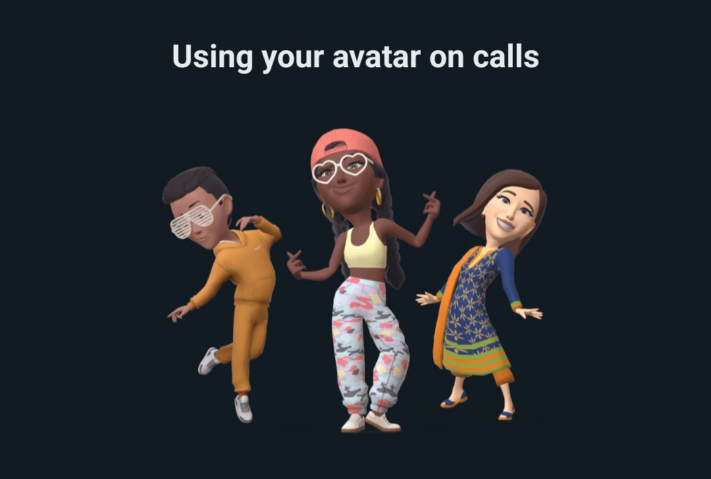
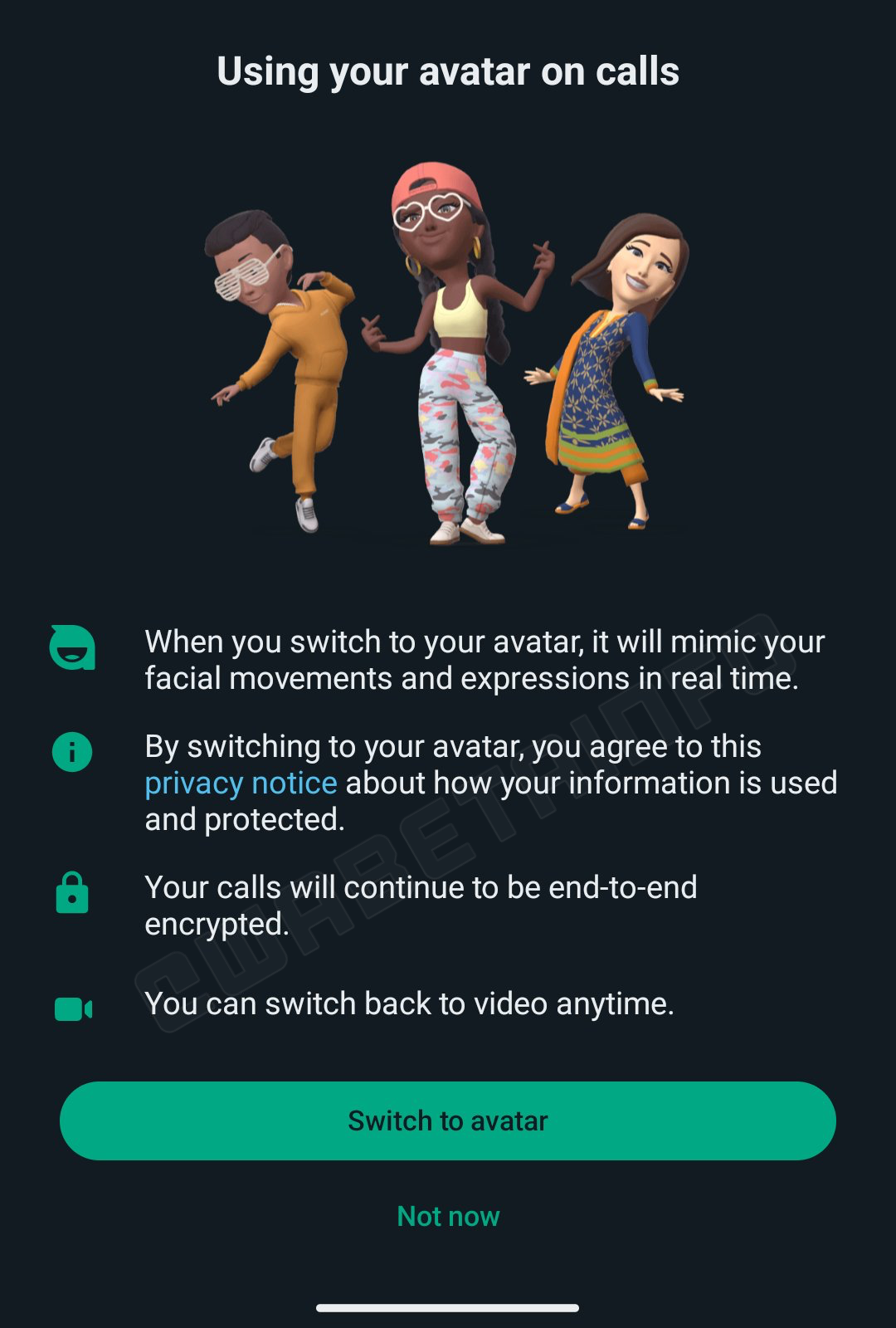
Vissa betatestare har fått fram möjligheten att genomföra videosamtal i Whatsapp där avatarer representerar användaren, istället för att visa ett videoflöde från frontkameran. Varför då ha ett videosamtal överhuvudtaget och inte ett röstsamtal?
Användaren kanske inte känner sig bekväm med vanliga videosamtal – överhuvudtaget eller för stunden. Avataren speglar dessutom användarens huvudrörelser och ansiktsuttryck i realtid, så den animerade figuren rör sig på samma vis som användaren.
Enligt Wabetainfo kommer fler få tillgång till nyheten under de kommande veckorna.
As a teenager growing up in Ontario, I always envied the kids who spent their summers tree planting; they’d come back from the bush in September, insect-chewed and leathery, with new muscle, incredible stories, thousands of dollars, and a glow imparted by the knowledge that they’d made a new forest with their own blistered hands.
I was too unathletic to follow them into the bush, but I spent my summers doing my bit, ringing doorbells for Greenpeace to get my neighbours fired up about the Canadian pulp-and-paper industry, which wasn’t merely clear-cutting our old-growth forests – it was also poisoning the Great Lakes system with PCBs, threatening us all.
At the time, I thought of tree-planting as a small victory – sure, our homegrown, rapacious, extractive industry was able to pollute with impunity, but at least the government had reined them in on forests, forcing them to pay my pals to spend their summers replacing the forests they’d fed into their mills.
I was wrong. Last summer’s Canadian wildfires blanketed the whole east coast and midwest in choking smoke as millions of trees burned and millions of tons of CO2 were sent into the atmosphere. Those wildfires weren’t just an effect of the climate emergency: they were made far worse by all those trees planted by my pals in the eighties and nineties.
Writing in the New York Times, novelist Claire Cameron describes her own teen years working in the bush, planting row after row of black spruces, precisely spaced at six-foot intervals:
Cameron’s summer job was funded by the logging industry, whose self-pegulated, self-assigned “penalty” for clearcutting diverse forests of spruce, pine and aspen was to pay teenagers to create a tree farm, at nine cents per sapling (minus camp costs).
Black spruces are made to burn, filled with flammable sap and equipped with resin-filled cones that rely on fire, only opening and dropping seeds when they’re heated. They’re so flammable that firefighters call them “gas on a stick.”
After more than a decade of use, Apple’s new iPhone 15 will retire the company’s proprietary Lightning connector in favor of the USB-C port. The long-rumored change comes ahead of a December 2024 European Union deadline requiring all new phones sold in the region to ship with a USB-C connector for their charging port.…
Heating and cooling homes can be expensive, but thankfully, there are heat pumps. And these electric home coolers and heaters are efficient home systems even in extremely cold temperatures, new research has found.
In an era of misguided technological innovation, teachers in Sweden are taking things back to basics. A movement in the country’s education system is emphasizing analog technology like actual books and handwriting in a bid to make education more effective.
Disney’s The Little Mermaid just posted the biggest Disney+ debut of the year. According to the company, the film got “16 million views in its first five days” on the platform, making it “the most viewed Disney movie premiere on Disney+ since Hocus Pocus 2,” which came out just over a year ago.
The original plan from 1989 was that Terry's name went first outside the US because he sold more books in the UK and round the world and mine went first in the US because I sold more books in the US.
And that was how things remained until we did the Harpers edition in February 2006, and then, because Terry sold lots of books in the US and we wanted to be on both the P shelves and the G shelves, we did the two editions in the US:
Terry's name goes first on anything to do with the two of us as authors connected with the TV adaption.
Sadly, not uncommon. And, in many instances, the actor never finds out. Three occasions come to mind….
Offer goes out for a series lead. A counter-offer is made. We go back and forth. Eventually, we’re almost there except for one sticking point. They want a producer credit and this is something the production company is simply not willing to budge on.
The agent responds “Then this is a deal-breaker. We’re moving on.” So the production, in turn, moves on and casts someone else for the role. Two weeks later, the agent reaches out and inquires why we haven’t been in touch.
What happened to “We’re moving on?” Apparently, he wasn’t serious and is apoplectic we took him at his word. He gives up on the producer credit demand but, by this point, it’s too late. He is furious.
A year later I meet the actor at an event. They express regret at not having been able to close the deal but understood it was a money issue. I inform them it was NOT a money issue but a credit issue. According to them, they neither knew nor requested the producer credit.
Offer goes out for a series lead. Agent counters very high. We counter his counter, but the agent is adamant. The number he has presented us with is the bare minimum. We simply can’t afford it and move on.
The next year, the actor auditions for a three line guest spot on the show – but isn’t quite right for the role. The year after that, I’m introduced to them through a friend at a party. They express admiration for the show and regret their audition didn’t resonate with us.
I assumed they were deflecting blame to their agent, but their shellshocked response when I told them we had, in fact, made an offer made it clear they had never been told.
An actor I worked with had been doing quite well for themself and expressed an interest in working on a specific show. One of the producers of said show informed them that they had already reached out to their agent and been flatly turned down.
Instead, the agent had suggested another one of their clients who they DID end up casting. The actor was livid and demanded their agent and his entire team present themselves on the set of their current production to explain themselves. Much bowing and groveling and scraping ensued.
No actor should be involved in the minutiae of the deal-making producer. That’s what an agent/rep is for. A good one will look out for their client’s best interest and push for them to get them the best deal.
Every so often, however, it doesn’t work out that way. And, on those occasions, I think it’s important that their client be kept in the loop. Which isn’t always the case.
Bad news: your car is a spy. If your vehicle was made in the last few years, you’re probably driving around in a data-harvesting machine that may collect personal information as sensitive as your race, weight, and sexual activity. Volkswagen’s cars reportedly know if you’re fastening your seatbelt and how hard you hit…
























 ALT
ALT


ALT

 ALT
ALT