Shared posts

29 Apr 17:37

The 'Guardian' falls victim to Syrian Electronic Army, 11 Twitter accounts compromised

by Chris Welch
Syria_large

After successfully overtaking the primary Associated Press Twitter account—its highest-profile "hack" to date —the Syrian Electronic Army turned its sights on the Guardian over the weekend. The group targeted and temporarily gained access to 11 Guardian-related accounts, all of which were revealed on its website. Many of the accounts (including Guardian Books and Guardian Travel) remain suspended as of today, though others seem to have been successfully recovered.

Guardian staffer James Ball confirms that, much like in the AP attack, the SEA deployed cleverly-disguised phishing emails to carry out its most recent batch of hacks.


The guys doing the Guardian phishing attack I mentioned yesterday (it's SEA) are really very good: sustained, changing, mails today.

— James Ball (@jamesrbuk) April 29, 2013

As these social engineering exploits persist, Twitter is said to be working on two-factor authentication—a security measure that would go a long way towards preventing these exploits. For now, it seems the best precaution potential targets can take is to be extra wary when dealing with email links.

29 Apr 16:41

Chat apps surpass SMS for the first time, study finds

by Chris Welch
Kik_for_iphone_2_large

Messaging apps are proving enormously popular across the globe; WhatsApp CEO Jan Koum recently solidified that point by claiming that his company's service has grown even bigger than Twitter. If that wasn't enough to give mobile operators pause, a new study from Informa may do the job. The research, conducted on behalf of the Financial Times, concludes that chat apps have overtaken traditional SMS in terms of message volume. By the end of 2012, more messages were being sent with WhatsApp, Kik, and manufacturer-driven solutions like iMessage and BBM compared with regular texting. SMS has long been a massive source of revenue in the mobile industry, so the consumer push towards free-to-use replacements is a worrying development for carriers. EU Commission VP Neelie Kroes was quick to highlight the finding.


It's official: chat apps have overtaken SMS globally. The cash cow is dying. Time for telcos to wake up & smell the data coffee.

— Neelie Kroes (@NeelieKroesEU) April 29, 2013

The crisis isn't immediate, however; SMS is still far ahead in overall user count, and Informa expects providers to rake in $120 billion from texting this year. But momentum clearly favors the up-and-comers, with message output expected to reach 41 billion per day in 2013 – double the number of forecasted texts. Koum said WhatsApp already processes 18 billion messages each day, so the firm's prediction isn't exactly unrealistic. Of course, these messaging apps also need to land on a successful monetization strategy at some point, and it remains to be seen if users will stick around once a price tag is attached.

29 Apr 16:41

Google Now comes to iPhone and iPad with new Search app update

by Dieter Bohn
Yousef Alnafjan

Must have, but without background sync/notifications it loses a lot of its appeal.

Googlenowios1_640_large

After a promo video let the cat out of the bag last month, Google is making it official: with an update to the Google Search application, Google Now is available on iOS. Compatible with both the iPhone and iPad, the update brings almost all of Google's information cards across from Android. The look and feel of the app is virtually identical on both platforms, a testament to Google's newfound ability to make well-designed apps on iOS. The main differences between Android and iOS are few, mainly in that iOS can display fewer different kinds of cards. "The types of Google Now cards available are largely the same on both platforms," says Baris Gultekin, Director of Product Management for Google Now.

On iOS, the Google Search app can't be launched with a system-wide shortcut (unless you are a jailbreaker) and it can't do the same kind of background sync that Now can do on Android. However, Google tells us that it will support the iOS background location feature, so that at least it won't need to spend as long hunting for your position when you open up the Search app. It also won't use iOS' notification system to push high-priority Now alerts as you can do on Android. 22 of the 29 card types available on Android are making their way to iOS, and the few holdouts include airline boarding passes, Fandango, and local events. Google Now will be able to display your next available appointment, but it will only pull that information from your Google Calendar, not the local calendar.


Android, of course, allows Google Now to be accessed with a swipe-up or long-press of a button on some phones, but it's worth pointing out that it might actually be available on fewer devices than on iOS thanks to minimum OS requirements.

Apple's hardware, Google's cloud services

Google has long said that it wants to make its services available on as many platforms as possible, but recent moves indicate that, when it comes to mobile, those platforms mainly include iOS and Android. It's notable that Google isn't holding back some of its best service features as Android exclusives, but Gultekin points out that Google still believes that Android offers a superior feature set for its products: "As with many Google products, Android (and Nexus devices) always give you the best Google experience, but we aim to make our services available to as many people as possible. Android offers more integration opportunities than iOS." Even so, the number and quality of Google's apps on iOS mean that heavy Google services users don't have as much incentive as they once did to stick with an Android device.

The updated Google Search app with Google Now is available in the App Store now.

29 Apr 14:32

Bizarre iMessage bug deletes last word of certain texts

by Chris Welch
Img_6972_large

Today news of a bizarre bug affecting Apple's iMessage platform is quickly spreading across Twitter. The bug appears to render the final word of certain messages sent from an iPhone or Mac invisible to both sender and recipient. Two phrases have been confirmed as affected by the issue, with one oddly including President Barack Obama. Attempting to send "I could be the next Obama" followed by a trailing space will result in Obama's name being hidden from the received message. Everything looks fine until you hit the "send" button, after which — on both screens — the final word vanishes and is replaced with blank space. Oddly, copying and pasting the message (blank text and all) reveals the original composition. We've been able to confirm the strange issue firsthand on various iPhones.

"The best prize is a surprise" seems to be another phrase that triggers the phenomenon. And though it's only being widely publicized today, iPhone owners have been complaining about the issue (which extends beyond the above samples) for several months now. An Apple support forums thread from December points out the repeatable problem on Mac OS X Mountain Lion, with later posts concluding that the visual bug only affects iPhone (messages show up properly on iPad). We've reached out to Apple for comment on the situation.

29 Apr 09:43

Google releases Glass kernel GPL source, lets developers have at it

by Joe Pollicino

While our own Tim Stevens is currently adapting to life with Google Glass, developers are going beyond scratching the surface and actually starting to fiddle with what's inside. Hot on the heels of Jay Freeman rooting Glass, Google's throwing devs a bone to by publicly releasing the kernel source. Interestingly, Karthik's Geek Center spotted info within the file that points to Glass potentially being equipped for NFC support. If you're up for tinkering, you'll find the temporary location of the tar.zx file itself at the source link.

Filed under: Misc, Robots, Wearables, Software, Google

Comments

Via: Karthik's Geek Center

Source: Google

28 Apr 11:44

Reshared post from نادي الفتح الرياضي:

28 Apr 08:07

Watch this: Kevin Spacey becomes a real-life political puppet master in 'House of Nerds'

by T.C. Sottek
Screen_shot_2013-04-28_at_1

If you thought House of Cardinals was a spot-on spoof of Netflix's political drama House of Cards, just wait until you see what aired Saturday at the White House Correspondents' Dinner in Washington, DC. The spoof, titled House of Nerds, brings together an ensemble cast of power players from the nation's political and cultural power centers; "Washington and Hollywood," Spacey says, reprising his role as the Machiavellian Frank Underwood. "Some new faces, some old faces, some new faces on old faces." Unlike Underwood, some of those faces include Washington's actual leaders from both sides of the aisle, including Senator John McCain, a cursing Rep. Steny Hoyer (a real House whip), White House Senor Advisor Valerie Jarrett, and others.

The entire production is polished, punchy, and stuffed with self-aware mockery of politicians and press, including several surprising exchanges between Underwood and real officials. "You'll have to introduce me to Ted Sarandos at the dinner," Rep. Hoyer tells Underwood. "I can't get my f***ing Netflix to work."

True to form, Spacey's character is as cutting as he is calculating. "I may lie, cheat, and intimidate to get what I want, but at least I get the job done," Frank says to Washington's elite at the Correspondents' dinner. "So I hope some of you are taking notes." Check out the full spoof below, courtesy of The Hollywood Reporter.


28 Apr 06:21

Leo Messi weaves through Bilbao defenders, scores masterful goal

by Brooks Peck

When Bayern Munich thumped Barcelona 4-0 in the first leg of their Champions League semifinal earlier in the week, Lionel Messi was largely made irrelevant as he dealt with the lingering effects of a hamstring injury. But in Barca's match against Athletic Bilbao on Saturday, Messi's hamstring seemed just fine as he weaved through defenders and fired a shot into the bottom corner of the goal.

Eccentric commentator/Messi-related nonsense shouter Ray Hudson once again reacted with his usual yelps of praise. "He emasculates them individually, collectively — he literally disperses the atoms inside of his body on one side of the defender and then collects them on the other," Hudson claimed.

In a match that could've sealed Barcelona's La Liga title had they won, Messi's 67th-minute goal made it 1-1. Two minutes later, Alexis Sanchez but Barca ahead, but Bilbao delayed the party with an Ander Herrera equalizer in the 90th minute.

Video via 101gg

27 Apr 06:43

Landing gear from 9/11 plane found wedged in Manhattan building

by Dante D'Orazio
22090808_bg1_large

A piece of the landing gear believed to come from one of the planes that struck the World Trade Center on September 11th, 2001, has been found in Manhattan over a decade since the terror attack took place. According to The New York Times, land surveyors working for a property owner in Lower Manhattan discovered three-foot wide, three-foot long, and 18-inch deep chunk of wreckage from a Boeing jet. The debris was found wedged between two buildings at 51 Park Place and 50 Murray Street, about three blocks north of the World Trade Center site.

A spokesman for the NYPD told the Times that the area was being treated as a crime scene, and that the medical examiner's office may search the soil for human remains. The spot between the two buildings is said to be very narrow. The spokesman added that "it had to come in at almost precisely the right angle to end up being wedged there." Back on September 11th, 2001, a landing gear assembly struck the roof of a nearby building at 45-47 Park Place, and other airplane debris were scattered in the few blocks surrounding the Trade Center site. The Daily News has more photos showing the location of the airplane debris discovered today.

27 Apr 06:43

Developers gain root access on Google Glass, not yet sure what to do with it

by Richard Lawler

Developers gain root access on Google Glass, not yet sure what to do with it

Access to Google's Glass headsets is still limited to a lucky few, but that's more than enough to include several curious coders. Some have had success identifying the hardware contained within, but others are focusing on the software. Cydia founder Jay Freeman posted the above image on Twitter this afternoon to show that he had gained root access on his unit, telling Forbes he relied upon a well-known Android 4.0.4 exploit to take control of its OS. The bad news? He hasn't been able to use it much yet, since the Explorer edition isn't quite ready for prescription glasses wearers. For now, the question of whether the same technique will work on eventual retail versions remains unanswered, as well as what it's actually going to be useful for. Steven Troughton-Smith suggests developers can use it to try out more complicated apps than Google currently allows, including always-on heads-up displays or camera apps. Overcoming any remote deactivation Google may try to enforce or loading your own unauthorized apps are also definite possibilities, though we're sure others will surface soon.

Filed under: Wearables, Google

Comments

Source: Jay Freeman (Twitter), Forbes, 9to5Google

27 Apr 03:43

482 – Link on the Wall

by TriforceBun

482 – Link on the Wall

Friday, April 26 — 11:00 AM

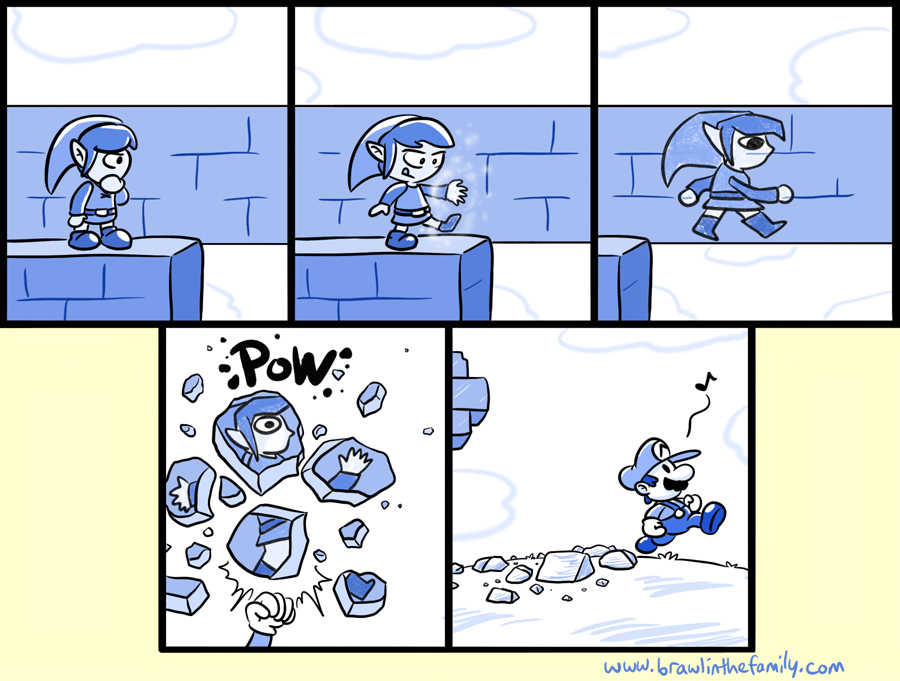
Link’s new ability in the upcoming 3DS Link to the Past-inspired Zelda game is rather cool from a gameplay standpoint…and more importantly, is ripe for parodying.  Who knew walking on walls would be so dangerous?

Hopefully Eario can humpty dumpty that mess so Hyrule isn’t forever doomed.

Some of you have gotten your books already!  If there’s a problem, please send me a message via Kickstarter (or email if you don’t have a Kickstarter, but the former is preferred so I can keep them in one place) and I’ll do my best to fix it.  Between getting the international orders labeled and paid for, and the continuing progress on digital rewards, I’ve still been quite busy over the past few weeks.  Thanks for your continuing patience!

-By Matthew

26 Apr 13:47

Real Madrid fans chant ‘less millions, more cojones’ at players in airport

by Brooks Peck

Real Madrid supporters were obviously upset about the team's 4-1 loss in Dortmund. This, after all, was a match that had a score of 1-1 at halftime. So when the team arrived at Dortmund's airport to make their trip home, their traveling fans were there and ready to make themselves heard.

"Menos milliones, mas cojones," (less millions, more balls) they chanted as the squad filed past them.

Their words stuck to the theme of Dortmund manager Jurgen Klopp's post-match comments. "That was like Robin Hood taking from the rich," he said, noting Madrid's superior wealth.

Though a comeback in the second leg wouldn't be completely impossible for Real Madrid, in order to achieve such a task, they would probably have to become a new kind of Robin Hood, who steals cojones. We can only hope they don't take that order too literal.

26 Apr 13:47

Andres Iniesta thinks this ‘end of an era’ talk about Barcelona is pretty dumb

by Brooks Peck

Bayern Munich beating Barcelona in the first leg of the Champions League semifinal wasn't terribly surprising. Beating them 4-0 was worthy of a gasp, but it's also been used to make sweeping declarations by those who are eager to write off Barcelona as a washed up super power.

What this assessment fails to take into account is the fact that Barca are one win away from another La Liga title and that they still extended their streak of consecutive years in the Champions League semfinals to six. Given that, Andres Iniesta thinks that dismissing Barcelona as past it is flat out wrong.

From Reuters:

"I think it is unfair to talk of a cyclical change," the Spanish World Cup winner told a news conference on Thursday.

"Over the last five years this team has won two Champions League titles...and we are on the point of winning a fourth La Liga title.

"It makes no sense to analyse five years in the one match in Munich. For me the end of an era is when years go by and you don't win any titles." [...]

"When you win the league you cannot say it has been a bad year because it is the most important title," said midfielder Iniesta.

With an all-German Champions League final seeming likely, those same people who have written off Barcelona are also declaring Germany as the absolute greatest footballing nation on the planet right now. And again, Iniesta thinks that kind of hyperbole should be taken down a notch.

"Bayern and Borussia are very good teams, well prepared physically and technically, and they have shown it in these two games," Iniesta said.

"It isn't that La Liga has dropped below them, it is just that the teams have overcome their rivals."

Andres Iniesta: Being logical and bagging trophies since 2005.

26 Apr 13:41

It’s this time of the year again: a long post from Elena

Yousef Alnafjan

Now there's a PayPal donation option for TOR, if you haven't donated already:
http://theoldreader.com/pages/donate

The most awesome cat ever except for mine(picture from Pusheen.com)


Today we are celebrating first year anniversary of The Old Reader. A year ago I talked to Dmitry about photography and, while browsing Google Reader, once again recalled how good it had been before November 2011 and persuaded Dmitry to start building a new reader for us and our friends. This was the start of our project. Then we had to come up with the name, and do it fast. Then Dmitry started coding, Anton began configuring stuff on his and Dmitry’s own servers, and I started asking all kinds of questions in numerous emails to my friends all around the world (here is my Oscar speech about people who helped us with the first beta in June).

I was sure that we could make it but I never imagined that we’d go as far as we have gone.
I never imagined that in a year we would grow up from 50 friends to over 200,000 people. I never imagined we’d be able to refresh about 4 million feeds every day. I never imagined that my “strategy” will apparently lead us to getting covered by all major tech media. And I certainly never imagined we would be getting this amount of warm words, feedback and support in donations that allows us to keep going.

But news can’t be always good. Recently Anton was asked to stop working on The Old Reader in his spare time because of a potential conflict of interest with his day job. This is a heartbreaking moment for Dmitry and me. Anton was the one who provided his own hardware when we started the project, then built our own infrastructure from scratch, managed, supported, and made it scaleable. He was always the “on call” engineer for The Old Reader, patching mongodb code at 6 AM or revamping our monitoring in the middle of night. He had a clear vision of his part of the job, and if you ever received a reply to your feedback that was probably too sharp and direct — that was most likely from him. We’d never go this far if not for his involvement in the project.

I am inclined to work on The Old Reader and bring it to a new level, starting with search for funding and making it a full-time job, even if it means putting away everything else, having even less spare time, and getting even more project-related emotional swings.

A year ago we only had an idea and some spare time, nothing else. Now we have a plan, a deadline, a vision, help from our new contributors (more on this in a separate blog post soon), and of course the invaluable support of our awesome users who donate to keep the project running.
And that’s a start.
Thank you everyone.

Elena

26 Apr 06:10

Texts From Superheroes, A Blog Featuring Witty Texts Between Comic Book Heroes & Villains

by Justin Page
Yousef Alnafjan

Wibbly-wobbly

Texts From Superheroes

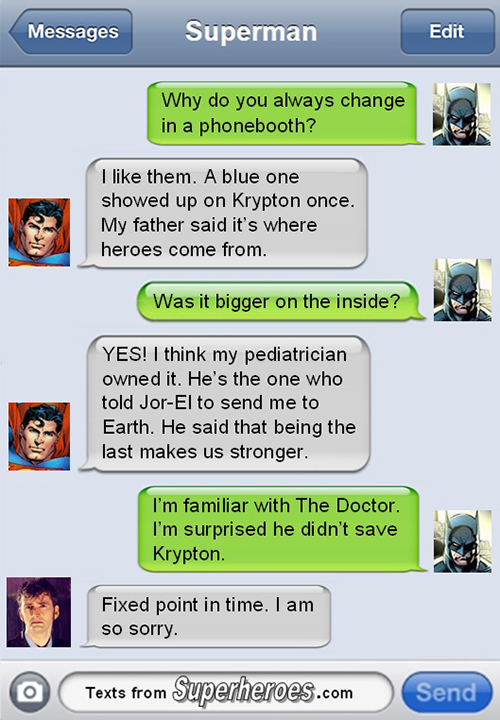
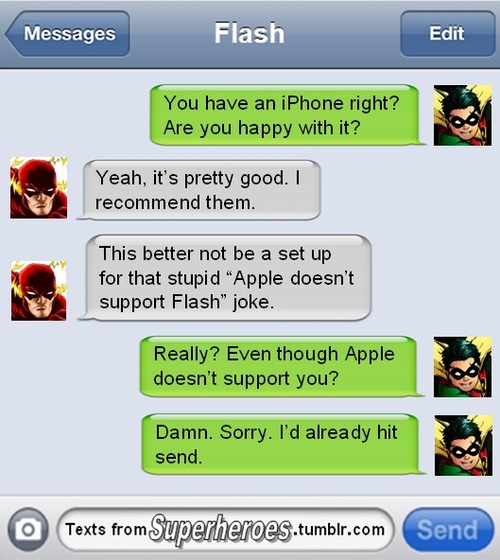
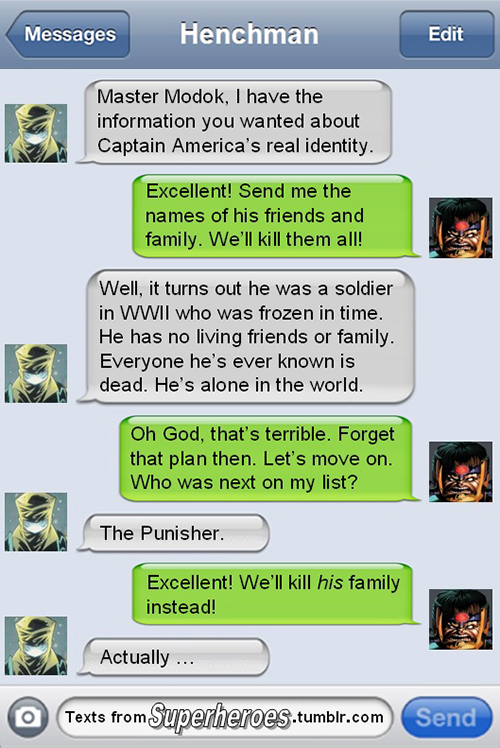
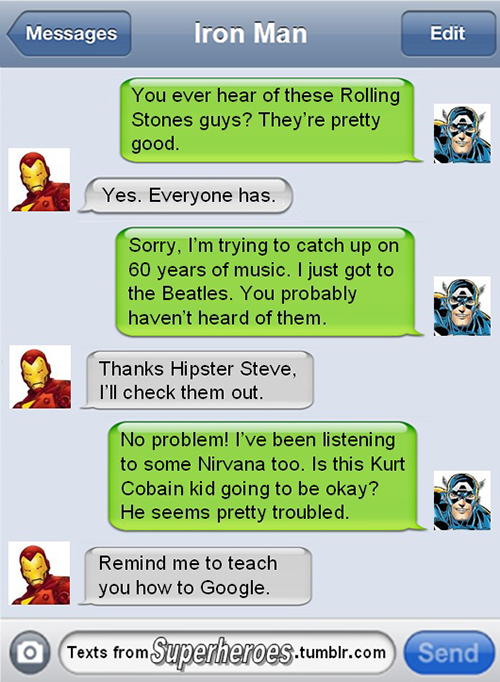
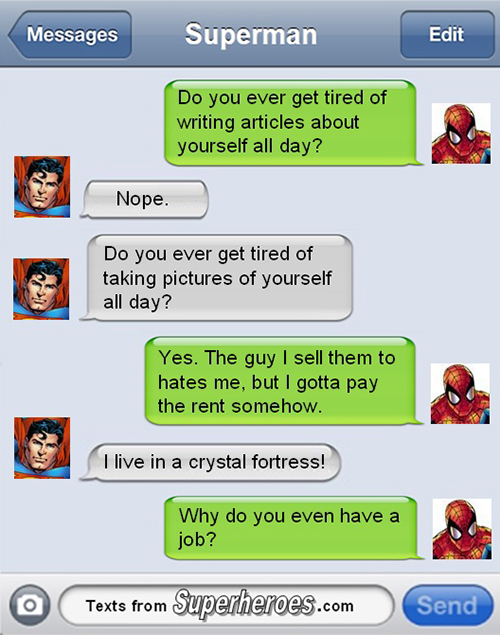
Texts From Superheroes is a Tumblr blog featuring witty iPhone text exchanges between comic book heroes and villains. The blog is run by internet comedian Diana McCallum and stand-up comedian Andrew Ivimey.

Texts From Superheroes

Texts From Superheroes

Texts From Superheroes

Texts From Superheroes

images via Texts From Superheroes

via Luis Figueroa, Nerd Approved

25 Apr 15:57

Super music bros: 'World 1-2' is an all-star collection of gaming's best musicians

by Andrew Webster
Rsc2ysnjf6jtsbvqebu5pbngkhdgk4d2dxm5jk3quqq_large

"I'm just a video game music fanboy from Kuwait," Mohammed Taher tells The Verge. "This wasn't planned." But despite the humble attitude, Taher has managed to create something special in the form of World 1-2, an upcoming album featuring some of the biggest names in video game music. There's everyone from the Grammy-nominated Austin Wintory, composer of Journey, to Manami Matsumae, who scored the very first Mega Man back in 1987. It's a diverse lineup, spanning multiple styles and eras, but with one unifying theme: video games. "A lot of people think video games are just chiptunes," Taher explains, and World 1-2 is a way of showing just how much more the medium has to offer.


"A lot of people think video games are just chiptunes."

It all started with a podcast. When Taher was thinking about making a new intro song for his Arabic-language gaming podcast, he thought it might be fun to reach out to Souleye, the composer behind indie hit VVVVVV, about crafting a new song. To Taher's surprise, he agreed, and the new music was a hit. "The response was great," says Taher. It also got him thinking about working with even more musicians. He originally hatched a scheme to release a small EP on his gaming site, world1-2.net. Eventually he convinced both Eirik Suhrke (the composer behind games like Spelunky, Ridiculous Fishing, and Hotline Miami) and Saudi Arabia-based electronic musician Agent Whiskers to put together a four-song EP. From there it kept growing: soon members of the metal band Metroid Metal agreed to contribute tracks, and from there, Taher says, "It just started rolling."

But the biggest breakthrough came later, when Taher decided to reach out via Twitter — and an interpreter — to renowned video game musician Akira Yamaoka, best known for his work on the Silent Hill series of horror games. And again, to his surprise, Yamaoka agreed. This helped give the project some extra credibility, and gave Taher even more motivation and confidence to continue to reach out to prominent musicians.

Keiji Yamagishi was at the top of the list. Best known in North America and Europe for his soundtracks to classic games like Tecmo Bowl and Ninja Gaiden, Yamagishi is also well known in the Middle East and Japan for Captain Tsubasa Vol. II: Super Striker, a Famicom game based on a soccer-themed anime series. "I think I like it as much as some people like Mega Man music," Taher says of the game's soundtrack.

18499439ea699832555f795c2c358392-d6259ey

Unfortunately, Yamagishi hadn't worked on any game-related music since 2003's Onimusha Tactics, and Taher had been searching for details on what the musician was up to since 2008 with little success. Then, last year, through the help of a friend, Taher managed to track down Yamagishi's newly created Facebook account. Social networking once again proved useful, as Taher befriended the composer and began exchanging messages. Yamagishi not only agreed to create a new track for World 1-2, but he's also working with Taher on a brand new chiptune album, his first solo release. "I think my passion towards music has come back to me," Yamagishi says. "I'm happy to have realized that the work I did when I was young was not all for naught."

"I think my passion towards music has come back to me"

But despite this success in reaching out to artists, Taher's inexperience with the music industry did lead to a few issues. For instance, while Journey's Wintory was willing to work with him, he also required a contract before things started. "I didn't know what to do," Taher says, "because I had never written a contract before." He originally thought the roadblock would force him to leave Wintory out of the project, but a week later Yamaoka's assistant sent him a message saying that the musician had already started working on his song, and now wanted to go over the contract details. With two big-name artists on the line, Taher eventually managed to draft up a suitable contract and both musicians are now featured on the album.

The result of all of this hard work is a 20-track-long album that covers a huge range of video game music — there's everything from the hyper chiptune song "Tokyo Skies" by Super Hexagon composer Chipzel to Wintory's sweeping and emotional "Circles." It's a wide swath of what video game music has to offer, from remixes to original songs. Taher says he has so much material, in fact, that he'll be putting out a second compilation later this summer.

With multiple albums in the works, he's accidentally created a record label of sorts, appropriately dubbed "Koopa Soundworks." World 1-2 will be launching on May 2nd, though you can pre-order now and check out five tracks early. And even though the project has grown into something rather large, Taher says he has no plans to quit his day job, and only wants the project to become self-sustaining — for the past eight months he has ignored his savings account to put money into the project, paying musicians and engineers. He has no illusions about becoming some sort of video game music mogul. "I'm just a regular guy who enjoys music."

25 Apr 13:12

funnyordie: Game of Thrones on Facebook Read the Game of...


funnyordie:

Game of Thrones on Facebook

Read the Game of Thrones Facebook posts in their epic entirety.

This is way funnier than it has any right to be.

25 Apr 13:05

Conference or Not, We'll Cherish These E3 Nintendo Memes Forever

by Brian Ashcraft

Nintendo is not holding a big time E3 press conference this year. Bummer! Know why? The memes and the memories, that's why.

In the past, Nintendo's E3 press conferences have given birth to some of the best gaming memes the internet has seen. Thus, this summer could see a huge hole in internet fun, which is truly unfortunate.

Let's take a look back at some of the most delightful (and delightfully embarrassing) Nintendo's E3 press conference moments from over the years.

Thanks for the meme-mories, Nintendo!

"That's the Worst Japanese I've Ever Heard"

This was apparently the first question Shigeru Miyamoto was asked at the 2001 E3 press conference.

Reaction Guys

The meme is called "Gaijin Yonkoma" ("4-frame foreigners") in Japan, where it still pops up online from time to time. The meme uses two photos of IGN reporters (disinterested in one and excited in the other) to show, as KnowYourMeme explains, something akin to "At first I was like X, but then I was like Y."

The now famous photos were taken at Nintendo's 2003 and 2004 press conferences and uploaded to IGN's boards. From there, the photos went viral in Japan.

"Kicking Ass, Taking Names, and Making Games"

This is from Nintendo's 2004 E3 press conference, which showcased the Nintendo DS and hinted at the then codenamed Revolution. That console would become the Nintendo Wii.

Link Miyamoto

This was a high point for E3, for Nintendo, and for everyone. Even to this day, goosebumps.

Miyamoto, The Orchestra Conductor

I wanted this game. Wii Music was not this game. But for a few minutes on stage at the 2006 E3, Nintendo created magic.

"My Body is Ready"

Said by Nintendo of America's Reggie Fils-Aime at the 2008 E3 and never forgotten by the internet. The press conference itself, however, was not good. At all.

Ravi

...

Non-Specific Action Figure

This happened. No, really. It did. But, you know what, it's aged pretty well.

Reggie Is a Zombie

At last year's E3, Reggie turned into a zombie—or a zombi. He likes French food, but who doesn't?

There are many more Nintendo E3 memes and moments from over the years, whether it's Miyamoto pretending to throw a Pikmin into the crowd or the company unveiling new hardware like the Nintendo 64. What made those moments was that they were big. There was a crowd. There was energy.

Sometimes, Nintendo pulled off feats of wonder and amazement. Sometimes, Nintendo fell flat on its face. But one thing was constant: Nintendo gave E3 everything it had. And this year, Nintendo isn't, which is a shame. A real shame.

25 Apr 12:02

Stupendous.


Stupendous.

25 Apr 08:03

Nintendo not doing E3 press conference, holding smaller closed events instead

by JC Fletcher
Yousef Alnafjan

Called it

Nintendo not doing E3 press conference, holding smaller closed events insteadIn an investor presentation, Nintendo CEO Satoru Iwata announced that Nintendo will skip the usual large-scale E3 press conference this year in favor of "a few smaller events that are specifically focused on our software lineup for the U.S. market."

One of these events will be for American distributors, with another closed event "for mainly the Western gaming media." Iwata noted that Nintendo is not planning to announce any new hardware at this E3, with showing off software the main focus.

While Nintendo is dropping a lot of mainstream press attention with this move, it makes a lot of sense for a company with the recent financial history of Nintendo to skip out on some expensive pageantry. Especially when the company makes E3-level announcements monthly, for a tiny fraction of the cost.

JoystiqNintendo not doing E3 press conference, holding smaller closed events instead originally appeared on Joystiq on Wed, 24 Apr 2013 23:18:00 EST. Please see our terms for use of feeds.

Permalink | Email this | Comments
25 Apr 08:02

Miiverse now accessible through web browsers

by JC Fletcher
Yousef Alnafjan

Next: smartphone apps and the ability to share directly to Twitter/Facebook.

Miiverse now partially accessible through web browsersYou can't quite draw Mario tableaux on your smartphone to share with your pals yet, but you can load up Miiverse on your computer or smartphone's web browser to look at your friends' stuff. Browser access to the Wii U's adorable social network has launched, in beta.

Load up the Miiverse site here and you'll be able to view your Activity Feed, friends list, and notifications, and "Yeah!" others' posts - pretty much everything but make new posts and new accounts.

Even though it's now accessible outside the Wii U, you still need to make a Nintendo Network ID on a Wii U in order to use Miiverse.

JoystiqMiiverse now accessible through web browsers originally appeared on Joystiq on Wed, 24 Apr 2013 22:20:00 EST. Please see our terms for use of feeds.

Permalink | Email this | Comments
25 Apr 01:14

Fujifilm X100S review: Making today’s pictures with yesterday’s design

by Dan Seifert
Yousef Alnafjan

Classy design

X100s-hero_large

Retro is so hot right now. Mad Men is on its sixth season and still pulling in huge ratings. The Great Gatsby is due to hit theaters next month, with a period-correct 1920s setting. And Fujifilm's new X100S, an update from 2010's X100, is one of the most retro inspired cameras we've seen to date. But despite its throwback look and feel, it has all the capabilities one would expect from a modern digital camera. Available now for $1,299.99, the X100S is one of the latest entries into the increasingly crowded high-end fixed lens compact camera segment.

At that price, you wonder who this camera is for, exactly. It's a bit out of the price range of the average camera buyer, and the camera's looks beg to be used by a photographer who knows what they're doing. But can the X100S take the place of a pro's rig when on the go? Is the X100S just a novelty toy for those that wish cameras were what they used to be? I've spent the past couple of weeks with the X100S to find out.


Hardware / design

Delightfully retro, modern at heart

The X100S looks as if it's straight out of Mad Men, but it doesn't quite match the build of other cameras

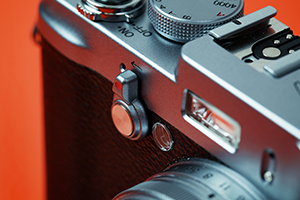
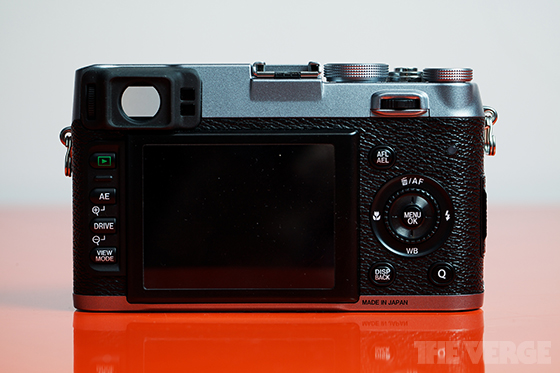
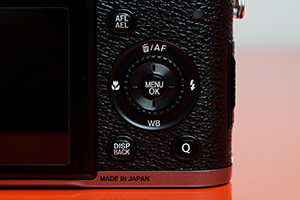
The X100S (and the X100 that preceded it) looks like it was just lifted out of 1965. (On more than one occasion during my time reviewing it, people noted that it looked like their dad's old camera.) Luckily, they made beautiful cameras back in 1965, and I’m a big fan of the X100S’ aesthetics. It seems that many of the people that I’ve shown the camera to are as well. A true rangefinder, the X100S features a die-cast magnesium top and base with polyurethane (not leather, unfortunately) inserts to provide grip when handling it. While it feels solid and well-constructed, the build quality doesn't quite match the Sony RX1, another high-end fixed lens compact camera. On the back of the camera is a 2.8-inch, 460,000-dot LCD and a smattering of controls, including the new Q button for quick access to commonly changed settings, while metal exposure compensation and shutter speed dials flank the shutter button on top of the camera.

The hybrid viewfinder is unique and fantastic

The most unique and interesting feature of the X100S is its hybrid viewfinder, which can be switched between a traditional optical viewfinder and a high-resolution electronic viewfinder via a switch on the front of the camera. The pass-through finder features overlays that can display things like focus points, parallax offset, exposure settings, and horizon meters. It almost feels like something from a science fiction movie, like you are looking through Tony Stark’s Iron Man helmet. The EVF mode can show a whole host of information in addition to what the optical finder offers, as well as things like white balance and actual exposure for a scene. Both options worked well, though the camera was faster and more responsive with the optical finder. Due to the viewfinder being separate from the lens itself, the optical viewfinder can have some perspective issues when you are photographing close subjects, which is something you have to be conscious of when framing or your subjects’ heads might just get cut off. This is something that you find on any rangefinder camera, and while it takes some getting used to, the guidelines in the viewfinder help steer you in the right direction.

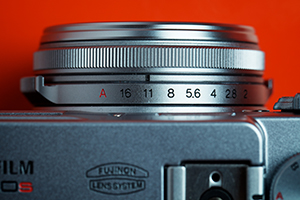
The X100S has just a single, fixed, 23mm f/2.0 lens with a manual aperture and focus rings. Annoyingly, the aperture ring only offers full-stop increments, which requires you to use a different control on the back of the camera to dial in more precise settings (the shutter speed dial on the top of the camera suffers from the same malady). The lens is significantly more compact that the 35mm Carl Zeiss lens mounted to the RX1, making the whole package of the X100S quite a bit slimmer. The X100s is easier to store in a shoulder bag or generous jacket pocket, but it can't really be called truly pocketable, however. The lens quality is impressive — images are sharp from edge to edge at any aperture, and there isn't any chromatic aberration or other imperfections to worry about. The lens also has a built-in, 3-stop neutral density filter that lets you take images with a shallow depth of field even on a bright, sunny day.

As with any fixed lens camera, you are limited to a single perspective for all of your shots on the X100S. Some may find this too limiting, while other photographers find that it forces them to be more creative with their composure and framing. Either way, one easy way to decide the X100S isn't the camera for you is if you need a lot of zoom — or any at all.

Fujix100s2_300
Fujix100s7_300
Fujix100s6_300 Fujix100s12_300

Fujix100s8_2040_verge_super_wide Image quality / performance

Speed demon

The X100S runs laps around the older model, and takes better pictures Fujix100ssamples1_300 Fujix100ssamples16_300 Fujix100ssamples20_300


Behind the tack-sharp lens on the X100S is a new 16.3-megapixel APS-C X-Trans CMOS II sensor, which Fujifilm claims rivals full-frame sensors for resolution and low-light performance. Sure enough, in use the X100S more than held its own with regards to picture quality. Images were relatively noise-free and clear all the way up to ISO 6400, and even ISO 12,800 and 25,600 were usable in a pinch. Colors were accurate and well saturated without being cartoonish, but the images didn't convey the same "wow" factor that a full-frame camera offers, and it was rare that I was in a situation where I didn't feel like a less expensive camera like Sony's NEX-5R could pull off the same shot. That said, the X100S offers impressive pictures right out of the camera — most of the JPEGs it produced were very good and required very little in the way of post processing. The camera's white balance was also very accurate and reliable, something that even the best digital cameras still struggle with today.

In addition to upgrading the X100S' sensor, Fujifilm has also included a new EXR II image processor and autofocus system, which addresses the two major performance issues that plagued the X100. The X100S is a very quick, responsive camera — there's virtually no delay when turning it on and snapping frame after frame, and writing images to the memory card doesn't bring the camera to a halt (something the X100 had plenty of trouble with). Fujifilm also makes some bold claims about the X100S' new autofocus, which uses a hybrid phase and contrast detection system. The camera has the ability to switch between the two systems on the fly: it will use phase detection for speed, or contrast detection for accuracy in low light, depending on what you are photographing. The manufacturer boasts a top speed of 0.08 seconds to lock focus, and it definitely felt fast in practice, though it wasn't remarkably better than other cameras in its class and didn't feel any faster than a pro DSLR to me. The X100S also has a much improved manual focus mode over the X100, as it now has focus peaking to better display your exact point of focus.

The X100S uses a rechargeable battery, rated for about 330 shots between charges. In practice, it easily lasted all day for me, and it proved to be much less of a worry than the battery in the Sony RX1. Heavy duty shooters might want to invest in an extra battery for peace of mind, but most people won’t have to worry about it.

Fujix100ssample_875_1 Controls

Interface issues

Fujix100s1_560

Shooting with the X100S is fun, provided you can get over the learning curve of its control schemes. As mentioned earlier, the aperture and shutter speed dials only offer full stop increments, so you have to use a secondary control with your right thumb to access more fine-tuned settings. Fujiflm has improved its controls over the X100, but I found them to be less intuitive than other cameras I've used in the past. But once you're past that warm-up phase, the X100S is an intimate camera that can produce great images again and again. Photographers with more experience behind manual cameras will adapt to the controls the quickest, and the optical viewfinder can be liberating for those used to staring at screens to frame your pictures. Fujifilm has included the usual filter modes seen on almost every camera these days, and there are a variety of black and white modes to choose from. The X100S can also shoot 1080p HD video, but unlike Sony's cameras, the video mode is very much an afterthought on the Fujifilm, as it is buried under menus and doesn't have a dedicated record key. Fortunately, the 60 fps video that the X100S captures is detailed and smooth, so it's definitely usable – it's just not what Fujifilm wants you to do with this camera.

Clumsy controls can take some getting used to Fujix100s4_300 Fujix100s9_300 Fujix100ssample_875_2
24 Apr 21:45

Microsoft to reveal next generation Xbox May 21

by Alexander Sliwinski
Xbox reveal May 21 Microsoft will reveal the next Xbox on May 21.

The event will have a global stream on Xbox.com, Xbox Live and Spike TV (US and Canada). No word yet if the Xbox 360 Pizza Hut app will also stream the event.

"On that day, we'll share our vision for Xbox, and give you a real taste of the future. Then, 19 days later at the Electronic Entertainment Expo (E3) in Los Angeles, we'll continue the conversation and showcase our full lineup of blockbuster games," said Xbox's community guru Larry "Major Nelson" Hryb.

The event is titled "A New Generation Revealed" and will occur at Microsoft's Redmond, Washington, campus on Tuesday, May 21 at 1PM Eastern (10AM Pacific, 6PM UK).

JoystiqMicrosoft to reveal next generation Xbox May 21 originally appeared on Joystiq on Wed, 24 Apr 2013 13:07:00 EST. Please see our terms for use of feeds.

Permalink | Email this | Comments
24 Apr 05:02

Apple patent outs system for turning video game choices into comic books, is all about Mass Effect

by Ben Gilbert
Yousef Alnafjan

Apple buying EA and making Mass Effect 4 an iOS exclusive

Apple patent outs system for turning video game choices into comic books, is all about Mass Effect

Commander Shepard is not someone we expected to pop up in an Apple patent from 2009 (granted today), but here we are, staring into his icy visage. He and the rest of the Normandy's crew are used as just one example of a system that Apple patented, which turns game story choices into a unique comic book (nevermind the fact that Mass Effect comics exist on their own). Of course, like with so many of these patents, it's possible this system'll never see the light of day, but we'd like to detail it all the same for the sheer strangeness of its ambition.

Essentially, the results of a player's in-game choices are used to populate a post-game comic book-style story -- progress, character info, settings, dialogue, achievements and screenshots are all pumped into an algorithm alongside the results of said variables, metrics from your playthrough, and your performance therein. The comic could be pushed to the cloud directly from your game console or PC, according to images included with the patent, which could then be pulled back down to a variety of devices (a tablet it shown, as well as standard televisions and PC monitors). Apparently Apple couldn't identify a good storytelling example from its own iTunes App Store, as Commander Shepard and co. are the only example given of a game use case. Again, it's rather unlikely we'll see this stuff pop up in Apple products anytime soon (if ever), but it's quite a concept nonetheless. That watch patent, however ... that's another story.

Filed under: Gaming, Software, Apple

Comments

Source: USPTO

24 Apr 04:56

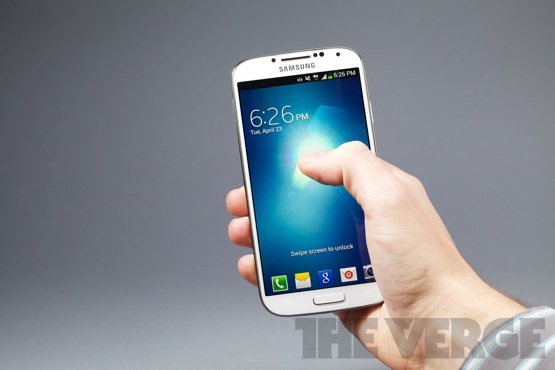
Samsung Galaxy S4 review

by David Pierce
Yousef Alnafjan

This review is basically a love letter to the HTC One

Gs4_1-hero_large

Years ago, people either bought an iPhone or “a Droid." Verizon’s marketing power, those insane robot ads, and maybe that just-close-enough naming convention made the carrier's Android phones virtually synonymous with their operating system.

But now I hear people every day saying "oh, is that the new Galaxy?" or "I don't really want an iPhone. I think I'm going to get a Galaxy." Thanks to its high quality and wide availability, not to mention Samsung's sheer brute-forcing marketing effort, the Galaxy S III became the face of the Android universe. It has sold tens of millions of units, and helped Android take huge marketshare away from the iPhone. Now Samsung's back with that device’s successor, the Galaxy S4. The new handset changes little from the GS III, but it adds a lot — a bigger screen, and a laundry list of software tweaks and features. It's a variation on a theme, a safe tweak to a strategy that’s worked impossibly well for Samsung.

But the landscape has changed since the Galaxy S III came out, and good cameras, big and beautiful screens, and fast performance now come virtually standard. The Galaxy S4 comes into a fiercely competitive market, with great phones on all sides and a particularly strong showing from the HTC One — is it enough of an improvement to keep Samsung atop the Android heap? I've had one for a week or so, and I have a few thoughts on the subject.

Hardware

Some things never change

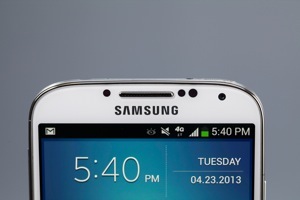
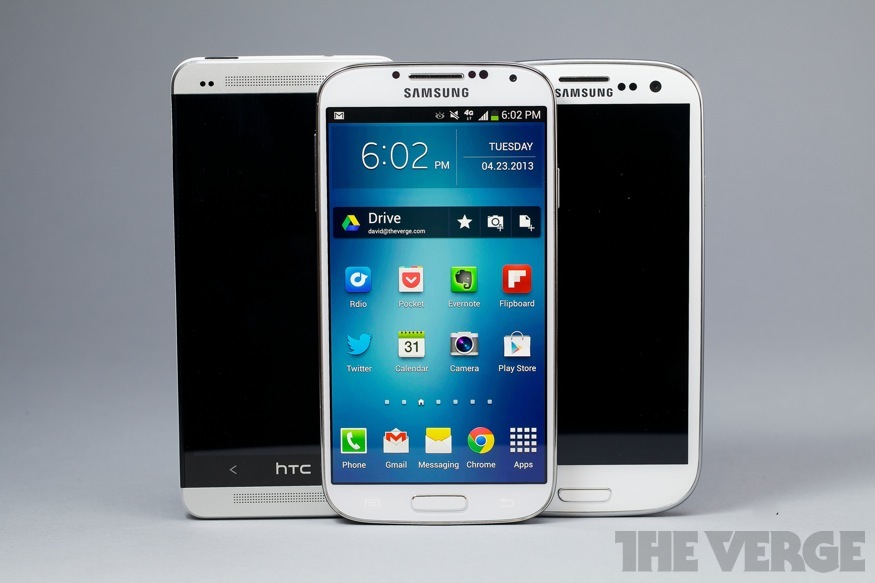
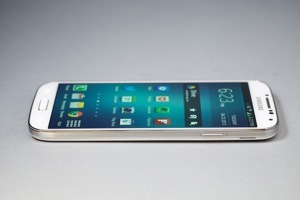
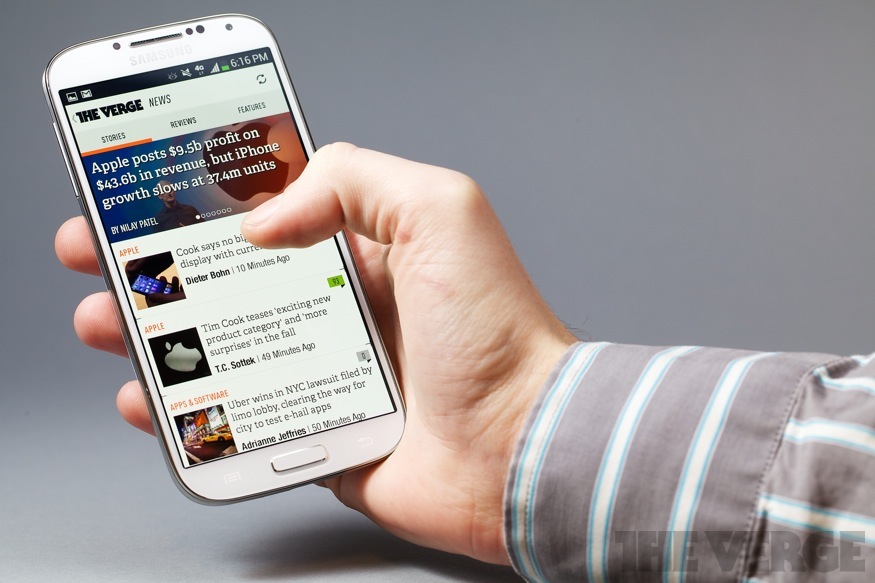
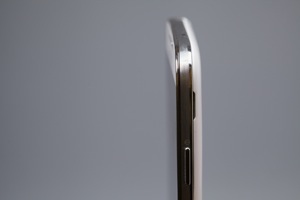
The GS4's primary competitors are the iPhone 5 and the HTC One, and from a pure design perspective that should make Samsung very, very nervous. Where Apple and HTC have both made beautiful, well-made, high-quality phones, the GS4 has Samsung back in the land of cheap, plasticky handsets. It looks for all the world like the Galaxy S III — despite having a bigger screen and more horsepower, at 7.9mm and 4.6 ounces it's actually imperceptibly thinner and lighter than the S III. But copying the S III wasn’t a good idea.

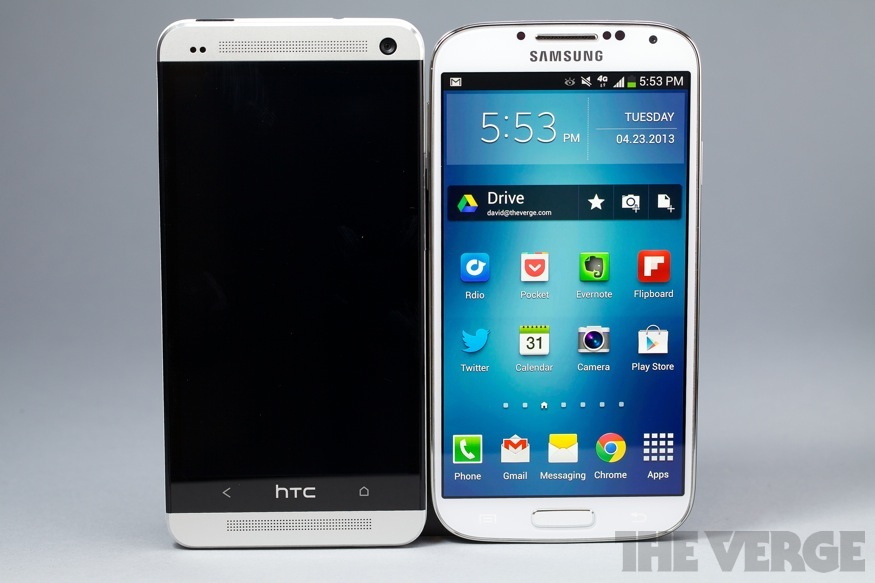
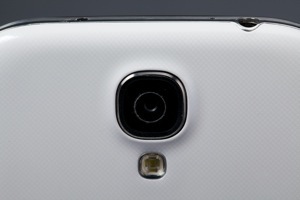
I don't like holding this phone, and I can't overstate how much that informs the experience of using it. It makes an awful first impression, slippery and slimy and simply unpleasant in your hand. My white review unit is completely smooth and glossy, with a subtle checkered pattern that looks textured but is neither grippy nor textured anywhere on its body. Even the silver band around the sides, which is obviously supposed to look like metal, is plastic. Everyone I showed the GS4 to frowned and wrinkled their nose as if it smelled bad, before rubbing their fingers on the back of the phone and then handing it back to me — that's the opposite of the standard reaction to HTC’s One, which everyone wants to ogle and hold. That's going to be a huge problem for Samsung, because the GS4 and One are likely to be next to each other on store shelves, and at least on first impression there's absolutely no contest between the two.

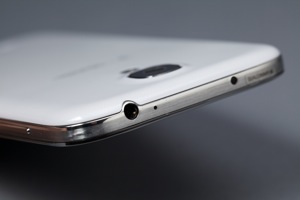
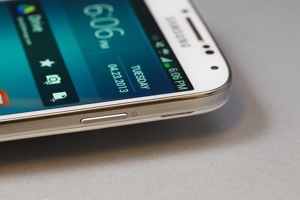
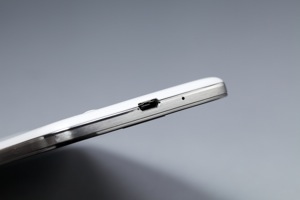
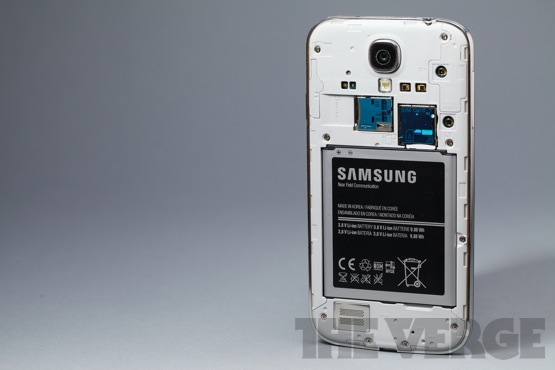
It's a shame, too, because Samsung didn’t have to do it this way. The company made tradeoffs for a removable battery and a slightly thinner body, but I’m not sure those are features worth sacrificing so much for in 2013. It's not all bad: the GS4 is thin and light, and feels durable despite its cheap materials. It's also an improvement over the S III, thanks to slightly flatter edges and shrunken bezels. The port layout is smart: power button on the right, volume on the left, headphone jack up top and Micro USB on the bottom, with the SIM card, microSD slot, and battery accessible when you peel off the removable back. I’m thrilled the GS4 has a physical home button, with capacitive Back and Menu keys on either side. It's very comfortable for such a large phone, but I can't get over the gross feeling I get holding it.

Samsung's proven repeatedly that people don't care about build quality, or at least will overlook it in favor of features and performance, but the landscape's different now. The HTC One is a powerful, feature-rich device that is also beautiful and classy, while Samsung's handset feels like an overpowered children’s toy. Samsung's feature list has to be awfully long to overcome that — and it is, but I'll get there.

Can we finally decide design matters? Gs4_14-300px Gs4_6-300px Gs4_15-300px Gs4_8-300px Gs4_7-300px Gs4_13-875 Display
In living color

It may not be perfectly accurate, but it looks good Gs4_4 Gs4_27-300px Gs4_2 Gs4_9
Gs4_28-555px

Through my entire time with the GS4, I kept imagining walking through a store and trying to pick a phone. Before even considering how Samsung can beat HTC, I wondered how such an apparently evolutionary change would convince users to upgrade from the S III, or to spring for the newer and more expensive model when the GSIII is still a solid choice.

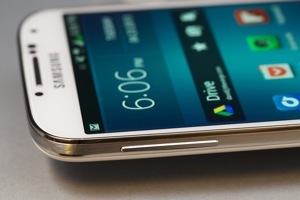
The answer's simple, and luckily for Samsung it's also immediately obvious. It's the screen. The GS4's 5-inch, 1920 x 1080 display is big, beautiful, and seriously eye-catching. The latter is partially a bad thing: the S4 uses a Super AMOLED panel like many of Samsung's phones, and like many of Samsung’s phones it displays overly contrasted and vibrant colors. Those colors may not be accurate — reds and oranges absolutely explode off the screen, whether they should or not — but they certainly catch your eye. And with a ridiculous 441 pixels per inch, even the PenTile display matrix I usually loathe causes no problems. The glass is rigid and responsive to touch, and works even if you have gloves on — which I shouldn’t have needed to test in April in New York City, and yet here we are.

For some reason, Samsung has always had trouble with screen brightness settings — the GS4 can never seem to decide how bright its screen should be, changing suddenly and drastically often and without warning. I turned automatic brightness off very quickly.

I tried to pick my favorite between the One's display and the GS4's, and wound up going back and forth a dozen times before giving up. Both are incredibly high-res, bright, and crystal clear; the One is slightly more accurate, but I still periodically forget my nitpicking and get lost in the GS4's vibrant colors. You really can't lose, and that's pretty great.

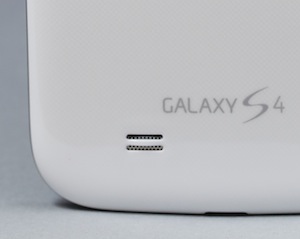
The lone speaker on the Galaxy S4 resides on its backside, in that wonderfully unconsidered spot where audio is both muffled by your hand and blasting directly away from your ears. Once again, HTC broke the curve by offering two big, powerful speakers pointed straight at your face — but the One aside, the GS4 offers surprisingly loud sound from rear-facing grille. It's not very rich and is very compressed, but it's loud. Loud is good.

2013-04-22_12 Camera

The camera Instagram deserves

While HTC is trying to convince buyers that megapixels don't matter, and that its so-called Ultrapixels are better anyway, Samsung went the opposite direction. I don't know if all the pixels the Galaxy S4's 13-megapixel sensor are the reason, or if I should credit Samsung's fast processor or the clear attention paid to its software, but the upshot is that the GS4's camera is the best Android camera I've ever used by a considerable margin, and in most cases it's every bit as good as the iPhone 5's camera.

However, the One and the Nokia Lumia 920 do considerably better than the GS4 in poor lighting. When it’s dark, the GS4 takes the same soft, noisy pictures as any other smartphone camera, but without the incredible brightness capabilities of the One — there are pictures you'll get with the One or the 920 that the GS4 just can't capture. The GS4's autofocus stumbles in low light, too; I learned quickly to take three shots at night, in order to get one that was properly focused.

It's actually Samsung's experience with dedicated cameras that make shooting photos with the GS4 so nice. The company borrowed a lot of the GS4's camera software from the Galaxy Camera, a concept car of sorts that clearly informed its ability to build a great cameraphone. The interface is much improved over the S III, from the scrolling mode dial to the one-press capture of either stills or video. It's also simple and fast, two things many cellphone cameras are not.

2013-04-22_19 2013-04-19_10
2013-04-22_12 2013-04-19_09


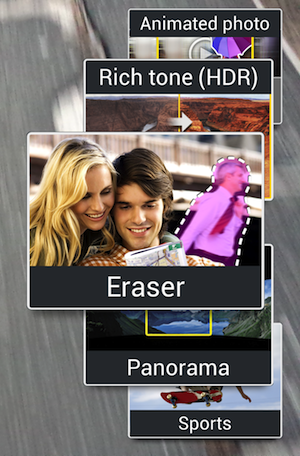
The GS4's greatest photographic achievement, though, is that it manages to be simple and fast while simultaneously offering the largest, most impressive feature set of any smartphone camera I've ever used. If you're just turning the phone to Auto and firing pictures, you're missing out. Instead, you should try turning it to Eraser Mode, which detects moving objects in your photo — like the stranger that always walks by right as you take the shot — and automatically removes them. Or scroll up to Drama Shot, which takes a series of pictures as a subject moves and then shows a whole leap, or the soccer ball's whole flight path, in one automatically-overlaid photo. Animated Photo lets you take a few seconds of video, then choose with your finger whether a part of the frame is still or in motion — you can actually create and share animated GIFs without ever leaving the camera app. Some of the more advanced features require some staging — and Drama Shot sometimes takes a couple of tries — but they're all pretty cool.

All except for Dual Camera, which despite Samsung's heavy promotion remains a mystery to me. The pitch is simple enough: you take a picture with both front and rear cameras simultaneously and overlay one on the other, so the person taking the picture appears in the picture as well. It's a neat idea in theory, but in practice left me just superimposing giant versions of my head onto random buildings, inside weird postage-stamp borders or within a heart. It's a fun, silly way to take an "I'm in New York!" selfie without turning the camera on yourself, and maybe that's enough, but it's still a little odd that Samsung is putting so much marketing muscle behind such a niche feature.

There are a lot of trees in this forest, some of them less than perfect, but taken as a whole the Galaxy S4's camera is a triumph. If it supplants the many terrible Android cameras posting to my Instagram feed, we'll all be better off.
Gs4_16-875 Software

What comes after the kitchen sink?
Gs4_19-555px

Speaking of forests with lots of trees: the GS4 may run Android 4.2, but Samsung has heaped so many features on top of Google's operating system that it almost feels like something entirely different. Normally I'm conditioned to believe stock Android is better than any manufacturer skin, but Samsung overhauls the software so completely that I'm less annoyed than I would be with a company like Motorola or LG, where the changes are typically a combination of aesthetic, problematic, and pointless. Some of Samsung's added features are all three, but many are downright useful.

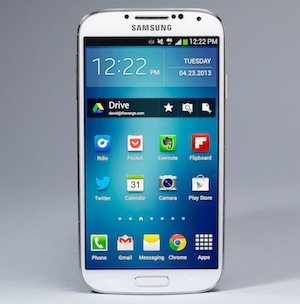
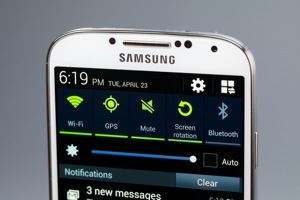
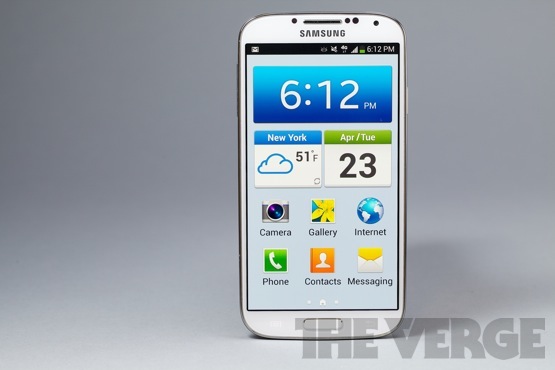
To start, the GS4 keeps all the features Samsung has debuted on various Note models and the Galaxy S III. Samsung pioneered the radio and connectivity toggles in the notification windowshade, and the GS4 offers access more and more settings there, including a brightness slider. Samsung's big clock-and-weather widget comes on the home screen by default, and the general Touchwiz look and feel remains intact. The green-on-blue-on-gray scheme is growing on me, but Samsung's hideous Calendar app never will; likewise many of the Phone menus and screens look cartoonishly terrible, with huge icons and ugly images.

What Touchwiz mostly offers is options: with a bit of effort, the GS4 can look and feel almost any way you choose. You can hide or rearrange apps in the app drawer, pick and choose quick-launch apps for the lock screen, change the order of settings and toggles, and much, much more. There's even an Easy Mode on the GS4, which turns your phone into something like John's Phone: it presents a simple dialer, shortcuts to a few common apps, huge icons for everything, and hides almost everything else. Samsung probably should’ve taken this as a sign, because if your phone needs Easy Mode you’re probably doing something wrong, but it does at least do a nice job simplifying everything the GS4 has going on.

The Galaxy S4 has a lot going on – maybe too much Gs4_24 Gs4_25-300px Gs4_22-300px 2013-04-23_21 2013-04-23_21
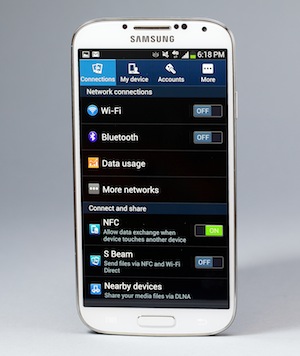
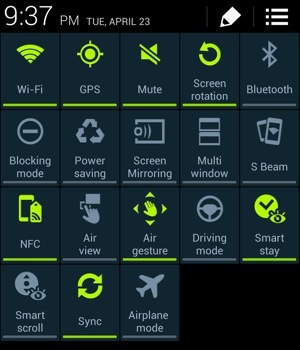
And boy, is there a lot going on. There are now 18 (yes, eighteen) toggles in the notification pulldown, which you can see by pressing a new button at the top right — it opens up a command center of sorts, which lets you turn off everything from Wi-Fi and Bluetooth to some of the wilder eye-tracking features. I kind of wish there were a Medium mode that would take away all the Minority Report stuff, and just leave a more normal Android phone.

I'll never forget Samsung's launch event for the GS4, a bizarre spectacle at Radio City Music Hall where actors went through feature after feature, explaining how they work together to make the GS4 your "Life Companion." Some of Samsung’s additions fit this bill a little more closely than others. S Health is the best example of an actual Life Companion – it's a Fitbit- or FuelBand-style app that tracks your steps, calories, sleep, and diet, offering you a way to get fit (or in my case just provide more data about my pathetically sedentary lifestyle). It's handy to have built right into your phone, and the app's pretty powerful thanks to the S4's temperature and humidity sensors — you can actually tell it how you feel, and it'll figure out how you should adjust your surroundings to feel better. S Health is a great tool, though it won't be as good as it could be until its companion accessories come out in a few months' time.

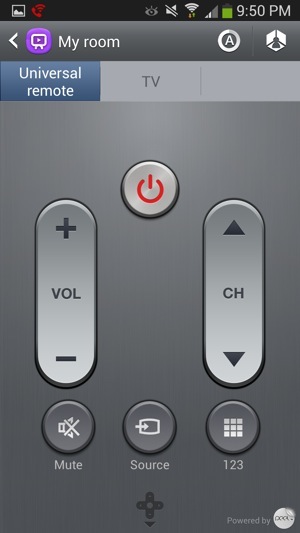
My aforementioned sedentary lifestyle is also probably to blame for why I used WatchOn, Samsung's handy universal remote and search-based TV guide app, far more than S Health. It’s a great app, offering quick and easy control over your whole home theater setup via the IR blaster on top of the GS4, plus the really clever Peel-made search and recommendations interface across your cable box, Netflix, Blockbuster, and other services. More than anything, it's just convenient — I tend to have my phone in my hands while I watch TV anyway, so switching to WatchOn to change the channel is light work.

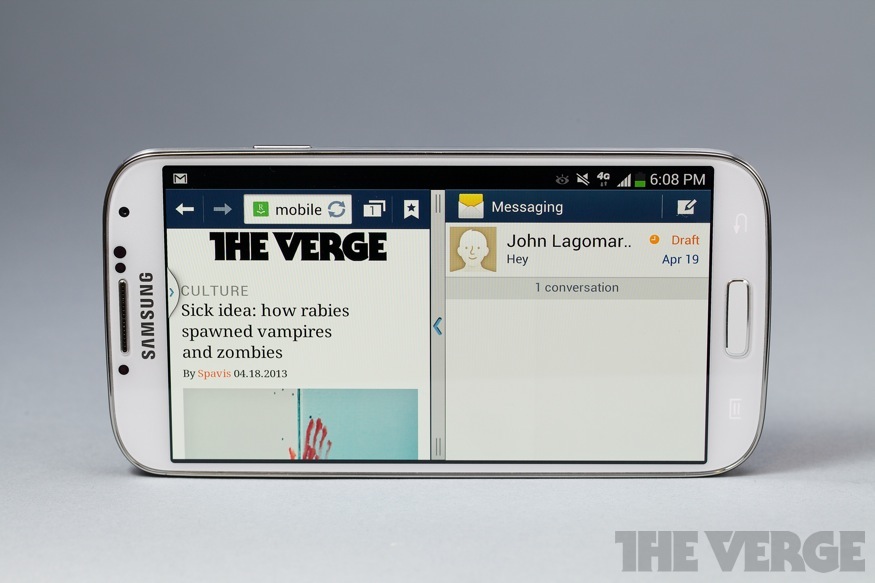
There's a full-fledged suite of Office products via the Polaris suite, though I can't say there's any way to make editing a PowerPoint on your phone a pleasant experience. There’s also a built-in translator app — I bet you can guess it’s name — plus a handy tool for scanning business cards and QR codes. Carriers (in my case T-Mobile) also add some bloatware, though Samsung lets you hide most of the apps you don’t want from the drawer — yet again, the GS4 is an incredibly malleable phone. It just takes some work to get it the way you want. You can even run two apps at once, side-by-side with a system just like the Note 8.0’s, which works surprisingly well on a smaller screen because there are just so many pixels to play with.

I like the apps and services Samsung adds to the Android experience here, but I'm less enamored with all the ways Samsung has reimagined how you'll want to actually interact with your cellphone. These features were touted heavily on the GS III despite the fact that I never once saw a regular person using S Beam or AllShare, and the trend continues unabated with the S4.

The hand waving software is more useful — sometimes. There's Air View, which approximates the Galaxy Note's ability to recognize when you're hovering over the screen with the S Pen and unearth content without making you tap, but requires only your finger. It's handy for previewing an email without opening it, or seeing stories in Flipboard, but not much else, and it requires precision hovering a centimeter away from your target — I wound up accidentally tapping on the screen half the time anyway.

Air Gestures has me completely torn. It's really impressive, letting you wave your hand over the phone to scroll up and down a webpage or flip through a gallery, and it works reliably once you figure out your hand has to pass over the top of the phone, where the IR sensor sits next to the earpiece. I started using it while my hands were wet, or if I had something in my hand. (Sadly it doesn't work with Pocket, so I can't wave my coffee-filled hand over the phone to flip pages while riding the subway.) It's overly sensitive, though, and will often scroll back when you’re just moving your hands around. It also tended to jump as I was pointing something out or showing someone a photo, which became a pain. I wound up leaving both Air View and Air Gestures on, mostly just to show people how cool they are — and because I love that I can wave at my phone to change songs.

The list goes on and on, really, with Samsung offering features galore that you'll probably never use. The Story Album app lets you create scrapbooks from your photos, though there are plenty of third-party apps that do it better. Group Play is like AllShare on steroids – you can have everyone listen to the same song at the same time, play a game together, or all look at a slideshow, except everyone has to have a GS4 and jump through a bunch of hoops to get it all working. Of course there's also S Beam and NFC, plus a new security feature called Knox that separates your personal information from your work data — handy if you're bringing your GS4 to work, mostly superfluous otherwise.

Much of what Samsung offers seems to be just for show, designed to give sales clerks something to demo that makes the GS4 unique. The best features get out of your way, but too many are simply obtrusive — I wound up using the GS4 like I would any other phone, with most of the additional features off, and as much as I'd be thrilled to watch people waving at their phones on the subway, I'm not betting it catches on.
2013-04-23_21
Eye tracking and hand waving Gs4fixed-875
Performance

Still on the bleeding edge
Gs4_5-555px

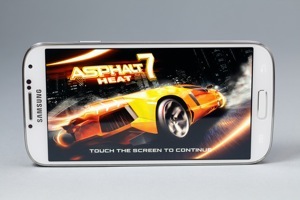
Samsung’s Galaxy S lineup has never wanted for power, and neither does the Galaxy S4 — it’s an impressively fast and powerful phone, capable of handling anything I threw at it. I could get it to drop frames in Asphalt 7 or stutter ever so slightly when closing some apps, but only by turning on and turning up every conceivable feature on the phone — and even then its stumbles are rare. Used more normally, once you've disabled some of the more obnoxious software features, it's virtually flawless.

I say "virtually" because the phone does trip up occasionally, and only in surprising places like the Gallery, which sometimes freezes and crashes for no obvious reason. Samsung's software design is clearly to blame here, and it's the most lasting reason I still dislike software skins — they just create problems Android doesn't otherwise have. But otherwise the 1.9GHz Qualcomm Snapdragon 600 processor and 2GB of RAM inside the S4 do every bit as well as you'd expect bleeding-edge specs to do. Some international markets are getting Galaxy S4s powered by Samsung’s own Exynos processor, which should be even more powerful.

The phone's going to be available on every carrier on the planet, or at least Samsung makes it feel that way — it's coming to all four major US carriers, plus a handful of smaller regional companies. I tested a device with T-Mobile, and while this device supports the company's brand-new LTE network (and its new, contract-free service plans) I didn't have a chance to test it because, well, T-Mobile’s LTE network only works in Las Vegas. Reception and data speeds were normal for T-Mobile in New York City, and I'm looking forward to the bump when LTE comes on in Manhattan. Call quality was solid if unspectacular, though I very much appreciated the "Extra Volume" button that makes the other person just astonishingly loud in your earpiece — construction zones and sirens be damned, you'll hear just fine.

My biggest frustration with the HTC One has always been its battery. It’ll last a day, but only with a bit of hand-holding. If that’s lower-middle class, I’d say the Galaxy S4 is upper-middle class: it lasts a full day almost no matter how I use it (unless I stream HD Netflix videos constantly, in which case it dies in about five hours), and will even get me to the morning if I forget to plug it in. I rarely forget to plug my phone in every night, and I don’t mind needing to charge every night, but I’m so used to babysitting my iPhone 5 all day or watching the One’s meter hit red that not having to worry about the GS4 all day was pretty wonderful.

There's never a shortage of power from Samsung Gs4_10-300px Gs4_29 Gs4_26-300px Gs4_12-875
24 Apr 04:29

Tim Cook teases 'exciting new product category' and 'more surprises' in the fall

by T.C. Sottek
Iphone__2_of_2__large

During Apple's Q2 investor call, CEO Tim Cook teased "the potential of exciting new product categories," and suggested that the company will announce new products in the fall. "We've got a lot more surprises in the works," Cook said. "Our teams are hard at work on some amazing new hardware, software, and services that we can't wait to introduce in the fall and into 2014. We continue to be very confident in our future product plans." Cook said that there will be "really great stuff coming in the fall and across all of 2014."

When asked about the new product categories, Cook declined to provide a specific timeframe, suggesting a new category may not appear this year. "The reality is that the work we do to produce truly innovative products is very hard," Cook said. "I assure you that we're working very closely with manufacturing partners to achieve a very exciting roadmap."

Apple's CEO wouldn't name specifics, but if earlier reports pan out, one of those surprises could be a wristwatch running iOS. The comments came following Apple's promising second quarter report in which the company posted a profit of $9.5b on revenues of $43.6b — right in-line with Apple's expectations from last quarter. "Decline in Apple's stock price over the last couple quarters had been very frustrating to all of us, but Apple remains strong," Cook said. "The most important objective at Apple will always be creating the most innovative products."

24 Apr 04:26

Google accelerates push to replace passwords by joining FIDO Alliance

by Casey Newton
Security-2012-02-14-verge-1020_large

Amid a growing consensus that passwords are not adequately secure, the group of tech companies working to supplant them with something stronger has gained a significant new ally. The FIDO Alliance said today that Google, which has shown a strong interest lately in making user authentication more secure, has joined its board of directors.

FIDO is developing alternative methods to verify a user's identity when they try to log into websites and services, with a spaghetti-against-the-wall approach that includes biometrics, voice and facial recognition, USB security tokens, NFC, and one-time passwords. The goal is to create a standards-based specification for password alternatives that work with Internet services and with one another.

Goodbye password, hello authentication ring

Google joins original members Lenovo, PayPal, Nok Nok Labs, and Validity on the board. Semiconductor company NXP and input device maker CrucialTec also joined the board today.

"Joining the FIDO Alliance is a great way to increase industry momentum around open standards for strong authentication," said Sam Srinivas, who leads information security efforts for Google, in a statement. "We look forward to continuing our current development work on strong, universal second-factor tokens as part of a new FIDO Alliance working group."

In January, Google security researchers published a paper outlining new ways to authenticate users. Among them: a USB token that plugs into the user's computer and communicates its identity via a website, giving the user access to their accounts without having to supply a password. Eventually, Google argued, the authentication technology could fit in a ring on your finger.

FIDO, which formed in July 2012, will hold its next meeting with members from May 14 to 16 in San Francisco.

24 Apr 04:25

Twitter reportedly working on two-factor authentication

by Jeff Blagdon
Twitterstock_large_jpg

Twitter is reportedly working on a two-factor authentication system. Wired writes that the company is currently testing the new security solution internally before rolling it out to the public.

Following a number of high-profile hacks, including that of Wired editor Mat Honan, several companies have shifted to two-factor authentication, including Apple, Microsoft, and others. Today’s hack of the Associated Press account provides a vivid illustration of the need for some kind of enhanced security after a fraudulent claim of explosions at the White House sent the Dow plummeting by 100 points.

Two-factor authentication relies on two pieces of information to confirm a user's identity. Implementations typically check for access to a mobile device by requiring you to enter the content of an SMS or similar message in addition to your standard password. So far, no specifics have been announced about the enhanced security at Twitter, but the company is reportedly hoping to implement the new measure "shortly." Twitter declined to comment on this story.

23 Apr 22:04

Comic #104- What We Desire

by Tyler Rhodes
Yousef Alnafjan

Again, very topical

23 Apr 15:29

Gunpoint gears up for Steam

by Ludwig Kietzmann
Yousef Alnafjan

Looks incredible.


Gunpoint
, a 2D collusion of quiet intrusion, espionage and elusion, will be available for PC through Steam once it's complete. The game stands out for its romantic combination of spy and electrician, letting you divert power in devious ways between switches and several objects in the environment.

Lead designer Tom Francis has posted a new video (above) demonstrating Gunpoint's gadgets, some of which allow you to reprogram gun triggers, survive tremendous falls and scale steep surfaces.

Note on something that should have been mentioned earlier: Clicking play on the video above has likely electrocuted a stranger somewhere in the world.

JoystiqGunpoint gears up for Steam originally appeared on Joystiq on Mon, 22 Apr 2013 16:00:00 EST. Please see our terms for use of feeds.

Permalink | Email this | Comments