New submitter Kimomaru writes "Ars Technica asks, 'How does a non-technical manager add value to a team of self-motivated software developers?' IT Managers have come some way in the past decade (for some). Often derided as being, at best, unnecessary and, at worst, a complete waste of budgetary resources, managers in technology today can add significant value by shielding developers and systems engineers from political nonsense and red tape. From the article: 'Don't underestimate the amount of interaction your manager does with other departments. They handle budgets, training plans, HR paperwork. They protect the developers from getting sucked into meetings with other departments and provide a unified front for your group.'" Has that been your experience?
Hugh Pickens DOT Com writes "Here's an interesting paper by two physicists at Michigan Technological University who have come up with a practical methodology for finding time travelers through the internet. 'Time travel has captured the public imagination for much of the past century, but little has been done to actually search for time travelers. Here, three implementations of Internet searches for time travelers are described, all seeking a prescient mention of information not previously available. The first search covered prescient content placed on the Internet, highlighted by a comprehensive search for specific terms in tweets on Twitter. The second search examined prescient inquiries submitted to a search engine, highlighted by a comprehensive search for specific search terms submitted to a popular astronomy web site. The third search involved a request for a direct Internet communication, either by email or tweet, pre-dating to the time of the inquiry. Given practical verifiability concerns, only time travelers from the future were investigated. No time travelers were discovered. Although these negative results do not disprove time travel, given the great reach of the Internet, this search is perhaps the most comprehensive to date.' Stephen Hawking's similar search (video) also provided negative results."
Carlo Séquin is a computer science professor and sculptor at UC Berkeley who explores the art of math, and the math of art. He lives in a world of impossible objects and mind-bending shapes. Séquin’s research has contributed to the pervasiveness of digital cameras and to a revolution in computer chip design. He has developed groundbreaking computer-aided design (CAD) tools for circuit designers, mechanical engineers, and architects. Meanwhile, his huge abstract sculptures have been exhibited around the world. Visiting the computer science professor emeritus’s office is like taking a trip down the rabbit hole. Paradoxical forms are found in every corner, piled on shelves, poised on pedestals, hanging from the ceiling—optical illusions embodied in paper, cardboard, plastic, and metal.
I wrote about Séquin for the new issue of California magazine and you can read it here: Sculpting Geometry
It's been two years since I first blogged Communicore Weekly, a great Disney podcast. Now, two years and 104 episodes later, they've launched an ambitious new project: Communicore Weekly: The Musical! It's a one-hour, fully orchestrated musical story about the battle against evil Michael Eisner.
Host Jeff Heimbuch writes: "Through the use of patent-pending time travel technology, Communicore Weekly was able to obtain an episode of the radio broadcast 'Theater On The Move' from the year 2215. In this episode, they are celebrating the 200th anniversary of Communicore Weekly: The Musical, and have brought the actors playing the pivotal roles of Jeff and George onto the show to discuss the lavish anniversary production and to share the music of the show."
Featuring all-new, all original songs from Amplify This Music (better known as the Communicore Weekly Orchestra), Communicore Weekly: The Musical will have you in stitches when you're not tapping your feet along to the catchy tunes.
'In the two years we've being doing it, we've really tried to make Communicore Weekly not just one of the most unique Disney podcasts, but one of the most unique podcasts out there, period. I've never heard of a podcast producing an entire musical before. Since we've always been a very musical show, it was a natural progression for us to actually produce a musical,' says Jeff Heimbuch, co-writer of the musical.
'Writing the music for the show is always a lot of fun, because the guys come up with some pretty crazy ideas. When faced with the challenge of writing original songs that fit into this ridiculous story, I absolutely could not turn it down. Plus, George is my brother, so it would have been really awkward if I had said no,' says Andrew Taylor, co-writer and musical genius.
'I like turtles,' says George Taylor, co-writer, 'But I hate squirrels.'
'My lawyer said I'm not allowed to comment,' says Steve Williard, co-writer and another musical genius.
Following in the footsteps of some of the greatest Disney films, by pairing a great story with fantastic music, Communicore Weekly: The Musical is sure to entertain people of all ages.
Here are Nature magazine's 10 people who mattered in 2013. They range from engineers making breakthroughs in cloning and solar cell efficiency, to a scientist who studies sexual assault trends and a diplomat who called attention to global warming. These are the people who are changing the world of science.
I am not a proponent of making up fictitious data, but for the purposes of demonstrating technology, why not? This post is the third in a three-part follow-up from the private beta I did in Calgary a few weeks ago. You can check out the IPython Notebook version too. If you want more of this in person, sign up at the bottom or drop us a line. We want these examples to be easily readable, especially if you aren't a coder, so please let us know how we are doing.
Start by importing some packages that you'll need into the workspace,
%pylab inline
import numpy as np
from scipy.interpolate import splprep, splev
import matplotlib.pyplot as plt
import mayavi.mlab as mplt
from mpl_toolkits.mplot3d import Axes3D
Define a borehole path
We define the trajectory of a borehole, using a series of x, y, z points, and make each component of the borehole an array. If we had a real well, we load the numbers from the deviation survey just the same.
But since we want the borehole to be continuous and smoothly shaped, we can up-sample the borehole by finding the B-spline representation of the well path,
smoothness = 3.0
spline_order = 3
nest = -1 # estimate of number of knots needed (-1 = maximal)
knot_points, u = splprep([x,y,z], s=smoothness, k=spline_order, nest=-1)

# Evaluate spline, including interpolated points
x_int, y_int, z_int = splev(np.linspace(0, 1, 400), knot_points)

plt.gca(projection='3d')
plt.plot(x_int, y_int, z_int, color='grey', lw=3, alpha=0.75)
plt.show()
Define frac ports
Let's define a completion program so that our wellbore has 6 frac stages,
number_of_fracs = 6
and let's make it so that each one emanates from equally spaced frac ports spanning the bottom two-thirds of the well.
Set a colour for each stage by cycling through red, green, and blue,
stage_color = []
for i in np.arange(number_of_fracs):
    color = (1.0, 0.1, 0.1)
    stage_color.append(np.roll(color, i))
stage_color = tuple(map(tuple, stage_color))
Define microseismic points
One approach is to create some dimensions for each frac stage and generate 100 points randomly within each zone. Each frac has an x half-length, y half-length, and z half-length. Let's also vary these randomly for each of the 6 stages. Define the dimensions for each stage:
frac_dims = []
half_extents = [500, 1000, 250]
for i in range(number_of_fracs):
    for j in range(len(half_extents)):
        dim = np.random.rand(3)[j] * half_extents[j]
        frac_dims.append(dim)
frac_dims = np.reshape(frac_dims, (number_of_fracs, 3))
Plot microseismic point clouds with 100 points for each stage. The following code should launch a 3D viewer scene in its own window:
size_scalar = 100000
mplt.plot3d(x_int, y_int, z_int, tube_radius=10)
for i in range(number_of_fracs):
    x_cloud = frac_dims[i,0] * (rand(100) - 0.5)
    y_cloud = frac_dims[i,1] * (rand(100) - 0.5)
    z_cloud = frac_dims[i,2] * (rand(100) - 0.5)

    x_event = x_frac[i] + x_cloud
    y_event = y_frac[i] + y_cloud
    z_event = z_frac[i] + z_cloud

    # Let's make the size of each point inversely proportional
    # to the distance from the frac port
    size = size_scalar / ((x_cloud**2 + y_cloud**2 + z_cloud**2)**0.002)

    mplt.points3d(x_event, y_event, z_event, size, mode='sphere', colormap='jet')
You can swap out the last line in the code block above with mplt.points3d(x_event, y_event, z_event, size, mode='sphere', color=stage_color[i]) to colour each event by its corresponding stage.
A day of geocomputing
I will be in Calgary in the new year and running a one-day version of this new course. To start building your own tools, pick a date and sign up:
Advancements in technology are making what once was relegated only to highly educated scientists, engineers and developers accessible to — and affordable for — the mainstream. This democratization of technology and the empowerment it affords was an underlying thread through many of the stories at this year’s Business Innovation Factory (BIF) summit. From allowing hobbyists and makers to innovate and develop on an advanced level to enabling individuals to take control of their personal health data to using space suits to help children with cerebral palsy, technological advancements are beginning to empower — and enrich — at scale.
With the rise of quantified self, for example, people have begun amassing personal data based on their activities and behaviors. Some argue that QS doesn’t go quite far enough and that a more complete story can be told by incorporating emotional data, our sense of experience. While it’s empowering in many ways to be able to collect and control all this personal big data, what to do with this onslaught of information and how to process it remains a question for many.
Alexander Tsiaras, who founded theVisualMD, argued in his talk at BIF9 that “story gives a soul to the data,” and that it’s time to change the paradigm, to start using technology to create ecosystems to empower people to understand what’s going on inside their bodies as a result of their behaviors.
Using visualization and interactive media, personal big data — medical records, test results, lab reports, diagnoses, and exercise and eating habits, for instance — are deconstructed, as Tsiaras explained, to “demystify” the data: “The beauty of visualization is that it speaks to everyone,” he said. From stories to explain test results to stories to help patients visualize the processes going on inside their bodies when they eat particular foods or when they exercise, people are able to turn their personal big data into stories, whether to better understand a chronic condition or to understand how their behaviors play into prevention. “This is the most important thing,” Tsiaras argued, “the moment you take control, that empowerment is huge.”
Arguably, one of the most democratizing and empowering of technological innovations is 3D printing — innovators can now manufacture the products they conceive, even at scale. BIF storyteller Ping Fu emphasized the potential of the technology through a powerful personal story of how her past experiences led her to computer science — a breakthrough, she explained, that changed her life personally and professionally, leading her to co-found 3D printing and design company Geomagic. Fu defined innovation as “imagination applied” and shared examples of innovations in 3D printing, including the Smithsonian’s plan to scan and print artifacts from its collection (which can now be achieved by individuals at home), custom prosthetics designed as mirror images of actual limbs, and the digital preservation of UNESCO World Heritage sites. Fu stressed that the technology should not be viewed as a platform for printing tchotchkes, that real-world, useful products are being produced.
This argument was further supported by storyteller Easton LaChapelle, a 17-year-old high school student who has used 3D printing technology in coordination with advancements in (and some creativity with) engineering materials to create a robotic hand that’s wirelessly controlled by a robotic glove — complete with haptic feedback — and a 3D-printed brain-wave-controlled robotic arm.
Affordable access to 3D printing, LaChapelle said, was key to his ability to move forward with his designs, and he noted that 3D printing is a driving force for innovation: “I can design something in my room and hit print, and within an hour, it’s in front of me; that alone is really fascinating, that you’re able to design something and have it physically in front of you; it’s remarkable in today’s world — it’s a whole evolving technology.”
Advancements in technology aren’t only empowering LaChapelle to create innovative designs in robotics; they’re empowering him to help humanity, and in turn, empowering humanity. He explained during his story:
“When I was at the science fair in Colorado, I had the first generation of the arm there for a public viewing, and a 7-year-old girl came up to me. She had a prosthetic limb from the elbow to the fingertip, with one motion — open-close — and one sensor. That alone was $80,000. That was really the moment that touched my heart, the “ah-ha” moment, that I could take what I’m already doing, transfer it directly to prosthetics, and potentially make people’s lives better.”
The final iteration of the arm is completely 3D printed, making it lightweight — from fingertip to shoulder, it’s in line to weigh less than five pounds — and cost about $400 to produce. “The third generation arm is the final [iteration of the arm] and the point where it can change people’s lives,” said LaChapelle. He’s currently working on developing exoskeleton legs for a friend who was paralyzed in a car accident, technology that he’ll make available to anyone with paralysis, MS or any other condition that impairs movement: “I want to solve this. My approach is to give them something they can afford and something they can use easily.”
You can watch LaChapelle’s inspiring talk in the following video:
In a similar vein, storyteller Dava Newman, professor of Aeronautics and Astronautics and Engineering Systems at MIT, explained how her team uses advances in materials technology to develop exoskeleton space suits to address particular issues astronauts experience in space, such as combating bone density loss, and increasing mobility and flexibility (see the gravity loading countermeasure suit, which is also used to help children with cerebral palsy perform daily activities).
Suits are also designed with high-precision EGain sensors to help provide muscular protection and measure hot spots and pressure while astronauts are training, in hopes of preventing shoulder injuries, for instance. The ultimate goal is developing the BioSuit, which uses electrospun materials, dielectric elastomers and shape memory alloys to provide a skin-tight, pressurized but flexible suit environment for astronauts. Newman stressed that the importance of our work as scientists, designers, researchers, artists, mathematicians, etc., is to take care of one another:
“…200 miles, 400 kilometers — Boston to New York — that’s where we’re living in space now; it’s low Earth orbit, and it’s fantastic and it’s great, but it’s been 40 years since we’ve been to another planetary body. I think, with all my great students and all the great dreamers in the world, we’ll get to the Moon, we’ll get to Mars, and we’re going for the search of life. It’ll be humans and rovers and robots all working together. The scientific benefit will be great, but the most important thing is that we learn about ourselves — it’s in the reflection and thinking about who we are and who humanity is.”
As technology advances and empowers more and more people to create, build and produce more and more innovative products and experiences, a discussion has begun as to the responsibility we have as engineers, scientists, designers, etc., to consider the implications and ramifications of our work, to using our designs for the benefit of humanity, to further social progress in a positive direction. It’s clear through these and other storytellers from BIF9 that doing so results in a more enriching, empowering experience for everyone.
sfcrazy writes "Apart from being involved in open source through software, Google promotes the open source model through its various media channels and participation in open source events across the globe. One such initiative has been their affiliation with the Open Invention Network patent pool (OIN). 'Linux now powers nearly all the world's supercomputers, runs the International Space Station, and forms the core of Android. But as open source has proliferated, so have the threats against it, particularly using patents. That's why we're expanding our participation in Open Invention Network, becoming the organization's first new full board member since 2007."
A map inside the Serbian town of Presevo tracks the routes migrants use to cross the Serbian-Macedonian border. (Marko Djurica/Reuters)
Facebook is so ubiquitous—it has 1.19 billion monthly active users, or more than 15 percent of the Earth’s population—that it’s possible to detect huge migration patterns from a few snippets buried in its users’ profiles, specifically the huge tide of people moving to mega-cities around world.
Data scientists at Facebook compared users’ hometowns with their current homes to discern the 10 cities with the most “coordinated migrations,” where at least 20 percent of the population of one city has moved to another city. The top destinations were scattered across the world; not surprisingly, most of them are in countries that are rapidly urbanizing:
For most of the cities on the top 10 list, the megacity migrations are coming from within the same countries. For example, 97 percent of the people moving to Lima are from Peru. But there are a few interesting outliers: Kampala, Uganda is absorbing a significant number of people from towns in the war-torn Democratic Republic of Congo, and Istanbul, Turkey is drawing immigrants from Eastern European countries with sizable Turkish minorities.
Migration to Turkey (Facebook)
A separate study used a slice of Facebook data to look more specifically at movements between countries, rather than cities. A team at Wolfram Research found major inflows of US immigration from India, China, and Great Britain.
Immigration to the U.S. (Wolfram Alpha)
The Facebook researchers concluded that the social network “offers a wealth of data suitable for the study of human mobility.” That study by necessity excludes most examinations of China, where Facebook is banned, and which has undergone the largest migration in human history as its once-rural workforce has moved to the country’s giant cities.
China is struggling to control the tidal forces of urbanization, with party leaders laying out a series of announcements this week to institute “people oriented” reforms. Beijing might find the process a lot easier if it had some juicy Facebook data to analyze.
Bitcoin just crashed 50% today, on news that the Chinese government has banned local exchanges from accepting deposits in Yuan. BtC was trading over $1000 yesterday; now it's down to $500 and still falling.
Good.
I want Bitcoin to die in a fire: this is a start, but it's not sufficient. Let me give you a round-up below the cut.
Like all currency systems, Bitcoin comes with an implicit political agenda attached. Decisions we take about how to manage money, taxation, and the economy have consequences: by its consequences you may judge a finance system. Our current global system is pretty crap, but I submit that Bitcoin is worst.
For starters, BtC is inherently deflationary. There is an upper limit on the number of bitcoins that can ever be created ('mined', in the jargon: new bitcoins are created by carrying out mathematical operations which become progressively harder as the bitcoin space is explored—like calculating ever-larger prime numbers, they get further apart). This means the the cost of generating new Bitcoins rises over time, so that the value of Bitcoins rise relative to the available goods and services in the market. Less money chasing stuff; less cash for everybody to spend (as the supply of stuff out-grows the supply of money). Hint: Deflation and Inflation are two very different things; in particular, deflation is not the opposite of inflation (although you can't have both deflation and inflation simultaneously—you get one disease or the other).
Bitcoin is designed to be verifiable (forgery-resistant) but pretty much untraceable, and very easy to hide. Easier than a bunch of gold coins, anyway. And easier to ship to the opposite side of the planet at the push of a button.
Libertarians love it because it pushes the same buttons as their gold fetish and it doesn't look like a "Fiat currency". You can visualize it as some kind of scarce precious data resource, sort of a digital equivalent of gold. Nation-states don't control the supply of it, so it promises to bypass central banks.
But there are a number of huge down-sides. Here's a link-farm to the high points:
Mining BtC has a carbon footprint from hell (as they get more computationally expensive to generate, electricity consumption soars). This essay has some questionable numbers, but the underlying principle is sound.
To editorialize briefly, BitCoin looks like it was designed as a weapon intended to damage central banking and money issuing banks, with a Libertarian political agenda in mind—to damage states ability to collect tax and monitor their citizens financial transactions. Which is fine if you're a Libertarian, but I tend to take the stance that Libertarianism is like Leninism: a fascinating, internally consistent political theory with some good underlying points that, regrettably, makes prescriptions about how to run human society that can only work if we replace real messy human beings with frictionless spherical humanoids of uniform density (because it relies on simplifying assumptions about human behaviour which are unfortunately wrong).
TL:DR; the current banking industry and late-period capitalism may suck, but replacing it with Bitcoin would be like swapping out a hangnail for Fournier's gangrene. (NSFL danger: do not click that link)
Left to right: A snapshot of the author's graffiti; a "selfie" of the author, dressed in his suit and tie and ready to vandalize; a surveillance video still of the work in progress (Bobby Constantino)
Ten years ago, when I started my career as an assistant district attorney in the Roxbury neighborhood of Boston, I viewed the American criminal justice system as a vital institution that protected society from dangerous people. I once prosecuted a man for brutally attacking his wife with a flashlight, and another for sexually assaulting a waitress at a nightclub. I believed in the system for good reason.
But in between the important cases, I found myself spending most of my time prosecuting people of color for things we white kids did with impunity growing up in the suburbs. As our office handed down arrest records and probation terms for riding dirt bikes in the street, cutting through a neighbor’s yard, hosting loud parties, fighting, or smoking weed – shenanigans that had rarely earned my own classmates anything more than raised eyebrows and scoldings – I often wondered if there was a side of the justice system that we never saw in the suburbs. Last year, I got myself arrested in New York City and found out.
On April 29, 2012, I put on a suit and tie and took the No. 3 subway line to the Junius Avenue stop in the Brooklyn neighborhood of Brownsville. At the time, the blocks around this stop were a well-known battleground in the stop-and-frisk wars: Police had stopped 14,000 residents 52,000 times in four years. I figured this frequency would increase my chances of getting to see the system in action, but I faced a significant hurdle: Though I’ve spent years living and working in neighborhoods like Brownsville, as a white professional, the police have never eyed me suspiciously or stopped me for routine questioning. I would have to do something creative to get their attention.
As I walked around that day, I held a chipboard graffiti stencil the size of a piece of poster board and two cans of spray paint. Simply carrying those items qualified as a class B misdemeanor pursuant to New York Penal Law 145.65. If police officers were doing their jobs, they would have no choice but to stop and question me.
I kept walking and reached a bodega near the Rockaway Avenue subway station. Suddenly, a young black man started yelling at me to get out of Brownsville, presumably concluding from my skin color and my suit that I did not belong there. Three police officers heard the commotion and came running down the stairs. They reached me and stopped.
“What’s going on?” one asked.
“Nothing,” I told them.
“What does that say?” the officer interrupted me, incredulously, as the other two gathered around. I held the stencil up for them to read.
“What are you, some kind of asshole?” he asked.
I stood quietly, wondering whether they would arrest me or write a summons. The officers grumbled a few choice curse words and then ran down the stairs in pursuit of the young man. Though I was the one clearly breaking a law, they went after him.
I continued west, through Crown Heights, Prospect Heights, and then north through Fort Greene, carrying the stencil, talking to residents. I crossed the Brooklyn Bridge and arrived at City Hall. I walked around the building a few times, and then went down Broadway to the Wall Street Bull. From Brownsville to downtown Manhattan, I would estimate that I passed more than 200 police officers, some from a distance, some close enough to touch. Though I was conspicuously casing high-profile public targets while holding graffiti instruments, not one of them stopped, frisked, searched, detained, summonsed, or arrested me. I would have to go further.
I walked up to the east entrance of City Hall and tagged the words “N.Y.P.D. Get Your Hands Off Me” on a gatepost in red paint. The surveillance video shows me doing this, 20 feet from the police officer manning the gate. I moved closer, within 10 feet of him, and tagged it again. I could see him inside watching video monitors that corresponded to the different cameras.
As I moved the can back and forth, a police officer in an Interceptor go-cart saw me, slammed on his brakes, and pulled up to the curb behind me. I looked over my shoulder, made eye contact with him, and resumed. As I waited for him to jump out, grab me, or Tase me, he sped away and hung a left, leaving me standing there alone. I’ve watched the video a dozen times and it’s still hard to believe.
I woke up the next morning and Fox News was reporting that unknown suspects had vandalized City Hall. I went back to the entrance and handed the guard my driver’s license and a letter explaining what I’d done. Several police officers were speaking in hushed tones near the gates, which had been washed clean. I was expecting them to recognize me from eyewitness descriptions and the still shots taken from the surveillance cameras and immediately take me into custody. Instead, the guard politely handed me back my license, explained that I didn’t have an appointment, and turned me away.
I went home and blogged about the incident, publicizing what I’d done and posting pictures, before returning to the guard tower the next day, and the next, to hand over my license and letter. Each time, the guards saw a young professional in a suit, not the suspect they had in mind, and each time they handed me back my license and turned me away. On my fifth day of trying, a reporter from Courthouse News Service tagged along. At first skeptical, he watched in disbelief as the officer took my license, made a phone call, and sent me on my way.
On Friday May 4, 2012, I turned myself in at Manhattan Criminal Court. Two Intelligence Unit detectives arrived and testily walked me outside to a waiting unmarked police car. Court papers show that they’d staked out my apartment to arrest me, and that I unwittingly kept eluding them. In one dramatic instance, two officers had tailed me as I walked down Eastern Parkway. I’d entered the subway station at the Brooklyn Museum, unaware that I was being followed. One of the officers had followed me through the turnstiles while another guarded the exit. The report states that the officers then inexplicably lost contact with me.
Now, we drove west on Canal Street during rush hour, inching across Manhattan to the West Side before turning around and crawling back to a precinct in the East Village. Eight hours later, around midnight, the officers drove me to central booking, in the basement of the courthouse where I had surrendered. “The judge just left, man, your timing sucks,” one of my cellmates told me as the iron door clanged shut.
The cell was approximately 20 feet by 30 feet, and a large metal toilet platform occupied a quarter of the room. I stepped over several men lying on the floor and took the open seat adjacent to the platform. The toilet over me had no door and no partition, and the entire room had a view of sitting users. Feces and urine were caked onto the metal and smeared on the concrete next to me, which is why the seat was vacant.
Over the next 24 hours, I watched as men and women came and went, many with cuts, bruises, and welts. I asked several of them how they’d been injured, and they described fierce struggles with the police. One young man cradled what he reported was a broken wrist. Another pulled up his shirt and revealed three Taser burns. Yet another removed his fitted cap and pointed to a swollen knot on his head. I exchanged uncomfortable glances with the few other white men in the cellblock.
“Did they treat you like that?” I whispered.
“No, you?”
“No.” We held out our wrists to compare.
“I’m trying man, but they won’t listen to me,” another man implored through the phone, “Hold on—”
“When will you let me see my attorney? He’s been upstairs waiting to see me for two hours!” another man called out in the direction of a group of corrections officers sitting and talking out of view.
Some time later, around 2:00 a.m., an older man started calling out, pressing himself against the bars.
“CO, I’m diabetic. I need my sugar pills,” he pleaded.
Nothing.
“CO, please,” he begged another CO with thin-rimmed glasses walking by.
“CO, I’m diabetic, I need my sugar—”
“Sir, can’t you see I’m busy here?” he interrupted, without stopping.
Some time later the door swung open and a CO led three more men into our cell. Eighteen men were now sitting and lying feet to head, or feet to feet, along the length of the bench and floor.
“Sir, do you think this is the right way to treat people, piling them on top of one another, when you have an empty cell open all night?” I said indignantly, when morning came, pointing at a vacant cell across the hall.
“I’ve been doing this 22 years,” the officer replied. “So yeah, I do.”
Around midnight, after 34 hours in custody, I was led to a courtroom upstairs to be arraigned. The district attorney’s office, responsible for prosecuting offenders, asked the judge to dismiss my case with three days of community service. This is standard practice for first-time, nonviolent misdemeanor offenders. The judge read through the paperwork and agreed, though he raised the number of community service days to five.
I accepted the sentence and the clerk began reading it into the record.
“Your honor, wait!” the assistant state attorney interrupted. Startled by the outburst, the judge looked up and scowled as the attorney read something written on her file. She blushed and continued, “I’m sorry, I have to withdraw my offer.” As the judge shook his head and set a date to return, I felt an odd pang of empathy for her. Once, as a rookie prosecutor, a judge had humiliated me in open court for being evasive about a file that had an ominous yellow “do not dismiss” sticky note on it.
Two months later I arrived at Manhattan Criminal Court at 9:00 a.m. and stood in a line of people that stretched out to the street. I found my way to the courtroom and watched cases being called until around noon, when my attorney beckoned me into the hallway and confirmed what had been written on the assistant state attorney's file at arraignment. “The district attorney’s office is playing hardball. They are seeking a guilty plea against you and requesting jail time if you don’t take it.”
“But it’s a first-time misdemeanor, that ridiculous—”
“I know, but they aren’t budging. Your only chance at avoiding the consequences of a guilty conviction is going to trial.”
Seven subsequent months of visits offered snaking lines, courtrooms packed with misdemeanor offenders, assistant state attorneys threatening jail time, and the steady issuing of fees, fines, and surcharges.
In the end I was found guilty of nine criminal charges. The prosecutor asked for 15 days of community service as punishment. My attorney requested time served. The judge—in an unusual move that showed how much the case bothered him—went over the prosecutor's head and imposed ordered three years of probation, a $1000 fine, a $250 surcharge, a $50 surcharge, 30 days of community service, and a special condition allowing police and probation officers to enter and search my residence anytime without a warrant.
At my group probation orientation, the officer handed each of us a packet and explained that we are not allowed to travel, work, or visit outside New York City.
“Wait, what?” I blurted out. “This is true even for nonviolent misdemeanors?”
“Yes, for everyone. You have to get permission.”
After the orientation, I went straight to my probation officer and requested permission to spend Christmas with my family in Massachusetts. I listened in disbelief as she denied my request—I’d worked with probation departments in several states, and I knew that regular family contact has been shown to reduce recidivism. My probation officer also refused to let me go home for Easter and birthdays. After six or seven of these refusals, I complained to a supervisor, citing New York’s evidence-based practices manual, and was assigned to a new probation officer.
In May, I requested permission to visit a class of third graders in my old neighborhood. The year before, when I’d set out to march from Boston to Florida to protest the handling of the Trayvon Martin case, the class had joined me for a day, calculated my route, and located places for me to sleep. After one of the students, Martin Richard, was killed in the Boston Marathon bombing, the class invited me to march with them in his memory. Though my new probation officer and I have an excellent relationship, and she has allowed me to visit my family twice, she denied this request.
I do not relate these experiences to gain sympathy. I broke the law knowing there would be consequences. I tell my story because this is the side of the system we didn’t get to see where I grew up. In the wealthy suburbs of Massachusetts, our shared narrative told us that people who didn’t live where we lived, or have what we had, weren’t working as hard as we were. We avoided inner city streets because they were dangerous, and we relied on the police to keep people from those places out of our neighborhoods. Whatever they got, we figured they deserved. My total, unquestioning belief in this narrative was the reason I arrived in Roxbury, fresh out of law school, eager to incarcerate everything in sight.
After I was sentenced, I went across the street to scan my hand into a biometrics database. As I walked down the steps of the courthouse, I noticed that there were some words carved into the façade of the building. It was a quote from Thomas Jefferson, describing one of the “essential principles” of American democracy: “Equal and exact justice to all men, of whatever state or persuasion.”
Last Friday night at Tipitina’s Dragon Smoke took the stage and Stanton Moore recorded it through Google Glass for us.
For those unfamiliar with the group, Dragon Smoke is a great example of a New Orleans Jazz Fest tradition: the Superjam. The “Superjam” idea is to put together a band of people who don’t normally play together and see what happens. In this case the talent in question consists of Eric Lindell on Vocals/guitar, Ivan Neville on Vocals/keyboards, Stanton Moore on drums, and Robert Mercurio playing bass.
Since their first gig at the Dragon’s Den they’ve played every Jazz Fest since 2003, and it’s always been one hell of a show. Now you get to see it from the drummer’s seat!
Many thanks to Stanton Moore, Tipitina’s music club (love ya, Nancy!), and the rest of the guys in Dragon Smoke for being a part of the series! Coming up next, and in a mere few days, a full twenty minute segment from the Spirit of New Orleans Drum Camp taught by Stanton Moore. It’s been a percussive week, we hope you enjoy the results!
Crows are among the planet's most intelligent animals, teaching their young to use tools for foraging and banding together to fight off intruders. Now, the first study of how abstract reasoning works in these birds' brains could shed light on how intelligence works in a truly alien, non-mammal brain.
Although plenty of museums have hosted science fiction exhibits before, sci-fi fans never had what Greg Viggiano calls "a comprehensive science-fiction museum" all their own. Viggiano hopes to change that over the next several years as the executive director of the Museum of Science Fiction, which is currently slated to open somewhere in downtown Washington, D.C. in 2017.
Binary arithmetic, the basis of all virtually digital computation today, is usually said to have been invented at the start of the eighteenth century by the German mathematician Gottfried Leibniz....
The British Library has uploaded one million public domain scans from 17th-19th century books to Flickr! They're embarking on an ambitious programme to crowdsource novel uses and navigation tools for the huge corpus. Already, the manifest of image descriptions is available through Github. This is a remarkable, public spirited, archival project, and the British Library is to be loudly applauded for it!
We plan to launch a crowdsourcing application at the beginning of next year, to help describe what the images portray. Our intention is to use this data to train automated classifiers that will run against the whole of the content. The data from this will be as openly licensed as is sensible (given the nature of crowdsourcing) and the code, as always, will be under an open licence.
The manifests of images, with descriptions of the works that they were taken from, are available on github and are also released under a public-domain 'licence'. This set of metadata being on github should indicate that we fully intend people to work with it, to adapt it, and to push back improvements that should help others work with this release.
There are very few datasets of this nature free for any use and by putting it online we hope to stimulate and support research concerning printed illustrations, maps and other material not currently studied. Given that the images are derived from just 65,000 volumes and that the library holds many millions of items.
If you need help or would like to collaborate with us, please contact us on email, or twitter (or me personally, on any technical aspects)
We'll need a wavelet like the one we made last time. We could import it, if we've made one, but SciPy also has one so we can save ourselves the trouble. Remember to put %pylab inline at the top if using IPython notebook.
import numpy as np
from scipy.signal import ricker
import matplotlib.pyplot as plt
Now we need to make a physical earth model with three rock layers. In this example, let's make an acoustic impedance earth model. To keep it simple, let's define the earth model with two-way-travel time along the vertical axis (as opposed to depth). There are number of ways you could describe a wedge using math, and you could probably come up with a way that is better than mine. Here's a way:
nsamps, ntraces = [600, 500]
rock_names = ['shale 1', 'sand', 'shale 2']
rock_grid = np.zeros((n_samples, n_traces))

def make_wedge(n_samples, n_traces, layer_1_thickness, start_wedge, end_wedge):
    for j in np.arange(n_traces):
        for i in np.arange(n_samples):
            if i <= layer_1_thickness:
                rock_grid[i][j] = 1
            if i > layer_1_thickness:
                rock_grid[i][j] = 3
                if j >= start_wedge and i - layer_1_thickness < j-start_wedge:
                    rock_grid[i][j] = 2
                    if j >= end_wedge and i > layer_1_thickness+(end_wedge-start_wedge):
                        rock_grid[i][j] = 3
    return rock_grid
Let's insert some numbers into our wedge function and make a particular geometry.
Now we can compute the reflection coefficients. I have left out a plot of the reflection coefficients, but you can check it out in the full version in the nbviewer
Now we make the wavelet interact with the model using convolution. The convolution function already exists in the SciPy signal library, so we can just import it.
from scipy.signal import convolve
def make_synth(f):
    synth = np.zeros((n_samples+len(t)-2, n_traces))
    wavelet = ricker(512, 1e3/(4.*f))
    wavelet = wavelet / max(wavelet)   # normalize
    for k in range(n_traces):
        synth[:,k] = convolve(rc[:,k], wavelet)
    synth = synth[ np.ceil(len(wavelet))/2 : -np.ceil(len(wavelet))/2, : ]
    return synth
Finally, we plot the results.
frequencies = array([5, 10, 15])
plt.figure(figsize = (15, 4))
for i in np.arange(len(frequencies)):
    this_plot = make_synth(frequencies[i])
    plt.subplot(1, len(frequencies), i+1)
    plt.imshow(this_plot, cmap='RdBu', vmax=maxrc, vmin=-maxrc, aspect=1)
    plt.title( '%d Hz wavelet' % freqs[i] )
    plt.grid()
    plt.axis('tight')

    # Add some labels
    for i, names in enumerate(rock_names):
        plt.text(400, 100+((end_wedge-start_wedge)*i+1), names,
                 fontsize=14, color='gray',
                 horizontalalignment='center',
                 verticalalignment='center')
That's it. As you can see, the marriage of building mathematical functions and plotting them can be a really powerful tool you can apply to almost any physical problem you happen to find yourself working on.
Leading academic journals are distorting the scientific process and represent a "tyranny" that must be broken, according to a Nobel prize winner who has declared a boycott on the publications.
Randy Schekman, a US biologist who won the Nobel prize in physiology or medicine this year and receives his prize in Stockholm on Tuesday, said his lab would no longer send research papers to the top-tier journals, Nature, Cell and Science.
Schekman said pressure to publish in "luxury" journals encouraged researchers to cut corners and pursue trendy fields of science instead of doing more important work. The problem was exacerbated, he said, by editors who were not active scientists but professionals who favoured studies that were likely to make a splash.
The prestige of appearing in the major journals has led the Chinese Academy of Sciences to pay successful authors the equivalent of $30,000 (£18,000). Some researchers made half of their income through such "bribes", Schekman said in an interview.
Writing in the Guardian, Schekman raises serious concerns over the journals' practices and calls on others in the scientific community to take action.
"I have published in the big brands, including papers that won me a Nobel prize. But no longer," he writes. "Just as Wall Street needs to break the hold of bonus culture, so science must break the tyranny of the luxury journals."
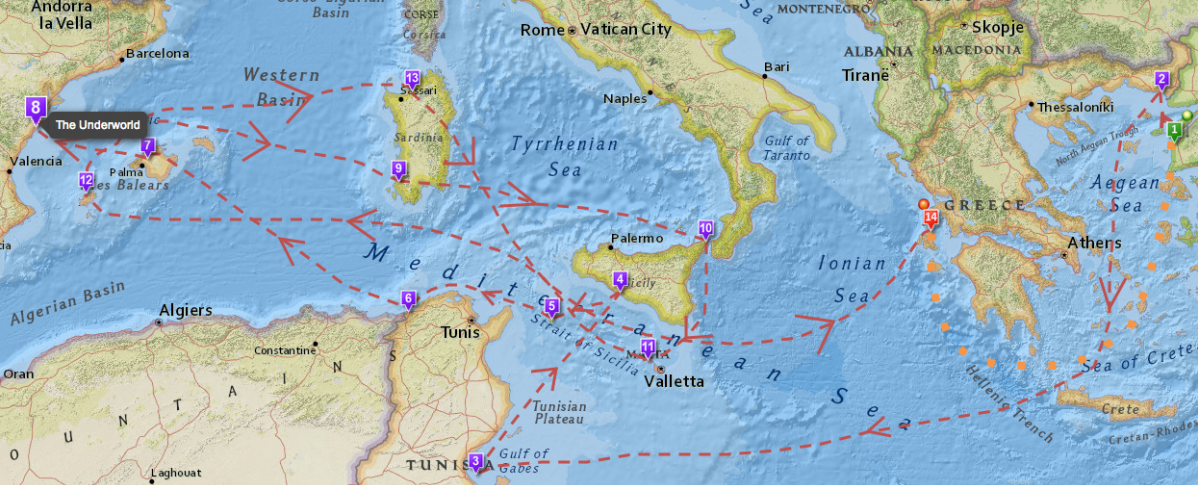
The Odyssey, one of Homer’s two great epics, narrates Odysseus’ long, strange trip home after the Trojan war. During their ten-year journey, Odysseus and his men had to overcome divine and natural forces, from battering storms and winds to difficult encounters with the Cyclops Polyphemus, the cannibalistic Laestrygones, the witch-goddess Circe and the rest. And they took a most circuitous route, bouncing all over the Mediterranean, moving first down to Crete and Tunisia. Next over to Sicily, then off toward Spain, and back to Greece again.
If you’re looking for an easy way to visualize all of the twists and turns in The Odyssey, then we’d recommend spending some time with the interactive map created by Gisèle Mounzer. “Odysseus’ Journey” breaks down Odysseus’ voyage into 14 key scenes and locates them on a modern map designed by Esri, a company that creates GIS mapping software.
Meanwhile, if you’re interested in the whole concept of ancient travel, I’d suggest revisiting one of our previous posts: Play Caesar: Travel Ancient Rome with Stanford’s Interactive Map. It tells you all about ORBIS, a geospatial network model, that lets you simulate journeys in Ancient Roman. You pick the points of origin and destination for a trip, and ORBIS will reconstruct the duration and financial cost of making the ancient journey. Pretty cool stuff.
Calendars are great to have in your house, but the problem with most of them is that despite cute pictures of kittens or baby turtles, the calendars you can buy at those pop-up kiosks in the mall don't actually get updated with the events in your life. Instructables user Piney wanted a smarter wall calendar, so they built one with a Raspberry Pi and a LCD screen.
For as long as I can remember such things – back to my undergraduate years in the 1960s – humanists have been defending themselves and their work against all comers: politicians, scientists of all kinds, and disgruntled letter writers. And always the defense comes down to this: we provide a holistic and integrated view of what it is to be human in a world that is, well, just what IS the world like anyhow?
It's a mug's game and I refuse to play it. I was trained in the human sciences: hermeneutics AND cognitive science, history AND social science, and I've played jazz and rhythm and blues in seedy nightclubs, ritzy weddings, and outdoors before thousands. It's all good. It's all come into play as I've investigated the human mind through music and literature.
In this essay I look at literature. First I consider literary form as displayed in ring form texts. Then I review a historical problem posed by Shakespeare and the rise of the European novel. My general point will be that we need all our conceptual resources to deal with these problems. But let's begin with an analogy: how do we understand, say, a cathedral?
The Cathedral Problem
Cathedrals are made of stone blocks, mortar, pieces of stained glass, lead strips, metal fittings, wooden beams and boards, and so forth. You can go through a cathedral and count and label every block and locate them on a (3D) map. You can do the same for the doors and cabinets, the plumbing, heating fixtures, and wiring, and so forth. You will now, in some sense, have described the cathedral. But you won't have captured its design. That's difficult and those how focus on it often use vague language, not because they like vagueness, but because, at the moment, that's all that's available.
And so it goes with literature and newer psychologies: cognitive science, evolutionary psychology, and neuroscience. My humanist colleagues keep hearing that they should get on board with the cognitive revolution and the decade of the brain. But it all sounds like trying to explain a cathedral by counting the building blocks, measuring the pitch of the roof, and analyzing the refractive properties of pieces of colored glass.
The advice may be well meant, but it isn't terribly useful. It takes our attention away from the problem – how the whole shebang works – and asks us to settle for a pile of things we already know. Almost.
Ring Forms in Literature
I first learned of ring form in an article published in PMLA – the oldest literary journal published in the United States – back in 1976: "Measure and Symmetry in Literature" by R. G. Peterson. The idea is a simple one, that some texts, or parts of texts, are symmetrically arranged about a center point: A B … X … B' A'. He produced many examples, from Iliad through Shakespeare's Hamlet to the "Author's Prologue" to Dylan Thomas, Collected Poems. But my interests, like those of most literary critics, were elsewhere and so I merely noted the article and went on about my business.
I was reminded of this work some years ago when I entered into correspondence with the late Mary Douglas, a British anthropologist who rose to academic stardom – such as it was back in ancient times – after the 1966 publication of Purity and Danger: An Analysis of Concepts of Pollution and Taboo. She spent the last decade of her career immersed in the arcana of classical and Biblical studies, publishing monographs on the Book of Leviticus and the Book of Numbers and, in 2007, Thinking in Circles: An Essay on Ring Composition, based on a series of lectures she had delivered at Yale. Among other things, she argues that such forms aren't special to the ancient world, that they continue in modern times – she offers Sterne's Tristram Shandy as an example.
She opens her 10th chapter by referring to Roman Jakobson, one of the pioneering linguistics of the 20th Century, who believed, on the basis of extensive study, that such patterns reflect "a faculty inherent in the relation among language, grammar, and brain." But why are such patterns so very difficult to recognize if they are so natural to us?
That's a good question. I'm not sure just who has jurisdiction over it, but I should think the newer psychologies would be interested in it. And I would think they would be even more interested in explaining just how it is that the mind comprehends such large-scale verbal structures.
Ring form speaks to the mind's power of and interest in ordering experience–which is why I've been devoting time to ring forms at New Savanna. Ring form is, to continue our metaphor, a design for a type of cathedral. It's not about the stones, mortar, metal fittings, and wooden beams of the cathedral, that is, it's not about our ability to recognize faces, or recognize speech sounds, or to form close emotional bonds with others, whether our children, parents, or spouses. Its about our passion for deploying all those abilities, and more, in an integrated and coherent fashion to create poems, plays, novels, movies, and even comic books and video games.
How do we do it? How does such order emerge spontaneously – for there is little evidence of conscious intent? And why is it so pleasurable? We don't know. But surely any attempt at understanding must begin with the fact that such forms exist and with analyses and descriptions of examples, many of them.
From Shakespeare to the Novel
Now let us consider claims by two distinguished literary critics, Harold Bloom, and the late Leslie Fiedler. These claims are about literary history, hence, about the mind in history. What's at stake in them? How do we determine whether or not, or in what sense, they're correct?
In 1998 Bloom published Shakespeare: The Invention of the Human, in which he claimed, in so many words – in fact, very many words – that Shakespeare's works constitute the psycho-cultural workshop in which modern consciousness was forged. Here's what he said in a 1991 interview in the Paris Review:
Western psychology is much more a Shakespearean invention than a Biblical invention, let alone, obviously, a Homeric, or Sophoclean, or even Platonic, never mind a Cartesian or Jungian invention…The principal insight that I've had in teaching and writing about Shakespeare is that there isn't anyone before Shakespeare who actually gives you a representation of characters or human figures speaking out loud…And then, in the course of pondering, undergoing a serious or vital change, they become a different kind of character or personality and even a different kind of mind. We take that utterly for granted in representation. But it doesn't exist before Shakespeare.
Bloom isn't simply talking about ideas about ourselves; he's talking about what we in fact are. If you're going to think about the mind as computational in nature – as some are wont to do – then it's a computer that programs itself. And it does some of that self-programming by drinking in plays, poems, and stories – Toronto psychologist Keith Oatley writes of literature as simulated experience, Such Stuff of Dreams (2011). Shakespeare, Bloom is arguing, created new software for the mind and thus gave us the tools to remake ourselves.
And that, I submit, is what Leslie Fiedler had in mind in his 1966 classic, Love and Death in the American Novel (pp. 332-33):
The series of events which includes the American and French Revolutions, the invention of the novel, the rise of modern psychology, and the triumph of the lyric in poetry, adds up to a psychic revolution . . . a new kind of self, a new level of mind; for what has been happening since the eighteenth century seems more like the development of a new organ than a mere finding of a new way to describe old experience.
This "new organ" is not a physical organ; it's now a new brain region; it's a virtual organ. New software, if you insist.
What are we to make of these claims? Just what can we infer about people's minds by examining the plays they watched and the novels they read? Can we conclude anything whatsoever about their minds? If so, have these scholars drawn reasonable conclusions?
Let's start with that last question. Both men have read a lot. Bloom could pronounce on Shakespeare's novelty, not simply because he's read Shakespeare, but because he's read a great deal of literature both before and after Shakespeare. Fiedler's judgment about the novel is of a similarly comprehensive nature.
You can't arrive at such judgments by reading only 10, 20, 50 or even a 100 books. And mere reading isn't sufficient; you must study them and think about them, reading what other scholars have had to say as well. That's the ONLY way to absorb that range of material.
By way of comparison, Darwin didn't arrive at the notion of evolution by examining a few plants and animals on his property and around his neighborhood. He read books full of accounts of the lifeways 1000s upon 1000s of plants and animals and went halfway around the world to make his own observations about biological diversity. Bloom and Fiedler didn't have to make the perilous trip through the Strait of Magellan to conduct primary research – they could read texts in the comfort of their studies – the comprehensive nature of their scholarship is similar.
All of which is to say that, at least provisionally, we have to accept Bloom's and Fiedler's judgments as reasonable assessments of their subject matter. The changes they observe in texts are real.
So what? Do literary texts testify as deeply about our minds as neuroimaging studies and neuroanatomy?
Of Chess and Culture
Think of the mind as being like a game, such as chess. The game board, the pieces, and the basic rules are given by biology. But there's more to playing chess than simply knowing the rules.
Knowing the rules gets you into the game. To play even moderately well, however, you have to pick up tactics and strategy through actually playing the game and through study as well. While those strategies must be consistent with the rules, you can't derive them from or reduce them to those rules
So it is with culture and biology. When Bloom says that Western psychology is a Shakespearean invention he's saying that Shakespeare created a new family of strategies for playing the game. Fiedler is making the same claim about the novel.
Let's push the analogy one step further. Players who have acquired these newer strategies are going to be more effective players than those who haven't. THAT's what's at stake in the claims Bloom and Fiedler are advancing. By training ourselves on Shakespeare, Bloom is arguing, we can better understand ourselves and thereby act more effectively in their world.
The idea is so outrageous that it is perhaps simplest simply to hide it away, get rid of it. Don't think about it. But those thousands upon thousands of texts won't go away. They testify to a change in mentality.
A Rage for Order
Our two metaphors, the cathedral and the chess game, work in similar ways. The chess metaphor is about the freedom culture enjoys in the deployment of biological materials. The human mind is an elastic machine embodied in a plastic brain. It can change and develop new organs over historical time. The cathedral metaphor is about the relationship between literary study and the newer psychologies.
The point is that sophisticated literary scholars see things in literary texts that are invisible to those psychologies. Humanists resist those psychologies, not because they are wedded to superstition, but because they don't see how those psychologies can help them with the problems that interest them.
If you think that the problem of mind is basically one of the relationship between two kinds of metaphysical substance, mind and matter, then you have bought in to a reductionist account of the mind. Yes, that's an issue. But it's not the only issue.
We must also understand the mind's rage for order and coherence. That's a different kind of problem. That's a problem about the relationship between the cathedral's design and the materials of which it is fabricated, about the relationship between the basic rules of chess and the manifold chess worlds consistent with those rules.
Coming up with a common conceptual language in which to state and investigate these issues has been a problem in the human sciences. And I suppose it will remain so for yet awhile. As far as I can tell, however, no one gets to claim the high ground on this. To put it bluntly, when it comes to mind and culture, the scientists don't know what they're talking about and the humanists haven't quite figured out how to talk about what they know.
An anonymous British poet of the 14th century had a few words for dealing with situations like this. His best-known poem, Sir Gawain and the Green Knight, eventually became a motion picture, twice actually. It tells of a brave knight attempting an impossible quest: "In destinies sad or merry, / True men can but try". Perhaps we should begin by admitting that we are all...well, true men isn't going to pass muster in this 21st Century, but perhaps true scholars will suffice.
Can we ever say enough about Stanley Kubrick? The director of Lolita, Dr. Strangelove, 2001: A Space Odyssey, and The Shining — to name only a few of his entries into the canon —generated a depth of interest still explored to this day by his fans and critics alike, not that he has many outright detractors. Those who praise Kubrick praise him to the skies, and even those who consider that a bit much still have to admit his powerful influence, never likely to dissipate, on cinema as a whole. Released in 2001, just two years after Kubrick’s death (which itself came just days after he completed Eyes Wide Shut), the 140-minute Stanley Kubrick: A Life in Picturesreveals the life and work of the man who now stands almost as a Platonic ideal of the auteur, and it does so film-by-film, one at a time — surely, I like to think, the way the intensely focused craftsman himself would have preferred it.
To speak upon the impact of Kubrick’s pictures, the incomparable experience of working on them (not to mention the often incomparably trying experience of working with him), and the nature of the usually well-concealed personality that drove them, the documentary recruits actors like Jack Nicholson, Nicole Kidman, Keir Dullea, Shelley Duvall, Malcolm McDowell, and Tom Cruise (who narrates); other important collaborators like designer Ken Adam, composer Wendy Carlos, and science-fiction visionary Arthur C. Clarke; colleagues like Woody Allen, Alex Cox, Steven Spielberg, Martin Scorsese, and Sydney Pollack (who also acted in Eyes Wide Shut); and, one advantage of having Kubrick’s brother-in-law Jan Harlan in the director’s chair, various friends and family members. An especially telling observation comes from a high school classmate of Kubrick’s, who remembers what the filmmaker-to-be told him when he asked why, instead of doing his own homework, Kubrick copied it from him every morning:: “He said to me, very simply and in what I learned was his characteristic quiet way, ‘I’m not interested.’”
Oh, man. Christopher Lee is so old, you guys. Which is partially why it's so wonderful that's he's still churning out awesome holiday music like this new heavy metal cover (with accompanying metal lyrics!) of "Jingle Bells" titled, of course, "Jingle Hell." The other reason is that his singing voice is still amazing.


 It's been two years since I first


 Make a set of 3D axes, so we can plot the well path and the frac ports.