Shared posts

26 Jan 06:07

NSA Interception In Action? Tor Developer's Computer Gets Mysteriously Re-Routed To Virginia

by Mike Masnick
So this one is odd. A core Tor developer, Andrea Shepard, recently ordered a computer from Amazon.com to her home in Seattle. Yet, as she tweeted last night, something odd happened on the way to delivering that package to her house:

You'd think #NSA shipment 'interdiction' would be more subtle... pic.twitter.com/KVCscLbdgG

— Andrea (@puellavulnerata) January 24, 2014
If you can't see the image, here's a larger version: Also, some more details from PrivacySOS. As you can see, rather than go from the Amazon warehouse in Santa Ana, California up the coast to Seattle, instead the package went across the country to Dulles, Virginia to Alexandria (right outside of DC) and was "delivered" there. Upon seeing this, my initial reaction was that it might not be a big deal. With shipping logistics these days, it's not uncommon to see a sort of hub system, where packages travel across the country from one warehouse to a shipping hub, only to be shipped back across the country for actual delivery.

But that does not appear to be what happened here at all. As Kade from PrivacySOS pointed out, the final Alexandria address is the final delivery location, rather than the sign of something in process. Also, the fact that it bounced around and then went "out for delivery" to that address shows that it wasn't just popping in and out of a hub for delivery to Seattle.

There are some possible other explanations, including just a general screw-up on the part of Amazon. But given the revelations of how the NSA's TAO group does very targeted spying, that often involves getting access to computers being shipped to targets, combined with the fact that the NSA has made it clear that breaking Tor is a priority that has mostly stymied them, this certainly should raise multiple eyebrows.

Permalink | Comments | Email This Story


26 Jan 06:04

Journalism! MSNBC Cuts Off Congresswoman Talking About NSA To Get To 'Breaking News' About Justin Bieber

by Mike Masnick
If you haven't yet, you should watch this 25-second clip of MSNBC "reporter" Andrea Mitchell cutting off Congresswoman Jane Harman just as she was explaining why the government needs to end the Section 215 bulk phone records collection program that spies on all Americans... in order to rush to cover the "breaking news" of Justin Bieber's court appearance live. Yes, apparently, making sure they cover Bieber's bond hearing live is more important than discussing the US government surveilling every American illegally. Of course, an argument can be made that this is what the American public wants, though that's partly because the cable news programs have learned since the OJ era that nothing gets viewers like covering a high profile court case to an extreme level.

Permalink | Comments | Email This Story


26 Jan 06:00

Yale Student Creates Unblockable Replacement For Useful Course Catalog Site Yale Blocked; Yale Reconsiders Initial Block

by Mike Masnick
I'll never understand what makes some people and organizations freak out when users of their systems make better versions. A decade ago we wrote about two examples of this: when a genealogist made a much better version of the interface to search through Ellis Island's data, and when someone built a better version of Odeon Cinema's website to work with non-IE browsers. In both cases, the official websites freaked out that someone might make a better version without permission.

The same kind of thing played out last week, with a story you might have heard of, concerning Yale blocking access to a site built by a pair of students (two years ago), creating a better course catalog. Unlike Yale's official course catalog, this one made it easy to see class evaluations and teacher ratings. Yale came up with a variety of excuses for this block, first saying that the site's name, YBB+ (for Yale Blue Book Plus) violated the university's trademark on Yale Bluebook. After the students changed the name to CourseTable, the university blocked it again, claiming it was "malicious." When people pointed out how ridiculous that was, Yale told the two students that the real problem was that they had made it too easy to see that course evaluation data, which Yale did not approve for use of in that manner. Of course, data is data. And I don't see how Yale has any legitimate claim to block how anyone uses that data. You can't copyright the data. The best Yale could come up with was the silly claim that this was "violating the appropriate use policy" and "breaching the trust the faculty had put in the college to act as stewards of their teaching evaluations." That still doesn't make much sense, other than that the University wanted to try to hide data it had released itself.

Then, after all of that, Yale also claimed that CourseTable violated the copyright in the course descriptions. I would think that the developers would have an incredibly strong fair use claim here (use in education, not interfering with the market "value" of the original, etc.).

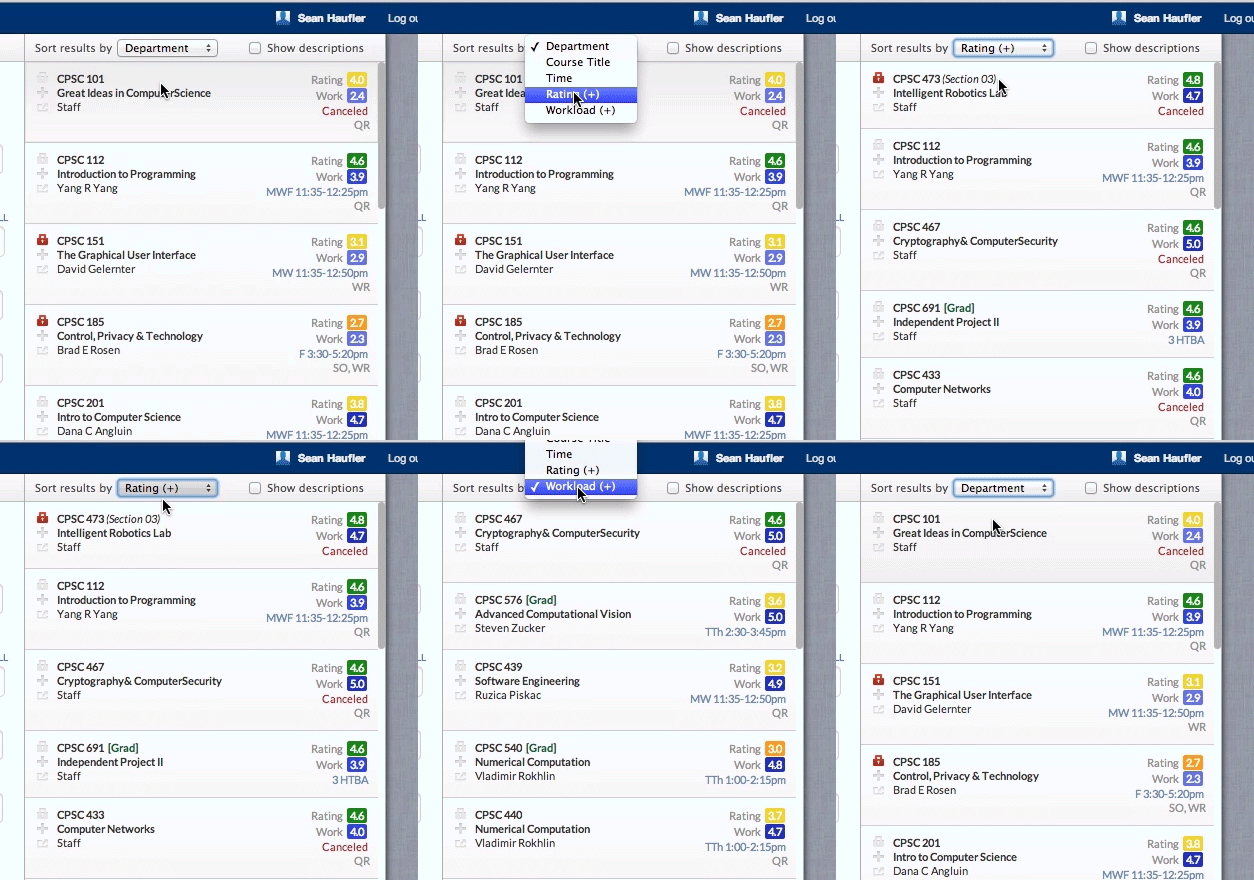
Either way, another Yale student, Sean Haufler, saw how ridiculous all of this was, and decided, what the heck, he could write a system that clearly gets around all of Yale's supposed complaints: he created a Chrome Extension, so that the same information from CourseTable/YBB+ shows up whenever anyone using it surfs through Yale's official site. He notes that this seems to get around all of Yale's claimed issues:

I built a Chrome Extension called Banned Bluebook. It modifies the Chrome browser to add CourseTable’s functionality to Yale’s official course selection website, showing the course’s average rating and workload next to each search result. It also allows students to sort these courses by rating and workload. This is the original site, and this is the site with Banned Bluebook enabled (this demo uses randomly generated rating values).

Banned Bluebook never stores data on any servers. It never talks to any non-Yale servers. Moreover, since my software is smarter at caching data locally than the official Yale course website, I expect that students using this extension will consume less bandwidth over time than students without it. Don’t believe me? You can read the source code. No data ever leaves Yale’s control. Trademarks, copyright infringement, and data security are non-issues. It’s 100% kosher.

As Haufler points out, he's hoping to demonstrate to Yale's administration that not only was this whole censorship effort stupid and futile, but that if it's granting students access to data, it shouldn't then try to block how they use that data. It seems especially troubling that an institution of higher learning would do this kind of thing.

Just as I was finishing up this post, I learned that Yale dean Mary Miller has admitted to perhaps reacting too hastily, and recognizing that technology has changed quite a bit. While she still seems to claim that using the data violates an acceptable use policy, she seems at least willing to consider this:
Although the University acted in keeping with its policies and principles, I see now that it erred in trying to compel students to have as a reference the superior set of data that the complete course evaluations provide. That effort served only to raise concerns about the proper use of network controls. In the end, students can and will decide for themselves how much effort to invest in selecting their courses.

Technology has moved faster than the faculty could foresee when it voted to make teaching evaluations available to students over a decade ago, and questions of who owns data are evolving before our very eyes. Just this weekend, we learned of a tool that replicates YBB+'s efforts without violating Yale’s appropriate use policy, and that leapfrogs over the hardest questions before us. What we now see is that we need to review our policies and practices. To that end, the Teaching, Learning, and Advising Committee, which originally brought teaching evaluations online, will take up the question of how to respond to these developments, and the appropriate members of the IT staff, along with the University Registrar, will review our responses to violations of University policy. We will also state more clearly the requirement/expectation for student software developers to consult with the University before creating applications that depend on Yale data, and we will create an easy means for them to do so.


Permalink | Comments | Email This Story


18 Jan 15:54

January 17, 2014


WOOB
18 Jan 14:32

Growing Number Of People Agree That Ed Snowden Is A Whistleblower

by Mike Masnick
A new poll from Quinnipiac University suggests that, despite widespread efforts by politicians to attack and demonize Ed Snowden, a growing percentage of the American population views him as a whistleblower. It's now up to 57% from what had been 55% in the last poll. The same poll also showed that a majority of people now think that the US government's anti-terrorism policies have "gone too far." It cracked 51%, up from 45% right after the first Snowden revelation, and way up from the 25% who felt that way back in 2010. The poll also suggests that fewer and fewer people support the Section 215 bulk metadata collection program, even when it's framed with this question, which I would imagine most people are biased towards agreeing with:
"Do you support or oppose the federal government program in which all phone calls are scanned to see if any calls are going to a phone number linked to terrorism?"
After the Snowden leaks, 51% of people supported that description of the program, while 45% opposed. Now it's down to 48% support and up to 47% opposed. Similarly, the percentage of people who claim this program "is necessary to keep Americans safe" has dropped from 54% down to 48%. Perhaps it helps that multiple studies have now shown that the program has not helped.

It's certainly slow going, but it certainly appears that the trend in public opinion is moving against these programs and increasingly in support of Snowden.

Permalink | Comments | Email This Story


18 Jan 14:32

Four Questionable Claims Obama Has Made on NSA Surveillance

by Kara Brandeisky

Today President Obama plans to announce some reportedly limited reforms to National Security Agency surveillance programs.

Since the first disclosures based on documents provided by former NSA contractor Edward Snowden, Obama has offered his own defenses of the programs. But not all of the president’s claims have stood up to scrutiny. Here are some of the misleading assertions he has made.

1. There have been no abuses.

And I think it's important to note that in all the reviews of this program [Section 215] that have been done, in fact, there have not been actual instances where it's been alleged that the NSA in some ways acted inappropriately in the use of this data … There had not been evidence and there continues not to be evidence that the particular program had been abused in how it was used. -- Dec. 20, 2013

At press conferences in June, August and December, Obama made assurances that two types of bulk surveillance had not been misused. In fact, the Foreign Intelligence Surveillance Court has reprimanded the NSA for abuses both in warrantless surveillance targeting people abroad, and in bulk domestic phone records collection.

In 2011, the FISA Court found that for three years, the NSA had been collecting tens of thousands of domestic emails and other communications in violation of the Fourth Amendment. The court ordered the NSA to do more to filter out those communications. In a footnote, Judge John D. Bates also chastised the NSA for repeatedly misleading the court about the extent of its surveillance. In 2009 – weeks after Obama took office – the court concluded the procedures designed to protect the privacy of American phone records had been “so frequently and systemically violated that it can fairly be said that this critical element of the overall … regime has never functioned effectively.”

The NSA told the court those violations were unintentional and a result of technological limitations. But the NSA’s own inspector general has also documented some “willful” abuses: About a dozen NSA employees have used government surveillance to spy on their lovers and exes, a practice reportedly called “LOVEINT.”

2. At least 50 terrorist threats have been averted.

We know of at least 50 threats that have been averted because of this information not just in the United States, but, in some cases, threats here in Germany. So lives have been saved. -- June 19, 2013

The record is far less clear. Obama’s own review group concluded that the sweeping phone records collection program has not prevented any terrorist attacks. At this point, the only suspect the NSA says it identified using the phone records collection program is a San Diego cab driver later convicted of sending $8,500 to a terrorist group in his homeland of Somalia.

The NSA’s targeting of people abroad appears to have been more effective around counter-terrorism, as even surveillance skeptics in Congress acknowledge. But it’s impossible to assess the role the NSA played in each case because the list of thwarted attacks is classified. And what we do know about the few cases that have become public raises even more questions:

3. The NSA does not do any domestic spying.

We put in some additional safeguards to make sure that there is federal court oversight as well as Congressional oversight that there is no spying on Americans. We don't have a domestic spying program. What we do have are some mechanisms where we can track a phone number or an e-mail address that we know is connected to some sort of terrorist threat, and that information is useful. -- Aug. 7, 2013

In fact, plenty of Americans’ communications get swept up. The government, of course, has the phone records of most Americans.  And, as the FISA Court learned in 2011, the NSA was gathering tens of thousands of domestic emails and other communications.

Additionally, the NSA's minimization procedures, which are supposed to protect American privacy, allow the agency to keep and use purely domestic communications in some circumstances. If the NSA “inadvertently” vacuums up American communications that are encrypted, contain evidence of a crime, or relate to cybersecurity, the NSA can retain those communications.

The privacy standards suggest there is a “backdoor loophole” that allows the NSA to search for American communications. NSA critic Sen. Ron Wyden, D-Ore., has said, “Once Americans' communications are collected, a gap in the law that I call the 'back-door searches loophole' allows the government to potentially go through these communications and conduct warrantless searches for the phone calls or emails of law-abiding Americans.”It’s not clear whether the NSA has actually used this “backdoor.”

And while the NSA acknowledges that it intercepts communications between Americans and surveillance targets abroad, the agency also intercepts some domestic communications that mention information about foreigners who have been targeted. As a result, the NSA has sometimes searched communications from Americans who have not been suspected of wrongdoing – though an NSA official says the agency uses “very precise” searches to avoid those intercepts as much as possible.

4. Snowden failed to take advantage of whistleblower protections.

I signed an executive order well before Mr. Snowden leaked this information that provided whistleblower protection to the intelligence community – for the first time. So there were other avenues available for somebody whose conscience was stirred and thought that they needed to question government actions. -- Aug. 9, 2013

Obama’s presidential policy directive forbids agencies from retaliating against intelligence personnel who report waste, fraud and abuse. But the measure mentions only “employees,” not contractors. Whistleblower advocates say that means the order does not cover intelligence contractors.

“I often have contractors coming to me with whistleblower-type concerns and they are the least protected of them all,” attorney Mark Zaid told the Washington Post.

What’s more, the directive was not yet in effect at the time Snowden came forward.Since the leaks, the Office of the Director of National Intelligence has said “the Executive Branch is evaluating the scope” of the protections.

Former NSA employee Thomas Drake argues that even if Snowden were a government employee who went through the proper legal channels, he still wouldn’t have been safe from retaliation. Drake says while he reported his concerns about a 2001 surveillance program to his NSA superiors, Congress, and the Department of Defense, he was told the program was legal. Drake was later indicted for providing information to the Baltimore Sun. After years of legal wrangling, Drake pleaded guilty to a lesser charge and got no prison time.

18 Jan 14:27

Google prepares for the age of wearable tech, begins work on Android Fitness API

by Derek Ross

Sony_Smartband

If there’s one thing we learned at CES recently, it’s that the age of wearable technology is upon us. At CES, we saw smartwatches, smartglasses, smartbands, and other wearable tech from numerous manufacturers. As the fairly new industry moves forward, so does the need for our smartphones to better communicate with these devices.

Fitness lovers will be excited to learn that Google is working on a new fitness API for Android. This new API will be able to tap into your devices sensors and store the data on your Google profile. The Fitness API will allow applications to view and edit fitness data, fitness tracking, access health information, and access activity data.

google-fitness-api

google-fitness-api-2

This API could become available via a Google Play Services update or in the next version of Android. That’s all we know for now. We’ll keep you posted as more information becomes available.

Source: Google System

16 Jan 19:27

January 15, 2014


Once more doing some curated comicking over at The Nib.
16 Jan 19:11

Unexpected Things: Guy Capitalizing On The Concept Of Music SEO By Recording 100 Songs A Day

by Mike Masnick
There's an incredible story that recently played on On the Media's awesome off-shoot TLDR podcast, talking about a guy who basically spends all of his free time writing and recording songs on pretty much every topic imaginable, and then uploading them to Spotify and iTunes, just in case someone is magically looking for a song about any particular topic. He's already recorded 14,000 songs, and says last year he made about $23,000 from royalties. Many of the songs seem quirky, and I'm not sure many people would consider them to be any good, but that's not really the point. The point is to have some music on pretty much any topic.

The more I thought about this, I realized this is yet another unique outcome of the modern digital era. In our Sky is Rising report from a few years ago, one of things we noted was the massive explosion in books (mostly ebooks), but we carefully noted that many of them were these odd automated productions, pulling feeds of information and releasing them in book form. That kind of thing is designed to be created cheaply and never sell many copies, but still might be incredibly useful for the 2 or 3 people who need exactly what's in that book. If you can produce enough things like that, perhaps it's worthwhile.

And, with digital music becoming so common, it's not such a crazy idea to basically try to thrive on search engine optimizing (SEO'ing) music searches. I say this as someone who has created Spotify playlists about trains, bananas and (just last week) "the ABCs" for my son. As I was setting those up, I thought about just how incredibly different the world my son will grow up in is than what everyone else has experienced. When he says, "I want to hear songs about trains!" it's actually not that difficult to do exactly that. This goes beyond just what many people thought the rise of digital music would bring about, which is the breakdown of the need for "albums" as people move to singles, but the opportunity to create songs on a theme or topic for those people who are looking for it. There may not be that many people actually searching for any such particular song, but if you can make enough of them, covering enough topics that when someone needs just any song on a particular topic, there's now an opportunity to do that.

This isn't "the future of music" or anything of that sort. It's just one of those wonderful, tangential things enabled by our digital world, filling a need that is actually quite useful for some, in a way that really wasn't possible not too long ago.

Permalink | Comments | Email This Story


16 Jan 19:09

Obama Plans Cosmetic Changes To NSA: Embraces 'The Spirit Of Reform' But Not The Substance

by Mike Masnick
The expectation all along was that the President's intelligence task force was likely to recommend cosmetic changes while leaving the worst abuses in place. And, in fact, many of us were quite surprised to see the panel's actual recommendations had more teeth than expected (though, certainly did not go nearly far enough). It was pretty quickly suggested that President Obama wouldn't support the most significant changes, and now that he's set to announce his plan on Friday, it's already leaked out that he's going to support very minimal reforms that leave the problematic spying programs of the NSA effectively in place as is.
Mr. Obama plans to increase limits on access to bulk telephone data, call for privacy safeguards for foreigners and propose the creation of a public advocate to represent privacy concerns at a secret intelligence court. But he will not endorse leaving bulk data in the custody of telecommunications firms, nor will he require court permission for all so-called national security letters seeking business records.
As the NY Times says, he's taking the political way out, making sure not to upset the surveillance hawks:
The emerging approach, described by current and former government officials who insisted on anonymity in advance of Mr. Obama’s widely anticipated speech, suggested a president trying to straddle a difficult line in hopes of placating foreign leaders and advocates of civil liberties without a backlash from national security agencies. The result seems to be a speech that leaves in place many current programs, but embraces the spirit of reform and keeps the door open to changes later.
Yeah, but embracing "the spirit of reform" is not actually doing any reform. It's a bullshit approach guaranteed not to win anyone's approval, which seems to be the way the president often operates. Say you're going to do something, then offer a weakly compromised version of the plan and pretend you've actually done something big. It's not leadership, it's "let's talk big, and do little."

As the NY Times says, this "largely codifies existing practices."

Basically, this whole charade simply dumps the whole thing back into Congress's hands to try to push through real reform -- meaning that rather than letting President Obama decide what to do, we need to get things like the USA Freedom Act passed as a starting point, followed by more significant surveillance freforms.

Permalink | Comments | Email This Story


16 Jan 19:01

Chart Of The Day

by Andrew Sullivan

Climate Pie Chart

James Powell updates his chart on global warming research:

I have brought my previous study (see here and here) up-to-date by reviewing peer-reviewed articles in scientific journals over the period from Nov. 12, 2012 through December 31, 2013. I found 2,258 articles, written by a total of 9,136 authors. (Download the chart above here.) Only one article, by a single author in the Herald of the Russian Academy of Sciences, rejected man-made global warming. I discuss that article here.

Holly Richmond passed along the chart:

[I]f a year-long sample isn’t good enough for you, Powell previously examined 21 years of peer-reviewed literature and found that only 24 out of 13,950 articles — or two-tenths of a percent — came out and rejected human-caused climate change.

The fact that one major political party in the US rejects outright this massive preponderance of scientific research is now so familiar to us that we forget just how obscene it is. It is not a position or an argument. It is a transparent lie in defense of short-term material interest against the long-term interests of everyone. There can and should be plenty of debate about what to do about human-caused climate change; but there should simply be no serious debate about its causes. It’s impossible to take the GOP seriously until they recant their knownothingness on this subject. At this point, it is simply an affront to reason.

16 Jan 18:39

immersus: Every airline flight in the world over 24 hours.


immersus:

Every airline flight in the world over 24 hours.

15 Jan 02:31

January 14, 2014


Ever wonder why everything tastes like chicken? Cori McLean explains, with "science" in this new BAHFest video.

04 Jan 23:23

Camera stabilizing tech used in spoon for Parkinson's.

31 Dec 17:29

The Greatest Response To A Cease And Desist Letter, Probably Written While Drunk

by Above The Law
Cross-posted from

This year certainly had its share of ups and downs in terms of lawyerly antics, but in our minds, 2013 shall forever be known as the year of the snarky cease and desist response letter. Back in June, we broke the news of the now famous response to a cease and desist letter received from the Town of West Orange, New Jersey, which went viral worldwide thanks to the power of sarcasm. A few months later, we wrote about an equally entertaining response to a cease and desist letter received from the American Bankers Association, rife with Spice Girls lyrics and Valley girl lingo.

It’s been a while since we wrote about one of these treasures, so we figured we’d close the year out with a bang. We discovered yet another amazing response to a cease and desist letter, and this one may be the greatest of them all — if only because we think its author might have been drunk while writing it….

Jeff Britton, the owner of Exit 6 Pub and Brewery in Cotteville, Missouri, received a cease and desist letter from none other than Starbucks, specifically from Anessa Owen Kramer of Honigman Miller Schwartz and Cohn, over a beer named “Frappicino.” As the world knows, the lords of coffee sell a frozen drink (a coffee Slurpee?) by the name of “Frappuccino.” Yes, the names are similar, but to be confused enough to think you could order the nectar of mall-hopping teenage girls at a bar, you’d have to be pretty drunk.

Rather than cower in fear over the legal consequences threatened by America’s coffee monarch, Britton decided it would be in his best interests to write a response on his own, without the assistance of legal counsel, because he didn’t need no stinkin’ lawyer. Here’s what he posted on the Exit 6 Facebook page:

So quick little story. Last week I received a cease and desist letter from the attorneys at Starbucks. Apparently there was a beer on Untappd that someone named “Frappicino”. 3 people had checked into said beer. 3. Starbucks [didn't] like that. So I got a letter. They wanted me to remove the beer and promise never to use their names again. They also wanted my written response and guarantee. Here is their letter. And also my response.

Needless to say, Britton’s response is amazing — he even threw in some legalese, despite the fact that he’s not a lawyer (oh yeah, heretofore, baby). Here are some highlights from his letter (all errors included in the original). You’d have to be drunk to write something like this, right? Who cares, it’s freakin’ awesome:

Exit 6 has proudly sold at least 38 drinks in Cottleville MO and has a strong presence in St Charles county, a suburb 40 miles outside the St Louis metropolis. It has recently come to Exit 6 Pub and Brewerys attention that there were 3 check ins to the beer with a very similar name to the “F Word”. Unfortunately it was only similar to the F Word because we meant to call it the same thing. Lucky for us, we’re poor spelers.

I would like for both Ms Owen Kramer and Mr Bucks to rest assured we meant no deception, confusion, or mistaking in the naming of the beer F Word. We never thought that our beer drinking customers would have thought that the alcoholic beverage coming out of the tap would have actually been coffee from one of the many, many, many stores located a few blocks away. I guess that with there being a Starbucks on every corner of every block in every city that some people may think they could get a Starbucks at a local bar. So that was our mistake.

Mr. Bucks isn’t Ms. Owen Kramer’s co-counsel; no, this “poor speler” is addressing Mr. Star Bucks himself, as if he were an actual human being. We imagine Britton was at least six Frapps in at this point.

We haven’t even gotten to the best part yet. To show Mr. Bucks just how sorry he really was, Britton enclosed a check in the amount of Exit 6′s profits made from its “Frappicino” beer to be applied to Ms. Owen Kramer’s legal fees, which he admits were “probably … more than Exit 6 made last year.” Here it is:

Behold: the legal equivalent of a mic drop. Cheers to you, Jeff Britton! We raise a glass in your honor.


Permalink | Comments | Email This Story


23 Dec 14:42

12/22/2013

by billamend

12/22/2013

23 Dec 14:41

December 20, 2013


Tell your children.
17 Dec 02:45

Profile Info

It's ok, they'll always let you opt out! Like they did with the YouTube real name profile thing.
12 Dec 21:59

Man Builds Amazing Igloo Using Frozen Milk Cartons

by Dmitry

Daniel Gray, a New Zealander visiting Canada with his Canadian girlfriend to meet her family found a very unique way to spend some of his time during their cold December visit. With the help of his girlfriend (Kathleen Starrie) and her family, he build the most amazing thing in their Edmonton backyard.

1145 Man Builds Amazing Igloo Using Frozen Milk Cartons
They started out by clearing out some snow to create space.

277 Man Builds Amazing Igloo Using Frozen Milk Cartons
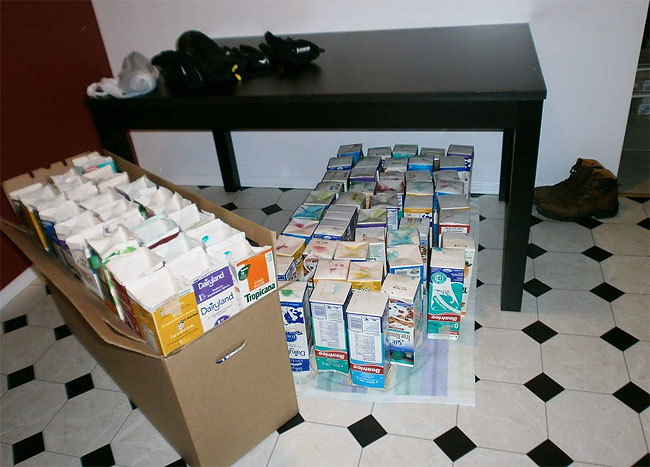
Then the first layer of ice blocks, built from milk cartons they collected, added coloring to, and froze.

363 Man Builds Amazing Igloo Using Frozen Milk Cartons
Building the spiral….

454 Man Builds Amazing Igloo Using Frozen Milk Cartons
Laying blocks on top of the spiral. What is this thing?

547 Man Builds Amazing Igloo Using Frozen Milk Cartons
640 Man Builds Amazing Igloo Using Frozen Milk Cartons class="alignnone size-medium wp-image-529660" />

All bundled up, working diligently on their creation.

733 Man Builds Amazing Igloo Using Frozen Milk Cartons
831 Man Builds Amazing Igloo Using Frozen Milk Cartons
All of the colorful milk cartons used in preparation.

930 Man Builds Amazing Igloo Using Frozen Milk Cartons
Okay, it’s definitely coming along now.

1028 Man Builds Amazing Igloo Using Frozen Milk Cartons
Is that an igloo?

1146 Man Builds Amazing Igloo Using Frozen Milk Cartons
Daniel works from the inside

1225 Man Builds Amazing Igloo Using Frozen Milk Cartons
1324 Man Builds Amazing Igloo Using Frozen Milk Cartons
And here’s the inside. Definitely looking like an igloo.

1417 Man Builds Amazing Igloo Using Frozen Milk Cartons
1519 Man Builds Amazing Igloo Using Frozen Milk Cartons
And at last, the incredible multi-colored igloo built from snow and milk carton blocks.

1616 Man Builds Amazing Igloo Using Frozen Milk Cartons
1713 Man Builds Amazing Igloo Using Frozen Milk Cartons
It looks incredibly cozy. I want one.

Via Viralnova, Reddit.


Creative Market: Download Free Design Assets – New Every Week!


12 Dec 21:58

20 Breathtaking Winter Landscapes That Will Give You the Chills, Literally

by admin

winter-landscapes-29

Winter has crashed down upon us and settled in for a long stay, but that does not mean nature’s beauty has faded away. As you can see in this series of winter landscape photographs, nature plays no favorites with beauty. She is just as cunning of an artist with ice and snow as she is with green grass. flowers, and trees. She paints the trees with a dusting of frost. She creates icy mirrors from the still lakes to reflect the beauty of her creations. She creates sculptures with her icicles and snow drifts. She intermixes snow covered trees and ground with open waters filled with wild geese. She floats snow through the nighttime air creating twinkling flakes reflecting lights. Nature’s elegance stretches through the seasons. We are thrilled that some photographer dare the cold to capture some of nature’s most dramatic scenes.

Photo above by EarthPix

winter-landscapes-26

Photo by Lake Baikal

winter-landscapes-7

Photo by Hideyuki Katagiri

winter-landscapes-40

Photo by Marcin Ryczek

winter-landscapes-15

Photo by Kent Shiraishi

winter-landscapes-1

Photo by Jan Machata

winter-landscapes-25

Photo by Dmitry Dubikovskiy

winter-landscapes-8

Photo by Norbert Maier

winter-landscapes-6

Photo by deep21

winter-landscapes-27 Photo by Friðþjófur M

winter-landscapes-10

Photo by Lars van der Goor

CA8028

winter-landscapes-35

Photo by Thomas Zakowski

winter-landscapes-17

Photo by Edwin van Nuil

winter-landscapes-20

Photo by Evgeni Dinev

winter-landscapes-3

winter-landscapes-11

Photo by Mark Geistweite

winter-landscapes-43

Photo by Emmanuel Coupe

winter-landscapes-41

Photo by Peter From

winter-landscapes-5 Photo by oskarpall

ShareThis

10 Dec 23:25

Kansas City Cops Tell Man They'll Kill His Dogs And Destroy His Home If Forced To Obtain A Search Warrant

by Tim Cushing

Good news, citizens! You have the right to refuse a warrantless search of your premises. It's a right that's guaranteed by the Fourth Amendment. But that right won't protect you from the consequences of your failure to roll over for law enforcement. Nope, the right to not be subjected to a warrantless search can actually be held against you -- not in a court of law, mind you -- but by the police themselves.

Eric Crinnian, an attorney in Kansas City, Missouri, says police came to his door looking for parole violators, and got upset when he refused them permission to tramp through his house and paw through his possessions. In fact, he claims, one cop went so far as to threaten to shoot his dogs if he made them abide by the requirements of the law by getting a search warrant to look through his home.
Here's the direct quote from the news article:
“If we have to get a warrant, we’re going to come back when you’re not expecting it, we’re going to park in front of your house, where all your neighbors can see, we’re gonna bust in your door with a battering ram, we’re gonna shoot and kill your dogs [...] and then we’re going to ransack your house looking for these people.”
This sounds suspiciously like a threat (several threats, actually). This is the classic "you can do this the easy way or the hard way" persuasion technique that's been deployed by law enforcement since there's been law enforcement. Even when not spoken out loud, the "or else" always hangs in the air when LEOs "ask nicely" for permission to do things they can't legally do without your consent.

Rarely is this threat spoken with such clarity and detail, however. As both Reason and the Volokh Conspiracy note, the threat delivered by a KCPD officer may not actually be illegal.
John Hamilton, an associate professor of criminal justice administration at Park University and a retired Major with the Kansas City, Missouri, Police Department, told the news station that the officers' threats may not be illegal, though they're inappropriate and it's possible they violate department policy. He also pointed to the matter of appearances, saying that such behavior "makes it tenuous when you appear in front of the court in a case like that."
Not exactly illegal, but not very helpful should this incident result in a lawsuit. In fact, Missouri's laws give police officers leeway to make threats such as these without repercussion, as Reason's J.D. Tucille notes.
Missouri has a statute that defines a "credible threat… against the life of, or a threat to cause physical injury to, or the kidnapping of, the person, the person's family, or the person's household members or domestic animals or livestock" as aggravated stalking and might fit the bill in this situation. However, that law explicitly exempts law enforcement officers "conducting investigations of violation of federal, state, county, or municipal law," which is more than a little disturbing.
In all likelihood, the citizen who exercised his Fourth Amendment rights will be the only one who is punished (in one fashion or another) for the officer's threats. Making these allegations public will decrease the likelihood of the KCPD following through on its offer to tear apart Crinnian's home and shoot his pets. Of course, this could just as easily go the other way. The PD has already promised to retaliate for his refusal to permit an unconstitutional search. It may up its level of retribution in the wake of this public embarrassment.

There's also this to consider. While the officer's words may sound like a threat, what he's saying may not be a threat. It may just be a simple observation of what doing this the "hard way" will entail.
Some people have hypothesized that the police officer was merely describing the normal warrant execution process rather than threatening to retaliate by causing gratuitous property damage. I think it's worth noting that these are not inconsistent. It would not surprise me to learn that the police routinely retaliate against people who make their lives difficult by causing gratuitous damage during the warrant execution process.
No-knock warrants are always more damaging than those announced by a knock on the door. Police use different tactics depending on their perception of the person they're serving the warrant to. People with the power and money to retaliate in court are often handled with more respect (and less collateral damage) than those that are perceived to be powerless (yet somehow more dangerous). Note how an arrest of celebrity is carried out much differently than arrests of millions of nobodies.

"We'll come back with a warrant, but we'll make you wish you had consented earlier." It's almost extortion and yet, it's almost certainly not punishable under Missouri law. Gotta love that Fourth Amendment protection, which grants you the right to turn down a warrantless search, but instead subjects you to a violent, noisy, destructive search of your house once the proper paperwork is secured.

Hopefully, Crinnian's public complaint will either a) force the KCPD to conduct an orderly, non-dog-shooting search of his premises or b) move any judge asked to sign this warrant makes sure the KCPD has dotted every evidentiary "i" and crossed every reasonably suspicious "t." Better yet, let's hope it convinces the PD to drop its apparently errant investigation of Crinnian.

But the underlying message is both terrible and crystal clear. You are protected from illegal searches, but not from petty retaliation conducted under the color of law. The system has checks and balances, but these are essentially meaningless when the balance of power has shifted this far out of whack.


Permalink | Comments | Email This Story


09 Dec 21:33

Photo


06 Dec 18:40

Code found in Plex software hints that Chromecast support is just around the corner

by Chris Chavez

Chromecast featured

When the Chromecast first hit the scene back in July, Google’s streaming media dongle garnered a lot of attention from developers looking to develop for the new platform. It was the team at Plex — makers of the popular media player app that streams locally stored content to a variety of internet connected devices — that caused some of the biggest ruckus. Barely a few days after the Chromecast was made official, Plex tweeted how they were “actively investigating and optimistic” about future Chromecast support. This would help fix a glaring omission in the Chromecast, it’s complete lack of streaming locally stored media.

Towards the tail end of August, our own Derek Ross posted on his Google+ that Plex (and aVia) were already in talks with Google to support Chromecast and that a release was likely due sometime in the fall. Needless to say, Plex coming to the Chromecast hasn’t been the biggest secret. Now that we are on winter’s doorstep without hide nor hair of Plex on our streaming dongles, you might be wondering if any progress has been made. Well, fear not, it looks like Chromecast support is still very much in the cards.

chromecast-plex-profile

It was in the most recent version of Plex’s software that the fine folks at GigaOM discovered it already includes a Chromecast configuration file, right alongside Android, Firefox, Chrome, and others. Evidence doesn’t get much harder than that. With the Chromecast receiving a minor update this week, and Google holding a hack-a-thon this weekend for developers to preview their Google Cast API — brace yourselves, it seems Plex could be only the beginning. My Chromecast is ready.

[via ChromeSpot]

04 Dec 17:00

Starred Items!

We’re excited to announce that starred items are now live in The Old Reader.  This has been one of the most requested features and something we’ve felt belongs in the application for a long time.  Hotkey (f) and API support are also available.  Starred items will automatically be sent to pocket for users that have it activated.

As most of you know, our focus over the past few months was to increase performance and stability of The Old Reader.  We’ve made tremendous strides and can now focus on adding functionality and making this tool a long-term sustainable platform built for the Open Web.  The best is yet to come.

Thanks for using The Old Reader!

(www.catgifs.org/2013/09/07/cat-surprised-cat-animated-gif/)

29 Nov 21:37

November 29, 2013


Everything in the SMBC Store is 15% off, today only!

AND BONUS, the new SMBC BOOK (of 100% nerd jokes) is now available for sale!

28 Nov 03:41

Creative Commons Issues an Update to its Copyright License Suite

by Parker Higgins

After more than two years of community discussions and many drafts, the nonprofit Creative Commons has released a new version of its popular copyright license suite. These licenses allow rightsholders to release some of the exclusive rights associated with copyright while retaining others, in a way that’s easy for re-users, indexable by computers, and that stands up to legal review in many countries.

Version 4.0 accomplishes some ambitious goals, but sticks to the spirit of earlier licenses, so that it shouldn't disrupt existing uses. In several places, the text has been clarified to better reflect the way the public uses the licenses in practice. The attribution requirements, for example, have been slightly adjusted to better accommodate the way re-users are typically providing attribution, by expressly allowing attribution to come in the form of a link to a separate "credits" page.

Among the most notable changes, version 4.0 breaks with the earlier practice of "porting" licenses to different jurisdictions, and is now designed to work all over the world. In the same vein, Creative Commons will provide official translations of the license deeds so that licensors and licensees can read the text in the local languages.

That change works towards another goal of the 4.0 license suite: to be flexible and robust enough to support new uses for many years without requiring any major version updates. Version 3.0 was released in February 2007 and has worked effectively for the last five years; the hope is that this new version can be used for even longer.

One of the primary reasons to use a popular license suite like Creative Commons instead of writing your own set of permissions is that it reduces the problem of "license proliferation." The planned longevity of Creative Commons 4.0 licenses also keeps with that goal, giving licensors plenty of time to get on the latest version.

Encouragingly, Creative Commons reached this final version through a completely transparent process. Goals were laid out in public discussions at a 2011 global summit, and continued in blog posts, open meetings, and mailing lists for the following two years. As a result, the licenses have the legitimacy of public consensus and the motivations for changes are well understood.

Contrast that process with the secretive copyright policy discussions happening in closed backroom negotiation sessions for trade agreements like the Trans-Pacific Partnership (TPP), and it's clear why groups like EFF understand that the "official" approach is broken. Creative Commons licenses are real legal documents that set effective policy for hundreds of millions of works across the Web—there's no reason they can't also be a model for effective and transparent policy-making.

It was a welcome development then, if not a major surprise, to see Creative Commons issue a policy statement last month supporting fundamental copyright reform around the globe.

Between that policy statement and the new licenses, Creative Commons is doing good work towards enabling its long-held vision of universal access to research and education, and full participation in culture. EFF is a proud to use Creative Commons licenses for all the original material on our site.

image by Creative Commons, used under CC BY 4.0.

Related Issues: 

Share this: Share on Twitter Share on Facebook Share on Google+ Share on Diaspora  ||  Join EFF
25 Nov 12:50

New Study

When the results are published, no one will be sure whether to report on them again.
24 Nov 18:53

11/24/2013

by billamend

11/24/2013

24 Nov 18:51

picadorbookroom: Good job, Oklahoma! The first 24-hour library...


picadorbookroom:

Good job, Oklahoma! The first 24-hour library vending machine in the US.

11 Nov 20:49

November 11, 2013


WOOP! We'll be releasing the new science-themed SMBC book on Black Friday. Stay tuned, geeks!