Visit Uncrate for the full post.

If your cat laps at a faucet, or your dog treats the toilet bowl like it’s a bar, your furry friend might want a water fountain to call their own. Fresh, clean water is critical to the health and happiness of our pets, and a gentle flowing stream may make your pet more excited to drink.

If the only hex wrenches you have are the five or six random ones kicking around the bottom of your kitchen drawer—leftovers from IKEA builds, light fixtures, and towel bars—it might be time for an upgrade.
The good news is that you don’t need to invest a lot to get a decent set. After testing 18 models, we think the inexpensive Amazon Basics Hex Key Allen Wrench Set with Ball End is the best for around-the-house jobs, like installing towel bars, tightening door handles, or assembling knock-down furniture.

Packable daypacks are a perfect option if you need a lightweight spare bag to stash inside your luggage when you travel. They’re also great if you need an extra bag while running an unexpected errand during your daily commute.
After testing 18 packable daypacks, we chose three lightweight, portable, well-constructed bags to fit a variety of situations, including traveling, hiking, and commuting.

With the price of a gallon of gas hitting new highs, now averaging $4.60- a gallon in the United States, it’s increasingly important to find the cheapest gas available wherever you are. A common recommendation for finding cheaper gas is the crowdsourced gas-price finder app GasBuddy. But when we took a closer look at the app, its privacy practices set off alarms.

If you take care of them properly, hardwood floors can last for years. Fortunately, this is relatively simple to do. You can keep your beautiful wood floors looking great with just a small amount of effort.
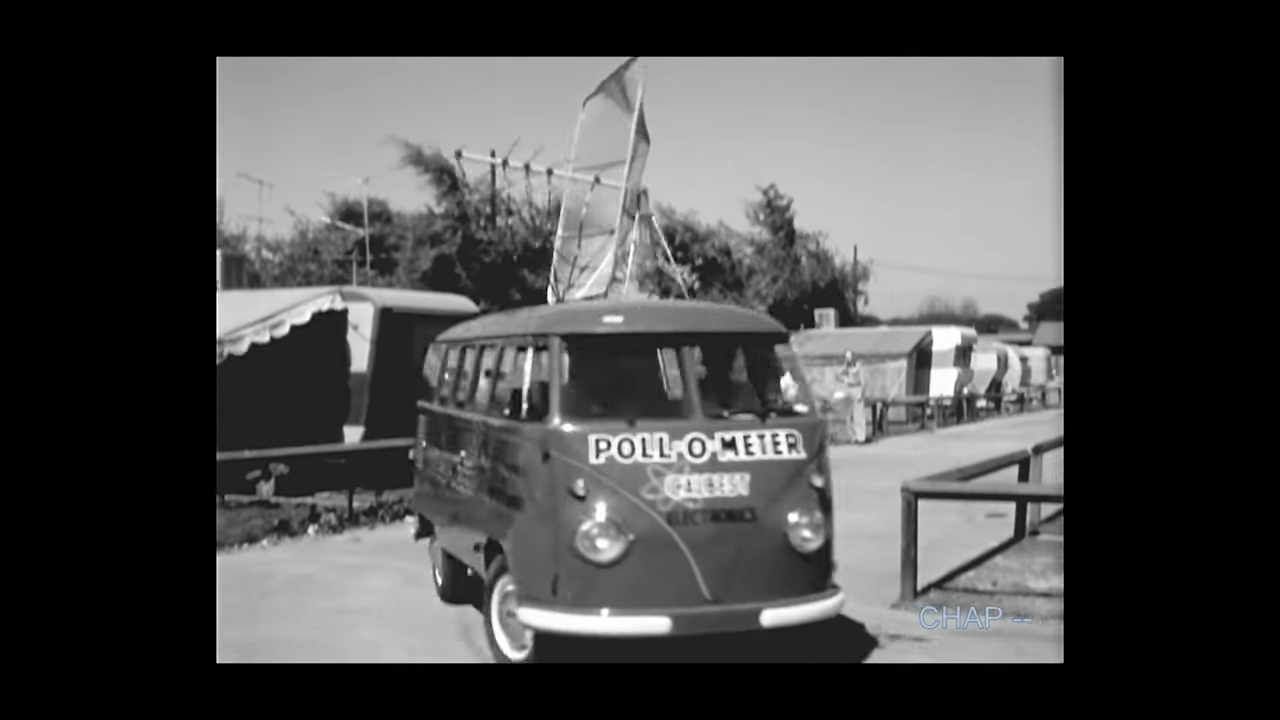
It may come as a shock to some, but TV used to be a big deal — a very big deal. Sitting down in front of the glowing tube for an evening’s entertainment was pretty much all one had to do after work, and while taking in this content was perhaps not that great for us, it was a goldmine for anyone with the ability to monetize it. And monetize it they did, “they” being the advertisers and marketers who saw the potential of the new medium as it ramped up in early 1950s America.
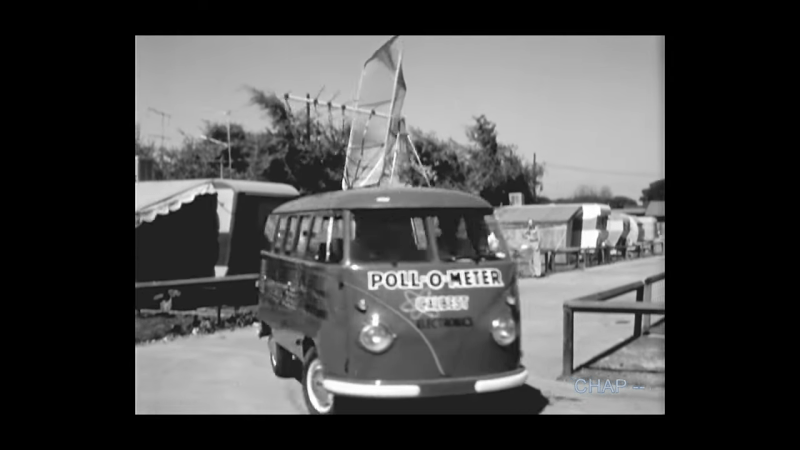
They faced a bit of a problem, though: proving to their customers exactly how many people they were reaching with their ads. The 1956 film below shows one attempt to answer that question with technology, rather than guesswork. The film features the “Poll-O-Meter System,” a mobile electronic tuning recorder built by the Calbest Electronics Company. Not a lot of technical detail is offered in the film, which appears aimed more at the advertising types, but from a shot of the Poll-O-Meter front panel (at 4:12) and a look at its comically outsized rooftop antenna (12:27), it seems safe to assume that it worked by receiving emissions from the TV set’s local oscillator, which would leak a signal from the TV antenna — perhaps similar to the approach used by the UK’s TV locator vans.
The Poll-O-Meter seems to have supported seven channels; even though there were twelve channels back in the day, licenses were rarely granted for stations on adjacent channels in a given market, so getting a hit on the “2-3” channel would have to be considered in the context of the local market. The Poll-O-Meter had a charming, homebrew look to it, right down to the hand-painted logos and panel lettering. Each channel had an electromechanical totalizing counter, plus a patch panel that looks like it could be used to connect different counters to different channels. There even appears to be a way to subtract counts from a channel, although why that would be necessary is unclear. The whole thing lived in the back of a 1954 VW van, and was driven around neighborhoods turning heads and gathering data about what channels were being watched “without enlisting aid or cooperation of … users.” Or, you know, their consent.
It was a different time, though, which is abundantly clear from watching this film, as well as the bonus ad for Westinghouse TVs at the end. The Poll-O-Meter seems a little silly now, but don’t judge 1956 too hard — after all, our world is regularly prowled by equally intrusive and consent-free Google Street View cars. Still, it’s an interesting glimpse into how one outfit tried to hang a price tag on the eyeballs that were silently taking in the “Vast Wasteland.”
“BYE-BYE TO THE BAND”
By Raymond Benson
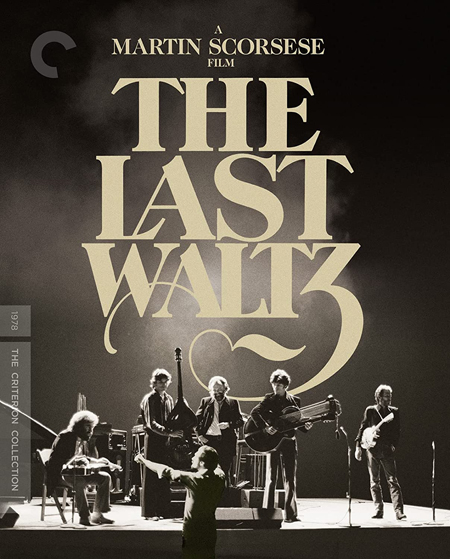
One of the most celebrated and critically acclaimed rock concert films is Martin Scorsese’s documentary, The Last Waltz, which was unleashed in the spring of 1978. The movie documents the final concert performed by The Band, the legendary session group for Bob Dylan and others that became a recording and touring entity in their own right in the late 1960s and early 70s.
The Band, hailing from Canada, got their start as The Hawks, the backup band for rockabilly singer Ronnie Hawkins. By the mid-sixties, they were working for Dylan with the name change to The Band, and also started recording on their own (Music from Big Pink was their debut in 1968). At the time of their breakup, the group consisted of Robbie Robertson (guitar, vocals), Rick Danko (bass, guitar, fiddle, vocals), Richard Manuel (keyboards, vocals), Garth Hudson (keyboards, sax), Levon Helm (drums, guitar, vocals), and unofficial sixth member John Simon, who was their record producer and occasional musician.
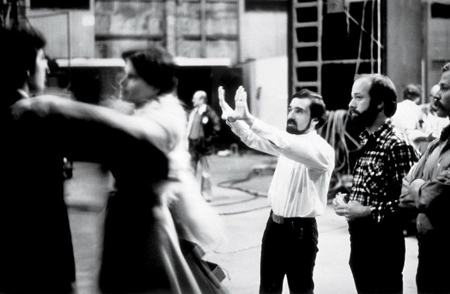
By late 1976, Robertson had become weary of touring and wanted to do a final concert (and ultimately leave the group). The rest of The Band went along with it, even though they didn’t particularly want to end their partnership. Robertson enlisted the help of concert impresario Bill Graham, and they secured the Winterland Ballroom in San Francisco for a “celebration” on Thanksgiving Day (November 25), 1976, that even included a turkey dinner for attendees. Both Bob Dylan and Ronnie Hawkins were invited to perform, but as the event was being planned, more guest stars were added, culminating in a who’s who roster of top musicians, including Eric Clapton, Neil Young, Van Morrison, Neil Diamond, Joni Mitchell, Ringo Starr, Ronnie Wood, Paul Butterfield, Dr. John, Muddy Waters, and others. Even more guests were filmed in studio settings later. (Not widely known is that Stephen Stills was supposed to join the concert, but he arrived late toward the end of the evening, only to participate in a group jam that was deleted from the final film. This can be seen as a bonus supplement outtake on home video versions of the movie.)
A mere six weeks prior to the concert, it was decided that the event should be documented on film, and so Robertson, impressed with what he’d seen of Martin Scorsese’s work and knowing that the man had been assistant director and co-editor of Woodstock (1970), called the filmmaker. Scorsese, busy with New York, New York (1977), somehow found the time to fit the shoot into his schedule. With minimum preparation, Scorsese hired such cinematographers as Michael Chapman, Vilmos Zsigmond, László Kovács, and others to strategize and film the complicated live show in which anything could happen.
They got the job done, and the result is indeed remarkable.
Scorsese and Robertson (also acting as co-producer) decided to intersperse the concert footage with backstage interviews, a tour of The Band’s recording studio and HQ, and a couple of extra performances shot on a sound stage with Emmylou Harris and the Staple Singers.
Indeed, The Last Waltz is a wonderful concert film—the photography and sound is exceptional and the performances are fun and enjoyable. However, this reviewer has always had a minor quibble with the movie—and concert films like it—when the flow of the concert is broken up by inserting backstage interviews. When compared to something like Stop Making Sense (1984), which is a Talking Heads concert from start to finish without interruptions, The Last Waltz feels choppy. Aside from that, The Last Waltz deservedly belongs on the list of four or five greatest rock concert documentaries.
The Criterion Collection’s new re-issue comes in two flavors—4K Ultra + Blu-ray Combo (2 disks), or the single Blu-ray only package. The movie is a new 4K digital restoration, supervised and approved by Scorsese, and it looks beautiful. The 5.1 surround DTS-HD Master Audio is supervised and approved by Robertson. There are two alternate soundtracks—the original 1978 2.0 surround mix, and an uncompressed stereo mix from 2001.
Two previously issued audio commentaries accompany the movie. Both feature Scorsese and Robertson and/or other members of The Band, the production crew, and performers Dr. John, Ronnie Hawkins, and Mavis Staples.
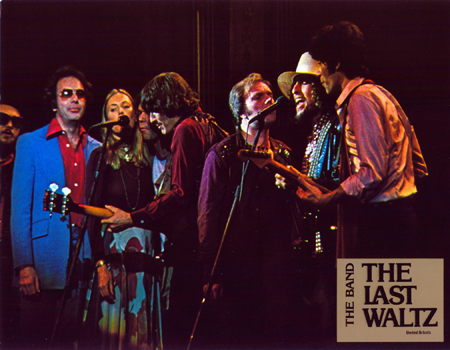
Most of the supplements are ported over from the previous 2002 “special edition” DVD, including the aforementioned “Jam 2” outtake, a TV interview from 1978 with Scorsese and Robertson and a featurette, “Revisiting The Last Waltz.” New to the Criterion edition is a recent half-hour conversation between Scorsese and Rolling Stone writer David Fear as they discuss rock concert movies in general, Scorsese’s history with rock music, and The Band’s legacy. The trailer completes the package, along with an essay by critic Amanda Petrusich in the booklet.
The Last Waltz is a must-have for fans of rock concert movies, The Band, Martin Scorsese’s filmography, and pretty much any of the guest performers who appear in picture (Bob Dylan, Neil Young, Joni Mitchell, Neil Diamond, Eric Clapton, etc.). The film documents what truly was, as Scorsese claims, “the end of an era.”
CLICK HERE TO ORDER FROM AMAZON

March 10 is Tibetan Uprising Day, commemorating the heroic Tibetan resistance against Chinese Communist imperialism. Over the next several days, I will tell the story of the Tibetans' fight against an evil empire, leading to the Dalai Lama's escape on March 20, 1959 and the founding of the Tibetan government in exile. Today's post describes the political and military history of Tibet in the first decades of the twentieth century, before the invasion of Mao Zedong's army in 1949.
These posts are excerpted from my coauthored law school textbook and treatise Firearms Law and the Second Amendment: Regulation, Rights, and Policy (3d ed. 2021, Aspen Publishers). Eight of the books' 23 chapters are available for free on the worldwide web, including Chapter 19, Comparative Law, where the Tibet materials appear at pages 1885-1916. The Tibet sections are part of a larger section on the most murderous regime in history, the 1949-76 dictatorship of Mao Zedong. In this post, I provide citations for direct quotes. Other citations are available in the online textbook chapter.
Although history rarely repeats itself precisely, the history of the Tibetan resistance does provide some useful lessons about factors that impede or hinder armed resistance to tyranny.
During the 1950s, the greatest armed resistance to Mao's rule was in Tibet. "The Tibetan Revolt was a major international embarrassment for the Chinese and for Mao; it must be considered one of the factors in Mao's eclipse and in the retrenchment polices of the early 1960s." Warren W. Smith, "The Nationalities Policy of the Chinese Communist Party and the Socialist Transformation of Tibet," in Resistance and Reform in Tibet 53, 67-68 (Robert Barnett & Shirin Akiner eds. 1994).
In other words, the Tibetan resistance helped to force Mao to end his Great Leap Forward, a policy that had forced the Chinese peasantry into communal slave labor, and caused the worst famine in human history, killing tens of millions. By indirectly helping to terminate the so-called Great Leap Forward, the Tibetan resistance saved millions of Chinese lives.
Tibet's geography and autonomy
Earlier sections of Chapter 19 of the Firearms Law textbook present case studies of Armenian and other Christian resistance to genocide in Turkey during World War I, and of Jewish resistance to the Holocaust during World War II. Unlike the Ottoman Christians or the European Jews, Tibetans had a very strong and longstanding gun culture. They immediately recognized that orders to register or surrender their guns were orders to submit to imminent enslavement.
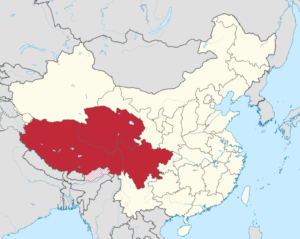
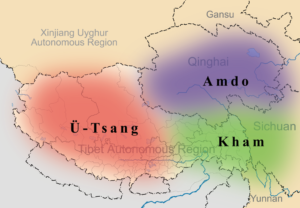
Historically, Tibet comprised three large provinces: Kham (southeast), Amdo (northeast), and U-Tsang (west). Over half the Tibetan population lived in the two eastern provinces. The national capital is Lhasa, in U-Tsang. Kham and Amdo are often referred to as Eastern Tibet, while the U-Tsang area comprises most of Central Tibet. Central Tibet also includes Chamdo, the westernmost province of Kham. Resistance by the Khampos of Chamdo would help draw the rest of Central Tibet into the armed revolt against Chinese invaders.
Tibet had long exercised autonomy while acknowledging the suzerainty of another empire, either Mongol or Chinese. "Suzerainty" was a deliberately vague term. To the extent the meaning can be pinned down, it means nominal sovereignty over an internally autonomous or semi-independent state. Hugh Richardson, High Peaks, Pure Earth: Collected Writings on Tibetan History and Culture 625-30 (Michael Aris ed. 1998).
In the Tibetan view, this was a reciprocal priest-patron relationship. The Tibetan Buddhists, as priests, provided religious leadership, and the patrons helped to protect Tibet. The priest-patron model was reasonably accurate for Tibetan relations with the Mongols, who embraced the Buddhism they learned from the Tibetans. Notwithstanding Tibetan pride, priest-patron was not how the Chinese treated Sino-Tibetan relations, as the Chinese were disinclined to think they had anything to learn from mountain barbarians. All of Tibet was beyond "China proper" and the Great Wall. Supplying a foreign military presence in Central Tibet was especially difficult, resulting in de facto independence for long periods.
In the mid-eighteenth century, China's Manchu Dynasty wrested much of Kham and Amdo from Tibet and held onto them until the dynasty fell in 1911. After a failed 1905 uprising of Tibetans in China's Yunnan and Sichuan provinces, the Manchu Dynasty began a campaign to eradicate the Buddhist clergy, and to populate Tibetan areas with poor peasants from Sichuan. In 1910, a bloodthirsty Chinese army led by Zhao Erfeng took over Lhasa and drove the thirteenth Dalai Lama into exile.
Whatever nominal allegiance Tibet thought it might owe to the Manchu Dynasty in Peking (which the Communists later renamed Beijing), Tibet felt no obligation to the brand-new Republic of China. On August 12, 1912, the Tibetans rose up and expelled the Chinese army.
During 1917-18, Tibet repelled an attack by the Republic of China, and then advanced into Tibetan ethnic areas formerly under Chinese control, reacquiring them in the 1918 Treaty of Rongbatsa. But in 1931-32, the Republic of China pushed the Tibet army back to the Yangtze (Tibetan Drichu) River.
The most thorough attempt to delineate the Tibet-China-India borders based on historical practice was the 1914 Simla Accord. In the three-way negotiations between Tibet, China, and British India, the Tibetans produced extensive documentary evidence for their claims, while the Chinese had bare assertion. The Simla Accord divided Tibet into "Outer Tibet" (Central Tibet plus some of Eastern Tibet) and "Inner Tibet" (the rest of Eastern Tibet). The parties recognized "the suzerainty of China" and also "autonomy" and "territorial integrity" of the "country" of Outer Tibet. Simla Accord, art. 2. China would not convert Tibet into a Chinese province, and Great Britain would not annex any portion of Tibet. Id. Neither China nor Great Britain would send troops into Tibet (with some small specified exceptions); neither would interfere with the civil administration of Outer Tibet by the "Tibetan Government in Lhasa." Id. arts. 3-4. As for Inner Tibet, "[n]othing in the present Convention shall be held to prejudice the existing rights of the Tibetan Government in Inner Tibet, which include the power to select and appoint the high priests of monasteries and to retain full control in all matters affecting religious institutions." Id. art. 9. A map attached to the treaty delineated the borders of Inner Tibet and Outer Tibet. Id.
Although the three negotiating parties had agreed to the Simla Accord, the Chinese central government ultimately refused to ratify it because it wanted a different boundary, even though Simla had attempted to placate China by assigning to Inner Tibet many areas where Outer Tibet had the better claim. Tibet and Great Britain mutually agreed to adhere to the accord; they stated that China was debarred from enjoyment of the accord's benefits until China ratified it.
Whatever the legal effects of the Simla Accord, the reality on the ground remained the same: "there was no modern boundary between Tibet and China; instead there were overlapping zones, open zones, and locally governed territories, both lay and monastic." Carole McGranahan, "From Simla to Rongbatsa: The British and the 'Modern' Boundaries of Tibet," 28 Tibet J. 39, 40 (2003). Kham was "mostly under the local control of hereditary kings, chiefs, and lamas. . . ." Id. Tibetans and Chinese did not think of the contested regions in the sense that European nation-states had defined their own borders—as exact lines where a nation enjoyed 100 percent sovereignty on its side, and no sovereignty on the other. The situation remained unchanged until the Chinese invasion that would come in 1949.
Starting in 1931, the Japanese invasion of Manchuria distracted the Republic of China. "By the mid-1930s, most of Tibet was again enjoying de facto independence." Kenneth
Conboy & James Morrison, The CIA's Secret War in Tibet 5 (2002).
As a practical matter, the Eastern Tibetans who lived within areas claimed by China or Tibet mostly governed themselves. Many were pastoralists or nomads. To the extent that they felt any allegiance to a faraway capital, it was to Lhasa, with whom they shared language and religion, and not to the more distant Peking or Nanking. (Nanking was the capital of the Republic of China from 1927-37 and 1945-49, and had sometimes been the imperial capital in previous centuries).
While always respectful of the Dalai Lama, Kham's leaders did not necessarily feel responsible to the government in Lhasa. Likewise, before communism was imposed, the Amdowas (northeastern Tibet) comprised hundreds of nomadic tribes, each with "its own army, temples, and laws." Jianglin Li, Tibet in Agony: Lhasa 1959 at 45 (2016). The Eastern Tibetans would contribute the greatest armed resistance to Maoist imperialism.
Today, the "Tibet Autonomous Region," formally created in 1965 by the People's Republic of China, does not include vast areas of historic or ethnic Tibet. Most of Amdo has been transferred to China's Qinghai province, plus a smaller part to Gansu. While the Chamdo region of Kham is in the Tibet Autonomous Region, most of Kham is presently divided between China's Qinghai, Sichuan, and Yunnan provinces. Tibetan ethnic areas constitute a quarter of the territory of the People's Republic of China.
The moral duty to use force to end suffering
Tibetan identity has long been closely tied to Tibetan Buddhism (Vajrayana), which is distinct from the Hinyana (a/k/a Theravāda), Mahayana, or Zen sects of other nations. While Buddhist scriptures are predominantly pacifist, they are not exclusively so. The martial arts were created by Buddhist teachers. Buddhist nations have employed armed force for self-defense as much as other nations. The core principle of Buddhism is ahimsa, compassion for the suffering of others. In the views of many Buddhists, including the present Dalai Lama, ahimsa permits the choice to reduce the suffering of others by using violence, including deadly force, against the persons causing the suffering. See David B. Kopel, "Self-defense in Asian Religions," 2 Liberty L. Rev. 79 (2007).

Tibetan Buddhists were familiar with the martial example Manjushri (Manjushree, Manjusri), Bodhisattva of Wisdom. He had transformed himself in a successful mission to kill Death. Many paintings depicted him with a holy book in one hand and a flaming sword in the other. Manjusri's sword cut through the roots of ignorance. Another bodhisattva, Vajrapani, pugnaciously defended embattled guardians of the Buddhist faith. The Epic of King Gesar told the historical (according to Tibetans) story of the great warrior king from days of yore who fought enemies of dharma—Buddhist teachings and the natural order of existence.
"Tibetan history was littered with examples of monks taking up arms when Buddhism was perceived as being threatened. . . . [W]hen defending the faith, monks could be the most magnificent of soldiers," with a stamina and rigor fortified by the monastic lifestyle. Mikel Dunham, Buddha's Warriors: The Story of the CIA-Backed Tibetan Freedom Fighters, the Chinese Invasion, and the Ultimate Fall of Tibet 149 (2004).

Tibet is not exclusively Buddhist. There had long been a Muslim minority that was respected and religiously free. There were four mosques in Lhasa alone. The Bon religion arose around the tenth century and was persecuted as a rival to Buddhism. By the twentieth century, it existed mainly in eastern Tibet, well beyond Lhasa's control.
The Dalai Lama's Proposal for Collective Defense
While Tibet was independent, the then-Dalai Lama, Thupten Gyatso (birthname Choekyi Gyaltsen), proposed a Tibet-Nepal-Bhutan defense alliance, with military training for young men. Although the Dalai Lama was head of state, much of the political power in Tibet's quasi-feudal theocracy was held by three large monasteries in Lhasa. Their armed monks, the dob-dobs, outnumbered Tibet's tiny army and police. As military buildup would have required substantial taxes on the monasteries, the monasteries squashed the plan. Nepal and Bhutan rejected the alliance proposal.
In a "Political Last Testament" in August 1932, Dalai Lama Thupten Gyatso wrote:
Efficient and well-equipped troops must be stationed even on the minor frontiers bordering hostile forces. Such an army must be well-trained in warfare as a sure deterrent against any adversaries.
Furthermore, the present era is rampant with the five forms of degeneration, in particular the "red" ideology. [He then summarized communist abuses of Buddhism in Outer Mongolia.] In the future, this system will certainly be forced either from within or without on this land. . . . If, in such an event, we fail to defend our land, the holy lamas . . . will be eliminated without a trace of their names remaining. . . . Moreover, our political system . . . will be reduced to an empty name; my officials . . . will be subjugated like slaves to the enemy; and my people, subjected to fear and miseries, will be unable to endure day or night. Such an era will certainly come.
Roger E. McCarthy, Tears of the Lotus: Accounts of Tibetan Resistance to the Chinese Invasion, 1950-1962, at 37-38 (1997).
Would the defense system have saved Tibet? "I'm convinced it would have," said the current Dalai Lama, Tenzin Gyatso. Dalai Lama with Jean-Claude Carrière, Violence and Compassion: Dialogues on Life Today 149 (1996) (originally published in France as La Fource du Bouddhisme (1994)).
In the Tibetan Buddhist system, after the death of the Dalai Lama or the Panchen Lama (second-ranking), the people would wait until his reincarnated soul was discovered in a young boy. The thirteenth Dalai Lama died in 1933; Lhamo Thondup was born in 1935. Identified as a possible Dalai Lama when he was a small child in a small Amdo village, he was enthroned in 1940, taking the religious name Tenzin Gyatso. Since Dalai Lamas were chosen in early childhood, there would always be a number of years before the child reached maturity and could assume leadership. In the interim, Tibet would be governed by a regency. As history demonstrates, regencies can be dangerous, because the government is often weak and subject to intrigues. After the death of the thirteenth Dalai Lama, "the Tibetan Government, such as it was, appeared oblivious to the need for national reform to prepare for the challenges ahead." Premen Addy, "British and Indian Strategic Perceptions of Tibet," in Resistance and Reform in Tibet at 35. The regent "allowed the military to decline, while lining his pockets at the expense of Tibetan economic surpluses." Dunham at 49.
The current, fourteenth, Dalai Lama has stated that he may decide not to be reincarnated. His primary motivation seems to be the avoidance of communist interference in the selection process. The communist rulers of today's China, although officially atheist, have asserted authority over the "control and recognition of reincarnations." The Dalai Lama notes that the communist Chinese "are waiting for my death and will recognize a Fifteenth Dalai Lama of their choice." The Dalai Lama, Reincarnation (Sept. 24, 2011). After China declared that the next Dalai Lama's selection process "must comply with Chinese law," the current Dalai Lama replied, "In future, in case you see two Dalai Lamas come, one from here, in free country, one chosen by Chinese, then nobody will trust, nobody will respect [the one chosen by China]." Sophia Yan, "China Says Dalai Lama Reincarnation 'Must Comply' with Chinese Laws," The Telegraph, Mar. 21, 2019.
Tibetan Arms Culture
Tibetans had a long tradition of being armed, but many of their firearms were flintlocks or matchlocks, which had long been obsolete in most of the rest of the world.
Matchlocks are impossible to keep always-ready, ill suited for long distance, poor for maintaining the user's concealment, and quite slow to reload after the single shot. Flintlocks were better in all respects, but still far inferior to firearms invented since the mid-nineteenth century, which used metallic cartridges, and which were much faster to reload and more powerful. Tibet was economically backwards and had no firearms manufacturing industry. Tibetans could and did make their own swords and knives.
During World War II, Tibet stayed neutral, and did not authorize Allied arms shipments to the Republic of China's army that was battling Japanese invasion. Nevertheless, wartime conditions tend to increase the gun supply, and Tibetans, especially in Kham, seem to have taken the opportunity to acquire a wide variety of modern firearms, some of them purchased in Burma and then imported.
Tibet's formally organized military forces were small. As of the mid-1930s, Eastern Tibet had about ten thousand regulars and militia; half of them had modern British Lee-Enfield .303 bolt action rifles. In Lhasa there were under a thousand soldiers plus 300 armed police. In most of the nation, defense was provided only by militia armed with matchlocks. Military training in general was desultory. On the eve of the 1949 communist invasion, "Tibet's army—if you could call it that—was at most ten thousand troops with nineteenth century weapons." Dunham at 56.
Although many Tibetan firearms were inferior, Tibet's arms culture was strong. High proficiency at riding, shooting, and swordsmanship were part of Tibetan identity, and the skills were learned early in childhood. Such skills had always been necessary for survival—whether for protection against bandits, or for hunting in an environment where neither game nor ammunition were abundant.
"Khampas were heavily armed," skilled at brigandage, and "incomparable horsemen, hunters, and trackers." Dunham at 7. "Every self-respecting male owned at least one silver embellished pistol or rifle, even if it was nothing more than a flintlock. The poorest of beggars carried a sword or oversized knife hitched at his waist, and he knew how to use it." Id. at 17. Wealthy families had arsenals. So did the monasteries, with their warrior monks, the dob-dobs.
When the war began, man for man the Tibetans were far superior to the China's misnamed People's Liberation Army (PLA). The Tibetans often inflicted casualties on the Chinese at about ten times the rate that the Chinese did on them. Unlike the Tibetans, the Chinese were poor marksmen. While the PLA demanded unthinking obedience, the Tibetans knew how to think for themselves, to improvise and survive. In combat, PLA officers did not lead their men, but instead stayed in the rear, to shoot those who tried to escape.
According to a captured Chinese army document, PLA soldiers fired 20 bullets per Tibetan guerilla killed, whereas for Tibetans shooting at the PLA, the norm was one shot, one kill.
Moreover, the average altitude of Kham and Amdo is over 3,000 meters (about 10,000 feet), and even higher in Central Tibet. Tibetan physiology has evolved such that Tibetans breathe easily in very thin air, whereas invading lowlanders have a much more difficult time.
Supported and sheltered by the Tibetan people, Tibet's guerillas could hit, run, and disappear. "Many people think it impossible for guerrillas to exist for long in the enemy's rear. Such a belief reveals lack of comprehension of the relationship that should exist between the people and the troops. The former may be likened to water the latter to the fish who inhabit it. How may it be said that these two cannot exist together? It is only undisciplined troops who make the people their enemies and who, like the fish out of its native element cannot live." Mao Tse-tung, On Guerrilla Warfare, ch. 6 (1937).
When the Chinese communists invaded Tibet, the corrupt Tibetan government failed, but the Tibetan people rose up nonetheless, as will be described in the next post.
The post Tibet's Armed Resistance to Chinese Invasion appeared first on Reason.com.
The Great Resignation has been the economic buzzword of the pandemic.
The share of workers voluntarily leaving their jobs escalated from a fairly typical 2.3% in January 2021 to new record highs of 2.8% last April, 2.9% in September, and 3.0% in December, per Federal Reserve data.
The “quits” rate hasn’t cooled much since, either. It was at 2.8% in January, the most recent month for data.
That’s 4.3m American workers leaving their jobs in one month.

Zachary Crockett / The Hustle
Theories have abounded for why resignations have grown so prevalent.
The bump in these numbers has been attributed to burnout, a desire to switch careers, and the rise of the “antiwork” movement, which questions the status quo of modern employment. (The r/antiwork subreddit jumped from ~100k members at the start of the pandemic to ~1.8m as of March 2022.)
Some analysts have settled on the Great Renegotiation as a more accurate moniker for the situation because most people leaving their jobs have jumped to greener pastures at another employer.
But why are so many people really leaving their jobs? And what are they doing afterwards?
The Hustle surveyed ~1.1k people who left jobs during the pandemic and found a variety of reasons for why they resigned and where they ended up after their resignations.
Among the findings:

Zachary Crockett / The Hustle
But the survey made it obvious the Great Resignation defies easy explanation.
Within these categories, the reasons for leaving a job were nuanced. One respondent’s burnout, for instance, was precipitated not just by strenuous work hours but also a subpar salary and diversity, equity, and inclusion issues from being one of the only women at her company.
To better understand these nuances, we decided to interview 4 people in varying industries, and at different stages of their careers, who left their jobs.
Here are their stories.

Lucas Ochoa says people in the restaurant industry “are less and less willing every year to put up with” difficult work conditions and low pay. (Courtesy of Lucas Ochoa)
Lucas Ochoa arrived at work one day last November and realized he was in for a difficult shift.
Ochoa heard the entire kitchen staff at the downtown Louisville restaurant where he worked had walked out during lunch. For dinner, the staff would be down by about half. Ochoa would be the lone server’s assistant (also known as a busser or runner), down from the 3 server’s assistants he says the restaurant often had.
Ochoa, 24, had started about a month earlier as a job on top of EMT school. The work was tough. He carried heavy trays between the dining room and kitchen for 6-hour shifts, making minimum wage plus tips.
On good nights his hourly wage could come out to $20. But there were also bad nights, when he made far less doing the same difficult job.
And given the shortage of staff, this night was particularly crazy.
“I was running back and forth,” Ochoa said. “I’d already chugged like 3 Gatorades that evening.”
While he was carrying an order to a table, Ochoa says a general manager for the restaurant asked him if he could pick up another tray.
“I turned around and was like, ‘Hey, could you pay a living wage?’” Ochoa said.
The general manager, Ochoa said, told him he could leave and not come back. Ochoa agreed.
“I was like, ‘OK. I’m not gonna carry an entire dinner service on my back 5 nights a week, while being in EMT school and being disrespected.’”
Ochoa had been working off and on in the restaurant industry for 8 years and believed his anger at managerial treatment reached a boiling point during the pandemic. He was also emboldened knowing so many other jobs were available.
And it didn’t take him long to find his next one, at Starbucks.
At first, work as a barista suited Ochoa. The pace was easier, and he believed he was making decent enough money — $12/hour base pay and with tips closer to $15-$17 — while being treated with respect by management.
But not long ago, Ochoa said, he asked his manager whether Starbucks’ corporate pay raise would lead to higher pay for all employees at their store. He said the manager responded by cutting his work down to one shift per week.
With his hours reduced, Ochoa quit. He was again able to find another job quickly, in security. It pays more than Starbucks.
As necessary as he believes it was for him to leave his last 2 jobs, he’s still not in an ideal place.
“I’d honestly rather be making lattes,” Ochoa said over a text message. “But there’s no way I could make ends meet on one $12/hour shift a week.”
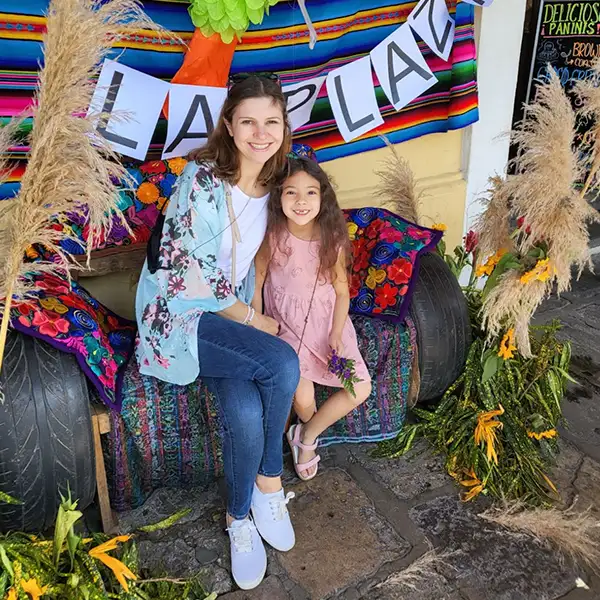
Verena Goetz, pictured with her daughter, Lina, realized during the pandemic she didn’t have enough time with her kids. (Courtesy of Verena Goetz)
Verena Goetz had a love-hate relationship with her work as an international move coordinator for a large moving company.
She enjoyed the work and the people, and she felt dedicated to the job. But the stress could be overbearing. Goetz wasn’t just coordinating the transportation of boxes; she was moving people’s most important possessions.
When the pandemic hit and shipping channels were thrown into disarray, her job became even more complicated. At the same time, Goetz started working from home, spending more quality time with her husband and daughter, and rethinking how she prioritized life.
Before the pandemic, Goetz noted, “you weren’t really just sitting down and spending time with your kids.”
In fall 2020, she had her 2nd child. As Goetz’s maternity leave winded down, she decided she didn’t want to return to work, at least temporarily.
But money was an issue. Her family resided in a Washington, DC-area condo and had plans to move to Seattle for her husband’s new job. Her ~$60k annual salary was necessary to pay for housing and living expenses.
Then, Goetz’s family got the break it needed when her husband discovered he could work remotely for his new job. In January 2021, Goetz resigned, and they moved to Antigua, Guatemala, where her husband is from and housing costs are roughly half what they paid in DC.
The time off from work has been rewarding, even necessary. Not long after arriving in Antigua, Goetz says she was diagnosed with stress-related ulcers.
Still, Goetz is “kind of itching to get back.” She’s done consulting work on the side and may pursue a new career in sustainability. But for now she’s enjoying seeing her children grow in a way she never expected.
“We just kind of try to make more time now,” Goetz said. “It’s changed our outlook a little bit.”

Dominic Walton does not expect to return to the corporate world anytime soon. (Courtesy of Dominic Walton)
Corporate life was the only professional life Dominic Walton knew.
He had worked for a variety of companies, including Netflix and Charles Schwab and most recently Paychex. He liked his manager, but the long hours were getting to be too much.
“I noticed there is definitely more work than bodies, which you come to learn is just the nature of the corporate world,” Walton said.
“It became almost an expectation where people are smiling and giving you positive affirmations yet asking you to take on all these roles and additional work with no additional pay and not even keeping up with inflation.”
As his frustrations mounted, Walton thought back to a business idea he had before the pandemic. In June 2021, he created an LLC, and last September, at the peak of the Great Resignation, he officially quit and dove into Walton Logistics LLC full time.
Walton bought a 26-foot truck and transports general freight and goods, contracting with various companies that assign him long-distance trips or local work around his Phoenix-area home.
Walton says he was making ~$70k annually at his old job. With his own business, he says he can make $10k+ a month while working fewer hours and having the flexibility to spend more time with his young daughter.
“And I don’t mind getting sweaty and putting on some steel-toed boots and moving some pallets around and some tanks around,” he said. “I like the sweat and the hard work.”
Walton doesn’t expect a return to a traditional desk job, at least not in the near future. In the coming years, he would like to buy more trucks, hire drivers, and build his business.

Madeleine Pembelton plans to study biology in college before applying to veterinary schools. (Courtesy of Madeleine Pembelton)
To zero in on her goal of becoming a veterinarian, Madeleine Pembelton, 19, intended to take a gap year after graduating high school in 2021 to work as a veterinary assistant.
She finished ~200 hours of coursework on top of her high school AP classes for a veterinary assistant certification program and needed to complete 300 hours of clinic experience. The problem was that the pandemic reduced opportunities for in-person clinic work.
That meant no certification. And no certification meant much greater difficulty in securing a veterinary assistant job.
“The clinics I was interviewing with, I was declined because of lack of experience,” Pembelton said.
So Pembelton figured she would continue working at Pet Supplies Plus, a retailer in her hometown of College Station, Texas. At best, she assumed she might be able to pick up some hours as a kennel tech for a veterinarian, cleaning kennels and walking dogs.
Then, like almost everywhere else, veterinarians were hit by the Great Resignation. Pembelton interviewed at a local veterinarian office where several people had recently left.
“There was an opportunity there, and it was just perfect timing,” Pembelton said. “So I just jumped on it.”
She resigned from her job at Pet Supplies Plus (where she still visits former co-workers) and started working full time as a veterinary assistant. Pembelton makes higher wages and believes she’ll have an improved resume for when she starts college in the fall and applies to veterinary programs in the future.
Her good fortune probably wouldn’t have happened in any other job market.
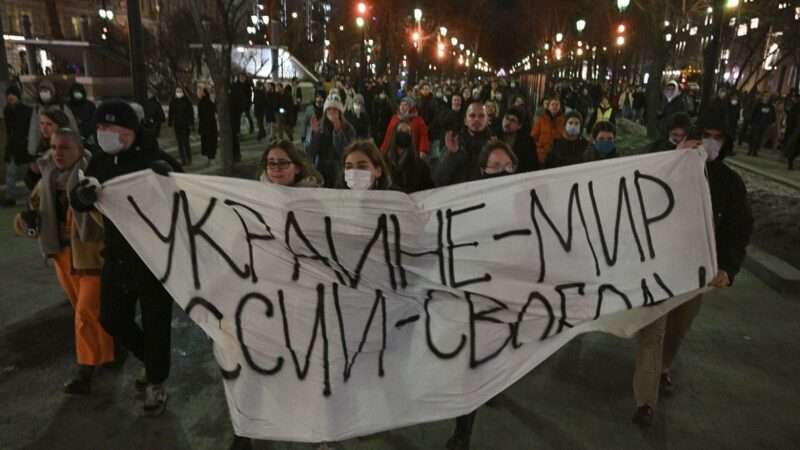
A few days ago, I put up a post expanding on economist Timur Kuran's idea of combating the Russian invasion of Ukraine by granting asylum to Russian troops who surrender, thereby increasing incentives to desert. Canadian political commentator Scott Gilmore offers a much broader version of the same idea, one that isn't limited to soldiers. He suggests Western nations take a wide range of steps to encourage Russians to join with us in opposing Putin:
The western alliance has moved quicker and implemented more sanctions than anyone would have predicted just a week ago…
And, unfortunately, this historically harsh set of sanctions has failed to move Putin….
Perhaps, then, the west should consider an alliance wide-strategy of offering a million little carrots aimed not at Russia, but at Russians.
For example, the Ukrainian government is now promising Russian deserters 5 million rubles (approximately US $47,000), which is 450 times more than what the Kremlin pays the families of soldiers killed in action. NATO and the EU could match that and add an offer of asylum for them and their families….
Even if each deserting Russian soldier was offered a huge bounty, say $100,000, it would still be incredibly cost effective when you weigh it against the price of supporting a protracted war, or the cost in men and material to remove that soldier from the battlefield in the traditional fashion.
This strategy could be applied more widely. For example, some of these million little carrots could be offered to Russian diplomats. We have already seen at least one resign in protest, but there could be hundreds more if the western alliance also dangled in front of them a path to citizenship and a stipend to cover living costs. This may seem unfair, but the world needs to be pragmatic about this and realize that bigger fish will require larger bait.
For senior military staff or Kremlin officials in Moscow, maybe even notable journalists or celebrities, we could also offer a path to citizenship and an even larger stipend….
But for them and all the rest, there would be one very important catch. All of these little carrots would require a recorded video statement explaining their opposition to the war and urging others to join them.
If thousands of these testimonials were shared in the media and online, coming from powerful Russians and lowly conscripts both, it would be almost impossible for the Kremlin to control the narrative domestically. It would be a body blow to morale, and it would handicap further attempts at disinformation and propaganda.
But, most importantly, a million little carrots strategy would remove Russian boots on the ground. If you consider the slow progress of the Russian military after (according to Pentagon estimates) 90 per cent of the troops assigned to this invasion have already been deployed, it is clear that even a small number of deserters will have a disproportionately large impact on Moscow's ability to fight this war….
I agree with most of Gilmore's points. But I would make the video optional rather than mandatory. Some potential deserters or defectors might fear to make the video, because possible retaliation against their families back home. In addition, the video would be less credible if Russian viewers find out (as they likely would) that it was a mandatory condition of getting asylum in the West.
The strategy of incentivizing Russians to come over to our side can be broadened still further, by offering an open door to Russian migrants, including those who are not high government officials, oligarchs or celebrities. Ordinary people, particularly those with useful scientific technical skills, are still of value to the Putin regime. Better to have them on our side instead. I will have have more to say about this point in an op ed in the New York Times, which is expected to be out on Tuesday. Among other things, it will address a number of potential objections.
This approach should be supplemented by doing everything reasonably possible to avoid sanctions and "cancellations" aimed at ordinary Russians, especially those who oppose Putin's regime. There is good reason to take steps that deny resources to the government (such as freezing Russia's central bank assets abroad) and penalize its high officials and collaborators. But, for both moral and strategic reasons, we should minimize collateral damage to innocent civilians. Political scientist Yascha Mounk makes some good points on this in a recent Washington Post article:
Although we are waging a righteous battle against Vladimir Putin, we are not at war with the Russian people. Acting as if we are is as immoral as it is counterproductive….
Putin undoubtedly enjoys widespread support. But over the past week, many Russians have found the courage to criticize his assault on Ukraine, often incurring tremendous risk in the process.
Thousands have already been arrested for protesting the war. About 7,000 Russian scientists and academics have signed an open letter demanding "an immediate halt to all military operations directed against Ukraine." Similar petitions are circulating among teachers, doctors and many other groups. What appears to be the biggest one, on Change.org, has attracted over a million signatories.
Even more Russians share these sentiments but lack the bravery or the opportunity to speak out….
All of this drives home the importance of continuing to draw the vital distinction between the Russian government and the Russian people — something that many pundits, politicians and institutional leaders are, sadly, failing to do….
Heavy sanctions will unavoidably impose significant costs on ordinary Russians. But since they are necessary to assist Ukraine and weaken Putin, they are morally defensible. It is right to stop doing business with Russian companies, to seize the property of oligarchs who got rich thanks to their connections to the Kremlin, and to ban sports teams from competing in international competitions under the Russian flag….
But none of this is a reason to punish individuals for the accident of their birth or to cast Russia's rich culture under a general pall of suspicion. Dictators do not speak for everybody who shares their nationality. And so we must avoid punishing ordinary Russians who neither have close links to the Kremlin nor represent their country in an official capacity. It would be a serious injustice to stop Russian academics from giving talks in the West, to subject every Russian living outside the country to an ideological litmus test or to cancel performances by Russian artists based purely on their nationality.
As Gilmore and Mounk explain, differentiating between Russia's government and its people is not only morally right, but also a good way to counter Putin's propaganda and weaken his regime's position.
Like the Cold War against the Soviet Union, the conflict with Putin is not just a military confrontation decided by material factors, but also a war of ideas and ideologies. The ideology of liberal democracy ultimately triumphed over communism. It can also prevail over Putin's brutal authoritarian nationalism. Indeed, the latter probably has a much weaker appeal than communism did, at the height of the latter's influence. Putin's "Russian world" is far less enticing than the utopia of freedom and limitless abundance once promised by Lenin and Stalin. But we are far less likely to win if we alienate large numbers of potentially sympathetic Russians by unnecessarily lumping them in with the enemy.
The "million carrots" strategy is not a complete substitute for sanctions against the Russian state and providing military aid to Ukraine. But it can help increase the effectiveness of these other measures, and at little cost. Indeed, Russian defectors, immigrants, and military deserters, can make valuable contributions to Western economies and societies, as have previous generations of Russian immigrants during the Soviet era, and before. This is another point I will cover in greater detail in my forthcoming New York Times article.
UPDATE: The New York Times article is now out, and available here.
The post How to Fight Putin by Offering Russians "a Million Little Carrots" appeared first on Reason.com.
If it is called a local, pub, tavern, inn, hostelry, saloon, 19th hole, watering hole, or bar, public houses are fascinating places, luring people of all walks of life to its alcoholic nectar, like bees to flowers. Pubs around the world tend to all tastes, palates, and sub-cultures these days, with inventive owners providing varieties […]
The post 10 of the Coolest Pubs in the World appeared first on Listverse.

There are now some 120,000 warehouses globally, and another 50,000 are likely to be added before 2025. Over the next few years, more robots will be deployed into these warehouses—the logistics market—than in all other application categories combined, including farming, medicine, and home use. Just as the 1960s saw the mechanization of industry, with an accompanying boom in productivity and prosperity, the 2020s will be the dawn of the robotification of services.
Industrial robots came into use in 1961 when General Motors (G.M.) installed a simple robotic arm on its New Jersey production line. The machine had been invented by Unimation, a company founded by the father of robotics, Joseph Engelberger—a self-professed Isaac Asimov enthusiast. By 1969, G.M. rebuilt its Lordstown, Ohio, factory with an array of Unimates to perform welds, and the facility soon achieved a twofold leap over its former production rate, making it the most productive factory in the world. (That same factory would be sold in 2020 to startup Lordstown Motors, with plans to make electric trucks.) Automobile manufacturers everywhere were among the first and fastest to embrace industrial robots.
The International Federation of Robotics, founded in 1987, issues an annual robot census. When 2020 began, it found nearly 400 million industrial robots at work in factories around the world, twice the number from five years earlier. But for the first time, over half of all robot purchases globally were in services, not industrial applications. And while growth in the latter is expected to continue, installations of service bots are expected to rise more than 200 percent in just a couple of years.
About half of all service robots are found in the logistics market, with "inspection" applications at about one-fifth. The military, an early and ongoing supporter of robotic technology, accounts for only a tiny fraction of the market. The rest is made up of everything from professional cleaning and fruit picking to delivering medications in hospitals.
The service-bot counterpart to the robotification of G.M.'s Lordstown factory came in 2012, when Amazon spent $775 million to buy Kiva Systems. Kiva had invented a clever self-propelled turtle-like robot that can scoot around warehouses carrying entire shelf-units of packages.
Firms like Amazon and Walmart need more than the information exchanged between buyers and sellers in cyberspace; they need the physical exchanges that occur in warehouses. That's how the seamless experience of "one-click" shopping happens. Kiva-class service bots are the cloud's hands and feet, directly and wirelessly controlled by the cloud in real-time.
In the past decade, annual net additions to warehouse square footage have increased 400 percent. That helps explain a nearly identical 400 percent increase during the past five years in service robot sales into the warehouse and logistics supply chain.
E-commerce has done more than increase the demand for warehouses; it has changed their function. Before, pallets of goods arriving at a warehouse were redistributed, often again on pallets, to local retailers, where staff would unpack and sort the goods onto shelves for display. One-click e-commerce has pushed the latter half of this process back upstream into warehouses, many of them multi-story structures bigger than football fields, where single packages (down to a tube of toothpaste or a single book) are grabbed, boxed, and delivered directly to the consumer's doorstep.
As e-commerce pushes more and smaller warehouses toward the edge of supply chain networks, closer to consumers, service bots solve another problem. Since such edge facilities are necessarily located where real estate is more expensive, operators chase greater efficiency in using a building's floorspace by packing things in more tightly. In these high-density workspaces, it's far safer to use robots and automated systems. The pinnacle of density, a kind of Rubik's Cube–like design for bins and packages, leaves no room for people.
Whether in the hyper-dense local warehouses or the hyper-scale remote warehouses, the 2020s will see the emergence of what we might term a warehouse-scale robot. Human beings will still be involved, especially at the front end and the output, but the storing, moving, and sorting of packages will be autonomous, just as the storing, moving, and sorting of data is automated in a warehouse-scale computer.
Package-handling service bots are part of a broader warehouse automation trend, both inside the buildings and for that last mile. As performance and adaptability improve and as costs decline, robotification will come to every segment of the services sector, from security, safety, and environmental monitoring and assessment to education, farming, general-purpose cleaning, and health care. After the logistics market, service bot deployments are growing fastest in medicine and agriculture.
John Froelich invented the first farm tractor in 1891, and he formed a company a few years later called the Waterloo Gasoline Traction Energy Company, named to differentiate it from the existing but far inferior steam-driven machines of the day. In 1918 he sold the company to a plow manufacturer called John Deere.
Almost 80 years after that, John Deere's Precision Farming Group began work on a GPS-guided tractor. That came to fruition in 2002, when the company debuted a GPS-guided self-navigating farm vehicle—the machine that marks the dawn of agricultural cyber-physical systems. Ubiquitous self-driving cars may still be years away, but at least two-thirds of North American crop acreage already uses self-guided cyber-physical machines. In Australia, the figure is 90 percent.
Overall, agriculture accounts for a relatively small piece of the robot market—about $5 billion a year. But that's about to change. The cloud's A.I. logic engine marks an improvement comparable to the gasoline engine's improvement over steam. Instead of huge, expensive tractors, we'll also soon see swarm farm robots: machines a fraction of the size and cost, useful for hyper-precise fertilizing and weeding, enabling smaller boutique farms to compete with their industrial-scale counterparts. Meanwhile, the combination of A.I.-enabled vision systems (to see whether the fruit is ripe) and soft materials for grabbers will finally lead to fruit-picking robots. And just in time: Demographic trends point to both a rising labor gap in agriculture and rising global demand for food.
Medical robots are still in their infancy, but they're also already a $5 billion industry. Two decades ago, the Food and Drug Administration (FDA) approved Intuitive Surgical's da Vinci robot for use during endoscopic surgery. In 2017 it approved Mazor Robotics' spinal surgery robot, and in 2018 it gave Auris Health the go-ahead for a robot used in endoscopic and lung surgeries.
Many of these innovations entail an elastic use of the word robot. Machines like the da Vinci would be more precisely described as "tele-operated" or "robot-assisted": A person remotely operates the machine, and the machine assists in precision. In other words, the machine is not autonomous. The same is true of "exoskeletons," a class of Iron Man–style devices that help humans lift and move heavy objects, minimizing strain and enhancing strength. While unwieldy and impractical prototypes date back to the 1960s, only recently have the maturation of lightweight materials, superior power systems, sensors, and A.I.-enabled software controls allowed us to build useful exoskeletons.
Exoskeletons are now beginning to show in medical, manufacturing, and even construction markets. For example, Sarcos Robotics recently put its latest system into field trials partnering with Delta Airlines for baggage handling. Sarcos makes the reasonable claim that for an all-in cost equivalent to about $25 per hour, an exoskeleton can increase employee productivity by four- to eightfold in heavy-lifting tasks.
In June 2020 another pioneer, Ekso Bionics, received FDA clearance to market an exoskeleton that helps patients with brain injuries regain their ability to walk. Similarly, after retiring its walking Asimo robot in 2018, Honda started applying the technology to wearable exoskeletons for the elderly. As exoskeletons become less costly and more durable and comfortable, we can expect wheelchairs to become a thing of the past. Exoskeletons are on track to become a multibillion-dollar industry in the 2020s.
One benefit from the introduction of service bots will be improved safety for employees in high-risk occupations. Nine out of 10 of the most dangerous occupations are in construction, landscaping, farming, ranching, and fishing, all fields being transformed by the robotics revolution.
The most interesting question now is not how much existing machines will improve but what entirely new kinds of machines are on the verge of commercial viability.
The annual industrial robot census does not count consumer machines. Nearly 20 million bots were sold on the consumer market in 2020. These are—for now—mostly low-cost devices for relatively low-value applications: vacuuming, mowing lawns, toys, etc. They are more akin to automatic washing machines than the anthropomorphic robots that writers like Asimov imagined.
As with the automobile and the smartphone, the true robot is made possible when a whole suite of technologies matures. Henry Ford could not have built his great enterprise but for the confluence of the gasoline engine, petroleum refining, and the assembly line, none of which he or his company invented. Similarly, the iPhone could not have been built were it not for the maturation of three technologies, none of which Apple had anything to do with inventing: the silicon microprocessor, the pocket-sized TV screen, and the lithium battery.
For useful, untethered robots, the three enabling technologies now maturing are vision "chips," synthetic "muscles," and lithium batteries. Put those together with ubiquitous supercomputing power, and a revolution becomes possible.
The collapsing size and increasing capabilities of vision chips were propelled not by the aspirations of roboticists but by the consumer market for digital cameras embedded in smartphones, automotive engineers chasing chip-sized radar for better cruise control, and other unrelated applications. The solution that has eluded roboticists for years, the ability to mimic muscles, now emerges from materials sciences, with electrical, pneumatic, and polymer actuators that have the necessary efficiency, power, range of motion, durability, and (soon) self-repair. And the onboard power to animate it all? We owe that to the lithium chemistry developed at Exxon in the late 1970s.
At the growth rates now underway, professional service robots will become an increasingly common part of everyday work life for a rapidly increasing fraction of the populace. Until now, the service sector has been infamously immune to the kinds of machine-driven productivity gains seen in factories and farms—gains that invariably create new kinds of work and a widespread growth in wealth.
When cars were first introduced, it was clear that profoundly superior performance was inevitable, even though the utility of the first Packard in 1899 wasn't much greater than a horse-drawn wagon. The path forward, and the velocity of growth and change, became obvious in 1919 with the introduction of the Model T. By the end of the 1920s, about 20 percent of the population owned cars. Along the way, hundreds of U.S. automakers sprung up, creating fortunes and entirely new domains of direct and indirect employment.
In the 2020s, as robot manufacturing matures, home-owners will first begin to purchase lower-cost versions of service robots to, say, help the home-bound elderly. At that point, a new class of machine will have been literally domesticated. And who knows what will happen then? In the words of Steffi Paepcke, a team leader at the Toyota Research Institute: "If the inventors of the automobile had asked people riding horses what they wanted, they would have answered that they just wanted a faster horse. It can be difficult to imagine a future that's vastly different from the status quo."
Not everyone has been enthralled with the rise of the robots. In 1961, with automobile manufacturing jobs declining even as output soared, President John F. Kennedy created an Office of Automation and Manpower to address, as he put it, "the major domestic challenge of the Sixties: to maintain full employment at a time when automation, of course, is replacing men." Today, about 60 percent of the kinds of jobs that existed in that period no longer exist.
But if labor-saving technology were a net job destroyer, the unemployment rate would have been continually rising over all of modern history. It hasn't. As some skills cease to be essential, different types of work emerge instead. The robotification of services promises to bring us the same things the mechanization of industry did: more business, more services, more wealth, and more well-being.
This article is adapted from The Cloud Revolution: How the Convergence of New Technologies Will Unleash the Next Economic Boom and A Roaring 2020s by permission of Encounter Books.
The post How Robots Will Transform the 2020s appeared first on Reason.com.
A to-do list app can help you plan out your day by reminding you to knock out one task or chore at a time.
From practical compacts to flashy transport fit for Hawaii-based, high-living private investigators.
There are subtle conventions behind smoking a cigar. Here's to making sure you know how to smoke one like a pro.
The post How to smoke a cigar properly: The ultimate beginner’s guide appeared first on The Manual.
The post Candid Street Photography: 19 Tips to Improve Your Images appeared first on Digital Photography School. It was authored by James Maher.

This article was updated in April 2023 with contributions from James Maher and Jaymes Dempsey.
Candid street photography is a ton of fun – but it can also be pretty difficult, especially for the beginner street snapper.
In this article, I share my favorite 19 tips and strategies to level up your candid street shots. These are techniques I’ve developed from over a decade of photographing on the streets – and I guarantee that, if you apply them carefully, you’ll end up with great results.
Let’s get started.
Many beginner street shooters work with a DSLR and a midrange zoom lens – and while it’s fine to do street photography with such bulky equipment, lightening your load will make a huge difference. You will have more energy, your coordination will be better, and you will be faster and more willing to explore. You’ll also be able to photograph in situations where you don’t feel comfortable bringing a large camera.
So what type of gear do I recommend?
First, consider a more compact street photography camera. Mirrorless models – especially APS-C and Micro Four Thirds options – are smaller and lighter, plus they look less intimidating to the people you’re photographing.
And if you do want to stick with your DSLR, consider using a small prime lens, such as a 35mm or a 50mm. A 50mm f/1.8, for instance, will be far smaller than your standard zoom. It’ll also be very cheap and offer high-quality optics.
Note that prime lenses will restrict you to a specific focal length, but this limitation can actually be quite freeing. By sticking to 35mm or 50mm (the two favorite focal lengths for most street photographers), you will quickly learn to see how the lens sees, and you’ll be able to better visualize shots before you raise the camera to your eye.


Speed is key in candid street photography, and how you hold the camera can make all the difference in the world. I like to wrap the camera strap around my wrist instead of around my neck. It is much quicker and easier to maneuver the camera this way, and it also allows you to easily shoot from the hip (see the next section!) if you need to.
When walking down a street I usually hold the camera in front of me at a 45-degree angle, halfway between vertical and horizontal, with my finger on the trigger. This way, I can easily get my camera into the right position if something spontaneous should happen without tipping off the subject that I am going to photograph them.

Whenever possible, try to keep your camera in your hands and at attention when you are photographing. If you allow it to hang off your neck or your wrist, then when an amazing moment occurs you will have to locate and grab the camera before putting it to your eye.
Not only will that cause you to miss great shots, but it’s also a lot more noticeable. Holding your camera at all times is really the least conspicuous way to capture a candid street image.
Also, try to keep the camera up high as much as you can. Then, when you take an image, you won’t have to move your arm at all!

My biggest critique of street photographers is when I see a photograph with an extremely interesting subject, yet the photographer decided to shoot the entire street and make what should have been the entire photo become just a small part of the frame. Fill the frame with what is important and cut out everything else. Leave some room for the imagination.
Also, with a prime lens and fast-moving subjects, you’re not always going to be able to be in the perfect spot or catch the perfect angle on the fly. Don’t be afraid to crop in or improve the angle afterward. Candid street photography is very different from landscape photography, where you are always able to plan out every aspect of your image before taking the shot. You should get used to using the crop tool, even if it’s just for a slight correction.

Unless you have a very small rangefinder, the reality is that it is much easier to photograph someone without them noticing if you don’t have to raise the camera above your chest or look through the viewfinder.
The advantage to shooting from your hip with the camera strapped to your wrist is that it really becomes an extension of your arm. You don’t have to shoot in front of you and can shoot sideways or even backward if you need to. It frees you up to integrate your lens into a situation without anybody noticing. You can shoot from the hip with either both hands or one hand holding the camera, but one hand gives you a little more freedom to aim in any direction.
Just keep your arm straight down at your side and then angle the camera up and in whichever direction the scene is happening. Then, if you need to, you can raise your arm or bend your elbow a bit to get the exact frame, but be discreet about it.

Another advantage of shooting from the hip is that you can catch people from a very low angle. I often prefer my candid photography to come from a close-up and low angle because it elongates people and allows the subject to fill the frame. This is obviously not true for every situation, but a lot of the time this is my personal preference.
The slight diagonal angle can be very pleasing, especially for vertical portraits. The angle injects some energy into a photo and allows you to catch a bit more of the surroundings. It creates a lead for the eye to enter the photo and keeps it there, bouncing around between the subject and its surroundings.
I often shoot my candid street shots in Manual because I like to have my exposure dialed in before taking these types of photos. When getting close-ups, you never really know how the camera is going to read a situation and that often leads to a lot of messed-up exposures unless you take full control over your exposure settings.
But Manual shooting on the street can take some serious getting used to. If you suddenly go from a sunny street to a shady street then you will have to remember to change your settings. I usually keep a sunny and shady general exposure setting in my head and flip back and forth between them.
But what happens then if something sudden occurs? Say you’re walking down a sunny street, settings set up perfectly, when all of a sudden you look to your right and notice a couple of locksmiths in a very dark van, one passed out and one about to light his cigarette. The moment is about to happen:

Well, in that case, I quickly switch over to Aperture Priority on my camera, which I have preset with a low aperture value. Even though you will have a loss of some depth of field, you will be able to have it work in both extremely bright or dark situations with a fast enough corresponding shutter speed. You can also do this with a shutter speed (via Shutter Priority mode) as well.
If you attend photography workshops or take photography classes, you’ve probably encountered the standard advice: keep your ISO as low as possible.
Yet while high ISOs can create unpleasant noise effects, modern cameras offer very impressive high-ISO capabilities; you can often shoot at ISOs of 1600 and 3200 with minimal noise, which is why, in my view, you shouldn’t be afraid to boost that ISO.
I typically shoot candid street photos at ISO 400 in sunlight, ISO 800 in light shade, ISO 1600 in dark shade, ISO 3200 at dusk, and ISO 6400 at night. With an entry-level or less-advanced camera, I would drop this by one stop (i.e., shoot ISO 200 in sunlight and up to ISO 3200 when doing street night photography).

You see, a high ISO gives you a huge advantage. It lets you use a fast shutter speed, even in low light – which means you can shoot handheld, you can freeze motion, and you can use a small aperture to maximize depth of field.
(Why is a deep depth of field necessary? For one, if you fail to focus on your subject, you may still get a sufficiently sharp shot. Plus, it’ll let you keep multiple subjects sharp within a single composition, which is a great way to add context and complexity to your candid images.)

Zone focusing is the technique of turning your camera to manual focus mode, pre-focusing it to a distance of about 8-10 feet, and then capturing your subject once they are in the range of sharpness for your camera. This is easier to do with a wide-angle lens with a medium to small aperture such as f/8 to f/16 so that there is more area of your image in focus. Keep in mind that this is a skill that can be improved – there are many photographers who can zone focus well even at f/2.
You can read more about zone focusing here, and while it is a little difficult to learn at first, you will quickly get much better at it. The main benefit of this type of focusing is so that you no longer have to lock the autofocus in on your subject. This allows you to be a little more spontaneous with your shooting, and it will give you an added split second to take the photograph. That, in turn, will allow you to better capture those very fast moving moments.
Most importantly, it will allow you to be a little more candid than you can be using autofocus. Since you won’t have to point the camera directly at your subject to lock in the focus nor will you have to look through the viewfinder to make sure you are focusing correctly, you can be much more inconspicuous. This will allow you to shoot from the hip and still know that your shots will be sharp.
Street photographers often just take a camera, walk around, and explore – but by constantly walking, you may be doing yourself a disservice. You’ll miss out on the shots that require a bit of patience (which are often better than the shots you’ll get when walking around).
So instead of walking constantly, head outside – and when you find a promising location, linger for a while and wait for something to happen.
By picking a spot, you give a magical moment plenty of time to materialize – and if you’ve chosen your location carefully, you’ll be able to combine subject interest and a good background for a top-notch result. After all, it’s when the right location merges with an interesting moment that a great photograph appears.

Additionally, if you lie in wait, you’ll be faster at noticing your surroundings. You won’t be focused on walking, so you can instead spend time scanning the flow of people.
Plus, people will be coming into your scene rather than the other way around. This might not seem like a big deal, but in my experience, it makes the whole practice of candid street shooting easier and less confrontational.
One last note: If you want to do candid street photography while remaining unnoticed, make sure you raise your camera to your eye before your subject walks into the image. Then keep your camera up as the subject leaves the scene. That way, it’ll seem like you were just photographing the background!

It will be important for you to eventually photograph in all types of situations, from less busy to very crowded, but particularly when you are learning, go where a lot of action is happening. Go to fairs, get out at busy times, shoot from busy corners. The more that is happening, the more invisible you will be, and the less you will be noticed by other people. This will help a lot with your comfort level.
In addition, if you’re in a busy area, you’ll often have all sorts of interesting elements around you, so you won’t have to move much. That way, you will be able to spend more of your energy watching your surroundings for a good moment to occur. This, of course, doesn’t mean that you shouldn’t photograph while you are walking and exploring, just that you should do your best to stay in busy areas.

As a street photographer, you can benefit a lot from acting. You might play the part of a spaced-out tourist, engulfed in something happening across the street, or perhaps someone who is lost and has to stop for a moment to collect himself, but you are certainly not someone who looks like he is about to take a photo.
I like to act like I’m walking around daydreaming, just spaced out by my surroundings and looking in the somewhat opposite direction of what I want to photograph. I will make my path intersect in the right way with the subject and then stop as if I’m gathering myself or as if I see something interesting. My body will often be angled away from the subject while my camera will be at my hip pointing up at it. Then I take a photograph or two and walk out of there like nothing happened.
Most importantly though, is to never point your head directly at the subject, or god forbid, make eye contact! There is something almost evolutionary about eye contact that will make a person immediately notice you. Even for a split second, it will ruin your cover. Instead, try to look ‘through the person’.

Similar to the last point, the way you move your camera can play a big part in keeping the situation candid. There is one thing that most photographers do, called the camera snap, where they take the camera away from their eye instinctively right after they take an image.
Of course, there will be shots that you take so quickly that people won’t notice. But for other moments when people notice you, this will often give away the fact that you were taking their photograph.
Instead, take the picture and keep the camera up to your eye. Then move the camera away like you were taking a picture next to them and slowly remove the camera from your eye.

No matter how you look at it, street photography is inherently uncomfortable – if not for you, for the people you’re photographing. Some of your subjects will be flattered by the camera, but others will be confused or even bothered.
If you do street photography for long enough, even if you use a low-key approach, you’ll eventually run into people who question you. They may even get mad.
So what do you say when this happens?
When someone asks if you took their photo, own up to it and tell them what you were doing. Talk to them and explain why you found them interesting. I always keep a business card with me, and I offer to send the photograph if they email me for it.
No matter what happens, always keep a smile on your face. If someone seems angry, there’s no need to get defensive or angry back. It’s your legal right to take photos on the street (depending on where you are photographing, of course), but you don’t need to explain this, at least not at first. It’s not the best thing to bring up right away as it can make people even angrier.

Instead, figure out how to defuse the situation. Tell them that you didn’t mean to make them uncomfortable. Over the years, I’ve offered to delete a couple of photos when I felt it was necessary.
If you’re careful, however, you won’t experience many issues. I’ve been shooting frequently for 15 years, and I can only recall one or two uncomfortable situations.

Candid street photography is about capturing life and culture as it goes on around you. It doesn’t have to be about beauty, and it doesn’t have to be about creating “standard” street shots that get lots of love on Instagram.
So express yourself. Shoot what interests you. Capture subjects that are unique. You don’t always need to take the prettiest or most beautiful photographs; instead, try to create something that makes viewers think or that throws them off balance, even if it’s weird. Capture images for yourself, regardless of whether some people fail to understand or fail to like them right away.
Remember: It is not your job to please everyone. It’s your job to take a good photograph.
And be spontaneous. With other forms of photography, you can be a perfectionist about every detail. While it is also important to think this way when doing street photography, so many of your decisions will be made in a split second. Let yourself go. Whenever you feel there is potential for a strong image, even if you aren’t certain, go for it. Many of these shots will fail, but some of them will end up being the best photos you’ve ever taken.


Sometimes, stopping completely is not an option. It will just look too obvious. But at the same time you have to be completely stopped to take a photo. No matter how fast your shutter is, if you are slightly moving while taking a photo then it will probably be ruined.
So there is a move called the stutter-step (can you tell I’m a basketball fan?). It’s basically just a very quick stop in full stride, almost like you freeze for a second in mid-motion. It probably looks a bit ridiculous to anyone who’s actually paying attention, but it happens so fast that nobody will notice. Once you try it out you’ll understand what I’m talking about and it takes a little bit of practice to get used to.
For this next photo, because I wanted the camera focus to be on the NUTS street vendor stand (to emphasize the “nutty” quality of this arguing group of tourists), it meant that I couldn’t get the people in the foreground to be perfectly sharp. That just goes with the territory and sometimes you have to make some sacrifices. In this case, I think it works, but only in black and white.

As a street photographer, I’m much less afraid of blur and grain than a lot of people. The reality is that it’s not always bright out, you need a fast enough shutter speed, and you don’t have the luxury of using a tripod. You will often be stuck with some blur, slight soft focus, or grain from a high ISO.
(Also, and this is only my personal opinion, but I think that these types of photos just look so much better in black and white. You can really turn something that looks terrible in color into a great photograph by making a good black and white out of it. After all, street photography is about the content in the photo, and black and white often helps to focus on that!)

Make sure you review your street photos often – and as you do, group them based on feel. Sequence them into a loose narrative. Come back to these groups, add to them, and take away from them. Over time, you will notice ideas that grow organically, and you’ll start to feel inspired to take more shots, different shots, interesting shots.
The ultimate expression of “photo grouping” is a book, and you may want to eventually think about putting one of them together. However, before you head down that path, purchase a simple corkboard for your office wall and fill it with 4×6 and 5×7 images. Constantly print and replace photos to create a cohesive wall of images. It’s a lot of fun, it’s a great way to view your progress, and it’s also great for developing ideas and inspiration.

This is such a simple tip, but it is immensely important.
In your free time, look up the work of street photographers and study their portfolios. Explore the content, learn the technique, and think about the styles that you like. Watch videos of these photographers in action to see how they approach the street. Go to gallery shows and look at real-life prints to train your eye. This will give you a range of ideas about what to capture the next time you are out shooting.
Also, don’t be afraid to look beyond the candid street photo genre. For instance, you might consider looking at still-life street shots, architectural street shots, or street portraits – whatever interests you, make sure you pursue it, as it will only help your photography!
All of this is inspiring and fun to do. Start a photography book collection or even purchase a couple prints for your walls. The more you surround yourself with street photos, the better you will become, the more ideas you will have, and the more inspired you will be.
If you’re not sure where to start, here’s a list of incredible candid street shooters to look into:
Now that you know how to improve your candid street shots, go out and have some fun!
The more time you spend shooting, the better your images will look. So keep practicing, keep developing your skills, and keep honing your craft.
Just remember that the hardest part of street photography is getting out of the front door. The moments are flying around everywhere, but you need to be there and be bold with your camera to be able to catch them. Now grab your gear and have some fun!
Now over to you:
Which of these tips do you plan to use first? What type of candid street photography do you like to shoot? Share your thoughts in the comments below!
The post Candid Street Photography: 19 Tips to Improve Your Images appeared first on Digital Photography School. It was authored by James Maher.

18728 points, 296 comments.