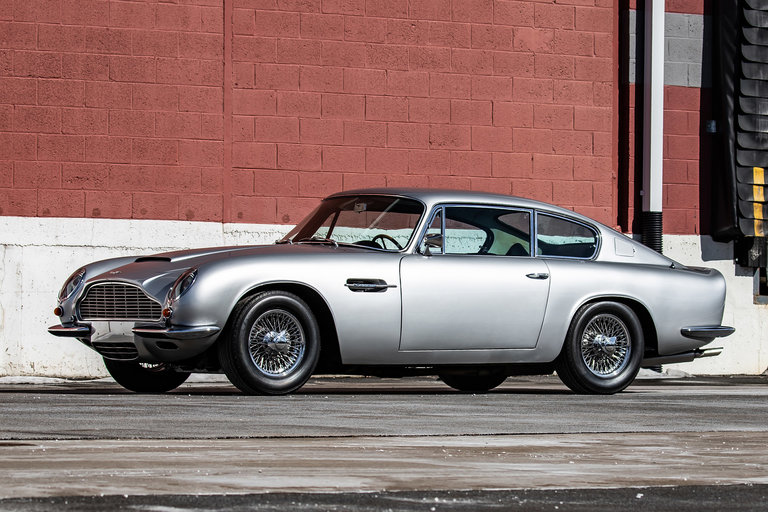
Visit Uncrate for the full post.
As of Monday, the CNN article was directly responsible for helping to sell more than 23,000 books in just a few days.
“Thanks, CNN!” says author Connor Boyack.
The Current Thing is always a crisis: a desperate time that calls for desperate measures, up to and including censorship.
Conformity with the Current Thing orthodoxy is mandatory, and heresy (“misinformation”) cannot be tolerated.

Jazz musician Robin Barnes has trademarked her nickname, “the Songbird of New Orleans.” Her soulful sound has landed her a residency at the legendary Polo Club Lounge at the Windsor Court Hotel, and she’s also founder of Move Ya Brass, a free fitness-class series with three Big Easy locations. Here, Barnes shares her perfect day in her hometown.
Sunrise Stretch
“Move Ya Brass has an early-morning yoga class at Crescent Park, an Instagrammable park on the Mississippi. I love waking up and doing beautiful yoga to soulful music. As you finish class, the sun rises on the river.”

Photo from Bigstock
Coffee and Contemplation
“My favorite spot in the whole city is City Park. It’s where I pick up a café au lait from Cafe du Monde. I love the area right by the bayou—you see these beautiful oak trees that are like 800 years old, curving their limbs into the ground. I can sit on a branch and disappear.”
Lunch Stop
“I recommend the shrimp po’ boys from Parkway Bakery in Mid-City. I actually like my po’ boys on a bun: You get the same amount of shrimp, less bread, less calories—maybe!”
A Little Shopping
“I like flashy, showy things, just being larger than life when I’m performing. There’s a company called Fringe+Co. on Magazine Street where you can find some amazing fringe jackets that make it look like you have wings.”
Afternoon Snack
“I love sno-balls, and you can’t go wrong with Pandora’s. My favorite thing to get is an ice cream–filled strawberry sno-ball with condensed milk on top. Watch out—it’s super-sugary!”

Photo by Andrew Simoneaux
Family Time
“My daughter, ‘Baby Bird’ Riley, is crazy about Storyland in City Park, and I can understand why. Just imagine seeing all your favorite stories come to life as figurines!”
Cocktail Hour
“An amazing place for a cocktail is Compère Lapin; chef Nina Compton is the truth. I have the honor of having a mocktail named after me there: the Songbird. It’s beautiful—it looks like it has feathers. And although it’s nonalcoholic, you can add liquor to it.”
Dinner Done Right
“If you want a traditional New Orleans meal that’s not in the French Quarter, go to Brigtsen’s. Chef Frank, oh my gosh, he is one of the most amazing people in New Orleans. If I could bathe in his food, I would.”
If It’s a Thursday . . .
“On Thursdays, my husband and I perform with our band, Da Lovebirds, at the Peacock Room at Hotel Fontenot. It’s intimate, lovemaking music, but it’s still a party.”

Photo courtesy of Windsor Court Hotel
If It’s the Weekend . . .
“The Polo Club at the Windsor Court Hotel, where I have my traditional jazz residency on Friday and Saturday nights, is very much old New Orleans elegance. Sit back, enjoy a cocktail, and forget what century you’re in!”
Night Off
“The best place for live music in New Orleans is definitely Frenchmen Street. That’s where you’re going to find me when I’m not performing. The Spotted Cat is my favorite venue—it’s artists doing everything from traditional New Orleans jazz to jazz-fusion to more original music.”
This article appears in the Spring & Summer 2022 issue of Southbound.
The post A perfect day in New Orleans appeared first on Atlanta Magazine.
Our beloved fire wrangler—you’ve likely seen Steve Nestor on Steven’s show, Project Fire—recently received an extraordinary piece of corned beef brisket from our friends at Holy Grail Steak in advance of St. Patrick’s Day. It began with a lean, perfectly “corned” brisket flat from highly-prized Tajima American Wagyu cattle. Oh, my. The best! Though he could’ve made corned beef and cabbage, Steve’s self-serving colleagues urged him to smoke this stupendous slab of meat, then make Reuben sandwiches, one of our favorite assemblages of food ever. In the 1950s, this unlikely combination of corned beef, sauerkraut, Thousand Island-style dressing, Swiss cheese, and dark rye crushed more than 600 entries in a sandwich contest. And no wonder. Read on, and make the best Reuben of your life!
The Reuben sandwich consists of corned beef, sauerkraut, Swiss cheese, and a Thousand Island-like dressing served on rye bread. The origins of the Reuben sandwich are in dispute. There are two individuals that are credited with inventing the Reuben sandwich. In New York City, Arnold Reuben, the proprietor of Reuben’s Restaurant and Deli on E. 58th Street, claimed to have created the first Reuben sandwich in 1914. The Reuben was made late at night for a local actress, Anna Selos, and it was called the Reuben Special. That sandwich consisted of turkey, ham, Swiss cheese, coleslaw, and a savory mayonnaise-based dressing, and was served on rye bread.
But…
In Omaha, Nebraska, a local grocer named Reuben Kulafosky requested a corned beef and sauerkraut sandwich while playing his weekly poker game at the Blackstone Hotel. Bernard Schimmel ran the kitchen and put his own twist on the sandwich: He drained the sauerkraut, topped it with corned beef and Swiss cheese, and served it on dark rye bread. To put it over the top, Schimmel grilled the sandwich. On March 14, Omaha celebrates Reuben Sandwich Day.
In 1956, the Reuben won the National Sandwich Idea Contest and is now a staple on menus across the country.
Corned beef is famous on St Patrick’s Day here in the United States, but did you know it is not popular in Ireland on St Paddy’s Day? In the 1600’s, most tables in Ireland on the patron saint’s holiday featured boiled bacon and cabbage. Cows were prized for their dairy products and their meat, and were primarily owned by royalty and the wealthy, and not available to the average person.
Irish immigrants to the United States were looking for a taste of home on St Paddy’s Day, but could not afford bacon and pork. They gravitated toward the cheapest cuts of meat, like brisket. The beef was paired with cabbage because cabbage, too, was cheap. Instead of boiling the brisket, the Irish adopted techniques from immigrants from eastern Europe, such as brining or salt-curing. The “corn” in corned beef refers to the corn kernel-sized salt crystals used in the brining process.
Here’s how I put my Reuben Sandwich together with the amazing help from the Holy Grail Steak company (HGS). (Be sure to use code: BARBECUEBIBLE for a 20% discount if you are interested in this.)
The corned beef I received from HGS was three pounds of pleasure and already brined. I wanted to elevate the Reuben sandwich to a new level, so I decided to smoke and then braise the corned beef. I also added my Irish influence on the Reuben.


I set-up my Big Green XL (BGE) for indirect grilling by inserting the diffuser plate and obtained a temperature of 250 degrees F. I used two cherry chunks to create wood smoke. I smoked the corned beef for four hours and until it reached an internal temperature of 165 degrees F. I then placed the corned beef in a foil pan with two cups of Guinness beer (what else?) and braised it for an additional three hours until the corned beef reached an internal temperature of 205 degrees F. I let the corned beef rest before slicing.

Next, I set-up my grill for direct grilling and heated it to medium-high heat. I brushed the grill grates clean and oiled them with a folded paper towel.
While the grilled heated up I prepared the sandwiches. I used Irish butter to butter the outside of the rye bread and started to build the sandwiches. I placed the corned beef on the bottom, topped it with an Irish cheddar cheese, sauerkraut, dill pickle chips, and home-made Reuben dressing. I used Steven’s Double-Down Rubin recipe from Man Made Meals as my guide to make the sandwiches.

Once the grill was hot, I placed the sandwiches on the grill. I cooked the sandwiches for ninety seconds and then gave each a quarter turn and grilled for another ninety seconds until the bread started to brown. The quarter turn of the sandwich creates those cool grill marks Steven prizes. I carefully flipped the sandwiches and repeated the process until the bread was golden-brown and the cheese was melted. I also used a grill press to help hold the sandwich together while grilling. Use a cast iron pan if you do not have a grill press.

I sliced the sandwiches, and it was time to dig in. The bread was crusty and contrasted with the tender and smoky corned beef and the creamy dressing. The sauerkraut was fresh and crunchy and added a balance of texture. The corned beef was tender, salty, and smoky. I liked the zing the pickles added to the sandwich. The Irish cheddar cheese holds it all together.

Holy Grail Steaks Offer!
Receive 20% off Coupon Code: BARBECUEBIBLE
Are you going to take the Reuben sandwich to the next level? Let us know on Facebook, Twitter, Reddit, or Instagram!
The post Make the Best Reuben Sandwich Ever! appeared first on Barbecuebible.com.
SR
The portable grills I have encountered over the years are either too heavy and difficult to transport, or they were poorly built and fell apart after a few cooks. As its name implies, the Nomad Grill and Smoker was designed for portability.
The well-packaged Nomad recently arrived on my front steps. It was accompanied by a smaller box with Nomad’s natural charcoal and tumbleweed fire starters. Once I had the grill out of the easy-to-open box, I noticed the cool sky blue trim on the grill. The grill is smart-looking and sleek, as if it’s right out of a James Bond or Mission Impossible movie. Definitely cool.

The grill, about the size of a carry-on suitcase, is lightweight, but is solidly constructed of anodized aluminum with an ergonomically-designed handle. As sold, the unit weighs 28 pounds and features 212 square inches of cooking space, enough to do one or two racks of baby back ribs or a dozen burgers. With an optional second grate (sold separately), the cooking space can be expanded to 425 square inches with an increase in weight of just three pounds. The two latches on the front keep the grill firmly closed for transport.

My goal was to evaluate the Nomad’s ability to smoke and direct grill, and see how quickly I could set it up and break it down. I opted to do reverse-sear double-thick pork chops.
I brined two double-thick pork chops overnight. I rinsed the pork chops and let them air dry in the refrigerator for a few hours. I then seasoned the chops with a spice rub. A big thank you to Holy Grail Provisions for providing a Mangalitsa Pork 8-Bone Rib Roast for this test. (If you are interested they have a 20% discount if you use the code BARBECUEBIBLE.)
To set up the grill for smoking, I lit six pieces of the Nomad charcoal in a chimney starter. The Nomad charcoal takes thirty minutes to heat up, longer than regular lump charcoal; but the Nomad charcoal has a longer burn time. Once I placed the lit coals in the grill, I added two cherry chunks to create wood smoke.

I used a remote thermometer to track the temperature of the grill while it heated up. There is a Tel-Tru T-State bimetal thermometer built into the lid of the Nomad, but I could not see its display from inside the house. (It was only 20 degrees outside when I started the cook!)
The chops smoked for about an hour, reaching an internal temperature of 145 degrees. I then rested the chops for about 10 minutes. Meanwhile, I added more lit charcoal to the grill and set-up a two-zone fire for direct grilling. Note: The charcoal should be placed perpendicular to the fins (ridges) in the grill for optimal convective-like airflow.

I grilled the pork chops for three minutes, then flipped the chops and repeated the process on the opposite side. Total cooking time was about seven minutes since I also seared the sides of the pork chops. I basted the pork chops at the end with Steven Raichlen’s Cherry Lambic Barbecue Sauce to keep with the cherry theme. I also grilled broccolini to go with the pork chops.

The Nomad grill grate magnetically attaches to the grill to keep it in place during transport or cooking. The grate can also be used as grill basket for veggies by flipping it over. The hexagon design of the cast stainless steel grate looks cool and adds to the grate’s strength.
When I finished cooking, I latched the grill closed and shut both vents to extinguish the fire. The grill was cool after twenty minutes. The next day I noticed most of the charcoal could be used a second time. The long burn time of the Nomad charcoal makes it ideal for low and slow cooking. To clean the grill, I removed the leftover charcoal to use with my next cook, scraped the grate on both sides, and then disposed of the spent ash. The Nomad cools off quickly and is easy to clean which makes it ideal for tailgating, camping, or anytime you need a grill on the go. The grill can be moved by one person. The set-up and break-down of the Nomad grill was quick and easy.

If necessary, the inside of the grill can be cleaned with warm water and mild soap. Nomad recommends that you avoid using harsh chemicals as they can damage the anodized finish. All components should be dry before storing to prevent oxidation.
Due to the construction of the outer shell, the Nomad can be placed on a variety of surfaces. I put mine on a metal and ceramic table on my deck and there were no burn marks or color changes on the table. I can picture the Nomad set-up on a picnic table.
I can imagine burgers, steaks, kebabs, veggies, chicken parts, or shrimp being grilled on the Nomad when set-up for direct grilling. I think the Nomad could also work for smoking fish, reverse-searing pork chops or steaks, or just to get wood smoke on something you were planning to direct grill. I am looking forward to experimenting with it.
It seems the Nomad is the perfect grill to take on outdoor excursions since it is easy to set-up and start cooking. The grill can be carried by one person. The ability to smoke and direct grill expands the cooking possibilities for a portable grill. Clean-up is effortless.
If I lived a nomadic life, the Nomad would join me on my adventures. The grill retails for $599; an additional grill grate, which more than doubles the cooking space, retails for $128.
Have you ever used a portable grill or smoker? Let us know on Facebook, Twitter, Reddit, or Instagram!
The post Outrageous Brined, Smoked Pork Chops on the Portable Grill and Smoker from Nomad appeared first on Barbecuebible.com.

 |
 |
 |
|---|
You should be especially aware at intersections, where other vehicles can cross your path of travel.
There are many things to scan for, including traffic devices, road surfaces, and the traffic and pedestrians around you.
In a slow, tight turn, such as turning around in a parking lot, it helps to counterweight by leaning in the opposite direction of the motorcycle and direction of the turn.
Put pressure on the outside footrest.
Info: www.msf-usa.org


Life on Antarctica’s Cuverville Island can be harsh. Colonies of orange-billed gentoo penguins scale its often windy, snow-covered slopes, building nests for their young with small stones and pebbles they gather from the island’s rocky outcrops. Patches of moss and lichen grow sparingly, some of the few signs of flora on an otherwise barren land. But on one day in February, an unusually out-of-place sight appeared: a man sitting in a chair.
“I’d never come across someone wanting to bring a camping chair ashore in Antarctica before,” says Jonathan Fuhrmann, a Scenic Eclipse cruise ship glaciologist whose role that day was to help passengers get to and from the island’s viewpoint. “At first it seemed so bizarre, but he’d brought it with him for the biosecurity check”—a process that assures whatever you’re bringing ashore won’t introduce foreign organisms or diseases—"so I thought, ‘why not?’” Perched in a lightweight and foldable Helinox chair on a spot that Fuhrmann had assured him wasn’t interfering with the views of other guests, the man stared out over Antarctic waters. “He even proceeded to read a book for a while,” says Fuhrmann, “which looked thoroughly enjoyable.”

Robert “Robby” Silk, 49, was participating in the sport of competitive chair-sitting, a still-evolving endurance activity Silk has pioneered that involves sitting in extreme environments, from sun-up to sundown without any sort of time pieces or electronic devices. “The idea,” says Silk, “is to really just be, and not do much of anything.” On June 21, 2020, Silk completed his longest sit to date: a 14-hour, 27-minute stretch in California’s Joshua Tree National Park. Before Antarctica, this budding trend-setter had only sat himself in desert settings, including Sedona, Arizona, and the state’s McDowell Mountain Regional Park in North Scottsdale. (The Antarctic continent is the largest desert on earth, but many of its surrounding islands are considered tundra.)
While Silk’s endeavor is unusual, unexpected endurance sports have been around for decades. Take the Dutch sport of paalzitten, or pole sitting, in which participants sit atop wooden poles for hours, each one attempting to outlast the other. It was supposedly invented to help stave off boredom during long winter months. Or danceathons, prolonged dance sessions that can last from hours to weeks, with cash prizes awarded to the last team standing.

But despite the obvious notoriety that competitive chair-sitting brings (“It would be amusing to be in the Guinness Book,” says Silk, “but I hadn't really thought about it.”), Silk says he does it for many of the same reasons that people run marathons: to take a break from daily trivialities and routines and simply test himself. There’s even training involved, since anyone who’s ever flown thousands of miles in an airplane knows that sitting for long periods can wreak havoc on everything from mental stability to physical dexterity. “I don’t do calisthenics beforehand for nothing,” he says.
Although the “competition” part is a bit tongue-in-cheek—Silk is, to date, the only competitor—the sport’s overall objective is to complete the most difficult sit possible. For deserts, this generally means a factor of high temperature, total degrees of heat (meaning the day’s average temperature), and length of day. A tricky equation, since the further north you go during the summer solstice the more daylight you’ll get, but overall temperatures tend to decrease. In a place like Antarctica, where the focus is more on “extreme” sitting, Silk jokingly says that icicles forming on the tips of your chair can be good. But frostbite? Not so much. “It’s meant to be uncomfortable,” he says, “but not deadly."
“I think extreme sitting has the ability to rival other outdoor endurance sports, including climbing and even pole sitting.”
Silk first came up with the idea of extreme chair sitting back in 1995, during a six-month sojourn in Israel. Silk was reading The Haj, a novel by American author Leon Uris. In it, he came across a scene that depicted a man somewhere in the desert, awaiting a delivery. A traveler who happens upon the man and asks, “What will you do if it takes a week?”
“Wait,” says the man.
Silk found a world in which “time is of no consequence” appealing. Five years later, he decided to give his own waiting-in-the-desert a go. His goal was to sit in one place and spend the entire day watching the arch of the sun.
Unfortunately, his first foray into chair-sitting was short-lived. Just three-and-a-half hours after planting himself down in Arizona’s Sedona desert, Silk had already endured a bee sting and was experiencing severe bloating from copious amounts of cheese he’d eaten the night before. By 9 a.m., he was through.

Still, over the next two decades, the idea of desert chair sitting stuck with him, until in 2019, he decided to try again, this time in Joshua Tree National Park a year later. Little did Silk know that it would be the absolute perfect sport for the era of social distancing.
Silk scouted a spot in Joshua Tree that was fairly accessible, though away from any parking lots or hiking trails, with plenty of direct sunlight and a 360-degree view. Then, dressed in a long-sleeved shirt with light SPF protection, long pants, hiking boots, and a wide-brimmed hat and shawl for his neck, he sat. In addition to his chair, his provisions included beef jerky, chunks of fresh watermelon, and energy bars, and two gallons of water. He’d also packed a couple of books, a journal, and a tube of SPF 50 sunscreen.
Over the next fourteen-plus-hours, Silk did a lot of nothing. He watched several large beetles and a couple of lizards wander past. He dozed off a time or two and stood occasionally to stretch and relieve himself. He also thought about random things, like whether a thoroughbred truly is a better athlete than a greyhound. But more than anything, he just sat. “Your surroundings matter,” says Silk. “Because that's all that there really is.”

Silk and his friend, Peter Wick (who filmed Silk’s Joshua Tree stint), are currently in the process of securing grants for a chair-sit in Chile’s Atacama Desert—one of the driest places on earth—where they’re hoping to bring along a competitor. “With the rigors of any physical endurance challenge,” says Silk, “I think extreme sitting has the ability to rival other outdoor endurance sports, including climbing and even pole sitting.”
For anyone who’s thinking of engaging in this competitive pastime, Silk’s advice is to start slowly: maybe sitting for a few hours or in weather that’s not too hot or cold, before working toward longer, tougher sits. But his biggest tip is to stay mindful. “When you’re doing full-day sits,” says Silk, “the sun, cold, or wind might start getting to you. Just remember that this is an extreme outdoor sport and dealing with physical discomfort is part of being an endurance athlete.”
Guy Martin on German Texans, racing prep, and dirty politicians
The post Ask G&G: Derby Luck and Texas’s German Accent appeared first on Garden & Gun.
The annual hummingbird migration returns to the South, and one little Texas house puts out a big, sweet welcome
The post The Birds Are Back in Town appeared first on Garden & Gun.

Call it a satellite communicator or satellite messenger — either way, it pays to have one with you in case of emergency.
Spring is here, and prime camp season is upon us. Here are a few smart campsite booking alternatives to make your camping trip the best one yet.
The post Get your camping trip organized this summer with these campground booking sites appeared first on The Manual.
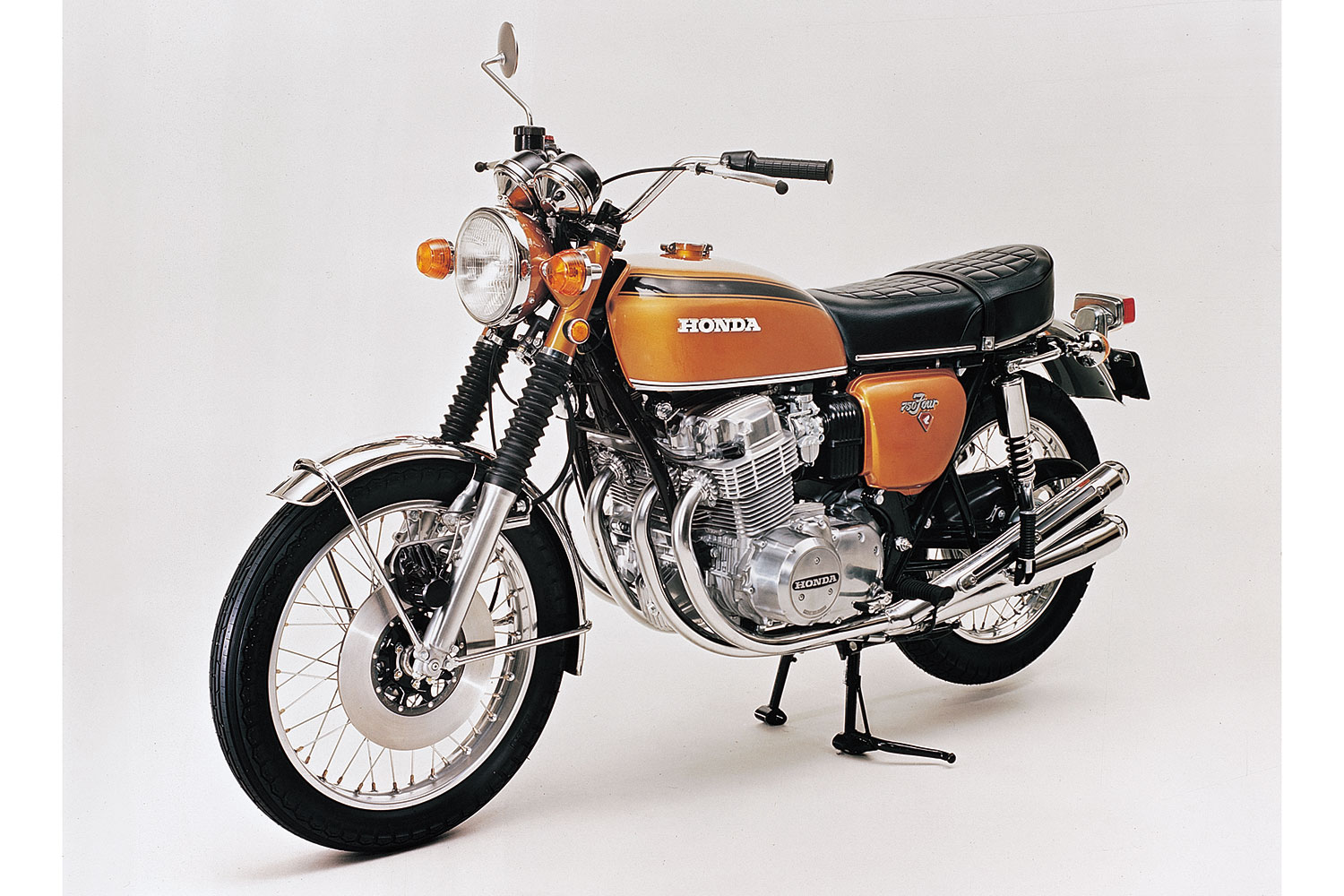
The Vintage Japanese Motorcycle Club is celebrating its 45th Anniversary this year. Founded in 1977, VJMC is the premier North American Club dedicated to the preservation, restoration, and enjoyment of vintage Japanese motorcycles (20 years old or older) and the promotion of the sport of motorcycling. The VJMC hallmark is “participation at all levels and to have fun” – for all motorcycle enthusiasts young and old.
This year’s National Rally will take place in Eureka Springs, Arkansas, June 23-26. Pre-registration is required for all attendees.

Membership is $35 per year and includes a full-color 64+ page magazine printed six times per year, rides, rallies and shows at local, regional, and national events. The VJMC has over 3,300 members and is a totally volunteer-based, nonprofit club.
Tom Kolenko, President of VJMC: “This club has been successful for 45 years because it brings people and vintage Japanese bikes together for fun, friendship, and new riding experiences. We have a great vintage community that celebrates the past while riding into the future.”
For more information, visit vjmc.org or call (763) 420-7829.

Sunshine, wine, good food, and savoir vivre (knowing how to live) – these are just a few reasons why the Côte d’Azur and the Provence region of southern France are so captivating. But for motorcyclists, the real draw of this region near the western border of northern Italy are the roads threaded throughout the Maritime Alps. The Edelweiss Bike Travel Best of Southern France Tour gives motorcyclists a taste of the good life in this enchanting part of Europe.
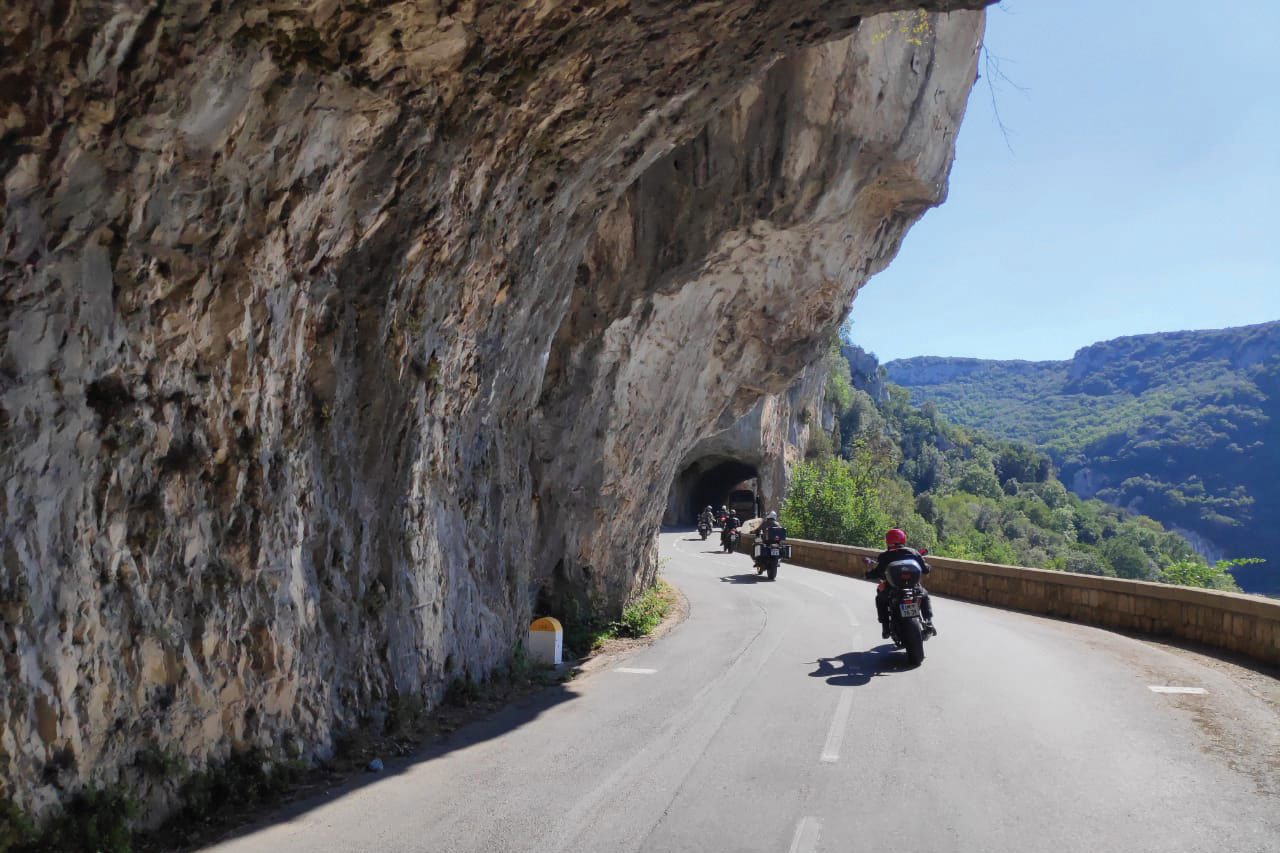
RELATED: Edelweiss Bike Travel Morocco Tour
Day 1: Arrival
The tour begins and ends in Saint-Paul-de-Vence, a medieval village tucked into the mountains with views of the picturesque Mediterranean coast. The town is not far from iconic French Riviera cities like Cannes and Nice (which has the closest major airport), as well as the casinos and Formula 1 course in Monte Carlo, Monaco.
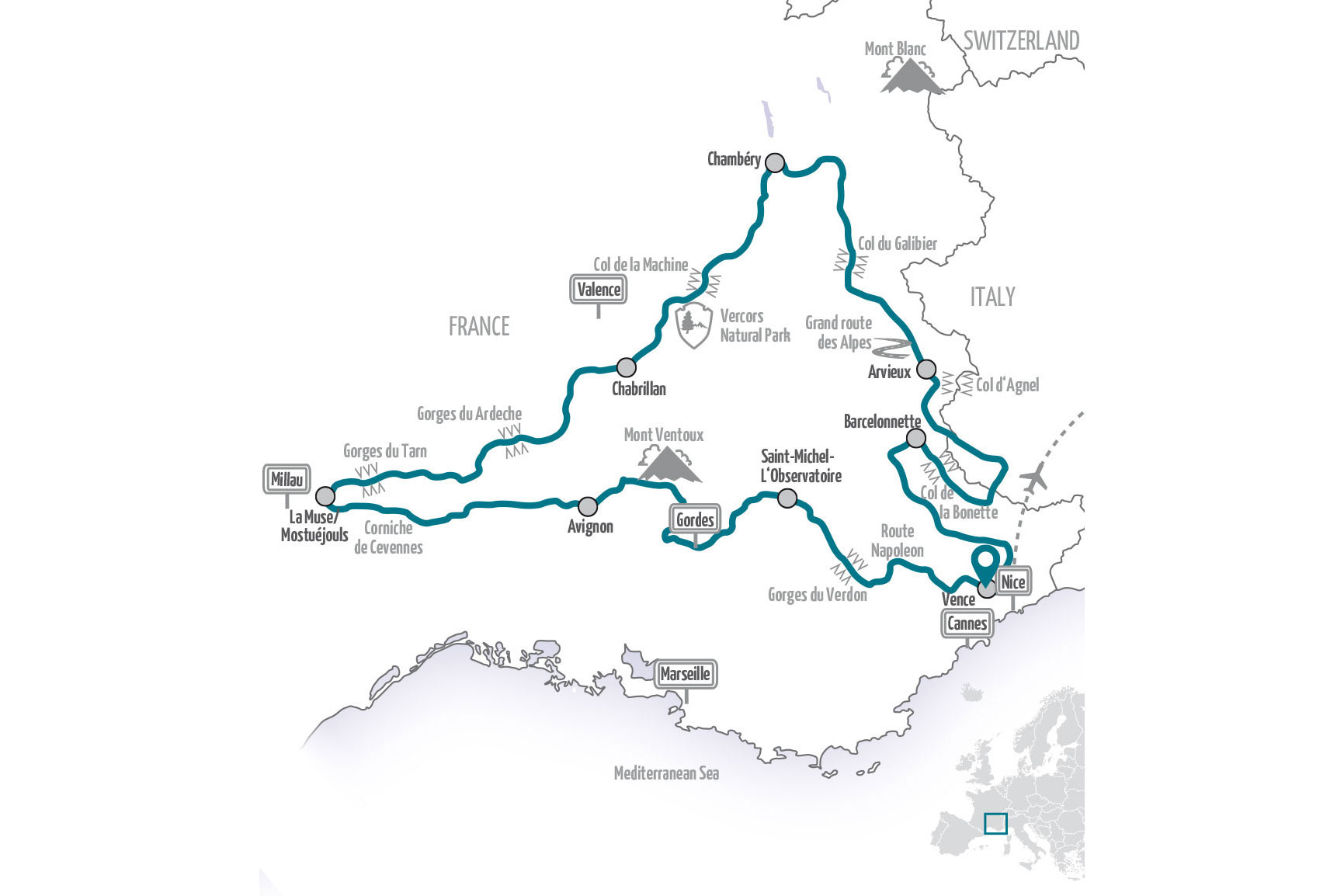
The tour covers approximately 1,300 miles over nine days, with a rest day in Mostuéjouls. A wide range of motorcycles are available for this tour, from small bikes like the BMW G 310 R to mid-sized bikes like the Honda NC750X and Ducati Monster 821 to liter-class bikes like the Suzuki V-Strom 1050XT, BMW R 1250 GS/RT, and Harley-Davidson Pan America. Prices start at $6,550 and vary based on choice of motorcycle and single vs. double room. Lodging and most meals are included as part of the tour price.

Like so many cities, towns, and villages in southern France, Saint-Paul-de-Vence is full of history and character. The picturesque walled city was initially a fortified medieval defense post and played a significant role in the French Revolution. For centuries it has been a lodestone for tourists, travelers, and artisans, as well as a significant center for the Impressionist and Expressionist art movements of the 20th century. Recently it was home to, and is the final resting place of, modern artist Marc Chagall, who bequeathed to the city some of his most significant works.
Part of what draws one here is the magical blend of tranquility and brilliance. For artists it’s the light, for others it’s the mild climate and rustic setting. For many it is simply the nearness and yet quiet respite from the hustle and bustle of France’s more famous Mediterranean cities.
Seven guests have arrived, coming from the United States, Brazil, and Germany, and all have chosen to ride adventure bikes: BMW R 1250 GSs and S 1000 XRs and a KTM 1290 Super Adventure. The bikes are parked next to the pool, ready to ride. For all but two of the tour participants, this is their first time in this region. For some, this is their first time in France. The evening before the tour we met for a briefing, followed by camaraderie over a delicious meal of good wine and poisson à la provençale. Marlene and Klaus, a couple from Germany, received a special recognition for having completed many Edelweiss tours already.
Day 2: Saint-Paul-de-Vence to Saint-Michel-l’Observatoire
Our day begins with a nip in the air and long shadows stretching across the lawn. There’s not a cloud in the sky, yet the sweltering heat of summer is behind us and it’s a pleasure to don some warmer riding gear for a picture-perfect autumn day. It’s in the mid-40s now, but by the afternoon it will be in the mid-60s. Our route takes us along the Gorges du Loup, to the medieval walled city of Gourdon, and ultimately the spectacular Gorges du Verdon – one of the most iconic canyon landscapes in Europe. Moustiers-Sainte-Marie is our last stop of the day, right at the foot of an ancient monastery, for a coffee before reaching our lodging for the night. This ancient town was first settled in the 5th century, and with its 12th-century Romanesque church, it is considered one of France’s plus belle ville de pays (most beautiful country towns).
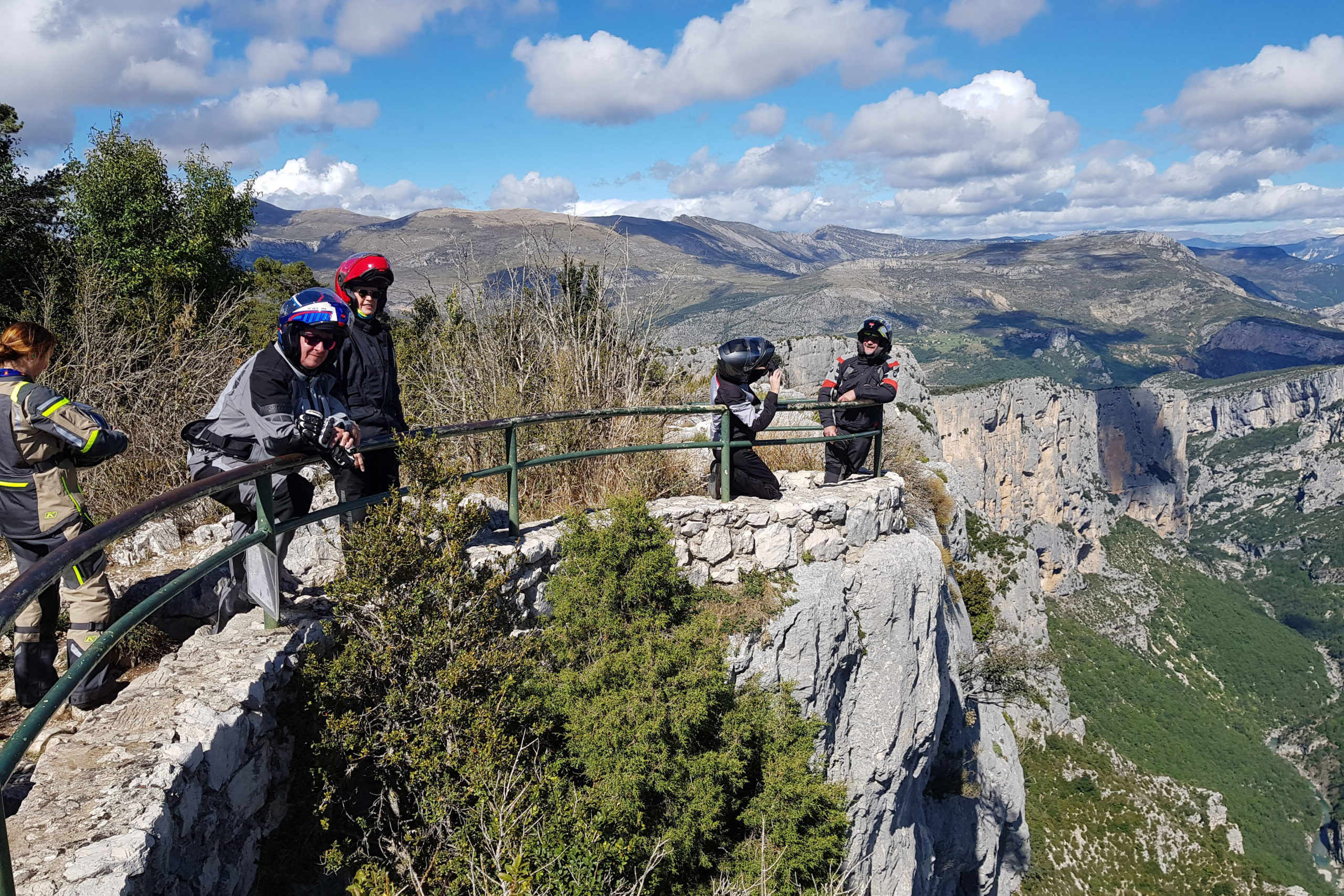
After a full day of riding, the day ends with a respectful appreciation of the amazing scenery, stunning vistas, extensive history, and relaxed simplicity that is typical of Provence. Our group is getting into the swing of things as the cares of their lives back home begin melting away. Can it get any better?
Day 3: Saint-Michel-l’Observatoire to Avignon
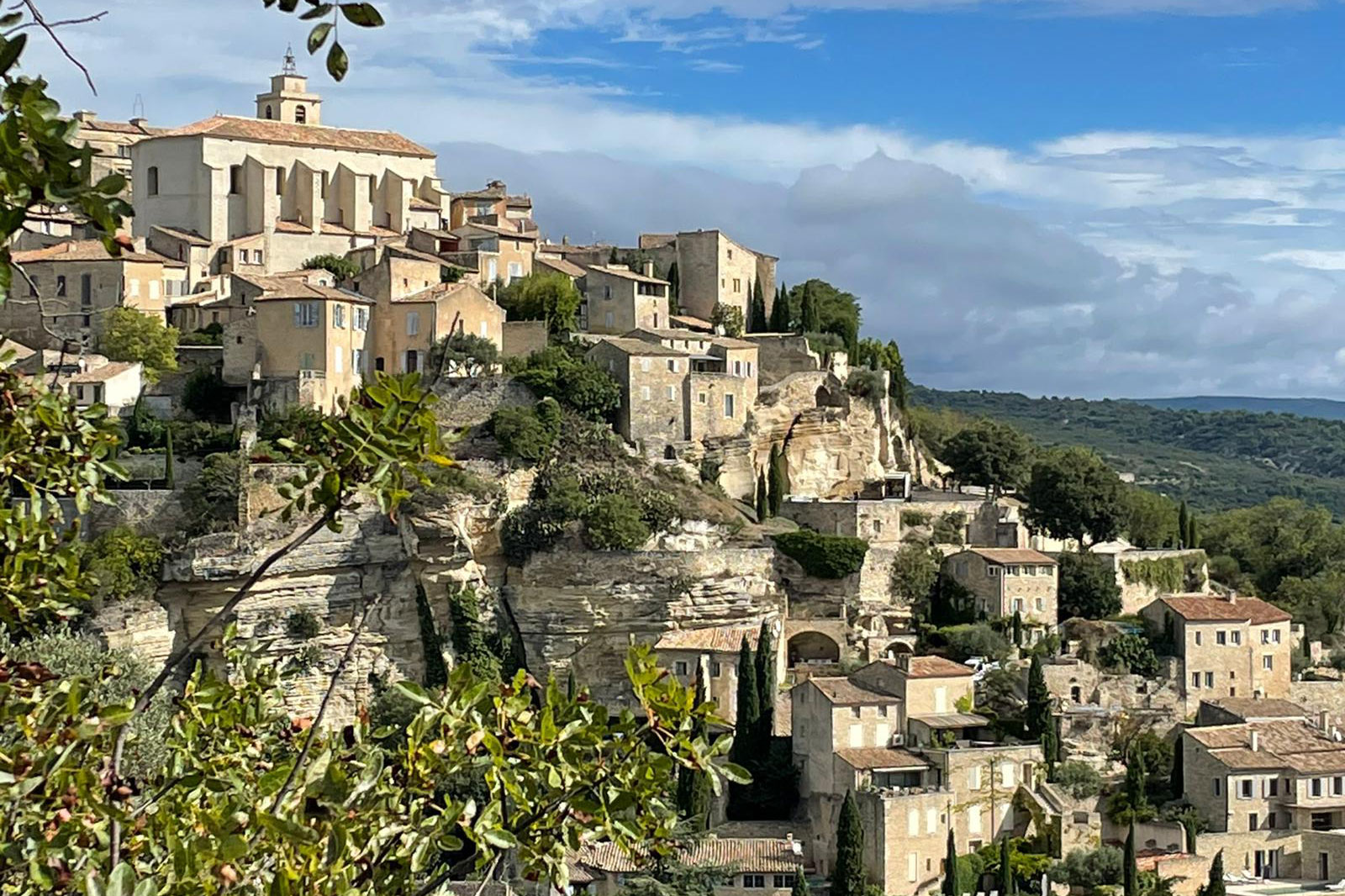
We’re on our way to Avignon, and it’s a gorgeous day, with blue skies dotted with fluffy white clouds, creating the perfect backdrop for the charming villages we visit. After a short warm-up ride, we stop in the beautiful village of Roussillon for coffee. With its ancient buildings seeming to tumble down the mountainside, we find our lunch stop in Sault even more enchanting.
After lunch, we follow part of the famous Tour de France route over 6,263-foot Mont Ventoux, where the blue skies give way to thick, gray fog. We pause to allow a herd of sheep to pass and keep a keen eye out for bicyclists. They’re everywhere! We must be cautious, as some of the bicyclists descend the mountain faster than our motorcycles. We’re amazed, and the fearless cyclists command our respect.
Upon arriving in Avignon, we enjoy a little tailgate party with snacks and post-ride “boot” beers served from the back of the chase van. The night’s accommodations are in an old palace in the center of the city, and we’ve arrived early enough for a visit to the spa or to explore the beautiful city perched on the bank of the Rhône River, which is a veritable jewel of provincial culture and heritage. We’re rewarded with another delicious dinner, and afterward we all linger to chat about what we’ve seen and experienced so far. The anticipation of the next day’s ride is palpable.
Day 4: Avignon to Mostuéjouls
The Côtes du Rhône region is renowned for its red cuvée wines made from a blend of Grenache, Syrah, and Mourvèdre grapes. We visit La Chartreuse-de-Valbonne, a monastery founded in 1203, where Carthusian monks first cultivated the grapes and fermented the juices to produce the wine that made this region world famous.
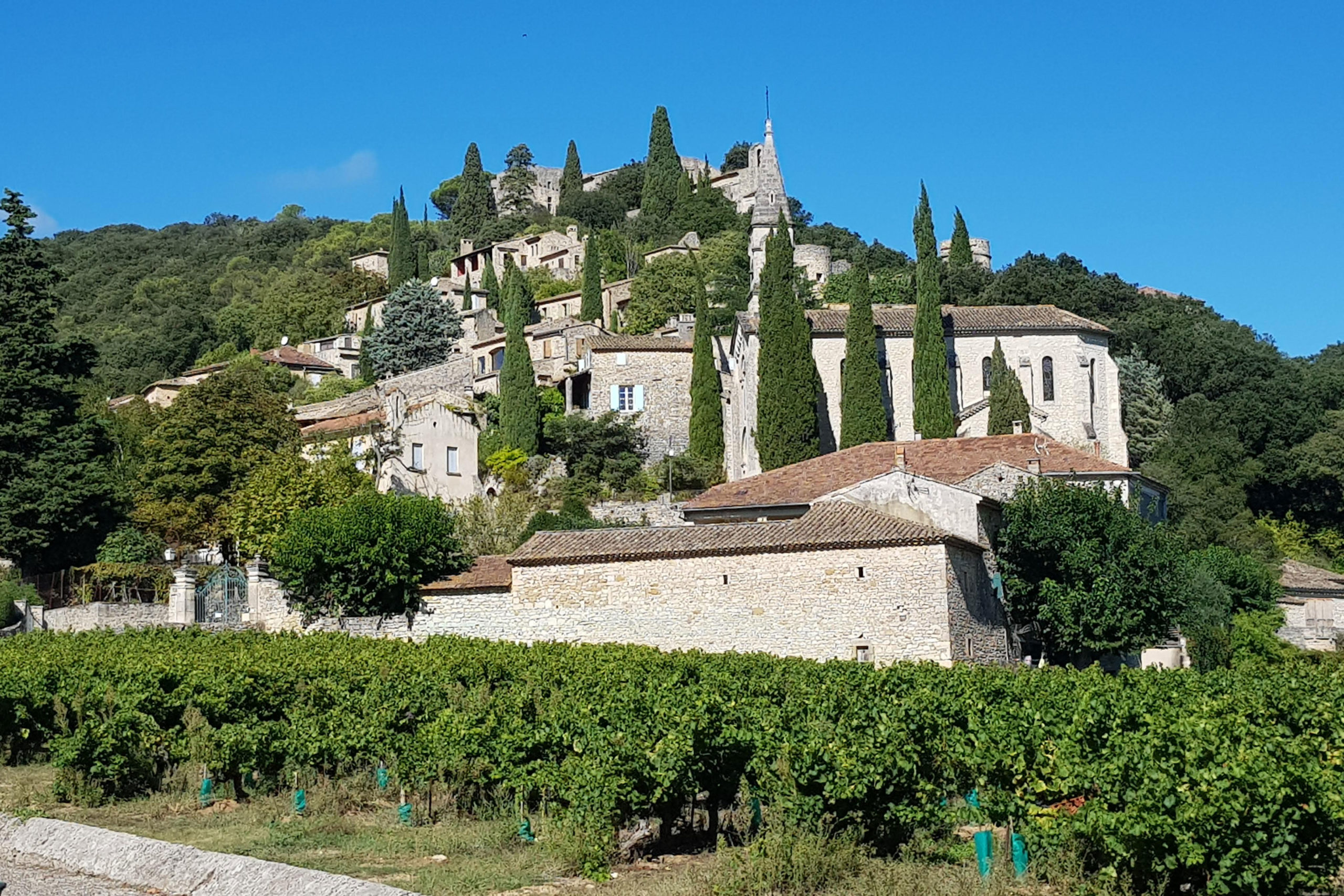
The day continues with a major highlight: a thrilling roller-coaster ride on narrow, heavily shaded forest roads, over a 3,000-foot pass, and into Grands Causses Regional Natural Park. Within the park is Gorges de la Jonte, a jagged, plunging canyon up to 1,500 feet deep where vultures can be seen circling in the thermic winds high above the rugged terrain. After another thrilling day of riding, we arrive in Mostuéjouls, where we spend the next two nights and a rest day at a first-class hotel with a pool.
Day 5: Rest Day in Mostuéjouls
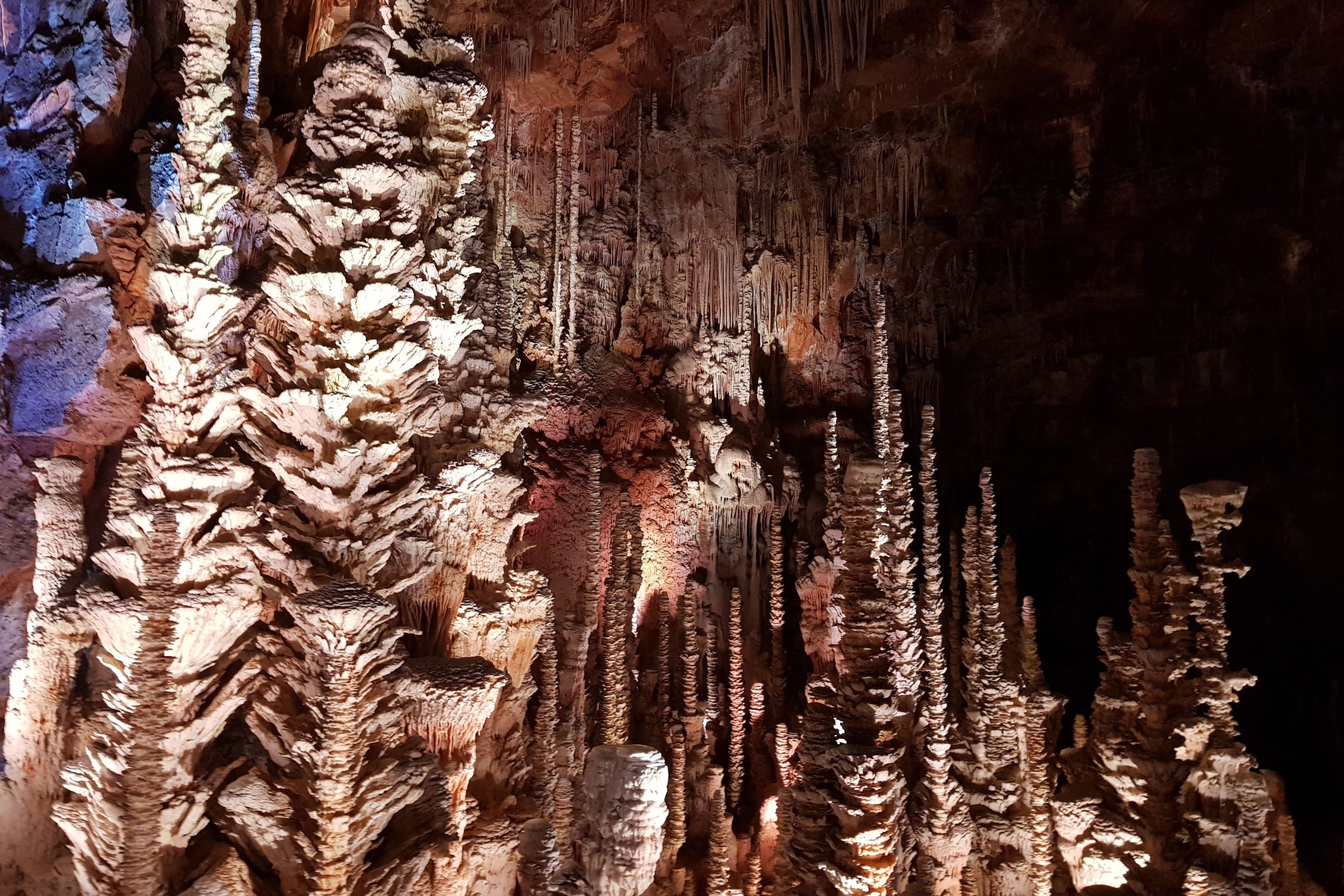
This picturesque alpine village on the Tarn River is popular with climbers, kayakers, bicyclists, and motorcyclists. Some took the opportunity to squeeze in another day of riding on the fantastic local roads, while others explored or relaxed. One of the area’s highlights is located nearby in Cévennes National Park – an enormous limestone cave called Aven Armand that’s filled with intricate stalagmites and stalactites. Another is Viaduc de Millau, an 8,000-foot-long multi-span cable-stayed bridge that’s the tallest in the world, with a structural height of just over 1,100 feet.
Day 6: Mostuéjouls to Chabrillan
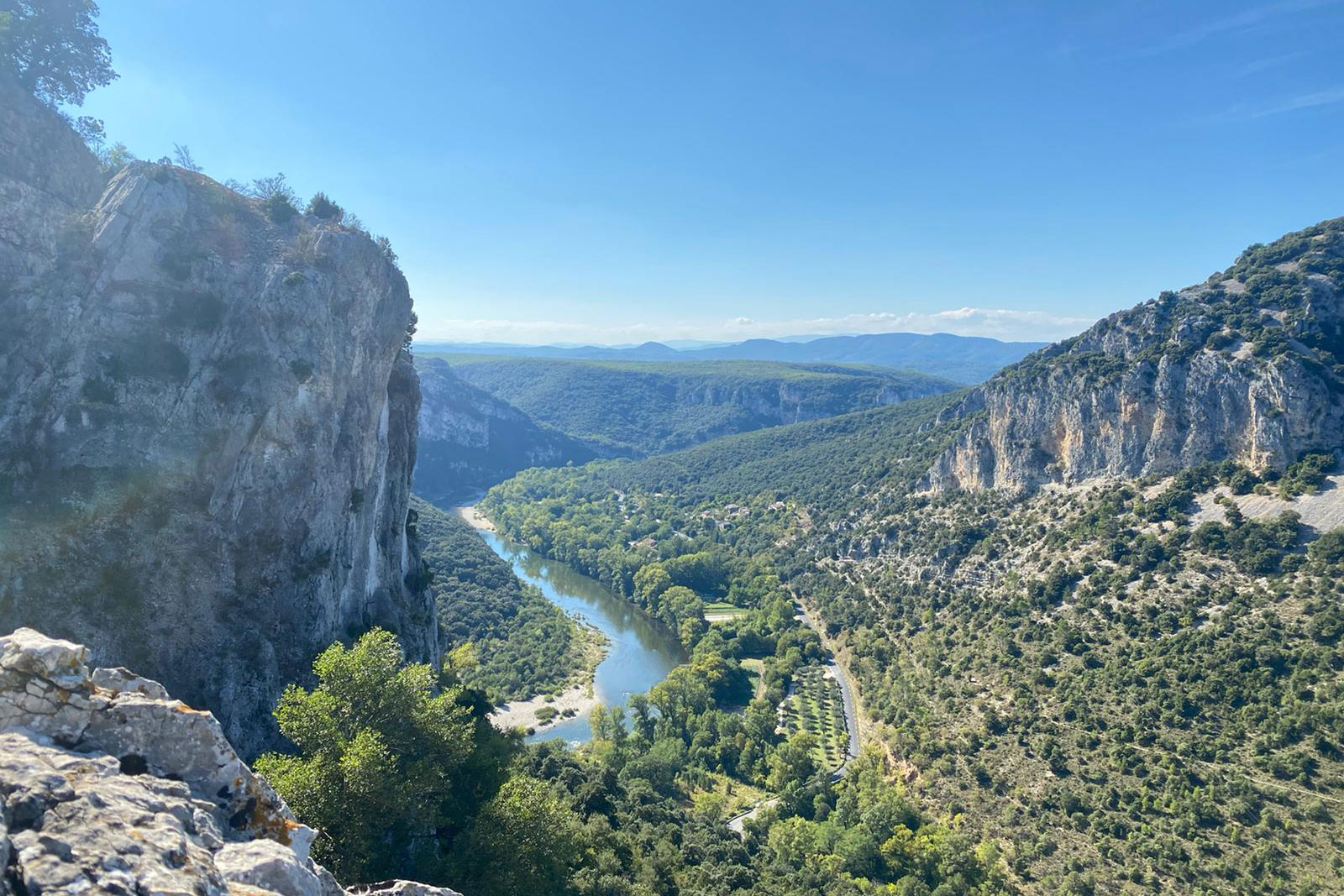
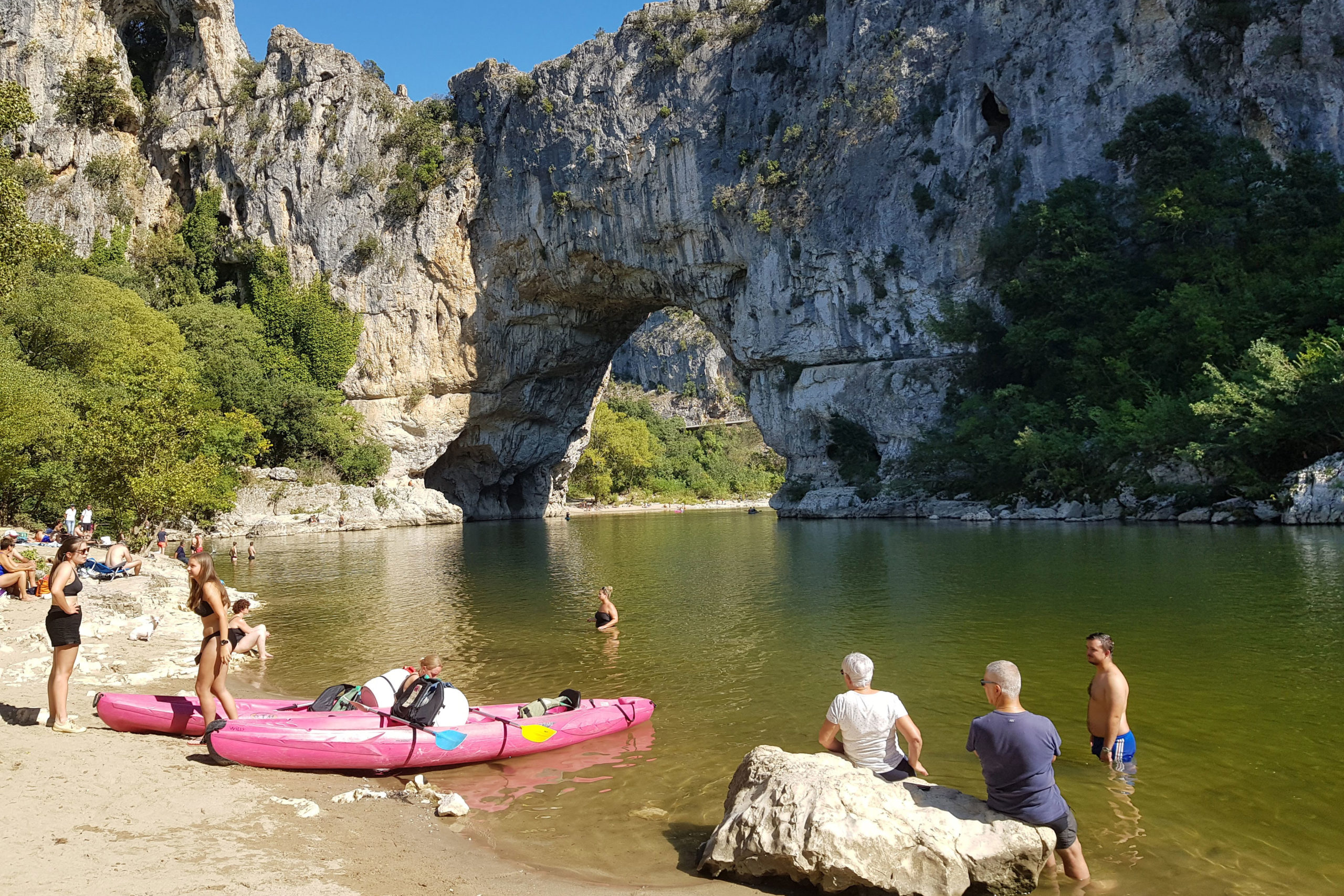
We continue our triangular, clockwise loop route, riding through the Gorges du Tarn and Gorges de l’Ardèche, where we stop at Pont d’Arc, an enormous natural stone bridge that was formed when the Ardèche River broke through a narrow escarpment of soft limestone. The arch is nearly 200 feet wide and more than 100 feet tall, and a nearby beach makes it popular with swimmers and sunbathers. It’s another beautiful day, and we take the opportunity to stop and enjoy the view down into canyons and across to distant mountains carpeted in rich green vegetation.
Day 7: Chabrillan to Chambéry
As we travel northeast, we’re making our way into the foothills of the French Alps. The scenery gets more rugged and the mountains soar higher. We summit Col de la Machine, a breathtaking 3,316-foot pass, followed by another gorge. We’ll spend the next two riding days at higher elevations, mostly above 6,000 feet. Days like this are why we go on alpine motorcycle tours. The vistas, the undulating pavement, and the surprises around every unfamiliar corner. This is riding heaven – we all know it and enjoy sharing it with each other.
Day 8: Chambéry to Arvieux
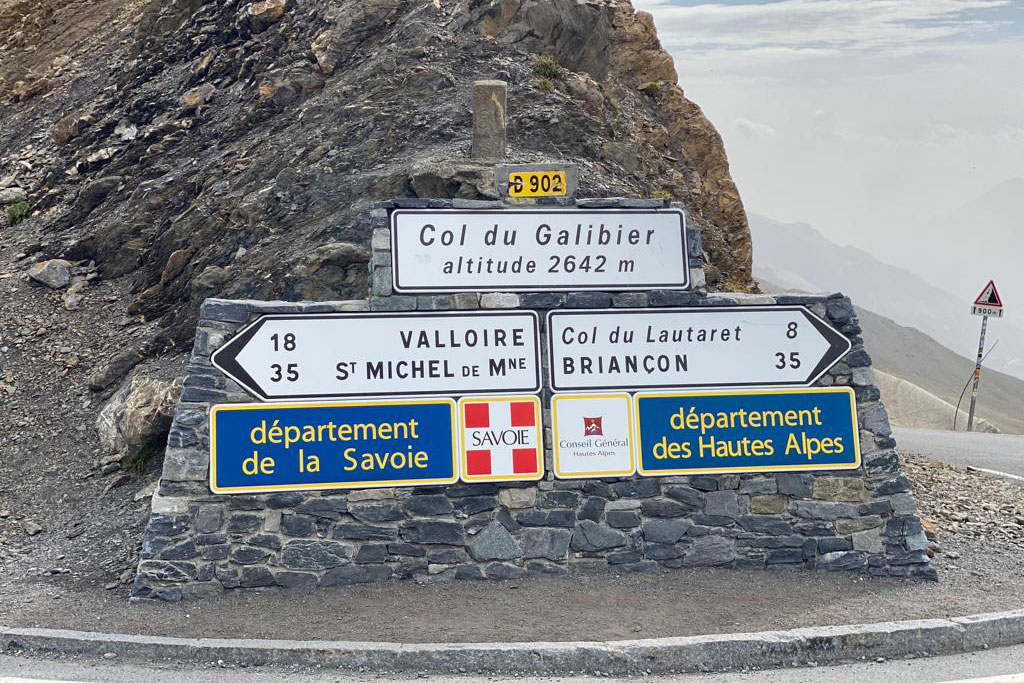
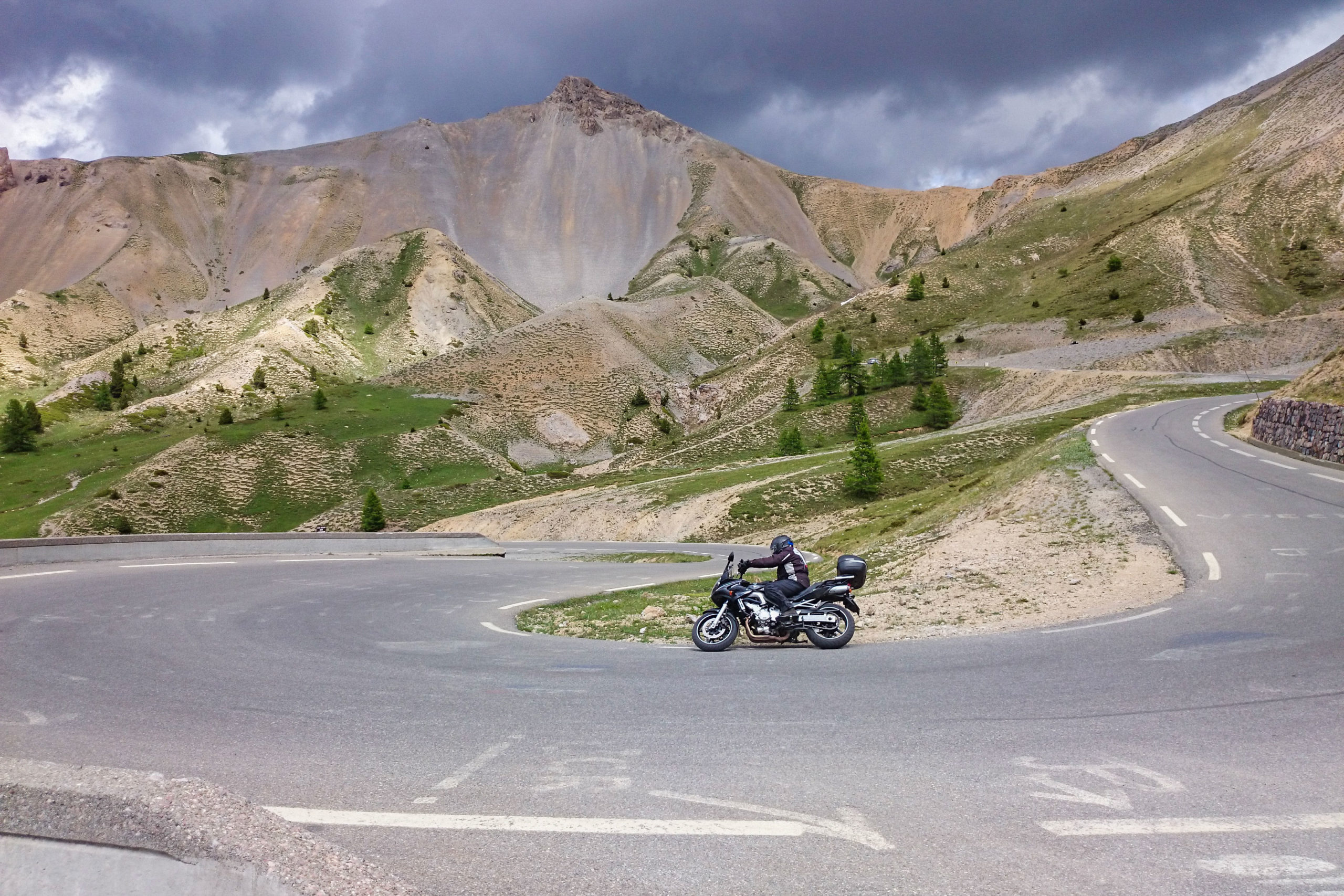
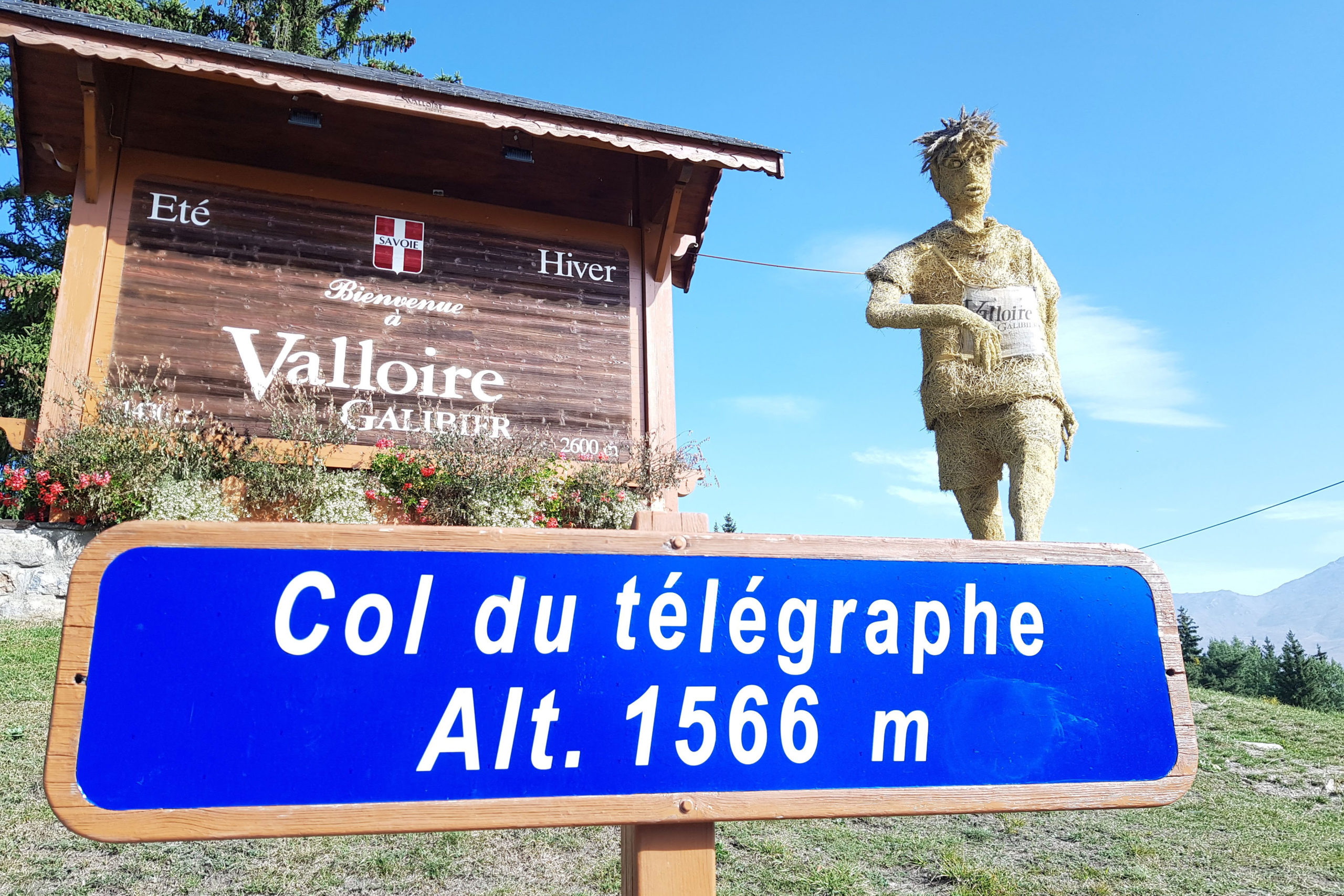
More alpine passes today. Col du Télégraphe (5,138 feet). Col du Galibier (8,668 feet). Col du Lautaret (6,752 feet). Col d’Izoard (7,743 feet). Each is legendary in its own right. They are rites of passage for bicyclists – challenges on the grueling Tour de France race. We are grateful for throttles!
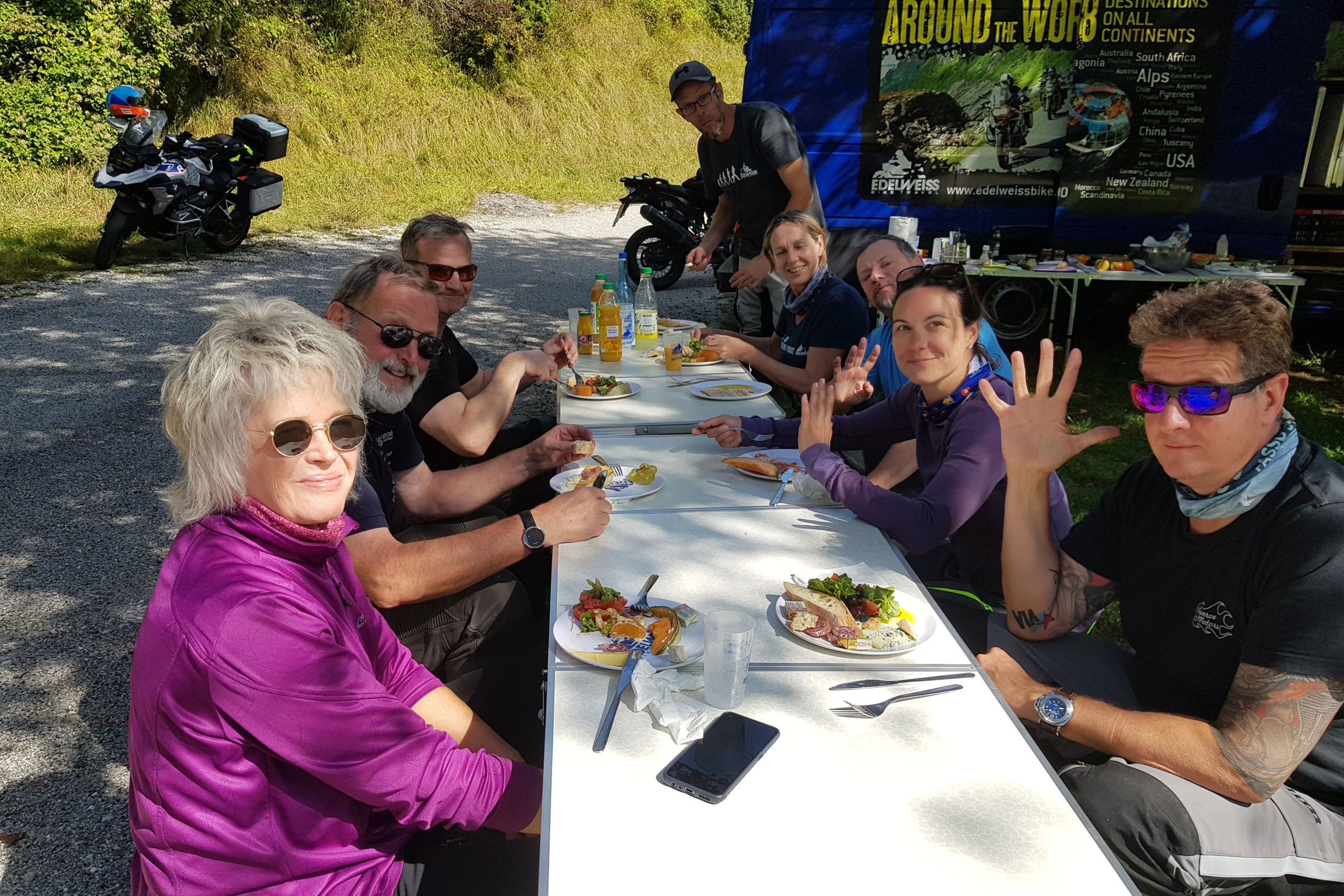
Being high in the Alps made for an ideal location to enjoy one of Edelweiss’ famous picnic lunches. One of the tour guides bought a variety of local delicacies, and the chase van was stocked with tables, chairs, and everything needed for a nicely catered buffet. With the sun shining and beautiful mountain views, we relaxed and enjoyed having this little part of paradise all to ourselves.
Day 8: Arvieux to Jausiers
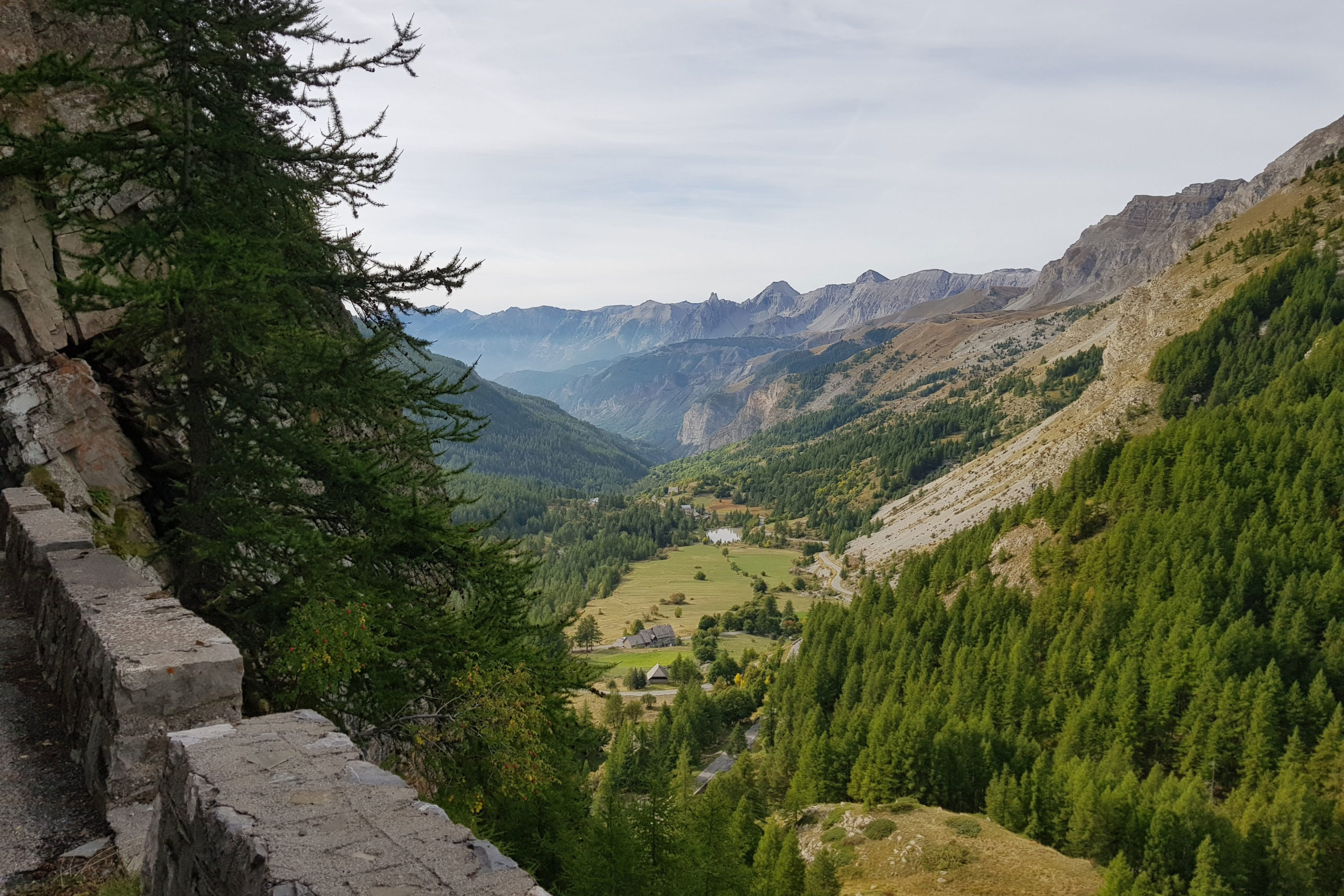
We wake up in Arvieux to cold rain and fog, our only inclement weather of the trip. After riding briefly into and out of Italy (ciao!), we ride back into France and find that a landslide on the route to Col de la Bonette has blocked our passage. With torrential rain and temperatures just above freezing, our hands are soaked and our spirits are numbed. We detour back to Vinadio, Italy, and assuage our disappointment with hot beverages and perhaps the best pizza we’ve ever eaten. We backtrack and follow a clear route to Jausiers, where we all welcome a hot shower, a warm dinner, and a soft, dry bed.
Day 9: Jausiers to Saint-Paul-de-Vence
Since we missed Col de la Bonette (8,907 feet) yesterday, on our last riding day we do an early-morning up-and-back ride to the monumental pass. We squeeze in more mountain riding on our way back to Saint-Paul-de-Vence, where we put down our kickstands for the last time.
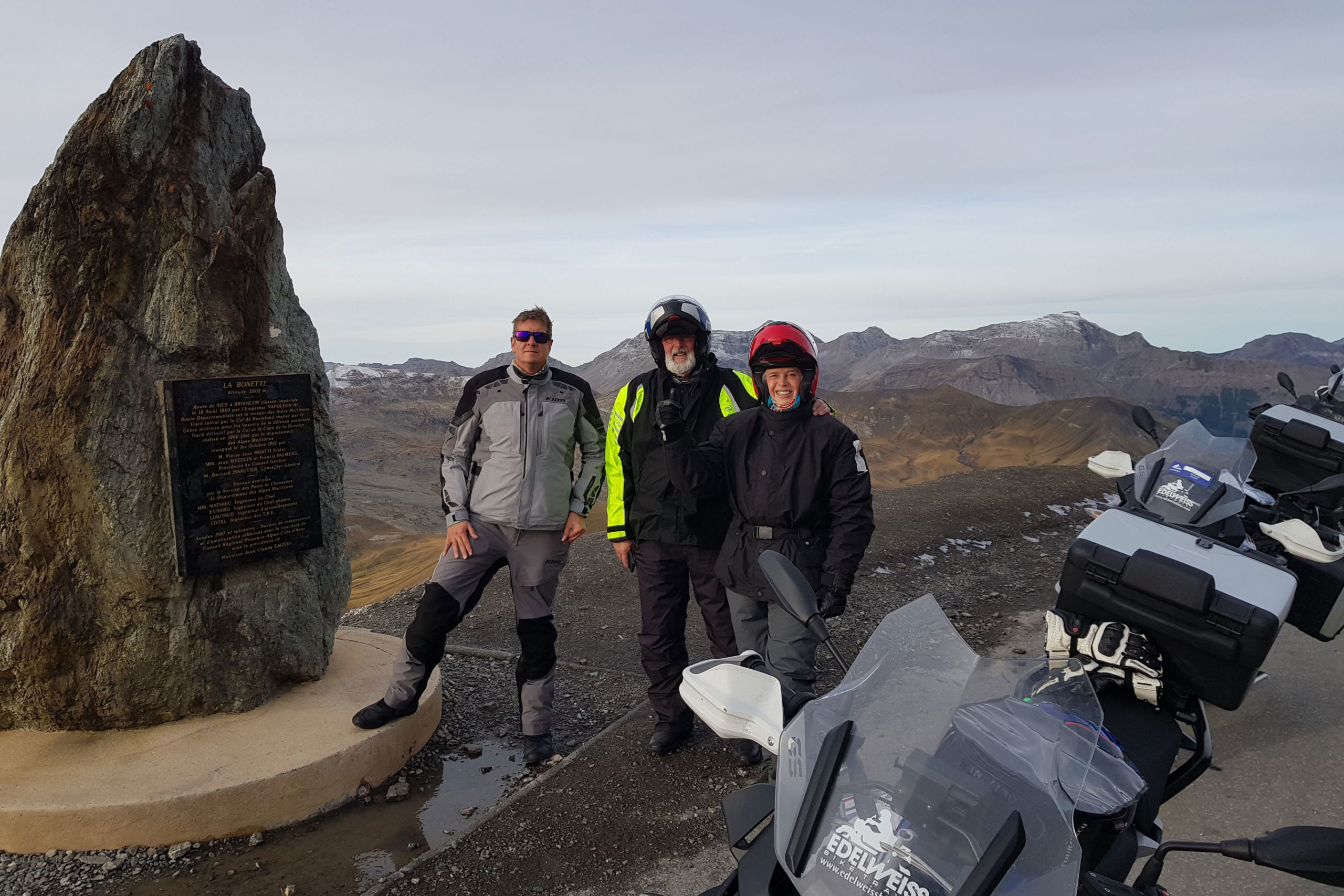
Our international group shares a mix of elation and disappointment. We’ve had a wonderful tour and even faced a few challenges, and we don’t want it to end. Over our final dinner together, Edemar from Brazil says, “The end of a dream is the birth of new plans!”
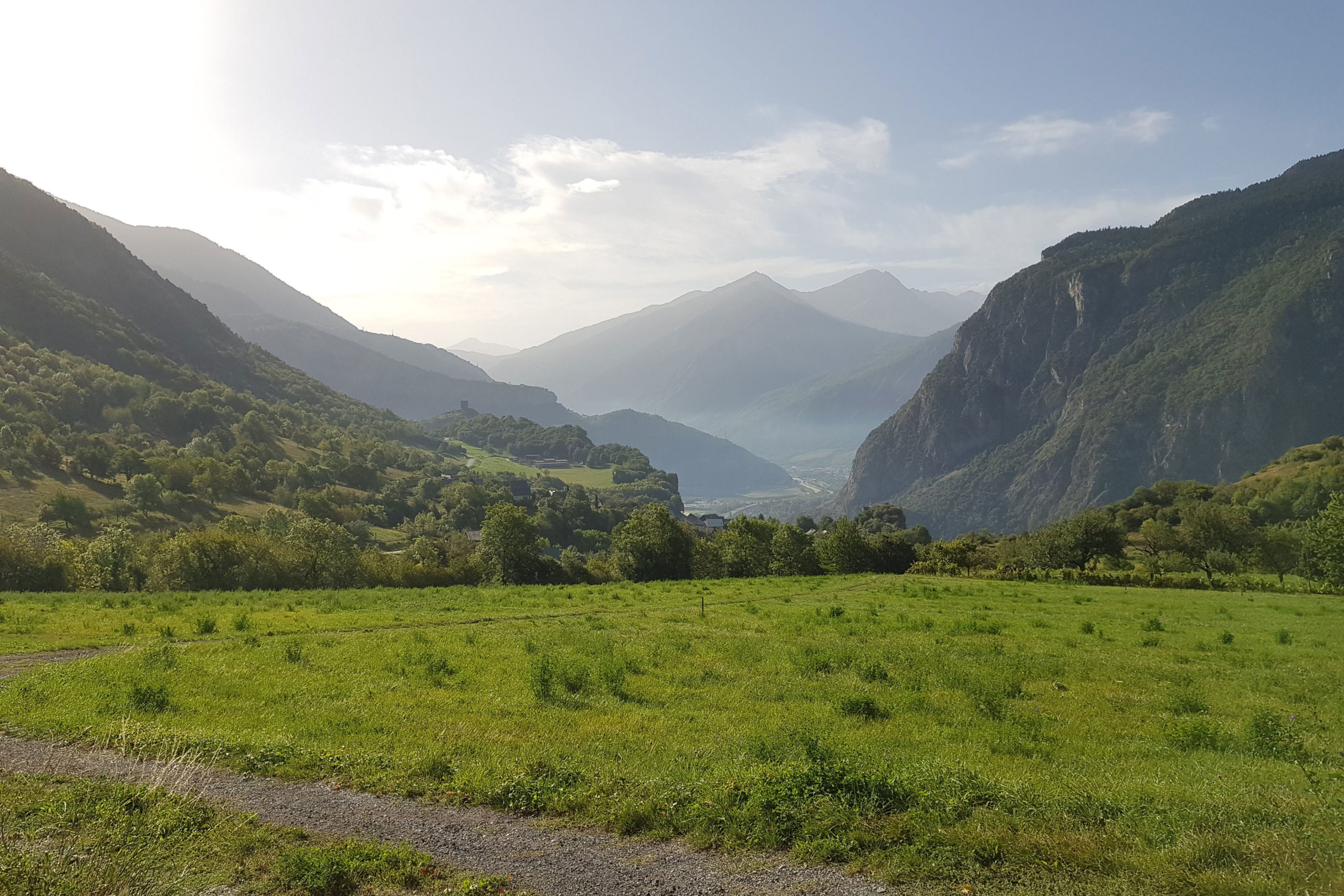
We all were at a loss for words to describe how stunning the trip had been. Great food, amazing riding, impressive historical sites, exploration of new places, and a soul-warming group experience. A wonderful adventure that made us ready for more!
Edelweiss Bike Travel’s Best of Southern France tour is scheduled to run in June and September of 2022 and 2023. Prices start at $6,550. Visit edelweissbike.com for more details.
The post Edelweiss Southern France Tour first appeared on Rider Magazine.


