Adventure-proof packing systems innovator Giant Loop has responded to thousands of rider requests with the introduction of its new Keg Kaddy Party Panniers. Frosty cold beverages are on tap at the end of every day’s adventure now, with the world’s first integrated solar-powered refrigeration system cooling a full-sized 15.5 gallon keg (approximately 124 pints) kept fresh with a carbon dioxide injection.
A propane barbecue grill completes the party and balances the weight for optimal off-road performance and handling. Giant Loop logo tap handles and built-in cup dispenser. Built-in hot and cold storage keeps food fresh for up to five days. And just in case any revelers indulge in “one too many,” a breathalyzer disables the motorcycle’s ignition system if the rider’s blood alcohol level exceeds legal limits.
“This is our first ‘crowd-sourced’ design,” explains lead developer Inna Tocksicaded. “Taking inspiration from the famed Coolest Cooler, we added every requested bell, whistle and feature our customers suggested. Plus, we are headquartered in Bend, Oregon, one of the capitals of the USA microbrewing industry, so it’s a natural fit.”
Other features include expandable storage compartments for folding table and chairs, tiki lamps, patio lights, portable urinals, and other festive accoutrements (optional accessories, not included). When fully loaded, this go-light fiesta on wheels weighs in at a mere 305 lbs, which is less than many adventure touring riders normally pack for weekend outings.
For riders who want to party like it’s 1999, Giant Loop’s new Keg Kaddy Party Panniers (GL part #KKPP) are priced affordably at just $2,999.99, including solar panels, CO2 and propane tanks, and barbecue. Keg BMW Motorcycle Owners Association members qualify for special pricing. Kaddy Party Panniers are available exclusively at giant-loop.com.
It seems absurd to ask, but who was Benjamin Franklin, really? The American founder’s legacy is at once ubiquitous and somehow elusive. He was never president, nor a cabinet secretary—he’s not even name-checked in Hamilton. Surveying his various careers as a scientist, inventor, writer, publisher, and diplomat, one could be forgiven for not properly engaging with any of them. Call it the curse of the polymath.
That was the challenge before filmmaker Ken Burns, whose new, two-part documentary, Benjamin Franklin, premiered April 4, 2022 on PBS. The famed documentarian spoke with Atlas Obscura about Franklin’s enduring relevance, misunderstood politics, endless curiosity, and manifest flaws—including, of course, a lifetime of slave-ownership before a late-in-life awakening.
Burns—whose films cover everything from baseball to country music—also shared some insight into his own secret obsessions.
You made a film about Thomas Jefferson. HBO did a series about John Adams. Then there’s Hamilton. So, why Benjamin Franklin and why now?
Well, there's no “now.” This is a project that was begun five years ago. We had zero idea what the “now” would be like. I've just been drawn inexorably to Franklin, to arguably the most important person in that whole founding period. And more importantly, I think because he's accessible and knowable, he provides us a kind of portal into that founding, warts and all. We can appreciate his own journey, the shedding of many of his own flaws and understanding what those flaws were.
After watching the film, it definitely feels like he would have been the most interesting commentator on today’s world, out of all the Founding Fathers.
Yeah, I think so…. He was social media. He was a printer. He was a publisher. He produced books, almanacs. He was the postmaster. He was Apple and Google and Twitter and Facebook all in one. He'd understand it completely. He spoke in aphorisms and tweets. Of course he’d get it. And he'd be disappointed at our partisanship because he was all about compromise.
Hypothetically, how might he have participated in the conversation around vaccination, considering his experience with his son Frankie?
Yeah, but that's misunderstood. He was a huge proponent of vaccinations, we should say inoculations, that's the more accurate term. So he is a huge proponent in his writing, and he was planning to get Frankie inoculated, but Frankie was sick. And so because inoculations were so hard on the system, it was very difficult to figure out how to do it. And [Frankie] had a bad cold. So they waited until the cold was over, and by that time Frankie had smallpox and died. And then it fell to [Benjamin], this big social media titan, to have to explain to the public why inoculations were good and how tragic it was and sort of bare his soul, to have to live out a tragedy in a life that was examined all up and down the United States.
Do you have a favorite piece of Franklin writing that you discovered in the course of making this film?
You know, I did. And it's spiritual. He said: “Here is my Creed. I believe in one God, the Creator of the Universe. That He governs it by his Providence. That he ought to be worshiped. That the most acceptable service we render to him is in doing good to his other children. That the soul of man is immortal, and will be treated with justice in another life respecting its conduct in this. These I take to be the fundamental points in all sound religion, and I regard them as you do in whatever sect I meet with them.”
Here we have a guy who's on the $100 bill. It's the largest bill in general circulation in the United States. Everybody wants more Benjamins, right? And so he's been held up for generation after generation—almost while he was still alive—as the example, the American example of pulling yourself up by your bootstraps, doing it on your own, self-reliance, all of this sort of stuff, and is held up as a kind of god by libertarians. They've only got half a $100 bill, and I don't mean $50. They don't have Grant. This thing has been torn in half because this other half is not just that striving. It's the civic engagement and the civic responsibility. It's what he says in that creed: You'll be judged by what you've done for others. And so all of his magnificent inventions are held without patents, which could have exponentially exploded his wealth. But he wanted to give something back.
And this is not to ignore the owning of other human beings. This is not to ignore the kind of romanticization of native populations [while] participating in a massive dispossession of land. It's not that you can sort of give lip service to the education of young women but don't see fit to do it for his own daughter, [or] leave your wife for 15 out of the last 17 years of her life, though you know she's ill and had a bad stroke but you haven't made the trip back. So it's, to me, endlessly interesting and so contemporary. And it makes that period accessible because he has all of these flaws that seem human.
Atlas Obscura is planning a series on “Secret Obsessions.” Ben Franklin was so eclectic and poured himself into so many different pursuits throughout the course of his life, as you have. So, what's your secret obsession?
I'm obsessed with Diners, Drive-Ins and Dives. I hate anything on the cooking channels that's a competition. It's all about, to me, making good food and having this weird guy celebrate every possible type of cuisine in the United States, every possible ethnicity, every possible race. It's just, to me, exciting. When my daughter, Olivia, was home from school a couple of months ago, we got in the car and drove two and a half hours—the most you can go east and west in our tiny state of New Hampshire—to pick up lunch at a particular place that we had seen. And none of us have the bandwidth to ever do that kind of spontaneous, “Let's do it,” but we woke up on a Sunday morning and I looked at her and I said, “Let's do it.” We did this spectacular drive, and it was like thieves. We were back six, five and a half hours later, having had this wonderful meal and happy that we did it.
What did you get?
I got a fish, sort of a crab cake fish sandwich from a place in Portsmouth, New Hampshire, and Olivia got some elaborate Korean thing. And it was this restaurant that was basically about all the street food that you could get from all these different nationalities. It was very cool and lived up to all of the hype that we saw Guy Fieri do with it. And, in fact, one of the things that they made on the show is the thing I got: this fish sandwich. Fieri is like nails on the blackboard to [a lot of people], and just a hustler. And I disagree completely. I just think he's ecumenical and open to stuff that people make. And there are very few people [like that].
To bring it back to Franklin, is there a secret or obscure invention, achievement, or interest of his that you find just as compelling as the more notable ones?
I think it's the armonica [or bowl organ]. It's such a beautiful thing. As somebody said, it was “celestial ravishment.” Talk about obsession … it’s a classic Franklin thing. So his obsession is this unstoppable curiosity, right? I mean, he cannot stop looking at the world and looking inward and looking at the affairs of human beings. And, because of his wisdom, seeing it in a way that helps us make it modern, translatable. We lose the awkwardness of the breech pants and the waistcoats and the powdered wigs. We're into just stuff that sounds like today with him.
Photography comes from the Greek words “photo” (meaning light) and “graphia” (meaning drawing). So "photography" equals “light drawing.” Keep this in mind.
There are dozens of private islands scattered off the coast of Florida. The Willifords own one of them. For almost 30 years, it has been a sanctuary for their family—and also a source of strain. Now they must decide whether to keep it or let it go. The answer, like the island itself, is anything but simple.
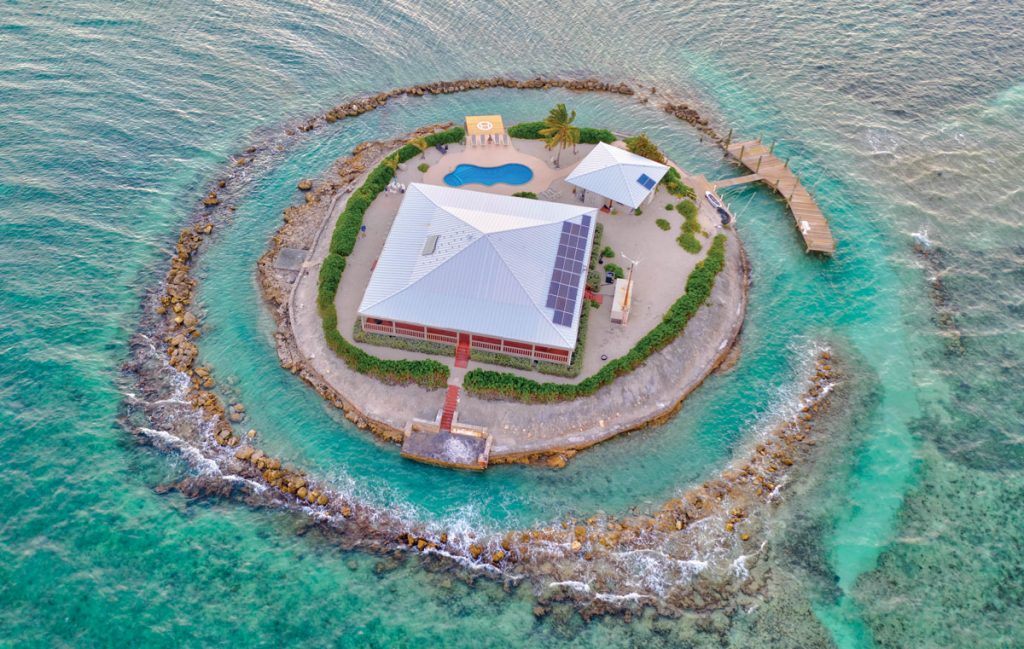
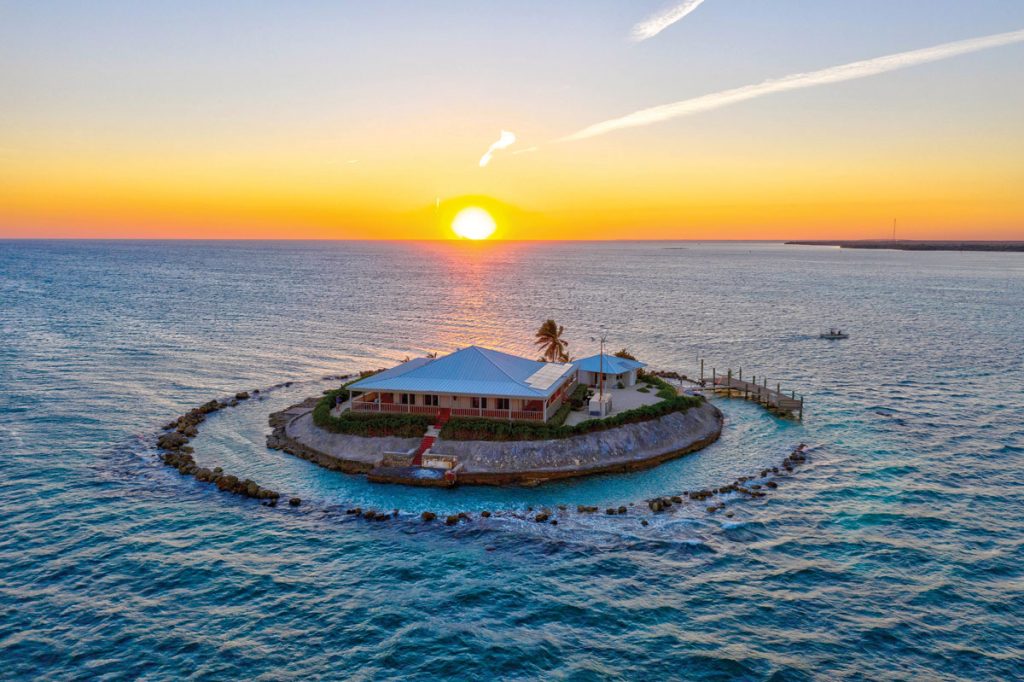
From a bird’s eye view, it is exactly how you picture a private island. A circle of white beach surrounded by vast Atlantic waters, a simple tin-roof house in the middle. There is a pool, a sundeck, and a small helicopter landing pad. A one-room guest cottage overlooks a 100-foot dock. Palm trees drop the occasional coconut. A rocky barrier encircles the island, trapping a shallow moat of water that glows emerald beneath the sun.
Lush vegetation flanks a pathway to the dock
Photo by Harold Daniels
The island, called East Sister Rock, is a quarter mile off the shores of Marathon, Florida, in the middle of the Florida Keys. Visible from the mainland, its 1.4 acres have fascinated many a binocular-wearing traveler and become a favorite flyover spot for helicopter tours. For $11,000, groups of six can spend a week on the island, snorkeling with rays, kite surfing right off the dock, and fishing for snook. They can wave at the pleasure boats that slow to check the place out. They can pretend East Sister Rock is theirs.
But the real owners of this island are not what you might picture. They are not celebrities nor Silicon Valley expats, but a hardworking family of six. The Willifords do not live on East Sister Rock; their home is the Miami suburb of Coral Gables. They bought the island in 1995, when it was a house and little else, and built its complex, off-grid electrical and water system on their own. When Hurricane Irma destroyed all but the home’s cement walls in 2017, they had no insurance, and they spent a year rebuilding everything themselves. Each Saturday, they commute two-and-a-half hours to the island to launder and scrub it before new renters arrive. They patch its holes, mend its hammocks, sand and paint its dock. The Willifords outsource nothing.
The Williford family—Elena, Marissa, Bob, and Wesley—on East Sister Rock island
Photo by Harold Daniels
Their plan has always been to keep the house in the family, a gift for future generations. But they also have it on the market. They are conflicted about the island—within the family, within themselves. “It is paradise,” says Bob Williford, the family patriarch. “But nothing about it is easy.”
In 1995, a doctor from New York put East Sister Rock up for sale. He had built a simple house on it some 15 years prior, when private islands weren’t yet a real-estate sector and environmental regulations were lax. The house had no electricity and a small cistern to hold rainwater. Sale price: $750,000.
The Willifords’ Carolina skiff shuttles them between the island and Marathon, Florida
Photo by Harold Daniels
Bob’s wife, Elena, was pregnant with their third son. She and Bob, a contractor, owned a vacation condo in Marathon, but once the baby arrived, the space would be too small. As they paged through real-estate listings, Bob spotted the island’s pre-auction advertisement. “He had always dreamed of owning a place he could make completely solar- and wind-powered and live off the grid,” Elena recalls. “He wanted to see it.”
“Why wouldn’t I?” Bob says. “No electric bill, no water bill. And it looked like a decent place.” Born and raised in South Florida, Bob is as unfiltered as a cup of Everglades water. He delivers both facts and jokes with nonchalant bluntness; he drapes his arms around his adult kids as if they’re still small. He met his wife in Miami in 1983, when he was an up-and-coming builder in need of a permit and she the government clerk handling his request. “I liked the way she talked,” he says of the accent Elena developed as a child in Cuba. “And I liked the way she licked envelopes.”
The Williford boys on their island home’s wraparound porch in the nineties
Photo by Harold Daniels
Cringeworthy comments aside, the story has a feel-good ending: He asked Elena on a date, she agreed, he had a motorcycle, they went riding off into the sunset. “She chased all my other girlfriends away,” he says, smiling broadly as Elena rolls her eyes. “But now, I don’t want to be anywhere without Mami.”
Elena—Mami to everyone in her family—is wary of too many questions and protective of the details of her life. “I’m much more private than Bob,” she says. It’s part of what makes her the family backbone, the person who quietly keeps things running behind the scenes while also keeping an eye on her children. There are four Williford kids now, all of them grown and living in South Florida. Two of them still reside under Bob and Elena’s roof. “To some people, that might seem strange, but I’m Cuban,” she says. “We like to have our families together.”
Bob and Elena Williford
Photo by Harold Daniels
It was this idea of togetherness that compelled Elena to take a boat to the island with Bob and her young sons and see it for herself. The three-bedroom, two-bathroom house was made of solid concrete poured atop 80 pilings that lifted it 15 feet above sea level. A near-constant breeze made the hammocks on the wraparound porch sway. Baby nurse sharks wriggled within the safety of the moat. As Elena held her boys’ hands and walked them through the house, she spotted Bob outside the window speaking to the real estate agent. “As soon as we left, Bob announced, ‘I just bought the island,’” Elena says.
She wasn’t surprised, nor was she daunted. She had fled Cuba with her family in 1968, when she was eight years old. She’d built a life and a family in America. “This,” she says, “was just a new adventure.”
For Bob and Elena, memories of the next few years are bathed in a golden light. The Willifords spent nearly every weekend on the island, often bringing Elena’s parents—los abuelos—with them. Bob slowly created the off-grid system of his dreams (complete with state-of-the-art solar panels and a 15,000-gallon rainwater tank) while Elena cooked arroz con pollo and shrimp paella over a fire. The Willifords had a fourth child, a girl, and didn’t bother keeping clothes on any of the kids while they were away from the mainland.
It was more Gilligan’s Island than Lifestyles of the Rich and Famous, but that didn’t bother them. “It was like camping,” Elena says. “We traveled to the island with bags of ice to keep us cool. We had to turn on the generator to heat baby formula.”
Wesley Williford and his girlfriend, Mary Jane Perun, on one of the island’s many hammocks
Photo by Harold Daniels
On Sundays, when it was time to return home, the Williford children would hide in crevices beneath the porch. Once found, they’d sneak crabs home and bring their stowaway pets to school to show their friends. Teachers called Elena; Elena lectured her children. “I would tell them, ‘Don’t let anyone know we have an island,’” she says. “I imagined what people might think.”
But their friends eventually found out. Wesley, the 29-year-old second-born, recalls learning as a teenager that all his buddies were speculating about his parents’ jobs. “People thought we had to be drug dealers,” he says with a smile.
“As a symbol of great possession, the privately owned island may yet supplant even the steamship.”
–Fortune, 1930
Farhad Vladi owns private-island consulting firm Vladi Private Islands. According to him, there are roughly 1,000 inhabitable private islands in the United States. Off the coast of Florida, there are approximately 50. Most do not belong to people with recognizable names. “Rich-rich people, they prefer to rent an island versus own one the paparazzi can find out about,” Vladi says. “That’s why I always say the majority of island owners are poor-rich people.”
The sundeck faces a helicopter landing pad
Photo by Harold Daniels
These poor-rich people grapple with a question to which there is no easy answer: Should they pay to insure their island? Chris Krolow, owner of Private Islands Inc., says annual premiums for very small islands usually begin at $25,000 and can skyrocket from there, quickly reaching six figures. And every year, those numbers go up. “Some owners look at how expensive insurance is and don’t opt for it,” Krolow says. “Then they keep their fingers crossed.”
The Willifords have experienced both sides of the insurance coin. In 2005, Hurricane Wilma tore their island apart. They had insurance, but it would not pay what was needed (citing “acts of God” and all that). The Willifords gave up and eventually dropped their coverage. In came Irma in 2017, and in that particular case, being totally uninsured proved more disastrous than being disappointingly insured. They had to borrow half a million dollars to repair the island all by themselves. (They also took advantage of the months of construction and added a few upgrades, including an in-ground pool.) Today, they pay $28,000 a year for what Elena calls “the ability to relax—a little bit.”
The island’s pool, built after Hurricane Irma
Photo by Harold Daniels
After Hurricane Irma, the Willifords needed to focus on monetizing East Sister Rock. Though they had casually made it available to renters beginning in the early aughts, charging $5,500 a week, they capitalized on its new amenities and “jacked up the price,” as Wesley puts it. Wesley became the island’s chief marketer, touting its 360-degree views and easy accessibility (including a rare perk: unlimited use of the family’s skiff). Like his father, Wesley is unreserved, especially when it comes to talking about the island. He sees himself as the corrector of false assumptions; for example, he wants people to know that East Sister Rock has satellite TV and high-speed internet. “People say to me, ‘I don’t think I could stay on your island. I have to be connected,’” Wesley says. “I’m like: ‘We have everything! We even have Netflix!’”
Interest in East Sister Rock has grown over the years—especially during the pandemic, when rental inquiries jumped tenfold and “the place paid for itself,” Wesley says. The Willifords have earned the right to be picky about who stays there. They used to accept bachelor parties from Miami, until one particularly rowdy group left a toilet sitting outside by the pool. Today, they book repeat families who save up all year to spend a week in a private paradise. When Justin Bieber’s team offered Elena $100,000 to rent East Sister Rock for a week, she flatly refused. “It was already booked,” she says simply.
The Willifords have learned the hard way that irresponsible renters can quickly cost more than they pay. Some have drained their rainwater tank of 5,000 gallons in a week. Others seem to have forgotten that the island relies upon its own power. “It happens more than you would believe: They’ll turn all the lights in the house on, then go to Key West for the day,” Wesley says. “That burns our system.”
East Sister Rock island
Photo by Wesley Williford
And no one understands that system or how to repair it but the Willifords. Bob can explain it simply enough: Solar panels lining the tin roof generate energy for 1,000 pounds of lithium batteries. These batteries in turn provide electricity to the house. Rainwater is collected in the tank and heated by solar power, with a backup electrical heater. If there’s not enough rain, a 2,000-foot water hose is run from the mainland. It takes the hose two days to fill the tank. Still, peek inside the island’s shed and you’ll discover the twisting labyrinth of wires and cords that keeps everything humming; it looks like something belonging to a cartoon mad scientist. When renters are on the island, either Bob or Wesley must stay nearby to solve any issues that arise.
But most calls that come in have nothing to do with the utilities and everything to do with the island’s ocean-locked location. “Saltwater is our number-one problem,” Wesley says. “It’s a destroyer.” At least once a year, he and his father must buy a new, full-sized refrigerator in Marathon, hoist it onto the skiff, and motor it to the island. Then they shimmy the rusted one out of the kitchen and return it to the mainland. The grill has to be replaced every six months. TVs are rarely good for a year. They can never buy enough touch-up paint. “When you’re out here in the ocean, you’re in a battle,” Wesley says. “You’re fighting against nature itself.”
Marissa Williford remembers when the moat’s water reached her waist. The youngest of the Williford kids, she was fascinated by starfish and spent many childhood mornings inching along the watery pathway in search of them. Occasionally she would startle a stingray from its resting spot on the moat’s floor; she felt no fear as it flapped its wings and glided away. So often was she at play in the Atlantic, she felt she belonged there. She was as comfortable with its familiar, if shy, residents as she was with her own family.
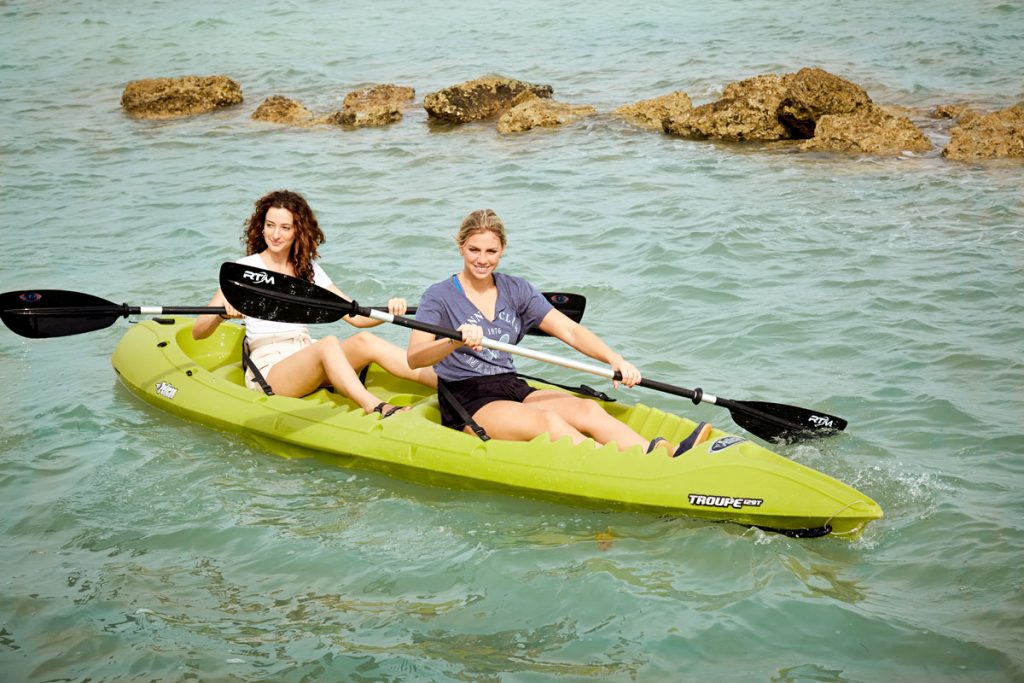
Mary Jane Perun and Marissa Williford kayak around the island
Photo by Harold Daniels
Like her mother, Marissa is not one to overshare. The 24-year-old won’t mention that she just finished business school at the University of Miami and is applying to medical school. Her father is the one to proclaim it. She doesn’t talk about the many, many Saturdays she skipped hanging out with friends because she and her family had to clean the island for renters. But after taking a deep breath, she will speak about the prospect of selling it to someone else. “I would be devastated,” she says. “I don’t even like to think about it. I grew up here—it’s my home. It was always the plan for us to take over.”
But plans, like people, evolve. Bob and Elena are getting older, and they say they feel crushed by South Florida’s ever-expanding sprawl. They want to move farther north, maybe to South Georgia. Buy some land and breathe fresh air. Experience more than one season. Make it enticing enough that their kids will come, too. And if all of them move that far, who would look after the island?
In 2016, they went under contract with a buyer. But Hurricane Irma spooked the would-be Robinson Crusoe. It takes a special kind of person to be willing to live under constant threat of destruction, especially as the waters continue to warm and hurricanes line up each summer like planes jammed nose-to-tail at Miami International. No sooner has one taken off than another begins to pick up speed. The only question is where each will land. Any given day, the answer could be the Florida Keys, with East Sister Rock on the front line.
Marissa Williford with some of the family’s dogs
Photo by Harold Daniels
Wesley says he can handle the stress. At this point, he knows the place almost as well as his dad and can fix anything that gets damaged. “Yes, it takes a lot of time and energy to keep this place up, and there’s always the fear of hurricanes,” he says. “But a lot of us want to keep it in the family.”
Says Bob, “Things change. Kids change. As you get older, you have less energy and drive to keep pushing. We’ll keep it for sale and see what happens.”
Bob Williford’s private island is exactly what most people picture. And yet it is not what he himself envisioned, not anymore. It is a place he knows might belong to someone else soon, someone who did not raise their children on it and did not rebuild it, and rebuild it again, with their own hands. To many, his island is a symbol of success. To him, it’s a lot more complicated. From way up high, all you see is the instant beauty of a circular white beach lapped by turquoise waters. But up close, you notice the slow decay of a concrete home whipped by salt-tinged winds.
Private Islands for Rent
East Sister Rock Island Marathon, Florida Located a quarter mile from Marathon in the Florida Keys, the island comes with a three-bedroom, two-bathroom house with a guest cottage, pool, and boat. In the morning, wave hello to schools of dolphin. Come evening, lie in a hammock on the wraparound porch and watch for shooting stars. $11,000/week
East Sister Rock Island
Photo by Wesley Williford
Island Camp Nags Head, North Carolina Meet your hosts at the Nags Head Causeway or the Manteo waterfront in the Outer Banks, then take a short boat ride across the Roanoke Sound to your own private retreat. The three-bedroom, one half-bathroom house has an outdoor hot shower and views of the famed Bodie Island Lighthouse. $6,000/week
Island Camp
Photo by James Schuler
Old House Cay Hilton Head, South Carolina Set among a cluster of uninhabited private islands 10 minutes from Hilton Head Island, this hideaway features a three-bedroom, two-and-a-half- bathroom cottage. Wander the long wooden dock over grassy marshes to watch the sun set over the Atlantic. $3,500/week
Old House Cay
Photo courtesy of Old House Cay
This article appears in the Spring & Summer 2022 issue of Southbound.
Retro movie lovers know that George C. Scott told the Academy in advance that he wouldn't be on hand to accept the Best Actor Oscar if he won for "Patton". When he did win, Scott was home sleeping, having expressed his distaste for the competitive nature of the awards.The film's producer, Frank McCarthy, accepted the award. Just two years later, Marlon Brando was a "no-show" when he won Best Actor for his career-reviving performance in "The Godfather". Instead, he sent a young Native American woman to express why he was declining the honor. Brando, who was actively involved in social justice causes for Native Americans, was protesting the way they had traditionally been treated in Hollywood films. Unlike Scott, however, Brando gave no advance notice, thus leaving presenters Roger Moore and Liv Ullman somewhat confused about what was going on. For the record, years later Scott gave an interview to Playboy in which he criticized Brando's actions. He said that he felt it was ill-mannered to string the Academy along without telling them up front, as he had, that he intended to not accept the award. As related in Far Out Magazine, there was a third Oscar winner who refused the award: screenwriter Dudley Nichols who had won for John Ford's 1935 classic "The Informer". Nichols had refused the honor due to contentious problems relating to the Academy and industry unions. Click here to read.
Restoring a vintage radio receiver has the potential to be a fun weekend project, but it pays to know what you’re up against. Especially in the case of vacuum tube electronics, running down gremlins in the circuits isn’t always a straightforward process (also, please mind the high voltage that is present in old vacuum tube equipment). [Mr Carlson] has a knack for getting old radios humming once again, and his repair of a 1960s General Electric barn find radio receiver is a thorough masterclass in vintage electronics servicing.
Seriously, if you’ve got a spare ninety minutes, the video (after the break) is a thorough and unabridged start-to-finish diagnosis and repair of a vintage radio, and an absolute must for anyone interested in doing the same. This barn find radio was certainly showing its age, and it wasn’t long before in-circuit testing found an open filament in one of several vacuum tubes, but the radio was still stubbornly silent. Further testing revealed that the IF transformers were out of spec, requiring servicing and alignment. After fine tuning both the IF and RF sections of the radio, things were definitely looking (and sounding) better.
Fine tuning the various components in the radio went a long way to living up to its “long range” claims, and by the end of the video, it’s almost impossible to find dead air on the AM dial of this radio. If you’ve never had to make fine adjustments to a receiver, especially of this vintage, this video has all the details you’ll need. With the board exposed, [Mr Carlson] also took care of some preventative maintenance, including replacing the original filter capacitor with newer components, as well as replacing the mains safety capacitor with an even safer modern alternative.
We can’t get enough of these restorations, so make sure to check out our detailed write-up of restoring a WWII aircraft radio.
Like many office workers, we at The Takeout have returned to in-person work. We’re back to our old commutes, re-acclimating to the joys of crowded public transit, and most importantly, we’re back to bringing lunch to the office. For me, unfortunately, the office lunch transition has been rough. I’m... not exactly a…
Brasiliana Pizza’s Portuguesa is topped with hard-boiled eggs, olives, ham, peas, oregano—and more
Photograph by Wedig + Laxton
New York, of course, leads the world in pizza consumption. Second place: Sao Paulo, Brazil, which has more inhabitants of Italian descent than any city in the world—including any city in Italy. Six years ago, Thiago Machado and Nicollie Conovalow moved from Sao Paulo to Orlando, where Machado worked in a Brazilian pizza parlor; in 2021, the pair moved to Atlanta and struck out on their own, opening a small business—takeout and delivery only, operating out of a Westside ghost kitchen—that specializes in Brazilian pizza.
The savory pies from Brasiliana Pizza feature toppings like olives, tuna, hard-boiled eggs, Calabresa sausage, and the soft processed cheese Catupiry (see previous page), but Machado and Conovalow also pay tribute to another Brazilian tradition: the dessert pizza. Their Brigadeiro, for instance, is a takeoff on Brazil’s famous fudge balls that comes showered in chocolate sprinkles. Brasiliana is one delicious ripple in the endless stream of pizzerias opening in Atlanta these days, offering pies in just about every style imaginable—Detroit, New York, Greece, Naples, Sicily. Has the Colorado Springs–style pizza yet been invented? If so, you’ll probably be able to get it here soon. Until then, some other worthy newcomers:
New Delhi at Tandoori Pizza and Wing Co.
Photograph by Wedig + Laxton
Archna Malhotra Becker, long one of the city’s best Indian chefs, opened Tandoori Pizza and Wing Co. last year in Politan Row in Midtown. The menu is fusion at its finest, with pizza options like the New Delhi (with chutney marinara, assorted veggies, and cilantro) served on a naan crust.
Greek Special at Greek Pizzeria & Gyros
Photograph by Wedig + Laxton
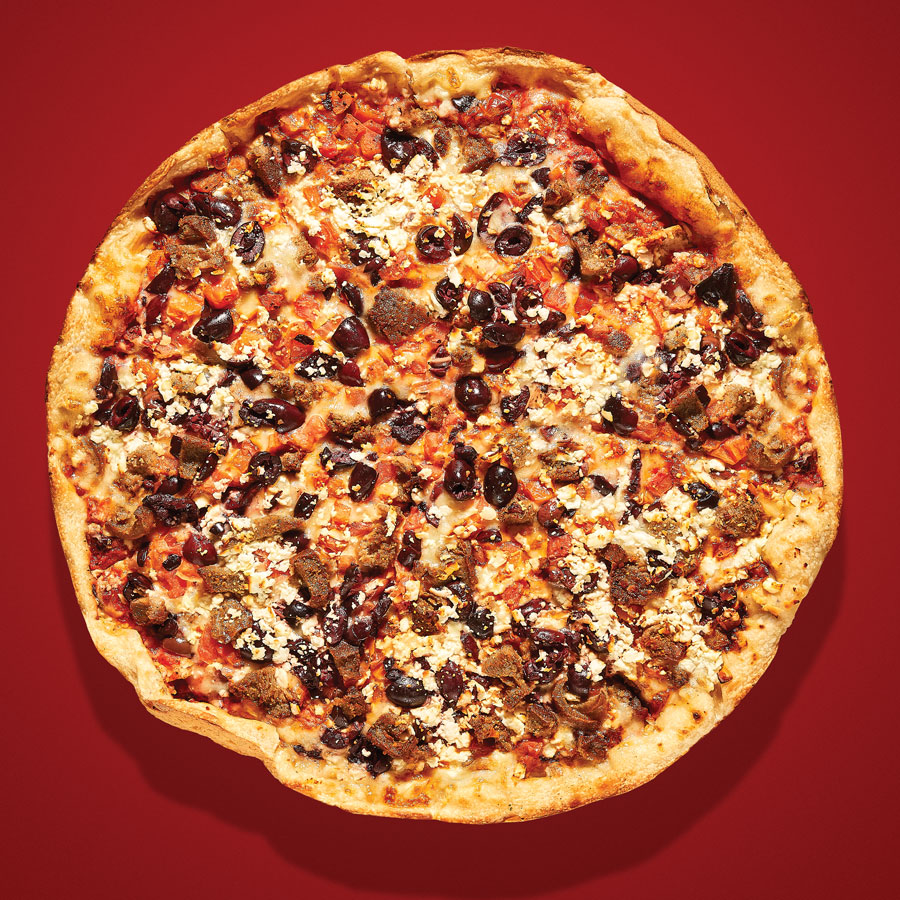
Kafenio owner Johnny Gianoulidis modeled his new Brookhaven spot, the Greek Pizzeria & Gyros, after a restaurant his parents owned when Gianoulidis was a kid. No need to choose between the two food groups referenced in the restaurant’s name: The Greek Special—with lamb or chicken, feta, olives, and tomato—is basically a gyro pizza.
Noni Style at Pielands
Photograph by Wedig + Laxton
Nina & Rafi owner Billy Streck opened Pielands in December in Virginia-Highland, serving New York–style slices and whole pies like the marinara-, mozz-, and basil-topped Noni Style. Another highlight: bottled cocktails,like a rum-based old-fashioned, that can be drunk on site or taken home.
Colony Squared at Emmy Squared
Photograph by Wedig + Laxton
Launching Emmy Squared first in Brooklyn in 2016, Emily and Matthew Hyland have since expanded across the country, with new Atlanta locations in Glenwood Park and Midtown. Their Detroit-style pies—focaccia-esque dough with irresistibly crunchy edges—include the Colony Squared, with pepperoni, pickled jalapeños, and a drizzle of honey.
Anti-Carnissima at Il Giallo
Photograph by Wedig + Laxton
In October, the team behind the Sandy Springs Italian restaurant Il Giallo opened G’s Pizza next door. The pies are takeout only and Neapolitan in persuasion, and come in varieties like the Anti-Carnissima (roasted peppers, artichokes, caramelized onion, rapini) and the Lasagna, topped with short rib.
Our guest on Episode 32 of the Rider Magazine Insider Podcast is C. Jane Taylor, who describes herself as a writer, a biker, a mom, a wife, a warrior, and sometimes a bit of a chicken. But at age 50, when she received an invitation to join the AARP, she ripped up the letter and bought a motorcycle. On April 19, Jane is releasing a new book called Spirit Traffic: A Mother’s Journey of Self-Discovery and Letting Go, about a 10,000-mile cross-country motorcycle trip she took with her husband and son. You can read an excerpt from Jane’s book in the April 2022 issue of Rider. You can buy Spirit Traffic online or at bookstores, and it’s available as an audiobook. For more information, visit cjanetaylor.com.
You can listen to Episode 32 on iTunes, Spotify, and SoundCloud, or via the Rider Magazine Insider webpage. Please subscribe, leave us a 5-star rating, and tell your friends! Scroll down for a list of previous episodes.
Teeny Turner Screwdriver
This little Picquic screwdriver has 7 bits stored in the handle. I use it to fix eyeglasses, open battery cases, and repair other small items around the house. — MF
USPS Service Standard Maps
I needed to figure out how long it would take a stamped letter to reach the other side of the country and an initial google search buried this very helpful, color-coded “delivery days” map of the US. You can filter by originating zip code or the destination, as well as class of mail. You might never need this, but in the off chance that you do it’s useful to bookmark. — CD
Ebike shopping tips
Ebikes are a fantastic, but still underutilized, transportation option. Ryan Johnson wrote up the best roundup of buying advice for ebikes I’ve seen for anyone in the market for an ebike — and you should be! — KK
Nerdy tattoo designs
I don’t have a single tattoo. Not one. And I have no intention of getting one. But I follow this fantastic tattooist on Instagram because their designs are so delightful. Michele Volpi creates exquisitely detailed monochrome diagrams that are whimsical, elaborate, yet scientifically precise. My kind of thing. — KK
Ways to improve your life without trying
I love reading lists of ways to improve your life and even more so when they are virtually effortless ways. Here is a list of the Guardian’s 100 ways to slightly improve your life without really trying. My favorite ones are:
22. Laugh shamelessly at your own jokes.
34. Go for a walk without your phone.
55. Learn the names of 10 trees.
60. Drop your shoulders.
78. Always book an extra day off after a holiday.
97. Listen to the albums you loved as a teenager.
— CD
High resolution public domain art Artvee is a collection of tens of thousands of digitized paintings and illiustrations from museums around the world. According to the site, these images are “available for use for any purpose with no restrictions attached.” I especially like these typographic theater posters. — MF
Mass production can be a beautiful thing. This video is a compilation of machines that we rarely get to see, and the amazing way they get things done. You probably won't learn a whole lot from watching this (or you just might), but how they do what they do is almost like art. We get to see materials we don't recognize perfectly formed into things we suddenly recognize. But it's not just manufacturing. Get a close up view of large equipment farming, cooking, street cleaning, earth digging, and more. None of the clips are long enough to get boring. They just move on to the next machine. -via Nag on the Lake
On Thursday, the Supreme Court decided Houston Community College v. Wilson. I'll take a point of personal privilege to highlight that the Petitioner was represented by Rick Morris, an alum of the South Texas College of Law Houston. And throughout the case, Rick worked closely with students at the South Texas College of Law Houston to prepare. Their work led to a unanimous majority opinion by Justice Gorsuch.
The U.S. Supreme Court ruled 9-0 today in favor of STCL Houston 1991 alumnus Rick Morris, in a case he argued Nov. 2 – after preparation with STCL students and professors. Read more here: https://t.co/UGsvUa1Djo
Respondent, on the other hand, was represented by McDermott Will & Emery and the Yale Law School Supreme Court Clinic. And Justice Gorsuch faulted Respondent for not filing a cross-petition:
But as merits briefing unfolded, Mr. Wilson did not just seek to defend the Fifth Circuit's judgment; he also sought to challenge it in part. Specifically, he argued that the Fifth Circuit erred to the extent that it upheld the Board's nonverbal punishments as consistent with the First Amendment. Generally, however, when a respondent in this Court seeks to alter a lower court's judgment, he must file and we must grant a cross-petition for review. See Genesis HealthCare Corp. v. Symczyk, 569 U. S. 66, 72 (2013). Mr. Wilson filed no such petition in this case. As a result, we decline to take up his challenge to the Fifth Circuit's judgment, and the only question before us remains the narrow one on which we granted certiorari: Does Mr. Wilson possess an actionable First Amendment claim arising from the Board's purely verbal censure?
At least in this case, a well-respected Houston law firm and the South Texas College of Law Houston bested a global law firm and Yale Law School. We'll take the victory. Rick now joins the ranks of other South Texas alum who argued at the Supreme Court, including Lynne Liberato.