Shared posts

24 Nov 19:11

EYES ON THE SOUTH: Fred Hirschman :: November 24 2014

Based in Aurora, Ohio, Fred Hirschman trains his eye on places around the South, and primarily Florida, in the series "Southern Speculation." Fred writes:
It’s odd as a Northerner to think of “The South” as somewhere that starts past the edge of Ohio. For me, the Virginias and other surrounding "southerly" states have always been somewhat reminiscent of what Ohio has to offer. From the Carolinas and farther south is where I find the largest differentiations from the North, in terms of the physical and cultural landscape. These photographs serve as a chronicle of objects and scenes that aren’t typical in the North, but are otherwise ordinary scenes that struck my curiosity.

Pine Island, FL


Cape Coral, FL


Cape Coral, FL


Cape Coral, FL


Pine Island, FL


Pine Island, FL


Fort Myers Beach, FL


Ocala, FL


Pine Island, FL


Fort Myers, FL


Fort Myers, FL


Ocala, FL


Hardeeville, SC

Cape Coral, FL


Cape Coral, FL


Cape Coral, FL


Cape Coral, FL


Cape Coral, FL


Fred Hirschman lives in Aurora, Ohio, and is an undergraduate student at The University of Akron. He's presented his work in group shows throughout Ohio and was included in group shows related to Aint Bad Magazine's latest call for entries, most notably "The American South." Fred will be graduating in December 2014 with a BFA in Photography, and is currently applying to graduate programs. www.fredhirschman.com
24 Nov 18:38

The ICE Guide To Avoiding Deportation In Five Easy Steps

President Obama's executive amnesty for an estimated five million illegal aliens is, from the perspective of Republicans, an unconstitutional power grab that threatens the republic. In Obama's telling, over soft piano music in a campaign-style YouTube video, it “just comes down to people.”

Another version is the one agents of U.S. Customs and Immigration Enforcement (ICE) experience in trying to enforce U.S. immigration laws – specifically a five point checklist they were provided Friday evening and obtained by Breitbart News.

The bureaucratic document uses the Orwellian title “Parental Accountability Checklist.” The line below that explains it is a “Checklist for NOT Arresting/Removing Individuals Under Deferred Action Expansion.”

First, agents must ask detained aliens: did you have a U.S. citizen or lawful permanent resident child on Nov. 20, 2014? Have you resided in the U.S. since Jan. 1, 2010? Were you physically present in the U.S. on Nov. 20, 2014? And were you “without lawful immigration status” on Nov. 20, 2014?

If the alien answers “yes” to these questions, and they have not been convicted of serious crimes, “the individual should be released from custody or not removed, and referred to USCIS to seek deferred action,” the document instructs.

As one might imagine, apprehended aliens theoretically facing deportation may not always provide truthful answers to these questions. So ICE has established the robust policy of taking people completely at their word and letting someone else check it out later, should the alien ever later apply for official amnesty from the Obama administration.

“It's not our job to make any kind of initial investigation or ask for anything...just take them at their word and release so they can apply in Jan and let CIS figure it out,” an angry ICE agent explained.

Aliens referred to USCIS to apply for “parental accountability” are obviously likely to follow-up with the agency, providing phone bills, birth certificates and other documents for USCIS to investigate. After all – when tens of thousands of unaccompanied children streamed across the border this summer, a whopping 6 percent of them later showed up in court, abiding by their notice to appear. And federal agencies like USCIS are known for their ability to competently handle a sudden surge of more than double their normal capacity, as contemplated by the executive order and the agency's early order for materials to print millions of additional id cards for its recipients.

Right?

The checklist also explains the DHS “enforcement priority” system that has been discussed in recent days that kicks in once aliens have bypassed the initial questions.

“Priority 1” includes “suspected of terrorism or espionage, or who otherwise pose a danger to national security,” people apprehended while in the act of crossing the border, “aliens with a conviction for active participation in a criminal street gang” (so long as they are older than 15), and those convicted of a felony crime – “other than a state or local offense for which an essential element was the alien's immigration status.”

To fall under “Priority 2,” an alien must have been convicted of at least three misdemeanors, on three separate occasions (other than traffic incidents and immigration-related offenses), or have been convicted of a “serious misdemeanor.”

The latter term has the following definition, according to the document. 

*”Significant misdemeanor” means: an offense of domestic violence; sexual abuse or exploitation; burglary; unlawful possession or use of a firearm; drug distribution or trafficking; or driving under the influence; or an offense for which the individual was sentenced to time in custody (not including suspended sentences) of 90 days or more. Domestic violence-related crimes should be carefully assessed to determine whether, as a mitigating factor, the individual was also the victim of domestic violence. Feel free to consult your local OPLA office if you have questions about whether the subject’s criminal history meets this definition or whether the individual is otherwise a DHS enforcement priority.

As Byron York wrote in the Examiner, "the administration views convicted drunk drivers, sex abusers, drug dealers, and gun offenders as second-level enforcement priorities."

“Priority 3” consists of aliens who have been ordered to be removed after Jan. 1, 2014. 

Asked about the documents and and remarks from ICE agents, a spokeswoman for ICE did not provide comment for publication.

Expanded DACA Screeing _11-21-2014_.pdf


24 Nov 15:52

Photo


24 Nov 15:52

alrights: Micro-photography of individual snowflakes by Alexey...


alrights:

Micro-photography of individual snowflakes by Alexey Kljatov

fuckin WOW

24 Nov 15:47

Slate: 'End Birthright Citizenship'

Editors Note: Center-Right commentator Reiham Salam argues for a simple way to end our illegal immigration problem. We reprint here

Whether you agree or disagree with President Obama’s use of his executive authority to temporarily shield 3.8 million unauthorized immigrants from the threat of deportation (on top of the 1.5 million he shielded in 2012), this much is true: The Obama administration has permanently altered the immigration debate. The president and his lawyers are right to insist that his executive action has not granted these immigrants “legal status.” Rather, it allows unauthorized immigrants to apply for a three-year reprieve from removal, which comes with a work permit. Though many conservatives, myself included, have questioned the wisdom of this unilateral action, the executive branch is very powerful in our constitutional scheme, and I don’t doubt that his actions will be vindicated by the courts. So no, I don’t intend to quibble over whether the president had the right to take this step. But I do want to discuss what happens next.

One can imagine a scenario in which the president announced this three-year reprieve while also telling unauthorized immigrants to pack their bags: OK, guys, I’m giving you three years to get your affairs in order, but after that you’re out of here. Instead, he emphasized the virtues of immigrants, lawful and otherwise. “These people—our neighbors, our classmates, our friends—they did not come here in search of a free ride or an easy life,” Obama said. “They came to work, and study, and serve in our military, and above all, contribute to America’s success.”

Is that really true? It’s not obvious to me that impoverished people who choose to cross the border illegally, or to overstay their visas, are thinking first and foremost about contributing to America’s success. My guess is that most of them are keen to take advantage of the place premium, i.e., the fact that wages for the same work are much higher in a rich, productive country like the United States than in a poor, less productive one, like Nepal or Peru. I’d also guess that while these women and men are generally grateful for the opportunity to live and work in the United States, they care more about their own families, in the U.S. and abroad, than about some abstract American national community. (This is why remittances from immigrants toiling in rich countries to the relatives they’ve left behind in poor countries vastly outweigh the overseas development assistance handed out by stingy Western governments.) I don’t mean to suggest that immigrants are bad people. I just think that they’re ordinary, run-of-the-mill people—a mix of sinners and saints, like the rest of us, who care more about their kith and kin than perfect strangers.

Regardless, the president’s rhetoric leaves the strong impression that he sees this reprieve as a stopgap measure that will pave the way for a permanent welcome to most of today’s unauthorized immigrant population. As Ramesh Ponnuru observes, Obama didn’t give us any principled reason why unauthorized immigrants who’ve been here for a while should stay while those who haven’t should go. But again, let’s leave that aside. The president’s intentions are clear: He wants to grant certain classes of unauthorized immigrants legal status and he doesn’t have the power to do so unilaterally, so he’s doing the next-best thing. Fair enough.

Instead of inviting future waves of less-skilled immigrants, we should ensure that those who already live here don’t become a permanent underclass.

There was something else the president left out of his announcement, though. As we bring large numbers of unauthorized immigrants in from the shadows, so to speak, we must confront a few important facts. Unauthorized immigrants are, with very few exceptions, heartbreakingly poor. They tend to have extremely low levels of educational attainment, and workers with limited skills have been taking a beating in the U.S. labor market for decades. All the available evidence suggests that giving unauthorized immigrants the legal right to work in the U.S. will increase their wages, but not by much. And the children of less-skilled immigrants tend to have poor educational and labor market outcomes—indeed, there is some evidence that is true for the grandchildren of less-skilled immigrants, too.

Does this mean that I oppose bringing unauthorized immigrants in from the shadows? No, it does not. What it means is that I take that task very seriously, because I understand that granting unauthorized immigrants legal status—or, for now, temporary quasi-legal status—entails a generational challenge. Given the scale of this challenge, and the fact that today’s unauthorized less-skilled immigrants are vulnerable to economic competition from future less-skilled immigrants, we also ought to declare that enough is enough: This will be the last less-skilled wave that we will absorb for the indefinite future, and that this will also be the last amnesty.

To demonstrate our seriousness on this front, we should take a step that countries like Australia, Britain, France, Ireland, and New Zealand have already taken: We should end automatic birthright citizenship. If it is wrong to tear families apart by deporting the parents of U.S. citizens—and it really is wrong, in case you were wondering—we ought to establish that only the children of those who are living in the United States as citizens or lawful permanent residents will be granted citizenship at birth.

Read the rest of the article here.


24 Nov 15:38

Internet crusader Al Franken rakes in cash from cable giant

by Yaël Ossowski

This internet originally appeared on watchdog.org.

U.S. Sen. Al Franken, D-Minn., has made his name in the latter part of his first term as a crusader for net neutrality and a huge critic of billion-dollar mergers of multimedia companies.

And while his ire has been focused on Comcast, the nation’s second largest media conglomerate, he’s been raking in cash from competitor Time Warner Cable, the third-largest, according to profits.

Since 2009, Franken has raised $33,450 from lobbyists from TWC, according to the Center for Responsive Politics, a nonprofit dedicated to tracking political spending.

In his many speeches on the Senate floor and in committee hearings on the issue of regulating the Internet and barring mergers between large media firms, Franken has consistently criticized Comcast’s proposed merger with Time Warner.

“The proposed acquisition also would threaten innovation and economic activity on the Internet, and it would jeopardize the free flow of information and ideas on which our democracy depends,” wrote Franken in a 40-page statement published on his website in August. “Because the proposed acquisition does not advance the public interest — but, rather, is inimical to it — it must be rejected.”

Responding to Watchdog.org, Franken’s press office denied such donations influenced his decisions on the Senate floor.

“Senator Franken is grateful for the support he receives, but when making policy decisions, he always does what he thinks is best for Minnesotans regardless of who has donated,” said Franken office spokesman Michael Dale-Stein.

Responding to President Obama’s statements advocating a plan to introduce net neutrality and reclassify Internet broadband as a public utility, Franken was more than excited, even throwing in a jab at the same multibillion corporations that have funded his political career.

“I welcome today’s news that President Obama is pressing the FCC to maintain a free and open Internet. He joins a chorus of more than 3.5 million Americans who have told the FCC that killing net neutrality is a terrible idea, and who strongly believe a very simple principle: there shouldn’t be one Internet for deep-pocketed corporations and a separate Internet for everyone else,” he said in a recent statement on his website.

Franken’s biggest donor is Susman Godrey, one of the largest antitrust law firms in the country. It has given Frank nearly $80,000 since he was sworn in after a tough election battle in 2008 with former Sen. Norman Coleman.

24 Nov 15:36

White House Quietly Releases Plans For 3,415 Regulations Ahead Of Thanksgiving Holiday

by Daily Surge

While Americans are focused on what delicious foods they’re going to eat for Thanksgiving, the White House is focused on releasing its massive regulatory agenda– marking the fifth time the Obama administration has released its regulatory road map on the eve of a major holiday.

The federal Unified Agenda is the Obama administration’s regulatory road map, and it lays out thousands of regulations being finalized in the coming months. Under President Barack Obama, there has been a tradition of releasing the agenda late on Friday– and right before a major holiday.

“It’s become an unfortunate tradition of this administration and others to drop these regulatory agendas late on a Friday and right before a holiday,” Matt Shudtz, executive director of the Center for Progressive Reform, told The Hill newspaper.

The White House’s regulatory agenda for spring 2014 was released on the eve of the Memorial Day weekend, when millions of people set out on weekend getaways or family vacations.

“It’s unfortunate because it’s an update on protections for Americans of all stripes,” Shudtz told the Hill. “It lays out the administration’s plan and it deserves more attention.”

But the White House may have a good reason to do so because its Unified Agenda for fall 2014 includes some 3,415 regulations– more than the last regulatory agenda, and one that includes 189 rules that cost more than $100 million.

One of the most contentious rules is the Environmental Protection Agency rules to limit greenhouse gas emissions from new and existing power plants. According to the agenda, these rules will be finalized in 2015.

They have been criticized by Republicans and the coal industry for accelerating the demise of coal-fired power and for setting the stage for increases in electricity prices. Republicans, who are set to take control of the Senate next year, have vowed to fight EPA regulations.

“The president said his policies were on the ballot, and the American people spoke up against them,” said incoming Senate Majority Leader Mitch McConnell, a Kentucky Republican. “It’s time for more listening, and less job-destroying red tape. Easing the burden already created by EPA regulations will continue to be a priority for me in the new Congress.”

But environmental groups and the EPA argue the rule will actually help lower utility bills and help fight global warming.

“The good news is that we can afford to tackle the growing threat of climate change and, really, we can’t afford not to,” said Starla Yeh, a policy analyst at the Natural Resources Defense Council. “Doing the right thing will save money even as we protect our health, our communities and future generations.”

A more pressing EPA rule set to be finalized is the so-called coal ash rule for coal-fired power plants. A final rule will be issued by Dec. 19, and could be bad news for the power sector, which will bear the brunt of $20.3 billion in compliance costs.

But probably the most fought-over rules to be finalized by the EPA next year will be its redefining of the “Waters of the United States” under the Clean Water Act. The EPA will issue its redefinition next year, according to the agenda.

Federal lawmakers from both parties, along with companies from virtually every sector of the economy, have opposed the rule, saying it greatly expands the EPA’s power to regulate even small bodies of water on private property.

“The ‘waters of the U.S.’ rule may be one of the most significant private property grabs in U.S. history,” said Louisiana Republican Sen. David Vitter, adding “they want to take another step toward outright permitting authority over virtually any wet area in the country, while at the same time providing a new tool for environmental groups to sue private property owners.”

But the EPA says the rule is needed to clear up uncertainty over the EPA’s jurisdiction in the wake of two Supreme Court rulings. The EPA says “the decisions established important considerations for how those regulations should be interpreted” and that “[e]xperience implementing the regulations following the two court cases has identified several areas that could benefit from additional clarification through rulemaking.”

Follow Michael on Twitter and Facebook

Content created by The Daily Caller News Foundation is available without charge to any eligible news publisher that can provide a large audience. For licensing opportunities of our original content, please contact licensing@dailycallernewsfoundation.org.

Content created by The Daily Caller News Foundation is available without charge to any eligible news publisher that can provide a large audience. For licensing opportunities of our original content, please contact licensing@dailycallernewsfoundation.org.

Powered by WPeMatico

The post White House Quietly Releases Plans For 3,415 Regulations Ahead Of Thanksgiving Holiday appeared first on Daily Surge.

24 Nov 13:11

'Fruit Pickers' Left Out of Obama's Amnesty

“Are we a nation that tolerates the hypocrisy of a system where workers who pick our fruit and make our beds never have a chance to get right with the law?  Or are we a nation that gives them a chance to make amends, take responsibility, and give their kids a better future?” That was the challenge President Barack Obama posed to America on Thursday evening as he issued his decree that effectively provided amnesty to millions.

While he called out "fruit pickers: in his speech extending legal status to millions of foreign nationals illegally present in the U.S., Obama did not specifically extend legal status to those agricultural workers. Some of those workers will be offered legal status, but due to their children's status, not their farm work.

“The President’s action will allow at least 250,000 of America’s current professional farm workers who feed our nation to apply for temporary legal status and work permits. Farm workers who have lived in the United States for five years and have children who are US citizens or Legal Permanent Residents, pass a criminal background check, pay all of their taxes, and pay a fee will be able to work and live in the United States without fear of deportation,” said United Farm Worker President Arturo Rodriguez after watching Obama’s address to the nation. A UFW statement specifically estimated that 125,000 of those farm workers are located in California.

“While we appreciate the president’s interest in reforming our inadequate immigration system, we’re afraid his action may complicate efforts to achieve a comprehensive, long-term solution,” California Farm Bureau Federation President Paul Wenger said in response to the President’s executive action.

Wenger went on to say, “We’ve also been clear that we support border security--and border security will be enhanced by a permanent reform of immigration law that allows farm employees to enter the U.S. legally, to move between employers as needed, to return to their home countries and then re-enter the U.S. legally when their work cycle resumes.” He also emphasized it is not clear how many really will come out of the shadows for a program that could evaporate with a shift in political action.

Some in the farm industry question whether those given legal status will remain in the farming industry. The San Francisco Chronicle reports, “Past efforts to create a farmworker visa have included provisions that aim to keep recipients in agriculture for at least a few years.”

The Chronicle reported on comments from Western Growers President and CEO Tom Nassif, indicating skepticism over whether, after receiving legal status and work permits, “those people will be required to stay in agriculture, or will they now have work permits to go work in any industry they wish?” His comments also questioned the union estimates of those farm workers illegally present in the U.S. that would receive legal status through Obama’s decree.

Nassif issued a statement in anticipation of Obama’s decree, declaring, “An effective border security bill should be passed immediately” and should acknowledge securing the border as “an ongoing and continuous commitment.” Nassif listed this among his requirements to achieve “meaningful reform legislation.”

“Agriculture’s needs must be a top priority to ensure our existing workforce is given an incentive to continue working in agriculture until a new and better visa program is in place,” Nassif said before advocating for a “path to legal status that acknowledges their past service and ongoing importance to this industry.”

“We will oppose any piecemeal legislative package that fails to put the agriculture industry at the front of the line,” Nassif declared in his opinion on requirements for “meaningful immigration reform,” saying, “Our industry is in jeopardy.”

Western Growers stated it would be analyzing Obama’s executive order in the days after its announcement, and would release an evaluation of the “impact this executive action will have on the fresh produce industry.”


24 Nov 01:47

Ski cabin with red windows in Ushuaia, Argentina. Contributed by...

by deuscorreia


Ski cabin with red windows in Ushuaia, Argentina.

Contributed by Deuscorreia.

24 Nov 01:43

Bill Black: Why and how Holder let all the big bank CEOs off the hook (Video)

by Nick Sorrentino

“Responsibility remains so diffuse, and top executives so insulated that any misconduct could again be considered more a symptom of the institution’s culture than a result of the willful actions of any single individual.” -Eric Holder on why he “could not” prosecute anyone in the top echelons of the big banks. What a guy.

bailout scale tarp c                  c

Bill Black is no ideologue. He is someone who is committed as far as I can tell to legitimate justice in massive system of financial fraud we know today as “banking.” No doubt he and I would disagree about the size and power of government generally and probably about the fundamental nature of money itself. However, he helped prosecute the case against bankers during the S&L crisis and he is extremely knowledgeable, not to say was also effective.

Read More

24 Nov 00:54

Obama: Not Legitimate for Future Presidents to Lower Taxes via Executive Action

After unilaterally granting temporary amnesty and work permits to millions of illegal immigrants last week, President Barack Obama said it would not be legitimate for a future president to unilaterally lower tax rates. 

When asked on ABC's This Week if his successor could unilaterally act to lower taxes if Congress does not, Obama replied, "absolutely not."

Obama, despite the IRS's targeting of conservative and Tea Party organizations, also said that his administration only audits "folks who are most likely to be cheating" and said that even though the IRS does not "audit every single person... we still expect that people are going to go ahead and follow the law."


23 Nov 20:29

Oakland to Require Developers to Sponsor Public Art

Oakland, following the lead of San Francisco, will require private developers to include funds for public art in their projects. The City Council passed legislation proposed by former Councilwoman Libby Schaaf, who was elected the mayor of Oakland in November’s election, that forces developers to allocate 1% of their projects’ costs for public art, to either be displayed in their venues or given to a city arts fund. 

The city arts fund would then spend the money to display public art elsewhere in the city. Sculptures, murals and mosaics will be created to adorn the city. 

Arts advocates are delighted with the City Council’s decision. Bruce Beasley, an Oakland  sculptor with works ensconced in the Museum of Modern Art and the Guggenheim Museum in New York who fought for the new law, said: 

Artists look at it as beneficial for them, but the real purpose is to enrich the city. Good public art makes cities vibrant and exciting and interesting places to be. We hope that’s what this does for Oakland. Public art should be the very best art, of the highest quality. It should be out of the museums and put in the public space. It should raise the aesthetic profile of a city. This is not welfare for artists — it will benefit everyone.

According to the San Francisco Chronicle, Beasley recently gave his $20 million West Oakland sculpture compound, archives and unsold works to the Oakland Museum of California.

Allocating a percentage of funds for public art is not a novel idea; many cities already require publicly funded projects to do so, including Oakland, but requiring private developers to fund public art is more rare. Cities requiring 1% for public art include Los Angeles, New York City, Philadelphia, Washington D.C., Pittsburgh, Charlotte and New Haven. San Francisco requires 2% of costs for public buildings to be spent on public art, and 1% for private developers. 

The new Oakland law pushes the private developers to choose among roughly 5,000 local artists. Caroline Stern, a local artist, told the Chronicle that when California terminated redevelopment in 2012, arts commissions became minimal. She said, “This won’t change the world, but I’m thrilled it passed. This will make a big difference in parts of the city that are 'arts deserts.'" Stern also asserted that more art would lead to less graffiti and vandalism, and possibly less crime. 

Gregh McConnell, president of the Jobs and Housing Coalition, articulated what some developers felt about the new law, told the Chronicle, “We don’t oppose public art, but we need to look at the cumulative effect of all these fees. At some point, it’ll be too much. There’s a lot of building going on here, but it’s still nothing like San Francisco. Now, that’s a boom. We’re not there yet.”


23 Nov 20:09

Using a 10 Stop Neutral Density Filter to add Drama to the Sky

by Darlene Hildebrandt

In this Adorama video Bryan Peterson shows you how he uses a 10 stop neutral density filter to take an image from average, to dynamic. The filter basically just blocks light allowing you to make longer exposures. In this city skyline shot it changes how the clouds appear in the final image.

Filter mentioned in the video:

Other dPS articles about using ND filters:

The post Using a 10 Stop Neutral Density Filter to add Drama to the Sky by Darlene Hildebrandt appeared first on Digital Photography School.

23 Nov 19:53

Labour party ‘loons’ want to limit Brits to one pint of beer per day

by Jim Jamitis

It looks as though the Labour party in the U.K. is as bent on creating a nanny-state as American Democrats. Did we catch Bloombergism from them or did they catch it from us?

#Labour plan to stop drinkers having more than ONE PINT of beer a day.. http://t.co/tzgnYF0nu1 Labour in touch with the working man again!

— Lady Durrant (@LadyDurrant) November 23, 2014

@LadyDurrant Dave will be saying vote #ukip get #Nigel before you know it.

— Steven McKeane (@GalaReiver) November 23, 2014

#LabourParty plan to limit drinkers to 1 a day. http://t.co/TinCTzGG4Q I'll choose what I drink thanks Ed Hitler!!

— Vote UKIP For Change (@englishbrand) November 23, 2014

#Labor wants to crack down on beer drinkers while letting 10,000 immigrant paedophile rapists run free! http://t.co/UPwd6B52Bp #UKIP #UK

— Zanesville Democrat (@ZANVDEM) November 23, 2014

1 pint a day… Just another idiotic idea from health fascists @UKLabour who want to dictate what booze you drink http://t.co/hhw0DoQm2n

— Hand of GOD (@HandofGOD7) November 23, 2014

@HandofGOD7 @UKLabour The never give up wanting to dictate…risible

— JJSALMO (@jjsalmo) November 23, 2014

@jjsalmo @UKLabour They actually think we're grateful for their eternal interference & nannying. So wrong, so out of touch. Grim people.

— Hand of GOD (@HandofGOD7) November 23, 2014

@LadyDurrant Perhaps they could start off by banning more than one pint per person in House of Commons bars.

— MaggieLavan (@MaggieLavan) November 23, 2014

@LadyDurrant Usual left wing thought process. Must keep serfs sober so we can employ them on zero hour contracts. Labour just don't get it.

— Phil Begley (@yorkshirebegley) November 23, 2014

@LadyDurrant Let them drink Pimms

— Ian Ashton (@IanAshton01) November 23, 2014

@LadyDurrant this should work out well…

— hughes (@thehugheslady) November 23, 2014

@LadyDurrant @oowmygawd it seems that labour want all the pubs to go bust, then the muslims can come along and turn them into mosques.

— peter nunn (@nunnp1) November 23, 2014

Health-Stasi Nanny Fussbucket @lucianaberger is right! http://t.co/UlB5Te2Pv5 Only 1 glass of wine a day for me now! pic.twitter.com/dQTMRvnwsj

— A Libertarian Rebel (@A_Liberty_Rebel) November 23, 2014

@LadyDurrant FFS! Now the loons want to dictate how we live.

— Richard Rogers (@oowmygawd) November 23, 2014

It’s that darned totalitarian impulse.


22 Nov 13:52

Winter is coming but this might make it a little better

22 Nov 04:45

$300 For The Best Stories Written Around This Picture

by PulpCovers


This is not the first time they offered such a contest.

This entire issue can be downloaded here

via

22 Nov 04:43

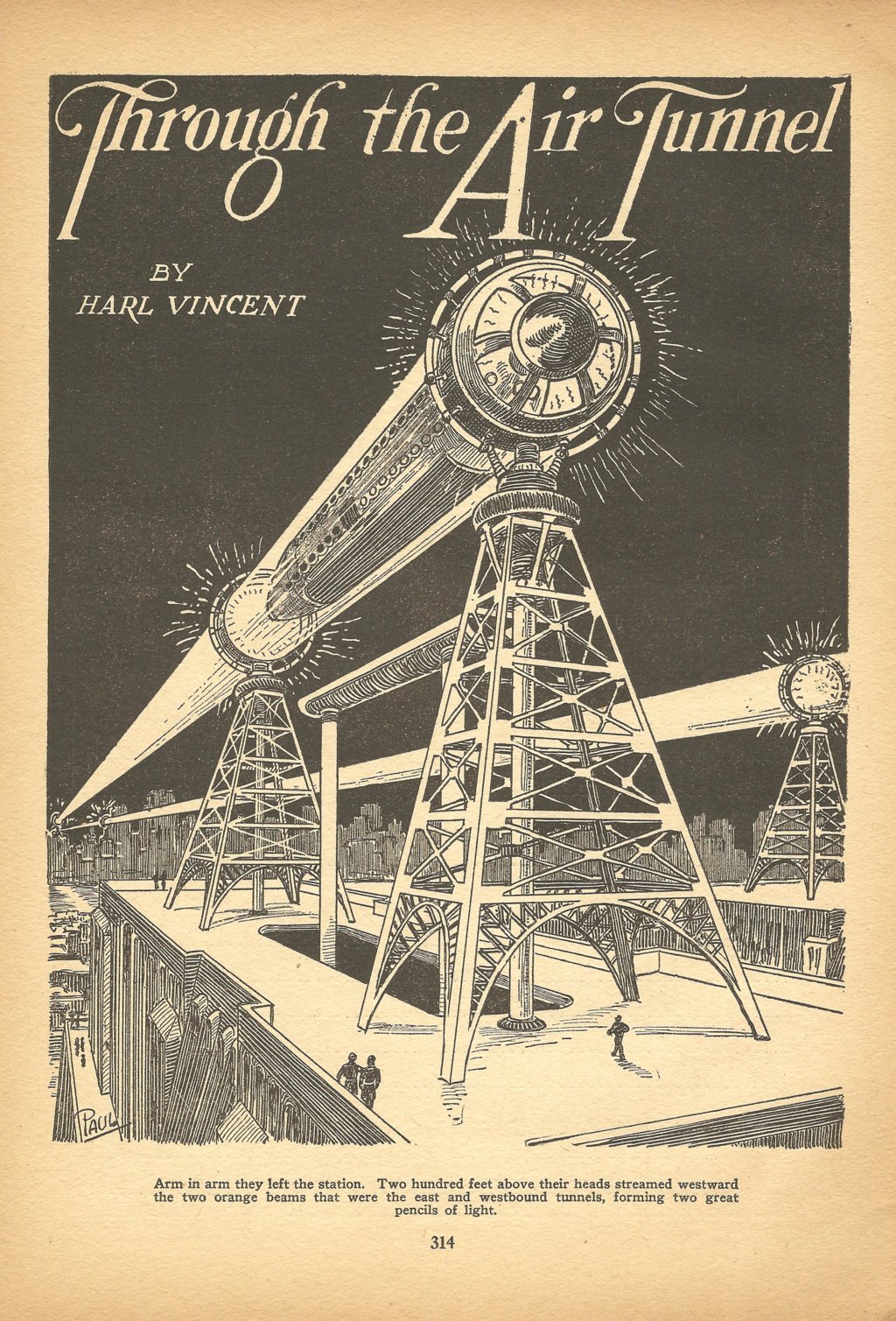
Through The Air Tunnel

by PulpCovers


This entire issue can be downloaded here

via via

22 Nov 04:42

The Storm Buster

by PulpCovers


This entire issue can be downloaded here

via via

21 Nov 19:19

Doctoral Degrees, Ranked By Legitimacy

by Timothy Burke on The Concourse, shared by Timothy Burke to Deadspin

Doctoral Degrees, Ranked By Legitimacy

1. Medical doctor (M.D.)

Read more...


21 Nov 15:18

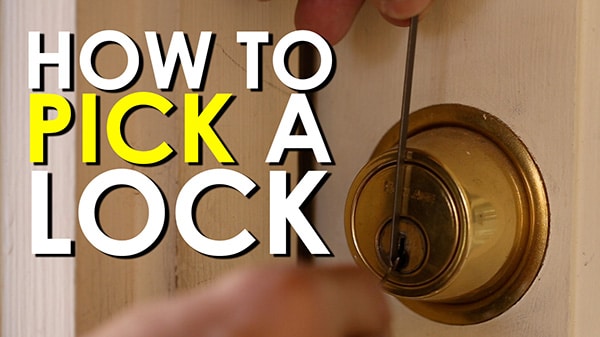
An Introduction to Lock Picking: How to Pick Pin Tumbler Locks

by Brett

Picking a lock.

Some of you might be thinking, “Brett, why should I learn how to pick a lock if I don’t plan on breaking into people’s homes?”

Great question.

There are a few good reasons why law-abiding citizens should learn how to pick a lock:

Lock picking opens your eyes to the “illusion of security.” We all lock our doors to keep our loved ones safe at night and to secure our possessions during the day. After I picked my first lock within two minutes of learning how to do it, I realized that locks don’t really do much except provide the illusion of security. Locks make us feel safe, but if someone really wanted to get in your house, they could easily pick the lock on your front door. If they didn’t know how to do that, they could find another way in. You can’t just rely on a lock to keep you and your family safe. You need to utilize other tools and tactics and create multiple layers of security.

Realizing how little locks actually keep you and your stuff safe was both terrifying and surprisingly heartwarming. Terrifying because I saw that someone could easily enter my house and walk off with a crapload of stuff without having to break a window; heartwarming because seeing how easy it is to pick a lock and yet how rarely people get burgled, made me realize that most people don’t break into homes because, well, most people are good people.

It makes you handy. If you’ve ever been locked out of your house or car, you know how annoying it is to be standing there like a chump, waiting for someone to show up with a key or a professional locksmith to arrive. Wouldn’t you love to be able to jimmy your way in yourself? Not only can this skill save you a lot of time and money, being able to solve a problem like that on your own is pretty dang satisfying. Plus, you can help out all your friends when they get locked out too.

Knowing how to pick a lock may even help you save a life one day. ITS Tactical has highlighted a few instances in which someone picked their way into an older parent’s home because they weren’t answering the phone, only to find their parent collapsed on the floor. Could they have kicked the door down or broken a window? Sure. But picking a lock just takes a few seconds and doesn’t leave any damage. So why wouldn’t you do that if you could?

It’s a cool and fun skill! There’s simply a “cool” factor of knowing how to pick a lock. Of all the Jason Bourne-esque skills every man wishes he had, it’s one of the most attainable. The idea that I can surreptitiously enter most doors without a key makes me feel all-powerful, like some sort of super ninja-spy.

It’s also a fun little hobby and something I like to do when I’m taking breaks from work or hanging out with the kids while they do their kid thing on the carpet. If you get really into lock picking, you can actually go to events and contests to test your skills against other lock pickers.

Below we walk you through basic lock-picking techniques for tumbler locks. I made a lock picking YouTube video a few years ago that shows how to do this step-by-step.

The Legality of Lock Picking

There’s a common misconception that the only people who can legally own lock-picking tools are first responders or licensed locksmiths. The reality is that in most states, as long as you’re not trying to illegally enter someone’s home with your lock-picking set, you can legally own, carry, and use lock-picking tools.

There are, however, some states that have laws that make owning lock-picking tools prima facie evidence of criminal intent. If you’re caught with picks in these states and you want to avoid criminal charges, you have to prove that you didn’t plan on committing a crime.

Long story short: owning lock-picking tools and learning how to pick locks is perfectly legal and ethical as long as you do so without nefarious intent. Just be a decent human being. For a summary of lock-picking laws across the country, see here.

How to Pick a Pin Tumbler Lock

Pin tumbler locks are the most common locks found on the front doors of homes. So it makes for a good first lock to learn how to pick.

How a Pin Tumbler Lock Works

You don’t really need to understand how basic pin tumbler locks work to successfully pick them, but it does help.

The design of the basic pin tumbler lock has been in use since 4000 BC. Of course, it’s gotten more complex over the millennia. The design that is used in most cylinder locks — like the one on your front door — has been around since 1861, and it hasn’t changed much. Basically, most of the world is using a technology that’s been around for a century and a half to keep their most prized possessions safe and secure.

Here’s the anatomy of most run-of-the-mill pin tumbler locks:
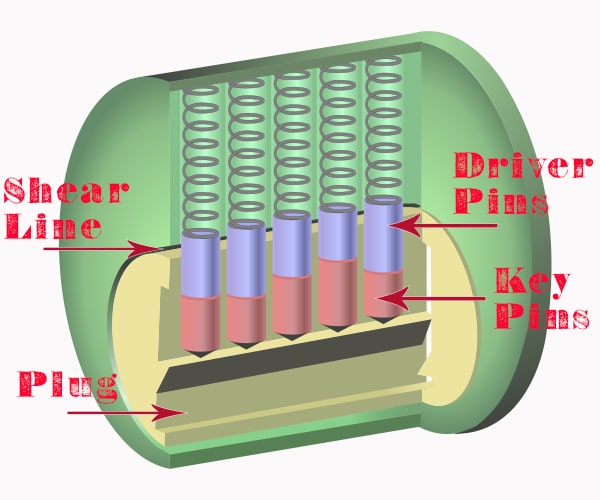
Anatomy of pin tumbler locks with labelings.

Pin tumbler locks consist of an outer cylindrical casing (colored green) in which a plug is housed. The small gap between the outer casing and the plug is called the shear line. Remember that. It will come in handy here in a bit. The plug has an opening for the key. When the proper key is inserted into the plug, the plug can rotate, thus unlocking the lock. On top of the plug, a series of five or six holes are drilled. The holes contain key pins (colored red) of different lengths. They’re called key pins because they touch the key when you insert a key into the plug. Above each key pin is a driver pin that’s spring-loaded. Pins are also sometimes referred to as “binding pins.”

So you have an idea of how the pins look in action, here’s a gif of me inserting a pick into a see-through practice lock:

pin tumble lock cross section gif

In the diagram above, there’s no key in the plug. Because of the different key pin lengths, the driver pins cross the shear line, making it impossible for the plug to rotate. If you put a wrong key into a lock, the notches on the key won’t lift up the key pins at the right height, causing them to protrude through the shear line as you can see in the diagram below:
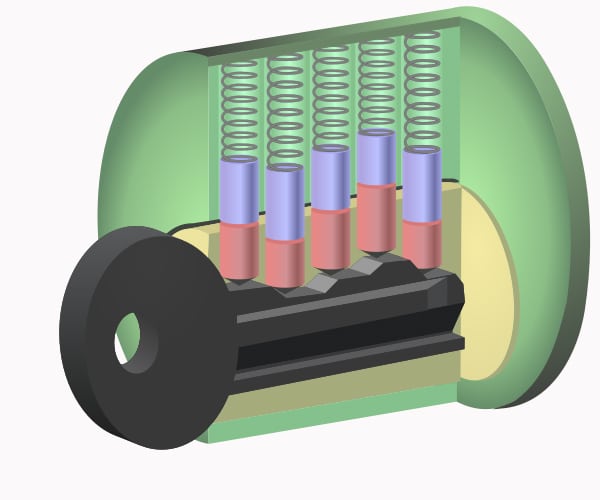
Anatomy of wrong key entering in pin tumbler lock.

In order for the plug to rotate, you need to lift each of the key pins and driver pins to the correct height — until the gap between the key pins and driver pins reaches the shear line. When all of the pins reach this position, the plug can rotate. That’s what happens when you put a properly cut key into a lock:
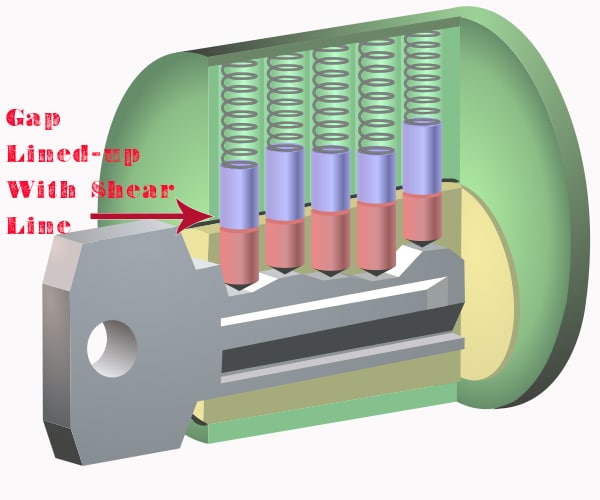
Inner view of Right key entering in lock.

Pretty simple, huh?

When you pick a lock, all you’re doing is using tools, instead of a key, to line up the gap between the key pins and driver pins with the shear line between the outer casing and the plug. That’s it. And it’s super easy to do.

Tools Needed for Picking a Pin Tumbler Lock

There are various tools you can use to pick a lock. For this post, we’re going to focus on using the most common lock-picking tools: a tension wrench and pick rakes. 

Below is my wallet-sized lock-picking set that I got from SEREPick while I was at the ITS Muster. The picks are made of titanium. There’s one tension wrench and several rakes with different numbers of ridges, which allow you to pick several pins at a time. There’s also a pick that allows you to pick one pin at a time. Some locks will require you to do that.

Wallet-sized, titanium made lock pick.
If you’re looking for something a little sturdier and robust, you can find lock-picking sets several places online (even Amazon). If you want to be even more of a MacGyver, you could even make your own picks from a windshield wiper.

You can also use a paperclip to pick a lock. Check out our article on how to pick a lock with a paperclip.

Lock-Picking Technique

Lock picking is more art than science. You definitely have to develop a “feel” for it. Each lock is different, but the same basic principles apply. The easiest way to pick a lock is to use the fast and dirty method: scrubbing.

1. Insert Tension Wrench into the Bottom of Key Hole and Apply Slight Pressure
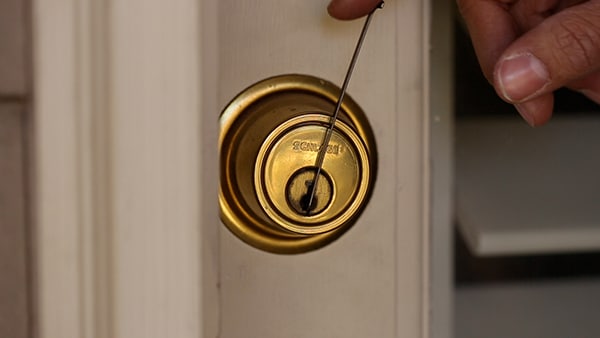
Inserting Wrench into the bottom of Key Hole and apply slight pressure.

The tension wrench is the key (no pun intended) to successfully picking a lock. Thanks to video games, people wrongfully think it’s the pick, because that is the thing that’s actually lifting the key pins to line up with the shear line.

Here’s why the tension wrench is so important: as you’re lifting the pin sets with your pick you need to apply tension on the plug. If you’re applying the right amount of torque on the plug, once the driver pin passes the shear line, the plug will rotate slightly. When you pull your pick out, the key pin will drop back down, but the driver pin will catch the edge of the plug, thus staying above the shear line. Here’s a diagram of what it looks like:
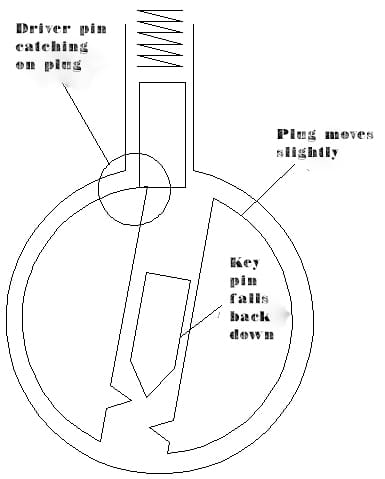
Anatomy of tumbler lock driver pin with labeling.

You’ll keep lifting pins with your pick and applying pressure with your tension wrench, until all the driver pins have cleared the shear line.

So far so good? Alrighty.

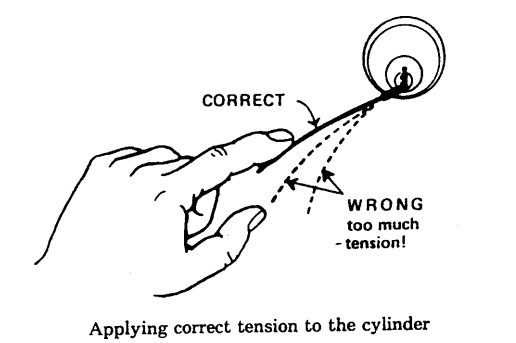
So take your tension wrench and place it in the bottom of the key hole. Apply slight pressure in the direction you would turn the key if you had it. And by slight I mean slight. If you apply too much pressure, you’re just going to cause the driver pins to bind below the shear line. You need to have enough give to let the driver pins rise above the shear line, but have enough torque that when they start dropping down, an edge of the drive pin catches the plug as it starts to rotate.

How much is too much pressure? If your tension wrench is bending a lot, then you’re probably applying too much pressure. So lean on the side of applying less pressure than more.

2. Insert Pick at Top of Lock
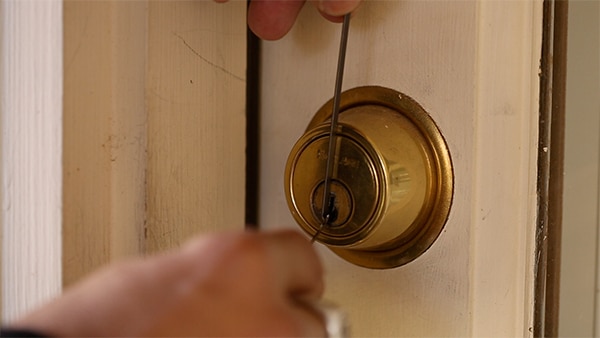
Inserting pick at top of lock.

Pick your pick. I prefer the Bogota rake that has three ridges. This one has picked every lock that I’ve used it on very easily.

Slide the rake all the way to the back.

3. While Applying Slight Torque to Your Wrench, Scrub Your Pick Back and Forth in the Key Hole

Keep applying that slight pressure on your tension wrench. I use my left hand for that. With your right hand, scrub or rake the inside of the plug with your pick. As you pull the pick back, simultaneously lift up in order to apply pressure on the pins. It looks sort of like this motion:

pick a lock rake motion gif

4. Repeat Until All the Pins Set

Keep applying torque on your wrench and scrubbing the pins until they all set. You may need to apply more torque and pressure on the pins with your pick as you get near the last one or two pins that need to set. If you’re not making any progress, you probably applied too much torque with the wrench. Relax, let the pins reset, and start over again, focusing on not using too much pressure.

That’s it! Really. That’s all there is to it. You can successfully pick most pin and tumbler locks using this scrubbing method.

You may run across locks that require a little bit more finesse by picking each pin set one at a time. In these trickier locks, you may need to get more methodical by looking for the pin stack that resists the most and picking it first and then repeating the process until all the pins are successfully picked.

Practice, Practice, Practice
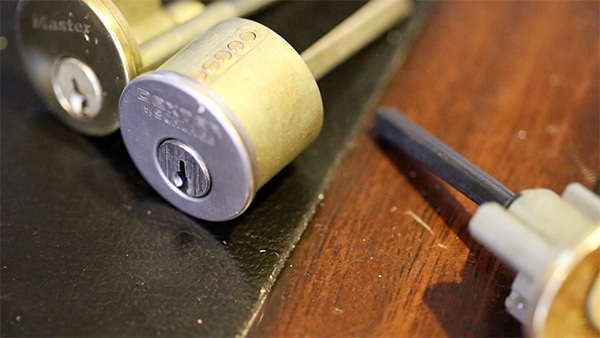
Locks displayed along with tool.

Like I said above, lock picking is more art than science. The best way to learn how to do it is to simply pick locks as much as possible. Buy yourself different pin and tumbler locks at the hardware store and keep them on your desk or by your couch. When you’re taking a break from work or while you’re watching TV, practice picking. I’ve got three or four locks in my drawer that I’ll bust out during the day for practice sessions.

You’re one step closer to becoming Jason Bourne. Remember, use this knowledge for fun or for legal entries. If you’re going to burgle, only burgle hamburgers. Robble, robble.

Frequently Asked Questions

What can I pick a lock with?

Your best bet is a lock-picking set that includes a tension wrench and a set of rakes. My favorite is the set from SEREPick. In a pinch, you could fashion some lock picks with a paper clip, bobby pin, or even windshield wiper blades. In my experience, picking a lock with paper clips is more difficult because they have a tendency to break in the lock. 

Is lock picking legal? 

Depends on which country or state you live in. In most instances, as long as you’re picking a lock and don’t have criminal intent, you’re fine. In some states, owning a set of lock picks is prima facie evidence of criminal intent and things get more complicated. Be sure to check local laws before buying a lock-picking set. 

Can you pick a lock with a credit card?

Not tumbler locks. But some locks on internal doors can be opened by jimmying a credit card between the lock and the door. Here’s how to use a credit card to open these doors.

Further Reading

If you want to get more in-depth in the art of lock picking, check out these two sources:

CIA Lock Picking Field Operative Training Manual

The MIT Guide to Lock Picking (This baby goes really in-depth into the mechanics and physics of why we’re able to pick locks. Very thorough. Definitely recommend reading it.)


With our archives 4,000 articles deep, we’ve decided to republish a classic piece each Sunday to help our newer readers discover some of the best, evergreen gems from the past. This article was originally published in November 2015.

This article was originally published on The Art of Manliness.

21 Nov 15:16

Strongest Wiper in The Universe

21 Nov 02:37

Transparency Fail: Obamacare Enrollment Tally Included Dental Plans

In a departure from previous practice, the Obama administration combined those who signed up for dental only plans with those who signed up for full insurance plans in order to announce a total number of subscribers which surpassed their goal.

Bloomberg reports that the gimmick was uncovered by investigators for the House Oversight committee. They found that nearly 400,000 dental only plans were included in numbers announced by HHS in September. Without the added dental only plans, the number of subscribers would have fallen just short of 7 million, the original target for Obamacare sign-ups.

When the first open enrollment period ended in April, the Obama administration announced they had achieved 8 million enrollments plus another 1.1 million who signed up for dental plans. The 8 million included hundreds of thousands of people who never went on to pay a first month's premium. Their enrollments were eventually dropped, something which most observers had long predicted would happen to around 15% of all sign-ups.

Bloomberg's Alex Wayne argues that once the number of those actually enrolled dropped under 7 million, the Obama administration used the addition of the dental plans as a way to hide the decline and make it appear the program had still surpassed it's first year goal by several hundred thousand people.

Since the story broke this morning, HHS has confirmed that dental plans were included, calling it an error:

UPDATE: @HHSGov spox confirms that ~380,000 dental plan subscribers "erroneously" included in 7.3. million #Obamacare total.

— Alex Wayne (@aawayne) November 20, 2014

The revelation of this sleight-of-hand by the administration comes at a time when it is already being heavily criticized for a lack of transparency surrounding the passage of the Affordable Care Act (ACA). A number of video clips of MIT economist and Obamacare architect Jonathan Gruber have surfaced in which Gruber says elements of the bill were written to fool American voters. The White House had distanced itself from Gruber and claims the process surrounding the passage of the bill was unusually transparent.


20 Nov 20:14

The economist FA Hayek wrote extensively about “Spontaneous Order” in the economy. A short video about birds explains the fundamental idea.

by Nick Sorrentino
Markets move like this.

Markets move like this.

Anyone who has read us for any period of time understands that nature and natural rhythms are important in our political and economic calculus. We love the “natural world.” This love is one of the reasons we believe in the power of markets. (Which are natural.)

Below is a video about the “starlings of Otmoor.”  Otmoor is a marshy area near Oxford England. In this amazing display of seemingly random order there is much to be learned about economics. I think Hayek would have agreed.

It’s beautiful, that’s for sure.

Read More

20 Nov 18:14

America's NATO Allies will Force Keystone XL Approval Next Year

The Keystone XL pipeline bill failed on a vote count of 59-41 and failed to achieve a filibuster-proof U.S. Senate passage. With 40% of the pipeline already built and North American energy costs some of the lowest in the world, President Obama will be under huge pressure from America’s NATO allies in Europe and Canada to allow the State Department to rule the Keystone XL is in the “national interest.”

Two sections of the Keystone pipeline, equaling 40% of the 2,000 mile project from Alberta, Canada to the Texas Gulf Coast, have already been built and are transporting oil. These sections are a 298-mile segment from Steele City, Nebraska to Cushing, Oklahoma and a 485-mile segment between Cushing and Nederland, Texas.

TransCanada Corporation as the sponsor of the Keystone project has suffered from delayed approval for the project since November 2011. The Obama Administration and its environmentalist allies say the EPA approval has been delayed due to 2.5 million public comments. Critics complain that producing crude from oil sands emits 17% more greenhouse gasses than traditional oil drilling because of heating sands to release oil.

During the delay, Canada’s oil production rose from 3 to 3.7 million barrels per day. Canada by 2018 may only be behind the United States, Saudi Arabia, and Russia as the world's fourth-largest oil producer.

Last month TransCanada filed an application to build a $12 billion Energy East pipeline project to send 1.1 million barrels of oil per day across Canada from Alberta to Saint John, New Brunswick, where a deep-water port will be built. But at a distance of 2,700 miles versus 1,200 for the Keystone Pipeline, the economics favor the U.S. route.

Although the Keystone XL sponsors state that Canadian oil sent to Texas will be for U.S. consumption, America just recorded its highest level oil exports in 57 years. With U.S. domestic production more than doubling in the past five years, America is now the world’s largest producer of oil and natural gas. But U.S. infrastructure has not kept pace with production. The Keystone pipeline will eventually be enlarged to serve as the backbone for a North American oil and gas distribution system.

The European Union’s lack of domestic oil and natural gas supplies has forced the 28-nation block to be reliant on expensive and politically problematic Russian energy supplies. Consequently, the EU’s “average” residential electricity rates are 119% higher than the U.S., according to the Energy Information Agency. The cost spread since 2006 has been widening as U.S. rates rose by 16% and EU rates on average jumped 42%.

Residential electrical rates in Germany are 214% higher than the U.S., with taxes and levies accounting for about half of retail electricity prices. German electrical transmission system operators charge residential consumers a “renewable energy levy” that is used to subsidize the expansion of certain renewable generation facilities.

Despite the massive taxes to support lavish subsidies, non-hydro renewables generation in the European Union only increased its share of electrical production from 6% in 2006 to 12% by 2013. During the same period, the U.S. renewables increased from 2.5% to 5%. But these high and increasing costs for electricity in the EU may explain why Goldman Sachs just predicted Europe will soon be in a triple dip recession.

Preventing large-scale exports of Canadian oil outside North America is in the United States’ vital interests, according to Stratfor Global Intelligence. Oil is the largest globally traded product in the world, and it forms the foundation for global economic activity. As the dominant military power in international waters and its largest consumer, the United States has a keen interest in the global oil market and the places where oil is produced.

The loss of the Keystone XL approval vote in the U.S. Senate spares a very unpopular President Obama from having to veto the pipeline for political reasons. But after the new Congress is seated in January, President Obama will bow to America’s European and Canadian allies in NATO and quietly direct the State Department to rule the Keystone XL is in the “national interest.”


20 Nov 16:09

Pentagon duped; Paid Bergdahl ransom to con man...


Pentagon duped; Paid Bergdahl ransom to con man...


(Second column, 7th story, link)

19 Nov 14:29

The return of Speedy Working Motors

by Chris Hunter

Silver Vase by SWM Moto — the classic Italian marque returns.
How can you not love a motorcycle brand called Speedy Working Motors? It might sound like a slogan on a Japanese t-shirt, but SWM is actually an Italian marque with a solid history going back to 1971.

SWM went bust in 1984, but the company is now back with a bang: six new models are slated for production, starting in September 2015. And despite being production bikes, four of the new models slot perfectly into the current custom scene zeitgeist.

Silver Vase by SWM Moto — the classic Italian marque returns.
The driving force behind the new SWM motos is Ampelio Macchi, an engineer whose CV includes stints with Aprilia, Cagiva and Husqvarna. He’s secured backing from the giant Chinese powersports manufacturer Shineray, which has over 100 motorcycles and ATVs in its catalog and exports to 86 countries worldwide.

Our favorite is the Silver Vase model (top and above), a scrambler with a nod to SWM’s successes in the ISDT. The engine is a 435cc air-cooled single, the frame is a classic double-cradle design, and dry weight is an admirable 150 kg. (Probably just as well, since the rear brake is a drum.) Wheels are 19” at the front and 18” at the back, and shod with Metzeler Karoo 3 tires.

Gran Turismo by SWM Moto — the classic Italian marque returns.
The Gran Turismo 440 (above and below) is a classic ‘naked,’ with a low slung exhaust system, a stepped seat, and road-oriented Pirelli MT90 rubber. Like the Silver Vase, it’s sporting a trapezoidal tank and fits the SWM ethic of “clean, flowing and light” design.

Gran Turismo by SWM Moto — the classic Italian marque returns.
The Gran Milano 440 (below) has more of a British café racer vibe. There’s a solo seat, and the elongated tail unit is vaguely remiscent of Norton’s early 70s Fastback design. To our eyes it’s the least successful variant, although it has a certain gawky charm.

Gran Milano by SWM Moto — the classic Italian marque returns.
The Gran Milano 440 Special (below) ditches the retro vibe and switches to light alloy 17” rims and Pirelli MT60 RS rubber. There are disc brakes all round and fully adjustable USD forks. Dry weight drops to 145 kg (330 pounds).

Gran Milano Special by SWM Moto — the classic Italian marque returns.

The new SWMs will be built in Lombardy, and will feature six-speed transmissions, fuel injection and electronic ignition. The engines are reportedly Husqvarna designs, from the pre-KTM era. The bottom line is that Shineray provides the cash, while Macchi comes up with the goods. And these goods look mighty fine.

Pricing is yet to be confirmed, but we’re likely looking at between 5,000 and 6,000 euro—which is US$6,250 to US$7,500. The European markets will get the machines first, closely followed by Australia and the South American countries—which share similar homologation standards. After that, SWM will tackle Asia and North America.

On paper, it looks very promising. And reaction at the EICMA show earlier this month was overwhelmingly positive.

Sig. Ampelio Macchi, we wish you the best of luck.

SWM Moto | Facebook

Silver Vase by SWM Moto — the classic Italian marque returns.

The post The return of Speedy Working Motors appeared first on Bike EXIF.

19 Nov 14:19

George Will: If Obama Wants Infrastructure, Approve Keystone XL

Columnist George Will said that if President Obama really wants the US to spend more money on infrastructure, he should approve the Keystone XL Pipeline on Tuesday's "Special Report" on the Fox News Channel.

"He says rightly that we as a nation should be spending much more on infrastructure, [the] Keystone XL Pipeline is infrastructure, pure infrastructure, supported by his great constituency beyond the environmentalists which is organized labor in this country" he stated.

Will added, "furthermore, this now begins to go against the fundamental Obama pose that explains all the swooning about him in the media and academia, that is the pose of the calm, deliberative, weighing of evidence man. Evidence didn't enter into this, this is a purely ideological opposition on his part that can be changed by nothing."

Follow Ian Hanchett on Twitter @IanHanchett


19 Nov 01:04

#GruberGate in Two Minutes

18 Nov 23:49

Germany tops USA as 'world's favorite country'...


Germany tops USA as 'world's favorite country'...


(Third column, 5th story, link)
Related stories:
18 Nov 14:57

Watch the Milky Way Eat Its Neighbors [Video]

by Clara Moskowitz
The Milky Way has a history of devouring its neighbors, the smaller satellite galaxies that orbit it. Over time our galaxy’s gravity will tug on the near sides of these satellites more strongly...

-- Read more on ScientificAmerican.com