FT: Party like 1929, S&P hits 49th closing high...
(First column, 8th story, link)
Related stories:
 ust how tough are you? Tough enough to attempt crossing Antarctica? Tough enough to make it through an Arctic winter? Tough enough to set sail for self-rescue vaguely aimed at the most isolated place on earth?
Ernest Shackleton and his crew of men did all of the above. The early 1900s was a time of sterner men. Tougher men. A time before radio, much less the Internet. A time before the meat grinder that was the Great War took the best of a generation of Western men and nearly destroyed Europe to boot.

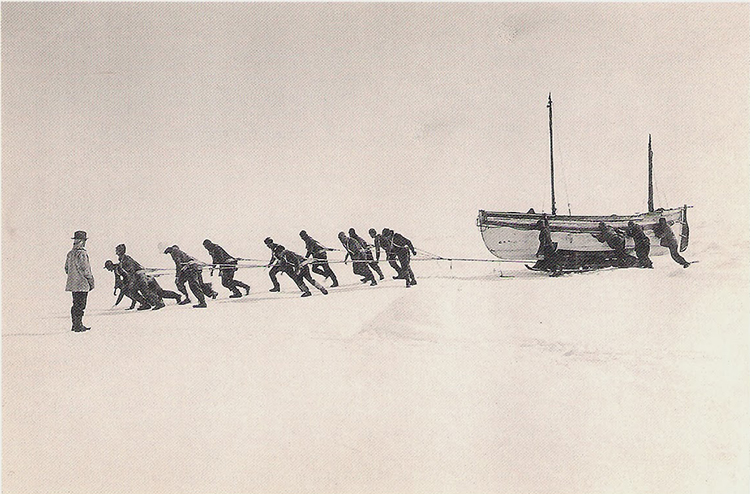
Shackleton and his crew missed most of that. While war was brewing, no less an authority than the king of England told him that he must go on his planned expedition to cross Antarctica for the glory of the British Empire.
A crew of 28 men — including one stowaway in search of adventure — set out from London on the same day in 1914 that Germany declared war on Russia. By the time the Endurance made it to the Southern Atlantic, things went quickly from bad to worse. Ice slowed the ship's journey to the Antarctic mainland. Eventually, in January of 1915, the Endurance became fixed in ice. The men accepted the news graciously, hunkering down for an Arctic winter. There would be no sun for six months.
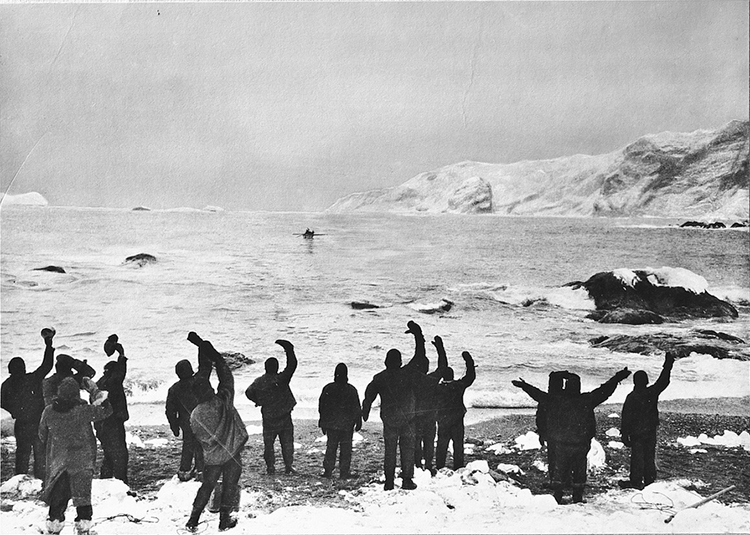
This winter was nothing but the good times, as it turned out. The men played chess, threw parties, and made cheerful, nightly toasts — "to our wives and sweethearts. May they never meet." It was only after the winter, when food ran out, that things began to get hairy. After months floating on an ice floe, Shackleton — lauded by every man on the journey as the greatest leader who ever lived — decreed that the men would make tracks for Elephant Island, located between Antarctica and the southermost point of South America.
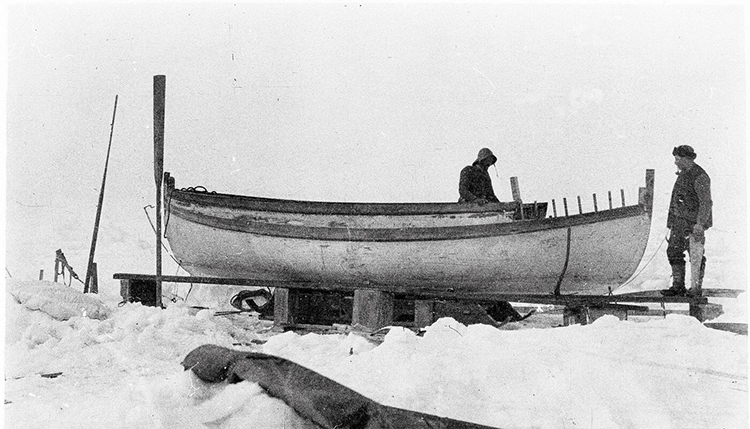
This took the men out of the frying pan, into the fire. Packed into three life boats, the crew made it to Elephant Island, but the windy, inhospitable rock offered little in the way of refuge. So Shackleton took the strongest of the lifeboats, the James Caird, and led five of his men to strike out for South Georgia, an inhabited island 800 nautical miles to the northeast.
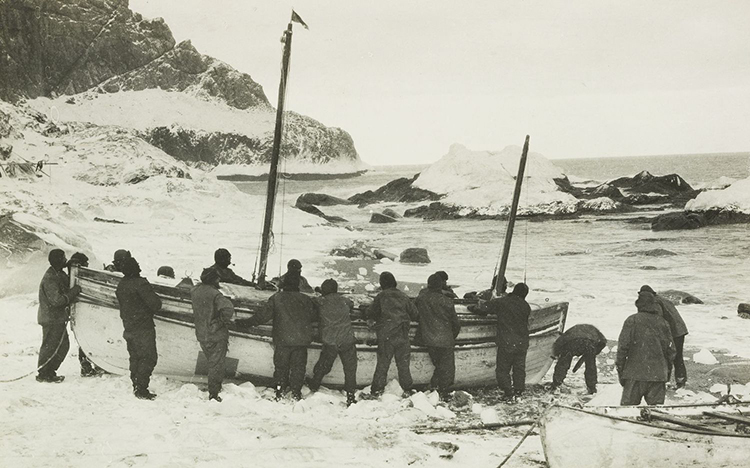
The remaining 22-man crew stayed behind. Just over two weeks later, after surviving hurricane-force wind and waves, the James Caird hit the shores of the island; Shackleton trekked to a nearby whaling village, organized a rescue trip for the remainder of his crew, and headed back south to collect the rest of the men.
After nearly two years of being stranded, not a single one of the Endurance men died. Everyone made it back home, and the voyage of the James Caird is lauded as one of the greatest small boat journeys ever taken. Perhaps most importantly, while the men (understandably) grumbled and griped toward the end, they never cracked. They never broke rank. That is what kept them alive.
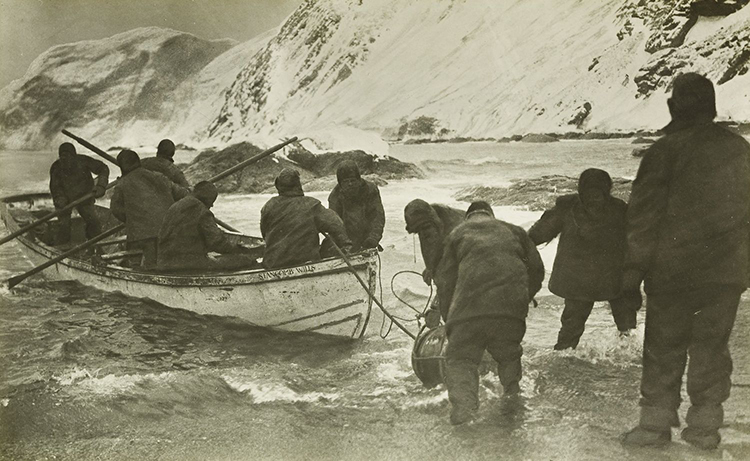
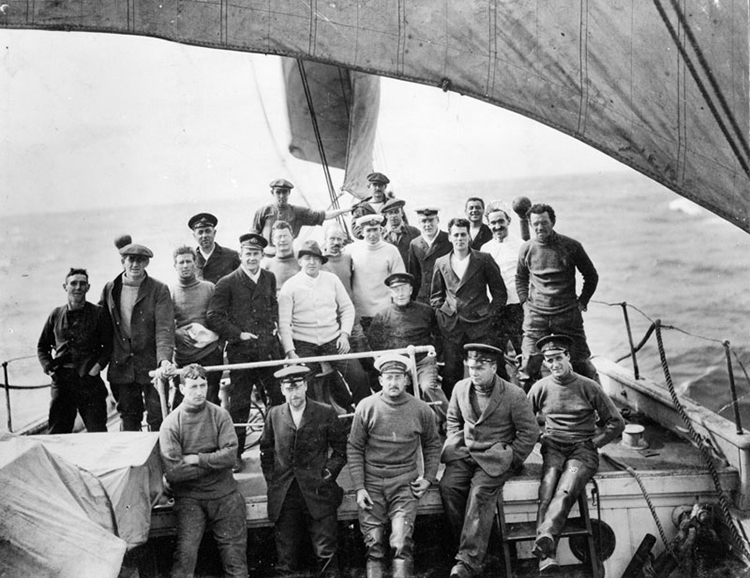
Images ©: 1, 2, 5 Royal Collection Trust; 3, 4, 6 The James Caird Society.

 Earlier today, I put up a post -
"Bee
Apocalypse Science Scandal? Did Scientists 'Fix Evidence' To Ban
Neonic Pesticides?" I cited an article in the Times
about what is being alleged and asked if some one could supply me
with a link to the actual document that outlines how the activist
scientists supposedly orchestrated getting a predetermined
conclusion that neonic pesticides are bad published in a prominent
peer-reviewed journal.
Earlier today, I put up a post -
"Bee
Apocalypse Science Scandal? Did Scientists 'Fix Evidence' To Ban
Neonic Pesticides?" I cited an article in the Times
about what is being alleged and asked if some one could supply me
with a link to the actual document that outlines how the activist
scientists supposedly orchestrated getting a predetermined
conclusion that neonic pesticides are bad published in a prominent
peer-reviewed journal.
As it happens, European risk communications specialist David Zaruk, who blogs as the Risk-Monger, has a nice analysis of what happened and he provides a link to the relevant confidential note. In his analysis, "IUCN's Anti-Neonic Pesticide Task Force: An exposé into activist science," Zaruk reports:
The Risk-Monger recently came across a strategy document carelessly left on-line by activist scientists that lies at the heart of the founding of the IUCN Taskforce on Systemic Pesticides. The Addendum to this document (see page 3) spells out a rather distasteful anti-neonicotinoid campaign strategy lacking in scientific integrity. The process has been tried and tested before by activists, but their behaviour has never been so clearly articulated in writing. I thought this document should be shared so we know the type of people are standing behind the “science” defending the bees.
How did this story unfold?
- Under the auspices of the IUCN, the International Union for Conservation of Nature, a group of activists map out a four-year campaign strategy to attack the pesticide industry and seek the banning of neonicotinoids.
- The idea is to collect like-minded researchers, get funding to set up a task-force to attack neonics using the IUCN as a base with WWF (or some other NGO) doing the lobbying.
- Once funding is in place for the campaign organisation, start the research, write a main high-impact report and get a few other articles published (find some big names to use).
- On that basis, organise a broader campaign (with the support of several high-impact PR specialists) to promote their anti-neonic publication.
- Brace for reactions and blowback from other scientists and industry.
One little issue to note: no credible scientist starts with a campaign strategy and then conjures up some evidence as an afterthought to fit his or her activist agenda. That is not science! It is lacking in integrity and detrimental to the reputation of researchers the world over, which this band of activists were quite happy to decimate for a chance to play politics.
They were also more successful than they would have ever have imagined, getting neonics banned in the EU 16 months ahead of their strategic plan.
Zaruk's exposé has evidently not been much appreciated by those criticized and apparently has provoked the threat of a lawsuit demanding an apology. The strange part is that the scientist who is threatening the lawsuit was apparently not mentioned by Zaruk. Very thin-skinned indeed.
Zaruk's entire analysis of the sorry episode is well worth your time.
Reason is your voice in debates about politics, culture, and ideas. Our annual Webathon is underway and your tax-deductible gift will help us fight against big government, crony capitalism, the drug war, and so much more. For details on giving levels and swag, go here now.

From reader David Ratzlaff:
This is my 320 sq ft cabin that was on an Island on Kinbasket Lake in the Kootenay’s of British Columbia. We had to move it off of the island last summer so I built a log barge that is 56 ft x 36 ft. Now it’s floating and called the Marge Barge after my wife Margaret Ruth.
 Firefox added its 'Hello' videochat feature to its experimental beta browser back in October, and now it's taking on board user feedback to make it all a little more appealing. You can still use the feature without registering for the account, but th...
By Rae Jefferson
A&E Editor
Christmas parties are a common tradition that bring friends and family together under one roof to celebrate the joy of relationship during the holidays. With parties sometimes comes the pressure of providing quality entertainment and fun for guests. Fortunately, there is a plethora of Christmas party games and activities that will bring together holiday party attendees and can be used as a great tool for helping guests mingle with one another.
1. White elephant – This tried and true classic involves one of the best things about Christmas: gifts. Before the event, establish what kinds of gifts will be given. Some versions include purchasing gifts worth a certain dollar amount; setting a theme, such as a color; or contributing low-priced gag gifts. This helps to ensure gift value is as consistent as possible from person to person.
Participants set their wrapped gifts in a common area, being sure to avoid drawing attention to which gift is theirs. Someone then numbers slips of paper, one per player. Participants draw slips, which will determine playing order. The player with slip number one chooses a gift from the pile and opens it. The next player, who will have slip number two, can choose a gift from the pile or steal the first player’s present. If the present is stolen, player one must choose a different gift. After the gift is selected, player three’s turn begins.
Game play continues like this until the last player has selected a gift. Players who’s presents are stolen cannot immediately steal that present back. Each item may only be stolen three times; the fourth person to have it in their possession becomes its permanent owner.
2. Giftwrap relay – Wrapping gifts is often inseparable from Christmas tradition. This game, however, puts a twist on the task. Two to four player are provided with a box, wrapping paper, scissors, tape, bows… and oven mitts.
Each player takes their place before a wrapping station and waits for a two-minute timer to begin. When the clock starts, players must race to wrap the boxes while wearing the oven mitts. The player who produces the most appealing package at the end of the timer wins.
3. Photobooth – Selfies will surely abound at any good Christmas shindig, so why not provide guests with the perfect location to capture the shots? Cheap backdrops can be made using items such as party streamers, fabric, Christmas lights or paper banners, and props are an added bonus. The mustache-on-a-stick never gets old.
4. Cookie/ gingerbread decorating – Cookie decorating can be used as a contest or just a fun activity. The best part is that it can be altered to fit your needs. Attendees can use homemade, pre-made or store-bought cookies, and the icing can be made in-house or come from a can. Many grocery stores sell gingerbread house and tree kits with all the supplies included. There is even an ugly sweater sugar cookie kit available for purchase.
5. Ugly Christmas sweater contest – With the resurgence of vintage clothing came the famous ugly Christmas sweater. It is quickly becoming a staple of the holiday season, with local thrift stores being swept clean of every mothball scented snowman sweater in their possessions. For those who are not fond of purchasing someone’s old knits, some stores now sell new holiday sweaters with intentionally obnoxious designs.
The best Christmas sweaters, however, are always homemade, so check out Pinterest for some great ideas for ugly Christmas sweaters.
6. Secret Santa – This is another traditional group present game. Each participant writes their name on a slip of paper and puts it into a container. Some versions of the game even require players to fill out a fact sheet to guide their secret santa while shopping. Each player draws a name and then purchases a gift for the person on their slip of paper. Players bring their gifts to the party without revealing who each santa is. As each person opens their present, they make guesses at who their santa is. At the end, any santsas who were unidentified should confess who they purchased a present for.
7. Heads Up – One of the easiest ways to get party guests to interact is to pit them against one another in a cut-throat competition, otherwise known as Heads Up.
The game is a phone application that involves guessing a word or phrase that pops up on the screen. Players take turns holding the phone horizontally above their foreheads with the screen facing the rest of the players. As words pass across the screen, players give the phone-holder clues as to what the screen says. When the guesser has successfully identified the word, the phone is tilted up to move on to the next word. If the word cannot be guessed, the phone must be tilted down to pass the word. The player with the most guesses in the end wins.
"The great mass of human beings, absorbed in the toils, cares and activities of life, are only dimly conscious of the pace at which mankind has begun to travel," Winston Churchill wrote to open his predictive essay in the March 1932 edition of Popular Mechanics, which sought to both illuminate this exponential progress and also to extrapolate it into the future.
Not yet prime minister, Churchill's byline reads "former British Chancellor of the Exchequer." The essay itself had appeared in different forms under the same bold headline—"Fifty Years Hence"—in different magazines the year before, and would be further edited before appearing in "Thoughts and Adventures," a collection of essays that Churchill published in November 1932.
There is tremendous passion for the scope of human progress evident in the prose. The predictions, although interesting especially in their accuracy, are almost secondary to Churchill's intent to convey just how far we'd come in the preceding generations:
A priest from Thebes would probably have felt more at home at the council of Trent, two thousand years after Thebes had vanished, than Sir Isaac Newton at a modern undergraduate physical society, or George Stephenson in the Institute of Electrical Engineers. The changes have been so sudden and so gigantic, that no period in history can be compared with the last century. The past no longer enables us even dimly to measure the future.
This, however impressive, also presents a problem for the task he has undertaken:
There are two processes which we adopt consciously or unconsciously when we try to prophesy. We can seek a period in the past whose conditions resemble as closely as possible those of our day, and presume that the sequent to that period will, save for some minor alterations, be similar. Secondly, we can survey the general course of development in our immediate past, and endeavor to prolong it into the near future.
He then concludes, "Only the second is open to us now, and this only in a partial sphere."
Nevertheless, Churchill ventures some specific predictions with admirable foresight. About new forms of energy:
If the hydrogen atoms in a pound of water could be prevailed upon to combine together and form helium, it would suffice to drive a 1,000-horsepower engine for a whole year. If the electrons—those tiny planets of the atomic systems—were induced to combine with the nuclei in the hydrogen, the horsepower liberated would be one hundred and twenty times greater still.
And communication:
Wireless telephones and television, following naturally upon their present path of development, would enable their owner to connect up to any room similarly equipped and hear and take part in the conversation as well as if he put his head in the window.
Talk of genetically-enhanced food:
New strains of microbes will be developed and made to do a great deal of our chemistry for us. With a greater knowledge of what are called hormones, i.e., the chemical messengers in our blood, it will be possible to control growth. We shall escape the absurdity of growing a whole chicken in order to eat the breast or wing by growing these parts separately under a suitable medium. Synthetic food will, of course, also be used in the future.
And where that food will be grown:
Vast cellars, in which artificial radiation is generated, may replace the cornfields and potato patches of the world.
The final paragraph concerns itself with human reproduction and genetic tinkering. Multiple versions exist—some more incendiary than others. In Popular Mechanics, he writes that
There seems little doubt that it will be possible to carry out the entire cycle which now leads to the birth of a child, in artificial surroundings. Interference with the mental development of such beings, expert suggestion and treatment in the earlier years, would produce beings specialized to thought or toil.
The piece ends there, but a later version carries this vision of specialization from birth to a sinister, scifi, and anti-Soviet conclusion:
The production of creatures, for instance, which have admirable physical development, with their mental endowment stunted in particular directions, is almost within the range of human power. A being might be produced capable of tending a machine but without other ambitions. Our minds recoil from such fearful eventualities, and the laws of a Christian civilization will prevent them. But might not lop-sided creatures of this type fit in well with the Communist doctrines of Russia? Might not the Union of Soviet Republics armed with all the power of science find it in harmony with all their aims to produce a race adapted to mechanical tasks and with no other ideas but to obey the Communist State? The present nature of man is tough and resilient. It casts up its sparks of genius in the darkest and most unexpected places. But Robots could be made to fit the grisly theories of Communism. There is nothing in the philosophy of Communists to prevent their creation.

Hit the image to see the Hatch 2014 Fly Fishing Photo Contest winners.
When trying to come up with gift ideas for your parents this year, look to the past for inspiration. They say history repeats itself, and you can see it in action with these infographics: My dad could use a new pair of Sperries, and my mother still wears Chanel No. 5 perfume. It makes you wonder if mom's velour sweatsuit is due for a comeback (please no).


OS X: Cloud storage like Dropbox and Google Drive makes it easy to continue what you're working on no matter where you go—but you have to actually remember to sync the right files. Quicksand automatically syncs your most recently opened files, so you always have them on hand—even if you forget.

Jon Stewart’s impact on the media and politics is undeniable. “NBC Nightly News” anchor Brian Williams has noted that, when he presents a news story “Jon’s always in the back of my mind,” and that Stewart’s “The Daily Show” “hold[s] people to account, for errors and sloppiness…it’s healthy.” Stewart is often seen in this light—as a comedic check on the excesses of hypocritical politicians and the press that enables them. Stewart is a channel for the frustration many feel against those in power, and a voice for those without.
But for all the praise Stewart has received, some of it justly deserved, we should also discuss the negative impacts of “The Daily Show,” and of comedy-news programs more generally. Although immensely entertaining, irresistibly likeable, and at times informative, Stewart is doing great damage to the public discourse in this country. He is, of course, not the main culprit of this. But his approach is indicative of the national mood and illustrative of how not to engage with those we disagree with. “The Daily Show” is at fault in two primary ways: its reliance on caricatures and its promotion of cynicism.
“The Daily Show” is a comedy program. As Stewart himself has observed, if he cannot get his audience to laugh, he won’t stay on the air for very long. But it’s also a news program. Before Stewart took over “The Daily Show” in 1999 it mostly focused on pop culture. He transformed the show and in doing so introduced millions of young viewers to politics—viewers who might otherwise find traditional news sources boring and uninteresting. To many, this is good; the pleasure of humor opens the door to the at-times tedious process of political engagement. But how that door is opened matters quite a bit. The form a message takes cannot be disentangled from its effect on the listener.
Comedy by nature has difficulty with nuance. It often depends on broad brushes, hyperbole, and straw men. These are highly useful for producing a comedic effect—it magnifies and picks apart everyday items or experiences, so they no longer seem normal, but absurd. Comedy is a unique way of commenting on our condition, and its capacity to unveil everyday absurdities makes it ripe for commenting on the political and the social.
But this orientation also means comedy can only go so far. Comedy can delegitimize the opposition. The picture it paints is often absurd, so paints characters as caricatures. This isn’t necessary to comedic portrayals, and it is of course possible to involve nuance in the presentation. Louis C.K.’s portrayal of what it means to be an overweight (or even slightly overweight) woman in “So Did the Fat Lady” is a prime example of this. His portrayal should attune us again to comedy’s limits in this regard: the final scene is fit within a brilliantly comedic show, but one that has pushed the bounds of being “only” a comedy. His show “Louie” confounds these kinds of categories. The scene itself does not demand that the viewer laugh; the absurdity is bent away from the comedic and toward the tragic. Like all great tragedies, the central character can do everything “right”—Sarah Baker‘s character can have all the personality traits a man might look for in a partner—and yet she will still fail. The comedic absurdity of Louis avoiding a date with an overweight woman in the first half of the episode is transformed into a profound social commentary on the resulting tragedy of the situation.
“The Daily Show” seems at first glance to also be a genre-bending show. It deals with substantive policy questions and reports on serious political events while maintaining a comedic outlook. But Stewart rarely leaves the comfortable zone of comedic absurdity. When he does, he ventures into righteous indignation (some of it justified), but usually after he has constructed a straw man through humor. Given Stewart’s admitted ideological leanings, the straw men constructed for liberals and conservatives are importantly different. The common trope on “The Daily Show” is that Democrats are spineless and incompetent, while Republicans are stupid and morally suspect. Stewart is frustrated and disappointed with Democrats, but he’s outraged by and disgusted with Republicans. The problem with the Democratic Party is one of means; the problem with the Republican Party is one of ends.
Politics by nature concerns itself with ambiguous phenomena. Reasonable disagreement is possible on most political issues, and there are rarely any “knock-down” arguments for one side or the other. Due to differing experiences, circumstances, information, intuitions, reasoning, and value structures, people come to disagree about politics, often forming justifiable yet incompatible perspectives.
But because of its heavy dependence on comedic straw men, “The Daily Show” rarely presents the best of each side. Any position can be poorly defended by the ignorant, the cynical, or the morally defunct, but oftentimes there are good, honest, reflective people who hold that position as well. The reason “The Daily Show” does not present the best of each should be obvious: it’s looking for a laugh. Those who are most easily shown to be absurd will be those most often profiled, and given Stewart’s ideological leanings, the Right will be castigated far more than the Left. This kind of presentation leaves the uninformed viewer with the sense that there are no good arguments on one side, and those who hold that position should be mocked, rather than engaged.
Good public discourse breaks through moral bubbles. Public discourse shares perspectives and reasoning, exposing us to those whom we disagree with. It allows us to better understand one another, and in listening to criticisms of our own positions, better understand ourselves. In private life we may choose to associate with people who are like us, but in a political society we must come together to adjudicate public matters. We must talk, to figure out how we are to govern ourselves. That we live among one another forces us to engage with people and perspectives that we might not have known existed. But the Balkanization of the media has limited our exposure to the best the other side has to offer. When Fox News presents President Obama as a socialist straw man, Stewart rightly criticizes it. But he adds to this trend. The comedic form of “The Daily Show” limits Stewart’s ability to contribute to a healthy public discourse, and often contributes to its decay.
But “The Daily Show” does not only select the most easily caricatured representatives of certain positions. It also carefully crafts its interviews to make certain people and groups look as foolish as possible. For example, The Washington Post recently published a story about how “The Daily Show” producers lied to Washington Redskins fans. While the fans had been explicitly told there would be no “cross-panel discussion” between them and Native American activists who oppose the football team’s name, in the middle of the interview the producer invited several activists into the room to confront them. This tactic was meant to shame and insult the Redskins fans, and regardless of how one feels about the controversy (in this case I side with Stewart), this is not how to have meaningful discussions.
In response to the controversy, Stewart did not air the portion of the interview where the activists confronted the fans, and said, “If we find out, in a piece, that someone was intentionally misled or if their comments were intentionally misrepresented, we do not air that piece.” But this example is not an isolated incident. “The Daily Show” often edits to present those it interviews in a bad light. Interviews that last only a couple of minutes on the air can go on for several hours in person. If the interviewer cannot elicit the kinds of responses he can easily mock, the interview will go on until he can get the right line. “The Daily Show” isn’t looking to truly hear from those it interviews, it’s looking for a laugh, and will do what it can to manufacture something worthy of mockery. Matt Slick has detailed his own experience being interviewed on the show, testifying to how answers are edited, taken out of context, and spliced together to obviously misrepresent them for comedic effect, while others have also complained about the show’s tactics.
Creating straw men is of course not unique to “The Daily Show.” But it is more essential to the show’s comedic enterprise than other forms of political news media. And, in some ways, it is more destructive. We cannot expect every story to present the best of each side. There is in almost every instance a better argument that can be made than the one we hear. But comedic straw men have a more insidious way of delegitimizing opposition than typical straw-men presentations. They degrade the opposition not only by twisting and misrepresenting their arguments, but also by ridiculing them. The arguments are not to be taken seriously, nor are those who hold such views. This damages the viewer’s ability to constructively engage with the other side. The typical audience of “Real Time with Bill Maher” is perhaps the best example of this impulse—it means for its audience revel in their own intelligence and moral perceptiveness while chuckling at those Neanderthals who hold another view.
“The Daily Show’s” selective presentations can also be found in its criticism of the media. Given the number of stations, shows, and personalities, it is no wonder Stewart has found a reservoir of material. It’s true that CNN can be so awful at times that it seems to border on performance art. These instances are rightly mocked, as are the ideologically dogmatic and uninformed assertions that fill the airwaves. But the compounding effect of these segments, taken in isolation of broader, more substantive public discussions, has a profoundly negative effect on the uninformed viewer. Coupled with Stewart’s penchant for highlighting politicians’ similarly foolish comments and claims, the average viewer is primed to cynicism and apathy. This sidelines the truly good work of many in the press and earnest politicians, since they do not fit within the broader narrative “The Daily Show” presents. This narrative—one that breeds cynicism and apathy—is the one most dangerous to our republic.
Cynicism is a uniquely damaging impulse for democratic societies. A republic or commonwealth defines a form of government that is a public affair, one organized for the common good. These systems of governance are distinguished from those that privilege the private interests of the rulers, andfrom those that claim to institute policies aimed at the common good but are created with little to no public involvement. As citizens—rather than subjects—members of a democratic society must remain actively engaged in political decisions for the regime to remain true to its political form. A cynical citizenry that lacks the public engagement needed to sustain truly democratic politics, can easily become apathetic and slip into becoming a democracy merely in structure, rather than substance.
This is not to say that participatory politics requires blind trust. Indeed, a healthy dose of skepticism is necessary for citizens to hold their representatives to account. But cynicism goes further than mere skepticism. It stymies the impulse to act, to believe that one can make a difference in politics. Cynicism is, at its core, an anti-political orientation. It leaves us confident that we know “what’s really going on,” and in our supposedly superior knowledge of the Sisyphean uselessness of politics, we are then left with political apathy. The confidence that comes with cynical surety is the cognitive opposite of skepticism; it interprets all new knowledge and experience within its own self-perpetuating narrative.
Cynicism’s corrosive effect on public involvement has been extensively studied by the social sciences; it negatively impacts political participation, volunteer work, interpersonal trust, and increases levels of social suspicion and xenophobia. Its effect extends down from what is typically thought of as “public” and infiltrates into civil society, with distrust for politicians and the political process being strongly linked to diminished social capital.
The first major study of “The Daily Show’s” impact on cynicism indicated that viewers rated George W. Bush and John Kerry more negatively than non-viewers, and that they were also more cynical about the news media and the electoral system. Simultaneously, “Daily Show” viewers were more confident than non-viewers in their ability to understand American politics. A follow-up study also highlighted the ideological biases of the show’s humor, showing that viewers developed greater negative reactions towards Bush than Kerry. Later studies have also confirmed that exposure to “The Daily Show” generates “systemic cynicism,” and heightens viewer distrust of politicians and, in some cases, of the news media. Roderick P. Hart and Johanna Hartelius offer a persuasive analysis of the nature of cynicism, and firmly fit Stewart into the cynic tradition. As an example of Stewart’s tendency to purvey a cynical outlook, they cite his book, “America (the Book),” in which Stewart writes,
In every election, many people grapple with the nagging suspicion their vote doesn’t count. As a citizen and someone who is always right, it is respectively my duty and my pleasure to tell them they are wrong. In fact, our democracy depends on every citizen recognizing the value of his or her vote. And here is the value of that vote. In the most recent presidential election 105,360,260 people cast ballots. That means each person’s vote counted .000000949%. I defy you to find a mathematician who will tell you that number is less than or equal to zero. Okay, so we can agree, your vote counts. It counts .000000949%. Swish that around in your mouth for a while. How does it taste? Taste like freedom? ’Cause to me it tastes like jack-all squat.
Hart and Hatelius write that Stewart, “mock[s] the democratic ideal which assumes that voting is a worthwhile mode of participation,” and that he “suggests that citizens’ disillusionment with their own political impotence is more than justified given its negligible statistical significance.” Stewart narrows and delegitimizes the importance of the civic duty of voting by reducing it to mere calculation. His is a stance of ironic detachment, mirroring the increasingly ironic orientation of our post-9/11 culture.
Stewart’s success is, in many ways, a result of our own political discontent. The great forces of globalization, climate change, terrorism, technology, and demographic shifts have left many feeling powerless and isolated, without any real political agency. Irony is one potential response to this kind of experience. Cynicism consoles the ironist, commending him for his detachment by unveiling to him the foolishness of sincerity. Stewart unwittingly exploits and legitimizes this political orientation.
Whenever confronted about his influence and effect on political discourse, Stewart slips into the role of the mere comedian. As Hart and Hatelius note, while on “Crossfire” in 2004 “Stewart played the concerned citizen, a serious participant in the affairs of the day. But as soon as the hosts agreed to engage him on those terms, Stewart slipped away.” When pressed by Tucker Carlson, Stewart said, “It’s interesting to hear you talk about my responsibility,” pointing out, “You’re on CNN. The show that leads into me is puppets making prank phone calls.” Turning the conversation around, Stewart admonished his hosts, saying, “You know…you have a responsibility to the public discourse, and you fail miserably.”
Stewart deftly moves between citizen and comedian, using the former to rightly criticize the media when it fails, but then falling back on the latter when those same critiques are leveled against him. But whether he originally intended “The Daily Show” to be as politically influential and important as it is or not, the space it occupies demands that he himself take that responsibility seriously. Stewart has a profound impact on the way people interpret and understand politics, and on how they engage with those they disagree with. There is no reason to doubt that Stewart is genuinely worried about the state of public discourse. During his Rally to Restore Sanity, Stewart passionately declared, “We can have animus and not be enemies.” But his professed ends do not match his approach; his own show diminishes the possibility of the kind of discourse he advocates.
Correcting this is all easier said than done. As noted earlier, comedy has a difficult time dealing with nuance, and it can easily descend into straw men and caricatures. While I have focused in this article on “The Daily Show,” Stewart is by no means the worst offender—“The Colbert Report,” whose host takes on a caricatured right-wing persona, is even more problematic. And Stewart has done an excellent job in many segments striking a balance between his obligations as a citizen and a comedian.
In looking for ways to curb its excesses, “The Daily Show” could look to John Oliver’s “Last Week Tonight,” which has transformed the approach of the comedy-news program. Rather than instilling apathy and cynicism, Oliver has found a way to encourage activism and political engagement. His segments, although typically less funny than Stewart’s, also involve fewer straw men and caricatures. Whether inspiring viewers to pay attention to net neutrality or reporting on false and misleading claims the Miss America pageant has made (claims our comatose media took for granted), Oliver usually devotes enough time and care to provide context to the story. Like Stewart, Oliver is a man of the Left, but so far his show has been more measured in its comedic approach. “Last Week Tonight” has consistently raised the bar. This is easier for Oliver for many reasons—he only airs one show a week, the structure and length of his show allows for longer, more in-depth segments, he’s on HBO rather than cable—but there is no reason other comedy-news programs cannot learn from it.
These criticisms of “The Daily Show” are not meant to simply be agonistic. Friends are not flatterers, and we should be friends to Stewart’s professed ends. At its best, “The Daily Show” offers us everything it is often praised for doing, and political satirists have a historically rich and vital role in maintaining free and responsive democratic politics. From what one can see, Stewart is an intelligent, thoughtful, and genuinely concerned citizen. “The Daily Show” may be having damaging public discourse—but there’s no reason to think that cannot change.

New evidence has emerged showing a marked increase in youth smoking and tobacco smuggling rates in Australia, following the introduction of plain packaging two years ago. Remarkably, the volume of cigarettes sold also went up for the first time in decades. Despite the damning evidence, anti-smoking campaigners have claimed victory with the measure, calling for it to be introduced in the UK.
Plain packaging was introduced in Australia on December 1 2012, and placed all control over tobacco product packaging into the hands of the government. The legislation banned the use of all branding, colours or trademarks, replacing the lot with disturbing images and dire health warnings. The name of the brand is also displayed in standardised text.
Two years on, the Australian Institute for Health and Welfare has analysed the real world evidence to quantify the effects that the policy has had. They found that youth smoking rates increased by 36 percent in the period 2010-2013. Illicit sales also increased, from 11.5 percent of the market in 2011, to 14.3 percent by mid-2014, an increase of nearly 25 percent.
From the anti-tobacco lobby’s point of view, the most damning evidence against plain packaging ought to be the effect it had on sales. Since the 1970s, tobacco consumption has been in long term decline. The only exception to this trend was seen in the last three quarters of 2013, in which sales exceeded those in the last quarter before plain packaging was introduced. The rise in sales was eventually halted by a 12.5 percent tax rise on tobacco introduced in December 2013.
Faced with these figures, the authors of a study published in the Australian National University's journal Agenda were forced to conclude “Ronald Coase famously argued that if you tortured the data long enough they would confess. In this paper we have tortured the data, but there has been no confession.
“While we do not want to over-emphasise these results, we do conclude that any evidence to suggest that the plain packaging policy has reduced household expenditure on tobacco is simply lacking.”
Yet, inexplicably, anti-tobacco campaigners have hailed the introduction of plain packaging as a success. Sarah Woolnough, executive director of policy and information for Cancer Research UK said “This is an anniversary worth celebrating. Australia took the lead on this issue and two years later they’re reaping the rewards.
“Smoking rates have fallen, more people than ever support standard packs and scare stories about flooding the market with cheap, illegal tobacco have failed to materialise. It’s been a resounding success in Australia and we’re confident the same can happen here.
“Research has shown that removing the colourful designs of tobacco packs reduces the appeal of smoking to children. This measure will help cut the number of people killed by smoking and we’re urging the UK government to take the next steps as soon as possible.”
Commenting on the findings, Christopher Snowdon, Director of Lifestyle Economics at the Institute of Economic Affairs said “The policy of plain packaging is based on the belief that people start smoking as a direct result of seeing logos and colour schemes on cigarette packs. If that belief is ill-founded (as any smoker will tell you it is) then it is no surprise that plain packaging has failed to have even a slight impact on smoking rates.
“Plain packaging is one of a number of extreme anti-market measures proposed by the 'public health' lobby to hand the control of levers of competition to the state. The fact that plain packaging, like minimum pricing, is at the centre of major trade disputes is an indication of its threat to the workings of the free market.
“A market in which the government dictates what a product should look like, how much it should cost and what size it can be is barely a market at all. Smokers and the tobacco industry are often used as guinea pigs for draconian new legislation, but with the clamour for plain packaging to be extended to food and alcohol growing louder, its conspicuous failure in the only country to have tried it needs to be understood.”
Meanwhile back in Australia, a prominent anti-smoking campaigner, Melanie Wakefield of the Centre for Behavioural Research in Cancer has been engaged without tender by Australia’s Department of Health to conduct to undertake a National Tracking Survey of 400 current and ex-smokers between 2012 and 2014 to assess the effectiveness of the plain packaging laws.
She has been handed a budget of AUS $3 million in order to do so, which comes on top of another AUS $7million that her department has received in federal funding over the last decade.
Philip Morris Limited Director of Corporate Affairs, Chris Argent, said “This is akin to a student setting the end of year exam questions, taking the test and then marking their own work.”


The Chinese economy recently overtook the U.S. to become the largest in the world, in terms of national economic output.
The latest numbers pertaining to the world economy were released by the International Monetary Fund, showing that when national economic output is measured in "real" terms of goods and services, China will outproduce the United States.
According to the fund, China will produce $17.63 trillion this year, while the U.S. will only produce $17.42 trillion. As Market Watch put it, China now accounts for 16.5 percent of the global economy, beating out the U.S. by .2 percent.
The statistics are particularly shocking, given that a little over a decade ago, the U.S. produced almost three times as much as China did.
In terms of international exchange rates, the U.S. still remains substantially larger than China -- but that may not be as important as it seems. "Yes, when you look at mere international exchange rates, the U.S. economy remains bigger than that of China, allegedly by almost 70%," Market Watch reported. "But such measures, although they are widely followed, are largely meaningless. Does the U.S. economy really shrink if the dollar falls 10% on international currency markets? Does the recent plunge in the yen mean the Japanese economy is vanishing before our eyes?"
In many ways, economic output levels can be considered more telling than international exchange rates.
The newly released statistics could spell bad news for the U.S., Market Watch predicted. The U.S. has largely dominated the world, economically speaking, since the early 20th century.
If the current trends continue, that could all change in the not-so-distant future.
Follow Kristin Tate on Twitter @KristinBTate.

 State officials who met Thursday in Savannah to discuss the entertainment industry's economic impact in Georgia said the business has increased from $242 million in 2007 to $5.1 billion in 2014. What is lagging, they said, is post-production work such as editing and sound work.
Lee Thomas, deputy commissioner for the Georgia Department of Economic Development's film division, said direct spending on films last year alone totaled $1.4 billion and included 158 film and television projects that created…
State officials who met Thursday in Savannah to discuss the entertainment industry's economic impact in Georgia said the business has increased from $242 million in 2007 to $5.1 billion in 2014. What is lagging, they said, is post-production work such as editing and sound work.
Lee Thomas, deputy commissioner for the Georgia Department of Economic Development's film division, said direct spending on films last year alone totaled $1.4 billion and included 158 film and television projects that created…If you’ve followed the news recently you may have heard about the crazy snow storm in New York state in the USA. Many feet of snow fell in 24 hours and whole cities were brought to a halt.
But cold weather can make for some great photographic opportunities. Enjoy this series of frosty winter images, but stay warm!
The post 31 Awe Inspiring Majestic Winter Images by Darlene Hildebrandt appeared first on Digital Photography School.
Because nothing says rational equity markets like a 16-year-old penny-stock-day-trader who turned $10,000 into $300,000 this year...
Meet Connor Bruggermann - the new normal 'investor'...

The son of a former vice president at JP Morgan who worked on the floor of the New York Stock Exchange, 16-year-old Connor Bruggermann could well be the poster-child for what the Fed has wrought on the American public.
As The Verge reports, while his dad warned that with penny stocks "you could make money or lose money very, very quickly," Bruggemann, on the other hand, embraced the chaos. For Bruggemann, as for many others, penny stocks were another outlet for that risky reward seeking. "There is a lot of fraud and manipulation, a lot of them are not legitimate companies," he says. "It could be someone like you or I sitting here saying we have a $5 million deal with Panasonic, when in reality that’s not true." According to the SEC, penny stock scams have surged over the last two years.
At home, in a room he shares with his older brother, Bruggemann has two monitors set up as a trading station. But most of the time, he tells me, "I prefer to trade on my phone."
Risk management...?
"I guess the rule of thumb is, when you invest in a penny stock, expect to lose every dollar you put in. So there is always that risk," he told me. "There have been several times where I put every dollar I’ve had on the line, and fortunately it's worked out almost every time." He stops, then corrects himself. "Every time! Or else I’d have nothing."
Not everyone sees this as a great success story...
"There are NO prodigies, just bull markets," says Howard Lindzon, an investor and founder of Stocktwits. He encouraged me not to cover Bruggemann’s story. Other traders I talked to were much harsher. "It's bullshit. Trust me," said one. "This is being orchestrated by a penny stock alerts product; it's a marketing scam."
But don't worry, you can get in on this too...
While the promises on Bruggeman’s website are far less aggressive than "Get rich quick" schemes like Sykes', there is an element of self-interest in creating a watch list of penny stocks. "If someone is going to pay me for what I’m trading, I don’t want to get in at a penny and they get in at a penny and a half." Recommending stocks you already own without disclosing that fact is at the heart of many penny stock schemes.
It’s worth emphasizing here that, while The Verge could find no evidence of Bruggeman pushing penny stocks to his followers in an attempt to pump and dump shares, the basic nature of his website is fraught with that potential. Bruggeman says he is careful to indicate which stocks he is in and alerts followers when he enters and exits a stock. For now, the community following his watch list of stocks is fairly small.
"We have 16 people it’s emailed out to daily. My Twitter is a little over 1,000. They don’t subscribe to me, but if I tweet, sometimes they will follow my plays."
But even he is a realist...
...and maintains no illusions about the world he’s playing in. "The company I’m in right now, the CEO got arrested for embezzling funds. He stole $185,000 from the Girl Scouts, before this." What he likes about this world is that he is competing against people like himself, mostly small-timers he feels he can beat. "[In] penny stocks, you’re playing against high schoolers. You’re playing Division III."
...
He keeps a copy of Michael Lewis' new book, Flash Boys, on his dresser as a reminder that in their own ways, all markets have their unscrupulous players. Penny stocks are a risky game, he acknowledges, but "there is way more cheating on Wall Street."
Read more here at The Verge...
* * *


Steep slopes, muddy trails, river crossings and scree slopes turn a garden variety trip into a journey. Adrenaline junkies, take note: off-road excursions are just as exciting as transcontinental road trips, if not more so. Set yourselves up with any of these great vintage off-road adventure cars and you'll see why.
...
Sammy discovers the Ocean People, surfers who help bring clean water to his village so that he can explore the world.
...

Today marks 70 years since the day the Greek Communist Party first attempted to seize control of Greece by force. Though they were defeated, Marxism has remained a prominent force in Greece - and is primarily responsible for the economic condition the country is in.
Some background: When the Germans invaded Greece, the Nazi-Soviet Pact was still in effect. Therefore, the Communist Party did not resist. On January 17, 1941, the Secretary General of the Greek Communist Party issued a statement saying:
The overthrow of [Greek ruler] Metaxas is the most imminent and vital interest of the country. The position of the Greek Communist Party is this: the people of Greece are only defending their national independence. They are indifferent and unsympathetic towards the British-German war; they want separate peace through the good offices of the Soviet Union and a true Balkan entente.
As a result, most of the anti-Nazi resistance was crushed and the Communist Party was not. This changed only after the Nazis invaded the Soviet Union. The Communist Party, having sat on the sidelines up until that point, was still intact and organized itself into the guerrilla army ELAS, the largest of the anti-Nazi resistance groups. Well-armed, ELAS was able to take the fight to the Nazis and attack rival non-Communist anti-Nazi resistance groups at the same time.
By late 1944, with help from the Allies, the resistance drove the Nazis out of Greece. What happened next is described by Nicholas Gage in Eleni:
With almost the entire country in their grip, the ELAS fighters were furious that the previous spring their leaders had signed an agreement in Lebanon with the ministers of the exiled King George II, giving ELAS only four seats in the Parliament that would now rule Greece.
Convinced that they had been cheated of their rightful victory, ELAS troops decided to stage a coup. On the night of December 3, 1944, they attacked British and Greek troops in Athens, following a demonstration in which ELAS supporters were fired on by police, and according to various accounts, seven to twenty-eight were killed. At the height of the battle, ELAS had its enemies pinned into a few pockets near the city center. Throughout Athens the Communist Party's secret police, OPLA, fanned out, knocking on doors, executing thousands of real and imaginary enemies of the party. ...
[The] British, sent to Athens to prevent a Communist takeover of the country, inspired by a surprise Christmas Day visit by Winston Churchill, beat back ELAS and won control of the city.
The Communists, on orders from Stalin, were forced to sign a ceasefire. But after the Axis powers were defeated, the Communists launched a guerrilla campaign to overthrow the Greek government, plunging the country into a brutal civil war. In 1947, U.S. President Harry Truman and the newly-elected Republican Congress passed a bill to give massive military aid to the Greek government in order to crush the Communists. Over the next few years, the Greek government was able to drive the Communists out of Greece. But as they retreated north, the Communists kidnapped hundreds of thousands of children and took them behind the Iron Curtain.
Those captive children were forced to grow up in squalor and tyranny in Red Albania, Bulgaria and Romania. But in Greece, free market economic reforms were put in place in the early 1950s, and life improved dramatically. In the 1983 edition of Modern Times, Paul Johnson wrote that "during the 1970s, the Greek economy's growth-rates, averaging 5-6 per cent, with only 2 per cent unemployment, were much superior to those of Western Europe. By the early 1980s, Greece was quickly approaching West European living-standards, and that was an added reason to suppose her new political and social stability might be lasting."
Unfortunately, it was not to be. While the economy did enter a remarkable era of prosperity, post-Civil War Greece was also a time of turbulence - the most extreme example being the thuggish Military Junta that took over the country in 1967, which ruled until finally being ousted in 1974 (the Mitsotakis family was a target of this regime and was forced to flee the country to escape political repression, which is how my father came to America). The turmoil created an opening for Marxists to take advantage of opposition to the Junta to join the mainstream. And so it was that Andreas Papandreou started the Pan-Hellenic Socialist Movement, or PASOK. As Papandreou described it: "Are we Marxists: Yes or no? ... we must say yes."
Robert Kaplan, in his classic Balkan Ghosts, wrote of Papandreou:
In his study, prominently displayed, were photographs of Fidel Castro and Marshal Tito. Papandreou ... saw nonaligned Communist Yugoslavia as the ideal model for Greece. PASOK forged early links with the Syrian Baath party “based on our common ideological-political positions,” explained Papandreou in 1975. In February 1977, eight months after the hijacking of an Air France planeload of Israelis from Tel Aviv to Entebbe, Uganda, Papandreou praised Ugandan leader Idi Amin: "He is a fighter of the metropolitan centers of the West and he himself is their target. This by itself places him on the global chessboard in the area of the anti-imperialist forces." Later in 1977, Papandreou traveled to Muammar Qaddafi's Libya, whose regime Papandreou declared was “not a military dictatorship. The contrary is true. It is governed on the model of the demos of the ancient Athenians.” Consistent reports, in both the Greek and foreign press, alleged that Qaddafi helped fund PASOK's successful 1981 campaign, in which Papandreou was elected Prime Minister. In 1984, publicly addressing Papandreou in Athens, Qaddafi's second-in- command, Major Abdel Salam jalloud, said, "Brother Papandreou, we have examined you carefully, we have tested you and we trust you. We are determined to do everything we can to strengthen your position because it is in our interests that you remain in power."
Greek state television and radio, by 1982, had become carbon copies of the party-controlled media in the Communist countries to the north. Greek television and radio had never been free, but under the conservative leader Karamanlis, the practical control amounted to keeping the left-wing opposition off the air; the broadcasts lacked any aggressive, ideological tone. Papandreou, moreover, campaigned for allaghi (“change”), including a pledge to liberalize the media. Under him, however, the evening television news became a parade of Papandreou speeches and ribbon-cutting appearances. Nothing was neutral. Every group mentioned—Palestinian guerrillas, Nicaraguan contras—were either “freedom fighters” or “fascists,” whatever the PASOK world view demanded. When an American naval officer was assassinated by terrorists in Athens, PASOK newspapers labeled the murder “a CIA conspiracy,” explaining that the Central Intelligence Agency had its own man murdered “in a deliberately timed effort to create anti-Greek sentiments in the United States." Papandreou told his audiences at televised rallies that America was “the metropolis of imperialism.” The American military bases in Greece were, this veteran of the U.S. Navy maintained, “the bases of death.” Papandreou was then traveling to the Eastern Bloc more often than any other NATO leader. During a visit to Poland, still under martial law, Papandreou derided Solidarity as “negative, dangerously negative.”
Under Papandreou's Marxist leadership, the government grew to control a very large portion (two-thirds) of the economy, employ one of every five workers, and quadruple the national debt. Large-scale government monopolies were everywhere, run by massive public-sector unions. And on top of all that, it became law that civil servants, the number of which was skyrocketing thanks to a grand patronage system, could not be dismissed unless they were caught in a criminal offense.
The process has proved near impossible to reverse. Thus, the Greek economy crashed and is still burning.
Today, Greek politics revolves around a centrist-Socialist alliance and a hardline coalition of pro-Moscow communist groups. The Reds' chief economic advisor, Euclid Tsakalotos, was reported by Businessweek to believe that "the cure to Greece’s depression is what Germany received after World War II, when its economy was in a shambles: a Marshall Plan to put it back on its feet, forgiveness for some of its debt, and a payment scheme that takes into account the state of the economy." As usual with Marxists, he is way off the mark. It wasn't the Marshall Plan that fixed Germany. As Steve Forbes writes, Germany's "post-World War II economic savior" was Ludwig Erhard. "Against the wishes of the Allied occupiers, Erhard in the late 1940s threw off all of West Germany’s economic and rationing controls. He brought in a new currency, the deutsche mark, and launched the process of dramatically reducing Germany’s crushing wartime tax rates. Sound money, lightening the tax burden, removing government barriers to doing business–these were the ingredients for Germany’s postwar economic miracle."
Greece dodged a bullet 70 years ago. They have since managed to shoot themselves in the foot. With any luck, the Greeks will be able to save themselves before the Lenin-wannabes among them gain the power to set up the Secret Police and firing squads the Communist Party was so fond of.


This article originally appeared on CNBC:
Saudi Arabia, and its fellow members of OPEC, may have just launched an oil war. At the conclusion of its December conference, held in Vienna on Thanksgiving Day, OPEC, led by Saudi Arabia, decided not to cut oil production to halt the better than 30-percent drop in the price of crude oil this year.
For American consumers of energy products, that may very well be the best news of 2014. But the Saudis don't appear to be letting oil prices drop out of the goodness of their hearts. Increasingly, energy experts are saying that the Saudis are using a menacing little maneuver to manipulate the price of crude back up by punishing companies - and countries - mainly the U.S. and its energy industry, by driving prices so low that the recent increases in domestic oil production will be scaled back dramatically as fracking becomes a money-losing endeavor for both marginal and major oil producers in the U.S. Read More Harold Hamm loses $10 billion from oil shock Unlike Russia, or other OPEC members, Saudi Arabia is said to have enough spare change that it can fund its government for several years to come, and, thus, can suffer plunging prices better than other producers. It appears that Saudi Arabia is ripping out a play from its 1986 strategy book when it flooded the energy market with crude oil in an effort to punish cartel members who were not abiding by their agreed-upon quotas and as a result, grabbing market share from Saudi Arabia.
Back in the 1980s, the Saudis were the so-called "swing producers" of OPEC, raising and lowering their output to maintain stable to higher prices on the world oil market. That, of course, came after the world suffered two oil shocks, one in 1973, as the result of Arab oil embargo, and again in 1979, during the Iranian Revolution. During that period, the price of crude gushed from about $2 a barrel to an all-time high of $35.
Read the full story at Reuters.

 "QUANTUM SHOT" #888 "QUANTUM SHOT" #888 Link - article by Avi Abrams Time-Slices: Random Delectable Pieces of Art, Style and Technology - Year-by-Year, from 1900 to Now DRB Time-Slice: 1930 Design - Issue 2 Time-Slices: totally addictive and delicious "Best of the Best" pickings of country-specific art, culture, technology and fashion, which should go great with our special Dark Roasted Blend of cool things to complement your daily coffee ritual! To ensure total and complete randomness of these outings we use Random Number Generator for "Years" and "Category" and Random Country Generator for "Locations". We are going to gradually fill out our custom 100-year timeline with fascinating entries (in parallel with our usual features and normal content), so stay tuned and check on us often! Today's "Spin of the Exploration Wheel" gave us the following: Year: 1930 Category: Design Location: Vatican City One would need to be kneeling to speak with Pope Pius XII on a phone This is one Very Important Telephone for a Very Important Person. In fact, having a Golden Telephone in your possession is considered one of the symbols of great power, or communicating with a Higher Power. In case of Pope Pius XII who has been given this particular golden telephone in 1930, the Higher Power would be... God? Maybe not, since communication with God is done by means of prayer - but whatever is spoken on this phone, we're sure, would be quite important... So much so, in fact, that the original protocol of speaking with the Pope at the time was to kneel. After Pope Pius the protocol has been changed, so it is not a requirement to kneel today. Oooph, what a relief.   (images via) This golden telephone was used for until the end of Pope John XXIII's pontificate in 1963. "Since 1963, the pope uses a standard phone in 'papal' white." Interestingly, another "golden telephone" has been given to the Cuban dictator Fulgencio Batista in 1957, hardly a saintly figure (the golden telephone also appeared in "The Godfather Part II" movie, further damaging its "power connection" reputation). This page includes an amusing story about such phones: In Oliver Stone's "The Doors", Jim Morrison meets Andy Warhol who greets him at a party. The camera focuses on a golden telephone, which Warhol picks up and holds out to Morrison saying: "Somebody gave me this telephone... I think it was Edie... yeah it was Edie... and she said I could talk to God with it, but uh... I don't have anything to say... so here... (giving Jim the phone) this is for you... now you can talk to God." Jim Morrison accepts the telephone and later gives it to a homeless person. The Sultan's phone: another V.I.P. phone from 1930 Film Biz Recycling is an interesting company that "seeks to recycle and re-purpose the vast amount of reusable commercial material run-off from New York City's movie productions". One of the great examples of their ex-movie-set goodies (see more here) is this highly ornamental Sultan's phone:  (image credit: Film Biz Recycling) Another 1930s Classic Telephone: from a Private Eye Office Phones surely have come a long way since the 1930s (or even 1980s). Rotary dial phones are already obsolete, with some better examples becoming fascinating technology artifacts. Kids today are growing up without ever using a rotating-dial phone, without hearing a particular quaint sound they make (some say, it's "clicking", others try to imitate it as "ra-ta-ta") - that sound gone from our memory together with the loud chirping of dial-up modems. On the left you can see a restored Art Deco design styled by Ericsson in 1934, and on the right is a "regal beehive telephone" - both with an internal ringer (a rarity at the time!), decorated with the brushed steel or brass inserts:  (images via 1, 2) There is an excellent selection of classic 1930s phones available on this site (some of them are as expensive as a new iPhone):  (images via) Here is a wooden Crosley 1930s Wall Phone (with a 1920s style crank handle which actually turns) featuring brushed bronze plates:  (images via) Non-dial phones from the 1930s have that subtly menacing, even sinister look to them... This model 700 from the Kellogg Company of Chicago has also been nicknamed "ashtray" due to unusual style of its bakelite pitch-black body:  (image via) And we finish with some of the Russian Collection phones used in the Soviet Union in the 1930s:  Article by Avi Abrams, Dark Roasted Blend. CONTINUE TO OUR "AWESOME GADGETS" CATEGORY! ->
|