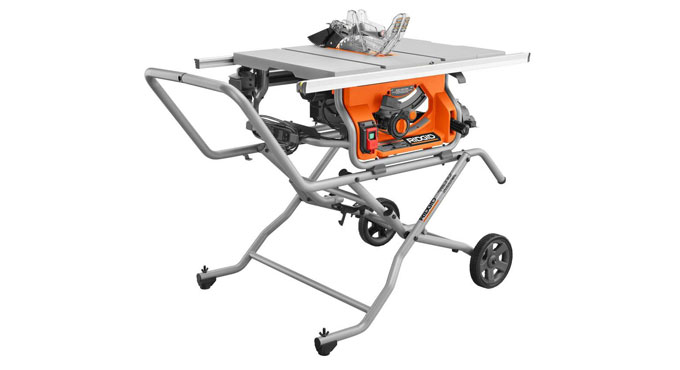
A table saw is a tool that is often underappreciated or forced out of small shops due to the size (and cost!) of most high-end units. I agree that most jobs can be done with a circular saw, but it is nearly impossible to replicate the precision and repeatability of a table saw, particularly when making multiple parts. I have used Ridgid 10 in. Pro Jobsite Table Saw with Stand ($399) for the past 7 years at my job, where we had little space for tools that aren’t used frequently and we dutifully abused it when it did get used (we often ripped 5/8″ thick 4’x8′ sheets of aluminum for tabletops with zero issues with a Freud aluminum blade).
The great part about this unit is that it folds down to 30″ wide by 24″ deep and is easily tucked up against a wall or behind a larger machine. As an added bonus, folding it dumps out any sawdust (or aluminum shards in our case) into a pile on the floor, making cleanup a breeze. This saw has a strong motor (15A) and an accurate, solid fence that feels much more sturdy and trustworthy than the fences on competing saws. I like using the saw so much that I purchased one for myself. It also has large wheels that make transport a breeze, even on rough surfaces.
I don’t have a garage, so I keep the saw in a shed and wheel it over 500ft of grass to the driveway when I need to use it without issue. It also boasts a lifetime free parts and service when you register it, which I haven’t had to use, but like the peace of mind that if anything breaks, it shouldn’t be an issue.
-- Ross Carmichael
10 in. Pro Jobsite Table Saw with Standby Ridgid
$399
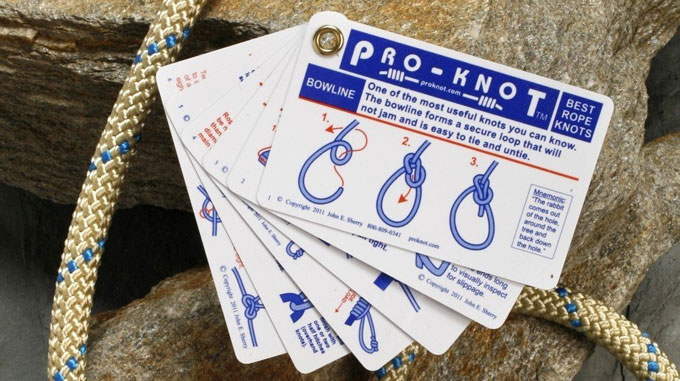
I’m a technical theatre professional, and being able to tie the proper knot in the appropriate situation is critical to saving time and staying safe. For a number of years, I’ve kept several sets of Knot Tying Cards around for emergencies. I keep one in my messenger bag, one in the glove box of my car, one in my tool bag, and there’s likely another one in the official junk drawer in the kitchen. While there are around 10 knots I use on an almost daily basis when I’m working, there are a handful of specialty knots I know when to use, but can never retain how to start (or finish) them. One particularly bothersome knot is the Trucker’s Hitch. If done correctly, it will secure an unruly load in short order (and can be tied with one hand if you’re dexterous). If you do one little turn incorrectly, however, It becomes a slip knot and won’t hold squat.
That’s where these flash cards come in handy. They have this and other bothersome knots, and the cards provide enough of a trigger that I can execute the desired effect. More often than not, when someone 20 feet away asks me to tell them how to tie a particular knot, I end up throwing the set to them. Much easier than explaining it! And they always manage to tie the knot safely. Not all knots are created equal, and knowing how to create and properly use a variety of them is useful for everyone. On the stage, though, a poorly-tied knot can quite literally kill someone. I’ve seen more than one “of course I know how to tie a square knot” load crash to the floor because hubris trumped common sense and basic knowledge.
That said, these cards are handy for those who already know how to tie proper knots, but don’t do so every day and need a quick reminder. For the novice knot-tier, the previously-reviewed Morrow Guide has never been equaled, IMO. I once taught a knot-tying class to a group of high school theatre students. I provided a 50-foot piece of rope and told them it could become a ladder. I showed them the page in the book and let them have at it. In about 30 minutes, they had a load-bearing 12-foot rope ladder. You can’t beat that!
Triumph Bonneville is one of those iconic motorcycles that even non-riders know the name of, perhaps because their father rode one back in the day. In recent years, the Bonneville has grown into a decent-sized family, and like all families, the Bonnevilles change over time. Today, the 2021 Triumph Bonneville family made their first public appearance, and apparently, they have been taking pretty good care of themselves during the pandemic. While Euro 5 compliance leads the list of changes each Bonnie model underwent, the good folks at Hinckley took the opportunity to grace a handful of key changes on each Bonneville model.
2021 Triumph Bonneville T120
Bonneville T120 and T120 Black
The twin brothers of the Bonneville family have been working out in their spare time. While most of us have been sitting on our couches eating ice cream and watching Netflix, the T120 and the T120 Black have managed to lose a total of 15.5 lb. each instead of gaining their Covid-19.
Power numbers from the 1200cc high-torque parallel-Twin remain the same at a claimed 79 hp at 6,500 rpm and 77 lb-ft at a low 3,500 rpm. By utilizing a lighter crankshaft and optimized clutch and balancer shafts, the engine’s rotating mass has been reduced for snappier throttle response. The engine’s service intervals have now increased to 10,000 miles.
2021 Triumph Bonneville T120 Black
Let’s talk about the weight loss. The 18 in. X 2.75 in. front and 17 in. X 4.25 in. wheels are new 32-spoke aluminum rimmed units which pay off in multiple ways. They reduce unsprung weight and rotating mass, making for quicker steering and better road holding. The twin 310mm discs mounted to the wheels get squeezed by Brembo two-piston sliding calipers, which are assisted with ABS. The rear brake remains a Nissin two-piston caliper mated to a 255mm disc.
On the technology front, cruise control is now standard and receives its own dedicated button on the handlebar. Additionally, the ride modes were massaged for an improved riding experience.
Expect to see the Bonneville T120 and T120 Black in US showrooms in May 2021. The starting price for both models is $12,050.
2021 Triumph Bonneville T100
Bonneville T100
The smaller sibling to the 1200cc Bonnevilles, the Triumph Bonneville T100 features a 900cc parallel-Twin. Not only did the T100 lose weight to the tune of 9 lb., but it also gained in power output, too. The 84.6mm x 80.0mm engine bumped its horsepower a full 10 hp to 64 hp at 7,400 rpm, while peak torque checks in with 59 lb-ft at 3,750, and 80% of that before 2,000 rpm. The engineers even had time to increase the redline by 500 rpm. Part of the T100’s weight reduction comes from a low inertia crankshaft, lighter balancer shafts, a thin-walled clutch cover, and a magnesium cam cover.
While the decrease in weight affects handling, the T100 also receives a higher-spec non-adjustable 41mm fork. The rear suspension remains twin preload-adjustable shocks. The same Brembo calipers and 310mm discs seen on the T120s make an appearance here, as does the ABS.
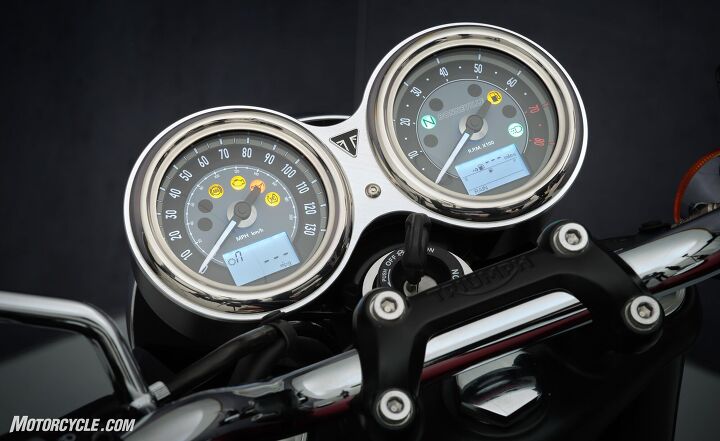
The styling also received a smattering of changes. A new instrument face gives riders something pretty to look at, and the engine covers and cam cover received black power coating. Triumph also lists 117 factory accessories for your customizing pleasure.
Expect the Triumph Bonneville T100 to appear in North American showrooms in March 2021 for a starting price of $10,500.
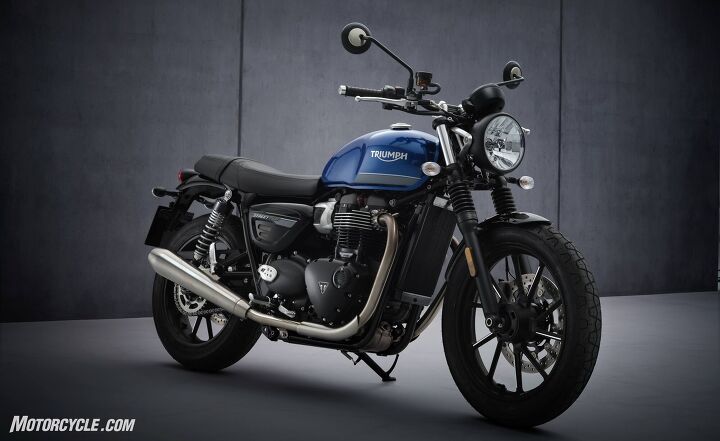
2021 Triumph Street Twin
Street Twin
If the latest 900cc High Torque parallel-Twin engine was good enough for the T100, it should be in the amiable Street Twin, too. This means that the Street receives the same 10 hp bump in power with improved emissions and fuel economy. As with the engine, the up-spec brakes make their way here, too.
The Hinckley engineers didn’t stop there, though. The seat features a new 10mm thicker seat with a new foam that increases rider comfort while traveling 30 in. from the ground. Carrying the rider are new cast aluminum wheels with machined detailing. The bodywork and brushed aluminum detailing are also new.
The Triumph Street Twin will hit American sales floors in March 2021 for a MSRP of $9,400.
2021 Triumph Street Twin Gold Line Limited Edition
Street Twin Gold Line Limited Edition
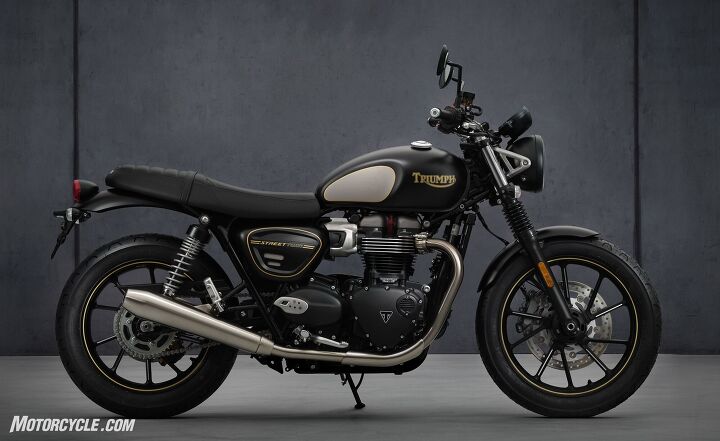
This bike is what happens when you take the already stylish Street Twin and give it a makeover. Only 1000 of these limited edition motorcycles will be made, and each will come with a certificate of authenticity. These hand-detailed custom motorcycles receive hand-laid gold pin striping with a Triumph heritage logo over the Matte Sapphire Black paint. The knee cutouts receive brushed aluminum surrounded by more gold. Even the wheels get the gold pin striping treatment. Finally, the new side panel which includes a custom Street Twin logo.
You’ll have to wait until June 2021 to throw a leg over the Street Twin Gold Line Limited Edition and show up with $10,150.
2021 Triumph Bonneville Speedmaster
Bonneville Speedmaster
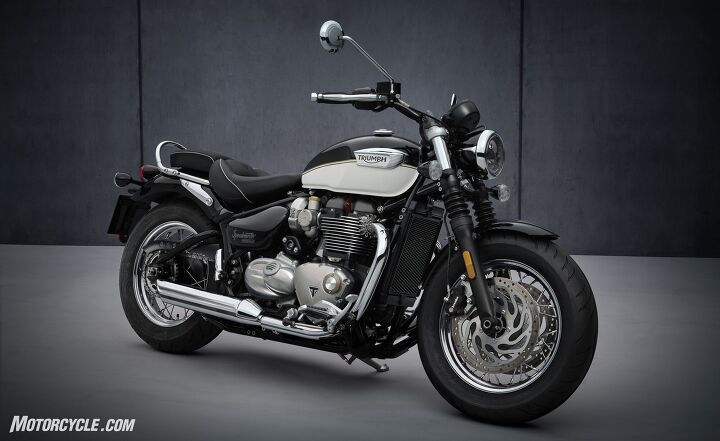
The cruiser in the Bonneville family receives the same engine changes as the T120 for improved power, responsiveness, and emissions. The front brakes get the Brembo treatment, too. The fork, however, gets higher-specification 47mm Showa cartridges. The preload-adjustable mono shock stays the same. Other than the new instrument face, the Speedmaster’s styling remains unchanged. 2021’s colors are: Jet Black, Fusion White/Sapphire Black, and Red Hopper. Look for it in March 2021 for $13,150.
2021 Triumph Bonneville Bobber
Bonneville Bobber
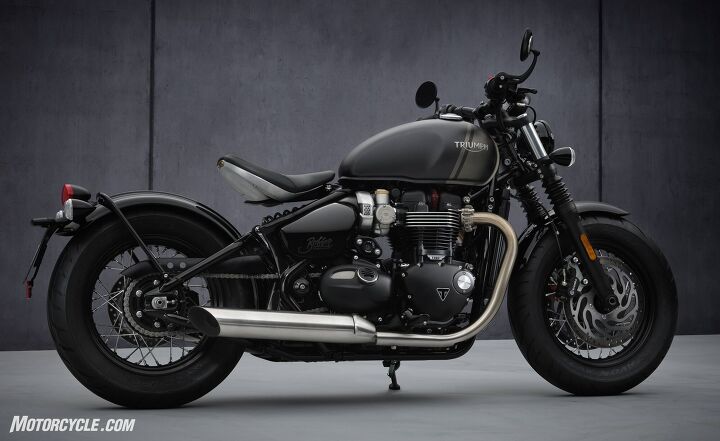
Fans of this stripped down Bonneville will be happy to learn that the Bobber has lost none of its elemental appeal and has gained the performance changes afforded to the 1200cc high-torque engine. In addition to the more responsive engine, the Bobber sports a new 3-gallon tank. The fork holds a new, fat 16-inch front wheel and the Brembo calipers of the other Bonnies. Finally, the engine gets some new clothes in the form of black powder coating on the engine, cam, and sprocket covers along with the new instrument styling.
See the Bonneville Bobber in person in March 2021. It will have a $13,150 price tag with Matte Storm Gray/Matte Storm Ironstone, Cordovan Red, and Jet Black color options.
In a 7-minute video uploaded by The Slo Mo Guys, host Gav shows how an old-school handheld 16mm Russian film camera works thanks to detailed footage captured at 1,000 frames per second with a Phantom Flex 4K.
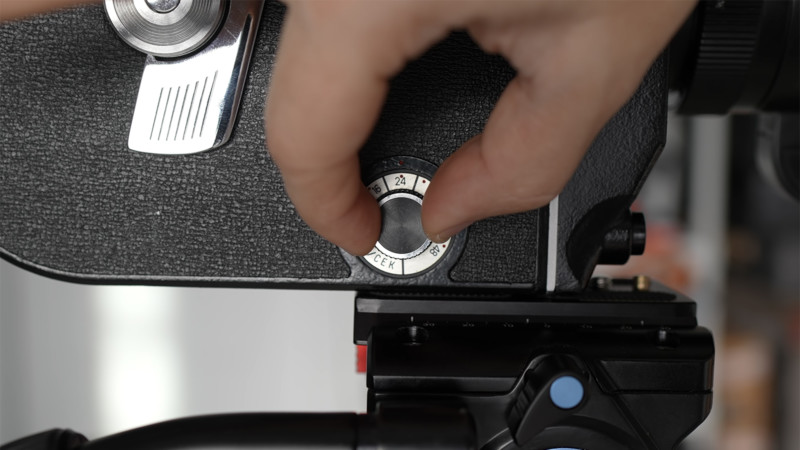
After showing how film is loaded into the camera (and what film specifically this particular model camera takes), Gav demonstrates how to adjust the frame rate and shows what that looks like when operating. Of note, this particular camera can shoot as low as 8 frames per second all the way up to 48 frames per second.
Similar to how a DSLR works, which the Slo Mo Guys shared in a previous video, this film camera provides the shooter with a true-the-lens view of the subject, so the filmmaker can actually see what the camera is going to capture. It does this through a series of mirrors that reflect down to a mirrored disc that is placed at a 45-degree angle in front of the area where the film is exposed to light.
This mirror doesn’t quite work the same way as in a DSLR, however. It doesn’t move out of the way to then make room for a shutter that opens and closes to allow a certain amount of light to hit the film, but rather just rotates out of the way to reveal the film plane.
“This mirror is the shutter itself,” Gav explains. “It’s a rotary disc shutter.”
That shutter, which looks like two mirror plates on each side of a disc, spins at a rate that exposes film to light 24 times a second (or more, or less, depending on the camera’s setting). The gap between the spinning blades determines the shutter speed: every half rotation of the disc, which is one frame, the film is exposed by 1/60th of a second, which is determined by that gap in the shutter (and is fixed).
Also interesting, when looking through the viewfinder there is blackout for when the film is exposed and the mirror is not in place. That means that anyone looking through the viewfinder is actually seeing frames that the camera isn’t capturing. While they happen so fast you won’t likely notice, it’s still fascinating to think about.
“You’re basically seeing the opposite cycles,” Gav says.
Thinking about how a DSLR works again, you’ll recall that if there is any motion to the camera during image capture, blur can happen if the shutter speed is slow enough. In that same train of thought, you might be curious why anything this camera captures isn’t a blurry mess. As demonstrated, Gav shows that as the film moves through the camera and is exposed to light, it is held perfectly still by the camera. It’s a wonderful piece of engineering. When the film goes from one frame to the next behind the spinning mirror, it moves into place and appears stationary by the time light hits it. Looking at a sheet of film that he numbered from 1 to 24 to show this effect, Gav notes that as the numbers advance, they move into place and remain steady without us (or the slow-motion camera) even seeing that happen.
To see how this works, he removes the mirror disc. What he reveals is that the machine is so well-timed that the film is perfectly moved into place by the mechanism which prevents any blur from happening.
The whole video is full of incredible, detailed shots of the film camera’s interior in motion, which for anyone who loves seeing the mechanics of cameras is just a joy to watch.
For more from The Slo Mo Guys, make sure you subscribe to their YouTube channel.
Among the fans of the Shelby Cobra, there are whispers in dark rooms of the Super Snake — a twin-supercharged 427 Competition Coupe of which only two were made, one...
There’s a lot to unpack when talking about zeroing a rifle, including at what distance it should be zeroed. Steve Adelmann walks you through important considerations.
Looking at the target after firing can tell you a lot about your shooting. Here’s a quick guide to help you spot some of the more common marksmanship errors, all based upon shooting a pistol with two hands on the gun.
Tom Davies knows a thing or two about staying the course. The 29-year-old British adventurer, also known as GeoWizard, first gained a following through YouTube videos that showcased his skill playing the popular web-based game GeoGuessr. His channel, which he describes as “home of the mischievous adventure,” has 74 million views and counting.
Davies is perhaps now best known for his “Mission Across” series, which chronicles his adventures trying to cross entire countries in a straight line. He chooses a route, uploads it to a handheld GPS, and sets off. The mission’s success is determined by the accuracy with which he follows that linear route; he even has a grading system. A mission in which there is no deviation of more than 25 meters (about 80 feet) is defined as a platinum run. Less than 50 meters (a little more than 160 feet)? It’s a gold run.
His two attempts to cross Wales were unsuccessful, but Davies recently scored a platinum run across Norway, no small achievement given the country’s abundance of mountains and fjords.
Davies has encountered everything from barbed-wire fences and hostile farmers to brittle cliffs and gorges. Among his most harrowing moments: getting stuck in a peat bog, slowly sinking as he struggled to move. His next project promises ample adventure. With his best friend Greg, a veteran of the second "Mission Across Wales" attempt, Davies is planning a straight shot across rugged Scotland.
Atlas Obscura chatted with Davies via email about keeping to the straight and narrow.
How did you come up with the straight line mission concept?
Its roots hark back to my late childhood, when myself and my then step-brother, and now best friend, Greg would leave my mother’s house, perched on the edge of the huge conurbation that is the West Midlands (of England), and simply set off in an easterly direction into the countryside of Staffordshire searching for adventure and mischief. Aged 13 and with nothing but a fiver in our pockets and the clothes on our back, we would "mission" our way through fields, clamber over fences, hedges and rivers, evading farmers and inevitably making some sort of strange and intriguing discovery. Without fail we would have a string of great stories to regale Greg's dad, who would begrudgingly pick us up from some random town 15 miles away.
Fast-forward to a 28-year-old me, still yearning for adventure and wanting to do something new in a world where there was so little left to be done, trying to think of some obscure record that could potentially be broken. Slowly but surely, with the knowledge that no one my age could have possibly hopped more barbed wire fences than myself, and with a lot of free time to scour Google Earth, the mad idea that was the straight line mission became a reality.
Just how challenging is it to walk in a straight line?
You have to be constantly looking at the screen of the GPS to make sure you're not veering from it, which is especially hard in dense, disorientating forests or in the high pressure environment of a working farmyard.
What causes you the most worry?
Farmers and landowners were the main source of paranoia in Wales, and will be in the upcoming Scotland trip. If a stern, no-nonsense farmer catches up to you on his quad bike, which is highly possible, then it could easily end the trip. You won't meet many farmers who will let you climb over their hedgerows. At best they will direct you to the nearest track and off their land, which could be hundreds if not thousands of meters off course, and I aim to keep well within 25 meters.
You’ve tasted victory in Norway and suffered defeat in Wales. Which moments stand out for you most?
Half a mile into my first Wales attempt, a freezing, swollen river forced me over 100 meters wide (of my line). Luckily, I found a rotting old bridge on which I managed to eke my way over the raging torrent below. Ultimately I failed the trip nine miles from the coast when I got into a sticky situation in the mountains. (I was) hypothermic and running on empty after having walked across 12 miles of swampy, uneven moorlands and rather large mountains. I was supposed to rendezvous with a subscriber of mine, Joey, at the other side of the mountains to restock on food and GoPro batteries, but (facing) a ravine, undetected on Google Earth, darkness drawing in and no phone signal, I realized I had to get off that mountain. Heartbreakingly but with no choice, I had to leave my line and climb down to safety so that Joey and my family knew I was alive and well.
Norway, which I made sure to plan more thoroughly, had hardly any fields or owned land. It was wild, and the biggest threats there were navigating the steep cliffs and drops in the rugged mountain wilderness. Thanks to some help from another subscriber, Noah, who identified all of the steepest gradients using lidar imagery, I managed to do so safely. In the end I almost drowned in a peat bog, but thankfully I managed to claw my way out and stagger on, completing the Norway line with a maximum deviation of around 25 meters. A huge weight off my shoulders.
What will be the biggest challenges for you in Scotland and beyond?
I can't give too much away, but with some of the obstacles that lie on our line, it promises to be a truly epic adventure. Beyond that I don't plan on slowing down. Despite its brutal, often torturous nature, I'm in love with this breed of adventure. There aren't too many countries where a straight line mission is realistically possible, but I plan to conquer the ones where it is.
This interview has been edited for length and clarity.
But increasingly, the real engines behind Berkshire Hathaway's investment arm are more recent pick-ups: growth-oriented stocks such as Apple and Amazon.com, and even lesser-known firms such as Snowflake and StoneCo.
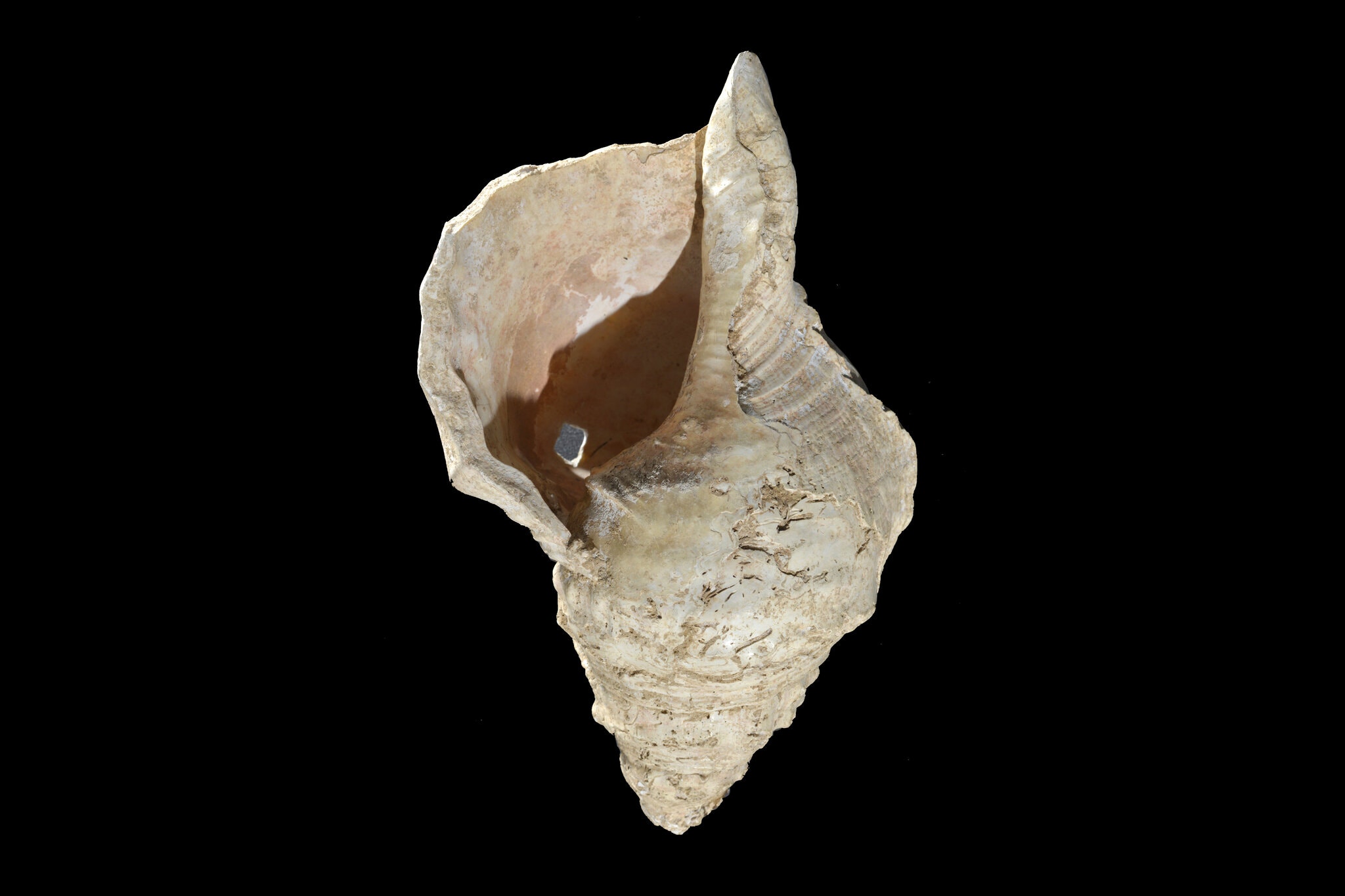
Photo by C. Fritz, Muséum d’Histoire naturelle de Toulouse
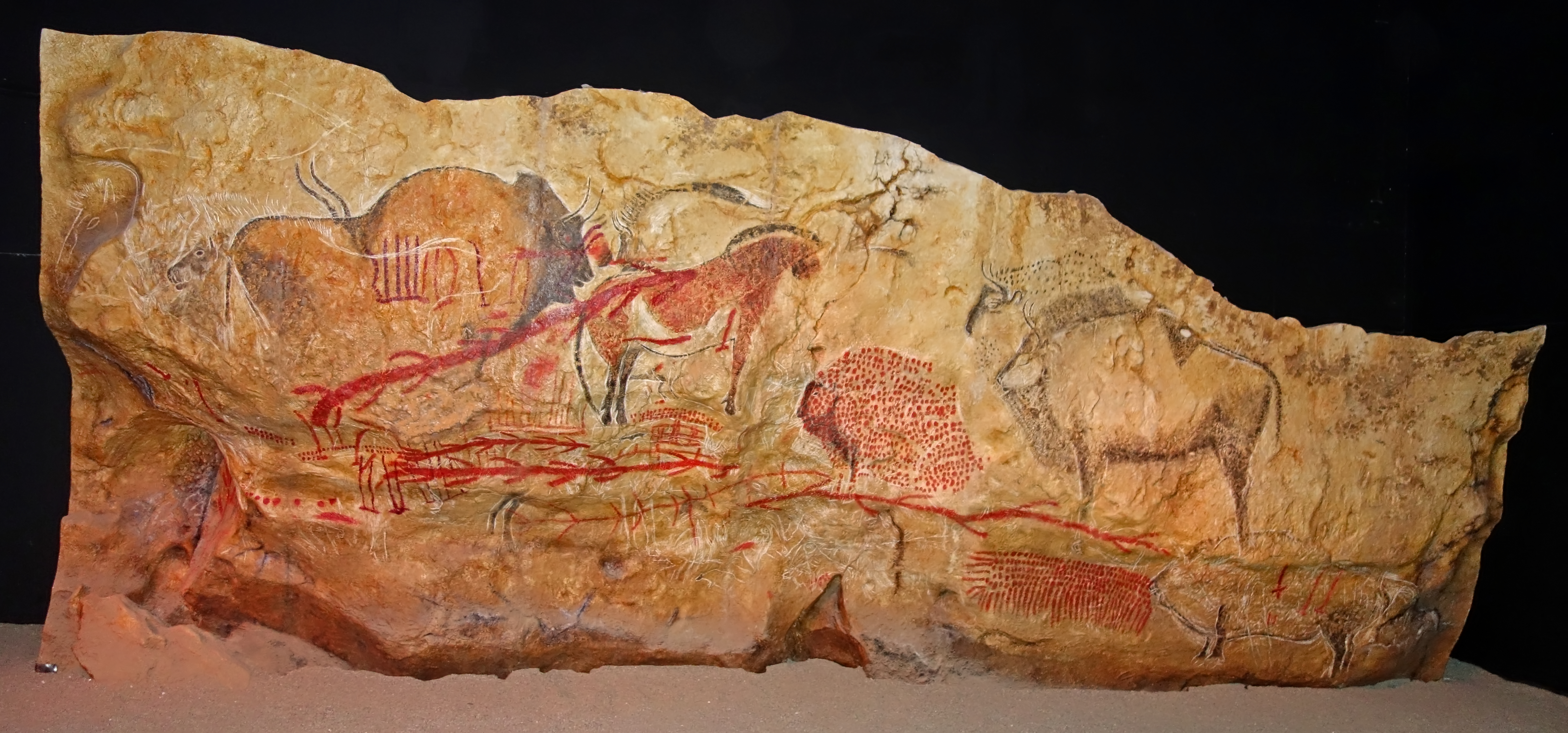
Brian Eno once defined art as “everything you don’t have to do.” But just because humans can live without art doesn’t mean we should—or that we ever have—unless forced by exigent circumstance. Even when we spent most of our time in the business of survival, we still found time for art and music. Marsoulas Cave, for example, “in the foothills of the French Pyrenees, has long fascinated researchers with its colorful paintings depicting bison, horses and humans,” Katherine Kornei writes at The New York Times. This is also where an “enormous tan-colored conch shell was first discovered, an incongruous object that must have been transported from the Atlantic Ocean, over 150 miles away.”
The 18,000-year-old shell’s 1931 discoverers assumed it must have been a large ceremonial cup, and it “sat for over 80 years in the Natural History Museum of Toulouse.” Only recently, in 2016, did researchers suspect it could be a musical instrument. Philippe Walter, director of the Laboratory of Molecular and Structural Archeology at the Sorbonne, and Carole Fritz, who leads prehistoric art research at the French National Center for Scientific Research, rediscovered the shell, as it were, when they revised old assumptions using modern imaging technology.
Fritz and her colleagues had studied the cave’s art for 20 years, but only understood the shell’s peculiarities after they made a 3D digital model. “When Walter placed the conch into a CT scan,” writes Lina Zeldovich at Smithsonian, “he indeed found many curious human touches. Not only did the ancient artists deliberately cut off the tip, but they also punctured or drilled round holes through the shell’s coils, through which they likely inserted a small tube-like mouthpiece.” The team also used a medical camera to look closely at the shell’s interior and examine unusual formations. Kornei describes the shell further:
This shell might have been played during ceremonies or used to summon gatherings, said Julien Tardieu, another Toulouse researcher who studies sound perception. Cave settings tend to amplify sound, said Dr. Tardieu. “Playing this conch in a cave could be very loud and impressive.”
It would also have been a beautiful sight, the researchers suggest, because the conch is decorated with red dots — now faded — that match the markings found on the cave’s walls.
The decoration on the shell looks similar to an image of a bison on the cave wall, suggesting it may have been played near that painting for some reason. The conch resembles similar “seashell horns” found in New Zealand and Peru, but it is much, much older. It may have originated in Spain, along with other objects found in the cave, and may have traveled with its owners or been exchanged in trade, explains archeologist Margaret W. Conkey at the University of California, who adds, writes Zeldovich, that “the Magdalenian people also valued sensory experiences, including those produced by wind instruments.
Many thousands of years later, we too can hear what those early humans heard in their cave: musicologist Jean-Michel Court gave a demonstration, producing the three notes above, which are close to C, C-sharp and D. The shell may have had more range, and been more comfortable to play, with its mouthpiece, likely made of a hollow bird bone. The shell is hardly the oldest instrument in the world. Some are tens of thousands of years older. But it is the oldest of its kind. Whatever its prehistoric owners used it for—a call in a hunt, stage religious ceremonies, or a celebration in the cave—it is, like every ancient instrument and artwork, only further evidence of the innate human desire to create.
These 15 geographically separated destinations were chosen to help out local economies, show off the vast diversity of the country and maybe help people learn a thing or two.
Less than 2 months after breaking the $20k barrier for the first time, the digital currency more than doubled in price, hitting a high of $49,344 this week.
Every time bitcoin is proclaimed to be dead, it seems to surge back, buoyed by bullish investors, favorable legislation, and tech titans’ tweets.
At this point, nearly everyone has heard of bitcoin. But many folks still don’t quite understand how the currency is created.
It’s not printed like cash. It’s not a physical object like a gold bar. It’s not stored on a piece of plastic like a debit card. It just exists somewhere in a vast digital expanse until it’s excavated into circulation by a so-called bitcoin miner.
In this illustrated guide, we’ll cover the following:
How bitcoin is created (a process called mining)
How the economics of mining have changed over time
The effects this process has on power consumption
The digital miner
To help explain all of this, we’d like to introduce you to a man named Willy “Wild Eyes” Tibbs.
Wild Eyes made a fortune in the California Gold Rush in 1849. Now — 170 years later — he’s back from the grave for his next prospecting adventure.
Zachary Crockett / The Hustle
Wild Eyes has heard that there are riches to be made in mining a newfangled digital resource called bitcoin.
As he sees it, bitcoin shares a few similarities with gold:
There’s a finite supply: As dictated by bitcoin’s creator, there can only ever be 21m total coins.
They must be mined: The only way to release new bitcoin into circulation is through the efforts of digital excavators.
Wild Eyes digs a little deeper and finds out that bitcoin was created in the wake of the financial crisis in 2008 by an elusive pioneer (or group of pioneers) under the alias of Satoshi Nakamoto.
Nakamoto’s mission was to create a decentralized currency system that wasn’t beholden to middlemen. Among it’s touted benefits:
It’s democratic: Unlike paper money, where a single central authority like a bank manages a record of all transactions, bitcoin is minted, circulated, and audited by thousands of users.
It’s harder to manipulate: Government agencies can’t intercede by doing things like increasing volume or fiddling with interest rates.
It’s global: Someone in Tennessee can instantaneously trade bitcoin with someone across the globe in Tokyo at a low cost.
The backbone of this concept is a distributed network called the blockchain, where a record of all bitcoin transactions is stored.
Now, for an old-school argonaut like Wild Eyes, this is a tad complicated.
Zachary Crockett / The Hustle
To help him out, let’s step back a bit and briefly explain the blockchain using something he can understand: a choo-choo train.
Imagine that the blockchain is a loooong train — a blocktrain, if you will.
This train contains a public record of all bitcoin transactions. Each time a trade is made through a cryptocurrency platform like Coinbase, the details of the transaction are coded and broadcast, along with other transactions, to a vast network of users called bitcoin miners.
From there, the following process unfolds:
Miners compete to add the next car to the train by bundling up a bunch of transactions into “blocks.”
Miners solve a computational problem (called “proof of work”) that assigns the block an identifying code (a hash).
The “winning” block is distributed to, and verified by, all the other miners in the network and is added to the blockchain.
Only one car can be added to the train at any given time, and each one takes ~10 minutes on average to verify and attach.
Zachary Crockett / The Hustle
These bitcoin miners serve 2 major functions:
They are the printing press of bitcoin: Adding new blocks to the blockchain is the only way to release new bitcoin into circulation.
They are the auditors of bitcoin: Through the process of mining, they verify the legitimacy of all transactions on the blockchain.
By solving the equation first and adding the next block to the chain, a miner is rewarded with a set amount of bitcoin.
When bitcoin mining first started, the reward was 50 bitcoin (BTC). But as dictated by the coin’s creator, the reward is cut in half every time 210k new blocks are added to the chain — or roughly every 4 years.
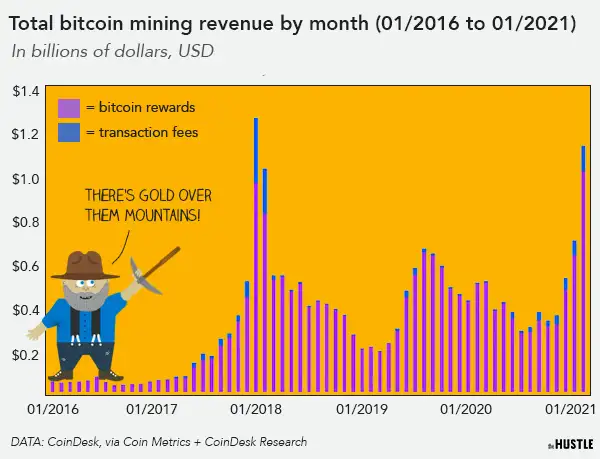
As of February 2021, miners receive 6.25 bitcoin for every new block they mine — or ~$294k based on the current market value. They also get to keep the transaction fees from the trades in that block, which are currently around $20/trade.
Today, it’s estimated that there are more than 1m bitcoin miners in operation — and they’re all competing to add the next block to the chain.
Combined, the rewards these miners earn top$1B per month.
Zachary Crockett / The Hustle
On paper, these numbers make mining an extremely appealing pursuit for folks like Wild Eyes.
But as it turns out, the money’s not so easy to come by.
The bitcoin mining arms race
As mentioned above, a bitcoin miner has to solve a computational problem in order to successfully add a new block to the blockchain and receive his reward.
We won’t get into the nitty-gritty of that problem here (check out this post for a full breakdown on the math).
But in simple terms, a miner basically has to employ a computer to run through trillions of hexadecimal number combinations until it spits out an acceptable 64-character code. This coding keeps the blockchain secure.
The difficulty of this problem adjusts in proportion to the network’s total mining power: As more bitcoin miners join the network to compete, the problem becomes harder to solve, thus requiring even more computing power.
This led to something of a bitcoin mining arms race.
A decade ago, it was possible to mine bitcoin using a simple computer processor. But as mining began to spread, people utilized more powerful hardware like GPUs (graphics processing units), FPGAs (field-programmable gate arrays), and dedicated ASIC mining machines.
The volume of miners on the network — and the random nature of number generation — has made winning a block reward into a lottery.
Zachary Crockett / The Hustle
Bitcoin miners have to weigh the cost of hardware (and more importantly, the cost of the electricity required to run it) against the slim odds of winning on a regular basis.
In most cases, operating alone is no longer financially viable.
Let’s say Wild Eyes bought an old ASIC machine — say an Antminer s9 (~$400 on eBay) — and rigged it up in his basement. According to bitcoin mining calculators, it would likely take him 225 years to generate a block.
And while sitting around waiting for that to happen, he’d spend ~$3.50 per day (~$1.3k per year) on electricity just for the one machine.
For this reason, today’s bitcoin mining scene is dominated by 2 factions:
Mining pools: Groups of individual miners who combine their computing power, then divide any rewards up proportionally, based on how much computing power each person contributed
Massive mining “farms” that have thousands of machines running 24/7
Around 66% of the world’s bitcoin mining now happens in China, where cheap hardware makes large operations more economically feasible.
In Dalian — China’s bitcoin mining capital — one factory alone mines 750 bitcoin per month, or $35.6m in value at the current market rate. To do so, it utilizes 3k+ ASIC machines and spends $1m+ per month on electricity.
Zachary Crockett / The Hustle
Averaging across all types of operations, one bitcoin costsbetween $5k and $8.5k to mine. Power makes up the vast majority of the overhead.
The key for many mine operators is to plunk down where electricity costs are especially cheap — places like Iceland, upstate New York, small towns in Washington State, and rural Texas.
But power consumption isn’t just an economic consideration, it’s one of the biggest controversies in the practice of bitcoin mining.
The power problem
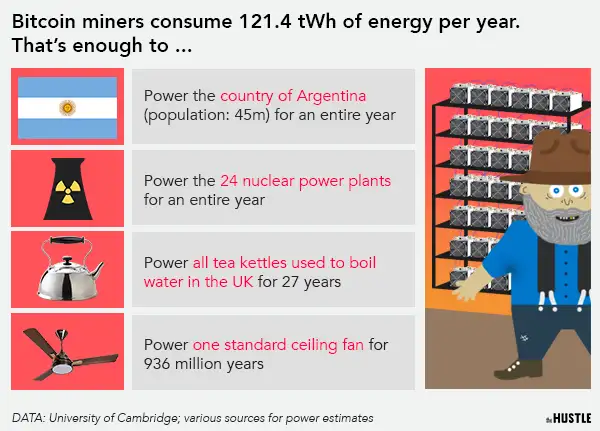
Collectively, bitcoin miners use121.4 terawatt-hours (tWh) of electricity per year to sustain their operations.
To give that number some additional context, that’s enough to power the entire population of Argentina (45m) for an entire year.
Zachary Crockett / The Hustle
Of course, traditional financial institutions aren’t much better.
It has been estimated that the world’s banks collectively consume at least100 tWh of power per year, when factoring in branches, servers, ATM machines, and paperwork.
Eventually, though, the power used by miners will be a moot point.
Roughly 18.6m (88.5%) of the possible 21m bitcoin have already been mined. At the current rate, the final bitcoin is projected to be mined in the year 2140.
Most of the gold, so to speak, has been snatched from the streams. So ol’ Wild Eyes may be better off just buying bitcoin on the open market.
I am still looking for tips testers: Pick a tip (any tip), subject it to honest, real-world testing, report back. 3 tipsters will win signed copies of my Tips and Tales from the Workshop Volumes 1 and 2 (V2 coming this spring).
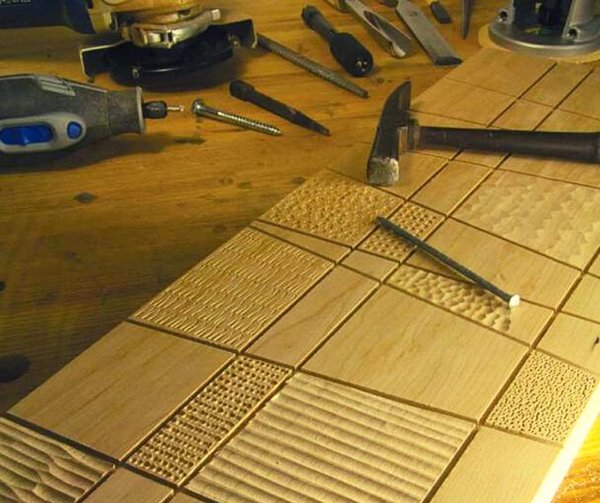
Adding Textures to Wood
So many cool textures with common tools and materials.
Make: tweeted a link to this piece I did on their website many years ago. Apparently it still gets a lot of traffic. Looking at it again, I see why. Lots of great ideas in here (from Canadian Woodworking) on using screws, round files, chisels, and other tools and hardware to create patterns/textures in wood.
Saving the Best for Last
A year and a half in the making!
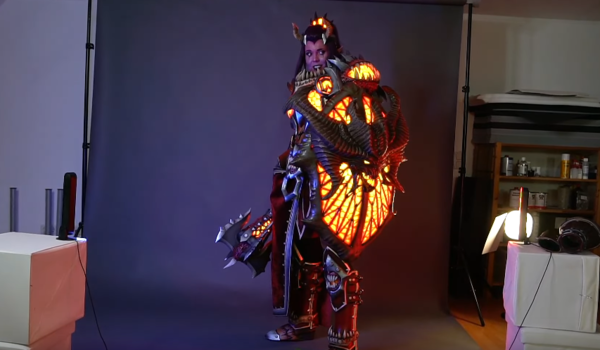
On KamuiCosplay, Svetlana shows off the amazing “Demonic Brigitte” outfit she spent a year and a half working on. In the video, she shares a great tip: When doing a long and complicated project, don’t be tempted to build the part that you’re most excited about first. Save it for the end. That way, it’ll power you through the less exciting parts. In her case, she was most excited about making the shield, so she saved that for last.
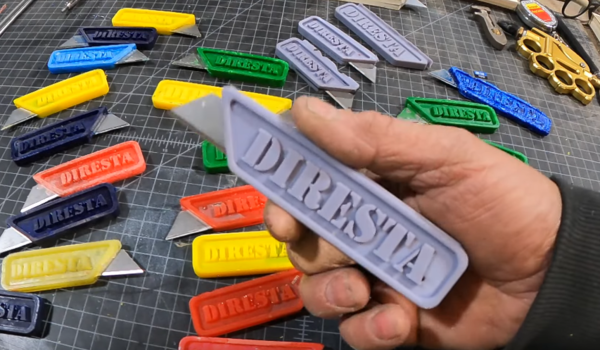
Making a Disposable Utility Knife with Leftover Resin
Can’t have enough of these around home and shop.
Jimmy DiResta had a cool idea. He created a mold for a disposable utility knife, so if he’s casting something and has a bunch of leftover resin, he can cast a disposable utility knife with the excess. He’s planning on developing the mold into a product for sale, but you could obviously create such a mold yourself. This project also raises a question. If you do a lot of casting and have leftover resin, what other tools and castable objects can you create silicone molds for?
Cable Organizing and Labeling
“Cable labeling” Say that 20 times!
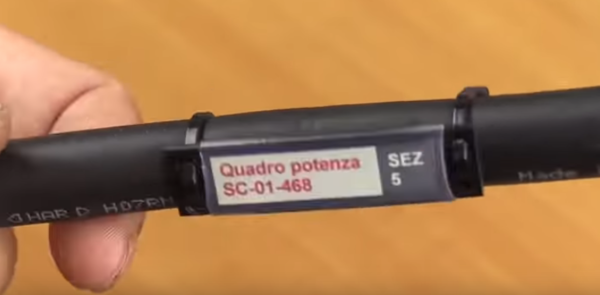
To be honest, I found this video annoyingly redundant. But it was a good reminder of how you can use plastic cable ties to neatly organize cable runs and pieces of ties and clear heat shrink tubing for creating handsome cable labels.
Inverting Boxes
Do you have some cardboard boxes that are downright grotty from multiple trips through the mail system or new shipping boxes from mailing services you no longer use? Hopefully, you already know this, but you can easily turn those boxes inside out and give them a new life. I used to use FedEx years ago and had a big stash of their boxes in every size. Now, I just invert them to mail through other services. [Via Jimmy DiResta]
Shop Tales: Beewax and Boning
Back in October, I got this wonderful email from reader Jeff B, in response to my call for shop tales I can use in the next volume of my tips book. This is exactly the sort of thing I’m looking for. Thanks, Jeff!
In the mid-1980s, I lived with my wife and two kids in Seattle on the south side of Queen Anne Hill. I worked at a funeral home at the time and walked two miles to work. I made myself a walking stick from a piece of driftwood and sealed it with shellac, or something similar. Several times during my daily walking commute, I ran into Mr. Ball (that’s all I ever knew him as). He was about 70, spoke with a southern accent, and always wore a suit and tie. He used a walking stick, too, of his own making. His was curly willow, with sinuous twists to it. Mr. Ball chose a walking stick with a natural fork in it. The bottom third of the stick had two legs leaving the fork, and each leg was a curly mirror image of the other. At the bottom of the stick, Mr. Ball put two plastic champagne corks to protect the wood. He looked at my stick and suggested that I use something more natural and less toxic to seal future walking sticks. He used beeswax, rubbing it into the pores of the wood with a piece of bone or antler. He called this boning. He said it also compresses the outer layer of wood, making the surface stronger. After the boning, you go over the wood with a cloth to make the wax shine. Mr. Ball also said that as a child he didn’t have sandpaper. He’d smooth wood by using a piece of broken glass.
We moved and I never saw Mr. Ball again. I often wonder about him. I’ve used the beeswax and boning method on dozens of projects since. Next to my workbench, I have a little cardboard box of beeswax, a few antler sections, and a piece of bone.
[Gareth’s Tips, Tools, and Shop Tales is published by Cool Tools Lab. To receive the newsletter a week early, sign up here.]
This tool has been my go-to ratchet for the past 18 months on a slow-moving Vanagon restoration job. It is the absolute best option for getting to nuts and bolts in difficult to reach places or scenarios when you have to add extensions and swivel adapters to reach a fastener.
This tool functions as a normal ratchet would, but adds one unique and indispensable feature; the handle can twist to rotate the socket. What this allows you to do is to get the socket on a nut or bolt in a difficult to reach area, and then turn the handle to tighten or loosen the fastener without having to “swing” the ratchet from side to side. It is truly a zero arc ratchet when in the twist mode.
Even better, you can twist the handle either left or right and BOTH twisting actions work in whatever mode the ratchet is set in. So you are loosening a bolt in a tight area, you can twist the handle left AND right to continue loosening. This ratchet has allowed me to finish some tasks that would require possibly removing engine components to get enough arc room to swing a conventional ratchet, adding more time and frustration to the task.
I wouldn’t use this ratchet to snug or break loose stubborn hardware, as I worry this extra wizardry comes at the cost of strength/durability (I hope someone does a teardown on one someday so I can wrap my head around how it works!), but I have never had any issues arise and this is likely overcautious on my end.
-- Ross Carmichael
Stanley Hand Tools 89-961 1/4-Inch Rotator Ratchet