Shared posts

02 Mar 12:43

Garfield’s a boy … right? How a cartoon cat’s gender identity launched a Wikipedia war.


“Sir?” (Copyright Paws Inc.)

Garfield is lazy; Garfield is a cat; Garfield likes lasagna.

Is there really much more to say about Garfield? The character is not complicated. Since the comic debuted in 1978, Garfield’s core qualities have shifted less than the mostly immobile cat himself.

But this is 2017 — a time of Internet wars, social conundrums and claims to competing evidence about Garfield’s gender identity.

Wikipedia had to put Garfield’s page on lockdown last week after a 60-hour editing war in which the character’s listed gender vacillated back and forth indeterminately like a cartoon version of Schrödinger’s cat: male one minute; not the next.

“He may have been a boy in 1981, but he’s not now,” one editor argued.

The debate has spilled into the broader Internet, where a Heat Street writer complained of “cultural marxists” bent on “turning one of pop culture’s most iconic men into a gender fluid abomination.”

It all started with a comment Garfield’s creator, Jim Davis, made two years ago in an interview with Mental Floss — titled innocuously: “20 Things You Might Not Know About Garfield.”

Between the site’s plugs for Garfield DVDs, Davis revealed a few harmless curiosities about the cat: Garfield is named Gustav in Sweden. Garfield and his owner Jon Arbuckle live in Muncie, Ind.

“Garfield is very universal,” Davis told Mental Floss mid-interview. “By virtue of being a cat, really, he’s not really male or female or any particular race or nationality, young or old.”

The remark caused no fuss. At first.

Until last week, when the satirist Virgil Texas dug the quote up and used it to make a bold claim and bold move:

A brief note about Virgil Texas: He’s been known to troll before. The writer once co-created a fictional pundit named Carl “The Dig” Diggler to parody the media and annoy Nate Silver.

But Texas told The Washington Post he was only concerned about “Garfield canon,” in this case.

Texas said he came across Davis’s old quote while watching a five-hour, live-action, dark interpretation of Garfield (yes, really). So he invented a Wikipedia editor (anyone can do it) named David “The Milk” Milkberg last week, and changed Garfield’s gender from “male” to “none.”

Almost instantly, the universe of Garfield fans clawed in.

A Wikipedia editor reverted Garfield’s gender back to male less than an hour after Texas’s change.

One minute later, someone in the Philippines made Garfield genderless again.

And so on. Behind the scenes, Wikipedia users debated how to resolve the raging “edit war.”

“Every character (including Garfield himself!) constantly refers to Garfield unambiguously as male, and always using male pronouns,” one editor wrote — listing nearly three dozen comic strips across nearly four decades to prove the point:

The one where Jon tells Garfield “good boy!” before Garfield shoves a newspaper into his owner’s mouth.

The one where the cat’s “magical talking bathroom scale (probably a proxy for Garfield himself) refers to Garfield as a ‘young man’ and a ‘boy.’ ”

But another editor argued that only one of those examples “looks at self-identification” — a 1981 strip in which Garfield thinks, “I’m a bad boy” after eating a fern.

And Milkberg/Texas stuck to his claims: “If one could locate another source where Jim Davis states … that Garfield’s gender is male or female, then this would give rise to a serious controversy in Garfield canon,” he wrote on the Wikipedia debate page. “Yet no such source has been identified, and I highly doubt one will ever emerge.”

Threads of competing evidence spiraled through Twitter, where one commenter compared the Garfield dispute to Krazy Kat: a sexually ambiguous cartoon predecessor, profiled last month by the New Yorker.

Some hunted beyond the comic section in search of answers, into the ambiguous world of Garfield-themed merchandise and quasi-canonical arguments.

And some took the whole thing as a joke.

But others chided or philosophized: “Why must we care what Garfield is or isn’t?” Jimmy King asked. “Who cares what someone else perceives as him being male or female?”

Many pondered the meaning of Davis’s words in 2014, which were confusing because the creator referred to Garfield as “he” while suggesting the cat was neither he nor she.

A Wikipedia user proposed a compromise — “to provide both genders, each appropriately referenced: ‘Male[1] and/or none[2].” That didn’t get much traction.

Garfield’s gender swapped 20 times over 2½ days (during which his religion was briefly listed as Shiite Muslim for some reason) before an administrator was forced to step in.

Garfield was finally, officially listed as male on Wikipedia — citing four comic strips including one from 1979 in which a veterinarian says “he’s too fat.”

And the page was locked against more edits until March.

Yet a Heat Street writer dragged the argument to the very end of February — citing the spinoff character Garzooka’s “hard pecs” and “prominent bulge” as evidence of “a rugged, heterosexual American MAN.”

That didn’t resolve anything, of course.

Maybe this will:

“Garfield is male,” Davis told The Washington Post on Tuesday. “He has a girlfriend, Arlene.”

Presented with new evidence, the satirist deferred to the creator. “He’s in charge of the canon,” Texas said. “I’m just curious how it squares with his prior statement …

“If I had the opportunity I would interrogate him.”

But Wikipedia has already progressed beyond gender disputes. Now other aspects of the fat, lazy cat are being called into question.

“Forget about his gender and alleged Muslim faith,” a user wrote Monday. “Need we really list Arlene under the ‘spouse’ category?”

More reading:

This is what happens when two Internet nerds battle over politics

With his first-ever ‘Garfield’ musical, creator Jim Davis revels in a dream fulfilled

From our 1982 archives: “The Cat That Rots the Intellect”

01 Mar 14:15

The ‘Kellyanne Conway on the couch’ controversy is so incredibly dumb

Joel Thrasymachus Dahl

"This is not only dumb, but it distracts from more serious and consequential debates like Trump's travel ban, his campaign's contacts with Russian intelligence officials and his war against leaks. We're WAY better than this. We need to act like it."

Agreed. If everything is an outrage, nothing is an outrage.

On Monday night, this photo began making the rounds on the Internet:


Senior adviser Kellyanne Conway (Jonathan Ernst/Reuters)

The photo, taken Monday, show White House counselor Kellyanne Conway perched on a couch in the Oval Office as President Trump stands behind his desk and representatives of a number of historically black colleges and universities gather around him.

Conway is kneeling on the couch. Other pictures of the same moment show she has her shoes on.

This has, of course, inflamed the (mostly liberal end of the) Internet.

THE HORROR.

SHE IS DISRESPECTING THE OFFICE OF THE PRESIDENT.

HOW COULD SHE.

And so on and so forth.

This tempest in a teapot is, in a word, dumb. In two words: incredibly dumb.

First of all, every party not in the White House likes to express shock and outrage at the way the other side is treating this hallowed job and office. Republicans were incensed when Bill Clinton and Barack Obama treated the Oval Office with slightly less formality than did Ronald Reagan, who, famously, always wore a suit coat in the Oval Office.

Obama puts his feet on the desk! Obama throws a football!

This is all par for the Internet outrage/partisan police.

It was dumb when Republicans leveled the charge of Obama and Clinton disrespecting the White House. It is equally dumb now.

Then there is the specific context of the photo above. While not captured in most of the photos that initially circulated on the Web, other snaps of the moments following the initial picture show Conway just trying to get in position to take a photo of the gathering.

Anyone who has ever tried to take a big group picture can sympathize.

The simple fact is that this is a totally contrived “controversy” born of some people's blind hatred for Conway and, by extension, Trump and his White House. There is simply no “there” there.

Conway was on the sofa to try to get a good angle to snap a photo. It's not indicative of anything, or revealing of anything. It's just someone trying to take a photo.

We have reached a point in our politics — and Trump was the agitator if not the originator of this latest flash of polarization — in which even the most mundane of events is somehow invested with nefarious symbolism.

This is not only dumb, but it distracts from more serious and consequential debates like Trump's travel ban, his campaign's contacts with Russian intelligence officials and his war against leaks. We're WAY better than this. We need to act like it.

28 Feb 14:02

An unlikely ally for President Trump: Liberal actress Jennifer Garner


Actress Jennifer Garner, Alabama Gov. Robert Bentley (R), left, and National Governors Association Vice Chairman Jay Inslee (D), the governor of Washington, attend the association’s winter meeting in Washington on Saturday. (Cliff Owen/Associated Press)

Jennifer Garner has not given up on Donald Trump’s Washington.

The 44-year-old actress spent the weekend lobbying the town’s pillars of power to support early education for poor rural children. She spent Friday on Capitol Hill meeting dozens of top staff members. On Saturday, she delivered the keynote address before the annual National Governors Association winter meeting here. A potential sit-down with Ivanka Trump, who is advocating for more funding for child care, fell apart because of scheduling conflicts, but Garner remained optimistic about a face-to-face discussion soon.

Other Hollywood liberals have shunned the new commander in chief — notably during Sunday’s Academy Awards ceremony, when many jokes were told at President Trump’s expense. But Garner, a true-blue Democrat who campaigned for Hillary Clinton last year and held a fundraiser for Barack Obama in 2008, is taking a unique approach: pushing a cause that would benefit the new administration’s political base.

The West Virginia native has long worked to bring assistance to poor, rural communities in desperate need of it. She has no plans to change that just because most of those communities went big for Trump in last year’s election. In fact, she sees an opportunity to hold the president accountable for the pledges he made to the country’s rural working class.

“I’m looking forward to helping him make good on what they saw as promises, a mandate from him, that he was going to make their lives better,” Garner said in a 45-minute interview with The Washington Post.

It’s another indication of how Trump has changed the rituals of Washington. For decades, Hollywood celebrities have used the glow of the Capitol dome to advance personal causes. Some may be less inclined to do so now, when legislative gains might help burnish Trump’s image.

That makes Trump’s presidency a psychological test of sorts for some members of the Hollywood elite, who can either demonstrate their true commitment to the causes they push — or expose their charity work here as more about bolstering themselves.

Very much in the former camp, Garner acknowledged that some of her friends “want to turn their back to this administration . . . [and] just wouldn’t even want to engage.”

Not her. “If he’s willing to help the poor kids who got him elected, then let’s do it. They certainly think he’s going to,” she said.

For nine years, Garner has been on the board of Save the Children, a nonprofit organization. Mark Shriver is president of its political advocacy arm, Save the Children Action Network. Save the Children is known primarily for its international projects, but it has also built out a niche focus on U.S. education programs, particularly in poor rural communities.

That’s Garner’s personal story. She grew up solidly middle class, but she knew plenty of poor children who started elementary school behind and never caught up. They lived in the same sort of communities that Robert F. Kennedy, Shriver’s uncle, visited in the mid-1960s along the Mississippi Delta, shaping the ideas of his 1968 presidential campaign.

Together, Garner and Shriver have urged Congress and state governments to fund reading and literacy programs that include all-day kindergarten. The organization has its own reading programs that it administers in schools and during in-home visits.

They found that children in rural areas are 60 percent more likely to be placed in special education programs when they start kindergarten. Garner has her own intuitive test when she meets small groups of rural children to determine which come from homes where parents have more time and resources to engage with them.

“Humpty Dumpty sat on a wall,” she said, singing the nursery rhyme out loud. “Humpty Dumpty had a great . . .”

Some children shout “fall.” Others offer blank stares, because they’re from homes with less educational nourishment. “You just wouldn’t believe the number of kids who have never heard a nursery rhyme,” she said.

Garner and her allies aren’t asking for assistance only for rural America, they’re also pressing for a rewrite of the tax code. And they’re not shy about the approach: political shame.

If a tax package is going to cut rates and red tape for corporations and Trump’s fellow billionaires, the thinking goes, the president had better find a way to expand credits and deductions for the education needs of the families that formed the bedrock of his support.

“If there is tax reform and there’s nothing for poor, working families in this country, and families that are middle class and struggling, that’s not good,” Shriver said.

Garner calls their cause the “bobblehead issue,” because everyone loves to tell her that they support children, but in the end it sometimes seems as though they just enjoy being around a beautiful celebrity.

“Everyone’s nodding and couldn’t agree more, and shaking your hand and want their picture,” she said. “But when the vote is cast, nobody’s out there screaming and yelling for poor kids.”

Garner returned home to West Virginia last year to help raise money after devastating flooding in the state. Reliably Democratic during her childhood, West Virginia ended up giving Trump his largest margin of victory — something she could see coming by talking to people in economically depressed areas.

“People felt like Trump really understood them, that he was going to come in and create jobs for them,” she said. “They felt like they needed something to just turn everything upside down.”

It’s that level of despair that leaves Garner willing to deal with Trump when some of her friends want to offer nothing but resistance. She may even be willing to meet the president.

“Send me a ticket to Mar-a-Lago. I’m ready to go down and have a steak and a good chat,” she said, only half joking about the prospect. “I really think it’s great, if he’s willing to help the poor kids who got him elected.”

Read more from Paul Kane’s archive, follow him on Twitter or subscribe to his updates on Facebook.

27 Feb 21:28

Sanders purchased first new suit in eight years for Clinton's Inauguration

by Fearlessleader12345@gmail.com

WASHINGTON, D.C. --- A source close to Bernie Sanders confirms that the Vermont Senator purchased his first new suit in eight years to celebrate the occasion of the inauguration of his former competitor and fellow progressive, President Hillary Rodham Clinton.

The source, who chose not to be named, said it was the first new clothing Sanders had purchased since Barack Obama’s inauguration in 2009.

Eyewitness testimony places Sen. Sanders at a Men’s Warehouse in Burlington, Vermont in early January, making it possible that he bought the suit there. Another witness says he “left with at least one large bag”, and that he “spent a large amount of time in the clearance section”.

The source also confirms that Sanders, who is notoriously frugal, also purchased a new shirt from Costco Wholesale for $19.99.

When questioned, Senator Elizabeth Warren (D-MA), confirmed that this behavior was in line with Sanders' character, and said she hoped Sanders would be browsing clearance racks again in 2025.

“I hope, for more reasons that just one, that Senator Sanders will have many more suit purchases to come,” Warren said, “When the most frugal man in the government buys a suit in celebration, you know you’re headed in the right direction.”

27 Feb 18:26

George W. Bush critiques Trump on travel ban, free press

Joel Thrasymachus Dahl

Dubya kept his mouth shut during the entire Obama presidency, because he felt it was his patriotic duty not to criticize the sitting president, because the country needs the current president to succeed.

This makes me hopeful that Trump will face an insurgency from within the GOP. Not that someone will steal the 2020 nomination away from him, but somebody might run against him and seriously damage him.


Former president George W. Bush and wife Laura Bush arrive at the U.S. Capitol  before President-elect Donald Trump is sworn in at the 58th Presidential Inauguration o in Washington on  Jan. 20. (John Angelillo/EPA)

Former president George W. Bush rarely weighs in on current political events, but on Monday, he offered some of his most pointed critiques of President Trump's statements and policies in an interview with NBC News' “Today” show.

Asked about Trump's claim that the media is the “enemy of the people,” Bush warned that an independent press is essential to democracy and that denouncing the press at home makes it difficult for the United States to preach democratic values abroad.

“I consider the media to be indispensable to democracy,” Bush said. “We need an independent media to hold people like me to account.

“Power can be very addictive and it can be corrosive and it's important for the media to call to account people who abuse power, whether it be here or elsewhere,” he added.

Bush noted that during his presidency, he sought to persuade people like Russian President Vladimir Putin to respect a free press.

“It's kind of hard to tell others to have an independent free press when we're not willing to have one ourselves,” Bush said.

On Russia, Bush added that “we all need answers” about whether Trump campaign officials had contact with Russian officials in the election. But he did not endorse the idea that an independent prosecutor was necessary. Bush said that Senate Intelligence Committee Chairman Richard Burr was an “independent thinker” capable of handling the inquiry.

“If he were to recommend a special prosecutor, then it'd have a lot more credibility with me,” Bush said of Burr.

Bush's interview was pegged to the release of his new book of oil paintings of wounded veterans. But the former president seemed unusually willing to offer criticism of the sitting president from his own party, a departure from his longtime practice of staying out of the fray.

Bush even chuckled as host Matt Lauer reminded him of Trump's colorful description of “American carnage” during his inaugural address, which Bush attended.

Lauer sought to pin Bush down on his position on Trump's travel ban, which Bush refused to endorse.

Instead, he offered a defense of religious freedom, warning that the terror threat is not a religious war but an ideological one.

“I think it's very important for all of us to recognize one of our great strengths is for people to be able to worship the way they want to or to not worship at all,” Bush said. “A bedrock of our freedom is the right to worship freely.”

“I understood right off the bat that this was an ideological conflict and people who murder the innocent are not religious people — they want to advance an ideology and we have faced those kinds of ideologues in the past,” he added.

Pressed to state clearly whether he supports or opposes the ban, Bush would only say “I am for an immigration policy that's welcoming and upholds the law.”

27 Feb 17:38

Video Content

Joel Thrasymachus Dahl

Who's going to be the Trump-like candidate of this new social media platform?

"So, like, sexy news videos?" "No, people have tried that--it's still just video content. We need to actually inform people THROUGH making out. I would call it 'Mouth Content,' but I think that's already the title of a Neil Cicierega album."
27 Feb 14:46

Activists Prank CPAC Attendees Into Waving Russian Flags At Trump

NATIONAL HARBOR, MARYLAND—When President Donald Trump took the stage Friday at the Conservative Political Action Conference, he was greeted with cheers, chants of "USA," and dozens of Russian flags.

Two young, progressive activists from DC, Jason Charter and Ryan Clayton with the group Americans Take Action, purchased tickets to the conference, and handed out nearly 1,000 flags to attendees as a prank. After they were thrown out of the conference, they told TPM they wanted to "shed light on an important issue"—namely, the drip of revelations of backchannel communications between the Russian government and the Trump campaign—and allow people to "get a laugh out of their day."

Charter, 22, told TPM by phone that he and Clayton organized the prank in order to "honor Trump's relationship with Putin." He said almost no one at CPAC seemed to realize the flag he handed them bore the horizontal red, white, and blue stripes of the Russian Federation underneath Trump's name.

"I asked people if they wanted a Trump flag and they took it," Charter said. "Many Trump supporters were proudly waving their Russian Trump flag."

"I think it says a lot about Donald Trump's base and their education level," he added. "I don't want to insult anyone, but I think you should know what the Russian flag is. They are one of the world's major powers, and it's a pretty easily recognized flag."

CPAC staff quickly confiscated the flags, but not before the embarrassing image went viral on social media.

In an additional protest, Charter got to his feet while Trump was speaking and yelled, "Fascist!" He and Clayton were removed from the premises by security and told they were barred from returning.

CPAC communications director Ian Walters declined to comment to TPM on the flag incident or the removal of the two pranksters.

Charter, who also organized protests on Inauguration Day that involved shouting passages from the Constitution during Trump's first speech as commander in chief, said he hoped the action pushes Republicans to pay more attention to lingering questions about Trump and former national security adviser Mike Flynn's conversations with the Russian government.

"If Hillary Clinton's senior advisor had to resign due to connections with, say, Chinese diplomats, and had conversations off the record, there would be a major investigation going on," Charter said.

22 Feb 17:45

Phone

Joel Thrasymachus Dahl

So true. I think I'm measurably calmer during those times when my phone's regularly-scheduled "do not disturb" hours are on. Oddly, I don't feel the compulsion to check my phone too much during those times, but get antsy every time I do hear it beep or ding outside those hours.

[*disables social networking accounts*] [*social isolation increases*] Wait, why does this ALSO feel bad?
22 Feb 06:38

Shakespeare’s Trump I, Act I, Scene I

It is the first press conference of Trump’s reign, and TRUMP sits before a CNN REPORTER, a BREITBART REPORTER, and a FOX REPORTER, with KELLYANNE CONWAY by his side.

TRUMP.

Let me begin with smiles and bonhomie

For all Americans and everyone,

Including, yea, my many enemies

And those who’ve fought and lost ’gainst me — I won! —

Such catastrophic losers they, that here

They know not what to do. You need not fear!

With me, you’ll win, win, win, win, win, and win,

Until, like some fat child o’erstuffed with sweets —

Melania’s great with Barron’s meals, just great —

You’ll have consumed such a surfeit of good

That more would sicken you. The eagle tweets,

And while some fret ’bout what that screech portends,

You’re on the winning side with me, my friends.

Just stay my friends. Trust me. All will be well.

KELLYANNE CONWAY.

Behold, such Christian charity as we

Forgive our foes. Who dares this man decry

As flame-faced or revenge-obsessed? Not he!

Hark now, hear more o’ this soothing lullaby.

TRUMP.

America is burning dark in Hell!

George Washington, if he’s alive, must weep

That Washington and politicians reap

The benefits of all, and yet share none,

While fact’ries rust and so much goes undone.

Th’establishment has risen while you fell,

Their wins have not been yours, their zinfandel

Of celebration drunk by them alone,

While struggling fam’lies ’cross the land lay prone.

Those hypocrites, always themselves enriching!

The times called for a leader deaf t’their bitching.

And you found Trump! This moment, now, is yours

As are this country’s newly safened shores!

Forgotten man, remembered will you be

And raised above all others — save just me!

No more will mothers and their children thirst

In inner cities black and drug-accursed,

No more will crime and gangs despoil your dreams.

I am encouraged by your fearful screams

To start my term with this, my solemn vow:

The carnage stops right here and stops right now!

CNN REPORTER.

’Tis hard to say of which nation Trump speaks.

Is this the USA, or some backwater,

A failed, dead state? The story that he seeks

To spread is one of widespread, wholesale slaughter.

TRUMP.

I ne’er said that! Thou fraud, thou fake, thou flunky!

Your channel is a pox upon us all!

Thou lightweight rock-brained loser! Keening bore!

Yea, no one likes you! Why are you still here?

Be quiet!

BREITBART REPORTER.

Mr. President, pray tell,

How will you fight this wholespread, widesale slaughter?

TRUMP.

I like that question. See, how hard was that?

I know not why the media complex fails

To even get the simplest matters right.

Since I apprenticed them in showmanship,

You’d think that TV stations would know well

Who, what I am, yet all the coverage

They have to offer’s so non-flattering,

That it disgusts me, like a covered whore

Or an uncovered trollop past her prime —

I’ve seen the best, you know; the grandest dames,

My pageant judged the nation’s beauties fair,

A judgment I informed behind the scenes,

Investigating flesh in locker rooms.

That makes me smart. One must ignore the rules

To win the game sometimes, ask anyone.

Consider all the business laws I broke —

But never mind that now. Behold this pen!

It fits so snugly in my large strong hand —

FOX REPORTER.

Yet, sir, the nation waits with bated breath

To hear your proclamations save us all.

TRUMP

Your station has been kind to me, lap-fox,

So I will show you patience, more perhaps

Than you are showing me. To business, then!

I order the erection of a wall,

As mighty an erection as you would

Expect from towering Trump, to bar the door

To lazy thieves of sixteen-hour jobs

From Mexico, that treach’rous trouser-stain

That runs beneath America’s left leg.

FOX REPORTER.

Applause, applause!

BREITBART REPORTER.

Hear, hear! Within that fence,

Build catapults to hurl such man-waste hence!

TRUMP.

I now pull up our drawbridge, banning all

From seven deadly terror-loving states,

Iraq, Iran, Somalia, Syria,

Sudan, Afgha — er, Libya, Yemen, Saud —

No, just those seven, who house not my friends.

FOX REPORTER.

’Tis grand to see this petty purge addressed!

But seriously, I thought you spoke in jest

Of Syria, which is my native land —

TRUMP.

Then thou art banned! Thou still don’t understand?

Thy access is revoked. Take him away!

Enter two SECRET SERVICE AGENTS, who take the FOX REPORTER by the arms. SECRET SERVICE AGENTS and FOX REPORTER exeunt.

I had one more decree. What was my thought?

’Tis true that terrorism makes assault

Upon one’s peace of mind, as you all see!

That Syrian has made me lose my place —

Ah! Most important, I demand the truth

About my base support must be revealed!

I won the most real votes! Who dares say not?

Three million voters voted false, ’tis true!

And who dares say my coronation crowd

Was not the largest in all history?

Two million attendees falsely stayed home,

Then falsely joined a protest the next day!

My truth is truth! And truth is trust in Trump!

Its trumpets trump all strumpets who’d deny

My thrusting triumph! Mine and all of yours,

For truly, ’tis all you, my audience,

And your well-demonstrated faith in me

’Twill make our country great again. God bless.

Exit Trump.

KELLYANNE CONWAY.

Observe, you all, what Donald truly meant,

For he is at his best when he addresses

The deepest problems of our government

Such as the immigrational excesses

That felled our structures, struck by hijacked planes

While Muslim crowds in Jersey cheered —

CNN REPORTER.

Not so.

Those traitor crowds railed only in Don’s brains.

KELLYANNE CONWAY.

Must you repeat fore’er what one can’t know?

Indeed, if you heard forty times a day

That Bannon pulls the wings off butterflies,

In time, you would believe. So let’s just say

Some facts can have alternative replies.

No news team thought that Trump would win th’election,

And thus, none can now judge our new direction.

The time for talk is done, ’tis action’s hour.

We’ll shake and rouse this city built on power.

You watch.

Exeunt KELLYANNE CONWAY, BREITBART REPORTER.

CNN REPORTER.

Yet action brings reaction: so says science,

And tyranny, when naked, seeds defiance.

Exit.

17 Feb 17:47

Chess Notation

Joel Thrasymachus Dahl

Nic, if you want to start feeling like a chess badass again, we could go back to playing online chess, this time across campus instead of across the country.

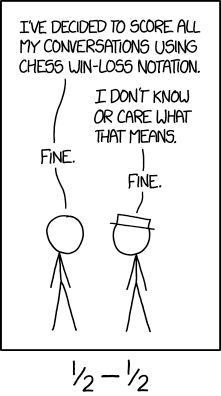
I've decided to score all my conversations using chess win-loss notation. (??)
10 Feb 17:18

Trump backs Kellyanne Conway after she was criticized for promoting Ivanka Trump fashion

by By Julie Pace and Julie Bykowicz Associated Press

WASHINGTON - Kellyanne Conway, the high-profile White House counselor, has come under fire from Democratic and Republican lawmakers, fact checkers and the media. But she's so far maintained the support of her boss, President Donald Trump.

Trump backed Conway both publicly and privately Thursday after House Oversight Committee Chairman Jason Chaffetz, R-Utah, criticized her for promoting Ivanka Trump's fashion line during a television appearance and urged the Office of Government Ethics to review the matter.

09 Feb 18:15

It’s not impossible that Trump orchestrated the whole Gorsuch leak episode


President Trump shakes hands with 10th U.S. Circuit Court of Appeals Judge Neil Gorsuch after introducing him as a Supreme Court nominee. (Carolyn Kaster/AP)

There's a tendency to assume that President Trump is always operating off a master plan that only he can see. That where others see chaos, he sees careful orchestration.

That sense is rooted in the fact that Trump's 2016 presidential campaign constantly looked like it was totally out of control — and then he won. If Trump fooled us all then, what's to say he's not doing it again right now?

Which brings me to the news of the moment: that Trump's Supreme Court nominee, Neil Gorsuch, criticized the chief executive's attacks on the federal judge who put his travel ban on hold late last week. Gorsuch reportedly called those attacks “disheartening” and “demoralizing.”

On its face, this is a remarkable story. The man whom Trump picked to replace the late Justice Antonin Scalia on the Supreme Court is turning on the president just a week after he was nominated. Given how much Trump hates being criticized by alleged allies, it was a stunning comment — and one that lit the political world on fire Wednesday night. How would Trump react? Would he pull the nomination? Attack Gorsuch? Both? Neither? As always with Trump, all options were on the table.

But dig a little deeper and the conspiracy theories begin to seem, well, not so conspiratorial. The whole story originated with Sen. Richard Blumenthal (D-Conn.) after a meeting with Gorsuch. Blumenthal said that during the meeting Gorsuch had used the words “disheartening” and “demoralizing” to describe Trump's comment. He said that he then asked Gorsuch if he could publicize those comments and Gorsuch said he could.

Gorsuch spokesman Ron Bonjean, an old Washington communications pro, confirmed quickly that Gorsuch had used the words. And Kelly Ayotte, the former Republican senator from New Hampshire who is shepherding Gorsuch's nomination, put out a statement Thursday morning broadly echoing the truth of the leak. “While [Gorsuch] made clear that he was not referring to any specific case, he said that he finds any criticism of a judge's integrity and independence disheartening and demoralizing,” said Ayotte.

Later Thursday morning in an interview on Fox News, White House counselor Kellyanne Conway seemed to suggest that the episode was an example of Trump's hands-off approach to his court and Cabinet picks. “He is very comfortable with his nominees expressing their own points of view,” Conway said. “He said that when these folks were being grilled by the Democratic senators, who ended up voting against them anyway for no good reason except politics. He said, 'I want them to express their own independent views.' So, the president is very comfortable with that.”

So:

1. Trump's Supreme Court nominee ran down Trump in a meeting with a Democratic senator.

2. He told that same senator that it was okay to tell the whole world about his comments.

3. Gorsuch's two lead handlers largely confirmed the events.

4. Conway used the leak to make the case that Trump is magnanimous when it comes to the people he chooses for important posts.

You can see why people might raise an eyebrow. After all, what better way for Gorsuch to overcome Democratic senators' skepticism about him than to show some independence from Trump? What better signal that he recognizes the clear separation between the executive branch and the judicial branch? Even if you don't believe in conspiracy theories, you'd be hard-pressed to come up with a better scenario to help establish Gorsuch as his own man, not beholden to the president.

And/but there's this tweet from Trump this morning.

It's not clear what Blumenthal “misrepresents” according to Trump — especially since Bonjean and Ayotte seem to confirm the episode.

The Democratic National Committee, for one, was not fooled. “While Donald Trump’s morning tweets show [White House strategist] Steve Bannon may not have clued him in on the ruse, this is clearly a meaningless White House-orchestrated attempt to help Judge Gorsuch pretend he won’t be a rubber stamp for the Trump administration,” said a DNC spokesman.

No matter whether Trump intentionally engineered this whole thing, the potential outcomes are all to the good for him. First, Gorsuch gets a very high-profile chance to separate himself from the controversial president. Second, Trump allies get to paint him as someone who is very much willing to let people have their own views even if they don't jibe with his. And third, Trump gets to pick a fight with a Democrat over Vietnam service.

In his eyes, that's a win-win-win. And I don't think we can rule out the possibility that this was all part of his broader plan.

06 Feb 13:13

February 5, 2017

Joel Thrasymachus Dahl

Sharing in order to have a platform to wank (I mean, discuss great ideas), not because this post is especially interesting.

I was thinking about the whole electoral college / popular vote issue, and came up with an idea (probably impossible to enact, but you never know).

So, the electoral college is very likely never going away, because to get rid of it would require the cooperation of the states that benefit from it, and those states have absolutely no incentive to ratify that constitutional amendment, nor to get on board with the national popular vote compact (which doesn't go into effect until over 270 EV worth of states also sign onto it, meaning you need the cooperation of at least a few of those states who wouldn't ratify the constitutional amendment that ditched the electoral college).

Also (and I know everyone on TOR disagrees with me on this), there's the whole thing where the electoral college prevents urban areas from running utterly roughshod over rural areas. Even if rural (or urban, someday) areas are full of shit, changing too much in one direction without a broad majority of the country's demographics on board can never be a good thing politically, even if the cause is noble (c.f. this little disagreement we all had in the 1860s).

So how about this: what if (with the necessary constitutional amendments) we kept the electoral college, but required a win of BOTH the electoral college AND the national popular vote in order to become president?

And then, in any instance where no candidate wins both, the election goes to the House (same as is currently required, if there are only electoral vote pluralities), BUT the house does *not* elect a president, but rather a "conservator" (not sure if that's the right term for it) who

--May not be the current president
--May not be any former president who served two terms
--Could be a former one-term president
--May not be any of the candidates who just failed to win both PV and EV
--May not be a current or former "conservator"
--Will serve a term of exactly one year with all the powers/role of a president, while a new election is being held (with either new candidates, the same candidates, or both)
--Becomes ineligible for the office of the presidency, the moment s/he is sworn in as conservator
--Must otherwise fit all the other constitutional requirements to be president
--Must be willing to serve as conservator.

I know it would be almost as impossible to get this ratified as it would be to ditch the electoral college for PV election of the president, but assuming that weren't an issue, how do you all think this would work as a compromise idea?

I know CNN would love it. I can hear their execs getting erections right now.

Super Bowl Sunday saw little in the way of policymaking as the nation turned its attention to football and Lady Gaga. President Trump had a telephone call with the Secretary General of NATO Jens Stoltenberg during which the two discussed the conflict in Ukraine, “how to encourage all NATO allies to meet their defense spending commitments,” and other topics.

The 9th Circuit Court of Appeals denied the Trump administration’s request for an immediate administrative stay, meaning the temporary restraining order suspending travel restrictions is still in effect.

06 Feb 12:41

Company forced to retool Super Bowl ad that depicted Trump’s border wall. See full ad here.

Perhaps more than any other time in history, politics appear to be playing a larger role than ever in the Super Bowl. Bill O’Reilly interviewed President Trump in an interview that aired before the game; former president George H.W. Bush and his wife, Barbara, did the coin toss; and some of the ads have tackled controversial social issues such as immigration.

One such ad was imagined by the family-owned company 84 Lumber, which decided to tackle the subject in its first Super Bowl ad. It wasn’t exactly how the company originally planned it, however.

In the ad’s initial iteration, a Mexican mother and daughter, who appear to be on their way to the United States, come across a depiction of an imposing border wall, reminiscent of the one Trump has touted will eventually divide the country from Mexico.

“Ignoring the border wall and the conversation around immigration that’s taking place in the media and at every kitchen table in America just didn’t seem right,” said Rob Shapiro, the chief client officer at Brunner, the agency that worked with 84 Lumber to come up with the ad. “If everyone else is trying to avoid controversy, isn’t that the time when brands should take a stand for what they believe in?”

But while 84 Lumber believed in its message, Fox, which aired Sunday’s game, thought it was a little too controversial.

“Fox would not let us air ‘the wall,’ ” Schapiro said. 

“Of course we were disappointed,” added Amy Smiley, 84 Lumber’s director of marketing. “But ultimately, it’s their network and their decision.”

Smiley said Fox expressed “concerns about some of the elements” in the initial spot and so when the network ultimately rejected the ad last month, she “understood their reasons.”

Smiley said current events played a role in the ad’s rejection, especially all the talk about Trump’s proposed wall.

“…[T]he conversation in the media exploded around this topic, and it evolved into something controversial that made Fox a little too uncomfortable,” she said. 

Fox did not return The Post’s request to comment.

Ultimately, 84 Lumber and Brunner came up with an edit that Fox finally approved and aired on Sunday. Gone is the wall, replaced by a less imposing barbed-wire fence at what appears to be the border.

Called “The Journey Begins,” the ad depicts a Mexican woman and her daughter readying to travel to the United States. Under the old version, the two arrive at the border wall, where their quest appears to end in a cliffhanger.

In the new ending, the mother and daughter are shown holding hands while “See the conclusion at Journey84.com” appears across the screen.

Viewers who go to the website won’t just find the conclusion to the pair’s journey, but also the original, rejected ad.

“We all felt too strongly about the message to leave it on the editing room floor,” Smiley said.

“The commercial that will air during the Super Bowl does not have the ending we originally wanted, but the message has not changed,” Schapiro said. “Our message is that America is the land of opportunity and 84 Lumber is the company of opportunity.”

This post has been updated.

More from Super Bowl LI:

Best of Super Bowl: Patriots’ comeback, top commercials, Lady Gaga’s halftime performance

Tom Brady, Patriots rally to beat Falcons in overtime to win fifth Super Bowl

Tom Brady didn’t just have the best Super Bowl ever. He played the greatest football game ever.

Brewer: Patriots show they’ve got guts with record Super Bowl comeback

Eight numbers that show just how crazy Patriots’ comeback really was

Deflategate ended with Super Bowl LI and Roger Goodell heard the boos to prove it

Trump left his Super Bowl party just as the Patriots began their historic rally

Sean Spicer gets crushed by Super Bowl jokes, one night after SNL takedown

Super Bowl LI reminded a lot of people of Election Night

‘And sisterhood’: Schuyler Sisters put their own spin on ‘America the Beautiful’

Fans feeling weird about Trump-Brady tie find a way to cheer for Patriots without guilt

Couch Slouch: Patriots’ comeback darkens a nation’s already dark hour

Julian Edelman one-upped Julio Jones’s insane fourth-quarter Super Bowl catch

Gisele Bündchen had a classic reaction to the best Super Bowl ever

Police: Super Bowl drunk drivers will be subjected to Justin Bieber ad

Cowboys owner Jerry Jones loudly booed at Super Bowl

$11 for a soda? Super Bowl concession prices were through the roof.

03 Feb 19:40

Bannon film outline warned U.S. could turn into ‘Islamic States of America’

The flag fluttering above the U.S. Capitol is emblazoned with a crescent and star. Chants of “Allahu Akbar” rise from inside the building.

That’s the provocative opening scene of a documentary-style movie outlined 10 years ago by Stephen K. Bannon that envisioned radical Muslims taking over the country and remaking it into the “Islamic States of America,” according to a document describing the project obtained by The Washington Post.

The outline shows how Bannon, years before he became a strategist for President Trump and helped draft last week’s order restricting travel from seven mostly Muslim countries, sought to issue a warning about the threat posed by radical Muslims as well as their “enablers among us.” Although driven by the “best intentions,” the outline says, institutions such as the media, the Jewish community and government agencies were appeasing jihadists aiming to create an Islamic republic.

The eight-page draft, written in 2007 during Bannon’s stint as a Hollywood filmmaker, proposed a three-part movie that would trace “the culture of intolerance” behind sharia law, examine the “Fifth Column” made up of “Islamic front groups” and identify the American enablers paving “the road to this unique hell on earth.”


(Obtained by The Washington Post)

The outline, titled, “Destroying the Great Satan: The Rise of Islamic Facism [sic] in America,” lists Bannon as the movie’s director, as well as its co-writer with his longtime writing partner Julia Jones. The title page includes the line “A Film By Stephen K. Bannon” in capital letters.

Jones, reached by The Post, declined to discuss the contents of the document in detail but confirmed its authenticity. She added that it was essentially Bannon’s product.

“It was all his words,” Jones said.

A White House spokeswoman declined to comment. Bannon did not respond to several requests for comment.

The film proposal included as possible on-air experts two analysts who went on to advise Trump, although their names are misspelled in the document: Walid Phares, a Lebanese-born Maronite Christian who has warned that jihadists are posing as civil rights advocates, and Heritage Foundation security expert James Jay Carafano, who has defended Trump’s executive order.

Phares could not be reached for comment. A Heritage spokesman said Carafano was not familiar with the project.

The outline offered an early glimpse of Bannon’s belief that the West and “supremacist” Islam are headed for a “fundamental clash of civilizations,” as the outline said. He later expressed this view publicly as chief of Breitbart News, a site that often features articles about radical Islamists and has provided a platform for the alt-right, a small, far-right movement that seeks a whites-only state.

“We are in an outright war against jihadist Islamic fascism,” he said at a 2014 talk via Skype to a group at the Vatican, according to a transcript first published by BuzzFeed. “And this war is, I think, metastasizing far quicker than governments can handle it.”

“I believe you should take a very, very, very aggressive stance against radical Islam,” he added, citing ancient battles between Christian and Islamic forces.

Trump, who has known Bannon since 2011, has voiced similar views about the threats posed by jihadist Muslims. During the campaign, he called for “a total and complete shutdown of Muslims entering the United States until our country’s representatives can figure out what the hell is going on” and said that there is a “great hatred towards Americans by large segments of the Muslim population.”

At Thursday’s National Prayer Breakfast, Trump showed sympathy for Muslim victims of terrorism, saying that “peace-loving Muslims” have been “brutalized” by the Islamic State.

One of Trump’s first acts as president was to issue last week’s travel limits, which temporarily bar travelers from Iraq, Iran, Sudan, Somalia, Syria, Libya and Yemen. Administration officials have said the order is not a “Muslim ban” but is instead targeted at countries whose citizens pose the greatest terrorism risk. However, none of those countries are the birthplace of terrorists who committed recent attacks in the United States connected to extremist Islamist ideology, unlike Saudi Arabia, Egypt and Pakistan.

Trump officials are now considering designating as a foreign terrorist organization the Muslim Brotherhood, one of the oldest Islamist organizations in the Middle East, even though experts have said it does not pose a threat to the United States.

The 2007 film summary calls the Muslim Brotherhood “the foundation of modern terrorism.”

Shadi Hamid, a senior fellow at the Brookings Institution who reviewed the outline for The Post, called it “propaganda” that was “designed to generate hate against not just Islamists, not just extremists, but Muslims writ large.”

“There’s no way you can look at this and Steve Bannon’s other comments and remarks and say Steve Bannon is a friend of American Muslims,” said Hamid, author of “Islamic Exceptionalism: How the Struggle Over Islam is Reshaping the World.”

“It’s remarkable that someone involved with a film like this is at the center of power at the White House,” he added.

Tim Watkins, a producer involved in discussions with Bannon about the project, rejected the idea that the film was driven by anti-Muslim bias.

“This is not because Bannon had a hate or dislike for Muslims,” Watkins said. “I believe that he believed that no society is without its radical fringes.”

Watkins said that he and Bannon met with Steven Emerson, author of the 2002 book “American Jihad: The Terrorists Living Among Us” and founder of the Investigative Project on Terrorism, at an Italian restaurant in Washington and discussed the project. After hearing about Emerson’s research, Watkins said he came up with the idea for the opening sequence featuring the reconstituted American flag flying over the Capitol dome.

“Based on what I heard, it seemed like a documentary in the making,” Watkins said.

Emerson, whose book asserted many Muslim institutions in the West provided ideological support for militants, was listed as an executive producer on the proposal. A section of the film was to be drawn from Emerson’s research archives, according to the document.

“Steve Bannon and I definitely had some interaction at some point about a film, due to a mutual interest in the threat of radical Islamism,” Emerson wrote in an email, describing himself as someone who deeply respects Islam. He added that he did not recall ever seeing the outline, which he said contained material that was not drawn from his work.

“I believe there is a witch hunt and campaign of character assassination being waged against Steve Bannon for his comments against radical Islam like there has been waged against me for many years in order to silence critics of radical Islam,” he said.

The outline used stark language to spell out the dangers posed by Islamist jihadists.

“The ideology is scary, and its ideologues will frighten small children as we bring to light an unbroken chain of ‘thinkers’ who epitomize the culture of hate,” the outline reads.

Part of the film would detail “the rise of a global holy war — financed by the cash flow of oil — to attach and destroy western civilization,” according to the outline.

The proposal names two dozen conservative writers and terrorism experts who could serve as potential on-screen guests, including Robert Spencer, director of the Jihad Watch website, labeled by the Southern Poverty Law Center as an anti-Muslim propagandist.

In an email, Spencer rejected that term as “a smear,” adding that he is “no more anti-Muslim than critics of Nazism were anti-German.”

Spencer, who has written for Breitbart and was interviewed by Bannon on its daily radio show, said he did not recall any discussions about the 2007 film proposal. But he said that he found Bannon “to be brilliant and extraordinarily well-informed about both the history and doctrines of Islam.”

The outline warns about “front groups and disingenuous Muslim Americans who preach reconciliation and dialogue in the open but, behind the scenes, advocate hatred and contempt for the West.”

It names the Council on American-Islamic Relations and the Islamic Society of North America as examples of such “cultural jihadists.”

The proposal also lists other “enablers,” including The Post, the New York Times, NPR, “Universities and the Left,” the “American Jewish Community,” the ACLU, the CIA, the FBI, the State Department and the White House.

“The road to the establishment of an Islamic Republic in the United States starts slowly and subtly with the loss of the will to win,” the outline reads. “The road to this unique hell on earth is paved with the best intentions from our major institutions. This political/accommodation/appeasement approach is not simply a function of any one individual’s actions but lies at the heart of our most important cultural and political institutions.”

Bannon’s work on the “Great Satan” project came after the release of his well-received 2004 Ronald Reagan biopic “In the Face of Evil.” That film contained a coda that warned about the threat of “the beast” during a montage of Muslims praying, terrorist camps and people falling to their deaths from the World Trade Center on 9/11.

Bannon then produced political documentaries including “Border War: The Battle Over Illegal Immigration”; “Generation Zero,” an examination of the global economic crisis; and “Battle for America,” which hammered an “out-of-touch, arrogant, and ever-expanding central government.”

It’s unclear why “Great Satan” was never produced. Jones, a political liberal who was Bannon’s screenwriting partner for 16 years, said that after helping him type up the proposal, she did not work on it any further.

02 Feb 17:48

Trump at National Prayer Breakfast Asks People to ‘Pray for Arnold’ Over ‘Apprentice’ Ratings; Schwarzenegger Responds

President Donald Trump veered off script at the start of the National Prayer Breakfast Thursday when he asked a room full of lawmakers, foreign dignitaries and religious leaders to pray for Arnold Schwarzenegger so that ratings of his show — NBC’s “The Apprentice” — would go up.

President Donald Trump nominates Judge Neil Gorsuch to the Supreme Court during a ceremony in the East Room of the White House January 31, 2017 in Washington, DC. (Credit: Alex Wong/Getty Images)

President Donald Trump nominates Judge Neil Gorsuch to the Supreme Court during a ceremony in the East Room of the White House January 31, 2017 in Washington, DC. (Credit: Alex Wong/Getty Images)

Trump, who lauded the six-decade long traditional gathering as a “testament to the power of faith” was introduced by Mark Burnett, the television producer who teamed up with Trump to create “The Apprentice.” The hit show arguably launched Trump’s political ambitions.

Trump left the show, however, in 2015 as he explored a presidential run and Burnett replaced him with Schwarzenegger, the movie star and former California governor.

“We know how that turned out,” Trump said, knocking Schwarzenegger. “The ratings went right down the tubes. It has been a disaster.”

Trump then turned to the audience and said: “I want to just pray for Arnold … for those ratings.”

The comment may have been intended as a joke, but Trump’s opening came in sharp contrast to how past presidents have addressed the breakfast.

Schwarzenegger promptly replied via a Twitter video: “Hey Donald. I have a great idea. Why don’t we switch jobs? You take over TV, cause you’re such an expert in ratings. And I take over your job, so that people can finally sleep comfortably again.”

Trump and Schwarzenegger have been in a public back-and-forth since the former California governor took over the show.

The annual multi-faith breakfast is held on the first Thursday of February each year. Lawmakers and religious leaders from about 70 countries gather at the Washington event, first organized in 1953. It is meant to bring bipartisan political leaders and their religious counterparts together to meet, pray and build relationships. Every president since Dwight D. Eisenhower has headlined the event.

Trump used his remarks to weigh in on reports circulating on his phone calls with foreign leaders from Australia and Mexico, attempting to allay concerns.

“When you hear about the tough phone calls I’m having, don’t worry about it. Just don’t worry about it. They’re tough. We have to be tough. It’s time we’re going to be a little tough, folks,” he said. “We’re taken advantage of by every nation in the world, virtually. It’s not going to happen anymore. It’s not going to happen anymore.”

The keynote speaker at the National Prayer Breakfast was Barry Black, the chaplain of the United States Senate.

Moved by Black’s remarks, Trump lauded him.

“Thank you as well to senator chaplain Barry Black for his moving words,” he said.

Trump added: “I don’t know, chaplain, whether that’s an appointed position? Is that an appointed position? I don’t know if you’re Democrat or Republican, but I’m appointing you for another year. The hell with it.”

To many, especially the religious leaders in the room, “hell” is a swear word.

When then-President Barack Obama spoke at the national prayer event in 2016, he highlighted the importance of needing to overcome fear through faith.

Trump also touched on supporting religious liberty, protecting national security and defending his controversial travel ban in his wide-ranging speech.

“Our republic was formed on the basis that freedom is not a gift from government, but freedom is a gift from God. It was the great Thomas Jefferson who said, ‘The god who gave us life, gave us liberty,’ ” Trump said.

He continued: “Jefferson asked, ‘Can the liberties of a nation be secured when we have removed a conviction that these liberties are the gift of god?’ Among those freedoms is the right to worship according to our own beliefs. That is why I will get rid of and totally destroy the Johnson amendment and allow our representatives of faith to speak freely and without fear of retribution. I will do that.”

The Johnson amendment prohibits tax-exempt organizations like religious groups from endorsing or opposing political candidates, something Trump often mentioned on the campaign trail.

In 2013, neurosurgeon Ben Carson rose to political prominence after giving an impassioned speech at the breakfast. Carson, Trump’s nominee to lead the Department of Housing and Urban Development, attacked what he saw as government overreach including in the area of health care, one of Obama’s signature policy achievements.

His performance made him a favorite of conservatives, in no small part because his full-throated denouncement came with Obama sitting near him at the head table.

Obama’s final speech focused on overcoming fear through faith. The 2016 breakfast came one day after Obama made a historic visit to a Baltimore mosque and spoke about the importance of religious inclusivity.

“Fear can lead us to lash out against those who are different or lead us to try to get some sinister ‘other’ under control,” said Obama, making a veiled reference to divisive rhetoric on the presidential campaign trail.

This is Trump’s first time attending the breakfast.

38.907192 -77.036871

02 Feb 12:28

Deal reached to close Southern California airport

  • FILE - This Jan. 21, 2011 file photo shows an aircraft approaching Santa Monica Airport in Santa Monica, Calif. The city said Saturday, Jan. 28, 2017 that it has reached an agreement with the federal government to close the airport in December, 2028. Santa Monica spokeswoman Constance Farrell says the city aims to turn the 227-acre site into a large park. Photo: Damian Dovarganes, AP / AP2011
  • FILE - This Jan. 21, 2011 file photo shows an aircraft taking off from Santa Monica Airport in Santa Monica, Calif. The city said Saturday, Jan. 28, 2017 that it has reached an agreement with the federal government to close the airport in December, 2028. Santa Monica spokeswoman Constance Farrell says the city aims to turn the 227-acre site into a large park. Photo: Damian Dovarganes, AP / AP2011

Photo: Damian Dovarganes, AP

FILE - This Jan. 21, 2011 file photo shows an aircraft approaching Santa Monica Airport in Santa Monica, Calif. The city said Saturday, Jan. 28, 2017 that it has reached an agreement with the federal government to close the airport in December, 2028. Santa Monica spokeswoman Constance Farrell says the city aims to turn the 227-acre site into a large park. less
FILE - This Jan. 21, 2011 file photo shows an aircraft approaching Santa Monica Airport in Santa Monica, Calif. The city said Saturday, Jan. 28, 2017 that it has reached an agreement with the federal government ... more
Photo: Damian Dovarganes, AP
FILE - This Jan. 21, 2011 file photo shows an aircraft taking off from Santa Monica Airport in Santa Monica, Calif. The city said Saturday, Jan. 28, 2017 that it has reached an agreement with the federal government to close the airport in December, 2028. Santa Monica spokeswoman Constance Farrell says the city aims to turn the 227-acre site into a large park. less
FILE - This Jan. 21, 2011 file photo shows an aircraft taking off from Santa Monica Airport in Santa Monica, Calif. The city said Saturday, Jan. 28, 2017 that it has reached an agreement with the federal ... more
Photo: Damian Dovarganes, AP

Deal reached to close Southern California airport

SANTA MONICA, Calif. (AP) — A Southern California city and the federal government on Saturday said they reached a deal to close Santa Monica's airport, ending a lengthy legal battle over the site.

Under the agreement, the city can close the airport after 2028 and carry out plans to turn the 227-acre property into a park, Santa Monica officials said.

In the meantime, the city can shorten the airport's single runway to 3,500 feet from its current length of nearly 5,000 feet, which means larger jets will no longer be able to take off or land, city officials said.

Santa Monica has long sought to shut the airport located amid residential neighborhoods in a seaside city of more than 90,000 people. Residents have raised concerns about noise, air pollution and the risk of planes crashing into neighborhoods.

Shortening the runway — which the city hopes to do within six months — will reduce jet operations by 44 percent, and jets are responsible for 95 percent of the noise complaints received by the city, said Mayor Ted Winterer.

"We think this is a big change for our community," Winterer told the Associated Press. "We can immediately shorten the runway, immediately reducing the impact."

The airport caters to private and chartered planes and has 90,000 take offs and landings a year. About 20 percent involve jets, said Santa Monica spokeswoman Constance Farrell.

Santa Monica has been trying to close the airport for decades. In recent years, the city has dueled in court over the future of the property with the Federal Aviation Administration, the agency tasked with regulating the country's airports.

Federal and local officials have feuded over a 1948 agreement over the transfer of airport property and a grant the FAA issued for airport improvements in 1994 that required the airport to operate for a determined period of time, according to federal court filings.

"This is a fair resolution for all concerned because it strikes an appropriate balance between the public's interest in making local decisions about land use practices and its interests in safe and efficient aviation services," FAA Administrator Michael Huerta said in a statement.

31 Jan 17:51

The Complicated Relevance of Dr. Seuss's Political Cartoons

UC San Diego Library

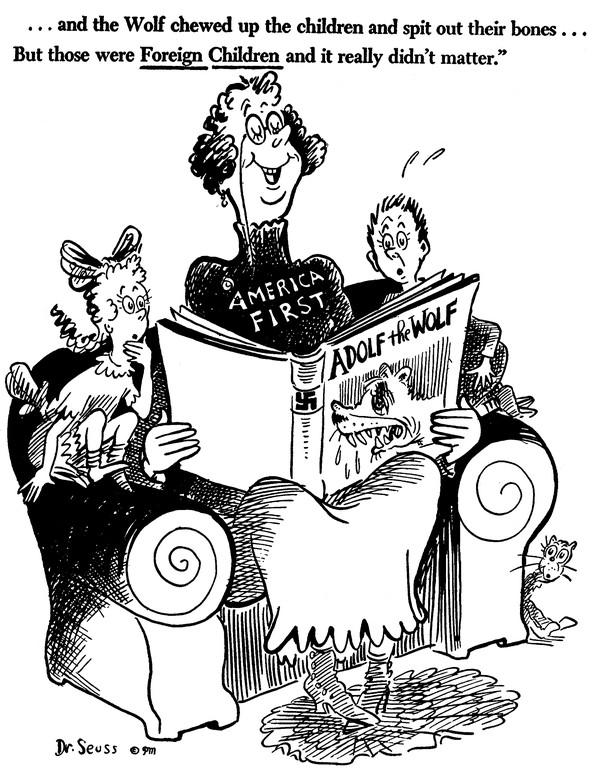
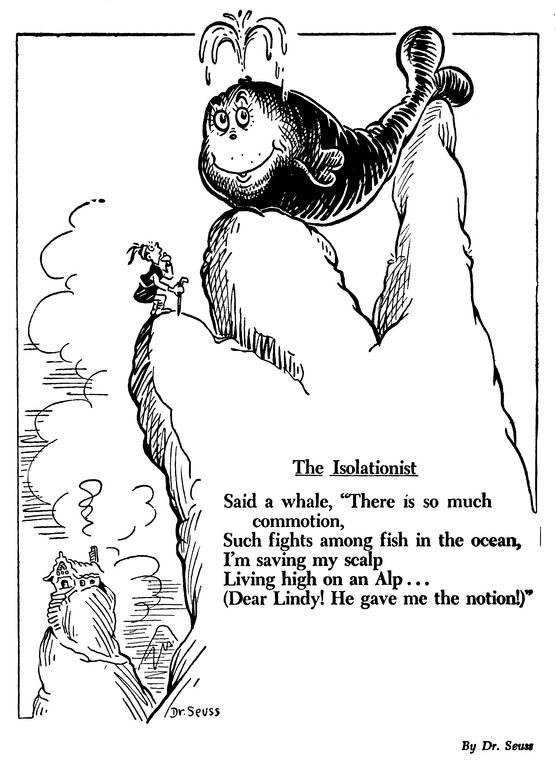
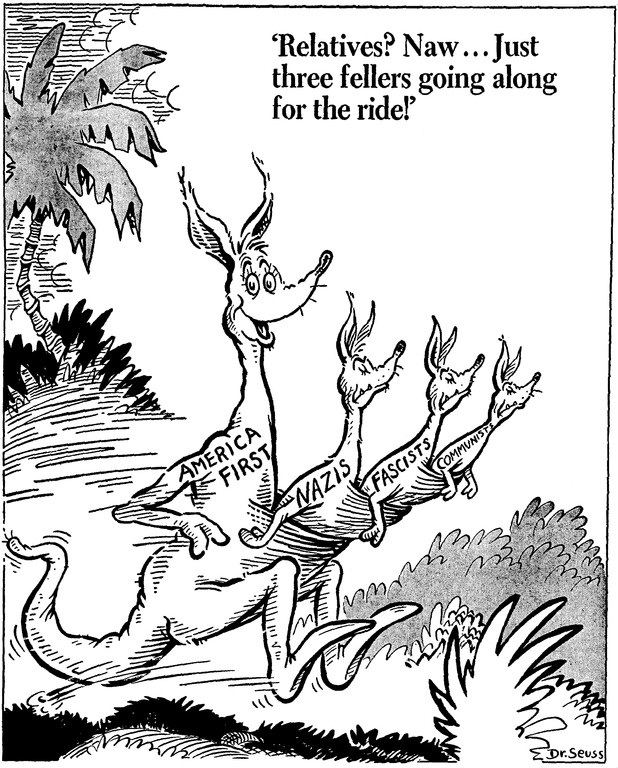
Of all the significant cultural figures finding new relevance during a turbulent news cycle, one of the more intriguing is Dr. Seuss. The German-American cartoonist and author, born Theodor Seuss Geisel, is best known for his children’s books, The Cat in the Hat, The Lorax, and Horton Hears a Who among them. But for two years starting in 1941, Geisel worked as a political cartoonist for the liberal New York newspaper PM, crafting more than 400 cartoons on the subject of World War Two. One of these in particular, a drawing lampooning the non-Interventionist America First movement, has been reemerging recently amid protests against President Trump’s executive order barring immigrants and refugees from seven Muslim-majority countries.

UC San Diego Library

The cartoon, which mocks an apparent blithe naiveté about the dangers posed by Nazi Germany, as well as a callousness regarding the lives of children who aren’t American citizens, makes it a striking accompaniment to modern protests, not least of which is that Trump has named one of his own official platforms “America First.” As a collection, Geisel’s war cartoons target isolationism, anti-Semitism, and racism. They skewer Hitler, Mussolini, and a variety of American nationalists, including Charles Lindbergh and the Catholic priest and radio host Father Charles Coughlin, a fervent anti-Semite and conspiracy theorist. But they also deploy a fierce anti-authoritarianism and humanism that runs through all of Dr. Seuss’s books. Geisel’s political cartoons go a long way in demonstrating how the spirit of Seuss—zany, honest, brash, and brave—was born.

They also have their own flaws, most notably their racist portrayal of both Japanese citizens and Japanese Americans. Geisel’s bigoted treatment of both only a few months before the forced internment of Japanese Americans was something many believe he tried to atone for in his later books. But the body of work he created during the war helped establish the foundations of what the writer Philip Nel has described as “America’s first anti-Fascist children’s writer.” And it helps explain why Dr. Seuss continues to resonate now, 15 years after Geisel’s death, and as American nationalism gains momentum once again.

According to Dr. Seuss Goes to War, Richard H. Minear’s 1999 book on Geisel’s editorial cartoons, PM was founded as an outspoken liberal publication, free of advertising, and funded by its five-cent purchase price. Ralph Ingersoll, its founder, described part of the paper’s mission as opposing “people who push other people around just for the fun of pushing, whether in this country or abroad.” Sometime around January 1941, Geisel drafted his first political cartoon and showed it to a friend who worked at PM, who passed it on to Ingersoll. It depicted Virginio Gayda, an Italian journalist and Fascist whom many saw as a mouthpiece for the dictator Benito Mussolini, beating furiously at the keys of a steam-emitting typewriter, all while suspended from a hook behind him. Geisel attached a note about Gayda with the cartoon that read, “Almost every day, in amongst the thousands of words that he spews forth, there are one or two sentences that, in their complete and obvious disregard of fact, epitomize the Fascist point of view.”

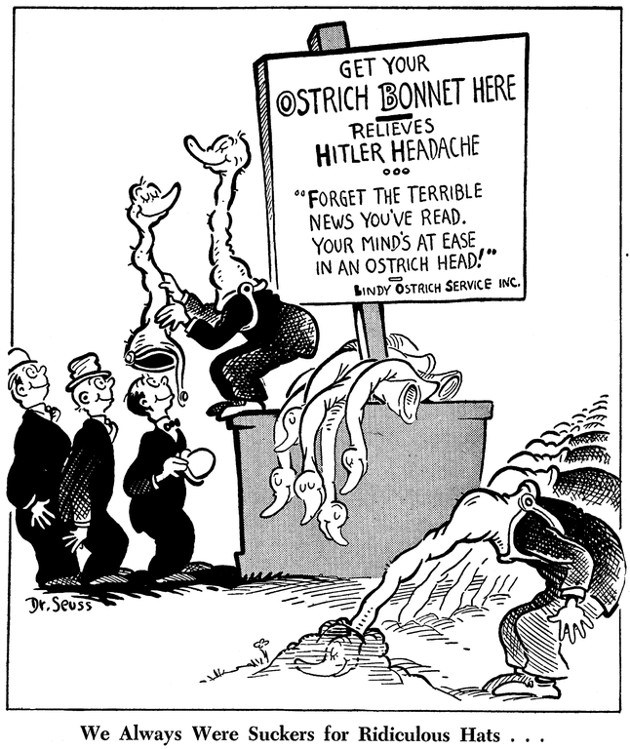
By May 1941, Geisel was publishing as many as seven cartoons a week in PM, and many of his most impassioned works came during this time, in the months leading up to the attack on Pearl Harbor. One drawing, published in April, depicted a coin featuring an ostrich burying its head in the sand, inscribed as “The Lindbergh Quarter.” Another published the next day showed Americans standing in line to purchase their own ostrich hats, guaranteed to relieve “Hitler headache.” The caption: “We always were suckers for ridiculous hats.”

UC San Diego Library

Geisel’s antipathy toward anti-interventionists possibly stemmed from his German-American upbringing in Springfield, Massachusetts, and his circle of friends in New York. Minear told me that in 1976, Geisel wrote a note responding to an interview request from Dartmouth College, saying, “I believed the USA would go down the drain if we listened to the America-First-isms of Charles Lindbergh and Senators Wheeler and Nye, and the rotten rot that the Fascist priest Father Coughlin was spewing out on radio. I, probably, was intemperate in my attacks on them. But they almost disarmed this country at the time it was obviously about to be destroyed.”

Geisel took aim at Hitler and Mussolini, at Lindbergh, and particularly at America First adherents, whom he saw as turning a willful blind eye to the dangers posed by Hitler’s Fascist regime, or even directly associating themselves with Nazism. One cartoon, “The Isolationist,” even featured a limerick, accompanying a drawing of a whale suspending himself “safely” on top of a mountain, out of water, and thus out of danger. It reads, “Said a whale, ‘There is so much commotion/Such fights among fish in the ocean/I’m saving my scalp/Living high on an Alp/(Dear Lindy! He gave me the notion!)”

UC San Diego Library

But after Pearl Harbor, Geisel’s cartoons became more overtly opposed to Japan, and more crude in style. He depicted Hideki Tojo, the Prime Minister and Supreme Military Leader of Japan, as an ugly stereotype, with squinting eyes and a sneering grin. In February 1942, he drew a long line of Japanese-Americans on the Pacific Coast of the U.S. collecting blocks of TNT from a kiosk labeled “Honorable 5th Column,” with one pointing a telescope across the ocean. The caption read, “Waiting for a signal from home.”

It’s more than a little baffling now to see Geisel, who’d railed repeatedly against racism, Jim Crow, and anti-Semitism in his cartoons, proffer up such bigoted depictions of Asians both in the U.S. and overseas. “We all have blind spots,” Minear told me. “I use that as a teaching moment—even Dr. Seuss went astray.” In his book, Minear also points out that such sentiment was common in the New York circles Geisel moved in at the time. Although there were reader complaints about drawings he made mocking dachshunds, and the pacifist John Haynes Holmes, there were no letters recorded objecting to his treatment of Asians.

Minear believes, though, that Geisel tried to make up for his earlier prejudice in later works. “Horton Hears a Who came after a trip to Japan, and is easy to read allegorically,” he told me. “The people of Whoville are Japan, Vlad Vladikoff is Russia, Horton is us/democracy, etc.” Geisel supposedly came up with the idea for Horton, in which an elephant discovers a microscopic universe, on a trip to Japan, and dedicated the 1954 book to a Japanese friend. The theme of the story, that “a person’s a person no matter how small,” seems to offer a note of contrition for jingoistic wartime expressions. In the 1980s, too, according to the writer Donald E. Pease, Geisel scanned his earlier books for racial stereotypes, and altered a reference to a “yellow-faced Chinaman who eats with sticks” in And to Think That I Saw It on Mulberry Street.

Horton isn’t the only book that echoes themes explored in Geisel’s political cartoons. Minear thinks that almost all of his later books (with the exception of the ones designed as reading aids) are political in some way or another. The Lorax is an obvious parable about environmentalism. The Sneetches and Other Stories includes an absurd fable about strange yellow creatures, half of whom have stars on their bellies and discriminate against the other half, and vice versa. The Butter Battle Book seems particularly potent today, with its tales of the Yongs and the Zooks, who live on either side of a vast wall, and hate each other because of the different ways they eat their bread and butter. The two sides create increasingly inventive and destructive weapons to fire over the wall until both come up with a device called the Bitsy Big-Boy Boomeroo, which means mutually assured destruction should it ever be fired. The book ends with a standoff, with both sides waiting to see what the other does. It’s a message to children made explicit in what Geisel wanted his last words to be, which he told his biographers, Judith and Neil Morgan, were: “We can and must do better than this!”

Then there’s Yertle the Turtle, a book of stories whose title character is the king of the pond, a ruthless authoritarian who demands that the other turtles stack themselves on top of each other so he can ascend to the top and get a better view. Yertle, who ignores the pain of his underlings, is finally bested by a burp, in a suitably absurd revolution. In the first drawing of him, Minear says, Geisel gave Yertle a Hitler mustache. But now Minear sees another figure in him. Between the narcissism and the arrogance, he says, Yertle “is Trump 50 years ago.”

Little surprise, then, that Geisel’s cartoons, political and non, are finding a new audience now, as protests ramp up against the 45th president, whose affects and actions are at times as recognizable and cartoonish as Dr. Seuss’s characters. It’s hard not to assume Geisel would be cheered by seeing his work inspire signs and memes and viral tweets. “Humor has a tremendous place in this sordid world,” he once said. “It’s more than just a matter of laughing. If you can see things out of whack, then you can see how they can be in whack.”

28 Jan 00:13

Antonin Scalia, part-time liberal


Supreme Court Justice Antonin Scalia. (Charles Rex Arbogast/Associated Press)

As President Trump prepares to name a successor to Justice Antonin Scalia, the conventional wisdom is that the choice will not change the liberal-conservative balance on the court. After all, this argument goes, if Trump chooses any of the names on his previously published list, the court and the country will simply be swapping one conservative justice for another.

That understanding is incorrect and, as the Senate considers Trump’s nominee and the impact on the court, could be dangerously misleading. This will come as a surprise to many, but in a number of important areas, including the rights of criminal defendants and freedom of speech, the justice was actually quite liberal, as that term is commonly applied. Of Scalia’s approximately 879 opinions, including comments on denials of petitions for certiorari, I have counted 135 as liberal and a number of others as arguably liberal.

No doubt, Scalia was personally a committed conservative and originalist. He relied on that pair of approaches to render conservative opinions on abortion, the right to die, women’s rights, rights of gays and lesbians, obscenity, the death penalty, habeas corpus, the exclusionary rule relating to illegal searches and seizures, regulatory takings of private property, gun rights, establishment of religion, states’ rights, standing to challenge federal regulatory statutes, the scope of the commerce clause, the Freedom of Information Act and more.

Yet Scalia’s commitment to his jurisprudence led him to write many important liberal opinions, although they are less well-known than his conservative decisions, with their often provocative language.

In criminal cases, Scalia was the court’s leading protector of defendants’ rights under the confrontation clause. Because the testimony had not been subject to cross-examination, he disallowed the use of previous grand jury testimony by a witness who was unavailable at trial. He prevented screens to shield child witnesses in child abuse cases from seeing their alleged abusers. Likewise, Scalia was liberal in his interpretation of the double jeopardy clause and the prohibition against ex post facto judicial decisions under the due process clause. He insisted that indictments, to be valid, list all the elements of a crime, and consistently relied on the rule of lenity, which requires criminal statutes to be clear before they are enforced against a defendant. He also broadly supported the right to trial by jury in civil cases, protected by the Seventh Amendment.

Scalia took a similarly liberal approach on questions of what constitutes an unreasonable search or seizure. He protected homes from searches by heat-detectors seeking signs of marijuana plants or dogs sniffing around a house to detect narcotics. He dissented when the court upheld the taking of a DNA sample from the mouth of someone arrested on one offense and then charged with another crime based on a DNA match. Invasive searches to detect the commission of other crimes, he said, violated the Fourth Amendment and due process. He insisted that any interference with personal property by law-enforcement officers amounted to a search that required a warrant or exigent circumstances, such as when the police affixed a GPS device on a suspect’s car without a warrant.

When it came to the Sixth Amendment’s right to trial by jury, Scalia once again was a leader of the liberal position. He insisted that juries, not judges, make the critical decision of whether an action amounted to a hate crime, and therefore was subject to more severe punishment. Scalia made the powerful point that judges were part of the state, and that trial by jury was designed to protect Americans from the state.

On matters involving the First Amendment, Scalia advocated a broad scope for freedom of speech. Notwithstanding Trump’s argument that flag-burners should be subject to criminal prosecution, Scalia joined the opinion of liberal justice William Brennan striking down laws making flag desecration a crime as unconstitutional. He wrote his own opinion striking down a law prohibiting cross-burning that intimidated African Americans. Scalia’s First Amendment prohibited making distinctions based on the content of a statement. He opposed extending the limited protections afforded obscenity to animal cruelty and violence on First Amendment grounds. However, to the dismay of many liberals, he rejected all attempts by those who sought to curtail the influence of money in politics by voting to hold all limitations on campaign contributions and spending unconstitutional under the First Amendment’s right to freedom of speech.

When the time comes to evaluate Trump’s nominee to the Supreme Court, we should not be misled by statements that he or she is a conservative in the mold of Scalia. The reality is much more nuanced. The odds are that we are going to have a nominee who not only follows Scalia’s conservative opinions, but also rejects his liberal ones. In short, the court without Scalia is likely to be a lot worse than the one with him still serving.

26 Jan 16:50

Footage of Train-truck Collision in Salt Lake

Joel Thrasymachus Dahl

So that's why my Amazon package is delayed? Sheesh.

Scary video. Glad nobody was hurt.

26 Jan 14:04

Shia LaBeouf Arrested At Anti-Trump Art Installation In New York

by dianalodderhose
UPDATED with LaBeouf charged and released:  Shia LaBeouf was arrested in New York early Thursday morning after he allegedly pushed a man outside of the site of his new permanent protest against new President Donald Trump. He was charged with misdemeanor assault and released, according to NYC police. The American Honey actor, who was nominated for a British Independent Film Award last month, has been appearing in a live video stream called "He Will Not Divide Us" since…
25 Jan 19:04

This Dutch video on Trump has gone viral because, well, just watch it

Joel Thrasymachus Dahl

"German isn't even a real language. It's fake."

By Gianluca Mezzofiore

"We totally understand it's going to be America First — But can we just say 'The Netherlands Second?'"

This is the Dutch plan for Trump's presidency. 

The video is a spoof message by news satire show Zondag met Lubach to officially introduce Holland to Trump "in a way that will probably appeal to him the most".  

"We speak Dutch. It's the best language in all of Europe. We've got all the best words. All the other languages? Failed. Danish? Total disaster," a voiceover says, mimicking Trump's cadence. 

"German is not even a real language."

Topics: Donald Trump, The Netherlands, viral video, Watercooler
20 Jan 19:23

Donald Trump’s New Twitter Background Is a Photo From the Inauguration of Barack Obama

President Donald Trump officially took over the @POTUS Twitter account on Friday:

Donald-Trump-Potus-Twitter-background

Screengrab from Twitter

The new Twitter background made me wonder: Whose inauguration is this from? The answer:

The inauguration of President Barack Obama, on Jan. 20, 2009.

carterdayne

Maybe the background was Melania’s idea?

17 Jan 20:17

Republicans move to spend billions on Obamacare — before they kill it

170113_greg_walden_obamacare_gty_1160.jpg

On their way to killing Obamacare, Republicans are leaning toward funding up to $9 billion in health care subsidies this year to keep the program afloat — even though they sued the Obama administration to stop those exact payments.

The move is the most significant sign yet that the GOP is serious about propping up Obamacare temporarily to provide a smooth transition to a yet-to-be disclosed Republican replacement.

Story Continued Below

The irony is deep: Republicans have never voluntarily funded an Obamacare program. This particular subsidy, which covers out-of-pocket health care costs for low-income participants, has been a GOP target since 2014 when House Republicans went to court to argue the White House funded it unconstitutionally. Republicans were exultant last May when the Federal District Court for the District of Columbia ruled in their favor, even though the payments were allowed to continue pending an appeal.

Now, though, several Republican sources say they will have no choice but to appropriate the money. With President-elect Donald Trump and top lawmakers vowing a smooth transition to a new plan, they can't blow up Obamacare until they enact a replacement.

Energy and Commerce Chairman Greg Walden (R-Ore.) wants to see the program funded “one way or another," he told POLITICO. “If you don’t, the plans have the ability to cancel midyear, and we said we wouldn’t pull the rug out from under people — and we shouldn’t.”

The court case centers on cost-sharing subsidies that help certain low income people with out-of-pocket medical costs, such as doctors' co-pays — not the separate premium subsidies that are helping millions of people, including some middle-class families, purchase insurance through Obamacare.

If Republicans were to stop the payments, they would risk owning the very sudden and likely collapse of the Obamacare exchange markets. That’s because insurers would still be on the hook for the payments under the law, and would likely flee the markets almost immediately to avoid paying out billions.

Donald Trump tweeted that Obamacare "will soon be history," adding pressure to congressional Republicans to repeal the law quickly.

Cutting off the money midyear “would be disastrous” for the state’s insurance market and those covered by it, Utah Gov. Gary Herbert wrote House Majority Leader Kevin McCarthy (R-Calif.) on Friday, urging Congress to fund the subsidies until year's end.

“As we work to re-craft healthcare in our country, we must be careful not to increase the rate of uninsured, particularly for our most vulnerable citizens,” Herbert wrote.

If Republicans do support the program, however, some fear they would be blamed for “bailing out” insurance companies. One idea that has been floated to counter that narrative is to give the funding directly to consumers rather than to insurance companies.

“What they say is, we’re only doing this because they can’t change the law quickly enough,” said Tom Miller, a health care policy expert at the American Enterprise Institute.

Several Republican sources stressed that no final decisions have been made, but they will have to come soon: The court allowed the subsidies to continue while the Obama administration appealed the decision. The Trump administration must inform the Court of Appeals for the D.C. Circuit by Feb. 21 whether it will continue that appeal. If it should stand down, the payments could end almost immediately and Congress would have to be prepared to make a decision.

Republican conversations around how to deal with the fallout of the House v. Burwell lawsuit include how the subsidy program would be funded — whether in an appropriations bill or in one of the Obamacare repeal and replacement bills— and whether the entirety of the $9 billion program would be replaced.

“While we build replacements, we want the 11 million Americans who now buy insurance on the exchanges to be able to continue to buy private insurance,” Lamar Alexander (R-Tenn.) said on the Senate floor. “Among the actions that will help are to … approve the temporary continuation of cost-sharing subsidies for deductibles and co-pays.”

Not everyone is on board with the argument that Republicans should continue the subsidy through an appropriation.݅

House Republicans are expected to pass a budget on Friday that clears a path for the repeal of the Affordable Care Act.

Rep. Tom Cole (R-Okla.), chairman of the House Labor and Health and Human Services appropriations subcommittee, said the GOP isn’t responsible for funding the mistakes Democrats made while writing Obamacare.

“You can’t [fund the program] unless you’re going to increase the allocation to the committee,” he told POLITICO, referring to the overall limits on health spending his committee must work with. If the House has to fund the program, other health care programs would have to be cut to pay for it.

“I don’t know that we're particularly obligated to pay for the mistakes that the Obama administration made that violated the law,” he said.

But even Cole said he wants to see a smooth transition and doesn’t want to see benefits dropped suddenly.

Insurance companies have a huge stake in the program. The cost-sharing payments are made to insurers, who must use them to defray consumers' out-of-pocket costs. The companies added language to their contracts for 2017 that allows them to leave the market is the payments are ended, although they have not said that they would definitely drop coverage immediately.

Besides its strategy on Obamacare, the House has long-term constitutional concerns in the case.

For the first time, a federal district court said the legislature could sue the White House over appropriations disputes. The House wants to ensure that ruling stands, according to senior Republican aides. They’re likely to lose on that point if the Trump administration moves ahead with the Obama administration’s appeal, according to court-watchers.

“The D.C. Circuit [Court of Appeals] consists of a majority of judges appointed by Democratic presidents,” said Nicholas Bagley, a University of Michigan Law School professor who argues the House doesn’t have the right to sue. “I think this is not a long-term winner for them.”

170112_john_kasich_gty_1160.jpg

That means the House has a strong incentive to encourage the Trump administration to drop the appeal, even if that means a future White House could be sued by the House of Representatives.

“We’re working through the mechanics on it because we also want to preserve the court victory,” Walden said. “Regardless of who is in power, if you get to the point where a president can spend whatever he or she wants without any check and balance from the Congress, you don’t have these branches anymore.”

The first decision will come from the new Trump administration Justice Department. While several Republican sources expect Trump’s DOJ to drop the appeal, the president-elect’s transition team has not tipped its hand. A Trump spokesman declined to comment on the case because it involves the current White House.

“Upon taking office, the Trump administration will evaluate this case and all related aspects of the Affordable Care Act,” the spokesman said.

Rachael Bade and Rachana Pradhan contributed to this report.

13 Jan 21:36

The touching letter the Bush twins wrote to Sasha and Malia Obama about being first daughters


President George W. Bush’s daughters, Jenna and Barbara, have their photo taken in the East Room at the White House in May 2012. (Charles Dharapak/AP)

In 2009, as their father penned a letter to his successor, the twin daughters of President George W. Bush, Jenna and Barbara, wrote a letter of their own.

Their dad’s letter would be confidential and offer advice, tucked away in the top drawer of the Resolute Desk in the Oval Office, where incoming President Barack Obama would find it on his first day of work as leader of the free world. Now a White House tradition, this had been done by every sitting president since Ronald Reagan.

And so as their father prepared to pass the torch, the Bush girls decided they had advice to offer, too — not for the new president, but for his young daughters, Sasha and Malia.

From one pair of first daughters to another, they titled it “Playing House in the White House.”

Barbara and Jenna, then 27 years old, told Sasha, 7, and Malia, 10, to surround themselves with “loyal friends,” to cherish their pets in times when they’d need “the quiet comfort that only animals can provide,” to slide down the banister of the solarium and play sardines on the White House lawn.

Most importantly, they said, “remember who your dad really is.”

Eight years later, with just a week until Sasha and Malia leave the White House, the Bush sisters, now 35, have written a second letter — this time with advice not about living inside the White House, but outside of it.

“We have watched you grow from girls to impressive young women with grace and ease. And through it all you had each other. Just like we did,” they wrote in the letter, published first online by Time magazine. “Now you are about to join another rarified club, one of former First Children — a position you didn’t seek and one with no guidelines. But you have so much to look forward to. You will be writing the story of your lives, beyond the shadow of your famous parents, yet you will always carry with you the experiences of the past eight years.”

Americans have an odd fascination with the idea of first daughters. It has inspired a handful of popular movie narratives — Katie Holmes’s “First Daughter,” the Disney classic “My Date with the President’s Daughter” and “Chasing Liberty” starring Mandy Moore — and was a major plotline in Aaron Sorkin’s popular TV series “The West Wing,” which often wove in the fictional president’s complicated relationship with his three daughters.

The scrutiny these fictional first daughters faced is not unlike the pressure the real ones encounter, and for the past quarter-century, Americans have had only female first children in the White House — Chelsea Clinton, the Bush twins, Malia and Sasha Obama.

And perhaps no first children were confronted with the harsh reality of having a dad in chief as much as Jenna and Barbara Bush, whose father was in the White House during their college years and whose antics with underage drinking drew intense publicity.

The sisters made note of that in their letter to the Obama sisters.

“Enjoy college. As most of the world knows, we did,” they wrote. “And you won’t have the weight of the world on your young shoulders anymore.”

In 2014, a Hill staffer for a Republican congressman resigned amid widespread backlash after she criticized on social media the appearance of Sasha and Malia during the televised traditional turkey pardon on Thanksgiving.

“Dear Sasha and Malia, I get you’re both in those awful teen years, but you’re a part of the First Family, try showing a little class,” the staffer wrote at the time. “Rise to the occasion. Act like being in the White House matters to you. Dress like you deserve respect, not a spot at a bar.”

Jenna Bush Hager, who kept her family name after she was married, defended the Obama girls after the incident, saying she felt “fiercely protective of them.


President Barack Obama, joined by his daughters Malia, right, and Sasha speaks at the White House during the presidential turkey pardon ceremony, an annual Thanksgiving tradition, on Nov. 26, 2014. (Jacquelyn Martin/AP)

That sentiment was obvious in the letter she and her sister penned Thursday.

The Bush twins encouraged Malia and Sasha to keep in contact with the people that made their stay in the White House feel normal, including their Secret Service agents, and challenged them to use their political and diplomatic experiences as first daughters for the greater good.

“You have lived through the unbelievable pressure of the White House,” they closed the letter. “You have listened to harsh criticism of your parents by people who had never even met them. You stood by as your precious parents were reduced to headlines. Your parents, who put you first and who not only showed you but gave you the world.

“As always, they will be rooting for you as you begin your next chapter. And so will we.”

Jenna Bush Hager is a correspondent for the “Today” show on NBC and her sister, Barbara, is the chief executive and co-founder of Global Health Corps, a nonprofit organization focused on the global health equity movement.

You can read their letter to the Obama sisters here:

Malia and Sasha, eight years ago on a cold November day, we greeted you on the steps of the White House. We saw both the light and wariness in your eyes as you gazed at your new home. We left our jobs in Baltimore and New York early and traveled to Washington to show you around. To show you the Lincoln Bedroom, and the bedrooms that were once ours, to introduce you to all the people—the florists, the grounds-keepers and the butlers—who dedicate themselves to making this historic house a home. The four of us wandered the majestic halls of the house you had no choice but to move in to. When you slid down the banister of the solarium, just as we had done as 8-year-olds and again as 20-year-olds chasing our youth, your joy and laughter were contagious.

In eight years, you have done so much. Seen so much. You stood at the gates of the Robben Island cell where South Africa’s Nelson Mandela was imprisoned for decades, your arms around your father. You traveled to Liberia and Morocco with your mom to talk with girls about the importance of education—girls who saw themselves in you, saw themselves in your parents, saw who they could become if they continued to study and learn. You attended state dinners, hiked in national parks, met international leaders and managed to laugh at your dad’s jokes during the annual Thanksgiving turkey pardon, all while being kids, attending school and making friends. We have watched you grow from girls to impressive young women with grace and ease.

And through it all you had each other. Just like we did.

Now you are about to join another rarified club, one of former First Children—a position you didn’t seek and one with no guidelines. But you have so much to look forward to. You will be writing the story of your lives, beyond the shadow of your famous parents, yet you will always carry with you the experiences of the past eight years.

Never forget the wonderful people who work at the White House. Our greeter as 7-year-olds at our grandfather’s Inauguration was Nancy, the White House florist, who ushered us in from the cold. She helped us make colorful bouquets of winter flowers for our grandparents’ bedside. Twenty years later, Nancy did the flowers for Jenna’s wedding. Cherish your own Nancy. We stay in touch with our Secret Service. They were part of growing up for us: there for first dates, first days and even an engagement and a honeymoon. We know it wasn’t always easy—the two of you and the two of us were teenagers trailed by men in backpacks—but they put their lives on hold for us.

Enjoy college. As most of the world knows, we did. And you won’t have the weight of the world on your young shoulders anymore. Explore your passions. Learn who you are. Make mistakes—you are allowed to. Continue to surround yourself with loyal friends who know you, adore you and will fiercely protect you. Those who judge you don’t love you, and their voices shouldn’t hold weight. Rather, it’s your own hearts that matter.

Take all that you have seen, the people you have met, the lessons you have learned, and let that help guide you in making positive change. We have no doubt you will. Traveling with our parents taught us more than any class could. It opened our eyes to new people as well as new cultures and ideas. We met factory workers in Michigan, teachers in California, doctors healing people on the Burmese border, kids who lined the dusty streets of Kampala to see the American President, and kids with HIV waiting to get the antiretroviral drugs that would save their lives. One tiny girl wearing her finest lavender dress looked young, which she was not. She was little because she was sick. Her mom admitted that she might not live to see these drugs work, but her brothers and sisters would. After meeting this girl, Barbara went back to school and changed her major, and her life’s path.

You have lived through the unbelievable pressure of the White House. You have listened to harsh criticism of your parents by people who had never even met them. You stood by as your precious parents were reduced to headlines. Your parents, who put you first and who not only showed you but gave you the world. As always, they will be rooting for you as you begin your next chapter. And so will we.

More from Morning Mix: 

Introducing Daliyah, the 4-year-old girl who has read more than 1,000 books

‘Flip or Flop’: The phoenix-like rise and bizarre fall of HGTV’s second-favorite couple

Shaking hands is ‘barbaric’: Donald Trump, the germaphobe in chief

13 Jan 04:39

Winter storms putting dent in drought, as snowpack, ground-water basins rise

by Steve Scauzillo

Rain-slicked freeways and homeowners ankle-deep in mudflows notwithstanding, most of Southern California remains in a drought, state and local water officials said Thursday. But recent winter storms chipped away at some of the worst of the drought across the rest of the state.

About 42 percent of the state is out of the drought, according to the U.

12 Jan 17:55

Why Rural America Voted for Trump

Why Rural America Voted for Trump

By ROBERT LEONARD

Photo
Trump supporters at a rally in Iowa last January. Credit Sam Hodgson for The New York Times

Knoxville, Iowa — One recent morning, I sat near two young men at a coffee shop here whom I’ve known since they were little boys. Now about 18, they pushed away from the table, and one said: “Let’s go to work. Let the liberals sleep in.” The other nodded.

They’re hard workers. As a kid, one washed dishes, took orders and swept the floor at a restaurant. Every summer, the other picked sweet corn by hand at dawn for a farm stand and for grocery stores, and then went to work all day on his parents’ farm. Now one is a welder, and the other is in his first year at a state university on an academic scholarship. They are conservative, believe in hard work, family, the military and cops, and they know that abortion and socialism are evil, that Jesus Christ is our savior, and that Donald J. Trump will be good for America.

They are part of a growing movement in rural America that immerses many young people in a culture — not just conservative news outlets but also home and church environments — that emphasizes contemporary conservative values. It views liberals as loathsome, misinformed and weak, even dangerous.

Who are these rural, red-county people who brought Mr. Trump into power? I’m a native Iowan and reporter in rural Marion County, Iowa. I consider myself fairly liberal. My family has mostly voted Democratic since long before I was born. To be honest, for years, even I have struggled to understand how these conservative friends and neighbors I respect — and at times admire — can think so differently from me, not to mention how over 60 percent of voters in my county could have chosen Mr. Trump.

Continue reading the main story

Recent Comments

Charley Darwin

H.L. Mencken said it best: "Democracy is the theory that the common people know what they want and deserve to get it good and hard."They...

Ed

I find the parts where the rural roads and services are bad or non existent. That doesn't happen because blue counties and towns are liberal...

COMMENTOR

The ignorance and hatred of so many conservatives shows through in this article. Liberals don't work or strive - only you do. How stupid....

  • See All Comments

Political analysts have talked about how ignorance, racism, sexism, nationalism, Islamophobia, economic disenfranchisement and the decline of the middle class contributed to the popularity of Mr. Trump in rural America. But this misses the deeper cultural factors that shape the thinking of the conservatives who live here.

For me, it took a 2015 pre-caucus stop in Pella by J. C. Watts, a Baptist minister raised in the small town of Eufaula, Okla., who was a Republican congressman from 1995 to 2003, to begin to understand my neighbors — and most likely other rural Americans as well.

“The difference between Republicans and Democrats is that Republicans believe people are fundamentally bad, while Democrats see people as fundamentally good,” said Mr. Watts, who was in the area to campaign for Senator Rand Paul. “We are born bad,” he said and added that children did not need to be taught to behave badly — they are born knowing how to do that.

“We teach them how to be good,” he said. “We become good by being reborn — born again.”

He continued: “Democrats believe that we are born good, that we create God, not that he created us. If we are our own God, as the Democrats say, then we need to look at something else to blame when things go wrong — not us.”

Mr. Watts talked about the 2015 movie theater shooting in Lafayette, La., in which two people were killed. Mr. Watts said that Republicans knew that the gunman was a bad man, doing a bad thing. Democrats, he added, “would look for other causes — that the man was basically good, but that it was the guns, society or some other place where the blame lies and then they will want to control the guns, or something else — not the man.” Republicans, he said, don’t need to look anywhere else for the blame.

Hearing Mr. Watts was an epiphany for me. For the first time I had a glimpse of where many of my conservative friends and neighbors were coming from. I thought, no wonder Republicans and Democrats can’t agree on things like gun control, regulations or the value of social programs. We live in different philosophical worlds, with different foundational principles.

Sign Up for the Opinion Today Newsletter

Every weekday, get thought-provoking commentary from Op-Ed columnists, the Times editorial board and contributing writers from around the world.

Please verify you're not a robot by clicking the box.

Invalid email address. Please re-enter.

You must select a newsletter to subscribe to.

Sign Up
Receive occasional updates and special offers for The New York Times's products and services.

Thank you for subscribing.

An error has occurred. Please try again later.

You are already subscribed to this email.

View all New York Times newsletters.

Overlay this philosophical perspective on the American rural-urban divides of history, economy and geography, and the conservative individual responsibility narrative becomes even more powerful. In my experience, the urban-rural divide isn’t really so much a red state versus blue state issue, it’s red county versus blue county. Rural Iowans have more in common with the rural residents of Washington State and New Mexico — places I’ve also lived — than with the residents of Des Moines, Seattle and Albuquerque.

Look at a national map of which counties went for Democrats and which for Republicans: Overwhelmingly the blue counties are along waterways, where early river transportation encouraged the formation of cities, and surround state capitals. This is also where most investment in infrastructure and services is made. Rural Americans recognize that this is how it must be, as the cities are where most of the people are, yet it’s a sore spot.

In state capitols across America, lawmakers spend billions of dollars to take a few seconds off a city dweller’s commute to his office, while rural counties’ farm-to-market roads fall into disrepair. Some of the paved roads in my region are no longer maintained and are reverting to gravel. For a couple of generations now, services that were once scattered across rural areas have increasingly been consolidated in urban areas, and rural towns die. It’s all done in the name of efficiency.

In cities, firefighters and E.M.T.s are professionals whose departments are funded by local, state and federal tax dollars. Rural America relies on volunteers. If I have a serious heart attack at home, I’ll be cold to the touch by the time the volunteer ambulance crew from a town 22 miles away gets here.

Urban police officers have the latest in computer equipment and vehicles, while small-town cops go begging.

In this view, blue counties are where most of our tax dollars are spent, and that’s where all of our laws are written and passed. To rural Americans, sometimes it seems our taxes mostly go to making city residents live better. We recognize that the truth is more complex, particularly when it comes to social programs, but it’s the perception that matters — certainly to the way most people vote.

To make matters worse, jobs are continuing to move to metropolitan areas. Small-town chamber of commerce directors and mayors still have big dreams, and use their perkiest grins and tax abatements to try to lure new businesses, only to see their hopes dashed, time and again. Many towns with a rich history and strong community pride are already dead; their citizens just don’t know it yet.

Many moderate rural Republicans became supporters of Mr. Trump when he released his list of potential Supreme Court nominees who would allow the possibility of overturning Roe v. Wade. They also think the liberal worldview creates unnecessary rules and regulations that cripple the economy and take away good jobs that may belong to them or their neighbor. Public school systems and colleges are liberal tools of indoctrination that go after what we love and value most — our children.

Some of what liberals worry about they see as pure nonsense. When you are the son or daughter of a carpenter or mechanic and a housewife or secretary who lives paycheck to paycheck, who can’t afford to send kids to college, as many rural residents are, white privilege is meaningless and abstract.

It’s not just older people. The two young men at breakfast exemplify a younger generation with this view. When Ted Cruz campaigned in a neighboring town in 2015, I watched as a couple of dozen grade-school pupils sat at his feet, as if they were at a children’s service at church. His campaign speech was nearly a sermon, and the children listened wide-eyed when he told them the world is a scary place, and it’s godly men like him who are going to save them from the evils of President Obama, Hillary Clinton and their fellow Democrats.

Write A Comment

While many blame poor decisions by Mrs. Clinton for her loss, in an environment like this, the Democratic candidate probably didn’t matter. And the Democratic Party may not for generations to come. The Republican brand is strong in rural America — perhaps even strong enough to withstand a disastrous Trump presidency.

Rural conservatives feel that their world is under siege, and that Democrats are an enemy to be feared and loathed. Given the philosophical premises Mr. Watts presented as the difference between Democrats and Republicans, reconciliation seems a long way off.

Robert Leonard is the news director for the radio stations KNIA/KRLS.

12 Jan 13:16

Some Questions for Paul Ryan as He Tries to Sleep

by John

Hi, Paul. I think you’re one of the most fascinating characters in American politics. Really!

You’re a hot nerd dad who does his homework. You probably listen to podcasts.

People may call you white bread, but c’mon: you don’t eat carbs.

Republicans had to beg you to be Speaker of the House. Was your reluctance to take the job real or calculated? Either way, well done Mr. Ryan. You got one of the most powerful posts in America without looking like you wanted it.

While I disagree with your positions on almost everything, you’ve long struck me as cool-headed and intellectually consistent. It’s clear there are principles guiding your decision-making process — or at least, decisions are retroactively framed within your principles.

(I suspect some Republicans view Obama this way: they don’t like his policies, but they can’t help but admire his professionalism. Maybe you do, too.)

But from the moment Trump became the Republican candidate, something has changed, Paul. It had to. You finally met your antagonist.

Trump is the antithesis of you on almost every metric: fat, old, lecherous, capricious and unprincipled. A screenwriter couldn’t develop a better villain to challenge your character and belief system.

But what story are we telling?

Is it a tragedy where the hero is corrupted into becoming the thing he despises most? Is it an inspirational tale of the stalwart squire saving the kingdom? Is it a comedy like Veep or The Office where life stumbles along despite persistent chaos?

I want to imagine that you, Paul Ryan, lie awake at night, wrestling with the choices you have to make, and the story in which you find yourself the protagonist.

In that spirit, here are some questions I’d love to ask you in those liminal moments of pillowed pondering.

  1. What do you tell your kids about Trump? Do you say he’s a good man? A flawed man? A man who needs our help to make the best choices for America? I’ve always thought that what parents tell children reveals a lot about their worldview.

  2. You’ve met the guy face-to-face. In your heart of hearts, do you think Donald Trump is sane? For the sake of this question, let’s define sane as “capable of consistently rational thought so as not to be a danger to himself or others.”

  3. If the answer is yes-he’s-sane, how do you explain his third-person tweets and sudden reversals? Is it all planned? Is he secretly smarter than we realize?

  4. If the answer is no-he’s-not-sane, how do you feel about Trump having control of our nuclear arsenal?

  5. Back in July, during the controversy over Trump suggesting that a judge’s Latino heritage should disqualify him, you said, “Claiming a person can’t do their job because of their race is sort of like the textbook definition of a racist comment.” If that’s “textbook racism,” is there a specific more-racist thing he could say where you’d bail on him? Is it the n-word?

  6. Seriously, don’t these cabinet picks drive you crazy? Yes, it’s the Senate that has to deal with them, but it must kill you that several of these guys seem to have no qualifications other than liking Trump.

  7. In interviews, you’ve said that Atlas Shrugged is one of your three most re-read books. Ivanka Trump is flattered by comparisons to Dagny Taggart. Which Rand character do you identify with? The pioneering Hank Rearden? The elusive John Galt?

  8. In October, tape came out where Trump bragged about his exploits with with women: “Grab them by the pussy. You can do anything.” Are you comfortable leaving your wife, daughter or young female staffer alone in a room with Trump?

  9. Also in October, Trump tweeted, “Our very weak and ineffective leader, Paul Ryan, had a bad conference call where his members went wild at his disloyalty.” Then, at the start of the new session, you couldn’t talk your members out of an ill-conceived backroom plan to gut the congressional ethics system. So was Trump sort of right? Do you worry that you’re an ineffective leader?

  10. Seriously, the white supremacist stuff: Does it freak you out that Nazis are a thing again?

  11. And Russia. Do you believe they have compromising information on Trump? It’s crazy that we’re living in a reality-show version of The Americans. (For the record, I don’t believe the Russians have anything compromising on you beyond the handful of times you started a late-in-the-day Other workout on your Apple Watch in order to hit your Move goal, which is set really high anyway.)

  12. As a student of economics, I’m sure you’re familiar with the sunk cost fallacy, in which people make irrational decisions based on prior investment. Is Trump a sunk cost? That is, should you continue to spend political capital on him because of what you’ve already invested? Or is the smart choice to cut your losses and move on?

  13. You have an agenda to reshape many governmental institutions, starting with repealing Obamacare. You have a majority in both houses. But you’ll need Trump to sign it. What happens if he refuses to sign the bill, perhaps because it’s unpopular?

  14. At the Republican National Convention, you said you were looking forward to the State of the Union, where you’d be “right up there on the rostrum with Vice President Mike Pence and President Donald Trump.” Can you still envision that speech? You’d be sitting behind Trump while he says — well, what will he say? Will he go off script? Will you applaud when he says something shocking? Either way, that’s some pretty damning video.

  15. Among colleagues, have you discussed scenarios in which Pence becomes president? C’mon. There’s got to be a codename for that, something like Silver Surfer.

  16. If you had a time machine and could travel back one year, what would you do differently? I can imagine several timelines in which you became the Republican nominee, much the way you became Speaker of the House.

  17. What else keeps you awake at night? I’ve listed some of my guesses, but I’m certain you know some terrifying things the rest of America doesn’t.

  18. Finally, do you have a plan? Because I’ll tell you, from an outside observer’s perspective, it doesn’t look that way. You seem aware that you’re standing next to a toxic, dangerous narcissist, but seem reluctant to face him head-on. That can earn an audience’s sympathy, but not their respect.

It’s simply hard to root for a character like that.

Sleep well.

10 Jan 14:38

Saturday Morning Breakfast Cereal - Perception of Time

by tech@thehiveworks.com


Click here to go see the bonus panel!

Hovertext:
FIGHT ME, INTERNET

New comic!
Today's News:

Just two days left to submit a proposal for BAHFest London!

06 Jan 16:00

Donald Trump Savages Arnold Schwarzenegger’s ‘Celebrity Apprentice’ Ratings, Blames Clinton Endorsement For Slide

by Lisa de Moraes
Donald Trump who, in addition to being the next president of the United States, remains executive producer of NBC’s Celebrity Apprentice, this morning gleefully savaged the shows’ latest season launch. This is believed to mark the first time a TV series EP has taken to Twitter to celebrate his show’s lousy numbers, but then many things Trump does these days are “firsts” : Wow, the ratings are in and Arnold Schwarzenegger got "swamped" (or destroyed) by comparison to…