Liam Smith, 24, of Bristol, England, was on a dinner date with a woman he met on Tinder when they returned to his flat. She took a poop in his bathroom but it wouldn't flush, so she decided to toss the feces out the window. From there, things became a bit crazy. Here is his story which apparently has been confirmed to be true:
"We had a lovely evening, and enjoyed each other's company very much.
"After our meal, we repaired back to my house for a bottle of wine and a scientology documentary.
"About an hour in to Louis Theroux and chill, my date got up to use the toilet. She returned with a panicked look in her eye, and told me she had something to tell me.
"'I went for a poo in your toilet', she told me 'and it would not flush.
"She continued, I don't know why I did this, but I panicked. I reached into the toilet bowl, wrapped it in tissue paper, and threw it out of the window'."
"I was understandably concerned, and told her we would go outside, bag up the offending poo in the garden, bin it, and pretend the whole sorry affair had never happened.
"Unfortunately, owing to a design quirk of my house, the toilet window does not in fact open to the garden.
"Instead, it opens into a narrow gap of about a foot and a half, separated from the outside world by another (non-opening) double glazed window.
"It was into this twilight zone that my date had thrown her poo.
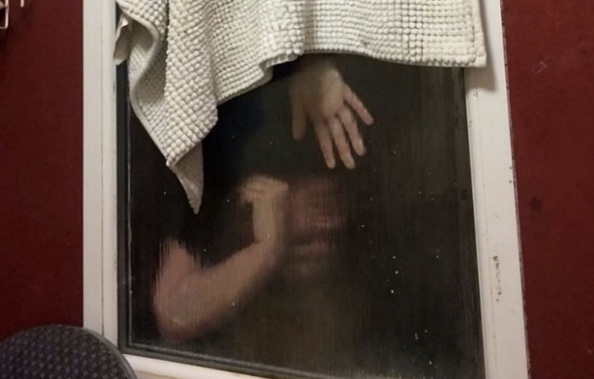
"As can be seen in the picture, the inside window opens at the top, into the gap that is separated from the garden by a non-opening double-glazed window pane.
"Seeing only one solution, I messaged our house group-chat, and went upstairs to find a hammer and chisel to smash open the window."
"Being an amateur gymnast, she was convinced that she could reach into the window and pull the poo out, using the tried and tested 'inside out bag as glove' technique.
"Unfortunately she couldn't reach. She climbed further in and had the same problem. Eventually I agreed to give her a boost up and into the window.
"She climbed in head first after her own turd, reached deeper into the window, bagged it up, and passed it out, over the top and back into the toilet from whence it came.
"She called out to me to help her climb out from the window, I grabbed her waist and I pulled. But she was stuck. Stuck fast.
"Try as we might, we could not remove her from the window. She was stuck fast, upside down in the gap.
"Unfortunately for my date, at this stage I could see only one way out of our predicament.
"She had been upside down in the window for around 15 minutes at this point, and I was starting to grow concerned for her health. I called the fire brigade.
"Bristol's finest were on scene sirens blaring in a matter of minutes.
"Once they had composed themselves after surveying the scene in front of them, they set to work removing my date from the window using all of their special firemen hammers and tools.
"It took them about 15 minutes.
"Unfortunately, although they rescued my date unharmed from what must have been a rather unpleasant confined space to find yourself in, in the process they had to completely destroy the window with their special fire tools.
"I'm not complaining, they did what they had to do. Problem is, I've been quoted north of £300 to replace the window.
LOS ANGELES - A 21-year-old man was sentenced today to life in prison without the possibility of parole for the fatal baseball-bat beating of a USC graduate student from China who was attacked during an attempted robbery near campus after walking another student home from a late-night study session.
I'm still betting on the rule of thumb that incumbents always get reelected, no matter how much they cock things up.
But . . .
The most common way for an incumbent to get defeated for reelection is to have a rebellion from within his own base.
Jessica Leveto, chair of Moving Forward Together, a grass-roots group in Ohio, watches people sign petitions at the Harbor Perk Coffeehouse in Ashtabula. (Maddie McGarvey/FOR THE WASHINGTON POST)
When Susan Kroger decided to help launch a political activism group for women in her largely rural, pro-Trump region, she expected a few dozen liberal neighbors to show up.
But when she opened the doors at the group’s first community meeting in Sioux Falls, S.D., 100 people flooded into the room. Now nine months later, Kroger says the group has quickly grown to 2,300 active members.
It’s a story emerging across Trump country, where left-leaning grass-roots groups have popped up in some of the reddest parts of the nation — a sign that “the resistance” has gone rural.
Most surprisingly, Kroger said, some of her newest members are disappointed Trump voters. The uncertainty over health-care policy has become a top issue driving first-time activists to join their ranks, Kroger and other grass-roots organizers said.
“The exciting thing about our events is that every time we hold one, I always ask ‘Who here is new?’ and about half the people raise their hand,” said Kroger, co-chair of LEAD South Dakota, an abbreviation for Leaders Engaged and Determined. “I’ve heard from a few women who voted for Trump and have since had a change of heart.”
Donald Trump won 60 percent of rural voters in the 2016 presidential election, slightly more than Mitt Romney in 2012 and Sen. John McCain (R-Ariz.) in 2008. But since then, the president’s national approval rating has slipped to 39 percent in late July, according to Gallup, helping to explain why political activism groups are flourishing in some places that turned out heavily in Trump’s favor during the election.
Results of a Washington Post-Kaiser Family Foundation poll suggest that Trump has long been on shaky ground in parts of rural America. Rural respondents to the April poll were as likely to strongly disapprove of Trump’s job as president as to strongly approve, 30 percent each. When broken down by gender, rural women reported a slightly higher disapproval than rural men, perhaps why many of the grass-roots groups are led by women.
Kelly Sullivan, a 30-year-old restaurant server in Sioux Falls and member of LEAD, noted that rural America has long been politically diverse, but the recent surge of political activism has made it more noticeable.
“People like us in smaller places and people that are in the rural communities, we’re just the same as the big city slickers,” Sullivan said of her fellow rural activists. “The feeling that we’re not being represented, or the feeling that the current administration is doing things that we disagree with, we’re on the same page as the people who are in the big cities.”
Trump won all but five of the 66 counties in South Dakota — including Minnehaha, the county in which Sioux Falls, a city of about 170,000 people, is located. The state gave Trump one of the highest approval ratings in the country during his first six months in office — 54 percent, according to Gallup.
Still, Sullivan said a resistance effort has been building in the state since Trump was elected. In January, she co-chaired a local march in conjunction with the national women’s march, attracting nearly 3,300 demonstrators to downtown Sioux Falls in 30 degree temperatures. Sullivan said the experience — seeing the sea of like-minded people — transformed her from a person who never dreamed of being politically active to someone who uses her spare time to call lawmakers. She is also preparing for her own run for a state legislative seat next year.
LEAD South Dakota has a nine-person board of directors and committees tasked with monitoring state legislative activity, candidate recruitment and other efforts. So far, the group is working with 75 candidates who are interested in running for office and is planning to break into chapters across the state to help manage its rapid growth.
“I was absolutely surprised to see the groundswell here in South Dakota,” Kroger said. “I have some experience in politics so I know how it feels to be the little guy in a state where you very much feel like the minority.”
In Ohio, Moving Forward Together Ashtabula County, a grass-roots group affiliated with the nationwide Trump resistance movement Indivisible, has also exceeded its leader’s initial expectations.
When Moving Forward hosted its first community forum in May, a panel to discuss concerns about health care and immigration, “I was afraid it would be three people and a sign,” said the group’s chair, Jessica Leveto. The forum took place in Jefferson, Ohio — a rural town of about 3,000 people, in a county that cast 57 percent of its votes for Trump.
Nearly 125 people showed up, Leveto said.
Moving Forward started in a local coffee shop in February, and within two weeks — with a few social media posts and through word of mouth — its numbers outgrew the space, said Leveto, an assistant professor of sociology at Kent State University at Ashtabula.
Leveto points to May’s Affordable Care Act repeal vote as an indicator of her group’s growing muscle. Despite routinely following party line votes, Ashtabula’s congressman, U.S. Rep. David Joyce (R-Ohio), was among the 20 Republicans who did not vote in favor of the repeal.
“I think we had something to do with that,” Leveto said. “I don’t think it was just our group, but the groups in the district. I think there were a lot of phone calls.”
Joyce did not return requests for comment.
Rural political action organizers say a health-care revision is a dominant issue that has galvanized their groups because members are concerned that rural citizens will be largely affected by any changes. Leveto said, specifically, many attendees at her group’s May event wanted answers on how an overhaul might effect the area’s fight against the opioid crisis.
In The Post -Kaiser poll, 95 percent of rural respondents said Medicaid is very or somewhat important to their communities. Thirteen percent said they rely on Medicaid themselves, compared to 10 percent of their urban and suburban counterparts, a statistically insignificant difference.
“Our communities are at risk, these are things that even in the South, we see the need to stand up and fight for the people in our community and I think that’s something that transcends region,” said Mandy Fowler, founding member of the Kudzu Coalition of West Alabama, a growing political action organization.
As an Indivisible group, the Kudzu Coalition hosts local forums, provides advocacy training and coordinates phone calls and emails to legislators. Its cornerstone event is a weekly demonstration called “Show up Shelby,” when members gather in the lobby of Republican Sen. Richard C. Shelby’s Tuscaloosa office to call for a town hall meeting.
The group uses the name of the Kudzu plant, an invasive species common in the South that is resistant to most herbicides. Fowler said it’s an appropriate moniker in a state where nearly 63 percent of voters backed Trump.
“We grow fast and we connect and we flourish in an area where it can be difficult for others to thrive. We are hard to get rid of,” Fowler said.
The group spun off from a closed Facebook page that connected Alabamians who wanted to discuss their dissatisfaction with the election.
“Especially in a red state, it can make things uncomfortable at work, school, places like that, where people are more Republican,” said Kisha Emmanuel, a graduate student in Tuscaloosa who began following the page soon after the election. She’s now an active member of the Kudzu Coalition.
As the number of page followers grew, Fowler said she wanted to mobilize the energy she was seeing online and began in-person meetings in December.
Small town and rural mobilizing will probably yield results, said James Simmons, a professor at the University of Wisconsin at Oshkosh who recently researched voter trends and attitudes in rural areas.
“If you look across the country, and you look at the real change that has happened over the last five or 20 years, it hasn’t happened at the national level, you see policy driven at the state level,” Simmons said. “If you’re talking about populist discontent, this is where it was bubbling.”
President Donald Trump. (Evan Vucci/Associated Press)
On Thursday, Foreign Policy published a remarkable memo penned by a former staffer on President Trump’s National Security Council. The author, Rich Higgins, was forced out last month by national security adviser H.R. McMaster for composing it. The memo contends that the president is the target of a vast conspiracy spearheaded by so-called cultural Marxists, who have allied with Islamists and captured (among other groups) the media, the deep state, academia, “global corporatists” and leaders of both parties. That Higgins worked for the NSC is disturbing enough. But more disturbing is that Trump, who saw the memo when it was passed to him by his son Donald Trump Jr., was “furious” at Higgins’s removal — a sign of the scary conspiratorial depths the president is already descending to.
The president’s enemies, Higgins claims, are employing “political warfare as understood by the Maoist Insurgency model.” Even Republican leaders have been subjugated, Higgins says, because they are “more afraid of being accused of being called a racist, sexist, homophobe or Islamophobe than of failing to enforce their oaths to ‘support and defend the Constitution.’ ” (Yes, Higgins says you and I have a choice: Either don’t be homophobic or support the Constitution.) He concludes chillingly, “The recent turn of events give rise to the observation that the defense of President Trump is the defense of America.”
The roots of the Higgins memo go back decades in the history of the right. Extreme-right groups such as the John Birch Society have long warned of cultural-Marxist-led conspiracies. (The memo’s first footnote cites a JBS member’s interview with a Soviet defector on “how Jewish Marxist ideology is destabilizing the economy.”) Past Republican presidents didn’t mind getting these groups’ votes, but Birchers and their like were kept far away from 1600 Pennsylvania Avenue.
Not so in Trump’s White House. Thankfully, Higgins’s time at the NSC was short. But the memo found its way to the president anyway, via a curious route. “Among those who received the memo,” reports Foreign Policy, “according to two sources, was Donald Trump Jr.” We may never know the reason an NSC staffer was sharing a “technical assessment” with the executive director of the Trump Organization, since Republicans have stopped caring about email security. But however Trump Jr. obtained the document, he “gave the memo to his father, who gushed over it, according to sources.” Trump “is still furious” that Higgins was forced out.
Trump’s attraction to an alternate reality where he is the target of the political elite, the banking elite, Marxists, the Islamic State, the deep state and professors from coast to coast fits in nicely with one of his rules: Nothing is ever his fault. He blamed a botched raid in Yemen on “the generals.” He blamed the failure of his Trump Shuttle airline on the economy. He blamed his failures in Atlantic City on two executives who died working for him. Facing declining poll numbers and an utter failure to “drain the swamp” or repeal major Obama-era legislation, the president once again has resorted to playing the victim. He remains, as one White House ally put it to The Post in May, “in the grip of some kind of paranoid delusion.”
There’s no sign that Trump’s attitude will change. The “wiser heads” — Chief of Staff John F. Kelly, McMaster and others — that some hoped would foster a kind of sanity in the president have so far proved ineffective. How long they last in their jobs is anyone’s guess, but it’s unlikely they’ll make it four years. Their replacements are more likely to amplify the conspiracies than argue against them. Trump will continue to see himself as under siege from all sides.
Trump’s paranoia echoes that of another president: Richard Nixon. Nixon rejected the Birchers publicly, but he shared the idea of a campaign against the president. “Never forget, the press is the enemy … the establishment is the enemy, the professors are the enemy,” he said in December 1972. More frighteningly, as Nixon’s presidency ended in disaster, Defense Secretary James R. Schlesinger, worried about Nixon’s growing instability and increased drinking, told commanders that any order of a nuclear launch should be routed through him or Secretary of State Henry Kissinger. Less than 50 years later, the Oval Office is at the center of a terrifying combination of delusions, a foreign policy crisis and nuclear launch codes. As with Nixon’s presidency, the end of this one cannot come soon enough.
TOR poll: how much money would each of you bet on the possibility that sometime between now and 2018, Trump will actively campaign against a GOP congressman or senator who has earned his ire.
I mean actively hitting the campaign trail in that person's home state, not just an errant tweet.
And I mean however briefly, before his staff try to stop him, and possibly succeed.
I can't decide how much I'd bet on this. It would be some non-zero amount, but I'm not sure if it would be a tiny amount or a large amount.
If I expanded the criteria to include errant tweets or an off-the-cuff remark on camera somewhere, I'd bet a huge amount on this.
A bit belatedly, President Trump summoned Republican senators to the White House on Wednesday in an attempt to corral votes for a health-care bill that had already died on the vine. The lesson Trump appears to have learned from the House Republicans’ successful vote to overhaul Obamacare is that, in Washington, dead operates by the “Princess Bride” standard: There’s mostly dead and there’s all dead.
The Senate bill, Trump hopes, is only mostly dead.
The problem he has is that the Senate bill needs 50 votes to pass, relying on Vice President Pence to break a tie, and there are only 52 Republican senators. Which means, as any 8-year-old could tell you, that losing three Republican senators dooms a bill opposed by the Democratic caucus.
This week, either Sen. Mike Lee (R-Utah) or Jerry Moran (R-Kan.) would have been the third vote to kill the Senate Obamacare replacement, had they not been savvy enough to both announce their objections simultaneously, meaning that neither would be the one to have delivered the fatal blow. They joined Sens. Rand Paul (R-Ky.) and Susan Collins (R-Maine), dropping the number of Republican votes to 48 and (mostly) killing the bill.
Others, such as Sen. Dean Heller (R-Nev.), seemed like they might similarly tip into the “no” column, offering us an interesting picture of the opposition the bill faced.
Heller and Collins both represent blue states, meaning that their constituencies were probably less receptive to embracing the (unpopular) Republican bill. They’re to the left of the Republican cluster of dots below.
Paul and Lee are at the top of the cluster, indicating that they’re more conservative than most of their colleagues. Moran is a more unusual case, landing more in the middle of the pack — although he represents a state that backed Trump by a wide margin.
Now, all of this was set in place before Wednesday’s luncheon. Trump hadn’t done much to influence the Republican caucus on the Senate bill, so the four detractors all announced their decisions largely outside of his influence. So this lunch was the president’s opportunity to twist some arms.
Trump’s expertise is not in cajoling elected officials on policy details. So on two occasions during the lunch, he instead leveled a threat that he had deployed against wavering House Republicans: Nice job you got there, shame if something happened to it.
He made an argument like that about Heller, for example.
This is a pretty potent threat for Heller, which opponents of the bill used against him. Heller is one of the relatively few Republican senators up for reelection next year (although a lot of Democrats and both independents are).
Before addressing Heller, though, Trump referred to Lee and Moran.
“The other night I was surprised when I heard a couple of my friends — my friends — they really were and are,” he said. “They might not be very much longer, but that’s okay. I think I have to get them back.”
Well, actually, Mr. President, that’s not a great threat. Both of them will hold their seats until two years past when you yourself face reelection.
Thanks to the Republicans’ strong performance last year, a lot of the members of Trump’s caucus — including Lee, Paul and Moran — won’t face reelection for another five years. Making threats against them seems … a bit toothless.
After all, Trump has to be reelected in 2020 (along with a number of other Republicans, including Collins).
If he gets past that and stays fairly popular with the Republican base then maybe he can start threatening to take out Moran and Lee. Right now, though? They’re not super worried about falling in line with their party’s caucus to keep the president happy.
That’s by design, of course.
Journalist Jon Ralston is referring to a probably apocryphal conversation between George Washington and Thomas Jefferson. As conveyed by the Thomas Jefferson Foundation, Washington is having coffee with Jefferson as the Constitution is being developed.
“Why,” Washington asked, “did you just now pour that coffee into your saucer, before drinking?”
“To cool it,” Jefferson answered, “my throat is not made of brass.”
“Even so,” Washington said, “we pour our legislation into the senatorial saucer to cool it.”
Senate terms are six years long and staggered so that there’s stability in the body and so that senators can take the long view. Members of the House, by contrast, have to worry about reelection constantly, and so are more responsive to the whims of the moment.
Trump is a whims guy. He’s discovering that his party’s senatorial caucus is less likely to be.
This article was corrected to clarify the context for Trump’s comments about Lee and Moran.
POLITICS | WASHINGTON MEMO Trump as a Novel: An Implausible ‘Soap Opera Without the Sex and Fun’ By MATT FLEGENHEIMER JULY 19, 2017 WASHINGTON — So it’s a few days before the election last November — just a few more days, surely, before Donald J. Trump would return to his golden tower to start a niche TV venture and fill a sagging Twitter feed with exclamation-pointed despair — and a book agent goes to his client with an idea: How about something on the Trump White House That Wasn’t? The writer — Steve Israel, then a Democratic congressman from New York, now at work on his third political satire — whips up a proposal, “Trumplandia.” Plot lines include a furtive meeting with President Vladimir V. Putin of Russia, overnight social media rockets fired from Mar-a-Lago and a top administration post for Ben Carson, now the secretary of housing and urban development, who once suggested through a surrogate that he was not qualified to run a federal agency. “Highly implausible,” the agent said of the pitch then. “My pen name could have been Nostradamus,” Mr. Israel says now. Many classes of Washingtonian have struggled with these first six months in President Trump’s thrall: senators, fact-checkers, people who enjoy sleep. But in a city so enchanted by its own history, so practiced in projecting a seen-it-all nonchalance, it has been a particularly trying time for a certain kind of storytelling swamp creature. Novelists linger over blank pages. Historians grope for precedent, and shrug. Even past participants in scandal strain to follow the narrative arc. “It’s early. We’re getting introduced to the characters,” said John Dean, the White House counsel and Watergate supporting player during the Nixon administration, who has become a frequent author in the decades since. “We’re not quite sure how this story is going to unfold, as comedy or tragedy.” He does have a guess. He pleaded guilty to a felony once. At present, though, the elements for either genre are slotting into place — an Allen Drury novel crossed with Shakespeare, with final touches entrusted to producers for the E! network. Foreign intrigue. Strained alliances at the Capitol. A blundering son. Face-lift tweets. There are nits to pick, and self-appointed editors to pick them. Where is this going? Which act are we on? “It’s like a soap opera without the sex and fun,” grumbled Matt Latimer, an author and former speechwriter for President George W. Bush. (He is reminded that the administration is young.) Some have chafed at the pacing and repetitive story lines, like Republicans’ halting efforts to pass health care legislation. Others wonder whether some elements are a bit on the nose, like the subject line on Donald Trump Jr.’s email chain about meeting with a Kremlin-connected lawyer last year: “Russia - Clinton - private and confidential.” Chekhov’s gun is not supposed to be fired skyward like a flare. “The Great White Shark has been jumped, indeed, pole-vaulted,” said Christopher Buckley, the author of politically charged sendups like “Thank You for Smoking.” “American politics has given the satirist pretty much nowhere to go. But away.” And still the writers try, reaching for analogies that can manage to mangle past and present in equal measure. It’s Iran-contra with a spray tan, Lewinsky with a grande covfefe. It’s “The Godfather,” but this time there’s a silent son-in-law in charge of Middle East peace for some reason. Sometimes inspiration springs from odd corners of the mind. William S. Cohen — the former Clinton administration secretary of defense, Republican senator from Maine and occasional novelist — was stirred recently by the memory of a poster on the back of a Senate Armed Services Committee bathroom during his tenure. It depicted Soviet soldiers on the march, he said, with a tagline that read, “Come visit us before we come visit you.” “Well,” he said by phone, “the Russians have come to visit us.” Late-night comedians have leaned most often on the Nixon age for comparison, with mixed success. In March, John Oliver, the host of HBO’s “Last Week Tonight,” described the Trump-Russia affair as “Stupid Watergate” — a prospective scandal “with all the intrigue of Watergate, except everyone involved is really bad at everything.” He has found that the framing device is aging distressingly well. “Unfortunately, it was supposed to be a self-contained joke,” he told Stephen Colbert on “The Late Show” last week, “but current events are making it more and more relevant. Which is not normally how jokes work.” The label seemed to offend Mr. Dean, of Nixonian infamy, by implication. “Most people don’t appreciate how stupid Watergate was,” he said. “It was hamfisted all over the place.” No question. But rarely has the ham-fistedness felt so all-consuming, infusing even the simplest of tasks from a president who, seeing little need for subtext, tends to read the bracketed stage directions aloud. A scene: For a moment this week, it seemed that the Senate health bill would be imperiled by a blood clot in Arizona, found in a war hero senator, John McCain, whom Mr. Trump once disparaged for being captured in combat. The president appeared eager to play narrator this time. “He’s a crusty voice in Washington,” he said of Mr. McCain, in something approaching a compliment. Then came the bottom line: “Plus, we need his vote.” The Republicans did not, as it happened. By Tuesday, they needed his and several others they did not have. No one said Mr. Trump was a reliable narrator. But there it was again, a sharp detour in this most peculiar chapter, sending the capital lurching down a cul-de-sac so unfamiliar that Senator Jerry Moran of Kansas — Senator Jerry Moran! Of Kansas! — played a decisive role in felling Republicans’ signature legislative promise of the last seven years. Maybe the tale will continue thus, hurtling forth in serialized chunks before a finale that may or may not arrive before January 2025. Mr. Israel, the congressman-turned-novelist, saw another ending once upon a time — liberal fantasy stacked upon liberal fantasy. His book proposal concludes on Inauguration Day 2021. Mr. Trump, scandaltarred and missing his real estate life, has decided against another run. Ground has already been broken on the Trump presidential library in Palm Beach, Fla. And as a helicopter whirs off, hauling the former president away, the book’s protagonist, a Trump press secretary named Jared Gold, sees an email: “President Sanders wants to meet with you.”
Trump as a Novel: An Implausible ‘Soap Opera Without the Sex and Fun’
President Trump at the White House on Tuesday.
Credit
Stephen Crowley/The New York Times
WASHINGTON — So it’s a few days before the election last November — just a few more days, surely, before Donald J. Trump would return to his golden tower to start a niche TV venture and fill a sagging Twitter feed with exclamation-pointed despair — and a book agent goes to his client with an idea: How about something on the Trump White House That Wasn’t?
The writer — Steve Israel, then a Democratic congressman from New York, now at work on his third political satire — whips up a proposal, “Trumplandia.” Plot lines include a furtive meeting with President Vladimir V. Putin of Russia, overnight social media rockets fired from Mar-a-Lago and a top administration post for Ben Carson, now the secretary of housing and urban development, who once suggested through a surrogate that he was not qualified to run a federal agency.
“Highly implausible,” the agent said of the pitch then.
“My pen name could have been Nostradamus,” Mr. Israel says now.
Many classes of Washingtonian have struggled with these first six months in President Trump’s thrall: senators, fact-checkers, people who enjoy sleep. But in a city so enchanted by its own history, so practiced in projecting a seen-it-all nonchalance, it has been a particularly trying time for a certain kind of storytelling swamp creature.
“It’s early. We’re getting introduced to the characters,” said John Dean, the White House counsel and Watergate supporting player during the Nixon administration, who has become a frequent author in the decades since. “We’re not quite sure how this story is going to unfold, as comedy or tragedy.”
He does have a guess. He pleaded guilty to a felony once.
At present, though, the elements for either genre are slotting into place — an Allen Drury novel crossed with Shakespeare, with final touches entrusted to producers for the E! network.
Foreign intrigue. Strained alliances at the Capitol. A blundering son. Face-lift tweets.
There are nits to pick, and self-appointed editors to pick them. Where is this going? Which act are we on?
Photo
Representative Steve Israel of New York at the White House in 2015.
Credit
Tom Williams/CQ Roll Call, via Associated Press
“It’s like a soap opera without the sex and fun,” grumbled Matt Latimer, an author and former speechwriter for President George W. Bush. (He is reminded that the administration is young.)
Some have chafed at the pacing and repetitive story lines, like Republicans’ halting efforts to pass health care legislation.
Others wonder whether some elements are a bit on the nose, like the subject line on Donald Trump Jr.’s email chain about meeting with a Kremlin-connected lawyer last year: “Russia - Clinton - private and confidential.”
Chekhov’s gun is not supposed to be fired skyward like a flare.
“The Great White Shark has been jumped, indeed, pole-vaulted,” said Christopher Buckley, the author of politically charged sendups like “Thank You for Smoking.” “American politics has given the satirist pretty much nowhere to go. But away.”
Sometimes inspiration springs from odd corners of the mind. William S. Cohen — the former Clinton administration secretary of defense, Republican senator from Maine and occasional novelist — was stirred recently by the memory of a poster on the back of a Senate Armed Services Committee bathroom during his tenure. It depicted Soviet soldiers on the march, he said, with a tagline that read, “Come visit us before we come visit you.”
“Well,” he said by phone, “the Russians have come to visit us.”
Late-night comedians have leaned most often on the Nixon age for comparison, with mixed success. In March, John Oliver, the host of HBO’s “Last Week Tonight,” described the Trump-Russia affair as “Stupid Watergate” — a prospective scandal “with all the intrigue of Watergate, except everyone involved is really bad at everything.”
He has found that the framing device is aging distressingly well.
“Unfortunately, it was supposed to be a self-contained joke,” he told Stephen Colbert on “The Late Show” last week, “but current events are making it more and more relevant. Which is not normally how jokes work.”
The label seemed to offend Mr. Dean, of Nixonian infamy, by implication.
“Most people don’t appreciate how stupid Watergate was,” he said. “It was ham-fisted all over the place.”
No question. But rarely has the ham-fistedness felt so all-consuming, infusing even the simplest of tasks from a president who, seeing little need for subtext, tends to read the bracketed stage directions aloud.
The president appeared eager to play narrator this time.
“He’s a crusty voice in Washington,” he said of Mr. McCain, in something approaching a compliment. Then came the bottom line: “Plus, we need his vote.”
The Republicans did not, as it happened. By Tuesday, they needed his and several others they did not have. No one said Mr. Trump was a reliable narrator.
But there it was again, a sharp detour in this most peculiar chapter, sending the capital lurching down a cul-de-sac so unfamiliar that Senator Jerry Moran of Kansas — Senator Jerry Moran! Of Kansas! — played a decisive role in felling Republicans’ signature legislative promise of the last seven years.
Maybe the tale will continue thus, hurtling forth in serialized chunks before a finale that may or may not arrive before January 2025.
Mr. Israel, the congressman-turned-novelist, saw another ending once upon a time — liberal fantasy stacked upon liberal fantasy.
245
Comments
His book proposal concludes on Inauguration Day 2021. Mr. Trump, scandal-tarred and missing his real estate life, has decided against another run. Ground has already been broken on the Trump presidential library in Palm Beach, Fla.
And as a helicopter whirs off, hauling the former president away, the book’s protagonist, a Trump press secretary named Jared Gold, sees an email: “President Sanders wants to meet with you.”
OK, I'm a bit more excited about this than I am about the Target. I feel my yuppy boner growing.
This replaces a Superior Groceries that used to be there, and was dirt cheap, making TJ's look like Whole Foods by comparison. So, gentrification much?
Southern California neighborhood grocery chain Trader Joe's is the first major new tenant in the USC Village project. (Photo/Anthony92931)
The first confirmed new tenant for USC Village is Trader Joe’s, a specialty grocery store that will serve students and neighbors beginning fall 2017.
Community-serving retail was a central promise of the student residential and retail complex, the biggest development in the history of USC at $650 million and one of the largest in the history of South Los Angeles. The store, to be located on the northwest corner of Jefferson Boulevard and Hoover Street, will measure approximately 12,700 square feet. Trader Joe’s bills itself as “a unique, neighborhood grocery store with foods and beverages ranging from the everyday to the exotic.” The chain was founded in 1958 in the Los Angeles area and now includes more than 400 stores in 40 states.
The USC Village Trader Joe’s will be the closest location for residents of downtown Los Angeles, where many USC students, faculty and staff reside.
The university officially launched construction of the USC Village project on Sept. 15.
“In the past four years, we have been privileged to break ground on a number of new projects at USC. But this village is an especially historic moment for USC, for our neighborhood and for Los Angeles as a whole,” USC President C. L. Max Nikias said during Monday’s official groundbreaking ceremony for USC Village.
Besides Trader Joe’s, the complex will include a drugstore, fitness center, Trojan Town USC store, restaurants and outdoor dining, parking and a community room. Bank of America and Starbucks coffee are among the returning tenants.
Tree-lined entrances will lead to a central plaza surrounded by outdoor dining and community-serving shops and cafes. A cluster of five-story residence halls and a clock tower in the Collegiate Gothic architectural style will rise above USC Village, housing up to 2,700 of USC’s top students under the mentorship of senior faculty masters.
USC Village will replace the nearly 50-year-old University Village and will sit on 15 acres of land the university has owned for several years.
The university will build USC Village without any public subsidies or taxpayer funds. USC also will provide more than $40 million in community benefits, including up to $20 million to an affordable housing fund managed by the city. The university will upgrade Jefferson Boulevard and fund construction of a new fire station, other roads around campus, a law clinic, a small business adviser and ombudsmen.
The project is expected to create thousands of permanent jobs and temporary construction jobs at USC, already the largest private employer in Los Angeles. USC has a project labor agreement and aims to fill at least 30 percent of the construction jobs locally.
Get new episodes of shows you love across devices the next day, stream live TV, and watch full seasons of CBS fan favorites anytime, anywhere with CBS All Access. Try it free! http://bit.ly/1OQA29B
--- The Late Show with Stephen Colbert is the premier late night talk show on CBS, airing at 11:35pm EST, streaming online via CBS All Access, and delivered to the International Space Station on a USB drive taped to a weather balloon. Every night, viewers can expect: Comedy, humor, funny moments, witty interviews, celebrities, famous people, movie stars, bits, humorous celebrities doing bits, funny celebs, big group photos of every star from Hollywood, even the reclusive ones, plus also jokes.
NFW this has a major segment complete. "well underway" likely means that they've done a lot of the stuff that comes before breaking ground.
Entrepreneur Elon Musk, who is chief executive officer of high-tech companies SpaceX and Tesla, tweeted yesterday that his underground tunnel project in Los Angeles is well underway.
The project addresses "soul-destroying" traffic in L.A. His vision is to dig deep tunnels under the city so cars can be transported to their respective destinations in a faster manner.
Donald Skunks the Democrats Maureen Dowd Maureen Dowd JUNE 24, 2017
Supporters of the Democratic candidate Jon Ossoff after his loss in Georgia on Tuesday night. Credit David Goldman/Associated Press WASHINGTON — YOU know who is really sick and tired of Donald Trump winning, to the point where they beg, “Please, Mr. President, sir, it’s too much”?
Democrats.
The Democrats just got skunked four to nothing in races they excitedly thought they could win because everyone they hang with hates Trump.
If Trump is the Antichrist, as they believe, then Georgia was going to be a cakewalk, and Nancy Pelosi was going to be installed as speaker before the midterms by acclamation. But it turned into another soul-sucking disappointment.
“It’s Trump four and us zero,” says the Democratic congressman Tim Ryan of Ohio. “I don’t want to admit that. When it comes out of my mouth, it bothers me. But Trump does robo calls. He tweets. He talks about the races. He motivates his base, and he moves the needle, and that’s a problem for us. Guys, we’re still doing something wrong here because a) he’s president and b) we’re still losing to his candidates.”
With Jon Ossoff, as with Hillary Clinton, the game plan was surfing contempt for Trump and counting on the elusive Obama coalition. Heavy Hollywood involvement is not necessarily a positive in Georgia, though. Alyssa Milano drove voters to the polls but couldn’t bewitch the Republicans. And not living in the district is bad anywhere.
Democrats are going to have to come up with something for people to be for, rather than just counting on Trump to implode. (Which he will.) The party still seems flummoxed that there are big swaths of the country where Democrats once roamed that now regard the Democratic brand as garbage and its long-in-the-tooth leadership as overstaying its welcome. The vibe is suffocating. Where’s the fresh talent?
In a new piece in The Atlantic, Emanuel and Bruce Reed — who engineered their party’s last takeover of Congress in 2006, the first since 1994 — argue that Democrats need to channel their anger and make 2018 a referendum on Trump’s record, not his impeachment.
In dwindling swing districts, Emanuel told me, Democrats need to choose candidates who are pro-middle class, not merely pro-poor.
They can’t just waltz in and win seats held by Republicans. And they can’t go full Bernie. They have to drum up suburban candidates who reflect their districts, Emanuel says, noting that they wrenched back control of Congress by recruiting a football player in North Carolina, an Iraq veteran in Pennsylvania and a sheriff in Indiana.
It’s shocking that Hillary couldn’t be bothered to come up with an economic message or any rationale other than “It’s My Turn.” “Hillary never got a real message out,” Michael Bloomberg, who eviscerated Trump at Hillary’s convention, told Anderson Cooper. “It was ‘Don’t vote for that guy’ and the gender issue. Whereas Donald had us saying ‘Make America Great Again.’ ”
Ryan says Democrats need to stop microtargeting. “They talked to a black person about voting rights, a brown person about immigration, a gay about gay rights, a woman about choice and on and on, slicing up the electorate,” he said. “But they forgot that first and foremost, people have to pay their mortgages and get affordable health care.”
He also urged his fellow Democrats to stop obsessing about Trump and Russia and start obsessing on globalization, automation and wage stagnation.
“The crazy thing is that there’s a great opportunity here, because neither party has figured out how to thrive in the new economy,” he said.
Carrier and Boeing, where Trump visited to boast about saving jobs, announced layoffs last week, and Ford is shifting some production to China. And news flash for Donald: King Coal has been dethroned.
“Trump leveraged his wealth to convince working-class people that he could deal with these changes,” Ryan said. “But just saying, ‘The Chinese rent from me,’ doesn’t mean he’s figured this stuff out.”
Trump may be nuts enough to blow up the world. But the Democrats are nuts if they think his crazy is enough to save them.
Supporters of the Democratic candidate Jon Ossoff after his loss in Georgia on Tuesday night.
Credit
David Goldman/Associated Press
WASHINGTON — YOU know who is really sick and tired of Donald Trump winning, to the point where they beg, “Please, Mr. President, sir, it’s too much”?
Democrats.
The Democrats just got skunked four to nothing in races they excitedly thought they could win because everyone they hang with hates Trump.
If Trump is the Antichrist, as they believe, then Georgia was going to be a cakewalk, and Nancy Pelosi was going to be installed as speaker before the midterms by acclamation. But it turned into another soul-sucking disappointment.
“It’s Trump four and us zero,” says the Democratic congressman Tim Ryan of Ohio. “I don’t want to admit that. When it comes out of my mouth, it bothers me. But Trump does robo calls. He tweets. He talks about the races. He motivates his base, and he moves the needle, and that’s a problem for us. Guys, we’re still doing something wrong here because a) he’s president and b) we’re still losing to his candidates.”
The 43-year-old Ryan, who failed to unseat Pelosi as House minority leader last year, says that the Democrats’ brand is toxic, and in some places worse than Trump’s. Which is beyond pathetic.
The Republicans have a wildly unpopular, unstable and untruthful president, and a Congress that veers between doing nothing and spitting out vicious bills, while the Democratic base is on fire and appalled millennials are racing away from Trump. Yet Democrats are stuck in loser gear.
Trump’s fatal flaw is that he cannot drag himself away from the mirror. But Democrats cannot bear to look in the mirror and admit what is wrong.
“We congenitally believe that our motives are pure and our goals are right,” Rahm Emanuel, the mayor of Chicago, told me. “Therefore, we should win by default.” But, he added dryly: “You’ve got to run a good campaign. In elections, politics matter. Oooh, what a surprise.”
As Ryan sighs: “If you don’t win, you don’t have power, and you can’t help on any of these issues we care about.”
Democrats cling to an idyllic version of a new progressive America where everyone tools around in electric cars, serenely uses gender-neutral bathrooms and happily searches the web for the best Obamacare options. In the Democrats’ vision, people are doing great and getting along. It is the opposite of Trump’s dark diorama of carnage and dystopia — but just as false a picture of America.
With Jon Ossoff, as with Hillary Clinton, the game plan was surfing contempt for Trump and counting on the elusive Obama coalition. Heavy Hollywood involvement is not necessarily a positive in Georgia, though. Alyssa Milano drove voters to the polls but couldn’t bewitch the Republicans. And not living in the district is bad anywhere.
Democrats are going to have to come up with something for people to be for, rather than just counting on Trump to implode. (Which he will.) The party still seems flummoxed that there are big swaths of the country where Democrats once roamed that now regard the Democratic brand as garbage and its long-in-the-tooth leadership as overstaying its welcome. The vibe is suffocating. Where’s the fresh talent?
In a new piece in The Atlantic, Emanuel and Bruce Reed — who engineered their party’s last takeover of Congress in 2006, the first since 1994 — argue that Democrats need to channel their anger and make 2018 a referendum on Trump’s record, not his impeachment.
In dwindling swing districts, Emanuel told me, Democrats need to choose candidates who are pro-middle class, not merely pro-poor.
They can’t just waltz in and win seats held by Republicans. And they can’t go full Bernie. They have to drum up suburban candidates who reflect their districts, Emanuel says, noting that they wrenched back control of Congress by recruiting a football player in North Carolina, an Iraq veteran in Pennsylvania and a sheriff in Indiana.
It’s shocking that Hillary couldn’t be bothered to come up with an economic message or any rationale other than “It’s My Turn.” “Hillary never got a real message out,” Michael Bloomberg, who eviscerated Trump at Hillary’s convention, told Anderson Cooper. “It was ‘Don’t vote for that guy’ and the gender issue. Whereas Donald had us saying ‘Make America Great Again.’ ”
Ryan says Democrats need to stop microtargeting. “They talked to a black person about voting rights, a brown person about immigration, a gay about gay rights, a woman about choice and on and on, slicing up the electorate,” he said. “But they forgot that first and foremost, people have to pay their mortgages and get affordable health care.”
He also urged his fellow Democrats to stop obsessing about Trump and Russia and start obsessing on globalization, automation and wage stagnation.
“The crazy thing is that there’s a great opportunity here, because neither party has figured out how to thrive in the new economy,” he said.
Carrier and Boeing, where Trump visited to boast about saving jobs, announced layoffs last week, and Ford is shifting some production to China. And news flash for Donald: King Coal has been dethroned.
Write A Comment
“Trump leveraged his wealth to convince working-class people that he could deal with these changes,” Ryan said. “But just saying, ‘The Chinese rent from me,’ doesn’t mean he’s figured this stuff out.”
Trump may be nuts enough to blow up the world. But the Democrats are nuts if they think his crazy is enough to save them.
Go back to Florida, Florida Man. In California, we're just hippy anti-vaxer crazy, not Florida crazy.
In a case of life imitates art, a man dressed like — and claiming to be — the action antihero Mad Max was arrested in the California desert last night. Big deal, you say? That guy done up like the Joker was busted twice in Florida last month, right? Well, this dude took things to the next level.
Jack Lee Ernest, 39, was riding a quad on Old Highway 59 in Barstow at about 11 PM Thursday when a San Bernardino Sheriff’s deputy tried to pull him over. But Ernest tried to ride…
Hey Houston! Just about a week until BAHFest proposals are due, and we need to see more! We'd especially like to see more proposals from women. So, please do us a favor and nudge your nerdy friends.
One of the major problems with the 2009 film was that it was just trying to do too much in too little runtime.
So, HBO high-production values adaptation? Yeah, that could be good.
Sounds like HBO just figured out that Game of Thrones is in its final few seasons, and they need a replacement ready. If this Watchmen thing happens, its first season episodes will probably air with the final season episodes of GOT as lead-in.
The Leftovers creator Damon Lindelof might be heading for another series at HBO. Lindelof is in very early talks to develop an adaptation of the comic book series Watchmen for the premium cabler. We hear the project is very premature in the early deal-making phase, and nothing has closed.
The 2009 film Watchmen, directed by Zack Snyder, was based on the 1986-87 DC Comics limited series by Alan Moore and Dave Gibbons. HBO had considered an adaptation of Watchmen back in…
“Pumpkin,” a 7-month-old Guernsey cow who does not produce chocolate milk. (The Washington Post)
Seven percent of all American adults believe that chocolate milk comes from brown cows, according to a nationally representative online survey commissioned by the Innovation Center of U.S. Dairy.
If you do the math, that works out to 16.4 million misinformed, milk-drinking people. The equivalent of the population of Pennsylvania (and then some!) does not know that chocolate milk is milk, cocoa and sugar.
But while the survey has attracted snorts and jeers from some corners — “um, guys, [milk] comes from cows — and not just the brown kind,” snarked Food & Wine — the most surprising thing about this figure may actually be that it isn’t higher.
For decades, observers in agriculture, nutrition and education have griped that many Americans are basically agriculturally illiterate. They don’t know where food is grown, how it gets to stores — or even, in the case of chocolate milk, what’s in it.
One Department of Agriculture study, commissioned in the early ’90s, found that nearly 1 in 5 adults did not know that hamburgers are made from beef. Many more lacked familiarity with basic farming facts, like how big U.S. farms typically are and what food animals eat.
Experts in ag education aren’t convinced that much has changed in the intervening decades.
“At the end of the day, it’s an exposure issue,” said Cecily Upton, co-founder of the nonprofit FoodCorps, which brings agricultural and nutrition education into elementary schools. “Right now, we’re conditioned to think that if you need food, you go to the store. Nothing in our educational framework teaches kids where food comes from before that point.”
Upton and other educators are quick to caution that these conclusions don’t apply across the board. Studies have shown that people who live in agricultural communities tend to know a bit more about where their food comes from, as do people with higher education levels and household incomes.
But in some populations, confusion about basic food facts can skew pretty high. When one team of researchers interviewed fourth-, fifth- and sixth-graders at an urban California high school, they found that more than half of them didn’t know pickles were cucumbers, or that onions and lettuce were plants. Four in 10 didn’t know that hamburgers came from cows. And 3 in 10 didn’t know that cheese is made from milk.
“All informants recalled the names of common foods in raw form and most knew foods were grown on farms or in gardens,” the researchers concluded. “They did not, however, possess schema necessary to articulate an understanding of post-production activities nor the agricultural crop origin of common foods.”
In some ways, this ignorance is perfectly logical. The writer and historian Ann Vileisis has argued that it developed in lockstep with the industrial food system.
As more Americans moved into cities in the mid-1800s, she writes in the book “Kitchen Literacy,” fewer were involved in food production or processing. That trend was exacerbated by innovations in transportation and manufacturing that made it possible to ship foods in different forms, and over great distances.
By the time uniformity, hygiene and brand loyalty became modern ideals — the latter frequently encouraged by emerging food companies in well-funded ad campaigns — many Americans couldn’t imagine the origins of the boxed cereals or shrink-wrapped hot dogs in their kitchens.
Today, many Americans only experience food as an industrial product that doesn’t look much like the original animal or plant: The USDA says orange juice is the most popular “fruit” in America, and processed potatoes — in the form of french fries and chips — rank among the top vegetables.
“Indifference about the origins and production of foods became a norm of urban culture, laying the groundwork for a modern food sensibility that would spread all across America in the decades that followed,” Vileisis wrote, of the 20th century. “Within a relatively brief period, the average distance from farm to kitchen had grown from a short walk down the garden path to a convoluted, 1,500-mile energy-guzzling journey by rail and truck.”
The past 20 years have seen the birth of a movement to reverse this gap, with agriculture and nutrition groups working to get ag education back into classrooms.
Aside from FoodCorps, which worked with slightly more than 100,000 students this year, groups like the National Agriculture in the Classroom Organization and the American Farm Bureau Foundation are actively working with K-12 teachers across the country to add nutrition, farm technology and agricultural economics to lessons in social studies, science and health. The USDA Farm to School program, which awarded $5 million in grants for the 2017-2018 school year on Monday, also funds projects on agriculture education.
For National Dairy Month, which is June, NACO has been featuring a kindergarten-level lesson on dairy. Among its main takeaways: milk — plain, unflavored, boring white milk — comes from cows, not the grocery case.
Nutritionists and food-system reformers say these basic lessons are critical to raising kids who know how to eat healthfully — an important aid to tackling heart disease and obesity.
Meanwhile, farm groups argue the lack of basic food knowledge can lead to poor policy decisions.
A 2012 white paper from the National Institute for Animal Agriculture blamed consumers for what it considers bad farm regulations: “One factor driving today’s regulatory environment ... is pressure applied by consumers, the authors wrote. “Unfortunately, a majority of today’s consumers are at least three generations removed from agriculture, are not literate about where food comes from and how it is produced.”
Upton, of FoodCorps, said everyone could benefit from a better understanding of agriculture.
“We still get kids who are surprised that a french fry comes from a potato, or that a pickle is a cucumber,” she said. “... Knowledge is power. Without it, we can’t make informed decisions.”
Update: This story originally said the survey in question was commissioned by the National Dairy Council. It was actually commissioned by the Innovation Center of U.S. Dairy, its sister organization. The Post regrets the error.
Los Angeles will honor "Batman" actor Adam West with a fitting tribute Thursday - lighting up the Bat-signal for the beloved Caped Crusader.
The public ceremony will be held at Los Angeles City Hall, with Mayor Eric Garcetti, Los Angeles Police Chief Charlie Beck and "surprise Bat-guests" in attendance, according to
Three French nationals were arrested at Los Angeles International Airport when customs officers found nearly 5 pounds of crystal methamphetamine hidden in their underwear and in their luggage, authorities said Wednesday.
The June 11 arrests occurred when Transportation Security Administration officers intercepted a French Polynesian man at a checkpoint with 3.
Lawmakers who want to implement stricter vaccination rules could look to California, where a 2014 measles outbreak at Disneyland inspired a bill barring parents who don’t vaccinate their children for religious or ideological reasons from sending those children to public school. The measure faced significant opposition from anti-vaccination activists, but its sponsor attributed its success to two powerful allies: a compelling mathematical model and vocal support from pro-vaccine parents. The bill went into effect last summer, and vaccination rates have since rebounded.
Measles is a highly contagious and potentially deadly viral infection. Although the MMR vaccine that prevents it is quite effective, some children — including those with pre-existing health conditions, like cancer or compromised immune systems, and those who are younger than 6 months old — cannot receive it. These vulnerable populations rely on herd immunity to protect them. When vaccination levels reach a critical threshold — 83 percent to 94 percent for measles — the high concentration of immune people squelches the spread of the disease, preventing it from reaching large numbers of unprotected people.
The trouble with getting vaccination rates to this critical threshold is that people lack scientific understanding, said University of Bristol professor Stephan Lewandowsky, who studies how prior beliefs influence the acceptance of scientific facts. The concepts of herd immunity and exponential growth are difficult for most people to grasp, Lewandowsky said. What people don’t intuit on their own is that an average person with the measles is likely to infect 12 to 18 others in an unvaccinated population, meaning that the number of measles cases increases more than tenfold with each fresh round of infection, so what starts as an isolated case can rapidly become a full-blown epidemic. Normally, herd immunity puts up roadblocks that keep each new case from being converted into others — if most people are immune, the disease fizzles out before encountering new potential hosts — but with something as contagious as measles, it doesn’t take many parents opting out of immunization before this critical protection mechanism becomes ineffective.
“If you don’t know how high the level of coverage has to be in order to get herd immunity, then people might legitimately think, ‘Ah, well, we throw in a few exceptions to keep the religious people quiet,’” Lewandowsky said. “If it were seatbelts or something then it might not be a bad idea, but vaccination is special because of the need to have this incredibly high coverage to get herd immunity.”
When making the case for mandatory vaccination, simply presenting people with the facts may not convince them and could even backfire, Lewandowksy said. People tend to dig in deeper when presented with information that contradicts their worldview. To reverse people’s beliefs, it’s more helpful to provide an explanatory model, he said.
That method helped in California. Pediatrician and state Sen. Richard Pan introduced Senate Bill 277 in 2015 and went looking for a way to explain the importance of mandatory vaccination. He stumbled across a model that depicts how an epidemic unfolds when herd immunity is lost. The model, a graphical outbreak simulator called FRED (Framework for Reconstructing Epidemiological Dynamics) Measles, was developed at the University of Pittsburgh under the direction of public health researcher Mark Roberts.
FRED Measles demonstrates that if 20 percent of schoolchildren aren’t vaccinated, a single isolated case of measles can rapidly erupt into an epidemic. The FRED platform allowed researchers to build a simulation of human interaction dynamics, Roberts said, wherein virtual people in 116 million households across the country live, work and socialize according to data synthesized from the U.S. Census.
The FRED Measles model can be used to visualize infectious disease dynamics in any county, so Pan could show his fellow senators exactly how an outbreak would play out in their own backyards.
“There was something about showing a movie of your hometown that people relate to,” said Don Burke, dean of the school of public health at the University of Pittsburgh. It was his idea to break the model down by county.
Lewandowsky said that making the simulation relevant to where you live taps into a well-established principle of cognitive psychology called “construal theory.” When a problem feels local, Lewandowsky said, people are more likely to be proactive.
When former California state Sen. Marty Block first laid eyes on the bill, he said, he was concerned that making vaccination a prerequisite for attending public school would limit access to education. After watching a simulated outbreak unfold among his constituency, however, Block said his sense of duty to protect public health overwhelmed his other concerns.
“If people decide to put themselves in harm’s way as a knowing decision, it bothers me still, but that may be their right,” Block said. “When I saw the simulation, it was clear that they were putting others in harm’s way. That’s when it became to me a very important thing for the government to legislate.”
Opponents of California’s bill also predicted that if it became law, vaccination rates would remain the same while school enrollment would drop. But the opposite turned out to be true, Pan said. After the law went into effect in 2016, vaccination rates hit an all-time high — and school enrollment increased, according to the California Department of Public Health.
“Most parents are on the fence,” Pan said. “It’s not because they don’t believe in vaccines; they’re nervous about them. And so what happened is that the law pushed them off the fence, and they got their kids immunized.”
The legislation appears to have changed behavior, and Lewandowsky said attitudes will likely follow suit. When a new law requires people to change the way they act, they tend to vociferously decry the change at first, but opposition often evaporates as years pass and the new behavior becomes the status quo. Lewandowsky said that attitudes toward bans on indoor smoking had followed this pattern, for example.
But could the model convince lawmakers in other states? It’s hard to say. Most states still allow parents to exempt their children from vaccination for religious reasons, and more than a dozen of those — including Minnesota — also allow philosophical exemptions. Last year, Roberts reached out to 20 or 30 legislators in states trying to tighten vaccine exemption laws. He explained how FRED Measles could help proponents of these bills to make their case and even offered to travel to the legislators’ states to present the model in person. To his surprise, he didn’t gin up much interest.
Pan said the onus for changing vaccination laws cannot be on legislators alone — grassroots organization among pro-vaccine parents is also essential. While 88 percent of U.S. parents believe that the benefits of vaccination outweigh the risks, they are generally not passionately outspoken about the belief, Pan said.
FRED Measles could be useful to parent-led movements too — its original intent was to target the public, Burke said. To that end, he and his colleagues made the simulation available online and aimed to make it user-friendly and even smartphone compatible. Burke’s colleagues sent the link to Twitter-famous figures in hopes of reaching the widest possible audience.
But Lewandowsky thinks the problem with public engagement on health policy is not that people don’t have access to information, but that 99 percent of people aren’t paying attention.
“Data is certainly very important, but data by itself can’t carry the day,” Pan said. “What carries the day is parents being mobilized and activated. That’s how we were successful in California.”
CORBIN, Kentucky — There have been no marches against the Republican bill to repeal and replace Obamacare here. No raucous town halls. There was only one protest rally anywhere in the region. Photographs captured a solitary woman holding a sign.
In an area that stands to lose a lot of health coverage under the GOP’s American Health Care Act, the silence does not equal endorsement. It is a sign, instead, of disappointment setting in among a group of conservative voters who only months ago were bubbling with hope for Donald Trump’s health care plan.
The uninsured rate here in this rural swath of southeastern Kentucky has plummeted faster under the Affordable Care Act than any other area in the country. I visited the area last winter and talked to Obamacare enrollees who voted for Trump. They expected the president to repeal the law and replace it with something much better. “That man has a head for business,” one enrollee told me. “He will absolutely do his best to change things.”
A handmade sign to sign up for health care in Corbin, Kentucky.
Byrd Pinkerton/Vox
I went back this spring just after the House passed the AHCA, the bill to repeal and replace Obamacare that would cause 23 million fewer Americans to have health coverage, according to Congressional Budget Office estimates. The optimism was gone. Resignation had replaced it.
“You know, thinking about it, I’m not even sure what I expected. I just thought it would miraculously work out wonderful for everybody,” Bobbi Smith, a 62-year-old Obamacare enrollee who voted for Trump, says. “So I guess maybe I didn’t put enough thought into what I would expect from a health care act.”
The souring on the Republican bill in a deep-red area of the country reflects the AHCA’s profound unpopularity nationwide. But the lack of protest also shows the strength of partisanship in the United States, which could prove a protective shield for Republican legislators in the 2018 midterms.
In southeastern Kentucky, the Obamacare enrollees I interviewed were disappointed — but they also weren’t mad that their Congress member, Hal Rogers, voted to pass it. They talked about all the other good things he had done for the area in his decades of service. They gave him the benefit of the doubt, expecting that he must have cast his vote to improve the economy or solve a budget issue.
This includes Kathy Oller, an Obamacare enrollment worker who supported Trump in the 2016 election. She feels let down by the Republican health care plan — “If they take the expanded Medicaid away, it really, really is gonna kill Kentuckians because they won’t have health insurance,” she says — and she’s already seeing other ways that Trump health policies are hurting Kentucky. Obamacare sign-ups, she said, were slower this year, as people in Kentucky were confused about whether the health care law still existed.
Kathy Oller (left) speaks with Bobbi Smith, whom she enrolled into Affordable Care Act coverage. “You know, thinking about it, I’m not even sure what I expected. I just thought it would miraculously work out wonderful for everybody,” Smith says.
Byrd Pinkerton/Vox
But Oller doesn’t regret her vote for Trump — “I don’t have regrets,” she says plainly — and she trusts that Rogers, whom she has also voted for, knows what he’s doing. She gets most her news from his weekly emails to constituents; she cites his arguments for why the law needs to be repealed.
This sentiment felt ubiquitous in Corbin. Obamacare enrollees I interviewed didn’t like the Republican plan, but they still trusted the Republican Party to do the right thing on health care.
They felt like they had picked a side, and now they were going to stick with it.
“It won’t be good for anybody”: the Republican health care plan would hit Kentucky especially hard
Perhaps no one stands to lose out more under the AHCA than the people who live in southeastern Kentucky.
In 2013, 20.4 percent of Kentuckians lacked health insurance. Now just 7.8 percent do. More Kentucky residents report having a regular source of health care, and fewer say they have skipped needed medical attention because of the cost.
The AHCA would reverse many of those gains. The bill the House passed would end the Medicaid expansion, a program responsible for three-quarters of Kentucky’s coverage gains.
It would reform the individual market in ways that would hurt southeastern Kentucky too. It would allow insurers to charge older enrollees significantly higher premiums, a practice limited under current law. This would hit Kentucky especially hard: 31 percent of Obamacare enrollees there are over 55 — well above the 20 percent national average.
You could see how all these changes would play out with someone like 62-year-old Clifford Hoskins. He’s retired and was recently diagnosed with black lung disease, the product of a three-decade career in the coal mines.
Hoskins signed up for Medicaid in early 2016 but recently transitioned to marketplace coverage when disability checks bumped up his income. He pays a $232 monthly premium for his plan, and receives a subsidy of about $700 from the federal government to cover the rest of the cost.
Hoskins liked his Medicaid plan, which paid for an ankle surgery last year. He likes his new marketplace coverage too. He takes at least four medications regularly to treat his black lung disease, some kidney issues, and depression. He describes his Medicaid plan as “the best insurance I ever had in my life.”
62-year-old Clifford Hoskins enrolled in Affordable Care Act programs when he retired from his coal mining job. He describes Medicaid as “the best insurance I ever had in my life.”
Byrd Pinkerton/Vox
Under the AHCA, analysts estimate Hoskins’s premium would rise 24 percent as insurers would be able to charge someone his age a higher amount. His subsidy, meanwhile, would drop from $700 each month to $333.
Those two changes alone would more than triple his out-of-pocket premium, from $232 each month under Obamacare to $822 each month under the Republican plan.
“It’s going to at least take half, if not all, of my Social Security,” Hoskins says. “If I had to pay the full amount, that would not be good. That would put you back in poverty.”
There would be other changes at play too. Kentucky could waive out of Obamacare’s essential health benefits package, allowing insurers to cover fewer benefits. This would only lower premiums slightly, analysts say, and could be risky for someone like Hoskins. An insurance plan, for example, may decide to stop some of his prescription medications.
Hoskins had been reading a lot about the bill the House passed. He mostly reads things on the internet, starting at the AOL homepage, ever since he canceled his cable service a few months ago to save money. He doesn’t like what he’s seen.
“From what I’ve read on it, it’s not going to be good for anybody,” he says.
This all got him frustrated. He didn’t vote in the 2016 election — he was still in the hospital recovering from ankle surgery. There were certainly parts of the Trump agenda he liked, such as the president’s immigration policy. “I've not got anything again the wall,” Hoskins says. “I've got nothing against protecting our borders.”
But he says he’d be a one-issue voter when the next election rolls around if Republicans repeal the Affordable Care Act. “If they do away with this, there are going to be a lot of changes to my voting,” he says. “This is my biggest issue right now.”
To Hoskins, this was common sense: Of course votes would shift if Congress voted to end health insurance for millions of Americans. He predicted that Rogers’s vote to repeal Obamacare “probably changed every working person’s opinion [who is] on the Affordable Care Act.”
Actually, it didn’t. Most Obamacare enrollees I talked to didn’t like the Republican bill, but they didn’t think it would change their votes either.
“Maybe its a trade-off for all the stuff he’s done”: how partisanship protects Republican legislators
Kentucky’s Fifth Congressional District runs through the heart of Appalachian Kentucky. It is the fourth-most-Republican district in the entire country, according to the Cook Political Report’s Partisan Voter Index.
The district first voted Rogers into office in 1981, and has reelected him 18 times since. The last Democrat to run against him, in 2014, got 22 percent of the vote.
Kentucky Rep. Hal Rogers leaves a meeting of the House Republican conference in the Capitol on April 26, 2017.
Tom Williams/CQ Roll Call
The places that benefited the most from Obamacare also tend to be some of the places with the most partisan voting records. If you zoom in on the 10 congressional districts that saw the biggest declines in uninsured rates, you will see eight are considered safe seats in the 2018 midterms. None are competitive enough for the Cook Political Report to rank them as toss-ups.
Political tribalism has become a major force in American politics — and is alive and well in the Kentucky Fifth. Voting Republican is just part of what it means to live in that area of the country. “Like my dad told me, this is a Republican county,” Hoskins says when I ask why he registered with the party.
Rogers’s office declined my request for an interview — but the Congress member felt like a constant presence during my trip to Kentucky. The local highway is named after him, and so is the water park. People like Oller relied on his emails to constituents to get information about Obamacare.
“This is Hal Rogers; he just puts it simple,” she says, when I asked her how Obamacare was going in her state. “Kentuckians have to choose between paying for health insurance and putting groceries on the table.”
Nearly all Obamacare enrollees expected Rogers to stick around. They weren’t mad about it either. Despite opposing his vote for the AHCA — and having an intensely personal stake in the matter — they felt he’s served the district well.
Michael Martin, a 47-year-old Obamacare enrollee, says he thought of Rep. Rogers’s AHCA vote as “a trade-off for all the other stuff he’s done. He’s brought jobs in. One of the places where I worked was one of the places he brought in.”
Martin likes his Obamacare coverage. He used to have a federal contracting job but is currently unemployed. He pays $77 each month and gets a $341 monthly subsidy from the government. He’s currently in treatment for thyroid cancer, which was diagnosed when he was on the Medicaid expansion about a year ago. He had a bypass surgery a few years ago, when he had insurance at work, and worries about that being categorized as a preexisting condition.
Michael Martin, a 47-year-old Obamacare enrollee.
Byrd Pinkerton/Vox
Martin has kept up with the health care debate. When we met in mid-May, he told me he was waiting for the new CBO number that would come out the next week. What he saw online made him think the new bill would be a raw deal for him.
“I saw a chart on the internet that showed the estimates of how much a person with preexisting cancer or cardiac problems would have to pay,” he says. “I fall into those categories. If you add them together, I’m like a double risk. The number was really up there, the premium.”
Martin wouldn’t tell me whom he voted for in the 2016 election; the people I met generally seemed more reticent to talk about which candidate they favored during this trip. But he did say he’d supported Rogers in the past and was currently puzzling over his Congress member’s vote. He wasn’t necessarily mad, more confused. I asked him whether he thought Rogers had the best interests of Kentuckians at heart.
“He’s gotta know, right?” Martin responded. “Well, he’s gotta know, but I can’t see the reasoning why he voted ‘yes,’ you know?”
Bobbi Smith hadn’t followed the health care debate as closely. She pays $330 each month for her Obamacare plan and gets a $447 subsidy from the government. She’s happy with her insurance, which worked well when she was diagnosed with breast cancer last January.
Smith didn’t like the idea that AHCA could raise her premiums just because she’s older. “The higher premium for older people is generally a gripe,” she says. “And for people with preexisting conditions, that’s terrible. [It would] be really hard for them.”
Bobbi Smith, 62, has used her Affordable Care Act plan to receive treatment for breast cancer. She supported Donald Trump in the 2016 election.
Byrd Pinkerton/Vox
But Smith started kicking around the idea a bit more, and began to come around to the Republican plan. “You can’t buy insurance for anything else that’s already damaged either, if you think of it that way,” she says. “You can’t wreck your car, then go buy insurance. ... It would be wonderful if they could just be insurance at the same price as everybody else...”
She paused for a moment, and then says, “I don’t see that being feasible.”
Smith didn’t like the changes we talked about in the Republican plan — but she wasn’t especially worried about them either. She understood that her premium might go up and her subsidy could go down. But she felt like she had picked a side in America’s political debate, and for now, she is going to stick with it.
“We choose which party we place our values with,” she says. “We’re supposed to trust them to do for us, you know, what our party stands for.”
Republicans’ vote for an unpopular bill will test the limits of partisanship
Partisanship is the best predictor of what people think of the Affordable Care Act, even better than whether someone has benefited from the law.
“Partisanship trumps personal experience,” says Mollyann Brodie, who runs the Kaiser Family Foundation’s monthly tracking poll. “Your party affiliation tells me whether you think you were helped or hurt by Obamacare, even if you don’t have individual insurance.”
The recent uptick in support for Obamacare doesn’t reflect Republicans suddenly reconsidering their opinions. Brodie says that when you dig into the numbers, Republicans are just as opposed to Obamacare as they have been for years. Instead, you see Democrats who were lukewarm supporters suddenly becoming more fervent proponents.
But partisanship also has limits. Conventional wisdom has suggested that Trump’s core supporters would stick with him through thick and thin. FiveThirtyEight’s Nate Silver suggests that has become less true ever since the American Health Care Act passed. The ranks of voters who “strongly support” the president has dropped consistently since mid-May.
Silver’s argument rang true in Corbin. The voters who were willing to defend Hal Rogers were less willing to give Trump the same deference. They voted for change, for the candidate who promised to support a health care plan that covers everybody. They felt let down.
“It doesn't look like Trump's going to listen to us,” Oller told me over eggs at Cracker Barrel on a rainy Thursday morning. “I kind of figured he would listen. He would listen to everybody and try to work it out. But he’s got too many other fish to fry now.”
The politics of repeal are, ironically, most dangerous for Republicans who represent districts with fewer Obamacare enrollees
Contrast the Kentucky Fifth with California’s 49th Congressional District, which Rep. Darrell Issa, a Republican, currently represents. Issa’s district is relatively high-income and had a high insured rate before the Affordable Care Act passed. Gains in coverage have been relatively modest.
But Issa has been besieged by protesters at his office and at raucous town halls. The Cook Political Report rates his district as a “toss-up” in 2018.
Republican Rep. Darrell Issa speaks at a town hall meeting at a high school in San Juan Capistrano, California, June 3, 2017.
Bill Wechter/AFP/Getty Images
Issa won his district narrowly in 2016, by just about 5,000 votes. The place he represents, a swath of Southern California coastline running through San Diego County, has lots of angry Democrats. Brodie’s research has found an intensity gap between the parties: Democrats tend to strongly oppose the AHCA, whereas Republicans are lukewarm in their support.
“What we always saw on the ACA was that Republicans were strongly opposed and Democrats were less strongly in favor,” Brodie says. “Now our polling is starting to show a mirror image of that.”
Arthur Schaper (left), supporter of President Donald Trump, speaks with demonstrator Marti Eisenberg (center) before a town hall meeting with Rep. Issa at a high school in San Juan Capistrano, California, on June 3, 2017.
Bill Wechter/AFP/Getty Images
Obamacare enrollees probably won’t rise up en masse to oust Republicans such as Issa. But the vote could haunt those members by driving angry Democrats to turn out in greater numbers — and persuading some dismayed Republicans not to turn out at all.
More than 40 people in Los Angeles County and surrounding regions have been diagnosed with mumps, prompting public health officials Thursday to declare an outbreak and issue an alert to physicians and providers to be aware of it.
In the alert, public health officials said many of the cases were initially misdiagnosed and there was a reliance of using false negative results.
Women participate in a fitness class led by Kira Stokes, left, at NYSC Lab in New York. (Seth Wenig/AP)
Calorie counting is a useful way to lose weight, but a new study suggests a fitness tracker could sabotage your efforts.
The devices are overwhelmingly popular. For instance, since its inception, the leading brand, Fitbit, has sold at least 30 million of them. The company promises on its website that the devices “track steps, distance, calories burned, floors climbed, active minutes & hourly activity.” Others, such as PulseOn, Apple Watch, Basis Peak, Samsung Gear S2 and Microsoft Band, promise the same.
A team of Stanford researchers, however, recently called foul after testing these trackers. The scientists said in a paper published Wednesday in the Journal of Personalized Medicine that though the devices purport to help users track their calories — daily energy expenditure —thenumber is often markedly incorrect.
The least accurate, PulseOn, was off by an average of 93 percent. The most accurate device, Fitbit Surge, was off by an average of 27 percent, the Guardian reported.
In a statement to NPR, PulseOn said the extremely high level of inaccuracy may “suggest that the authors may not have properly set all the user parameters on the device.”
The consequences of such large margins of error could, of course, be significant.
“People are basing life decisions on the data provided by these devices,” Euan Ashley, a professor of cardiovascular medicine at Stanford and co-author of the study, said in a news release.
Let’s say, as a hypothetical, some users check their device at the end of a long day and discover to their delight they burned 1,000 calories when they actually only burned 730. They might have an extra dessert or glass of wine since they think they’ve met their goal.
Over time, that adds up. In this scenario, that’s 1,890 extra calories each week the users don’t know about. Each pound of fat is composed of 3,500 calories.
“It’s just human nature,” Tim Church, professor of preventative medicine at Pennington Biomedical Research Center at Louisiana State University who wasn’t involved in the study, told NPR. “People are checking these inaccurate counts and they think they’ve earned a muffin or earned some ice cream and they’re sabotaging their weight-loss program.”
Six fitness devices, clockwise from top left: the Garmin Vivoactive, Fitbit Blaze, Garmin Vivoactive HR, Samsung Gear Fit2, Apple Watch and Fitbit Surge. (AP)
Of course, some margin of error when using a device like this is inevitable, but the scientists said it should be far lower.
“For a lay user, in a non-medical setting, we want to keep that error under 10 percent,” Anna Shcherbina, a Stanford graduate student and study co-author, said in a news release.
One of the key issues, Shcherbina hypothesized, was the difference in users’ body compositions.
“It’s very hard to train an algorithm that would be accurate across a wide variety of people because energy expenditure is variable based on someone’s fitness level, height and weight, etc.,” Shcherbina said.
The study participants included a “diversity of ages, male and female, and then also we looked at diversity of skin tone, and then size and weight to try and represent the population generally,” Ashley told the Guardian.
The devices proved most accurate for white women who were already fit, meaning “for those for whom it might matter the most, who are trying to lose weight, the error was actually greater,” Ashley told NPR, speculating that perhaps the companies only test the devices on a narrow group of people.
While the energy expenditure numbers were woefully off, Shcherbina pointed out that it’s much easier to assess heart rate, which can be measured directly and not through proxy calculations.
Indeed, Ashley said, “The heart rate measurements performed far better than expected.” Most were off by only about 5 percent.
There have long been hints that these devices aren’t useful for weight loss. A multiyear study published last September in JAMA split into two groups almost 500 people hoping to lose weight. One used fitness trackers, while the other did not.
Those with the trackers lost about 50 percent less weight than those without.
At the time, the study’s lead author, John Jakicic, a researcher of health and physical activity at the University of Pittsburgh, thought it had to do with people incorrectly interpreting the fitness trackers.
“These technologies are focused on physical activity, like taking steps and getting your heart rate up,” Jakicic told NPR. “People would say, ‘Oh, I exercised a lot today, now I can eat more.’ And they might eat more than they otherwise would have.”
The Stanford study, though, suggests that perhaps the participants were merely working with faulty data.
James Madison had presidential “negligence” on his mind.
Credit
Getty Images
The simmering talk of impeachment swirling around President Trump largely concerns whether he committed a crime by asking James Comey, when he was still the director of the F.B.I., to end an investigation of Michael T. Flynn, the onetime national security adviser. From the perspective of criminal law, the resulting questions, which pertain mainly to the president’s intent in making the request, are inescapable. From the perspective of the decidedly political act of impeachment, they are irrelevant. The purpose of impeachment is not punitive. It is prophylactic.
Criminal law looks backward toward offenses committed. The object of impeachment is not to exact vengeance. It is to protect the public against future acts of recklessness or abuse. Consequently, the issue in deciding whether Mr. Trump is liable to impeachment is less what happened in the Oval Office between him and Mr. Comey than what those events say about what will happen in similar situations in the future. That is not a case for casual impeachment. On the contrary, since it is harder to predict future acts than to prove what has already occurred, such a standard may be harder to meet.
Our tendency to read the impeachment power in an overly legalistic way, which is ratified by 230 years of excessive timidity about its use, obscures the political rather than juridical nature of the device. The Constitution applies presidential impeachment to “Treason, Bribery, or other high Crimes and Misdemeanors.” The famous latter phrase does not refer to offenses like burglary on the one hand or loitering on the other. If it did, impeachment would be available for casual transgressions, which no framer of the Constitution intended.
The phrase dates in American constitutionalism to the founder George Mason’s proposal to make the president liable to impeachment not just for treason and bribery — the original formulation at the Constitutional Convention — but also for what he called “maladministration.” His fellow framer James Madison objected to the vagueness of the term, so Mason substituted “high Crimes and Misdemeanors.” That phrase, in turn, is traceable to the British legal commentator William Blackstone, a contemporary who was revered in colonial America, who applied it to the “mal-administration of high officers,” among other things.
Mason’s intent was clearly to delineate a political category, something Alexander Hamilton — who did not shrink in the defense of executive power — recognized in Federalist 65, which says that impeachment applied to offenses “of a nature which may with peculiar propriety be denominated POLITICAL, as they related chiefly to injuries done immediately to the society itself.”
The victim Hamilton identified — “the society itself” — defined the nature of the offense. Earlier, at the 1787 Constitutional Convention, Madison had indicated the same understanding. Note, crucially, the purpose for which he said impeachment should be available: “Mr. Madison thought it indispensable that some provision should be made for defending the community against the incapacity, negligence or perfidy of the Chief Magistrate.”
The tendency to read “high Crimes and Misdemeanors” too literally is one reason the 25th amendment, which treats presidential incapacity as though it requires a special constitutional mechanism when in fact one was already in place, became necessary. It is also why, in a development that surely would have surprised Hamilton and Madison alike, the republic has managed 23 decades without a successful impeachment and conviction, the resignation of President Richard Nixon notwithstanding.
The political nature of the impeachment authority does not mean it is merely a contest over power. Still less is it supposed to rehash electoral disputes. Instead, the point is that because its purpose is to “defend the community” rather than to punish an individual, the standards of a criminal trial do not apply. The Constitution’s specification that prosecuting an individual for an act for which he or she was impeached does not constitute double jeopardy reinforces this understanding.
The prophylactic rather than punitive character of the impeachment power still, of course, requires an offense. But the offense indicates a pattern on the basis of which future behavior can be predicted. The idea is not to humiliate the president or to cause him to suffer by the loss of his office. It is to protect the public against his negligence or abuse.
In this sense, it does not matter whether Mr. Trump explicitly intended to obstruct justice when he reportedly attempted to cajole Mr. Comey. The determination Congress must make is what its level of confidence is that Mr. Trump can be trusted not to abuse the levers of power in similar ways if he continues to hold them. On another front, there is little question that he committed no crime when he leaked classified information to the Russian ambassador. But that, too, is not the question impeachment poses. The issue is whether Madison’s community and Hamilton’s society need to be defended against similar behavior in the future.
There are reasonable arguments to be made that despite all the controversies, the president can demonstrate the discipline his office requires. Others may assert that the acts of which he is accused did not occur, did not occur the way they were reported, or did not constitute high crimes or misdemeanors if they did occur.
The evidence should be carefully gathered, a process in which Robert S. Mueller III, acting as special counsel, will help considerably. But Mr. Mueller is no substitute for Congress’s independent responsibilities of investigation and sober evaluation. The question is by what standards they should conduct this work, and that question provides an opportunity to correct the mistaken assumption according to which presidents can forfeit the public trust only by committing what the law recognizes as a crime. That is a poor bar for a mature republic to set. It is not the one a newborn republic established.
And that is why the idea that the conversation about impeachment is simply a political persecution of a man who is technically innocent of a literal crime not only jumps the investigatory gun. It misses the constitutional point.
Greg Weiner is a political scientist at Assumption College and the author of “Madison’s Metronome: The Constitution, Majority Rule, and the Tempo of American Politics.”