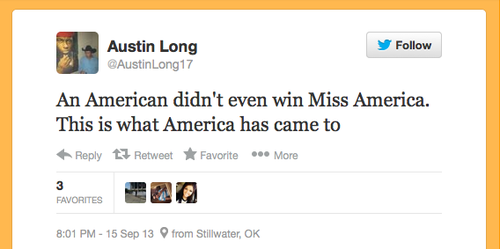
The saddest paragraph you’ll read today about the government shutdown.
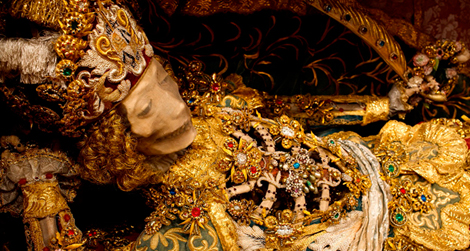
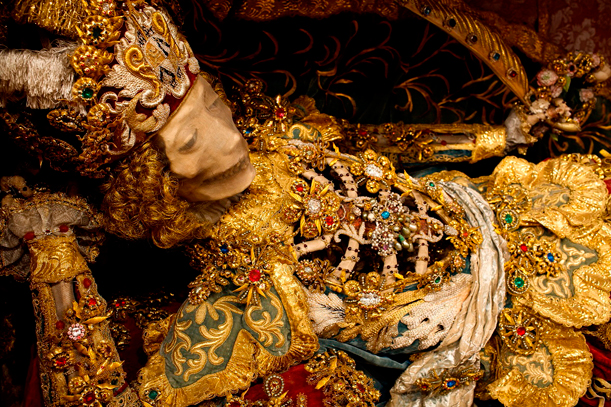
Saint Coronatus joined a convent in Heiligkreuztal, Germany, in 1676.
Paul Koudounaris is not a man who shies away from the macabre. Though the Los Angeles-based art historian, author and photographer claims that his fascination with death is no greater than anyone else’s, he devotes his career to investigating and documenting phenomena such as church ossuaries, charnel houses and bone-adorned shrines. Which is why, when a man in a German village approached him during a 2008 research trip and asked something along the lines of, “Are you interested in seeing a dilapidated old church in the forest with a skeleton standing there covered in jewels and holding a cup of blood in his left hand like he’s offering you a toast?” Koudounaris’ answer was, “Yes, of course.”
At the time, Koudounaris was working on a book called The Empire of Death, traveling the world to photograph church ossuaries and the like. He’d landed in this particular village near the Czech border to document a crypt full of skulls, but his interest was piqued by the dubious yet enticing promise of a bejeweled skeleton lurking behind the trees. “It sounded like something from the Brothers Grimm,” he recalls. “But I followed his directions—half thinking this guy was crazy or lying—and sure enough, I found this jeweled skeleton in the woods.”
The church—more of a small chapel, really—was in ruins, but still contained pews and altars, all dilapidated from years of neglect under East German Communist rule. He found the skeleton on a side aisle, peering out at him from behind some boards that had been nailed over its chamber. As he pried off the panels to get a better look, the thing watched him with big, red glass eyes wedged into its gaping sockets. It was propped upright, decked out in robes befitting a king, and holding out a glass vial, which Koudounaris later learned would have been believed to contain the skeleton’s own blood. He was struck by the silent figure’s dark beauty, but ultimately wrote it off as “some sort of one-off freakish thing, some local curiosity.”
But then it happened again. In another German church he visited some time later, hidden in a crypt corner, he found two more resplendent skeletons. “It was then that I realized there’s something much broader and more spectacular going on,” he says.
Koudounaris could not get the figures’ twinkling eyes and gold-adorned grins out of his mind. He began researching the enigmatic remains, even while working on Empire of Death. The skeletons, he learned, were the “catacomb saints,” once-revered holy objects regarded by 16th- and 17th-century Catholics as local protectors and personifications of the glory of the afterlife. Some of them still remain tucked away in certain churches, while others have been swept away by time, forever gone. Who they were in life is impossible to know. “That was part of this project’s appeal to me,” Koudounaris says. “The strange enigma that these skeletons could have been anyone, but they were pulled out of the ground and raised to the heights of glory.”
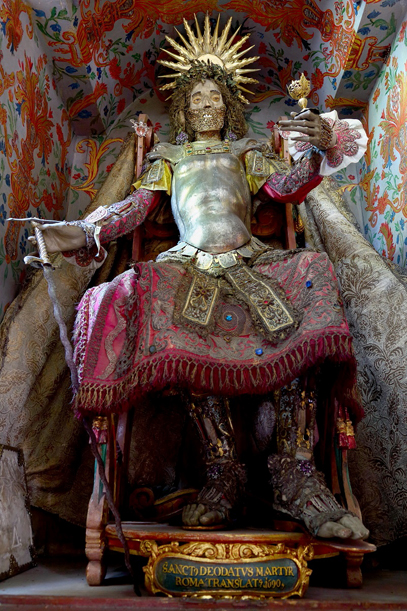
To create Saint Deodatus in Rheinau, Switzerland, nuns molded a wax face over the upper half of his skull and fashioned his mouth with a fabric wrap.
His pursuit of the bones soon turned into a book project, Heavenly Bodies: Cult Treasures and Spectacular Saints from the Catacombs, in which he documents the martyred bones’ journey from ancient Roman catacombs to hallowed altars to forgotten corners and back rooms. Though largely neglected by history, the skeletons, he found, had plenty to say.
Resurrecting the Dead
On May 31, 1578, local vineyard workers discovered that a hollow along Rome’s Via Salaria, a road traversing the boot of Italy, led to a catacomb. The subterranean chamber proved to be full of countless skeletal remains, presumably dating back to the first three centuries following Christianity’s emergence, when thousands were persecuted for practicing the still-outlawed religion. An estimated 500,000 to 750,000 souls—mostly Christians but including some pagans and Jews—found a final resting place in the sprawling Roman catacombs.
For hundreds of skeletons, however, that resting place would prove anything but final. The Catholic Church quickly learned of the discovery and believed it was a godsend, since many of the skeletons must have belonged to early Christian martyrs. In Northern Europe—especially in Germany, where anti-Catholic sentiment was most fervent—Catholic churches had suffered from plunderers and vandals during the Protestant Revolution over the past several decades. Those churches’ sacred relics had largely been lost or destroyed. The newly discovered holy remains, however, could restock the shelves and restore the morale of those parishes that had been ransacked.
The holy bodies became wildly sought-after treasures. Every Catholic church, no matter how small, wanted to have at least one, if not ten. The skeletons allowed the churches to make a “grandiose statement,” Koudounaris says, and were especially prized in southern Germany, the epicenter of “the battleground against the Protestants.” Wealthy families sought them for their private chapels, and guilds and fraternities would sometimes pool their resources to adopt a martyr, who would become the patron of cloth-makers, for example.
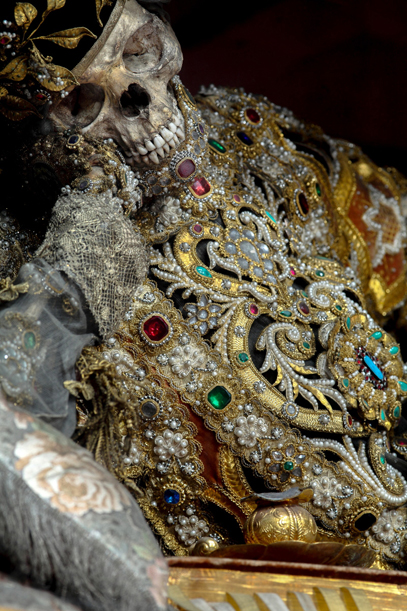
Saint Valentinus is one of the ten skeletons decorated by the lay brother Adalbart Eder. Valentinus wears a biretta and an elaborate deacon’s cassock to show off his ecclesiastical status. Today, he is housed in Waldsassen Basilica in Germany, along with his nine brethren.
For a small church, the most effective means of obtaining a set of the coveted remains was a personal connection with someone in Rome, particularly one of the papal guards. Bribery helped, too. Once the Church confirmed an order, couriers—often monks who specialized in transporting relics—delivered the skeleton from Rome to the appropriate northern outpost.
At one point, Koudounaris attempted to estimate in dollar terms how profitable these ventures would have been for the deliverymen, but gave up after realizing that the conversion from extinct currencies to modern ones and the radically different framework for living prevented an accurate translation. “All I can say is that they made enough money to make it worthwhile,” he says.
The Vatican sent out thousands of relics, though it’s difficult to determine exactly how many of those were fully articulated skeletons versus a single shinbone, skull or rib. In Germany, Austria and Switzerland, where the majority of the celebrated remains wound up, the church sent at least 2,000 complete skeletons, Koudounaris estimates.
For the Vatican, the process of ascertaining which of the thousands of skeletons belonged to a martyr was a nebulous one. If they found “M.” engraved next to a corpse, they took it to stand for “martyr,” ignoring the fact that the initial could also stand for “Marcus,” one of the most popular names in ancient Rome. If any vials of dehydrated sediment turned up with the bones, they assumed it must be a martyr’s blood rather than perfume, which the Romans often left on graves in the way we leave flowers today. The Church also believed that the bones of martyrs cast off a golden glow and a faintly sweet smell, and teams of psychics would journey through the corporeal tunnels, slip into a trance and point out skeletons from which they perceived a telling aura. After identifying a skeleton as holy, the Vatican then decided who was who and issued the title of martyr.
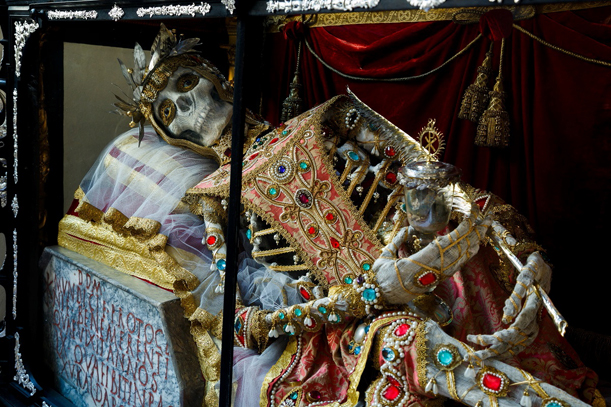
Saint Munditia arrived at the Church of Saint Peter in Munich along with a funerary plaque taken from the catacombs.
While there doubters within the Vatican, those on the receiving end of these relics never wavered in their faith. “This was such a dubious process, it’s understandable to ask if people really believed,” Koudounaris says. “The answer is, of course they did: These skeletons came in a package from the Vatican with proper seals signed by the cardinal vicar stating these remains belong to so-and-so. No one would question the Vatican.”
The Dirt and Blood Are Wiped Away
Each martyr’s skeleton represented the splendors that awaited the faithful in the afterlife. Before it could be presented to its congregation, it had to be outfitted in finery befitting a relic of its status. Skilled nuns, or occasionally monks, would prepare the skeleton for public appearance. It could take up to three years, depending on the size of the team at work.

The talented nuns of Ennetach decorated the ribcage of Saint Felix in Aulendorf.
Each convent would develop its own flair for enshrouding the bones in gold, gems and fine fabrics. The women and men who decorated the skeletons did so anonymously, for the most part. But as Koudounaris studied more and more bodies, he began recognizing the handiwork of particular convents or individuals. “Even if I couldn’t come up with the name of a specific decorator, I could look at certain relics and tie them stylistically to her handiwork,” he says.
Nuns were often renowned for their achievements in clothmaking. They spun fine mesh gauze, which they used to delicately wrap each bone. This prevented dust from settling on the fragile material and created a medium for attaching decorations. Local nobles often donated personal garments, which the nuns would lovingly slip onto the corpse and then cut out peepholes so people could see the bones beneath. Likewise, jewels and gold were often donated or paid for by a private enterprise. To add a personal touch, some sisters slipped their own rings onto a skeleton’s fingers.
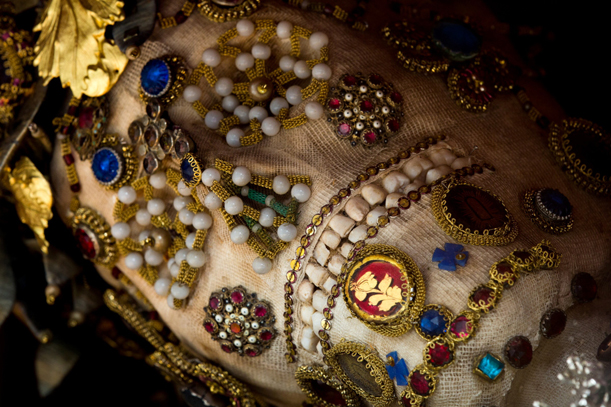
Saint Kelmens arrived in Neuenkirch, Switzerland, in 1823 – decades after the original wave of catacomb saints were distributed throughout Europe. Two nuns decorated his bones.
One thing the nuns did lack, however, was formal training in anatomy. Koudounaris often found bones connected improperly, or noticed that a skeleton’s hand or foot was grossly missized. Some of the skeletons were outfitted with full wax faces, shaped into gaping grins or wise gazes. “That was done, ironically, to make them seem less creepy and more lively and appealing,” Koudounaris says. “But it has the opposite effect today. Now, those with the faces by far seem the creepiest of all.”
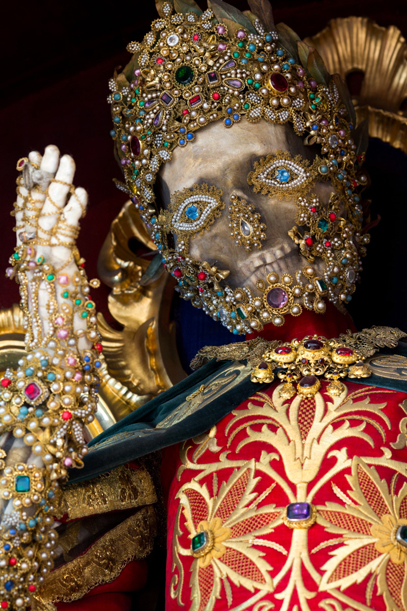
Saint Felix of Gars am Inn, Germany, was regarded as a miracle-worker.
They are also ornately beautiful. In their splendor and grandeur, Koudounaris says, the skeletons may be considered baroque art, but their creators’ backgrounds paint a more complicated picture that situates the bones into a unique artistic subcategory. The nuns and monks “were incredible artisans but did not train in an artisan’s workshop, and they were not in formal dialogue with others doing similar things in other parts of Europe,” he says.
“From my perspective as someone who studies art history, the question of who the catacomb saints were in life becomes secondary to the achievement of creating them,” he continues. “That’s something I want to celebrate.”
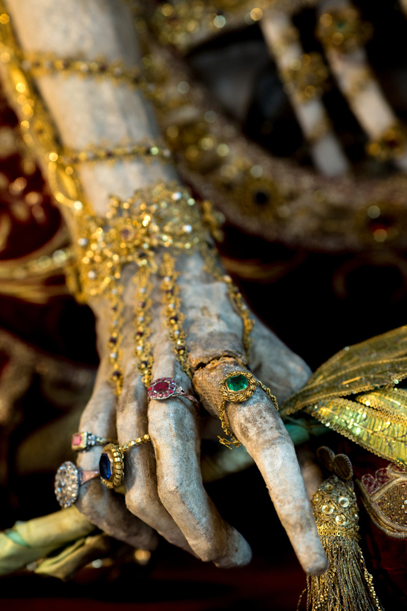
Devoted patrons often gave their own jewelry to the saints, such as these rings worn on the gauze-wrapped fingers of Saint Konstantius in Rohrschach, Switzerland.
In that vein, Koudounaris dedicated his book to those “anonymous hands” that constructed the bony treasures “out of love and faith.” His hope, he writes, is that “their beautiful work will not be forgotten.”
Fall from Grace
When a holy skeleton was finally introduced into the church, it marked a time of community rejoicing. The decorated bodies served as town patrons and “tended to be extremely popular because they were this very tangible and very appealing bridge to the supernatural,” Koudounaris explains.

Saint Gratian, another of Adalbart Eder’s Waldassen skeletons. Here, the saint is decked out in a re-imagining of Roman military attire, including lace-up sandals and shoulder, chest and arm guards.
Baptismal records reveal the extent of the skeletons’ allure. Inevitably, following a holy body’s arrival, the first child born would be baptized under its name—for example, Valentine for a boy, Valentina for a girl. In extreme cases, half the children born that year would possess the skeleton’s name.
Communities believed that their patron skeleton protected them from harm, and credited it for any seeming miracle or positive event that occurred after it was installed. Churches kept “miracle books,” which acted as ledgers for archiving the patron’s good deeds. Shortly after Saint Felix arrived at Gars am Inn, for example, records indicate that a fire broke out in the German town. Just as the flames approached the marketplace—the town’s economic heart—a great wind came and blew them back. The town showered Felix with adoration; even today, around 100 ex-votos—tiny paintings depicting and expressing gratitude for a miracle, such as healing a sick man—are strewn about St. Felix’s body in the small, defunct chapel housing him.
As the world modernized, however, the heavenly bodies’ gilt began to fade for those in power. Quoting Voltaire, Koudounaris writes that the corpses were seen as reflection of “our ages of barbarity,” appealing only to “the vulgar: feudal lords and their imbecile wives, and their brutish vassals.”
In the late 18th century, Austria’s Emperor Joseph II, a man of the Enlightenment, was determined to dispel superstitious objects from his territory. He issued an edict that all relics lacking a definite provenance should be tossed out. The skeletons certainly lacked that. Stripped of their status, they were torn down from their posts, locked away in boxes or cellars, or plundered for their jewels.
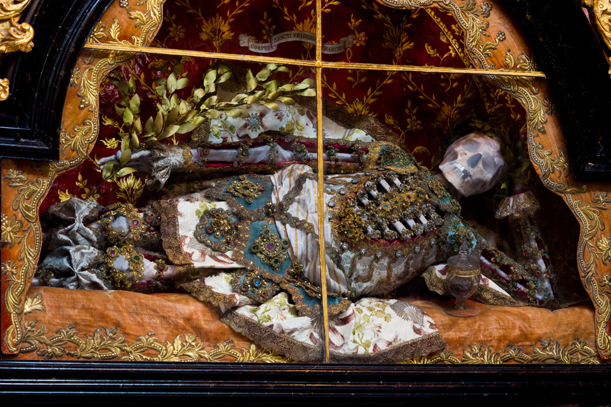
Catacomb saints were often depicted in a reclining position, as demonstrated here by Saint Friedrich at the Benedictine abbey in Melk, Austria. He holds a laurel branch as a sign of victory.
For local communities, this was traumatic. These saints had been instilled in people’s lives for more than a century, and those humble worshipers had yet to receive the Enlightenment memo. Pilgrimages to see the skeletons were abruptly outlawed. Local people would often weep and follow their patron skeleton as it was taken from its revered position and dismembered by the nobles. “The sad thing is that their faith had not waned when this was going on,” Koudounaris says. “People still believed in these skeletons.”
The Second Coming
Not all of the holy skeletons were lost during the 18th-entury purges, however. Some are still intact and on display, such as the 10 fully preserved bodies in the Waldsassen Basilica (“the Sistine Chapel of Death,” Koudounaris calls it) in Bavaria, which holds the largest collection remaining today. Likewise, the delicate Saint Munditia still reclines on her velvet throne at St. Peter’s Church in Munich.
In Koudounaris’ hunt, however, many proved more elusive. When he returned to that original German village several years later, for example, he found that a salvage company had torn down the forest church. Beyond that, none of the villagers could tell him what had happened to its contents, or to the body. For every 10 bodies that disappeared in the 18th and 19th centuries, Koudounaris estimates, nine are gone.
In other cases, leads—which he gathered through traveler’s accounts, parish archives and even Protestant writings about the Catholic “necromancers”—did pan out. He found one skeleton in the back of a parking-garage storage unit in Switzerland. Another had been wrapped in cloth and stuck in a box in a German church, likely untouched for 200 years.
After examining around 250 of these skeletons, Koudounaris concluded, “They’re the finest pieces of art ever created in human bone.” Though today many of the heavenly bodies suffer from pests burrowing through their bones and dust gathering on their faded silk robes, in Koudounaris’ photos they shine once more, provoking thoughts of the people they once were, the hands that once adorned them and the worshipers who once fell at their feet. But ultimately, they are works of art. “Whoever they may have been as people, whatever purpose they served rightly or wrongly as items, they are incredible achievements,” he says. “My main objective in writing the book is to present and re-contextualize these things as outstanding works of art.”

Only the head of Saint Benedictus – named in honor of Saint Benedict, the patron of the monastery – arrived in Muri, Switzerland, in 1681.
Accomplishing that was no small task. Nearly all the skeletons he visited and uncovered were still in their original 400-year-old glass tombs. To disassemble those cases, Koudounaris thought, would “amount to destroying them.” Instead, a bottle of Windex and a rag became staples of his photography kit, and he sometimes spent upward of an hour and a half meticulously examining the relic for a clear window through which he might shoot. Still, many of the skeletons he visited could not be included in the book because the glass was too warped to warrant a clear shot.
For Koudounaris, however, it’s not enough to simply document them in a book. He wants to bring the treasures back into the world, and see those in disrepair restored. Some of the church members agreed with Koudounaris’ wish to restore the skeletons, not so much as devotional items but as pieces of local history. The cost of undertaking such a project, however, seems prohibitive. One local parish priest told Koudounaris he had consulted with a restoration specialist, but that the specialist “gave a price so incredibly high that there was no way the church could afford it.”
Still, Koudounaris envisions a permanent museum installation or perhaps a traveling exhibit in which the bones could be judged on their artistic merits. “We live in an age where we’re more in tune with wanting to preserve the past and have a dialogue with the past,” he says. “I think some of them will eventually come out of hiding.”
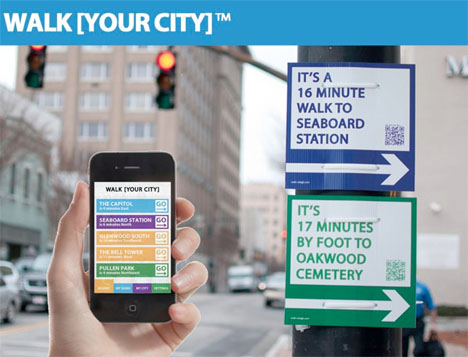
What are you missing out on in your own city by sticking to your established routes each day, or driving instead of walking? Sometimes it’s easy to forget how close any number of interesting locations are to the places you visit on a regular basis, even by foot – and walking can be the best way to truly experience any given city. Walk [Your City] aims to encourage that kind of exploration with a combination of user-powered custom street signs and online tools.
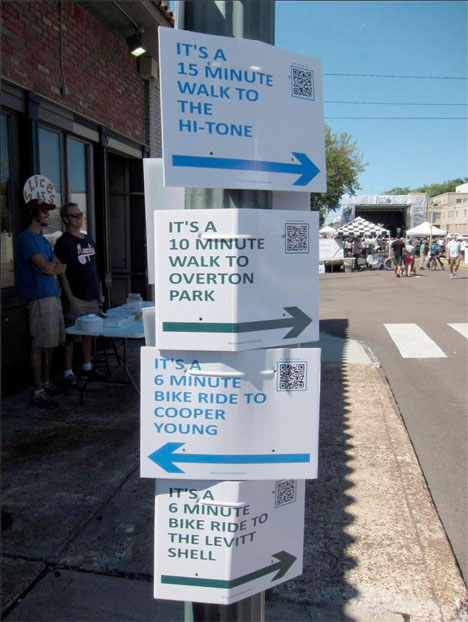
The signs tell pedestrians how close certain attractions are by foot. Scan the QR code, and you’ll get an entire walking route that gives you the walk or cycle minutes to points of interest along your path. You can join in the process by ordering your own custom-made sign and putting it up yourself.
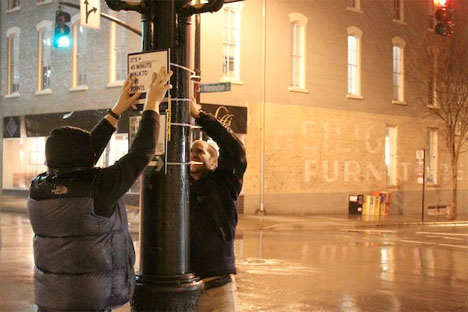
The project started in North Carolina with Walk Raleigh, a guerrilla wayfinding operation that posted 27 signs at three major intersections throughout the city in January 2012. The signs weren’t legally sanctioned by the city, so they were taken down – but the project caught the attention of officials, who are now making Walk Raleigh a permanent feature.
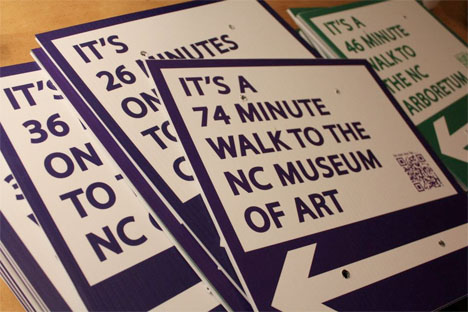
New York City has gotten behind the project officially, too. WalkNYC kicked off in June 2013 and aims to be “the citywide standard for pedestrian wayfinding.” Other cities around the nation and in Canada are following suit. If you’re interested in implementing Walk [Your City] in your own community, you can simply go ahead and make your own signs at WalkYourCity.org.


|
Bri & Alex sent in one of those “oh sigh” submissions. It’s a marketing poster illustrating a gadget that makes it easier to open your door when you have your hands full. With what might you have your hands full? Well, if you’re a dude, it’s probably a briefcase and suitcase from a business trip. If you’re a woman, it’s probably laundry and groceries.
 The commercials are equally gender stereotypical.
Good work, Brinks Home Security! You wouldn’t want to offend a customer by suggesting that women have jobs or men do laundry!
Lisa Wade is a professor of sociology at Occidental College. You can follow her on Twitter and Facebook.(View original at http://thesocietypages.org/socimages)

"There are two books in America: one for the poor and one for the rich. The poor person does a crime, and gets 40 years. A rich person gets a slap on the wrist for the same crime. They say that the poor person doesn’t want to work and the poor person just wants a handout. Well I picked cotton until I was thirteen, left Alabama and got my education in the streets of New York. I drove a long distance truck all my life and never once drew welfare, never once took food stamps either. I sent four kids to college. But they say all poor people do is sit around with a quart of beer. Look in this bag next to me. I’ve got three things in this bag next to me: a Red Bull, a Pepsi, and Draino, because my drain is clogged. But you see, even if I do everything right, I still have to play by the poor book.”
Every once in a while the internet is abuzz being horrified by vintage ads for Lysol brand douche. The ads seem to suggest that women are repulsing their husbands with odorous vaginas caused by neglected feminine hygiene. In fact, it only looks like this to us today because we don’t know the secret code.


These ads aren’t frightening women into thinking their genitals smell badly. According to historian Andrea Tone, “feminine hygiene” was a euphemism. Birth control was illegal in the U.S. until 1965 (for married couples) and 1972 (for single people). These Lysol ads are actually for contraception. The campaign made Lysol the best-selling method of contraception during the Great Depression.
Of course, we’re not wrong to be horrified today. Lysol was incredibly corrosive to the vagina; in fact, it’s recipe was significantly more dangerous than the one used today. Hundreds of people died from exposure to Lysol, including women who were using it to kill sperm. It was also, to add insult to injury, wholly ineffective as a contraceptive.
Here’s to safe, legal, effective contraception for all.
Via Buzzfeed and @CreativeTweets.
Lisa Wade is a professor of sociology at Occidental College. You can follow her on Twitter and Facebook.(View original at http://thesocietypages.org/socimages)

Meaningful conversations are linked to happiness. (Image: lawgeek)
I am teaching an undergraduate course called “How Conversations Work.” Taking this course is a great way to become so self-conscious about how you talk that it becomes hard to have a normal conversation at all. “It wears off,” I promise the students, knowing that this statement is half-true.
This week I put on the table an argument about conversations that will inform our discussions for the rest of the term: Conversations are work.
Conversations, at their best, may seem easy, fun, and free-flowing—but they feel that way to us only because everyone is pulling their weight in terms of the conversational work.
To understand the work involved in conversation, think about a conversation you have had recently that felt like really hard work. Did you find yourself asking all the questions and never being asked a question in return? Did your questions elicit only short yes/no-like answers, which gave you little material to work with for follow-up discussion? Were you searching desperately for topics of potentially shared interest, while the other person just waited for you to come up with something for the two of you to talk about? Did the other person’s body language give you no sense that they were engaging in what you were saying?
In all these cases, we can see the conversational work your interlocutor* was not doing, which forced you to work so hard.
Being a good conversationalist requires doing your fair share of the conversational work (and perhaps going a little above and beyond)—and doing it as if there is nothing else you would rather be doing.
Here are some key forms of conversational work:
This list is just a start, but it already shows the active multitasking involved in any conversation, especially a good one.
I am far from the first linguist to point out that conversation is work. More than 30 years ago, the linguist Pamela Fishman published an article called “Interaction: The Work Women Do” (1978), in which she argued that women do more of the conversational “shitwork,” based on extensive recordings of three male-female couples. In other words, in her study women asked more questions, introduced more topics, provided more back-channeling, picked up more topics, etc. (I have always loved Fishman’s introduction of “conversational shitwork” as a technical term.)
We are living in a moment when a good number of people, both young and old, are worried that we are collectively losing our ability to connect through old-fashioned, in-person conversation. A recent study in Psychological Science suggests that meaningful conversation with others makes us happier people. So it bears repeating that good conversation doesn’t just happen; we need to do the work to make it happen. The benefits far surpass the work.
_____________
*The term “interlocutor” points to a striking lexical gap in the language: an informal term for “the person one is talking to.”
Two recent events had a strikingly similar theme. Kenichi Ebina won America’s Got Talent and Nina Davuluri won Miss America. In both instances, other Americans objected to their victories, claiming that they were not really American because Ebina and Davuluri are of Japanese and Indian origin respectively. Still other Americans objected to this reaction. And yet, as I’ll argue below, most of us share their bias.
First, thanks to Public Shaming, we have examples of the reaction on Twitter. Reactions to Ebina’s win:



Reactions to Davuluri’s win:
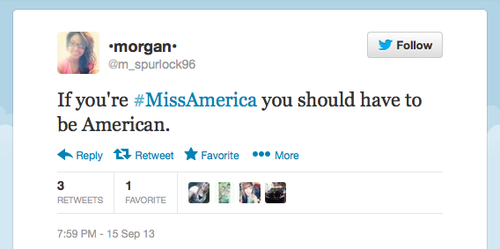


These are stark examples of people who believe that only white people count as American. It’s a bizarre position, of course, because people of European descent are immigrants to America, and an overtly racist one as well. I don’t lose any sleep over publishing their identities on this blog.
But, the truth is, the majority of us — even those of us who oppose racism and embrace the idea that the U.S. is a nation of immigrants — hold the belief that America = white. We just believe this subconsciously.
Project Implicit is an online psychological test that measures implicit beliefs, ones we hold that we’re not necessarily conscious of holding. One test is of the association of Asian-ness with American-ness. It works by measuring how long it takes us to sort Asian and European faces and American and Foreign famous sites into the proper categories.
First they ask you to sort faces and places with Asian and Foreign together on the left and European and American together on the right. Like this:
 Then they switch the bottom designations so that Asian and American are on one side and European and Foreign are on the other. For most people, the harms their ability to sort faces and places: it slows down and includes more errors, revealing that their brain implicitly sees Asian and foreign as one category and American and European as another.
Here’s the aggregate data. Almost a quarter of people make no association either way, 60% implicitly believe that Asians are less American than Europeans, and 17% think the opposite.
 The take home message is: even though it’s easy to condemn the twits making overtly racist comments, this is a problem that is much more pervasive and pernicious. Even those of us who are horrified by those tweets likely carry the bias behind them.
(View original at http://thesocietypages.org/socimages)
Piraro makes the point that he is allowed to publish a cartoon showing a street prostitute holding up a sign saying "GLUTEN FREE" (see it here), but he was censored when he came out with a cartoon showing a deadbeat vampire loiterer holding up a sign saying "WILL SUCK FOR BLOOD". Both clearly suggest the possibilty that oral sex is being referred to, if you have a dirty mind, but the second explicitly contains a word (suck) commonly recognized by the relevant prudish authorities as colloquial sex talk, wheras the first doesn't. The prostitute cartoon would doubtless also have been banned if it had incorporated the word eat, instead of just implying it through the reference to a potentially allergenic food ingredient. Piraro's comment on the situation is: "Americans (and maybe all humans, I'm not sure) are more obsessed with words than with their meanings."
He goes on:
I will never understand this as long as I live. Under FCC rules, in broadcast TV you can talk about any kind of depraved sex act you wish, as long as you do not use the word "fuck." And the word itself is so mysteriously magical that it cannot be used in any way whether the topic is sex or not. "What the fuck?" is a crime that carries a stiff fine — "I'm going to rape your 8-year-old daughter with a trained monkey," is completely legal. In my opinion, today's "gluten-free" cartoon is far more suggestive in an unsavory way than the vampire cartoon, but it doesn't have a "naughty" word so it’s okay.
Are we a nation permanently locked in preschool? The answer, in the case of language, is yes.
He makes a very good point, IMHO.

Elis Stenman built a house out of paper. In 1922 the mechanical engineer began designing a summer home in Rockport, Mass., using wood for the frame, floor, and roof but fashioning the walls from newspaper pressed about an inch thick and coated with varnish.
“Actually, I guess he was supposed to cover the outside with clapboards, but he just didn’t,” Stenman’s grandniece, Edna Beaudoin, told the Cape Ann Sun in 1996. “You know, he was curious. He wanted to see what would happen to the paper, and, well, here it is, some 70 years later.”
In 1924 Stenman moved in and began making furniture, also out of newspaper, rolling it into logs, cutting it to length with a knife, and gluing or nailing it into usable finished pieces (one placard reads THIS DESK IS MADE OF THE CHRISTIAN SCIENCE MONITOR).
Stenman died in 1942, and his family has maintained the house ever since, showing it to curious visitors. “I think probably the most common question is just ‘Why?’” Beaudoin says. “We just really don’t know where he got the idea to build a house out of paper. He was just that sort of a guy.”
How could anyone pack three major misunderstandings about a linguistic science story into a single eight-word headline?
On September 15, Rachel Martin interviewed the much-publicized economist Keith Chen on National Public Radio’s news program Weekend Edition Sunday. And the headline chosen for the transcript put up on the NPR Web site was: “The Language You Use Might Save You Money.”
This piles new layers of silliness onto previous facile treatments of a topic that needs to be given careful thought and interpreted with statistical sophistication.
To summarize, Chen’s thesis is not about “the language you use,” and not about saving you money, and not about any language doing something for you.
Let me try to undo some of the damage NPR’s careless headline writer has done.
Chen’s claim has three components. The first is linguistic: He thinks languages can be divided into those that use some obligatory mark of future time reference and those that just use the present tense to refer to the future. (I think it’s a bit more complicated than that.)
The second is a piece of speculative psychology: He believes people with different native languages are subject to subtly different influences on their view of the future, in that if you are a native speaker of a language with obligatory marking of future tense you will be tempted to think that the future is a quite different place from the present, while speaking the other kind of language will tempt you to think of the future as continuous with the present.
The third is a testable hypothesis about the effects of this subtle influencing of your perceptions. He believes the linguistic influence has causal efficacy with regard to nonlinguistic aspects of your life, in that thinking of the future as different from the present will tend to make you save less and expose yourself to more long-term risks (by smoking, drinking, overeating, and so on).
Chen claims the subliminal linguistic promptings, faint and subtle though they may be, are sufficient to have effects that show up in published large-scale societal statistics on personal finance and health.
The NPR headline is therefore a disgrace to the profession of journalism in three separate ways.
I’ve explained elsewhere (here and here and here) why I’m skeptical about Chen’s thesis. But Chen has coherent and thoughtful responses to his critics (here, for example).
I remain a skeptic: I doubt the reality of the causal link. I think our main task now should be to develop a statistically based understanding of the etiology and numerosity of the many peculiar language/culture correlations we find (Mark Liberman discusses the matter in this post, referring to the work of correlation experts Sean Roberts and James Winters).
But Chen’s paper is a serious piece of work, and he deserved better than to be saddled with the utterly stupid headline that NPR chose.
Not that critics or copy editors have doomed his career: Since the splash made by his future-tense paper, Chen has moved (just this past summer) from Yale’s business school to a tenured associate professorship in the Anderson Management School at UCLA. It’s something worth keeping in mind if you talk to journalists about your research (as I did over lunch today): Goofy headlines may be annoying, but they won’t necessarily harm your employment prospects. We should take comfort in that.

"I’m having a hard time trusting in The Process."
“What process?”
“The process that says if I do my part, everything will turn out right.”
 By now we all know about the University of Kansas professor, David W. Guth, who was “placed on leave” (read: suspended) last week for a tweet deemed offensive to National Rifle Association members.
Reaction to The Chronicle’s coverage of the incident (and there was a great deal of reaction) suggests that most readers can be divided into one of four categories: those who agree with the professor’s sentiments and don’t think he should be punished; those who basically agree but believe he went too far and deserves what he gets; those who disagree and would like to see him strung up by his, um, toes; and those who disagree but believe he has a right to speak his mind without penalty.
Count me squarely in the fourth group. I don’t like what Mr. Guth said, for reasons I won’t go into here because they’re not relevant to this post. But I also believe he has a right to say it without risking his livelihood—and I don’t think he crossed any line. While acknowledging that free speech has limits, I’m not convinced that his tweet falls into the “yelling fire in a crowded theater” category.
The tweet’s wording makes it clear that he’s not calling for violence against NRA members but rather wishing for them the same kind of heartache that, in his opinion, their policies create for others. As one Chronicle commenter put it, the tweet is “more like a curse than a call to action.”
And make no mistake: This is a free-speech issue. Specifically, it’s a case of the government, in the form of a state university, attempting to censor someone who expressed his opinion as a private citizen. And if you don’t believe his suspension was politically motivated, in a conservative state like Kansas, then I’ve got some oceanfront property outside of Topeka that I’d like to sell you. That’s exactly the sort of partisan, government-sponsored censorship that the First Amendment was designed to prevent.
That Mr. Guth works for the university is irrelevant, except to the extent that it gives the state power to make his life miserable. In what way did his tweet have anything to do with his work as a professor? In what way was it—to use the language of the Garcetti v. Ceballos Supreme Court decision concerning free-speech protections for public employees—“pursuant to his duties”? In what way does it affect his ability to do his job? How has it really hurt the institution or its students?
Oh, that’s right. Now the whole world knows that the University of Kansas, like every other college in the country, has leftist professors. That was a closely guarded secret until this guy let the cat out of the bag. I suppose that shocking revelation might cost the university a few donors, at least until the flap dies down. But I imagine it will recover.
This is not, by the way, an academic-freedom issue, strictly speaking, because the tweet in question was not directly connected to Mr. Guth’s work. However, when an institution of higher education censors speech anywhere, that action has a chilling effect on speech everywhere, including the classroom.
I call on the university’s administrators to rescind any sanctions they may have imposed and allow Mr. Guth to return to his duties. Show the nation what it means to value free speech and the free exchange of ideas, on and off the campus, even when that speech is repugnant. Make a clear statement that, even if you disagree with Mr. Guth’s opinions, you support his right to express them. Surely that’s a principle both liberals and conservatives in your state can agree on.
I further call on the National Rifle Association to publicly defend Mr. Guth. Surely your intent is not to promote the Second Amendment at the expense of the First. Isn’t that why a bunch of farmers and shopkeepers took up arms at Lexington and Concord—to assert the rights of a free people, including the right to speak their minds without being punished by the government? This is your chance to show a skeptical public that, as an organization, you support the entire Constitution, not just one line in it.
Even as our political discourse in this country grows increasingly uncivil, we have to recognize that we’re not going to get anywhere by trying to silence one another. That’s a game two can play, to the ultimate detriment of both. The upper hand in any situation is never more than temporary, so that the censorship you exercise today may be turned against you tomorrow. All ideas, except perhaps those that truly advocate violence, deserve to be heard. The bad ones need not be forcibly suppressed, as they will eventually die on their own of neglect. As Jefferson put it, “reason and free enquiry are the only effectual agents against error.”
Fortunately, a controversy like this gives us all an opportunity to listen to what Lincoln called “the better angels of our nature.” May we make the most of that opportunity.

Far from the stereotype of a dark and grungy underground space where you don’t want to touch anything with your bare hands, these 15 standout subway stations are practically art galleries. From the gilded Baroque metros of Moscow to the world’s largest glass dome in Taiwan, these transit stations are worth a stop just to take a look around.


An old subway station in Barcelona, built in 1968, was covered with new surfaces to create an entirely new look, with black resin floors and lightweight white glass-reinforced concrete over the walls. The result is bright and clean with pops of color and a much more updated feel.

Stockholm boasts an incredible 90 decorated subway stations, each of which bearing its own unique visual identity. This one, Radhuset (courthouse) was built in 1975, and resembles a bright red cavern.

The dramatic Westfriedhof station in Munich, Germany features eleven large lamps that cast colored lights onto various areas of the platform. The ceiling and walls are just barely illuminated in a deep, dark blue.

The busiest transport hub on the Moscow metro is a showcase of Stalinist architecture, with a palatial Baroque theme in bright yellow. It’s one of the most luxurious subway stations in the world, with marble columns, murals and massive chandeliers.

The stunning Crater of Luz by Oscar Tusquet Blanca is the centerpiece of the Toledo station in Naples, Italy – one of the most art-filled subway lines in the world. The Naples metro features 13 ‘Art Stations’ that aim to give everyone a close-up look at prime examples of contemporary art.

|
|

"My philosophy is: ‘If you like yourself, everything around you will fall into place.’"
I recently across two examples of cross-species education. Both illustrate that what we often consider instinctual must also often be learned, revealing that nature and nurture are not competitive forces, but deeply interconnected. The first is adorable to the point of making me cry from laughter, the second is so sad I can hardly stand it.
Here’s the first. A sheep tries to teach a young bull how to head butt. Words don’t do justice to the care and patience shown by this teacher.
Perhaps the bull just isn’t ever going to understand, but the fact that the sheep seems to understand that the bull doesn’t understand, and then thinks of an idea of how to fix that, is amazing to me. Presumably, he would take as much care with a young sheep who would be predispositioned for head-butting, but might still benefit from some instruction.
Here’s the second. Remember the movie Free Willy, where the captive killer whale is freed by a little boy? Well, in true Hollywood irony, the whale that played Willy, Keiko, wasn’t freed at the end of the movie, of course.

After the movie was released in 1993, however, people joined in a movement to free him. After 22 years in captivity, humans — who count as animals in this story – spent a decade and 20 million dollars trying to rehabilitate him to the wild, attempting to teach him how to feed himself and bond with wild whales. He continued to seek out humans, even after he was left to fend for himself, and died in 2003 from pneumonia.
There are lots of lessons to take from this story. One is the importance of nurture in making us what nature intended us to be. Keiko was a social individual who learned how to be a captive killer whale. Given the opportunity, he never could be the wild killer whale he once had the potential to be. Or, at least, we’ll never know if he could.
Whenever we talk about human biological imperatives, we should remember the patient sheep and the friendly killer whale. We need each other to become human, and we can become human in many different ways, depending on what is demanded of us. Nature never works alone. Without each other, we simply don’t become recognizably human at all — as one of the worst cases of child neglect taught us only too well — regardless of our biological potential.
Lisa Wade is a professor of sociology at Occidental College. You can follow her on Twitter and Facebook.(View original at http://thesocietypages.org/socimages)

To His Children
First of all, don't feel bad that I'm gone. While I will miss spending time with each of you, I'm sure it will be an interesting time for me and I look forward to seeing all of you when you come over. To each of you I send my love. If on this side of life I'm able to watch over and help you out, know that I will. If I can't, I'm sure I can at least be waiting for you when you come over. This all may sound silly to you guys, but what the hell, I'm gone—and who can argue with me?
Life is meant to be fun, and joyous, and fulfilling. May each of yours be that—having each of you as a child of mine has certainly been one of the good things in my life. Know that I've always loved each of you with an eternal, bottomless love. A love that has nothing to do with each other, for I feel my love for each of you is total and all-encompassing. Please watch out for each other and love and forgive everybody. It's a good life, enjoy it.
-------------------------------
To Friends & Family
I'm not at all afraid of the thought of death and in many ways look forward to it with much curiosity and interest. I'm looking forward to meeting up with some of my friends who have gone on ahead of me and I will be waiting there to say hi to those of you who are still back there. I suggest you first have a nice, friendly little service of some kind. It would be lovely if some of the people who sing would do a song or two, some of which should be quite happy and joyful. It would be nice if some of my close friends would say a few nice, happy words about how much we enjoyed doing this stuff together. Incidentally, I'd love to have a Dixieland band play at this function and end with a rousing version of "When the Saints Go Marching In."
Have a wonderful time in life, everybody; it feels strange writing this kind of thing while I'm still alive, but it wouldn't be easy to do after I go.








Fred McFeely Rogers (March 20, 1928 – February 27, 2003)
I’m gonna reblog this every time.
Fred Rogers Real Actual Guardian of Childhood.
This chokes me up Every. Time.
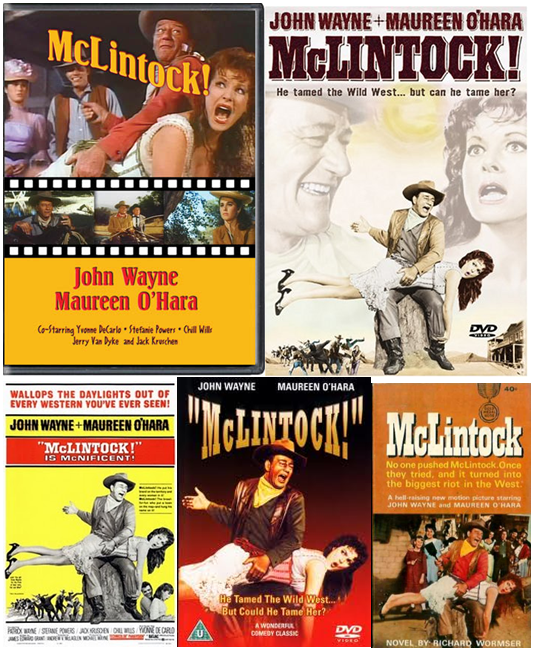
Lauren McGuire pointed us to a post by Gilligan at Retrospace inspired by a scene in the 1963 Western, McLintock! The movie included a scene in which George McLintock, played by John Wayne, uses a shovel to spank his estranged wife, played by Maureen O’Hara.
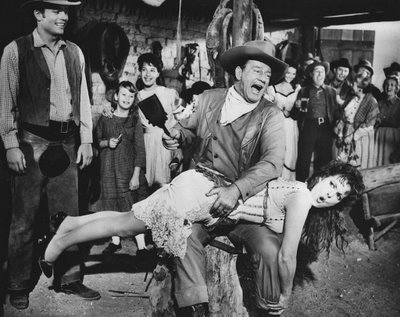
The spanking scene apparent stuck quite the chord, as it was used repeatedly in the promotional materials.
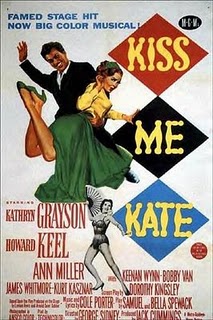
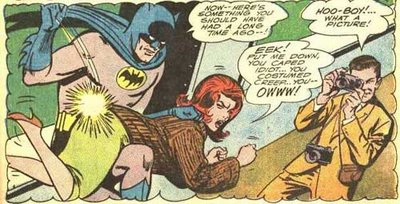
Gilligan suggests that the spanking of adult women by adult men was a midcentury theme, from Kiss me Kate to comic books:

Here’s an Q&A from the New York Daily Mirror, circa 1950s (thanks to @perstornes):
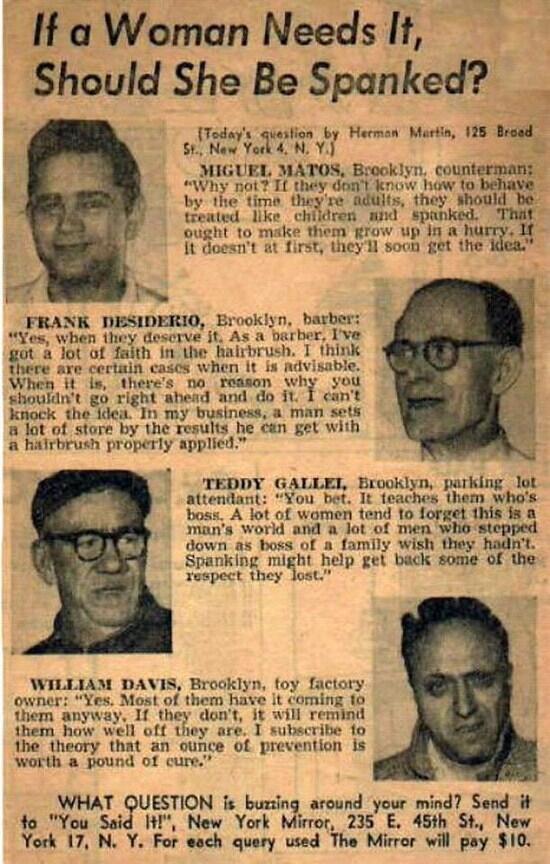
Lady spanking is a manifestation of the infantilization of women. The idea that they are not men’s equals, but are expected to obey them as subordinates and can be punished when they do not behave. Of course, materials riffing on the spanking adult women today (outside of porn and fetish communities) would probably inspire an outcry, but that leaves open the possibility that the gendered power asymmetry simply manifests in other ways. Adult women are still infantilized (see posts here, here, and here) and dominance/submission is still sexualized in mainstream materials (consider our post asking what love is supposed to look like).
Originally posted in 2010; re-posted in response to a new example. Images borrowed from here, here, here, here, here. H/t Retrospace.
Lisa Wade is a professor of sociology at Occidental College. You can follow her on Twitter and Facebook.(View original at http://thesocietypages.org/socimages)
Here is something quite simple, sent along by Judy B. It’s a screenshot of Gimp, an open source image editing application. An optional plug-in, created by a user, offers a series of filters for images, including ones that “beautify.” One of the options is “skin whitening.”

This is one more reminder that we live in a racist society that conflates whiteness with beauty. Remember, too, though, that someone — very possibly a set of people — had to make a conscious decision to include skin whitening as an option and position it as a sub-category of beautification. Then they had to, literally, type the words into the program and make it so.
This shit doesn’t just happen. It’s not random. Racism isn’t just an ephemeral cultural thing. It involves actual decisions made by real people who, if not motivated by racism, are complicit with it.
Lisa Wade is a professor of sociology at Occidental College. You can follow her on Twitter and Facebook.(View original at http://thesocietypages.org/socimages)

NeverWet has been making headlines as the silicon-based spray that repels liquids from clothes and electronics, but this off-book use shows another fascinating application that may be even longer-lasting: urban art invisible until poured upon.
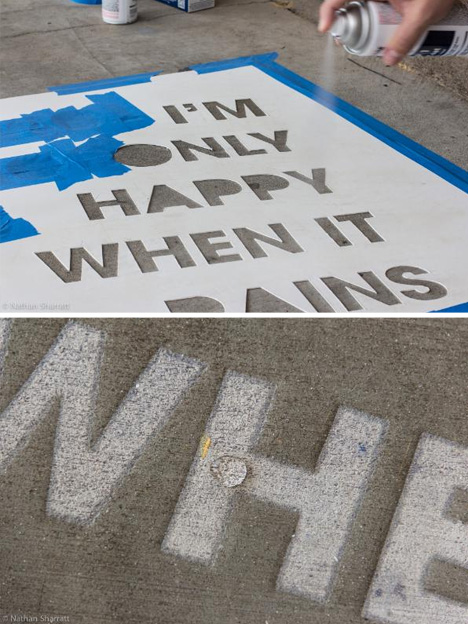
As part of a Home Depot competition, Nathan Sharratt decided to create stencils and spray hydrophobic NeverWet onto streets and sidewalks, resulting in areas of deflected moisture surrounded by soaked concrete. Like invisible ink, the water-repellent areas remain hidden until another liquid is applied.

Given criticism of NeverWet when applied to shoes (apparently it can discolor or leave residue) and phones (touchscreen and durability issues have been reported), this may prove to be a more persistent, if unintended, long-term application of the product.

And for any interested subversive artists, it could prove a unusual boon when bothered by police: how will the authorities justify arresting someone for spraying an invisible coating on a public surface? Meanwhile, best of luck to Nathan in the contest – a win here is surely deserved! As one reader (3AlarmLampscooter) from Reddit noted: there are practical and legal street applications of this too, potentially: “Instead of a sign saying slippery when wet… graffiti saying slippery.” That, and consider: sidewalk happy-hour signs for drink specials in the rain, or way-finding messages for seeking shelter in a storm. Many interesting possibilities.
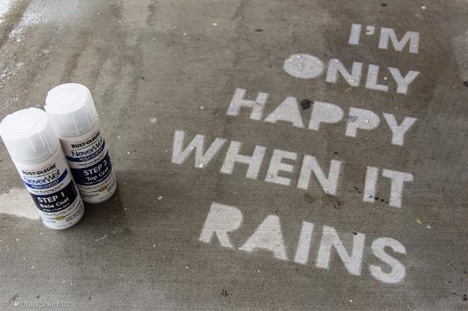
Short-form instructions for those looking to (officially: don’t!) try this at home or in the neighborhood: “Step 1: You need a stencil. You can do something simple or use an image that includes a fair amount of detail. I created my own stencils from cardboard, but there’s no reason you can’t use a ready-made or store-bought stencil. Just know that NeverWet will get sprayed on that, too. Step 2: Place stencil on concrete. I recommend that you only try this on light-colored concrete for best results. Step 3: Spray the NeverWet into the cut-out areas of your stencil according to the manufacturer’s instructions found on the label. I did two base coats and two top coats.”

|
|
This past February, brothers named Elwin and Yohan were arrested for six rapes in France, but both denied the charges. Deciding which is guilty is a tricky affair — they’re identical twins, so the genetic difference between them is very slight. Marseille police chief Emmanual Kiehl said, “It could take thousands of separate tests before we know which one of them may be guilty.”
This is only the latest in a series of legal conundrums involving identical twins and DNA evidence. During a jewel heist in Germany in January 2009, thieves left behind a drop of sweat on a latex glove. A crime database showed two hits — identical twins Hassan and Abbas O. (under German law their last name was withheld). Both brothers had criminal records for theft and fraud, but both were released. The court ruled, “From the evidence we have, we can deduce that at least one of the brothers took part in the crime, but it has not been possible to determine which one.”
Later that year, identical twins Sathis Raj and Sabarish Raj escaped hanging in Malaysia when a judge ruled it was impossible to determine which was guilty of drug smuggling. “Although one of them must be called to enter a defence, I can’t be calling the wrong twin to enter his defence,” the judge told the court. “I also can’t be sending the wrong person to the gallows.”
In 2003, a Missouri woman had sex with identical twins Raymon and Richard Miller within hours of one another. When she became pregnant, both men denied fathering the child. In Missouri a man can be named a legal father only if a paternity test shows a 98 percent or higher probability of a DNA match, but the Miller twins both showed a probability of more than 99.9 percent.
“With identical twins, even if you sequenced their whole genome you wouldn’t find difference,” forensic scientist Bob Gaensslen told ABC News at the time. More recent research shows that this isn’t the case, but teasing out the difference can be expensive — in the Marseilles case, police were told that such a test would cost £850,000.
It goes on. Last month British authorities were trying to decide how to prosecute a rape when DNA evidence identified both Mohammed and Aftab Asghar. “It is an unusual case,” said prosecutor Sandra Beck. “They are identical twins. The allegation is one of rape. There is further work due.”
We’re celebrating the end of the year with our most popular posts from 2013, plus a few of our favorites tossed in. Enjoy!
The philosopher Susan Sontag has written achingly about the way in which men are allowed to age and women are not.
The great advantage men have is that our culture allows two standards of male beauty: the boy and the man. The beauty of a boy resembles the beauty of a girl. In both sexes it is a fragile kind of beauty and flourishes naturally only in the early part of the life-cycle. Happily, men are able to accept themselves under another standard of good looks — heavier, rougher, more thickly built…
There is no equivalent of this second standard for women. The single standard of beauty for women dictates that they must go on having clear skin. Every wrinkle, every line, every gray hair, is a defeat.
Perhaps nowhere is this more plain than in the movies, where men’s love interests stay the same age as they get older, and @sphericalfruit sent in a fantastic example. The four posters below are part of a new marketing plan for the forthcoming movie, The Counselor.
Notice anything?


What a stunning example of Sontag’s observation. The men are not considered unattractive by virtue of the fact that you can tell they have skin. The women, in contrast, have faces that are so smooth that they look inhuman; their images are halfway between photograph and cartoon. Amazingly, this treatment of images of men and women is so ubiquitous that it now looks more or less normal to us.
Cross-posted at VitaminW.
Lisa Wade is a professor of sociology at Occidental College. You can follow her on Twitter and Facebook.(View original at http://thesocietypages.org/socimages)
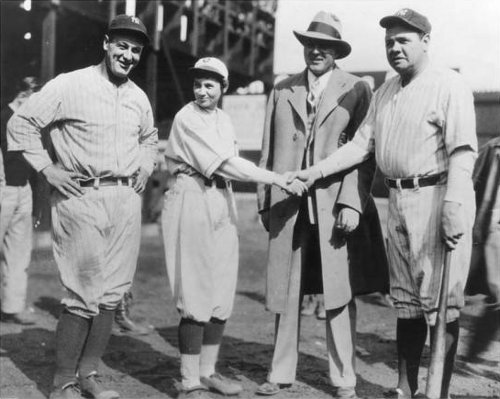
On April 2, 1931, during an exhibition game between the minor-league Chattanooga Lookouts and the New York Yankees, 17-year-old pitcher Jackie Mitchell found herself facing Babe Ruth.
She struck him out in four pitches. “I had a drop pitch,” she said, “and when I was throwing it right, you couldn’t touch it.”
The New York Times reported that Ruth “flung his bat away in high disdain and trudged to the bench, registering disgust with his shoulders and chin.”
“I don’t know what’s going to happen if they begin to let women in baseball,” he told a Chattanooga newspaper. “Of course, they will never make good. Why? Because they are too delicate. It would kill them to play ball every day.”
Next up was Lou Gehrig. She struck him out, too.

I got this email from an Ivy League student when I arrived to give a speech. She was responsible for making sure that I was delivered to my hotel and knew where to go the next day:
Omg you’re here! Ahh i need to get my shit together now lol. Jk. Give me a ring when u can/want, my cell is [redacted]. I have class until 1230 but then im free! i will let the teacher she u will be there, shes a darling. Perhaps ill come to the end of the talk and meet you there after. Between the faculty lunch and your talk, we can chat! ill take make sure the rooms are all ready for u. See ya!
To say the least, this did not make me feel confident that my visit would go smoothly.
I will use this poor student to kick off this year’s list of Professors’ Pet Peeves. I reached out to my network and collected some things that really get on instructors’ nerves. Here are the results: some of the “don’ts” for how to interact with your professor or teaching assistant. For what it’s worth, #2 was by far the most common complaint.
1. Don’t use unprofessional correspondence.
Your instructors are not your friends. Correspond with them as if you’re in a workplace, because you are. We’re not saying that you can’t ever write like this, but you do need to demonstrate that you know when such communication is and isn’t appropriate. You don’t wear pajamas to a job interview, right? Same thing.
2. Don’t ask the professor if you “missed anything important” during an absence.
No, you didn’t miss anything important. We spent the whole hour watching cats play the theremin on youtube!
Of course you missed something important! We’re college professors! Thinking everything we do is important is an occupational hazard. Here’s an alternative way to phrase it: “I’m so sorry I missed class. I’m sure it was awesome.”
If you’re concerned about what you missed, try this instead: Do the reading, get notes from a classmate (if you don’t have any friends in class, ask the professor if they’ll send an email to help you find a partner to swap notes with), read them over, and drop by office hours to discuss anything you didn’t understand.
3. Don’t pack up your things as the class is ending.
We get it. The minute hand is closing in on the end of class, there’s a shift in the instructor’s voice, and you hear something like “For next time…” That’s the cue for everyone to start putting their stuff away. Once one person does it, it’s like an avalanche of notebooks slapping closed, backpack zippers zipping, and cell phones coming out.
Don’t do it.
Just wait 10 more seconds until the class is actually over. If you don’t, it makes it seem like you are dying to get out of there and, hey, that hurts our feelings!
4. Don’t ask a question about the readings or assignments until checking the syllabus first.
It’s easy to send off an email asking your instructor a quick question, but that person put a lot of effort into the syllabus for a reason. Remember, each professor has dozens or hundreds of students. What seems like a small thing on your end can add up to death-by-a-thousand-paper-cuts on our end. Make a good faith effort to figure out the answer before you ask the professor.
5. Don’t get mad if you receive critical feedback.
If an instructor takes a red pen and massacres your writing, that’s a sign that they care. Giving negative feedback is hard work, so the red ink means that we’re taking an interest in you and your future. Moreover, we know it’s going to make some students angry at us. We do it anyway because we care enough about you to try to help you become a stronger thinker and writer. It’s counterintuitive but lots of red ink is probably a sign that the instructor thinks you have a lot of potential.
6. Don’t grade grub.
Definitely go into office hours to find out how to study better or improve your performance, but don’t go in expecting to change your instructor’s mind about the grade. Put your energy into studying harder on the next exam, bringing your paper idea to the professor or teaching assistant in office hours, doing the reading, and raising your hand in class. That will have more of a pay-off in the long run.
7. Don’t futz with paper formatting.
Paper isn’t long enough? Think you can make the font a teensy bit bigger or the margins a tad bit wider? Think we won’t notice if you use a 12-point font that’s just a little more widely spaced? Don’t do it. We’ve been staring at the printed page for thousands of hours. We have an eagle eye for these kinds of things. Whatever your motivation, here’s what they say to us: “Hi Prof!, I’m trying to trick you into thinking that I’m fulfilling the assignment requirements. I’m lazy and you’re stupid!” Work on the assignment, not the document settings.
8. Don’t pad your introductions and conclusions with fluff.
Never start off a paper with the phrase, “Since the beginning of time…” “Since the beginning of time, men have engaged in war.” Wait, what? Like, the big bang? And, anyway, how the heck do you know? You better have a damn strong citation for that! “Historically,” “Traditionally,” and “Throughout history” are equally bad offenders. Strike them from your vocabulary now.
In your conclusion, say something smart. Or, barring that, just say what you said. But never say: “Hopefully someday there will be no war.” Duh. We’d all like that, but unless you’ve got ideas as to how to make it that way, such statements are simple hopefulness and inappropriate in an academic paper.
9. Don’t misrepresent facts as opinions and opinions as facts.
Figure out the difference. Here’s an example of how not to represent a fact, via CNN:
Considering that Clinton’s departure will leave only 16 women in the Senate out of 100 senators, many feminists believe women are underrepresented on Capitol Hill.
Wait. Feminists “believe”? Given that women are 51% of the population, 16 out of 100 means that women are underrepresented on Capitol Hill. This is a social fact, yeah? Now, you can agree or disagree with feminists that this is a problem, but don’t suggest, as CNN does, that the fact itself is an opinion.
This is a common mistake and it’s frustrating for both instructors and students to get past. Life will be much easier if you know the difference.
10. Don’t be too cool for school.
You know those students that sit at the back of the class, hunch down in their chair, and make an art of looking bored? Don’t be that person. Professors and teaching assistants are the top 3% of students. They likely spent more than a decade in college. For better or worse, they value education. To stay on their good side, you should show them that you care too. And, if you don’t, pretend like you do.
Thanks to @triciasryan, @hormiga, @wadewitz, @ameenaGK, @holdsher, @joanneminaker, @k_lseyrisman, @jessmetcalf87, @deeshaphilyaw, @currerbell, and @hist_enthusiast, and @gwensharpnv for their ideas! Originally posted in 2013; cross-posted at Business Insider and Pacific Standard.
Lisa Wade is a professor of sociology at Occidental College and the co-author of Gender: Ideas, Interactions, Institutions. You can follow her on Twitter and Facebook.(View original at http://thesocietypages.org/socimages)
Trigger warning: Graphic descriptions of sexual assault.
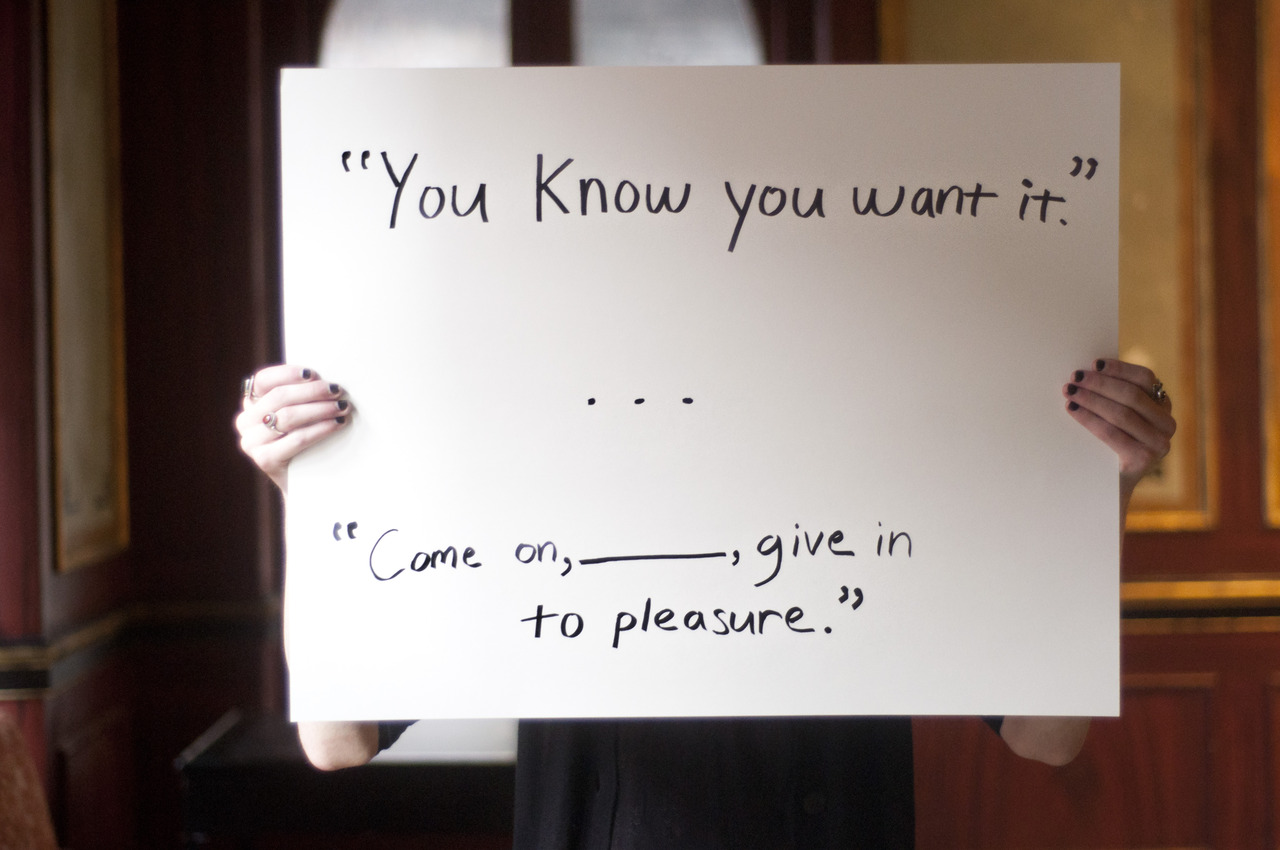
Robin Thicke’s summer hit Blurred Lines addresses what he considers to be sounds like a grey area between consensual sex and assault. The images in this post place the song into a real-life context. They are from Project Unbreakable, an online photo essay exhibit, and feature images of women and men holding signs with sentences that their rapist said before, during, or after their assault. Let’s begin.
I know you want it.
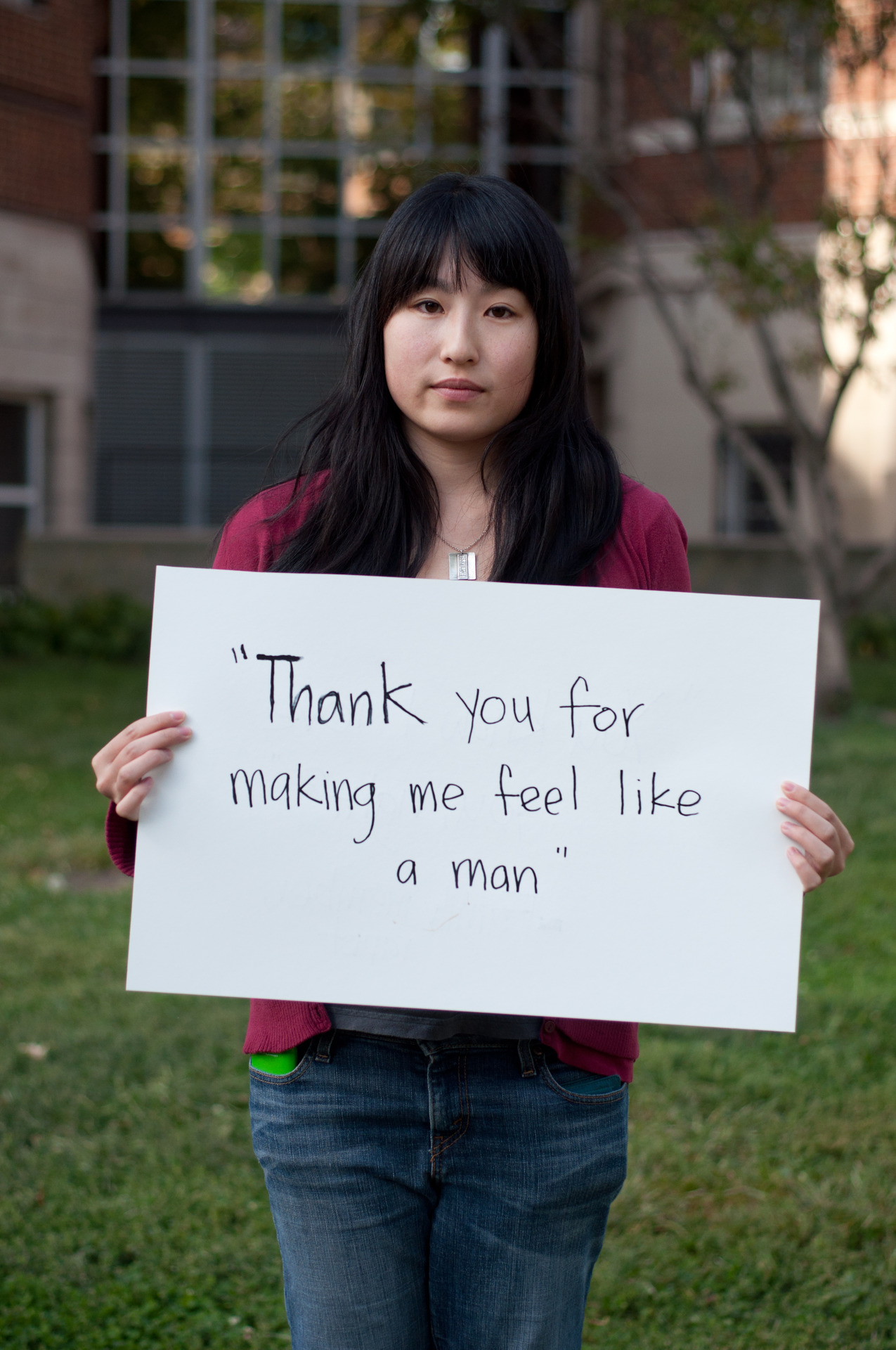
Thicke sings “I know you want it,” a phrase that many sexual assault survivors report their rapists saying to justify their actions, as demonstrated over and over in the Project Unbreakable testimonials.

You’re a good girl.
Thicke further sings “You’re a good girl,” suggesting that a good girl won’t show her reciprocal desire (if it exists). This becomes further proof in his mind that she wants sex: for good girls, silence is consent and “no” really means “yes.”

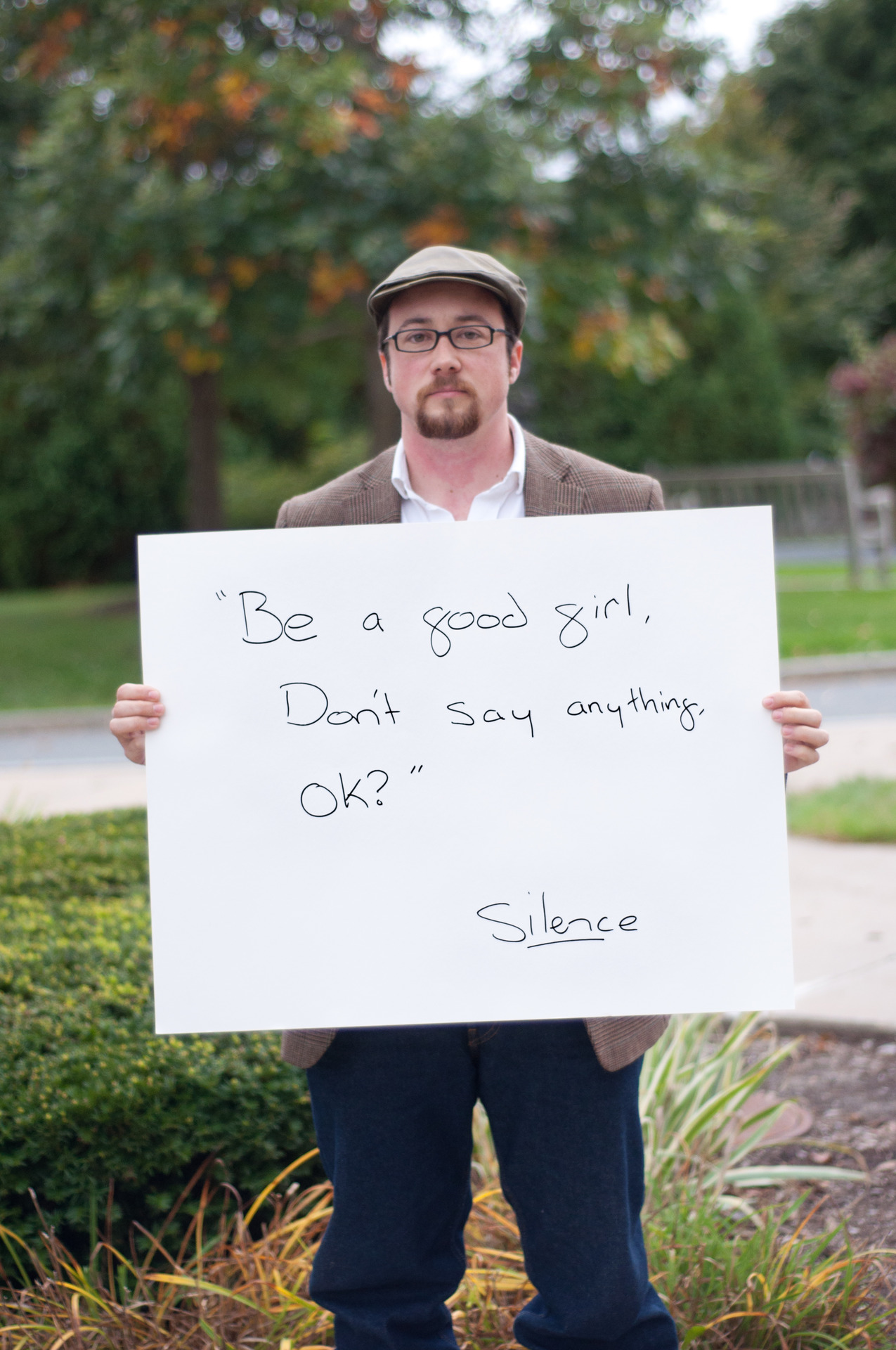
Calling an adult a “good girl” in this context resonates with the the virgin/whore dichotomy. The implication in Blurred Lines is that because the woman is not responding to a man’s sexual advances, which of course are irresistible, she’s hiding her true sexual desire under a facade of disinterest. Thicke is singing about forcing a woman to perform both the good girl and bad girl roles in order to satisfy the man’s desires.
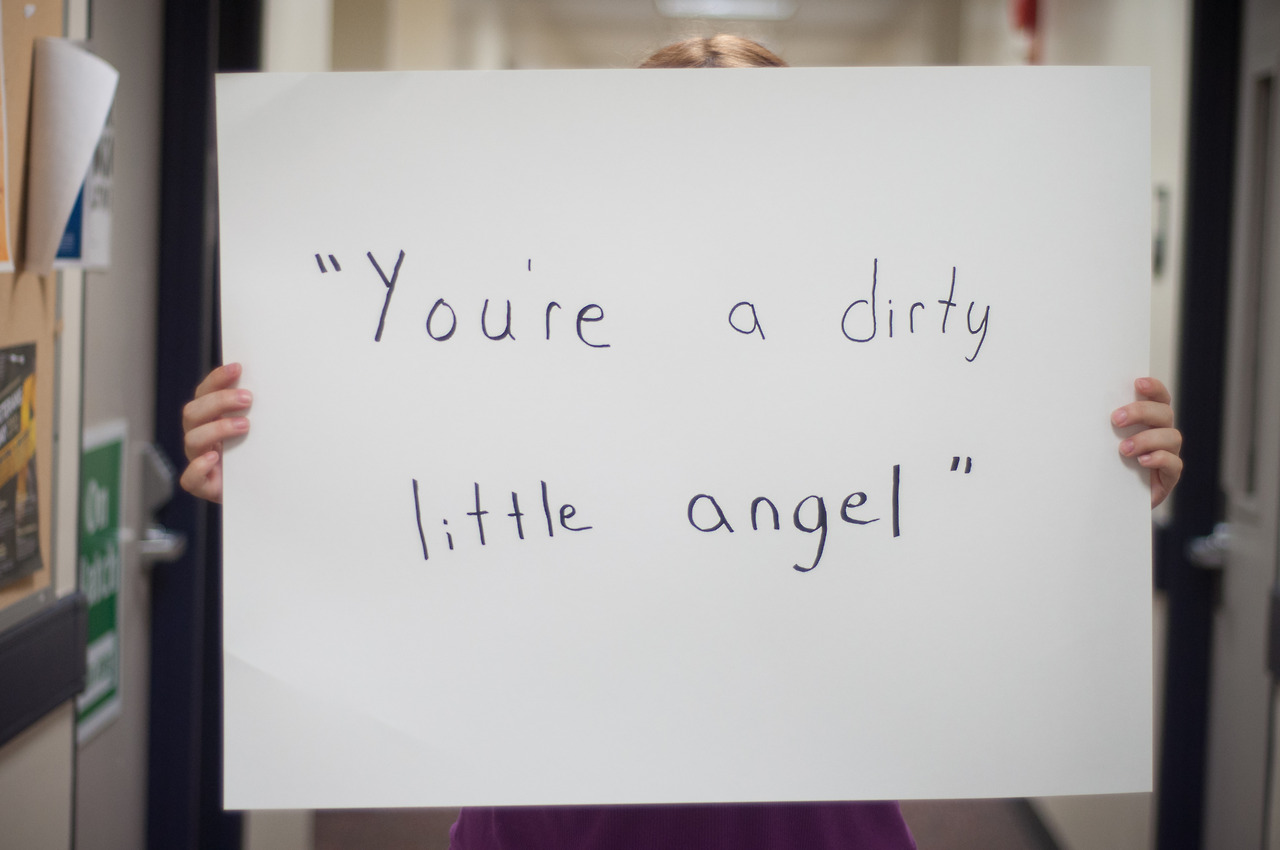
Thicke and company, as all-knowing patriarchs, will give her what he knows she wants (sex), even though she’s not actively consenting, and she may well be rejecting the man outright.
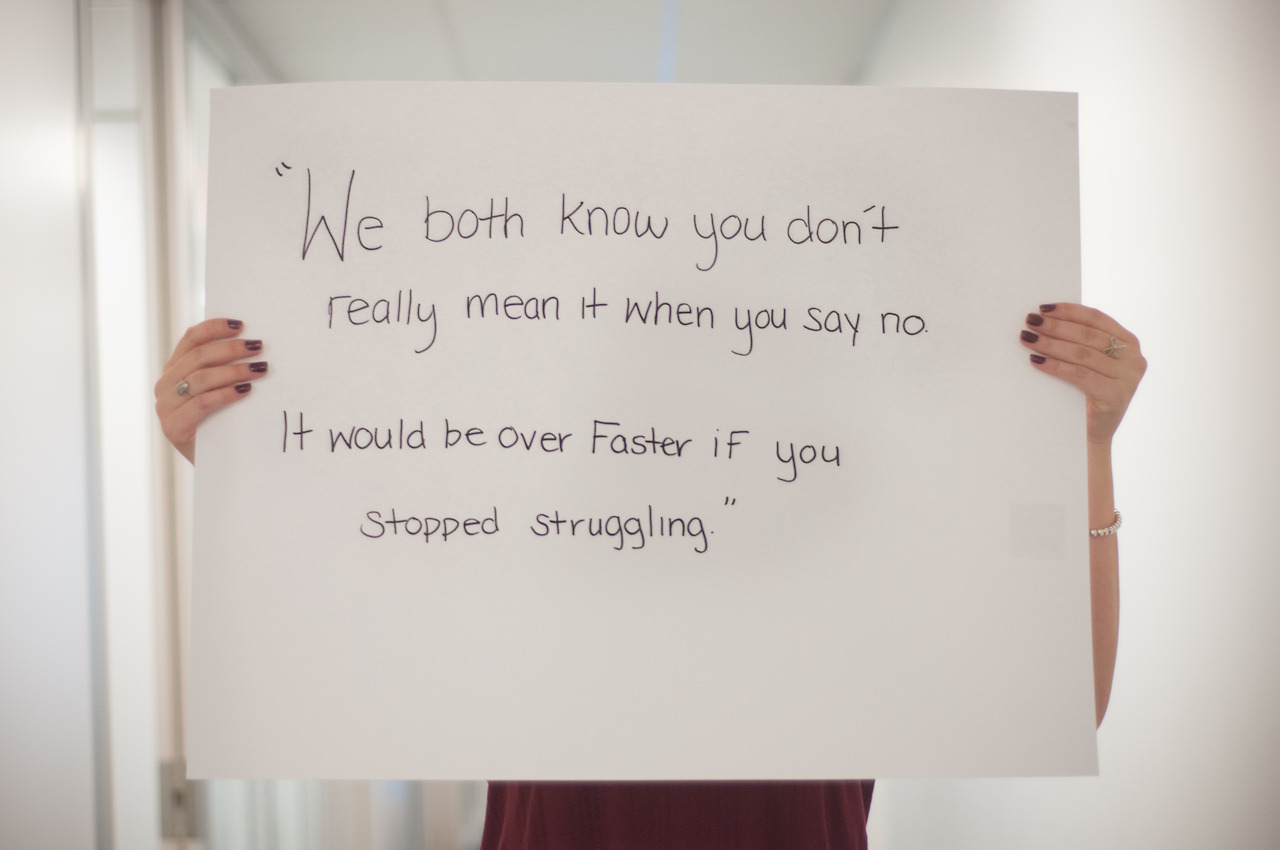
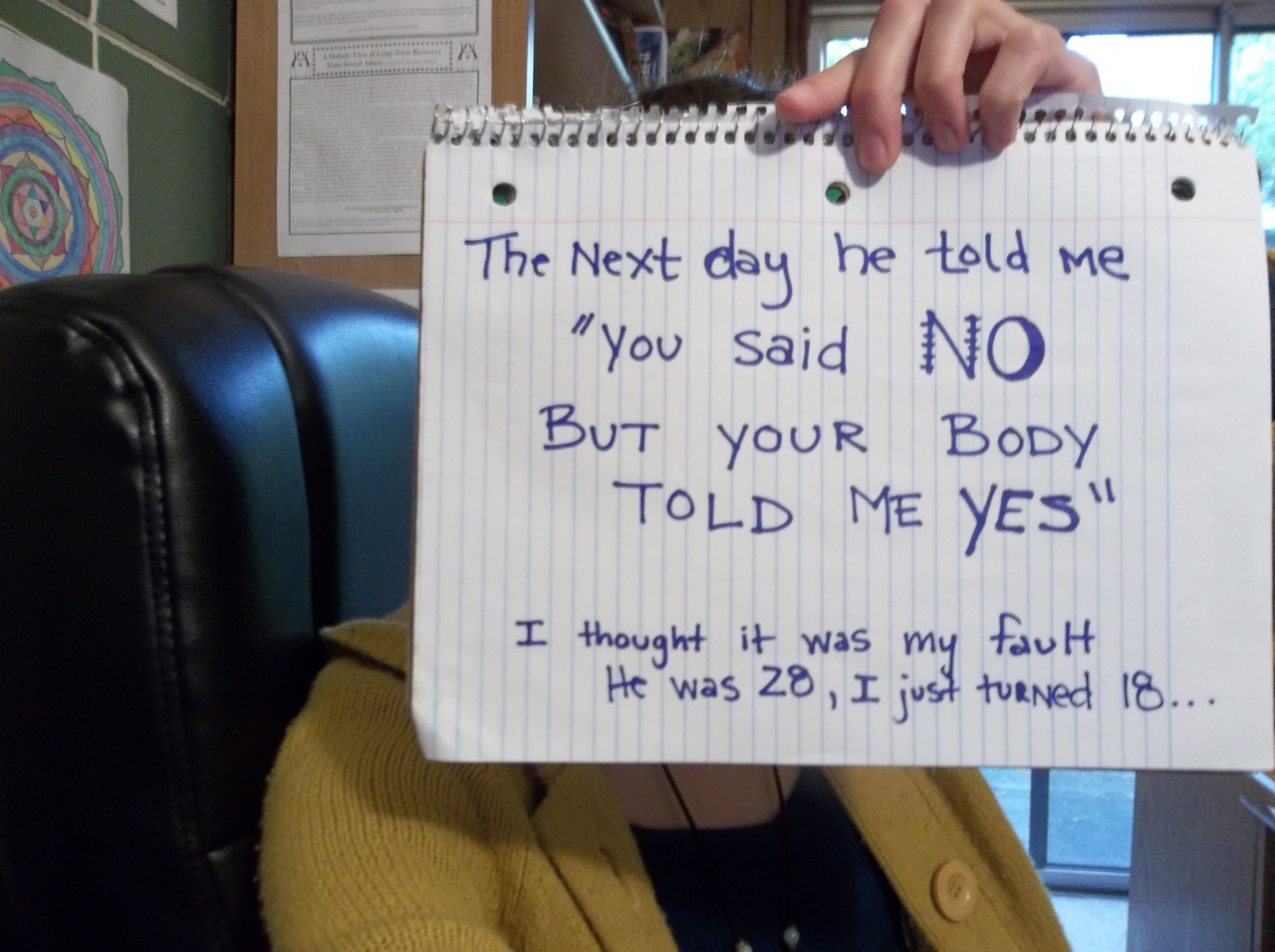
Do it like it hurt, do it like it hurt, what you don’t like work?
This lyric suggests that women are supposed to enjoy pain during sex or that pain is part of sex:
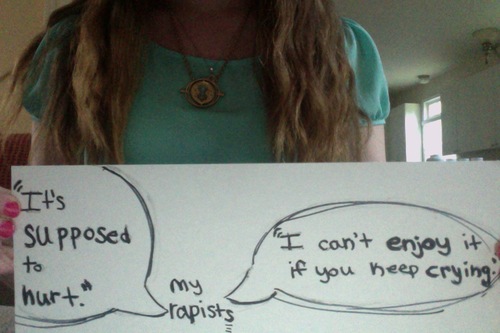
The woman’s desires play no part in this scenario – except insofar as he projects whatever he pleases onto her — another parallel to the act of rape: sexual assault is generally not about sex, but rather about a physical and emotional demonstration of power.
The way you grab me.
Must wanna get nasty.
This is victim-blaming. Everybody knows that if a woman dances with a man it means she wants to sleep with him, right? And if she wears a short skirt or tight dress she’s asking for it, right? And if she even smiles at him it means she wants it, right? Wrong. A dance, an outfit, a smile — sexy or not — does not indicate consent. This idea, though, is pervasive and believed by rapists.
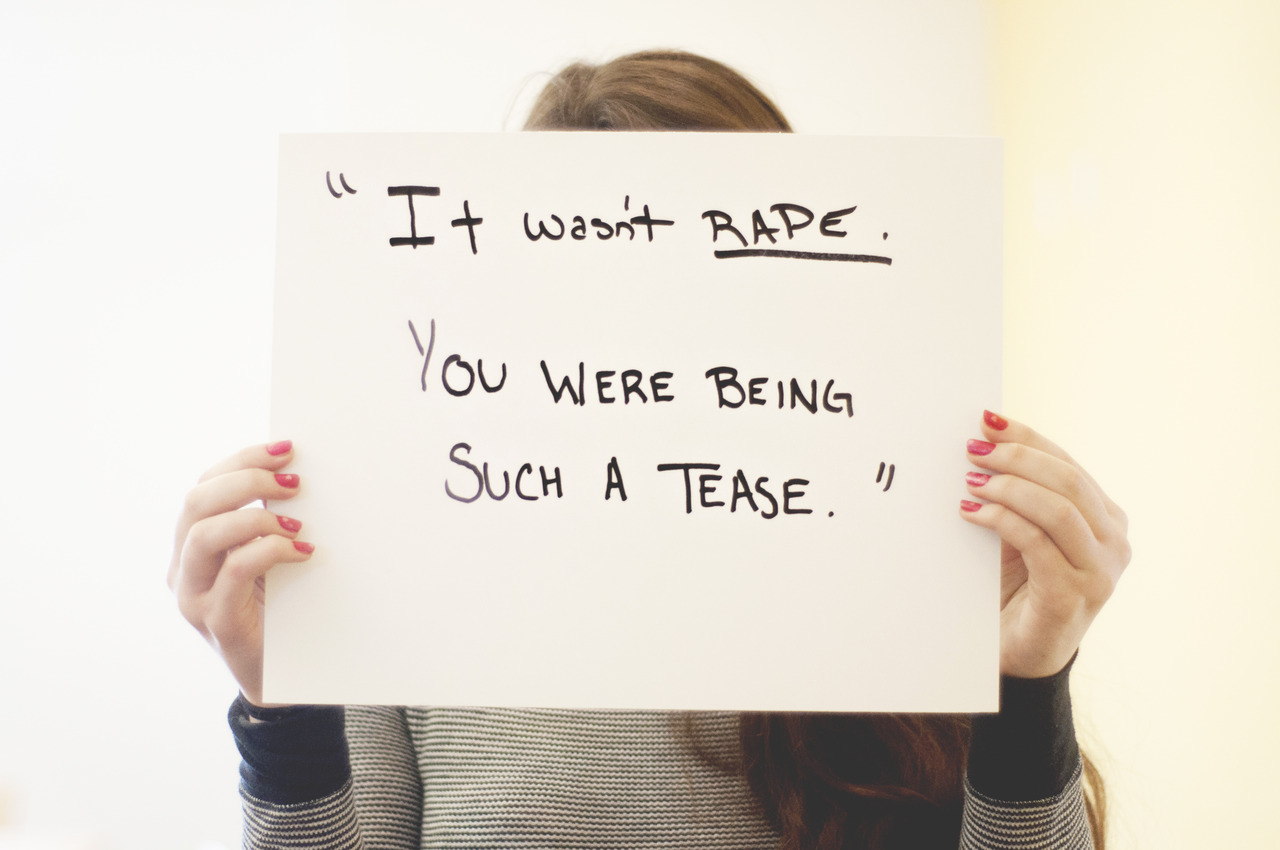
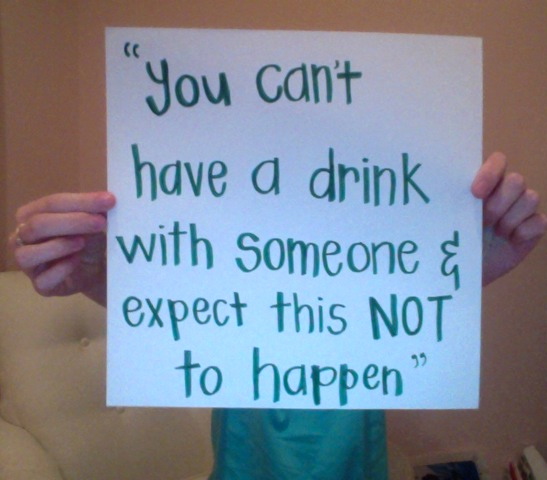
And women, according to Blurred Lines, want to be treated badly.
Nothing like your last guy, he too square for you.
He don’t smack your ass and pull your hair like that.
In this misogynistic fantasy, a woman doesn’t want a “square” who’ll treat her like a human being and with respect. She would rather be degraded and abused for a man’s gratification and amusement, like the women who dance around half naked humping dead animals in the music video.

The pièce de résistance of the non-censored version of Blurred Lines is this lyric:
I’ll give you something to tear your ass in two.
What better way to show a woman who’s in charge than violent, non-consensual sodomy?
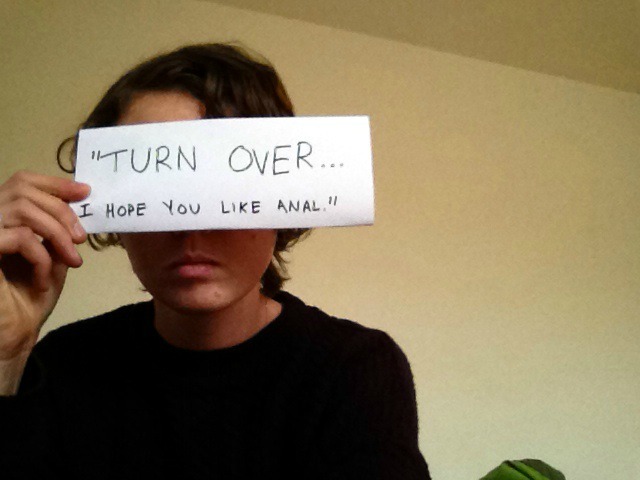
Ultimately, Robin Thicke’s rape anthem is about male desire and male dominance over a woman’s personal sexual agency. The rigid definition of masculinity makes the man unable to accept the idea that sometimes his advances are not welcome. Thus, instead of treating a woman like a human being and respecting her subjectivity, she’s relegated to the role of living sex doll whose existence is naught but for the pleasure of a man.
In Melinda Hugh’s Lame Lines parody of Thicke’s song she sings, “You think I want it/ I really don’t want it/ Please get off it.” The Law Revue Girls “Defined Lines” response to Blurred Lines notes, “Yeah we don’t want it/ It’s chauvinistic/ You’re such a bigot.” Rosalind Peters says in her one-woman retort, “Let’s clear up something mate/ I’m here to have fun/ I’m not here to get raped.”
There are no “blurred lines.” There is only one line: consent.
And the absence of consent is a crime.
Sezin Koehler is an informal ethnographer and novelist living in Florida. You can find her on Twitter and Facebook.
(View original at http://thesocietypages.org/socimages)

Why do we buy books? Well, until very recently, there were few other ways to get them. We could go to a library, or borrow them from people we knew. Otherwise, we had to buy them. And, until recently, buying them meant buying objects, the sturdy real things, and keeping them somewhere—neatly in bookshelves, dangerously in basements, or resignedly in boxes left unpacked from the last move. E-books made ownership easier but less sure. Hold up your Kindle or your tablet or your smart phone and give it a shake; they’re in there somewhere—or else in the cloud. Technology made some purchases unnecessary; publishers couldn’t squeeze us for Milton or Dickens anymore since they’re available for free online. The Kindle has a lending program, with which you can let someone borrow one of your books for fourteen days (hurry along, borrowers of “War and Peace”). But mostly, and unlike with music or movies or digital journalism, to consume books we still buy them and then get to keep them.
The founders of Oyster, a handsomely designed new app for the iPhone and iPod Touch, are hoping that people are looking for a new way to get access to books. The app, which takes its name from a line in “The Merry Wives of Windsor” (“the world’s mine oyster,” spoken, incidentally, by a thief), currently gives users access to more than a hundred thousand titles for a monthly fee of just under ten bucks. (Netflix for books, as it’s been called.) Users tap a book to read it instantly, and can store up to ten downloads at a time to read offline. Oyster also offers recommendations based on previous selections, and allows users to share what they’ve been reading on social media. (You can also turn off the social features and read privately.) Right now you need an invitation to join, but Oyster will be expanding both how many people can use it and the number of available books, and the founders say that they plan to release a version for iPad later this fall.
...read moreIn a recent column, I asked the question, “Who is driving the online locomotive?”—in other words, who exactly is pushing the idea of offering more and more (not to mention bigger and bigger) online classes? Because that’s certainly where higher education seems to be headed.
I concluded that the people who hire college graduates are not among the culprits, citing a recent Chronicle survey in which prospective employers reported positive impressions of all types of higher-education institutions—except for online colleges. Of course, as I noted (and as several readers pointed out), there’s a big difference between getting an entire degree online and taking a few online courses en route to getting a degree. But employers’ general lack of regard for computer college suggests that they find the online-learning environment a bit suspect.
Not long after that column was published, I had a conversation with a good friend of mine that reinforced my perception of employers’ attitudes toward online classes.
My friend is a partner in a large, multinational professional-services firm. I wish I could say more, but even though he gave me permission to quote him in this post, he really doesn’t want to be identified. Suffice it to say that his firm is one of the best known in its industry, with a client list that includes many of the world’s most recognizable brands.
One of my friend’s duties, as a partner, is to serve as the primary recruiting and hiring manager for the regional office where he works. In that capacity he frequently visits college campuses, coordinates with human-resources folks at corporate headquarters, and interacts with his counterparts at other firms. So even though some might dismiss his thoughts as merely “one person’s opinion,” I’m convinced that this particular person knows what he’s talking about—that he speaks not just for himself, and not just for his firm, but for a large and lucrative profession.
What he said to me, after I told him about my column and some of the responses to it, was, “Oh, we would never hire somebody who took online classes.”
Never? Really?
“Well,” he admitted grudgingly, “I suppose a few online classes wouldn’t necessarily be a deal-breaker. But if someone has a degree from an online college, or we can tell from their transcript that they took a lot of their classes online, we wouldn’t consider them. I think that’s pretty much true for any of the big firms in our industry.”
Think about that statement, just for a moment, in light of Jeb Bush’s recent prediction that, by 2018, more than 80 percent of professional degrees will be earned online.
When I asked my friend why companies like his aren’t interested in people who took “a lot” of classes online, he explained, “The biggest problem with most of our new hires is that they already think everything can be done electronically. They’re always on their computers and handheld devices, e-mailing or texting clients and colleagues. As their supervisor, I’m constantly having to remind them that our business is based on personal relationships. I literally have to tell them to get out from behind their computers and go talk to people. That concept is largely foreign to them.”
He concluded, “I’m sure online classes are fine for teaching certain specific concepts. But that’s not really what we’re interested in. We can teach those concepts ourselves. What we really value in a college education is the interpersonal skills that students develop while they’re in school. Online classes just don’t teach those.”
We’re celebrating the end of the year with our most popular posts from 2013, plus a few of our favorites tossed in. Enjoy!
Philosopher Sandra Lee Bartky once observed that being feminine often means using one’s body to portray powerlessness. Consider: A feminine person keeps her body small and contained; she makes sure that it doesn’t take up to much space or impose itself. She walks and sits in tightly packaged ways. She doesn’t cover the breadth of the sidewalk or expand herself beyond the chair she occupies.
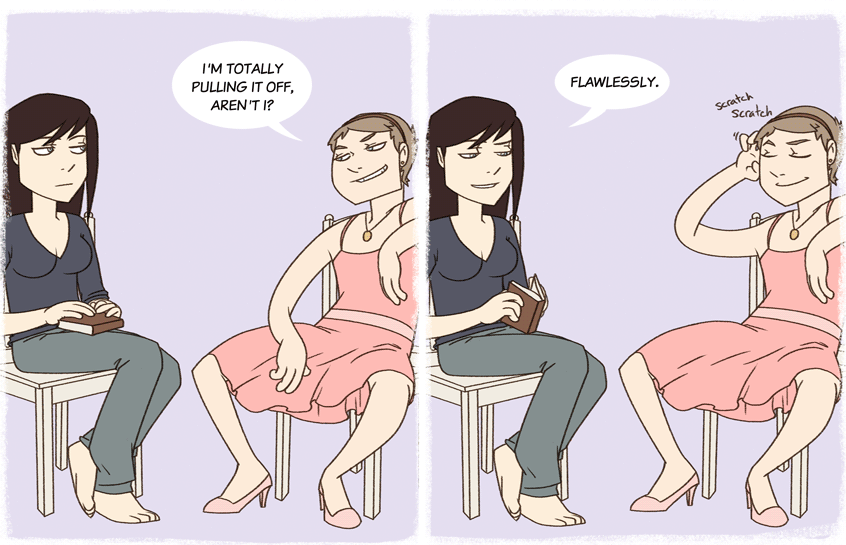
Comic by A. Stiffler at Chaos Life.
.
Likewise, burping and farting, raising one’s voice in an argument, and even laughing loudly are considered distinctly unfeminine. A feminine person doesn’t use her body to forcefully interact with the world, she lets others do for her when possible. ”Massiveness, power, or abundance in a woman’s body is met with distaste,” Bartky wrote.
Stunningly, when you think about it, these features of feminine body comportment are, in fact, not uniquely feminine, but associated with deference more generally. Bartky again:
In groups of men, those with higher status typically assume looser and more relaxed postures; the boss lounges comfortably behind the desk while the applicant sits tense and rigid on the edge of his seat. Higher-status individuals may touch their subordinates more than they themselves get touched; they initiate more eye contact and are smiled at by their inferiors more than they are observed to smile in return. What is announced in the comportment of superiors is confidence and ease…
Acting feminine, then, overlaps with performances of submissiveness. Both men and women use their bodies in more feminine ways when their interacting with a superior, whether it be their boss, their commander, a police officer, or their professor.
New evidence suggests that this is not pure theory. Psychologist Andy Yap and his colleagues tested whether “expansive body postures” like the ones associated with masculinity increase people’s sense of powerfulness and entitlement. They did. In laboratory experiments, people who were prompted to take up more space were more likely to steal, cheat, and violate traffic laws in a simulation. A sense of powerfulness, reported by the subjects, mediated the effect (a robust finding that others have documented as well).
In a real world test of the theory, they found that large automobiles with greater internal space were more likely than small ones to be illegally parked in New York City.
Research, then, has shown that expansive body postures that take up room instill a psychological sense of power and entitlement. The fact that this behavior is gendered may go some way towards explaining the persistence of gender inequality and, more pointedly, some men’s belief that they have earned their unearned privileges.
Cross-posted at Jezebel and Pacific Standard.
Lisa Wade is a professor of sociology at Occidental College. You can follow her on Twitter and Facebook.(View original at http://thesocietypages.org/socimages)