Click here for a stellar collection of mondegreens from comedian Peter Kay. And prepare to have half a dozen songs ruined for you forever. A mondegreen is a speech perception error that causes you to hear the words of a song incorrectly. Peter Kay tells you what you're going to hear, and then plays passages from well-known pop songs of the last decade or two, often miming the crucial part; and thereafter you will never be able to hear those lines any other way. In fact you will forget what the real words were in the first place. Be afraid; be very afraid.
mkvande
Shared posts
16 Sep 01:59
A miscellany of mondegreens
by Geoffrey K. Pullum
Janani.kandhadai, Katherinelfunk likes this
15 Sep 04:36
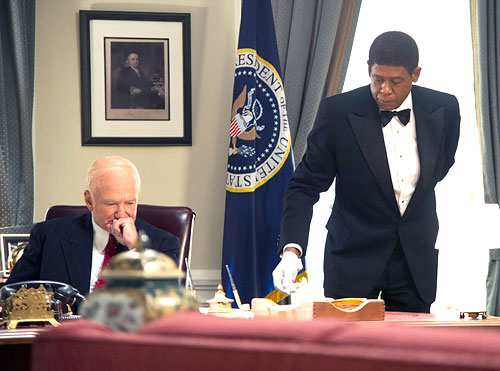
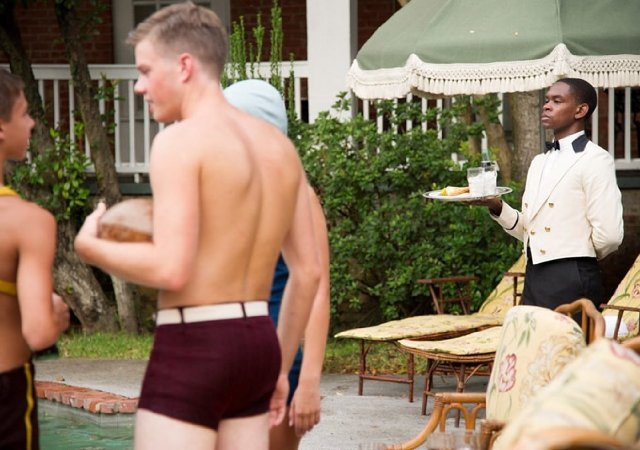


Double Consciousness in Lee Daniels’ The Butler
by Jonathan Harrison PhD
It always gives an old sociologist like me a big thrill when a classical concept that I love appears in a mainstream cultural product. I received such a buzz when I saw the movie Lee Daniels’ The Butler over the Labor Day weekend.
One of the movie’s African American characters, speaking in the 1940s, notes that a Black man must wear “two faces,” one for other Blacks and another for Whites. Perceptive critics have identified how this borrows from “double consciousness,” a concept that W.E.B. DuBois first wrote about in 1897. A.O. Scott cites Paul Laurence Dunbar’s line, “We wear the mask that grins and lies”; whilst Frank Roberts notes that the movie’s butler “wrestles with the realization that he is in The White House but certainly not of it,” which in turn illustrates the wider dilemma of being in America but not of America.
Still of Lee Daniels’ The Butler from imdb.com
Still of Lee Daniels’ The Butler from imdb.com
.
However, what really gives the movie its power is how it resonates with the continuing experiences of African Americans today. Black men who are still shell-shocked by the George Zimmerman verdict will know only too well how they often have to show “two faces” in order to avoid harassment. Barack Obama noted this fact when he observed, a week after the verdict, that there “are very few African American men who haven’t had the experience of walking across the street and hearing the locks click on the doors of cars” or of “getting on an elevator and a woman clutching her purse nervously and holding her breath until she had a chance to get off.”
Similarly, Father Bryan Massingale, who is a priest of the Archdiocese of Milwaukee and a professor of theology at Marquette University, records how he was once “abruptly stopped by the police, rudely questioned and roughly searched, under the suspicion that I was the perpetrator of a robbery” and how “Living with such terror and indignity is to be expected” even if you are ” a priest, a university professor, and a respected member of the community (or so I would have thought).” Such profiling strongly resembles DuBois’ emphasis upon:
…this sense of always looking at one’s self through the eyes of others, of measuring one’s soul by the tape of a world that looks on in amused contempt and pity.
The entire subtext of The Butler is the manner in which the movie’s different characters cope with the task of continually “measuring one’s soul” in this way: the continual feeling of being trapped in the gaze of the white employer’s “contempt and pity.” It is a tribute to the ability of popular culture to occasionally convey powerful truths that this movie does not pull its punches in staying true to that part of DuBois’ sociological vision.
Dr. Jonathan Harrison earned a PhD in Sociology from the University of Leicester, UK. His research interests include the Holocaust, comparative religion, racism, and the history of African Americans in Florida. He teaches at Florida Gulf Coast University and Hodges University. He’d like to thank Dr. Kris De Welde for her comments on earlier drafts of this piece.
(View original at http://thesocietypages.org/socimages)
15 Sep 04:19


Does Europe Have a Sex Selection Problem?
by Jennifer Hickes Lundquist PhD and Eiko Strader
Excess under age-60 female mortality in less developed countries is estimated to add up to 3.9 million missing women worldwide (World Bank, 2011). A large proportion of this is due to sex-selective abortion practices. The practice occurs most commonly among poorer families in societies where boy children are given greater economic and social status than girl children. In such a context, the transition to smaller families can lead parents to choose boys over girls. Notably, female fetuses are most likely to be aborted when the first child born is a girl.
The table below shows the countries with the most skewed ratios at birth in the world. While there is naturally a slightly higher sex ratio of boys to girls — between 1.04-1.06 — ratios above that are considered to be altered by technology due to gender preferences for boy children.

The reason we find this newest 2013 data of particular interest is that, despite the popular Western focus on Asia, the practice occurs in more European countries. Perhaps most striking is the central European country that ranks at the top of the list—Liechtenstein. This strikes us as odd, given that Liechtenstein has never made this list in the past. Perhaps this is a data collection error (in very small populations, as also in Curacao, the results can be skewed). But we are surprised that no journalists have picked up on the fact that the worst offending son-preference country in the world is now, allegedly, a European country. We contacted the CIA to ask them about this possible data anomaly but have not yet heard back.*
On the other hand, if the Liechtenstein data is accurate, this would be a very interesting story indeed, especially since Liechtenstein has the most restrictive laws against abortion in Europe. A quick scan of gender equity policies in Liechtenstein shows that women there were not legalized to vote until 1984, indicating that it is not the most gender egalitarian of European countries.
In any case, whether Liechtenstein’s inclusion in this disreputable list is a data error or not, the other European countries on the list are legitimate. They have been high for many years, and a recent report on Armenia, for example, documents longstanding norms in gender preference. The disproportionate focus on birth sex ratios in China and India no doubt reflects their status as the #1 and #2 most populous countries, which means a much greater overall impact in sheer numbers. Nevertheless, our point stands. Why has the disproportionate inclusion of non-Asian countries on the above-list gone virtually unmentioned by journalists?
Do Developed Western Countries Prefer Boys?
Americans often think of parental sex preference as a thing of the past, or a problem in developing countries. After all, the U.S. sex ratio at birth falls in the normal range, at 1.05. This is in spite of the curious American cottage industry in sex-identification home use kits, such as the Intelligender, the GenderMaker and the Gender Mentor.

In surveys, American parents report an ideal of two children and equal preference for boys and girls. However, American gender preferences manifest themselves in more sneaky ways. A 2011 Gallup poll showed that, if they were only able to have one child, the highest preference was for a boy. These results are little changed from the same Gallup question asked of Americans in 1941.
To return to a point made in an earlier post on skewed sex ratios, Americans may not be so different, after all, in their gender preferences from the countries in the above table. The crucial difference, she noted, is that some Asian countries are more enabled to act on their boy preference than others. It appears we should now be including some European countries in that “enabled” group as well.
* Neither the United Nations, Population Reference Bureau, nor the World Bank have published 2013 statistics yet for comparison to the CIA data.
Jennifer Lundquist is an associate professor of sociology at the University of Massachusetts, Amherst who specializes in stratification and social demography.
Eiko Strader is a PhD student in sociology at the University of Massachusetts, Amherst who studies inequality in labor markets and the welfare state.
(View original at http://thesocietypages.org/socimages)
09 Sep 23:45

"There’s a lot of pressure being the child of...
"There’s a lot of pressure being the child of immigrants."
“Why’s that?”
“My mother is Thai, my father is from Chile. They met while working at a restaurant. There’s a knowledge among first generation immigrants— that they aren’t going to be the ones to achieve the American Dream. They have to work hard and struggle so that their children will have a shot at it. So they educate their children and pass the Dream along to them. And now I have an obligation to make more fucking money than them, to live the American Dream, to validate all the risks they took and everything they went through. And that’s a heavy burden.”
Lblock likes this
08 Sep 21:40

Tanya
by Greg Ross

In August 1942 a students’ nursing brigade discovered 12-year-old Tanya Savicheva, weak with hunger, living alone in an apartment in Leningrad, which had been besieged by Hitler since September 1941. She had kept this diary:
- Zhenya died on December 18, 1941, at twelve noon.
- Grandma died on January 25, 1942, at three in the afternoon.
- Leka died on March 17, 1942, at five o’clock in the morning.
- Uncle Vasya died on April 13, 1942, at two o’clock at night.
- Uncle Lesha on May 10, 1942, at four o’clock in the afternoon.
- Mama died on May 13, 1942, at 7:30 in the morning.
- The Savichevs are dead.
- Everyone is dead.
- Only Tanya is left.
The nurses evacuated her along the narrow lifeline that had been opened that summer by the Soviet army and placed her in an orphanage in a nearby village, but she died there, probably of chronic dysentery, in July 1944. The diary is kept today in the St. Petersburg Museum of History.
Madolan, Charis.verelanthe likes this
08 Sep 04:13


Race and Beliefs about the Ongoing Fight for Civil Rights
by Lisa Wade, PhD
Last week sociologist Philip Cohen, who blogs at Family Inequality, attended the 50th anniversary of the March on Washington. He noted that the crowd was primarily Black; you can see participants in his photoset here. Are White people unenthusiastic about Civil Rights? Perhaps. There is evidence, in any case, that they are less likely than Black Americans to think that ongoing activism is necessary. Cohen offers the results of a series of polls.
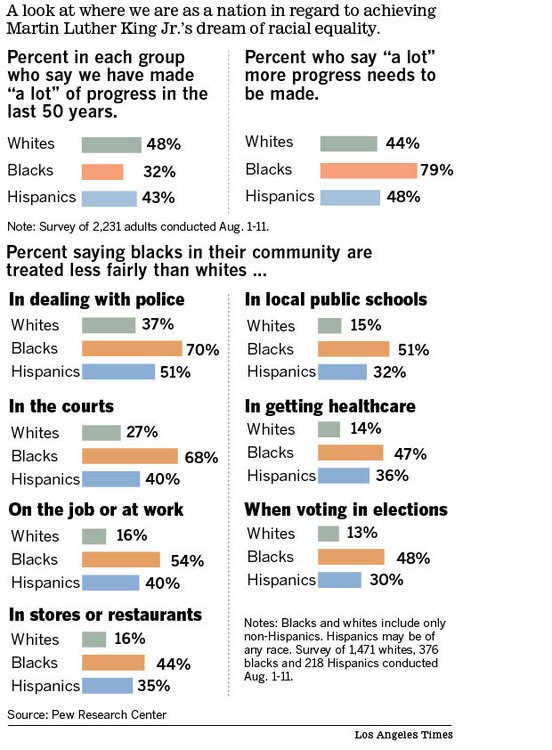
Pew Research Data published in the Los Angeles Times reveals that Black people are less likely than White people to think we’ve made a lot of progress in the last 50 years. They are also substantially more likely to believe that Blacks are treated less fairly than Whites in a wide range of circumstances:
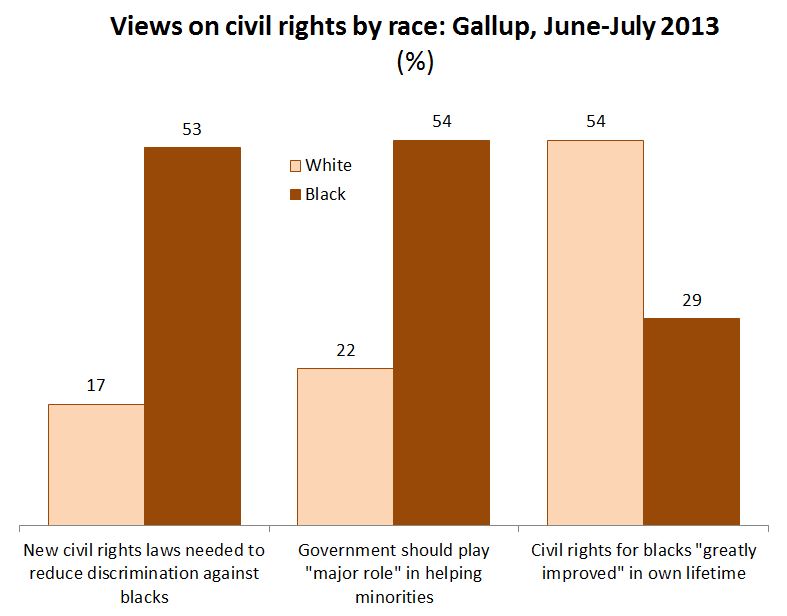
A Gallup poll confirms that Black Americans are less likely than Whites to feel that race-related rights are “greatly improved.” It also reveals that they are more than twice as likely to endorse new civil rights laws and government intervention to assure non-discrimination.
Finally, the General Social Survey asks whether the fact that Blacks are worse off than Whites is due to mainly to discrimination or because of some other cause. More than half of Blacks and a third of Whites say “yes, it’s discrimination.”
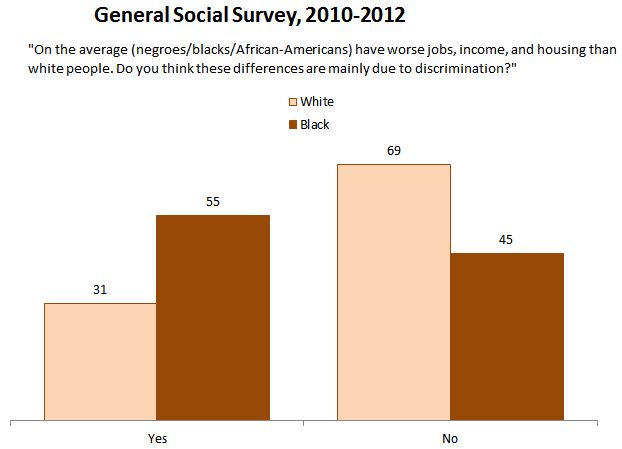
These data reveal that plenty of White Americans are concerned with racial equality, believe we have a long way to go, and support working to improve the treatment of Black Americans. There are also plenty of Black Americans that think things aren’t so bad. Nonetheless, there is a significant and persistent racial gap between the two groups.
Lisa Wade is a professor of sociology at Occidental College. You can follow her on Twitter and Facebook.(View original at http://thesocietypages.org/socimages)
08 Sep 04:09

An Ancient Mystery
by Greg Ross
Around 1275, a native culture known as the Gallina vanished from northern New Mexico. And almost every Gallina skeleton ever found has been that of someone brutally murdered. No one knows why.
“[Someone] was just killing them, case after case, every single time,” U.S. Forest Service archaeologist Tony Largaespada told National Geographic News in 2007.
Seven skeletons found in a remote canyon paint a typical picture — one had a fractured skull, forearm, jaw, thighbone, pelvis, and several broken ribs; another bore cut marks on the upper arm that suggested blows from an ax. A 2-year-old child had had its skull crushed.
In other cases the victims’ necks have been broken, and the bodies are commonly thrown into a house, which is then burned to the ground.
Possibly this was a genocide, or possibly internecine conflict within the Gallina. Either could have been exacerbated by a drought that is known to have gripped the area around this time. But, so far, no one knows the reason.
mkvande likes this
06 Sep 02:10


Men Feel Bad Around Smart, Successful Women
by Lisa Wade, PhD
We’re celebrating the end of the year with our most popular posts from 2013, plus a few of our favorites tossed in. Enjoy!
You know all those badass ladies out there that are inexplicably single? Well, maybe it’s not so inexplicable.
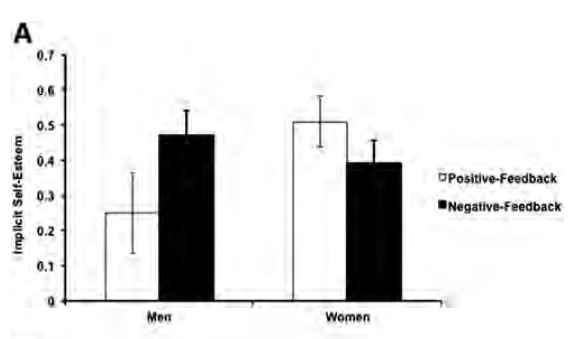
In a study contending for most-depressing-research-of-the-year, psychologists Kate Ratliff and Shigehiro Oishi tested how a romantic partner’s success or failure affects the self-esteem of people in heterosexual relationships. The short story: men feel bad about themselves when good things happen to their female partners. Women’s self-esteem is unaffected. Here’s some of the data.
The vertical axis represents self-esteem. In this experiment, respondents were told that their partner scored high on a test of intelligence (“positive feedback”) or low (“negative feedback”). The leftmost bars show that men who were told that their partners were smart reported significantly lower self-esteem than those who heard that their partners weren’t so smart.
In the second condition, respondents were asked to imagine a partner’s success or failure. Doing so had no effect on women’s self-esteem (rightmost bars). For men, however, imagining their partners’ success made them feel bad about themselves, whereas imagining their failure made them feel good.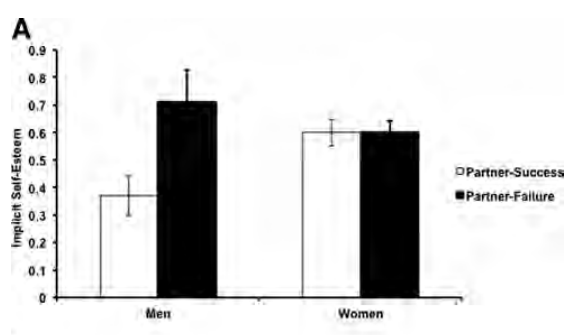
The various experiments were conducted with American and Dutch college students as well as a diverse Internet sample. The findings were consistent across populations and were particularly surprising in the context of the Netherlands, which is generally believed to be more gender egalitarian.
We’ve got a long way to go.
Cross-posted at The Huffington Post and Pacific Standard.
Lisa Wade is a professor of sociology at Occidental College. You can follow her on Twitter and Facebook.(View original at http://thesocietypages.org/socimages)
mkvande likes this
06 Sep 01:31
Public Spheres and Social Media Circles
by profmamamusings
My deep interest in the comparisons between sociability in 18th century England and social media in 21st century America (and the world, but I live in America) led me to structure my course on 18th century British literature around sociability, scandal, and satire. For the sociability unit, we are discussing coffeehouse culture, reading selections from The Tatler, The Spectator, The Female Spectator, and The Invisible Spy, and discussing public spheres and the formation of public opinion. Today we talked about Nancy Fraser’s essay “Rethinking the Public Sphere,” and applied it to coffeehouse culture and to the culture of social media.
The class is a wonderful mix of students. Four are traditional undergraduates (three are English majors, one is a communications major), and one is a retired education professor who loves sitting in on classes. We meet in a small seminar room that smells slightly of coffee. Everyone is rather comfortable with each other.
I knew today’s reading would be a bit daunting — the course is a 300-level so not all the students have had Literary Criticism yet. Fraser’s essay also requires at least a basic understanding of Habermas’ concept of an ideal public sphere as well as Althusser’s RSA/ISA/subjecthood philosophies and Foucault’s formulations of power structures. To help with all that, I created a PowerPoint that broke down the concepts a bit and contextualized some of those theories. (PowerPoint is here.)
We moved through the PowerPoint slides. They took notes for a bit, then we began applying the concepts and that’s when the discussion really began to get going. We talked about social media and slactivism. Our retired professor is a child of the 60s so she gave us insight into that decade of physical activism. We decided using social media to organize a physical protest or demonstration is the ideal action (i.e. Moral Monday protests and the overnight organizing against the Sharia Law/Motorcycle Vagina bills in North Carolina), but for most people, activism ends with a twibbon. We wondered if a proliferation of individual voices drowns out the message, and talked about how a coalition of public spheres needs to form so that individuals can see themselves as deliberative bodies. They decided class is the biggest stratified layer of public spheres now, and class issues exclude some voices.
I’ve used Fraser’s essay in my own work in the past, but only as it applies to literature. Today we applied these ideas to a networked culture that Fraser most likely couldn’t have imagined in 1990 when she wrote the essay. It was so exciting to see theory as a foundation for their thoughts on their own voices, on their participation within a democratic society. I also saw the essay in a new way as I’ve gotten older and have become more active in social justice and feminist policy issues. Good theoretical and critical writing enables people to peek behind the curtain of society, to see the inner workings, and, hopefully, to fix what is broken.
mkvande likes this
01 Sep 02:50

These two were excited to have their picture taken, but...
These two were excited to have their picture taken, but didn’t seem to speak much English.
“We are from Mauritania,” they said.
“What do you miss most about Mauritania?” I asked.
“The capital city is Nouakchott,” they said.
At this point, I was thinking that the language barrier was going to keep me from getting much in terms of an interview, but I tried again.
“Tell me more about Mauritania,” I said.
The seated man held out one hand: “Half-Muslim.”
Then he held out his other hand: “Half-African.”
Then he brought both hands together: “No problem.”
mkvande likes this
01 Sep 02:48


Assumptions, Agenda, and How the Conversation Really Goes Down
by Isis the Scientist
I’ll preface this post by saying that the real life Dr. Isis is pretty spectacular. My kids are cute. My research is hilarious. The online Dr. Isis is pretty fucking disenfranchised. I am over feminism and I am over the online academeratti. Mostly, because I realize that although they seem to have a lot of opinions about how I should do things, we don’t share the same core, fundamental values and I fear that we never will.
As readers of this blog will no doubt be aware, my latest round of disenfranchisement began when Michael Eisen called me a hypocrite for seeking to publish a paper in a high impact factor journal. I wrote about the shenanigans here. Now, admittedly Michael offered his apologies. I decided to take the low road, reject said apology, and tell the #OpenAccess movement to go fuck itself.

Even though Michael probably truly believes he has been sincere, it’s the emptiest of apologies. Why the rudeness and incivility from La Dra. Isis?
Because no one learned shit for dick from this interaction and it infuriates me. Let me share with you the inside baseball about how these interactions go down, beginning with the pivotal moment in which Michael Eisen calls your beloved blog hostess a hypocrite. I respond with…

Because, as you all know, I took great offense at being told what my priorities and moral obligations should be. The part that you likely didn’t see is the shit that followed.
My response to Michael Eisen came from a particular place. Was influenced by a particular world view and my identification with a particular group. Not long after the initial tweeting between Michael and I, the junior scientists of Twitter (assistant professors and postdocs) joined in. I feel their support, and I am so thankful for it (see Proflike for a particularly good post on the matter), but my core point about how it is particularly problematic to ask minority scientists to be risk takers was dominated by a new narrative about how important it is for all junior faculty to get tenure. How “we all” gotta keep our jobs. And we got to hear about how Ethan Perlstein is a special little snowflake and how we should all leave the game and join him. This was my reaction to that hot bag of fuck. Per the usual, the whole conversation quickly got white washed.
What happened next was particularly problematic, but typical and endemic to this culture.
The minority scientists picked up their drinks and moved to the back room to keep talking where they could be heard.
I got phone calls from my hermanos who vented to me about the changing rules of the system and how minorities are always expected to know how to play the game, but never find out the rules until it’s too late. And, they’re excluded from the circles that make the rules in the first place. I got emails from folks with hilarious subject lines like “Preach it, Vato” (which was my personal favorite). I got text messages from people who said things like “I have your back in this, but I don’t feel powerful enough to join you [paraphrased a la Isis].”
There was a whole conversation that happened that most people didn’t see because the mainstream culture we exist in refuses to do one simple, basic thing.
It refuses to ask questions and it refuses to listen before it speaks.
Mainstream culture counters conflict by offering its own seemingly (to them) universal experiences. It offers these experiences until it is blue in the face and until they feel truthy for all, never noticing that they’ve talked over the original point. Then they get to problem solving. And then comes the most infuriating step in the process…

It tells you that it can empathize.
No you can’t, motherfucker! The mainstream culture doesn’t understand dick and won’t in the forseeable future because no one at any point in these discussions stops to really ask about the experiences of the others. They create experiences and solutions that make them feel good – like they’re making strides toward increasing the number of diverse voices – but they never actually listen. If there’s any doubt in your mind, sit in one of these discussions and count the relative number of “I” statements and the relative number of questioning statements.
And Drugmonkey and Miko hit the nail on the head as to why the Open Access movement is the most troubling representative of this culture. Michael Eisen and others in the movement treat junior scientists as the infantry men, sent out to accept the machine gun spray for the greater cultural good. Minority scientists are the ones most likely to take the bullet. The deck is already stacked against them. They’ve got no body armor. In my culture, community is a core value and I can see my brothers and sisters being persuaded to take the bullet because its proposed as the “moral” thing to do. Yet, I was reminded in a conversation yesterday that one of the biggest bits of outreach an underrepresented scientist can do, is to move to the next level. Get a PhD. Get a faculty job. Get tenure. Every time you open a door ahead, you leave five open behind you and that is important to our community.
So, I leave the conversation today with a newly found peace of mind. A sense of what feels right to me. I can get behind the idea of open access as an abstract concept. But as far as the general “community?”

If only I could give fewer than zero fucks.
(My sincerest thanks to the incomparable Dr. Rubidium for the amazing GIFs. She is truly a genius of indignant hilarity and role model to us all. I aspire to be more like her.)
Justine Marie Sherry likes this
01 Sep 02:45



Double Standards at the VMA Awards: What about Robin Thicke?
by Brett Wheeler MS
The Miley Cyrus performance at the VMAs has received quite the reaction. She appears to have shocked celebs as well as the media, and has even been blasted by a group of angry parents. The Internet outrage over her performance has spawned multiple offshoots, including a backlash against people slut-shaming Miley, as well as criticisms about her appropriation and exploitation of black culture.
What has been largely been missing from the conversation (with a few notable exceptions) is the lack of outrage at the 36-year-old man who ground up on Miley’s 20-year-old ass while singing his summer megahit rape culture anthem.
JEFF KRAVITZ/FILMMAGIC via Vanity Fair
.
Far fewer people are expressing concern about the catchy song in which a husband and father outlines with complete confidence his ability to infer when “good girls” “want it.” The same guy who, when discussing the lyrics to his song, tells an interviewer:
Even very good girls have a little bad side. You just have to know how to pull it out of them.
The guy who boasts that he based his hit song on the time-honored masculine performance of hollering at bitches:
We started acting like we were two old men on a porch hollering at girls like, ‘Hey, where you going, girl? Come over here!’ That’s why, in the video, we’re doing all these old men dances. It was great.
That does sound pretty great, Robin.
Overall, the 2013 VMA debacle provides a painfully accurate example of the sexual double standard we have for women and men. A woman who performs sexuality (for whatever reason) is to be castigated, while a man who engages in the exact same performance (and who has unabashedly doubled down on his support for the rape myth that no means yes) hardly raises an eyebrow.
Brett Wheeler is a part-time psychology professor who is pursuing a PhD in positive psychology. His research interests include human sexuality, humor, and how these variables contribute to well-being.
(View original at http://thesocietypages.org/socimages)
01 Sep 02:05

Samuel Johnson's A Dictionary of the English Language, published in April 1755, is one of history's most important dictionaries, written practically single-handedly by Johnson over the course of eight years having being commissioned for the fixed sum of £1,575. After writing the initial proposal, Johnson attempted to raise additional funds for the project by securing a patron, and he soon found one in Lord Chesterfield who, despite pledging £10, offered very little else in terms of support—until, that is, the book was completed seven years later, at which point Chesterfield anonymously wrote two positive reviews in which he was glowingly named as patron. Furious at what he saw as an opportunistic move after years of toil, Johnson wrote an angry but admirably restrained letter to his patron that was almost instantly, and still is, considered a classic.
Note: "Le vainqueur du vainqueur de la terre" translates as "The conqueror of the conqueror of the earth."
(Source: The beauties of Samuel Johnson; Image via.)
RSS Feed proudly sponsored by TinyLetter, a simple newsletter service for people with something to say.
Seven years have now passed, my Lord
by Shaun Usher
Samuel Johnson's A Dictionary of the English Language, published in April 1755, is one of history's most important dictionaries, written practically single-handedly by Johnson over the course of eight years having being commissioned for the fixed sum of £1,575. After writing the initial proposal, Johnson attempted to raise additional funds for the project by securing a patron, and he soon found one in Lord Chesterfield who, despite pledging £10, offered very little else in terms of support—until, that is, the book was completed seven years later, at which point Chesterfield anonymously wrote two positive reviews in which he was glowingly named as patron. Furious at what he saw as an opportunistic move after years of toil, Johnson wrote an angry but admirably restrained letter to his patron that was almost instantly, and still is, considered a classic.
Note: "Le vainqueur du vainqueur de la terre" translates as "The conqueror of the conqueror of the earth."
(Source: The beauties of Samuel Johnson; Image via.)
To The Right Hon. the Earl Of Chesterfield.
February, 1755.
My Lord,
I have been lately informed, by the proprietor of the World, that two papers, in which my Dictionary is recommended to the public, were written by your Lordship. To be so distinguished, is an honour, which being very little accustomed to favours from the great, I know not well how to receive, or in what terms to acknowledge.
When, upon some slight encouragement, I first visited your Lordship, I was overpowered, like the rest of mankind, by the enchantment of your address; and could not forbear to wish that I might boast myself Le vainqueur du vainqueur de la terre;—that I might obtain that regard for which I saw the world contending; but I found my attendance so little encouraged, that neither pride nor modesty would suffer me to continue it. When I had once addressed your Lordship in public, I had exhausted all the art of pleasing which a retired and uncourtly scholar can possess. I had done all that I could; and no man is well pleased to have his all neglected, be it ever so little.
Seven years, my Lord, have now passed, since I waited in your outward rooms, or was repulsed from your door; during which time I have been pushing on my work through difficulties, of which it is useless to complain, and have brought it, at last, to the verge of publication, without one act of assistance, one word of encouragement, or one smile of favour. Such treatment I did not expect, for I never had a Patron before.
The shepherd in Virgil grew at last acquainted with Love, and found him a native of the rocks.
Is not a Patron, my Lord, one who looks with unconcern on a man struggling for life in the water, and when he has reached ground, encumbers him with help? The notice which you have been pleased to take of my labours, had it been early, had been kind; but it has been delayed till I am indifferent, and cannot enjoy it; till I am solitary, and cannot impart it; till I am known, and do not want it. I hope it is no very cynical asperity not to confess obligations where no benefit has been received, or to be unwilling that the public should consider me as owing that to a Patron, which Providence has enabled me to do for myself.
Having carried on my work thus far, with so little obligations to any favourer of learning, I shall not be disappointed though I shall conclude it, if less be possible, with less; for I have been long wakened from that dream of hope, in which I once boasted myself with so much exultation,
My Lord,
Your lordship's most humble,
most obedient servant,
SAMUEL JOHNSON.
RSS Feed proudly sponsored by TinyLetter, a simple newsletter service for people with something to say.
mkvande and -1 others like this
01 Sep 01:56
Why We Speak
by Ben Yagoda
Sometimes you wonder if that whole language thing might not have been the best idea. I’m referring not to when people say “Best. [Blank.] Ever.” or misuse literally, but to when they use words to dissemble, bully, obfuscate, self-aggrandize, proudly display their ignorance, or and/or snarf up airtime like an imperial power having its way with a virgin land. Other times, though, you really understand the whole concept. One of those occasions, for me, came last week, when I heard excerpts of the telephone conversation between Antoinette Tuff, a bookkeeper in a DeKalb, Ga., elementary school, and a DeKalb police dispatcher. Tuff called the police because a man walked into the school carrying an AK-47 and (the police later determined) 500 rounds of ammunition. A tape of the conversation, which lasted 24 minutes, is available on YouTube, and I highly recommend you listen to it.
Tuff starts by saying, “I’m on Second Avenue in the school and the gentleman said tell them to hold down the police officer coming and he said he going to start shooting so tell them to back off.” (In this post I use the transcript provided by National Public radio.)
Early on, Tuff passes on to the dispatcher the demands made by the gunman, whose name is Michael Hill: “Now, what did you want me to tell her, sir? OK. He told me, put you on hold and call the news, ma’am. … OK. He doesn’t want the kids. He wants the police. So back off and—and what else, sir? He say he don’t care if he die. He don’t have nothing to live for. … He said he should’ve just went to the mental hospital instead of doing this because he’s not on his medication.”
At one point, we hear her addressing Hill: “I can help you. Let’s see if we can work it out so that you don’t have to go away with them for a long time.” When he appears to mention suicide, she tells him, “No. You don’t want that. You gonna be OK. I thought the same thing. You know, I tried to commit suicide last year after my husband left me, but look at me now. I’m still working and everything is okay.”
Finally, Hill tells Tuff he’s sorry and puts down his weapon. She makes sure the dispatcher understands he’s unarmed: “OK, he said that they can come in now. He needs to go to the hospital. … He’s laying on the floor. He’s got everything out of his pockets. There isn’t anything. The only thing he has is his belt. Everything is out of his pockets. Everything is sitting here on the counter, so all we need to do is they can just come in, and I’ll buzz them in.”
“It’s gonna be all right, sweetheart,” she tells Hill. “I just want you to know that I love you, though, OK? And I’m proud of you. That’s a good thing that you’re just giving up and don’t worry about it. We all go through something in life.”
Yes, we do. And if we’re lucky, there’s someone like Antoinette Tuff to talk us through it.
There are a couple of things to note about Tuff’s brilliant performance, one of them obvious: Her language is firmly African-American Vernacular English, sometimes referred to as Ebonics. In one short, devastating sentence—”He say he don’t care if he die”—there are three deviations from standard English. But just as obviously, far from inhibiting or restricting her communication with Hill (who is white, by the way), her mastery of and comfort with this grammar makes her all the more forceful and effective. So does the respect with which she addresses and (more remarkably) refers to Hill (“the gentleman”).
As clearly awesome as Tuff is, her performance wasn’t merely a burst of genius. She and other staff members had had training in how to deal with emergency situations, including hostile trespassers. While speaking with the gunman and dispatcher, she signaled a code to colleagues, who set off a phone tree to tell teachers to lock doors and send children to safety. One of the most notable marks of how well she was trained is the care she takes, once Hill has laid down his weapon, to make it clear that he is no longer a threat.
No, Antoinette Tuff isn’t a superwoman, merely an inspiring one. After the police rushed in and apprehended Hill, she told the dispatcher, “OK. I’m gonna tell you something, baby, I ain’t never been so scared in all the days of my life.”
mkvande and -1 others like this
28 Aug 03:23


The Racial Empathy Gap
by Lisa Wade, PhD
In graduate school at the University of Wisconsin-Madison, I proctored law school exams to earn extra money. At the end of one exam, while I was collecting the final papers, I overheard two students discussing their answers on an essay question about sentencing. One said to the other: “I gave the rich guy a lesser sentence because I figured, since he had such a cushy life, it would take less punishment to get through to him.” There’s your next crop of lawyers, I thought, doling out the prison sentences to the poor and letting the rich off with a slap on the wrist.
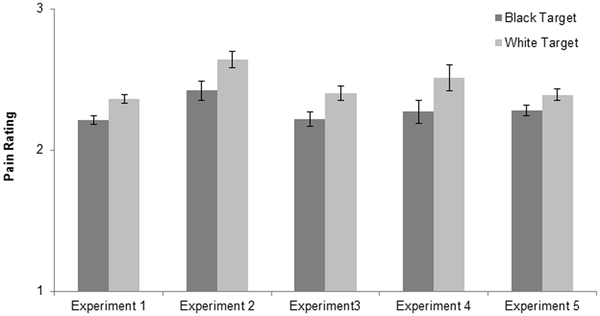
Well, it turns out that there is a well-documented psychological phenomenon behind what I’d overheard. Morten B. sent along an essay by Jason Silverstein in which he reviews the literature on the racial empathy gap. All things being equal, if you show a person an imagine of a dark- and a light-skinned person being harmed, they will most likely react more strongly to the latter. Studies have found evidence of this using both self-report and measures of brain activity. Notably, both Black and White people respond similarly.
Here are the results of six studies using self-report; in the first four, the relationship between race and how much pain subjects attributed to the target was statistically significant:
What’s going on?
Silverstein explains that this isn’t necessarily about racial animosity or even identification with one’s own group (remember that both Black and White people show this response). Instead, it appears to be related to the perception that Black people have already had to cope with a great deal of pain — from racism, poverty, poor health, etc — and, as a result, have a greater pain threshold. In other words, they are less sensitive to pain because they’ve been hardened.
Efforts to parse out whether this effect is due to race specifically or perceptions of whether a person has lived a hard life suggest that it might be primarily the latter. But, as Silverstein points out, we tend to homogenize the Black population and assume that all Black people face adversity. So, whether the phenomenon is caused by race or status gets pretty muddy pretty fast.
In any case, this is perfectly in line with the soon-t0-be-lawyer I overheard at Wisconsin. He gave the “hardened criminal” a harsher sentence than the person convicted of a white-collar crime because he believed that a greater degree of suffering was required to make an impact. That was just a hypothetical case, but Silverstein reviews research that shows that the racial empathy gap has real world consequences: undertreatment of pain (even in children) and, yes, harsher sentences for African Americans convicted of crimes.
Lisa Wade is a professor of sociology at Occidental College. You can follow her on Twitter and Facebook.(View original at http://thesocietypages.org/socimages)
Katiesullivan likes this
28 Aug 02:48

"I haven’t slept in a very long time." “Why’s...
"I haven’t slept in a very long time."
“Why’s that?”
“I work two jobs at two different hotels. I just finished three shifts in a row. Last night I went to my room service job at 11 PM, and worked through the night until 6 AM. I went home to take a shower, then had to be at the other hotel for my front desk job at 8 AM. I worked there until 3:30 PM, then ran back to the first hotel for another shift that started at 4 PM. I just got off a few minutes ago, and I’m sitting here to rest for a moment before getting on the train home.”
“Oh, wow.”
“I work this hard because I’m a single parent. I came here when I was very young from the Dominican Republic. I’m very happy with what I have done. I started with nothing and I raised two kids. But I have to work two jobs so that they can get an education and go to college. I tell them everyday: ‘Look at how hard I work. Look at how I don’t have time to sleep. I can’t control my own time. I can’t manage my own schedule. This is why you need an education. I work this hard so that you can do the things that I am unable to do, and have the things that I can’t have.’”
Heatherg516, bpark and one other like this
28 Aug 02:45


Men are People and Women are Women: The Home Depot Edition
by Lisa Wade, PhD
Thanks to @colleeneliza for tweeting us this great example of the centering of masculinity as “normal” and the othering of women. Notice that Home Depot is offering “Do-It-Yourself” workshops and special workshops for women and kids (screenshot taken 8/18/13):

This is just one more example of the way in which men are regarded as people and women as a special kind of person. Like kids, in this case, needing special treatment. We’ve got lots of them.
Lisa Wade is a professor of sociology at Occidental College. You can follow her on Twitter and Facebook.(View original at http://thesocietypages.org/socimages)
28 Aug 02:33


The “Sworn Virgins” of Albania: Social Rules and Accommodations
by Lisa Wade, PhD
New interest in the virgjinesha inspires us to re-post our coverage from 2012.
Rigid gender roles often inspire creative solutions. Families in Afghanistan, for example, when they have all girls, often pick a daughter to pretend to be a boy until puberty. The child can then run errands, get a job, and chaperone “his” sisters in public (all things girls aren’t allowed to do). The transition is sudden and doesn’t involve relocation, so the entire community knows that the child is a girl. They just pretend nothing at all strange is going on. In fact, it’s not strange. It happens quite routinely.
A similar phenomenon emerged in Albania in the 1400s. Inter-group warfare had left a dearth of men in many communities. Since rights and responsibilities were strongly sex-typed, some families needed a “man” to accomplish certain things like buy land and pass down wealth.
In response, some girls became “virgjinesha,” or sworn virgins. A sworn virgin was a socially-recognized man for the rest of “his” life (so long as the oath was kept). Many girls would take the oath after their father died.
There are only about forty sworn virgins left; as women were granted more and more rights, fewer and fewer girls felt the need to adopt a male identity for themselves or their families.
Some of the remaining virgjinesha were featured in a New York Times slideshow. Two of the images, by photographer Johan Spanner, are reproduced here.

After becoming a man, Qamile Stema [below] said she could leave the house and chop wood with other men. She also carried a gun. At wedding parties, she sat with men. When she talked to women, she recalled, they recoiled in shyness.

Qamile Stema said she would die a virgin. Had she married, she joked, it would have been to a traditional Albanian woman. “I guess you could say I was partly a woman and partly a man, but of course I never did everything a man does,” she said. “I liked my life as a man. I have no regrets.”
Photographer Jill Peters has captured images of sworn virgins, including this images of Lumia from 2011:

(View original at http://thesocietypages.org/socimages)
mkvande likes this
24 Aug 05:15
Step 312: Not all voices are equally relevant in a conversation
Remember:
If you are a member of a group that has privilege, and someone who does not have that privilege is good enough to be explaining their experience to you, just be quiet for a second and listen.
Really! Just for the duration of this conversation, you do not need to relate their experience to yours, or take apart what they are saying based on your own opinions, or dissect what this means to you or for you. It’s OK! You will survive without interjecting yourself and your thoughts on race/gender/sexuality/ability whatever into what this person is trying to tell you.
mtaczak and -1 others like this
24 Aug 05:13


#overlyhonestsyllabi and Our Duty as the Gatekeepers
by Isis the Scientist
I’ve been largely away from the internet for the last 48 hours, fighting the latest wave of bacterial crud to sweep through the university hospital. Between having two kids in daycare and working here, I basically live my life in a gigantic petri dish. When I came back to Twitter this morning, I found a lot of my tweeple cracking wise and using the hashtag #overlyhonestsyllabi.
I can appreciate the frustrations of college teaching. Not every student is fully invested in mastering the material. Not every faculty member is fully investing in teaching the material. But, as with memes that start in the academic Twitterverse, it doesn’t take long before we all come off like a bunch of ivory tower-dwelling cockmonkeys. Por ejemplo:


My favorite was…

And, as usual, our pants are down and our privilege is showing.
This last semester I taught a basic science general education class that is tangentially related to my area of research. I knew when I agreed to do it that it was populated mostly with at risk students. The section was small, only 15 students. I asked them about themselves the first day of class. All of them were the first in their family to go to college. Most of them were from an underrepresented group. Many of them were non-traditional students and many had families. All of them worked outside of school and needed their income for more than beer money.
This was, without a doubt, the hardest teaching that I have ever done. I realized on the first day that it didn’t matter that I had stayed up late meticulously preparing a syllabus and assignments. These students didn’t understand how to use the syllabus as a tool. My 5 pages of material was intimidating as fuck to them. They struggled with their writing. They didn’t have good note taking skills or understand how to use the reading and lecture materials to complement each other. It wasn’t that these kids weren’t smart. It’s that no one had given them the tools they’d need to navigate the system and succeed in the context of the ivory tower. In the context of our community’s expectations for them.
Some days it really did feel like guerilla warfare. Explaining things for the fourth time that, if I were back teaching in the med school. I could expect my students to know. Or to be confident enough in the system to figure it out. Part of what made it feel like warfare at the beginning was the structure of the course. I taught one night a week from 5:30-10 pm. At 5:30 pm on the first night, the students were enthusiastic. By 8 pm, the room took on a distinct Lord of the Flies vibe. I realized quickly that a lot of these students had just come from work, or they were headed to work after, and they were hungry. The next week I brought snacks and put them out at ~8 pm. The tone for the rest of the night was completely different than it had been the previous week. It was such a simple intervention, but it made a world of difference in their ability to keep focused on the material.
I was lucky in that I knew from the beginning that this group needed more than scientific material. They needed help with their academic skills and we were able to spend a lot of time developing those. I can’t say that every student passed, and I can’t say that we fixed everything, but we made a lot of progress. A lot of progress. But, I’ll say again that I was lucky in knowing that these students were struggling. How often do these students end up mixed into our lectures and fail because we don’t recognize until it’s too late? How often are these the kids we say we hope don’t become doctors…
I understand the venting behind #overlyhonestsyllabi but, besides coming across douchey as hell, it also puts the responsibility squarely on the shoulders of the student to succeed instead of making us ask why our students are struggling. I worry about the exclusionary tone of it, especially as I consider the plight of the underrepresented student in STEM. We tell them to come and play the game, we ignore the need to teach them the rules, and then we mock them when they fail instead of introspecting enough to realize that it’s actually we that are failing them.
One of the tweets that rubbed me rawest was this one:

I know that many of us feel hassled by having to teach. By the demands of our students and the demands of their parents, but I was recently reminded how much hope these parents place in their children and what it means to be trusted with their education. I received a short note this week from a parent that said simply, “Thank you from [student's] mom. I am so grateful for your generosity.” Knowing how this student had struggled at times, and how successful he’d gone on to be, this note was everything. Absolutely everything.
It’s easy to write a student off at the first sign of faltering – to tell them that this is a sign they’ll never be a doctor. Or a lawyer. Or, whatever else they aspire to. It’s harder to ask why they’re failing and what we can do to change that…
23 Aug 03:52

In 1984, iconic advertising executive and real-life Mad Man David Ogilvy received a letter from his 18-year-old great nephew, Harry. Having just finished school, Harry was now faced with the common dilemma of whether to go to university or jump straight into full-time work, and so asked his highly respected relative for some wisdom on the matter. Ogilvy responded with the following multiple choice letter of advice.
(Source: The Unpublished David Ogilvy: A Selection of His Writings from the Files of His Partners; Image: David Ogilvy, courtesy of Ads of the World.)
RSS Feed proudly sponsored by TinyLetter, a simple newsletter service for people with something to say.
Take your pick
by Shaun Usher
In 1984, iconic advertising executive and real-life Mad Man David Ogilvy received a letter from his 18-year-old great nephew, Harry. Having just finished school, Harry was now faced with the common dilemma of whether to go to university or jump straight into full-time work, and so asked his highly respected relative for some wisdom on the matter. Ogilvy responded with the following multiple choice letter of advice.
(Source: The Unpublished David Ogilvy: A Selection of His Writings from the Files of His Partners; Image: David Ogilvy, courtesy of Ads of the World.)
June 6, 1984
Dear Harry,
You ask me whether you should spend the next three years at university, or get a job. I will give you three different answers. Take your pick.
Answer A. You are ambitious. Your sights are set on going to the top, in business or government. Today's big corporations cannot be managed by uneducated amateurs. In these high-tech times, they need top bananas who have doctorates in chemistry, physics, engineering, geology, etc.
Even the middle managers are at a disadvantage unless they boast a university degree and an MBA. In the United States, 18 percent of the population has a degree, in Britain, only 7 percent. Eight percent of Americans have graduate degrees, compared with 1 percent of Brits. That more than anything else is why American management outperforms British management.
Same thing in government. When I was your age, we had the best civil service in the world. Today, the French civil servants are better than ours because they are educated for the job in the postgraduate Ecole Nationale d'Administration, while ours go straight from Balliol to Whitehall. The French pros outperform the British amateurs.
Anyway, you are too young to decide what you want to do for the rest of your life. If you spend the next few years at university, you will get to know the world - and yourself - before the time comes to choose your career.
Answer B. Stop frittering away your time in academia. Stop subjecting yourself to the tedium of textbooks and classrooms. Stop cramming for exams before you acquire an incurable hatred for reading.
Escape from the sterile influences of dons, who are nothing more than pickled undergraduates.
The lack of a college degree will only be a slight handicap in your career. In Britain, you can still get to the top without a degree. What industry and government need at the top is not technocrats but leaders. The character traits which make people scholars in their youth are not the traits which make them leaders in later life.
You put up with education for 12 boring years. Enough is enough.
Answer C. Don't judge the value of higher education in terms of careermanship. Judge it for what it is - a priceless opportunity to furnish your mind and enrich the quality of your life. My father was a failure in business, but he read Horace in the loo until he died, poor but happy.
If you enjoy being a scholar, and like the company of scholars, go to a university. Who knows, you may end your days as a Regius Professor. And bear in mind that British universities are still the best in the world - at the undergraduate level. Lucky you. Winning a Nobel Prize is more satisfying than being elected Chairman of some large corporation or becoming a Permanent Undersecretary in Whitehall.
You have a first-class mind. Stretch it. If you have the opportunity to go to a university, don't pass it up. You would never forgive yourself.
Tons of love,
David
RSS Feed proudly sponsored by TinyLetter, a simple newsletter service for people with something to say.
mkvande likes this
21 Aug 16:56


The Surprising Reason We Don’t Tip Flight Attendants
by Lisa Wade, PhD
When the airline industry first tried to go commercial after World War I, it needed to convince skeptical customers that air travel was safe. One strategy was to make passengers feel that the entire crew was able and willing to see to their safety. This included the stewards, the all-male precursors to the stewardess. But which men to hire? The default employee should have been an African American. Ocean liners and train cars, air travel’s main competitors and the model on which they built their business, largely employed Black porters and stewards. But the airlines believed that the overwhelmingly White passengers would not have felt comfortable placing their lives in the hands of Black men. So they hired White men instead. Kathleen Barry, who discusses this in her book Femininity in Flight, explains:
Equanimity on aircraft circa 1930 was a tall order for anyone, but stereotypes dictated that it would most likely come from white male attendants. With uniforms that echoed the naval-style garb of pilots, stewards reassured passengers that the white men in the cabin as well as the cockpit were competent and in control.

If stewards were so capable and appreciated, why not offer one’s appreciation in cash? The answer is, in short, because tips were for Black people. Black porters on trains and boats were tipped as a matter of course but, according to Barry, tipping a White person would have been equivalent to an insult. A journalist, writing in 1902, captured the thinking of the time when he expressed shock and dismay that “any native-born American could consent” to accepting a tip. ”Tips go with servility,” he said. Accepting one was equivalent to affirming “I am less than you.” This interpretation of the meaning of a gratuity, alongside airlines’ need to inspire confidence and simple racism, is why we don’t tip flight attendants today.
Lisa Wade is a professor of sociology at Occidental College. You can follow her on Twitter and Facebook.(View original at http://thesocietypages.org/socimages)
21 Aug 15:38


The Commoner Who Salvaged a King’s Ransom
by Mike Dash

George Fabian Lawrence, better known as “Stoney Jack,” parlayed his friendships with London navvies into a stunning series of archaeological discoveries between 1895 and 1939.
It was only a small shop in an unfashionable part of London, but it had a most peculiar clientele. From Mondays to Fridays the place stayed locked, and its only visitors were schoolboys who came to gaze through the windows at the marvels crammed inside. But on Saturday afternoons the shop was opened by its owner—a “genial frog” of a man, as one acquaintance called him, small, pouched, wheezy, permanently smiling and with the habit of puffing out his cheeks when he talked. Settling himself behind the counter, the shopkeeper would light a cheap cigar and then wait patiently for laborers to bring him treasure. He waited at the counter many years—from roughly 1895 until his death in 1939—and in that time accumulated such a hoard of valuables that he supplied the museums of London with more than 15,000 ancient artifacts and still had plenty left to stock his premises at 7 West Hill, Wandsworth.
“It is,” the journalist H.V. Morton assured his readers in 1928,
perhaps the strangest shop in London. The shop sign over the door is a weather-worn Ka-figure from an Egyptian tomb, now split and worn by the winds of nearly forty winters. The windows are full of an astonishing jumble of objects. Every historic period rubs shoulders in them. Ancient Egyptian bowls lie next to Japanese sword guards and Elizabethan pots contain Saxon brooches, flint arrowheads or Roman coins…
There are lengths of mummy cloth, blue mummy beads, a perfectly preserved Roman leather sandal found twenty feet beneath a London pavement, and a shrunken black object like a bird’s claw that is a mummified hand… [and] all the objects are genuine and priced at a few shillings each.
H.V. Morton, one of the best-known British journalists of the 1920s and 1930s, often visited Lawrence’s shop as a young man, and wrote a revealing and influential pen-portrait of him.
This higgledy-piggledy collection was the property of George Fabian Lawrence, an antiquary born in the Barbican area of London in 1861—though to say that Lawrence owned it is to stretch a point, for much of his stock was acquired by shadowy means, and on more than one occasion an embarrassed museum had to surrender an item it had bought from him.
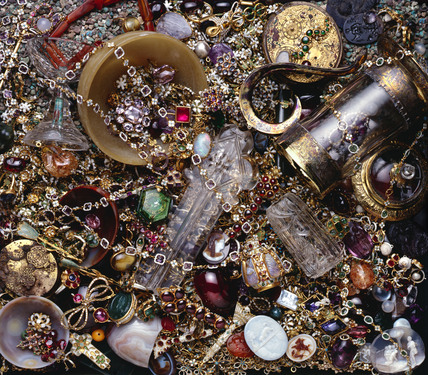
For the better part of half a century, however, august institutions from the British Museum down winked at his hazy provenances and his suspect business methods, for the shop on West Hill supplied items that could not be found elsewhere. Among the major museum pieces that Lawrence obtained and sold were the head of an ancient ocean god, which remains a cornerstone of the Roman collection at the Museum of London; a spectacular curse tablet in the British Museum, and the magnificent Cheapside Hoard: a priceless 500-piece collection of gemstones, broaches and rings excavated from a cellar shortly before the First World War. It was the chief triumph of Lawrence’s career that he could salvage the Hoard, which still comprises the greatest trove of Elizabethan and Stuart-era jewelery ever unearthed.
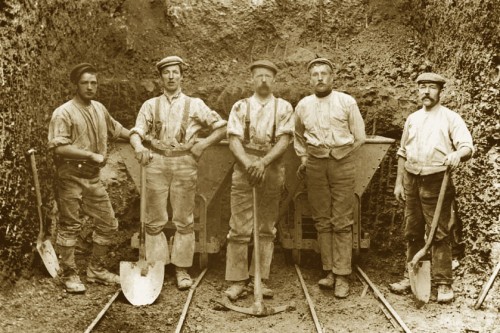
Lawrence’s operating method was simple but ingenious. For several decades, he would haunt London’s building sites each weekday lunch hour, sidling up to the laborers who worked there, buying them drinks and letting them know that he was more than happy to purchase any curios—from ancient coins to fragments of pottery—that they and their mates uncovered in the course of their excavations. According to Morton, who first visited the West Hill shop as a wide-eyed young man around 1912, and soon began to spend most of his Saturday afternoons there, Lawrence was so well known to London’s navvies that he was universally referred to as “Stoney Jack.” A number, Morton added, had been offered “rudimentary archaeological training,” by the antiquary, so they knew what to look for.
Lawrence made many of his purchases on the spot; he kept his pockets full of half-crowns (each worth two shillings and sixpence, or around $18.50 today) with which to reward contacts, and he could often be spotted making furtive deals behind sidewalk billboards and in barrooms. His greatest finds, though were the ones that wended their way to Wandsworth on the weekends, brought there wrapped in handkerchiefs or sacks by navvies spruced up in their Sunday best, for it was only then that laborers could spirit their larger discoveries away from the construction sites and out from under the noses of their foremen and any landlords’ representatives. They took such risks because they liked and trusted Lawrence—and also, as JoAnn Spears explains it, because he “understood networking long before it became a buzzword, and leveraged connections like a latter-day Fagin.”
London navvies–laborers who excavated foundations, built railways and dug tunnels, all by hand–uncovered thousands of valuable artefacts in the British capital each year.
Two more touches of genius ensured that Stoney Jack remained the navvies’ favorite. The first was that he was renowned for his honesty. If ever a find sold for more than he had estimated it was worth, he would track down the discoverer and make certain he received a share of the profits. The second was that Lawrence never turned a visitor away empty-handed. He rewarded even the most worthless discoveries with the price of half a pint of beer, and the workmen’s attitude toward his chief rival—a representative of the City of London’s Guildhall Museum who earned the contemptuous nickname “Old Sixpenny”—is a testament to his generosity.
Lawrence lived at just about the time that archaeology was emerging as a professional discipline, but although he was extremely knowledgeable, and enjoyed a long career as a salaried official—briefly at the Guildhall and for many years as Inspector of Excavations at the newer Museum of London—he was at heart an antiquarian. He had grown up as the son of a pawnbroker and left school at an early age; for all his knowledge and enthusiasm, he was more or less self-taught. He valued objects for themselves and for what they could tell him about some aspect of the past, never, apparently, seeing his discoveries as tiny fragments of some greater whole.
To Lawrence, Morton wrote,
the past appeared to be more real, and infinitely more amusing, than the present. He had an almost clairvoyant attitude to it. He would hold a Roman sandal—for leather is marvelously preserved in the London clay—and, half closing his eyes, with his head on one side, his cheroot obstructing his diction, would speak about the cobbler who had made it ages ago, the shop in which it had been sold, the kind of Roman who had probably brought it and the streets of the long-vanished London it had known.
The whole picture took life and colour as he spoke. I have never met anyone with a more affectionate attitude to the past.
Like Morton, who nursed a love of ancient Egypt, Stoney Jack acquired his interest in ancient history during his boyhood. “For practical purposes,” he told another interviewer, “let us say 1885, when as a youth of 18 I found my first stone implement…. It chanced that one morning I read in the paper of the finding of some stone implements in my neighborhood. I wondered if there were any more to be found. I proceeded to look for them in the afternoon, and was rewarded.”
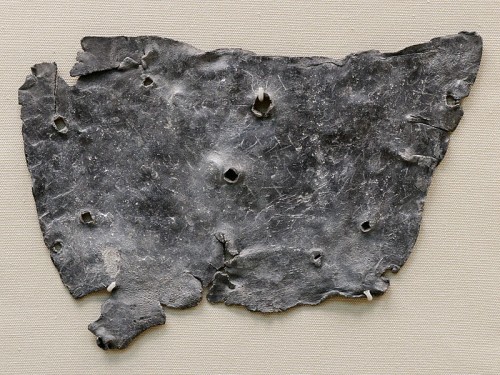
A Roman “curse tablet”, recovered by Lawrence from an excavation in Telegraph Street, London, is now part of the collection of the British Museum.
Controversial though Lawrence’s motives and his methods may have been, it is hard to avoid the conclusion that he was the right man in the right place to save a good deal of London’s heritage. Between 1890 and 1930 the city underwent redevelopment at a pace unheard of since the Great Fire of 1666; old buildings were demolished and replaced with newer, taller ones that required deeper foundations. In the days before the advent of widespread mechanization in the building trade, much of the necessary digging was done by navvies, who hacked their way down through Georgian, Elizabethan, medieval and finally Saxon and Roman strata that had not been exposed for centuries.
It was a golden age for excavation. The relatively small scale of the work—which was mostly done with picks and shovels—made it possible to spot and salvage minor objects in a way no longer practicable today. Even so, no formal system existed for identifying or protecting artifacts, and without Lawrence’s intervention most if not all of the 12,000 objects he supplied to the Museum of London, and the 300 and more catalogued under his name at the British Museum, would have been tipped into skips and shot into Thames barges to vanish into landfill on the Erith marshes. This was very nearly the fate of the treasure with which Stoney Jack will always be associated: the ancient bucket packed to the brim with a king’s ransom worth of gems and jewelery that was dug out of a cellar in the City of London during the summer of 1912.
It is impossible to say for certain who uncovered what would become known as the Cheapside Hoard, exactly where they found it, or when it came into the antiquary’s possession. According to Francis Sheppard, the date was June 18, 1912, and the spot an excavation on the corner of Friday Street and Cheapside in a district that had long been associated with the jewelery trade. That may or may not be accurate; one of Lawrence’s favorite tricks was to obscure the precise source of his most valued stock so as to prevent suspicious landowners from lodging legal claims.
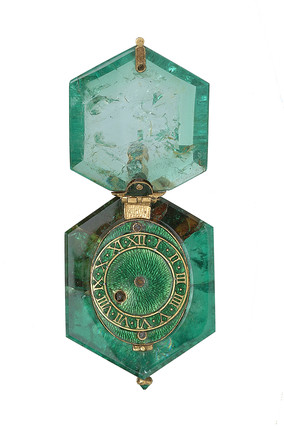
This dramatic pocket watch, dated to c.1610 and set in a case carved from a single large Colombian emerald, was one of the most valuable of the finds making up the Cheapside Hoard–and led historian Kris Lane to put forward a new theory explaining the Hoard’s origins. Photo: Museum of London.
Whatever the truth, the discovery was a spectacular one whose value was recognized by everyone who saw it—everyone, that is, but the navvies who uncovered the Hoard in the first place. According to Morton, who claimed to have been present as a boy when the find was brought to West Hill by its discoverers one Saturday evening, the workmen who had uncovered it believed that they had “struck a toyshop.” Tipping open a sack, the men disgorged an enormous lump of clay resembling “an iron football, the journalist recalled, “and they said there was a lot more of it. When they had gone, we went up to the bathroom and turned the water on to the clay. Out fell pearl earrings and pendants and all kinds of crumpled jewellery.”
For the most accurate version of what happened next, it is necessary to turn to the records of the Museum of London, which reveal that the discovery caused so much excitement that a meeting of the museum’s trustees was convened at the House of Commons the next evening, and the whole treasure was assembled for inspection a week later. “By that time,” Sheppard notes, “Lawrence had somehow or other got hold of a few more jewels, and on June 26 [the museum] sent him a cheque for £90…. Whether this was the full amount paid by the trustees for the hoard is not clear. In August 1913 he was paid £47 for unspecified purchases for the museum.”
Morton—who was 19 at the time of the discovery—offered a more romantic account many years later: “I believe that Lawrence declared this as treasure trove and was awarded a large sum of money, I think a thousand pounds. I well remember that he gave each of the astounded navvies something like a hundred pounds each, and I was told that these men disappeared, and were not seen again for months!”
Whatever the truth, the contents of the navvies’ bucket were certainly astonishing. The hoard consisted of several hundred pieces—some of them gems, but most worked pieces of jewelery in a wide variety of styles. They came from all over the world; among the most spectacular pieces were a number of cameos featuring Roman gods, several fantastical jewels from Mughal India, a quantity of superb 17th-century enamelware, and a large hinged watch case carved from a huge emerald.
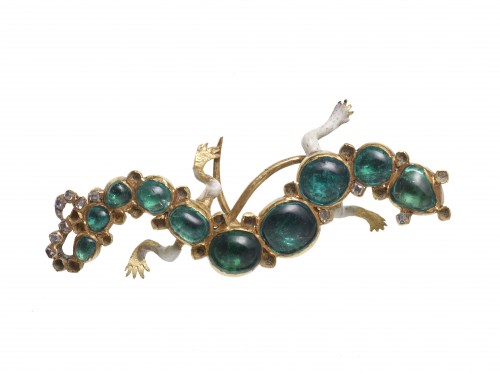
A finely-worked salamander brooch, typical of the intricate Stuart-era jewelry that made up the Cheapside Hoard. Photo: Museum of London.
The collection was tentatively dated to around 1600-1650, and was rendered particularly valuable by the ostentatious fashions of the time; many of the pieces had bold, complex designs that featured a multiplicity of large gems. It was widely assumed, then and now, that the Cheapside Hoard was the stock-in-trade of some Stuart-era jeweler that had been buried for safekeeping some time during the Civil War that shattered England, Ireland and Scotland between 1642 and 1651, eventually resulting in the execution of Charles I and the establishment of Oliver Cromwell’s short-lived puritan republic.
It is easy to imagine some hapless jeweler, impressed into the Parliamentarian army, concealing his valuables in his cellar before marching off to his death on a distant battlefield. More recently, however, an alternative theory has been advanced by Kris Lane, an historian at Tulane whose book The Color of Paradise: The Emerald in the Age of Gunpowder Empires suggests that the Cheapside Hoard probably had its origins in the great emerald markets of India, and may once have belonged to a Dutch gem merchant named Gerard Polman.
The story that Lane spins goes like this: Testimonies recorded in London in 1641 show that, a decade earlier, Polman had booked passage home from Persia after a lifetime’s trading in the east. He had offered £100 or £200 to the master of an East India Company ship Discovery in Gombroon, Persia, to bring him home to Europe, but got no further than the Comoros Islands before dying–possibly poisoned by the ship’s crew for his valuables. Soon afterwards, the carpenter’s mate of the Discovery, one Christopher Adams, appropriated a large black box, stuffed with jewels and silk, that had once belonged to Polman. This treasure, the testimonies state, was astonishingly valuable; according to Adams’s wife, the gems it contained were “so shiny that they thought the cabin was afire” when the box had first been opened in the Indian Ocean. “Other deponents who had seen the jewels on board ship,” adds Lane, “said they could read by their brilliance.”
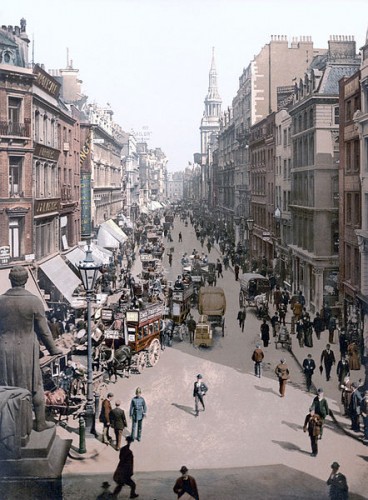
Cheapside–for many years center of London’s financial district district, but in Stuart times known for its jewelry stores–photographed in c.1900.
It is scarcely surprising, then, that when the Discovery finally hove to off Gravesend, at the mouth of the Thames, at the end of her long voyage, Adams jumped ship and went ashore in a small boat, taking his loot with him. We know from the Parliamentary archive that he made several journeys to London to fence the jewels, selling some to a man named Nicholas Pope who kept a shop off Fleet Street.
Soon, however, word of his treachery reached the directors of the East India Company, and Adams was promptly taken into custody. He spent the next three years in jail. It is the testimony that he gave from prison that may tie Polman’s gems to the Cheapside Hoard.
The booty, Adams admitted, had included “a greene rough stone or emerald three inches long and three inches in compass”—a close match for the jewel carved into a hinged watch case that Stoney Jack recovered in 1912. This jewel, he confessed, “was afterward pawned at Cheapside, but to whom he knoweth not”, and Lane considers it a “likely scenario” that the emerald found its way into the bucket buried in a Cheapside cellar; “many of the other stones and rings,” he adds, “appear tantalizingly similar to those mentioned in the Polman depositions.” If Lane is right, the Cheapside Hoard may have been buried in the 1630s, to avoid the agents of the East India Company, rather than lost during the chaos of the Civil War.
Whether or not Lane’s scholarly detective work has revealed the origins of the Cheapside Hoard, it seems reasonable to ask whether the good that Stoney Jack Lawrence did was enough to outweigh the less creditable aspects of his long career. His business was, of course, barely legitimate, and, in theory, his navvies’ finds belonged to the owner of the land that they were working on—or, if exceptionally valuable, to the Crown. That they had to be smuggled off the building sites, and that Lawrence, when he catalogued and sold them, chose to be vague about exactly where they had been found, is evidence enough of his duplicity.
A selection of the 500 pieces making up the Cheapside Hoard that were recovered from a ball of congealed mud and crushed metalwork resembling an “iron football” uncovered in the summer of 1912. Photo: Museum of London.
Equally disturbing, to the modern scholar, is Lawrence’s willingness to compromise his integrity as a salaried official of several museums by acting as both buyer and seller in hundreds of transactions, not only setting his own price, but also authenticating artifacts that he himself supplied. Yet there is remarkably little evidence that any institution Lawrence worked for paid over the odds for his discoveries, and when Stoney Jack died, at age 79, he left an estate totaling little more than £1,000 (about $87,000 now). By encouraging laborers to hack treasures from the ground and smuggle them out to him, the old antiquary also turned his back on the possibility of setting up regulated digs that would almost certainly have turned up additional finds and evidence to set his greatest discoveries in context. On the other hand, there were few regulated digs in those days, and had Lawarence never troubled to make friends with London navvies, most of his finds would have been lost for ever.
For H.V. Morton, it was Stoney Jack’s generosity that mattered. “He loved nothing better than a schoolboy who was interested in the past,” Morton wrote. “Many a time I have seen a lad in his shop longingly fingering some trifle that he could not afford to buy. ‘Put it in your pocket,’ Lawrence would cry. ‘I want you to have it, my boy, and–give me threepence!‘”
But perhaps the last word can be left to Sir Mortimer Wheeler, something of a swashbuckler himself, but by the time he became keeper of the Museum of London in the 1930s–after Stoney Jack had been forced into retirement for making one illicit purchase too many outside a guarded building site–a pillar of the British archaeological establishment.
“But for Mr Lawrence,” Wheeler conceded,
not a tithe [10 percent] of the objects found during building or dredging operations in the neighborhood of London during the last forty years would have been saved to knowledge. If on occasion a remote landowner may, in the process, theoretically have lost some trifle that was his just due, a higher justice may reasonably recognize that… the representative and, indeed, important prehistoric, Roman, Saxon and medieval collections of the Museum are largely founded upon this work of skillful salvage.
[London's Cheapside Hoard goes on display in its entirety for the first time in a century at the Museum of London from October 11.]
Sources
Anon. “Saved Tudor relics.” St Joseph News-Press (St Joseph, MO), August 3, 1928; Anon. “Stoney Jack’s work for museum.” Straits Times (Singapore), August 1, 1928; Michael Bartholomew. In Search of HV Morton. London: Methuen, 2010; Joanna Bird, Hugh Chapman & John Clark. Collectanea Loniniensia: Studies in London Archaeology and History Presented to Ralph Merrifield. London: London & Middlesex Archaeological Society, 1978; Derby Daily Telegraph, November 20, 1930; Exeter & Plymouth Gazette, March 17, 1939; Gloucester Citizen, July 3, 1928; Kris E. Lane. The Colour of Paradise: the Emerald in the Age of Gunpowder Empires. New Haven: Yale University Press, 2010; J. MacDonald. “Stony Jack’s Roman London.” In J. Bird, M. Hassall and Harvey Sheldon, Interpreting Roman London. Oxbow Monograph 58 (1996); Ivor Noël Hume. A Passion for the Past: the Odyssey of a Transatlantic Archaeologist. Charlottesville [VA]: University of Virginia Press, 2010; Arthur MacGregor. Summary Catalogue of the Continental Archaeological Collections. Oxford: Ashmolean Museum, 1997; Francis Sheppard. Treasury of London’s Past. London: Stationery Office, 1991; HV Morton. In Search of London. Boston: Da Capo Press, 2002; Derek Sherborn. An Inspector Recalls. London: Book Guild, 2003; JoAnn Spears. “The Cheapside Hoard.” On the Tudor Trail, February 23, 2012. Accessed June 4, 2013; Peter Watts. “Stoney Jack and the Cheapside Hoard.” The Great Wen, November 18, 2010. Accessed June 4, 2013.
mkvande likes this
20 Aug 18:02
Welcome to Hiroshima
by Jane Eyre
is what you first see, stepping off the train:
a billboard brought to you in living English
by Toshiba Electric. While a channel
silent in the TV of the brain
projects those flickering re-runs of a cloud
that brims its risen columnful like beer
and, spilling over, hangs its foamy head,
you feel a thirst for history: what year
it started to be safe to breathe the air,
and when to drink the blood and scum afloat
on the Ohta River. But no, the water's clear,
they pour it for your morning cup of tea
in one of the countless sunny coffee shops
whose plastic dioramas advertise
mutations of cuisine behind the glass:
a pancake sandwich; a pizza someone tops
with a maraschino cherry. Passing by
the Peace Park's floral hypocenter (where
how bravely, or with what mistaken cheer,
humanity erased its own erasure),
you enter the memorial museum
and through more glass are served, as on a dish
of blistered grass, three mannequins. Like gloves
a mother clips to coatsleeves, strings of flesh
hang from their fingertips; or as if tied
to recall a duty for us, Reverence
the dead whose mourners too shall soon be dead,
but all commemoration's swallowed up
in questions of bad taste, how re-created
horror mocks the grim original,
and thinking at last They should have left it all
you stop. This is the wristwatch of a child.
Jammed on the moment's impact, resolute
to communicate some message, although mute,
it gestures with its hands at eight-fifteen
and eight-fifteen and eight-fifteen again
while tables of statistics on the wall
update the news by calling on a roll
of tape, death gummed on death, and in the case
adjacent, an exhibit under glass
is glass itself: a shard the bomb slammed in
a woman's arm at eight-fifteen, but some
three decades on—as if to make it plain
hope's only as renewable as pain,
and as if all the unsung
debasements of the past may one day come
rising to the surface once again—
worked its filthy way out like a tongue.
Mary Jo Salter
a billboard brought to you in living English
by Toshiba Electric. While a channel
silent in the TV of the brain
projects those flickering re-runs of a cloud
that brims its risen columnful like beer
and, spilling over, hangs its foamy head,
you feel a thirst for history: what year
it started to be safe to breathe the air,
and when to drink the blood and scum afloat
on the Ohta River. But no, the water's clear,
they pour it for your morning cup of tea
in one of the countless sunny coffee shops
whose plastic dioramas advertise
mutations of cuisine behind the glass:
a pancake sandwich; a pizza someone tops
with a maraschino cherry. Passing by
the Peace Park's floral hypocenter (where
how bravely, or with what mistaken cheer,
humanity erased its own erasure),
you enter the memorial museum
and through more glass are served, as on a dish
of blistered grass, three mannequins. Like gloves
a mother clips to coatsleeves, strings of flesh
hang from their fingertips; or as if tied
to recall a duty for us, Reverence
the dead whose mourners too shall soon be dead,
but all commemoration's swallowed up
in questions of bad taste, how re-created
horror mocks the grim original,
and thinking at last They should have left it all
you stop. This is the wristwatch of a child.
Jammed on the moment's impact, resolute
to communicate some message, although mute,
it gestures with its hands at eight-fifteen
and eight-fifteen and eight-fifteen again
while tables of statistics on the wall
update the news by calling on a roll
of tape, death gummed on death, and in the case
adjacent, an exhibit under glass
is glass itself: a shard the bomb slammed in
a woman's arm at eight-fifteen, but some
three decades on—as if to make it plain
hope's only as renewable as pain,
and as if all the unsung
debasements of the past may one day come
rising to the surface once again—
worked its filthy way out like a tongue.
Mary Jo Salter
mkvande likes this


19 Aug 21:55


What’s Wrong with White Culture?
by Lisa Wade, PhD
 All In with Chris Hays does a great job mocking the “What’s wrong with Black culture?” question. He and his “guest,” Gawker’s Cord Jefferson, straight-face skewer news programs that take every instance of African American law breaking as an opportunity to castigate the group writ large. It’s great satire:
Via Todd Krohn at The Power Elite.
Lisa Wade is a professor of sociology at Occidental College. You can follow her on Twitter and Facebook.(View original at http://thesocietypages.org/socimages)
19 Aug 21:33


An Argument for the Total Irrelevance of Beauty
by Lisa Wade, PhD
Today is Love Your Body Day and is this is our favorite body positive post of the year, re-posted in celebration. Enjoy these seven beautiful minutes in which Kara Kamos explains that she is ugly and she couldn’t care less (most of the time):
What’s more important than being beautiful?
- Breathing
- Living
- The universe
- New life forms
- Doing stuff
- Friends
- Having fun
Personally, I really identified with the discussion that starts at 3:51 about not letting how she looks get in the way of her doing things. Often when I’m asked to do public speaking or appear on video, a part of me silently asks the question, “Am I attractive enough to deserve to do this?” The question is absurd. Not because I AM pretty enough, but because the question assumes that, if I weren’t, I would turn down an opportunity on that basis alone. And that is plain silliness.
See all of our body loving posts from the archive!
Lisa Wade is a professor of sociology at Occidental College. You can follow her on Twitter and Facebook.(View original at http://thesocietypages.org/socimages)
mkvande likes this
19 Aug 21:29
Of course all men don’t hate women. But all men must know they benefit from sexism
by Laurie Penny
Anger is an entirely appropriate response to learning that you’re implicated in a system that oppresses women – but the solution isn’t to direct that anger back at women.
This is going to hurt. In the past few months, it has been almost impossible to open a newspaper or turn on a television without encountering a story about another underage girl being raped, another female politician harassed, another trans woman murdered. But as women, girls and a growing number of male allies start speaking out against sexism and injustice, a curious thing is happening: some people are complaining that speaking about prejudice is itself a form of prejudice.
These days, before we talk about misogyny, women are increasingly being asked to modify our language so we don’t hurt men’s feelings. Don’t say, “Men oppress women” – that’s sexism, as bad as any sexism women ever have to handle, possibly worse. Instead, say, “Some men oppress women.” Whatever you do, don’t generalise. That’s something men do. Not all men – just somemen.
This type of semantic squabbling is a very effective way of getting women to shut up. After all, most of us grew up learning that being a good girl was all about putting other people’s feelings ahead of our own. We aren’t supposed to say what we think if there’s a chance it might upset somebody else or, worse, make them angry. So we stifle our speech with apologies, caveats and soothing sounds. We reassure our friends and loved ones that “you’re not one of those men who hate women”.
What we don’t say is: of course not all men hate women. But culture hates women, so men who grow up in a sexist culture have a tendency to do and say sexist things, often without meaning to. We aren’t judging you for who you are but that doesn’t mean we’re not asking you to change your behaviour. What you feel about women in your heart is of less immediate importance than how you treat them on a daily basis.
You can be the gentlest, sweetest man in the world yet still benefit from sexism. That’s how oppression works. Thousands of otherwise decent people are persuaded to go along with an unfair system because it’s less hassle that way. The appropriate response when somebody demands a change in that unfair system is to listen, rather than turning away or yelling, as a child might, that it’s not your fault. And it isn’t your fault. I’m sure you’re lovely. That doesn’t mean you don’t have a responsibility to do something about it.
Without invoking dull gender stereotypes about multitasking, we should all agree that it’s relatively easy to hold more than one idea at a time in the human brain. It’s a large, complex organ, the brain, about the size and weight of a horrible, rotting cauliflower, and it has room for many series’ worth of trashy TV plot lines and the phone number of the ex-lover you really shouldn’t be calling after six shots of vodka. If it couldn’t handle big structural ideas at the same time as smaller personal ones, we would never have made it down from the trees and built things such as cities and cineplexes.
It should not, therefore, be as difficult as it is to explain to the average male that while you, individual man, going about your daily business, eating crisps and playing BioShock 2, may not hate and hurt women, men as a group –men as a structure – certainly do. I do not believe the majority of men are too stupid to understand this distinction, and if they are we need to step up our efforts to stop them running almost every global government.
Somehow, it is still hard to talk to men about sexism without meeting a wall of defensiveness that shades into outright hostility, even violence. Anger is an entirely appropriate response to learning that you’re implicated in a system that oppresses women – but the solution isn’t to direct that anger back at women. The solution isn’t to shut down debate by accusing us of “reverse sexism”, as if that will somehow balance out the problem and stop you feeling so uncomfortable.
Sexism should be uncomfortable. It is painful and enraging to be on the receiving end of misogynist attacks and it is also painful to watch them happen and to know that you’re implicated, even though you never chose to be. You’re supposed to react when you’re told that a group you are a member of is actively screwing over other human beings, in the same way that you’re supposed to react when a doctor hammers your knee to test your nerves. If it doesn’t move, something is horribly wrong.
Saying that “all men are implicated in a culture of sexism” – all men, not just some men –may sound like an accusation. In reality, it’s a challenge. You, individual man, with your individual dreams and desires, did not ask to be born into a world where being a boy gave you social and sexual advantages over girls. You don’t want to live in a world where little girls get raped and then are told they provoked it in a court of law; where women’s work is poorly paid or unpaid; where we are called sluts and whores for demanding simple sexual equality. You did not choose any of this. What you do get to choose, right now, is what happens next.
You can choose, as a man, to help create a fairer world for women – and for men, too. You can choose to challenge misogyny and sexual violence wherever you see them. You can choose to take risks and spend energy supporting women, promoting women, treating the women in your life as true equals. You can choose to stand up and say no and, every day, more men and boys are making that choice. The question is – will you be one of them?
Laurie Penny is the contributing editor of the New Statesman
19 Aug 20:49
What do you do the day after a death threat?
by Laurie Penny
You carry on, writes Laurie Penny.
Last night I went for dinner with a friend, M, who is one of those women who can’t walk down a street without being hassled by men: cat-calling, making bizarre animal noises at her, professing undying love or threatening rape. This is a daily reality for many of us, but with M it’s on a whole other level of threat awareness. Just strolling home with her feels like walking through an enemy camp. We were talking, naturally, about the situation for women who have an online presence in the UK right now, and how frightening and relentless the sexist bullying is getting, and M asked me how I manage to continue to write, given that I’ve been dealing with all this bullshit for more than three years now. I asked her: how do you continue to walk down pavements in public? The answer is: M walks with her hips swaying and her head held high. Because she knows she has a right to the street.
On Monday, I received a bomb threat. This has been happening to several prominent British women journalists and politicians recently, and I suppose it’s some sort of dubious distinction, but it didn’t make it any less frightening and enraging to have to call the police and then find somewhere else to stay for the night. I’m lucky in that I live alone and have relatively little trouble grabbing my go-bag and sleeping on a strange sofa; I know that at least one of the other women who received these threats has a disabled child, and I can only imagine the hassle and stress she went through.
I have a few friends who live nearby, but for some reason, the person I called instantly was somebody I know from online dating, somebody I used to sleep with casually and don’t anymore. He was out with his new girlfriend that night, so offered me his room. I knew instantly that that was where I wanted to be, by myself; it’s a room I used to feel very safe in, where nothing was ever demanded of me except what I wanted to give. His housemate let me in, and I rushed upstairs, shut the door, and took the enormous Jedi-warrior bathrobe that I used to mock so horribly off the hook. I made tea, took off my clothes, wrapped myself in the Jedi robe and sat cross-legged on the bed. I wrote the column I had due for the next day. I felt like nothing could touch me.
Right now it’s pretty scary to be a woman who makes a public spectacle of herself in Britain. By "making a spectacle", I mean "daring to have an opinion in public"; the piece I wrote in 2011 about a woman’s opinion functioning as the mini-skirt of the internet is relevant here. Twitter is also in total meltdown as various camps of campaigners tear chunks out of each other, and it’s upsetting to see. One of the bizarrely modern headaches I’ve had lately is the ongoing, extremely public feud between my current editor and my ex-girlfriend over intersectionality issues, a fight which I’ve had to scramble to avoid because it’s a huge helping of fuck no. There is a deep well of unkindness, of recrimination and refusal to listen, bubbling up online right now in my communities. It is disturbing, and it’s exhausting.
When I’d finished my column, my eyes swimming with tiredness, I posted on Facebook: I need clear space to write. The past two years have been a litany of online attacks and British media bearpit bollocks and the energy I’ve wasted on the mental overheads has been enormous. I don’t want to do it anymore. I wanted to be a writer and a campaigner, I didn’t ask to be a scapegoat and a target, and I didn’t expect it. It’s a curious lonely place to be in and there’s nothing anyone can really do. I’m still here and still fighting but I don’t want to have to fight like this. It’s boring.
Not giving up comes at a cost. I haven’t yet flounced off Twitter or made any sort of dramatic, public exit from the spaces in which I work and receive abuse, because I don’t think that my doing so would help anyone. That doesn’t mean I haven’t seriously considered just kicking it in for the good of my mental health. Imagine that you’re a professional dancer and you have to dance down a street where men are screaming abuse at you, throwing things, leering, sending threats. Do you stop dancing, even if you know a little part of your soul will die if you do? No, fuck that. You keep on dancing; even when your bones ache and your head rings from the relentless cunt bitch stupid girl attention seeker sellout whore. You keep on dancing, but there’s a cost. Don’t ever imagine there’s not a cost
I don’t make it easy for myself. I know that. Not only have I not shut up about women’s rights over the past three years like people want me to, I’m in the middle of writing a book which talks openly about sex, including my own experiences. Part of the reason I’m doing this is that I’ve a slightly adventurous sexual history and am an active member of the queer and poly community in London and elsewhere, and I know that those who are seeking to attack me are probably going to find that out at some point; I’ve been threatened before by people who wanted to release details and/or pictures of me as a half-naked teenager, and I know it’s going to come out at some point; I want to be in control of when and how that happens. I’m not ashamed in any way, not of my life choices and not of my decision to keep on talking.
But the energy it takes to carry on is enormous, and becomes self-reflexive: you write and speak just in order to keep on writing and speaking in adversity. This is no way to be creative; it is no way to sustain a writing life. It makes me angry, and I want it to stop so I can get on with all the other work I want to do. I do not want to be known as the girl who gets a ton of flak for speaking up; I want to carry on saying things that have relevance, even if only to a handful of readers scattered across the world. I’m bored of this, and I’m angry, and I want it to stop. Also I am considering buying my own Jedi robe to wear whenever I open Twitter. That’s all.
mkvande likes this
19 Aug 17:23
I was a Manic Pixie Dream Girl
by Laurie Penny
Men grow up expecting to be the hero of their own story. Women grow up expecting to be the supporting actress in somebody else's.
Like scabies and syphilis, Manic Pixie Dream Girls were with us long before they were accurately named. It was the critic Nathan Rabin who coined the term in a review of the film Elizabethtown, explaining that the character of the Manic Pixie Dream Girl "exists solely in the fevered imaginations of sensitive writer-directors to teach broodingly soulful young men to embrace life and its infinite mysteries and adventures". She pops up everywhere these days, in films and comics and novels and television, fascinating lonely geek dudes with her magical joie-de-vivre and boring the hell out of anybody who likes their women to exist in all four dimensions.
Writing about Doctor Who this week got me thinking about sexism in storytelling, and how we rely on lazy character creation in life just as we do in fiction. The Doctor has become the ultimate soulful brooding hero in need of a Manic Pixie Dream Girl to save him from the vortex of self-pity usually brought on by the death, disappearance or alternate-universe-abandonment of the last girl. We cannot have the Doctor brooding. A planet might explode somewhere, or he might decide to use his powers for evil, or his bow-tie might need adjusting. The companions of the past three years, since the most recent series reboot, have been the ultimate in lazy sexist tropification, any attempt at actually creating interesting female characters replaced by... That Girl.
Amy Pond was That Girl; Clara Oswald has been That Girl; River Song, interestingly enough, did not start out as That Girl, but the character was forcibly turned into That Girl when she no longer fit the temper of a series with contempt for powerful, interesting, grown-up women, and then discarded when she outgrew the role (‘Don’t let him see you age’ was River’s main piece of advice in the last season). ‘The Girl Who Waited’ is not a real person, and nor is ‘The Impossible Girl.’ Those are the titles of stories. They are stories that happen to other people. That’s what girls are supposed to be.
Men grow up expecting to be the hero of their own story. Women grow up expecting to be the supporting actress in somebody else's. As a kid growing up with books and films and stories instead of friends, that was always the narrative injustice that upset me more than anything else. I felt it sometimes like a sharp pain under the ribcage, the kind of chest pain that lasts for minutes and hours and might be nothing at all or might mean you're slowly dying of something mundane and awful. It's a feeling that hit when I understood how few girls got to go on adventures. I started reading science fiction and fantasy long before Harry Potter and The Hunger Games, before mainstream female leads very occasionally got more at the end of the story than together with the protagonist. Sure, there were tomboys and bad girls, but they were freaks and were usually killed off or married off quickly. Lady hobbits didn't bring the ring to Mordor. They stayed at home in the shire.
Stories matter. Stories are how we make sense of the world, which doesn’t mean that those stories can’t be stupid and simplistic and full of lies. Stories can exaggerate and offend and they always, always matter. In Doug Rushkoff's recent book Present Shock, he discusses the phenomenon of “narrative collapse”: the idea that in the years between 11 September 2001 and the financial crash of 2008, all of the old stories about God and Duty and Money and Family and America and The Destiny of the West finally disintegrated, leaving us with fewer sustaining fairytales to die for and even fewer to live for.
This is plausible, but future panic, like the future itself, is not evenly distributed. Not being sure what story you're in anymore is a different experience depending on whether or not you were expecting to be the hero of that story. Low-status men, and especially women and girls, often don't have that expectation. We expect to be forgettable supporting characters, or sometimes, if we're lucky, attainable objects to be slung over the hero's shoulder and carried off the end of the final page. The only way we get to be in stories is to be stories ourselves. If we want anything interesting at all to happen to us we have to be a story that happens to somebody else, and when you’re a young girl looking for a script, there are a limited selection of roles to choose from.
Manic Pixies, like other female archetypes, crop up in real life partly because fiction creates real life, particularly for those of us who grow up immersed in it. Women behave in ways that they find sanctioned in stories written by men who know better, and men and women seek out friends and partners who remind them of a girl they met in a book one day when they were young and longing.
For me, Manic Pixie Dream Girl was the story that fit. Of course, I didn't think of it in those terms; all I saw was that in the books and series I loved - mainly science fiction, comics and offbeat literature, not the mainstream films that would later make the MPDG trope famous - there were certain kinds of girl you could be, and if you weren't a busty bombshell, if you were maybe a bit weird and clever and brunette, there was another option.
And that's how I became a Manic Pixie Dream Girl. The basic physical and personality traits were already there, and some of it was doubtless honed by that learned girlish desire to please - because the posture does please people, particularly the kind of sad, bright, bookish young men who have often been my friends and lovers. I had the raw materials: I’m five feet nothing, petite and small-featured with skin the color of something left on the bottom of a pond for too long and messy hair that’s sometimes dyed a shocking shade of red or pink. At least, it was before I washed all the dye out last year, partly to stop soulful Zach-Braff-a-likes following me to the shops, and partly to stop myself getting smeary technicolour splotches all over the bathroom, as if a muppet had been horribly murdered.
And yes, I’m a bit strange and sensitive and daydreamy, and retain a somewhat embarrassing belief in the ultimate decency of humanity and the transformative brilliance of music, although I’m ambivalent on the Shins. I love to dance, I play the guitar badly, and I also - since we’re in confession mode, dear reader, please hear and forgive - I also play the fucking ukelele. Truly. Part of the reason I’m writing this is that the MPDG trope isn’t properly explored, in any of the genres I read and watch and enjoy. She’s never a point-of-view character, and she isn’t understood from the inside. She’s one of those female tropes who is permitted precisely no interiority. Instead of a personality, she has eccentricities, a vaguely-offbeat favourite band, a funky fringe.
I’m fascinated by this character and what she means to people, because the experience of being her - of playing her - is so wildly different than it seems to appear from the outside. In recent weeks I’ve filled in the gaps of classic Manic Pixie Dream Girl films I hadn’t already sat through, and I’m struck by how many of them claim to be ironic re-imaginings of a character trope that they fail to actually interrogate in any way. Irony is, of course, the last vestige of modern crypto-misogyny: all those lazy stereotypes and hurtful put-downs are definitely a joke, right up until they aren’t, and clearly you need a man to tell you when and if you’re supposed to take sexism seriously.
One of these soi-disant ironic films is (500) Days of Summer, the opening credits of which refer to the real-world heartbreak on which writer-director Scott Neustadter based the character of Summer" 'Any resemblance to people living or dead is purely coincidental. Especially you, Jenny Beckman. Bitch.'
Men write women, and they re-write us, for revenge. It's about obsession, and control. Perhaps the most interesting of the classics, then, is the recent 'Ruby Sparks', written by a woman, Zoe Kazan, who also stars as the title character. It’s all about a frustrated young author who writes himself a perfect girlfriend, only to have her come to life. When she inevitably proves more difficult to handle in reality than she did in his fantasy, the writer’s brother comments: "You've written a girl, not a person."
“I think defining a girl and making her lovable because of her music taste or because she wears cute clothes is a really superficial way of looking at women. I did want to address that,” Kazan told the Huffington Post. “Everybody is setting out to write a full character. It's just that some people are limited in their imagination of a girl.”
Those imaginative limits, that failure of narrative, is imposed off the page, too, in the most personal of ways. I stopped being a Manic Pixie Dream Girl around about the time I got rid of the last vestiges of my eating disorder and knuckled down to a career. It’s so much easier, if you have the option, to be a girl, not a person. It’s definitely easier to be a girl than it is to do the work of being a grown woman, especially when you know that grown women are far more fearful to the men whose approval seems so vital to your happiness. And yet something in me was rebelling against the idea of being a character in somebody else’s story. I wanted to write my own.
I became successful, or at least modestly so - and that changed how I was perceived, entirely and all at once. I was no longer That Girl. I didn’t have time to save boys anymore. I manifestly had other priorities, and those priorities included writing. You cannot be a writer and have writing be anything other than the central romance of your life, which is one thing they don’t tell you about being a woman writer: it’s its own flavour of lonely. Men can get away with loving writing a little bit more than anything else. Women can’t: our partners and, eventually, our children are expected to take priority. Even worse, I wasn’t writing poems or children’s stories, I was writing reports, political columns. I’ve recently been experimenting with answering ‘fashion’ rather than ‘politics’ when men casually ask me what I write about, and the result has been a hundred percent increase in phone numbers, business cards, and offers of drinks. This is still substantially fewer advances than I receive when I the truthful answer to whether I wrote was: “sometimes, in notebooks, just for myself.”
I don't often write about love and sex on a personal level these days, even though I spend a great deal of time thinking about it, like everyone else in the It's Complicated stage of their twenties. Lately, though, as I've been working on longer ideas about sexism and class and power, I keep coming back to love, to the meat and intimacy of fucking and how it so often leads so treacherously to kissing. I flick through a lot of feminist theory in the down hours where some people knit or go jogging, and I was prepared for the personal to be political. What I didn't understand until quite recently was that the political can be so, so personal.
There was never a moment in my life when I decided to be a writer. I can't remember a time when I didn't know for sure that that's what I'd do, in some form, and forever. But there have been times when I didn't write, because I was too depressed or anxious or running away from something, and those times have coincided almost precisely with the occasions when I had most sexual attention from men. I wish I’d known, at 21, when I made up my mind to try to write seriously for a living if I could, that that decision would also mean a choice to be intimidating to the men I fancied, a choice to be less attractive, a choice to stop being That Girl and start becoming a grown woman, which is the worst possible thing a girl can do, which is why so many of those Manic Pixie Dream Girl characters, as written by male geeks and scriptwriters, either die tragically young or are somehow immortally fixed at the physical and mental age of nineteen-and-a-half. Meanwhile, in the real world, the very worst thing about being a real-life MPDG is the look of disappointment on the face of someone you really care about when they find out you’re not their fantasy at all - you’re a real human who breaks wind and has a job.
If I’d known what women have to sacrifice in order to write, I would not have allowed myself to be so badly hurt when boys whose work and writing I found so fascinating found those same qualities threatening in me. I would have understood what Kate Zambreno means when she says, in her marvellous book Heroines, I do not want to be an ugly woman, and when I write, I am an ugly woman. I would have been less surprised when men encouraged me to be politer and grow my hair long even as I helped them out with their own media careers. My Facebook feed is full of young male writers who I have encouraged to believe in themselves, set up with contacts, taken on adventures and talked into the night about the meaning of journalism with who are now in long-term relationships with people who are content to be That Girl. I would have understood quite clearly what I was choosing when I chose, sometime around the time I packed two suitcases and walked out on Garden State Boy, to be a person who writes her own stories, rather than a story that happens to other people.
I try hard, now, around the men in my life, to be as unmanic, as unpixie and as resolutely real possible, because I don’t want to give the wrong impression. And it’s a struggle. Because I remain a small, friendly, excitable person who wears witchy colors and has a tendency towards the twee. I still know that if I wanted to, I could attract one of those lost, pretty nerd boys I have such a weakness for by dialling up the twee and dialling down the smart, just as I know that the hurt in their eyes when they realise you’re a real person is not something I ever want to see again. I still love to up sticks and go on adventures, but I no longer drag mournful men-children behind me when I do, because it’s frankly exhausting. I still play the ukelele. I wasn’t kidding about the fucking ukelele. But I refuse to burn my energy adding extra magic and sparkle to other people’s lives to get them to love me. I’m busy casting spells for myself. Everyone who was ever told a fairytale knows what happens to women who do their own magic.
So here’s what I’ve learned, in 26 years of reading books and kissing boys. Firstly, averagely pretty white women in their late teens and twenties are not the biggest, most profoundly unsolvable mystery in the universe. Trust me. I should know. Those of us with an ounce of lust for life are almost universally less interesting than we will be in our thirties and forties. The one abiding secret about us is that we’re not fantasies, and we weren’t made to save you: we’re real people, with flaws and cracked personalities and big dreams and digestive tracts. It’s no actual mystery, but it remains a fact that the half of the human race with a tendency to daydream about a submissive, exploitable, transcendent ideal of the other seems perversely unwilling to discover.
Secondly, you can spend your whole life being a story that happens to somebody else. You can twist and cram and shave down every aspect of your personality that doesn’t quite fit into the story boys have grown up expecting, but eventually, one day, you’ll wake up and want something else, and you’ll have to choose.
Because the other thing about stories is that they end. The book closes, and you’re left with yourself, a grown fucking woman with no more pieces of cultural detritus from which to construct a personality. I tried and failed to be a character in a story somebody else had written for me. What concerns me now is the creation of new narratives, the opening of space in the collective imagination for women who have not been permitted such space before, for women who don’t exist to please, to delight, to attract men, for women who have more on our minds. Writing is a different kind of magic, and everyone knows what happens to women who do their own magic - but it’s a risk you have to take.
mkvande and -1 others like this