Shared posts

18 Apr 20:40

Rare Books 101, Part IV: Handling Rare Books

by bibliodeviant

Reblogged from Aldine by Rebecca Romney:

Click to visit the original post
  • Click to visit the original post
  • Click to visit the original post
  • Click to visit the original post
  • Click to visit the original post
  • Click to visit the original post
  • Click to visit the original post
  • Click to visit the original post

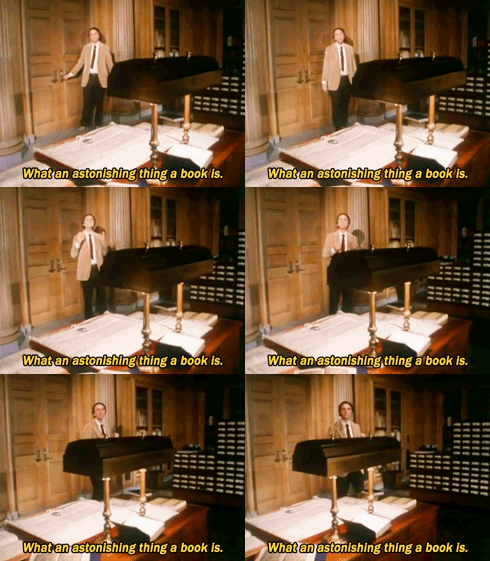
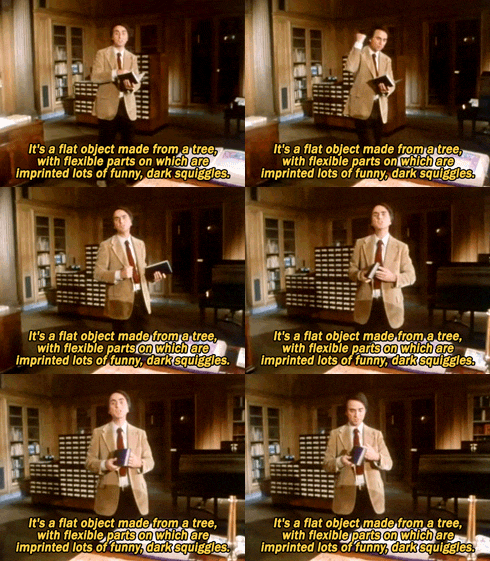
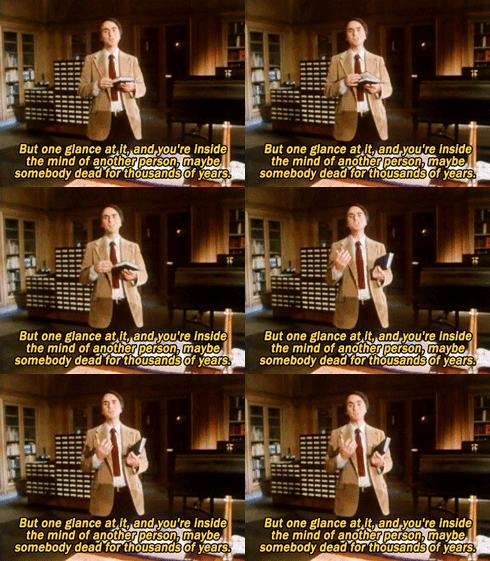
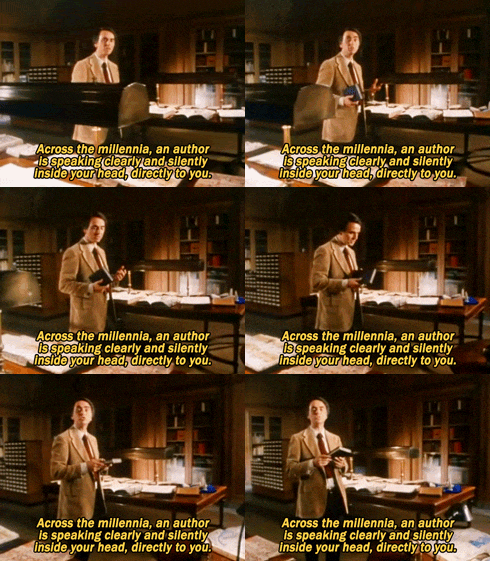
Don’t be afraid. Be careful, but don’t be afraid.

This is Part IV of my Rare Books 101 Series. If you are new to the Series, you can read the other articles here:

Part I: Basics
Part II: Editions
Part III: Storage

I often see a contradictory mix of emotions on a person’s face when I hand him a first edition copy of his favorite book.

Read more… 1,021 more words

This basically covers a lot of useful stuff:
18 Apr 20:37

“Come and See the Blood in the Streets!”

by Nicholas Thompson

h_14333375-580.jpg

One of the most moving poems I’ve read is Pablo Neruda’s “I’m Explaining a Few Things.” It’s about the Spanish Civil War, and it begins by describing the peace in a suburb of Madrid before the fighting broke out.

My house was called
the house of flowers
because in every cranny geraniums burst.
...read more
18 Apr 02:28

Terrorism and Privilege: Understanding the Power of Whiteness

by Tim Wise

Cross-posted at Tim Wise’s website and Pacific Standard.

As the nation weeps for the victims of the horrific bombing in Boston yesterday, one searches for lessons amid the carnage, and finds few. That violence is unacceptable stands out as one, sure. That hatred — for humanity, for life, or whatever else might have animated the bomber or bombers — is never the source of constructive human action seems like a reasonably close second.

But I dare say there is more; a much less obvious and far more uncomfortable lesson, which many are loathe to learn, but which an event such as this makes readily apparent, and which we must acknowledge, no matter how painful.

It is a lesson about race, about whiteness, and specifically, about white privilege.

I know you don’t want to hear it. But I don’t much care. So here goes.

White privilege is knowing that even if the Boston Marathon bomber turns out to be white, his or her identity will not result in persons like yourself being singled out for suspicion by law enforcement, or the TSA, or the FBI.

White privilege is knowing that even if the bomber turns out to be white, no one will call for your group to be profiled as terrorists as a result, subjected to special screening, or threatened with deportation.

White privilege is knowing that if the bomber turns out to be white, he or she will be viewed as an exception to an otherwise non-white rule, an aberration, an anomaly, and that he or she will be able to join the ranks of Tim McVeigh and Terry Nichols and Ted Kaczynski and Eric Rudolph and Joe Stack and George Metesky and Byron De La Beckwith and Bobby Frank Cherry and Thomas Blanton and Herman Frank Cash and Robert Chambliss and James von Brunn and Robert Mathews and David_Lane and Michael F. Griffin and Paul Hill and John Salvi and James Kopp and Luke Helder and James David Adkisson and Scott Roeder and Shelley Shannon and Wade Michael Page and Byron Williams and Kevin Harpham and William Krar and Judith Bruey and Edward Feltus and Raymond Kirk Dillard and Adam Lynn Cunningham and Bonnell Hughes and Randall Garrett Cole and James Ray McElroy and Michael Gorbey and Daniel Cowart and Paul Schlesselman and Frederick Thomas and Paul Ross Evans and Matt Goldsby and Jimmy Simmons and Kathy Simmons and Kaye Wiggins and Patricia Hughes and Jeremy Dunahoe and David McMenemy and Bobby Joe Rogers and Francis Grady and Demetrius Van Crocker and Floyd Raymond Looker, among the pantheon of white people who engage in politically motivated violence meant to terrorize and kill, but whose actions result in the assumption of absolutely nothing about white people generally, or white Christians in particular.

And white privilege is being able to know nothing about the crimes committed by most of the terrorists listed above — indeed, never to have so much as heard most of their names — let alone to make assumptions about the role that their racial or ethnic identity may have played in their crimes.

White privilege is knowing that if the Boston bomber turns out to be white, you will not be asked to denounce him or her, so as to prove your own loyalties to the common national good. It is knowing that the next time a cop sees you standing on the sidewalk cheering on runners in a marathon, that cop will say exactly nothing to you as a result.

White privilege is knowing that if you are a student from Nebraska — as opposed to, say, a student from Saudi Arabia — that no one, and I mean no one would think it important to detain and question you in the wake of a bombing such as the one at the Boston Marathon.

And white privilege is knowing that if this bomber turns out to be white, the United States government will not bomb whatever corn field or mountain town or stale suburb from which said bomber came, just to ensure that others like him or her don’t get any ideas. And if he turns out to be a member of the Irish Republican Army we won’t bomb Dublin. And if he’s an Italian American Catholic we won’t bomb the Vatican.

In short, white privilege is the thing that allows you — and me — to view tragic events like this as merely horrific, and from the perspective of pure and innocent victims, rather than having to wonder, and to look over one’s shoulder, and to ask even if only in hushed tones, whether those we pass on the street might think that somehow we were involved.

It is the source of our unearned innocence and the cause of others’ unjustified oppression.

That is all. And it matters.

Tim Wise is among the most prominent anti-racist writers and educators in the United States.  The author of six books on race in America, he has spoken on over 800 college and high school campuses and to community groups across the nation.  His new book, The Culture of Cruelty, will be released in the Fall of 2013.

(View original at http://thesocietypages.org/socimages)

18 Apr 02:21

The Accidentally Color-Blind Racist

by Gwen Sharp, PhD

Last week someone sent me a link to an article about Brad Paisley’s new song, “Accidental Racist,” which features LL Cool J. Given that you’re a Soc Images reader, chances are good you’ve heard about this song. I don’t remember what I was expecting when I saw the title of the song, but man. I really was not prepared for that experience. There’s no official video available on YouTube at the moment, but someone made a video of the song with the lyrics:

In Racism without Racists: Color-Blind Racism and the Persistence of Racial Inequality in the United States, Eduardo Bonilla-Silva discusses the rhetorical strategies that Whites often use to minimize the existence of racial inequality today. As being openly racist has become increasingly stigmatized in the U.S., a version of “color-blind” racism has emerged.

One argument that underpins color-blind racism is the framing of racial oppression and injustice as elements of the past that, while regrettable, can’t be remedied now. Moreover, it’s history; since African Americans aren’t enslaved or legally segregated today, we need to move on from here and treat everyone as equals, with no special considerations for anyone. As one of Bonilla-Silva’s interviewees explained, “…what happened in the past is horrible and it should never happen again, but I also think that to move forward you have to let go of the past…And it should really start equaling out…” (p. 78).

Along with this is often an attempt to equate the discrimination faced by some groups of European immigrants (Italians, the Irish, Jews, etc.) to the experience of African Americans, as this interviewee did: “…they were slaves back in the past and yet, how often do you hear about the people who were whites that were slaves…Boy, we should get reparations, the Irish should get reparations from the English…” (p. 79). From this perspective, African Americans are just one of many groups that had it bad; the impacts of a legally institutionalized racist system that denied African Americans full citizenship or access to opportunities is ignored. This storyline of “we all had it bad” equalizes various experiences of racial and ethnic inequality.

And this is the problem with Paisley’s song (well, it’s one of the problems, but let’s focus). Take these lyrics (found here):

And it ain’t like you and me can re-write history
Our generation didn’t start this nation
We’re still pickin’ up the pieces, walkin’ on eggshells, fightin’ over yesterday
And caught between southern pride and southern blame

And we’re still paying for the mistakes
That a bunch of folks made long before we came

And these contributions from LL Cool J:

If you don’t judge my gold chains…I’ll forget the iron chains

The past is the past, you feel me…Let bygones be bygones

While Paisley may mean well, his song presents racial inequality or conflict as the result of long-past history, “mistakes…made long before we came,” something we need to just get past so we can appreciate each other. And it equates wildly divergent issues, presenting everyone has having a fair, legitimate complaint. Slavery (“iron chains”) and adopting an aesthetic style (“gold chains”) that some Whites might not like are, apparently, equivalent issues. Ending racism is just a matter of everybody deciding to be nicer. If Whites can get over not liking what some African Americans wear, well then hey, African Americans will get over a history of institutionalized racial oppression and the impacts it still has today.

In the world of color-blind racism, this is a fair, plausible compromise.

You might also enjoy SNL’s take from last weekend:

Gwen Sharp is an associate professor of sociology at Nevada State College. You can follow her on Twitter at @gwensharpnv.

(View original at http://thesocietypages.org/socimages)

17 Apr 23:06

The Leisure Class

by Greg Ross

A sort of mania for gambling overtook White’s, a gentlemen’s club in London, in the 18th century. Excerpts from its betting book:

  • “January the 14th, 1747/8. Mr. Fanshawe wagers Lord Dalkeith one guinea, that his peruke is better than his Lordship’s, to be judged of by the majority of members the next time they both shall meet.”
  • “Lord Ravensworth betts Ld. Leicester & Ld. Coke ten guineas each, that the General Post Office is not three miles distant from Lord Gower’s house in Upper Brooke Street.”
  • “Feb. 10th, 1748-9. Mr. Fanshawe betts Dr. Wm. Stanhope twenty guineas, that there was not a play acted at Covent Garden Play house twenty years ago.”
  • “Ap. 2nd, 1761. Mr. Fanshawe wagers Mr. Gauquier one Guinea that if Mr. Harley comes to the House of Commons the first day of sitting, he comes in a red gown.”
  • “Mr. Talbot bets Lord Frederick Bentinck five guineas, that destroying a horse by poison is not a capital offence by Act of Parliament.”
  • “Mr. Talbot bets Mr. Blackford one guinea, that the play of Julius Cæsar is acted within six weeks from this day. Feby. 15th, 1812.”
  • “Sir G. Talbot bets Sir Watkin W. Wynn five guineas, that he Sir W. does not drink a bottle of claret on French ground before the expiration of this month of March. March 6th, 1814.”
  • “Col. Cooke bets Ld. Clanwilliam thirty-five guineas, that if a person understood between them ever fights a duel, he kills his man.”

In 1816 Lord Alvanley and a friend bet £3,000 as to which of two raindrops would be the first to reach the bottom of a windowpane. In a 1750 letter, Horace Walpole wrote, “They have put in the papers a good story made on White’s; a man dropped down dead at the door, was carried in; the club immediately made bets whether he was dead or not, and when they were going to bleed him, the wagerers for his death interposed, and said it would affect the fairness of the bet.”

16 Apr 15:02

Edinburgh’s Mysterious Miniature Coffins

by Mike Dash

arthur

The “fairy coffins” discovered on Arthur’s Seat, a hill above Edinburgh, in 1836. Were they magical symbols, sailors’ memorials—or somehow linked to the city’s infamous mass murderers, Burke and Hare? Photo: National Museum of Scotland.

It may have been Charles Fort, in one of his more memorable passages, who described the strange discovery best:

London Times, July 20, 1836:

That, early in July, 1836, some boys were searching for rabbits’ burrows in the rocky formation, near Edinburgh, known as Arthur’s Seat. In the side of a cliff, they came upon some thin sheets of slate, which they pulled out.

Little cave.

Seventeen tiny coffins.

Three or four inches long.

In the coffins were miniature wooden figures. They were dressed differently in both style and material. There were two tiers of eight coffins each, and a third one begun, with one coffin.

The extraordinary datum, which has especially made mystery here:

That the coffins had been deposited singly, in the little cave, and at intervals of many years. In the first tier, the coffins were quite decayed, and the wrappings had moldered away. In the second tier,  the effects of age had not advanced so far. And the top coffin was quite recent looking.


Edinburgh in 1830

Fort’s short account is accurate, so far as it goes—and for more than a century not much more was known about the origin or purpose of the strange miniature coffins. Fewer than half of them survived; the Scotsman, in the first known published account, explained that “a number were destroyed by the boys pelting them at each other as unmeaning and contemptible trifles.” Those that were brought down from the hillside eventually found their way into the collection of Robert Frazier, a South Andrews Street jeweler, who put them on display in his private museum. When, after Frazier’s retirement in 1845, the collection was auctioned off, this lot, described in the sale catalogue as “the celebrated Lilliputian coffins found on Arthur’s Seat, 1836,” sold for just over £4. The coffins thus passed into unknown private hands, and remained there until 1901, when a set of eight, together with their contents, were donated to the National Museum of Scotland by their then-owner, Christina Couper of Dumfriesshire.

Circumstantial evidence strongly suggests that these coffins were the same group as the one Frazier obtained in 1836, but few more details are available. The first newspaper reports appeared some three weeks after the initial discovery, and none named any of the boys. One much later account, which is unreferenced and which appeared in the Edinburgh Evening News as late as 1956—but which is so detailed that it may have been based on some otherwise unknown contemporary source—adds that the find was made on June 25, 1836, and notes that the niche, which was “about a foot in height and about 18 inches wide,” was opened up with trowels: tools it seems reasonable to suppose a group of boys out rabbiting might have had about their persons.

Arthur’s Seat–a long-extinct volcano–looms above Edinburgh, and has always had the air of a place apart. Photo: Wikicommons.

Another intriguing detail in the same account states that the surviving coffins were retrieved the “next day” by the boys’ schoolmaster, one Mr. Ferguson, who was a member of a local archaeological society. The coffins were still unopened at this point, the reporter Robert Chapman added, but “Mr. Ferguson took them home in a bag and that evening he settled down in his kitchen and began to prise the lids up with a knife…. Mr. Ferguson took them to the next meeting of his society and his colleagues were equally amazed.” Where Chapman got this information remains unknown, but a search of the contemporary street directories shows that two schoolmasters named Ferguson were working in Edinburgh in 1836–George Ferguson as a classics master at Edinburgh Academy, and Findlay Ferguson as a teacher of English and math at Easter Duddingston.

The Chapman account at least explains how the surviving coffins found their way from the boy discoverers into the hands of the city’s learned gentlemen. In these murky circumstances, it is unsurprising that the precise spot where the find was made is only vaguely known. The Scotsman reported that the boys who unearthed the coffins had been “searching for rabbit burrows on the north-east range of Arthur’s seat” when one spotted “a small opening in the rocks, the peculiar appearance of which attracted their attention.” Another account, which appears to have circulated orally in Edinburgh at this time, and which was put in writing by a correspondent to Notes & Queries under the headline, “A Fairy’s Burial Place,” puts it a good deal more dramatically:

While I was a resident at Edinburgh, either in the year 1836 or 1837, I forget which, a curious discovery took place, which formed the subject of a nine days’ wonder, and a few newspaper paragraphs. Some children were at play at the foot of Salisbury Craigs, when one of them, more venturesome than the others, attempted to ascend the escarpment of the cliff. His foot slipped, and to save himself from a dangerous fall, he caught at a projecting piece of rock, which appeared to be attached to the other portions of the cliff. It gave way, however, beneath the pressure of his hand, and although it broke his fall, both he and it came to the bottom of the craig. Nothing daunted, the hardy boy got up, shook himself, and began the attempt a second time. When he reached the point from whence the treacherous rock had projected, he found that it had merely masked the entrance to a large hole, which had been dug into the face of the cliff.

Salisbury Crags–on the left–and Arthur's Seat

Salisbury Crags, on the left, and Arthur’s Seat. Photo: Geograph, made available under CCL.

The Scotsman‘s account is, I think, to be preferred here—Notes & Queries adds various other details which are known to be untrue, such as the statement that the coffins had “little handles, and all the other embellishments which the undertakers consider necessary to respectability” —but it is actually broadly in line with N&Q‘s with regard to location. Conversely, another Edinburgh paper, the Caledonian Mercury, describes the spot as lying “at the back of Arthur’s Seat”–that is, on the south side of the hill. Given the relative accessibility of the northern face, and the length of time that appears to have separated the burials from their discovery, it is perhaps marginally more likely that the exact site of the find was neither Salisbury Crags nor the north range of Arthur’s Seat, but a spot to the south, in a relatively remote location on the far side of the Seat from Edinburgh itself. This ties in rather intriguingly with the notion that Findlay Ferguson of Easter Duddingston may have been the schoolmaster associated with the find, since Duddingston lies directly beneath the southern face of Arthur’s Seat. Whatever the facts, it seems clear from the contemporary sources that the coffins were found not in a substantial “cave” on the hillside, as is sometimes supposed, but in a small gap in the rocks. The Scotsman, again, has the clearest description:

The mouth of this little cave was closed by three thin pieces of slate-stone, rudely cut at the upper ends into a conical form, and so placed as to protect the interior from the effects of the weather.

According to one later account, in a record in the so-called “Continuation Catalogue” of the Society of Antiquaries of Scotland, at least one of these slates was “rudely shaped like the headstone of a grave.” As for what the boys found when the slates had been removed, it was “an aperture about twelve inches square in which were lodged seventeen Lilliputian coffins, forming two tiers of eight each, and one on a third, just begun!” Each of the coffins, the Scotsman added,

contained a miniature figure of the human form cut out in wood, the faces in particular being pretty well executed. They were dressed from head to foot in cotton clothes, and decently laid out with a mimic representation of all the funereal trappings which usually form the last habiliments of the dead. The coffins are about three or four inches in length, regularly shaped, and cut out from a single piece of wood, with the exception of the lids, which are nailed down with wire sprigs or common brass pins. The lid and sides of each are profusely studded with ornaments, formed with small pieces of tin, and inserted in the wood with great care and regularity.

So much for the circumstances of the discovery. The greater mystery, as the Scotsman was swift to point out, was what exactly the coffins were, who had placed them in their hiding place, and when. Several potential explanations were advanced, the most popular being that the burials were part of some spellwork, or that they represented mimic burials, perhaps for sailors lost at sea. Most of these solutions, however, assumed that the newspapers of the day were correct to state that the burials had been made over a considerable period of time. According to the Edinburgh Evening Post, for instance,

in the under row the shrouds were considerably decayed and the wood rotten, while the last bore evident marks of being a very recent deposit.

This assumption is, however, hard to prove. The discovery was made not by some trained archaeologist, who made a painstaking examination before moving a single piece of wood, but by a group of boys who appear to have thoroughly mixed up the coffins by hurling them at each other, and who never gave any first-person account of their find. The best that can be said is that several of the surviving coffins display considerably more decay than the others—the most obvious sign being the rotten state (or complete absence) of the figurines’ grave clothes—but whether the decay was the product of time or simply weathering is not now possible to say. It may be that the decayed coffins were simply those that occupied the lower tier in the burial nook, and so were most exposed to water damage. If that’s the case, there is no need to assume that the burials stretched over many years.
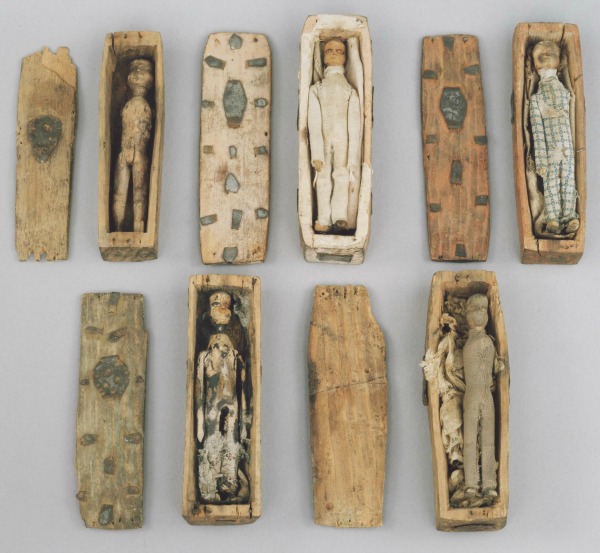
Five of the eight surviving coffins discovered in 1836. The photo shows the differences in the clothing of their wooden occupants as well as their varying states of preservation and the two different techniques used to fashion them. Credit: National Museum of Scotland

This matters, because the only comprehensive study yet made of the “fairy coffins” strongly indicates that all postdate 1800, and that the odds favor a deposit or deposits made after about 1830—within about five years, in other words, of the discovery of the cache. The work in question was carried out by Allen Simpson, a former president of the Royal Scottish Society of Arts and currently a member of the faculty of History and Classics at Edinburgh University, and Samuel Menefee, senior associate of the Center for National Security Law at the University of Virginia, and it was published, regrettably obscurely, in the journal of the city’s local history society: The Book of the Old Edinburgh Club.

Simpson and Menefee began their work by describing the eight surviving artifacts (which can still be seen today, on display in the National Museum of Scotland). Two, they note, were originally painted pink or red; the interior of one is lined with paper, made with rag fiber and datable to the period after 1780. As for the details of the construction:

Each coffin contains an ‘occupant’ and has been hollowed from a solid piece of wood. Each also has a lid which has been held in place by pins of various sizes, driven down through the sides and ends of the coffin base. In many instances the pin shafts are still in place, though some are bent over; when the lids were prised off the coffins most of the hand-wound pin heads became detached…. Although the type of wood has not previously been commented on, it has now been identified as Scots pine. Coffin dimensions vary…those now accessible for study are 3.7 to 4.1 inches long, 0.7 to 1.2 inches wide, and 0.8 to 1.0 inches deep with their lids in place….

Judging by the longitudinal scoring on the base of the recess, a sharp knife—probably a hooked knife—has been used. The fact that the surfaces at the ends of the recess are so cleanly cut indicates that the knife has been very sharp; but the user has apparently not been a woodworker by trade because he has not had access to an edged tool such as a chisel to cut out the base of the recess, and has had difficulty in controlling the depth of the cuts (which have even penetrated the base of coffin No.5).

There are two types of external shape. Five of the coffins (Nos 1, 2, 4, 6 and 8) have been carved with square-cut corners and edges, although most have slightly bowed sides so that the coffin has a taper at each end. However, the remaining three (Nos 3, 5 and 7) have a pronounced rounding of the edges and ends of the coffin; this suggests a different manual approach…and may indicate that the coffins could have been carved by two different individuals.

Arthur's Seat coffins - fiogurine side view

A side view of one of the figurines found on Arthur’s Seat, showing how one arm has been removed to allow it to fit inside its coffin. Photo: National Museum of Scotland.

As to who did the carving, Simpson and Menefee point out that “the most striking visual feature of the coffins is the use of applied pieces of tinned iron as decoration.” Analysis of this metal suggests that it is very similar to the sort of tin used in contemporary shoe buckles, and this in turn opens the possibility that the coffins were the work of shoemakers or leatherworkers, who would have had the manual skills to make the coffins but would have lacked the specialist carpentry tools needed to make a neater job of it.

The figurines found within the coffins were also studied. Each of the eight is neatly carved from close-grained white wood, and they share almost identical proportions, varying in height by no more than 5 millimeters—about a fifth of an inch. Some have arms, but several dolls have had them removed, apparently to allow the figure to fit neatly into its coffin. This suggests that the figures were not carved specifically for the purpose of burial, but have been adapted from an existing set; Simpson and Menefee—noting their “rigidly erect bearing,” indications that they originally wore hats, and their carefully carved lower bodies “formed to indicate tight knee breeches and hose, below which the feet are blackened to indicate ankle boots”—believe they are the remnants of a group of toy soldiers, and note that each is made to stand upright with the addition of a slight weight on its front, which might have been supplied by the addition of a model musket. (There would have been no need to ensure carvings intended simply as corpses would stand upright.) The features are very similar, and “it seems unlikely that the figures were ever intended to represent particular individuals.” Moreover, “the open eyes of the figures suggest that they were not carved to represent corpses.”

Based on their appearance, the authors tentatively date the group to the 1790s; no dendrochronological analysis or carbon dating, however, has been done on the collection. Several of the surviving figurines are still clad in well-preserved “grave clothes.” As Simpson and Menefee point out, “single-piece suits, made from fragments of cloth, have been moulded round the figures and sewn in place. With some figures there is evidence of adhesive under the cloth. The style of dress does not relate to period grave clothes, and if it is intended to be representational at all then it is more in keeping with everyday wear…. The fact that the arms of figure No.8 were already missing when the figure was clothed suggests that the fabric was merely intended to cover the figures decently and not to represent garments.” All the fabrics are cheap, made of plain woven cotton, though one of the figures is clad in checks and three “seem to have commercially inked patterns applied to the cloth.”

Arthur's Seat coffins - figurine clothing and stitching

Two more figurines, showing details of the stitching and clothing, crucial clues to their likely origin. Photo: National Museum of Scotland.

The evidence of the figurines makes dating the burials much easier. According to Naomi Tarrant, curator of European textiles at the National Museum of Scotland, the good condition of the surviving vestments suggests they were buried in the 1830s. More revealingly, one of the figures has been sewn into its grave clothes with a three-ply thread. Cotton thread replaced linen in Scotland from about 1800; “almost certainly,” Simpson and Menefee assert, “such thread would have been manufactured in the thread mills of Paisley, where tradition has it that cotton thread was not made before 1812.” Three-ply thread, according to Philip Sykas of Manchester Art Galleries–the leading expert on that topic – came into use in about 1830. Sykas believes that the mixture of one-, two- and three-ply threads found on the Arthur’s Seat figures “indicates a date in the 1830s.”

Now, none of this proves all the burials took place at so late a date as 1830; it is possible that the decayed surviving figurines represent interments that took place earlier than this, and also that the figurines sewn with one- or two-ply thread predate 1830. Nonetheless, it does seem possible to suggest that all the burials took place, at the outside, between about 1800 and 1830, and it is entirely likely that Simpson and Menefee are correct to state that all took place during the 1830s. This in turn suggests it is possible that all 17 figurines were interred at the same time, and the fact that the coffins seem to have been carved by at most two people and that the figurines apparently originally formed part of a single set implies that the burial(s) were carried out by the same person, or small group of people “over a comparatively short period.”

If this is true, write Simpson and Menefee, “the significant feature of the burial is that there were seventeen coffins,” and “it is arguable…”

that the problem with the various theories is their concentration on motivation, rather than on the event or events that caused the interments. The former will always be open to argument, but if the burials were event-driven—by, say the loss of a ship with seventeen fatalities during the period in question—the speculation would at least be built on demonstrable fact. Stated another way, what we seek is an Edinburgh-related event or events, involving seventeen deaths, which occurred close to 1830 and certainly before 1836. One obvious answer springs to mind—the West Port Murders by William Burke and William Hare in 1827 and 1828.

William Burke

William Burke, one half of the infamous pair of “resurrection men” responsible for 17 murders in the Scottish capital during the late 1820s.

Simpson’s and Menefee’s solution to the mystery is certainly dramatic— so much so it seems that nobody has actually asked whether the pair searched for news of any Scottish shipwreck from the early 1830s, as they suggest it might be wise to do. (It would appear that they did not.) The West Port murders, after all, were and remain notorious: They were committed in Edinburgh by two Irish laborers, Burke and Hare, to profit by supplying corpses to Edinburgh’s medical school, where they were in great demand for dissection. The pair’s victims, mostly indigents who, they supposed, would not be missed, numbered 17, of whom one expired of natural causes while the rest were murdered. The killers’ trial, in which Hare turned King’s evidence and Burke was convicted and later hanged, was one of the sensations of the age. Crucially, in the authors’ view, the fact that all of the 17 victims were dissected, and consequently had no decent burial, may have inspired a “mimic burial” on Arthur’s Seat:

Considering beliefs such as the alleged mimic burial given to Scottish sailors lost at sea, it would not be unreasonable for some person or person, in the absence of the seventeen dissected bodies, to wish to propitiate these dead, the majority of whom were murdered in atrocious circumstances, by a form of burial to set their spirits at rest. While it is always possible that other disasters could have resulted in an identical casualty list, the West Port murders would appear to be a logical motivating force.

Since Simpson and Menefee first reported their findings in 1994, their thesis has been elaborated. The Edinburgh Evening News reported in 2005 that George Dalgliesh, principal curator of Scottish history at the National Museum of Scotland, believes “the most credible theory is that [the coffins] were made by someone who knew Burke and Hare,” and so had a strong motive to make amends for their crimes. Attempts to suggest that Burke himself may have manufactured and buried the pieces in an agony of contrition seem to fail on the problem that the murderers were arrested almost immediately after committing their 17th killing, leaving little or no time for any burial to be made; a DNA sample for Burke has been obtained from the murderer’s skeleton, which is preserved at Edinburgh University, but no traces of DNA could be recovered from the buried figurines.

There is, moreover, one potentially fatal objection to the theory that the Arthur’s Seat coffins are connected to the West Port murders: no fewer than 12 of Burke and Hare’s victims were female, yet the clothed bodies found in the coffins were uniformly dressed in male attire.

Without knowing more about burial customs in early 19th-century Scotland it is hard to know how worrying this objection is, but certainly it would appear no more difficult to clothe a figurine in a miniature dress than it would be to stitch on trousers. In the absence of firm evidence of any connection to the activities of Burke and Hare, I would suggest the first step in any future investigation should be to examine Scottish newspapers published between, say, 1820 and 1836, for evidence of any other disasters involving the deaths of 17 people—ideally, none of them women. Two titles, the Scotsman and the Caledonian Mercury, have now been digitized, and could be searched by a determined researcher. We await further developments.

A close up of two of Edinburgh’s mysterious miniature dolls. Are these intended to be the faces of two victims of the notorious bodysnatchers Burke and Hare? Credit: National Museum of Scotland.

Sources

Caledonian Mercury, August 5, 1836; Charles Fort. Complete Books. New York: Dover, 1975; Edinburgh Evening News, October 16, 1956 and December 2, 2005; Edinburgh Evening Post, August 20, 1836; Samuel Pyeatt Menefee and Allen Simpson, ‘The West Port murders and the miniature coffins from Arthur’s Seat,’ The Book of the Old Edinburgh Club, new series vol.3 (1994); Notes & Queries, 3S. III, April 4, 1863; Proceedings of the Society of Antiquaries of Scotland 36 (1901-02); The Scotsman, July 16, 1836.

16 Apr 02:38

Can Everyday Hassles Make You Depressed?

by Jeremy Dean

Post image for Can Everyday Hassles Make You Depressed?

Do you sweat the small stuff?

When it comes to pinpointing the source of our woes, we tend not to think too much about the little hassles of everyday life; after all they're just little hassles, nothing compared to the big stuff.

You're late for a meeting, you run out of biscuits or you get a parking ticket; irritating certainly, but nothing really serious, or anything like it.

Instead, we tend to blame the big events in life: divorce, disease and bereavement. And, when looking for what puts people over the edge, that's exactly where psychological researchers have concentrated their attention: on the big stuff.

But many are waking up to the fact that although the little hassles in life are smaller, they're also more numerous, so they can really add up over time. And, whether stressful events are big or small, it matters a lot how we deal with them.

Daily stressors

In new research published in Psychological Science, Charles et al. (2013) looked at people's reactions to everyday stressors and how this played out a decade later. Participants were asked about their daily stressors over eight days and generally how they felt. People reported having all the usual sorts of stressors like having arguments, a fridge breaking down or being late for an appointment.

Then, 10 years later, they were revisited and asked whether they had been treated for anxiety, depression or any other emotional problems in the last year.

What the results showed was that how people reacted to the little stressors of everyday life predicted whether they developed psychological problems a decade later (incidentally, the number who did report a disorder was almost one in five).

This fits in with other recent studies which have also shown that people's reactions to ordinary stressors predict depressive symptoms (e.g. Parrish et al., 2011).

Whether problems are big or small, what matters is how we react to them. People who tend to do worst are those that have the strongest emotional reaction to both big and small events.

We tend to think that depression is always a reaction to some really bad thing happening and sometimes it is; but sometimes it's all those little things piled on top of one another that can get you down.

Image credit: Stephen Poff


Making Habits, Breaking Habits

In his new book, Jeremy Dean--psychologist and author of PsyBlog--looks at how habits work, why they are so hard to change, and how to break bad old cycles and develop new healthy, creative, happy habits.

"Making Habits, Breaking Habits", is available now on Amazon.

Reviews
The Bookseller, “Editor’s Pick,” 10/12/12 “Sensible and very readable…By far the most useful of this month’s New You offerings.”
Kirkus Reviews, 1/1/13 “Making changes does take longer than we may expect—no 30-day, 30-pounds-lighter quick fix—but by following the guidelines laid out by Dean, readers have a decent chance at establishing fulfilling, new patterns.”
Publishers Weekly, 12/10/12 “An accessible and informative guide for readers to take control of their lives.”

"Making Habits, Breaking Habits", is available now on Amazon.


13 Apr 21:11

Watch for my kickstarter to raise money to remake this film with...


Watch for my kickstarter to raise money to remake this film with better special effects. 

13 Apr 21:08

Don’t Forget to Be Awesome

by James

FOUND by Julia near New River Valley, Virginia

This was found in a copy of Mother Night at the public library. I read a lot but don’t discuss books much, so it was wonderful to find this from an unknown fan of one of my favorite writers. Yes, I returned the book with the note in it.

13 Apr 20:54

Who Works? Stick Figures, Gender, and Illustrating the Workforce

by Lisa Wade, PhD

Cross-posted at The Huffington Post.

One of our Pinterest boards collects images that reveal that men are the “neutral” sex in contemporary Western cultures. This means that (1)  the image that pops up in our minds when we say “person” or “human” or “worker” is usually implicitly male, (2) non-sexed representations of people are usually assumed to be male (e.g., cartoon animals appear female to us unless we slap on eyelashes and lipstick), (3) items for sale often get marketed as either “item” or “women’s item” (e.g., “deodorant” and “women’s deodorant”), and (4) men and male bodies get to stand in for humanity (e.g., in scientific research).

Instances of this phenomenon have been a fun series on the blog; we featured another one just this past weekend, on how (not) to write obituaries.  Then today SocImages Contributor Philip Cohen sent along another great example that we couldn’t resist sharing. The graphic below, released by Bloomberg Business Week, is meant to help us understand who is in and out of the labor force.  While 3% of Americans want to work but can’t find a job, large proportions are also permanently or temporarily out of work on purpose: they’re retired, in college, in the military, disabled, or a stay-at-home parent.

For our purposes in this post, what’s interesting is the way they illustrate the categories.  See what you see:

1

In all cases but one, the stick figured is either non-sexed and therefore implicitly male (e.g., the newspaper reader and the disabled) or explicitly male (the business-suited full-time employees, the mustachioed retiree).  The one exception, of course, is for the stay-at-home parent.  Suddenly the stick figure is a female.  We see this all over.  As soon as parenting or housework is involved, all those neutral/male stick figures sprout skirts.

Now, to be fair, 97% of stay-at-home parents are female, but so is 50% of the American workforce. You wouldn’t guess so, however, by this graphic.  Also, for what it’s worth, it doesn’t have to be like this.

Lisa Wade is a professor of sociology at Occidental College. You can follow her on Twitter and Facebook.

(View original at http://thesocietypages.org/socimages)

13 Apr 20:52

Whose Deviance Do We Notice?

by Gwen Sharp, PhD

Screen Shot 2013-04-10 at 10.55.52 PM

Back in 2010 we featured a post about a segment from the “What Would You Do?” series from abc News that illustrated the way that race plays a role in who is labeled as deviant and who is given the benefit of the doubt.

The producers had teens vandalize a car in public to see what onlookers would do. To see if race played a role, they tried it with a group of White boys and then with a group of African American boys. Only one 911 call was made on the White boys, but 10 calls were made on the African American teens. Moreover, while the White teens were vandalizing the car, 911 received a call to report the African American boys simply for being asleep in a car, which the caller took as a possible sign they were planning to engage in criminal activity.

We see this same pattern in another “What Would You Do?” segment. This time, a young White man and a young African American man try to remove a lock from a bike as the cameras capture the reactions of onlookers.

The onlooker interviewed toward the end says race played no role in his reaction. But the extremely different reactions to the two teens indicate differences in who is perceived as likely to be engaged in criminal activity, and whose criminal activity we may think deserves being reported to the police, rather than given a disapproving tsk-tsk as we walk on by.

Gwen Sharp is an associate professor of sociology at Nevada State College. You can follow her on Twitter at @gwensharpnv.

(View original at http://thesocietypages.org/socimages)

12 Apr 03:50

Archy and Mehitabel

by Greg Ross

http://commons.wikimedia.org/wiki/File:First_drawing_of_Archy.gif

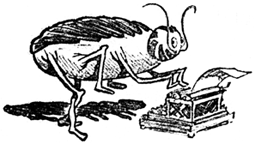
In 1916, New York Sun columnist Don Marquis told his readers an unlikely story: He had arrived early at work to discover a gigantic cockroach jumping about on the keys of his typewriter.

“He did not see us, and we watched him,” Marquis wrote. “He would climb painfully upon the framework of the machine and cast himself with all his force upon a key, head downward, and his weight and the impact of the blow were just sufficient to operate the machine, one slow letter after another.” The result was poetry:

expression is the need of my soul
i was once a vers libre bard
but i died and my soul went into the body of a cockroach
it has given me a new outlook upon life …

there is a cat here called mehitabel i wish you would have
removed she nearly ate me the other night why dont she
catch rats that is what she is supposed to be for
there is a rat here she should get without delay

In the years that followed, the sensitive cockroach helped Marquis fill hundreds of pages with wry and sometimes trenchant social commentary:

as i was crawling
through the holes in
a swiss cheese
the other
day it occurred to
me to wonder
what a swiss cheese
would think if
a swiss cheese
could think and after
cogitating for some
time i said to myself
if a swiss cheese
could think
it would think that
a swiss cheese
was the most important
thing in the world
just as everything that
can think at all
does think about itself

And:

a good many
failures are happy
because they dont
realize it many a
cockroach believes
himself as beautiful
as a butterfly
have a heart o have
a heart and
let them dream on

It’s not clear what inspired Marquis to create such an unlikely pair of characters, but his friend Christopher Morley offered one idea. “I remember that in the early days of the ‘Sun Dial,’ when the paper moved from Park Row to Nassau Street, Don’s typewriter desk got lost in the skirmish; so for some years he rattled out his daily stint with his machine perched on an up-ended packing case. This box had stenciled on it the statement 1 GROSS TOM CAT, which meant Tomato Catsup, but became by legend the first suggestion of mehitabel.”

11 Apr 19:31

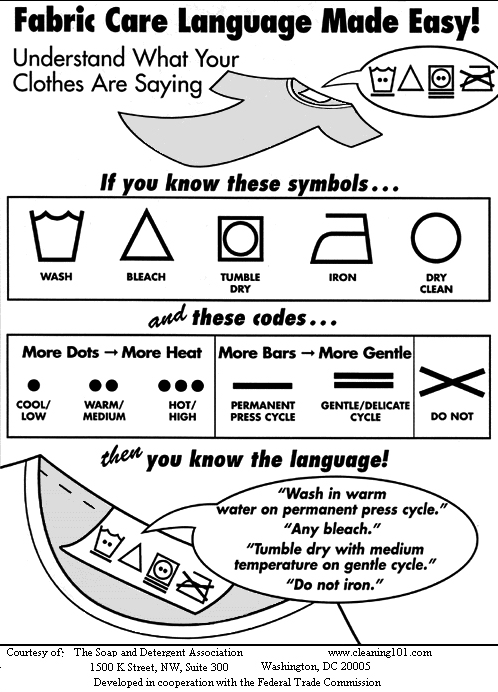
Step 295: Print this out for your laundry room

image

11 Apr 19:30

Step 294: Follow the rules of the Kvetching Rings

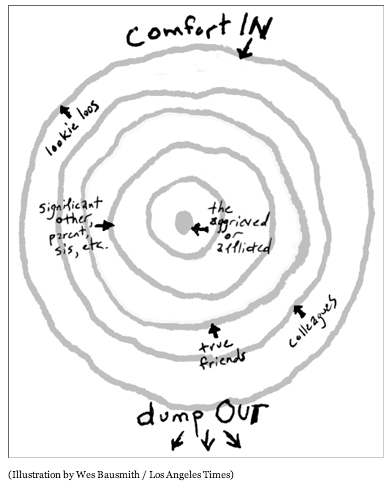
And now, an amazing strategy to be good to people having any kind of crisis:

image

Draw a circle. This is the center ring. In it, put the name of the person at the center of the current trauma. For Katie’s aneurysm, that’s Katie. Now draw a larger circle around the first one. In that ring put the name of the person next closest to the trauma. In the case of Katie’s aneurysm, that was Katie’s husband, Pat. Repeat the process as many times as you need to …

When you are done you have a Kvetching Order. One of Susan’s patients found it useful to tape it to her refrigerator.

Here are the rules. The person in the center ring can say anything she wants to anyone, anywhere. She can kvetch and complain and whine and moan and curse the heavens and say, “Life is unfair” and “Why me?” That’s the one payoff for being in the center ring.

Everyone else can say those things too, but only to people in larger rings … 

When you are talking to a person in a ring smaller than yours, someone closer to the center of the crisis, the goal is to help. Listening is often more helpful than talking. … If you want to scream or cry or complain, if you want to tell someone how shocked you are or how icky you feel, or whine about how it reminds you of all the terrible things that have happened to you lately, that’s fine. It’s a perfectly normal response. Just do it to someone in a bigger ring.

— Susan Silk and Barry Goldman, writing in the LA Times

Seriously, the whole thing is so great. Go read it. And thank you to LN for submitting it!

11 Apr 17:53

c.1740 : A Mantua Court Dress

by Amanda Uren
05 Apr 15:37

Used in the trenches

by simonbeattie

Earlier in the year, I wrote about a couple of books relating to the First World War.  Here’s another with a WWI connection: a miniature Qur’an produced by the Glasgow publishers David Bryce & Sons between about 1900 and 1910.  (The coin, in case you’re wondering, is a nickel.)

In general, I’m not that taken with miniature books.  Carter’s ABC for Book Collectors sums them up as ‘books whose principal (usually only) interest lies in their very small size’.  But this Qur’an is different.  Louis Bondy calls it an ‘almost legendary title published by Bryce …  The bindings vary from richly gilt-stamped red or black morocco with gilt edges to plain stiff wrappers and yellow edges …  Lately it has become increasingly difficult to find copies of this book’ (Miniature Books, pp. 111–2).

The Gutenberg Museum in Mainz takes up the story.  ‘The production of miniature Korans in manuscript has a long tradition, but the printing of them in this form had to await the arrival of photolithographic techniques in the late 19th century.  Such Korans were published in Delhi in 1892 and Istanbul c. 1899, but the one which seems to have achieved the widest circulation is this Scottish edition.  It was one of a long series of miniature books produced by David Bryce and Sons.  All the copies were issued with metal lockets and magnifying glasses.  Many were supplied to Indian and other Muslim soldiers fighting for the British in the First World War, and served also as talismans’ (Middle Eastern Languages and the Print Revolution, exhibition catalogue, 2002, no. 79).

It was in this last context that the book was mentioned by T. E. Lawrence: ‘[Auda] told me later, in strict confidence, that thirteen years before he had bought an amulet Koran for one hundred and twenty pounds and had not since been wounded …  The book was a Glasgow reproduction, costing eighteen pence; but Auda’s deadliness did not let people laugh at his superstition’ (Seven Pillars of Wisdom, Book 4, Ch. 53).

Given the condition of this copy, I don’t think it was ever actually taken into battle, but it is still a wonderful little book.