Stick-figure guidance in a German bathroom (yasmapaz & ace_heart/Flickr)
Thursday brought an advance in the cause of standing up to pee. A judge in the German city of Duesseldorf ruled in favor of a man suing his landlord for a full refund of his security deposit, which had been partially withheld because the marble floor of the tenant's bathroom had been damaged by uric acid, presumably from the errant urine of an upright person relieving himself.
"Someone who still practices this previously dominant custom is regularly confronted with significant disputes, particularly with female cohabitants," Judge Stefan Hank observed, according to AFP. "However normally he must not reckon with damage to the marble floor of a bathroom or guest toilet."
"Despite the increasing domestication of men in this area, urinating while standing up is indeed still common practice," Hank added.
Why, you might ask, is the judge referring to men urinating while standing up as a fading social phenomenon—a "previously dominant custom" undermined by the "increasing domestication of men?"
The dispute in Duesseldorf is actually part of a long-running debate in Germany over whether men should be encouraged to sit down when urinating. The controversy pits stehpinklers (men who stand up to pee) against sitzpinklers (men who sit down), and it has taken some bizarre twists over the years. In 2004, for example, The Telegraphreported that sitzpinkler had become a synonym for "wimp," and that a company had invented a gadget that attached to toilets and scolded stehpinklers when they lifted the seat. One admonition, in a voice mimicking that of former German Chancellor Gerhard Schroeder, declared, "Hey, stand-peeing is not allowed here and will be punished with fines, so if you don't want any trouble, you'd best sit down." Millions of the devices had been sold in German supermarkets.
As has been the case with similar campaigns in countries ranging from Sweden to Taiwan, proponents of seated male urination in Germany typically cite its hygienic and health benefits. The University of Chicago law professor Mary Anne Case has elaborated on the argument:
[E]fforts to encourage men to adopt urination methods associated in the western world with women have also been seen as threats to masculinity. Feminists in Germany have been urging men to accustom themselves to urinate while sitting on a toilet seat by posting signs in restrooms with the imperative “Hier wird sitzend gepinkelt” (Here one pees sitting down) and by explaining that such a practice would be more sanitary and create less work for those responsible for cleaning toilets, who are most often women. While some men have taken pride in accommodating this demand, others have vehemently resisted, going on talk shows, publishing editorials and cartoons, and forming Facebook groups of “Stehpinkler” (“Those who pee standing up”). So vehement was the resistance that academic Klaus Schwerma, a proponent of Sitzpinkeln, could write an entire critical book entitled “Stehpinkeln—Die Letzte Bastion der Maennlichkeit?” (Peeing Standing Up—the Last Bastion of Masculinity?).
Case herself is on a toilet crusade, but of a different sort than that of the good landlord from Duesseldorf. In a 2010 essay, she explored the benefits and drawbacks of abolishing "the laws of urinary segregation" in public restrooms, which, she observed, are "among the very few sex-segregated spaces remaining" in the United States.
"Urinals lead restrooms equal in square footage to offer more excreting opportunities to men than to women," she explained, causing longer lines for women's bathrooms and other inequities. "When such features as fainting couches, full length mirrors, and vanities are added—as they sometimes are—to women’s but not to men’s rooms, the ratio of excreting opportunities given equal square footage gets even worse for women." Case, for her part, endorsed the model of the single-user, unisex airplane toilet for public places. She didn't address excreting opportunities in the privacy of one's home. That, after all, is a matter best left up to the excretor and his or her family—and the German courts.
I try not to talk about my research at dinner parties. I’ll say ‘medical ethics’ if pressed, which will sometimes trigger an unwelcome follow-up: ‘But what about medical ethics? That’s a pretty big field.’ ‘I study lots of things,’ I’ll say – and that’s true, I do. ‘But I focus on medically unnecessary surgeries performed […]
sarahnaomi writes There sits, in the Clarendon Laboratory at Oxford University, a bell that has been ringing, nonstop, for at least 175 years. It's powered by a single battery that was installed in 1840. Researchers would love to know what the battery is made of, but they are afraid that opening the bell would ruin an experiment to see how long it will last. The bell's clapper oscillates back and forth constantly and quickly, meaning the Oxford Electric Bell, as it's called, has rung roughly 10 billion times, according to the university. It's made of what's called a "dry pile," which is one of the first electric batteries. Dry piles were invented by a guy named Giuseppe Zamboni (no relation to the ice resurfacing company) in the early 1800s. They use alternating discs of silver, zinc, sulfur, and other materials to generate low currents of electricity.
As previously reported, the new season of HBO's "Girls" will feature a new song from St. Vincent (and another one from Grimes) called "Teenage Talk", which will close out an episode.
Have only skimmed but I had to share because my mom is huge into this essential oil mix called thieves oil (from the sleezy-sounding "young naturals"). I keep asking her how it is supposed to work and all their literature sounds like magic. Maybe this will shut me up...
Essential oils often evoke thoughts of scented candles and day spas, but their benefits beyond relaxation are less well-known. Essential oils are ultimately just plant extracts—and those are used in countlesscleaning and personal-careproducts, and are the main ingredient in some pest-control products and some over-the-counter medications, like Vick’s VapoRub and some lice sprays. They’re used in the food industry because of their preservative potency against food-borne pathogens—thanks to their antimicrobial, antibacterial, and antifungal properties. Various oils have also been shown to effectively treat a wide range of common health issues such as nausea and migraines, and a rapidly growing body of research is finding that they are powerful enough to kill human cancer cells of the breast, colon, mouth, skin, and more.
A handful of promising, real-life studies have been conducted with humans and other animals, though most of the research in that realm thus far has been conducted in the lab. More controlled trials will be required before some of these applications will be available to the public, but meanwhile, scientists have turned up exciting results in another area of use: countering the growing antibiotic-resistance crisis. “The loss of antibiotics due to antimicrobial resistance is potentially one of the most important challenges the medical and animal-health communities will face in the 21st century,” says Dr. Cyril Gay, the senior national program leader at the United States Department of Agriculture’s (USDA) Agricultural Research Service.
As Cari Romm previously reported in The Atlantic, livestock consume up to 80 percent of the antibiotics used in the U.S., and the amount actually jumped by 16 percent between 2009 and 2012, according to a recent FDA report. This rampant use of the drugs has led to “superbugs” that are becoming increasingly resistant to the antibiotics that are used to treat not just farm animals, but humans as well. In fact, almost 70 percent of the antibiotics given to these animals are classified as “medically important” for humans. According to Romm, “In the U.S., antibiotic resistance caused more than two million illnesses in 2013, according to a report by the Centers for Disease Control and Prevention, and an estimated 23,000 deaths,” and they’ve also amounted to an extra $20 billion in healthcare costs. And it’s only poised to get worse: a recent report commissioned by the U.K. government estimates that drug-resistant microbes could cause more than 10 million deaths and cost the global economy $100 trillion by the year 2050.
While the drugs are, of course, sometimes necessary to treat infections in livestock, the real reasons they’re overused are to speed up growth and to compensate for the cramped, unsanitary living conditions the animals endure. Dr. Stuart B. Levy, a man of many titles—hematologist and professor at Tufts University; director of the Center for Adaptation, Genetics, and Drug Resistance; president of the Alliance for the Prudent Use of Antibiotics; and author of the book The Antibiotic Paradox: How the Misuse of Antibiotics Destroys Their Curative Powers—says he and his colleagues consider the misuse of antibiotics on farms to be the biggest influence on antibiotic resistance, which has been declared “an increasingly serious threat to global public health that requires action across all government sectors and society” by the World Health Organization. Levy has been warning about this impending disaster for nearly 40 years, a couple of decades after farmers discovered that putting small amounts of antibiotics in the animals’ feed resulted in increased growth. Even back then, a study led by Levy found that chickens developed resistance to the antibiotic tetracycline at a rapid pace–within a week, the animals had resistant bacteria in their gut. Months later, the stubborn bugs had spread to untreated chickens and even the farmers. And it didn’t stop there: Those resistant bacteria also became resistant to other antibiotics that the chickens hadn’t even consumed. “Antibiotics used anywhere creates antibiotic resistance, and that resistance doesn’t stay in that environment,” Levy says. “And resistance is transferrable among bacteria of different types.”
What’s being done to confront this major contributor to this obvious, growing world health threat? The FDA has asked those in the agricultural industry to voluntarily reduce their use of antibiotics, but no one is keeping track of whether they do (nor has there been a record of the antibiotic use all these decades). Farmers can still say they’re using it for prevention of infections. “The lobby is so strong it’s hard to get categorical refusal to do this,” Levy says. “We really want to convince the users—the farmers—that this is a practice that should be eliminated.”
Whether farmers choose to use it or not, there is a strong alternative on the horizon. Numerous recent studies—including several done by the USDA—have shown great promise in using essential oils as an alternative to antibiotics in livestock. One of their studies, published in October 2014 in the journal Poultry Science, found that chickens who consumed feed with added oregano oil had a 59 percent lower mortality rate due to ascites, a common infection in poultry, than untreated chickens. Other research, from a 2011 issue of BMC Proceedings, showed that adding a combination of plant extracts—from oregano, cinnamon, and chili peppers—actually changed the gene expression of treated chickens, resulting in weight gain as well as protection against an injected intestinal infection. A 2010 study from Poultry Science produced similar findings with the use of extracts from turmeric, chili pepper, and shiitake mushrooms. A multi-year study is currently underway at the USDA that includes investigations into the use of citrus peels and essential oils as drug alternatives.
Researchers have also directly compared the effects of commonly used antibiotics with those of various essential oils. One such study, from the March 2012 issue of the Journal of Animal Science, found that rosemary and oregano oils resulted in the same amount of growth in chickens as the antibiotic avilamycin, and that the oils killed bacteria, too. Additional findings have shown that essential oils help reduce salmonella in chickens, and another study found that a blend of several oils can limit the spread of salmonella among animals. One of the co-authors of that study, Dr. Charles Hofacre, a professor at the University of Georgia’s College of Veterinary Medicine, says it’s such a new area of research that they don’t yet know exactly how the essential oils work, but “there is some strong evidence that they are functioning by both an antibacterial action in the intestine and also some have an effect to stimulate the intestinal cells ability to recover from disease more quickly–either by local immunity or helping keep the intestinal cells themselves healthier.”
Of course, there is also a dire need for alternatives to antibiotics for the direct treatment of infections in humans and animals, not only for illness prevention and growth-boosting in livestock. Research investigating the use of essential oils in humans has produced encouraging results, but such studies have been small and surprisingly rare, especially given the demonstrated success of their use in livestock. An Italian study found that a combination of thyme and clove essential oils was just as effective in treating bacterial vaginosis as the usual antibiotic treatment, and results of a study by U.S. researchers show that staph-infected wounds healed faster when they were treated with vapors of tea-tree oil than with conventional methods. Research published in December 2013 reported that a hand gel made with lemongrass oil was effective in reducing MRSA on the skin of human volunteers, and previous research has shown that a cleanser made with tea-tree oil clears MRSA from the skin as effectively as the standard treatments to which bacteria appear to be developing resistance. This type of simple, inexpensive fix—an essential-oil-based hand sanitizer—could be a major boost to hospitals, in particular, since MRSA infections are so common in healthcare settings.
In the lab, scientists have been testing all kinds of combinations of essential oils and antibiotics, and they’re repeatedly finding that the oils—used on their own and in combination with some common antibiotics—can fight numerous pathogens, including antibiotic-resistant strains of E. coli, Staphylococcus aureus (which causes staph infection), and other common types of bacteria. Results consistently show that combining essential oils and antibiotics significantly lowers the amount of antibiotic required to do the job. For example, two recent studies showed that lavender and cinnamon essential oils killed E. coli, and when combined with the antibiotic piperacillin, the oils reversed the resistance of the E. coli bacteria to the antibiotic. Another recent study found that basil oil and rosemary oil were both effective in inhibiting the growth of 60 strains of E. coli retrieved from hospital patients. Other research has produced similar results for many other essential oils, both alone and in combination with antibiotics. Researchers believe that one mechanism by which the oils work is by weakening the cell wall of resistant bacteria, thereby damaging or killing the cells while also allowing the antibiotic in.
Further investigation is clearly needed to advance this promising area of research, but that would require time and money. “Such investment is not likely to come from the mainstream pharmaceutical industry, which has not placed much emphasis on antibiotic development for a number of reasons, including the excessive cost in bringing a single drug to market without a commensurate return,” says Dr. Nicole M. Parrish, associate professor of pathology at the Johns Hopkins University School of Medicine and associate director of medical mycobacteriology at The Johns Hopkins Hospital, who co-authored a recent review on the potential use of essential oils as alternatives or supplements to antibiotics.
She says the situation is urgent: When she and her colleagues perform testing to determine the appropriate medication for a patient, they often find that there are no longer any effective antibiotics in existence to treat the bacteria in question. “We feel helpless in the face of this growing threat, and the answer as to why we have not made more progress on this front is simple: economics. Unfortunately, the 'specter' of monetary gain overshadows the perspective from 'the trenches.'” She says that essential oils contain some of the most potent antimicrobial compounds available, and that furthering our understanding of them may lead to the development of entirely new classes of drugs. “Let us all hope the prevailing wind changes to move this field of research forward,” she says.
Gay explains that “phytonutrients” or “phytochemicals” are chemical compounds derived from plants that have a range of health benefits, “including promoting tumor killing and increased resistance to infectious diseases, and they have been used as health-promoting agents by many cultures for several millennia.” Their potency isn’t surprising when you consider that the plant compounds that make up essential oils exist in the first place to help plants protect themselves from infection, endure temperature variations, heal from damage, and repel pests. Still, skepticism is likely in a culture like ours that is used to lab-created synthetic medicines (not to mention the bad reputation essential oils may have gained from being frequently touted as miracle cures for everything), even though some of our most important and common pharmaceuticals originated from plants. For example, aspirin is derived from willow bark, though the key compound is now synthesized by manufacturers; the treatment for malaria (still used today) is derived from fever-tree bark; morphine is derived from the poppy plant; the cancer-fighting drug paclitaxel was initially derived from the bark of the Pacific yew tree; and many cold and cough medicines and muscle-relief creams have mint extract as the main ingredient. Even a newly developed Ebola treatment hinges on the use of tobacco plants.
Back on the farms, some are already putting essential oils into practice. “There are a number of companies that are currently selling plant extracts as feed additive, and large integrated producers are also adding feed additives to their rations to enhance the health of animals, especially their intestinal health, during their production cycle,” Gay says. No one seems willing to readily offer that information, though—and they don’t have to. One farmer who has talked publicly about using essential oils is Scott Sechler, owner of Bell & Evans Farms, a high-end producer of antibiotic-free poultry. Back in 2012, he told the New York Times about his use of oregano oil and cinnamon to fight infection on his farms, which now number about 140 with a total of 9 million chickens at any given time. Though he says the approach worked better than all other options he had tried, he still told the Times, “I have worried a bit about how I’m going to sound talking about this,” adding, “But I really do think we’re on to something here.” He clearly knows about the stigma attached to his approach, despite the fact that it’s working. So,essential oils are truly a secret weapon, an unsung hero being used successfully but not quite openly.
It took Sechler nearly 10 years just to get the people he works with to believe in his method, including farmers, workers at the feed mills, and his own employees, of which there are now around 1,200. He has met his share of skepticism from colleagues, too. For someone who notes that he lacks a formal education, Sechler is at the forefront of some cutting-edge methods (for one, he counts Temple Grandin, the famous animal-science expert, as a friend who helped him implement a humane slaughter system). He has been on the antibiotic-free kick for about 30 years, and he describes his current method in terms of its effects on gut bacteria—another hot topic right now. “We started with a breed of chicken that wasn’t raised to be stressed and overfed and to live in sanitary conditions,” he says. They also feed the chickens high-quality grains enhanced with essential oils, and they avoid the use of toxic chemicals like hexane, which is commonly used by other farmers in processing their feed. “With our chicken breed, housing environment, and feeding program, we’re able to promote healthy gut bacteria—we use oregano oil to kill the bad bacteria and cinnamon oil to support the good bacteria.”
He says his model works for him because he’s not trying to correct a problem that’s already out of control. Some farmers need more powerful weapons because they’re trying to compensate for ongoing problems caused by improper cleaning practices and unsanitary living conditions. They might put baby chickens on the remnants of manure from previous flocks because they don’t properly clean out the barn first, and then they may use chlorine to wash the processed chickens. Whatever bacteria (and antibiotics) that aren’t left at the chicken plant end up on plates. On Sechler’s farms, he says he doesn’t allow these problems to get out of hand in the first place. “You can’t just introduce essential oils into a bad environment and expect magic–—they don’t fix a screw-up,” he says. “But if you meet them halfway by doing things right, they will carry you across the finish line.” People warned him that the bacteria would become resistant to the essential oils, too, but they haven’t yet, and his farms processed over 50 million chickens last year. According to C. Norman Shealy, a Duke-educated neurosurgeon and author of The Healing Remedies Sourcebook: Over 1000 Natural Remedies to Prevent and Cure Common Ailments, it is possible for bacteria to become resistant to essential oils, but it’s unlikely because the oils contain hundreds more chemical compounds than antibiotic medications, making it difficult for bacteria to adapt to the oils.
Adopting healthier practices may cost a penny or nickel more per pound, which could affect stock prices of the big poultry producers. Sechler, whose company is not publicly traded, says he has been fortunate to have a loyal and ever-growing customer base that is willing to pay a bit more for better quality. Sechler says if the public starts asking for antibiotic-free meat en masse, more producers will comply, and change should come from other key players, too. “Essential-oil use by the food industry should be a hundred times bigger than it is,” he says. “Universities need to be able to speak up to some in the industry without getting their heads chopped off,” instead of tiptoeing around them because they provide research funding. He also believes the USDA and the FDA should create standards limiting antibiotic use and require everyone in the industry to comply by a certain date, similar to the way fuel efficiency standards for cars have been introduced and enforced.
“Unfortunately in this industry, you have to force people. Unless everyone has to do it, many won’t,” Sechler says. Despite encouraging study results and Sechler’s proven success, the lack of regulation and record-keeping is a potential problem with the use of essential oils, too: “These products are being used every day, but I really can’t tell you how many chickens or turkeys are being given these products because I don’t think there is anyone keeping track of this across the country,” Hofacre says, and Gay notes that the feed additives are not regulated either. “However, they are being used very successfully and I think as we learn more about the various essential oils and other plant extracts we will find more effective combinations,” Hofacre says.
Levy thinks the investigations into plant extracts as alternatives to antibiotics is “wonderful,” but he cautions that for any alternative, “it should be demonstrated that this practice is really useful, and alternatives should be given the same scrutiny” that antibiotics haven’t been.
Researchers at the University of Rochester’s Institute of Optics led by professor Chunlei Guo have developed a new type of hydrophobic surface that is so highly water repellant, it causes water droplets to bounce off like magic. Unlike earlier hydrophobic surfaces that rely on temporary (and slowly degrading) chemical coatings such as teflon, this new super-hydrophobic surface is created by etching microscopic structures into metal with the help of lasers. Potential applications include airplane wings that resist icing, a whole new type of rust proofing, or even a toilet that wouldn’t require water. Watch the video above to see the surface in action, and you can read Guo’s research paper here. (via Sploid)
For a certain generation, the most iconic detectives in history aren't Sherlock Holmes and Watson — they're Kate Monday and George Frankly.
From 1987 to 1992, a segment called Mathnet was the best reason to watch PBS's math program, Square One. It had amazing jokes, incredible acting, and, if there was time, even a little mathematics.
The only problem is that most of the show's viewers were too young to realize just how amazing it was. Fortunately, now we're all old enough to uncover the backstage drama (like why Pat Tuesday replaced Kate Monday), comprehend the amazing references, and discover which show may have put Mathnet off the air.
As you uncover these Mathnet mysteries, try to be guided by the show's famousmotto: "To cogitate and to solve."
1) Mathnet was originally criticized for being too fluffy
Mathnet debuted as a part of Square One 1987, which was Children Television Workshop's (CTW) attempt to make math fun for kids. Square One included skits, lessons, and even raps about math. Mathnet closed out the show with a single-camera style mystery in the style of Dragnet, but with absurd humor and simple math lessons woven into the show's plot.
For example, in "The Case of the Willing Parrot," the intrepid detectives chased after a silent film star's fortune. Using the Fibonacci sequence, they decoded the pattern of tiles outside Fatty's home to figure out where his fortune was hidden. The key to a safe deposit box was hidden behind the tile that broke the pattern.
The show's pedigree didn't shield Mathnet from criticism. After seeing the show in 1987, one critic snarked that "there is virtually no math in Mathnet." It was true that there weren't a lot of calculations, but executive producer David Connell fiercely defended the show, saying that "closer to the heart of math is the ability to think and solve problems."
2) The show's Dragnet parody was precise and layered
It's obvious that Mathnet references the classic TV and radio show Dragnet. Monday and Frankly were mathematicians who used math to solve minor crimes for helpless kids and old ladies. It was funny enough when Joe Friday was rewritten as Kate Monday and, later, Pat Tuesday, but the references didn't stop there.
First, the show always began with a monotone opening:
The story you are about to see is a fib, but it's short. The names have been made up, but the problems are real.
That was followed by the lead detective's voiceover, which, depending on the season, was some variation of this staccato monologue:
My partner is George Frankly. My boss is Thad Green. Head of our computer division is Debbie Williams. My name is Monday, I'm a mathematician.
Monday and Tuesday were competent and serious while George was the punchline. Together, they managed to use basic arithmetic, geometry, and simple algebra to solve crimes.
The Dragnet style didn't stop with obvious references to the original series. This snippet of dialogue from the pilot episode includes a joke, but it also features the distinctive ping-pong dialogue style of Dragnet:
Monday: We've got a problem, George. Baseball.
Frankly: I love baseball, Kate. Martha and I, we went to Dodgers stadium just last night, Kate.
Monday: The Dodgers played in Cincinnati last night, George.
Frankly: Yeah, no trouble parking. You wanna go with us, Martha and me, to a Dodger game, Kate, no trouble parking.
In case you weren't counting, the main characters said each other's names five times. Joe Friday would be proud.
3) Mathnet didn't just parody Dragnet — it referenced all of old Hollywood
The Dragnet homages were abundant, but they weren't the only easter eggs in Mathnet. Old Hollywood got references, too. As Michael J. Hayde notes in his history of Dragnet, Mathnet loved to name-check classic movies and TV.
Character names included Archie Leach (Cary Grant's real name), Benny Pill (a reference to Benny Hill), and a silent film star named Roscoe "Fatty" Tissue (a tribute to Fatty Arbuckle). There were also allusions to Citizen Kane, The Maltese Falcon, and other classic Hollywood films.
4) Mathnet had a big impact on kids
Mathnet's opening shot, via VHS.
From the beginning, Mathnet was the most popular part of Square One.
As CTW President Joan Ganz said, it "knocks the socks off 12-year-olds." There have been plenty of fans who can testify to Mathnet's educational help, from the "angle of reflection" problems featured in the pilot episode to the multiplication and division in "The Mystery of the Maltese Pigeon." In another episode"The Problem of the Missing Monkey," the detectives figured out how to use a map's scale to determine the distance between two points.
That math helped kids in other ways, too. In June 10, 1998, the Richmond Times-Dispatch highlighted Jimmy Hoke, who managed to win a University of Idaho contest featuring weekly math problems. Jimmy was a Mathnet addict who said the show helped him win the prize — a brand new computer. Hoke's mom gave a plausible reason why Jimmy won: "He's probably the only child who dressed up as George Frankly for Halloween."
5) You can visit where Mathnet was filmed — it's now a police museum.
When Mathnet was being filmed in Los Angeles, it wasn't shot just anywhere. The cast was lucky enough to film in an old police station.
The station is now a museum, but it's shown up in quite a few TV and film productions, including Parks and Recreation.
6) George Frankly was originally set to be a generic "man in baseball cap" — but he aced the audition.
Mathnet superfan Maia Weinstock tracked down most of the show's cast for interviews, which are filled with greattrivia. Actor Joe Howard revealed that his role as George Frankly wasn't originally a sure bet.
The casting director actually wanted Howard to read for "man in the baseball cap," but his audition was so strong that he was immediately chosen to play George Frankly. That was with stiff competition, too — Howard says Phil Hartman also auditioned for the role.
It's a good thing Howard pulled it off, because he came to define the role of the buffoonish yet well-meaning detective. It also meant we got to see his dancing:
George Frankly doing the box step.
7) Behind-the-scenes drama is the reason Pat Tuesday replaced Kate Monday.
Mathnet fans have always wondered why Kate Monday was replaced by Pat Tuesday two seasons in. Now we know: In 2012, Beverly Leech, who played Kate Monday, revealed just why her character left the show.
In 1990, Mathnet moved from LA to New York. Leech guesses that budgetary concerns and proximity to the show's writers motivated the move. But it also meant a cast shake-up: Though Joe Howard made the transition to New York, Leech couldn't go because of personal and financial reasons. So she was replaced.
It was an amicable, but difficult, breakup. Leech said, "the producer and I both cried on the phone...But CTW/PBS did what they had to do to meet their budget, and I did what I had to do to meet mine."
8) Beverly Leech, Joe Howard, and Toni Di Buono are all character actors you've probably seen elsewhere
As a kid, the world of Mathnet seemed real. But as adults, we know that dedicated character actors gave the show most of its distinctive flavor.
James Earl Jones was a big get to play boss Thad Green, but less notable names showed up as well. In The Case of the Parking Meter Massacre, you'll spot Wayne Knight, best known as Newman on Seinfeld, playing the fishy Mr. Pickwick (an allusion to The PIckwick Papers by Charles Dickens). Similar to Newman's scheme on Seinfeld to recycle aluminum cans in different states, Pickwick had his own Newman-esque plan to resell stolen parking meters to small municipalities in neighboring states.
Joe Howard was in Grumpy Old Men and Anger Management, along with a slew of other projects (he seems to be frequently cast as a priest). His son is an actor as well and recently played a ninja turtle.
Being on Mathnet meant the stars had to be careful what roles they took outside of the hit show. In the November 12, 1991, edition of the Columbus Dispatch, Di Buono said that "as far as the kids are concerned, I'm Pat Tuesday." She was willing to act in commercials, but she only did a voiceover for Miller Ultralite beer because she didn't want kids to see Pat Tuesday's face.
9) Ghostwriter may have killed Mathnet
It's tough to know exactly why CTW axed Mathnet, but both Howard and Di Buono blame Ghostwriterfor sapping up CTW's budget. Ghostwriter, which premiered in 1992, centered around a gang of friends who used the help of a ghost to solve crimes. Academically, it favored words over numbers.
When CTW changed hands, the new management was interested in promoting their own pet project. "The first thing these new people brought in was this show called Ghostwriter," Howard said, "and they spent a fortune developing it—I mean, a fortune. They could have done five Mathnet's. But, they wanted to do their own thing. And you know, it was really a shame."
@Lev, @Burly- here's the essay (commentary?) I mentioned over beers.
I found the idea of evolving physical laws to be intriguing (new to me), but not his appeal to the authority of dirac and feynman (yes, Lev- Feynman!).
I'd be much more interested in Deutsch's review of the Unger Smolin book rather than this guy. Let's hope we get to read that.
Physics hinges on the idea that the human mind can encompass the universe. What if that’s wishful thinking?… more»
from a WashPo piece on anger at western media over 'ignoring' this story:
"Now [President Goodluck] Jonathan, despite publicly condemning the attacks in Paris, waited about a week to speak publicly about the Baga massacre. In fact, several days after the massacre, he was busy speaking at an election campaign rally (Jonathan never mentioned the words Boko Haram) and uploading photos of his niece’s wedding on Facebook. And you want me to be angry at Western media? It is Nigeria’s government that ultimately is responsible for the life and security of all Nigerian citizens. And in this basic duty, it has failed. It is Nigeria’s military that is responsible for protecting the territorial integrity of the country — despite its massive budget, it has failed."
In the first week of January, Nigerian rebel group Boko Haram attacked the town of Baga in Northeast Nigeria. The Nigerian military fled almost immediately, leaving civilians unprotected as Boko Haram spent days slaughtering hundreds or even thousands of people. Casualty estimates are thus far unreliable — in part because the militants devastated the town so thoroughly that survivors were not able to bury or even count the dead — but observers believe that the attack is the worst atrocity that Boko Haram has ever committed.
Amnesty International has now released satellite images from before and after the attack that clearly show the horrifying destruction that occurred. Slide the bar back and forth to see the changes:
The image on the left was taken on January 2, 2015, before the Boko Haram attack. The image on the right was taken on January 7, 2015, after the attack. Red areas show healthy vegetation. The magnified inset in the image on the left shows intact trees and structures before the attack, and the inset on the image on the right shows the same area heavily burned afterwards. (Digital Globe via Amnesty International)
This second set of images shows buildings in an area of Baga before and after Boko Haram burned them:
The image on the left was taken on January 2, 2015, before the Boko Haram attack. The image on the right was taken on January 7, 2015, after the attack. Red areas show healthy vegetation.(Digital Globe via Amnesty International)
These attacks are, obviously, appalling. Unfortunately, as Max Fisher wrote last week, they are unlikely to stop soon, because the Nigerian government and military have shown little interest in confronting Boko Haram. Indeed, the military commits its own attacks on civilians in Northern Nigeria — including an attack on Baga itself in April 2013.
Sarah Gerard's new novel follows a young woman suffering from an eating disorder, and her alcoholic boyfriend. Reviewer Jason Heller says the book balances real-world issues and emotional punch.
rossgneumann writes The defense team for Ross Ulbricht, the 30-year-old man accused of running the online black market Silk Road under the pseudonym Dread Pirate Roberts, just dropped an unexpected new theory: Mark Karpeles, the CEO of failed Bitcoin company Mt. Gox, is the real Dread Pirate Roberts. "We have the name of the real mastermind and it's not Ulbricht," Joshua Dratel, Ulbricht's lawyer, said in court today. He plans to argue that Karpeles framed Ulbricht.
malachiorion writes If you're into robots, AI, you've probably read about the open letter on AI safety. But do you realize how blatantly the media is misinterpreting its purpose, and its message? I spoke to the organization that released letter, and to one of the AI researchers who contributed to it. As is often the case with AI, tech reporters are getting this one wrong on purpose. Here's my analysis for Popular Science. Or, for the TL;DR crowd: "Forget about the risk that machines pose to us in the decades ahead. The more pertinent question, in 2015, is whether anyone is going to protect mankind from its willfully ignorant journalists."
Here's another reason: "Cat (Brolin) and mouse (Phoenix) run into a host of Hollywood character-actor champions along the way, from the great Jena Malone"
When a celebrated director helms the first-ever adaptation of a book by a notoriously cerebral author, the natural impulse is to overanalyze. This is the blessing and the curse facing Inherent Vice, the rare stoner comedy that will receive more critical attention than it should. The movie’s based on the 2009 novel by Thomas Pynchon, the notoriously camera-shy author considered a paradigmatic postmodernist. It’s directed by Paul Thomas Anderson, the rare Hollywood creative who can produce enigmatic films of epic lengths within the studio system, the last of which, The Master, showed his unaccommodating art at its peak. Considering all this, the stakes were always going to be too high for this film.
But at its most basic level, Inherent Vice, in book and film forms, isn't asking for probing inquiry: It's about a pothead bumbling around L.A. There’s a quest, of sorts, resembling the concept of a '40s noir: In 1970, private investigator Larry “Doc” Sportello (Joaquin Phoenix) is visited by his tall, tanned California ex-flame Shasta Fay (Katherine Waterston, a femme fatale in an orange high-necked minidress). She's now dating a real estate mogul named Michael Wolfmann, but there's trouble in paradise: Wolfmann’s wife and her boyfriend want Fay’s help in committing Wolfmann to a mental institution to make off with his money. Before long, Fay’s disappeared, Doc’s set up for the murder of the tycoon’s bodyguard, and he starts looking into Wolfmann, aimlessly because he’s stoned.
If the investigation sounds like an odyssey, it comes together by coincidence. A Black Panther asks Doc to locate Wolfmann's bodyguard (who happens to be involved in the Aryan Brotherhood). A heroin-addict-turned-drug-counselor's request that he determine if her late husband is actually dead turns up intelligence interest at the federal level, and an old acquaintance of Wolfmann's, Jade (Hong Chau, supremely funny). The new characters and odd coincidences point him to a larger conspiracy involving a mysterious entity known as the Golden Fang, which could alternately be a luxury schooner, an Indo-Chinese drug ring, or a syndicate of dentists.
It's taken 50 years for a work by Thomas Pynchon to come to the big screen because his narratives are impossible to follow, by design perhaps. Pynchon's novels contain dozens of characters, wordy, indirect language, loose ends, and perhaps most obviously difficult for studios with a deadline, incredible attention to detail. (Pynchon’s Inherent Vice made reference to an encyclopedia of California ’70s miscellany including: chocolate-covered bananas, pooka-shell necklaces, liquid eyeliner, shag-carpeted walls, whorehouse menus, and ’fros.)
This is—unfortunately for the success of the movie as a mystery but really great for its value as comedy—a very faithful adaptation. The movie’s at its best when it’s visually riffing on the sudden appearances of dissonant characters and things in Pynchon’s prose. These motifs show up in the movie version like bad pennies, conjuring the sense of paranoia Doc’s feeling as he goes down the rabbit hole of finding Shasta surrounded in a haze of smoke. It's hard not to go down with him. When a client who's supposed to be in hiding shows up protesting a Nixon speech on television, is that a sign? An indication of a larger conspiracy at play? Who’s in charge here? Even for the viewer who hasn't lived through the ’70s and experienced Nixon in office, the era’s anxiety over the higher powers are expertly induced.
But Inherent Vice could just as equally be “about” the history of California, fear of authority, the rise of capitalism, postmodernism, The Movies, and/or an insurance policy (“inherent vice” refers to a clause in policies that excludes coverage when a loss is caused by a quality in the property itself). At one point during the film I wrote in my notebook, GOLDEN FANG = AMERICA. It seemed plausible at the time. In the cold light of day it looked more like a conclusion come to whilst on strong substances.
Which is the point, of course. Inherent Vice inherentlyrewards only half-serious analysis: Anything more is just as much a trap as is assuming Pynchon was being serious about the postage-stamp conspiracy in The Crying of Lot 49. Anderson's latest is defiantly unresonant, a movie about the decline of marijuana culture a year after it became legal in some states. It's funny and light in the box-office season when most everything else is serious and has gravity. (How refreshing to have a psychedelic druggie mystery in the mix.) Semiotics nerds, who solove Pynchon, might call the effort a fitting moment when a familiar signifier (Paul Thomas Anderson) doesn't necessarily line up with an agreed-upon signified (deep masterpiece) and creates a feeling of postmodern unease. I call it Anderson finally enjoying the clout he’s reaped.
The actors are having a good time, too. Joaquin Phoenix pulls off the blazed look of alarm masterfully, even if he mumbles his lines on occasion (Pynchon enunciates). As Lt. Det. “Bigfoot” Bjornsen, Brolin’s even better: His LAPD officer and wannabe-TV actor is given the best scene in the entire film, just as iconic as “I drink your milkshake!” from There Will Be Blood. Cat (Brolin) and mouse (Phoenix) run into a host of Hollywood character-actor champions along the way, from the great Jena Malone to Owen Wilson to Michael Kenneth Williams. They eat a lot of pizza, smoke a lot of pot, shoot some dope. They make reference to the Red Scare, the Black List, and James Wong Howe. If the adaptation’s a little too faithful to sustain a cinematically tight story, there’s still a lot to admire in the sheer, uninhibited folly of the whole thing, the gall to get groovy while the Oscar-watchers are on high alert.
"Lewis is excited about teixobactin mainly because of the indication that it will be difficult for pathogens to develop resistance against it. Unusually for an antibiotic, teixobactin is thought to attack microbes by binding to fatty lipids that make up the bacterial cell wall, and it is difficult for a bacterium to alter such fundamental building blocks of the cell. By comparison, most antibiotics target proteins and it can be relatively easy for a microbe to become resistant to those drugs by accumulating mutations that alter the target protein’s shape."
Potential drug kills pathogens such as MRSA — and was discovered by mining 'unculturable' bacteria.
I can remember the first time I saw andromeda in the telescope at wolf ridge it was a star to the naked eye, and a fuzzy ball in the eyepiece. very cool.
" Never before have astronomers been able to see individual stars inside an external spiral galaxy over such a large contiguous area."
High-resolution portrait of Andromeda reveals patterns of star formation.
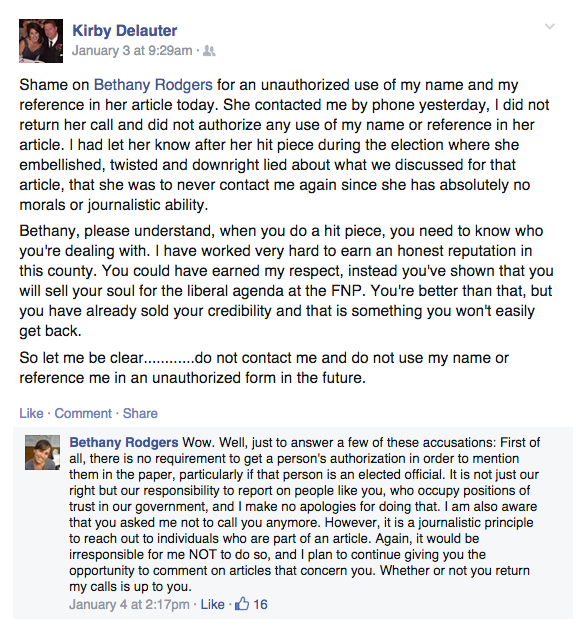
I wonder if this guy really believes he gets to authorize the use of his name in the papers.
Frederick County, Maryland, Councilman Kirby Delauter on Saturday threatened the Frederick News-Post with a groundless lawsuit for using his name without his permission. The newspaper's editorial board responded on Tuesday with an article, titled "Kirby Delauter, Kirby Delauter, Kirby Delauter," naming him 29 times, including the headline and photo caption.
Round about then, we wondered, if it’s not a joke, how should we now refer to Kirby Delauter if we can't use his name (Kirby Delauter)? Could we get away with an entire editorial of nothing but "Kirby Delauter" repeated over and over again -- Kirby Delauter, Kirby Delauter, Kirby Delauter? OK, imagine we agreed because of temporary madness or something funny in the water that week, how would we reference "Kirby Delauter" and do our job as journalists without running afoul of our lack of authorization?
And here is Kirby Delauter's original demand, which he posted on Facebook:
Funny essay- at first i thought it was a lot of bluster based on a narrow data set, but it did get me laughing- good writing.
Some gems: "as Bill O’Reilly put it when he appeared on the Daily Show in 2004, “You’ve got stoned slackers watching your dopey show every night, and they can vote.”
Bemoaning the stoned slackers of the world might not be a wise choice for the author responsible for what we might term the “Mansplanations of History for Stoned Slackers” series: Killing Lincoln (2011), Killing Kennedy (2012), Killing Jesus (2013), and Killing Patton (2014)..."
"And we want O’Reilly—not an actual historian—to mansplain Lincoln, Kennedy, Jesus, and all of the other great mansplaining icons of history. We want mansplainers mansplaining other mansplainers. We dig hot mansplainer-on-mansplainer action."
"Perhaps that the much-heralded partisan mansplainers of the hardcover list—women among them—may be some of the most unfit writers ever to put pen to paper (“I started running again, and it wasn’t long before I started feeling pretty good, because I started thinking about some pretty good things.” —Sarah Palin, Going Rogue). "
some gems
Listen closely to two decades of The New York Times’s nonfiction best-seller list and you will hear a shrill cry for help from the American people… more»
First time accepted submitter Kubla Kahhhn! writes Recently, the WSJ posted a controversial piece "Science Increasingly Makes a Case for God", written by non-scientist Eric Metaxas. Noted astrophysicist Lawrence Krauss wrote a simple and clear retort in a letter to the editor, which the WSJ declined to publish, but Richard Dawkins did.
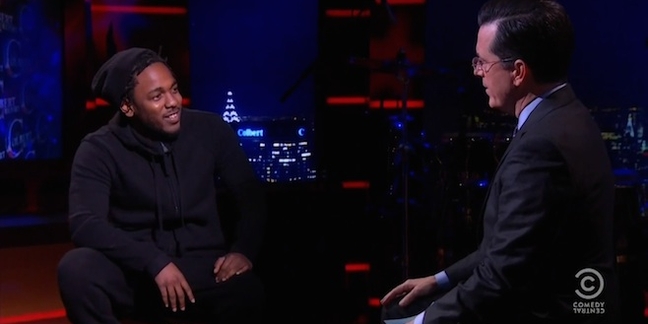
As Stephen Colbert prepares to say goodbye to "The Colbert Report", he welcomed Kendrick Lamar. Kendrick debuted an untitled new track alongside a band featuring Thundercat and Bilal. The track was reportedly produced by Astronote. Watch below via MissInfo.tv. Update: Official video is now available.
Kendrick also sat down for a brief conversation with Stephen. Stephen joked that since he was the last-ever musical act on the "Report", "Paul McCartney, R.E.M., Jack White, and Nas were your opening acts." They also discussed why Kendrick prefers being referred to as a writer instead of a rapper and what he wants to communicate through his songs.
Stephen also recommended that he turn "Swimming Pools" into a Dewar's commercial and asked about his "stage name" Kendrick Lamar. "Why did you decide to name yourself after Anna Kendrick and Senator Lamar Alexander?"
@TertiaryMatt- seems like a good follow-up to the Katz fluff piece. I found the one-leg-pedals design to be creative. I would add a quote from the NYT piece but there seems to be some new barrier to copying/pasting text from their articles (WTF?)
HughPickens.com writes The human genome is astonishingly complex and dynamic, with genes constantly turning on or off, depending on what biochemical signals they receive from the body. Scientists have known that certain genes become active or quieter as a result of exercise but they hadn't understood how those genes knew how to respond to exercise. Now the NYT reports that scientists at the Karolinska Institute in Stockholm have completed a study where they recruited 23 young and healthy men and women, brought them to the lab for a series of physical performance and medical tests, including a muscle biopsy, and then asked them to exercise half of their lower bodies for three months. The volunteers pedaled one-legged at a moderate pace for 45 minutes, four times per week for three months. Then the scientists repeated the muscle biopsies and other tests with each volunteer. Not surprisingly, the volunteers' exercised leg was more powerful now than the other, showing that the exercise had resulted in physical improvements. But there were also changes within the exercised muscle cells' DNA. Using technology that analyses 480,000 positions throughout the genome, they could see that new methylation patterns had taken place in 7,000 genes (an individual has 20–25,000 genes). In a process known as DNA methylation, clusters of atoms, called methyl groups, attach to the outside of a gene like microscopic mollusks and make the gene more or less able to receive and respond to biochemical signals from the body. In the exercised portions of the bodies, many of the methylation changes were on portions of the genome known as enhancers that can amplify the expression of proteins by genes. And gene expression was noticeably increased or changed in thousands of the muscle-cell genes that the researchers studied. Most of the genes in question are known to play a role in energy metabolism, insulin response and inflammation within muscles. In other words, they affect how healthy and fit our muscles — and bodies — become. Many mysteries still remain but the message of the study is unambiguous. "Through endurance training — a lifestyle change that is easily available for most people and doesn't cost much money," says Sara Lindholm, "we can induce changes that affect how we use our genes and, through that, get healthier and more functional muscles that ultimately improve our quality of life."
coffee with butter? why haven't I tried that before?
When I first heard about the Bulletproof Diet — the "revolutionary" plan for weight loss — I tried to turn a blind eye. I really did.
But then, there were rumblings around the newsroom. "My Silicon Valley Facebook friends are posting about it a lot," said one colleague. Another wanted to know whether there was any science to the claims that butter-laden coffee could actually help achieve a new level of mental clarity. When the "cult" turned up in the New York Times, my editor said we should be writing about it, too.
here's another one Lev- still a little scary to consider, but I also wonder if there's an argument to be made that the global community needs to discuss this and maybe even undertake some "low-risk" projects (problematic, I know), before a rogue actor decides not enough is being done and takes matters into their own hands (which i know happened once already)
There’s no question it reduces the global average temperatures; even the people who hate it agree you could reduce average global temperatures. The question is: How does it do on a regional basis?
By far the single most important thing to look at on a region-by-region basis is the impact on rainfall and temperature.
And the answer is, it works a lot better than I expected. It’s really stunning.
A lot of us thought that, in fact, geoengineering would do a lousy job on a regional basis — and there’s lots of talk on the inequalities — but in fact, when you actually look at the climate models, the results show they’re strikingly even.
Now, it’s not perfect and there are some things it won’t do. Turning down the sun does nothing for ocean acidification.
But it looks like it can cut, like, 80 percent of the total variation in climate, which is really stunning.
In some ways we should be singing it from the rooftops. But the scientific community is so painfully scared of talking about it. These papers come out, and people find the best ways to say, well, it sort of works, but it’s really awful.
The fact is, people really appear to have found a way to significantly reduce the climate risk — by more than half, which is a big deal.
@Lev, I knows you likes to think about geoengineering...
Rambo Tribble writes: Scientists from the University of Leeds have proposed that brighter ships' wakes, created by reducing their component bubbles' sizes, could moderately increase the reflectivity of our oceans, which would have a cooling effect on the climate. The technology is touted as being available and simple, but there could be side effects, like wetter conditions in some regions. Still, compared to many speculative geoengineering projects, "The one advantage about this technology — of trying to generate these tiny 'micro-bubbles' — is that the technology does already exist," according to Leeds' Prof Piers Forster.
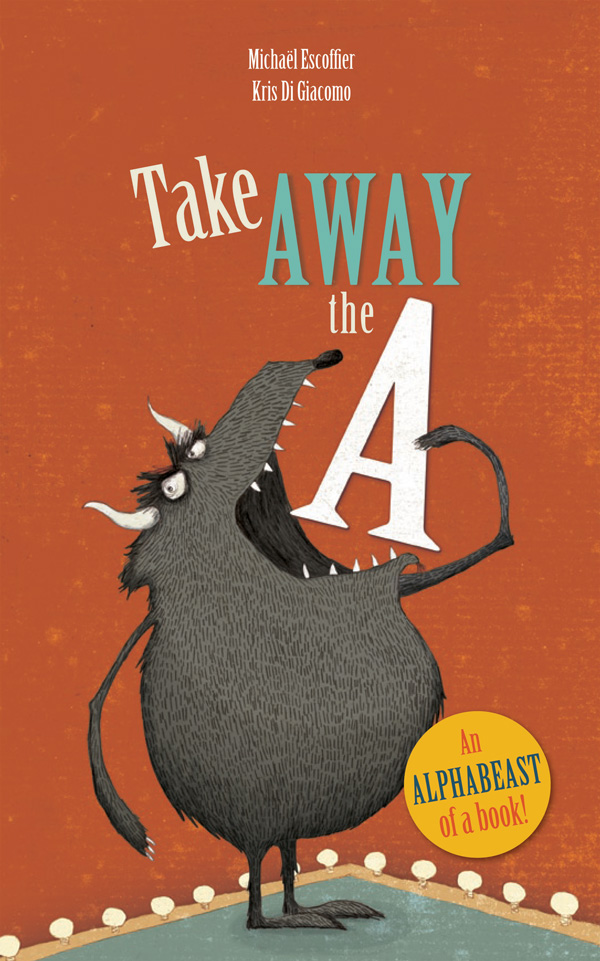
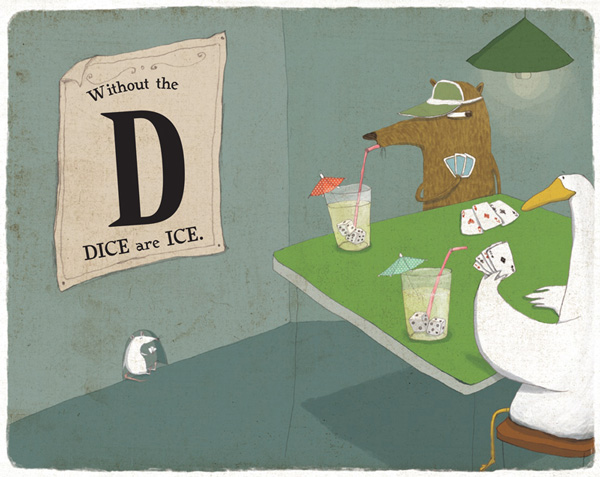
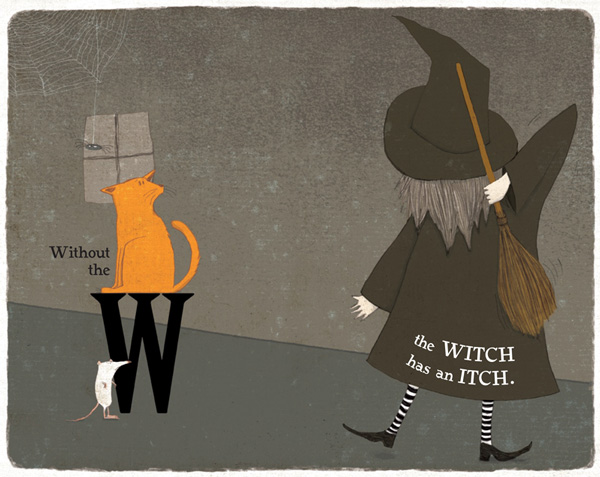
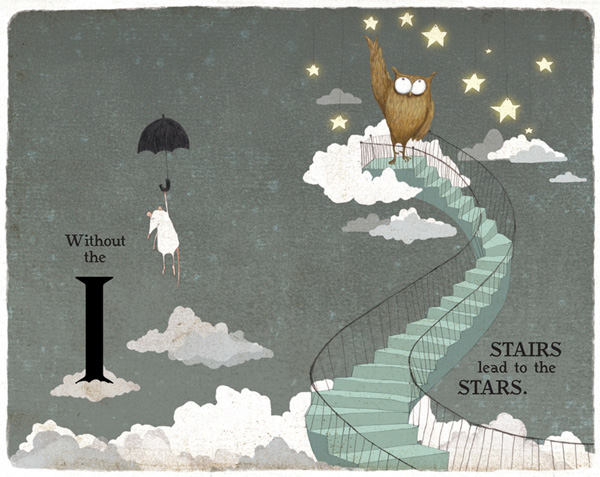
As a lover of unusual alphabet books, I was gladdened by this year’s crop of particularly wonderful additions, including Maira Kalman’s imaginative design history primer, Ah-Ha to Zig-Zag and Oliver Jeffers’s magnificent short stories for the letters, Once Upon an Alphabet. Joining them is Take Away the A: An Alphabeast of a Book! (public library) by writer Michaël Escoffier and illustrator Kris Di Giacomo — an irreverent exploration not only of the letters and their alphabetic order, but also of how they come together to form words and convey ideas. Each letter of the alphabet is removed from one word to produce another as the two are depicted in a humorous semi-sensical vignette of confused meanings. A weary pig and chicken hitchhike on the side of the road because without its M, their farm has suddenly gotten too far; a family of snails find themselves bewildered at the dinner table as their aunt loses her U and becomes an ant; a terrified chicken realizes that without the X, the two foxes staring it down become foes. What emerges is a playful celebration of language not as a dry, mathematical exercise in letter-organization but as a living organism, in which letters make meaning through a vast mesh of metaphorical associations driven by the imagination — the very faculty that is the hallmark of children’s minds.
Throughout the story, there is also a subtle, wistful lament about our relationship to animals, its only protagonists. A monkey sits atop a cash register, collecting change, because without his K, he makes money selling bananas; but monkeys — as well as their primate relatives, chimps — have a long and heartbreaking history of being abused as money-makers in the hands of humans, from circuses to labs to the illegal pet trade. Having lost their O, a party of four — a duck, a zebra, an antelope, and a wolf — are fur-clad at tea time; the cruel price of fur garments, of course, is always animal lives.
In another vignette, the polar bears lose their E and find themselves at the zoo, behind bars, as a human father and child ogle them while enjoying their ice cream, sold to them by a displaced penguin.
But rather than embitter the story, these subtleties only enrich and elevate it by offering possible topics of education and conversation so understated as to offer parents the choice of whether or not to gently broach these darker issues with the child-reader. What remains at the forefront is the irreverent sweetness of the story, full of fable-like characters — there is the wolf, and the fox, and the ant, and the mouse — who behave in delightfully unfablelike ways.
A touch of continuity tickles the masterful pattern-recognition machine that is the human mind at any age. I was especially charmed by the ample and imaginative cameos of the orange octopus, always cheeky, and the little white mouse, a perennial cautious bystander and occasional bold partaker in the quirky alphabetic adventures.
Illustrations courtesy of Enchanted Lion; photographs my own
Donating = Loving
In 2014, I poured thousands of hours and tons of love into bringing you (ad-free) Brain Pickings. But it also took some hefty practical expenses to keep things going. If you found any joy and stimulation here over the year, please consider helping me fuel the former and offset the latter by becoming a Supporting Member with a recurring monthly donation of your choosing, between a cup of tea and a good dinner.
You can also become a one-time patron with a single donation in any amount.
Brain Pickings has a free weekly newsletter. It comes out on Sundays and offers the week’s best articles. Here’s what to expect. Like? Sign up.
Brain Pickings takes 450+ hours a month to curate and edit across the different platforms, and remains banner-free. If it brings you any joy and inspiration, please consider a modest donation – it lets me know I'm doing something right.
Music video by Bing Crosby & David Bowie performing The Little Drummer Boy / Peace On Earth. HLC Properties Ltd., under license to Beach Road Music, LLC Bing...
@Lev (for the tennis) and @BT (fer the beetz) I remember when this was happening live- I listened a bit and it was pretty boring, but I figured if anyone can make some interesting stuff with the data, it will be JM. Now it just needs some self-deprecating goofy lyrics and vocals.
Earlier this year, James Murphy teamed up with IBM to convert the raw data from U.S. Open tennis matches into music. Using an algorithm, Murphy and IBM turned the data into over 400 hours of sound. Now, Murphy has remixed those sounds into a 12-track album released by IBM. It is titled, appropriately, Remixes Made With Tennis Data. Listen below.
Below, check out a video detailing the making of the album:
getting to that age where my parents are talking about this.
Antibiotics, defibrillators, feeding tubes and ventilators are lifesaving tools that sometimes become weapons to prolong life against our will. None of us can escape death but some of us want to shape our final time on earth. We don’t want to live for years in a nursing home rendered unconscious by late-stage dementia; or brain-damaged […]












/assets.sbnation.com/uploads/chorus_asset/file/2744622/Bulletproofcover-final.0.jpg)