Shared posts

12 Apr 20:11

The Path Between Pseudo-Spirituality and Pseudo-Science

Corvus.corax

more shares from Stefan on a Saturday- can you tell I'm in Rochester today?

I don't think I've read any of Harris' books yet, but this one does seem to touch on several themes discussed at the April manclub and prior.

(Photo via Bala Sivakumar)

I am often asked what will replace organized religion. The answer, I believe, is nothing and everything. Nothing need replace its ludicrous and divisive doctrines—such as the idea that Jesus will return to earth and hurl unbelievers into a lake of fire, or that death in defense of Islam is the highest good. These are terrifying and debasing fictions. But what about love, compassion, moral goodness, and self-transcendence? Many people still imagine that religion is the true repository of these virtues. To change this, we must begin to think about the full range of human experience in a way that is as free of dogma, cultural prejudice, and wishful thinking as the best science already is. That is the subject of my next book, Waking Up: A Guide to Spirituality Without Religion.

Authors who attempt to build a bridge between science and spirituality tend to make one of two mistakes: Scientists generally start with an impoverished view of spiritual experience, assuming that it must be a grandiose way of describing ordinary states of mind—parental love, artistic inspiration, awe at the beauty of the night sky. In this vein, one finds Einstein’s amazement at the intelligibility of Nature’s laws described as though it were a kind of mystical insight.

New Age thinkers usually enter the ditch on the other side of the road: They idealize altered states of consciousness and draw specious connections between subjective experience and the spookier theories at the frontiers of physics. Here we are told that the Buddha and other contemplatives anticipated modern cosmology or quantum mechanics and that by transcending the sense of self, a person can realize his identity with the One Mind that gave birth to the cosmos.

In the end, we are left to choose between pseudo-spirituality and pseudo-science.

Few scientists and philosophers have developed strong skills of introspection—in fact, many doubt that such abilities even exist. Conversely, many of the greatest contemplatives know nothing about science. I know brilliant scientists and philosophers who seem unable to make the most basic discriminations about their own moment to moment experience; and I have known contemplatives who spent decades meditating in silence who probably thought the earth was flat. And yet there is a connection between scientific fact and spiritual wisdom, and it is more direct than most people suppose. 

I have been waiting for more than a decade to write Waking Up. Long before I saw any reason to criticize religion (The End of Faith, Letter to a Christian Nation), or to connect moral and scientific truths (The Moral Landscape, Free Will), I was interested in the nature of human consciousness and the possibility of spiritual experience. In Waking Up, I do my best to show that a certain form of spirituality is integral to understanding the nature of our minds. (For those of you who recoil at every use of the term “spirituality,” I recommend that you read a previous post.)

My goal in Waking Up is to help readers see the nature of their own minds in a new light. The book is by turns a seeker’s memoir, an introduction to the brain, a manual of contemplative instruction, and a philosophical unraveling of what most people consider to be the center of their inner lives: the feeling of self we call “I.” It is also my most personal book to date.

If you live in the U.S. or Canada, you can order a special hardcover edition of Waking Up through this website. This edition of the book will have the same text as the trade version, but it will be printed on nicer paper and have several other aesthetic enhancements. Simon and Schuster will be doing only one printing, and all orders must be placed by April 15th. Proceeds from the sale of the special edition of Waking Up will be used to develop an online course on the same topic.

12 Apr 20:04

Cheaper Fuel From Self-Destructing Trees

by samzenpus
sciencehabit (1205606) writes "Wood is great for building and heating homes, but it's the bane of biofuels. When converting plants to fuels, engineers must remove a key component of wood, known as lignin, to get to the sugary cellulose that's fermented into alcohols and other energy-rich compounds. That's costly because it normally requires high temperatures and caustic chemicals. Now, researchers in the United States and Canada have modified the lignin in poplar trees to self-destruct under mild processing conditions—a trick that could slash the cost of turning plant biomass into biofuels."

Share on Google+

Read more of this story at Slashdot.


12 Apr 16:49

This Ex-Astronaut Is Stalking Asteroids to Save Civilization

Corvus.corax

continuing the killer asteroid theme...
"anybody who knows anything about space and probability knows that this is something you have to solve. Nothing else matters at all if you’re going to get wiped out. Since 2000, there have been eight impacts roughly the size of Hiroshima or larger, and the fact that asteroids hit Earth somewhat randomly means you’re basically on borrowed time. You don’t know when the next one’s gonna happen."

Ed Lu wants to nudge killer space rocks out of their near-earth trajectories.


12 Apr 16:48

Ancient Asteroid Boiled Oceans, Burned the Sky, and Shook Earth for a Half-Hour

Corvus.corax

what's so cool about this is that the evidence has led to such a detailed explanation. I fucking love science.

These days we freak out whenever some dinky bollide explodes in the sky over Russia. But scientists have now reconstructed the effects of an enormous 3.26-billion-year-old asteroid impact on Earth that boiled the oceans, turned the sky red hot, and generated a half-hour-long earthquake that shook the planet.


12 Apr 16:13

Watch How Fruit Flies Avoid Attack by Banking Like Fighter Jets

Corvus.corax

I propose an alternate title: how fighter jets barely scratch the surface of the agility of fruit flies.

Researchers have recorded a remarkable flight behavior in the fruit fly species Drosophila hydei, they report today in Science. When threatened by a predator, the spry critters can change course in just one one-hundredth of a second, rolling on their sides and banking hard. Normally flapping their wings 200 times a second, the flies accomplish this in almost a single wing beat.


09 Apr 02:46

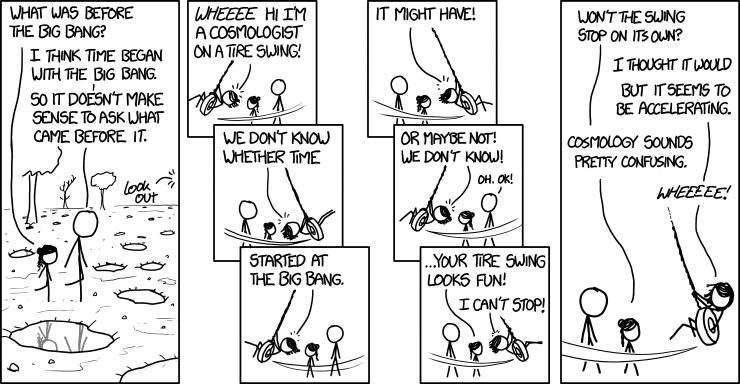
Cosmologist on a Tire Swing

Corvus.corax

Hey Bryan, you may enjoy a movie I watched the other day on Netflix- Mr. Nobody. It deals with multiple timelines and the seeming unidirectionality of time (in a fictional way- which of course drags down its robustness), and stars Jerod Leto (dreamy and wrinkly both). Anyway, ignore the angels in the first 10 minutes and it's a fun story.

No matter how fast I swing, I can never travel outside this loop! Maybe space outside it doesn't exist! But I bet it does. This tire came from somewhere.
08 Apr 20:34

*Flash Boys*, the new Michael Lewis book

by Tyler Cowen
Corvus.corax

more from Cowen, The linked article is interesting and makes it clear that there are several kinds of HFT, and no one knows exactly what their effects are.

For all the criticism the book has received, I liked and enjoyed it.  It illuminates a poorly understand segment of the financial world, namely high-frequency trading, and outlines some of the zero- and negative-sum games in that world.  The stories and the writing are very good, as you might expect.

It is a mistake to take the book as a balanced or accurate net assessment of HFT, but reading through the text I never saw a passage where Lewis claimed to offer that.  Maybe the real objections are to be lodged against the 60 Minutes coverage of the book (which I have not seen).

Why not read a fun book on a fun and understudied topic?  Just don’t confuse the emotional tenor of the stories with a final and well-reasoned attitude toward the phenomenon more generally.  Surely you are all able to draw that distinction.  Right?

Here is a good Noah Smith post about agnosticism and HFT.

08 Apr 19:45

St Vincent - 'St Vincent'

Corvus.corax

Show was great. She shredded on the guitar.
Favorite track:
http://grooveshark.com/s/Regret/6Mmoca?src=5

Annie Clark finds strength in her own frank freakishness on powerful and direct fourth album


08 Apr 01:36

The Significance of Our Insignificance

Corvus.corax

apropos of the discussion last week...

Peter Watson is an intellectual historian, journalist, and the author of thirteen books, including The German Genius, The Medici Conspiracy, and The Great Divide. He has written for The Sunday Times, The New York Times, the Observer, and the Spectator. He lives in London.

He was kind enough to answer a few question about his new book The Age of Atheists: How We Have Sought to Live Since the Death of God.

*  *  *


1. You begin your account of atheism with the 19th-century German philosopher, Friedrich Nietzsche. Why is he a good starting point?

In 1882 Nietzsche declared, roundly, in strikingly clear language, that “God is dead”, adding that we had killed him. And this was a mere twenty years after Darwin’s Origin of Species, which is rightly understood as the greatest blow to Christianity. But Nietzsche’s work deserves recognition as a near-second. Darwinism was assimilated more quickly in Germany than in Britain, because the idea of evolution was especially prevalent there. Darwin remarks in one of his letters that his ideas had gone down better in Germany than anywhere else. And the history of Kulturkampf in Germany – the battle between Protestantism and Catholicism – meant that religion was under attack anyway, by its own adherents.  Other people responded to Nietzsche more than to anyone else – Ibsen, for example, W. B. Yeats, Robert Graves, James Joyce. In Germany there was the phenomenon of the Nietzschean generations – young people who lived his philosophy in specially-created communities. And people responded to Nietzsche because, his writing style was so pithy, to the point, memorable, and crystal clear. It is Nietzsche who tells us plainly, eloquently, that there is nothing external to, or higher than, life itself, no “beyond” or “above”, no transcendence and nothing metaphysical. This was dangerous thinking at the time, and has remained threatening for many people.


2. You say at one point in your book that psychology, or perhaps therapy, has taken over from religion as a way to understand our predicament, and – to an extent – deal with it. Do you follow Freud in viewing religion as, essentially, a product of neurosis?

I do think there is sound anthropological evidence that the first “priests”, the shamans of Siberia, were probably psychological misfits or malcontents, and that throughout history we have gone on from there, because many well known religious figures – some of the Hebrew prophets, John the Baptist, St. Paul, St. Augustine, Joan of Arc, Luther – were psychologically odd. Religion is not so much neurosis as psychological adjustment to our predicament – that’s the key, religion is to be understood psychologically, not theologically. It was George Carey, when he was archbishop of Canterbury, not me, who said “Jesus the Saviour is becoming Jesus the Counselor”. (This was in the 1990s.) And it was a well known Boston rabbi, Joshua Loth Liebman, who, soon after the end of World War Two, wrote a best-selling book that admitted that traditional religion had been too harsh on ordinary believers and that the churches and the synagogues and the mosques had a great deal to learn from what he called the new depth psychology – he meant Freudianism. So the church invited the psychologists to put their tanks on its lawn, so to speak. And psychotherapy hasn’t looked back. More people go into therapy now as a search for meaning than for treatment for mental illness.


3. What do you conclude from this?

That worship, the religious impulse, is best understood as a sociological phenomenon, rather than a theological one. In your own books you point up some of the absurdities of religion, but the two I regard as most revealing are the worship of a Royal Enfield motor-bicycle in a region of India, a bike involved in a crash in which its driver was killed but now is reckoned to have supernatural powers. And second, the Internet site, godchecker.com, which lists – apparently without irony – more than 3,000 “supreme beings.” I wonder how many fact-checkers they have. (That last sentence is written in a new type-face I have invented, called Ironics.)

In the recent world-wide survey of religion and economics by Pippa Norris and Ronald Inglehart, they show convincingly that religion is expanding in those areas of the world where ‘existential insecurity’ – poverty, natural disasters, disease, inadequate water supplies, HIV/AIDS, the lack of decent health care – is endemic and growing, whereas in the more prosperous and secure West, including now the USA, atheism is inexorably on the rise. Religion is prevalent among the poor and in decline in the more prosperous parts of the world. It is less that religion is on the rise as poverty is.


4. In your book you survey the views of a great number of people. How would you describe your own atheism?

We are gifted with language and Nietzsche had a gift for language. I follow people like the German poet Rilke and the American philosopher Richard Rorty who say that our way to find meaning in life is to use language to “name” the world, to describe new aspects of it that haven’t been described before, and in so doing enlarge the world we inhabit, enlarge it for everyone. This links science and the arts, in particular poetry. When new sciences are invented they bring with them new language, and scientific discoveries – continental drift, say, dendrochronology, the Higgs boson – that enlarge our understanding precisely through incorporating new language. But so does the best art, the best poetry, the best theatre.  This is therefore an exercise for the informed – increasingly the very well informed, as the more mature sciences are now more or less inaccessible to the layman. Language enables us to be both precise about the world, and to generalize. As a result we know that life is made up of lots and lots of beautiful little phenomena, and that large abstractions, however beautiful in their own way, are not enough. There is no one secret to life, other than that there is no one secret to life. If you must have a transcendent idea then make it a search for “the good” or “the beautiful” or “the useful”, always realizing that your answers will be personal, finite and never final. The Anglo-American philosopher Alasdair MacIntyre said “The good life is the life spent seeking the good life.” That implies effort. We can have no satisfaction, no meaning, without effort.


08 Apr 01:31

The Pro-Orgasm Movement

by Merissa Nathan Gerson
Corvus.corax

umm.
huh.

Wearing a red mini dress and stilettos, Nicole Daedone slips into an apron. “I wear an apron because I’ve ruined all my dresses with lube at this point,” she jokes. A small blonde woman clad in black comes out and joins Daedone on stage. We are in the Scottish Rite Center, a masonic temple in downtown Oakland, California. The massive columned room is packed with people of all ages, shapes, and sizes. They have been dancing, yelling out. Call this the orgasm revival.

A massage table with cushions is carried onto the stage. “A demo is fundamentally a celebration,” quips Daedone. She pulls on a pair of rubber gloves. The blonde woman climbs onto the table, takes off her pants, spreads her legs, and the demo begins.

Nicole Daedone is the founder of One Taste—a business dedicated to teaching “orgasmic meditation,” or “OM.” This was the keynote opening to the OMX 2014 Unconditional Sex: Entering the Flow State conference last weekend. In front of a crowd of just more than 700 people (plus a telecasting), Daedone proceeded to bring the woman on stage to a state of orgasmic bliss using a complex stroking technique that she has learned from a lifetime of spiritual and sexual training. She gave the crowd a taste of what she terms an “unapologetically asymmetrical” practice that focuses unilaterally on the female orgasm as a means of finding deeper connection to the body, the divine, and each other.

“We women are prone to exaggeration,” she told the crowd. “You want to learn to bring her to a state where nothing can be faked. … We aim for a state of involuntarily being turned on—swelling of the lips, darkening of the eyes, crying.”

The conference, a three day event hosting speakers ranging from Naomi Wolf, author of Vagina and New York Times bestselling author Steven Kotler to a BDSM expert named Cléo DuBois and Dr. Jenny Wade, an expert on transcendental sex, was as much a meeting place as it was revival or cultish festival. The lectures were punctuated by raffles, dance parties, and every hour, on the hour, the option to OM—to practice the orgasm meditation that brought all these names together. “Most of us have an incredibly limited understanding of what orgasm can be,” Daedone explained.

On Saturday morning, day two of three, the OM-ing began. In a mandatory orientation in a wood-paneled side room, they reminded us “You need to provide your own lube. Keep track of your lube—each jar looks the same.” This was no ordinary weekend at the Scottish Rite Center. Jars of lube floated about and many men and women wore shirts reading “Orgasm Expert” or “Powered by Orgasm.” When I opted for a 15-minute massage to relieve the stress, even the massage therapist used lube on my shoulders and suggested, to relieve my back tension, that I “get stroked three times a week.” At this conference, climax was prescribed as the cure to all ailments. “Orgasm,” Daedone said, “gives you the power to be the change you wish to see in the world.”

Dr. Sarah Gottfried, author of The Hormone Cure proposed just this in her Saturday morning talk. She suggested we remodel the limbic system with oxytocin—a hormone released during orgasm. Her message: “We ghetto-ize orgasm. We have internalized patriarchy.” OM is her proposed patriarchal break down. “Orgasm is a majorly needed nutrient,” she said, “it reconstitutes us hormonally, emotionally, and spiritually.”

In order to practice orgasmic meditation, the conference participants all had to go through a training. There was an early how-to certification class followed by the option to “OM every hour on the hour.” This meant that every hour on the hour, on the third floor of the Masonic temple, the conference-goers paired off two by two. In a room filled with blankets, cushions, yoga mats, plastic gloves, small hand towels, and a ton of lube, each woman removed her pants. Her partner, stranger or not, would stroke her clitoris in the prescribed manner for the full 15 minutes. Afterward, they emerged like nothing had happened. But a strange glow and intensity built over the day.

Despite being a conference about the female orgasm, there seemed to be a solid focus on men, masculinity, and the power this practice might offer them throughout the weekend. “Men want to please you more than you can humanly imagine,” Daedone said. She told stories of men who couldn’t please their women that went something like, “No matter what I did, I couldn’t make her happy, it was devastating to my masculinity.” Manhood, in the model Daedone proposes, is tied to this worshipping of the female sexual experience.

The conference was at least half full of men, young and old. During the training session, a young man named Eli, a One Taste coach from Brooklyn, told us what he takes from the experience.

One man asked him: Why bother? What does a man get from sitting there stroking a woman and not receiving hands-on pleasure in return? “As a stroker I am learning to feel,” Eli said, “to put my finger on this incredibly sensational spot on a living breathing organism, to come into contact with so much life in one particular place.” He also spoke about his white middle class male privilege and how he had to really check it at the door. “For me this is one thing that is not going according to my ride.” What he does: “Feel where the sensation is and meet it on its terms. I have to actually be willing to sit down and feel what’s right. I have a felt sense that I didn’t have before this.”

OM, they said in the training, “is a practice. It follows a very specific set of guidelines.  It is a specific container. It is its own sovereign thing. No offers or expectations.” It is separate from sex, from foreplay, from what happens in the bedroom. It is a meditation, an isolated and contained practice meant to bring the “stroker” and the “strokee” to a deeper sense of awareness. Daedone explained in the keynote: “For me it is the same if I am on my back or I’m stroking. I am surrendering more to her orgasm than she is surrendering to me, but we are both surrendering to the same thing.”

OM-ing is essentially a 15 minute partnered exercise. The stroker strokes the upper left hand quadrant of the clitoris without a finite goal. “There is no trying to get enlightened,” they explained at our demo, “Climax doesn’t mean [you’ve done it] right or wrong. If you get into the position you have already done it right.” Their message is that women should be climaxing more and this comes through feeling, trusting, undoing subconscious patriarchal conditioning, and letting go.

“The clitoris alone has two times as many nerve endings as the entire penis,” explained one instructor. The kind of touch they suggest: “A slow, light, feel-every-ridge-on-your-fingertip kind of stroke.” The idea is that the woman learns to feel more nuanced elements of pleasure and the stroker, through observing and exploring the strokee's experience and what it elicits in his own body, then comes into closer contact with himself.

The practice, as they preach it, is maybe 10 percent technique, 90 percent feeling. “If you are looking for technique,” they warned, “you are in the wrong place.”

Still, the practice is more complicated than I realized. The conference seemed peppy, silly, cultish and irritating until I bought into it. A guy in a top hat was my partner and it worked, the whole scary thing worked. I was in a room with a whole bunch of strangers and all we cisgendered women took our pants off.  We let the strangers do this thing to us that felt, really, like an extreme version of going to the gynecologist. Yes, 15 minutes is a long time. Yes, I learned to ask for what I wanted. And yes, the results were amazing. By the third day of the conference I was a convert. I was touching people too much, and attentively listening to the benefits of orgasm.

It turns out the OM community is vast.  If I needed to be “stroked three times a week,” apparently it could be arranged at Bay Area meet ups, no strings attached.  Pleasure, in this system, is sanctioned and enabled on a regular basis.

On the last day of the conference, someone in the bathroom had a medical emergency. She was in a wheel chair and needed a dry pair of pants. I took off my leggings from under my dress and just passed them on. That was what Nicole Daedone's conference did to me—made me open and loving and weird and alive, and willing to share my heart, or my pants, with perfect strangers.


07 Apr 16:22

'Coffee Flour': The Java You Can Eat

by Megan Garber
Corvus.corax

I have often wondered about the coffee cherry pulp. Hard to believe that people in the countries of origin haven't already thought of this... but seems a good-looking waste-stream reduction idea nonetheless.

Making coffee is a complex thing. Long before the stuff makes it to your cup/glass/comically large thermos, it must be converted—from fruit to bean. Doing that requires that the fruit (the "cherries") be harvested from "spindly, bush-like" coffee plants. The cherries must then be processed, their beans extracted from their pulp. The beans must then be dried, roasted, and otherwise converted into the thing most of us know as "coffee."

This process is not only labor-intensive; it is is also wasteful. It results in, among other things, much of the coffee cherry being discarded.

Out in (yep) Seattle, there's a startup, CF Global, that is trying to reclaim the coffee cherry. Its big idea is this: to take the remnants of the process that turns the coffee bean into a beverage ... and turn them into food.

The result of this? Coffee Flour, a food ingredient that's made from discarded coffee cherries. You take the pulp that gets separated from the coffee been in that initial extraction process and then dry it and mill it—the results being a flour that can, CF Global says, mimic traditional flour. Coffee Flour, the company claims, can be used in pasta and baked goods. It can work as a dry rub for meats. It can bring coffee flavor to sauces. It can even be used in energy drinks. 

CF Global is a spinoff of Intellectual Ventures—the firm, led by Nathan Myhrvold, that is most (in)famous for its patent trollery, but that also offers would-be investors assistance through its Invention Development Fund. Myhrvold, it's worth noting, is also the author of the foodie bible Modernist Cuisine: The Art and Science of Cooking. And Coffee Flour could be another step in the march toward modernist cooking: a way to convert the beloved beverage into something edible. And a way to extract value from something that has traditionally been treated as trash. 

Via GeekWire


04 Apr 23:18

60 Minutes Dubbed Engines Noise Over Tesla Model S

by timothy
cartechboy (2660665) writes "Did you watch the Tesla 60 Minutes segment the other night? If you did, you might have ended up on the floor rolling around laughing like I did. Since when does the Tesla Model S electric car make audible engine noises? Or downshift? Turns out, 60 Minutes dubbed engine noises and a downshift over the Model S running footage. The show claims it was an editing error. Call it what you want, it was absolutely hilarious. A little note to TV producers assigned to cover Tesla Motors in the future: Electric cars don't upshift or downshift." At least they didn't fraudulently blow it up!

Share on Google+

Read more of this story at Slashdot.


03 Apr 20:17

The Rise And Fall Of Stefan Zweig, Who Inspired 'Grand Budapest Hotel'

Corvus.corax

Zweig has a great book called the Chess Story that I enjoyed very much, but I'm really sharing to let you know about a book that Kayla's cousin has recently published and got a Kirkus review that is pretty funny:
https://www.kirkusreviews.com/book-reviews/jeff-miller/the-nerdy-dozen/

The Viennese writer was once one of the world's most translated authors, but after his death he was forgotten — until now. Wes Anderson credits Zweig's writing at the end of his latest film.

» E-Mail This

03 Apr 17:38

DARPA Embraces Nature With Establishment of Biological Technologies Office

by samzenpus
Corvus.corax

seems both inevitable and a little scary

Zothecula (1870348) writes "From robotics to optics and forgery prevention to solar cells, biomimicry has proven fertile ground for researchers. Recognizing nature's potential in the development of new technologies, DARPA has announced the establishment of the Biological Technologies Office (BTO), a new division that aims to 'merge biology, engineering, and computer science to harness the power of natural systems for national security.'"

Share on Google+

Read more of this story at Slashdot.


03 Apr 17:17

The Age of Atheism: How We Have Sought to Live Since the Death of God, by Peter Watson

by Michael Dirda
Corvus.corax

Dirda gushes...

If, as Nietzsche proclaimed, God is kaput, then what? In a highly readable and immensely wide-ranging work of intellectual history, Peter Watson surveys and summarizes the various answers to this question that have been proposed during the past 125 years. “The Age of Atheists” is, in effect, an account of 20th-century philosophical and moral thought, focused, as its subtitle explains, on “how we have sought to live since the death of God.”

Read full article >>


03 Apr 17:09

MIT Researcher Enlists Bacteria To Assemble Nanotech Materials

by timothy
Corvus.corax

Wow.
The source article feels a little low-quality, but it is here: http://www.theregister.co.uk/2014/03/23/mit_makes_living_couch_from_ecoli_bacteria/

I had to look up "boffins": British slang for a scientist, engineer, or other person engaged in technical or scientific work.

The Register reports on an approach to nanotech that combines biological computing with micro-mechanics, embodied in the work of MIT associate professor Timothy Lu. Lu's research has resulted in the creation of tiny structures assembled using modified E. coli. "Specifically," says the article, "the MIT researchers were able to put bacteria to work producing conducting biofilms, some of which were studded with quantum dots, and arranging gold nanowires. This paves the way for the development of mass manufactured cell-based material factories, and even 'living materials' that have some of the desirable properties of bones or trees, Lu confirmed." His most radical idea, says Lu, is furniture that shapes itself to cushion the user's most-stressed areas.

Share on Google+

Read more of this story at Slashdot.


01 Apr 16:15

Serious Resistant Infections Increasingly Found in Children

by Maryn McKenna
Corvus.corax

super low rates, but still. scary.

Serious drug-resistant infections in children are rising across the United States.
    
01 Apr 16:07

What should you talk about?

by Tyler Cowen
Corvus.corax

Did you guys see this one?

I'm not sure that I'm ready to endorse the apparent either-or, socialize vs. gain insight, but the idea is akin to previous readergroupthoughts on the value of reader over the value of fb (although there we were discussing the difference between talking about one's self vs. talking about something of interest, like an intriguing idea).

I think the guys group is about both socializing and gaining insight, and even when talking to new people (like at Bryan's for St.Paddy's) I think a good conversation transitions between the social and the insight-gain.

Robin Hanson reports:

If your main reason for talking is to socialize, you’ll want to talk about whatever everyone else is talking about. Like say the missing Malaysia Airlines plane. But if instead your purpose is to gain and spread useful insight, so that we can all understand more about things that matter, you’ll want to look for relatively neglected topics. You’ll seek topics that are important and yet little discussed, where more discussion seems likely to result in progress, and where you and your fellow discussants have a comparative advantage of expertise.

You can use this clue to help infer the conversation motives of the people you talk with, and of yourself. I expect you’ll find that almost everyone mainly cares more about talking to socialize, relative to gaining insight.

I would be curious to hear what other people think of this…

01 Apr 02:36

Tom Cruise Respawns Into Alien War in New Edge of Tomorrow Trailer

by Angela Watercutter
Corvus.corax

more of tom's megalomaniacal formula, I suspect, but it still looks cool.

Tom Cruise fights the same battle over and over again (and gets shot by Emily Blunt) in the latest trailer for Edge of Tomorrow.


25 Mar 18:01

Jimmy Wales To 'Holistic Healers': Prove Your Claims the Old-Fashioned Way

by timothy
Corvus.corax

notable in that strongly-held beliefs in wacko medicine and 8000 signatures can't necessarily overcome the robustness of cooperative Wikipedia.

Barence (1228440) writes with this excerpt from PC Pro: "Wikipedia founder Jimmy Wales has issued a sharp response to petitioners calling for his site to "allow for true scientific discourse" on holistic healing. The petition, currently running on the Change.org site, claims that much of the information on Wikipedia relating to holistic approaches to healing is "biased, misleading, out of date, or just plain wrong". It has attracted almost 8,000 supporters at the time of publication. Wales's response to the petition, posted on the same page, is far from conciliatory: 'No, you have to be kidding me,' he writes. 'Every single person who signed this petition needs to go back to check their premises and think harder about what it means to be honest, factual, truthful. What we won't do is pretend that the work of lunatic charlatans is the equivalent of 'true scientific discourse'. It isn't.'"

Share on Google+

Read more of this story at Slashdot.


25 Mar 17:36

Adam Carolla Joins Fight Against Podcast Patent Troll

by timothy
Corvus.corax

FYI Bjorn- yer podcasts are under attack.

First time accepted submitter tor528 (896250) writes "Patent troll Personal Audio has sued top podcasters including Adam Carolla and HowStuffWorks, claiming that they own the patent for delivery of episodic content over the Internet. Adam Carolla is fighting back and has started a Fund Anything campaign to cover legal fees. From the Fund Anything campaign page: 'If Adam Carolla loses this battle, then every other Podcast will be quickly shut down. Why? Because Patent Trolls like Personal Audio would use a victory over Carolla as leverage to extort money from every other Podcast.. As you probably know, Podcasts are inherently small, owner-operated businesses that do not have the financial resources to fight off this type of an assault. Therefore, Podcasts as we know them today would cease to exist.' James Logan of Personal Audio answered Slashdotters' questions in June 2013. Links to the patent in question can be found on Personal Audio's website. The EFF filed a challenge against Personal Audio's podcasting patent in October 2013."

Share on Google+

Read more of this story at Slashdot.


23 Mar 15:41

Nietzsche and religion

by thuudung
Corvus.corax

you missed this one Bryan, and it mentions Trotsky... only skimmed the top so far.

Atheists vs. Nietzsche. While they may agree that God is dead, many espouse the sort of liberalism that Nietzsche ridiculed. It’s awkward… more»

22 Mar 13:49

Religion Is Good For Your Brain

by timothy
Corvus.corax

today's religion share 2 of 3

Hugh Pickens DOT Com writes "Sheila M. Elred writes in Discovery Magazine that a recent study has found that people at risk of depression were much less vulnerable if they identified as religious. Brain MRIs revealed that religious participants had thicker brain cortices than those who weren't as religious. 'One of the worst killers of brain cells is stress,' says Dr. Majid Fotuhi. 'Stress causes high levels of cortisol, and cortisol is toxic to the hippocampus. One way to reduce stress is through prayer. When you're praying and in the zone you feel a peace of mind and tranquility.' The reports concluded that a thicker cortex associated with a high importance of religion or spirituality may confer resilience to the development of depressive illness in individuals at high familial risk for major depression. The social element of attending religious services has also been linked to healthy brains. 'There's something magical about socializing,' says Fotuhi. 'It releases endorphins in the brain. It's hard to know whether it's through religion or a gathering of friends, but it improves brain health in the long term.'" (Read more, below.)

Share on Google+

Read more of this story at Slashdot.


22 Mar 01:15

The World's Smallest Time Machine Is Still Pretty Big

Corvus.corax

fyi duders

The Time Traveler's Almanac is a gigantic new compilation of — you guessed it — stories about time travel. Reviewer Jason Sheehan says the selection of stories and authors is very nearly perfect.

» E-Mail This

21 Mar 20:32

Stories in the dark

by thuudung
Corvus.corax

3 of 3, looking forward to this one too- less religion than spiritualism...

As science advances, myth and folklore aren’t banished but reinvented. At the limits of knowledge, scientists draw subconsciously on the old stories… more»

21 Mar 00:58

Hell on earth

by Ross Andersen
Corvus.corax

there is some creepy shit here- haven't read it all yet...

A Hell of a future. Photo by Martin Barraud/Gallery StockEven in my most religious moments, I have never been able to take the idea of hell seriously. Prevailing Christian theology asks us to believe that an all-powerful, all-knowing being would do what no human parent could ever do: create tens of billions of flawed and fragile creatures, pluck out a few favourites to shower […]

The post Hell on earth appeared first on Aeon Magazine.

14 Mar 01:24

SpaceX Wants To Go To Mars — and Has a Plan To Get There

by timothy
Corvus.corax

I definitely recommend a recent book "The Martian" for a fluff-but-science-and-math-heavy portrayal of a manned Mars mission.

mknewman writes with an article at NASA SpaceFlight which lays out the details of a plan from SpaceX to send a craft to Mars, using an in-development engine ("Raptor") along with the company's Super Heavy Lift Launch Vehicle. "Additionally, Mr. Musk also introduced the mysterious MCT project, which he later revealed to be an acronym for Mars Colonial Transport. This system would be capable of transporting 100 colonists at a time to Mars, and would be fully reusable. Article is technically dense but he does seem to follow through on his promises!" This is an endeavor that's been on Elon Musk's mind for a while.

Share on Google+

Read more of this story at Slashdot.


11 Mar 18:50

Markets in Everything: Prostitution for Beginners

by Alex Tabarrok
Corvus.corax

up next: we'll be covering the sex trades and mega brothels...

The Guardian: An enterprising association of sex workers in Barcelona has angered some of Spain’s most prominent feminists by offering an “intro to prostitution” course in response to what its members say is a growing number of women turning to sex work in the wake of Spain’s financial crisis.

…Four hours was too little time, she said, to cover a list of topics such as dealing with the stigma of prostitution, sex tricks, filing tax returns and marketing. A second day will be held this month because of high demand. “Nobody else can teach these things,” said Borrell. “Not psychologists, anthropologists or political scientists – only prostitutes.”

In related stories, this piece on the legal, mega-brothels of Germany is well produced.

11 Mar 18:24

The mindfulness racket

by thuudung
Corvus.corax

Mr. Morozov strikes again...
"In other words, why we disconnect matters: We can continue in today’s mode of treating disconnection as a way to recharge and regain productivity, or we can view it as a way to sabotage the addiction tactics of the acceleration-distraction complex that is Silicon Valley."

Techies have a new cause to champion: mindfulness. Unplug, at least for a while. But beyond the Buddhist rhetoric lies a business agenda… more»

11 Mar 17:49

Embarrassing Stories Shed Light On US Officials' Technological Ignorance

by samzenpus
colinneagle writes "Speaking at the SXSW Conference recently, Dr. Peter W. Singer, director of the Center for 21st Century Security and Intelligence, recalled one U.S. official who was 'about to negotiate cybersecurity with China' asking him to explain what the term 'ISP' (Internet Service Provider) means. This wasn't the only example of this lack of awareness. 'That's like going to negotiate with the Soviets and not knowing what "ICBM" means,' Dr. Singer said. 'And I've had similar experiences with officials from the UK, China and Abu Dhabi.' Similarly, Dr. Singer recalled one account in which Janet Napolitano, the Secretary of the U.S. Homeland Security Department from 2009 to 2013, admitted that she didn't use email 'because she just didn't think it was useful.' 'A Supreme Court justice also told me "I haven't got round to email yet" — and this is someone who will get to vote on everything from net neutrality to the NSA negotiations,' Dr. Singer said."

Share on Google+

Read more of this story at Slashdot.