
Andrew Hickey
Shared posts
26 Nov 14:35


#1173; The Appetizer App
by David Malki
arcturus, personal responsibility and one other like this
26 Nov 14:34


#1175; In which a Sacrifice is made
by David Malki

Ryan Stonecipher, Vvicked likes this
19 Nov 17:17


Amazon Launches Storywriter, a Free Screenwriting Tool
by PG
From the Amazon Media Room:
Amazon today announced Amazon Storywriter, a free, cloud-based screenwriting software for writers of all levels to create movie and TV screenplays in standard format, offering an alternative to costly industry options. Also, in an effort to further enable talented writers to present their work for consideration and to expand its search for the next great movie or TV series, Amazon will now accept drama submissions and will no longer take a free option on scripts submitted directly to the amazonstudios.com site.
Starting today, creators can simply log in with their Amazon account to access Amazon Storywriter. This writer-friendly software takes the pain out of formatting, with features including auto-format as you type and import/export of PDF, FDX and Fountain formats. Screenwriters can write online while their scripts are saved as they work, knowing all their material is being stored securely in the cloud. Additionally, they can write offline with a free installable Chrome app for Mac and PC.
. . . .
Amazon is always on the lookout for compelling new voices and interesting characters in series and movies that have the potential to become hits. Amazon continues to accept original scripts for feature films, primetime comedy series for adults, series for children between the ages of 2-14, and now for the first time also welcomes drama series submissions. In addition, Amazon will no longer take a free option on script submissions, thus allowing Writers Guild of America and the Animation Guild members to submit their original material through the online submission process.
Link to the rest at Amazon Media Room
Click to Tweet/Email/Share This Post
19 Nov 13:30
Erysichthon Gotta Eat
by Ovid
I always love a good Greek myth
and today’s was brought to my attention
by long-time reader Ilya “Not Ilya of Murom” Lastname
and it is about an eating disorder
So you guys know about Demeter, right?
She’s the goddess of fertility and crops and whatnot
her daughter got stolen by the king of hell for sex reasons
it was a whole thing.
Anyway, being as she is in charge of fertility and crops and whatnot
it makes sense that Demeter would have an official forest dedicated to her
with a tree in it that is also dedicated to her
and covered in garlands and shit
one for each prayer she’s answered
so either she answers a lot of prayers
or everybody keeps falsely attributing their success to her
and then showering her tree in the ancient greek equivalent of macaroni pictures
in fact I’m not entirely convinced that Demeter likes these offerings
they seem like fancy trash to me
i don’t know how Demeter feels about littering
but I would wager she does not feel super great about it???
regardless, she does feel pretty attached to the actual tree
seeing as it is a literal extension of her body
which is why she is none too pleased
when this shitty king named Erysichthon decides to chop it down.
It is not at all clear why Erysichthon wants to do this
he doesn’t need the wood or anything
there’s no record of Demeter doing anything particularly shitty to him
maybe he just has really bad seasonal allergies
or he’s trying to erect a strip mall
or he just fucking hates trees
all totally understandable motivations
but Demeter doesn’t see it that way
she sees it the way where some rich asshole is carving up part of her body with an axe
so she makes the tree turn into flesh and start GUSHING BLOOD
and all Erysichthon’s guys are like “dude trees aren’t supposed to do that
this tree is CLEARLY haunted
why don’t we quit while we’re ahead
as in while we are not beset by vengeful ghosts”
but Erysichthon chops down the tree anyway
he gets blood everywhere
crushes a ton of other trees under its massive trunk
it’s a horrible waste
which is what makes it so metal.
Demeter obviously is not impressed by how metal this all is.
Instead she decides Erysichthon needs to get punished
and in the ancient Greek tradition
of punishments having fuck all to do with the crime
she decides to make him perpetually hungry.
Here’s the problem:
making people hungry is the exact opposite of what Demeter can do
she is straight up the goddess of feeding people
she is the concerned jewish mother of the Greek pantheon
so she has to ask Famine to do this thing for her
which is complicated by the fact
that Demeter and Famine are NOT EVEN ALLOWED TO HANG OUT
so Demeter has to send a go-between to the fucking Eurasian steppes
to find Famine on the tundra
with her ribs all exposed and her eyes all sunken
guts all visible through the skin
doing a photoshoot for Chanel
and the go-between is like “psst:
Demeter wants you to fuck a dude up.
Climb down his throat and shit a black hole in his stomach
please and thank you.”
and Famine is like “Sure whatever
I wasn’t doing anything this evening anyway.”
So Famine flies to Erysichthon’s house and gives him The Hunger
which is like if every food item in the world
was suddenly Subtraction Soup from the Phantom Tollbooth
everything he eats just makes him more hungry
he’s hoovering down food like a tyrannical Guy Fieri
he’s sitting at dinner like “mm this bucket of fried chicken is good
you know what it would go great with?
ELEVEN BUCKETS OF FRIED CHICKEN.”
He cleans out countless all-you-can-eat buffets
he even goes to Sizzler
his stomach is a void
his a mouth is a portal to the Other Side
he is Galactus
it’s super inconvenient
he sells everything he owns to buy more food
and then when he runs out of things to sell
he starts selling people
namely his daughter Mestra
he sells her into slavery for a cheesy crunch wrap from Taco Bell
but for some reason she doesn’t want to be sold into slavery
so she prays to Poseidon
who she boned once
and he’s like “Ugh, fine, you get one favor in exchange for riding my trident
boom:
you are now a shapeshifter”
so she turns into an old fisherman
and when the slaver shows up like “hey, have you seen any hot dames around here?”
she’s like “Uh nope. Just fish. I am a fisherman. Yes.”
and the slaver is like “oh well”
and Mestra is like SCORE
but she may have celebrated too soon
because when her dad finds out she can shapeshift
he’s like “SWEET
now I can sell you over and over again to different people
and you can shapeshift to escape
and I can use the money to buy BURGERS”
and Mestra is like “Well i guess you are the adult here”
so they do that for a while
until Erysichthon is like “You know, these burgers are great
you know what they would go great with?
MY OWN FLESH”
so he eats himself
and then his daughter is like “Fuck yeah no more slavery.”
Then she becomes Mystique and lives happily ever after.
The moral of the story
is don’t tell your dad you can shapeshift.
The end.


19 Nov 12:22
Alice and Her Adventures in Gaslighting
by Ovid
Right so there’s this kid Alice
she doesn’t have anything to do because she is a kid
and child labor is like frowned on or something
so instead she is just sitting under a dumb tree with her sister
when this rabbit runs by
now normally this would not be unusual
rabbits can only move by running
and they don’t normally stop to hang out
pretty rude honestly
but this rabbit is wearing PEOPLE CLOTHES
and a little pocketwatch
and is muttering to himself in HUMAN ENGLISH
about how late he is
and she’s like “hey sis did you see that?”
and her sister is like “I didn’t see anything.”
THIS IS HOW IT BEGINS.
So Alice is like “fuck you” and she follows the rabbit
and she’s a dumb clumsy baby so she falls down his rabbit hole
it is incredibly deep for a rabbit hole
giving her enough time to resign herself to death
and then start thinking about her cat
but she doesn’t die for some reason
she lands in a big fancy room with a key and some drugs in it
the drugs say “drink me” on them so she figures she’d better
and they turn her into a tiny person
which is good because there is a tiny door to go through
but she left the key on the table when she drank the drugs
and now she can’t get it
it’s like one of those procedural adventure game puzzles
where if you fuck up the order you have to wipe your save file and restart
Alice should kill herself is what I’m saying
but no, instead she mopes around until she finds a cake that says EAT ME on it
and she’s like “fuck you too, cake”
but then she eats it anyway
all of it
and it makes her enormous
SHE TOOK TOO MUCH
BAD TRIP BAD TRIP
she starts crying and crying
she floods the whole room because she is so huge
she is an ecological crisis
then the rabbit rolls in and is like “HOLY FUCK A GIANT WOMAN”
and she’s like “HOLY FUCK A TALKING RABBIT”
but only the rabbit is capable of fleeing
so he does, and he leaves a little fan behind
which Alice STEALS because she is a BAD PERSON
so it serves her right when the fan makes her shrink again
once again without the fucking key
and she starts drowning in her tears
So then a bunch of animals show up
and engage in a stupid and pointless game called a Caucus Race
which I’m sure is an utterly gripping political allegory
until Alice scares them away by talking about her cat
for a person trapped in an acid trip
Alice spends a lot of time talking about her cat
I guess this sort of behavior predates the internet
Anyway then the rabbit shows up again
to try and recover his clothing accessories
but all he finds is a tiny girl in a sea of tears
so naturally he assumes she’s his maidservant
and sends her to his house to get more gloves and fans.
Alice does as she’s asked
(oh yeah that whole room and locked door disappeared
continuity is for weenies)
but she only makes it as far as the rabbit’s bedroom
when she finds his drugs that he just left lying on the counter
so she chugs the drugs because it’s been going GREAT SO FAR
and what do you know, she becomes giant again
she becomes so giant she cannot move inside the house
she is just a bunch of shitty arms and legs sticking out of a house
as a result of drinking some liquid
that this rabbit just LEFT OUT ON HIS COUNTER
like DO YOU REALIZE THE MILITARY APPLICATIONS OF THIS SHIT?
Didn’t they make a garbage cgi sequel to this story
where they had to fight a war or something?
where the fuck was this super soldier serum in that movie
seems like it would have been way useful
anyway all these animals gather to pelt Alice with rocks
and the rocks turn into cake
which she eats and it makes her tiny again
so there is like NO CONSISTENCY TO WHAT THESE THINGS DO
SOMETIMES THE CAKE MAKES YOU SMALL, SOMETIMES HUGE
THIS IS POOR UI DESIGN IS WHAT THIS IS
whatever
Alice leaves the rabbit’s definitely ruined house
and wanders into some woods
because that seems fucking safe.
in the woods she eventually runs into a caterpillar
but the caterpillar is too stoned to be of any fucking use
it’s just like “yeah man eat some of this mushroom i’m sitting on
i am sure it will solve ALL OF YOUR PROBLEMS.”
and through trial and error Alice soon discovers that
JUST LIKE EVERY INGESTABLE THING IN THIS WORLD
part of the mushroom makes her smaller
and the other part makes her large
or at least her neck grows longer
and by carefully combining these two potent pharmaceutical mushrooms
she is able to once again achieve a normal size
just in time to start trespassing on someone’s estate.
I mean whatever, right?
we’re talking about a world in which potent size-altering drugs are LITERALLY EVERYWHERE
private property is right out the window.
There’s a duchess who lives on this estate, but who the fuck cares
the important thing is her cat.
Fuck
the Cheshire
Cat
this ephemeral, gaslighting shitwit
seems to have been placed in Alice’s path
solely to erase her love for cats
all leering at her from the branches of trees
questioning her sanity
not even providing her with any good drugs
seriously, cat
EVERYBODY in wonderland’s got the good drugs
you couldn’t even throw her a pack of cigarettes?
NOPE
JUST CRYPTIC STATEMENTS AND AN EERIE LINGERING SMILE
A SMARMY CRESCENT OF SHIT-EATING TEETH
fuck this cat, is what i’m trying to say
the next clown posse Alice runs up on is no better
these three ICP rejects are just sitting around a table in the woods
having a fucking tea party
one of them is a rabbit
but not a nice pocket-watch carrying rabbit
a gnarly hobo rabbit
who is best friends with a haberdasher suffering from mercury poisoning
and a mouse who is CLEARLY addicted to heroin
all of whom are engaged in this perpetual teatime circlejerk
because they are too high to remember how time works
and are convinced that TIME ITSELF IS PUNISHING THEM
BY TRAPPING THEM AT 6PM FOREVER
at this point Alice is fed up with their bullshit entirely
and just leaves
bringing the total narrative impact of this trio of acid casualties
to exactly ZERO
Finally Alice runs into some dudes who are playing cards
they are painting some white roses red
because in a land where mushrooms can actually alter your size
landscaping is a fucking mystery.
These dudes work for the queen of hearts
who is also a playing card
and not some kind of hot cougar lady
although i don’t know, maybe
we don’t get a ton of character development
she mainly just stomps around demanding that people get beheaded
she fucking loves beheadings
she is like the whole french revolution stuffed into a ladysuit
and then the ladysuit is smashed flat by a trash compactor
and stuffed into a giant playing card
which would have been a novel way to counter the french revolution.
ANYWAY the queen invites Alice to play croquet with her
but it quickly becomes clear that no one knows how to play croquet
for one thing
in the game of croquet
one does not substitute mallets for LIVE FLAMINGOS
which is common sense
since the only sports which involve birds in any way
involve the KILLING of birds
because BIRDS ARE GOOD FOR NOTHING ELSE
yeah so then something happens
and another thing happens
and then the queen gets mad because someone stole some pastries
so naturally
based on some serious profiling
she accuses the Knave of Hearts
(aka the Jack of Hearts)
and everybody sits down to have a trial
which is a farce
because everybody knows the queen is just going to behead everybody anyway.
Pretty much all the animals from the story so far are here
like, apparently the rabbit works here
this is his job
seriously like everybody is here except for the caterpillar
the caterpillar was gonna go
but then it got high.
So then just when they are about to call Alice as a witness
(despite the fact that what the fuck could she possibly know)
her genome finally succumbs to the tremendous strain she’s put it under
by repeatedly changing size
and she starts growing for no reason at all
and everyone is like “STOP GROWING IT IS ILLEGAL”
and she’s like “FUCK YOU GUYS I CAN DO WHATEVER I WANT I’M A GIANT”
which is EXACTLY WHY THEY SHOULDN’T LEAVE BOTTLES OF GROWTH HORMONE EVERYWHERE
but just as when shit is getting real
Alice
who is the new god of this tiny stupid world
WAKES UP.
COME
THE FUCK
ON.
THIS IS SUPPOSED TO BE A CLASSIC WORK OF LITERATURE
BUT IT’S REALLY MORE LIKE LEWIS CARROL WRITING HIMSELF INTO A CORNER
WITH A BUNCH OF BULLSHIT THAT SOUNDS LIKE A TWEEN TRYING TO BE “SO RANDOM”
AND THEN HE WAS LIKE OH NO OH SHIT WHAT NOW
OH AHA YES IT WAS ALL A DREAM
PERFECT.
SO YEAH I DON’T KNOW WHAT THE MORAL IS
NOTHING HAD CONSEQUENCES OR ANYTHING
SO I GUESS JUST LIKE
DON’T EVER GO TO SLEEP?
GREAT
AWESOME
GOODNIGHT
19 Nov 11:36
Solid Dick 1½, or 'Did Mary Whitehouse Have a Point?'
by Jack Graham
 or 'Young Men Are Dying For It'
or 'Don't Mention the Chasms'
When I complain about the ideological message of this or that text, am I not tacitly admitting that Mary Whitehouse had a point? After all, isn't the worry ultimately about the effect it will have?
We know that cultural artifacts influence people enormously. Moreover, most of us (and I definitely include myself in this) get most of our most deeply embedded ideas and assumptions about the world from fictional media rather than non-fiction. The News has a great influence on our ideas about the world… but, as Aristotle said, Tragedy is a great deal more philosophical than History because History treats of what happened whereas Tragedy treats of the kinds of things that happen, or that we think happen. Fiction is largely about representing our ideas about how people work and act in our society, about how they function in the world, and make the world, and interact with it. It is inherently social because to partake of fiction is to interact with all sorts of other people and social processes, and to take away from fiction an understanding of the world which then changes our interactions with it. This is one reason why unjust representations are such a big deal.
Fiction, I would argue, thus has a moral aspect baked into it. News, of course, partakes of all sorts of moral assumptions, and transmits all sorts of moral notions - often unconsciously to both journalist and consumer - but its essential claim is to represent fact, even if this is often spurious. Part of the appeal of fiction is that it bypasses fact and addresses itself to the socially ontological, to our notions of how the world is rather than the specific things which happen in it. Moreover, it directly addresses itself to morality, to our notions of justice and injustice. All fiction does this, whatever its content, because the act of reading or watching fiction is the act of imaginative empathy, of questioning oneself about how one would act if placed in the same position as the characters. (It’s important to note, in passing, that this is a great deal more complex than any platitude about ‘identification’.) This is partly why fiction is a great deal more popular than non-fiction.
Fiction is also crafted to appeal directly at a pre-rational, emotional level which by-passes intellectual judgements, at least as a first move (which is why you can be moved by utter trash). This is why its so immensely pleasurable, and also therefore so incredibly formative and influential. We’re also socialised to learn the art of reading (book or visual narrative) much earlier than we are taught to learn critical thinking or engagement with non-fiction. Stories are, after all, a form of play, and the role of play and games - experimentation ideally without fear of failure - in child socialisation is huge. So yeah, fiction has a terrific influence on how we think, how we view the world, society, other people, etc, on our normative assumptions about it, and on our moral judgements about it.
Part of how ideology works, as I’ve already noted elsewhere, is that it creates a kind of hegemonic ‘common sense’ through the reiteration of ideas and representations that seem, as Aristotle would’ve said, ‘philosophical’, i.e. they seem to speak the ontological facts of life in society. You don’t even have to believe ideology to be impacted by it, if you think it expresses a fact of life. A crude example: you might disagree with a war your government is engaged in, but if you think that everyone around you is embedded in a hegemonic common sense idea that the war is necessary, you’re much less likely to protest. Everyone in Merak’s ward on Atrios is probably replete with reasons to curse the war against Zeos, and the Marshal, but the drama on they watch on TV represents the common sense of their society, the baseline normality, the expression of hegemonic assumptions. And it taps directly into their emotions. So they just sit there, allowing the normal operation of daily life to go ahead, despite the fact that the normal operation of daily life is insane and leading to armageddon.
To the extent that Mary Whitehouse’s view has any intellectual basis at all, it is in a crude kind of moral behaviourism which posits that humans are basically wind-up toys waiting to be pushed in this or that direction. We know that people don’t work like that. However, that is definitely not to say that the drip-drip-drip of ideology in fiction doesn’t foster attitudes, beliefs, assumptions, and behaviour. If they didn’t care what we think, and if they didn’t think that how we think can be managed, they wouldn’t put so much care into managing what we think. I’m not saying that all ideological production is conscious and deliberate; much of it is automatic, an emergent property of the culture of hierarchy. But diversions from the automatic production of the right kind of ideology, when they happen, are quickly noticed and addressed… even if the people doing it don’t always have the best handle on their real motives, c.f. Mary Whitehouse.
Aside from anything else, Mary Whitehouse was too blitheringly unconscious of her own real imperatives to really grapple with what bothered her about TV representations. I think her objections to sex on TV speak eloquently to her unconscious problems all by themselves, but they are also related to her objections to violence… not least because, in our culture, sex and violence are worryingly linked. (Twas ever thus in hierarchical and patriarchal societies based on contempt for the oppressed… though we’re generally a tad less extreme about it than ancient slave societies, where the natural accompaniment to an afternoon at the games, watching conquered people fighting to the death or being torn to pieces by animals, was a visit to the nearest slave-stocked brothel.) No, Mary was bothered by both sex and violence because, on the most basic level, she was bothered by any mass display which threatened to disturb the lovely appearance of tranquillity and harmony in society. Reactionaries of her stripe are generally not at all bothered by the actual splits and fissures and chasms and abyssals within society, but only by the recognition and acknowledgement of them, by the threat of them being uncovered and de-occluded. She was so upset by the idea of such possible uncoverings and de-occlusions that she even hid from herself the true nature of her unease about images in Doctor Who. She thought the problem with the end of ‘Deadly Assassin’ episode 3 was that kids would think the Doctor had his head under water for a week, and would (naturally) try to copy this and drown themselves, or their baby sisters. Actually, of course, Mary is uneasy about this story for other reasons… reasons that a febrile reactionary could hardly miss but which a crude philistine could never articulate. Another example of this sort of thing is the policemen having their faces ripped off to reveal Autons beneath in ‘Terror of the Autons’. This would supposedly prove dangerous because children would be made less willing to go to the good old fashioned British bobby to ask for help. Actually, what is being fretted over here is the submerged knowledge that there are already a great many people in British society who rightly fear and distrust the good old British bobby.
 And yet the temptation to pick at scabs is always there. The bourgeois managers and regulators of ideological production and dissemination are always tempted to peek under their band-aids at the fetid wounds they try to hide, and to study our faces for our possible awareness that we are wounded and septic. In this they resemble nothing so much as a guilty lover repeatedly asking their partner “What’s the matter?” despite not really wanting to hear the grievance or get into the argument again. They know that there are tensions. They don’t want those tensions acknowledged because it will upset the mood (which was fine for them until someone started making trouble). Still less do they want the tensions resolved (because the only way to resolve them would be by removing the injustice that produced them). But nor can they settle when they know that someone in the house is seething with resentment. That’s what Mary Whitehouse is like when she complains about this or that bit of sex and violence on TV. “Why can’t we all just get along? What’s wrong with just having a nice, quiet life?” And all the rest of the world has to do to satisfy this request is stop admitting that the world isn’t perfect just as it is.
To pick on poor old Iron Man again… that film is a perfect example of anxious picking at scabs, performed by a culture industry dominated by the kind of ideological hegemony that just doesn’t see why we can’t all just stop worrying and love the bombs. It’s a War on Terror movie without the War on Terror in it (in any recognisable form). It’s a movie about America at war in which America never fights. It’s a movie about Americans making weapons for Americans, in which no Americans ever use any weapons… except for one superhero, who uses his arsenal of devastating weapons for moral purposes, blasting the baddies cleanly and tidily off the screen without shedding any messy old blood.
It’s obvious to point out that Iron Man presents itself in the context of the War on Terror without once engaging critically with it, beyond vague gestures, formed of pure performative hand-waving, which give the impression of engagement without actually delivering any. In this, despite my somewhat puckish decision to single it out, the film is normal rather than unusual. Iron Man is distinguished from a crowd of similar movies by its popularity rather than by anything much else. Naturally, it doesn’t tackle criticisms of the War on Terror, still less make any. Why would it? None of the War on Terror movies did.
The public logic behind not tackling such issues is always the same. The film would fail. People don’t want to see that kind of thing in entertainment movies. (Don’t mention the chasm!) But this is, quite simply, crap. The very widespread queasiness about the War on Terror and humanitarian intervention that the film goes to such lengths to paper-over is itself evidence of a worldwide audience for films which express anxiety about such things. Look at Fahrenheit 9/11. It’s never the revulsion of the public which causes film-makers or studios to strip their films of any controversial content (and only in an insane world could scepticism about the War on Terror ever be considered controversial). It’s primarily a concentration of ideological conservatism in the elites who control the megabucks movie industry. When I see those warnings at the start of DVDs about piracy not being a victimless crime, I always say that this is true… it’s just that the victims are scum. They control the ideological output of their empires pretty carefully, and films that somehow slip through the net get very deliberately targeted for burial. They’re prepared to make a loss on a film if they deem its ideology dangerously suspect. It’s as old as the hills, from Citizen Kane (1940) to Burn! (1969) to 1900 (1976) to Matewan (1987). Even the shambolic Ishtar (1987) got itself killed by the studio for mentioning that the CIA conspires with Middle Eastern despots to keep Arab peoples subjugated. Remember the onslaught in the media against Oliver Stone for JFK (1991), which began even before the film was finished in post-production. It had the nerve to talk about the military industrial complex and Vietnam (admittedly in what turned out to be factually compromised ways) and so had to be smeared. Mysteriously, given the conventional wisdom about ‘political’ or ‘controversial’ films always bombing at the box office, JFK was a commercial success. And there’s also the perennial issue of what constitutes controversy or politics anyway. Something is deemed ‘political’ or ‘controversial’ when it deviates from established orthodox thinking, in other words: from ideology. Mark Gatiss justified the treatment of Churchill as an unimpeachable hero in ‘Victory of the Daleks’ on the grounds that Doctor Who is no place for politics… as if adulation of a politician (and warmongering imperialist) were somehow apolitical.
 We’re back to ideology again. This is how it works. Ideas that prop up wealth and power get propagated by the media because the media is a concentration of wealth and power. The media turns them into an all-encompassing web of normalised assumptions masquerading as neutral common sense, simply by virtue of their prevalence. The very prevalence creates the impression of certainly highly slanted ideas as ‘normal’ or ‘neutral’. Thus anything that diverges is seen as evidence of an agenda. Of course.
So much of what is conjured up by the current culture industries seems designed to resuscitate certain ideas, or to put them on life support. Ideology can, of course, often work like air being frenetically pumped into a burst tire, stopping it deflating even as it haemorrhages the oxygen that supports it.
(Interesting isn’t it, by the way, how the verb ‘haemorrhage’ has started to take on metaphorical implications of drastic leakage quite unrelated to its actual meaning… rather like the word ‘penury’ appears to have started to take on the meaning ‘miserliness’ in some parts of America, as if the concept of people actually being genuinely poor is so ideologically unacceptable that synonyms for ‘poverty’ must be redefined in order to remain utterable… an outrageous irony in a society so riven by drastic and visible inequality… but then what were we saying earlier about people being happy to tolerate the chasm as long as everyone skips over it without admitting that it’s there?)
Lots of high-profile movies and TV shows have been pumping air back into the burst tire of the War on Terror since almost day one. The movies I’m talking about are not the outliers like Brian de Palma’s Redacted (2007), which is extremely queasy about some of the conduct of American soldiers in Iraq, even if it is ultimately “pro troops” as one of the producers claimed. Nor am I talking about the slew of documentaries which came out, many of which are quite good. Michael Moore’s Fahrenheit 9/11 (2004) is an outlier amongst outliers… and its tremendous success gives the lie to the idea that there’s no market for straightforwardly negative depictions of the War on Terror. I’m talking about stuff like Lions for Lambs (2007), The Hurt Locker (2008), and Green Zone (2010). None of these movies could be said to be pro-Iraq war or pro-War on Terror in any straightforward sense. Indeed, that’s very much the point of them. The purpose and draw of such movies is that they claim and purport to offer a nuanced view of politically and morally complex events.
Now, I’d never dream of denying that the War on Terror was politically complex, nor would I wish to say that war is ever anything less than morally complex. But where such movies present moral complexity, they tend to be masking relatively simple and obvious political and moral principles behind a fug of nuance and more-grown-up-than-thou ruefulness about the complicated mess that is ‘the real world’. But such allegedly complex issues tend to actually be little more than the overcomplicated restatement of glib truisms, whereas the actual fundamental issues are as neglected as they are simple and obvious. The real historical and factual record of say, the West’s interactions with Iraq - Saddam as a CIA creature, arms sales to him when he was ‘our’ regional ally, the indiscriminate slaughter of the first Gulf War, the genocidal UN sanctions pushed through by the US and UK leading to the foreseeable deaths of more than a million people, the provable non-existence of WMD in Iraq even before the invasion, etc etc - is ignored in favour of concentration upon the complex feelings of American soldiers as they struggle to do good in the ‘mess’ of Iraq. Largely ignored are elementary notions such as that it is obviously wrong to attack, invade and occupy someone else’s country without provocation or necessity, using false pretences; that it is obviously wrong to brutalise that country’s population, loot their economy, destabilise the entire region, and kill possibly more than a million people in the process. These obvious and pertinent matters are lost, elephants misplaced in a room full of billowing clouds of faux-complexity and crypto-nuance. And thus the obscenity that should be self-evident can be evaded, and the endless war can continue, with the aggressors secure in the knowledge that they have agonised over it like the good people they are. This is how people can see the obvious when other people do horrific things, but not when they themselves do them. This is how people can be scandalised by Saddam’s invasion of Kuwait, and consider the US’s multiple invasions of Iraq as blessed moral quests. It goes without saying that ‘we’ are the good guys, ergo what ‘we’ do must be at least well-intentioned, by definition. Even if we later come to think it was a ‘mistake’, surely ‘we’ meant well. The kinds of films I’m talking about are a key part of the process whereby people accept these premises. Remember, ideology doesn’t have to be convincing, it just has to constitute itself as all-embracing. One crucial way in which this is achieved is by controlling the parameters of the debate. You can write off a Michael Moore film, or a Noam Chomsky book, as ‘political’, as the kinds of people who say that kind of stuff saying that kind of stuff as usual, as long as you have what looks like a range of opinions within the mainstream. Films like The Hurt Locker create the appearance of self-flagellatingly honest soul-searching going on… and surely this is the proper way to do it, with a questioning attitude rather than knee-jerk peacenik ideology, right? Hence, also, the idea that Western capitalist countries have fearless, questing, anti-authority journalists who regularly rake politicians over the coals. That’s how you control the debate. Fox News on the Right, the Washington Post on the Left, and shades of grey in between. How grown up. How adult. How complex. How nuanced. Everything that raises radical questions about the fundamental nature of Western ‘democracies’ can be safely shunted off into a little disreputable side-space called the ‘extreme’. No matter how well-sourced or well-supported the arguments of the extreme, they are just being ‘political’. No matter how drastic the horrors supported by the mainstream, that’s where you find real debate and discourse. (“Sit. Down. And. Talk,” sayeth the Doctor.)
It’s arguable that, for all the gestures to nuance, the more ostensibly ‘thoughtful’ films made about what we might call ‘Iraq etc.’ are essentially worse than anything made by Cannon in the 80s in which Chuck Norris blows away hordes of bloodthirsty Cubans and Nicaraguans, or screeching Muslim terrorists with AK47s. Because they are no less illusory and hallucinatory in their ideological addresses; they’re just more subtle about it. And, unlike Chuck’s epics, they exist now, for our present context.
Iron Man is simultaneously the most open and the most hidden of all these kinds of films. I think an interesting route into why and how lies in examining what it means to be a ‘comic book movie’ in the 2000s. Whether they are ‘serious’ like the Nolan films, or jollier like the films of the Avengers franchise, the modern comic book movie fights the same battle to be… well, the correct word is hard to pin down. It isn’t quite ‘serious’ or ‘realistic’… I think ‘plausible’ is the best word, as long as we understand this to mean ‘plausible as a modern movie’ rather than ‘plausible as something that could actually happen’. It speaks to the paradoxical way in which comic book concepts are eminently adaptable and popular with moviegoers, but also edged with a seemingly eternal hint of the ‘un-movieish’, owing to their origins in a fundamentally different medium, and a very different mode of address, itself based in different eras with very different expectations of media. To be frank: there’s something daft about comic book characters, and the daftness is of a sort that modern media cannot tolerate while still looking itself in the face. The producers of modern media are so self-aware, so self-conscious… they need the bat ears to be made as small as they can possibly be, without actually being removed entirely (which would obviate the brand).
 The art of achieving this ‘plausibility’ is now well-honed. The adaptation of the comic book concepts to modern standards of is done with just the right amount of tinkering, and with just the right amount of fidelity to the original concepts. The aesthetics of Iron Man himself illustrate this. The appearance of the character is developed so as to look ’plausibly’ like some kind of ‘possible’ notional technological development. Iron Man needs to be able to fly. The underlying ontology of the MCU is ostensibly non-supernatural, i.e. it presents itself as stopping short of any hesitancy on the part of the viewer as to the category of the Fantastic. It is SF rather than Fantasy or the uncanny. Aliens exist as a material reality; ghosts don’t. The concepts employed in these stories are as ludicrous in terms of what is actually possible as can be, but they claim - within the text - to exist within a natural material universe. The gods of Asgard are aliens not actual supernatural beings, etc. So, to be crude, Iron Man must be able to fly because Science. The effects sequences and design concepts which express the narrative conceit of flying are pitched to a level of perfection which allows the viewer to accept Tony Stark flying around in the air, unsupported by anything other than a flying suit of armour… a suit of armour which, by the way, is simultaneously near-impregnable and light enough to let him ascend to the outer atmosphere, lifted by rockets in his feet and hands. This is achieved aesthetically, with the brilliantly mimicked blue flames of rocket exhausts bursting from him, etc. In a related way, the iconic red and yellow colour of the character is adhered to with ‘faithfulness’ but also explained diegetically as a self-indulgent whim of Tony’s, thus transforming the now seemingly arbitrary comic book aesthetics into something that modern audiences will accept as stemming from character, and thus as believable. This is all terribly crucial to the success of a project such as a ‘serious’ comic book adaptation. Adaptations such as Iron Man cannot trade in the kind of camp, ironic, arch, self-awareness which characterises the 60s Batman TV show. They can’t do the brazen meta that Adam West and Burt Ward did. They must square the circle of presenting comic book concepts and aesthetics within a formally ‘realist’ or ‘naturalist’ visual narrative. Apart from anything else, the kind of modern cinematic CGI-based spectacle upon which today’s action films depend for their effectiveness cannot be doing with knowing, brazen artifice. Get it wrong and the structure collapses. Efface or deny the comic book concepts and aesthetics too much and the film ceases to meaningfully be a comic book adaptation. Fail to reconfigure or ‘justify’ them in ways which seem ‘natural’ or ‘believable’ to modern audiences and the film looks naff, arbitrary, and head-scratchingly odd. This circle must be squared so that modern multiplex audiences accept the film’s content without sneering, and to allow for the kind of spectacle that films of this kind trade in these days.
But the really interesting thing is that this kind of circle-squaring must also be done so that the films can make claims to ideological plausibility. The films make claims about the real world which allow them to present themselves as believable. Just as the aesthetics must be judged so as to contextualise Iron Man’s ability to fly in such a way that the audience will accept it as ‘believable’ within a ‘realist’ narrative, so also must the ideological claims, i.e. the claims about what constitutes a ‘realistic’ depiction of the conduct of American troops and/or terrorists in the theatre of the War on Terror. Again, the artifice is no less there, but cannot admit to its own existence. The straight face must be held.
Naturally, the claims to ‘realism’ are made by making the representations conform to all-encompassing and hegemonic ideas of common sense about such issues. For instance, in Iron Man the American troops are well-meaning, well-intentioned young people, just trying to do their best and serve their country in the midst of a dirty mess. The higher echelons of the army are also well-intentioned, wishing to promote the moral and democratic values of the United States, but are hemmed in by the dirty demands of politics, or the irrational and cynical antagonism of the media, or the unreasoning fanatical ruthlessness of the enemy. The problem out there in the Middle East is fundamentally caused by criminal gangs of brutal, uncivilised, ruthless, cynical foreigners with designs on world domination; simultaneous fundamentalists and nihilists who are fundamentally un-Western and opposed to Western values… which are, naturally, it is assumed, a real thing rather than just the false, self-congratulatory rhetoric of an empire. These representations ground the film in a view of the ‘real world’ which is soaked in ideology, obtained from elsewhere in the media. TV News, newspapers, other films, fictional TV shows, etc. The reiteration of these ideological assumptions in Iron Man works to make the film ‘plausible’ while also, of course, reinforcing the very ideology it employs.
Again though, there’s another layer to this, which is that a vital part of the effort at authenticity lies in the gestures made towards the idea that, contra the enormously simplistic and comforting assumptions which tacitly underwrite the story, the world is actually a very complex place full of unresolvable ambiguities. (See those artsy, 'intelligent' War on Terror movies mentioned above.) For instance, Iron Man features repeated instances of people confronting Tony with questions about the morality of arms dealing, whereupon he will respond with something about the Manhattan Project. This issue is framed as a ‘debate’ with points on both sides. The actual effect is that we can thus consign such obvious horror to the memory hole with a sigh of “well, it’s a tricky one…” In the world of Iron Man, the needless horror of Hiroshima is accepted a necessity and moral boon without question. It always is in such bourgeois morality plays, never mind that elsewhere they will excoriate anyone who says “the ends justify the means” as a cold-hearted fanatic. So when Tony mentions the Manhattan Project, we are to understand this as a reference to a noble endeavour which ended the Second World War and saved American lives… the perfect counterbalance to liberal qualms about making and selling weapons. The reality of the history in question need not trouble the writers or audience. When facts tell against the obvious common sense of hegemonic ideology, they may be safely ignored - indeed, it is necessary to ignore them in order to stay apparently sane. Hiroshima here becomes the ideological equivalent of some particularly good CGI. Just as the blue flames conjured up on a computer somewhere erase the problem of ‘realism’ and plausibility posed by Tony’s aerial antics, so the mere mention of the Manhattan Project erase the problem of the morality of arms dealing. Remember, the open-endedness of the ideological fix, which is the equivalent of the obvious artificiality of the blue flames, is not a problem. It suffices that the issue has been addressed, and addressed moreover in a way that looks like it satisfies, or could plausibly satisfy, somebody, some implied authoritative writer or viewer.
But,  of course, the end point of all this picking at the scabs of political unease, all this intense effort to present reassuring assumptions as at least ‘plausible’, lies in the perpetuation of (at least) public toleration for current imperialist policy. Films like this don’t generally make members of the public go out and kill people they think look like terrorists (though such things do happen… Zero Dark Thirty made plenty of racists tweet about how they came out of the cinema wanting to go and kill Muslims) but they undoubtedly play some role in reassuring people about the necessity of conducting foreign wars… or at least making people feel helpless when it comes to opposing them, dwarfed by a massive and towering wall of ideological ‘common sense’.
Mary Whitehouse selected the wrong targets, and targeted them for the wrong reasons. Her concern, whether she knew it or not, was to protect the wrong people and the wrong structures of power. She was a victim-blamer who bleated about violence on TV because it rippled the surface of the placid pool she wanted society to be, without ever noticing the people being held under the surface of that pool, drowning… or noticing them and thinking that was the right place for them, and only wishing they’d keep still and stop making unsightly waves. Mary would doubtless have been horrified by Iron Man, complaining about how it depicts violence and implied sex in front of the kiddy-winkies, without worrying about how it normalises war. Mary would doubtless also have been horrified by ‘The Zygon Inv’ too, by how scary it would be for the little ones. And yet, in a way that betrays and negates everything she ever believed and stood for, yes, she had a point. These texts raise the issue of the chasms and splits and fissures and abyssals in society, of the people drowning under the placid surface of the pond. They raise the issue in order to reassure us that the issue has been addressed; that someone authoritative somewhere has thought this all through; that there are points on both sides; that there’s a debate under way; that there’s a case to be made for either view should we wish to go and find it; that we are a morally-engaged culture; that there are all sorts of nuances and complexities… and, meanwhile, the bombs keep falling and the drones keep flying.
Are we really so different to that hallucinatory little boy who held his sister’s head under water in Mary’s feverish fantasy?
19 Nov 10:37
one day poison ivy was like, i'm great at crime, yes, but i have interests outside of crime you know
| archive - contact - sexy exciting merchandise - search - about | |||
 |
|||
| ← previous | November 16th, 2015 | next | |
|
November 16th, 2015: This, combined with my other Poison Ivy comic, is basically just me documenting how she is going to be the hero of the DC Universe. It'll be amazing, I PROMISE. UPDATE: I have heard some concerns that making the Arctic green would mean it would reflect less light, which would in turn increase the planet's temperature. Lucky for US that Ivy invented white plants that still absorb sunlight! She is extremely talented and we should all stop worrying about it. – Ryan | |||
Burthwheeler likes this
19 Nov 10:37
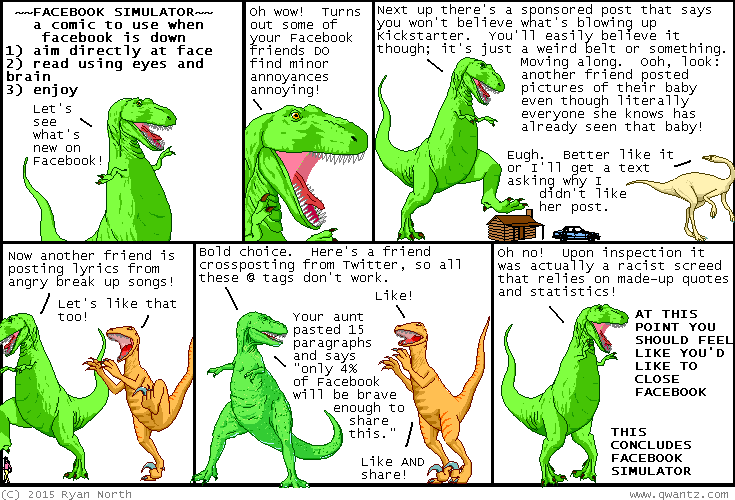
a comic to use when facebook is down, or, if i may be so bold: also when facebook is up
| archive - contact - sexy exciting merchandise - search - about | |||
 |
|||
| ← previous | November 18th, 2015 | next | |
|
November 18th, 2015: Can Facebook TRULY be replaced by a 58kb png file? This creator of the 58kb png file says: yes! – Ryan | |||
RC, Emily.f.hamilton and 2 others like this
19 Nov 10:35
Google says that Google+ is fetchin’ — here’s what would make it work
by Fred Clark
Dear Google, you still want to make Google+ a thing? Well, first you need to apologize for killing Google Reader and for getting rid of the blog search option.
Those were great moves for Facebook and the AOL-ization of the Web — but they were both really, really bad news for bloggers and blog readers. Fix that, then maybe we’ll talk about Google+ as something other than a punchline.
Here’s what might interest me in Google+: Give it a trackback feature. Only better.
 For a few glorious weeks in the early 21st century, we had this thing called “Trackback.” It was terrific. You’d write something on your blog or website and it would ferret out any other blog posts or websites engaging with that content. It spawned links and conversations and cross-pollinations that would never have otherwise occurred. It got us talking — and listening.
Then Trackback drowned in a flood of spam for Cialis and porn sites and clickbait and all the garbage we’d probably refer to as the “darkweb” if that didn’t already mean something else. But we still need something like Trackback, and we still miss it.
Now more than ever, since our time on the Web has gotten splintered into various platforms. A cross-platform trackback function that encompassed all of those platforms — publishers, blogs, Twitter, Facebook, Yelp, LinkedIn, YouTube, Amazon reviews … the whole shebang — would be invaluable. And it seems like something the folks at Google ought to be able to pull off, maybe better than anyone else.
Done right, it could also be a way of reclaiming the Web from parasitic aggregators and click-baiters. That click-bait ad linking to some aggregator’s sloppy rewrite of a Cracked.com article? It would now track back to the original content it hijacked/stole, restoring traffic and attention and credit to where it belongs.
When I see the next-generation of Google+ offering something like that — something that rewards content-creators, thereby encouraging the creation of content — then I’ll start paying attention. Until then, I’ll just assume that Google+ will continue to be — like Facebook — another gated community designed to make all those content creators work for its benefit, for free. And that is, to use Google’s own word, evil.
Myrddinn likes this
19 Nov 10:33


My comments on the Government’s call for evidence on Freedom Of Information
by Mike Taylor
The UK government is presently running a call for evidence on Freedom of Information. (It closes at midnight tonight, so if you want to contribute, get your skates on! Here’s a simple way to do it.)

Here is the submission that I just sent.
Q. Why do you think Freedom of Information should be protected?
We repeatedly hear various governments claiming they are going to be “the most open government” ever. In practical terms, the Freedom of Information Act has been by far the most significant part of a fulfilling this claim.
Q. How do you think government transparency could be improved?
Private companies providing public services should most certainly be subject to FOI. In accepting public money, they place themselves in a position of trust, and with that comes responsibility to the public who they serve.
Q. What protection should there be for information relating to the internal deliberations of public bodies? For how long after a decision does such information remain sensitive?
I do not feel that any changes are required to the present rules on what kinds of information are exempt.
Q. What protection should there be for information which relates to the process of collective Cabinet discussion and agreement? Is this information entitled to the same or greater protection than that afforded to other internal deliberative information? For how long should such material be protected?
The notion of exempting Cabinet discussions from FOI is absurd. The higher the level of discussion, the more crucial that it be exposed to public scrutiny — that what is done in our name by our representatives should be apparent to us. Adding this exemption would critically reduce the value of FOI. It should certainly not be done.
Q. What protection should there be for information which involves candid assessment of risks? For how long does such information remain sensitive?
There is a very fundamental principle at work here: when public money is being spent, the public has a right to know and understand the basis on which the spending decisions are made. In absence of such knowledge, the notion of “open government” is farcical. This pertains particularly in the case of risk assessments, as we should all understand from the many cases in which risks have been underplayed in ways that, in retrospect, seem obvious. Many eyeballs make assessment more robust. Public scrutiny will help to ensure that the best and wisest decisions are made, and that opportunities for corruption are minimised.
When attempting to extend surveillance in ways that infringe on the civil liberties of citizens, the Government repeatedly uses arguments along the lines “if you have nothing to hide, then you have nothing to fear”. That idea surely applies far more strongly to the deliberations of public bodies than to the communications of private citizens.
Q. Should the executive have a veto (subject to judicial review) over the release of information? If so, how should this operate and what safeguards are required?
Given how disastrous our illegal involvement in the Iraq war was, it seems that the use of ministerial veto in this case was spectacularly wrong — though we will only know how wrong when the Chilcot Inquiry is finally complete. Similarly, most informed opinion of recent NHS reforms is that they are harmful. Hiding these discussions has not been in the public interest — and government exists only for the public interest. For this reason, I would if anything weaken the right of ministerial veto; certainly not strengthen it.
Q. What is the appropriate enforcement and appeal system for freedom of information requests?
Authorities should have to justify decisions about FOI; otherwise the whole process is a shame. An organisation which can decline an FOI request and say nothing about why they have done so is not effectively subject to FOI at all.
Q. Is the burden imposed on public authorities under the Act justified by the public interest in the public’s right to know? Or are controls needed to reduce the burden of FoI on public authorities?
I would not necessarily oppose the introduction of a SMALL fee — say £1 — to discourage the bulk issuing of frivolous requests. However, in many cases, multiple separate FOI requests are necessary in order to legitimately obtain related information from a range of institutions, and large fees must not be allowed to discourage this.
For example, the eminent mathematician Sir Tim Gowers and others have used multiple FOI requests to UK universities to determine how much money they spend each year on subscriptions to the scholarly journals published by Elsevier — information which the universities would otherwise have been forbidden to disclose by ND clauses in their contracts with the publisher. This information is now freely available and may be analysed by anyone. An analysis by Zen Faulks shows that there is essentially no correlation between the size of a university and the amount it pays Elsevier. Armed with this information, UK universities will be better able to use their public funding by renegotiating their contracts with a publisher who at present extracts more than £18M from the 24 Russell-Group universities alone. By using FOI requests to turn an opaque, dysfunctional market into a transparent, efficient one, Gowers and his colleagues have probably saved UK Higher Education £5-10M per year — something that could never have happened had FOI fees been too high.
18 Nov 18:00
Five Comments on Hamilton
by Abigail Nussbaum
If you're like me, you probably spent some portion of the last six months watching your online acquaintance slowly become consumed with (or by) something called Hamilton. And then when you looked it up it turned to be a musical playing halfway around the world that you will probably never see. But something strange and surprising is happening around Hamilton--a race-swapped, hip-hop musical
18 Nov 15:14
My sweet embraceable you
by Fred Clark
“The posable Anton LaVey action figure is back,” Christian Nightmares tells us. And that prompts me to share this, from the appendix to Jon Trott & Mike Hertenstein’s fine book, Selling Satan: The Evangelical Media and the Mike Warnke Scandal:
“What would you like to hear?” The question was addressed to us by America’s Most Famous Satanist. He sat on a swivel chair in his kitchen, surrounded on three sides by triple-decked synthesizer keyboards. Blanche, the “Doctor’s” bleached-blond Boswell, stood nearby, looking like a mobster’s moll. She turned and asked me and my colleague, Jon Trott, if we wanted another cup of Folger’s instant.
“Sure.” It was getting very late and we’d been talking since dinner. “And, uh,” I said, turning back to LaVey, “how about some Gershwin?”
Anton Szandor LaVey snatched up a songbook off of one of the keyboards in front of him and leaned over the kitchen table to hand it to Blanche. “Read some of those titles for me,” he commanded. Then, turning back to Jon and me, he cooed, “Gershwin wrote so many wonderful songs.”
As Blanche rattled off song titles, LaVey doodled away on two or three of his keyboards at once: “Somebody Loves Me,” “Embraceable You,” even “Rhapsody in Blue.” He changed settings on the synthesizers as he played, fashioning a saxophone sound here, a little bassoon there, reserving a small Casio on the side for the occasional kettle drum roll. A little of the carny organ player was still in evidence.
He finished his medley with a great flourish and looked up. “Gershwin was a good Satanist,” he said.
Trott and Hertenstein couldn’t quite figure out what to make of LaVey, the author of The Satanic Bible and the founder, in the 1960s, of what he called the Church of Satan. But they could tell the old showman was more Barnum than Brimstone. They seem reluctantly fond of him. (LaVey died in 1997, just a few years after he hosted them for dinner.)
The odd account of their cordial, almost old-fashioned evening with LaVey makes for a strange conclusion to their long investigation into the cynical scam perpetrated by Warnke. Both men were sensational self-promoters and entrepreneurs. LaVey, born Howard Stanton Levey, reinvented himself as an occultist and made a living pretending to be a Satan-worshipper. Warnke reinvented himself as an ex-Satan-worshipper and made a living pretending to be an evangelist.
And thus LaVey is, in their book, a more sympathetic figure. Even despite the instant coffee.
In any case, I’m sure he would have loved that action figure. And the Anton LaVey Pez dispenser too.
18 Nov 11:37
Hardball Questions For The Next Debate
by Scott Alexander
Dr. Carson:
One of your most important achievements as a neurosurgeon was inventing the functional hemispherectomy, a treatment for epilepsy in which the epileptic hemisphere of the brain is severed from the healthy hemisphere and the body, allowing the healthy hemisphere to have full control of the body free from any epileptic interference. Children who get a functional hemispherectomy sufficiently early will be partly paralyzed on one side, but they will mostly be seizure-free.
Standard hemispherectomies remove the epileptic hemisphere from the body, but that tended to cause hydrocephalus, so your technique instead just severed all of its sensory and motor connections, leaving it present but inert.
But an anonymous neuroscientist on Reddit expressed some concern that just as the functional hemisphere seems to develop full independent personhood after the split, so the epileptic hemisphere may do so as well. Obviously it remains impaired by the epilepsy, but it’s not seizing all the time, so there will still be comparatively lucid intervals.
So my question for you is – what do you think happens to that person who is in an empty hemisphere, locked out of all sensory input and motor control? Do you think they’re conscious? Do you think they’re wondering what happened? Do you think they’re happy that the other half of them is living a happy normal life? Do they sit rapt in unconditioned contemplation of their own consciousness like an Aristotelian god? Or do they go mad with boredom, constantly desiring their own death but unable to effect it?
Also, a follow-up question. You solve paediatric epilepsy by severing all connections between right and left, consigning one to the outer darkness and turning complete control over to the other. Given that you’re trying to become President, that has obvious kabbalistic implications. Do you stand behind those kabbalistic implications or not?
Ms. Fiorina:
One of the issues that’s played a central role in your campaign is your belief that the Ottoman Empire was the greatest civilization in the world. Certainly their five-hundred-plus year reign was marked by impressive military, political, and artistic achievements. But I want to bring up a particular aspect of Ottoman governance today.
One of the really unique Ottoman innovations was its so-called “millet system”, where every ethnicity and religion was almost its own little empire-within-an-empire. For example, although the Ottoman Empire was itself Muslim, Christians within it got their own millet, led by the Patriarch of Constantinople. They made their own laws, which applied only to Christians, settled disputes between two Christian claimants, levied taxes from Christians to pay for Christian-related projects, and generally kept their own people in line. When the Ottoman Empire as a whole wanted something from its Christian population, the Sultan would meet with the Patriarch and they would hammer it out. There were similar structures in place for Jews, Armenians, et cetera.
The past few years have seen an almost unprecedented rise in identity politics in America, usually marked by the claim that the society is using its weight to kick around people of some identity or another. Society is kicking around blacks. Society is kicking around conservative Christians. Society is kicking around bisexuals. They all feel like they’re getting the short end of the stick, but a lot of their preferences are mutually exclusive, and it’s hard to imagine some kind of centralized government policy that could satisfy any of them.
As an admirer of the Ottoman Empire, you’d be in a uniquely good position to import some of the advantages of the millet system into the modern Western world. Obviously this would be complicated given all the conflicting identity claims and the close quarters in which everyone is intermingled, but there are already some visions of what it could look like – including my own Archipelago – and if it were raised to the level of a national discussion, people could no doubt come up with many more.
So my question for you is – weren’t you a pretty crappy CEO?
Mr. Bush:
Assume that fitness-to-be-President is a normally distributed trait with known heritability. Suppose also that past elections have 100% efficiency; that is, they always choose the most qualified candidate. We can then use some of the standard regression-to-the-mean equations to determine the chances that the highest fitness-to-be-President individual in generation G will be the offspring of the highest fitness-to-be-President individual in generation G-1.
The single most fit-to-be president man in a population of 300 million would be about six standard deviations above the norm. If that man breeds with the single most fit-to-be-president woman, and if in keeping with findings for other complex traits heritability is about 60%, we would expect their offspring to be about 3.6 standard deviations above the mean in fitness-to-be-president. One in every 2500 or so people is 3.6 standard deviations above average, meaning there would be at least 120,000 equally good or better presidential candidates than they in the United States.
How high would the heritability of presidential fitness have to be before there was at least a 10% chance that the offspring of the two most presidential Americans was himself presidential material? My calculations suggest about 90%, which is very high compared to what we know about similar traits – but actually not entirely outside the realm of plausibility.
But if a maximally-presidential man breeds with a woman who is less than maximally presidential, the odds fall precipitiously. Suppose that a maximally-presidential man breeds with a woman who is merely in the 99th percentile for presidential ability. Now given a heritability of 60% there will be three million Americans more presidential than their average offspring. Even given a 100% heritability, there is only a 1/73 chance that their offspring will themselves be worthy of the presidency.
So my question for you is: do you think Barbara Bush is an unrecognized political super-genius, or are there probably hundreds of thousands of Americans who would make a better president than you would?
Senator Cruz:
You were on your college debate team, and you were good at it. Really good. You won the national championships and you were pretty widely believed to be the best debater in the country. Quite an achievement. But my worry is – which is more likely? That the best debater in the country would also be the best choice for President? Or that he would be really really really good at making us think that he would be?
Don’t respond yet. Before you answer that question – well, before you answer any question – we’ve got to think about this on the meta-level. There’s a classic problem in epistemology. Suppose that we have a superintelligence with near-infinite rhetorical brilliance. The superintelligence plays a game with interested humans. First, it takes the hundred or so most controversial topics, chooses two opposing positions on each, writes the positions down on pieces of paper, and then puts them in a jar. Then it chooses one position at random and tries to convince the human of that position. We observe that in a hundred such games, every human player has left 100% convinced of the position the superintelligence drew from the jar. Now it’s your turn to play the game. The superintelligence picks a position from the jar. It argues for the position. The argument is supremely convincing. After hearing it, you are more sure that the position is true than you have ever been of anything in your life; there’s so much evidence in favor that it is absolutely knock-down obvious. Should you believe the position?
The inside view tells you yes; upon evaluating the argument, you find is clearly true. The outside view tells you no; judging from the superintelligence’s past successes, it could have convinced you equally well of the opposite position. If you are smart, you will precommit to never changing your mind at all based on anything the superintelligence says. You will just shut it out of the community of entities capable of persuading you through argument.
Senator Cruz, you may not quite be at the superintelligence level, but given that you’ve been recognized as the most convincing person out of all three hundred million Americans, shouldn’t we institute similar precautions with you? Shouldn’t your supporters, even if they agree with everything you are saying, precommit to ignore you as a matter of principle?
Senator Rubio:
When you became Florida’s Speaker of the House, one of the other men on stage here tonight, Jeb Bush, presented you with a golden sword, which he said was the “Sword of Chang”. He told you that “Chang is somebody who believes in conservative principles, believes in entrepreneurial capitalism, believes in moral values that underpin a free society. Chang, this mystical warrior, has never let me down.” You looked pretty excited about it.
Now, some might say that this all came from a giant misunderstanding. Back in the late 1940s, Mao Zedong’s victorious Chinese communists forced Chiang Kai-shek’s defeated Chinese nationalists to retreat to the island of Taiwan. The United States kept the peace in the the Taiwan Strait, mostly to prevent Mao from invading and finishing the job, but a common refrain in 1950s conservativism went that we should “unleash Chiang”; that is, advise Chiang Kai-Shek to go back across the strait and reconquer China. George H. W. Bush served as envoy to China, had to listen to this sort of stuff, and got annoyed enough at the “unleash Chiang” rhetoric that he would quote it ironically at bizarre times, like his documented habit of threatening that his serve would “unleash Chiang” on his tennis opponents. It’s unclear how we got from George H. W. Bush’s constant threats to “unleash Chiang” on people, to his son’s belief that Chang was a mystical conservative warrior. Maybe it was a joke, either Bush Sr. pranking Jeb or Jeb pranking you.
In any case, you hung the sword in “a place of honor in your office”. From that point forward, Jeb’s fortunes declined. He left the Florida governorship, failed to get any further high positions, and then ran a very lackluster Presidential campaign. But from that same point your own fortunes decidedly rose. You started a law firm, were appointed a professor, got elected to the Senate, and are currently running a spectacular Presidential campaign with most pundits betting on your eventual victory after Trump and Carson lose their shine. The connection between the transfer of the sword and the sudden switch in both your fortunes is so striking that even the Huffington Post, not normally a source for magic-sword-related journalism, wrote about it: Jeb’s Last Hope – Reclaim the Sword of Chang.
But here we have a conundrum: if there was never a mythical Chinese warrior named Chang, by what magic does this sword grant worldly success to its possessor and ignomious ruin to any who lose it? There is a legend that fits almost exactly: the tale of the Holy Lance, aka the Spear of Destiny, aka several other portentious sounding names. According to the story, this relic from Christ’s crucifixion grants victory to all who own it and swift ruin to all who lose it. Charlemagne was reputedly the first to make use of its power; he was unstoppable while he wielded it but died moments after dropping it during battle. The same pattern repeated with Frederick Barbarossa, then a host of other military leaders, until finally it passed to the Austrian Habsburgs. They realized its power, locked it away, and ended up winning the greatest empire in European history. Supposedly Hitler was obsessed with it, so much so that his fascination with the object inspired the depiction of Nazi archaeologists in Raiders of the Lost Ark, and he took it for himself after the Anschluss. As the war wound down, the relic caught the special attention of General George Patton, who brought it back safely to Vienna afterwards. But ever since that time there have been various rumors that it was a fake, and that Nazi sympathizers took the real Lance in preparation for the time when the Reich would rise again.
The book Secrets of the Holy Lance
Reporters John Buchanan and Stacey Michael cite recently declassified documents from the US National Archives that indicate that Prescott Bush “failed to divest himself of more than a dozen enemy national relationships that continued until as late as 1951. Bush conducted business following the end of World War II with moving assets into the Nazi refuges of Argentina, Panama, and Brazil.
So Prescott Bush was involved in moving Nazi “assets” from conquered Europe to South American refuges, presumably including the true Lance. Far be it from me to impugn his business ethics, but I don’t remember Nazi refugees in Argentina becoming an unstoppable force aided by a weapon of legendary mystical power. On the other hand, I do remember Prescott Bush being elected to the United States Senate just a few years later. Then his son and the presumed heir of his property was elected US President. Then his son was also elected US President. I need not add that according to the the laws of genetics, the chance of this happening by coincidence is hundreds-of-thousands to one even assuming implausibly high heritability of the fitness-to-be-president trait. Then his other son starts rocketing up through the ranks right up until the moment he gave you the sword of Chang, a sword named after a weird Bush family in-joke about a Chinese mystical warrior who doesn’t exist.
I think we can start to sketch out a plausible explanation here. Hitler didn’t want the Holy Lance falling into the hands of his enemies, so he replaced it with a fake and hired Nazi-artifact-smuggler Prescott Bush to transport the real one to safety in South America. Bush realized what he had, handed the South Americans a second fake, and kept the real one for himself, reforging it from a lance into a sword to cover his tracks – an action entirely in character for Prescott Bush, whose other relic-stealing adventures include the theft of Geronimo’s skull. He died unexpectedly without getting the chance to explain the significance of the artifact to his son George H. W. Bush. But since it seemed like a sentimentally important heirloom, George took care of his father’s weird golden sword anyway. When his sons asked him about it he didn’t have a real answer, so he just made his favorite in-joke about “unleashing Chiang”, and they believed him. Then eventually it passed to George W, later on to Jeb, and then Jeb thought it would be a funny present to give you to honor your election as Florida speaker.
Obviously the Lance is a significant strategic asset for America, and I imagine if you were President then its aura of victory would apply to the country as well, much as the Habsburgs’ possession of the lance enlarged Austria-Hungary. However, its powers are generally held to come from the Antichrist.
So my question for you is, do you think it’s ethical to use your magic sword to channel the power of the Antichrist if that would ensure America’s military success?
Mr. Trump:
You are famous both for your vast corporate empire and for your tendency to name the pieces of that corporate empire after yourself. By my count there are six buildings named “Trump Tower”, ten named some variation on “Trump Hotel”, a Trump Building, a Trump Palace, and a Trump Estate. You founded a financial services group called Trump Mortgage, a modeling agency called Trump Model Management, a bottled water brand called Trump Ice, and a magazine called Trump Magazine. You also started an airline called Trump Airlines, a TV company called Trump Productions, a book series called Trump Books, and your own radio talk show called Trumped!. There are also several Trump-themed games, like Donald Trump’s Real Estate Tycoon and Trump: The Game
Mother Jones wrote a great article on this last one. Trump: The Game seems to be a tacky Monopoly clone. Players move around a board and bid on properties, and when one of them gets locked out of bidding for a property the other player gets to say “YOU’RE FIRED” the same way you do on your show. The only way to get back in to a property once you’ve been fired is to use the game’s most powerful card, which has a picture of your face on it and is called “The Donald”.
My question for you is: WHY DIDN’T YOU CALL IT THE TRUMP CARD?!?!!!!111111111asdfdf
ThePrettiestOne, Anthony.bramante likes this
18 Nov 10:55
Today's Video Link
by evanier
People who do impressions of Oliver Hardy often quote him as saying, "Here's another fine mess you've gotten me into." Okay…but what he said in those movies was "Another nice mess." The confusion is understandable since they did make one film — excerpted in the montage below — called Another Fine Mess. Here are a number of times he said it the way he said it…
The post Today's Video Link appeared first on News From ME.
18 Nov 10:49
Thought for the Day
by Andrew Rilstone
For suspicion often creates what it expects. “Since, whatever I do, the neighbors are going to think me a witch, or a Communist agent, I might as well be hanged for a sheep as a lamb, and become one in reality.”
Screwtape Proposes a Toast
18 Nov 10:48
The Rennard debacle: better to rock the boat than have the tail wag the dog
by James Graham
A week after being elected as the House of Lords Parliamentary Party’s representative to the Lib Dem Federal Executive, Chris Rennard has resigned – effectively forced out after Tim Farron publicly called for him to go. Farron’s statement itself followed a demand by more than 200 Lib Dem members for a special conference to debate the issue. I meant to blog about this a few days ago, so now I’m coming to the topic the storm appears to have passed, but I think there are wider implications worth reflecting on.
First of all, well done Tim Farron. Perhaps it is a low bar by which to compare him, but Nick Clegg in similar circumstances would almost certainly have shrugged his shoulders and sat on his hands.
Secondly, well done to the Rock the Boat team. I don’t think anyone really wanted a special conference to resolve this, but if it had not been threatened then I suspect there would have been far greater pressure on the leadership to just let it slide.
I’m not interested in revisiting the whole Rennard Saga here; suffice to say that several of the women who made allegations against him are my friends, I believe them and I knew about the allegations for years before they were made public. They kept quiet, in part out of loyalty to the party and, contrary to some of the allegations being made by some of Rennard’s supporters, had no motivation to go out and damage the party when they decided to go to the media about it. And, despite the attempts by some to present this as some kind of Benny Hill sketch, we were not talking about pinched bottoms here, but genitalia being groped in the most degrading manner. This is important to emphasise, because these are the allegations which Alastair Webster described as “broadly credible” and which Rennard himself semi-apologised for being an “inadvertent” encroachment of personal space.
The one thing that everyone involved appears to agree with is that the Alastair Webster investigation into these allegations was a botched affair, admittedly in no small part due to the absurd disciplinary rules which dictated that for action to be taken the allegations had to reach the criminal standard of proof, as opposed to the balance of probabilities. In this regard, we have seen no justice done. Rennard himself can hide behind Helena Morrissey’s comments about the case as much as he likes, but without a process anyone has any faith in, or even the tiniest degree of contrition on his part, he simply cannot expect people to let him off the hook. The women who made these allegations have now all resigned the party. If allegations of his nature had been found “broadly credible” by a formal investigation into my conduct, I would personally have been mortified and followed them.
As it stands, Rennard has made it perfectly clear that he isn’t going anywhere. Without wishing to invoke Pyrrhus of Epirus, don’t rule out Rennard standing for the one-member-one-vote Federal Executive elections next year, and if he does then he will certainly be elected with substantially more than the 6.25% of the vote he will require to get a seat; I wouldn’t rule him out getting elected with the most first preference votes. As anyone who understands the single transferable vote system knows, that’s a pretty meaningless accolade – it wouldn’t make him any less the most hated candidate as well – but it is certainly something he will gleefully use to defend his position, and forcing him out will be substantially harder than it was this time. So while today’s resignation is a victory, it will possibly prove to be merely a reprieve.
As for the Lords Parliamentary Party more widely, I think the party is now waking up to a problem that may ultimately cause it even greater headaches in the long run. In short, the Lib Dem presence in the House of Lords is now 14 times larger than its presence in the House of Commons. The Commons team has little prospect of shifting a single vote this Parliament; the Lords team will enjoy a deciding role in every single vote. Their status and capacity will dwarf our MPs, and that’s a bad place psychologically for the party to be in.
What we saw last week was a power play; an attempt to put a leader, who they don’t especially like very much, squarely in his place. I suspect they were bolstered by the outcome of the tax credit vote a fortnight ago, in which the party was loudly cheering them on. It was crass, ineffectual and ultimately has made them all look very stupid (despite him winning his election by 2 votes to 1, not a single peer has come out and publicly defended their decision to back Rennard; although I understand that Tony Greaves has been making noises on Lib Dem forums), but don’t expect them to back down now.
I’ve always struggled with the mindset in the Lords. Its members always have the air of philanthropic paternalism, great eminences who have deigned to take an interest in mortal affairs. The fact that they are all there because of political patronage, is barely reflected upon. I’ve been involved in politics long enough to see the transformation, from loyal happy-clappy, nodding-dog committee tourist to grand independently minded (of course!) Lord of the realm, happen several times. The pomp and circumstance, the history and the chance to decide on important matters of legislation all contribute to entrench in them an almost messianic mindset.
This almost religious atmosphere is only shattered when they are forced to think of themselves in terms of real life. When I was on the Federal Executive, the Lords all-but downed tools over attempts to block them from working as multi-agency lobbyists and taking the Lib Dem whip. The common refrain was that they needed to work in public affairs because otherwise they’d be force to live a life in penury. By contrast, when the other big internal party of the day on whether to hold elections for Lib Dem peers was discussed, another refrain was that peers had to be independently wealthy to be able to afford to spend time in the Lords. Of course, as a matter of fact both claims were nonsense; pro-rata their daily allowances vastly exceeds the London median wage, and that’s before you take into account travel expenses.
What I’m suggesting here is that there is something fundamentally unhealthy about appointing people for life to sit in a legislative chamber. It inculcates a sense of entitlement and privilege which should have no place in our political system; it corrupts. As a party we ought to be wary of this.
Does it mean going as fair as the Liberal Prime Minister Trudeau has gone in Canada and withdraw the whip from them all? I can see some merit in that, but also a lot of risks – especially with the Commons party now so small. But I do think that our constitutional structures need to better reflect the fact that peers are unelected, and that that is a problem.
Personally, I’d like to see the appointees of the House of Lords PP to various internal committees as subject to a veto by the committee itself. If the Lords are going to play games like they did last week and attempt to impose someone who the leader has already stated he can’t work with, then we shouldn’t find ourselves in a constitutional crisis; the committee should simply tell them to think again. And this should apply to anyone, whether they are someone who has several allegations of sexual misconduct made against them, or simply someone who is a bit of an idiot. The purpose of the FE, Federal Policy Committee and others is to conduct party business in a professional manner; they don’t have time for stunts. Otherwise all that will happen is that those bodies will cease to be the ones where the real decisions get made, as we already see far too much is the case for the FE (in no small part, ironically enough, due to the way Chris Rennard conducted himself when he was the party’s chief executive).
The peers themselves vigorously opposed attempts to hold internal elections for Lib Dem appointments to the House of Lords; ironically, if they hadn’t done so, that would have increased their own political standing within the party. As it stands, while we should be grateful for their work in providing a bulwark against grotesque government legislation, we must be equally robust in opposing any further attempts by them for the tail to wag the dog. The alternative will be a party that continues to look out of touch and is more in love with being the whiggish occasional voice of calm within the establishment rather than a radical force for change.
The post The Rennard debacle: better to rock the boat than have the tail wag the dog appeared first on Quaequam Blog!.
18 Nov 10:41

A Princess of Mars
by Lawrence Burton

Edgar Rice Burroughs A Princess of Mars (1912)
Whilst I appreciate the general concept of Edgar Rice Burroughs as an institution, I've had some trouble with his books, or at least with the two I've read. Both Tarzan of the Apes and Pirates of Venus seem reasonably well written but suffer from certain cultural details so resolutely of their time that I just couldn't get past the sound of my own wincing. A Princess of Mars, so I was told, was the one to go for, written before Burroughs' prose began to crumble under the pressure of curling off yet another sequel every three days; and against all odds, I enjoyed the recent film adaptation for what it's worth.
Just to get it out of the way, I suppose we should acknowledge that A Princess of Mars is roughly what has come to be known as pulp fiction, a term deriving - at least so far as I understand it - from the more populist magazines, the Astoundings and Amazings, having been used as pulp to pad out crates of more important stuff during the war - reet classy leather-bound editions of The Lord of the Rings for example, proper books which might be read by doctors or dentists. Whilst it's true that the tastes of the reading public tended to dictate the general kind of story which appeared in the Astoundings and Amazings, pulp as a vaguely pejorative term equating to gob-punching tales for thickies is misleading and generally akin to returning that Ramones album to the record store because you got it home and found it sounded nothing like Emerson, Lake and Palmer. Of course, some pulps were shite, but this is generally true of publishing regardless of whether it's the sort of thing one might find in the home of Margaret Attwood or people with 'O' levels; so it really comes down to either personal taste or snobbery, specifically the ideas that literature can do only one thing, or that there are certain things which it should refrain from doing if it wishes to hang out with the cool kids. The most amusing example of such double standards I have encountered was, perhaps unsurprisingly, in the book section of a Doctor Who bulletin board where discussion of Cody Schell's Señor 105 novellas prompted one individual to ask but are they not a little pulpy? I suppose I can see how our man might have wished to be forewarned in the event of his unwittingly dedicating time to the perusal of something of less philosophical complexity than Doctor Who and the Giant Robot. In my view, art must be judged principally on how well it does that which it sets out to do. Whether that which it sets out to do was worth doing in the first place is a quite different thing.
Returning now to the author of Tarzan of the Apes and Pirates of Venus, A Princess of Mars turns out to be similarly of its time, but not cripplingly so, at least not beyond allowing for the fact that swashbuckling adventure aimed at a particular kind of audience will tend to involve goodies and baddies. John Carter is a proud southern gentleman with most of the attendant associations, and yet nothing reading too much like the politics of a nutcase; and of course, he arrives on Mars with certain advantages over the people who actually live there because he's a white bloke and he understands chivalry and being a good egg and suchlike, although if that is an issue then it's one you probably should have anticipated before picking up a book with Edgar Rice Burroughs identified as author on the cover.
The only real problem here is that for my money, A Princess of Mars is barely science-fiction in so much as that it does very little of the stuff I like my science-fiction to do, the things which tend to keep me interested; and for all that it's at least as well written as anything by Wells, A Princess of Mars could just as easily have been set in North Africa, the wild west, or anywhere on Earth where English isn't spoken and they eat a different part of the cow. So it doesn't really do a great deal outside of the traditional adventuring furniture of captive princesses and bad-tempered natives who grudgingly accept you as one of their own after you've beaten up that one guy on the high council whom no-one really liked in the first place. To be fair, the Martian element - presumably in part inspired by Edwin L. Arnold's Gullivar Jones - is well drawn, but low on detail beyond a few faintly unsatisfying excuses made about special kinds of ray; and so the bulk of the page count is spent on fighting, with different groups of Martians battling each other for reasons which were probably mentioned somewhere or other; or on the well-being of a Princess - quite a nice looking one too, surprisingly; or on our man coming up with all these great ideas and everyone agreeing how brilliant he is.
I suppose how much you're likely to enjoy this sort of thing depends on how much you enjoy this sort of thing, and whilst I don't actually find it offensive, and I can appreciate that Burroughs had an agreeable turn of phrase, A Princess of Mars just isn't my bag. That isn't to say I particularly disliked any aspect. On the contrary, there's plenty to recommend this one, not only the local colour and the pleasant, well-tuned prose, but even the fact of at least one party of warring Martians almost certainly amounting to Red Indians in space and revealing, in this instance, a degree of cultural sensitivity I hadn't really expected from Burroughs.
Whilst I appreciate the general concept of Edgar Rice Burroughs as an institution, I've had some trouble with his books, or at least with the two I've read. Both Tarzan of the Apes and Pirates of Venus seem reasonably well written but suffer from certain cultural details so resolutely of their time that I just couldn't get past the sound of my own wincing. A Princess of Mars, so I was told, was the one to go for, written before Burroughs' prose began to crumble under the pressure of curling off yet another sequel every three days; and against all odds, I enjoyed the recent film adaptation for what it's worth.
Just to get it out of the way, I suppose we should acknowledge that A Princess of Mars is roughly what has come to be known as pulp fiction, a term deriving - at least so far as I understand it - from the more populist magazines, the Astoundings and Amazings, having been used as pulp to pad out crates of more important stuff during the war - reet classy leather-bound editions of The Lord of the Rings for example, proper books which might be read by doctors or dentists. Whilst it's true that the tastes of the reading public tended to dictate the general kind of story which appeared in the Astoundings and Amazings, pulp as a vaguely pejorative term equating to gob-punching tales for thickies is misleading and generally akin to returning that Ramones album to the record store because you got it home and found it sounded nothing like Emerson, Lake and Palmer. Of course, some pulps were shite, but this is generally true of publishing regardless of whether it's the sort of thing one might find in the home of Margaret Attwood or people with 'O' levels; so it really comes down to either personal taste or snobbery, specifically the ideas that literature can do only one thing, or that there are certain things which it should refrain from doing if it wishes to hang out with the cool kids. The most amusing example of such double standards I have encountered was, perhaps unsurprisingly, in the book section of a Doctor Who bulletin board where discussion of Cody Schell's Señor 105 novellas prompted one individual to ask but are they not a little pulpy? I suppose I can see how our man might have wished to be forewarned in the event of his unwittingly dedicating time to the perusal of something of less philosophical complexity than Doctor Who and the Giant Robot. In my view, art must be judged principally on how well it does that which it sets out to do. Whether that which it sets out to do was worth doing in the first place is a quite different thing.
Returning now to the author of Tarzan of the Apes and Pirates of Venus, A Princess of Mars turns out to be similarly of its time, but not cripplingly so, at least not beyond allowing for the fact that swashbuckling adventure aimed at a particular kind of audience will tend to involve goodies and baddies. John Carter is a proud southern gentleman with most of the attendant associations, and yet nothing reading too much like the politics of a nutcase; and of course, he arrives on Mars with certain advantages over the people who actually live there because he's a white bloke and he understands chivalry and being a good egg and suchlike, although if that is an issue then it's one you probably should have anticipated before picking up a book with Edgar Rice Burroughs identified as author on the cover.
The only real problem here is that for my money, A Princess of Mars is barely science-fiction in so much as that it does very little of the stuff I like my science-fiction to do, the things which tend to keep me interested; and for all that it's at least as well written as anything by Wells, A Princess of Mars could just as easily have been set in North Africa, the wild west, or anywhere on Earth where English isn't spoken and they eat a different part of the cow. So it doesn't really do a great deal outside of the traditional adventuring furniture of captive princesses and bad-tempered natives who grudgingly accept you as one of their own after you've beaten up that one guy on the high council whom no-one really liked in the first place. To be fair, the Martian element - presumably in part inspired by Edwin L. Arnold's Gullivar Jones - is well drawn, but low on detail beyond a few faintly unsatisfying excuses made about special kinds of ray; and so the bulk of the page count is spent on fighting, with different groups of Martians battling each other for reasons which were probably mentioned somewhere or other; or on the well-being of a Princess - quite a nice looking one too, surprisingly; or on our man coming up with all these great ideas and everyone agreeing how brilliant he is.
I suppose how much you're likely to enjoy this sort of thing depends on how much you enjoy this sort of thing, and whilst I don't actually find it offensive, and I can appreciate that Burroughs had an agreeable turn of phrase, A Princess of Mars just isn't my bag. That isn't to say I particularly disliked any aspect. On the contrary, there's plenty to recommend this one, not only the local colour and the pleasant, well-tuned prose, but even the fact of at least one party of warring Martians almost certainly amounting to Red Indians in space and revealing, in this instance, a degree of cultural sensitivity I hadn't really expected from Burroughs.
17 Nov 16:00
My response to the Liberal Democrats Governance Consultation
by Zoe O'Connell
The Liberal Democrats are currently conducting a consultation on governance, the details of which can be found here. (PDF Link) As I bang on repeatedly about transparency and accountability in my response, it seems appropriate to make my response public – but be warned, at 3,800 words it’s quite long! I have been a little tardy submitting this as the deadline for responses is noon tomorrow, but there is still time left to respond if you wish. You might also want to read the responses of Jennie Rigg and Andy Hinton. (If you know of any more public responses, please let me know and I will list them here)
Although I wrote the response, Sarah Brown offered some input and endorses the points below.
Party Values
Q1 Are these still our values?
The language is a little dated in places, and most notably the list of protected characteristics is missing “gender identity”, but yes.
Q2 Are these values embedded into our party structure at all levels, members, volunteers, elected office holders and paid staff?
Belief in these values is embedded at all levels. Execution, as with many organisations of any size, can fall short.
Q3 What does the party do well to live its values?
Doing the right thing, not the politically expedient thing. Examples of this are legion, so I will not list them here.
Q4 What does it need to improve?
Communication and transparency. It should not be unexpected that overworked staff and volunteers usually have concerns other than communicating the results of meetings that, on the whole, will be dealing with routine and mundane matters. The only way this can happen is by elected office holders continuously pushing for more openness.
Q5 What should the party stop doing or do less of?
Poorly (If at all) communicated decisions. The externally-facing party may have a PR and communications machine, but those of us on internal committees do not. There is sometimes a reluctance to share some conversations that need not remain private because the public may see them badly, but if the party PR machine and Federal Executive have concerns about internal committee decisions being communicated accurately then resource needs to be assigned to this in just the same was as it is to, for example, conference motions.
The party also often tries to do things centrally, such as diversity, that those involved have limited experience and training on. The General Election 2015 campaign was a good example of this.
Q6 What should the party start doing or do more of?
Two-way communication with members. All-members emails giving the agenda for an upcoming sub-committee of the Federal Executive would clearly be excessive, but at least some of that that information should be online where interested members know to look. Two prominent examples where things need improvement are that the full results of previous committee elections are only available via a member’s web site and that the contact details of federal committee members are not made available, even if the committee members would be quite happy for details to be available to other members.
Committee membership pages need to be kept up to date and more complete. Several entries on the pages for the FE, FCC and FPC are incomplete and contain no text or photo or have information that is months or years out of date.
There is merit in establishing a part-time post whose role is internal communication – not of the Ad Lib or Newsletter variety, but responsible for updating the web site with all these details and minutes of meeting. I appreciate that funding such a post would be nearly impossible in current circumstances.
Q7 If we believe in power being exercised at the lowest level possible, how do we make sure that decisions are made as close to members as possible?
By letting members know that a decision will be taken in the first place, or that is has been taken so that it can properly be scrutinised. We have a hierarchical system with local parties at the bottom, but if local parties do not know what those at HQ are doing they are not able to influence the outcome. We already have consultations, such as this one, on major issues but very little information is available on who is making day-to-day decisions or will be voting at various Federal Committees.
Whilst opportunities for new Liberal Democrat peers will be limited at best in this parliament, thought should also be given to re-introducing Interim Peers List elections. At absolute worst it shows we are taking the problems seriously, but in better times will ensure that the House of Lords is kept supplied with an influx of members who are in-touch with the wider membership.
Governance Values
Q8 What should our strategic priorities be in determining the party’s structure?
Re-evaluation of the powers and role of some of the “middle-management” committees with a view to creating a more accountable and transparent structure. At the moment, some of these committees make decisions that can end up being the focus of internal party controversy when little is known about the membership of the committees and where there is no opportunity for the wider membership to hold them to account. Troubles in recent years with, to pick just two examples, the FFAC and English Council have often led to choruses of “Who are they?” and “Who sits on them?”. In the case of the FFAC, it is not even listed on the party’s web site.
Q9 What powers or decision making within the party could be placed at a more local level than at present?
A review of some of the “middle-management” committees could push power more towards regional parties – who can be held to account by their regional conferences.
Q10 How can we ensure that there is, in our governance, greater: a) selflessness, b) integrity, c) objectivity, d) accountability, e) openness, f) honesty?
More openness will inevitable lead to more of the other.
Q11 Are there any other principles that should underpin our governance?
I will simply quote Jennie Rigg’s one-word response to this question: “Justice”.
Transparency and Accountability
Q12 How do we balance the ideal of transparency against the need to prevent information useful to our opponents reaching them?
This question needs to be asked, but it troubles me that it needs to be asked in a party that is full of serving and ex-councillors and MPs for whom this should be second nature. Very little information is genuinely of value to political opponents and it makes up a small proportion of the information that should not be public – for example, future campaigns, the detail of any disciplinary hearings or the location of future conference venues which could cause personal embarrassment or financial issues for members if made public. If members of committees and groups are in the habit of flagging which agenda items and papers are confidential versus public, as often happens in council meetings, that will make the work of those who have been elected on a platform of transparency and openness that much easier.
Q13 Which levels of the party should have public-facing activities and which should not? What are these activities?
“Public facing” seems to mean “employs staff to handle PR”. It should be up to each organisation within the party to determine if it needs to do this, on the understanding that lack of a PR function does not mean that decisions made by that organisation should not be communicated to members.
Q14 Should the party consider having more direct public (i.e. non-member) input into the organisation, and if so what form would this take?
Outside of policy working group consultations, where it already happens, no.
Q15 Are there some basic principles we should use when amending our governance structure? Please note this is not a request for which committee to abolish! We want to understand what members want to know or monitor, and how you can feel that this is your party.
Review the process of electing members to committees where the electorate is not party-wide. Even committees that are not entirely appointed are made up of reserved places from other groups and “representatives” from other committees to the point that – on the FE – directed elected members are barely in the majority. These posts should be kept to an absolute minimum or abolished and power handed to the democratically elected members of the committee to co-opt suitable members, should they feel the need.
Whilst expanding the committee system would not be helpful right now, we should absolutely not be looking to abolish, reduce or limit the powers of the directly elected federal committees. That would concentrate too much power in too few hands, many of whom will be excellent, talented and well meaning people but still not accountable to the membership.
Q16 Do you want to see minutes of every meeting on the party website, reports on Lib Dem Voice and other blogs of party meetings? How should the party manage this openness of information with the few matters that are genuinely confidential?
I appreciate that there will be meetings whose topics will be entirely confidential but these should be the minority and certainly want to see us head in the direction of publishing more details. I am pleased to have been able to do this for Federal Conference Committee. Credit is also due to Mary Reid from LDV who has helped make this possible.
Unfortunately, continuing the theme of lack of details on the party web site mentioned earlier, even when minutes have been sent to HQ by the chair of committees it has been many months before they have been put up because this is not a staff priority.
I have skipped Q17-Q23 as I do not feel I have anything constructive to add that others have not already said better than I.
Respect for each other
Q24 Should we change the way our discipline structures work to streamline and simplify them?
To the extent that it is possible to do so whilst maintaining trust and integrity, yes. I am aware of cases where the party disciplinary procedure has been used, typically by those outside the party, to harass prominent members of the party who are also members of marginalised groups and where members have been subject to double jeopardy on procedural grounds. Opportunities to use our disciplinary system against us for less-than-honest purposes should be kept to a minimum, where that is compatible with justice, and members should never face double jeopardy except in the most serious cases.
On any topic that involves members of marginalised groups and sub-cultures, input should be sought from an appropriate body (Often AO or SAOs) as early as possible to ensure sensitive handling.
Q25 How do we make sure that systems of accountability are properly in place at a local, regional, state and federal level, so that reporting and monitoring procedures work for members?
Reporting back in an anonymous fashion, perhaps to regional conferences that investigations are taking place. For example: (And this is entirely fictional) “Fred Bloggs was appointed to lead an investigation following complaints of harassment made against a local party chair in Essex. The complaints were made by one member of the public, and the investigation concluded no further action was required”. Some councils do this well (Including my own council, Cambridge City) and their example cam be followed.
This will indicate to the membership that these issues are being taken seriously and investigated, because at the moment many are unaware that investigations happen at all.
Q26 What do members what from the complaints and disciplinary processes? Should there be a stronger focus on early mediation and speedier resolution of problems?
That justice is done and that it is done in a way that people have trust in. On speedy resolution, see my answer to Q24.
Diversity
The figures presented on page 11 of the consultation paper are misleading at best and it concerns me that this table has now been published widely across the party without giving (S)AOs the chance to check the figures for accuracy.
- Sources are not given, but there have been a number of studies conducted by the ONS that a 2% LGB figure could have been taken from. However, the sexual identity figures are considered experimental by the ONS and have attracted criticism from many organisations and activists. Confusion arises by taking only those individuals who were willing to out themselves as part of the survey and state that they were LGB and ignores the high levels of “Don’t know” (3.6%) and “Other” (0.4%) responses and those who were unable or unwilling to answer. (0.7%) A detailed discussion of the problems with LGB population estimates would be too lengthy to include here, but a figure of 6% – which was also used by the DTI in costing the introduction of civil partnerships – is often used.
- The 2% ONS figure has been quoted in the paper as covering LGBT+, whereas the ONS data only covers LGB. Although overlap between various groups means that simple addition is not possible, EHRC figures show that as much as 1% of the population falls under the protected characteristic of “Gender Reassignment” (with lower numbers actually identifying as trans*) and up to 0.4% identify to some degree as non-binary. Additionally, 1-2% of the population have intersex variations, covered under the “+” of LGBT+.
- It is unclear what is meant by “Federal Conference” or “Regional Conference”. (Those registered to attend or voting reps? How was this data collected?) Although, based on data collected by LGBT+ Liberal Democrats prior to the election, the figure of 6% for LGB&T candidates is accurate the 18% given for Local Party Officers is surprising and without more evidence I would have to say unbelievable. No current or former Local Party Officers or conference representatives I have spoken to can recall ever having completed an equalities monitoring form.
- There is insufficient breakdown to produce any useful analysis and basing decisions on the aggregate numbers risks making an already unequal situation worse. For example, we know that LGBT+ Westminster candidates are overwhelmingly white, cisgendered gay men – of 38 known LGB candidates, 36 (95%) were men. Similar breakdown is needed for all other figures – as an example of good practice, the Workforce Reports submitted to Cambridge City Council’s Equalities Panel, of which I am a member, includes 19 categories of “ethnic origin”. This allows the council to see if certain minorities within minorities are under represented, even if the overall figure looks healthy – as is the case with lesbian and bisexual women within the party hierarchy.
Q27 What can members and the party do to embed our values about diversity into the party?
Let (S)AOs, who are usually the subject matter experts on these topics, have input into areas that affect them at the point where consultations and manifestos are written not when they are published. HQ staff do not have the time to do this properly and doing it badly is worse than leaving it to (S)AOs and party members. I have expressed elsewhere my concerns about how diversity issues were handled during the general election campaign in particular and those concerns still stand.
In short, “Nothing about us, without us”.
Q28 What more should the party do to support and help those from groups with protected characteristics and those under represented in parliament?
and
Q29 What should the party do to make this happen?
These questions are difficult to answer well in an environment where we are not winning new Commons seats, nor are we likely to be awash with appointments to the House of Lords. Largely, see the answers to Q27 above and Q7 on the Interim Peers List. The Leadership Programme also worked well, but should not be seen as the only way for members of under-represented groups to be selected to winnable seats. At times, during the run-up to the last parliament, it felt as if members of diversity groups only counted if they came from the leadership programme. Where we stand members of marginalised groups we should also take steps to ensure they represent the diversity within marginalised communities rather than just the more “acceptable” fringes
Ensure that any positive action or publicity does not lose sight of diversity-within-diversity, as outlined above under 4. (Insufficient breakdown of figures)
Q30 Should the party look at specific arrangements to ensure that party bodies, candidates and the leadership of the party are more diverse?
(a) For example, should the party ensure that committees at all levels have at least one third women members, and a percentage of BAME members that reflect the community at that level?
The one-third quota for each (binary) gender on committees seems to work well. I am not sure that this approach would work for groups that are much smaller than 50%, and if the party includes BAME there will inevitably be an outcry from disability and LGBT+ groups. It also runs the very real risk of under-represented minorities-within-minorities losing out. Given the complexity surrounding internationality (i.e. the proportions of under-represented groups added together can equal more than 100%) it is entirely possible to create a situation where every member of a committee would need to be from an under-represented group. This is clearly undemocratic.
(b) Should the party return to the ‘zipping’ mechanisms for list elections used in England and Wales for the European elections in 1998, which gave us 50-50 gender breakdown in the European Parliament?
Yes. Zipping should be reserved for special circumstances rather than the norm, but I believe the current situation qualifies.
(c) Should the party look at all women shortlists, and BAME shortlists in areas with higher levels of BAME residents?
No. I am generally opposed to all-women short-lists, on the grounds that they are neither a very liberal nor democratic (at a local level) solution and these risk locking out other marginalised groups, in particular non-binary-identified individuals. An all-underrepresented-groups shortlist would be the least-worst option. Also see my answer for (a) above.
(d) How do we encourage, mentor and support people from underrepresented groups in politics to put themselves forward for roles in the party?
By creating role models, which can be done by both the methods outlined in (b) and by appointing more people openly or visibly diverse people to leaderships roles. I believe the party has done reasonably well on this in recent years.
(e) How do we make democracy in the party available to all members? (For example some local parties provide grants to members on low incomes to help them attend conference; in the past grants have also been available for disabled people to help with the extra cost of accessible hotel rooms)
By making democracy more transparent – see answers earlier. Some people will be so disadvantaged or just at the wrong point in their lives so that attending conference is completely untenable, so simply adding more funding can never be a complete fix.
(f) How can the party best use former MPs, candidates and Leadership Programme members to improve the public perception of diversity in the party?
We should not worry too much about former MPs and candidates, but focus instead on those coming up.
Q31 Should the party ensure diversity in the senior leadership roles of Leader, President and Deputy Leader?
Given the Leader and President are elected independently of each other, I am not sure how this would possible. I remain unconvinced that the role of Deputy Leader – handy though it may be for parliamentary procedure – is particularly relevant to the media or wider party.
Q32 If yes, should this just reflect gender diversity, or other under-represented characteristics as well.
As with shortlists, if diversity is imposed it should be all under represented groups.
Q33 Should a Deputy Leader be elected by the members or appointed by the Party Leader?
The role of Deputy Leader and the pool of candidates (MPs? All parliamentarians? All members?) needs to be better defined before this question can be answered.
Q34 If the Deputy Leader is elected, should the election for Leader and Deputy Leader be on a joint-ticket basis where possible?
If a decision is taken to impose diversity, I believe this is the only way of achieving it. (i.e. At least one of the two posts must be a member of an under-represented group)
Q35 Should remuneration and expenses be made available to the President and/or Deputy Leader?
Most certainly. Guaranteeing staff time and an income for the president (i.e. Unpaid for MPs, a top-up for Lords who I understand are paid less for their parliamentary role and full pay for non-parliamentarians) would go some way to making the post more accessible to those who lack either the wealth or an existing parliamentary seat.
Q36 Are party committees organised in such a way that all members who want to are able to take part? Can we use technology to help (as with telephone conferencing or Skype)?
Not well, and committees (And policy working groups) tend to be dominated by those inside the M25 as a result. Telephone conferencing works to an extent for meetings held in LDHQ but is usually unsatisfactory for meetings in Portcullis House or the Palace of Westminster and fails to communicate body language. I have worked for more than one international company which relies on Video Conferencing – often Skype, due to cost – for it’s internal communication. There is a cost associated with this for hardware of an appropriate standard but it is not prohibitively expensive. (Around £1,000)
Q37 Should we highlight the areas of responsibility for certain committees more clearly, and encourage members standing for committees to highlight their expertise in those areas, rather than the tendency to focus on campaigning experience?
Successful candidates will highlight in their election material the areas that members feel are important – transparency into the work of the committees will result in a more informed electorate and is likely to result in election material changing. Steps to enforce inclusion of certain details into election material feels undemocratic.
Q38 Should we actively encourage progression in party roles, especially for those from under represented groups?
Yes, but at the moment many are unaware of the work of the committees so do not see the benefit in standing.
(Q39 is “If you have never stood for a committee, please tell us why.”, so I am not answering it!)
Q40 Should we consider reducing the tiers of structures to simplify accountability?
Yes, as long as we are not eliminating directly-elected posts. See answers to earlier questions.
Q41 Should terms of office be streamlined, so that they are consistent within the party? If yes, what should the term be?
Committees do different jobs and members have varying levels of power, so there is no one-size-fits-all approach. Two years feels about the right length of time for a federal committee post as it balances the need for change, perhaps within a single parliament, with giving people the chance to learn the ropes. The same could be said for local party posts but two years may be too much of a commitment for many members to feel happy taking on the role.
Q42 Should all elected officers and committee members have a time limit before they have to stand down for a period before putting themselves up for election again, or be time limited?
Term limiting unique and powerful posts such as the President and at a local level, local party/(S)AO chair makes sense but term-limiting individual federal committee membership is less attractive and would result in the “usual suspects” committee-swapping and potentially a churn in experienced members.
Term-limiting local party/(S)AO posts other than chair could lead to smaller organisations collapsing due to lack of people willing to take on posts.
17 Nov 13:51
#RetroHugos1941 If This Goes On—, by Robert A. Heinlein
I read this as a teenager, and was hugely impressed by it. Growing up in the calcified conservative culture of Catholic Ulster, I felt a lot of sympathy for Heinlein's unsophisticated hero who realises gradually that those who claim to speak for God may actually be speaking for themselves, that a political reality can be deliberately constructed, and that girls are human beings too. Since the 1940 original text is eligible for next year's Retro Hugo for 1941, I returned to it with interest and a little trepidation. I must have been 15 or 16 when I first read it, two-thirds of my life ago; would it hold up?
And actually, yes it does. If anything, Heinlein's portrayal of a theocratic dictatorship ruling a dystopian future America seems a bit closer to the bone in 2015 than it did in 1983. (Though maybe that just reflects on my relative ignorance about the USA in the 1980s.) His thoughts about political messaging are pretty up to date as well, though of course the techniques turn out to be different. I was startled to read Ken MacLeod's assessment of Heinlein's importance to political SF in the Cambridge Companion to Science Fiction, but he was absolutely right; particularly here in the early stages of his career.
Bill Paterson's article on If This Goes On— for the Heinlein Society goes into some detail about the differences between the 55,000 word version of the story, revised in 1953, that we now have access to (in Revolt in 2100 and The Past Through Tomorrow) and the 33,000 word original. The biggest difference is that Sister Maggie, the most interesting character in the revised version of the story, appears to be largely absent from the original version, where our hero ends up with Sister Judith in an epilogue. There is also apparently much less about the Freemasons, and a couple of odd plot adjustments - Judith is horrified, not by the Prophet's sexual advances but by his cynical approach to taxation; and the victorious rebels decide to go for mass hypnotic reorientation of the formerly subject population rather than rejecting the idea as they do in the revised version.
I don't know how easy it will be to get hold of the 1940 text. A couple of things are clear to me, however. First, it's definitely a novella for Retro Hugo purposes; even if it was marketed at the time as a novel, the 2016 rules are clear that 40,000 words is the cutoff and it's a long way short of that. Second, without having read the 1940 version, but bearing in mind what Patterson says about the differences between it and the 1953 version, it's a pretty strong contender and is likely to get one of my own nominations in the Best Novella category. (NB that Jamie Todd Rubin has read the original and found the first half better than the second.)
More thoughts on the eligible short fiction of 1940 in due course.
And actually, yes it does. If anything, Heinlein's portrayal of a theocratic dictatorship ruling a dystopian future America seems a bit closer to the bone in 2015 than it did in 1983. (Though maybe that just reflects on my relative ignorance about the USA in the 1980s.) His thoughts about political messaging are pretty up to date as well, though of course the techniques turn out to be different. I was startled to read Ken MacLeod's assessment of Heinlein's importance to political SF in the Cambridge Companion to Science Fiction, but he was absolutely right; particularly here in the early stages of his career.
Bill Paterson's article on If This Goes On— for the Heinlein Society goes into some detail about the differences between the 55,000 word version of the story, revised in 1953, that we now have access to (in Revolt in 2100 and The Past Through Tomorrow) and the 33,000 word original. The biggest difference is that Sister Maggie, the most interesting character in the revised version of the story, appears to be largely absent from the original version, where our hero ends up with Sister Judith in an epilogue. There is also apparently much less about the Freemasons, and a couple of odd plot adjustments - Judith is horrified, not by the Prophet's sexual advances but by his cynical approach to taxation; and the victorious rebels decide to go for mass hypnotic reorientation of the formerly subject population rather than rejecting the idea as they do in the revised version.
I don't know how easy it will be to get hold of the 1940 text. A couple of things are clear to me, however. First, it's definitely a novella for Retro Hugo purposes; even if it was marketed at the time as a novel, the 2016 rules are clear that 40,000 words is the cutoff and it's a long way short of that. Second, without having read the 1940 version, but bearing in mind what Patterson says about the differences between it and the 1953 version, it's a pretty strong contender and is likely to get one of my own nominations in the Best Novella category. (NB that Jamie Todd Rubin has read the original and found the first half better than the second.)
More thoughts on the eligible short fiction of 1940 in due course.
17 Nov 12:02
On Paris, Beirut and everywhere else
by Nick

It is so short and jumbled and jangled, Sam, because there is nothing intelligent to say about a massacre. Everybody is supposed to be dead, to never say anything or want anything ever again. Everything is supposed to be very quiet after a massacre, and it always is, except for the birds.
And what do the birds say? All there is to say about a massacre, things like “Poo-tee-weet?”
(Kurt Vonnegut, Slaughterhouse-Five)
17 Nov 12:02
Do you want to watch some Doctor Who?
Aliens from the past; wonders from the future; all of time and all of space. It’s the trip of a lifetime…
But how to choose? There are so many stories! Where to start? Which Doctors? What style? Monsters, villains, scary horror? Wit, weirdness, wild ideas? Adventures in history, alien worlds, impossibilities in famous landmarks? Fun? Don’t scream!
Here’s my idea. One story at a time, ten reasons at a time to give you a taste of if you might like it.

November 23rd will be Doctor Who’s fifty-second anniversary, and it’s an important and popular fact that there are fifty-two weeks in a year. That gave me an idea. To celebrate fifty-two years of Doctor Who, the most brilliant television programme and the greatest idea in the history of the world, I’m going to pick one story I love, starting next week, each week for a year. Then every Saturday – because it has to be Saturdays – give you ten reasons why you should give it a go and put on the latest DVD I’ve chosen along with me. They may not be ten good reasons. They may be silly ones, strange ones or ones quite unsuitable for children. But they’ll be my reasons and, I hope, some will tickle your fancy too and make you want to watch some of the stories I’ll be recommending. And my husband will be doing the same! But different.
Oh, and if you’ve never watched an episode, don’t know the show, and want to find out anything about Doctor Who at all…? The best way is just to pick one and watch it. Which I’ll start with next week (or, for UK viewers, tune in to the next adventure on BBC1 tonight, or the Horror Channel on weekdays). But if you want to read something about why first, here’s one I prepared earlier: So Who is The Doctor Anyway? All You Need To Know About Doctor Who. I said there – though obviously I added more that you might want to know – that all you need to know is this:

(There’s a more interesting list further down.)
1 – Rules are for breaking.
2 – I’m only picking stories which were on TV, so you can easily pick them up on DVD (and most can be bought in other formats).
3 – These are all stories I love in one way or another, but not quite my ‘Top 52’. I’ll be trying to give more of a mix. So, for example, every Doctor’s going to have about four or five stories. Except when they don’t (see Rule 1).
4 – One of the things I most love about Doctor Who is that if you don’t like one of them, next week’s might be entirely different. So I’m amplifying that effect by not putting these stories in chronological order. I’m not writing a history of Doctor Who, but trying to tempt and divert you with an assortment from all over the place.
5 – Except that sometimes I’ll put several stories with similar themes in a row, to illustrate how different the styles can be. Or just because I like that sort of thing. And also except that most of the stories will have some sort of link to the next one in line. Sometimes it’ll be tenuous, sometimes it’ll be obvious, sometimes it’ll be a link of sorts to the next couple along. And I’ll let you guess each week. I’ve already decided the whole set of stories, and in order, too (see Rule 1).
6 – I’m doing this for fun, so don’t expect all of it to make sense.
7 – Spoiler warning: there won’t be spoilers every time, but where the thing I love best about a story is a giant spoiler, that’ll be towards the bottom of the list so you can read at least some of the ten.
8 – There might be some extras, some weeks. Rule 2 excludes a lot of brilliant books, comics, audio plays and other forms of Doctor Who which may be less accessible, but if I have the energy to post weekly, which on past performance is quite a gamble, I might even find the energy to post some shorter mid-week reasons to read, look at or listen to some of those. Possibly including some 1960s Doctor Who TV stories which, although brilliant, only exist as soundtracks because the BBC burnt a lot of the originals, thinking nobody was interested. I’m likely to choose extras that are in some way in tune with that week’s DVD choice, so you can have a guess at those links too, if you like.
9 – And I’m not going to stick to just ten reasons to watch each story, either. There’ll be a few extra details each time. Including (shh) in the small print, probably, any reasons you might, well, not not want to watch it exactly, but have a tiny warning about something that might make you want to watch it a bit less.
10 – It might seem a bit odd in the day of the box set binge and streaming complete seasons to pick just one story at a time. That’s because the BBC have only released about a third of Doctor Who’s Thirty-four / midway through Thirty-five seasons as DVD box sets (though more might soon be downloadable like that in packages from BBC Store). Most of those are from the series’ return to TV in 2005, where for marketing purposes they started counting again at “Series One,” partly as a relaunch and partly because it would otherwise be embarrassing to admit when people asked, ‘If this is number Twenty-seven, can I get The Complete Season One Box Set?’ that they’d burnt some of those stories so they’re difficult to put on DVD. Though Season One is still one of my favourites, even the bits I can’t see of it. However, let’s say every complete year’s-worth of Doctor Who was collected in its own box, or I just fancied bingeing on seasons rather than individual stories. Counting down in roughly reverse order, here’s another list of ten to gorge on:


You see? Extras. But don’t assume you can work out what’s coming from these imaginary box sets – or even who are my favourite Doctors. For a start, I’m always changing my mind, and on top of that, the Doctor I currently love the most isn’t even in any of those seasons, but he will have several stories in the weekly 52.
Where will I start? Where will it all end (will it end at all)? Tune in next Saturday, and every Saturday for the next year, to find out which Doctor Who story I love that I’m going to give you ten reasons to watch. If you can believe I’ll do it, I might.
Look – look. I think it’s started…


Introducing Doctor Who 52 – Ten Reasons to Read Ten Reasons To Watch…
by Alex Wilcock
Do you want to watch some Doctor Who?
Aliens from the past; wonders from the future; all of time and all of space. It’s the trip of a lifetime…
But how to choose? There are so many stories! Where to start? Which Doctors? What style? Monsters, villains, scary horror? Wit, weirdness, wild ideas? Adventures in history, alien worlds, impossibilities in famous landmarks? Fun? Don’t scream!
Here’s my idea. One story at a time, ten reasons at a time to give you a taste of if you might like it.

November 23rd will be Doctor Who’s fifty-second anniversary, and it’s an important and popular fact that there are fifty-two weeks in a year. That gave me an idea. To celebrate fifty-two years of Doctor Who, the most brilliant television programme and the greatest idea in the history of the world, I’m going to pick one story I love, starting next week, each week for a year. Then every Saturday – because it has to be Saturdays – give you ten reasons why you should give it a go and put on the latest DVD I’ve chosen along with me. They may not be ten good reasons. They may be silly ones, strange ones or ones quite unsuitable for children. But they’ll be my reasons and, I hope, some will tickle your fancy too and make you want to watch some of the stories I’ll be recommending. And my husband will be doing the same! But different.
Oh, and if you’ve never watched an episode, don’t know the show, and want to find out anything about Doctor Who at all…? The best way is just to pick one and watch it. Which I’ll start with next week (or, for UK viewers, tune in to the next adventure on BBC1 tonight, or the Horror Channel on weekdays). But if you want to read something about why first, here’s one I prepared earlier: So Who is The Doctor Anyway? All You Need To Know About Doctor Who. I said there – though obviously I added more that you might want to know – that all you need to know is this:
The Doctor is a traveller in time and space. He goes anywhere he likes, from Earth’s past, present and future to alien worlds and stranger places still. He respects life rather than authority, and obeys no-one else’s rules. He lives by his own joy in exploring new places and times, and by his own moral sense to fight oppression. He prefers to use his intelligence rather than violence, and he takes friends with him to explore the wonders of the Universe.
That’s it.

Here, As I’ve Promised Ten Things, Are Ten Rules I’ve Set Myself For What I’ll Do Each Week
(There’s a more interesting list further down.)
1 – Rules are for breaking.
2 – I’m only picking stories which were on TV, so you can easily pick them up on DVD (and most can be bought in other formats).
3 – These are all stories I love in one way or another, but not quite my ‘Top 52’. I’ll be trying to give more of a mix. So, for example, every Doctor’s going to have about four or five stories. Except when they don’t (see Rule 1).
4 – One of the things I most love about Doctor Who is that if you don’t like one of them, next week’s might be entirely different. So I’m amplifying that effect by not putting these stories in chronological order. I’m not writing a history of Doctor Who, but trying to tempt and divert you with an assortment from all over the place.
5 – Except that sometimes I’ll put several stories with similar themes in a row, to illustrate how different the styles can be. Or just because I like that sort of thing. And also except that most of the stories will have some sort of link to the next one in line. Sometimes it’ll be tenuous, sometimes it’ll be obvious, sometimes it’ll be a link of sorts to the next couple along. And I’ll let you guess each week. I’ve already decided the whole set of stories, and in order, too (see Rule 1).
6 – I’m doing this for fun, so don’t expect all of it to make sense.
7 – Spoiler warning: there won’t be spoilers every time, but where the thing I love best about a story is a giant spoiler, that’ll be towards the bottom of the list so you can read at least some of the ten.
8 – There might be some extras, some weeks. Rule 2 excludes a lot of brilliant books, comics, audio plays and other forms of Doctor Who which may be less accessible, but if I have the energy to post weekly, which on past performance is quite a gamble, I might even find the energy to post some shorter mid-week reasons to read, look at or listen to some of those. Possibly including some 1960s Doctor Who TV stories which, although brilliant, only exist as soundtracks because the BBC burnt a lot of the originals, thinking nobody was interested. I’m likely to choose extras that are in some way in tune with that week’s DVD choice, so you can have a guess at those links too, if you like.
9 – And I’m not going to stick to just ten reasons to watch each story, either. There’ll be a few extra details each time. Including (shh) in the small print, probably, any reasons you might, well, not not want to watch it exactly, but have a tiny warning about something that might make you want to watch it a bit less.
10 – It might seem a bit odd in the day of the box set binge and streaming complete seasons to pick just one story at a time. That’s because the BBC have only released about a third of Doctor Who’s Thirty-four / midway through Thirty-five seasons as DVD box sets (though more might soon be downloadable like that in packages from BBC Store). Most of those are from the series’ return to TV in 2005, where for marketing purposes they started counting again at “Series One,” partly as a relaunch and partly because it would otherwise be embarrassing to admit when people asked, ‘If this is number Twenty-seven, can I get The Complete Season One Box Set?’ that they’d burnt some of those stories so they’re difficult to put on DVD. Though Season One is still one of my favourites, even the bits I can’t see of it. However, let’s say every complete year’s-worth of Doctor Who was collected in its own box, or I just fancied bingeing on seasons rather than individual stories. Counting down in roughly reverse order, here’s another list of ten to gorge on:

Ten Doctor Who Box Sets To Binge On (if they were all in box sets, and if I felt like bingeing)
10 – Season Thirty-four / Series Eight (2014, Peter Capaldi)
A Good Man…? Because Peter Capaldi is brilliant, because so much else about the series feels suddenly refreshed, because it’s by far my favourite season since Steven Moffat took the helm, because I’m always hopeful that Doctor Who will be better. So when’s the next one on? Ah! Tonight! Wonder if that’ll make the 52…?
Stories: Deep Breath, Into the Dalek, Robot of Sherwood, Listen, Time Heist, The Caretaker, Kill the Moon, Mummy on the Orient Express, Flatline, In the Forest of the Night, Dark Water / Death In Heaven
9 – Season Thirteen (1975-1976, Tom Baker)
Body Horror – because the Doctor and Sarah Jane Smith (Elisabeth Sladen) are such a wonderful team, and because its visceral, colourful horror makes it probably the least suitable thing for children ever, which is why it absolutely thrilled me aged four and I’d heartily recommend it to any child who enjoys nightmares.
Stories: Terror of the Zygons, Planet of Evil, Pyramids of Mars, The Android Invasion, The Brain of Morbius, The Seeds of Doom
8 – Season Seven (1970, Jon Pertwee)
Exiled To Earth – because every single story is rather brilliant, and Brigadier Lethbridge-Stewart (Nicholas Courtney) and Dr Elizabeth Shaw (Caroline John) are very brilliant, even though there’s not a lot of TARDIS or playfulness.
Stories: Spearhead from Space, Doctor Who and the Silurians, The Ambassadors of Death, Inferno
7 – Season Sixteen (1978-1979, Tom Baker)
The Key to Time – because it’s enormously enjoyable. This is Doctor Who at its most fairy-tale, fluffy and fun, it’s the best place to watch K-9, and the show’s first serious ‘story arc’. Which is rarely serious at all, thanks particularly to some of the best writers ever to work on the show – such as Robert Holmes, David Fisher and Douglas Adams.
Stories: The Ribos Operation, The Pirate Planet, The Stones of Blood, The Androids of Tara, The Power of Kroll, The Armageddon Factor
6 – Season Twenty-Nine / Series Three (2007, David Tennant)
You Are Not Alone – because the individual stories are mostly very strong, the through-theme of human (or Time Lord) nature is stronger, and David Tennant finds his feet as the Doctor in suffering (and possibly through Freema Agyeman’s fantastic Martha Jones giving him a kick in the arse).
Stories: Smith and Jones, The Shakespeare Code, Gridlock, Daleks In Manhattan / Evolution of the Daleks, The Lazarus Experiment, 42, Human Nature / The Family of Blood, Blink, Utopia / The Sound of Drums / Last of the Time Lords
5 – Season Eighteen (1980-1981, Tom Baker)
Decay and Change – because it’s the ultimate in Who ‘concept albums’ from lead writer Christopher H Bidmead, best watched all the way through, a marvellous mixture of ideas and images for Tom Baker’s long finale. Everything ends, everything changes, but with an irresistible sense of hope.
Stories: The Leisure Hive, Meglos, Full Circle, State of Decay, Warriors’ Gate, The Keeper of Traken, Logopolis
4 – Season Twenty-Six (1989, Sylvester McCoy)
New Games – because Doctor Who went out, for a while, on a high, inspiring New Adventures to come in one of the most intelligent, innovative and impressive years in the history of the series, and where Ace (Sophie Aldred) comes to the fore in a very female-focused set of stories.
Stories: Battlefield, Ghost Light, The Curse of Fenric, Survival
3 – Season Twelve (1975, Tom Baker)
New Birth and Cold Science – because this was the first Doctor Who season I ever saw, and I’ve always loved it. Lead writer Robert Holmes and producer Philip Hinchcliffe come in with an amazing set of stories, still more amazing in their thematic unity, cold, stark visuals reflecting stories of fascistic elites placing survival at all costs over what makes us human, a mixture of sterility and rebirth, but all with the warmth of the Doctor, Harry and Sarah Jane.
Stories: Robot, The Ark in Space, The Sontaran Experiment, Genesis of the Daleks, Revenge of the Cybermen
2 – Season Twenty-seven / Series One (2005, Christopher Eccleston)
The Trip of a Lifetime – because Doctor Who was back on television, and more fantastic than I’d dared to hope. Christopher Eccleston’s war survivor and Billie Piper’s shop assistant journey together and bring out the best in each other in a bright and optimistic series that’s – as lead writer Russell T Davies put it – steeped in death. Still gorgeous to look at, too.
Stories: Rose, The End of the World, The Unquiet Dead, Aliens of London / World War Three, Dalek, The Long Game, Father’s Day, The Empty Child / The Doctor Dances, Boom Town, Bad Wolf / The Parting of the Ways
1 – Season Fourteen (1976-1977, Tom Baker)
Dark Religion – because Tom Baker, Philip Hinchcliffe and Robert Holmes – and Doctor Who – reach their height. Tales of Gothic horror, intelligent science, imagination, black humour, and so much more. Watch them all and find out.
Stories: The Masque of Mandragora, The Hand of Fear, The Deadly Assassin, The Face of Evil, The Robots of Death, The Talons of Weng-Chiang
You see? Extras. But don’t assume you can work out what’s coming from these imaginary box sets – or even who are my favourite Doctors. For a start, I’m always changing my mind, and on top of that, the Doctor I currently love the most isn’t even in any of those seasons, but he will have several stories in the weekly 52.
Where will I start? Where will it all end (will it end at all)? Tune in next Saturday, and every Saturday for the next year, to find out which Doctor Who story I love that I’m going to give you ten reasons to watch. If you can believe I’ll do it, I might.
Look – look. I think it’s started…

17 Nov 11:54
Smax
by Lawrence Burton

Alan Moore, Zander Cannon & Andrew Currie
Smax (2004)
For anyone who may not know, Smax is a character from Moore's Top 10, a grunting blue giant given to thumping people whilst dispensing terse observations of a generally grudging disposition; and Top 10, in case that too should seem mysterious, is sort of a cop show set in a city populated by superheroes, but funnier than that probably sounds. The story of Smax, his background and origin, never really felt like a story which needed to be told, but I'm really glad that it was.
Smax is basically Alan Moore doing a Terry Pratchett, or if you prefer, giving fantasy fiction the treatment he dishes out to the superhero genre in Top 10; and so our blue man returns to his home dimension to defeat a dragon, and to do his best to not get married to his own sister. It's one of those tales which seems so simple and yet could have gone so horribly wrong at the hands of almost any other writer, or even at the hands of Moore himself under other circumstances; but it's cute without slipping over into twee, clever without being smartarsed, and the jokes are funny, even laugh out loud funny here and there.
After the mindfuck of nine-hundred-plus pages of Jerry Cornelius, Smax is exactly what I needed - warming and gentle without turning into Terry fucking Wogan; and in terms of this particular writer, it's also exactly what I needed after that Fashion Beast shite the other week. As with much of Moore's work for the America's Best imprint, you can really tell he had fun writing this book. Such a shame Wildstorm and DC had to go and fuck it up for everyone.
Smax (2004)
For anyone who may not know, Smax is a character from Moore's Top 10, a grunting blue giant given to thumping people whilst dispensing terse observations of a generally grudging disposition; and Top 10, in case that too should seem mysterious, is sort of a cop show set in a city populated by superheroes, but funnier than that probably sounds. The story of Smax, his background and origin, never really felt like a story which needed to be told, but I'm really glad that it was.
Smax is basically Alan Moore doing a Terry Pratchett, or if you prefer, giving fantasy fiction the treatment he dishes out to the superhero genre in Top 10; and so our blue man returns to his home dimension to defeat a dragon, and to do his best to not get married to his own sister. It's one of those tales which seems so simple and yet could have gone so horribly wrong at the hands of almost any other writer, or even at the hands of Moore himself under other circumstances; but it's cute without slipping over into twee, clever without being smartarsed, and the jokes are funny, even laugh out loud funny here and there.
After the mindfuck of nine-hundred-plus pages of Jerry Cornelius, Smax is exactly what I needed - warming and gentle without turning into Terry fucking Wogan; and in terms of this particular writer, it's also exactly what I needed after that Fashion Beast shite the other week. As with much of Moore's work for the America's Best imprint, you can really tell he had fun writing this book. Such a shame Wildstorm and DC had to go and fuck it up for everyone.
17 Nov 11:41
ACCEPTABLE IN THE EIGHTIES
by lanceparkin
Two thoughts collided for me this week, following a couple of different Doctor Who discussions. The first is that somewhere along the way, the twelfth Doctor’s original costume:

Has clearly been ditched as a bad idea. It acted as a force multiplier, didn’t it? When Peter Capaldi delivered stern and acerbic lines, the stern and austere costume made them seem far more hostile than I’m sure was intended. Reading the scripts, he’s probably at his most misanthropic and grumpy in The Caretaker, but it comes across as comedy because he’s dressed as a caretaker (he’s not trying that hard: one of the jokes is that he’s wearing exactly the same costume, except with a different coat).

It struck me that Peter Capaldi had probably had something like his original costume idea since the eighties. The new series has a clear line with the costumes: the ninth Doctor wore a forties U-boat leather jacket, the tenth Doctor wore suits that wouldn’t be out of place in the fifties and early sixties, and the eleventh Doctor wore the tweed and bowtie that make him look like a seventies geography teacher. The twelfth Doctor’s original costume is a bit Spandau Ballet, isn’t it? It’s a bit early eighties.

So that was thought one.
And here’s thought two: when Peter Davison said he was leaving Doctor Who, then-producer John Nathan-Turner immediately thought of Colin Baker, a curly-haired man in (early) middle age. Davison had been twenty-nine when he was cast. All the other Doctors from 1963-89 were in their forties or fifties (Hartnell was playing at being a doddery old man, as he did in other things – he was only fifty-five when cast).
What if Davison had cemented the idea in either the audience’s or producer’s head that the Doctor was younger? Perhaps if he had stayed for a fourth or fifth season (Baker had been cast and announced and done a photoshoot before The Five Doctors, so it barely felt like Davison had arrived before he’d left).

So … it’s the mid eighties, the producer is scouring Spotlight for actors in their late twenties. Imagine, for a moment, that the producer was casting based on watching Channel Four at 10pm, looking at people from Peter Greenaway movies, other Channel Four films at the time, or alternative comedians.
The first thing to note is that it’s possible that Peter Capaldi could have made the cut. Here he is in the mid eighties, look.

Awwwww … I sense clickbait, so let’s do that again:

Holy Moley, he’s cosplaying Matt Smith, look, he’s got the stupid hair and chin and everything. In 1985, Capaldi was in pretty much exactly the same stage of his career Matt Smith was when he was cast as Doctor Who, he’d have told his agent he was keen. And imagine if he had been cast … well, he’d wear the same outfit he did in his actual first season, wouldn’t he? And it would look like a style evolution from Davison’s long coat, with touches of Pertwee, and a lad in his mid twenties would look really rather dapper in that, wouldn’t he? It wouldn’t make him grumpy, it would add a bit of authority.
But he would not be the producer’s only option. There’s a whole bunch of actors who ended up either playing the Doctor or seriously considered for it when they hit middle age: Richard E Grant, McGann, Rowan Atkinson, Lenny Henry, Hugh Grant, Fry, Laurie.


Doctor Who was popular in the Davison era, but of course it wasn’t the career stepping stone for the regular actors it is now (rather the opposite). So, yeah, sure, the immediate effect of casting, say, Gary Oldman as the sixth Doctor would be that it would have derailed Gary Oldman’s career and he’d have ended up playing Butch Dingle on Emmerdale or something (information: he was in one episode, his first wife, Lesley Manville, was a regular). But … Julian Sands, Rik Mayall, John Gordon Sinclair … Tim Roth. Yeah …

Imagine a 25 year old Tim Roth playing the sixth Doctor, as written (but not as costumed). Imagine him in Vengeance on Varos, or opposite Troughton in The Two Doctors. A hungry, angry, dangerous young future superstar, three years after he was in Made in Britain, on his way up. A Doctor Who that takes its cues from the British film industry at the time – the Handmade Films, the Channel Four Films, and, yes, Merchant Ivory.
In that light, the twelfth Doctor’s original costume feels a little like a relic from the show where that happened, where a twentysomething Peter Capaldi’s seventh Doctor got to visit a Paradise Towers and Terra Alpha shot like Derek Jarman or Stephen Frears had directed them, stark and neon-soaked.
Um … yes, please.
16 Nov 08:39


Paris
by John Scalzi
I have many thoughts on the Paris attacks but the one I want to point out today is this: there are 1.2 billion Muslims in the world and what most of them want to do is live their lives, love their family, friends and neighbors, and be at peace with themselves, their world and their God.
ISIS has claimed responsibility for the attacks; one of ISIS’ goals is to spread distrust of Muslims for its own ends, to end the “grayzone,” as it calls it:
Eliminating the grayzone – the zone of coexistence – and rendering a world as black & white as their own flag. That's what ISIS wants.
— Iyad El-Baghdadi (@iyad_elbaghdadi) November 14, 2015
.@Lexialex ISIS want to kill co-existence. Anti-Muslim bigots are their greatest gift pic.twitter.com/r7OxFsdvPT
— Dr Nafeez Ahmed (@NafeezAhmed) November 14, 2015
Which is to say that every time someone lumps all Muslims into the ISIS camp, the stupid, murderous, rapist, culture-destroying ISIS camp, they’re doing ISIS’ work for them. ISIS is relying on the rest of us to see the world as they do, and as they want us to.
If you believe that every Muslim supports ISIS and groups like it, then you should also believe that all Christians support the Ku Klux Klan and the Westboro Baptist Church and Scott Lively. You should believe that all white people support actions like the Charleston Shooting. You should believe every man celebrates the anniversary of the École Polytechnique Massacre. And so on, across any group or affiliation you might be able to name.
If you don’t believe all of these things, but somehow manage to believe that more than a billion people are somehow sympathetic to, and responsible for the actions of, a cadre of murderous fundamentalists (“fundamentalist” in this case, as in so many cases with that term, not accurately representing the fundamentals of the religion it claims to represent), then the problem is you, not 1.2 billion Muslims. If you demand they answer and apologize for ISIS, I will be more than happy to go down a list of all the things you can be identified as and demand you apologize and answer for the actions of the worst of that segment of society. I suspect you will get tired of this very quickly.
The Muslims I know, and I know more than just a few, are as horrified as anyone by ISIS and what they represent. The Muslims I know are good people, and I am proud if and when they consider me to be their friend. I don’t experience what they feel when events like this happen, which give bigots here, where we live, an excuse to hate and demonize them. But I can see the impact from the outside. It’s stupid what is done to them, and it’s wrong.
So: Don’t. Don’t do what ISIS wants you to do. Don’t be who ISIS wants you to be, and to be to Muslims. Be smarter than they want you to be. All it takes is for you to imagine the average Muslim to be like you, than to be like ISIS. If you can do that, you make a better world, and a more difficult one for groups like ISIS to exist in.
If you can’t do that, consider that perhaps you are more like ISIS than the average Muslim.
R. E. Stearns, clauaud and 2 others like this
13 Nov 13:32
Those who appointed Rennard need to accept the consequences of what they’ve done
by Nick
 With depressing predictability, many people’s response to the concerns a lot of Liberal Democrat members have raised about the return of Chris Rennard to the Federal Executive has been ‘aren’t there more important things to worry about?’ It’s also interesting to note that ‘shut up and deliver leaflets‘ has now evolved into ‘go and do some phone canvassing’. This is of course mixed in with ‘don’t you know there’s a by-election on’ and ‘talking about this just gives us bad publicity’ to try and shut down any debate by blaming everyone else for the bad things.
It’s an interesting attempt at political judo: trying to make it look like it’s those people complaining about the Lords putting Chris Rennard on the FE are the ones in the wrong, rather than those who’ve actually made the decision. It feels to me very much like people who misunderstand free speech – yes, you have the right to say what you like, or elect whoever you choose, but that doesn’t free you from the consequences of your actions. Imagine if Tim Farron used his slot at Prime Minister’s Questions to ask Cameron if he could tell him who put the ram in the ram a lam a ding dong. He’s perfectly entitled to ask that, and as leader he can choose the subject of his questions, but he’d have to face the consequences of that choice.
This is the situation the Lords group – or, at least, the 40-odd of them who voted for Rennard – are in. They’ve made their decision according to the rules they have and in accordance with the power they have to appoint a member to the FE. Having seen the decision they’ve made, a large chunk of people in the rest of the party have pointed out that it’s a really bad decision and the response hasn’t been to try and explain why they think it’s a good decision, but to complain that people are daring to criticise it. Hiding behind ‘there are more important things you should be doing’ and ‘you’re making the party look bad, go and deliver leaflets as penance’ is quite a depressing way to try and avoid a debate and shift the blame for the effects of a decision onto those who didn’t make it.
Too many people forget that liberalism is about the freedom to make decisions and act, but that freedom comes with responsibility for the consequences of your actions. No one acts in a vacuum or makes decisions that are void of consequences and to assume that you can do whatever you want without facing criticism when you get it wrong is to demand to be removed from all consequences and be unaccountable in the way you exercise your power. Unaccountable power is something liberalism opposes, and it’s those who are trying to get everyone to move on and just accept it that are being illiberal here.
Related Posts
- Why we need to make the case for liberalism as a whole, not just as a set of policies
- Why I’m backing Tim Farron for Liberal Democrat leader
- The Lib Dems should be radical in any appointments to the Lords
- Thoughts on the Lib Dems: Past, present and (hopefully) future
- Liberals should be standing up to the power of the City, not fawning over it
12 Nov 22:56


SPECTRE vs Trifecta
by katstevens
He’s got licences to kill, he’s got licenses to fish! But what was Sam Mendes’s *real* wish for James Bond in SPECTRE? An intrepid band of your FT correspondents stumbled upon an early draft of the screenplay last night, while digging through a remaindered box of Scampi Fries. The details can now be exclusively revealed below the cut – naturally what follows contains spoilers of the highest magnitude…
JAMES BOND!
It’s Mexico, and Westlife are filming a music video around the corner. The wall of a building falls down, and James Bond avoids being crushed by standing in the gap where the window frame is, Buster Keaton style.
* Credits roll, Sam Smith warbles on about tentacles *
Ian Botham turns up, clutching a bottle of prosecco and then his foot gets caught in a bucket.
Botham (right) enjoys his prosecco with a young Jonathan Agnew
Moneypenny has sex with someone who is not James Bond. Meanwhile, James Bond fancies a lady four years older than him.
“Have you seen my orthopaedic stockings anywhere luv?”
The gadget Q provides is deployed to devastating and hilarious effect.
James Bond wakes up – strapped to 4 tables!
“No I said Fort Ables”
“I shall torture you until you go mad and imagine the second half of the film”, snarls his brother/childhood friend/surrogate mother-murderer/arch-enemy/brutalist architecture fan – Blofeld.
Fluffy white cat not pictured
“Oh dear”, says James Bond.
Yet another lady appears! It’s Edith from Downton Abbey, who kills seventeen people because she’s at the end of a story arc. Hurrah!
1x Rustic Red pepper bagu £3.25
1x EAT Sweet Chilli £0.99
THE END
Shot on location in the Canary Wharf Wetherspoons
“Pulled pork burger and a pint of Greene King IPA please.”
JAMES BOND WILL RETURN IN:
** A Stamped Addressed Envelope **
12 Nov 22:43
In 1949, a year after the novel was published, NBC University Theater broadcast a radio adaptation of George Orwell's Nineteen Eighty-Four.
It's star, rather improbably, was David Niven.
You can listen to it on Open Culture.
David Niven as Winston Smith in Nineteen Eighty-Four
by Jonathan Calder
In 1949, a year after the novel was published, NBC University Theater broadcast a radio adaptation of George Orwell's Nineteen Eighty-Four.
It's star, rather improbably, was David Niven.
You can listen to it on Open Culture.
11 Nov 20:04

During the Coalition years it was taken for granted by the Liberal Democrats that it was not worth our putting up a serious fight in parliamentary by-elections. Better to concentrate of our resources on seats already held by the party (or being fought by candidates who had written complimentary biographies of the party's leader).
That view, thank goodness, no longer holds sway. At Oldham West and Royton the Liberal Democrats are running their first major by-election campaign since Eastleigh, says Richard Kemp:
It is possible to overdo the 'Lib Dem family' schtick: we are a political party and political parties exist to win and exercise power.
But Towards Gunfire is right to say:
Liberal Democrats are right to fight Oldham West and Royton hard
by Jonathan Calder

During the Coalition years it was taken for granted by the Liberal Democrats that it was not worth our putting up a serious fight in parliamentary by-elections. Better to concentrate of our resources on seats already held by the party (or being fought by candidates who had written complimentary biographies of the party's leader).
That view, thank goodness, no longer holds sway. At Oldham West and Royton the Liberal Democrats are running their first major by-election campaign since Eastleigh, says Richard Kemp:
When I went there I spent precisely 3 minutes in the HQ. I hadn’t gone there to chat I had gone there to work. The excellent staff turned us round quickly with 3 bundles of leaflets and some hillsides to climb to deliver them in! But in even in that brief period I met 6 people I know well – some of whom I have known for decades.
Even as Kris and I trudged out we were hugely aware that we were part of a national party coming together to deliver a result. We saw another delivery team on an adjacent patch. We got up the nose of 4 Labour deliverers who thought they had a divine right to rule.
We knew that inside the HQ other people were hitting the telephone canvass lines. That yet further people were preparing the next leaflet; send out telephone canvassing instruction, preparing for the next day. We knew we were contributing to and playing our part in an event which is important for our Lib Dem family.Meanwhile, Caron Lindsay points to two further reasons for going to Oldham, beyond feeling this Lib Dem buzz: you will come across ideas that will help your local campaign and you will be dragged from your comfort zone.
It is possible to overdo the 'Lib Dem family' schtick: we are a political party and political parties exist to win and exercise power.
But Towards Gunfire is right to say:
Whilst we are unlikely to win the Oldham West and Royton by-election, we must fight it as though it were a target constituency and make sure that we put in the financial and human resource that this approach implies.
How we perform in this by-election matters more than people think.
We must take this early opportunity to demonstrate our ability to bounce back from a crushing general election result and remind the electorate that we still exist. It's an opportunity to experiment with our new 'core' campaign messages and take on board any learning that arises from that.So listen to the ALDC when it tells you how to get involved:
Jane Brophy, ALDC member and Councillor in Trafford, is the candidate for the Lib Dems and is an absolutely fantastic campaigner.
If you are interested in seeing the buzz for yourself, please come to Oldham.
Our campaign HQ is at 51 Union Street, Oldham OL1 1HH and is less than 2 minutes walk from the nearby tram stop.
Alternatively you can make calls from home. Just drop the campaign a line on jane4oldhamwr@gmail.com and the team will be sure to get you fully briefed and raring to go.
11 Nov 20:02
 George Monbiot in today’s Guardian brings us the news that David Cameron has been writing to the leader of Oxfordshire County Council to complain about the council’s reduction in services. Probably unsure if he had an actual letter from the Prime Minister or a very clever hoaxer, the leader replied with a careful explanation of how strapped for cash OCC is, as is much of local government thanks to the cumulative effect of funding changes since 2010.
David Cameron believes his own spin
by Nick

Any excuse to drag out an old favourite.
What strikes me most about Cameron’s letter, though, is the way it regurgitates the spin Eric Pickles used to spout about how councils can mitigate the effects of the cuts. Pickles’ time as Secretary of State for Communities and Local Government was particularly fruitful in prompting posts for this blog, but did very little for local government. Pickles came into office with a vision of local government as something bloated and inefficient that was nothing more than all the worst nightmares of Taxpayers Alliance propaganda come to life, where massive office complexes were heated by diversity officers burning stacks of £50 notes, their work overseen by council meetings that were fuelled by expensive teas flown in from China and hand-made golden biscuits. This fuelled his belief that cuts in council budgets would be easy to make, exemplified in his 50 money saving ideas for local government.
Cameron’s letter comes from the same place, completely divorced from the reality of councils (like most senior politicians, he has no experience in local government) but instead accepting the man in Whitehall (in this case, whichever SpAd at DCLG actually wrote the letter) knows best. That’s why we hear talk of how the council can find savings through efficiencies, cuts in the back office and joint working, completely ignoring the fact that these are all things that councils have already done and have been doing for years. I can recall being at the LGA Conference in 2008 and seeing a message on a comments board there saying ‘if efficiency savings were so easy, we’d be doing them already’ but it seems the impression at the heart of government still remains that councils are full of potential savings that they just can’t be bothered to make.
I’d hoped that the government’s attitude would change after Eric Pickles was found a nice sinecure well away from the Cabinet table, but Cameron’s letter shows his attitudes still remain there. Local government’s still seen as something that should get on with the job of doing what the centre tells it, not having any opinions of its own about what it might be able to achieve. Meanwhile, the Prime Minister’s busy believing his own spin, even when the reality is staring him in the face.
Related Posts
- Leaders’ Question Time and the future of election debates
- 2015 General Election Day 27: Cordon sanitaire
- If Tories want to dump Cameron for Johnson, Boris’s own words will count against him
- 2015 General Election Day 14: Not making any dramatic commitments
- 2015 General Election Day 12: Ahead in the crucial constituency of Potemkin West
10 Nov 15:53
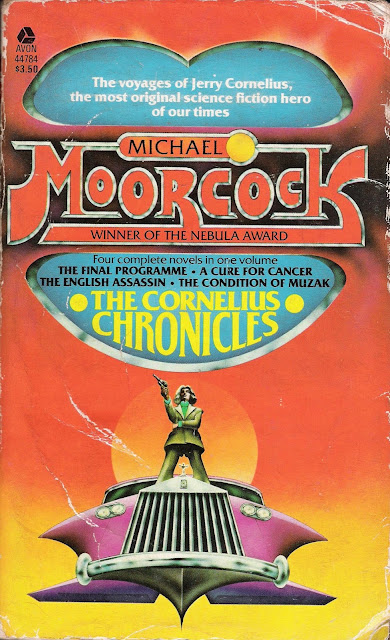
I get the impression this is additionally what Moorcock was doing with narrative, rejecting the tightly woven plotting of Sexton Blake and others in favour of something weirder, more organic, and certainly more provocative. What has surprised me most about reading this is suddenly realising where all those loopy sixties spy thrillers came from, The Prisoner, The Avengers, and ultimately Austin fucking Powers. Even the current, painfully self-conscious television version of Doctor Who looks a lot like it's trying hard to be Jerry from where I'm sitting. To veer off at a fairly substantial tangent, the position of Moorcock as a writer seems very much parallel to that of Hawkind, the band with which he has been closely associated, as memorably summarised by Nigel Ayers of Nocturnal Emissions in issue seven of The Sound Projector:
Of course, members of Hawkwind get walk-on parts in the third and fourth Cornelius books, so maybe the above isn't too great a digression. Reality logically intrudes upon Jerry Cornelius because it is our world to which his story refers, even at its wildest. Jerry is dead for much of The English Assassin (1972), or at least dead in some of its variant realities. Notable amongst the alternate worlds described in this volume are the proto-steampunk variants featuring Oswald Bastable from Moorcock's The War Lord of the Air, and Zenith from the Sexton Blake continuity for which Moorcock has also written, and there's the world - possibly our own - in which Jerry Cornelius is a fiction and A Cure for Cancer is only a novel. Generally speaking, The English Assassin is a parody of the establishment and the class system, rendered comic and ultimately stripped of meaning at a party with a guest list encompassing Frankie Howerd and numerous members of Hawkwind, amongs others. Over and over, it reveals institutions and traditions in collapse, returning to inert cultural material by a process of entropy, or even just boredom:
Whether intentional or not, this establishes Rupert Murdoch and J.R.R. Tolkien as essentially variations on a theme, or at least it does from where I'm sat. Only the lower orders - those with less to lose - survive more or less unscathed, as suggested at the close of the book with Mrs. Cornelius scoffing candy floss and contemplating bingo on the beach as she watches her offspring build sandcastles. When Moorcock novelised The Great Rock 'n' Roll Swindle he recast Irene Handl's nameless cinema usherette as Jerry's wonderfully coarse mother and its not difficult to see why. She is solid and eternal, unaffected by the broad sweep of history, history being for her, I suppose, a bourgeois affectation - more Jerry's concern:
Note the emergent sixties obsession with Victoriana, which Moorcock rewrote as that which we now recognise as steampunk. The Condition of Muzak (1977) completes the cycle and serves better than any of the other books to define just what it has all been about, namely the complex degrading to the simple, great art, culture, or even thought reducing to background music; and furthermore that the process of entropy is itself inherent to the existence of that which it destroys:
This final part of the story is framed within a variant of reality in which Jerry is revealed as a struggling musician and a bit of a loser, someone destined to fail, with all of those other, more glamorous realities quite possibly having been just his drug-addled juvenile fantasies, in turn serving to emphasise just how pathetic is the reality of this, his last and lowest plane of existence.
The Cornelius Chronicles are about change, the nature of change, the future, our expectations, and history as a construct; or they are in so much as they can be said to be about any one thing; at least I think they are. It's hard to tell because this is one fuck of a lot of non-linear narrative to get through, and it's routinely bewildering, even boring in places - some of which may be intentional - but as promised, the whole really is worth the effort expended in sticking with it. This is one of those rare books which could potentially change either your life, or at least the way you see the world.
Moorcock really is a genius.
The Cornelius Chronicles
by Lawrence Burton

Michael Moorcock The Cornelius Chronicles (1977)
I had two of the four volumes collected within this housebrick a while back, having picked them up cheap under the impression of Jerry Cornelius probably being important for some reason or other; but I ended up giving the collection away without having read the thing, and I'm not quite sure why beyond that I wasn't a big reader in the nineties. Having since recognised Moorcock as a fucking genius, I'd been quietly kicking myself on this particular score for a while, so here we are, back where I started, and this time I have all four in a single volume and my brain is probably better attuned to this sort of stuff than it once was.
Truthfully, I'd been put off Jerry Cornelius by association with Grant Morrison's Gideon Stargrave strips in Near Myths magazine which, according to Moorcock, were essentially photocopies of his own character coloured in with a slightly different crayon; but Moorcock's Dancers at the End of Time novels were decent enough to suggest that I should at least give Jerry a look, and on close inspection I see Moorcock was right, and that Gideon Stargrave is indeed a poor substitute for the real thing - Blink 182 when you could be listening to the Sex Pistols. It was specifically the affected flamboyance of Gideon Stargrave which always irritated the living shit out of me, so I'm amazed to read the genuine article and see that it can be done right, with wit, and without coming across like one of those seventies teenagers who used to walk to school with a Gentle Giant album under his arm and without the bag which would have prevented the rest of us seeing what he had and just how cool he was, how far ahead he was compared to everyone else. He'd probably even done it with a girl and everything.
Anyway, enough about that guy. I'd been warned that Cornelius is best read by just diving in, holding on tight, and not worrying too much over whether or not it makes sense. This was sound advice, although it's not so disjointed as I anticipated - at least not in the sense of a William Burroughs novel being disjointed. The Final Programme (1966) and A Cure for Cancer (1971) at least seem to follow vague stories, or else give a good impersonation of doing so. I've a feeling that it may be the latter - scenarios and set pieces arranged so as to suggest narrative without quite amounting to one, with the novels following a non-linear logic of their own, like a dream or a piece of music, or - if this isn't too obvious an observation - one of the weirder psychedelic albums of the era to which these stories refer.
It's significant that Jerry Cornelius is absolutely of his time, the sixties arguably being the point at which the ideas of the European avant-garde in art entered the mainstream and suddenly you had pop music taking its cues from Pierre Schaeffer or Marcel Duchamp. Hindsight has possibly dimmed the significance of this particular great leap forward, coming as it did with an intellectual dimension expressed as young people rejecting whatever behavioural models had already been set up for them by their parents' generation, but reading these novels is a great reminder of how dangerous such ideas once seemed, even the fact of their being ideas.
I had two of the four volumes collected within this housebrick a while back, having picked them up cheap under the impression of Jerry Cornelius probably being important for some reason or other; but I ended up giving the collection away without having read the thing, and I'm not quite sure why beyond that I wasn't a big reader in the nineties. Having since recognised Moorcock as a fucking genius, I'd been quietly kicking myself on this particular score for a while, so here we are, back where I started, and this time I have all four in a single volume and my brain is probably better attuned to this sort of stuff than it once was.
Truthfully, I'd been put off Jerry Cornelius by association with Grant Morrison's Gideon Stargrave strips in Near Myths magazine which, according to Moorcock, were essentially photocopies of his own character coloured in with a slightly different crayon; but Moorcock's Dancers at the End of Time novels were decent enough to suggest that I should at least give Jerry a look, and on close inspection I see Moorcock was right, and that Gideon Stargrave is indeed a poor substitute for the real thing - Blink 182 when you could be listening to the Sex Pistols. It was specifically the affected flamboyance of Gideon Stargrave which always irritated the living shit out of me, so I'm amazed to read the genuine article and see that it can be done right, with wit, and without coming across like one of those seventies teenagers who used to walk to school with a Gentle Giant album under his arm and without the bag which would have prevented the rest of us seeing what he had and just how cool he was, how far ahead he was compared to everyone else. He'd probably even done it with a girl and everything.
Anyway, enough about that guy. I'd been warned that Cornelius is best read by just diving in, holding on tight, and not worrying too much over whether or not it makes sense. This was sound advice, although it's not so disjointed as I anticipated - at least not in the sense of a William Burroughs novel being disjointed. The Final Programme (1966) and A Cure for Cancer (1971) at least seem to follow vague stories, or else give a good impersonation of doing so. I've a feeling that it may be the latter - scenarios and set pieces arranged so as to suggest narrative without quite amounting to one, with the novels following a non-linear logic of their own, like a dream or a piece of music, or - if this isn't too obvious an observation - one of the weirder psychedelic albums of the era to which these stories refer.
It's significant that Jerry Cornelius is absolutely of his time, the sixties arguably being the point at which the ideas of the European avant-garde in art entered the mainstream and suddenly you had pop music taking its cues from Pierre Schaeffer or Marcel Duchamp. Hindsight has possibly dimmed the significance of this particular great leap forward, coming as it did with an intellectual dimension expressed as young people rejecting whatever behavioural models had already been set up for them by their parents' generation, but reading these novels is a great reminder of how dangerous such ideas once seemed, even the fact of their being ideas.
'These old fashioned rules no longer apply. Your sort of morality, your sort of thinking, your sort of behaviour—it was powerful in its day. Like the dinosaur. Like the dinosaur it cannot survive in this world. You put values on everything—values...'
'I think I can see a little of what you mean.' Marek lost his composure and rubbed at his face. 'I wonder... is it Satan's turn to rule?'
'Careful, Herr Marek, that's blasphemy. Besides, what you are saying is meaningless nowadays.' Jerry's hair had become disarranged as he talked. He brushed it back from the sides of his face.
'Because you want it to be?' Marek turned and walked towards the stove.
'Because it is. I am scarcely self-indulgent, Herr Marek—not in present-day terms.'
'So you have your own code.' Marek sounded almost jeering.
'On the contrary. There is no new morality, Herr Marek—there is no morality. The term is as barren as your grandmother's wrinkled old womb. There are no values!'
I get the impression this is additionally what Moorcock was doing with narrative, rejecting the tightly woven plotting of Sexton Blake and others in favour of something weirder, more organic, and certainly more provocative. What has surprised me most about reading this is suddenly realising where all those loopy sixties spy thrillers came from, The Prisoner, The Avengers, and ultimately Austin fucking Powers. Even the current, painfully self-conscious television version of Doctor Who looks a lot like it's trying hard to be Jerry from where I'm sitting. To veer off at a fairly substantial tangent, the position of Moorcock as a writer seems very much parallel to that of Hawkind, the band with which he has been closely associated, as memorably summarised by Nigel Ayers of Nocturnal Emissions in issue seven of The Sound Projector:
If you look at the whole of that so-called industrial scene from Cabaret Voltaire to Marilyn Manson, the band with the most far reaching influence wouldn't be Throbbing Gristle, but Hawkwind! This is something that they rarely mention in the press, as Hawkwind have this reputation as a British hippie band who do science-fiction and theatrics and therefore must be naff. Zoviet France have told me they were very keen on Hawkwind; SPK were well into Hawkwind back in Australia; and what are Graeme Revell and Brian Williams doing nowadays? Making soundtracks for science-fiction films - I rest my case! I think it's about time Hawkwind were reassessed. I have long been tired of those outfits who cite influences no-one has heard of, or can stand listening to. Back in the early '70s, Hawkwind were the first band I was aware of to popularise the idea of sonic attack, infra and ultra sound as a weapon. Listen to Sonic Attack on Space Ritual. That of course has long since been taken up by that whole noise scene, but Hawkwind were rarely acknowledged. If you look at the information war thing, you'll notice that Hawkwind had the post-modern writers, Michael Moorcock and Bob Calvert working with them. Though Moorcock is best known for his very popular science-fiction and fantasy genre work, it's more accurate to call him a postmodernist or at least a modernist. Moorcock pointed many in the direction of William Burroughs and J.G. Ballard and - stone me, he even wrote for Re/Search. When Hawkwind's In Search of Space came out in the early seventies, it came with a booklet of very similar material to what the London Psychogeographical Society, the Association of Autonomous Astronauts, Iain Sinclair, and Tom Vague have been doing more recently. Whenever I used to see Psychic TV, I thought Hawkwind. Whenever I saw Throbbing Gristle I thought Hawkwind without the lights and without the tunes. That combat clothing thing - Hawkwind!
Of course, members of Hawkwind get walk-on parts in the third and fourth Cornelius books, so maybe the above isn't too great a digression. Reality logically intrudes upon Jerry Cornelius because it is our world to which his story refers, even at its wildest. Jerry is dead for much of The English Assassin (1972), or at least dead in some of its variant realities. Notable amongst the alternate worlds described in this volume are the proto-steampunk variants featuring Oswald Bastable from Moorcock's The War Lord of the Air, and Zenith from the Sexton Blake continuity for which Moorcock has also written, and there's the world - possibly our own - in which Jerry Cornelius is a fiction and A Cure for Cancer is only a novel. Generally speaking, The English Assassin is a parody of the establishment and the class system, rendered comic and ultimately stripped of meaning at a party with a guest list encompassing Frankie Howerd and numerous members of Hawkwind, amongs others. Over and over, it reveals institutions and traditions in collapse, returning to inert cultural material by a process of entropy, or even just boredom:
In the third bedroom of the Casa del Monte, seated on a black walnut panelled Lombardy bed, covered in seventeenth century carvings, the most corrupt and feeble-minded publisher in America sipped his vodka and tonic and stared sourly at his tennis shoes while one of the Oxford dons bored him with a long and enthusiastic description of the joys and difficulties involved in doing Now We Are Six into Assyrian. It was what they both deserved.
Whether intentional or not, this establishes Rupert Murdoch and J.R.R. Tolkien as essentially variations on a theme, or at least it does from where I'm sat. Only the lower orders - those with less to lose - survive more or less unscathed, as suggested at the close of the book with Mrs. Cornelius scoffing candy floss and contemplating bingo on the beach as she watches her offspring build sandcastles. When Moorcock novelised The Great Rock 'n' Roll Swindle he recast Irene Handl's nameless cinema usherette as Jerry's wonderfully coarse mother and its not difficult to see why. She is solid and eternal, unaffected by the broad sweep of history, history being for her, I suppose, a bourgeois affectation - more Jerry's concern:
The image of a Britain become a nation of William Morris wood-carvers and Chestertonian beer-swillers drove him deeper into his jungle and caused him to abandon his books. He was only prepared to retreat so far. He was forced to admit, however, that the seventies were proving an intense disappointment to him. He felt bitter about missed opportunities, the caution of his own allies, the sheer funk of his enemies. In the fifties life had been so appalling that he had been forced to flee into the future, perhaps even help create that future, but by the sixties, when the future had arrived, he had been content at last to live in the present until, due in his view to a conspiracy amongst those who feared the threat of freedom, the present (and consequently the future) had been betrayed. As a result he had sought the past for consolation, for an adequate mythology to explain the world to him, and here he hid, lost in his art nouveau jungle, his art deco caverns, treading the dangerous quicksands of nostalgia and yearning for times that seemed simpler only because he did not belong to them and which, as they became familiar, seemed even more complex than the world he had loved for its variety and potential.
Note the emergent sixties obsession with Victoriana, which Moorcock rewrote as that which we now recognise as steampunk. The Condition of Muzak (1977) completes the cycle and serves better than any of the other books to define just what it has all been about, namely the complex degrading to the simple, great art, culture, or even thought reducing to background music; and furthermore that the process of entropy is itself inherent to the existence of that which it destroys:
'If time could stand still,' said Hira reflectively, 'I suppose we should all be as good as dead. The whole business of entropy so accurately reflects the human condition. To remain alive one must burn fuel, use up heat, squander resources, and yet that very action contributes to the end of the universe-the heat death of everything! But to become still, to use the minimum of energy—that's pointless. It is to die, effectively. What a dreadful dilemma.'
This final part of the story is framed within a variant of reality in which Jerry is revealed as a struggling musician and a bit of a loser, someone destined to fail, with all of those other, more glamorous realities quite possibly having been just his drug-addled juvenile fantasies, in turn serving to emphasise just how pathetic is the reality of this, his last and lowest plane of existence.
The Cornelius Chronicles are about change, the nature of change, the future, our expectations, and history as a construct; or they are in so much as they can be said to be about any one thing; at least I think they are. It's hard to tell because this is one fuck of a lot of non-linear narrative to get through, and it's routinely bewildering, even boring in places - some of which may be intentional - but as promised, the whole really is worth the effort expended in sticking with it. This is one of those rare books which could potentially change either your life, or at least the way you see the world.
Moorcock really is a genius.