| archive - contact - sexy exciting merchandise - search - about | |||
 |
|||
| ← previous | November 9th, 2015 | next | |
|
November 9th, 2015: This comic isn't about Batman, and yet... I'M STILL THINKING ABOUT BATMAN! – Ryan | |||
Andrew Hickey
Shared posts
10 Nov 12:09
here is a comic about how to make new friends as an adult; as an adult with SEVERAL friends i am qualified to write this
09 Nov 16:06
My Agenda 2020 essay: What does it mean to be a Liberal Democrat today?
by Nick
 As part of the Agenda 2020 policy process, the party is holding an essay contest asking for 1000 words on ‘what does it mean to be a Liberal Democrat today?’ This is my entry to it, written in a rush as the deadline came near, and you can see other people’s efforts on Liberal Democrat Voice.
Liberal Democrats want to give more freedom to everyone to enable them to live their own lives. However, we also know that freedom for individuals is not enough, and that it must be combined with breaking down the unaccountable powers of the state, in the economy and in society to enable individuals to fully use their freedom. We live in a world where there is more power to affect the lives of individuals than there ever has been, and by focusing on freeing people from historic controls we are cutting the strings and chains that tie them down, but ignoring the new ropes and cables that bind them even tighter.
To be a Liberal Democrat is to recognise that power has to exist, but that where it does exist it must be accountable. We are not opposed to the existence of power and recognise that it is needed to build, maintain and develop the society we live in, but we recognise that power needs to be controlled. Freedom is not simply removing a power over someone, freedom is giving people the ability to participate in power.
Liberals understand that power comes in many different forms and that the power of the state is just one of them. Indeed, it may be the weakest power of all because the concept of state power being accountable to those it affects is widely accepted, even if not regularly seen in practice. As liberals, we can spend far too much time getting upset about the minutiae of the use and misuse of state power while ignoring unaccountable power in society and the economy.
As Liberal Democrats we often eagerly point to how we believe that ‘no one should be enslaved by conformity’, but without focusing on how we make that happen in reality. We need to recognise that just saying oppression and enforced conformity is bad is not enough. Identifying it should be just the first step and we need to be prepared to discuss how we as Liberal Democrats are actually going to take on the unaccountable power and privilege that causes so much harm in our society, including within our own party. To be a Liberal Democrat today should be to understand that just telling someone they are free isn’t enough, it’s about standing with them to challenge the power and privilege that oppresses them.
Liberalism is internationalist at its heart, recognising that everyone deserves the same rights and respect no matter where they live, what language they use or who their parents were. People working together across national borders have achieved some of the greatest liberal successes of the last century, from eradicating diseases to ending apartheid, but we need to ensure liberal and internationalist values remain for the centuries to come. There is a great power in people acting together through global institutions and we need to ensure that power is accountable and effective to achieve future liberal goals across the planet, and even beyond it.
To be a Liberal Democrat today should also be to understand the danger of unaccountable economic power. We need to deal with the new concentrations of unaccountable power within the economy that have massive effects on people’s lives that they can do nothing about. Free trade was a means to an end, ensuring that the poorest in society would be able to afford to eat, but we have turned it into an end in itself, regardless of the effect it has on people. We talk of trade between nations and empowering individuals, ignoring the vast unaccountable powers of corporations and how they take away freedom and choice from individuals, concentrating economic power amongst an unaccountable elite.
Liberalism is about people and we need to create a world where the economy works for the benefit of the people, not one where people work for the benefit of the economy. We need to fight for education systems that develop people as individuals, not merely as future workers; for social security that concentrates on supporting people, not subsidising employers; and for an economy that liberates people to spend more time doing what they want, where everyone’s abilities and contributions to society are welcomed.
Beyond the state, society and the economy, there is a further power that we must address: our environment. This is a different order of power, where climate change is capable of destroying everything our society is based on, rendering liberalism and every other ideology meaningless. And yet, it is vital that we understand a liberal response to this crisis is necessary because only through liberalism and recognising the value of every life on this planet can we build a global response. Liberalism is international by instinct, seeing potential in every person, and that international instinct is also environmental, recognising that we need to protect our planet to ensure that it’s not just us who get the chance to live the lives we want, but all the generations still to come. Human survival is important, and we increase our chances of that survival by giving people reasons to believe in a better tomorrow.
To be a Liberal Democrat today is to recognise that liberals have made a start in tackling these unaccountable powers in the state, in society and in the economy but it is only a start and there is so much more work to be done. The fight for liberalism is not a new one: it has taken many forms and many different names over the years, but at its heart it has always sought to break up power, to make it accountable, and to give all the chance to live the life they wish. To be a Liberal Democrat is to want to take power from the unaccountable and let people use it for themselves because that’s the only way we can create a world for everyone.
09 Nov 15:31
Announcing The Black Archive
by Philip
Launching in March 2016 from Obverse Books, The Black Archive is a series of book-length looks at single Doctor Who stories from 1963 to the present day.
The series will publish six titles each year, in simultaneous digital and print editions. Each title is a twenty to forty thousand word study of a single televised Doctor Who story, drawing on all eras of the series’ history.
Authors
09 Nov 15:31
Tagged: doctor, sensory, silly comments, sunglasses


#55 Dinah the Aspie Dinosaur and the Doctor Appointment (4)
by Dinah

This actually happened to me today. Not impressed.
Tagged: doctor, sensory, silly comments, sunglasses
06 Nov 15:28
How to Talk to Your Kid About Smoking
by Scott Meyer

Okay, this … THIS … is one of the better comics I ever produced (in my opinion).
Really, looking back, I think one of the main things that kept me from taking up smoking was that my mother and her friends smoked. They made it look anything but cool.
When other teenaged guys thought of smoking they thought of … I dunno … poker games, cigars, and cool Zippo lighters. I thought of home permanents, ultra slim cigarettes, and cheap plastic disposable lighters with the owner’s zodiac sign silkscreened on the side in one color of ink.
Note from Missy: Font change! I used to make new handwriting fonts every year or two. I think this one ended up being the BI font for the rest of the run.
You can comment on this comic on Facebook.
As always, thanks for using my Amazon Affiliate links (US, UK, Canada).
06 Nov 15:26
First thoughts on the Draft Investigatory Powers Bill
by Zoe O'Connell
The draft bill has been published, the generic “I have not read this yet but I must say something” statements have been made by politicians, and now it’s time to read what the bill actually says.
First impressions: It’s not a bill I could come close to supporting without major changes, but it’s an improvement on previous attempts. It’s also long. At 299 pages, very long indeed. The 35 page extended press release at the start, titled a “guide to powers and safeguards” is interesting, but of course doesn’t actually have any legal force. Many of the initial comments about the bill made by politicians seem to have been on the basis of reading this guide, and not the full bill. One comment I would pick up on in the initial section is that the bill is “bringing together existing powers”. Simplification on existing legislation always sounds good, but the Equality Act 2010 was also supposedly a consolidation exercise. Many readers will know my less-than-positive feeling on that particular piece of legislation!
Another highlight of the intro is the assertion that there are “862 suspected paedophiles” that this bill might help catch. You can’t publish a bill like this in the UK without using the “but, but… terrorists and paedophiles!” line. As investigations of both are, of course, shrouded in secrecy this makes scrutiny that much harder.
It’s going to take time for everyone to digest it all and figure out where any remaining problems lie, so discussion will probably take weeks before there is any kind of consensus. I’ve read it properly – highlighter in hand – once through so far and it’s likely I’ve missed bits but here’s what I have noticed so far. (This is not a list of what I would want to see in an Investigatory Powers Bill, as that would include things such as notification to individuals, just a commentary on what is actually present)
Judicial Oversight
Rejoice, for we have judicial oversight of interception warrants!
OK, hold on a second. We have some oversight but you can drive a coach and horses through much of it. Three major problems jump out:
The standard of proof required is that of “Judicial Review”. Quoting from the Courts and Tribunal’s web page: “[A Judicial Review] is not really concerned with the conclusions of that process and whether those were ‘right’, as long as the right procedures have been followed“. Essentially, we’ll have a group of very well paid judges checking that the Home Secretary signed the warrants correctly.
Warrants can be modified after issue to add names to them. In the case of “minor” changes, such as adding new phone numbers, they can be authorised by the police themselves. However, major changes only need a minister to approve the change – a judge does not need to be involved.
Finally, “urgent” warrants do not need reviewing for five working days. Judges are already used to being woken up at unsociable hours so that warrants can be applied for, so five days seems excessive. It still requires ministerial approval, and getting hold of a judge would seem easier and quicker than getting hold of a government minister.
Training warrants
Interception warrants can be issued for “testing, maintenance or development” of interception systems and “training of persons” who carry out interception, without any need that data collected should be destroyed without being examined. I do wonder how many people might find themselves “accidentally” intercepting the communications of people they know, or doing it to someone “who won’t possibly mind, because they have nothing to hide”.
Wilson Doctrine & Journalistic Sources
Looking on the positive side, the additional protections given to members of parliament would be put into law for the first time by this bill and explicitly cover members of other many other legislative bodies. However, these protections are watered down significantly from the original doctrine – rather than a blanket ban on interception of MPs communications, any warrant would require that the Prime Minister be consulted.
Journalists fare little better – judicial authorisation is required to get access to data on journalistic sources even in situations where a judge would otherwise not need to be involved. Other professions (Doctors, Lawyers and Ministers of Religion) get “extra consideration” in the Codes of Practice, but no extra safeguards against interception in the main bill. It’s clear that the intent is to make any exceptions to surveillance as limited as possible.
Communications Data Retention
A very important point for many people will be exactly who is required to keep bulk data – ie lists of web sites etc, visited by users. There’s a cost associated with collection that the Home Office may pay for, although they seem to be pushing the cost on to service providers with the latest bill. Luckily, only providers who have been notified by the Home Office that they need to collect data are covered and nothing prevents an operator stating that they have received or not received a retention notice. This allows privacy-conscious ISPs to be able to state publicly that they are not performing bulk retention of data. As Keith points out in the comments, section 77 does prohibit revealing the existence of a retention notice.
Filtering
There is a large section on “filtering” in the bill that deserves some explanation. Although data would be stored by ISPs, the Home Office would like to create a system (An API) so that they can remotely query and filter data on the ISPs systems without necessarily needing to talk to someone at the ISP. This removes a safeguard against wide-scale bulk data access without proper authorisation, and potentially allows someone to go on fishing expeditions that are marginally relevant to a warrant that’s been issues such as allowing queries like “tell me everyone across multiple ISPs who have accessed terrorist-hub.com”.
Security of collected bulk data
The headline issue has been retention of data for 12 months by ISPs, which is longer than many other countries. But how securely is the data kept? The bill answers that in a surprisingly poorly written clause: “subject to at least the same security and protection, as the data on any system from which it is derived“. The draft bill will no doubt have had the attention of many security experts within the Home Office, so it’s surprising that they did not pick up on the obvious point: Hacking a router gives you relatively little ability to capture much data without someone noticing but hacking a pre-existing bulk data archive gives you much more data and is thus a bigger target. As a result of this, the security of retained data needs to be significantly higher than that of other systems and I am surprised not to see reference to some soon-to-be published technical guidance on the measures required.
There is also no prohibition on the use of data collected by service providers for commercial purposes, such as being sold on to marketing companies or used for targeted advertising. (If it’s allowed for in the ISP’s terms and conditions, it’s not unlawful disclosure!) There are major privacy issues here that we’ve seen already on a smaller scale, where people access help sites for domestic violence or LGBT+ issues and then other members of their household receiving targeted advertising as a result. Service providers can do this already to an extent, but it costs money to do. If they’re going to have to do it anyway (Either paying for it themselves or being paid to do it) then they might as well make some money from it.
Finally, and most critically, there is no prohibition on a court ordering the disclosure of collected data to groups like copyright holders. It would become very easy for someone to apply to the courts for a list of everyone who has accessed Pirate Bay, Popcorn Time etc and send them not-so-nice legal letters.
Equipment Interference
…or “hacking into other people’s computers” as most people call it – although the bill would force service providers to cooperate in hacking attempts. Although more analysis of the bill is needed this is one area where the Bill looks like an improvement on the existing situation, as hacking is currently going on without proper scrutiny. The most obvious omission is the lack of any consideration for the side effects of hacking should they cause problems, by taking down critical computer systems or installing back doors into systems that are then abused by others.
Overseas
There has been a history of quid pro quo arrangements between security services where countries spy on each other’s citizens because the law doesn’t allow them to spy on their own citizens. Although the act prohibits formal arrangements of this type, it does not (that I can see) stop someone using information that they have been given that would otherwise have required an interception warrant. The act also allows the Home Secretary to sign agreements with other countries to honour each other’s warrants, but there is little to suggest that warrants from other countries would require the same level of authorisation and oversight as locally issued ones.
I will probably notice more on later re-reads of the draft bill, and I will post again if I find anything substantial.
06 Nov 15:26
Lookalike
by Andrew Rilstone
I wonder if any of your readers have spotted the astonishing resemblance between Namor, Prince of Atlantis and Cameron, Prime Minister of the United Kingdom.
I wonder if by any chance they are related?
I wonder if by any chance they are related?
 |
| Comic Book Character |
 |
| British Prime Minister |
06 Nov 15:25
A small research question
by Charlie Stross
So, I am currently investigating parasites, hyperparasites, parasitic castration, and other things that make readers go "ick". (Consider this a research question.)
I'm going to ignore bacterial and protozoal parasites for now, because my Toxoplasma gondii master tells me they're of no interest. And we all know about the mundane visible-with-the-naked-eye ones like tapeworms and pinworms, and the horrifyingly nasty Guinea worm that causes Dracunculiasis. But these are relatively straightforward parasites. Booooring.
However, parasites in general are fascinating and some of their variants are just totally bugfuck. Literally. Take Ophiocordyceps unilateralis, for example. It's a fungal parasite. Its spores hatch and brain-control its host—forest floor dwelling ants—makes them climb high up in the vegetation canopy, then digests its host's body and forms fruiting bodies to scatter new spores over the forest floor for more unfortunate ants to stumble across.
Or take the strange case of the hyperparasitoid wasps—wasps that lay their eggs in wasps that parasitize caterpillars: small cabbage white butterfly caterpillars are used as a host species by the parasitoid wasps—Cotesia rubecula and Cotesia glomerata—which in turn make a handly meal for the even smaller hyperparasitoid wasp Lysibia nana. (Thereby confirming something I've known since I was two years old: wasps are assholes.)
And then things get weird, because these are instances of parasitism where the parasitic life cycle is proceeding according to the script. When parasites go wrong, things get weird-ugly, really fast. Tapeworms sometimes run amok and end up encysting in the brains of their hosts. And then there was the recent case where an HIV-positive man contracted and died of cancer from a non-human source, namely an invasive tapeworm's own neoplasm (which became highly invasive in the immunocompromised host).
Anyway, I thought I should share the joy with you because I'm currently inventing semi-plausible parasitic and meta-parasitic lifecycles with humans as the basic host, for a future Laundry Files story (because Equoids are really just a little passé). And I thought you might like to share some of your favourite parasites and hyperparasites with me! (Nothing well-known or mundane, of course. Assume I'm already familiar with the common stuff.)
Anyone want to start?
06 Nov 15:23
How I Spent Friday
by evanier

I am still a day or three from returning to full-speed blogging so here's another rerun so you won't have wasted one entire click to come to this page. Here is what I did one day in February of 2010…
Friday afternoon, I did something I haven't done for around ten years. No, not shower…though I did that in the morning before the other thing. At the request of a friend, I went to an elementary school and talked to kids about cartoons. I showed them an episode of The Garfield Show and then I gave drawing lessons, teaching them how to draw Charlie Brown, Garfield, Scooby Doo, Bart Simpson, Spongebob Squarepants and an original character that we all created together. The kids, who were all around eight years of age, did quite well and some showed promise. It would not surprise me one bit if twenty years from now, some professional cartoonist came up to me at a convention and said, "Hey, were you the guy who came to my third grade class in 2010 and taught everyone how to draw Charlie Brown?"
I used to do this every few months because…well, I usually learn as much as the kids do. It's fascinating to watch them view a cartoon I've written and to see what they laugh at and what holds their attention. Unsurprisingly with kids this age, the physical humor gets more response than funny lines or situations…but some of Garfield's snide comments got immense laughs. More significant, I thought, was not what made them laugh but what held their attention.
The group I spoke to consisted of two separate classes crammed into one classroom. When I was ushered in, the instructors were spending a lot of energy, as they apparently do all day, just getting the kids to stop talking and listen. I have a fairly good memory of my schoolroom when I was that age and I don't recall us having quite that attention-deficit disorder. A generational thing? Too much exposure these days to fast-paced media? I don't know enough about children in and of this age to be able to say. I do know that once I told these kids I wrote the Garfield cartoons, I got the undivided focus of about two-thirds of the room and when I mentioned that I used to write Scooby Doo, I snagged the other third.
Well, why not? If you were that age, wouldn't you rather listen to a guy talk to you about Scooby Doo than about long division?
Another thing that surprised me: I was telling them how when I was their age, I'd watch cartoons on TV or read comic books of the characters I saw on TV…and then I'd teach myself to draw those characters. One of the kids asked me what the first one was — and while I'm not sure it was, I said, "This one." Then I turned to the whiteboard on which I was drawing and began sketching a Yogi Bear…about as well as I did when I was seven, I might add. As I started, I thought, "I wonder if they'll even know who this is." Yogi's not seen on Cartoon Network. He's on Boomerang a lot but I don't know how many homes get that…and there are no comic books.
Well, I needn't have worried. I was halfway through the drawing and everyone was screaming out, "Yogi Bear! Yogi Bear!" He was one of everyone's favorite characters. The clear fave by a wide margin, by the way: Spongebob. After I taught them how to draw Mr. Squarepants, they all wanted lessons on his supporting cast…and were disappointed that I simply don't know those characters. Several of them also do Spongebob impressions, one so well that Tom Kenny's job is in serious jeopardy. Sorry, Tom.
The first time I ever did this was back in '73. I was taking some morning classes at Santa Monica College and I was asked by a young lady who was in one of 'em. Afternoons, she was a student teacher at a nearby elementary school and she thought her students would benefit from a little chalk talk about cartooning. At the time, I wasn't interested in that but I was interested in the young lady. If she'd asked me to play Twister in the fast lane of the Santa Monica Freeway at rush hour, I probably would have.
I got there and watched a little of the class before I began. That's when I was told it was a "problem" class of kids with "learning disabilities" which mostly consisted of not paying attention to anything the teacher said and occasionally hurling items at her or each other. For an instant there, I wondered if playing Freeway Twister might not be preferable…but then I was introduced and when I started talking about cartoons and drawing, I suddenly had rapt attention. The teachers later said they had never seen that much focus. The kids didn't remain silent but like the ones yesterday, all their chatter was suddenly on topic, about the subject being taught.
Apart from the fact that the teaching assistant never did go out with me, the trip couldn't have gone better…a fact for which I deserve zero credit. Anyone who could have drawn the pupils' favorite characters could have done it, and many could have done it a lot better than I did. The point was that that kind of thing reached these kids…who, I'm horrified to realize, could have been the parents of the children I spoke to on Friday. That many years have passed. Still, the reaction was identical and it always is.
So is the moral of the story. The idea is to leave them with a number of thoughts. One is that this is a job. You can actually make a living drawing funny pictures or writing silly stories. Another thought is that you don't have to make it your occupation. There can be joy and satisfaction in just creating for the sake of making something.
Yet another is that whichever way you decide to go with it, it requires practice…lots of practice and dedication. The fourth thought is that it can be well worth it. I'm not sure classrooms ever do a good job of convincing children that things they learn there can have value to them later, possibly because so much of it will not.
Lastly, and this one is not so much a thought as a sensation…but it's just neat to be able to do that. Being able to draw Spongebob is like gaining a super-power. It might be worth investing the effort to learn to do it just so you can do it. I felt that way about drawing when I was a kid and also about magic and ventriloquism and a few other things. Even though I didn't go into those fields, I'm quite sure those interests had a role in getting me to where I am today. My father, who had no real marketable skills and always regretted it, used to say, "It's not that important what you do in the world as long as you can do something!"
Anyway, that's how I spent my Friday. And like I said, I think I learned at least as much as they did. Maybe more.

The post How I Spent Friday appeared first on News From ME.
04 Nov 18:26
this sounds like quite the tall... KALE
| archive - contact - sexy exciting merchandise - search - about | |||
 |
|||
| ← previous | November 4th, 2015 | next | |
|
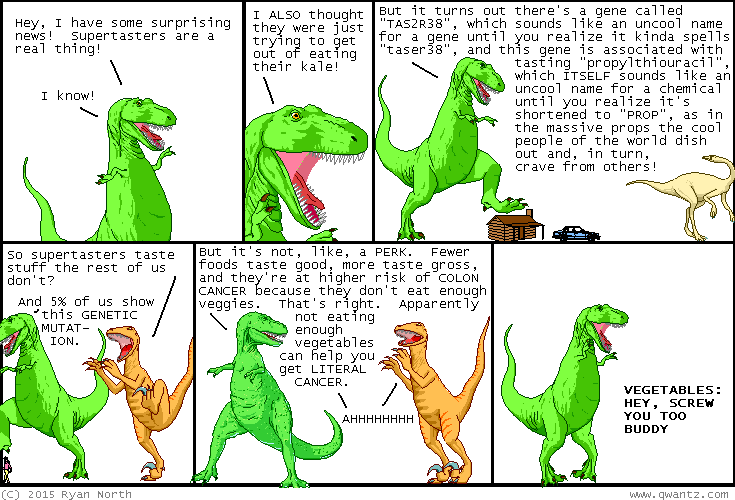
November 4th, 2015: Listen, you look up "cancer-fighting foods" online and you will find thousands of sites telling you to eat thousands of things and most of it is hot baloney. I managed to find this abstract showing some correlation between eating few fruits AND vegetables and colorectal cancers, so I dunno, maybe don't cut them COMPLETELY down to zero in your diet?? – Ryan | |||
04 Nov 16:50
Universal Basic Income as the Social Vaccine of the 21st Century.
Universal Basic Income as the Social Vaccine of the 21st Century.
04 Nov 16:50
Ireland to 'decriminalise' small amounts of drugs, including heroin, cocaine and cannabis, for personal use.
Ireland to 'decriminalise' small amounts of drugs, including heroin, cocaine and cannabis, for personal use.
04 Nov 16:50


“Beautiful Idiots and Brilliant Lunatics’ – The Book!
by nickelinthemachine
Andrew HickeyNoting for myself. Will buy as ebook if I remember...

Beautiful Idiots and Brilliant Lunatics published on November 15 2015.
It’s been a long time coming, for which I apologise, but the book of this website is published on the 15th November. Years ago I started this site, initially as a music blog, and I chose a line from one of my favourite songs ‘One for my Baby’ by Frank Sinatra. When the opportunity arose to put the website into book form it was obvious that the title doesn’t really make sense for a book about London. I found an Oscar Wilde quote from An Ideal Husband.
Mabel Chiltern says to Lord Faversham after he has complained about the decline of society:
Oh, I love London society! I think it has immensely improved. It is entirely composed now of beautiful idiots and brilliant lunatics.
Beautiful Idiots and Brilliant Lunatics contains twenty-four stories that have mostly come from Another Nickel in the Machine but there are a few that come from Flashbak.com for whom I also contribute. The stories have all been completely re-written (usually with even more tangents and digressions!) and have also now been properly attributed. I’ve also made sure that the book is still extensively illustrated with about 150 pictures and photos.
If you would like a signed copy of the book leave a comment or email me rob at nickelinthemachine.com or on twitter and I’ll get back to you with details.
The cover by the way is from the 100 Club on Oxford Street in 1949. They happy people are dancing to Humphrey Lyttelton and the photographer was Charles Hewitt. Here’s the actual picture:

12th November 1949: Jazz fans dance the night away to the wild sounds of Humphrey Lyttelton and his band, playing at a meeting of the London Jazz Club in the basement of No 100 Oxford Street. Original Publication: Picture Post – 4919 – A New Jazz Age – pub. 1949 (Photo by Charles Hewitt/Picture Post/Getty Images)

04 Nov 11:23
Helping students overcome command-line bullshittery.
Helping students overcome command-line bullshittery.
04 Nov 08:00
Thank you for voting (If you haven’t yet, go vote.)
by Fred Clark
Throughout much of the U.S. it’s an election day. It’s not a big sexy presidential election day, more of a nuts-and-bolts, boring-business-of-civilization election day. But those matter, too, a lot.
As John Oliver pointed out Sunday, voters in several states will determine the future of medicaid expansion today. This is not abstract or theoretical for more than three million low-income Americans. The people who bother to show up at the polls in their states today will determine whether or not those three million people are able to have access to health care.
When Oliver says “American lives are at stake here,” it’s no exaggeration:
Click here to view the embedded video.
And there are plenty of other important things at stake today. Here in Pennsylvania, we’re electing the justices who serve on our state supreme court. This is a horrible system, electing the judiciary. It’s why my state regularly suffers through embarrassments like having state supreme court justices forced to resign over their porn-filled and racist emails. Or having to convict those rat-bastards elected to lower courts up in coal country — the judges who were taking kickbacks from private prison operators and basically selling children into the prison system for money.
The Pennsylvania Bar Association’s evaluation of this year’s supreme court candidates is here.
Election day here in my town means picking a county council, county DA, county sheriff, and five seats on the Downingtown Area School District board. Those all matter.
 The sheriff’s election and the vote for other county posts like prothonotary, registrar of wills and recorder of deeds are the product of old reforms meant to curb corrupt patronage. To prevent local bosses from appointing cronies to county jobs (or selling those jobs to the highest bidder), those posts all became elected offices. So now instead of going to the corrupt boss’s brother-in-law, those jobs usually go to the candidates with the least-ethnic sounding names that appear closest to the top of the county ballot.
When those patronage reforms were first instituted, the idea was that local voters would be well-equipped to know local candidates. These days, it’s almost impossible to learn anything about such candidates or such elections, unless its from the candidates themselves. The collapse of the local press has thus, in effect, turned control of these local posts back to the corrupt moneymen of the old patronage system.
When I first worked for a newspaper, I was proud of the dynamite work we did informing readers about every candidate in every local race. We profiled and interviewed all of them. After the second round of layoffs, the paper stopped doing that. After the third round of layoffs, we didn’t even publish the results of every election. And after the fourth round of layoffs … well, I don’t know. My job was eliminated in the fourth round and I could no longer afford a subscription to a newspaper that I knew from experience no longer fact-checked or copy-edited much of what it published.
Still, though, the same Internet that contributed to the demise of your local paper offers some resources for informing yourself about local elections. Use it and learn what you can, because it may seem like there’s less at stake today than in those big, sexy national elections, but you also have much more of a say in what gets decided today. Local elections in an off-year are low-turnout affairs. Just by showing up to vote, you’ll have a bigger impact than you do in those big elections every four years.
As @absurdistwords said the other day on Twitter: “You know one of the easiest ways to wield political power? Show up to ANYTHING local.”
Do that. Show up.
04 Nov 07:50
Another look at the International Snooper’s League
by Zoe O'Connell
Ahead of the publication of the latest incarnation of the Communications Data Bill, due out tomorrow, I thought I’d take another look at how the UK compares with other countries when it comes to the number of requests for user data. There are many articles that quote the raw numbers and the US invariably comes out top in those terms – with a population of well over three hundred million people, that’s hardly surprising.
Instead, I look at the number of requests per million population – i.e, as a citizen how likely is it that someone such as the courts or police will be looking at my data. The UK has an unenviable record in this regard, topping the charts as the most-spied on population back in 2010. The UK remained top in Europe until the latter half of 2012, when France just managed to get ahead – a trend that was repeated in 2013.
Since then, more data has been made available. Originally, only Google produced data but many other companies have followed suit. The big three who publish useful data, in terms of requests received, are Google, (Including Google Plus) Microsoft (Including Skype) and Facebook. Below is the chart for the latter half of 2014, which is the latest period for which full data is available. France and the UK are still neck-and-neck on user data requests per million population, beaten only by Singapore’s recent obsession with collecting data from Google.

User data requests per million population – July-December 2014
03 Nov 17:49

I guess we've all had days like that. As to what any of it may mean, you should probably just read the thing, but the title is a metaphor for the human body, and some bloke on the internet reckons this is about the infiltration of the human body by hostile, alien elements. I can sort of see it in a structural sense, with a surprising majority of this text having been cut in with unrelated material to form a weird, ugly hybrid; and Burroughs was always obsessed with the notion of malign external forces intruding upon the human mechanism, almost a variant on original sin, rather oddly - language, addiction, information, or at a significantly greater stretch, the ugly spirit which supposedly overtook Burroughs during an innocent game of William Tell with his late wife. How well this idea is communicated by the text is debatable, but I nevertheless found it entirely readable; and it certainly communicates something fairly profound, even if that something isn't obvious. The Mayan Caper presents the most coherent narrative, and I'm tempted to read significance into its appearing close to the centre of the novel as relative calm at the eye of the storm, or possibly the core around which the rest forms, but it probably depends on the angle from which you look at it. Certainly it expresses the theme of language as both virus and modifier of environment in clearer terms than elsewhere in the novel.
I probably prefer my Burroughs a little more coherent than this one, but it's nevertheless worth a look, providing you don't have anything against text which rewires your brain as you read it.
The Soft Machine
by Lawrence Burton

William S. Burroughs The Soft Machine (1961)
This was, so I gather, Burroughs' first novel published since Naked Lunch had caused everyone to shit themselves with its tales of men's johnsons going in and out of the bottoms of other men, and with it having been written at least in part by glueing random bits of text together. High court judges and the more conservative elements of the literary establishment doubtless asked him to rein it in a bit, maybe think a bit more about what motivates his characters, maybe introduce a few witty catchphrases; but I guess he just decided to go for it, and The Soft Machine has accordingly been described by some bloke on the internet as the Burroughs novel which makes the others seem relaxing.
This was, so I gather, Burroughs' first novel published since Naked Lunch had caused everyone to shit themselves with its tales of men's johnsons going in and out of the bottoms of other men, and with it having been written at least in part by glueing random bits of text together. High court judges and the more conservative elements of the literary establishment doubtless asked him to rein it in a bit, maybe think a bit more about what motivates his characters, maybe introduce a few witty catchphrases; but I guess he just decided to go for it, and The Soft Machine has accordingly been described by some bloke on the internet as the Burroughs novel which makes the others seem relaxing.
The body rose presenting an erection, masturbates in front of the Comandante. Penis flesh spreads through his body bursting in orgasm explosions granite cocks ejaculate lava under a black cloud boiling with monster crustaceans. Cold grey undersea eyes and hands touched Carl's body. The Comandante flipped him over with sucker hands and fastened his disk mouth to Carl's asshole.
I guess we've all had days like that. As to what any of it may mean, you should probably just read the thing, but the title is a metaphor for the human body, and some bloke on the internet reckons this is about the infiltration of the human body by hostile, alien elements. I can sort of see it in a structural sense, with a surprising majority of this text having been cut in with unrelated material to form a weird, ugly hybrid; and Burroughs was always obsessed with the notion of malign external forces intruding upon the human mechanism, almost a variant on original sin, rather oddly - language, addiction, information, or at a significantly greater stretch, the ugly spirit which supposedly overtook Burroughs during an innocent game of William Tell with his late wife. How well this idea is communicated by the text is debatable, but I nevertheless found it entirely readable; and it certainly communicates something fairly profound, even if that something isn't obvious. The Mayan Caper presents the most coherent narrative, and I'm tempted to read significance into its appearing close to the centre of the novel as relative calm at the eye of the storm, or possibly the core around which the rest forms, but it probably depends on the angle from which you look at it. Certainly it expresses the theme of language as both virus and modifier of environment in clearer terms than elsewhere in the novel.
I probably prefer my Burroughs a little more coherent than this one, but it's nevertheless worth a look, providing you don't have anything against text which rewires your brain as you read it.
03 Nov 16:25


The Big Idea: Adam Christopher
by John Scalzi
Andrew HickeySounds interesting

Adam Christopher has written a novel called Made to Kill, which features a robot private investigator in an alternate noir Los Angeles. Yep, that’ll do. Here he is to talk about how it all came together.
ADAM CHRISTOPHER:
Ideas, as they say, come easy. Big ideas, small ideas; ideas that stand on their own, ideas that need to coalesce with others to make something new. Sometimes ideas are obvious, sometimes they are not.
And sometimes an idea will come, not out of nowhere, exactly, but out of something else entirely.
Like the idea of a robot hit man, working in 1960s Hollywood. An idea that became my new novel, Made to Kill—in fact, the idea that spawned a whole trio of books, The LA Trilogy.
A couple of years ago, I sold a scary space opera called The Burning Dark to Tor Books, and as part of joining that fine stable of authors, I was sent a big questionnaire to answer. There were dozens of questions, but I only had to pick a handful, which would then go up on Tor.com as a Pop Quiz at the End of the Universe, introducing me as a new Tor author.
As I read through the questions, one in particular intrigued me:
If you could find one previously undiscovered book by a non-living author, who would it be? Why?
The answer was immediately obvious: Raymond Chandler’s long-lost science fiction novel.
Now, I’m a huge fan of Chandler. I love crime and mystery fiction, old and new, but I have a particular affinity for what might be called the golden age of popular fiction, a period roughly from the 1920s to the 1940s which saw the birth of superhero comics, classic pulp science fiction, and what we would recognize as the modern detective story. Incredibly, during this period’s peak, reading fiction magazines was the number one leisure activity among adults in the United States. Pulp magazines devoted to detective and science fiction sold in the millions, each and every month. And sure, while a lot of it was of, shall we say, dubious quality, they were imbued with a spirit of adventure and excitement and really wild things, and from the pulp magazines came many writers who would define entire genres: Arthur C. Clarke, Isaac Asimov, HP Lovecraft, Dashiell Hammett—and Raymond Chandler.
Chandler himself hated science fiction. Hated it. In 1953 he wrote to his agent, complaining about this genre—lamenting the fact that “they pay brisk money for this crap?”—and launching into a 150-word pastiche involving Aldebaran III, pink pretzels, and, amazingly, what appears to be a computer called Google. Of course, it’s pure nonsense, a throwaway to prove his point, but it’s Raymond Chandler nonsense. Even here, there is that rhythm, the cadence he is famous for.
If his agent ever answered, the reply has never been published. But it gave me a fun idea—clearly, secretly, Chandler really loved sci-fi. He sent that letter to fish for interest from his agent, having written a series of novels set in the near-future and starring a robot detective. Then he had a change of heart, and burned the manuscripts, not realizing that his housekeeper had saved them from the grate.
Raymond Chandler and robots. Wouldn’t that be pretty neat?
My editor, Paul Stevens, certainly thought so. Maybe he was joking, but when he read my questionnaire answers, he suggested that I write that long-lost Chandler story. I took him up on the challenge, and in July 2014, Tor.com published Brisk Money, a novelette with a title borrowed from Chandler’s 1953 letter, written in a hardboiled, first-person style. Honestly, I didn’t know writing could be that much fun.
But it was only while I was actually writing that novelette that I realized my little idea had turned into a big one. As the story progressed, it turned out—much to my own surprise—that the electronic hero of the story, Raymond Electromatic, wasn’t really a robot detective.
He was a robot assassin.
In Brisk Money, we discover that while Ray is programmed to be a private eye, his supercomputer controller, Ada, has another idea. Ada’s prime directive is to generate a profit… and she works out that Ray can use his skills more lucratively as a hit man than as a gumshoe.
Suddenly, I had a whole new world waiting to be explored. This was 60’s Los Angeles, but in a skewed version of reality where the robot revolution had come and gone a decade earlier—mostly because people didn’t like robots, and certainly didn’t like them taking their jobs. As the last robot left, Ray uses the Electromatic Detective Agency as a front to hide his real work, knocking off people for, as they say, brisk money.
Except his activities have not gone entirely unnoticed…
From nowhere, I had not just a novelette, I had a whole novel—no, I had three novels. Brisk Money posed so many questions—what happened to the other robots? Why was the robot program really cancelled? What else is different in this world? And who are the agents tracking Ray’s every move?
Those were questions I was just desperate to know the answers to—and so did my editor. Without quite realizing it, I’d written a novelette and I found myself with a whole trilogy of novels, the first of which is Made to Kill. From out of nowhere, I had two characters—Ray and Ada—who had suddenly come to life, characters I fell in love with and I just knew I had to write more about.
Writing is a strange business—you can plan, you can set goals, have ambitions, work hard to achieve them. And sometimes that hard work pays off in ways you just don’t expect.
Like when a fun, throwaway answer to a standard pop quiz questions turns into a whole new adventure and a whole new world.
—-
Made to Kill: Amazon|Barnes & Noble|Indiebound|iBooks
Read an excerpt. Visit the author’s site. Follow him on Twitter.
03 Nov 11:46
The Tories would be in a stronger position over the Lords if at GE2015 they’d attracted more than 36.9% of the vote
by Mike Smithson
@LordAshcroft Given the 36.9% national CON vote share at GE2015 that seems quite reasonable.
— Mike Smithson (@MSmithsonPB) November 1, 2015
National vote shares at GE2005 & GE2015 levels do matter
Yesterday afternoon the Cameron biographer, pollster and former Tory treasurer, Lord Ashcroft, made the above perceptive Tweet about the limitations of the current government’s power. While in the 2010-2015 parliament this had been because of the Lib Dem coalition the reality now is that the Cameron government’s main limitation is the House of Lords.
Much has been written about last week’s vote by the upper house to impede George Osborne’s tax credits plan but there hasn’t been much about the challenges a majority government has when it has secured it with a national vote share of 36.9%
This is in sharp contrast to 2005 when Tony Blair’s LAB majority on 35.2% of the national vote sparked off a fair amount of discussion about legitimacy. In England at that election, it will be recalled, the Tories came top on votes but were a 100 English seats short of Labour.
It was in that context ten years ago that the Lib Dem group in the House of Lords declared that they would not be following the Salisbury convention which broadly ensures that election winners can enact specific policies in their manifestos. So it wasn’t surprising that after this May’s election the yellow team the Lords, now 100+ because of all the new peers created by Mr Cameron, announced that it was taking the same view of the Conservative 36.9% national vote share.
The big impact of the general election outcome in the upper house was that all those LD peers moved from government to opposition.
A quirk of first past the post in an increasingly multi party political environment is that the chances of overall majorities with UK vote shares in the mid-30s are much higher. Indeed two of the past three elections have produced such outcomes.
If the Tory vote share in May had been close to 40% or above then there would have been much more pressure on opposition peers not to do as they did. 36.9% wasn’t enough and we will see other clashes in the coming months and years.
National vote shares do matter.
Mike Smithson
03 Nov 11:15
Hoichi No-Ears Solos for Ghosts
by Ovid
Right so Halloween was yesterday or something
I don’t know
my memory of the last few days is sort of hazy
i think I might have gotten into a fistfight with Luigi on the train
and this morning while i was making breakfast i found a lot of blood
so i have to figure out what to do with that
but yeah anyway here’s a ghost story from Japan.
So there’s this temple called Amidaji
it was built for a very practical purpose
which is that about 700 years ago
there was this horrible battle right here
between the Heike clan and the Genji clan
and the Heike clan got totally wiped out
but they were really poor sports about it
so their ghosts all hung around sinking ships for 700 years
until finally someone was like fuck
we gotta built a temple or these ghosts will never shut up
so yeah now there’s a temple there.
Anyway the reason this temple is important
is because the best musician lives there
his name is Hoichi and he is the Ray Charles of ancient japan
as in he is blind and he can play the shit out of a biwa
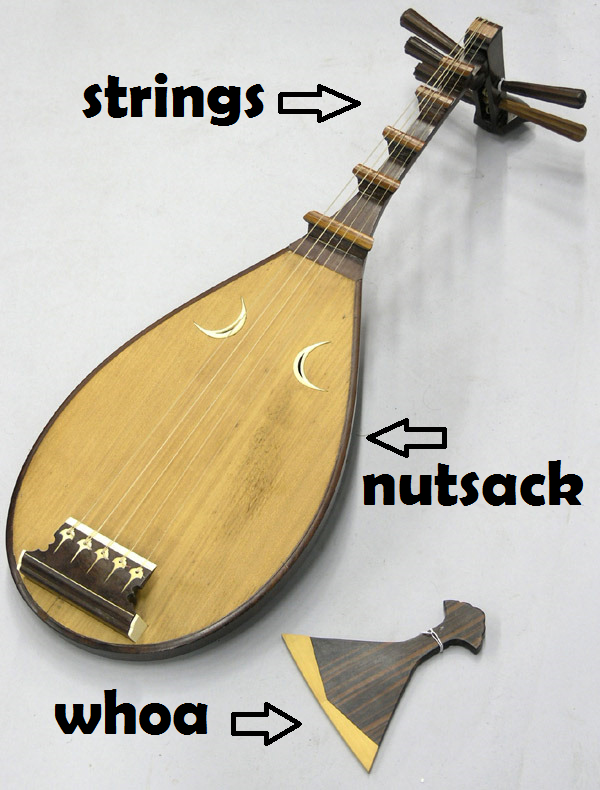
which is a nutsack-shaped guitar that you play with a pick the size of your hand
it is a dope instrument
and Hoichi is so good at playing it
that even GOBLINS weep to hear him.
FUCKING GOBLINS.
Hoichi has worked out a sweet deal with the priest of the Amidaji temple:
basically Hoichi gets to crash for free indefinitely
and in exchange all he has to do is play music for the priest
whenever he’s got friends over or he’s high or whatever
so basically Hoichi has no incentive to ever move out or get a job
and life is good
UNTIL ONE NIGHT
the priest goes out clubbing
and leaves Hoichi alone at the temple
and Hoichi is hanging out on the porch strumming his guitar
trying to pick up chicks
when all of a sudden somebody starts yelling “HOCHI
YO, HOCHI”
and Hochi is like “uh yes sir?”
because he assumes that anybody with sack enough
to just charge up and start yelling his name at midnight
is probably a samurai or something
(in modern times
this is no longer a safe assumption to make)
So the Samurai is like “I represent a very wealthy
very SECRET lord
who would like very much to hear you play your biwa and sing about shit
come with me right now or I will murder you and no one will care”
and Hochi is like “Well shit, I guess I’m being kidnapped
but at least I’m being kidnapped to a party”
so he lets this mysterious asshole take his hand and drag him away.
Pretty soon they arrive at a huge mansion
which is weird
because Hoichi does not remember there being a huge mansion in this town
but what does he know, he’s blind
and it feels real enough.
Eventually he sits down in a room full of people
and they’re all like “Okay dude play for us”
and he’s like “What should I play?”
and they’re like “We heard that your specialty
is the war between the Heiki and the Genji
so how about that.”
This is baby stuff for Hoichi.
He busts out a melodically perfect epic like he’s taking a shit
everyone is devastated by the sheer beauty of this jam
they’re all fucking weeping, it’s disgusting
and then he finishes and they’re like “OH DAMN SON
WE KNEW YOU WAS GOOD
BUT FUCK GOOD
THAT WAS STRAIGHT UP EVIL
WE WOULD LIKE TO BOOK YOU FOR THE NEXT SIX NIGHTS”
and Hoichi is like “fuck yessssss a real gig”
so then the samurai grabs his hand and leads him back to the temple
but before he lets him go he’s like “Listen dude
that lord you played for
he’s on some Howard Hughes shit
doesn’t want anybody to know who he is
so if you tell anybody what’s going on
I will personally end you.”
and Hoichi is like “Yup no problem got it.”
So Hoichi goes and crashes out around sunrise
and the priest was out all night clubbing so he has no idea Hoichi was gone
but the NEXT night Hoichi sneaks out again
and the priest tries to hit him up for some music
but he’s NOT THERE
so when Hoichi stumbles back in in the morning the priest is waiting for him
like “where have you been?”
and Hoichi
who does NOT WANT TO JEOPARDIZE THIS GIG
is like “Uhh
weird … sex … stuff?”
but the priest isn’t buying it
he’s thinking “this is Japan
if Hoichi was into weird sex stuff
he could be doing it during the DAYTIME.
No there is only one possibility:
DEMONS.”
So the next night when Hoichi goes out
the priest sends some of his boys to follow him
and they lose him pretty quickly because they are chumps
but on their way back to the temple
they suddenly hear Hoichi soloing SUPER HARD
and where is the music coming from?
THE MUSIC IS COMING FROM INSIDE THE CEMETERY.
So they run up to the cemetery
and Hoichi is playing his fucking hands off for a bunch of tombstones
and they’re like “this is crazy. Hoichi, stop shredding in the cemetery”
and Hoichi is like “NO
THIS IS THE DEFINING MOMENT OF MY CAREER”
so they grab him by the arms and haul him home because he is obviously crazy.
When he gets back to the temple the priest is like “ok dude what the fuck”
and Hoichi breaks down and tells the whole story
and the priest is like “oh ok I get it
yeah those are the ghosts of everybody who died in that battle you were singing about
I guess they really like to wallow
anyway it’s a good thing we saved you”
and Hoichi is like “Saved me?
Those ghosts just wanted to book me for a week.
Now that you know what’s up, they will instead want to murder me
how is this saving?”
and the priest is like “Dude they’re ghosts
you’ll thank me later
anyway you’re probably right about them wanting to kill you.
I’m gonna need you to take off all your clothes
so I can draw demon wards all over your body
and then the ghosts won’t be able to see you.”
Hoichi doesn’t really have a lot of options at this point
so he takes off his clothes and lets the priest draw a bunch of dicks on him
and then sits in a rigid meditation pose all night
waiting for this plan to fail.
Midnight rolls around and the samurai shows up again
he’s like “YO, HOICHI
I HOPE YOU ARE READY TO TEAR SHIT UP TONIGHT
WE GOT PHARELL, YOU GUYS ARE GOING TO DO A DUET, IT’S GONNA RULE”
but Hoichi doesn’t say shit
so the samurai comes inside and he’s like “Huh
that’s weird
I was hoping to find Hoichi in here
but all I see is a pair of floating ears.
I guess he must have disappeared from rocking too hard or something
but my boss will be pissed if I don’t bring back anything.
Better rip off these floating ears and bring them back
yes, that sounds sensible.”
So the samurai rips off Hoichi’s ears
but Hoichi just grits his teeth and bears it
while blood gushes out of both sides of his head
UNTIL SURNISE
when the priest comes in
almost slips on Hoichi’s blood
and then is like “Ohhhh shit
oh damn
wow
buddy
Forgot to draw demon wards on your ears, buddy
I told my intern to do that part but I guess he forgot
oh wow I’m so embarassed
but the good news is that the demons won’t bother you anymore!”
and Hoichi is like “Hooray
the best audience I have ever had or could ever hope to have
ripped my ears off and now thinks I’m dead.”
and the priest is like “You’re welcome!”
Obviously Hoichi isn’t too keen on living in the temple after that
which i guess was the push he needed to become a famous musician
so it looks like it all worked out in the end.
So the moral of the story
is that if someone passes out before you at a party
please, for their sake
be thorough.
The end.


03 Nov 10:45


How to drive away a repeat customer, in four identical steps
by Mike Taylor
Step 1. Offer to sell the customer an extended warranty
Step 2. Offer to sell the customer an extended warranty
Step 3. Offer to sell the customer an extended warranty
Step 4. Offer to sell the customer an extended warranty

This is, evidently, the strategy of Bosch, a white-goods manufacturer with a good reputation for quality and reliability, but who I will quite possibly never buy another device from because they will not stop spamming me.
It’s a little over two years since I started sending back all my printed spam, at the expense of the sender. It’s actually made a significant difference. I am getting far, far less charity spam than previously. Since then, only eight organisations have sent me more than one such spam (i.e. ignored being told to stop) — five charities, two banks and a telecomms company.
Bosch is the only company to have spammed me more than twice (i.e. to have ignored two separate stop-this postings), and have now sent me a fourth. All of them offering the exact same identical service, which I do not want, and have told them I do not want, and will never want.
So this time, I am sending it back in a marked envelope:

Let’s see if that does the trick.
Meanwhile, I can only advise the rest of you to avoid buying Bosch products, however good they may be, unless you enjoy receiving printed spam.
02 Nov 13:26
in which the author complains about potato chip flavours from the comfort of his website
| archive - contact - sexy exciting merchandise - search - about | |||
 |
|||
| ← previous | November 2nd, 2015 | next | |
|
November 2nd, 2015: The last time I complained about food was in 2012, and within SIX MONTHS Soylent started up. Internet, I have but one request: PLEASE CONTINUE TO MAKE MY FEVERED FOOD DREAMS A FEVERED FOOD REALITY. – Ryan | |||
02 Nov 11:25

This is your monthly reminder that J.C Wright is a whey faced coxcomb
by Andrew Rilstone
If something is to hard to do, then it's not worth doing. You just stick that guitar in the closet next to your shortwave radio, your karate outfit and your unicycle and we'll go inside and watch TV.
Homer J Simpson
I don’t look at J.C Wright's page very often. It makes me cross, and not even interestingly cross, in the way Dave Sim used to. Sim writing was clever, perverse, witty and nasty in equal proportions. It made you want to engage with it. Wright just makes you say “How can an intelligent person type that shit?”
I suppose I justify glancing at his pages in the way that I justify glancing at Richard Dawkins’ tweets. (I mean, apart from morbid fascination, like looking at the execution tableaux on Brighton pier when when I was a kid.) I once said that that the Argument From Prof Richard Dawkins can stand alongside the Ontological Argument and the Cosmological Argument as proofs of the existence of God. I think that an occasional glance at J C Wright and Melanie Phillips and Norman Tebbit are necessary if we are going to keep on marching down the good old socialist road. If that’s what being a conservative does to you then I definitely don’t want to be one.
In his journal this month, the Finest Writer Working Today dusts off a 70 year old letter from Edgar Rice Burroughs to a schoolboy. Apparently, the schoolboy’s English teacher had told him that Burroughs was “trash can literature”.
There are a number of possible answers to that, one of which would have been to ask the teacher to pick up Tarzan and the Ant Men and have a look it. It’s a proper story, written in proper sentences, with proper grammar (except foh de bleck folks, who speaks like dis), proper dialogue and proper description. I could imagine Tarzan or the early John Carters being set for a lower school English lesson. (We read Shane, I recall, which is about on the same level.) I think that’s why Burroughs star has diminished and his disciple Bob Howard’s reputation has increased. A Princess of Mars reads like a Victorian travelogue; a pastiche of Rudyard Kipling. The Conan stories are the distilled essence of pulp.
Burroughs responds that his books may be trash, but that millions of people read them and they have made him a lot of money. Presumably, even someone who has read no philosopher more recent that Plato can see the flaw in that? “This is popular” is not a response to “This is bad”: something can be bad and popular; something can be good but unpopular.
The main part of the Burroughs letter is worth quoting in full:
“My stories will do you no harm. If they have helped to inculcate in you a love of books, they have done you much good. No fiction is worth reading except for entertainment. If it entertains and is clean, it is good literature, of its kind. If it forms the habit of reading, in people who might not read otherwise, it is the best literature.”
Now, it was kind of Burroughs to take the trouble to reply to a fan’s letter; and he didn’t imagine that something he’d dashed off in five minutes was going to be reread decades after he had died. And younger readers will find it hard to believe that the primitive word-processor he was using didn't allow you to correct or edit. You could only change a piece of text by deleting the whole document and starting again. But even taking that into account, I think we can agree that this is a very confused piece of writing. Burroughs seems to argue modestly that his writing is “good of its kind” while arrogantly assuming that his kind of writing is really the only kind. He thinks that fiction in general is just for entertainment; but then argues that encouraging children to read is a good-thing-in-itself.
You can’t have it both ways. You can say “Pantomimes are just silly knockabout, of course; but many a child has fallen in love with theater when they were taken to see Cinderella and as a result discovered the riches of Shaw and Ibsen and O’Neil when they were older — so the ‘panto’ does much good.” Or you can say “Silly entertainment is what theater is all about: Hamlet is merely panto with all the fun taken out; if it doesn’t have a custard pie routine in it, it’s not worth bothering with”. Or you can take the teacher’s point of view and say “How can you, a clever boy, possibly be wasting your time watching a man dressed as a lady throwing a custard pie and at a lady dressed as a man when Long Days Journey Into Night is playing in the same town?” But I don’t think you can say all three.
I think that a Proper Actor would probably say “You may be surprised to know that the stage craft involved in putting on a pantomime and the stage craft involved in putting on a work by Shakespeare are very similar, and a person who truly loves theater loves both equally.” That was what Kenneth Williams said when he was asked why an actor of his caliber was wasting time on the Carry On movies.
The really astonishing thing, sitting there in ancient smudgy courier type is “No fiction is worth reading except for entertainment.” Really? No fiction contains strong manly role models for us to aspire to? No fiction teaches a moral message? No-one ever reads stories to learn about how people live in distant lands or what life was like many years ago? No-one ever studies fiction from a scholarly point of view? I also like the bit about the only kind of literature which can harm you being pornography. That’s a moral point, not a literary one, of course. But aren't there racist books; books that glorify crime; books steeped in commie or fascist propaganda; books that promote belief in the wrong kind of god; atheist books? Is there really no sin but the sin of masturbation?
No fiction is worth reading except for entertainment? I wonder what Prof Lewis and Prof Tolkien, teachers of English Literature both, who J.C Wright reveres and who, incidentally, both quite enjoyed Edgar Rice Burroughs, would have to say about that?
But this, indeed, seems to be the point of the letter, and what has excited Wright about it. Burroughs children were both studying English Literature at college, apparently — not elementary school, college — and the great man is shocked that their set texts are dry and difficult.
Well, yes: of course they are. That is what you are at college for. And I think we know what their lecturer would have replied. “You don’t need the my help to understand Riders of the Purple Range or Brideshead Revisited or even David Copperfield. They are written in your language by people who share the same cultural assumptions as you. So read them on your own time. But you do need my help to get to the bottom of Beowulf or the Faery Queene.”
But Burroughs suspects a conspiracy. Still smarting from having been called garbage-can literature he lashes out against all teachers at all times ever, slipping into language so pompous that you can see why it appealed to J.C Wright:
“The required reading seemed to have been selected for the sole purpose of turning the hearts of young people against books. That, however, seems to be a universal pedagogical complex: to make the acquiring of knowledge a punishment rather than a pleasure. It’s political correctness gone mad, I tell you.”
I may possibly have made the last bit up.
Imagine if you said that about any other subject. “The Karate teacher had some funny idea that I should learn some funny style of open handed fighting, when I can give a very good account of myself in the playground with clenched fists. I suppose his sole purpose is to put young men off the whole idea of fighting”. “I am a big fan of rock n’ roll and the music teacher wanted me to listen to something called Mozart, which I didn’t like after two minutes. What is the point of a music teacher teaching me music I don’t like? She should teach me the music I already like. It’s a con-trick to put me off music.”
Now, it’s not that interesting to discover that a bloody good pulp writer had a bit of a blind spot when it came to other kinds of writing. There are many people who think that people only become classical violinists because they are second rate musicians who can’t master jazz. Or vice versa.
What interests me rather more is Wright’s comment. Astonishingly, it turns out that Wright also has kids — at school rather than college. And, astonishingly, it turns out that their English teachers are part of the same conspiracy that Burroughs uncovered. They keep giving them difficult ("corrosive, dreary, hellish”) books because they want to put them off literature.
NUANCE WARNING! School English lessons are, of course, a different thing from University English courses; and there are honest differences of opinion about what school English is for. Maybe you are introducing children to wide variety of books of different kinds with the intention of forming the habit of reading for pleasure. Maybe you are making them read well-formed books so that their grammar, vocabulary and punctuation will improve and they will eventually be able to write good letters of application and get skilled clerical and middle-management jobs. Or maybe you think that everyone in England should be familiar with the canon of English literature — that if we are in any sense a Nation then all our citizens need a smattering of Shakespeare and Dickens and Milton and Hardy and other dead white guys. But at any rate, it is probably a greater sin to ask a twelve year old to read a book he finds positively boring than to ask a twenty year old to do so.
So which books is Wright objecting to?
“THE BEAN TREE by Barbara Kingsolver
FENCES by August Wilson
OF MICE AND MEN by Steinbeck (better written than the others, from a craftsmanship standpoint, but as the father of an autistic child, I found the sappy heavy-handed emotionalism to be terribly offensive. And the lefty portrayal of Okies was historically false, socialistic blither.)
(The lefty bits were socialist, were they? And were the socialist bits lefty? And maybe the conservative bits were on the right, and the right wing bits conservative?)
To Burroughs rule “all books are good, except pornography” we have added three more:
All books are good, except the sentimental
All books are good, except those that offend the parents of autistic children
All books are good, except the historically inaccurate
All books are good, except those written from a socialist point of view
But couldn’t an entertaining pulp writer like Burroughs be sentimental, historically inaccurate and left wing? And couldn’t a book be historically accurate, devoid of emotion, full of sound right-wing economic theory but still dull as ditch-water?
You started with the claim “Teachers set children dull books, in order to put them off literature”. Someone asked "Give me an example of one of these dull books.” You replied “Here is an example of a sentimental, historically inaccurate, left-wing book."
J.C Wright never answers the question. J.C Wright never answer the question.
And anyway...
How can you object to “Of Mice and Men” because you disagree with its politics? That's a moral judgement, from outside the book, that you are using to judge it. If Burroughs was right to say that all matters about a books is that it is entertaining and that it doesn't have any stark naked slave owners copping off with stark naked princesses, that's a non sequitur. But if he wasn't... Wasn't "bringing political opinions to bear on literature" and "only liking books whose politics you agree with" the besetting sin of the Hugo awards that you so abominate?
02 Nov 10:35

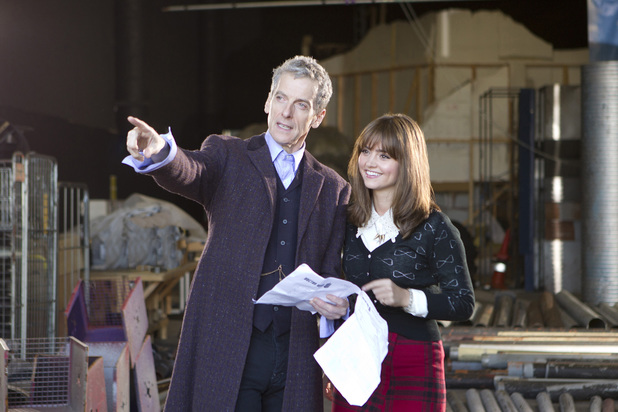
The Doctor Who Random Story Generator
by noreply@blogger.com (Paul Magrs)
The Doctor Who Random Story Generator!
It really works, folks! (Sort of!)
By Paul Magrs
November 2015
This is by no means complete, nor in the right order. Feel free to use any of this in any old order you fancy.
If we can agree that the essence of a good Doctor Who story in any genre or format consists of:
A) The plaiting of strong narrative strands pitching one or more groups of heroes against one or more group of villains and monsters; B) bold visual imagery involving contrasts and juxtapositions and C) slightly wonky allegory
Then this might work.
Ok:
Setting Up.
There needs to be two locations, with perhaps two or three rooms in each, and some inbetween place. There must be a strong contrast between all three. So: an Elizabethan manor house, a desert, a space ship. The Roman Forum, an asteroid belt, a blue swamp on Venus.
You must have a group of humans who live and work inside a hierarchy and wear uniforms accordingly. Soldiers, servants, colonists. Most stand in the background nodding in early scenes and their leaders fill in exposition about who and what and where they are. Revolutionaries and malcontents are a good thing to bring in here.
When the Doctor and Companion(s) arrive he gets to talk to both the highest and the lowliest in the land, classically sympathizing with the put-upon and the lowliest. (A good twist is when this turns out to be the leader.)
Take something from the news or popular consciousness. Global climate change, transsexuals being abused by Germaine Greer, the refugee crisis, etc. Map this onto your story about aliens quite obviously at the start, but end up trying to disguise it as your story gets out of control and has you saying all kinds of odd things you don’t really agree with.
Choose a favourite old story to follow and subvert: a Gothic tale, a Golden Age Mystery, a Shakespeare, a Greek Myth, a classic SF film or a Puffin classic of the 1960s.
Best if a Companion has a flashback trauma early in your story, either from a previous story, or their childhood. This will come in useful for giving your runaround finale more resonance.
The Doctor’s developed a new quirk: now he plays the triangle, plays with his yo-yo, is a bird spotter. This will come in useful too, before the story’s out.
At the heart of your story place something that’s to do with juxtaposition. Something strikingly visual. A giant whale with the head of a baby. A department store stranded alone on a world of ice. A theme park of cartoon characters in Dante’s Inferno. That kind of thing. Something that plays with scale, time, sense or genre distinctions is good.
STUFF HAPPENING
Obviously, in terms of working through the story, there needs to be the elements everyone knows:
Exploration / capture / bungled escape / recapture / escape / bungled recapture / discovery of a mystery / a corpse / a frightening state of affairs / someone who shouldn’t be there / an anachronism / a puzzle / aliens in disguise / a spooky factory. And then we must see the Doctor standing up to brutality and discover an enigma that only he half-understands as yet. (He might be pretending and completely understand it, or not understand it at all. This depends on which Doctor it is. Some might have already been to the end of the story and sorted it all out already, making them a manipulative weirdo, and others might not even know what day it is yet.)
Now they must meet a new, slightly tragic friend who takes them to meet his/ her people, who warn about all the dangers, and then there’s an attack, the Doctor is curious despite the dangers and goes to meet the enemy. The new friend goes with him, leaving the Companion(s) behind. After a number of exciting events the new friend dies nobly and tragically. The Doctor swears never to forget him / her, and promptly forgets him / her.
The Doctor is captured by the enemy, doesn’t even try to escape, generally larks about until they show him their doomsday device which, depending up the relative sophistication of the story, can be either a machine that looks like a teasmade or a long, impossible explanation of the whole season’s accumulated storylines. The Doctor will stare in outrage and slight bafflement either way.
MORE THINGS TO PUT IN:
A creature that is made of:
bits of insect / bits of metal / bits of fur / scales / suckers / tentacles / bones / rocks / corpses / gelatinous stuff / baked beans, or any combination of the above. Mostly they’ll just say ‘raaarggh’ and lumber about. For added comedic effect give them a funny voice or an entirely reasonable manner. For added sophistication, give them a long speech about the whole season’s accumulated story lines.
Put in an interesting mode of transport for taking the Doctor and friends between one location and another – a tube train through the time Vortex, a escalator through the clouds, a soil pipe.
Have them escape from the base / city / whatever and reveal a completely unexpected new location. Involve a shift in scale or perspective or context. Eg, ‘So we were inside a vacuum cleaner / 17thParis / Freud’s mind… the whole time!’
CLIMAX.
There must be a ticking clock. Or bomb. Or teasmade. Do not defuse it until the numbers are down to single figures. Keep all your characters running towards it.
The Doctor has a vital piece of information that he reveals once he gets to the teasmade. This ought – for the sake of story clarity – to be something he has learned within this story. Or, if you want to delight fans – it could be something no one’s mentioned since 1974.
The twist at this point, as everyone watches the teasmade, might be:
The villain is a hero / the helpful friend is still alive and a traitor / the villain reveals a backstory nugget that makes things more morally complicated and we start to like him or her a bit / or the hero does something assholish just at the wrong moment.
Or, someone from 1974 comes wandering in, completely unexpectedly.
You are allowed three interviews between the Doctor and your villain: 1) the villain triumphant, boasting and giving too much away. 2) A meeting of equals, in which the villain falls for the Doctor and offers to share power with him and the Doctor strings them along for a bit. C) The Doctor defeated and gradually, gleefully reversing the situation.
Petard Hoisting. The Doctor does something awful and downright fitting to his enemy.
NOTE ON VILLAINS: They used to be something from pantomimes or horror films. Now they should be like contestants from The Apprentice. (Companions are like contestants from The Great British Bake-Off.)
STORY STRANDS.
Separate your TARDIS Team early in the story. Let the two sets make new local friends. Ply their two strands with perhaps two strands featuring your story-specific characters (one nice, one evil.)
All are moving towards the same setting for the climax / denouement / wordy explanations. Say, throne room, top of an office block or the centre of the maze. Everyone tries to trip each other up in getting there. (Friends try to save each other / heroes try to prevent villains reaching the doomsday teasmade / villains use heroes as landmine sheep.)
KEY POINTS:
The invading monsters are invariably revealed to HAVE ALWAYS BEEN HERE.
The space-colonising humans have ALWAYS BROUGHT THE BEST AND WORST OF HUMANITY with them into the stars.
Even though SHITTY THINGS HAPPEN, SOME GREAT GOOD WILL COME. So – don’t muck about with history, even if it’s your Time Lordy mission or some school teacher gets a fit of conscience.
Any hierarchical system – whether Time Lords, school governors, soldiers or civil servants – is revealed to be rotten at the core. With free stationery comes great temptation.
ALWAYS REMEMBER:
The best Doctor Who stories are very clever things disguised as something stupid.
And the worst Doctor Who stories are very stupid things disguised as something clever…
And generally, the Doctor is the former while his enemies are the latter.
AVOID:
Long speeches about the trials of immortality or the web of time.
Avoid stories about trials.
Avoid having something be just the thing it is. If you have a story about giant insects, highwaymen, the moon, Albert Einstein, then reveal them to be something quite different as well. For example: an android, sentient jelly, a giant egg, an anteater, etc. Make the thing something very different from what it seemed to be. If the thing turns out to be just the thing it seemed to be, then that’s not as interesting or Dr Who-ish.
Best if the Tardis is on the blink. A time and space machine that works perfectly well is an awkward thing – for the obvious reasons – in a story involving danger and exciting adventure.
NEVER let your companion say: ‘Can’t we just go back to the TARDIS?’ Your audience might agree with them. Find a way to make it impossible to return until at least the coda.
HANDY GUIDE TO THE STAGES OF A STORY:
INTRODUCTION What the fuck?
MIDDLE BIT. Run like fuck!
CLIMAX FUCK!!
DENEOUEMENT Thank fuck!
CODA. What the fuck NOW?!
Now, the way you make those stages last long enough to last a whole story involves some of the following stuff. Use some of these (but not all, of course. That would be TOO MUCH.)
Cloning, mysterious transformation, horrible botched surgery, apparent death, getting lost, being sent into another dimension, getting whizzed into the distant past or future, becoming a ‘ghost’ (with a rational explanation), being mind probed (or mind-drained or mind-robbed), being locked up, being possessed, being kept waiting for execution, contracting a space disease, getting converted into a Cyberman, being shot into a virtual reality without knowing it, falling in love, or having a dream sequence.
ALWAYS INCLUDE:
A bad-tempered secondary cast member who loses his or her temper and bellows at the Doctor and Companion(s): ‘You’re wasting your time!’
This happens in almost every story.
It’s your job to make sure that they aren’t. Not one single moment must feel like wasted time or padding. In the world of Doctor Who, every single moment is absolutely packed! (With all the stuff in the list, above, obviously.)
Also, though being confused during the first three quarters of the story is a good thing, it’s nice if the audience comes to UNDERSTAND IT ALL by the end.
And that’s it.
02 Nov 09:14


No, the Kids Aren’t Reading the Classics and Why Would They
by John Scalzi
Writer Jason Sanford kicked a small hornet’s nest earlier today when he discussed “the fossilization of science fiction,” as he called it, and noted that today’s kids who are getting into science fiction are doing it without “Asimov, Clarke, Heinlein and Tolkien.” This is apparently causing a moderate bit of angina in some quarters.
I think Sanford is almost entirely correct (the small quibble being that I suspect Tolkien is still common currency, thanks to recent films and video games), nor does this personally come as any particular shock. I wrote last year about the fact my daughter was notably resistant to Heinlein’s charms, not to mention the charms of other writers who I enjoyed when I was her age… thirty years ago. She has her own set of writers she loves and follows, as she should. As do all the kids her age who read.
The surprise to me is not that today’s kids have their own set of favorite authors, in genre and out of it; the surprise to me is honestly that anyone else is surprised by this. As a practical matter, classic science fiction isn’t selling where today’s kids are buying (or where they are being bought for), namely, in the YA section of the book store. See for yourself: Walk into your local bookstore, head to the YA racks and try to find a science fiction or fantasy-themed book that more than fifteen years old. It’ll be a rough assignment. YA has a high audience turnover rate — kids keep aging out of the demo, don’t you know — and the new kids want their own books. The older books you’ll see tend to be a) ones assigned by schools, b) ones that had movies made from them.
Mind you, generally speaking, book stores stock newer books anyway; book stores, like other entertainment venues, rely on novelty (which in our line of work is called “front list”) to get people through the doors. If you’re doing well as an author, some of your backlist is on the shelf, too. But the shelf in a physical bookstore is only so long. These days, being someone who has been in a lot of bookstores recently, I note the shelf in science fiction and fantasy is mostly skewed to living, working authors, most notably their last couple of books. Some classic (i.e., now dead) authors are there but usually represented by two or three books rather than an extensive backlist.
Which is as it should be. All love to Heinlein, Clarke, Asimov, et al., but they’re dead now. They don’t need the money from readers; living authors do. Moreover, Heinlein, Clarke, Asimov, et al have been dead on average two to three decades and their best known work is half a century old. No matter how brilliant they were or how foundational they were to the genre, they’re going to be dated. None of the futures of Heinlein , as just one example, resemble a future that begins from today; they branch off from the 50s or 60s. Readers (in general) don’t want to have to go backwards a half century in order to move forward again.
Certainly you can’t expect new readers to the genre, including young readers, to backshift several decades — or, well, you can, but it would have the same effect as suggesting to a teenager today that if they want to see a movie about people their age, they should watch The Blackboard Jungle. Sure, it’s fine movie, and an important one. It’s just not especially relevant to the teenager of today. It wasn’t made for them, in any event. It was made for their grandparents.
Again, I’m not sure why it comes as a surprise to anyone that people might want entertainment aimed at them, which includes entertainment written by living people with a sense of what’s going on in contemporary culture. Most people aren’t approaching the genre as a survey course. They’re approaching it to be amused. And if they are approaching is as a survey course, then the good news is that it’s not actually that hard to find many if not most of the classics. There is infinite shelf space online, and you don’t have to sell that many copies of an ebook to remain in print. It’s there if you want it.
But — again — it’s okay if you don’t. I don’t expect new readers of the genre today to read much Heinlein or Clarke or Asimov. 60 years from now, and presuming I’m dead, I don’t expect them to read much of me, or Al Reynolds or Ann Leckie, either (to name just two other contemporary SF writers). They’ll be reading their authors, mostly. I hope they’ll enjoy them.
Esteban Peralta Losilla, clauaud and 2 others like this
01 Nov 17:21
I’m glad Westboro Baptist is protesting meteorology
by Fred Clark
The Westboro Baptist Church is sounding more and more like the Satanic Temple.
It used to be easier to tell them apart. One was an evil anti-Christian religious group that worshipped the devil while promoting a gospel of hate, and the other one called itself the “Satanic Temple.”
But lately the litigious protesters of Westboro Baptist have gotten so over the top that they’ve come to serve as a parody and rebuttal of their own message — the sort of thing best executed these days by Lucien Greaves and his merry band of nominally “Satanic” pranksters.
Consider, for example, Westboro’s protest earlier this month at the National Weather Service offices in Norman, Oklahoma:
The Westboro Baptist Church appeared at the National Weather Center in Norman on Thursday morning, protesting meteorology, weather science as well as homosexuality.
According to the church’s picket schedule, the theme of the protest was its stance on meteorology and the science of weather in relation to God’s will.
We are winding down the affairs of this earth and in the wrapping up of the affairs of this life there must be some truth. You enjoy the blessings of God when you look at nature, but you refuse to see what is in front of you, or to give God the glory for it! Instead you pawn off His judgments to your great god mother nature. It will not go well for you in the day of judgment when you stand before your God and have no explanation for serving the creature rather than the creator. For that is what you do when you turn to idols. Who sends the earthquakes? Who sends the fires? Who sends the hurricanes? You are powerless to stop any of it, as you are powerless to stop the God who sent them. Wake up! Repent while you can or Perish like those before you. Obey today!
This is kind of brilliant. I wish I’d thought of this.
By striking this pose as the lonely righteous defenders of a biblical stance on meteorology, the folks from Westboro shine a spotlight on just how arbitrarily selective so many of the things commonly described as a “biblical stance” really are.
Many have observed the vast difference between the way white fundamentalists and evangelicals here in America respond to meteorology and the way they respond to biological evolution. Evolution is rejected and denounced as a threat to the “biblical” ideology of young-Earth creationism, but even the most leaden literalists don’t blink an eye when the local weather reporter tells them that a low pressure system in the region could bring rain tomorrow. Meteorologists usually get a pass, with no challenge perceived and no challenge offered back to their understanding of the science of weather — even though that science contradicts numerous unambiguous statements in the Bible attributing the weather to God.
“Praise the Lord from the earth,” Psalm 148 says, “Fire, and hail; snow, and vapours; stormy wind fulfilling his word.”
Job 37:5-6 is more detailed:
God thundereth marvellously with his voice; great things doeth he, which we cannot comprehend. For he saith to the snow, Be thou on the earth; likewise to the small rain, and to the great rain of his strength.
In the following chapter of Job, it is the voice of God which says:
Have you entered the storehouses of the snow,
or have you seen the storehouses of the hail,
which I have reserved for the time of trouble,
for the day of battle and war?
It’s also God speaking in Deuteronomy 11:14 “I will give you the rain of your land in his due season, the first rain and the latter rain.” And it’s Jesus himself talking about God in Matthew 5: “Your Father which is in heaven … sendeth rain on the just and on the unjust.”
(Steve Wiggins has written a book about this biblical meteorology: Weathering the Psalms: A Meteorotheological Survey.)
From Genesis to Revelation, this is how the Bible talks about the weather — as something directly controlled and orchestrated by God. Rain and snow were things God kept in reserve until loosing them upon the world. And every day, actively, God was involved in making the sun to rise, the wind to blow, and the rain to fall.
 For many centuries, then, this was how Christians thought about the weather. And if you’d asked Christians, back then, why they thought this was how weather worked, they would’ve said it was because of the Bible, because this was a clear, recurring “biblical teaching.” (And most Christians would’ve believed that even though most Christians back then didn’t have Bibles.)
Eventually, though, we humans figured out a lot more about how weather works. We started learning and discovering all the stuff that we now refer to as meteorology. And Christians, almost unanimously, decided that this was how weather works. Subsequently, we started thinking of all those verses above and the dozens of other passages like them differently. We came to read them differently — understanding them in a way that no longer seemed to contradict what we’ve learned about meteorology.
And all of that happened without any controversy or crisis of faith, without any of the high drama like the trials of Galileo or John Scopes, and without meteorological denialism becoming a tribal hallmark for fundamentalist Christians fearful of modern science. No professor is in danger of getting kicked out of Wheaton or Liberty University or even Bob Jones for saying they believe in low pressure systems.
Our imagined “biblical stance” on meteorology changed in exactly the way that, for many American Christians, our “biblical stance” on biology never did. We Christians easily, almost imperceptibly, changed the way we understood all those Bible passages about the weather. But for many American Christians, doing the very same thing with all those Bible passages about the origins of life is portrayed as a grave and dangerous sin.
And the same American Christians who refuse to change their understanding of those creation passages also cling to their imagined “biblical stance” on human sexuality, rejecting everything humanity has learned about that subject just as emphatically as they reject all that we’ve learned about evolution.
Anything having to do with human sexuality — in particular, with the reality, humanity and dignity of LGBT people — has thus become, like evolution, a cultural hallmark that signals either loyalty to or a rejection of the Bible itself.
This is why that bizarre non-sequitur in the report above on the Westboro Baptist protest isn’t actually a non-sequitur at all. The protesters gathered at the National Weather Service to protest meteorology and weather science, it says. And then, “… as well as homosexuality.” It’s all the same thing, really — and not just for the fringe nutters of Westboro Baptist. It’s all the same thing for the vast majority of “mainstream” white evangelical Christians in America. It’s a defense of the Bible and of the way they insist everyone must read the Bible lest it cease to be “authoritative.”
Civil equality for LGBT people must be opposed because of the Bible. The teaching of evolution in schools must be opposed because of the Bible. And the National Weather Service must be opposed because of the Bible.
That last one might seem like a deviation from the prior two, but the logic is exactly the same. Westboro is warning their fellow Christians not to abandon “biblical teaching” on human sexuality the same way that earlier generations recklessly abandoned “biblical teaching” about the weather.
I don’t think the Westboro folks intended this protest to be a kind of performance art designed to highlight the cognitive dissonance of their fellow Christians. But if that had been their intent, I don’t think they’d have had to change any of what they did.
01 Nov 12:48
[psych, Patreon] Beneficent Trauma
[TW: traumas mentioned with moderate/alarming detail: violence, sexual violence, emotional trauma, surgery]
Here is a thing most people don't know, and even plenty of therapists haven't much thought about.
Usually when we talk about traumatic experiences, they are unambiguously "bad". An assault. Mistreatment. An accident that causes grievous physical harm. We – and the person traumatized – can say with conviction that the thing that happened was a bad thing, and it would have been better if that thing had never happened at all.
But sometimes experiences are traumatic but the traumatized person cannot say the trauma should never have happened. They are things that are in some sense "good". And that can leave the traumatized person in a weird psychological limbo.
Here's a couple of examples (fictionalized for privacy) from my own clinical experience.
• A young woman in her 20s who had been sexually trafficked as a young girl; for her years of captivity, she had also been battered and neglected, and drugged against her will. She was rescued in a police raid – by a SWAT team. Which is to say, one night, she was woken by masked, black-clad men bursting into the room, pointing automatic firearms at her face and screaming "GET ON THE FLOOR AND DON'T MOVE!" The client explains that there was no question in her mind that that SWAT team saved her life – and from a fate worse than death. But still, several times every night she would startle awake with her heart racing, nauseous with terror, with the memory of being able to see down the barrel of the weapon vivid in her mind; she often stayed up all hours, unable to bring herself to go to bed, and finally collapsing with exhaustion when the sun rose.
• A man in his late 40s, who had been born with a congenital heart deformity; at the age of 8 he had had corrective surgery for it. Without it, he certainly could not live a normal life, and probably wouldn't have lived a very long one. Yet: it was open heart surgery; "they gutted me like a fish". Worse, he was just old enough that at the time he had the surgery, it was considered best practice to not allow a child patient's parents to be with their child in the hospital; to not tell the child what was happening; and to not tell the child in advance what would happen so the child wouldn't have time to become frightened. So his lived experience was being suddenly taken to a strange place by his mother, and abandoned there into the care of strangers – he recalled screaming down the hospital corridor at her retreating back, "MOMMY MOMMY DON'T LEAVE ME I'LL BE GOOD" – who physically subdued him, drugged him, and when he woke up, he had a massive painful wound down his chest and months of terrifying recuperation. He knows now, as an adult, that his mother didn't turn to look at him because the tears running down her own face, and that everyone was trying to do the best they knew how to take care of him. But still, it meant that, fifty years later, every time he had to go to a medical facility, he had panic attacks, and so had been procrastinating the liver biopsy his PCP said he needed for over two years.
In both cases, the patients had developed straight-up classic PTSD, and in both cases, the patients felt quite guilty for having PTSD from something "good", that had been done entirely to their benefit, and indeed had saved their lives. As if their PTSD was criticism they were making of those to whom they were profoundly grateful – which of course it is not. They both had other traumas to point to and say, "That's the sort of thing that I should have nightmares about, have flashbacks of – not having my life saved!"
Indeed, when a trauma is something the patient sees as a necessary and beneficial thing, sometimes the patient rejects the idea that it could be what caused their PTSD, or that they have PTSD at all, despite the symptoms they present for treatment.
It is easier to deal with trauma when one can simply say, "That was awful and should never have happened." It is emotionally confusing when the trauma was a terrible thing one also is grateful about happening.
I'm not going anywhere profound with this; I'm mostly just posting for consciousness raising about this issue.
And I want to validate that it is in fact possible to have conflicted, complicated feelings about traumatic experiences. And that's okay. It doesn't mean you are ungrateful, or that you hate the person who did it to you (and it doesn't mean you don't hate the person who did it to you) or that you're rejecting them. It doesn't mean you didn't want to live, or didn't want to be rescued; it doesn't mean you were self-destructive or had a death wish. It just means that it was a complicated situation, and had multiple meanings for you.
Life is complex that way.
This post brought to you by the 63 readers who funded my writing it – thank you all so much! You can see who they are at my Patreon page. If you're not one of them, and would be willing to chip in so I can write more things like this, please do so there.
Please leave comments on the Comment Catcher comment, instead of the main body of the post – unless you are commenting to get a copy of the post sent to you in email through the notification system, then go ahead and comment on it directly. Thanks!
Here is a thing most people don't know, and even plenty of therapists haven't much thought about.
Usually when we talk about traumatic experiences, they are unambiguously "bad". An assault. Mistreatment. An accident that causes grievous physical harm. We – and the person traumatized – can say with conviction that the thing that happened was a bad thing, and it would have been better if that thing had never happened at all.
But sometimes experiences are traumatic but the traumatized person cannot say the trauma should never have happened. They are things that are in some sense "good". And that can leave the traumatized person in a weird psychological limbo.
Here's a couple of examples (fictionalized for privacy) from my own clinical experience.
• A young woman in her 20s who had been sexually trafficked as a young girl; for her years of captivity, she had also been battered and neglected, and drugged against her will. She was rescued in a police raid – by a SWAT team. Which is to say, one night, she was woken by masked, black-clad men bursting into the room, pointing automatic firearms at her face and screaming "GET ON THE FLOOR AND DON'T MOVE!" The client explains that there was no question in her mind that that SWAT team saved her life – and from a fate worse than death. But still, several times every night she would startle awake with her heart racing, nauseous with terror, with the memory of being able to see down the barrel of the weapon vivid in her mind; she often stayed up all hours, unable to bring herself to go to bed, and finally collapsing with exhaustion when the sun rose.
• A man in his late 40s, who had been born with a congenital heart deformity; at the age of 8 he had had corrective surgery for it. Without it, he certainly could not live a normal life, and probably wouldn't have lived a very long one. Yet: it was open heart surgery; "they gutted me like a fish". Worse, he was just old enough that at the time he had the surgery, it was considered best practice to not allow a child patient's parents to be with their child in the hospital; to not tell the child what was happening; and to not tell the child in advance what would happen so the child wouldn't have time to become frightened. So his lived experience was being suddenly taken to a strange place by his mother, and abandoned there into the care of strangers – he recalled screaming down the hospital corridor at her retreating back, "MOMMY MOMMY DON'T LEAVE ME I'LL BE GOOD" – who physically subdued him, drugged him, and when he woke up, he had a massive painful wound down his chest and months of terrifying recuperation. He knows now, as an adult, that his mother didn't turn to look at him because the tears running down her own face, and that everyone was trying to do the best they knew how to take care of him. But still, it meant that, fifty years later, every time he had to go to a medical facility, he had panic attacks, and so had been procrastinating the liver biopsy his PCP said he needed for over two years.
In both cases, the patients had developed straight-up classic PTSD, and in both cases, the patients felt quite guilty for having PTSD from something "good", that had been done entirely to their benefit, and indeed had saved their lives. As if their PTSD was criticism they were making of those to whom they were profoundly grateful – which of course it is not. They both had other traumas to point to and say, "That's the sort of thing that I should have nightmares about, have flashbacks of – not having my life saved!"
Indeed, when a trauma is something the patient sees as a necessary and beneficial thing, sometimes the patient rejects the idea that it could be what caused their PTSD, or that they have PTSD at all, despite the symptoms they present for treatment.
It is easier to deal with trauma when one can simply say, "That was awful and should never have happened." It is emotionally confusing when the trauma was a terrible thing one also is grateful about happening.
I'm not going anywhere profound with this; I'm mostly just posting for consciousness raising about this issue.
And I want to validate that it is in fact possible to have conflicted, complicated feelings about traumatic experiences. And that's okay. It doesn't mean you are ungrateful, or that you hate the person who did it to you (and it doesn't mean you don't hate the person who did it to you) or that you're rejecting them. It doesn't mean you didn't want to live, or didn't want to be rescued; it doesn't mean you were self-destructive or had a death wish. It just means that it was a complicated situation, and had multiple meanings for you.
Life is complex that way.

This post brought to you by the 63 readers who funded my writing it – thank you all so much! You can see who they are at my Patreon page. If you're not one of them, and would be willing to chip in so I can write more things like this, please do so there.
Please leave comments on the Comment Catcher comment, instead of the main body of the post – unless you are commenting to get a copy of the post sent to you in email through the notification system, then go ahead and comment on it directly. Thanks!
01 Nov 00:35
1941 Retro Hugo Awards: Some 1940 short sf available for free online
Following up on my list of the most anthologised sf short stories of 1940, here are links to those I found readliy available for free online after a cursory search (ie in the first page of Google results for title and author). I am happy to expand this list to include other short sf from 1940, as well as any I may have missed from my first list, and also to remove any links which violate copyright.
NB also that UNZ.org has the entire 1940 runs of Unknown, Thrilling Wonder Stories and Argosy in PDF - possibly others as well, but I couldn't see how to find out.
Novellas
"Blowups Happen", by Robert A. Heinlein
"But Without Horns", by Novell Page
"The Mound", by H.P. Lovecraft and Zealia Bishop
Novelettes
"The City of the Singing Flame", by Clark Ashton Smith
"The Exhalted", by L. Sprague de Camp
"Farewell to the Master", by Harry Bates
"The Red Death of Mars", by Robert Moore Williams
"The Sea Thing", by A.E. van Vogt
"Till Doomsday", by Robert Sale
"Vault of the Beast", by A.E. van Vogt
"The Voyage That Lasted 600 Years", by Don Wilcox
Short Stories
"Beauty and the Beast", by Henry Kuttner
"The Bleak Shore, by Fritz Leiber
"The Chaser", by John Collier
"The Circular Ruins", by Jorge Luis Borges
"Derm Fool", by Lester Del Rey
"Footsteps Invisible", by Robert Arthur
"The Great God Awto", by Clark Ashton Smith
"Inflexible Logic", by Russell Maloney
"John Duffy's Brother", by Flann O'Brien
"The Pipes of Pan", by Lester Del Rey
"Quietus", by Ross Rocklynne
"Song in a Minor Key", by C.L. Moore
The Song of the Slaves", by Manly Wade Wellman
"Successful Operation", by Robert A. Heinlein
"Thus I Refute Beelzy", by John Collier
“Tlön, Uqbar, Orbis Tertius”, by Jorge Luís Borges
"Train for Flushing", by Malcolm Jameson
"When It Was Moonlight", by Manly Wade Wellman
NB also that UNZ.org has the entire 1940 runs of Unknown, Thrilling Wonder Stories and Argosy in PDF - possibly others as well, but I couldn't see how to find out.
Novellas
"Blowups Happen", by Robert A. Heinlein
"But Without Horns", by Novell Page
"The Mound", by H.P. Lovecraft and Zealia Bishop
Novelettes
"The City of the Singing Flame", by Clark Ashton Smith
"The Exhalted", by L. Sprague de Camp
"Farewell to the Master", by Harry Bates
"The Red Death of Mars", by Robert Moore Williams
"The Sea Thing", by A.E. van Vogt
"Till Doomsday", by Robert Sale
"Vault of the Beast", by A.E. van Vogt
"The Voyage That Lasted 600 Years", by Don Wilcox
Short Stories
"Beauty and the Beast", by Henry Kuttner
"The Bleak Shore, by Fritz Leiber
"The Chaser", by John Collier
"The Circular Ruins", by Jorge Luis Borges
"Derm Fool", by Lester Del Rey
"Footsteps Invisible", by Robert Arthur
"The Great God Awto", by Clark Ashton Smith
"Inflexible Logic", by Russell Maloney
"John Duffy's Brother", by Flann O'Brien
"The Pipes of Pan", by Lester Del Rey
"Quietus", by Ross Rocklynne
"Song in a Minor Key", by C.L. Moore
The Song of the Slaves", by Manly Wade Wellman
"Successful Operation", by Robert A. Heinlein
"Thus I Refute Beelzy", by John Collier
“Tlön, Uqbar, Orbis Tertius”, by Jorge Luís Borges
"Train for Flushing", by Malcolm Jameson
"When It Was Moonlight", by Manly Wade Wellman
31 Oct 15:18
[tech, psych, Patreon] What Software is Made Of
Do you know what software is made of?
Yes, software. Broadly construed. Computer programs.
Some of you are thinking "ones and zeros!" and some are thinking "electrostatic charges!", which are in this case the same thing, and they're not wrong. But that's the kind of answer which is remarkably unhelpful in all but the most limited circumstances. It is most especially useless for furthering the understanding of people who do not program and who have never programmed.
And since the whole of human life around the globe is reorienting to being intermediated and organized around programmed (and sometimes programmable) artifacts, it would seem understanding programming (if not necessarily understanding how to program) would be a very important thing for all people, if only to understand the world they now live in.
But to return to the question, some of you are thinking, "instructions!" And some of you thinking that mean it in the sense of what assembly language is expressed in and some of you are thinking that in terms of the old analogy long used to explain programming to non-programmers, of it being like a shopping list – and those may or may not be different things.
But let's talk about the shopping list analogy for a moment. If you haven't heard it, it goes something like this. Imagine you were sending a robot to the store to go grocery shopping for you. So you want to give the robot a list of things to buy. Let's say that you need a loaf of bread, a gallon of milk, and a dozen eggs. You could make a list that says "a loaf of bread, a gallon of milk, and a dozen eggs". But the robot is really stupid. It's just a robot. So you need to be more specific than that. You need to tell the robot which sort of bread you want, or whether the robot should just pick the first loaf it comes to. You need to tell the robot whether to get whole or skim or low-fat milk. You need to tell the robot whether the eggs should be the cheap ones, the free-range ones, the extra omega-3 fatty acids ones, or what.
You are probably also going to want to tell the robot - because if you don't tell it, it won't know – that it should not place the milk on top of either the bread or the eggs.
You may also want to tell your robot to inspect the bread for mold, the milk for the expiration date, and the eggs for breakage, before accepting any specific item. And because the robot is so dumb, you have to specify that if the first package of Dan's Bakery Six Grain with Extra Gluten is moldy, it should replace that package on the shelf and pick a different package of Dan's Bakery Six Grain with Extra Gluten and check it – and then repeat that process until it either finds an acceptable (non-moldy) package of Dan's Bakery Six Grain with Extra Gluten or runs out of Dan's Bakery Six Grain with Extra Gluten to check, in which case it needs to.... what?
What do you want your robot to do if none of the available bread of the type you want isn't moldy?
Do you want it to pick a different type of bread? Do you have a prioritized list of bread preferences you could have the robot work down?
Do you want it not to buy bread at all?
Do you want it to buy based on some other criteria, like, "just pick the cheapest wheat bread"?
It's up to you. It's your robot. It's your shopping list. You decide.
And that's what software is made of: software is made of decisions.
I'm not just saying that one makes decisions when making software. That's true of the making of all made things, from knitting tiny sweaters for dolls to erecting valley-drowning hydroelectric dams. But dolls' tiny knit sweaters are made out of yarn or other fiber, and valley drowning hydroelectric dams are made of masonry and metal. They are also made of decisions, too, but if you subtracted out the decisions, there would still be the constituent matter: a skein of floss, a pile of concrete. If you subtracted out the decisions from a computer program, there wouldn't be anything at all.
Decisions are all there is to software. That's what it's built out of. A computer program is an instantiation of a set of decisions. There is nothing else in a computer program but decisions. To make software what one is doing is making decisions – carefully crafting decisions, and trying to express those decisions as clearly, precisely, and rigorously as possible.
A computer program is a specification of the behaviors of an inanimate object. And since inanimate objects, definitionally, do not have behaviors of their own, every single one of those behaviors specified in a computer program – and every single aspect of every one of those behaviors – has to be deliberately chosen and imbued into the object by code. Every single behavior, at every level of abstraction, represents a decision as to what the program is to do in that moment being described.
There is nothing else. If the programmer with their hands on the keyboard does not know what the program is to do, their hands remain still, the edit window remains empty.
A computer program is an expression of the set of decisions as to what behaviors an inanimate object should have, and under what circumstances.
Those decisions can be highly contingent and circumstantial; that is, a program can be told to examine momentary conditions and respond differently to different conditions, and these contingencies can be based on anything the computer program can perceive. Those decisions can be almost limitlessly sophisticated – they can be Turingly-completely contingent. They can even be (pseudo-)random. But however abstracted those decisions are, they are decisions.
If software is a building, then decisions are the concrete of the foundation, the wood of the framing, the nails and the hangers, the sheet-rock, the moisture barrier, the siding, the insulation, the wiring, the plumbing, the paint, the carpets, the carpet tacks, the tiling, the grout, the window glass and sash, the roofing, the gutters. Everything, everything, everything in a computer program – in software – is decisions. There is nothing else for a computer program to be made of.
This is the crucial thing that needs to be understood both by programmers and by the non-programmers who hire programmers to program for them.
Communications breakdowns and other strife between programmers and those they program for are overwhelmingly about conflict over decision-making.
Sometimes it's because the person retaining the programmer – whom I'll call the client – and the programmer are struggling over who gets to make a decision. But far, far more often, the conflict is over who has to make a decision.
We, in our culture, are used to thinking of making decisions as a privilege. It can be. But it's not intrinsically, or even often. Often, decision-making is an obligation. A responsibility. It is work.
("Where do you want to go to eat?" "Ehh, I don't know. Where do you want to go to eat?" "Oh, I don't know. What do you feel like?" "Anything is fine by me. Whatever you want." "I'm good with anything. You pick." "No, you pick.")
It does one a world of good to get over the often self-serving notion that "letting" other people decide things is always doing them a favor, and not, as it sometimes is, an abdication of responsibility that dumps additional work on their shoulders.
The client – that is the person commissioning work from the programmer – is the person who ultimately determines what the program should do. After all, it's their program. This means the programmer is going to need the client to be willing to answer questions about what the client wants and needs the program to do.
These questions are often terribly annoying, being both persnickety and difficult. Questions like, "On the screen that shows the listing of widgets with their frobs, will it ever be the case that a widget has more than one frob?"
The client may be tempted to respond, "Why do you even need to know?" The answer is that the programmer can make it work either way, but there are consequences of that choice. Huge consequences, that can involve a lot of money. And changing your mind later can mean throwing away a lot of work.
For instance, if your program can have an unlimited number of frobs per widget, every interface that presents the user with both widgets and the widgets' frobs needs to have some sort of scrolling or paging or other way of presenting an effectively infinite list of items, because the screen can only show so many. If you then change your mind and say, "You know what, let's limit widgets to one frob each", all of the work that went into making those screens know what to do when there were more than one frob per widget – decisions like "what should it do when there are more frobs per widget than can be displayed on one screen?" and "what order should the frobs appear?" and "should the listing of frobs be optional in some way, so the user can just see the widgets without being drowned in their frobs? If so, how should the user get to control that?" and so on and so on – all of that work gets discarded. But you're probably stuck paying for it now, if it's already happened, and the programmer's quality of life didn't get improved by having something they worked on thrown out.
(If you're not a programmer: imagine that your boss orders you to prepare a big report, and you spend a week doing so, and then when you submit it to your boss, your boss says, "Oh, this. Right. I don't actually need this after all. But thanks.")
Decisions build upon decisions. If you decide that the program you're commissioning needs to support multiple frobs per widget, then all these subsequent decisions about how the program will handle multi-frobs-widgets will need to get made – it's absolutely non-optional. Because software is made of decisions, the program literally cannot exist without these decisions getting made, in precisely the same way that your general contractor cannot pour the foundation for your house unless somebody comes up with some concrete.
The client might say, "Well, just make it (with/without) multi-frob capability, and we'll change it later." You can totally do that, and sometimes that's absolutely the right thing to do. But not making a decision is making a decision. Saying "just do this for now" is a decision, and it will get built into the software, because that is what the software is made of, that is all software has to be constructed of.
It is like telling an architect, "Just make one with one bedroom for now, and if we change our mind, we can add one later." Yes, you can do that. Maybe that's a good idea, maybe that's a bad idea. That's up to you to evaluate in light of your own circumstances. But the one thing it unquestionably is, is a decision.
Because decisions layer on top of decisions, the longer from the point a decisions is made (and built into the software) – that is, the further into a software development project one goes from any one given decision-making point – the deeper built it gets into the structure of the thing. And, consequently, the more expensive, in every sense, it is to change. Changing the structure of the foundation – especially changing how it bears loads – is harder and harder the more building is built on top of it.
Again, that doesn't mean one shouldn't make changes late in the process. It does mean, however, one shouldn't be shocked to find that it's hugely expensive. This is a major cause of budget overruns.
When a programmer gives a quote or time estimate for the project, the programmer makes one of two assumptions. There are decisions – a lot of them – that only the client can make, because it's the client's software and up to the client to dictate how the software should behave. Either the programmer prepares that quote predicated on the assumption that the client has and can readily provide all the client-side decisions, or the programmer figures that the client is not going to have figured out all these sorts of decisions, and pads the estimate to accommodate the client figuring these things out as the project proceeds. That extra budget/schedule padding may be to allow for the programmer to help the client figure these things out (called "requirements discovery", and personally one of my favorite parts of programming, actually) or it may be to allow for the programmer to do work over when the client realizes a decision needs to be changed.
Clients, obviously, prefer smaller estimates to bigger ones. Everyone wants their software done faster and cheaper. This puts pressure on programmers to make the former assumption: that the client will be able to rapidly provide all these decisions as to the behavior of their program. This is typically unrealistic to expect of clients.
For one thing clients, not being programmers, almost never have thought through the behavior of their envisioned software to the level of detail and with the level of rigor necessary to instantiate it in actual code. That's not a fault, that non-programmers don't think that way, but it's a huge problem when non-programmers decide not to fund the activities which compensate for it.
Because those decisions that only the client can make need to be supplied to build the software out of. If they're not supplied by the client, well, either work halts for want of materials, or the programmer makes a wild-ass guess based on no knowledge of how the thing should work because it is not their thing, and that guess – surprise, surprise – turns out to be wrong and has to be redone, much later when it's finally discerned how wrong it is.
One way or the other, the client inevitably winds up paying for not knowing – either by forking over up-front to find out what their decisions should be, or paying for work to be redone when they belatedly find out the hard what what their decisions should have been. Or, you know, both.
That's not a punishment. That's just the cost of materials sourcing. If the client happens to have the decisions already made and lying around, and they prove sound – "Oh, hey, I already have all these two-by-fours you can use to frame the house" – the programmer can just use those. If not, somebody's got to go get some.
But here's the other thing, and an awful thing it is. Regardless of whether the programmer makes the lean estimate (with no allowance for client requirements discovery/re-writing) or the sleeker one (with such an allowance), the client may wind up exceeding the estimated allowance.
This is not because the client is bad or wrong or stupid. (Though to be certain, the client being bad or wrong or stupid will make the overrun so much worse.) This is because making a new thing in the world is hard. It is super amazingly hard. That people don't get it right is not a surprise; it's the expectation.
Right now, there is a huge controversy brewing about the programming of self-driving cars, because they take the famed "Trolley Problem" of philosophy and make it bone-crunchingly real. The decisions need to be made, and made in advance and instantiated in software: what should a self-driving car do when it cannot avoid an accident, and can only choose between striking living beings? Continue and crash into a family of five, or swerve to hit a single-occupant car? We, society as the client, don't have an answer to that. We literally do not have a consensus, or, honestly, even a vague sense of what the right answers are to the question, "What should the car do in this horrible no-win situation?"
Even if you're developing something less life-and-death than the software that drives a car, the questions about what your program should do in certain circumstances can be absolute stumpers. Sometimes we only can find out that we got them wrong by building our best guesses in and trying them out, and getting to experience them for real.
If you're going to make software, a peace needs to be made with that fact. Among people who make software professionally and commercially, this is well known. The culture of professional software development has a variety of approaches to dealing with it, and they all cost money.
For instance, there is the approach described in the maxim, "Build one to throw away". Yes, that's a real thing. It was described, possibly for the first time, by Fred Brooks in his legendary The Mythical Man-Month: Essays on Software Engineering, in 1975, where he observes (synopsis from wikipedia):
At the end of the day, it's just plain hard to anticipate how you're going to want your software to behave. The decisions, of which there can seem to be a nigh-infinite number on even the simplest, humblest programs, can be extremely hard to get right when made in advance.
It can be hard to tell what you're going to want your program to do in advance, and the decisions you make can turn out to interact with one another and with unanticipated environments, in surprising ways. Super surprising ways.
Trying to imbue an artifact with useful or pleasing behavior by making a whole bunch of decisions about how it should behave in advance is, necessarily, to encounter the unknown: you don't entirely know what the environment is that your programmed object will find itself in, and you don't entirely know how your choices of prescribed behavior will serve in that environment. You may think you know what you want your program to do, and then when it does it, you find you didn't.
True story: I once worked on a website for an organization which had lots and lots of research groups. The organization, reasonably enough, decided that a lot of people coming to its home page were actually looking for specific research groups, so it wanted to present the visitor with a convenient list of the research groups, all with links to the individual research groups' pages. The client representative and the designer decided the home page should have a pull-down menu on the left side of the page, that would have all the research groups listed by name. They knew it would be long because there were a lot of research groups, so the menu would need to scroll, but that would be fine.
So we implemented this thing and populated it with real data.
When the designer came to fetch me to see how it worked, he was laughing: the menu stretched halfway across the page.
They'd thought about how long the menu would be – a function of how many research groups there were – but had failed to reckon how wide the menu would be. The width of the menu was a function of how long the names were of the research groups. And while all the research groups had short nicknames the people in the organization use to refer to them internally, their official full names – the ones on their research grants – were often these two- to three-hundred character monstrosities.
This precipitated a minor political crisis in the organization. Should they be using the full names? ("But our users don't know the official names, they use the nicknames too!") Or the nicknames? ("But OMG what if the NSF saw it?! What if our NSF grant officer is trying to find us through the web site and doesn't know the nickname?!") Or let each research group choose for themselves? ("But what about consistency?!") Should we not be using a menu? Should we use a menu but be line-wrapping the names?
(We dropped the menu, and made it a link to a separate page with a listing of all the projects, in alphabetical order.)
Whenever you embark on a programming project, you are just about certain to discover you have made some bad decisions that got built into your program, and now have to be changed, possibly at considerable expense. This is true regardless of whether or not you're a programmer. It is true not because there is something wrong with you. It is true because reaching the very end edges of our ability to anticipate how we are going to want things to be and coping with the unknowns we encounter is part of the fundamental nature of developing software.
There is a joke in science, "If we knew what we were doing, we wouldn't call it 'research'." I have long wished we had an expression for a similar sentiment about programming. Because programming naturally, regularly, and just about always involves an encounter with the unknown, and having to reckon with what you didn't reckon with.
The unknown always brings uncertainty. To budgets. To schedules. To results.
So what is to be done about this? One broad consensus that software development has managed to come to is that the most important thing for keeping costs down is the client being as deeply involved in the development project as possible. If the client abdicates decision-making authority over making the decisions that only the client has a chance of making right, and the programmer halts work, or worse guesses, that does not bode well for the project. If the client stays engaged in the project making the decisions they need to make, that increases the chances the decisions the software is built out of are the right one. If the client is constantly trying out draft versions of the software, they have a chance of catching bad decisions earlier, when it cheaper to fix them, rather than later, when it is not.
This is absolutely not what clients expect. Most people who are not previously familiar with software development, when they retain a programmer, they think they are going to have a little meeting, or even a long meeting, and tell the programmer what they want, and then the programmer will go away and make it. And maybe the programmer will come back once or twice with some questions for further elaboration ("did you want this in blue or green"?), but then the programmer will present the client with the completed program.
Clients with this expectation find it vexingly confounded. They find their programmer trying to get their attention with questions much more frequently than they anticipated. They did not expect to have to spend so much time interacting with the programmer. They did not expect to have to spend so much time "trying out" parts of the program. They did not plan their schedules to allow for all that time to be sunk into the project, and now find themselves harried and frazzled as they try to respond to all the questions and still do all the other things they had on their plate. Or they put off answering the programmer's questions; their project stalls, while the programmer waits for them to get back in touch with the decisions the programmer needs, and the anticipated completion date slips and slips and slips.
Here is a question no client has ever asked me: "how much of my time will you need?" I wish I'd figured out earlier that it was a discussion that needed having explicitly.
The expectation one can retain a programmer and tell them once, up front, what all you want the program to do, and you will then some time later receive an acceptable working program is largely an unreasonable expectation.
Professionals in software development have a term for this: "throwing it over the wall". It refers to the idea you can throw the project over a metaphorical wall to the programmer, and when they're done, they throw the completed program back over the wall to you.
There is a vast history of clients who have been confronted for themselves by the decision-making-intensive nature of software development rather desperately clinging to the throwing it over the wall approach. They concluded that this process could work if only they were to sit themselves down and write down all the decisions they possibly could, thinking through every contingency they possibly can, and putting it in one big document they could then hand to their eventual programmer. The idea being that then the programmer would just look up all the client's decisions for the program in a handy document.
This kind of document is called a specification, or "spec" for short.
Now, thinking through things deeply, and even in advance, is not a bad thing, and I do not ever want to discourage it in any domain. And in software development specs can be quite helpful. When I see a project with a good and thoughtful spec, I, as a programmer, think, "These are people who will be a pleasure to work with: they are forward thinking, attentive to detail, serious about this project, and have some idea of what it is they want their program to do."
But the idea that a spec can eliminate all of a programmer's questions for the client is a false fond fancy. The idea that if a spec is just detailed and thorough enough the client won't ever have to talk to the programmer again, except to say "thank you" when the golden master disk is put in their hands, borders on the delusional.
No one will ever write a spec that is so foresightful that it will correctly anticipate all the decisions that need to be made, and all the revelations that emerge along the way about what the decisions should have been.
A spec is a plan, and no plan has ever survived contact with the end users.
The software industry also has a term for this approach: it's called the "waterfall model", because, as the water in a waterfall only flows in one direction, this approach to software development presumes a unidirectional development process, and, as the pools of a cataract, has certain predictable, ordered stages. Also, and I have never seen this discussed explicitly, it depicts a process where work only moves from higher status people to lower status people, the way water flows down hill: the waterfall model is one with certain ideas of authority baked in, where the workers at each next stage are expected to build on the previous stage's work, and cannot question those decisions or send it back for revision.
Essential to the waterfall model is that there are no iterative processes. It is a plan for what will happen in software development that entirely denies the possibility that some important decision will turn out, somewhere later down the line, to have been made incorrectly. It simply doesn't allow for that scenario. It makes no provision for what to do when that happens – even though that happening is perfectly normal in software development.
"Waterfall" is something of a swear word among many programmers today.
I understand there are those who argue that "waterfall" is a strawman invented by partisans of other, competing software development methods, and that nobody really ever does or did waterfall.
This is an incorrect representation of the complaints against waterfall. Everyone who criticizes waterfall knows that nobody ever actually does it. Because waterfall is impossible. Waterfall is such a poor match for the reality of software development exigencies, that attempts to employ the waterfall approach nigh-inevitably fail. You may think you're going to do waterfall, but that just means you are going to be painfully wrong, and merely the last in a long list.
No, the problem with waterfall isn't that clients do it. It's that clients perennially try to do it.
True story: I knew a researcher who hired a programmer to develop some software for her. She told me that she went to a conference once, for people who do her kind of research. Or so she thought: it turned out that the conference was for people who program the sorts of programs she used in her research. She was not a programmer, so (she told me) a lot of it went right over her head. But (she told me) she found it revelatory. "I learned that QA [testing] is an iterative process!" she told me, half conspiratorially and half proudly. (That was a great thing to have learned, I assured her.)
Part of why I am writing this is to confront this pattern. In software development, the client is the one who calls the shots, because it's their money. The client, reasonably enough, is very protective of their money. They would rather not spend any more of it than is necessary; they might, reasonably enough, not even want to spend the necessary part.
The problem is that, by controlling the purse strings, the client has the authority. And that puts in the client in a precarious psychological situation: they are very vulnerable to wishful thinking. The programmer has very little leverage to tell the client, no, we shouldn't plan on doing it that way, because it will probably cost you more money in the long term. Quite to the contrary, the programmer may be under pressure – say a competitive bid situation – to indulge and affirm the client's wishful thinking, to get the job at all.
The client is extremely vulnerable to convincing themselves, "None of that will happen on my project. It will be fine. I will write a great and professional spec, and I will hold the programmer to it, and it will come out great, on time and under budget, with no substantial corrections necessary along the way." There's nobody to tell them no, nobody to tell them they're being foolish, nobody to tell them they will not be the exception.
So I am. That is my purpose in writing this. One of them, anyway.
Now, non-programmers reading this perhaps are wondering, if the client is making all these decisions, what is the programmer doing?
The programmer is also making decisions. A different kind of decision. The client is the expert in what the program should do to fulfill the client's needs. The programmer is the expert in how the program should do those things. The programmer makes decisions about implementation. The programmer makes the decisions about "how am I going to express this to the computer?"
Here's an example: consider threaded comments, like those here on LiveJournal. LiveJournal is a program (well, a group of programs, but run with it) that needs to keep track of what comment is the "parent" of what other comment. Whenever anybody asks to see a page with comment on it, the LiveJournal program has to cough up the right comments, in the right order, and all threaded correctly. Threaded comments are an example of a kind of data which are arranged in a "tree". Turns out there are a bunch of ways of representing tree-shaped data in the sort of database that LiveJournal uses to store comments (a type of SQL database). In fact, there are enough different ways to do it, that somebody wrote an entire book on the topic, discussing the various ways of doing that, and their comparative merits. LiveJournal's programmer (Brad) had to decide which way he wanted to store comments in LiveJournal's database, hopefully based on which approach he thought most advantageous in his particular case.
And if a client has any sort of tree-like data that they're going to want stored – threaded comments, org charts, outlines, linnaean classification charts, e.g. – and the decision is made to use a SQL database, then the programmer is going to have to decide which way of representing the data in the database is best for their project.
The programmer takes the decisions provided by the client and extrapolates from them to make further decisions about how best to put together a computer program to suit the client. The programmer makes decisions that trade off between conflicting program values. Should the program be fast to load at the expense of being slower to run? Should the code be simple and easier for subsequent programmers to read, or more complex and thus easier to extend? Scalability vs. portability? Security vs. archiveability? Write from scratch or use pre-made components? And so forth, and so forth.
True story: I once, on a contract job, was handed a pile of tcl (it's a language) code that dynamically generated DHTML for displaying a huge tree of data in a web browser, and told to debug it. I took at look at it: it was beyond bizarre, almost unreadably baroque. I was like, WTF? Clearly, I thought, this needed re-writing, into something sane and logical, something using recursion, or even just iteration, something that was legible. I started in on doing this. And then the team lead stopped me.
"Siderea, how's that tree?"
"This code is unbelievable. The damn thing walks the outside of the tree to figure out how to render it, making use of this system of flag variables to keep track of where it is. It's pure spaghetti. I'm rewriting it to climb down the tree."
"Don't do that."
"Wha?"
"If you use recursion, every time you call the function, it will have to query the database again."
"Yes?"
"We have a really slow database."
"That slow?"
"That slow."
"Oh. So that's why it's like that."
"Yeah, grody as it is, it's a solution that gets all the data out of the database in a single call."
"...I'll put it back the way it was then."
In this circumstance, the elegant, clean readable way to do things would come with an intolerable performance cost: the end user, sitting at the web browser waiting for the page to load, would be waiting a long time. Meanwhile the poor server would be over-exerting itself, and every other page on the site that also needed to query the database would slow down, as it waited in line for the database to get back to it.
And that is the sort of decision that our hypothetical programmer is making. Hopefully, the programmer is making them based on what they anticipate the client will best want, and so these too can be decisions that the programmer wants to run by the client.
Sometimes technical decisions need to be shared between the programmer and client. For instance, if the client has no reason to have a preference, the choice of what programming language to write a program in is often left to the programmer. But clients often have reasons to care what language a program is in. Maybe the client needs the program to run on a platform that only supports certain languages. Maybe the client has standardized all their custom programs to be in the same few languages. Maybe the client wants the program in the language they know best, so they can read it and edit it for themselves (sometimes a client is a programmer!) Maybe the client is concerned about having to hire a replacement programmer and wants their program to be in a popular language with lots of programmers available to hire.
But mostly, the client relies on the programmer to make good decisions about how to implement the decisions of the client. This is both a good thing and a bad thing. The client who thinks, "Oh, good, I'm not responsible for those decisions!" should be introduced to the client who thinks, "You mean I have to trust my programmer to make important decisions?" Quite aside from the mutual edification they can provide each other, the entertainment value for observers can be considerable.
At this juncture, I think we can easily imagine a client and a programmer, having read this. Neither are too happy about it.
We can imagine the client somewhat stunned and rather dismayed in the wake of this wake-up call, looking at the programmer – their programmer – who is looking a bit apologetic and defiant and despondent at once.
"But look," says the client to the programmer, "Okay, I can see the merit in all this. It has a hideous kind of sense. But I really don't see how this can work. I know generally what it is that I want, but you keep asking me questions – what I now realize are good questions, reasonable question – about the specifics, and I just don't know the answers.
"Like take the business with the widgets and their frobs. I understand from your estimate that if we build the widget-wrangler to have multi-frob capabilities, that will be a really substantial increase in time and money. But I also understand that if we go with cheaper option of single-frob widgets, and it turns out that we really ought to have gone with multi-frob capabilities, that's going to be even more expensive to fix. But the thing is, I don't know whether we need multi-frob capabilities!
"I included the frobs in the spec in the first place because I read what seemed to me to be a reasonable and persuasively argued article about widget-wrangling software that cautioned developers not to forget to include the widgets' frobs. I can send you the URL and you can read it for yourself. Then you'll know as much as me about the relationship of frobs to widgets.
"I simply don't know if multi-frob capabilities are necessary for all widget-wrangling software. Or if multi-frob capability is necessary for our specific users. Or if multi-frob capability is really attractive to some important subset of our users, like those belonging to big organizations who pay us large amounts of money for enterprise class site licenses. Or if multi-frob capability is a nice-to-have that only matters in weird exceptional cases, and the vast majority of our users wouldn't ever miss it if it weren't there. Or, frankly, if the article is full of crap, frobs are totally passé among widget-wranglers, and multi-frob handling is an active detriment to our users. I just don't know.
"I just don't know," continues the miserable client, "And without this knowledge, I can't begin to make a cost-benefit analysis of whether or not it's worth the money to take one risk or another. I can't tell whether it would be best to go ahead without multi-frob capability, whether it would be best to build out multi-frob capability, whether it would be best to do something in-between like build without multi-frob but with a little extra investment in doing it in such a way changing to multi-frob isn't as expensive, or whether it would be best to put off doing the project entirely until I figure this out.
"I'm sure there's a best choice, I don't know what it is or how to figure out which it is."
I have brought you to this low place for a reason. It's a lot like being trapped in a cave filling up with water, where you can't see any way out – so long as your head is above the surface. So long as you keep trying to keep your face from getting wet, you'll never escape. But once you entirely immerse yourself in the problem, get right to the bottom of it, open your eyes and look around, the way out – multiple ways out – are right there.
The software development industry has developed a whole host of specialists to assist clients with producing the quality decisions necessary for quality software.
The scenario I described of a client and a programmer, which is what organically arises when non-programmers hire programmers to program for them, is not actually the staffing model used in most professional organizations that produce software. Among people who make software professionally, there is not an assumption that a client and a programmer are sufficient between them to make well all the decisions that go into a software project. Among commercial producers of software it is common, if not conventional, for there to be other sorts of professional involved.
For figuring out how software that is to be used by humans (as opposed to used by other software) should be organized and represented to the user on the screen so that the user can make sense of it, and what ways the user should be able to interact with the software, there are User Experience designers (UX for short); UX experts not only make decisions based on research into Human-Computer Interaction (yes, that's a field of study), but conduct various forms of ad hoc study – interviews with would-be users, observations of how people do the task without the software, making physical mockups on paper to test, etc. – to find out how your users, actual and prospective, can best be served by the software.
Relatedly there are Information Architects and Visual Designers, both of which fall under the umbrella of UX. Information Architects help decide the conceptual organization of text-rich or otherwise content-rich, or navigationally complex software – websites, primarily. (Both LJ and Patreon could use some more IA love!) Visual Designers make decisions about how things should look; they're they interior decorators of software, choosing colors, fonts, decoration, illustration. What should the icons on the buttons look like? Ask a visual designer.
Understanding the needs and desires of people who might want to pay you to use your software – potential customers – falls under the rubric of marketing. Market research consultants can tell you about what extant research says about the market for various products, or conduct new research. As part of this they can help make technical decisions about compatibility with hardware, operating systems, and networks your target market uses. They may also be able to report to you what competitors are doing.
Sometimes software is created to automate or virtualize a manual, paper-based business process that already exists. This can be extremely challenging, because many fine details of how the process works – and sometimes how the process needs to work – aren't written down anywhere, they are knowledge passed from employee to employee as part of on-the-job training. It can also be challenging because business processes can be enormously complex and have very many different parties participating in them; in such cases, there are effectively many different kinds of users with different needs. People who are specialists in figuring out what a business process exactly is, and how it works and what its requirements are for reproduction or replacement in software, are called business analysts. Usually, business analysts are found in very large organizations with huge internal IT needs, where they often also have oversight authority for software development processes – indeed, the "client" for an institutional software development initiative, that is, the person representing the institutional interests and charged with bringing the software into existence for their institution, may have the job title "business analyst".
"QA" stands for quality assurance. QA testers or QA engineers can be thought of as specialists who help the programmer make technical decisions about how the software should function. They do two sorts of things. They check the software that's been developed to make sure it does what it was intended to – the QA tester will make sure that when when clicked on, the button that says "MAKE GREEN" makes something green, rather than blue, or doing nothing, or crashing the computer. They also check the software that's been developed to make sure that it doesn't do what it wasn't intended to. The best description of that is probably this. (There's a wee bit of computer code at the beginning that you can skip with impunity. Just read the embedded tweets.) In performing this latter function, the QA engineer not only checks the program for mistakes, but helps the programmer (and the client) think through what the program should do under really weird circumstances.
If you're going to make software that deals with accounting, you should probably have an accountant involved. If you're going to build a digital library, you would be prudent to have a librarian contributing to the project. If you're going to put together a system for medical records, you might want to involve a physician. *coff* The term for a team member who brings specialist knowledge of some domain the software is supposed to be competent in is a subject-matter expert, or SME (often pronounced "smee"). "SME" is not a job title like the previous examples, but a role on a software development team. SMEs are able to make or inform decisions about how the software needs to work.
These are some of the kinds of specialists that our hypothetical client might seek out for assistance on this project.
Thing is, they all cost money.
Nobody's willing to pay money for something they don't see the purpose of. Clients who don't understand that software is made of decisions, who approach their development project with the assumption that decisions don't really need to be made, or can be put off, or aren't important, or are infinitely changeable – and that somehow the software will still get made, and it will be alright, and also on-time and under budget – don't see any need to pay money to get people to help them make higher quality decisions than they can make on their own.
Heck, clients who don't understand that software is made of decisions, and all that follows from it, often disdain, in their ignorance, these professional resources when they're effectively provided for free. There are corporate environments in which designers and testers and market analysts and business analysts and SMEs are on salary, and yet they have trouble giving away their insight and industry to their colleagues – both client and programmer.
Loose change thoughts:
• The technical term for what I'm talking about is "design". "Design" is the decision-making of making things out of decisions. The problem is that the "design" operator is overloaded: it means too many different things in the software development space. It is too often (erroneously) equated with visual design.
I don't think that's wholly a mistake. I think the culture of the Anglosphere can be amazingly design-hostile. (The UK may be a partial counter-example.) There is in our culture a thread of contempt for concerning oneself with how good the thing one is making is. It's considered prissy and fussy, unmanly, shrewish, unreasonable.
• This is because design is emotional labor. Any attempt to anticipate the "goodness" of the appearance, function, behavior, etc. of an artifact to its users is, definitionally, an attempt to anticipate another's subjective experience and moderate one's own choices on their behalf.
• People love being the beneficiaries of emotional labor, but that doesn't seem to stop many of them from holding it – and those who perform it – in contempt. Most especially when the prospect of doing some themselves crops up.
• This is, alas, why Steve Jobs had to be a bastard. Our culture says that his preoccupations, his sensibilities are worthless and unworthy. Steve Jobs' secret sauce was treating all design decisions as just as important as they actually are. Since the culture here deprecates doing so, getting an army of people to go along with it in prospect, before they see what the results are like (retrospect is so much easier), probably requires a lot of coercion.
• You're not wrong in surmising that I'm saying a program is a hole in a computer chip into which you pour money. Cost-control of software development is a notorious problem. This post is my own effort to answer the titular question of Tom DeMarco's essay, "Why Does Software Cost So Much?" (in the book of the same name). His answer, btw, is "Compared to what?"
• I'm not surprised I liked doing requirements discovery; it's a lot like being a therapist! It involves eliciting thoughtful, detailed exploration of complicated social phenomena about which the people involved have trouble remaining calm.
• Making software is probably more like writing fiction than any branch of engineering, in how its made of decisions. Fiction, too, is 100% made of decisions.
• How much the artifacts of our lives is made of decisions has only gone up and up up through the 20th century. It is amazing and mind-blowing to contemplate one's immediate environment and reflect on how much of what one sees looks the way it does – is the way it is – because in each and every particular, some human chose for it to be that way, and not some other way. It's called "plastic" for a reason; and when there are no defaults, everything must be chosen.
When I heard there was a podcast called "99% Invisible", it took me about a half a second to conclude (correctly) it must be about design.
• Our whole world now – for most of us, excepting visits to nature – is a "built environment": nothing is natural/default, everything is artificial/decided.
Not that those decisions are made for you; mostly they were made for other people, advancing other people's agendas. They are made as cheaply, as profitably, as seductively, as minimally tolerable as possible. Your appliances are all made to be as beguiling as possible, and not last a minute longer than you (or your demographic cohort) can be anticipated to not want to replace it.
• It is fundamental to the nature of the endeavor that when you hire a programmer to program for you, you will have to trust their programming judgment. Now I wish to be clear here: I am not telling you clients to trust your programmers. I am telling you not to hire programmers you cannot trust. If you find you cannot trust any programmers, maybe get out of the software development business. That advice holds, whether it is the case that all the programmers you encounter really are scoundrels and incompetents, or whether it's just that the notion of entrusting any part of your business/project to someone else gives you the heebie-jeebies.
(If the latter, I totally feel you. I'm the queen of control freak untrusting heebie-jeebies, myself.)
Nor am I suggesting you be uncritical. But when you hire a skilled professional to work on your behalf, ultimately, to get the benefit you're paying for, you have to let the professional do what you hired them to do, which rests on them using their professional judgment.
This post brought to you by the 63 readers who funded my writing it – thank you all so much! You can see who they are at my Patreon page. If you're not one of them, and would be willing to chip in so I can write more things like this, please do so there.
Please leave comments on the Comment Catcher comment, instead of the main body of the post – unless you are commenting to get a copy of the post sent to you in email through the notification system, then go ahead and comment on it directly. Thanks!
Yes, software. Broadly construed. Computer programs.
Some of you are thinking "ones and zeros!" and some are thinking "electrostatic charges!", which are in this case the same thing, and they're not wrong. But that's the kind of answer which is remarkably unhelpful in all but the most limited circumstances. It is most especially useless for furthering the understanding of people who do not program and who have never programmed.
And since the whole of human life around the globe is reorienting to being intermediated and organized around programmed (and sometimes programmable) artifacts, it would seem understanding programming (if not necessarily understanding how to program) would be a very important thing for all people, if only to understand the world they now live in.
But to return to the question, some of you are thinking, "instructions!" And some of you thinking that mean it in the sense of what assembly language is expressed in and some of you are thinking that in terms of the old analogy long used to explain programming to non-programmers, of it being like a shopping list – and those may or may not be different things.
But let's talk about the shopping list analogy for a moment. If you haven't heard it, it goes something like this. Imagine you were sending a robot to the store to go grocery shopping for you. So you want to give the robot a list of things to buy. Let's say that you need a loaf of bread, a gallon of milk, and a dozen eggs. You could make a list that says "a loaf of bread, a gallon of milk, and a dozen eggs". But the robot is really stupid. It's just a robot. So you need to be more specific than that. You need to tell the robot which sort of bread you want, or whether the robot should just pick the first loaf it comes to. You need to tell the robot whether to get whole or skim or low-fat milk. You need to tell the robot whether the eggs should be the cheap ones, the free-range ones, the extra omega-3 fatty acids ones, or what.
You are probably also going to want to tell the robot - because if you don't tell it, it won't know – that it should not place the milk on top of either the bread or the eggs.
You may also want to tell your robot to inspect the bread for mold, the milk for the expiration date, and the eggs for breakage, before accepting any specific item. And because the robot is so dumb, you have to specify that if the first package of Dan's Bakery Six Grain with Extra Gluten is moldy, it should replace that package on the shelf and pick a different package of Dan's Bakery Six Grain with Extra Gluten and check it – and then repeat that process until it either finds an acceptable (non-moldy) package of Dan's Bakery Six Grain with Extra Gluten or runs out of Dan's Bakery Six Grain with Extra Gluten to check, in which case it needs to.... what?
What do you want your robot to do if none of the available bread of the type you want isn't moldy?
Do you want it to pick a different type of bread? Do you have a prioritized list of bread preferences you could have the robot work down?
Do you want it not to buy bread at all?
Do you want it to buy based on some other criteria, like, "just pick the cheapest wheat bread"?
It's up to you. It's your robot. It's your shopping list. You decide.
And that's what software is made of: software is made of decisions.
I'm not just saying that one makes decisions when making software. That's true of the making of all made things, from knitting tiny sweaters for dolls to erecting valley-drowning hydroelectric dams. But dolls' tiny knit sweaters are made out of yarn or other fiber, and valley drowning hydroelectric dams are made of masonry and metal. They are also made of decisions, too, but if you subtracted out the decisions, there would still be the constituent matter: a skein of floss, a pile of concrete. If you subtracted out the decisions from a computer program, there wouldn't be anything at all.
Decisions are all there is to software. That's what it's built out of. A computer program is an instantiation of a set of decisions. There is nothing else in a computer program but decisions. To make software what one is doing is making decisions – carefully crafting decisions, and trying to express those decisions as clearly, precisely, and rigorously as possible.
A computer program is a specification of the behaviors of an inanimate object. And since inanimate objects, definitionally, do not have behaviors of their own, every single one of those behaviors specified in a computer program – and every single aspect of every one of those behaviors – has to be deliberately chosen and imbued into the object by code. Every single behavior, at every level of abstraction, represents a decision as to what the program is to do in that moment being described.
There is nothing else. If the programmer with their hands on the keyboard does not know what the program is to do, their hands remain still, the edit window remains empty.
A computer program is an expression of the set of decisions as to what behaviors an inanimate object should have, and under what circumstances.
Those decisions can be highly contingent and circumstantial; that is, a program can be told to examine momentary conditions and respond differently to different conditions, and these contingencies can be based on anything the computer program can perceive. Those decisions can be almost limitlessly sophisticated – they can be Turingly-completely contingent. They can even be (pseudo-)random. But however abstracted those decisions are, they are decisions.
If software is a building, then decisions are the concrete of the foundation, the wood of the framing, the nails and the hangers, the sheet-rock, the moisture barrier, the siding, the insulation, the wiring, the plumbing, the paint, the carpets, the carpet tacks, the tiling, the grout, the window glass and sash, the roofing, the gutters. Everything, everything, everything in a computer program – in software – is decisions. There is nothing else for a computer program to be made of.
This is the crucial thing that needs to be understood both by programmers and by the non-programmers who hire programmers to program for them.
Communications breakdowns and other strife between programmers and those they program for are overwhelmingly about conflict over decision-making.
Sometimes it's because the person retaining the programmer – whom I'll call the client – and the programmer are struggling over who gets to make a decision. But far, far more often, the conflict is over who has to make a decision.
We, in our culture, are used to thinking of making decisions as a privilege. It can be. But it's not intrinsically, or even often. Often, decision-making is an obligation. A responsibility. It is work.
("Where do you want to go to eat?" "Ehh, I don't know. Where do you want to go to eat?" "Oh, I don't know. What do you feel like?" "Anything is fine by me. Whatever you want." "I'm good with anything. You pick." "No, you pick.")
It does one a world of good to get over the often self-serving notion that "letting" other people decide things is always doing them a favor, and not, as it sometimes is, an abdication of responsibility that dumps additional work on their shoulders.
The client – that is the person commissioning work from the programmer – is the person who ultimately determines what the program should do. After all, it's their program. This means the programmer is going to need the client to be willing to answer questions about what the client wants and needs the program to do.
These questions are often terribly annoying, being both persnickety and difficult. Questions like, "On the screen that shows the listing of widgets with their frobs, will it ever be the case that a widget has more than one frob?"
The client may be tempted to respond, "Why do you even need to know?" The answer is that the programmer can make it work either way, but there are consequences of that choice. Huge consequences, that can involve a lot of money. And changing your mind later can mean throwing away a lot of work.
For instance, if your program can have an unlimited number of frobs per widget, every interface that presents the user with both widgets and the widgets' frobs needs to have some sort of scrolling or paging or other way of presenting an effectively infinite list of items, because the screen can only show so many. If you then change your mind and say, "You know what, let's limit widgets to one frob each", all of the work that went into making those screens know what to do when there were more than one frob per widget – decisions like "what should it do when there are more frobs per widget than can be displayed on one screen?" and "what order should the frobs appear?" and "should the listing of frobs be optional in some way, so the user can just see the widgets without being drowned in their frobs? If so, how should the user get to control that?" and so on and so on – all of that work gets discarded. But you're probably stuck paying for it now, if it's already happened, and the programmer's quality of life didn't get improved by having something they worked on thrown out.
(If you're not a programmer: imagine that your boss orders you to prepare a big report, and you spend a week doing so, and then when you submit it to your boss, your boss says, "Oh, this. Right. I don't actually need this after all. But thanks.")
Decisions build upon decisions. If you decide that the program you're commissioning needs to support multiple frobs per widget, then all these subsequent decisions about how the program will handle multi-frobs-widgets will need to get made – it's absolutely non-optional. Because software is made of decisions, the program literally cannot exist without these decisions getting made, in precisely the same way that your general contractor cannot pour the foundation for your house unless somebody comes up with some concrete.
The client might say, "Well, just make it (with/without) multi-frob capability, and we'll change it later." You can totally do that, and sometimes that's absolutely the right thing to do. But not making a decision is making a decision. Saying "just do this for now" is a decision, and it will get built into the software, because that is what the software is made of, that is all software has to be constructed of.
It is like telling an architect, "Just make one with one bedroom for now, and if we change our mind, we can add one later." Yes, you can do that. Maybe that's a good idea, maybe that's a bad idea. That's up to you to evaluate in light of your own circumstances. But the one thing it unquestionably is, is a decision.
Because decisions layer on top of decisions, the longer from the point a decisions is made (and built into the software) – that is, the further into a software development project one goes from any one given decision-making point – the deeper built it gets into the structure of the thing. And, consequently, the more expensive, in every sense, it is to change. Changing the structure of the foundation – especially changing how it bears loads – is harder and harder the more building is built on top of it.
Again, that doesn't mean one shouldn't make changes late in the process. It does mean, however, one shouldn't be shocked to find that it's hugely expensive. This is a major cause of budget overruns.
When a programmer gives a quote or time estimate for the project, the programmer makes one of two assumptions. There are decisions – a lot of them – that only the client can make, because it's the client's software and up to the client to dictate how the software should behave. Either the programmer prepares that quote predicated on the assumption that the client has and can readily provide all the client-side decisions, or the programmer figures that the client is not going to have figured out all these sorts of decisions, and pads the estimate to accommodate the client figuring these things out as the project proceeds. That extra budget/schedule padding may be to allow for the programmer to help the client figure these things out (called "requirements discovery", and personally one of my favorite parts of programming, actually) or it may be to allow for the programmer to do work over when the client realizes a decision needs to be changed.
Clients, obviously, prefer smaller estimates to bigger ones. Everyone wants their software done faster and cheaper. This puts pressure on programmers to make the former assumption: that the client will be able to rapidly provide all these decisions as to the behavior of their program. This is typically unrealistic to expect of clients.
For one thing clients, not being programmers, almost never have thought through the behavior of their envisioned software to the level of detail and with the level of rigor necessary to instantiate it in actual code. That's not a fault, that non-programmers don't think that way, but it's a huge problem when non-programmers decide not to fund the activities which compensate for it.
Because those decisions that only the client can make need to be supplied to build the software out of. If they're not supplied by the client, well, either work halts for want of materials, or the programmer makes a wild-ass guess based on no knowledge of how the thing should work because it is not their thing, and that guess – surprise, surprise – turns out to be wrong and has to be redone, much later when it's finally discerned how wrong it is.
One way or the other, the client inevitably winds up paying for not knowing – either by forking over up-front to find out what their decisions should be, or paying for work to be redone when they belatedly find out the hard what what their decisions should have been. Or, you know, both.
That's not a punishment. That's just the cost of materials sourcing. If the client happens to have the decisions already made and lying around, and they prove sound – "Oh, hey, I already have all these two-by-fours you can use to frame the house" – the programmer can just use those. If not, somebody's got to go get some.
But here's the other thing, and an awful thing it is. Regardless of whether the programmer makes the lean estimate (with no allowance for client requirements discovery/re-writing) or the sleeker one (with such an allowance), the client may wind up exceeding the estimated allowance.
This is not because the client is bad or wrong or stupid. (Though to be certain, the client being bad or wrong or stupid will make the overrun so much worse.) This is because making a new thing in the world is hard. It is super amazingly hard. That people don't get it right is not a surprise; it's the expectation.
Right now, there is a huge controversy brewing about the programming of self-driving cars, because they take the famed "Trolley Problem" of philosophy and make it bone-crunchingly real. The decisions need to be made, and made in advance and instantiated in software: what should a self-driving car do when it cannot avoid an accident, and can only choose between striking living beings? Continue and crash into a family of five, or swerve to hit a single-occupant car? We, society as the client, don't have an answer to that. We literally do not have a consensus, or, honestly, even a vague sense of what the right answers are to the question, "What should the car do in this horrible no-win situation?"
Even if you're developing something less life-and-death than the software that drives a car, the questions about what your program should do in certain circumstances can be absolute stumpers. Sometimes we only can find out that we got them wrong by building our best guesses in and trying them out, and getting to experience them for real.
If you're going to make software, a peace needs to be made with that fact. Among people who make software professionally and commercially, this is well known. The culture of professional software development has a variety of approaches to dealing with it, and they all cost money.
For instance, there is the approach described in the maxim, "Build one to throw away". Yes, that's a real thing. It was described, possibly for the first time, by Fred Brooks in his legendary The Mythical Man-Month: Essays on Software Engineering, in 1975, where he observes (synopsis from wikipedia):
When designing a new kind of system, a team will design a throw-away system (whether it intends to or not). This system acts as a "pilot plant" that reveals techniques that will subsequently cause a complete redesign of the system. This second, smarter system should be the one delivered to the customer, since delivery of the pilot system would cause nothing but agony to the customer, and possibly ruin the system's reputation and maybe even the company.It is also the motivation behind the doctrine, attributed to Mark Zuckerberg of Facebook, "Move fast and break things". It was what motivated the Agile software development methodology, which was, as the name suggests, an approach which attempts to be more robust and less expensive in the face of the often painful emergent lessons as a project unfolds.
At the end of the day, it's just plain hard to anticipate how you're going to want your software to behave. The decisions, of which there can seem to be a nigh-infinite number on even the simplest, humblest programs, can be extremely hard to get right when made in advance.
It can be hard to tell what you're going to want your program to do in advance, and the decisions you make can turn out to interact with one another and with unanticipated environments, in surprising ways. Super surprising ways.
Trying to imbue an artifact with useful or pleasing behavior by making a whole bunch of decisions about how it should behave in advance is, necessarily, to encounter the unknown: you don't entirely know what the environment is that your programmed object will find itself in, and you don't entirely know how your choices of prescribed behavior will serve in that environment. You may think you know what you want your program to do, and then when it does it, you find you didn't.
True story: I once worked on a website for an organization which had lots and lots of research groups. The organization, reasonably enough, decided that a lot of people coming to its home page were actually looking for specific research groups, so it wanted to present the visitor with a convenient list of the research groups, all with links to the individual research groups' pages. The client representative and the designer decided the home page should have a pull-down menu on the left side of the page, that would have all the research groups listed by name. They knew it would be long because there were a lot of research groups, so the menu would need to scroll, but that would be fine.
So we implemented this thing and populated it with real data.
When the designer came to fetch me to see how it worked, he was laughing: the menu stretched halfway across the page.
They'd thought about how long the menu would be – a function of how many research groups there were – but had failed to reckon how wide the menu would be. The width of the menu was a function of how long the names were of the research groups. And while all the research groups had short nicknames the people in the organization use to refer to them internally, their official full names – the ones on their research grants – were often these two- to three-hundred character monstrosities.
This precipitated a minor political crisis in the organization. Should they be using the full names? ("But our users don't know the official names, they use the nicknames too!") Or the nicknames? ("But OMG what if the NSF saw it?! What if our NSF grant officer is trying to find us through the web site and doesn't know the nickname?!") Or let each research group choose for themselves? ("But what about consistency?!") Should we not be using a menu? Should we use a menu but be line-wrapping the names?
(We dropped the menu, and made it a link to a separate page with a listing of all the projects, in alphabetical order.)
Whenever you embark on a programming project, you are just about certain to discover you have made some bad decisions that got built into your program, and now have to be changed, possibly at considerable expense. This is true regardless of whether or not you're a programmer. It is true not because there is something wrong with you. It is true because reaching the very end edges of our ability to anticipate how we are going to want things to be and coping with the unknowns we encounter is part of the fundamental nature of developing software.
There is a joke in science, "If we knew what we were doing, we wouldn't call it 'research'." I have long wished we had an expression for a similar sentiment about programming. Because programming naturally, regularly, and just about always involves an encounter with the unknown, and having to reckon with what you didn't reckon with.
The unknown always brings uncertainty. To budgets. To schedules. To results.
So what is to be done about this? One broad consensus that software development has managed to come to is that the most important thing for keeping costs down is the client being as deeply involved in the development project as possible. If the client abdicates decision-making authority over making the decisions that only the client has a chance of making right, and the programmer halts work, or worse guesses, that does not bode well for the project. If the client stays engaged in the project making the decisions they need to make, that increases the chances the decisions the software is built out of are the right one. If the client is constantly trying out draft versions of the software, they have a chance of catching bad decisions earlier, when it cheaper to fix them, rather than later, when it is not.
This is absolutely not what clients expect. Most people who are not previously familiar with software development, when they retain a programmer, they think they are going to have a little meeting, or even a long meeting, and tell the programmer what they want, and then the programmer will go away and make it. And maybe the programmer will come back once or twice with some questions for further elaboration ("did you want this in blue or green"?), but then the programmer will present the client with the completed program.
Clients with this expectation find it vexingly confounded. They find their programmer trying to get their attention with questions much more frequently than they anticipated. They did not expect to have to spend so much time interacting with the programmer. They did not expect to have to spend so much time "trying out" parts of the program. They did not plan their schedules to allow for all that time to be sunk into the project, and now find themselves harried and frazzled as they try to respond to all the questions and still do all the other things they had on their plate. Or they put off answering the programmer's questions; their project stalls, while the programmer waits for them to get back in touch with the decisions the programmer needs, and the anticipated completion date slips and slips and slips.
Here is a question no client has ever asked me: "how much of my time will you need?" I wish I'd figured out earlier that it was a discussion that needed having explicitly.
The expectation one can retain a programmer and tell them once, up front, what all you want the program to do, and you will then some time later receive an acceptable working program is largely an unreasonable expectation.
Professionals in software development have a term for this: "throwing it over the wall". It refers to the idea you can throw the project over a metaphorical wall to the programmer, and when they're done, they throw the completed program back over the wall to you.
There is a vast history of clients who have been confronted for themselves by the decision-making-intensive nature of software development rather desperately clinging to the throwing it over the wall approach. They concluded that this process could work if only they were to sit themselves down and write down all the decisions they possibly could, thinking through every contingency they possibly can, and putting it in one big document they could then hand to their eventual programmer. The idea being that then the programmer would just look up all the client's decisions for the program in a handy document.
This kind of document is called a specification, or "spec" for short.
Now, thinking through things deeply, and even in advance, is not a bad thing, and I do not ever want to discourage it in any domain. And in software development specs can be quite helpful. When I see a project with a good and thoughtful spec, I, as a programmer, think, "These are people who will be a pleasure to work with: they are forward thinking, attentive to detail, serious about this project, and have some idea of what it is they want their program to do."
But the idea that a spec can eliminate all of a programmer's questions for the client is a false fond fancy. The idea that if a spec is just detailed and thorough enough the client won't ever have to talk to the programmer again, except to say "thank you" when the golden master disk is put in their hands, borders on the delusional.
No one will ever write a spec that is so foresightful that it will correctly anticipate all the decisions that need to be made, and all the revelations that emerge along the way about what the decisions should have been.
A spec is a plan, and no plan has ever survived contact with the end users.
The software industry also has a term for this approach: it's called the "waterfall model", because, as the water in a waterfall only flows in one direction, this approach to software development presumes a unidirectional development process, and, as the pools of a cataract, has certain predictable, ordered stages. Also, and I have never seen this discussed explicitly, it depicts a process where work only moves from higher status people to lower status people, the way water flows down hill: the waterfall model is one with certain ideas of authority baked in, where the workers at each next stage are expected to build on the previous stage's work, and cannot question those decisions or send it back for revision.
Essential to the waterfall model is that there are no iterative processes. It is a plan for what will happen in software development that entirely denies the possibility that some important decision will turn out, somewhere later down the line, to have been made incorrectly. It simply doesn't allow for that scenario. It makes no provision for what to do when that happens – even though that happening is perfectly normal in software development.
"Waterfall" is something of a swear word among many programmers today.
I understand there are those who argue that "waterfall" is a strawman invented by partisans of other, competing software development methods, and that nobody really ever does or did waterfall.
This is an incorrect representation of the complaints against waterfall. Everyone who criticizes waterfall knows that nobody ever actually does it. Because waterfall is impossible. Waterfall is such a poor match for the reality of software development exigencies, that attempts to employ the waterfall approach nigh-inevitably fail. You may think you're going to do waterfall, but that just means you are going to be painfully wrong, and merely the last in a long list.
No, the problem with waterfall isn't that clients do it. It's that clients perennially try to do it.
True story: I knew a researcher who hired a programmer to develop some software for her. She told me that she went to a conference once, for people who do her kind of research. Or so she thought: it turned out that the conference was for people who program the sorts of programs she used in her research. She was not a programmer, so (she told me) a lot of it went right over her head. But (she told me) she found it revelatory. "I learned that QA [testing] is an iterative process!" she told me, half conspiratorially and half proudly. (That was a great thing to have learned, I assured her.)
Part of why I am writing this is to confront this pattern. In software development, the client is the one who calls the shots, because it's their money. The client, reasonably enough, is very protective of their money. They would rather not spend any more of it than is necessary; they might, reasonably enough, not even want to spend the necessary part.
The problem is that, by controlling the purse strings, the client has the authority. And that puts in the client in a precarious psychological situation: they are very vulnerable to wishful thinking. The programmer has very little leverage to tell the client, no, we shouldn't plan on doing it that way, because it will probably cost you more money in the long term. Quite to the contrary, the programmer may be under pressure – say a competitive bid situation – to indulge and affirm the client's wishful thinking, to get the job at all.
The client is extremely vulnerable to convincing themselves, "None of that will happen on my project. It will be fine. I will write a great and professional spec, and I will hold the programmer to it, and it will come out great, on time and under budget, with no substantial corrections necessary along the way." There's nobody to tell them no, nobody to tell them they're being foolish, nobody to tell them they will not be the exception.
So I am. That is my purpose in writing this. One of them, anyway.
Now, non-programmers reading this perhaps are wondering, if the client is making all these decisions, what is the programmer doing?
The programmer is also making decisions. A different kind of decision. The client is the expert in what the program should do to fulfill the client's needs. The programmer is the expert in how the program should do those things. The programmer makes decisions about implementation. The programmer makes the decisions about "how am I going to express this to the computer?"
Here's an example: consider threaded comments, like those here on LiveJournal. LiveJournal is a program (well, a group of programs, but run with it) that needs to keep track of what comment is the "parent" of what other comment. Whenever anybody asks to see a page with comment on it, the LiveJournal program has to cough up the right comments, in the right order, and all threaded correctly. Threaded comments are an example of a kind of data which are arranged in a "tree". Turns out there are a bunch of ways of representing tree-shaped data in the sort of database that LiveJournal uses to store comments (a type of SQL database). In fact, there are enough different ways to do it, that somebody wrote an entire book on the topic, discussing the various ways of doing that, and their comparative merits. LiveJournal's programmer (Brad) had to decide which way he wanted to store comments in LiveJournal's database, hopefully based on which approach he thought most advantageous in his particular case.
And if a client has any sort of tree-like data that they're going to want stored – threaded comments, org charts, outlines, linnaean classification charts, e.g. – and the decision is made to use a SQL database, then the programmer is going to have to decide which way of representing the data in the database is best for their project.
The programmer takes the decisions provided by the client and extrapolates from them to make further decisions about how best to put together a computer program to suit the client. The programmer makes decisions that trade off between conflicting program values. Should the program be fast to load at the expense of being slower to run? Should the code be simple and easier for subsequent programmers to read, or more complex and thus easier to extend? Scalability vs. portability? Security vs. archiveability? Write from scratch or use pre-made components? And so forth, and so forth.
True story: I once, on a contract job, was handed a pile of tcl (it's a language) code that dynamically generated DHTML for displaying a huge tree of data in a web browser, and told to debug it. I took at look at it: it was beyond bizarre, almost unreadably baroque. I was like, WTF? Clearly, I thought, this needed re-writing, into something sane and logical, something using recursion, or even just iteration, something that was legible. I started in on doing this. And then the team lead stopped me.
"Siderea, how's that tree?"
"This code is unbelievable. The damn thing walks the outside of the tree to figure out how to render it, making use of this system of flag variables to keep track of where it is. It's pure spaghetti. I'm rewriting it to climb down the tree."
"Don't do that."
"Wha?"
"If you use recursion, every time you call the function, it will have to query the database again."
"Yes?"
"We have a really slow database."
"That slow?"
"That slow."
"Oh. So that's why it's like that."
"Yeah, grody as it is, it's a solution that gets all the data out of the database in a single call."
"...I'll put it back the way it was then."
In this circumstance, the elegant, clean readable way to do things would come with an intolerable performance cost: the end user, sitting at the web browser waiting for the page to load, would be waiting a long time. Meanwhile the poor server would be over-exerting itself, and every other page on the site that also needed to query the database would slow down, as it waited in line for the database to get back to it.
And that is the sort of decision that our hypothetical programmer is making. Hopefully, the programmer is making them based on what they anticipate the client will best want, and so these too can be decisions that the programmer wants to run by the client.
Sometimes technical decisions need to be shared between the programmer and client. For instance, if the client has no reason to have a preference, the choice of what programming language to write a program in is often left to the programmer. But clients often have reasons to care what language a program is in. Maybe the client needs the program to run on a platform that only supports certain languages. Maybe the client has standardized all their custom programs to be in the same few languages. Maybe the client wants the program in the language they know best, so they can read it and edit it for themselves (sometimes a client is a programmer!) Maybe the client is concerned about having to hire a replacement programmer and wants their program to be in a popular language with lots of programmers available to hire.
But mostly, the client relies on the programmer to make good decisions about how to implement the decisions of the client. This is both a good thing and a bad thing. The client who thinks, "Oh, good, I'm not responsible for those decisions!" should be introduced to the client who thinks, "You mean I have to trust my programmer to make important decisions?" Quite aside from the mutual edification they can provide each other, the entertainment value for observers can be considerable.
At this juncture, I think we can easily imagine a client and a programmer, having read this. Neither are too happy about it.
We can imagine the client somewhat stunned and rather dismayed in the wake of this wake-up call, looking at the programmer – their programmer – who is looking a bit apologetic and defiant and despondent at once.
"But look," says the client to the programmer, "Okay, I can see the merit in all this. It has a hideous kind of sense. But I really don't see how this can work. I know generally what it is that I want, but you keep asking me questions – what I now realize are good questions, reasonable question – about the specifics, and I just don't know the answers.
"Like take the business with the widgets and their frobs. I understand from your estimate that if we build the widget-wrangler to have multi-frob capabilities, that will be a really substantial increase in time and money. But I also understand that if we go with cheaper option of single-frob widgets, and it turns out that we really ought to have gone with multi-frob capabilities, that's going to be even more expensive to fix. But the thing is, I don't know whether we need multi-frob capabilities!
"I included the frobs in the spec in the first place because I read what seemed to me to be a reasonable and persuasively argued article about widget-wrangling software that cautioned developers not to forget to include the widgets' frobs. I can send you the URL and you can read it for yourself. Then you'll know as much as me about the relationship of frobs to widgets.
"I simply don't know if multi-frob capabilities are necessary for all widget-wrangling software. Or if multi-frob capability is necessary for our specific users. Or if multi-frob capability is really attractive to some important subset of our users, like those belonging to big organizations who pay us large amounts of money for enterprise class site licenses. Or if multi-frob capability is a nice-to-have that only matters in weird exceptional cases, and the vast majority of our users wouldn't ever miss it if it weren't there. Or, frankly, if the article is full of crap, frobs are totally passé among widget-wranglers, and multi-frob handling is an active detriment to our users. I just don't know.
"I just don't know," continues the miserable client, "And without this knowledge, I can't begin to make a cost-benefit analysis of whether or not it's worth the money to take one risk or another. I can't tell whether it would be best to go ahead without multi-frob capability, whether it would be best to build out multi-frob capability, whether it would be best to do something in-between like build without multi-frob but with a little extra investment in doing it in such a way changing to multi-frob isn't as expensive, or whether it would be best to put off doing the project entirely until I figure this out.
"I'm sure there's a best choice, I don't know what it is or how to figure out which it is."
I have brought you to this low place for a reason. It's a lot like being trapped in a cave filling up with water, where you can't see any way out – so long as your head is above the surface. So long as you keep trying to keep your face from getting wet, you'll never escape. But once you entirely immerse yourself in the problem, get right to the bottom of it, open your eyes and look around, the way out – multiple ways out – are right there.
The software development industry has developed a whole host of specialists to assist clients with producing the quality decisions necessary for quality software.
The scenario I described of a client and a programmer, which is what organically arises when non-programmers hire programmers to program for them, is not actually the staffing model used in most professional organizations that produce software. Among people who make software professionally, there is not an assumption that a client and a programmer are sufficient between them to make well all the decisions that go into a software project. Among commercial producers of software it is common, if not conventional, for there to be other sorts of professional involved.
For figuring out how software that is to be used by humans (as opposed to used by other software) should be organized and represented to the user on the screen so that the user can make sense of it, and what ways the user should be able to interact with the software, there are User Experience designers (UX for short); UX experts not only make decisions based on research into Human-Computer Interaction (yes, that's a field of study), but conduct various forms of ad hoc study – interviews with would-be users, observations of how people do the task without the software, making physical mockups on paper to test, etc. – to find out how your users, actual and prospective, can best be served by the software.
Relatedly there are Information Architects and Visual Designers, both of which fall under the umbrella of UX. Information Architects help decide the conceptual organization of text-rich or otherwise content-rich, or navigationally complex software – websites, primarily. (Both LJ and Patreon could use some more IA love!) Visual Designers make decisions about how things should look; they're they interior decorators of software, choosing colors, fonts, decoration, illustration. What should the icons on the buttons look like? Ask a visual designer.
Understanding the needs and desires of people who might want to pay you to use your software – potential customers – falls under the rubric of marketing. Market research consultants can tell you about what extant research says about the market for various products, or conduct new research. As part of this they can help make technical decisions about compatibility with hardware, operating systems, and networks your target market uses. They may also be able to report to you what competitors are doing.
Sometimes software is created to automate or virtualize a manual, paper-based business process that already exists. This can be extremely challenging, because many fine details of how the process works – and sometimes how the process needs to work – aren't written down anywhere, they are knowledge passed from employee to employee as part of on-the-job training. It can also be challenging because business processes can be enormously complex and have very many different parties participating in them; in such cases, there are effectively many different kinds of users with different needs. People who are specialists in figuring out what a business process exactly is, and how it works and what its requirements are for reproduction or replacement in software, are called business analysts. Usually, business analysts are found in very large organizations with huge internal IT needs, where they often also have oversight authority for software development processes – indeed, the "client" for an institutional software development initiative, that is, the person representing the institutional interests and charged with bringing the software into existence for their institution, may have the job title "business analyst".
"QA" stands for quality assurance. QA testers or QA engineers can be thought of as specialists who help the programmer make technical decisions about how the software should function. They do two sorts of things. They check the software that's been developed to make sure it does what it was intended to – the QA tester will make sure that when when clicked on, the button that says "MAKE GREEN" makes something green, rather than blue, or doing nothing, or crashing the computer. They also check the software that's been developed to make sure that it doesn't do what it wasn't intended to. The best description of that is probably this. (There's a wee bit of computer code at the beginning that you can skip with impunity. Just read the embedded tweets.) In performing this latter function, the QA engineer not only checks the program for mistakes, but helps the programmer (and the client) think through what the program should do under really weird circumstances.
If you're going to make software that deals with accounting, you should probably have an accountant involved. If you're going to build a digital library, you would be prudent to have a librarian contributing to the project. If you're going to put together a system for medical records, you might want to involve a physician. *coff* The term for a team member who brings specialist knowledge of some domain the software is supposed to be competent in is a subject-matter expert, or SME (often pronounced "smee"). "SME" is not a job title like the previous examples, but a role on a software development team. SMEs are able to make or inform decisions about how the software needs to work.
These are some of the kinds of specialists that our hypothetical client might seek out for assistance on this project.
Thing is, they all cost money.
Nobody's willing to pay money for something they don't see the purpose of. Clients who don't understand that software is made of decisions, who approach their development project with the assumption that decisions don't really need to be made, or can be put off, or aren't important, or are infinitely changeable – and that somehow the software will still get made, and it will be alright, and also on-time and under budget – don't see any need to pay money to get people to help them make higher quality decisions than they can make on their own.
Heck, clients who don't understand that software is made of decisions, and all that follows from it, often disdain, in their ignorance, these professional resources when they're effectively provided for free. There are corporate environments in which designers and testers and market analysts and business analysts and SMEs are on salary, and yet they have trouble giving away their insight and industry to their colleagues – both client and programmer.
Loose change thoughts:
• The technical term for what I'm talking about is "design". "Design" is the decision-making of making things out of decisions. The problem is that the "design" operator is overloaded: it means too many different things in the software development space. It is too often (erroneously) equated with visual design.
I don't think that's wholly a mistake. I think the culture of the Anglosphere can be amazingly design-hostile. (The UK may be a partial counter-example.) There is in our culture a thread of contempt for concerning oneself with how good the thing one is making is. It's considered prissy and fussy, unmanly, shrewish, unreasonable.
• This is because design is emotional labor. Any attempt to anticipate the "goodness" of the appearance, function, behavior, etc. of an artifact to its users is, definitionally, an attempt to anticipate another's subjective experience and moderate one's own choices on their behalf.
• People love being the beneficiaries of emotional labor, but that doesn't seem to stop many of them from holding it – and those who perform it – in contempt. Most especially when the prospect of doing some themselves crops up.
• This is, alas, why Steve Jobs had to be a bastard. Our culture says that his preoccupations, his sensibilities are worthless and unworthy. Steve Jobs' secret sauce was treating all design decisions as just as important as they actually are. Since the culture here deprecates doing so, getting an army of people to go along with it in prospect, before they see what the results are like (retrospect is so much easier), probably requires a lot of coercion.
• You're not wrong in surmising that I'm saying a program is a hole in a computer chip into which you pour money. Cost-control of software development is a notorious problem. This post is my own effort to answer the titular question of Tom DeMarco's essay, "Why Does Software Cost So Much?" (in the book of the same name). His answer, btw, is "Compared to what?"
• I'm not surprised I liked doing requirements discovery; it's a lot like being a therapist! It involves eliciting thoughtful, detailed exploration of complicated social phenomena about which the people involved have trouble remaining calm.
• Making software is probably more like writing fiction than any branch of engineering, in how its made of decisions. Fiction, too, is 100% made of decisions.
• How much the artifacts of our lives is made of decisions has only gone up and up up through the 20th century. It is amazing and mind-blowing to contemplate one's immediate environment and reflect on how much of what one sees looks the way it does – is the way it is – because in each and every particular, some human chose for it to be that way, and not some other way. It's called "plastic" for a reason; and when there are no defaults, everything must be chosen.
When I heard there was a podcast called "99% Invisible", it took me about a half a second to conclude (correctly) it must be about design.
• Our whole world now – for most of us, excepting visits to nature – is a "built environment": nothing is natural/default, everything is artificial/decided.
Not that those decisions are made for you; mostly they were made for other people, advancing other people's agendas. They are made as cheaply, as profitably, as seductively, as minimally tolerable as possible. Your appliances are all made to be as beguiling as possible, and not last a minute longer than you (or your demographic cohort) can be anticipated to not want to replace it.
• It is fundamental to the nature of the endeavor that when you hire a programmer to program for you, you will have to trust their programming judgment. Now I wish to be clear here: I am not telling you clients to trust your programmers. I am telling you not to hire programmers you cannot trust. If you find you cannot trust any programmers, maybe get out of the software development business. That advice holds, whether it is the case that all the programmers you encounter really are scoundrels and incompetents, or whether it's just that the notion of entrusting any part of your business/project to someone else gives you the heebie-jeebies.
(If the latter, I totally feel you. I'm the queen of control freak untrusting heebie-jeebies, myself.)
Nor am I suggesting you be uncritical. But when you hire a skilled professional to work on your behalf, ultimately, to get the benefit you're paying for, you have to let the professional do what you hired them to do, which rests on them using their professional judgment.
This post brought to you by the 63 readers who funded my writing it – thank you all so much! You can see who they are at my Patreon page. If you're not one of them, and would be willing to chip in so I can write more things like this, please do so there.
Please leave comments on the Comment Catcher comment, instead of the main body of the post – unless you are commenting to get a copy of the post sent to you in email through the notification system, then go ahead and comment on it directly. Thanks!