The past few months have been a worrying time for those of us who believe in the virtues of representative democracy. The long term trend of the decline of membership and support for political parties has, if anything, accelerated, and long standing loyalties to right or left have given way to a far more complicated political reality in which populist or even anti democratic voices are now being increasingly heard. The rise of Marine Le Pen in France or Donald Trump in the United States point to the failure of conventional politics to maintain a rational and intelligent framework for economic or social policy choices. Irrational and violent solutions are increasingly being touted across the democratic world.
Chat rooms have become the echo chambers of an ill informed political culture that, despite its ignorance, will brook no dissent and which reserves the right to intimidate and threaten in support of its cause. The Scottish cybernats represent a kind of intolerance that is a direct threat to democratic values. Increasingly there is little respect for dissenting opinion and little understanding of the power of informed debate.
The Labour Party in the UK is just the latest faction to be caught up in the trashing of previously sacrosanct political values. The vicious internal battles between a Parliamentary party which understands the necessary compromises required in public policy and the mass membership- many new to the Labour fold- who prefer a pure clear flame to any rational engagement with the issues or even the facts. That Jeremy Corbyn has spent his entire career as an isolated puritan rather than an engaged politician is what both attracts the mass membership and appals the Labour MPs in equal measure. Of course the loathing of the Parliamentary party is also based on the fact that they know him as a serial rebel with little understanding of the compromises required to be a successful political leader.
In the United States Donald Trump may have jumped the shark through his advocacy of "some kind of register" of US Muslims, which would probably be illegal under at least two articles of the constitution that as President he would have to take a oath to protect. However, his populist irrationality has an appeal to those with a grievance, which seems to include around a quarter of the Republican party at present. In France the landslide victory of the populist extreme right wing Front National also suggest the dictatorship of the chat room may yet be a possibility.
Nor can the British Conservatives feel entirely comfortable.
The fact is that support for the Conservatives is in long term decline too- and their supposed triumph in the 2015 election was merely that the Labour and Liberal decline has been faster than the Tories.
The fact is that the social fabric that provided the pool of support for political parties has changed radically and the political system across the Western Democracies is struggling to cope. That interested parties, such as Vladimir Putin have worked to subvert the democratic process is not helpful, but the fact is that the danger was there long before subversion became a threat.
Personally I have long believed that a radical change in the form and structure of democratic politics is necessary both to engage the voters in a more open and inclusive process, but also to ensure greater accountability. The politics of the populist is the politics of the excluded. Of course these people can advocate irresponsible even counter productive solutions when the current political structure remains opaque and exclusive.
Liberals have always tried to develop rational and worked out ideas, but the fact of our being included in a coalition that did essentially nothing to reform the constitution so that voters could participate more fully in the process has been a major cause of our failure. Talking about radical solutions looked fake when the Tories were able to block by tricks and stratagems every single one of our proposals. As I have advocated before, the time has come for us to focus more or less exclusively on the democratic deficit in the UK. No one will take our policies on any other area very seriously unless we can show that there is a determination to radically reform, even overthrow the current closed political system.
The Politics of the cabal is dying anyway. Long live open democracy!
Andrew Hickey
Shared posts

16 Dec 17:04


#1182; Santa’s Older Brother (Part 2)
by David Malki

Vvicked, personal responsibility likes this
16 Dec 17:03
Basic Income is the key to creating a liberal society
by Nick
 Mark Pack has written about his thoughts on whether Basic Income (or Citizen’s Income, as it was called when it was party policy in the 90s) should be Liberal Democrat policy again. He’s going off the idea of it, because he thinks you can achieve the same aims in welfare terms with modifications to Universal Credit, but I think he’s missing the wider implications of basic income and why I, and others, think it is the best option for creating a liberal society.
The principal problem with Mark’s approach is that he’s looking at basic income mainly as a welfare issue and how it would compare to the current system. For me, that misses the point about basic income: it’s not about making tweaks to the current system, but instead about proposing a completely new way of looking at issues of how we use the state to support and empower individuals. Part of this, I believe, comes from the way ‘welfare’ has replaced ‘social security’ over the last couple of decades, with all the connotations of it being handouts to the poor rather than providing a necessary security for everyone in society. To treat basic income as merely a ‘welfare’ policy is to miss the wider point of it.
Liberalism, for me, is about providing everyone with the opportunity and the power to live their lives to the full and a liberal state exists not just to protect people from the harm caused by others but to be proactive, distribute power and enable opportunity. A universal basic income, where society through the state provides a minimum standard of living to everyone without qualification, is the logical progression of other universal provision (such as education and healthcare) that was once seen as utterly utopian but is now widely accepted. A basic income is an inherently liberal idea because it creates opportunity for everyone by reducing risk. It gives people the ability to take entrepreneurial and creative risks because they know that the system is there to support them if they fail and give them the opportunity to try again.
One of the important questions we need to face is whether the vision we put forward of a liberal society is something that’s just a few tweaks away from what we have now, or something much more radical and different. The problem with the tweaking approach is that it ignores the widespread changes we’re going through with the advent of mass automation. (See, for instance, Scott Santens on the wider effects of self-driving trucks) Committing to widespread basic income coupled with other traditionally liberal ideas for redistributing power like Land Value Tax gives us the ability to set out an optimistic vision of a liberal future where automation is a good thing because it frees us from drudgery and gives all of us the opportunity to do more with our lives than merely toil away at work.
Basic income may not seem attractive when considered purely as a solution to ‘welfare’ issues, but it is so much more than that. We need to promote it not just as a policy idea amidst everything else remaining the same, but as part of a wider liberal reimagining of society. It’s a radical proposal to achieve liberal ends in the vein of Lloyd George, Keynes and Beveridge, and it won’t be something easily argued for or conceded by those who would see their own power drastically reduced by it. Formulating and explaining a fully liberal vision for the future isn’t going to be an easy task, but basic income needs to be seen as part of a set of policies that will bring radical change, not just as another way of keeping things close to what they are now.
(And if you want to do more, there’s the Liberal Democrats for Basic Income group on Facebook)
Related Posts
16 Dec 10:38
How To Be Pop!-ular
by evanier
Longtime followers of this blog have probably been wondering what's been keeping me. Why have I not written about Fritz Feld, the prolific character actor who was seen constantly in movies from the silent era until around 1989? Well, wait no longer…
Fritz Feld was born in Germany in 1900. He made his first film there in 1917 and by 1929 was in the U.S. motion picture industry being directed by the likes of Cecil B. DeMille. Mr. Feld was in hundreds of movies and TV shows but here are the names of a few films you may know: Bringing Up Baby, At the Circus (with the Marx Brothers), The Phantom of the Opera (1943 version), Call Me Madam, The Secret Life of Walter Mitty, Pocketful of Miracles, Barefoot in the Park, Hello Dolly!, The Sunshine Boys, The World's Greatest Lover and Mel Brooks's History of the World, Part I. His Internet Movie Database listing has 205 movie and TV show appearances and I'll bet it's far from complete. He passed away in 1993.

Feld played all kinds of roles but is best remembered for portraying a maître d'hôtel, a head waiter, a hotel manager or a butler. He was so perfect for these parts that it is said no one had to tell the casting folks to book Fritz Feld for them. They'd just see that the script called for a prissy head waiter and they'd call Fritz. And of course, directors would insist that he perform his trademark POP!
I never learned how to do this even though I was coached by the man himself. He would shape his mouth into an "O" and then slap it with the fingers of his hand — and out would come this loud "POP" sound. It was how the head waiter would signal lesser waiters to snap to attention…or something. Whatever it was, it was Fritz Feld's signature.
He was so well known for it that it was a gag in the Mel Brooks film, Silent Movie. Brooks, Marty Feldman and Dom DeLuise walk into a night club and they are greeted by the maître d' (guess who) who does a little bit extorting a tip from them. He also does his "POP" — except that since this is a silent movie, there is an actual title card that just reads "POP!"
Every filmgoer over a certain age got the joke because they all recognized him. They may not have known his name but they all thought, "Oh, there's that guy who always plays the maître d' and goes 'POP!'"
When I was growing up in West Los Angeles, Mr. Feld lived somewhere near us. I never knew exactly where but when I was walking around the neighborhood, he was often walking around the neighborhood. Our home was located near the Twentieth-Century Fox Studio and a number of the houses near us were occupied by folks who worked at Fox or had. For instance, our next door neighbor, Betty Lynn, was an actress for all the studios in town but when she and her parents had moved to Los Angeles and bought their house, she was a contract player at Fox. Perhaps that is why Mr. Feld chose that area.
I'm not sure why but even when I was around eleven, I knew who he was. I knew him by name and when I spotted him in a movie or TV show, I'd feel like I'd found an Easter Egg or something. And of course, I knew and tried to emulate his "POP!" How could you not attempt it?
When I passed him on the street, I'd do it for him — badly. To this day, I can't do it. But he was always delighted to be recognized and he'd do it back to me — properly and with uncanny volume. Sometimes, we'd stop and he'd tutor me in the fine art of POP!ping. I'd always tell him something like, "I saw you on The Danny Thomas Show last week" and he'd be so pleased that he had a fan of my age. Once in a while as we stood and talked, people in passing cars would recognize him and wave and he'd "POP" to them.
These encounters all took place before around 1968. I didn't see him on the street after that and I wondered if it was just chance or if maybe he'd moved away. I still saw him in plenty of movies and TV shows, though.
Around 1982, I was working on the Sunset-Gower lot in Hollywood — a facility that was formerly Columbia Pictures and which seemed to not have been cleaned or upgraded much since Frank Capra made Mr. Smith Goes to Washington there. One day as I was walking from my car to my office, I passed a little man and — three steps later — realized it was Fritz Feld! I scurried after him, stopped him and explained to him that I was that little kid he used to always see in our mutual neighborhood. "And I still can't do this," I told him as I demonstrated my anemic, soundless POP!
He laughed and we talked a bit. He said, "After my wife and I moved out to Brentwood, whenever I went for a walk, I would think, 'Oh, I miss my young fan.'" I told him I was sure that plenty of other people recognized him.
He said, "Yes, but an unusual thing happened. I am married a very lovely women, an actress. For years, anytime we went anywhere, people would recognize me and ignore her. Then one day, she did this commercial…it was for coffee. And then they had her back to do another one and another one…"
(Quick Annotation: Mr. Feld was married to Virginia Christine, who from 1965 until 1986 was seen incessantly as "Mrs. Olson" in ads for Folger's Coffee.)
He went on: "At first, I did not realize the power of a commercial like that. But before long, everyone was recognizing her and no one was recognizing me. It did not bother me until one time a woman in a store gushed over Virginia and then the woman turned to me and asked, 'So, what do you do?' And you know what I told her? I told her proudly, 'Madam, I do this!'"
And he made his POP! sound and I laughed. What a lovely man.
The post How To Be Pop!-ular appeared first on News From ME.
15 Dec 16:45
Google, D-Wave, and the case of the factor-10^8 speedup for WHAT?
by Scott
Update (Dec. 16): If you’re still following this, please check out an important comment by Alex Selby, the discoverer of Selby’s algorithm, which I discussed in the post. Selby queries a few points in the Google paper: among other things, he disagrees with their explanation of why his classical algorithm works so well on D-Wave’s Chimera graph (and with their prediction that it should stop working for larger graphs), and he explains that Karmarkar-Karp is not the best known classical algorithm for the Number Partitioning problem. He also questions whether simulated annealing is the benchmark against which everything should be compared (on the grounds that “everything else requires fine-tuning”), pointing out that SA itself typically requires lots of tuning to get it to work well.
Update (Dec. 11): MIT News now has a Q&A with me about the new Google paper. I’m really happy with how the Q&A turned out; people who had trouble understanding this blog post might find the Q&A easier. Thanks very much to Larry Hardesty for arranging it.
Meanwhile, I feel good that there seems to have been actual progress in the D-Wave debate! In previous rounds, I had disagreed vehemently with some of my MIT colleagues (like Ed Farhi and Peter Shor) about the best way to respond to D-Wave’s announcements. Today, though, at our weekly group meeting, there was almost no daylight between any of us. Partly, I’m sure, it’s that I’ve learned to express myself better; partly it’s that the “trigger” this time was a serious research paper by a group separate from D-Wave, rather than some trash-talking statement from Geordie Rose. But mostly it’s that, thanks to the Google group’s careful investigations, this time pretty much anyone who knows anything agrees about all the basic facts, as I laid them out in this blog post and in the Q&A. All that remains are some small differences in emotional attitude: e.g., how much of your time do you want to spend on a speculative, “dirty” approach to quantum computing (which is far ahead of everyone else in terms of engineering and systems integration, but which still shows no signs of an asymptotic speedup over the best classical algorithms, which is pretty unsurprising given theoretical expectations), at a time when the “clean” approaches might finally be closing in on the long-sought asymptotic quantum speedup?
Another Update: Daniel Lidar was nice enough to email me an important observation, and to give me permission to share it here. Namely, the D-Wave 2X has a minimum annealing time of 20 microseconds. Because of this, the observed running times for small instance sizes are artificially forced upward, making the growth rate in the machine’s running time look milder than it really is. (Regular readers might remember that exactly the same issue plagued previous D-Wave vs. classical performance comparisons.) Correcting this would certainly decrease the D-Wave 2X’s predicted speedup over simulated annealing, in extrapolations to larger numbers of qubits than have been tested so far (although Daniel doesn’t know by how much). Daniel stresses that he’s not criticizing the Google paper, which explicitly mentions the minimum annealing time—just calling attention to something that deserves emphasis.
In retrospect, I should’ve been suspicious, when more than a year went by with no major D-Wave announcements that everyone wanted me to react to immediately. Could it really be that this debate was over—or not “over,” but where it always should’ve been, in the hands of experts who might disagree vehemently but are always careful to qualify speedup claims—thereby freeing up the erstwhile Chief D-Wave Skeptic for more “””rewarding””” projects, like charting a middle path through the Internet’s endless social justice wars?
Nope.
As many of you will have seen by now, on Monday a team at Google put out a major paper reporting new experiments on the D-Wave 2X machine. (See also Hartmut Neven’s blog post about this.) The predictable popularized version of the results—see for example here and here—is that the D-Wave 2X has now demonstrated a factor-of-100-million speedup over standard classical chips, thereby conclusively putting to rest the question of whether the device is “truly a quantum computer.” In the comment sections of one my previous posts, D-Wave investor Steve Jurvetson even tried to erect a victory stele, by quoting Karl Popper about falsification.
In situations like this, the first thing I do is turn to Matthias Troyer, who’s arguably the planet’s most balanced, knowledgeable, trustworthy interpreter of quantum annealing experiments. Happily, in collaboration with Ilia Zintchenko and Ethan Brown, Matthias was generous enough to write a clear 3-page document putting the new results into context, and to give me permission to share it on this blog. From a purely scientific standpoint, my post could end right here, with a link to their document.
Then again, from a purely scientific standpoint, the post could’ve ended even earlier, with the link to the Google paper itself! For this is not a case where the paper hides some crucial issue that the skeptics then need to ferret out. On the contrary, the paper’s authors include some of the most careful people in the business, and the paper explains the caveats as clearly as one could ask. In some sense, then, all that’s left for me or Matthias to do is to tell you what you’d learn if you read the paper!
So, OK, has the D-Wave 2X demonstrated a factor-108 speedup or not? Here’s the shortest answer that I think is non-misleading:
Yes, there’s a factor-108 speedup that looks clearly asymptotic in nature, and there’s also a factor-108 speedup over Quantum Monte Carlo. But the asymptotic speedup is only if you compare against simulated annealing, while the speedup over Quantum Monte Carlo is only constant-factor, not asymptotic. And in any case, both speedups disappear if you compare against other classical algorithms, like that of Alex Selby. Also, the constant-factor speedup probably has less to do with quantum mechanics than with the fact that D-Wave built extremely specialized hardware, which was then compared against a classical chip on the problem of simulating the specialized hardware itself (i.e., on Ising spin minimization instances with the topology of D-Wave’s Chimera graph). Thus, while there’s been genuine, interesting progress, it remains uncertain whether D-Wave’s approach will lead to speedups over the best known classical algorithms, let alone to speedups over the best known classical algorithms that are also asymptotic or also of practical importance. Indeed, all of these points also remain uncertain for quantum annealing as a whole.
To expand a bit, there are really three separate results in the Google paper:
- The authors create Chimera instances with tall, thin energy barriers blocking the way to the global minimum, by exploiting the 8-qubit “clusters” that play such a central role in the Chimera graph. In line with a 2002 theoretical prediction by Farhi, Goldstone, and Gutmann (a prediction we’ve often discussed on this blog), they then find that on these special instances, quantum annealing reaches the global minimum exponentially faster than classical simulated annealing, and that the D-Wave machine realizes this advantage. As far as I’m concerned, this completely nails down the case for computationally-relevant collective quantum tunneling in the D-Wave machine, at least within the 8-qubit clusters. On the other hand, the authors point out that there are other classical algorithms, like that of Selby (building on Hamze and de Freitas), which group together the 8-bit clusters into 256-valued mega-variables, and thereby get rid of the energy barrier that kills simulated annealing. These classical algorithms are found empirically to outperform the D-Wave machine. The authors also match the D-Wave machine’s asymptotic performance (though not the leading constant) using Quantum Monte Carlo, which (despite its name) is a classical algorithm often used to find quantum-mechanical ground states.
- The authors make a case that the ability to tunnel past tall, thin energy barriers—i.e., the central advantage that quantum annealing has been shown to have over classical annealing—might be relevant to at least some real-world optimization problems. They do this by studying a classic NP-hard problem called Number Partitioning, where you’re given a list of N positive integers, and your goal is to partition the integers into two subsets whose sums differ from each other by as little as possible. Through numerical studies on classical computers, they find that quantum annealing (in the ideal case) and Quantum Monte Carlo should both outperform simulated annealing, by roughly equal amounts, on random instances of Number Partitioning. Note that this part of the paper doesn’t involve any experiments on the D-Wave machine itself, so we don’t know whether calibration errors, encoding loss, etc. will kill the theoretical advantage over simulated annealing. But even if not, this still wouldn’t yield a “true quantum speedup,” since (again) Quantum Monte Carlo is a perfectly-good classical algorithm, whose asymptotics match those of quantum annealing on these instances.
- Finally, on the special Chimera instances with the tall, thin energy barriers, the authors find that the D-Wave 2X reaches the global optimum about 108 times faster than Quantum Monte Carlo running on a single-core classical computer. But, extremely interestingly, they also find that this speedup does not grow with problem size; instead it simply saturates at ~108. In other words, this is a constant-factor speedup rather than an asymptotic one. Now, obviously, solving a problem “only” 100 million times faster (rather than asymptotically faster) can still have practical value! But it’s crucial to remember that this constant-factor speedup is only observed for the Chimera instances—or in essence, for “the problem of simulating the D-Wave machine itself”! If you wanted to solve something of practical importance, you’d first need to embed it into the Chimera graph, and it remains unclear whether any of the constant-factor speedup would survive that embedding. In any case, while the paper isn’t explicit about this, I gather that the constant-factor speedup disappears when one compares against (e.g.) the Selby algorithm, rather than against QMC.
So then, what do I say to Steve Jurvetson? I say—happily, not grudgingly!—that the new Google paper provides the clearest demonstration so far of a D-Wave device’s capabilities. But then I remind him of all the worries the QC researchers had from the beginning about D-Wave’s whole approach: the absence of error-correction; the restriction to finite-temperature quantum annealing (moreover, using “stoquastic Hamiltonians”), for which we lack clear evidence for a quantum speedup; the rush for more qubits rather than better qubits. And I say: not only do all these worries remain in force, they’ve been thrown into sharper relief than ever, now that many of the side issues have been dealt with. The D-Wave 2X is a remarkable piece of engineering. If it’s still not showing an asymptotic speedup over the best known classical algorithms—as the new Google paper clearly explains that it isn’t—then the reasons are not boring or trivial ones. Rather, they seem related to fundamental design choices that D-Wave made over a decade ago.
The obvious question now is: can D-Wave improve its design, in order to get a speedup that’s asymptotic, and that holds against all classical algorithms (including QMC and Selby’s algorithm), and that survives the encoding of a “real-world” problem into the Chimera graph? Well, maybe or maybe not. The Google paper returns again and again to the subject of planned future improvements to the machine, and how they might clear the path to a “true” quantum speedup. Roughly speaking, if we rule out radical alterations to D-Wave’s approach, there are four main things one would want to try, to see if they helped:
- Lower temperatures (and thus, longer qubit lifetimes, and smaller spectral gaps that can be safely gotten across without jumping up to an excited state).
- Better calibration of the qubits and couplings (and thus, ability to encode a problem of interest, like the Number Partitioning problem mentioned earlier, to greater precision).
- The ability to apply “non-stoquastic” Hamiltonians. (D-Wave’s existing machines are all limited to stoquastic Hamiltonians, defined as Hamiltonians all of whose off-diagonal entries are real and non-positive. While stoquastic Hamiltonians are easier from an engineering standpoint, they’re also the easiest kind to simulate classically, using algorithms like QMC—so much so that there’s no consensus on whether it’s even theoretically possible to get a true quantum speedup using stoquastic quantum annealing. This is a subject of active research.)
- Better connectivity among the qubits (thereby reducing the huge loss that comes from taking problems of practical interest, and encoding them in the Chimera graph).
(Note that “more qubits” is not on this list: if a “true quantum speedup” is possible at all with D-Wave’s approach, then the 1000+ qubits that they already have seem like more than enough to notice it.)
Anyway, these are all, of course, things D-Wave knows about and will be working on in the near future. As well they should! But to repeat: even if D-Wave makes all four of these improvements, we still have no idea whether they’ll see a true, asymptotic, Selby-resistant, encoding-resistant quantum speedup. We just can’t say for sure that they won’t see one.
In the meantime, while it’s sometimes easy to forget during blog-discussions, the field of experimental quantum computing is a proper superset of D-Wave, and things have gotten tremendously more exciting on many fronts within the last year or two. In particular, the group of John Martinis at Google (Martinis is one of the coauthors of the Google paper) now has superconducting qubits with orders of magnitude better coherence times than D-Wave’s qubits, and has demonstrated rudimentary quantum error-correction on 9 of them. They’re now talking about scaling up to ~40 super-high-quality qubits with controllable couplings—not in the remote future, but in, like, the next few years. If and when they achieve that, I’m extremely optimistic that they’ll be able to show a clear quantum advantage for something (e.g., some BosonSampling-like sampling task), if not necessarily something of practical importance. IBM Yorktown Heights, which I visited last week, is also working (with IARPA funding) on integrating superconducting qubits with many-microsecond coherence times. Meanwhile, some of the top ion-trap groups, like Chris Monroe’s at the University of Maryland, are talking similarly big about what they expect to be able to do soon. The “academic approach” to QC—which one could summarize as “understand the qubits, control them, keep them alive, and only then try to scale them up”—is finally bearing some juicy fruit.
(At last week’s IBM conference, there was plenty of D-Wave discussion; how could there not be? But the physicists in attendance—I was almost the only computer scientist there—seemed much more interested in approaches that aim for longer-laster qubits, fault-tolerance, and a clear asymptotic speedup.)
I still have no idea when and if we’ll have a practical, universal, fault-tolerant QC, capable of factoring 10,000-digit numbers and so on. But it’s now looking like only a matter of years until Gil Kalai, and the other quantum computing skeptics, will be forced to admit they were wrong—which was always the main application I cared about anyway!
So yeah, it’s a heady time for QC, with many things coming together faster than I’d expected (then again, it was always my personal rule to err on the side of caution, and thereby avoid contributing to runaway spirals of hype). As we stagger ahead into this new world of computing—bravely, coherently, hopefully non-stoquastically, possibly fault-tolerantly—my goal on this blog will remain what it’s been for a decade: not to prognosticate, not to pick winners, but merely to try to understand and explain what has and hasn’t already been shown.
Update (Dec. 10): Some readers might be interested in an economic analysis of the D-Wave speedup by commenter Carl Shulman.
Another Update: Since apparently some people didn’t understand this post, here are some comments from a Y-Combinator thread about the post that might be helpful:
(1) [T]he conclusion of the Google paper is that we have probable evidence that with enough qubits and a big enough problem it will be faster for a very specific problem compared to a non-optimal classical algorithm (we have ones that are for sure better).
This probably sounds like a somewhat useless result (quantum computer beats B-team classical algorithm), but it is in fact interesting because D-Wave’s computers are designed to perform quantum annealing and they are comparing it to simulated annealing (the somewhat analogous classical algorithm). However they only found evidence of a constant (i.e. one that 4000 qubits wouldn’t help with) speed up (though a large one) compared to a somewhat better algorithm (Quantum Monte Carlo, which is ironically not a quantum algorithm), and they still can’t beat an even better classical algorithm (Selby’s) at all, even in a way that won’t scale.
Scott’s central thesis is that although it is possible there could be a turning point past 2000 qubits where the D-Wave will beat our best classical alternative, none of the data collected so far suggests that. So it’s possible that a 4000 qubit D-Wave machine will exhibit this trend, but there is no evidence of it (yet) from examining a 2000 qubit machine. Scott’s central gripe with D-Wave’s approach is that they don’t have any even pie-in-the-sky theoretical reason to expect this to happen, and scaling up quantum computers without breaking the entire process is much harder than for classical computers so making them even bigger doesn’t seem like a solution.
(2) DWave machines are NOT gate quantum computers; they call their machine quantum annealing machines. It is not known the complexity class of problems that can be solved efficiently by quantum annealing machines, or if that class is equivalent to classical machines.
The result shows that the DWave machine is asymptotically faster than the Simulated Annealing algorithm (yay!), which suggests that it is executing the Quantum Annealing algorithm. However, the paper also explicitly states that this does not mean that the Dwave machine is exhibiting a ‘quantum speedup’. To do this, they would need to show it to outperform the best known classical algorithm, which as the paper acknowledges, it does not.
What the paper does seem to be showing is that the machine in question is actually fundamentally quantum in nature; it’s just not clear yet that that the type of quantum computer it is is an improvement over classical ones.
(3) [I]t isn’t called out in the linked blog since by now Scott probably considers it basic background information, but D-Wave only solves a very particular problem, and it is both not entirely clear that it has a superior solution to that problem than a classical algorithm can obtain and it is not clear that encoding real problems into that problem will not end up costing you all of the gains itself. Really pragmatic applications are still a ways into the future. It’s hard to imagine what they might be when we’re still so early in the process, and still have no good idea what either the practical or theoretical limits are.
(4) The popular perception of quantum computers as “doing things in parallel” is very misleading. A quantum computer lets you perform computation on a superposed state while maintaining that superposition. But that only helps if the structure of the problem lets you somehow “cancel out” the incorrect results leaving you with the single correct one. [There’s hope for the world! –SA]
15 Dec 16:37
Ask an unbounded question, get an uncomputable answer
by Scott
Just when I thought I could relax, as the waters slowly receded from the latest D-Tsunami, my inbox and Facebook feed once again lit up with inquiries—this time, asking me to confirm or deny that “A Paradox at the Heart of Mathematics Makes a Physics Problem Unanswerable.”
Uh-oh!
Luckily for my blood pressure, though, this one turned out to refer to something that more-or-less deserves the hype. In particular, it’s about a phenomenal 146-page paper by Cubitt, Perez-Garcia, and Wolf, which just appeared this week in Nature (in condensed form, of course). Incidentally, yeah, his name really is Toby Cubitt, pronounced like “qubit.” He’s a good guy.
To those in quantum computing, Cubitt et al.’s breakthrough is old news, having already been on the arXiv for almost a year (we’ve also had a talk at MIT about it). The arXiv has created a funny phenomenon, where you learn something new and cool, assimilate it, move on, and then a year later, everyone is suddenly asking you have you seen this thing, is it for real, etc. etc., just because the thing got some rubber stamp like acceptance to Nature that caused the press to pick it up. Like, dude, I was into the undecidability of the spectral gap way before it went mainstream.
One more amusing anecdote before we dive into the math. In his Nature News piece popularizing Cubitt et al.’s result, the writer Davide Castelvecchi quotes Rebecca Goldstein, the brilliant novelist and biographer of Kurt Gödel, as saying: “Turing thought more clearly about the relationship between physics and logic than Gödel did.” Here’s what happened: Nature News wrote to Rebecca to ask what Gödel’s own thoughts were about the relation between undecidability and physics. Rebecca passed the request along to me. So I wrote back to her, arguing that they might just as well ask what Turing thought, since the Cubitt et al. result is “really” about Turing-undecidability (with Gödel-undecidability just an automatic corollary), and at any rate:
I also think that Turing thought more clearly about the relationship between logic and physics than Gödel did (indeed, Gödel himself said that it was only Turing‘s analysis of the notion of computability, in terms of actual physical machines that one could imagine building, that convinced him that computability had been properly defined).
Rebecca passed that back to Nature News, agreeing with it, and then at some point the quote became hers. Far from being miffed about this, I consider having my forgettable words attributed to a genius like Rebecca to be one of the great honors of my life. (By pure coincidence, she and I are having lunch next week; hopefully this will butter her up.)
So, OK, let me restate Cubitt et al.’s great theorem in less pop-sciencey terms than Nature News used. (You could also just read the paper‘s intro, which is exceedingly clear, but what the hell—I’m here to serve.)
Suppose you have two-dimensional material made of a bunch of stationary particles, each with local Hilbert space dimension d, which are arranged on an L×L square grid (so, there are L2 particles in all). And suppose there’s some fixed d2-dimensional Hamiltonian h, with a local copy hi,j=h acting on each neighboring pair of particles (i,j). (I.e., the material is translationally invariant, with the same laws of physics acting throughout.) Let H be the total Hamiltonian: that is, the sum of the hi,j‘s over all the neighboring (i,j)’s.
Then a huge fraction of all of physics—quantum field theory, condensed-matter physics, you name it—can be summarized as, you’re trying to figure out the eigenvalues and eigenvectors of H. The lowest eigenvalue, λ0, tells you your material’s ground energy, while the higher eigenvalues, λ1,λ2,…, tell you the next discrete energy levels that the material can jump up to. The corresponding eigenvectors tell you which quantum states the material is sitting in when it has these energies: the ground state v0, and the excited states v1,v2,… Those, in turn, determine basically everything you could want to know about the material: whether it superconducts, etc. etc.
Of course, the eigenvalues and eigenvectors will depend on the lattice size L. Equally obviously, for any fixed L, you could in principle compute all the eigenvalues and eigenvectors by just diagonalizing some huge-ass matrix. (That matrix being H.) But physicists are usually more interested in the limiting behavior as L goes to infinity. One of their most basic distinctions is: the material is gapped if λ1-λ0, the difference between the first excited energy and the ground energy, converges to some positive value or even grows with L as L→∞. It’s gapless if λ1-λ0 converges to 0 as L→∞. (Actually, Cubitt et al. use more technical definitions of both of these concepts, but we’ll ignore that.)
Cubitt et al.’s theorem now says the following: for some fixed, constant local dimension d, there is no algorithm that takes as input the local Hamiltonian h (say, as a d2×d2 matrix of algebraic numbers), and that decides whether the material is gapped or gapless. Indeed, you can reduce the halting problem to that problem, in such a way that the material will be gapped if your Turing machine halts, or gapless if it runs forever.
As an immediate corollary, there’s some 2D material—characterized by a translationally-invariant local Hamiltonian h on particles of local dimension d—such that whether the material is gapped or gapless is independent of the axioms of ZF set theory, or whatever else your favorite axioms might be. (Proof: build a Turing machine M that halts if and only if it finds an inconsistency in set theory, then run Cubitt et al.’s reduction from the halting problem. By Gödel, if set theory is consistent then it can’t prove whether M halts or not.)
Cubitt et al. never bother to work out the local dimension d that suffices for them, but it could be worked out, and it’s probably at least in the tens of thousands. Thus, their result leaves open the possibility that there’s an algorithm to decide gaplessness for 2D lattices of qubits (i.e., the special case d=2), or other “reasonably low-dimensional” quantum systems. We simply don’t know right now. Another tantalizing open question is whether there’s an algorithm to decide gaplessness for one-dimensional spin chains—again, even in the special case d=2. Right now, the best we have in that direction is a difficult recent result of Bravyi and Gosset, which gives an algorithm to decide gaplessness for one-dimensional, frustration-free chains of qubits. (Here “frustration-free,” an amusing term that does not well describe this subject as a whole, means that you can minimize the energy H by minimizing the energies of each hi,j individually. Or, if you think of H as a SAT instance, it’s satisfiable.)
But while the exact value of d where uncomputability kicks in is still up for grabs, it’s extremely important that d is some fixed, universal constant, independent of the Turing machine. Indeed, as Cubitt et al. point out in their paper, this is the only feature that makes their new result not a trivial corollary of the uncomputability of Wang tiling. The latter is a famous result from 1966, which says that there’s no algorithm that takes as input a finite set of tiles, and that tells you whether, using unlimited copies of each tile, you could cover the entire plane (or equivalently, arbitrarily large finite regions of the plane). I.e., this is yet another “natural” math problem that secretly encodes the halting problem.
The fact that d is fixed also means that, in order to encode larger and larger Turing machines into the local Hamiltonian h (as you must, if you want to embed the halting problem), you need to use more and more bits of precision (!) in the ~d4 real numbers that define h. This then raises a question: how do you actually extract a description of a Turing machine from the binary expansions of the real numbers that define your Hamiltonian? To do this, Cubitt et al. use Kitaev’s phase estimation algorithm—which, interestingly, is the only part of their construction that uses quantum mechanics in any way. One thing that I’d love to understand better is whether the phase estimation is really essential here, or whether the analogous classical question, with the “Hamiltonian” given by a probability distribution over classical constraints, could also be proved to be undecidable for some fixed value of d—thereby showing that Cubitt et al.’s discovery had nothing to do with quantum mechanics.
(It’s possible that the answer to this is obvious; I didn’t think about it deeply. Note that if the “classical Hamiltonian” is also deterministic, then the problem must be decidable for every fixed d, since there are only finitely many possible h’s, and we could cache all the answers in a lookup table.)
Anyway, it’s now my professional duty, as the prickly, curmudgeonly blogger I am, to end the post by shooing you away from two tempting misinterpretations of the Cubitt et al. result.
First, the result does not say—or even suggest—that there’s any real, finite physical system whose behavior is Gödel- or Turing-undecidable. Thus, it gives no support to speculations like Roger Penrose’s, about “hypercomputing” that would exceed the capabilities of Turing machines. The reason, again, is that as soon as you fix a lattice size L, everything becomes computable. The Cubitt et al. result applies only to questions about the limiting behavior, as the number of particles goes to infinity. But we already knew lots of examples of physical systems for which predicting their behavior in some infinite limit is at least as hard as the halting problem: for instance, the Wang tiles discussed earlier, or Post rewrite systems, or even Turing machines themselves. Local Hamiltonians are a profound, nontrivial addition to that list—one that will be particularly striking to physicists, many of whom calculate the spectral gaps of at least 50 Hamiltonians between dinner and dessert. But in some sense, there was no a-priori reason why a problem this general, about physical systems of unbounded size, ought to have been computable.
Second, the result does not say that any particular question physicists want an answer to—for example, the million-dollar Yang-Mills mass gap problem—is Gödel-undecidable. “All it says,” is that the possibility that some real-world question of that kind could be undecidable isn’t totally closed off. The Nature News piece stresses this latter implication a lot—as, admittedly, do Cubitt et al. themselves. But to put things in perspective: four logicians proved around 1970 that there’s no algorithm to decide whether an arbitrary polynomial equation has an integer solution, thereby giving a negative solution to Hilbert’s Tenth Problem. Yet with few exceptions, “working number theorists” barely even noticed this development, nor was (say) Andrew Wiles dissuaded from proving Fermat’s Last Theorem, by the absence of a general algorithm to do things like what he was trying to do. (Indeed, the absence of a general algorithm was shown even earlier for equations like FLT, which have variables in the exponent.) So I doubt the mathematical physicists who calculate spectral gaps for a living will be any more terrified than the number theorists were, to learn that they’ve been laboring their entire lives on the shores of the halting problem. “Good for us, then!” they could rightly reply. “Maybe our jobs won’t be so easy to automate.”
Update (Dec. 20): My colleague Seth Lloyd calls my attention to a PRL paper of his from 1993, which also discusses the construction of physical systems that are gapped if a given Turing machine halts and gapless if it runs forever. So this basic idea has been around for a while. As I explained in the post, the main contribution of the Cubitt et al. paper is just to get undecidability into “the sort of system physicists could plausibly care about” (or for which they could’ve plausibly hoped for an analytic solution): in this case, 2D translationally-invariant nearest-neighbor Hamiltonians with bounded local dimension.
15 Dec 16:17
How the Labour party will now be slowly destroyed by our electoral system
by Mark Thompson
Here we go again. Mark banging on about electoral reform.
Well guilty as charged. However I really do feel it is going to play a substantial, probably pivotal role in the evolving disintegration of the Labour Party.
Before I lay out my thesis I should make it clear that despite my obvious opposition to New Labour's more authoritarian aspects and also to the sheer opportunism of the party in opposition between 2010 and 2015 I certainly do not wish to see its demise as a serious political force. Most of my family were Labour supporters when I was growing up. I was delighted with Blair's victory in 1997 and indeed enthusiastically voted for the party in both 1997 and 2001. If I was going to have to choose between 20 years of hegemony from Labour or the Tories I would choose Labour. They are closer to my own political philosophy than the Conservative Party for sure.
But it is becoming increasingly obvious to me that the Labour Party as it is currently constituted will not be here within a decade or two. We have seen a confluence of factors that now militate against its long term survival.
Firstly the membership has changed beyond all recognition from even 6 months ago, let alone 6 years ago. The extraordinary rise of Jeremy Corbyn who only squeaked into the ballot due to acts of charity by several Labour MPs who would never have dreamed he could win and certainly would never have done so had they realised this has triggered an influx of hundreds of thousands of new members, both full and "supporter" level, but all of whom have a vote in leadership elections. Many of these new members are what we used to refer to as "hard left" or even if they don't recognise themselves as such are certainly fellow travellers with much of what the hard left stands for.
Secondly Jeremy Corbyn, John McDonnell and their acolytes now have their hands firmly on the levers of power within the party. And despite their denials it is becoming increasingly obvious that the Momentum group set up to support Corbyn's aims is organising at a grassroots level and will eventually either through confrontation or attrition start to replace more moderate Labour MPs with candidates who are "one of them" to adapt one of Thatcher's most famous phrases.
Thirdly, the mere fact that Corbyn is the leader and groups like Momentum are now so active is leading to more and more people who were previously members of Trotskyist groups and other parties like the SWP etc. joining or in some cases re-joining the Labour Party. They feel like they have got their party back and are swelling the numbers.
A combination of these factors make it almost impossible for Corbyn to be dislodged. He won in the first round with 59.5% of the vote. This is a crushing victory. Burnham only managed 20%. And by way of comparison Blair only got 57% when he stood and won in 1994. Corbyn is master of all he surveys within the party. And the fact that if anything the membership now compared to a few months ago is likely to be even more Corbynite makes it even more difficult to imagine him being successfully challenged.
It is worth bearing in mind as well that if Corbyn is challenged, then according to the Labour Party rules he is on the ballot by default. This means he would no longer need the nominations of 35 Labour MPs to be a candidate in any future election.
The only way I can see the hard left cabal being ousted in the forseeable future would be if Corbyn himself decided to stand down. I wouldn't completely rule this out. It is possible that over the course of the coming months and perhaps couple of years he gets so worn down by the constant attacks from both inside and outside his party and from the media that he eventually chooses to throw in the towel. I have to say though that at the moment this seems pretty unlikely. He appears to be enjoying the job more and more and I doubt he will eschew the chance to remake the party in his own image.
And even if Corbyn did stand down I am certain another left winger, probably McDonnell or someone similar would stand for the leadership. And although the 35 MP threshold would kick in, given how hugely the membership has changed this year I would imagine there would be huge pressure on MPs to at least allow a left winger onto the ballot (who would then of course win). If MPs prevented this I would predict out and out civil war between the membership and the PLP with dozens of deselections happening in short order. Momentum might be largely keeping their powder dry for now but they would definitely not stand for that and they know they have the power to hold the MPs to ransom.
Perhaps the most important question arising from all of this though is why is it happening at all? How can we have a membership of a party that is so at odds with the vast majority of its own MPs? Why is someone like Jeremy Corbyn or John McDonnell even in the same party as say Peter Mandelson or Tristram Hunt or Liz Kendall? It doesn't really make much sense. Those people should really be in a completely different party to each other. Their aims and political anchors are in completely different places.
It's because of the electoral system stupid.
Of course in an ideal world Corbyn and Kendall would be in totally different parties. It was clear during the leadership campaign that they agreed on very little substantively. The problem is that if the hard left or the moderates wanted to split off and form another party the electoral system would punish both sides for doing this. In safe Labour seats where the Tory vote is very weak the left would probably be OK and the Labour Party and Splitters Party could fight each other for those constituencies. But in the vast swathe of marginals and semi-marginals against the Tories or other seats where e.g. UKIP or the Greens or the Lib Dems can run a united Labour Party close a split Labour Party would be a disaster for the left. In dozens, perhaps well over a hundred seats we would see the Tories primarily and perhaps other parties more marginally reap the rewards. Not because these other parties have necessarily done anything to deserve winning these seats but because Labour had split and First Past the Post awards seats to the largest plurality. In simple terms if Labour hold a seat with 50% of the vote where the Tories last time got 30% and Labour splits into two parties where each split party gets 25% of the vote the Tories win even if they still only get 30%.
Of course Labour knows all of this. If they have any doubt they just need to look to recent history and see what happened when Labour split during the 1980s when the Gang of Four formed the SDP. In the following two general elections both Labour and the SDP were hugely punished for being separate parties and the result was 16 more years of Tory government.
If we had a different electoral system based on some form of proportionality a decision to split would be much easier as even if the vote split down the middle (or more likely say the hard left got 10% of the vote and the moderates got 20% or 25% of the vote) then they would get seats allocated in roughly those proportions. And then following an election it's possible that those parties, perhaps in conjunction with others could form a government. But their respective electoral strengths would be clear and the coalition would be formed after an election rather than being forced to cram a load of people who loath and barely even understand each other's politics into the same party before an election.
But we don't have a system like this. And this is why by far and away the most likely scenario is that the Labour Party does not split and instead remains one single party. And slowly but surely that one single party is in the process of destroying itself. The constant off (and increasingly on) the record briefings against each other, the incredulity of many Labour MPs at the behaviour of the leadership (just look at the video of Tom Watson's face when McDonnell recently pulled out Mao's Little Red Book at the despatch box for this in microcosm), the grassroots organising to punish MPs who deviate from the Corbynite line. And eventually, inevitably the proof that Corbyn is unelectable in 2020. But even when this happens that won't stop the hard left. They simply will never accept that their programme is unpopular. They will blame anything but themselves and will instead carry on with their purity drive.
They will eventually after years of this be a hollowed out force with MPs fallen by the wayside replaced with true believers.
This could have been avoided or at least mitigated if the party had been able to separate into the more natural political groupings that common sense would dictate. But that can't happen. Our electoral system simply will not allow it.
It would be easy for someone like me who has campaigned for electoral reform for a long time often in the teeth of opposition from dinosaurs on the Labour benches to find this highly amusing. It is only 4 years since we had the chance to make a change to AV that could have helped facilitate a much better situation for the current Labour Party. But many within Labour fought tooth and nail to prevent this relatively minor but important progressive change to our system and they won. So they will now reap what they sowed.
But I do not find this situation amusing. It is deadly serious. Because the consequence will be probably 20 years at least of Tory governments. A Tory party who knew very well what they were doing when they blocked any chance of a proportional system during the 2010 Lib Dem coalition negotiations and a Tory party who pulled out all the stops (in alliance with those Labour dinosaurs) to prevent AV in 2011.
I suspect eventually Labour will come to see how they have shafted themselves in the long term through their refusal to countenance a more progressive electoral system.
But it will be too late by then. They won't have enough MPs to make any difference any more.
Well guilty as charged. However I really do feel it is going to play a substantial, probably pivotal role in the evolving disintegration of the Labour Party.
Before I lay out my thesis I should make it clear that despite my obvious opposition to New Labour's more authoritarian aspects and also to the sheer opportunism of the party in opposition between 2010 and 2015 I certainly do not wish to see its demise as a serious political force. Most of my family were Labour supporters when I was growing up. I was delighted with Blair's victory in 1997 and indeed enthusiastically voted for the party in both 1997 and 2001. If I was going to have to choose between 20 years of hegemony from Labour or the Tories I would choose Labour. They are closer to my own political philosophy than the Conservative Party for sure.
But it is becoming increasingly obvious to me that the Labour Party as it is currently constituted will not be here within a decade or two. We have seen a confluence of factors that now militate against its long term survival.
Firstly the membership has changed beyond all recognition from even 6 months ago, let alone 6 years ago. The extraordinary rise of Jeremy Corbyn who only squeaked into the ballot due to acts of charity by several Labour MPs who would never have dreamed he could win and certainly would never have done so had they realised this has triggered an influx of hundreds of thousands of new members, both full and "supporter" level, but all of whom have a vote in leadership elections. Many of these new members are what we used to refer to as "hard left" or even if they don't recognise themselves as such are certainly fellow travellers with much of what the hard left stands for.
Secondly Jeremy Corbyn, John McDonnell and their acolytes now have their hands firmly on the levers of power within the party. And despite their denials it is becoming increasingly obvious that the Momentum group set up to support Corbyn's aims is organising at a grassroots level and will eventually either through confrontation or attrition start to replace more moderate Labour MPs with candidates who are "one of them" to adapt one of Thatcher's most famous phrases.
Thirdly, the mere fact that Corbyn is the leader and groups like Momentum are now so active is leading to more and more people who were previously members of Trotskyist groups and other parties like the SWP etc. joining or in some cases re-joining the Labour Party. They feel like they have got their party back and are swelling the numbers.
A combination of these factors make it almost impossible for Corbyn to be dislodged. He won in the first round with 59.5% of the vote. This is a crushing victory. Burnham only managed 20%. And by way of comparison Blair only got 57% when he stood and won in 1994. Corbyn is master of all he surveys within the party. And the fact that if anything the membership now compared to a few months ago is likely to be even more Corbynite makes it even more difficult to imagine him being successfully challenged.
It is worth bearing in mind as well that if Corbyn is challenged, then according to the Labour Party rules he is on the ballot by default. This means he would no longer need the nominations of 35 Labour MPs to be a candidate in any future election.
The only way I can see the hard left cabal being ousted in the forseeable future would be if Corbyn himself decided to stand down. I wouldn't completely rule this out. It is possible that over the course of the coming months and perhaps couple of years he gets so worn down by the constant attacks from both inside and outside his party and from the media that he eventually chooses to throw in the towel. I have to say though that at the moment this seems pretty unlikely. He appears to be enjoying the job more and more and I doubt he will eschew the chance to remake the party in his own image.
And even if Corbyn did stand down I am certain another left winger, probably McDonnell or someone similar would stand for the leadership. And although the 35 MP threshold would kick in, given how hugely the membership has changed this year I would imagine there would be huge pressure on MPs to at least allow a left winger onto the ballot (who would then of course win). If MPs prevented this I would predict out and out civil war between the membership and the PLP with dozens of deselections happening in short order. Momentum might be largely keeping their powder dry for now but they would definitely not stand for that and they know they have the power to hold the MPs to ransom.
Perhaps the most important question arising from all of this though is why is it happening at all? How can we have a membership of a party that is so at odds with the vast majority of its own MPs? Why is someone like Jeremy Corbyn or John McDonnell even in the same party as say Peter Mandelson or Tristram Hunt or Liz Kendall? It doesn't really make much sense. Those people should really be in a completely different party to each other. Their aims and political anchors are in completely different places.
It's because of the electoral system stupid.
Of course in an ideal world Corbyn and Kendall would be in totally different parties. It was clear during the leadership campaign that they agreed on very little substantively. The problem is that if the hard left or the moderates wanted to split off and form another party the electoral system would punish both sides for doing this. In safe Labour seats where the Tory vote is very weak the left would probably be OK and the Labour Party and Splitters Party could fight each other for those constituencies. But in the vast swathe of marginals and semi-marginals against the Tories or other seats where e.g. UKIP or the Greens or the Lib Dems can run a united Labour Party close a split Labour Party would be a disaster for the left. In dozens, perhaps well over a hundred seats we would see the Tories primarily and perhaps other parties more marginally reap the rewards. Not because these other parties have necessarily done anything to deserve winning these seats but because Labour had split and First Past the Post awards seats to the largest plurality. In simple terms if Labour hold a seat with 50% of the vote where the Tories last time got 30% and Labour splits into two parties where each split party gets 25% of the vote the Tories win even if they still only get 30%.
Of course Labour knows all of this. If they have any doubt they just need to look to recent history and see what happened when Labour split during the 1980s when the Gang of Four formed the SDP. In the following two general elections both Labour and the SDP were hugely punished for being separate parties and the result was 16 more years of Tory government.
If we had a different electoral system based on some form of proportionality a decision to split would be much easier as even if the vote split down the middle (or more likely say the hard left got 10% of the vote and the moderates got 20% or 25% of the vote) then they would get seats allocated in roughly those proportions. And then following an election it's possible that those parties, perhaps in conjunction with others could form a government. But their respective electoral strengths would be clear and the coalition would be formed after an election rather than being forced to cram a load of people who loath and barely even understand each other's politics into the same party before an election.
But we don't have a system like this. And this is why by far and away the most likely scenario is that the Labour Party does not split and instead remains one single party. And slowly but surely that one single party is in the process of destroying itself. The constant off (and increasingly on) the record briefings against each other, the incredulity of many Labour MPs at the behaviour of the leadership (just look at the video of Tom Watson's face when McDonnell recently pulled out Mao's Little Red Book at the despatch box for this in microcosm), the grassroots organising to punish MPs who deviate from the Corbynite line. And eventually, inevitably the proof that Corbyn is unelectable in 2020. But even when this happens that won't stop the hard left. They simply will never accept that their programme is unpopular. They will blame anything but themselves and will instead carry on with their purity drive.
They will eventually after years of this be a hollowed out force with MPs fallen by the wayside replaced with true believers.
This could have been avoided or at least mitigated if the party had been able to separate into the more natural political groupings that common sense would dictate. But that can't happen. Our electoral system simply will not allow it.
It would be easy for someone like me who has campaigned for electoral reform for a long time often in the teeth of opposition from dinosaurs on the Labour benches to find this highly amusing. It is only 4 years since we had the chance to make a change to AV that could have helped facilitate a much better situation for the current Labour Party. But many within Labour fought tooth and nail to prevent this relatively minor but important progressive change to our system and they won. So they will now reap what they sowed.
But I do not find this situation amusing. It is deadly serious. Because the consequence will be probably 20 years at least of Tory governments. A Tory party who knew very well what they were doing when they blocked any chance of a proportional system during the 2010 Lib Dem coalition negotiations and a Tory party who pulled out all the stops (in alliance with those Labour dinosaurs) to prevent AV in 2011.
I suspect eventually Labour will come to see how they have shafted themselves in the long term through their refusal to countenance a more progressive electoral system.
But it will be too late by then. They won't have enough MPs to make any difference any more.
15 Dec 13:54
Heinlein’s Rules: Chapter Four
by dwsmith
HEINLEIN’S RULES
Five Simple Business Rules for Writing
CHAPTER FOUR
Moving now to the second rule.
Rule #2: You Must Finish What You Write.
Say 9 out of 10 people who claim they want to write are wiped out by Rule #1 because they “just can’t find the time.”
If that is the case, then my guess is that another half of the remaining writers are stopped cold by Rule #2.
Now, I have to be honest, I never had an issue with this rule, so I mostly just ignored it. I always finished what I wrote. Part of that was the early challenge to mail a story per week, but mostly I just hate leaving things unfinished.
So until Kris and I started teaching workshops, I had no idea how really deadly this not-finishing-projects was to many, many writers. I just had no idea, because it is not my problem.
So I talked with a lot of writers over the last fifteen years about various aspects of this problem of not finishing.
And I started watching all the excuses people give for not finishing, and it became clear how really deadly this rule is for many.
At first I thought it was a craft problem writers had. I thought maybe writers didn’t understand the ending structure, or how to build to an end, or even how to see an ending.
Sure, there were minor aspects of that, but when that was scraped away, it boiled down to a few common problems I’ll detail below.
HOW IT WORKS
The feeling of this problem goes like this for many:
Step one… Excitement about a story or an idea.
Step two… Excitement carries the writer a distance into the story or novel or an outline.
Step three… Excitement wears off, critical voice plows in, story looks like crap and too much work to keep going.
Step four… Writer makes up some excuse to stop and go find a project that is exciting again.
Step five… Repeat the first four steps without ever finishing anything.
Outlines do not help this problem.
Finishing has been made into an “important event” and thus almost impossible to actually get to. Like that pot of gold at the end of a rainbow.
As long as you are working on something, you can call yourself a writer. But when you finish, you aren’t writing, so it is better to stay a writer and just keep working on it.
You can’t fail if you just keep working on a project.
Writers with this problem can’t see not finishing as failure.
TWO MAJOR AREAS
1… Fear.
To put it simply, finishing something risks that what you finished will fail.
In my early days, failure was the story not selling to an editor. In this modern world, it can still be that, or it can be that you put it out indie and no one buys it.
If you keep working on something to make it better, rewriting it for the fifth time, reworking that plot you don’t think works, and so on and so on, you won’t risk the failure of no readers in the end.
To writers with this problem, a story must be some imaginary image of “perfect” before it can be released. And no story ever attains that.
For any of us, actually.
Kristine Kathryn Rusch did an entire book on this called “The Pursuit of Perfection.” That book deals with this problem and so much more and worth your time and money if you have this problem.
Fear of failure is real and if it has become the dominating force in your writing, you need to go get professional help to get past the problem. It is that serious. Not kidding.
Rule #3 coming up also works into this rule.
Finishing a sloppy first draft that you must rewrite is not finishing. Sorry.
As long as you are working on a story in some fashion or another, it is not finished, and thus you don’t have to risk the fear of failure.
And a small slice of writers have this issue because of fear of success. Not kidding here either. They don’t finish because their ego tells them their work is so wonderful, it will be an instant bestseller and they don’t want to be famous.
I have met a couple of these writers. I managed to not laugh until I walked out of the room.
Also, finishing brings in another fear.
Fear of mailing.
I have been an editor off and on for over thirty years. Not once do I remember a story that didn’t work. Why?
Because editors don’t read stories that don’t work.
Duh.
I can’t even remember the thousands of stories I have bought at various magazines over the years, let alone any story I didn’t read.
Duh.
But yet the fear of mailing to an editor scares some writers beyond words. So they are better off not finishing than to have to face that fear.
And now the fear of learning how to indie publish scares writers, so better to not finish than have to learn all the new stuff.
Fear.
On and on.
Excuse after excuse.
2… Love of a Project.
This is also fear based, but in a different way. It goes like this:
“If I finish this project, what do I do next?”
This boils down to the early fear all writers have of not finding another idea. I do a six-week online workshop called “Ideas to Story” that helps writers fix that issue completely.
And as you write more and more, you quickly come to realize that ideas are everywhere and far too many for you to ever get to.
I used to write ideas down in notebooks because of this fear. But after a few years I stopped because if I couldn’t remember the idea in a week, it wouldn’t be worth my time to write it.
And now I never even come up with ideas.
I don’t. Honest.
I write from triggers, an advanced way of telling stories, granted. But given enough time, every writer can get there.
But I do understand this excuse to not finish. I have a number of worlds I love to play inside. But I write and finish stories and novels inside the worlds. I never just work on one thing for years.
But I have seen more writers than I want to admit that are working on “their novel.” When they say that, you know this is their problem and Rule #2 is going to kill them.
Writers like this will finish a draft, maybe, then go into major rewrites, even though they have no idea how to rewrite or how to tell a better story, they still need to stir the words around.
Then they give it to some “editor” that they pay a vast amount of money to (called a scam) and the editor has them work on it some more.
And on and on.
Never finishing.
Sadly, I have never seen a writer find a solution to this. They can’t even admit the problem to themselves so they just cycle in the same world, same characters.
These writers will never finish because if they finished, all the people around them who had watched them work on “their novel” for years might actually have a chance to read it.
Far, far too dangerous to allow to happen.
You also see this with most of the sloppy-drafted NaNoWriMo novels. They will never be fixed and no one will ever read them because it’s too dangerous for the writer to let their supportive family who sacrificed time so they could write to see how really bad the book might be.
If Writing Is Not Fun
Writers who can’t seem to finish much, if anything, believe in the tortured “artist” myth, that writing must be hard and only years of working in the salt mines can make a novel brilliant.
Nope. That’s a myth.
Thankfully.
So two major reasons why this simple Rule #2 stops so many writers.
1… Fear of failure.
2… Fear of moving on to something new.
Notice fear is the major word in both.
If a fear of any kind is crippling you and stopping you from finishing a novel or story, don’t fight the story through. You won’t beat the fear that way.
Step outside of that one novel, that one story, and deal with the fear outside of any one story.
What are you afraid will happen?
And is that worse than never finishing anything?
Heinlein’s Rules are so simple. Remember, even he said that.
So let me lay out clearly what he meant with the first two rules in relationship to failure and fear of failure.
Think of the rules this way:
Rule #1… You Must Write. Not writing is failure.
Rule #2… You Must Finish What You Write. Not finishing is failure.
So if you are having fear issues, move the fear over to not writing and not finishing.
I can tell you this for a fact: The idea of not writing and not finishing what I write scares hell out of me.
Get help with your fears, move the fear to a fear of not writing.
And move the fear to a fear of not finishing.
Because not writing and not finishing are true failures.
I hate to tell you this folks: Every time you claim you want to write and then don’t write or don’t finish, everyone around you knows you are failing.
That should scare you more than anything.
15 Dec 12:26
Matty Groves Must Give Good Head
by Ovid
So here’s a cool thing I learned
from my friend who was born in West Virginia:
long ago in england
before condoms or twitter
people entertained themselves by singing dumb songs
and then later some of these people moved to North America
but they kept singing their dumb songs
because I guess nobody told them about twitter or condoms
or anything else, apparently
because, see
the forms of these songs have remained ALMOST UNCHANGED
from way way way back in the day
like, compare this
to this
to this:
So there’s this dude Matty Groves
and he’s got a lot to prove
because first of all he is a very small fellow
(perhaps a child?
the ballad is not clear
but it is called a Child ballad so it’s possible)
plus
his name MATTY GROVES
that’s only one step above Dick Bush on the shitty names ladder
So Matty Groves is at a holiday party
it is the medieval equivalent of an office christmas party
which means that all the lords and ladies are in attendance
and people are getting drunk
and making decisions they will perhaps regret.
Matty Groves is one of these people.
So Matty is chilling in the great hall or whatever
and these three chicks walk in:
one is dressed in green
one is dressed in red
and Maddy Groves is like “red and green?
that’s a bit too matchy-matchy for me.”
but the third one is dressed in white
and Maddy Groves is like “D-D-D-DONUTS”
and he turns to the dude next to him and he’s like “yo
You see that chick dressed in white?
I know she got a man
specifically a man named Lord Daniel
(or lord Arlen
or lord Barnetts or Barnard or Barnaby
depending on the version you’re looking at
which just suggests to me
that this dame got AROUND)
but do you know how many fucks I give?
none many
I’m gonna play the lap-sax with her ALL NIGHT.”
In other versions of the story
it’s the Lord’s wife that approaches Matty Groves
like “hey little boy let’s fuck”
so this interaction is either sleezy or pedophiley
take your pick.
Either way, the problem
(other than the sleaze and pedophilia)
is that some dude who works for Lord Daniel
just HAPPENS to be standing nearby
and he overhears this shit
and he’s like “Oh fuck
if Maddy Groves bangs Lord Daniel’s wife
and he finds out I didn’t do shit
I’m gonna be out of a job
and Lord Daniel gives DENTAL
that is SO RARE in medieval England
it’s practically an anachronism!”
But this pageboy doesn’t have a horse
he doesn’t even have a bike
he has to RUN
He has to run like TEN MILES
and then he gets to a river
and the BRIDGE is broken
so he has to swim across
and run like another ten miles
and finally he shows up at Lord Daniel’s house
because I guess Lord Daniel hates christmas
and also maybe his wife.
Maybe this whole infidelity thing is starting to make sense.
Anyway the page starts banging on the door
and Lord Daniel opens it up in his smoking jacket like “WHAT
WHAT DO YOU WANT
IT’S LIKE 3AM”
and the page is like “Dude, Matty Groves is about to fuck your wife
actually at this point he probably has fucked your wife
it took me a while to get here
and from what I’ve heard about Matty Groves
and your wife tbh
they are probably L-O-V-I-N-G IT”
So lord Daniel picks him up by the collar
and he’s like “Ok kid
if you’re lying to me I will straight up kill you
but if you’re telling me the truth
I don’t know, I’ll buy you a pizza or something.”
So Lord Daniel puts on his shades
jumps on his motorcycle
and takes off.
MEANWHILE, IN LORD DANIEL’S BEDROOM
(because oh yeah
I guess the christmas party was at Lord Daniel’s house
which makes it even weirder that he wasn’t there)
Matty Groves wakes up and he’s like “shit
what was that noise
that sounded like a motorcycle revving
and Lord Daniel is the only dude I know
who owns a motorcycle in Medieval England
I gotta get out of here”
but Lord Daniel’s wife is like “shhhh
don’t worry about that sound
it’s just … feudalism or something
go back to bed”
so clearly she wants Maddy Groves to fucking die
because what happens next is they both wake up
and Lord Daniel is standing at the foot of the bed
with TWO SWORDS
like “SURPRISE, BITCHES
Now get up, Matty Groves
put some damn pants on
I’m not gonna kill you with your dick out
people would talk”
So Matty starts putting on his clothes
and he’s like “Ok man look
because of our ridiculous code of chivalry
you definitely can’t kill me right now
I have zero swords
you have two swords
that’s like
200% more swords than I have
not cool.”
And Lord Daniel is like “Ok first of all
200% of zero is still zero
and fuck me if I’m getting talked down by someone who doesn’t understand math
but second of all yes
these swords are dope
I brought them from the future, I’m a time traveler
but I ain’t greedy
I give my employees dental, for fuck’s sake
one of these swords IS FOR YOU”
So Matty Groves, having run out of excuses, takes a sword
and Lord Daniel even lets him strike first
but Matty is a lover, not a fighter
so Lord Daniel gets to strike back
and he kills the poor little bastard in one blow
and then
with the dead body still bleeding all over the floor
Lord Daniel goes over and sits his wife on his lap and he’s like “ok look
if I was you and you was me
what would you do about all this”
and Lord Daniel’s wife looks deep into her own soul
and asks herself that eternal question:
Was the D worth it?
and the answer
is YES
so she says, “Boy
you’re pretty and everything
you got a nice chin
but not only do I like Matty Groves better than you
I like him better than your WHOLE family
so when you murder me
because I know that’s what’s going down
bury me somewhere nice
like, away from your gross parents
and put Matty right next to me
like within dicking distance
and when you die?
boy i know what you’re into
you can be buried by my feet.”
So yeah then Lord Daniel kills his wife
and probably has a hell of a time finding another one
so the moral of the story
is that open relationships solve a lot of problems.
The end.


15 Dec 12:17
We talk like people who live in infamy
by Fred Clark
I realize that Pearl Harbor Day was yesterday, but it’s December 8 and I’m only five days into my Advent Calendar, so I’m playing catch-up here. And in any case, today still works as an anniversary hook because it was this day, 74 years ago, that President Franklin D. Roosevelt delivered his “date which will live in infamy” speech to Congress.
On December 7, 1941, the military of imperial Japan launched a surprise attack on unsuspecting American battleships at a base in Hawaii. This was an “infamous” deed, however, because at the time Japan and the U.S. were not at war. That meant that, despite Japan’s focus on a military target, it was still an attack on non-combatants.
That was the rule or principle at stake. That is what made the difference between a brilliant attack executed with fearsome effectiveness and an act of “infamy” — of shameful, disgraceful evil.
Any such talk of rules or laws of war leads us somewhere strange. It’s not as though there are referees or traffic cops in war who can enforce such rules or laws. War crimes can only be judged after the fact — after one side or the other has won. This leads to the dubious situation in which war crimes can only be prosecuted by victors, and thus it becomes an incentive for more, and for more extreme, “war crimes,” since no such violation of the “rules” will ever be condemned if it results in victory.
 But there’s still a sense in which these rules and laws are inescapable, whether or not there ever exists any official authority to enforce them or to punish their violation. These are not the kind of rules that carry legal consequences but, rather, the kind of rules that carry consequences of identity. It is always possible to “get away with” attacking non-combatants. Attacking non-combatants may, sometimes, be militarily effective. It may, sometimes, lead to military victory that ensures no one will have the power to punish or impose sanctions against such a “forbidden” act. And yet it remains impossible to violate this rule without becoming a violator of this rule. Which is to say, more bluntly, it remains impossible to attack non-combatants without defining oneself as a complete asshole, a coward, and a shameful murderer.
YNATKC. Deliberately targeting non-combatants might help you win, and if you win then you’ll assuredly never be punished for doing that which is not “allowed.” But you’ll be infamous. You will have defined yourself, undeniably, as a gaping asshole. And everyone will know it, including you.
That’s what makes FDR’s “infamy” line so memorable. He was saying what everyone knew to be true, wholly apart from any question of military effectiveness or winning or losing of battles.* He was reminding everyone on all sides of every war that the rules exist and that they matter, not just when it comes to reputation, but when it comes to identity. The consequence of breaking those rules isn’t that others will call you infamous, but that you will be infamous regardless of what you or they or anyone else says.
Again, though, note what it was that made the attack on Pearl Harbor infamous: It was an attack on non-combatants. If Japan and the U.S. had already been at war, such an attack on a vital military installation would not have been against the “rules.” We recognize and reinforce that every time we refer to that attack as “Pearl Harbor Day.” It wasn’t an attack on Honolulu, or on Hawaii, or on America. It was an attack on Pearl Harbor — on a military target.
We no longer seem to bother with such precise distinctions when we talk about war. Look at the recent debate in the UK over the British government’s decision to begin bombing “Syria.” Drill down and you could find voices in that debate discussing this as a question involving declarations of war against specific military opponents, but in much of the press and, dismayingly, much of the Parliament, the whole discussion was “Bomb Syria: Yes or No?”
This was particularly dumb when it comes to the situation in Syria, where the civil war involves a bewildering multiplicity of factions and where the enemy of our enemy is often still our enemy (for any given value of “our”). Just a few years ago, the U.S. and the U.K. were debating whether or not to “Bomb Syria,” by which they seemed to mean, at that time, to launch airstrikes attacking the regime of Syrian dictator Bashar al-Assad. The current “Bomb Syria” debate seems to be about airstrikes attacking Assad’s foes — Daesh/ISIS/ISIL, which would likely strengthen the hand of the Bad Guy we wanted to Bomb Syria to get rid of just a couple of years ago.
But my point here isn’t only that our crude language of “Bomb Syria” is disastrously over-simplified and liable to make a complicated, no-good-options situation even worse. My point here is that this “Bomb Syria” language is infamous. And that talking like this makes us infamous.
The imperial Japanese military attacked Pearl Harbor. We want to “Bomb Syria,” or to “Bomb Iraq,” or to bomb some other entire country as a whole. That’s infamous talk. That’s against the rules.
- – - – - – - – - – - -
* The rest of the speech is memorable too, but I sometimes prefer John Rogers’ pithy summary of it: “Oh, I’m sorry, was wiping out our entire Pacific fleet supposed to intimidate us? We have nothing to fear but fear itself, and right now we’re coming to kick your ass with brand new destroyers riveted by waitresses. How’s that going to feel?”
Richard.gadsden, Malady579 likes this
15 Dec 12:12

‘If X is not wrong, then nothing is wrong’
by Fred Clark
“If slavery is not wrong, then nothing is wrong,” President Abraham Lincoln wrote in 1864. “I can not remember when I did not so think, and feel.”
I can remember when I did not so think, and feel. I remember the zealous enthusiasm that swept through our white evangelical churches, transforming our faith, as we were freed of the burden of guilt and complicity and responsibility that Lincoln described because we had found an alternative. We had discovered something new that allowed us to forget the past, and to ignore the present, recasting ourselves as moral champions in a cause far greater than that of emancipation, liberation and justice.
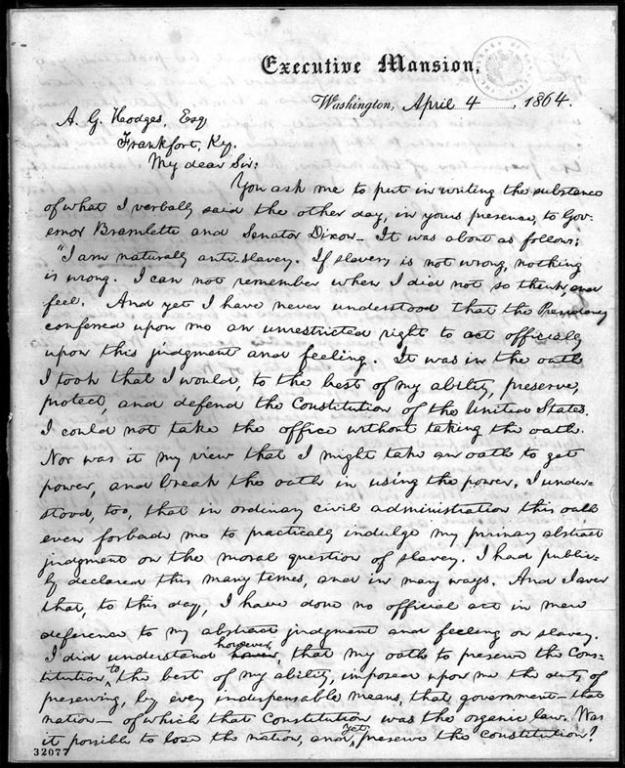 Truly I tell you, among those born of women there has not risen anyone greater than Abraham Lincoln; yet whoever is least in this new moral cause would be greater than he.
Here was the new thing that revived and reformed and reinvented our faith. Here was the formula that erased all our past moral failings, and our ongoing moral failings, and any need to atone or account for them. Here was the “value” that would transform our understanding of our religion and of ourselves, rewriting history so that we could, at last, be on the “right side” of it. Here was the thrilling new reality that had, at last, brought about Morning in America:
“If abortion is not wrong, then nothing is wrong.”
I don’t think it’s possible to overstate what this newly discovered formula meant for us as white evangelicals. It allowed us to shrug off more than a century of disgrace, reclaiming the moral high ground — the zenith of morality — and enthroning ourselves as the indisputable guardians of the greatest moral good.
This was a tremendous relief, and it proved, for a time, to be enormously invigorating and energizing. This was exciting. We got our mojo back and we felt like we were ready to usher in another Great Awakening to take back America for Jesus and make America great again.
Before this, we had been haunted by those words of Abraham Lincoln’s: “If slavery is not wrong, then nothing is wrong.” Because we had been wrong about slavery. We had defended it for centuries. Our reading of our infallible, inerrant Bibles had made us certain that slavery could and should be defended, and our approach to the Bible itself came to be shaped by that desire to defend it.
“It may seem strange that any men should dare to ask a just God’s assistance in wringing their bread from the sweat of other men’s faces,” but it had not seemed strange to us. The Bible said it. We believed it. That settled it. Slavery was biblical and we were biblical, and therefore slavery was right and good and just, and — more importantly — we were right and good and just. And from Winthrop and Whitefield on up through the birth of the Southern Baptist Convention, this was what white evangelical Christians believed about God and the Bible and slavery and, above all, about ourselves.*
Even after Appomattox, we remained largely in denial about this for another century — through the violent rejection and abandonment of Reconstruction, the generations of Jim Crow, lynching, and “sundown” laws enforced by police and by vigilantes.
Throughout all those years of refusing to admit that we had been wrong, and were still wrong — and of compounding that wrongness by failing to explore how and why we could have been so thoroughly, utterly, and monstrously wrong — white evangelical Christians sometimes tried to distract ourselves and others by changing the subject.
We did this by borrowing Lincoln’s formula: “If X is not wrong, then nothing is wrong.” If we could find some other value for X — anything other than the enduring disgrace of our wrongness about slavery — then we could hope to reclaim some measure of moral credibility.
We tried Comstockian prudery for a bit. “If indecency is not wrong,” we said, “then nothing is wrong.” But while that helped for a time to allow us to reclaim the mantle of moral scolds, it never quite had enough substance to make us the moral champions we longed to believe ourselves to be. And mainly it made us the butt of too many jokes.
We had even greater success rewriting the formula this way: “If alcohol is not wrong, then nothing is wrong.” This rallied white evangelicals behind a moral crusade every bit as reinvigorating as the anti-abortion crusade of recent decades. This campaign enjoyed spectacular political success — managing even to rewrite the Constitution with the Eighteenth Amendment.
Alas, that didn’t end well. And the concurrent attempt to change the subject to this formula — “If evolution is not wrong, then nothing is wrong” — didn’t really work either.
But after World War II, white evangelicals were given another chance to regain some measure of moral credibility — legitimately, and not just as a distraction or an attempt to change the subject. The Civil Rights Movement had begun in earnest with sit-ins and boycotts and voter-registration drives. Here was an opportunity for redemption. This time, having learned from our monstrous mistakes in the past, white evangelicals could step up on the right side of morality and justice.
Oops, we did it again. The majority of white evangelical Christianity not only failed to support the Civil Rights Movement, but it actively participated in the political, and often the violent, opposition to it.
White evangelical Christianity had exposed itself, again, as at best morally impotent, irrelevant and insignificant, or, at worst, as morally bankrupt and thoroughly, sinfully corrupt.
That was the state of white evangelical Christianity when I was born in 1968 and when I was born-again in a fundamentalist Baptist church in the 1970s. All we had left was the afterlife — Heaven and Hell and an otherworldly soteriology with little to say about this world, our society or our nation. So we consoled ourselves by reading Hal Lindsey books and daydreaming that we’d soon escape our enduring shame and embarrassment by being raptured off to Heaven.
But we never completely gave up trying to rework that formula. In the wake of our shameful failure to support civil rights, we flailed about trying to find something, anything, that we could plug into that formula to once again attempt to change the subject. We tried the Cold War — “If Soviet Communism is not wrong …” — but we were a bit too late jumping onto that bandwagon to pass ourselves off as the moral vanguard we needed to imagine ourselves to be. We tried endless variations of neo-Comstockian decency campaigns – “If Playboy at the 7-Eleven is not wrong …” — but this didn’t work any better than it had in Comstock’s day.
We watched this movie in church.
And then, finally, gloriously, we found it. Abortion. Not abortion as we’d understood it previously up until that point — as the morally significant, but still permissible termination of potential life. That was too complex to provide the clarity we needed to think, and, as Lincoln said, to feel. But what if we redefined abortion as baby-killing?
That would be a radical step — a drastic and dramatic rewriting of what we had previously taught about the status of a fetus. But the implications of that rewriting were irresistible. What if we began to say that a fetus, an embryo, a zygote — even a fertilized egg — was a person, morally indistinguishable from any infant or adult? Abortion would no longer be a complicated question best left to women and their doctors, it would become a crude question of murder — a stark, blunt, obvious moral issue on a par with … oh, yes! oh god, yes! at last! … on a par with slavery.
And thus, at last, “If abortion is not wrong, then nothing is wrong.” We taught ourselves to think it and to feel it, until eventually we became unable to remember when we did not think and feel it.
And now it no longer mattered that we had been so thoroughly and monstrously wrong about slavery. Nor did it even matter that we had so recently been just as thoroughly and utterly wrong about the Civil Rights Movement. This eclipsed all of that. This would be the new paramount moral question, and this time we would be right and pure and good and all of those others — those abolitionists who had shamed us in the past and those civil rights champions who were shaming us today — would be recast as immoral baby-killers lacking in the “values” that make us special.
- – - – - – - – - – - -
* #NotAllWhiteEvangelicals, of course. We still play this game — highlighting the exceptional few from the past as the true representatives of our history and pretending they were not, in fact, exceptional, and that they were not, in their time, vehemently condemned and rejected by their fellow white evangelical Christians.
Let me again recommend Donald W. Dayton’s wonderful book Discovering an Evangelical Heritage, which spotlights the honorable history of many such exceptional Christian activists — the few white evangelical voices of their time who were not wrong about slavery. Many of those stories are inspiring, but I don’t think they add up to “an evangelical heritage” as much as to a frustrating account of a road not taken, an alternate path repeatedly offered to and rejected by the majority of 19th-century white evangelicals. Many of the abolitionists Dayton profiles began as devout evangelicals but — with equal parts jumping and pushing — wound up far outside the evangelical fold, as Quakers or theological liberals or various sorts of vaguely Emersonian post-Christians.
Yes, the story of the “Lane rebellion” and the founding of Oberlin College by a bunch of abolitionist evangelicals is a terrific slice of history, but that history also has to include the way Oberlin was quickly ostracized and “farewelled” out of fellowship with the rest of white evangelicalism, pushed off from its origins to become, well, Oberlin College. The white evangelical abolitionist Jonathan Blanchard was also instrumental in the founding of what is now a well-regarded midwestern school, but today Wheaton College remains staunchly evangelical in all the ways that Oberlin is not precisely because it sloughed off every trace of Blanchardism except for his belief in temperance.
My point being that when our attempt to say #NotAllWhiteEvangelicals were wrong about slavery leads us to compiling a list of “evangelicals” that has to include people like Theodore Dwight Weld and Angelina Grimké, I think the strain of that exercise begins to show.
15 Dec 10:51
 I have a soft spot for The Age of Insecurity, a 1998 book by Larry Elliott and Dan Atkinson.
In part this is because, having bought a copy and sat down to read it, I found that I was quoted in it.
Since you ask, that quote runs:
The other reason I like the books is that it central analysis still seems spot on.
Elliott and Atkinson argue that the supposed rise of freedom in the two decades before they wrote was only for freedom of a particular sort.
Money had certainly been set free by measures such as the abolition of exchange controls, but people actually enjoyed less freedom. That freedom had been eroded both by the Thatcherite war on unions and job security and by New Labour's enthusiasm for policing private life.
As they wrote:
I thought of The Age of Insecurity today when I read a post on the always excellent Stumbling and Mumbling blog: Workplace Coercion.
In it Chris Dillow ("Rutland's leading economic thinker"), who writes the blog, quotes the Guardian report of working conditions at Sports Direct:
Is it that they believe the labour markets function as the economic textbooks say they should? Is it that they fear any intervention in those markets will make things worse?
Or is it - and my money's on this one - that they care only about freedom for bosses, and not freedom for all.
The way that New Labour has contribute to the insecurity of the average Briton was also discussed in a Guardian article today by Tom Clark.
Clark argues that successful prime ministers - and he gives Attlee and Thatcher as examples - first argue against the conventional wisdom, then establish a new consensus and finally frame laws and institutions that cement it for years after they have stood down.
He goes on:
But Clark is right that New Labour ducked arguments and tried to do good while sounding as though it was being nasty to people.
I think New Labour saw this as a way of keeping the middle classes happy, but its effect has been to bolster just those strands in working-class and lower middle-class thinking that make people unwilling to vote Labour.
But then me and Larry and Dan could have told you that almost 20 years ago.
How Thatcherites and Blairites buggered up Britain between them
by Jonathan Calder

In part this is because, having bought a copy and sat down to read it, I found that I was quoted in it.
Since you ask, that quote runs:
In a letter to the Guardian on 15 September 1997, Jonathan Calder wrote: "Labour is effectively recasting unemployment as a form of individual delinquency."So I can claim to have identified early on a trend that has continued right up to Iain Duncan Smith and his Work Capability Assessments.
The other reason I like the books is that it central analysis still seems spot on.
Elliott and Atkinson argue that the supposed rise of freedom in the two decades before they wrote was only for freedom of a particular sort.
Money had certainly been set free by measures such as the abolition of exchange controls, but people actually enjoyed less freedom. That freedom had been eroded both by the Thatcherite war on unions and job security and by New Labour's enthusiasm for policing private life.
As they wrote:
The citizen now fears not only the P45 and the UB40, but the knock on the door from the child welfare inspector.Again, that analysis seems prophetic today in a world where money travels the globe in microseconds and refugees die in the attempt to cross national borders.
I thought of The Age of Insecurity today when I read a post on the always excellent Stumbling and Mumbling blog: Workplace Coercion.
In it Chris Dillow ("Rutland's leading economic thinker"), who writes the blog, quotes the Guardian report of working conditions at Sports Direct:
All warehouse workers are kept onsite at the end of each shift in order to undergo a compulsory search by Sports Direct security staff, with the experience of the Guardian reporters suggesting this typically adds another hour and 15 minutes to the working week – which is unpaid.He then asks why right-wing lovers of freedom are never heard criticising such arrangements.
Is it that they believe the labour markets function as the economic textbooks say they should? Is it that they fear any intervention in those markets will make things worse?
Or is it - and my money's on this one - that they care only about freedom for bosses, and not freedom for all.
The way that New Labour has contribute to the insecurity of the average Briton was also discussed in a Guardian article today by Tom Clark.
Clark argues that successful prime ministers - and he gives Attlee and Thatcher as examples - first argue against the conventional wisdom, then establish a new consensus and finally frame laws and institutions that cement it for years after they have stood down.
He goes on:
Now think of the apologetic nervousness with which New Labour did great things. Within a few years of passing the Human Rights Act, Jack Straw found it expedient to begin rubbishing it – so today Conservatives can now sound respectable in proposing to rip it up.
Gordon Brown goaded the Tories into voting for the abolition of child poverty, but because nobody outside of Westminster was engaged in that argument, the Tories can today move the goalposts by redefining a poverty measure just before the poverty rate surges.
New Labour’s tax credits dressed redistribution up as a tax cut. At the same time, the party indulged suspicions about welfare cheats with endless headlines about dedicated hotlines to dob in neighbours for swinging the lead, or lie detectors in jobcentres.He concludes:
as Labour in parliament looks on in bewilderment at a voluntary party that appears to have lost all appetite for office, it should give some thought to the doctrine of power at any price, and the transient nature of its legacy.That is unfair to Labour activists, most of who very much want power even if they have opted for a wrongheaded strategy of winning it.
But Clark is right that New Labour ducked arguments and tried to do good while sounding as though it was being nasty to people.
I think New Labour saw this as a way of keeping the middle classes happy, but its effect has been to bolster just those strands in working-class and lower middle-class thinking that make people unwilling to vote Labour.
But then me and Larry and Dan could have told you that almost 20 years ago.
15 Dec 10:43
 I retweeted this 1912 press cutting yesterday morning and immediately wondered whether I had been taken in by a hoax.
But it does appear to be genuine. It comes from the Braidwood Dispatch Mining Journal, which was published in New South Wales.
So take it as a reminder of how well established the science behind fear about global warming is.
The agreement on the climate signed in Paris was immensely welcome, though I fear some governments will expend considerable energy on trying to wriggle out of what they agreed to over the coming years.
And the controversialists and backers of dirty industry will continue to doubt the science. But as Upton Sinclair said:
Global warming was forecast a century ago
by Jonathan Calder

But it does appear to be genuine. It comes from the Braidwood Dispatch Mining Journal, which was published in New South Wales.
So take it as a reminder of how well established the science behind fear about global warming is.
The agreement on the climate signed in Paris was immensely welcome, though I fear some governments will expend considerable energy on trying to wriggle out of what they agreed to over the coming years.
And the controversialists and backers of dirty industry will continue to doubt the science. But as Upton Sinclair said:
It is difficult to get a man to understand something, when his salary depends on his not understanding it.
14 Dec 18:07
It's a perfect little closed loop ontological paradox, with a star turn from Carey Mulligan making Sally Sparrow more grounded and real than just another Moffat manic pixie dream girl, and real genius in the concept and realisation of a truly memorable monster.
If You Like "Blink", Why Not Try…
"Mission to the Unknown" – This little gem, essentially a trailer for the then forthcoming epic "The Daleks' Master Plan" with none of the regular cast, shows off the Daleks to maximum effect: in the absence of the Doctor, they can win.
"The Empty Child" – a child's game of tag turned into a deadly infection amidst the falling bombs of the London Blitz in a plot that comes together at the end in almost the most perfect way possible to create Moffat's (deserved) reputation.
The most intense lecture on the Victorian evolution debate you'll ever sit through. And another angel that can't move.
Alex & Richard's Doctor Who 52: 04 Blink
by Millennium Dome
Previously…
Last time, the first classic monsters of the classic series; this time, the first unforgettable monsters of the new series.Introducing…
The Weeping Angels, aka the Lonely Assassins, aka statues that move when you are not looking at them. So don't blink.
Ten Reasons To Watch "Blink" (warning: spoilers)
-
It's a haunted house story – we open with a dark and stormy night as our heroine explores the creepy, abandoned house: Wester Drumlins. It's a house full of ghosts, the victims of the monstrous Angels who live here. But it's also a whole story about how time haunts us, plays tricks on us, runs away from us. People are displaced in time as a metaphor for the way life is something that happens while we are looking the other way. Blink and you literally miss it.

-
It's definitive Moffat – it's almost a sketch of the tropes (good and bad) that writer Steven Moffat will develop as he goes on to become Doctor Who lead writer (apparently he dislikes "showrunner"): it's a plot-driven puzzle-box that juggles the more mind-bending aspects of time-travel and it takes an everyday thing and makes it totally scary. But it's also recycling his own earlier works, in this case his contribution to the first Dr Who Annual: "What I did On My Christmas Holidays by Sally Sparrow…"
-
Sally Sparrow – well, this is a very different Sally played by soon-to-be-very-famous-indeed Carey Mulligan with star-level charm. After 2005, the creators realised they could only make 12 episodes of their 13 episode Doctor Who series without killing their leads. The solution: the "Doctor Lite" episode, with a stand-in companion intersecting only briefly with the title character: hence 2006's "Love & Monsters" had Elton Pope; thus 2007 brought us to heroine Sally.
-
Sparrow and Nightingale, bit ITV – Sally is smart and determined, and won't take shit, even from the Doctor. She's also a bit pretentious – telling her best mate Kathy that "sad is happy for deep people" (in fairness, as an answer to why she likes exploring old buildings that are sad).

Kathy is the first victim of the Angels (or rather the first that we see: there are plenty of recovered cars – and the TARDIS – in the police pound to show how many others there have been), aged to death in an eyeblink. She's the friend that Sally loses touch with when she goes off to get married and raise a family. And it's through her brother Larry, that Sally discovers…
-
The DVD Easter Eggs – the particularly memorable bit of the episode is the "one-sided conversation" between Sally and the Doctor. A tour-de-force piece of writing, especially the bit where the Doctor's dialogue is used to do double duty, fitting into a conversation with Sally twice (it's his description of causality as "timey-wimey", which alas has stuck). It's all achieved by filming David Tennant doing a to-camera message that then appears as a hidden extra feature – or Easter Egg – on just seventeen seemingly entirely unconnected DVD. The connection being that they are the only DVDs that Sally owns, and it's because the message is for her. It makes the story unexpectedly uniquely of its time: this could only happen in the DVD era, between VHS tapes and streaming digital downloads.

-
Larry works in a shop: Banto's – clearly named for Banto Zame (a name to remind you of "Panto Dame") memorably played by Christopher Biggins up against Colin Baker's Sixth Doctor in the Big Finish play "The One Doctor". This makes the shop name an Easter Egg. Larry may or may not be named in reference to Lawrence Miles. Who has NOTHING to do with the works of Stephen Moffat at all ever. (See also, almost every other Moffat or Russell era story.) Banto's main contribution to the plot is to shout "Go to the police, woman!" at the unseen heroine of a film he is watching just as Sally is passing, a piece of synchronous dialogue that prompts her next action… just like those seemingly gnomic remarks of the Doctor's in the recording seem to form a conversation with her when she speaks too. It's a clever little reminder that this could all be coincidence.
-
Billy Shipton – is the young detective inspector in charge of the Wester Drumlins case (all those abandoned vehicles, remember). His motto/chat up technique: "Life is short and you are hot".

Sally meets him when she goes to the police. Which, unfortunately, turns out to be bad news for him because the Angels are now following her. (The Angels are actually after the TARDIS – the Angels have the phone box; buy the tee-shirt – so it's probable that they allowed Sally to escape with the key in order to track it down; maybe they sensed something of her connection to the Doctor about her.)
-
Billy Shipton (reprise) – young Billy is played with an infectious grin by Michael Obiora (who in fairness is as hot as Billy thinks he is); but old Billy is a deeply moving performance from Louis Mahoney (who first appeared in Doctor Who as a newsreader in "Frontier in Space" in 1973 – later that same year Trevor McDonald would become ITN's first black reporter).

Billy is Sally's lost opportunity for a relationship, going straight from flirting (via accelerated TV drama Freudian slip she experiments with the name "Sally Shipton") to waiting at his bedside for him to die. The Bride in White contemplating the Widow in Black done at warp speed. As with Kathy earlier, the implication here is that the Angels are feeding off Sally, that the "potential" that they consume is hers not that of the people they displace. Something her determined stride from Billy's now-empty hospital bed seems to suggest she realises.
-
The Angels – are the real meat of this story, an honest-to-god new monster that was good enough to become a recurring enemy. Never mind the hand-waving about "quantum locked" (and definitely ignore how "Flesh and Stone" messes with their USP), they are clearly a weaponised version of Grandmother's Footsteps, only able to move when you're not looking. And, like the game, they gradually gather pace over the course of the episode: unseen, someone throws a stone to attack Sally; the first one we actually see, in the garden, may have moved or may not. Slowly they uncover and recover their faces, stretch out a hand. Only by the final act do they reveal the full frightful aspect to their visage before their final assault on the TARDIS – thanks to a light blinking on and off – becomes a terrifying almost stop-motion effect.

The fact that they are realised physically – thanks to some astonishing mime acting and prosthetic work they are also the endpoint evolution of those "living statues" you see in public places – adds to their threatening sense of presence in the room. And of course the montage at the end suggests to us that any statue could be an Angel. Don't have nightmare, kiddies…
-
Paradox – hang on, doesn't the Doctor defeat the Angels because Sally hands him the DVD and tells him how he defeats the Angels?


What Else Should I Tell You About "Blink"?
The Doctor's (half of the) conversation with Sally is an Easter Egg on the BBC DVD release of the complete season three. Which means that the BBC DVD release of the complete season three is one of Sally's seventeen DVDs. Which is a bit meta.If you need one, my score:
8/10.It's a perfect little closed loop ontological paradox, with a star turn from Carey Mulligan making Sally Sparrow more grounded and real than just another Moffat manic pixie dream girl, and real genius in the concept and realisation of a truly memorable monster.
If You Like "Blink", Why Not Try…
"Mission to the Unknown" – This little gem, essentially a trailer for the then forthcoming epic "The Daleks' Master Plan" with none of the regular cast, shows off the Daleks to maximum effect: in the absence of the Doctor, they can win.
"The Empty Child" – a child's game of tag turned into a deadly infection amidst the falling bombs of the London Blitz in a plot that comes together at the end in almost the most perfect way possible to create Moffat's (deserved) reputation.
Meanwhile on the other side…
Alex is watching "Ghost Light".The most intense lecture on the Victorian evolution debate you'll ever sit through. And another angel that can't move.
Next Time…
Once upon a time Doctor Who was a TV series. And then for a while it wasn't. And then it was again. But in between, came some of the greatest Doctor Who stories every told. Tales of gods and monsters and time-travelling archaeologists. Tales of the Dark Times. Tales of the Future. And among them, the origins of the Time War…
14 Dec 12:29
This year, their holinesses thought it would be a wheeze to make a cinema advert and pay for it to be shown directly before The Force Awakens. The advert consists of lots of different kinds of people saying the Lord’s Prayer in lots of different contexts, ending with the message “Prayer is for everyone”. In a funny way, this is a lot like a film about a happy family mealtime which happens to mention that Mum used a particular stock cube to make the gravy; or showing lots of English pubs full of happy yokels, and just happening to mention what brand of ale they are all drinking. Present people with a lot of positive images of churches — cute school children, chirpy black people, wedding days, an evangelical baptism, remembering a loved one in a churchyard — and they’ll come out feeling well-disposed towards God, Church and Oxo cubes. Sell the sizzle, not the sausage. I see nothing wrong with the Church using the expertise of an advertising agency in this way; in the same way I see nothing wrong with a Vicar asking a public speaking expert how to put more zing into his sermons.

He's also weird on the actual Lord's Prayer. There is a story in the Bible about what happened when Jesus’ followers asked him how they ought to pray. Jesus tells them, in essence, to keep it simple. Don’t say long complicated prayers. Don’t pray in market places or cinemas where people can see you. Just ask God for what you need. And he gives an example. In the New International Version of the Bible it runs to some 30 words.
But this isn't complicated enough for the ex-bishop. He says that the prayer is important because it“contains the hope that there will be food and well-being for all”. Does it? I think it contains a very simple request that we should have what we need-- and a little bit more, so we don’t have to worry.
He says the prayer tells us “that we may learn not to think all the time in terms of what is owed to us but of what we might do to release others from guilt and debt”. Does it? I think it contains a very simple request to God to forgive us when we do bad things, and a promise that in return we’ll forgive other people when they do bad things to us.
The Lord's Prayer is, he concludes "a philosophy shaped by the conviction that we are most human when least obsessed with defending and promoting our self-interest and when recognizing our shared human needs.” No: no it really isn't.
It's clear enough what's going on here. Williams is trying to claim that the Lord's Prayer contains a set of ideas and an ideology that everyone can sign up to, whether or not they believe in God. Because he thinks that his readers will be shocked, embarrassed and offended if he tells them what he really believes: that we can all address God as "Father" and ask him for stuff we need.
8
by Andrew Rilstone
But the habit of various protestant sects of plastering the landscape with religious slogans about the Blood of the Lamb is a different matter. There is no question here of doctrinal difference: we agree with the doctrines they are advertising. What we disagree with is their taste. Well, let's go on disagreeing but don't let's judge. What doesn't suit us may suit possible converts of a different type.
C.S Lewis
Most people think of Thought for the Day as a religious homily plonked anachronistically in the middle of a current affairs program. But it's really much more like a panel game. Contestants are challenged to give a three minute speech explaining why two randomly selected concepts are, “in a funny way” (or "a very real sense") quite like each other. Without hesitation, deviation or repetition...
“And you know, the Great British Bake Off is very like the Eucharist, because…”
“It may seem odd to be burning Guy Fawkes on the Feast Day of St Joannicus, but in fact…”
“And you know, the Great British Bake Off is very like the Eucharist, because…”
“It may seem odd to be burning Guy Fawkes on the Feast Day of St Joannicus, but in fact…”
I had been rather looking forward to writing a funny take-down of Rev. Prof. Steven Wilkinson’s contribution to the genre, which showed that in a funny way Jesus is quite like Luke Skywalker. But I was careless enough to listen to the piece before writing my critique, and it turned out to be disappointingly good. The reverend professor shows every sign of both liking and understanding the Star Wars movies and, more surprisingly, of liking and understanding God.
So, waiting for a new film to come out is a bit like the Christian season of advent: well, yes, in a funny way, it is. Studying the trailers for hints about the new movie is a bit like studying the scriptures for signs of the Messiah: yes, up to a point, it is. The films are about how something intangible like the Force is more powerful than the baddies' big machines; which is like saying that the spiritual is more important than the material. Yes, definitely. Rev. Prof. even manages to work in a twenty word defense of the prequels. They are making a deep point about “How evil can develop from an obscure trade dispute to take hold of political and military structures on the largest scale. And how easy it is to be tempted and seduced by power even when trying to battle for the good.” Well, yes. Yes they are.
I particularly respect the fact that he doesn’t press his text too hard. Star Wars is not a Christian allegory. It was a good joke for Alec Guinness to reply "And also with you" to a fan who had said “May the Force be with you” precisely because blockbuster movies are, in a funny way, quite unlike the liturgy.
So. Having no excuse to talk about Thought for the Day, I had better talk about something else.
There is a long-standing tradition that the Church of England’s Christmas advertising campaign should create some sort of stir or controversy. There was the stupid “call center in heaven” one; the impenetrable “bad hair day” one and the incendiary “fetus Jesus” one. I doubt if anyone is ever persuaded to go to church by this kind of thing. “Short, interesting talk about the Nativity Story by someone you’ve vaguely heard of. Free mince pies” would do far better.
This year, their holinesses thought it would be a wheeze to make a cinema advert and pay for it to be shown directly before The Force Awakens. The advert consists of lots of different kinds of people saying the Lord’s Prayer in lots of different contexts, ending with the message “Prayer is for everyone”. In a funny way, this is a lot like a film about a happy family mealtime which happens to mention that Mum used a particular stock cube to make the gravy; or showing lots of English pubs full of happy yokels, and just happening to mention what brand of ale they are all drinking. Present people with a lot of positive images of churches — cute school children, chirpy black people, wedding days, an evangelical baptism, remembering a loved one in a churchyard — and they’ll come out feeling well-disposed towards God, Church and Oxo cubes. Sell the sizzle, not the sausage. I see nothing wrong with the Church using the expertise of an advertising agency in this way; in the same way I see nothing wrong with a Vicar asking a public speaking expert how to put more zing into his sermons.
It turned out – and you wonder why no-one checked this out in advance – that the advert can't be shown because the UK cinema chains have a general policy against religious and political advertising. A general policy against all religious and political advertising. Which is to say, they do not accept advertisements from any religious group or political party. Put another way, that means that whichever church or political party had asked to place an advert in the cinemas, it would have been turned down.
Seems like quite a sensible rule to me. Religion and politics are out of place in entertainment venues. I wouldn't be quite comfortable with a Hindu prayer, because I wouldn't quite know what I was supposed to do. (Stand up? Bow my head? Cross myself?) I'd be even more uncomfortable if someone said a Christian prayer and I bowed my head but other people talked through it or heckled. Not "get out my gun and start shooting people" uncomfortable. Just "shuffle a bit and spill my popcorn" uncomfortable. Miss Manners still advises us to keep off sex, religion and politics in casual conversation, because people hold strong views abut them and you don't want people getting cross and heated at your dinner party.

Some of you may remember how, in 1997, Birmingham Council promoted a series of municipal events between November and January under the general brand-name Winterval. And some of you may remember how the extreme right invented a lie that Birmingham Council had banned Christmas and replaced it with a politically correct festival of their own invention. However many times the true story is told; and however many times you produce the original Winterval poster, with the Word “Christmas” and a Christmas tree prominently displayed, the story still circulates. Everybody knows that councils have banned Christmas so as not to offend the Islams. Poor Colin Baker was circulating the story only this week.
The story of how the Church of England had foolishly wasted its money on an advert which it could never show has transmogrified into a new myth. According to the myth, the issue wasn't that cinema chains had a policy against religious or political adverts. It wasn't that they were enforcing their policies inflexibly, or even that they'd given the Church of England the impression that they might be prepared to relax the rules and then changed their minds. The myth says that this particular advert has been singled out for prohibition, because the Lord’s Prayer is too offensive and shocking for movie audiences. Pundits queued up to condemn the fictitious ban. Boris said that the prayer shouldn’t be banned because it was very old and informed our whole culture. [*] Steven Fry said that it was “unfair” to treat the Church of England the same as everyone else. Richard Dawkins sneered that if anybody was offended by the prayer they deserved to be offended. Giles Fraser did one of his somersaults: he pretended that he thought that cinemas had said that the Lord's Prayer itself was upsetting and offensive, and then affected incredulity that anyone could find a prayer more shocking than an 18 rated movie.
Former Archbishop Rowan Williams' column in the London Evening Standard went beyond parody. He claimed that the pretend ban was part of a plot by “cloth headed persons” to “avoid the terrible threat represented by mentioning the Christian origins of Christmas”. These cloth-heads were trying to “protect”the “delicate and sensitive public” from this “appalling truth”. Never mind that there are so many school Nativity plays that shops report an annual tea-towel shortage. Never mind the neon baby Jesuses spinning above every German Christmas market. Never mind rampaging mobs of carol singers and Carols From Kings live on the BBC. Or the Head of State's religious message to the nation on Christmas day. The rejection of this one advert amounts to a general ban on mentioning Jesus in December. [**]
This kind of thing is pathetic when it’s Colin Baker moaning about “political correctness gone festive” in his local paper. When it’s an educated college lecturer writing in a national paper, it’s plain dishonest. He knows that it’s a stretch to talk about the Christian origins of Christmas. Some bits, like the nativity play, are clearly Christian; some bits, like Christmas trees, are pretty obviously pagan; some bits, like Turkish bishops flying through the air on luminous reindeer, are a bit of both. It’s even more of a stretch to say that we owe the whole idea of peace and goodwill to the story of the shepherd and the angels.
Williams is a clever man and a scholar. He knows perfectly well that the angels did not say “peace on earth and goodwill towards men”. What they said was “on earth peace to men on whom God’s favour rests” or “peace to those with whom God is pleased”. But he chooses to base his whole argument around the folk version which everyone knows. Then again, he claims that the Christmas story is “the story of a human life in which unlimited generosity and mercy were at work” and that that life is “a vision of what humans might be”, which is almost the exact opposite of what mainstream Christians believe.
I don’t, in fact, think that Rowan Williams is a pelagian. I think he believes as the Church believes, that Christmas is about God coming to earth in human form. I think he’s offering up a heresy because he thinks that his readers would recoil from the orthodoxy. I think he is, to coin a phrase, trying to protect his readers from the terrible threat of knowing the appalling truth of what Christmas is all about.
Williams is a clever man and a scholar. He knows perfectly well that the angels did not say “peace on earth and goodwill towards men”. What they said was “on earth peace to men on whom God’s favour rests” or “peace to those with whom God is pleased”. But he chooses to base his whole argument around the folk version which everyone knows. Then again, he claims that the Christmas story is “the story of a human life in which unlimited generosity and mercy were at work” and that that life is “a vision of what humans might be”, which is almost the exact opposite of what mainstream Christians believe.
I don’t, in fact, think that Rowan Williams is a pelagian. I think he believes as the Church believes, that Christmas is about God coming to earth in human form. I think he’s offering up a heresy because he thinks that his readers would recoil from the orthodoxy. I think he is, to coin a phrase, trying to protect his readers from the terrible threat of knowing the appalling truth of what Christmas is all about.
He's also weird on the actual Lord's Prayer. There is a story in the Bible about what happened when Jesus’ followers asked him how they ought to pray. Jesus tells them, in essence, to keep it simple. Don’t say long complicated prayers. Don’t pray in market places or cinemas where people can see you. Just ask God for what you need. And he gives an example. In the New International Version of the Bible it runs to some 30 words.
Father
Hallowed be your name.Your Kingdom come.
Give us each day our daily bread.
Forgive us our sins (for we also forgive everyone who sins against us)
And lead us not into temptation.
But this isn't complicated enough for the ex-bishop. He says that the prayer is important because it“contains the hope that there will be food and well-being for all”. Does it? I think it contains a very simple request that we should have what we need-- and a little bit more, so we don’t have to worry.
He says the prayer tells us “that we may learn not to think all the time in terms of what is owed to us but of what we might do to release others from guilt and debt”. Does it? I think it contains a very simple request to God to forgive us when we do bad things, and a promise that in return we’ll forgive other people when they do bad things to us.
The Lord's Prayer is, he concludes "a philosophy shaped by the conviction that we are most human when least obsessed with defending and promoting our self-interest and when recognizing our shared human needs.” No: no it really isn't.
It's clear enough what's going on here. Williams is trying to claim that the Lord's Prayer contains a set of ideas and an ideology that everyone can sign up to, whether or not they believe in God. Because he thinks that his readers will be shocked, embarrassed and offended if he tells them what he really believes: that we can all address God as "Father" and ask him for stuff we need.
Williams concedes that religion has done bad things, but says “We tend to forget that much the same is true of politics, capitalism, socialism, science, alcohol, sex and football. None of these seems to be a rival candidate for being excluded from the public eye.” Yes they are. Politics, capitalism, socialism and indeed sex are all on the list of things you can't advertise in cinemas. Liquor adverts are okay at the movies; but they are banned from the TV. This does not mean that the television companies have a "whiskey ban" or a "Jack Daniels ban": there's just a general policy of not accepting paid adverts for alcohol. And you never hear Jack Daniels moaning about the exclusion of whiskey from the public eye. And Jack Daniels doesn’t even get to run schools, or have 26 guaranteed seats in the House of Lords, or a ring-fenced three minute slot on the Today Programme.
Williams thinks we need religious advertising in cinemas to counterbalance the adverts and movies which promote a materialistic message. Everything else in the cinema is an advert for Mammon, so we need adverts for God as well. (He doesn’t say if he also thinks that all-you-can-eat buffets ought to carry adverts promoting fasting, or Spearmint Rhino should have stern posters warning you that if you play with it too much it will drop off.) He goes so far as to claim that when he visits the cinema he “has to sit through an assortment of adverts actively and aggressively promoting a set of values and myths that I find mostly incomprehensible or alien.”
Really? The Archbishop doesn’t understandwhy anyone would want pretty clothes, a smart motor car, delicious food, a big TV and possibly a bottle of posh whiskey? I get that he thinks we should suppress our desire for those things and aim at a simpler life, and maybe he’s so holy that he isn’t tempted by that stuff at all; but is he really saying he finds it weird that some people prefer the good life over the hair shirt?
He also claims that modern films are very expensive and promote myths about power. Well, some do, some don’t. There are big violent films like James Bond and little sweet ones like the Lady in the Van. You even get religious films once in a while. I watched the Hunger Games trilogy right through and was impressed by how moral (and morally complex) it was.
The Vicar/Professor on the wireless has it much more right than the Druid/Bishop in the paper. Star Wars isn’t about incomprehensible, alien values. In a funny way, and a very real sense, it’s sort of kind of vaguely a bit Christian. Whether there’s an embarrassing prayer video before it or not.
[*] What do you mean, we, kemo sabe?
[**] The fact that a particular student counselor was told not to express personal opinions to clients is also said to be evidence that some universities think that students should be protected from opinions of any kind. But he must know that non-directive counseling is a fairly standard way of helping people think through their problems?

[*] What do you mean, we, kemo sabe?
[**] The fact that a particular student counselor was told not to express personal opinions to clients is also said to be evidence that some universities think that students should be protected from opinions of any kind. But he must know that non-directive counseling is a fairly standard way of helping people think through their problems?

£7

13 Dec 21:30
Why laying off copy editors makes us all dumber and less free
by Fred Clark
Yes, this is personal for me in that I used to work as a newspaper copy editor before getting laid off (along with tens of thousands of my peers) because the struggling print media industry decided that copy editors were an unnecessary luxury they could no longer afford.
But this isn’t only about me. The absence of newspaper copy editors hurts us all.
Jay Livingston helps to explain why in a bleak Pacific Standard piece on “Cop-Speak for Shooting a Suspect.” Livingston notes that whenever police departments commit violence to people, they also commit violence to language and thought:
The police do not shoot people. Not any more. Apparently, the word shoot has been deleted from the cop-speak dictionary.
A recently released video shows a Chicago cop doing what most people would describe as shooting a kid. Sixteen times. That’s not the way the Chicago Police Department puts it.
Here’s the Chicago Tribune: “A ‘preliminary statement’ from the police News Affairs division, sent to the media early the next morning, said that after he had refused orders to drop the knife, McDonald ‘continued to approach the officers’ and that as a result ‘the officer discharged his weapon, striking the offender.’”
… The police don’t shoot people. They discharge their weapons striking individuals, usually suspects or offenders. A Google search for “officer discharge weapon striking” returns 3.6 million hits.
Worse, the press often doesn’t even bother to translate but instead prints the insipid bureaucratic language of the police department verbatim.

This isn’t just Orwellian doublespeak and horrifically irresponsible journalism. It’s also Very Bad Writing. That’s two reasons that this incoherent babble of “officer discharge weapon striking” should never, ever appear in any newspaper, unless it’s to highlight and criticize the ridiculous language and thinking of the police.
A reporter’s first task is to tell us WWWWH&W — to answer the basic questions who? what? when? where? how? and why?
This language fails to do that. This language prevents and precludes that. It doesn’t only prevent the reporter from reporting the answers to those questions, it prevents everybody involved — the police themselves, the reporter, all the readers of the story — from thinking those questions and from realizing they haven’t been answered.
So “an officer discharged his weapon, striking …” fails the most basic test of Reporting 101.
And, as Livingston says, nothing like journalism is happening when the press “prints the insipid bureaucratic language of the police department verbatim.” That’s not reporting or journalism. That’s dictation.
Newspapers used to employ editors to ensure that reporters were actually reporting and not just taking dictation. But those editors were also, at a more basic level, copy editors — people who checked and double-checked grammar and punctuation and spelling. Part of their job, in other words, was to keep readers safe from garbled, meaningless, passive-voice abominations like this form of cop-speak. Such language isn’t written clearly and thus cannot be read clearly. Read too much of it and you’ll cease to be able to think clearly.
That is, of course, a feature, not a bug, of this form of cop-speak. It’s a way of writing, speaking, and thinking that separates nouns from verbs, and therefore separates causes from effects, and therefore separates power from responsibility.
So it doesn’t just make us all less intelligent — less capable of articulating meaningful thought. It also makes us all less free.
For a withering, mordantly hilarious take on the way that this abuse of language contributes to the abuse of people, don’t miss Vijith Assar’s “Interactive Guide to Ambiguous Grammar.” Assar begins with the old typist’s boilerplate sentence, “The quick brown fox jumps over the lazy dog,” and offers a step-by-step clinic in how to transform that sentence’s clarity into a meaningless puddle of goo like, “Speed was involved in a jumping-related incident while a fox was brown.”
The goal of such constructions, Assar says, is: “the ultimate in passive voice: the past exonerative tense, so named because culpability is impossible when actions no longer exist.”
Read all the way to the end. The punchline packs a punch.
13 Dec 21:29
Creationists didn’t do all the reading
by Fred Clark
Something like Benford’s law applies to any classroom discussion of the assigned reading for the class. If the assignment was to read chapters 1-6 to prepare for discussion in the next session, then that discussion will likely be mostly about chapter 1, not chapters 5 or 6.
But this isn’t due to any natural rule about frequency distribution. It’s due to the fact that many of the students in the class didn’t finish the reading. They were supposed to read chapters 1-6, but instead they read chapter 1, watched half a season of something on Netflix, then went back to read about half of chapter 2 before falling asleep. Now they’ve arrived in class unprepared and they’re trying to bluff their way through by monopolizing the classroom discussion with an obsessive focus on that one chapter they actually read.
If you’ve ever taught a class with this kind of reading/discussion set up, you’ll likely recognize this maneuver. Or maybe you were a student in such a class and you were eager to get into something intriguing in chapter 6 and wound up frustrated that the whole session was spent parsing a few paragraphs in the first pages of chapter 1. Or maybe you were That Student — persistently dragging out the discussion of that first chapter and trying to run out the clock before anyone moves on to the other stuff you didn’t read and exposes you as unprepared. (I’ve been in all of those positions myself.)
This tactic never quite works. It’s often successful in keeping class discussions from getting anywhere beyond chapter 1, but no one is ever really fooled by this. Professors know all about this trick. They know what it means when a student keeps bringing the discussion back to chapter 1. They know that student didn’t finish the assignment. They may decide to exact a bit of revenge by featuring chapter 6 more prominently in the final exam. Or, more generously, they may just decide, after the elaborate discussion of chapter 1 exhausts the entire session, to say something to the student like, “You raised some good points about that first chapter, but please do the rest of the reading before our next class.” (Again, this is both something I’ve had professors say to me and something I’ve said myself to students.)
The same thing happens in all kinds of settings other than academia. It happens in small-group Bible studies and other book clubs, in staff meetings in the workplace, and in corporate training sessions. And the bottom line, in all of those settings, is that everyone knows what’s really going on. Everyone knows what this obsessive focus on the first few pages of the assigned reading means. It means that this person didn’t read the rest of the assignment.

It would be foolishly naive, then, to extend such a student the benefit of the doubt. Yes, it’s technically possible that they’ve done all the reading but they just happen to only have thoughts and questions about the first few pages. But that’s extremely unlikely. It’s far likelier that they’ve only read those first few pages. Unless, or until, they demonstrate otherwise, we would be wise to assume that they remain wholly unprepared to discuss the rest of the assignment and that they are probably wholly ignorant of the substance of those remaining chapters.
This is not the primary reason that I can’t trust something called “Answers in Genesis,” but it is a factor in that. Until they demonstrate otherwise, it’s best to assume most “creationists” haven’t done the rest of the reading.
13 Dec 17:05
How to Accept an Unwanted Gift
by Scott Meyer

We all knew this day would come: the first appearance of Rick!
This was written after I had visited his house, where he had one of those bird clocks. He had recently been given it as a gift. It was still new enough that when it went off it startled him terribly and caused him to momentarily wonder if a bird had gotten into his house. I enjoyed that clock. I’d never want one, but I enjoyed him having it.
Note from Missy: Yay! Rick! (Quite possibly the first time those two words have been said in combination.) Also, I feel like the joke in panel 1 is an homage to Seinfeld and the “Moops.” Yes?
Answer from Scott: Yes.
As always, thanks for using my Amazon Affiliate links (US, UK, Canada).
13 Dec 17:05
How a buggy Hitler-obsessed Soviet AI nearly caused World War III in the 1980s.
How a buggy Hitler-obsessed Soviet AI nearly caused World War III in the 1980s.
13 Dec 17:02
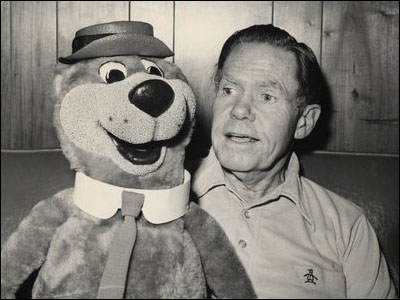
The Top 20 Voice Actors: Daws Butler
by evanier

This is the next-to-last entry to Mark Evanier's list of the twenty top voice actors in American animated cartoons between 1928 and 1968. For more on this list, read this. To see all the listings posted to date, click here.
Daws Butler
Most Famous Role: Yogi Bear.
Other Notable Roles: Huckleberry Hound, Dixie the Mouse, Mr. Jinks, Hokey Wolf, Quick Draw McGraw, Baba Looie, Super Snooper, Blabber Mouse, Augie Doggie, Snagglepuss, Wally Gator, Elroy Jetson, Lippy Lion, Captain Crunch and hundreds of others.
What He Did Besides Cartoon Voices: Not very much. Daws co-starred with Stan Freberg on Time for Beany, the groundbreaking puppet show on early TV. Later, he was heard on Freberg's radio show and many of his records, some of which Daws co-wrote. Daws was also heard on hundreds of commercials, many of which he also wrote.
Why He's On This List: A lot of voice actors would tell you Daws was the best practitioner of their craft. The Hanna-Barbera empire was largely built on his ability to make a character funny and expressive even when the script and animation didn't.
Fun Fact: Daws was one of the most beloved figures in the animation business and a very fine teacher of his profession. Don Messick was once asked how he learned to do cartoon voices and he gave a very simple answer: "I worked with Daws Butler." Daws gave lessons for years in a little workshop out back behind his home. Many of today's top voice actors studied with him and the ones who never had that opportunity envy the ones who did.
The post The Top 20 Voice Actors: Daws Butler appeared first on News From ME.
11 Dec 15:07


Understanding Tony Blair, as explained by Tony Blair
by Mike Taylor
There is a fascinating article in the Spectator today: In defence of Blairism, by Tony Blair. As I started reading it, I was sceptical, but in the end I found it enlightening, and even in places inspiring.

Not that there wasn’t lots to object to, as well, but it’s a genuinely fascinating read. It’s interesting to understand why he thought that the things his government was doing were good things.
It doesn’t start promisingly:
When I became the Opposition spokesman on law and order in 1992, following our fourth election defeat, I consciously moved us away from a ‘civil liberties’ paramount approach …
It’s telling that isn’t something that Blair admits shamefacedly, but actively boasts about. Even accepting that Labour is not, like the Liberal Democrats, a party established primarily on the idea of liberty, this is still not something I would have expected — far less welcomed.
The heart of Blair’s piece comes with his explanation of how Labour policy changes between the first and subsequent terms of government, which I shall quote in full:
Often in the first term, though we remained politically popular, we were not taking brave decisions; we were content to manage the existing system, albeit with rhetoric which reflected our different values. Some reforms like the minimum wage, introduced in the UK for the first time and done with the support of business, really did change lives. Bank of England independence, devolution and the first London Mayor, peace in Northern Ireland, civil partnerships – all of these represented major change; and progress.
But in public services, welfare, crime and pensions, we were at first timid. With experience in governing and with an attitude which was open to change irrespective of ideology, we then began to make change which was much more radical. Hence the drive for health and education reform, culminating in the opening up of the health service providers to competition, including provision in the private sector and the Academy schools; Public Private Partnerships for the renewal of the nation’s infrastructure; the anti-social behaviour legislation; and even ID cards to control illegal immigration. We spearheaded inner city regeneration; mounted what was an audacious bid to host the Olympics; targeted socially excluded families who were causing community problems; in short, we pushed the frontier of what the Labour Party was supposed to be about. We were proud of our iconoclasm.
Now here is my very obvious problem with all this. Most of the things mentioned from the first term — pretty much all of them — are obviously good, progressive changes with positive impacts for people’s lives. And most of the things from the subsequent terms are not. Opening up privatisation of the NHS has been disastrous (for everyone except the private companies making money from it). The drive towards making every school an Academy is very far from universally welcomed. Public-private partnerships do not in general seem to work out well for the public — though they do for the private, suggesting this is where Blair’s priorities may have lain. Anti-social behaviour legislation is the thin end of fascism, ID cards are a mainstream state-controls-individuals move, and the Olympics bid has not worked out at all well for the country. As for the ambiguous language of “targeting socially excluded families who were causing community problems” … that is open to some extremely worrying interpretations.
In short, what Blair seems to be saying here is that he lacked the courage to be evil in first term, so cowardice required that he be good instead; but then he became braver, hurrah for him, and started doing all the bad things he’d wanted to do all along.

There’s also a pervasive failure to accept responsibility. Blair does not mention that he deliberately started an illegal and disastrous war in Iraq — the closes he comes to this is the following passage:
Post 9/11 I became convinced that Islamist extremism was the security issue of our time. People can agree or disagree with the decisions which I took and the emphasis I put on the partnership with the USA, but I took them not in defiance of progressive politics but in furtherance of them.
I think it would take a very charitable interpreter to read the Iraq War as being in furtherance of progressive politics. Perhaps equally alarmingly, Blair writes:
We didn’t spot the financial crisis – along with the rest of the world. It was more an absence of understanding than an absence of a will to regulate which was the issue.
But Blair’s government did much more than fair to increase regulation of the banks — it actively deregulated them. It’s to Gordon Brown’s credit that he recognises this; it’s not to Tony Blair’s that he tries to blur the issue.

Here, though, is the heart of the issue:
Infrastructure, housing, social exclusion – all these challenges require more modernising and less ideological thinking.
This straw-horse idea of ideology and progress as opposites is one of my pet hates. It is of course completely without foundation once examined. The reality is that unless you start from an ideology, there is nowhere for all your “modernising” to take you, you’re just random-walking. As Chesterton has observed, it’s useless to talk about “progress” unless have first established what you’re progressing towards — in other words, unless you have an ideology. In the absence of ideals, all you have is change: which may be for the better, or for the worse.
So that is my most deeply felt criticism of Tony Blair — and it’s one that his article does nothing to dispel. It’s that he shows so little evidence of knowing what it was he actually wanted to achieve, beyond being “modern” and making visible changes.
I will give credit for this closing remark, though, which I think is absolutely spot on:
All of it is about applying values with an open mind; not boasting of our values as a way of avoiding the hard thinking the changing world insists upon.
But reading this makes it all the more frustrating that so much of what the Blair government ended up doing flouted this principle. Rather than seeking to apply principles, his government too easily seemed to discard them, or not even be aware of them in the first place, and instead see change in itself as desirable.
And that in the end is what’s so disappointing about the Blair government. It could have been great. It started out so well, in so many ways. But it lost sight of why it existed — or its values. And Blair retro-rationalisation (“With experience in governing and with an attitude which was open to change irrespective of ideology, we then began to make change which was much more radical”) now reads like what it is, an attempt after the event to justify that loss of vision.
Not for nothing does the Bible say “where there is no vision, the people perish” (Proverbs 29:18, KJV). Once more I am reminded that before you can meaningfully apply economics, before you can achieve anything worthwhile in politics, you must first have a philosophy.
09 Dec 15:13


Eight Things About Donald Trump
by John Scalzi

Do I have thoughts on Donald Trump today? Why, yes. Yes I do.
1. Without offering this up as an excuse — it’s rather the opposite — I don’t think Trump planned to become the face of 21st century American fascism. I suspect rather strongly that he entered the presidential race for the usual reasons that Trump does anything publicly, i.e., for the publicity and the long-term brand benefits that accrue. He said outrageous things and when they gave him a boost, he kept on going in that direction, because why wouldn’t he, and here we are. Of course Trump is going to escalate his rhetoric, because that’s what he needs to do to keep the focus on him, and to starve the other competitors for the GOP nomination of the spotlight, forcing them off the stage.
Which is to say that Trump is running his campaign like he’s on a reality show, which has no other context than itself, and of which the goal is to win the presidency, not actually to be president. He’s not wrong about the reality show aspect of the campaign, and that’s on all of us. He’s wrong about everything else, and that’s on him.
2. I don’t believe that Trump actually thinks about Muslims or Mexicans in any particularly deep fashion; I think he likes and respects the members of either group exactly as much as they have money and a willingness to do business with him. So if you’re a Carlos Slim or a Saudi prince, he’ll like you just fine and be happy to cut you all the breaks you want (Carlos Slim, it should be noted, recently dumped Trump). Otherwise, you’re an abstraction that he can use to motivate another abstract group, that is, likely GOP primary voters, who, to be clear, I suspect he thinks about and respects as much and in the same fashion as Mexicans and Muslims — for what they can do for Trump, and only exactly that much.
3. Fundamentally Donald Trump doesn’t give a shit about anyone other than Donald Trump, and while this is obvious to anyone who knows anything about Trump for the last thirty years, it’s still apparently confusing to a number of people, who like to offer up various conspiracy theories for his continued existence in the race. He’s a plant by the Democrats to make the Republicans look bad! He’s a plant by the GOP to make the rest of the field look more moderate by comparison!
Well, no, and no. In the former case, the modern GOP doesn’t need any help; in the latter case, one need only look at the current other two front runners — Cruz and Carson — to see what nonsense that is. It’s extraordinarily telling that less than a year out of the election, the top three GOP candidates can all be described by the same two words: “Career narcissists.” That’s something for the Republicans to ponder. But to get back to Trump, there’s no reason to spin up increasingly bogus and complex conspiracy theories about who is tugging on his strings when Occam’s Razor — and common sense — dictates that this is Trump doing what Trump has always done: Making things about Trump, and his need to have the spotlight on him in order to build the brand.
4. This may lead you to ponder the philosophical question of “If you espouse fascist, bigoted points of views but don’t really believe them, are you really a fascist and a bigot?” In these troubled times it’s useful to turn to the words of a man wiser than I, so let me quote: “By their fruits ye shall know them.” (Indeed much of surrounding context for that particular quote is useful in the case of Trump.) Trump is espousing bigoted, fascist ideas and is campaigning to become president on the strength of those ideas and the fervor they generate. Whether he’s saying them because he believes them or merely because they give him a short-term benefit for a longer-term business strategy, the end result is a mainstreaming and affirmation of those ideals.
But he’s an outlier! Well, no. You can’t say the man who has for months led the polls to be the candidate for president of one of the two major political parties in the United States is not in the mainstream. Trust me, the bigots and the fascists are delighted by the amount of cover that someone like Trump gives them to say that their views are, in fact, at the heart of the American experience. There are others equally delighted that their inchoate bigotry, which before they knew enough to keep to themselves, now has a focus and cover for expression. You don’t get to walk away from the responsibility for doing that.
5. Which is the thing that genuinely confuses me about this whole thing. Bluntly speaking, Trump is never going to be president; mainstreaming fascism or not, at the end of the day the numbers won’t break his way. He’ll be swamped in the electoral vote certainly and probably in the popular vote as well. And then what? As noted, you don’t just walk away from being a bigoted fascist; that shit follows you around. As a business move it’s puzzling; it tarnishes the brand value of the Trump name — and burnishing that value is why I think he was in it in the first place.
It’s possible Trump doesn’t see that there will be long-term damage (or doesn’t believe it), or believes that he’ll be able to work within the universe of people who don’t mind he yanked his brand toward bigotry and fascism. Hey, it didn’t stop Hugo Boss or Volkswagen, he might say, afterwards. And, you know, maybe that will work out for him just fine. Maybe it’ll get him new casinos in the Carolinas and speaking gigs to “values” organizations. On the other hand, speaking anecdotally, before this election I saw the Trump brand as merely vulgar. Now I find it repulsive, and I strongly suspect for the rest of my days I’m going to go out of my way to avoid anything to do with it. The question is whether the people like me do more damage to the brand than the value added by the people who don’t mind bigotry and fascism.
6. Lindsey Graham today has been calling out Donald Trump, calling him “a race-baiting, xenophobic religious bigot,” which is correct, and I absolutely applaud him for saying so. He’s also saying that Trump “doesn’t represent my party,” which is, unfortunately, not correct at all. Again, Trump has been leading the GOP polls almost without interruption for months. He’s not an outlier. He’s there for a reason. The reason is that the GOP has made space in their party for race-baiting xenophobic religious bigots, and has done so for years by conscious and intentional strategy. Trump did not bring his supporters into the GOP. They were already there. I strongly suspect Graham knows it. The GOP wasn’t always the party of race-baiting xenophobic religious bigots — there’s a reason the term was “Dixiecrat” and not “Republidixies” — but they took possession of them 50 years ago and have been banking on them ever since.
The GOP’s problem is that Trump is the distillation of every political strategy they’ve honed over the last several decades, and particularly ramped up over the last two. Lionizing the “political outsider”? Check! Fawning over billionaires? Check! Ratcheting up political rhetoric so that everyone who opposes you is the enemy and sick and awful? Check! Scaring the crap out of not-young white conservative Christians with the image of lawless racial and religious minorities? Check! Valorizing the tribalism of white conservative Christianity over the rule of law and the Constitution of the United States? Check!
There’s a reason why the National Republican Senatorial Committee’s executive director wants GOP candidates to “be like Trump” even as Graham bleats that Trump doesn’t represent the party. Lindsey Graham, are you shitting me? Trump doesn’t just represent your party. He’s the goddamn Platonic ideal of it. You can’t spend decades preparing the way for someone like Donald Trump and then pretend to be shocked, shocked when he roars down the field, flawlessly executing your playbook.
7. Also, getting rid of Trump, which the GOP now fervently wants to do, doesn’t solve the party’s fundamental problem, which isn’t Trump, but rather the fact that the race-baiting, xenophobic religious bigots he’s currently energizing will still be there if and when he goes. Dear GOP: Do you think that when Trump goes, the remaining candidates are planning to turn their backs on that particular constituency? Hell, Ted Cruz is positively drooling at the prospect of snapping up Trump’s leavings. And Cruz may not even have to wait that long; he’s gaining in Iowa, primarily on the strength of the same crowd Trump is riling up.
I think that the GOP wants to get back to where it was before, when it could pretend with a wink and a nod that race-baiting, xenophobic religious bigots weren’t in fact one of the two twin engines of the party, the other engine being rich autocrats, who don’t care for silly things like regulations or workers’ rights. Guys: It’s a little late for that (we figured out the rich autocrat thing, too). There’s only one way to fix your race-baiting, xenophobic religious bigot problem, and it’s not (just) by getting rid of Trump. He’s the symptom, not the disease.
Actually, he is a disease. But he’s an opportunistic infection allowed by a previous illness. You have to have had the one to have the other. The GOP didn’t vaccinate for the first. It actually smeared the infection vector all over its body.
8. In case it wasn’t clear: No one — no one — should be supporting Trump at this point. No one should have been supporting him at any point, mind you. But now more than ever is the point when anyone who isn’t comfortable with outright fascism and bigotry should make it clear, to themselves if no one else, that they are out. It doesn’t matter that Trump won’t win the presidency; it doesn’t matter that he might not even win the GOP nomination. Right now, in the United States, the leading candidate for president of one of the two major political parties — the leader by a substantial margin — is openly talking about denying an entire class of people their fundamental Constitutional and human rights, and being cheered for it. It’s not right, it’s bigoted and hateful, and yes, it absolutely is dangerous.
Trump has a right to say bigoted and fascist things. Other bigots and fascists have a right to support him. The rest of us should also exercise our rights and call Trump and the others out for what they are. And right now, the fact is: If you’re supporting Trump, you’re supporting a bigot and a fascist. That may or may not make you a bigot or a fascist, but it doesn’t say good things about you in any event.
If you love the principles that make the foundation of our laws — and of the United States in a general sense — then you should take your leave of Trump, and for that matter, of any candidate who would cheerfully ride into power the same constituency Trump is mining. What you stand for and who you stand with matters. It’s time to stand away from Trump. As far away as you can get.
JoeA, Serafin.shane and 2 others like this
08 Dec 17:13


#1180; In which Tales are told
by David Malki

Leandro, MadSc13ntist and one other like this
08 Dec 16:45
Advent Calendar, Day Five: Magnificat Is Coming to Town
by Fred Clark
I am happy to learn that Kay Starr is still with us more than half a century after her recording of “(Everybody’s Waitin’ for) The Man With the Bag” became an annual holiday favorite in the 1950s.*
This is a song about waiting and anticipating, so if we squint a bit, we can think of it as something like an Advent hymn. Of course, all this waiting isn’t for the Nativity of Jesus. The titular “Man With the Bag” is, rather, Santa Claus.
Many of the most popular Santa songs are kind of Advent-y in this way. They advise or even command us to wait and watch and prepare for the One Who Is to Come, bringing Joy to the World and good will to all, etc. So perhaps it would be useful to look more closely at one of those Santa-Advent songs and see how it compares to the very first Christmas song/Advent hymn ever recorded.
Let’s go with the big one: “Santa Claus Is Coming to Town.” That song dates back to 1934 and it’s been a seasonal hit for Perry Como, Bing Crosby, the Jackson 5, and (my personal favorite) Bruce Springsteen and the E-Street Band. Whether or not you’ve ever intentionally learned them, you probably know all the words:
Christmas card from urbanprey.storenvy.com. (Click pic for link.) “You better not cry” isn’t something I think we should ever actually say to children.
You better watch out
You better not cry
Better not pout
I’m telling you why
Santa Claus is coming to townHe’s making a list
And checking it twice;
He’s gonna find out
Who’s naughty or nice
Santa Claus is coming to townHe sees you when you’re sleeping
He knows when you’re awake
He knows if you’ve been bad or good
So be good for goodness sake …

Et cetera. And what is it that Santa will be bringing when he comes to town? Well, some versions of the song choose to dwell on the different kinds of toys he may have in his sleigh — “little tin horns and little toy drums,” one version suggests, while another verse lists “Curly head dolls that cuddle and coo / Elephants, boats and kiddie cars too.” But the word that jumps out at me is the one that harks back to that far older, first-ever Advent hymn. “The kids in girl and boy land,” the song says, “will have a Jubilee.”
Yes.
Granted, by the 20th century, that word “jubilee” had gotten watered down beyond all recognition. In context, I’m sure, it’s probably just meant to suggest a really fun time — a synonym for “party” that came to mind because it happens to rhyme with “tree.” But the word still carries a whiff of its original meaning — especially here, when anything less would seem like a let-down after all the jubilant anticipation the song encourages, and also considering this is a song celebrating the day on which we mark the birth of the person who claimed to be Jubilee personified.
But this promise of a coming Jubilee isn’t for everyone. Alongside that promise there’s also a repeated warning, almost a threat — “You better watch out.”
Both of those things — the promise and the warning — recur in that very first Christmas song as well. Here it is, Mary’s Magnificat, as recorded in the Gospel of Luke 1:46-55:
My soul magnifies the Lord,
and my spirit rejoices in God my Savior,
for he has looked with favor on the lowliness of his servant.
Surely, from now on all generations will call me blessed;
for the Mighty One has done great things for me,
and holy is his name.
His mercy is for those who fear him
from generation to generation.
He has shown strength with his arm;
he has scattered the proud in the thoughts of their hearts.
He has brought down the powerful from their thrones,
and lifted up the lowly;
he has filled the hungry with good things,
and sent the rich away empty.
He has helped his servant Israel,
in remembrance of his mercy,
according to the promise he made to our ancestors,
to Abraham and to his descendants forever.
Mary makes a list, and those of us reading Luke’s Gospel with 21st century American eyes will need to check it twice to see what it actually says. We expect Mary’s song and the rest of the Gospel to follow the pattern we’re accustomed to of blessings for the nice and punishment for the naughty. And so we presume we know what she’s getting at when she sings that God’s “mercy is for those who fear him.” And we presume we already know what that means.
But look again at who makes Mary’s “Nice” list: the lowly, the hungry. And look at who the naughty list includes: the proud, the powerful, the rich. The poor and the lowly will have a Jubilee. The powerful and the rich will be brought down and sent away. We’re tempted and conditioned to layer all sorts of piously moralistic assumptions on top of that. But those layers aren’t there in the song. The poor and lowly are not blessed because they are also in some way virtuous. They are blessed because they are poor and lowly. Period. The rich and powerful, likewise, are warned that they will miss out on the Jubilee simply because they are the rich and powerful.
That’s pretty much the same thing we hear from the child Mary was carrying when she wrote that song. Think of Jesus’ parable of Lazarus and the rich man. Lazarus goes to Heaven (sort of — that idea wasn’t quite there yet). Why? Not because he was devout or pious or because he had prayed a sinner’s prayer and accepted Jesus as his personalordandsavior. He was a poor beggar and he goes to Heaven because he was a poor beggar. The rich man, on the other hand, didn’t wind up in “Hell” (again, sort of, because that idea wasn’t quite formed yet either) due to his failure to pray the words and accept his personalordandsavior. He goes to Hell for one reason exclusively: He was rich and he didn’t do anything to help people like Lazarus.
This is, in fact, what the Bible always says about “Hell.” Most of the Bible never mentions the idea. You won’t find anything about Hell in Paul’s letters or in the Hebrew scriptures (the Old Testament). The “Hell” stuff is almost exclusively from the words of Jesus in the Gospels, and in the stories and sayings where he talks about Hell it’s always in the same sense as the Magnificat or the story of Lazarus. Hell is never a danger to the poor and the lowly. It is, rather, a warning — a threat — to the proud, the powerful and the rich.
Again, we expect all the Bible’s Hell talk to be about something else. We expect it to be about “salvation” and forgiveness of sins and personalords and such. But it’s not. It’s always a warning to the rich and powerful, a reminder that they’ll miss out on the coming Jubilee if they neglect the beggar at their gate.
We better watch out, indeed.
- – - – - – - – - – - -
* The official tally of still-living artists played on the “Old-fashioned Christmas” Big Box music channel now stands at nine: Starr, Bennett, Babs, Bowie, Tom Jones, Neil Diamond, Dionne Warwick, Angela Lansbury and Jose Feliciano.
08 Dec 12:34
This is set in the space year 2012: the future when it was first broadcast, now the past – which is almost as weird as "The Tenth Planet" being set in 1980.
Henry Van Statten, the man who "owns the internet" and so almost by definition the biggest monster on the planet, has a secret bunker in the Nevada desert where he keeps his museum of things that have fallen to Earth. And right at the bottom is the pride of his collection, the only living exhibit, and an example of just how far it is possible to fall. Let's just say he's not as smart as he thinks he is…

Almost perfect, demolishing every argument against the Daleks as ruthlessly as the Dalek itself wipes out the inhabitants of Van Statten's concrete museum.
Plus there's a Cyberhead among the exhibits.

"Asylum of the Daleks" – One Dalek, alone in the most secure cell at the bottom of a bunker-institution, and the one – impossible– girl who has put a little bit of humanity inside it. Sort of.
Russell Davies does absolutely everything right and a phenomenon (do-do do-do-do) is born.
Alex & Richard's Doctor Who 52: 03. Dalek
by Millennium Dome
Previously…
The Doctor… The Companions… the third angle to this triumvirate is the Monsters. And the first monsters of Doctor Who will always be…Introducing…
The Doctor's Arch Enemies (Monster Edition) – see also "Terror of the Autons".This is set in the space year 2012: the future when it was first broadcast, now the past – which is almost as weird as "The Tenth Planet" being set in 1980.
Henry Van Statten, the man who "owns the internet" and so almost by definition the biggest monster on the planet, has a secret bunker in the Nevada desert where he keeps his museum of things that have fallen to Earth. And right at the bottom is the pride of his collection, the only living exhibit, and an example of just how far it is possible to fall. Let's just say he's not as smart as he thinks he is…

Ten Reasons To Watch "Dalek" (warning: spoilers!)
-
The Dalek – "One Dalek is capable of exterminating aaaaalllll!!!!" shrieks one of the metal meanies in 1965's all-time Dalek extravaganza "The Dalek's Master Plan (du jour)", and here writer Rob Shearman sets out to prove it, taking the Dalek through its murderous paces examining and reinventing every part – gunstick, manipulator-arm, body, shields (they've got shields!), heads-up-display and zoom-in eyestalk, and the bubbling ball of hate and genius inside; even the "dalek bumps" – and all the while inverting every joke ever made about them, death by sink plunger being perhaps the most gruesomely memorable.

-
The Power of the Dalek – the Dalek though is far more than just a monster; it is an icon of Doctor Who; in many ways the Daleks made the Doctor, in both Watsonian (in Universe) and Doylist (from the perspective of the series creators) senses. Confronted by their pure evil, the Doctor begins to evolve a counter morality; and with the coming of Dalekmania a series that might have been cancelled after thirteen weeks became a hit that would go on to celebrate a golden anniversary.

And, quite rightly, the idea that the Great Time War could ultimately turn out to be against anybody else is unthinkable. Yet there was a period where it looked like the Daleks would not be returning to Doctor Who in 2005…
-
The Genesis of the Daleks… is credited not to Davros (the evil genius) and not to "laughing" Ray Cusak (the designer, who came up with the classic sixties pop-icon pepperpot shape and got paid all of £100 for his trouble) but to writer Terry Nation. And the estate of Terry Nation is (or more accurately, Hancock's their lawyers are)… uniquely sensitive to its rights as far as the deadly dustbins are concerned. Which means there can be some very tough negotiating to use them. Thankfully for history the dispute with the Nation Estate was resolved.
(In the period when he didn't have Daleks, though, writer Rob and showrunner Russell had to come up with an alternative. Apropos of nothing, Russell, never one to leave an idea unused, for "Last of the Time Lords" introduced the Toclafane – bodiless children's heads flying around in armoured spheres… Just saying.)
-
The Evil of the Dalek – the new series starts with an unusually bloodless Auton invasion. Clive (who is a not-very coded analogue Doctor Who fan) gets his head blown off by an Auton hand-gun at close range… but we don't see it. Along with a burping wheelie-bin, it made us wonder whether Russell had pitched his Doctor Who down to a child-friendly level, and would be keeping the deaths safely off-screen. Ho ho, how wrong we were. If anything, it's more that they want to build us up gently to this week. The Dalek slaughters about 200 people, in a variety of sadistically inventive ways, all on screen for your and your children's viewing pleasure. Try not to think that it's just "misunderstood" when it starts getting snuffly with Rose late on.

-
You Would Make a Good Dalek: Christopher Eccleston – the success of reintroducing the Dalek, which let's face it is a faintly ridiculous looking thing, relies in large part on the reaction of the Doctor, and once again Chris Eccleston is stunning. Peter Capalid is (rightly) praised for the expressiveness of his acting chops, but Eccleston is capable of so much more with so much less. A shuffle of the feet and a glance down and he conveys heatbreak when it seems Rose is rejecting his offer to take her away in the TARDIS as the end of "Rose". In these early episodes he plays the Doctor as a man playing the part of a man playing a part – the Doctor putting on a front to cover something too deep to express. So when he loses it here – his veneer cracks and he goes full on berserk – it sells both his take on the Doctor, stricken by survivor guilt, and the Dalek as not a slightly ludicrous relic but absolutely the face of the enemy.

-
The Human Factor: Billie Piper – people mocked the idea of former pop-princess as the Dcotor's companion, but this series simply would not have worked without her giving Rose Tyler her unique mix of working-class cheek and drive to experience everything the Universe can throw at her. Dalek, in particular, hinges on Rose treating the Doctor and Dalek as essentially the same, and essentially the same as her i.e. a person. And Rose succeeds in introducing some human factor to both the Dalek and the Doctor.

This liberal attitude, leaned from the Doctor, but that now has to be taught back to him, might at first seem like naiveté, but in fact it's the solution to the situation. The Dalek after all isn't safe; it's a ticking timebomb in the basement of Van Statten's museum! Rose's kindness might be what "sets it off" but is also in the end is what disarms it.
-
The New Dalek Paradigm: Nick Briggs. Briggsy trained himself for this role by playing a version of the Doctor for home-made audio adventures that would one day evolve into Big Finish. His take on Sherlock Holmes is also rather good but (I hope he'll forgive me) Holmes is a pretty good fit for Brigg's own character anyway. But it's as the Daleks that he's found his definitive persona. Here his acting completes the reinvention of the, basically doing here for voice work what Andy Serkis did for motion capture with Gollum – yes, I do think that the Dalek in "Dalek" is that level of achievement.

To give character and alien emotion to rubber prop with an electronically distorted voicebox… and more than that to make us actually care about this monster, even after it's slaughtered the rest of the cast… is genius.
-
The interconnectedness of things. This season of Doctor Who – Season Twenty-Seven, "The Trip of a Lifetime" – is the most thematically unified since Season Eighteen "Change and Decay". The first three stories are a starter course in what Doctor Who can do – invasion of Earth, aliens from the future, ghosts from the past – with touches of continuity from the old series, and establishing the Doctor as survivor of a war, the Great Time War in fact. "Aliens of London" then brings us back to where we started… Rose's home and another alien invasion… except it's all gone a bit wrong and we start to mix things up. Then we do "Dalek": six weeks in and a second chance to jump on board the trip of a lifetime (and another Radio Time cover to prompt you). The revelations in "Dalek" (who actually fought the Time War) simultaneously wrap up the narrative of the first half of the season (the Doctor's mysteries stand largely revealed by now), reboot the classic monsters and make it "ok" for the series to keep bringing back the ghosts of its own past, and set up the arc of the second half of the series. And as a bluff, links to the next episode by way of Adam's story as "the companion who failed" (which cunningly disguises the fact that the Doctor actually goes from one Dalek story straight to another… if you think about it). The second half of the season features story after story about people abusing Time Travel – Adam, Rose and Jack – before "Boom Town" makes the point completely clear that this is all about consequences, the one thing the classic series never seemed to have. But we also see that these stories are about redemption: Adam doesn't get it; Rose is sorry; Jack earns his; Margaret Slitheen gets her second chance. And then the conclusion shows us how the Doctor's casual attitude to the places he leaves behind is also an abuse of Time Travel and that there are some pretty big consequences of that too… but that through what he's been through with Rose, he too can earn his redemption.
-
Bad Wolf – the "DVD easter egg" running through the 2005 season, which caught the imagination of press and public was the repeated meme of "Bad Wolf", words running through the episodes like "Blackpool" through Rock.

This week it's the call sign of Van Statten's helicopter. It was clever because it was so inexplicable; even once you know the answer(!) The words are loaded with threat, redolent of the "big bad" concept from Joss Wheadon's Buffy the Vampire Slayer of a season "level boss" bad guy. They are invisible string, tying together disparate times and places, and (not coincidentally) the disparate episodes of the season for those who don't want to be bothered with developing themes like Rose's character growth or the Doctor's post conflict PTSD. And the solution is an ontological (bootstrap) paradox before Steven Moffat even thought he'd invented them.
-
"Elevate!" The Dalek conquers the stairs – which everyone knows the Daleks first did on screen in "Remembrance of the Daleks". (Or, by implication, as early as "The Chase", where they are able to reach the upper deck of the Marie Celeste; although toppling off into the water suggests a lack of sophistication to their powers of flight.)


What Else Should I Tell You About "Dalek"?
Rob Shearman, who wrote "Dalek" is the only writer from the 2005 "Eccelston Year" who has not returned to write another episode. Which is a shame, because he's also written some cracking Doctor Who for Big Finish (the adventures on CD people – you'll hear more about them as we go along).If you need one, my score:
9/10.Almost perfect, demolishing every argument against the Daleks as ruthlessly as the Dalek itself wipes out the inhabitants of Van Statten's concrete museum.
Plus there's a Cyberhead among the exhibits.

If You Like "Dalek", Why Not Try…
"Earthshock" – Classic monster reinvented as bigger big bad than ever before and goes on a rampage slaughtering most of the cast. With dinosaurs. Also features boy genius."Asylum of the Daleks" – One Dalek, alone in the most secure cell at the bottom of a bunker-institution, and the one – impossible– girl who has put a little bit of humanity inside it. Sort of.
Meanwhile on the other side…
Alex is watching "Rose".Russell Davies does absolutely everything right and a phenomenon (do-do do-do-do) is born.
Next Time…
Grandmother's Footsteps…
08 Dec 07:25
Set Doesn’t Know When to Quit, and Neither Does His Ass
by Ovid
Okay so I told at least part of this story a while ago
and there is a version of that version in my INCREDIBLE FIRST BOOK
but two things have happened since then:
ONE: my shitty friend Andrew won’t stop bothering me to tell it again
because I guess he doesn’t read my archives
TWO: I found a new and better source for this story that is WAY WEIRDER
SO BUCKLE YOUR BUTTS, NINJAS
WE’RE GOING TO EGYPT.
So Horus and Set both want to be king of the gods
everyone pretty much agrees on how this came to pass:
Set chopped up the previous king (Osiris) and ate his dick
his wife (Isis) found all the pieces and resurrected him using a cock of gold
she got pregnant from the gold cock and gave birth to Horus
Set killed Horus with some poison burgers, but death didn’t stick
so now Horus has grown up
and he has a legit claim to the throne
and everything is problems.
The way the Egyptian gods try to solve this should actually seem pretty familiar
what they do is they get together a council
of all the oldest, crankiest, and most conservative gods
and they bicker with each other for decades, failing to solve anything
half of them support Set
because he’s older and he’s got a big dick
and half of them support Horus
because he is THE SON OF THE PREVIOUS KING
AND THE OTHER CANDIDATE HAS TRIED TO MURDER HIM MANY TIMES
Set has a crazy amount of influence though
because like I said, half the gods are in bed with Big Desert
perhaps literally, but I’ll get to that.
Anyway, he manages to get Isis banned from the meeting
effectively hanging a big “NO GIRLS ALLOWED” sign over the door
but she bribes her way onto their secret island
and then she transforms herself into the hottest chick in the universe
and Set’s hot chick radar starts going crazy, so he goes off to stalk her
(Set’s hot chick radar is actually just his boner.)
He’s like “Hey pretty lady, what are you doing here?”
and she’s like “Well see my husband died
and his son was tending all our cows
but then some stranger just busted into our house
beat the shit out of my son
and was like ‘these are my cows now.’”
and Set is like “Wow that’s fucked up
obviously the cows belong to your son.”
and Isis turns back into herself and she’s like “HAHA GOT YOU BITCH
THE ANALOGY IS PERFECT, EAT A DICK
OH WAIT
YOU ALREADY DID”
and Set is like “FUCK YOU I ONLY SAID THAT SHIT BECAUSE YOU WERE HOT”
and then he runs back to the council and tells them everything
so the council is like “well?
are you going to give up your claim to the throne then?”
and Set is like “WHAT? NO
HORUS
TURN INTO A HIPPOPOTAMUS WITH ME
WE WILL GO INTO THE WATER AND SEE WHO CAN HOLD HIS BREATH LONGER
WHOEVER STAYS UNDER FOR THREE MONTHS WILL BE KING.”
and everyone is like “O…okay”
So Horus and Set go underwater
and Isis is like “this is bad
Set can hold his breath forever
it’s what makes him so good at oral”
so she makes a harpoon
and she chuck it into the water
but she accidentally hits Horus
and Horus is like “OW MOM WHAT THE FUCK”
and Isis is like “Oh shit sorry”
so she pulls back the harpoon and throws it at Set
and Set is like “OW SIS WHAT THE FUCK”
and Isis is like “Oh yeah you’re my brother huh”
so she pulls the barb out
and Horus is like “Seriously mom?
That dude is never not trying to kill me
why would you spare him?”
and Isis is like “Family values I guess?”
so Horus is like “I’ll show you family values”
and he chops off her head and leaves with it.
So now shit has really gone off the rails
Isis turns herself into a flint statue
(she’s apparently not dead though)
and the whole king thing is put on hold
just to track down Horus and tell him off
but unfortunately Set finds him first, while Horus is sleeping
REMOVES HIS EYEBALLS
and buries them in the sand
where they grow into lotuses for some reason.
Then set goes back to the other gods like “nope, didn’t find Horus
where did he go?
I guess it’s a mystery we will never solve now make me king.”
But Hathor, the chillest of the gods, finds Horus
and she is like “hey
dude,
Open your eye(s) so that I may put this milk in them”
(^^^^actual direct quote from the source
and also the kind of thing that would never get me to open my eyes
unless someone had already taken my eyes out and turned them into lotuses I guess)
anyway Hathor pours milk in Horus’s eyesockets
and i guess makes him new eyes out of mozzarella balls or something
So Horus shows back up at the council
like “hey I’m back
no thanks to Set, who gouged out my eyes.”
and Set is like “Boy this is awkward
hey Horus
why don’t you come over to my house for dinner and a sleepover
it will be an adult slumber party, it will be great.”
So Horus goes over to Set’s house for dinner
and he’s like “Hey I brought some beer if you want it
I hope you don’t try to kill me”
and Set is like “Haha whaaaat?
No way
that was the old Set
the new Set just wants to have sex with you”
and Horus is like “Oh
well that sounds safe”
so they do it in the butt
or at least between Horus’s thighs
but they don’t have a condom and Horus is all about safe sex
so instead of catching Set’s sperm in his butt
he catches it in his hands
and then he goes directly to Isis
and he’s like “Hey mom, Set jizzed on my hands”
and she’s like “EW EW EW WHAT THE FUCK”
and chops his hands off and throws them in a river
which seems like it would be inconvenient for Horus
except he chopped his mom’s head off earlier and she seems fine.
Anyway then Isis is like “Here, take this Viagra
Great, now bust a nut in this jar
okay, now sit tight while I pop over to Set’s garden
and dump this jizz all over his lettuce”
(btw ancient egyptians apparently considered lettuce an aphrodisiac
which actually explains a lot about rabbits)
Set, being a raw food vegan who likes to fuck
chows down on lettuce every night
so he just gobbles up all of Horus’s sperm
and immediately becomes pregnant
the two of them show up at the council the next day
and Set’s like “Okay guys, debate over
I peed in Horus’s butt
and we all know that you can’t be king with another man’s pee in your butt
it’s the law.”
and Horus is like “You did NOT pee in my butt
but I DID spooge in your salad”
and Set is like “Nuh uh”
and Horus is like “Yuh huh”
and Thoth, GOD OF WISDOM, is like “Okay guys there’s a very easy way to solve this
let’s just summon y’all’s sperm and see where it’s at
HEY SET’S SPERM, REPRESENT”
and Set’s sperm is like “We’re in the river, just chilling”
and then Thoth is like “HORUS’S SPERM, WHERE YOU AT?”
and they’re like “We’re in Set’s stomach. It sucks.”
and Thoth is like “Prove it. Come out his ear.”
and they’re like “Seriously?
we are divine sperm
and you want us to ooze out of a guy’s ear?”
and Thoth is like “fine, come out the top of his head”
and they’re like “that’s more like it”
and they spurt out of his head and form a golden halo
which Thoth takes
and proceeds to WEAR
next time you look at a picture of angels
imagine that they’re all wearing jizzcrowns
also
the concept of talking sperm is terrifying to me
i feel like my sperm would have some shit to say
it would be just like that song.
ALSO
some scholars believe that set actually gave birth to Thoth
as a result of these lettuce shenanigans
which would mean that his man-womb would have to be a time machine
like the ones from Primer
powerful enough to send Thoth back to when Horus was a baby
so he could fuck up Set’s plans in the past
which i guess is what babies mostly do anyway.
So yeah, seems like a pretty open and shut case
which is why Set does the reasonable thing
and challenges Horus to a boat race for kingship
which he loses, because he builds his boat out of rocks
but the council is STILL UNDECIDED
so they write a letter to Osiris
who is not dead
and has just been ruling the underworld this whole time
like “who should we make king?”
and Osiris is like “I DON’T KNOW HOW ABOUT MY SON???”
and they’re like “Yeah but”
and Osiris is like “BUT WHAT?
WHAT ARGUMENT COULD YOU POSSIBLY MAKE AT THIS POINT?”
and they’re like “Hm.
I guess when you put it that way
long live Horus.”
The moral of the story
is that if your defeat is assured
you can always filibuster
and if that doesn’t work
you can always fill him, buster
and if that doesn’t work
well
at least you had an orgasm.
The end.
bpark and -1 others like this
08 Dec 07:12
[psych/neuro, phil/ethics, movie review, sci, Patreon] The Dangerous Dualism of Gattaca
Last week, there was an international summit of scientists to discuss the ethics and regulation of editing human DNA (h/t Metafilter).
Which means "Gattaca" (1997) is in the public discourse again.
Now, if you haven't seen "Gattaca", you probably should, because it has become the cornerstone to discussions of the ethics of bioengineering people. And not unreasonably so: it's a dystopian view of a society that is classist in a painfully plausible way, allocating enormous social privilege on the basis of one's status as having been genetically engineered or not. The protagonist, conceived the old fashioned way and thus "in-valid", is a literal second-class citizen, laboring under both health burdens his engineered peers do not and crushing stigma and discrimination; he engages in a protracted and fraught subterfuge as a "borrowed ladder" - he conspires with someone "valid" to use their genetic identity to pass as a properly engineered middle-class person and be allowed to have a career.
"Gattaca" is an enormously thought-provoking movie, which is why people are still talking about it – and with it, Darmok-style, to discuss the issues it raises. It may even be a great movie, accomplishing that rare thing which "if this goes on" style science-fiction aspires to: it so succeeded in impressing on its audience its SFnal premise and the possible problems thereof that it propelled the contemplation of those ideas to the general cultural discourse in a durable way. That is, when people talk about "Gattaca", they're not talking about the acting, the cinematography, or even the details of the plot: they're talking about its ideas. The word "Gattaca" has become metonymy for the potential social problems of human genetic engineering. "Gattaca" did for genetic engineering of humans what 1984 did for state surveillance.
So I do actually recommend seeing it. However, "Gattaca" pissed me off, the way only something with a lot of promise can.
The problem is, at the end, "Gattaca" pulls its punches.
"Gattaca" poses a society in which people really are genetically "superior" and "inferior", and have started discriminating on that basis not just because they're meanie poopy-heads who have decided not to like the genetically impaired, but because those differences are real. The protagonist's congenital heart problem is not a mere product of stigma, nor is his less than 20/20 vision; these are real medical facts about him that have actual consequences for him – and maybe for his employer which would strongly prefer not to employ someone myopic and prone to cardiac arrest in a space-travel position.
At one point the protagonist and his love interest go to a piano concert performed by a twelve-fingered pianist-composer: the brilliant new music he plays is literally unplayable by a mere ten-fingered pianist. The majority of the plot hammers this point home: the engineered really can do things the non-engineered cannot, the engineered really do enjoy all sorts of essential advantages over the non-engineered, and why wouldn't employers prefer the most capable employees – which would be those who have all the benefits of modern genetic engineering. The non-engineered literally can't compete.
The protagonist doesn't just have to deceive the various forms of genetic surveillance he's under (e.g. requiring him to scatter his roommate's skin cells on his keyboard at work), he also has to constantly turn in the performance of someone who has genetic advantages he doesn't. He has to be – or to appear – at everything he does as good as someone who was engineered. Sometimes he does that by a combination of relentless application ("You want to know how I did it? This is how I did it, Anton: I never saved anything for the swim back.") and the chutzpah of outright fraud (e.g. faking being able to see what he cannot).
By these means, the protagonist ultimately prevails.
This is a problem, because the movie wants to have its cake and eat it too: on one hand, it wants us to believe that the genetic engineering of the future really can convey all these real and material benefits and advantages; on the other, it tries to sell us the moral that biology is not destiny, and these real and material differences can be transcended by a sufficiently determined person. As the tagline for the movie put it: "There Is No Gene For The Human Spirit."
Oh, there isn't, is there?
"Gattaca" positions the functioning of the mind outside of biology, beyond the reach of genes and genetic tampering. In doing so, it participates in a great, venerable, and toxic Western intellectual tradition, called Cartesian Dualism.
"Cartesian" refers to René Descartes, and his theory that the mind is an immaterial, non-physical thing. He (among many others) conceived of that-which-experiences within humans as being a soul, as per many religions, that, to quote wikipedia here "[occupies] an independent 'realm' of existence distinct from that of the physical world."
Strictly speaking, this is not actually a logical problem, so long as one posits that this independent, non-physical realm operates by some kind of rules and causality can flow back and forth across the boundary. But pragmatically, that is never what is meant by Cartesian Dualism. The "independence" of this non-physical realm, and the proposed non-physical minds that inhabit it, is independence from causal consequences arising from the oh so very physical bodies with which those minds are inexplicably linked. Cartesian Dualism is the superstition that minds exist independently from brains; that minds are supernatural entities untroubled by the perturbations of the mere meat that they are somehow encased in.
Cartesian Dualism is a philosophical position, but it is more than that: it is a widespread, everyday sort of fallacy. It is a sort of wishful thinking along the same lines as the Just World Fallacy. The emotional function of subscribing the Just World Fallacy is to provide a sense of control and thus safety in a capricious and thus dangerous world: "If I am good, nothing bad will happen to me." The emotional function of subscribing to Cartesian Dualism is similar, disidentifying the Self with the fragile and perennially imperiled body: "I am not the part of me that can have bad things happen to it."
The late 19th century and the 20th century were basically one stinging rebuke to Cartesian Dualism after another. Psychiatry. Psychology. Endocrinology. Neurology. Neurosurgery. Psychopharmacology.
Turns out that, no, you – the You-That-Experiences – most definitely is part of that part of you that can have bad things happen to it. We have the gruesome case studies – and the miraculous remedies – that demonstrate that pretty conclusively. A guy named Peter Kramer once wrote a book titled Listening to Prozac. You know what you hear when you listen to Prozac? The ringing blows driving the last nail into the coffin of what philosophical respectability Cartesian Dualism ever had.
Alas, would that it were so easy to stamp out a fallacy from the popular imagination. Once you know what to look for, it's apparent everywhere. It is an ordinary thing for even otherwise rational (or even rationalist), science-minded, skeptical (or even Skeptical), non-superstitious people to say or do things that presuppose that mind is exempt from the woes of the flesh. It pops up in people's attitudes about mental illnesses, most especially their own, where they run smack dab into the incontrovertable evidence in their own bodies that minds are in brains, and brains are quite physical. Why can't I "just get over it"?
And here we find it in the movie "Gattaca", which in the conclusion switches from forcing us to confront the inequalities of the dystopia it presents, to telling us that these inequalities don't really matter, because they are of matter: the "spirit", the mind, can transcend these obstacles of the mere flesh, though determination.
Which, it implies, will not be just as manipulated by genetic engineering as all the other traits of the body.
"Gattaca" flinches away from looking at the full consequences of its SFnl premise: that determination, too, is something genes can get their grubby little base pairs on.
Here: McGuffin, P, et al. (2011) Editorial: The truth about genetic variation in the serotonin transporter gene and response to stress and medication. Brit J of Psychiatry. 198 (6) 424-427; DOI: 10.1192/bjp.bp.110.085225 :
You don't have to believe that our mental traits are solely or wholly determined by genes – I certainly don't – to take my point: there are genes that impact the functioning of the mind, and they impact things we consider characterological. In a society where the economically privileged get to pick and chose what genes their children have, the economically privileged will probably pick, insofar as possible, to bless their children with the genes for pluck, resilience, determination, and other things which make for enjoyable protagonists in stories. This is because what the economically privileged typically want for their children is what audiences want of their protagonists: they want them to be winners.
In a society like that of "Gattaca", not only will the "in-valid" be, on average, less physically capable than the "valid", they will also be less mentally capable. Intellectually. Emotionally. Socially.
"Gattaca" gives us a protagonist who represents someone not just fighting the stigma of being "in-valid": he actually bears the real and disabling stigmata of his condition. If he had – as will happen randomly in nature – lucked into being as flawless a human specimen as his "valid" peers, and was excluded from the fullness of their privilege because of how he attained that elect state, that would have been a different story. That would have been a more fairy-tale-ish story, one of a prince in all but name, seeking his rightful throne. It would not have challenged the aristocracy of genetic privilege that "Gattaca" describes – it would have endorsed it.
This is what was so important and interesting about "Gattaca", and what about it showed such enormous promise. We, in our society, are replete with stories about how it is wrong to discriminate against others who, despite superficial differences, inside are "just like us". What we have too little of are stories about how it's wrong to discriminate against people who are actually different. Our society is pretty terrible about that, having no idea how morally to handle the fact that difference in capabilities is real. "Gattaca" gives us a story about a protagonist who really is, physically, "inferior" to those he steals equality from.
This is why "Gattaca" was ultimately so disappointing: what it did not do to the protagonist's physicality, it did to his mentality. It gave us a protagonist who was, by random happenstance, as good, if not better, than the genetically engineered in the psycho-moral characteristics he needs to beat the system. The movie winds up turning into a fairy-tale at the 11th hour: it's a terribly unjust system, but the worthy underclass member who happens to win the genetic lottery for grit and not internalizing prejudice gets to take his rightful place in the ruling class, happily ever after.
Now, I can, perhaps, understand why the movie did that. Had the protagonist not triumphed, it might have been unwatchably grim. We might not be discussing it still, 18 years later. Downer movies don't usually pack 'em in like ones with happy endings. Perhaps it was a good artistic decision.
But we need to remember, standing here on the edge of exactly the sort of scientific capabilities that "Gattaca" was premised on, that minds, too, are parts of bodies, and minds, too, are shaped by genes. We must not tell ourselves that genetic engineering of humans – and the differential access to genetic engineering in an already unequal society – won't really matter, so long as you have a good "spirit". If we play out Gattaca in real life, "human spirit" will also be something unequally allocated.
This post brought to you by the 81 readers who funded my writing it – thank you all so much! You can see who they are at my Patreon page. If you're not one of them, and would be willing to chip in so I can write more things like this, please do so there.
Please leave comments on the Comment Catcher comment, instead of the main body of the post – unless you are commenting to get a copy of the post sent to you in email through the notification system, then go ahead and comment on it directly. Thanks!
Which means "Gattaca" (1997) is in the public discourse again.
Now, if you haven't seen "Gattaca", you probably should, because it has become the cornerstone to discussions of the ethics of bioengineering people. And not unreasonably so: it's a dystopian view of a society that is classist in a painfully plausible way, allocating enormous social privilege on the basis of one's status as having been genetically engineered or not. The protagonist, conceived the old fashioned way and thus "in-valid", is a literal second-class citizen, laboring under both health burdens his engineered peers do not and crushing stigma and discrimination; he engages in a protracted and fraught subterfuge as a "borrowed ladder" - he conspires with someone "valid" to use their genetic identity to pass as a properly engineered middle-class person and be allowed to have a career.
"Gattaca" is an enormously thought-provoking movie, which is why people are still talking about it – and with it, Darmok-style, to discuss the issues it raises. It may even be a great movie, accomplishing that rare thing which "if this goes on" style science-fiction aspires to: it so succeeded in impressing on its audience its SFnal premise and the possible problems thereof that it propelled the contemplation of those ideas to the general cultural discourse in a durable way. That is, when people talk about "Gattaca", they're not talking about the acting, the cinematography, or even the details of the plot: they're talking about its ideas. The word "Gattaca" has become metonymy for the potential social problems of human genetic engineering. "Gattaca" did for genetic engineering of humans what 1984 did for state surveillance.
So I do actually recommend seeing it. However, "Gattaca" pissed me off, the way only something with a lot of promise can.
The problem is, at the end, "Gattaca" pulls its punches.
"Gattaca" poses a society in which people really are genetically "superior" and "inferior", and have started discriminating on that basis not just because they're meanie poopy-heads who have decided not to like the genetically impaired, but because those differences are real. The protagonist's congenital heart problem is not a mere product of stigma, nor is his less than 20/20 vision; these are real medical facts about him that have actual consequences for him – and maybe for his employer which would strongly prefer not to employ someone myopic and prone to cardiac arrest in a space-travel position.
At one point the protagonist and his love interest go to a piano concert performed by a twelve-fingered pianist-composer: the brilliant new music he plays is literally unplayable by a mere ten-fingered pianist. The majority of the plot hammers this point home: the engineered really can do things the non-engineered cannot, the engineered really do enjoy all sorts of essential advantages over the non-engineered, and why wouldn't employers prefer the most capable employees – which would be those who have all the benefits of modern genetic engineering. The non-engineered literally can't compete.
The protagonist doesn't just have to deceive the various forms of genetic surveillance he's under (e.g. requiring him to scatter his roommate's skin cells on his keyboard at work), he also has to constantly turn in the performance of someone who has genetic advantages he doesn't. He has to be – or to appear – at everything he does as good as someone who was engineered. Sometimes he does that by a combination of relentless application ("You want to know how I did it? This is how I did it, Anton: I never saved anything for the swim back.") and the chutzpah of outright fraud (e.g. faking being able to see what he cannot).
By these means, the protagonist ultimately prevails.
This is a problem, because the movie wants to have its cake and eat it too: on one hand, it wants us to believe that the genetic engineering of the future really can convey all these real and material benefits and advantages; on the other, it tries to sell us the moral that biology is not destiny, and these real and material differences can be transcended by a sufficiently determined person. As the tagline for the movie put it: "There Is No Gene For The Human Spirit."
Oh, there isn't, is there?
"Gattaca" positions the functioning of the mind outside of biology, beyond the reach of genes and genetic tampering. In doing so, it participates in a great, venerable, and toxic Western intellectual tradition, called Cartesian Dualism.
"Cartesian" refers to René Descartes, and his theory that the mind is an immaterial, non-physical thing. He (among many others) conceived of that-which-experiences within humans as being a soul, as per many religions, that, to quote wikipedia here "[occupies] an independent 'realm' of existence distinct from that of the physical world."
Strictly speaking, this is not actually a logical problem, so long as one posits that this independent, non-physical realm operates by some kind of rules and causality can flow back and forth across the boundary. But pragmatically, that is never what is meant by Cartesian Dualism. The "independence" of this non-physical realm, and the proposed non-physical minds that inhabit it, is independence from causal consequences arising from the oh so very physical bodies with which those minds are inexplicably linked. Cartesian Dualism is the superstition that minds exist independently from brains; that minds are supernatural entities untroubled by the perturbations of the mere meat that they are somehow encased in.
Cartesian Dualism is a philosophical position, but it is more than that: it is a widespread, everyday sort of fallacy. It is a sort of wishful thinking along the same lines as the Just World Fallacy. The emotional function of subscribing the Just World Fallacy is to provide a sense of control and thus safety in a capricious and thus dangerous world: "If I am good, nothing bad will happen to me." The emotional function of subscribing to Cartesian Dualism is similar, disidentifying the Self with the fragile and perennially imperiled body: "I am not the part of me that can have bad things happen to it."
The late 19th century and the 20th century were basically one stinging rebuke to Cartesian Dualism after another. Psychiatry. Psychology. Endocrinology. Neurology. Neurosurgery. Psychopharmacology.
Turns out that, no, you – the You-That-Experiences – most definitely is part of that part of you that can have bad things happen to it. We have the gruesome case studies – and the miraculous remedies – that demonstrate that pretty conclusively. A guy named Peter Kramer once wrote a book titled Listening to Prozac. You know what you hear when you listen to Prozac? The ringing blows driving the last nail into the coffin of what philosophical respectability Cartesian Dualism ever had.
Alas, would that it were so easy to stamp out a fallacy from the popular imagination. Once you know what to look for, it's apparent everywhere. It is an ordinary thing for even otherwise rational (or even rationalist), science-minded, skeptical (or even Skeptical), non-superstitious people to say or do things that presuppose that mind is exempt from the woes of the flesh. It pops up in people's attitudes about mental illnesses, most especially their own, where they run smack dab into the incontrovertable evidence in their own bodies that minds are in brains, and brains are quite physical. Why can't I "just get over it"?
And here we find it in the movie "Gattaca", which in the conclusion switches from forcing us to confront the inequalities of the dystopia it presents, to telling us that these inequalities don't really matter, because they are of matter: the "spirit", the mind, can transcend these obstacles of the mere flesh, though determination.
Which, it implies, will not be just as manipulated by genetic engineering as all the other traits of the body.
"Gattaca" flinches away from looking at the full consequences of its SFnl premise: that determination, too, is something genes can get their grubby little base pairs on.
Here: McGuffin, P, et al. (2011) Editorial: The truth about genetic variation in the serotonin transporter gene and response to stress and medication. Brit J of Psychiatry. 198 (6) 424-427; DOI: 10.1192/bjp.bp.110.085225 :
[...] We subsequently performed an updated systematic review and found 34 published studies on the interaction between 5-HTTLPR and adversity (as opposed to 5 and 14 studies scrutinised in the two ‘negative’ 2009 meta-analyses).10 We found that 17 of these replicated the original Caspi et al5 finding of environment interaction – that is, those carrying the short 5-HTTLPR allele have higher rates of depression or depressive symptoms following life events than those who only carry the long allele. [...]That's just one line of research that I happen to know something about off the top of my head. There are others.
There has now been a third meta-analysis which took a more inclusive approach, combining findings at the level of significance tests rather than raw data.11 This was positive overall and was most highly significant for a moderating effect of 5-HTTLPR on depression in relation to childhood maltreatment and medical illness rather than recent life events. This meta-analysis has confirmed a hypothesis previously proposed by Brown & Harris12 that the moderating effect of 5-HTTLPR is relatively specific to childhood maltreatment.
You don't have to believe that our mental traits are solely or wholly determined by genes – I certainly don't – to take my point: there are genes that impact the functioning of the mind, and they impact things we consider characterological. In a society where the economically privileged get to pick and chose what genes their children have, the economically privileged will probably pick, insofar as possible, to bless their children with the genes for pluck, resilience, determination, and other things which make for enjoyable protagonists in stories. This is because what the economically privileged typically want for their children is what audiences want of their protagonists: they want them to be winners.
In a society like that of "Gattaca", not only will the "in-valid" be, on average, less physically capable than the "valid", they will also be less mentally capable. Intellectually. Emotionally. Socially.
"Gattaca" gives us a protagonist who represents someone not just fighting the stigma of being "in-valid": he actually bears the real and disabling stigmata of his condition. If he had – as will happen randomly in nature – lucked into being as flawless a human specimen as his "valid" peers, and was excluded from the fullness of their privilege because of how he attained that elect state, that would have been a different story. That would have been a more fairy-tale-ish story, one of a prince in all but name, seeking his rightful throne. It would not have challenged the aristocracy of genetic privilege that "Gattaca" describes – it would have endorsed it.
This is what was so important and interesting about "Gattaca", and what about it showed such enormous promise. We, in our society, are replete with stories about how it is wrong to discriminate against others who, despite superficial differences, inside are "just like us". What we have too little of are stories about how it's wrong to discriminate against people who are actually different. Our society is pretty terrible about that, having no idea how morally to handle the fact that difference in capabilities is real. "Gattaca" gives us a story about a protagonist who really is, physically, "inferior" to those he steals equality from.
This is why "Gattaca" was ultimately so disappointing: what it did not do to the protagonist's physicality, it did to his mentality. It gave us a protagonist who was, by random happenstance, as good, if not better, than the genetically engineered in the psycho-moral characteristics he needs to beat the system. The movie winds up turning into a fairy-tale at the 11th hour: it's a terribly unjust system, but the worthy underclass member who happens to win the genetic lottery for grit and not internalizing prejudice gets to take his rightful place in the ruling class, happily ever after.
Now, I can, perhaps, understand why the movie did that. Had the protagonist not triumphed, it might have been unwatchably grim. We might not be discussing it still, 18 years later. Downer movies don't usually pack 'em in like ones with happy endings. Perhaps it was a good artistic decision.
But we need to remember, standing here on the edge of exactly the sort of scientific capabilities that "Gattaca" was premised on, that minds, too, are parts of bodies, and minds, too, are shaped by genes. We must not tell ourselves that genetic engineering of humans – and the differential access to genetic engineering in an already unequal society – won't really matter, so long as you have a good "spirit". If we play out Gattaca in real life, "human spirit" will also be something unequally allocated.

This post brought to you by the 81 readers who funded my writing it – thank you all so much! You can see who they are at my Patreon page. If you're not one of them, and would be willing to chip in so I can write more things like this, please do so there.
Please leave comments on the Comment Catcher comment, instead of the main body of the post – unless you are commenting to get a copy of the post sent to you in email through the notification system, then go ahead and comment on it directly. Thanks!
07 Dec 14:16
How to Get to Sleep
by Scott Meyer

I have been known to suffer from insomnia from time to time. I have also had dreams in which I was lying in bed, unable to sleep, which I think is proof that my own brain is messing with me. Some have suggested that both of those things are just symptoms of me just needing to relax. They’re right, of course, but when one is complaining about their inability to sleep, telling them to relax doesn’t actually feel like help.
As always, thanks for using my Amazon Affiliate links (US, UK, Canada).
06 Dec 20:35
Happy tenth anniversary David
by TSE
For 70% of Cameron's 10yrs as leader he's been ahead of his Lab opponent, in @IpsosMORI net satisfaction terms pic.twitter.com/qY5wuvQ8CS
— TSE (@TSEofPB) December 6, 2015
Today is the tenth anniversary of David Cameron’s election as Conservative Leader, and what a ten years it has been. The above chart neatly encapsulates why David Cameron is seen as the Conservative Party’s strongest asset, for around 70% of his tenure, he has led his Labour opponent on this front. With Cameron not standing again, Labour might have a chance of winning the 2020 general election. We saw in May, under First Past the Post, a popular, competent leader can make all the difference.
In these ten years, we saw the first peacetime coalition in seventy years, Scotland nearly seceding from The Union, the rise of UKIP, the possibility of the UK’s exit from the EU. In that time, Cameron has faced a lot of leaders*, taking on, for Labour: Tony Blair, Gordon Brown, Harriet Harman, Ed Miliband, Harriet Harman and Jeremy Corbyn**.
For the Liberal Democrats: Charles Kennedy, Vince Cable, Sir Menzies Campbell, Nick Clegg and Tim Farron.
For UKIP: Roger Knapman, Nigel Farage, Lord Pearson, Jeffrey Titford, Nigel Farage and Suzanne Evans.
For the SNP: Alex Salmond and Nicola Sturgeon.
I think one of Cameron’s ‘greatest’ achievements in his first ten years, was his failure to win a majority in 2010, which led to a coalition with the Liberal Democrats, which turned out be disastrous for the Liberal Democrats. In hindsight the Liberal Democrats might be more upset at Cameron’s failure to win a majority in 2010 than most Conservatives were in 2010.
TSE
*I’ve included acting leaders.
**Jeremy Corbyn, the Labour leader, I still struggle to comprehend that, and I don’t think I ever will