
Andrew Hickey
Shared posts
06 Dec 15:58
Cover Stories
by evanier
While I was digging out those panels from The Wiz comic book to scan the other day, I found a mis-filed file folder in my filing cabinet. It was full of rough sketches I did in the early seventies for covers of Gold Key comic books I was writing. I did mine tighter and more like finished art than the other folks who were designing these, even though I had no thought that they might ever ask me to draw the final covers…and indeed, they did not. Here are two examples with my pencil rough on the left and the finished comic on the right.
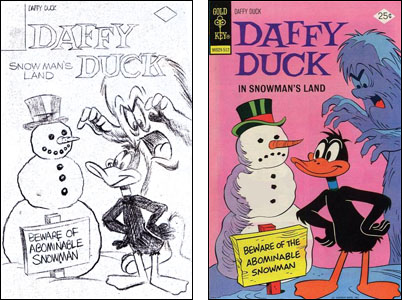
On the Daffy Duck one, I committed what was then considered a mortal sin: I merged Daffy's eyes together. This was the early seventies and there was no active Warner Brothers Cartoon Department. The folks who decided what those characters looked like — whether they were drawn properly — were in some sort of Licensing Division at the Warner company and they were furious if Daffy's eyes merged. There had to be black between them.
Fortunately, they never saw my rough or I might have been forbidden to ever draw (or even imagine) Daffy ever again. They didn't approve roughs; just the finished art which in this case was done by Joe Messerli.
My editor there, Chase Craig, told me horror stories of having to deal with those folks. Many of the artists he employed were former Warner Brothers animators. Tom McKimson was drawing the Bugs Bunny comic books I and others were writing. Phil DeLara was drawing Porky Pig or sometimes, it was Pete Alvarado. These were all guys who didn't take well to having someone tell them they were getting the characters wrong. At one point, someone at Warner's reportedly complained that Tom McKimson's Bugs didn't look right and they sent over some Xeroxes of old drawings that they wanted him to study to see the proper way to draw the wabbit. Tom replied, "Tell those idiots that I did those old drawings!"
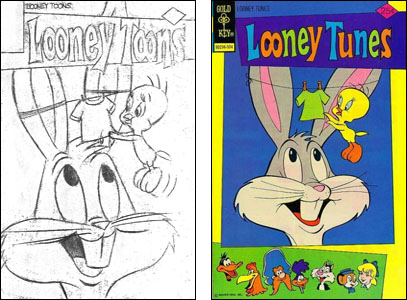
At one point, Chase informed me the company had decided to revive the old Looney Tunes comic book, though they wanted to retitle it Looney Toons. Warner okayed the new title, then changed their minds at the last minute, forcing it to be pulled off the presses so it could be changed to Looney Tunes. Something about trademarks.
I wrote the first issue and worked up the cover sketch. Before I did, I asked Chase who was going to design the title logo for the new book. He said — with some annoyance because there had apparently been problems over this recently — that his company had recently hired an "overpaid graphics designer" (that was the term he used) to do all their logos. He thought this person, who worked for their New York office, was not very good.
Chase had been fighting to get them to not redesign a lot of the logos on his books that he thought were in no need of improvement. He told me, "It doesn't matter what you do. This fellow will come up with something we'll all dislike." So when I did my cover rough, I didn't even try to suggest a logo idea. I just wrote "Looney Toons" on it in block letters without much thought.
Chase okayed the sketch but decided to add other characters' heads onto the cover so he had the final artists do a little rearranging. (I believe the final art was penciled by Pete Alvarado and I think that was Larry Mayer's inking.) My rough and Chase's amended rough accompanied the finished art when it was sent back to New York…
…where the "Overpaid Graphics Designer" followed what I'd penciled in. If I'd known he was going to do that, I would have tried to come up with an actual idea. And that, folks, is how creative decisions have often been made in the comic book industry.
The post Cover Stories appeared first on News From ME.
06 Dec 15:53
This reached number 4 in the singles chart in 1966, though it was released by the Small Faces' manager Don Arden (Sharon Osborne's father) without their knowledge.
Alex Petridis wrote well about the song in the Guardian:
Small Faces: My Mind's Eye
by Jonathan Calder
This reached number 4 in the singles chart in 1966, though it was released by the Small Faces' manager Don Arden (Sharon Osborne's father) without their knowledge.
Alex Petridis wrote well about the song in the Guardian:
It is the Small Faces’ equivalent of the Beatles’ Rain, the acid initiate staring back at the “straight” world, but while John Lennon sneers from a position of enlightened superiority – “they might as well be dead” – Lane sounds warm and open-hearted, forgiving the people sniggering at his new-found spiritual leanings. The music on Rain sets out to disorientate, but My Mind’s Eye sounds oddly comforting and familiar, as if inviting the listener to join in ...
Acid seemed to immediately strip the Small Faces of the preening machismo you can hear on their debut album. In its place came a brand of psychedelia that was charming and wry, devoid of self-importance, a veritable advert for the benefits of doing your crust in with LSD.
05 Dec 21:40

The Top 20 Voice Actors: June Foray
by evanier

This is an entry to Mark Evanier's list of the twenty top voice actors in American animated cartoons between 1928 and 1968. For more on this list, read this. To see all the listings posted to date, click here.
June Foray
Most Famous Role: Rocky the Flying Squirrel.
Other Notable Roles: Natasha Fatale, Nell Fenwick, almost any other female or little boy voice on a Jay Ward or Walter Lantz cartoon, Granny (owner of Tweety), Jokey Smurf and Mother Nature on The Smurfs, Magica De Spell and Ma Beagle on DuckTales, Grammi Gummi on Disney's Adventures of the Gummi Bears, Grandmother Fa in the 1998 Disney film Mulan, about 80% of all cartoon witches and hundreds of others.
What She Did Besides Cartoon Voices: June was another superstar of radio shows back when we had comedy and drama radio shows, plus she has done hundreds (make that thousands) of commercials and promos and she's often heard dubbing on-camera actresses and children in movies and television. Her on-camera jobs have been limited but she did play a Mexican telephone operator in several episodes of the TV series, Green Acres, and a serious on-camera romantic lead in a forgettable movie called Sabaka. And then there was her work with Stan Freberg on his records, radio shows and commercials, and her dozens of childrens records and her founding of the animation society ASIFA-Hollywood and so many other things.
Why She's On This List: She's June Foray, the most prolific and in-demand voice actress who ever lived.
Fun Fact: June did the voice of the popular doll, Chatty Cathy. And then when the TV series The Twilight Zone (the first version) decided to do an episode about an evil version of such a doll called Talking Tina, June did the voice of Talking Tina. Who else?
Additional Fun Fact: In 2012, June received an Emmy Award in the category of Outstanding Performer in an Animated Program for her role as Mrs. Cauldron on The Garfield Show, making her the oldest entertainer to ever be nominated for and to win an Emmy. The following year, she was honored with the Governors Award at the 65th Primetime Creative Arts Emmy Awards.
The post The Top 20 Voice Actors: June Foray appeared first on News From ME.
05 Dec 18:52
yes i do start the creative process by writing "one day, Batman"; why do you ask?
| archive - contact - sexy exciting merchandise - search - about | |||
 |
|||
| ← previous | December 4th, 2015 | next | |
|
December 4th, 2015: That Christmas shirt I made is back for a few days, actually! It's really great! It was a surprise it got extended but I am not complaining!
 – Ryan | |||


05 Dec 18:24

I have another First Person column in the Leicester Mercury today.
Pub culture destroyed in a generation
My defence of underage drinking in the Leicester Mercury
by Jonathan Calder

I have another First Person column in the Leicester Mercury today.
Pub culture destroyed in a generation
The other day a woman in front of me in the supermarket queue was asked to prove her age because she was buying a bottle of wine and looked under 25.
She did so without fuss – maybe she felt flattered? – but the incident made me think about how much our attitude to young people and alcohol has changed.
Back in the old days – in the Seventies – I was able to drink in pubs from the age of 16.
I did not do it often, but when I did it was always as part of a group of friends of the same age. We drank beer and we knew we had to behave ourselves because we weren’t really meant to be there.
But if we did behave then our presence was tolerated by the bar staff and other customers alike. I even remember playing snooker in a working men’s club on the shaky pretext that one of our number’s father was a member.
That would be unthinkable today. Any pub that let unaccompanied 16-year-olds through its doors to drink alcohol would lose its licence.
The result is that those teenagers who are determined to drink do so alone and unsupervised. They don’t drink beer but spirits and white cider.
Figures say that fewer young people drink alcohol today than did in the Seventies. I guess they are all at home in their bedrooms mixing music and being stalked on Facebook.
But those who do drink are surely getting a more harmful introduction to alcohol than my generation did.
Many things have changed since the old days – since the Seventies – and pubs are among them.
I have to admit that, much as we wanted to get into them, pubs were pretty unexciting places when you did. They turned out to be full of old men in flat caps drinking beer.
Everything changed in the Eighties. Suddenly pubs seemed positively designed to attract underage drinkers. They became fun palaces crammed with Space Invaders machines and Malibu.
Before that happened I had gone off to university to do my student drinking in York. In those days Yorkshire pubs really were ruled by fierce landladies who terrified all their customers.
Last time I was in York those landladies had gone and there was a security man on every pub door.
Traditional pub culture, including the tolerance for underage drinking I benefited from, was easy to destroy. Now it has largely gone and it would be next to impossible to re-establish it.
So the lady in her late twenties in front of me in the queue had to prove her age and teenagers are drinking vodka in bus shelters tonight.
05 Dec 18:22
Stolen circumcision ambulance found after tip-off
by Jonathan Calder
Our Headline of the Day Award goes to the Evening Standard.
05 Dec 18:09
Advent Calendar Day 4
by Fred Clark
We are aware of all Internet traditions. And as it is now December 4, it is high time for us to click over to Mark Evanier’s blog to re-read “My Xmas Story,” wherein Mr. Evanier is enjoying his lunch at Farmers Market in L.A.:
I arrived, headed for my favorite barbecue stand and, en route, noticed that Mel Tormé was seated at one of the tables.
Mel Tormé. My favorite singer. Just sitting there, sipping a cup of coffee, munching on an English Muffin, reading The New York Times. Mel Tormé.
I had never met Mel Tormé. Alas, I still haven’t and now I never will. He looked like he was engrossed in the paper that day so I didn’t stop and say, “Excuse me, I just wanted to tell you how much I’ve enjoyed all your records.” I wish I had.
Instead, I continued over to the BBQ place, got myself a chicken sandwich and settled down at a table to consume it. I was about halfway through when four Christmas carolers strolled by, singing “Let It Snow,” a cappella. …
This story gets ripped off every year by click-farm aggregators, so be sure to click through to Evanier’s blog and read the original by the guy who wrote it. It’s a lovely thing, as is this:
Click here to view the embedded video.
04 Dec 21:44
Science-fictional shibboleths
by Charlie Stross
Let's ignore, for the moment, the point that fiction is an exploration of human interior spaces, and that sometimes a spaceship or a princess is a metaphor; science fiction and fantasy are genres famous for their departure from the plane of mundanity, and usually a spaceship is just a form of transport between inhabited worlds ...
Let me tell you what makes me yell when I kick the tires on an SF/F novel these days.
There is a term of art that developed early on in the field of SF criticism: willing suspension of disbelief. When we read a work of fiction we are taking, as a given, statements that build upon one another to construct a cunningly plausible lie. We suspend our natural disbelief in things we know to be untrue, for dramatic effect cannot withstand the scorn reserved for falsehood. However, there is a limit (different for everyone) to the number of lies we can stack Jenga-style atop one another before our disbelief can no longer be held in abeyance: on reaching this point, the willing suspension of disbelief fails and the tower of implausibility totters and collapses in our minds.
Disbelief can be shattered easily by authorial mistakes—one of the commonest is to have a protagonist positioned as a sympathetic viewpoint character for the reader behave in a manner that is not only unsympathetic but inconsistent with the protagonist's parameters. But there are plenty of other ways to do it.
Certain patterns are guaranteed to make me throw a book at the wall these days (or they would, if I wasn't doing almost all my reading these days on an iPad), or at least stop reading on the spot. One such pattern is sometimes described as "the seven deadly words"; when you can say of a story "I am not interested in these people," the author has failed to hook you on the human content of their drama, and unless they're compellingly brilliant on another, inhuman, level—for example, the works of Olaf Stapledon or (some of) the works of Greg Egan—then that's it, game over. Another pattern is "this is pointless and tedious" (although it's even harder to define than "lack's human engagement"), and a third might be "this makes no sense" (on any level, including deliberate surrealism).
But then we get to more specific matters: specific shibboleths of the science fictional or fantastic literary toolbox that give my book-holding hand that impossible-to-ignore twitch reflex.
(Caveat: I am talking about books here. I basically don't do TV or film because my attention span is shot, my eyeballs can't scan fast enough to keep up with jerkycam or pull in enough light to resolve twilight scenes, and my hand/eye coordination is too crap for computer games.)
Asteroidal gravel banging against the hull of a spaceship. Alternatively: spaceships shelting from detection behind an asteroid, or dodging asteroids, or pretty much anything else involving asteroids that don't look like this:

That pock-marked potato, asteroid 243 Ida, is just under sixty kilometers long. (You could fit London onto about half of its surface area, with room left over.) Asteroids are not close together—bodies wider than 1km are, on average, about 900,000km apart—more than twice the distance from the Earth to the Moon. Smaller bodies tend to be gravitationally captured by larger ones over time (we're talking billions of years here); did you wonder where that rash of craters on 243 Ida came from? If you think of that scene from "The Empire Strikes Back" when you think of asteroid belts you are thinking of a whole bundle of nope.
Comets ... they're a bit more plausible as sources of dust and gravel. But they also originate a whole long way further out. While there's a lot of mass in the Kuiper belt (possibly enough to match a small to medium sized planet, unlike the asteroid belt between Mars and Jupiter) the volume of space involved is vast—double-digit light-hours across. (One light-hour, the distance light travels in an hour, is 1.079x10⁹km. Over a billion kilometers. If you set out to drive that distance in your SUV at highway speeds, it'd take you roughly 1150 years. Now multiply by a factor of 10-20.)
But basically unless your spaceship is parked on top of a frickin' comet approaching perihelion you are not going to get dust or gravel pinging off the hull ... unless you're insanely unlucky: because now the other shoe trops and we get to Annoying Trope #2.
Newton's Second Law, for dummies. E = 1/2 * (mv2) — it's not just a good idea, it's the law. Notice the huge distances I aluded to above? Well, to get between planet A and planet B in anything approximating reasonable human time spans, you need to go fast. And if you go fast, your velocity relative to the bodies around you is also high. In event of an inelastic collision the kinetic energy transfer is proprtional to the square of your velocity; and this has drastic consequences for space ships. Suppose you're in low Earth orbit and you hit a piece of space junk, for example a screw that's fallen off someone else's ship. It's traveling in pretty much the same orbit as you, but inclined at 30 degrees. What happens? What happens is you get a happy fun experience much like being hit by a bullet from a high-calibre sniper's rifle, because (I can't be bothered to do the trig here) it's packing a velocity component angled across your path at a goodly fraction of orbital velocity, and at orbital velocity a kilogram of water packs kinetic energy equal to about ten times its mass in exploding TNT.
You know what a high-speed car crash looks like, right? Space ships travel a lot faster than that: if they hit something, it's going to be very messy indeed. And that's at sluggish orbital velocities; if you starship is barreling along at about 85% of the speed of light general relativity has something to say on the subject and it's kinetic energy is equal to about half it's rest mass—the equivalent of a 10 megaton hydrogen bomb for every kilogram of hull weight. (The pilot's space-suited body alone packs the energetic punch of a Peak Strangelove 1980s USA/USSR strategic nuclear exchange.)
Human bodies are basically squishy sacks of goopy grease and water emulsions held together by hydrogen bonds and disulphide bridges between protein molecules and glommed onto some big lumps of high-grade chalk. We evolved in a forgiving, water-dominated low-velocity world where evolution didn't bequeath us nervous systems able to comprehend and deal with high energy interactions other than in an "ooh, that lightning bolt was close! Where's cousin Ugg?" kind of way. We can't even see objects that flash across our visual field in less than 50 milliseconds—a duration in which, at orbital velocity, an object will have travelled on the order of half a kilometer.
Intuition and high energy regimes: do the math, or your space combat will be a whole bundle of nope.
(Other related cognitive errors include but are not limited to: Napoleonic navies clashing in space and firing broadsides back and forth at one another's line of battle ... spaceships with continuous high acceleration fusion-powered motors or similar that don't glow white-hot then melt because vacuum is an insulator and shedding that much heat is a hard engineering problem (hint: a 100 ton spaceship accelerating at 1g requires 1 megaJoule of thrust: using a photon rocket for maximum efficiency that's going to require 3 x 10¹⁵ watts of juice going in, if it's 99.9% effective at heat dissipation that means it's racking up around three terawatt of leakage, and that's equivalent to about 45 kilotons of nuclear explosions per minute of waste heat) ... warships using active radar to hunt for one another (hint: active sensor reach is inversely proportional to the fourth power of the emission strength, passive sensors obey the inverse square law) ... warships using stealth in space (hint: infrared emissions, second hint: the background temperature you want to avoid standing out against is 2.73 degrees Kelvin, i.e. liquid Helium temperature) ...
Oh for fuck's sake, don't get me started on war in space, we'll be here forever unless we just throw physics to the winds of fiction and delegate all our hand-waving to magic hyperspace or cyberspace technology or something.
Now for a biggie: Mining the lunar regolith for Helium-3. This is junk science on stilts and it just keeps coming back from the dead. It's also a barrel of past-their-sell-by-date red herrings that keeps being rolled out by space cadets whenever they're challenged to produce an economic justification for space colonization. Here's why it's crap ...
Fusion, the Jenga-pile begins, is the energy source of the future. (This may or may not be true: I for one hope it is.) However, the easiest form of reaction you can run in a fusion power reactor is deuterium/tritium. This tends to release most of its energy in the form of neutrons, which can ideally be captured and used to breed more tritium fuel and produce waste heat to drive a turbine generator. The problem with neutrons is that they're rather penetrating and when they slow down enough to be captured by an atomic nucleus they transmute it, often into an unstable isotope. D/T reactors therefore look likely to suffer from one of the same problems as fission reactors: neutron-induced structural embrittlement and secondary activation producing high level radioactive waste.
Aneutronic fusion—which hasn't actually been tested yet in even a prototype research fusion reactor—offers the possibility of running on other fuels and producing <1% of its energy output in the shape of neutrons. Helium-3, an isotope of helium consisting of two protons and one neutron, can in principle be fused with deuterium instead of the (radioactive) tritium and produce power with a far lower neutron output—the energy-bearing product of the reaction is a proton, which can be contained using magnetic fields. Hence the interest in He3 fusion reaction designs.
The first problem with He3 reactors (after—cough—we don't know how to build one yet) is that He3 is incredibly rare. It costs on the order of millions of dollars per kilogram and the global supply is very restricted; there's certainly not enough of it to power a global energy economy even at today's levels. But there is some evidence that He-3 produced in the sun and emitted in the solar wind may be captured in the Lunar regolith. The plan, per the proponents of lunar colonization, is therefore to build vast strip mines on the moon to extract this vanishingly rare moonshine/pixie dust and export it to Earth to power our 22nd century energy economy. And of course estimates that we could power our current level of energy use by processing 4 million tons of lunar regolith per week are music to the space cadets' ears because, well, it means big engineering and thus big steely-jawed engineers with slide rules and socket wrenches on hand to repair the mining machines when they break. Space colony justified!
Except this is moonshine and junk. Firstly, we don't have an aneutronic fusion reactor, much less a planetary base load capacity driven by aneutronic fusion reactors in need of fuel. Hell, we don't even have a working D-T fusion reactor that can produce surplus energy; ITER isn't due to achieve first plasma until 2020 and won't begin D-T reaction operations before 2027, and the Wendelstein 7-X, while promising, is a generation behind (roughly equivalent to where the Joint European Torus was in the 80's).
But let's jump the gun. Let's assume we do have a working fusion reactor. Let's even assume we've put in the decades of legwork required to build a working aneutronic fusion reactor—it's worth noting that aneutronic reactions have to run about an order of magnitude hotter than D-T fusion reactors can achieve, and they're already in the 100 million Kelvin range. But let's play make-believe: are we then going to see large-scale lunar regolith mining to fuel the beasts?
Nope.
Because it turns out that if you can build an aneutronic reactor, then, subject to some considerable amount of fine tuning, you can run it on fuels other than sparkly lunar regolith moonshine and pixie dust—notably the proton-boron-11 cycle and the proton-lithium-7 cycle. Both these fuel cycles are aneutronic and run on isotopes that are readily available here on Earth in sufficient quantities to power our civilization for some millions of years without trying to build massive engineering infrastructure on an airless rock. There's even an aneutronic fusion cycle that relies on proton-nitrogen fusion, although it produces less energy and is even harder to achieve. Nitrogen and hydrogen ... nitrogen makes up about 80% of our atmosphere, and hydrogen makes up about 15% of our hydrosphere, so we're not running out of either of those fuels any time soon, either.
Upshot: any work of SF that takes "Lunar 3He mining" as an economic premise is about as plausible as one that assumes combustion powered by the release of phlogiston.
I've got a whole bundle more shibboleths up my sleeve that flag a work of SF as being implausible (this may account for why I'm more comfortable reading fantasy these days). Faceless 80's style corporations ruling entire planets (hint: who handles the externalities?): small farming planets (hint: just one ecosystem for a planet?): the glib dismissal of life support systems in space as trivially easy to maintain: monocultures of every kind: political structures based on design patterns proven to be unworkable in the context of any society more modern than the late middle ages (empires in space, I'm looking at you): any interplanetary/interstellar setting where the mechanics of trade are lifted straight out of a Joseph Conrad novel, or 1920s era pulps about life aboard a tramp steamer, or maybe the Traveller role playing game: AIs that follow the disembodied-brain-in-a-box mode of Hal 9000: futures in which we wear mini-dresses and three-piece suits, drive gas-burning automobiles (or hovercars: it's just a rabbit/smeerp replacement), carry handguns (or blasters: see rabbit/smeerp), eat the kind of food we eat today, live the kind of way we live today, and most importantly think the way we think today.
And I haven't even gotten as far as genre fantasy shibboliths yet!
So, over to you: what do you stub your toes on when you read SF, that throws you out of the state of willing suspension of disbelief?
Edit: if there's an entry for your pet shibboleth in the Turkey City Lexicon don't bother repeating it here—I'm taking familiarity with the canonical list of cliches as a given.
04 Dec 14:22
[econ] Observation about corporations liking markets on the outside?
I read a thing on the internet some time ago, and now, darn it, I've lost it. I'd like to find it and read it again, and maybe write something that has something to do with it.
It was some sort of blog post or online article, and I think it was by an economist. Honestly, I think it might have been about some other economics topic, and just mentioned the point of interest in passing. That point was the observation that libertarian-leaning CEOs often express fondness for the idea that the free market is the most efficient means for allocating resources, but they'd never dream of actually using markets within their organizations; they run their organizations as centrally planned as any Soviet state.
Does anybody recognize this, and can point me at an author or a post somewhere?
As as a side note, does anybody remember something about some large business(es) actually trying it, back in the mid 90s? That is, trying to use market-based economies within their organizations, out of an excess fervor for capitalism? I remember hearing about such a thing, and hearing it was a fiasco. If it did happen, I'd like to read up a bit on what happened.
It was some sort of blog post or online article, and I think it was by an economist. Honestly, I think it might have been about some other economics topic, and just mentioned the point of interest in passing. That point was the observation that libertarian-leaning CEOs often express fondness for the idea that the free market is the most efficient means for allocating resources, but they'd never dream of actually using markets within their organizations; they run their organizations as centrally planned as any Soviet state.
Does anybody recognize this, and can point me at an author or a post somewhere?
As as a side note, does anybody remember something about some large business(es) actually trying it, back in the mid 90s? That is, trying to use market-based economies within their organizations, out of an excess fervor for capitalism? I remember hearing about such a thing, and hearing it was a fiasco. If it did happen, I'd like to read up a bit on what happened.
04 Dec 11:01

LAST CHANCE
If my Patreon Pledges Reach $75 by December 31st I will switch the Blogger web comments back on.
HOW IT WORKS:
Regular readers may remember that I switched my comments off last year, because I was finding some of the attacks upsetting; because I was spending time responding to comments instead of writing new stuff; because I suspected that some people were using the blog as an open forum without being specially interested in my writing; and because, in the words of the great Alan Moore, if you are going to react, you might as well overreact.
Thirty of my regular readers are aware that this blog is supported by Patreon, a clever scheme by which you agree to pay $1 (twelve and sixpence in old money) each time one of my essay appear. (I aim to write between 4 and 8 a month, and you can set a maximum if you want to). There are a few little extras for subscribers -- a free download of my unfinished opus on Winnie-the-Pooh, and some recordings of me reading from the books right now, but I may have a little surprise lined up in the new year -- but the main thing is that it enables me to monetize my writing, which is only source of income apart from my day job. 36 of you have currently pledge $55 per essay; so if another 13 of you all pop $1 into the box, I'll say "thank you" by opening the blog up to comments again. Can't say fairer than that.
Andrew Rilstone
"Gee, Andrew, I didn't really agree with what you just said..."
by Andrew Rilstone
LAST CHANCE
If my Patreon Pledges Reach $75 by December 31st I will switch the Blogger web comments back on.
HOW IT WORKS:
Regular readers may remember that I switched my comments off last year, because I was finding some of the attacks upsetting; because I was spending time responding to comments instead of writing new stuff; because I suspected that some people were using the blog as an open forum without being specially interested in my writing; and because, in the words of the great Alan Moore, if you are going to react, you might as well overreact.
Thirty of my regular readers are aware that this blog is supported by Patreon, a clever scheme by which you agree to pay $1 (twelve and sixpence in old money) each time one of my essay appear. (I aim to write between 4 and 8 a month, and you can set a maximum if you want to). There are a few little extras for subscribers -- a free download of my unfinished opus on Winnie-the-Pooh, and some recordings of me reading from the books right now, but I may have a little surprise lined up in the new year -- but the main thing is that it enables me to monetize my writing, which is only source of income apart from my day job. 36 of you have currently pledge $55 per essay; so if another 13 of you all pop $1 into the box, I'll say "thank you" by opening the blog up to comments again. Can't say fairer than that.
Andrew Rilstone
02 Dec 16:34
Today's Political Rambling
by evanier
Jonathan Chait writes about what it would be like if Donald Trump were to take the Republican nomination. Chait doesn't think that's likely but he thinks it's a bit more possible than it once seemed.
I think it's possible, not probable. I have a line I've used on this blog before and I think I even used it as dialogue in a comic book or two. Someone says to someone else, "Your problem is you think never admitting you're wrong is the same thing as always being right." I've encountered a lot of people in my lifetime who were emotionally and/or strategically incapable of saying, "I stand corrected." It usually gets them in more trouble…but once in a while, they get away with it so they keep trying.
Trump has apparently decided that the secret of his success so far is acting just like Donald Trump…and Donald Trump never apologizes about anything that matters, never says he erred. He just attacks anyone who says he did and there are people out there who admire that swagger and seeming invulnerability. Does anyone really believe he saw thousands and thousands of Muslims cheering the demise of the World Trade Center?
Of course not. Every frame of video shot on 9/11 was carefully preserved for history. I don't know if it's still up but a few years ago, there was a website that archived the complete broadcast footage for that day of ABC, CBS, NBC, CNN and several New York stations and I downloaded every video on it, just to have it all. I'd go through every one looking for the scene Trump claims he saw on his TV but I'm sure he's already had people doing that, trying to find something he could pass off as what he insists he saw.
It ain't there. It exists on a reel somewhere with the footage Carly Fiorina swears she — and apparently, she alone saw in those Planned Parenthood sting videos. You'd have a better shot at locating a video of The Day the Clown Cried.
Trump's fans don't care. They're conditioned to not believe anything they don't want to believe. They're starting to remind me of the Ross Perot voters who were running around in 1992 not only insisting he would win the presidency but that it would be a clean sweep: He'd win every single state and all 538 electoral votes. This was at a point when there wasn't one poll anywhere showing him within ten points of winning even one of them.
Perot eventually got 19.7 million votes…but just find me anyone today who'll admit they voted for him. You might find one or two who'll say, "I knew he wouldn't win but that was my way of casting a protest vote." But you could probably fit all the ones who'd say "I'm proud of that vote" in a Scion xB and still have room for all the current Lindsey Graham supporters.
And I'm thinking that's how this whole Trump thing will end. He won't get knocked out of the race by the Republican elite hammering him. He won't be beaten by big commercial buys or attack ads. He won't be forced to get out by scandalous revelations or anything of the sort. His supporters will, a group of them at a time, reach their level of embarrassment. Being a Trump voter will increasingly require denial of reality and double-talking when others point out to you that he's triple-talking around every question because he has only vague answers to some and no answers to others. Ask him something substantive and watch Donald Duck.
Even the folks who still deep down think he'd make a great Chief Exec won't want to say that too freely…and they'll start to think he can't win, which is really the only thing most of them liked about him in the first place.
Am I sure this is what's going to happen? No. Of course not because I can be wrong. (See? That's not so hard to say…) So much that's happening in this election is unprecedented. That makes it hard for anyone to look at how our elections have worked in the past and to apply the old rules to the new contest.
But Ben Carson's chances seem to be plummeting because it's becoming awkward to support a guy with so many weird, factually-challenged statements out there. Maybe he's just the first in a series.
The post Today's Political Rambling appeared first on News From ME.
02 Dec 16:07


(In)Sense8
by Peter Watts
Spoilers. Duh.
When Caitlin Sweet, Mistress of the Character-Based Narrative, complains that a TV show wallows too much in characterization— worse, that it needs more science— you know a screenwriter somewhere has seriously missed the boat.
Really awesome opening credits, at least.
Over the weekend we binged on this Sense8 show everyone’s been raving about, curled up on Big Green with cheese and wine and Lexus (Kelly was supposed to join us, but was abducted by an employer with urgent deadlines to meet). Despite the glowing reviews, I approached it with a combination of hope and dread; it was, after all, the love child of J. Michael Straczynski and the Wachowski sibs, three bright flawed gems of the genre. Straczynski’s Babylon 5 was consistently brilliant in scope and ambition but only intermittently so in execution; the Wachowskis, after proving they could rock both indie (Bound) and SF (The Matrix), squandered their enormous cred on increasingly lame sequels and standalones. Sense8 might represent a return to form, or the last gasp of three has-beens clinging to each other as they circled the bowl.
I watched the first episodes with a sense of relief. The premise was intriguing. The performances were pretty good (some of the writing and characterizations were a bit clunky, but nobody who cut early B5 or Next-Gen the necessary slack can begrudge Sense8 a few episodes to find its feet). It was cinematically beautiful; and given the Wachowskis’ involvement, I don’t have to tell you the fight scenes rocked. I didn’t even mind that the science seemed shakey, at least to start with; only one of the characters had any kind of science background, and that was in pharmaceuticals. Eight minds scattered across the globe, suddenly finding themselves linked one to another? You’d expect them to figure out the rules through trial and error (which they did), but they’re not gonna have a clue about underlying mechanisms. Any speculation they indulge in is going to be loopy pretty much by definition. I was happy to wait for explanations: happier than I would have been if, for example, one of the newly-awakened “cluster” just happened to be a quantum neurologist who could exposit the technical specs by the end of the pilot.
And Jesus, wasn’t it nice to see such a diverse range of characters in a show whose premise doesn’t hinge on diversity and/or marginalization? Not one of those self-conscious shows about being trans or gay or black or viking, but a show about something else entirely in which the characters happen to be those things because that’s just the way folks are? That was pretty great.
In fact, the further the season progressed, the more apparent it became that that was maybe the only great thing about it.
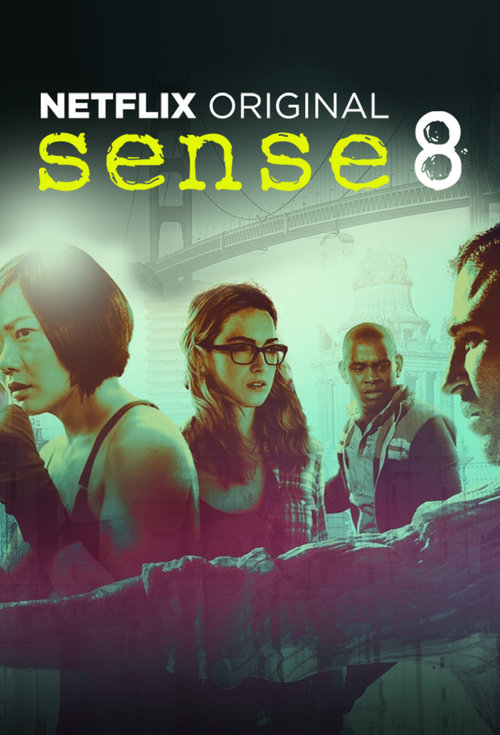
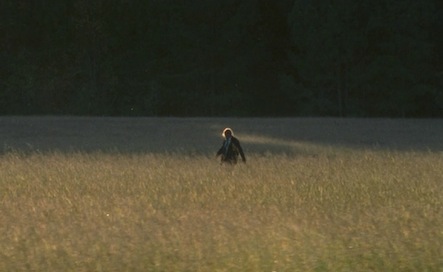
Look past the hokey promo shot. And the fact that one of the characters is named Ann Coulter.
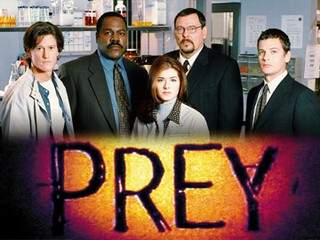
The idea that there are two distinct and competing species of modern Humans is a very cool one, ripe with SFnal potential. (It’s already been done on TV, in fact, back in 1998— in a pretty good, lamentably short-lived series called Prey.) Judging by the first season, though, Wachzynski don’t seem especially interested in the biological, ethical, or philosophical implications of their premise; they seem focused on character, almost to the exclusion of logic. Caitlin likens the series to Lost— a show which drew in viewers with three-dimensional characters and deep biographical back stories, only to alienate them when it failed to pay off all that setup in any coherent way.
Just how disinterested were Sense8‘s creators in exploring the ramifications of their own creation? You can get a pretty good sense in Episode 10— “What is Human?”— when one of the newly-awakened Sensates wonders, with understandable skepticism, how it’s possible for two distinct species to look so indistinguishably similar, to coexist in the modern world without everyone being aware of the fact.
“Evolution is frugal”, explains the show’s expository guru. “One small chromosome here or there and you walk on two legs instead of four … we are closer to humankind than the bonobo is to a baboon.” Except a single human chromosome contains up to 2000 genes, which is not exactly a “small” amount of variation (I’m guessing that “gene”, in fact— not chromosome— was the word the screenwriters were groping for). And if you want to illustrate how two distinct species can resemble each other to the point of indistinguishability, you might want to go with a different comparison than:
My God, it’s like they’re identical twins!
Okay, you might say. So Hollywood writers can’t be bothered to learn the difference between a gene and a chromosome. It’s not as though those guys are especially renowned for their biological erudition anyway. If you’re feeling generous you can write these shortcomings off as the equivalent of a typo, nothing for anyone but compulsive nerds and antisocial biologists to get upset about.
But it goes deeper than that. It’s not just that Sense8′s plays a bit loose with its techspeak; it’s that the show’s premise contradicts its own plot.
Consider: we’re told that the mind-hive state is baseline, that back in the Pleistocene the whole species was connected this way. We modern humans are a stunted offshoot, a mutation that lost the psychic interface; this gave us a competitive advantage allowing us to take over, because “killing’s easy when you feel nothing”. (This is presented as informed speculation by one of the characters— hence not definitive— but Straczynski’s on record stating that them’s the rules, so consider it canon.)
Right there I have problems. Sure, losing mind-to-mind empathic contact makes it a lot easier to kill without remorse— but there’s more to murder than attitude. There’s the fact that your supposedly-disadvantaged victims are still part of a telepathic network that allows them to be in a dozen places at once, that lets them instantaneously pool skills and knowledge and resources (and apparently muscle tone, given that untrained noncombatants become kick-ass killing machines when linked into the mind of a martial-arts expert). Every time you try to take out one, you’re actually fighting many. You were once part of such a network; but you traded it all away in exchange for a muffled conscience.
Not much of a threat, really.
It’s as though someone rewrote the The Walking Dead so that zombieism resulted not via some contagious pathogen, but by a process of random mutation. A cosmic ray tears through a germ cell: a critical base pair flips. One person becomes a walker. One person. They are now a shambling killing machine, utterly devoid of conscience and remorse. And this would in fact give them an edge when it came to slaughtering their former fellows, were it not for the fact that the rest of us still had mass communications, flame-throwers, and F16s. Also, good luck finding a mate who just happened to experience exactly the same random roll of genetic dice in time to found the new lineage.
I fail to see how such a trade-off constitutes an evolutionary advantage.
But okay. Let it slide, accept the premise as one of those single impossible things you’re allowed in an SF story. Let’s see how the implications play out. Sense8′s narrative arc involves an implacable human enemy determined to exterminate the Sensates because they pose a threat to singleton humanity. Straczynzki spells it right out in the Wall Street Journal: “By the end, the eight different characters are functioning as one. And that’s when you realize the danger, because it becomes cumulative. A person with that range of skills and determination is a massive threat to the organization.”
Except the whole series is based on the premise that we rose to ascendancy because we were the tougher, meaner bad-asses, that the mind-linked baseline strain didn’t stand a chance against our capacity for guilt-free murder. Our differing biology gave us a massive advantage over the other guys, who we must now hunt down because their differing biology gives them a massive advantage.
Is it just me, or does accepting Sense8′s premise logically entail rejecting Sense8′s plot? And given that three such admittedly smart folks as JMS and the Wachowskis spent a solid month “working out the rules”, how the hell did that slip by? (And we haven’t even started talking about how different species— even if they are more closely related than bonobos and baboons!— seem able to interbreed without any trouble.)
If I had to guess, I’d say it slipped by because they just didn’t care about that stuff. They were interested in exploring other issues entirely.
But here’s the thing: all that character-dense diversity stuff that Sense8 gets right is nothing to do with any particular genre. Every show should feel this inclusive. Every show should be so explicitly matter-of-fact about genitalia and childbirth. (I might be in the minority here; I’m one of those people who really doesn’t care about the “gratuitous” nudity in shows like Game of Thrones, because objectively the sight of genitals should be no more offensive than the sight of any other body part— and when was the last time anyone complained about all the bare feet you see on television, at times when showing bare feet doesn’t advance the plot at all! It’s completely gratuitous, shown for no other reason than to titillate foot fetishists!
(No: roll those eyes back down. I am not being disingenuous, and I am not being naive. I’m perfectly aware that genitals are shown all too often to titillate— but that’s because the dominant North American society was founded by brain-dead Bible-thumping prudes whose descendants, to this day, howl in outrage at a brief glimpse of Janet Jackson’s nipple while yawning at the latest cop-on-black homicide stats. Does anyone really think we owe the Standards of that Community anything but contempt, starting with sexual prudery and extending right across the board to evolution and climate change?
(But I digress.)
Where was I. Oh, right: Every show should be so matter-of-fact about human anatomy and the gender spectrum. The problem is, Sense8 is not ostensibly a show about those things; and while it’s great to see them get such a basic aspect so completely right, that’s not so much an accolade of Sense8 as it is an indictment of all the other shows out there.
Ultimately, all that progressive groundbreaking stuff is just wallpaper. In terms of actual story, Wachzynski seems mainly interested in giving us another iteration of the usual You’re A Wizard, Harry! wish-fulfillment fantasy: some unremarkable everyperson discovers they can be a medical expert, a lethal combat specialist, an Engine Whisperer, a Black-hat Hacker, or any other item in Batman’s utility belt the plot might call for. Sense8 is basically Buckaroo Banzai spread across eight bodies, played straight and without any of the winking self-awareness. It is— as I put it unto Caitlin— the Bruce Cockburn of televised SF: so earnest, so carefully progressive and inclusive and on the right side of history, that it almost feels treasonous to point out its hamfisted preachiness and incoherent narrative logic. It is— as Caitlin put it unto me— an earthbound Interstellar: visually gorgeous, superficially groundbreaking, but with a shockingly conventional Love Is The Answer moral twitching in its flaccid Hollywood heart.
Seriously, you need to check this out.
As the credits rolled for the final episode of the season, Netflix suggested that we might like to try another series with a similar theme: Orphan Black, a little home-grown Canadian number. Netflix was right: Orphan Black is, I think, what Sense8 wants to be. It doesn’t have nearly the production values— like most Canadian television, it feels a bit cheap in the grain and it lacks the geographic scope of the Wachzynski effort. But the spectrum suffuses Orphan Black as it does Sense8: as foundation, not focus. The difference is, something substantial rises from that foundation: a scientifically literate plot that makes sense, that not only understands the difference between genes and chromosomes but plays with gengineering (and religious) tropes in new ways. And Tatiana Maslany’s performance— in a dozen roles so far, and counting— is a wonder to behold.
Sense8 might yet build on its foundation. It might turn from something merely beautiful into something really good. Caitlin and I will keep watching; even as it stands, Sense8 has much to commend it. I suspect it won’t ever be as truly groundbreaking as it aspires to be, though.
It might have been, if only Orphan Black and Prey hadn’t got there first.
Serafin.shane likes this
02 Dec 15:58
Bombing Syria Considered Stupid
by Charlie Stross
Various commenters have been badgering me to run a discussion of the Paris massacres and subsequent international response on this blog. I've been reluctant to go there because we invariably get far more smoke than light in the heat of the moment, and because it's not a terribly productive use of my time.
(Update: as of 2-Dec, the war faction won in the British Parliament and the bombers are already flying missions. How this plays out remains to be seen.)
Once the scale of the atrocity was clear certain responses became inevitable. President Francois Hollande of France is facing re-election in early 2017, 18 months out, and he is both relatively unpopular and threatened by Marine le Pen, leader of the anti-immigrant, racist, neo-fascist National Front. Failing to go Full Bush on those to blame for the massacres—in this case, ISIL/Da'esh—would be electoral suicide, and so within days France sent its nuclear carrier battle group in the direction of Syria. Aide Memoire: do not fuck with the French, they have a centuries-long history of being an aggressively expansionist imperial power. Their collapse during the second world war was an historical aberration arising from the scale of their war dead a generation earlier (8% of total male population killed, many more injured; compare that to the ~2% death toll of the US Civil War). That they successfully resisted pressure from George W. Bush and Tony Blair to join the Iraq invasion is largely attributable to then-President Jacques Chirac, who as a young man had fought in the Battle of Algiers, and had a much better idea of the likely consequences of trying to occupy an Arab nation than the neoconservative adventurers. But these recent precedents are both anomalies, and expecting the French to sit on their hands in the face of a direct attack would be as delusional as expecting Margaret Thatcher to ignore the Argentinian invasion of the Falkland Isles in 1982.
Also from the let-sleeping-empires-lie department: it's a bad idea to piss off the Russians, too. In particular, Vladimir Putin's current presidency appears to be running off a very traditional Russian script whereby economic woes at home can be ignored by playing to the gallery with a display of strength. When Metrojet Flight 9268 was blown up by a bomb over the Sinai Peninsula and Da'esh claimed responsibility it was only a matter of time before the White Swans were brought out to score the entirely gratuitous point that the Russian Air Force has got a very big dick indeed. (Syria is within range of Su-24M and Su-25 tactical aircraft, which are far more numerous and much cheaper to operate; also, Scotland, Spain, Italy, and Greece are just slightly off the shortest route between Olengorsk and Idlib. Someone was not only waving their dick in public, but anxious that it be adequately admired by NATO.)
The Russians are also, cannily, building bridges. Their support for the Assad regime—a very long-term client state—is not unexpected; their tactical measures seem to focus on allowing the Syrian government to maintain contiguous territory for the Alawaite minority that it represents. Negotiations with Iran appear to be focussed on building a coalition of people who really don't get on with Wahhabite militias, such as Al Qaida in Iraq and the even-more rabid Da'esh, but also with Saudi Arabia (the elephant in the room who the west are habitually ignoring).
But there is another threadbare former imperial player in the region who we've been ignoring—and finally there's climate change.
Turkey was, prior to 1918 and the Sykes-Picot Agreement, the hegemonic imperial power in the middle east, in the form of the Ottoman Empire. Syria was as much a part of Turkey's "sphere of influence" as the Eastern Ukraine was of Russia's—incidentally, another zone where the post-1918 settlement is going up in gunsmoke and it's raining airliners. More to the point, geopolitically Turkey is in a weird position. It was roped into NATO in the wake of the second world war as part of the USA's policy of encirclement of the USSR—but Turkey's national aspirations are intrinsically at odds with some of its NATO partners, spiking on occasion to the level of warfare. Let us not forget that Turkey was also the imperial hegemon that ruled Greece and the Balkans. And today Turkey controls a vital regional resource—the tributary rivers that flow into the Euphrates, the main supply of irrigation of water into Syria and northern Iraq. Turkey has been damming the Euphrates and restricting the water flow to Raqqa province, violating international water sharing conventions. Syrian anger over the Güney Doğu Anadolu project was a major reason why the Assad government began providing material support to the PKK insurgency in Turkey. In turn, Turkish control over the Euphrates headwaters is a potent weapon against the Kurdish independence movement.
I'm an outsider and not adequately informed on this area. However, it looks (from here) as if the Turkish centralizing obsession with suppressing the PKK has led to the destabilization of Syria and northern Iraq. Syria's government encouraging a push towards water-intensive agriculture coincided with the most intense drought on record in Syria, from 2007 to 2010, then ran into the generalized political discord of the Arab Spring: the Ba'ath government badly mishandled the demographic/economic situation during the 00's and it would be a mistake to lay the blame for the Syrian civil war entirely on Turkey. However, cutting the river water supply to a drought-stricken region in the middle of a period of popular discontent didn't help.
Today, 4 years after the war began, Syria is a shattered mess. It's noteworthy that Da'esh controls areas where the water supply has been most badly affected, crippling agriculture, the main support of the poor, mostly conservative Sunni locals. Add in lots of former Iraqi army officers (pushed into fighting by the de-Ba'athication policies imposed by the US occupation and then the anti-Sunni policies of the subsequent Shi'ite government in Baghdad) and a seasoning of Wahhabite fanatics, and you have the recipe for Da'esh to get started, take root, and hold territory.
So what is to be done?
The British government of David Cameron, for no sane reason, seems to think that bombing the crap out of these drought-stricken regions is going to make Da'esh go away. (There's a parliamentary debate tomorrow, to be followed by a vote that the proponents of bombing will probably win). The trouble is that bombing may initially show some signs of successfully killing off groups of insurgents. But air strikes are a very blunt instrument—the post-1920s replacement for massed artillery—and sometimes it goes horribly wrong.
More to the point, it won't cure the underlying problem, which is idiots in Ankara messing with the region's water supply in the service of short-term political expediency. The Turkish Deep State is becoming increasingly brutal in its murderous attacks on peaceful Kurdish dissidents, and it seems willing to risk a much more dangerous escallation in the process.
What we need, I think, is not more bombs: there are too many bombs falling already. What we need is enough coastal desalination plants to relieve pressure on the Syrian water supply, combined with resettlement camps for refugees fleeing the war, and systematic initiatives at ground level to protect them from the Da'esh revenants—whose support will fade away once someone else is providing the basic services that Da'esh offers to those it conquers (when it's not enslaving, raping, and murdering them).
(And I think it's clear that we need to be rid of Da'esh for good. Even the Nazis didn't lower themselves to booby-trapping the mass graves of their genocide victims to prevent them being decently reburied.)
02 Dec 15:50
Abd el-Kader and Syrian refugees
by Fred Clark
For more than a year now, more than a dozen Republican candidates for president have been crisscrossing Iowa, site of the first-in-the-nation caucus they all hope will give them momentum to capture their party’s nomination for president.
Only Mike Huckabee and Rick Santorum have made campaign stops in tiny Elkader, Iowa, but Chris Christie, Ben Carson, Rand Paul, Ted Cruz, John Kasich, Carly Fiorina and Marco Rubio have all stumped for voters in nearby Dubuque. Jeb Bush was campaigning in Dubuque today.
So they’ve all likely ridden past signs for Elkader. They’ve seen its name on maps of Iowa. They’ve got organizers and operatives working there.
Given the cowardly, inhospitable opposition to Syrian refugees that all of these candidates have decided to make an issue, it’s safe to say that not a one of them knows anything about the person that gave Elkader, Iowa its name.
Elkader, the seat of Clayton County, was founded in 1846 and was given its name to honor Abd el-Kader, whose military exploits at the time were breathlessly recounted in American newspapers and popular magazines. El-Kader was a Sufi religious scholar who had arisen to become a brilliant general and warrior, uniting the Bedouins of Algeria in an astonishingly successful war against the powerful, larger and better-equipped army of France. His military success and his pious gallantry and graciousness in victory had made him a folk hero around the world.
Ultimately, the larger French army won its brutal war in Algeria. El-Kader surrendered and, betrayed in defeat, was forcibly taken to Paris. His presence there was meant to serve as a symbol of France’s victory, but he became, instead, a highly sought consultant visited by political and military leaders from all over Europe and the world. His popularity among the French people was such that the announcement of his freedom four years later was followed by a parade through the streets of Paris.
Abd el-Kader and his family moved to Damascus where he settled in 1855, intending to live out his days resuming the religious studies that the French invasion of Algeria had interrupted decades earlier. In a sense, then, el-Kader was a Syrian refugee, but he was a refugee who found refuge in Syria.
That’s not why his story is so relevant to the current American debate over Syrian refugees, though. That’s only a small part of what it is that all those Republican presidential candidates desperately need to learn from his story.
The really relevant bit came later, in 1860, when the Ottoman governor overseeing Syria sought to incite sectarian violence that he would then use as a pretext to slaughter the thousands of Christians living in that city:
The plan appears to have been this: that the Druze would incite attacks against Christians, “forcing” the Turks to step in and escort the Christian community to a citadel outside the city for their protection. There, Druze conspirators would be waiting to slaughter them all.
That’s from a terrific summary of this story by Rany Jazayerli, who’s better known as a writer for Baseball Prospectus and a smart, devoted fan of the Kansas City Royals. (Congrats on the World Series, Rany.) But he knows this story well – his great-great grandfather served under Abd el-Kader in Damascus.
The following is excerpted from his post “Abd El-Kader and the Massacre of Damascus,” which draws heavily on John W. Kiser’s book Commander of the Faithful: The Life and Times of Emir Abd el-Kader (the italicized portions are quoted from Kiser’s book):
On July 8th, Abd el-Kader had learned the details of the plot between the Druze and the Turks, and had rode out of the city to confront the Druze cavalry before they attacked. He – and his small army – succeeding in, ahem, convincing the Druze to call off their attack. Meanwhile, though, he was oblivious to the fact that there was a mob already sweeping through Damascus.
He returned to the city on July 10th, and found chaos before him. “Abd el-Kader soon learned that the Turkish troops assigned to protect the populace had been ordered into the citadel or were lackadaisically watching as rioters were running amok, burning homes and slaughtering Christians.”
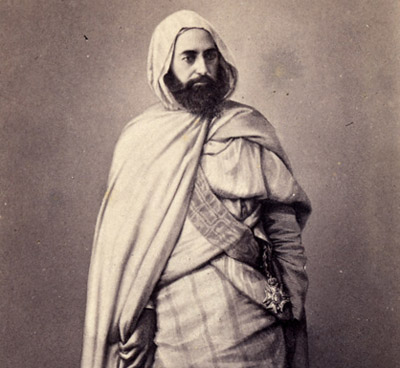
Abd el-Kader, photographed in Damascus, 1860.
And at that moment, Abd el-Kader, the man who had led his Muslim people in a war against Christian invaders for 15 years, knew what he had to do. And that he had to do it quickly.
First he and his men hurried to the French consulate to offer safe harbor; the French were immediately joined by Russian, American, Dutch, and Greek diplomats looking to flee the scene. And then:
All afternoon of July 10, Abd el-Kader plunged into the chaos of the Christian quarter with his two sons shouting: “Christians, come with me! I am Abd el-Kader, son of Muhi al-Din, the Algerian. … Trust me. I will protect you.” For several hours his Algerians led hesitant Christians to his fortresslike home in the Nekib Allée, whose two-story interior and large courtyards would become a refuge for the desperate victims.
“As night advanced fresh hordes of marauders – Kurds, Arabs, Druzes – entered the quarter and swelled the furious mob, who, glutted with spoil, began to cry for blood. Men and boys of all ages were forced to apostatize and were then circumcised on the spot. …Women were raped or hurried away to distant parts of the country where they were put in harems or married instantly to Mohammedans,” wrote [Charles Henry] Churchill of the events. “To say that the Turks took no means to stay this huge deluge of massacre and fire would be superfluous. They connived at it, they instigated it, they shared in it. Abd el-Kader alone stood between the living and the dead.”
Abd el-Kader returned with his men, and every Christian they could pull away to safety, to his estate. …
Well over a thousand Christian refugees were housed inside Abd el-Kader’s home, making it so crowded that people could not sit or lie down, let alone use the facilities. So Abd el-Kader arranged for small groups of his Algerian men to accompany the Christians, in groups of 100, to the citadel outside the city – the same citadel that the Druze had originally planned to use to slaughter them.
The residence was finally emptied out and cleaned. Abd el-Kader then circulated word that a reward of fifty piasters would be paid for each Christian brought to his home. For five days, the emir rarely slept, and when he did, it was on a straw mat in the foyer of his residence where he dispensed reward money from a sack he kept by his side. As soon as 100 refugees were collected, his Algerians escorted them to the citadel.
The worst of the rioting ended on July 13th, 1860. … At least 3,000 Christians were killed before it was all over. Abd el-Kader was credited with saving upwards of 10,000 Christians, including the entire European diplomatic corps.
This is a story that needs to be remembered. And with the current ugly turn in American politics, it seems particularly important to remember it now.
02 Dec 15:47
seriously: if you've never eaten spaghetti topless, try it! it saves SO MUCH LAUNDRY.
| archive - contact - sexy exciting merchandise - search - about | |||
 |
|||
| ← previous | December 2nd, 2015 | next | |
|
December 2nd, 2015: I made a new shirt! It's really great! You can get it for JUST ONE MORE DAY :0 >:0 – Ryan | |||
02 Dec 15:34
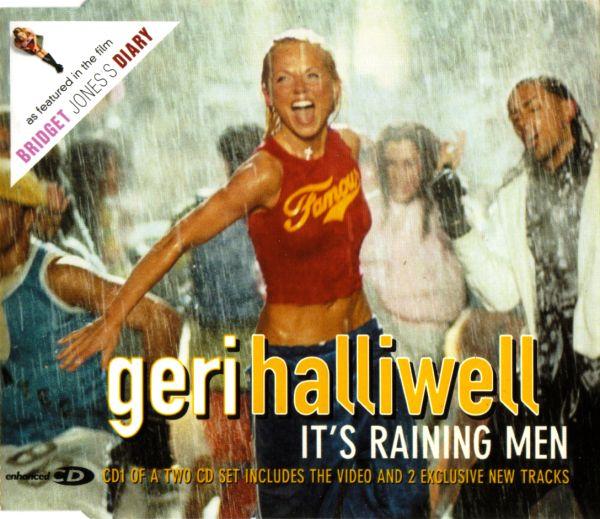
GERI HALLIWELL – “It’s Raining Men”
by Tom
#897, 12th May 2001
 Living with my parents over summer ‘95 I read the Independent, cover to cover, largely as a way to delay writing job applications. I become a small-scale fan of Bridget Jones Diary: Helen Fielding’s columns, comically exaggerated snippets of semi-posh London life, were a minor weekly highlight. On first encounter the pieces felt like a sitcom, and in classic sitcom style they seemed to match a mildly awful (but sympathetic) lead character with several still more awful supports. Fielding had refused to write an autobiographical single-girl-about-town column, preferring to take a more satirical route, but Bridget grew into an icon, and her sitcom grew a storyline.
The gloss of satire, and the repetitive structure a serial column demands, turned out to be a winning combination: Bridget constantly declares that she wants to change, but never can. But because this is a comedy, and she’s its heroine, this flips into something positive. As Kelly Marsh points out in her essay ‘Contextualising Bridget Jones’, Bridget’s surface neurosis masks secret unrepentance: she lays out her consumption of booze, cigs and food, then tells the stories of how she missed her targets with relish. She deals with society’s expectations (and her own) by ironising them. Fielding knows perfectly well that “guilty pleasures” is an idea that polices pleasure, not celebrates it, and every week Bridget would start with that policing, and go on to comically defy it.
All this makes “It’s Raining Men” an ideal choice of song. It’s about defiant excess, a carnival spirit of release, where guilt is banished, the unnatural order of things is overturned and the world bends to the desires of those who enjoy men. The original Weather Girls video sees two big, wickedly joyful women and a gaggle of dancers go on an unrestrained rampage through a cheap, gaudy set. The heart of The Weather Girls’ song is the crescendo before the final chorus – “I feel stormy weather moving in!” – sung with delight as a claim on pleasure and a warning of its power.
Geri Halliwell doesn’t have the lungs to match that, but she obviously loves the idea of it as a moment. The pantomime emphasis she gives it sums up her whole approach, though – this is a cover of a song done in the foreknowledge that the song is “cheese”, which saps its power. There’s probably no way for a Weather Girls cover in 2001 to escape that fate, but I don’t think Geri’s trying very hard. “It’s Raining Men” is a good song, and a great choice for Bridget Jones, but I don’t get that from this record. And certainly not from the video, which contrasts Renee Zellweiger at her most flustered and farcical with long pans over Geri’s ultra-toned body. The animating spirit of the thing seems to be “Isn’t Geri great, and how on-brand this song is for her!”
It’s too on brand, is the thing. She does a better job with this song than with some of her own, because it’s a better song, and because she barely tries to actually sing it. (Not a complaint, given the options). But she’s not quite convincing singing a song about the breaking of the dams the world puts on desire, since she made clear from the first words of “Wannabe” that she acknowledged no such limits. Who would ever have held her back? So the part of the song that’s about justice, not only joy, backs off, and we’re left with a romp: “Bag It Up”, part 2. Geri doesn’t need it to rain men, and she can’t sing it like she does.
02 Dec 15:16


Conversations with People with Asperger's Syndrome can leave you with a Wrong Impression
by Gavin Bollard
People with Asperger's Syndrome often come across in conversations as very self-obsessed and this is reflected in “Aspie-type” personalities in the media, such as “Doc Martin” in the British TV show of the same name and “Sheldon Cooper” from the “Big Bang Theory”**.
The question is whether this is a reputation that we deserve. It's certainly true that conversations with people with Asperger's can be an “experience” but is this a self-centred superiority complex or simply the way that a bunch of traits appear to others… and if so, what can be done about it?
One Sided Conversations

People with Asperger's often seem to dominate conversations, turning the topic to things that interest us (special interests) and then talking until the listeners make their escape.
To an outsider, this appears to be “conversation dominance”. It suggests that the “aspie” is not interested in the opinions and subjects of other people.
People with Asperger's are constantly thinking about their interests and apparently this isn't the case with “normal” people. When you're talking, you tend to say what you're thinking- and for us, it's pretty obvious what that is. In fact, it's hard for us to concentrate on other topics especially if, like “today's weather” or “last night’s sports game”, they seem to lack conversational depth.
This is an area where we can improve simply by trying to rein in our exposure of the special interest and trying to listen to others. It takes practice but it's an important skill to learn.
Being Direct
People with Asperger's often ask very direct questions, for example asking an elderly person exactly how old they are or aggressively asking multiple questions about a given purchase which interests them.
Other people can interpret this as being “nosey”, pushy or simply rude.
People with Asperger's see this quite differently. It shows interest, engagement and sometimes honesty, all traits that we admire in conversation.
Personally I've always been proud of my honesty but over the years I've learned that there are some things that you just can't say. I now refrain from personal comments of any kind to such an extent that I've been accused many times of “not giving compliments”. In fact it's arguably the most difficult part of my marriage.
Too often my most well-meant comments are taken completely the wrong way. It's easier to completely avoid all personal comments than it is to say things that are intended as compliments but could all too easily have unintended consequences.
This is an area where others need to change their unrealistic expectations of us. Of course over the years, I've learned through trial and observation to avoid specific types of comments and questions - and my reading of body language has improved significantly. It’s probably safe to say that these problems should decrease over time with familiarity.
Blurting and Interrupting

People with Asperger's syndrome are often seen to interrupt the conversations of others, simply blurting out what seems to be random facts. This leads others to presume that they consider their conversations to be more important or at best, that they are simply rude.
Blurting can be a symptom of “over-excitement” in a topic or the urgent need to convey some information before it is forgotten. People with Asperger's usually have great long term memory but short term tends to be poor.
More often, blurting is the result of difficulty locating simple entry points into a conversation. It's not uncommon for a person with Asperger's to walk up to a conversation and watch it like a tennis match for a few minutes before silently walking away. This isn't rudeness, simply the person being unable to find the right “gaps” in which to enter a conversation. After a few such attempts, blurting is only to be expected.
In General
There are many other nuances in “Asperger's conversation” but the answers usually boil down to the same things. Some things, the person with Asperger's needs to work on, some things develop naturally over time and sometimes others need to be more understanding and more accommodating.
The more time you spend listening to a person with Asperger's syndrome, the more you'll find yourself "acclimatizing" to their "peculiar" speech and world-view. If you're a regular watcher of either of the shows I mentioned earlier, think about how you feel about Doc Martin or Sheldon Cooper now versus how you felt about them in their earliest episodes.
The rudeness and the superiority complex that people with Asperger's syndrome often project is rarely intended as such.
** Neither Doc Martin, nor Sheldon Cooper are specifically identified as "having Asperger's syndrome". though it has certainly come up on one, maybe both, shows. They're both characters based on real like people who are known by the actors and/or writers. Nevertheless, the characters they portray are very "aspie-like".

02 Dec 14:56
[me, health] The Trouble with Being Visionary
Huh, fascinating.
I've been going through some slight adventures in vision correction: I ordered a pair of glasses to a new prescription on Aug 31; they come in on Sept 14, and I pick them up on Sept 16 and start going through the squeezy-eyeball adjustment period; then they get recalled by the optical shop and I return them on Sept 25, returning to my previous glasses and prescription, and going back through the squeezy-eyeball adjustment process; then I finally get the correctly made glasses on Nov 20th and go back through the squeezy-eyeball adjustment.
With my new glasses, it's much easier to read my computer screen; this was true even during the brief initial period I had them before recall – they were recalled for being made in such a way they were going to fall apart, not that the prescription was wrong. With my old glasses, I was having some mild eye strain, especially when at all tired.
But my subjective experience was not "My eyes ache and are tired." My subjective experience was "Wow, my concentration's shot": in my writing, I was having trouble staying on topic – lots of rambling – trouble staying organized – accidentally repeating myself – and trouble expressing my thoughts – lots of staring into the emacs buffer and no blood beading on my forehead.
My subjective experience of getting my vision better corrected for computer work was not "this feels nicer on the eyes" but "OH HEY, I CAN THINK AGAIN."[*]
[* Well, somewhat. I'm having other health issues which are messing with my sleep, and exhaustion is taking a toll on my cognition, too. But the improvement is much appreciated.]
I've been going through some slight adventures in vision correction: I ordered a pair of glasses to a new prescription on Aug 31; they come in on Sept 14, and I pick them up on Sept 16 and start going through the squeezy-eyeball adjustment period; then they get recalled by the optical shop and I return them on Sept 25, returning to my previous glasses and prescription, and going back through the squeezy-eyeball adjustment process; then I finally get the correctly made glasses on Nov 20th and go back through the squeezy-eyeball adjustment.
With my new glasses, it's much easier to read my computer screen; this was true even during the brief initial period I had them before recall – they were recalled for being made in such a way they were going to fall apart, not that the prescription was wrong. With my old glasses, I was having some mild eye strain, especially when at all tired.
But my subjective experience was not "My eyes ache and are tired." My subjective experience was "Wow, my concentration's shot": in my writing, I was having trouble staying on topic – lots of rambling – trouble staying organized – accidentally repeating myself – and trouble expressing my thoughts – lots of staring into the emacs buffer and no blood beading on my forehead.
My subjective experience of getting my vision better corrected for computer work was not "this feels nicer on the eyes" but "OH HEY, I CAN THINK AGAIN."[*]
[* Well, somewhat. I'm having other health issues which are messing with my sleep, and exhaustion is taking a toll on my cognition, too. But the improvement is much appreciated.]
01 Dec 16:10


Clues
Day 15 : # Info (1)
Day 16 : # Info (1)Day 17 : # Info (1)
Day 18 : # Info (1)
Day 19 : # Info (1) enter PASSWORD (the caps were on....)
Day 20 : # Info (1)
Day 22 : # Info (1)
Day 23 : # Info (1)
Christmas Eve : # Info (1)
http://powerpopcriminals.blogspot.com/2015/12/the-advent-wall-of-sound-2015-9th-awos.html
by angelo
THE ADVENT WALL OF SOUND 2015
9th AWoS, ZS Hosts, PPC (choose your acronym).
So, for the 9th year, here's the PPC AWoS. From the 1st of December to the 24th of December, everyday you'll have to click on one slice of the image. Everyday, each compartment will show a new album never posted before on this blog. Each post will be available for just one day (or maybe two, it will depend). Don't click on a part before the day or somebody could be hurt. Now you can enjoy the spirit of Power Pop. And of course, feel free to comment everyday.
Clues
Day 1 : # Info (1 + 2 + 3 + 4)
Day 2 : # Info (1)
Day 3 : # Info (1)
Day 4 : # Info (1)
Day 5 : # Info (1)
Day 6 : # Info (1 + 2)
Day 7 : # Info (1)
Day 8 : # Info (1)
Day 9 : # Info (1 + 2)
Day 10 : # Info (1)
Day 11 : # Info (1)
Day 2 : # Info (1)
Day 3 : # Info (1)
Day 4 : # Info (1)
Day 5 : # Info (1)
Day 6 : # Info (1 + 2)
Day 7 : # Info (1)
Day 8 : # Info (1)
Day 9 : # Info (1 + 2)
Day 10 : # Info (1)
Day 11 : # Info (1)
Day 12 : # Info (1 + 2)
Day 13 : # Info (1 + 2 + 3)
Day 14 : # Info (1)
Day 14 : # Info (1)
Day 15 : # Info (1)
Day 16 : # Info (1)
Day 18 : # Info (1)
Day 19 : # Info (1) enter PASSWORD (the caps were on....)
Day 20 : # Info (1)
Day 21 : # Info (1)
Day 22 : # Info (1)
Day 23 : # Info (1)
Christmas Eve : # Info (1)
01 Dec 16:04
Timequakes, Zugzwang and bombing Syria
by Nick
 Timequake, Kurt Vonnegut’s last novel, is an odd thing. The story is ostensibly about the world having to relive the years from 1991 to 2001 all over again, with full memory of everything we did during that time but unable to change any of it because we don’t possess free will. The book itself is about that story, but also about Vonnegut’s attempts to tell that story and ends up folding in on itself to become as much a story of his life as it is a fiction. It’s an understandable mess because why the concept is a good one – and people being doomed to make and repeat mistakes while pretending they have free will is a recurring theme of Vonnegut’s works – actually depicting it is hard work.
I’m reminded of Timequake this week because it feels like we’re staggering through a replay of the events of the build-up to war in 2003 and at least one side is being portrayed as possessing no free will in the matter. So, we get coverage like this
4 newspapers tie Corbyn's name to airstrikes in Syria. Wasn't it Cameron's proposal? What exactly is going on here? pic.twitter.com/77CA0bQk1M
— Media Diversified (@WritersofColour) November 30, 2015
and posts like this where the decision to start bombing Syria is taken as an unavoidable fact. Only those opposed to bombing appear to be deemed as possessing the free will required to have to come up with justifications for their actions, while those proposing it act as though they’re prisoners of destiny, lurching towards war because there’s no way to change their course of action and do something else. A whole army of keyboard Clausewitzes appear ready to blame those arguing against bombing for it happening while there own arguments in favour are little more than Something Must Be Done.
There’s a concept in chess (and wider game theory) called ‘zugzwang’ where a player finds themselves in a position where whatever move they make leaves them in a worse position. It feels an apt description for Jeremy Corbyn’s relationship with the media where whatever he does, it’s wrong: trying to get Labour to oppose air strikes is an attempt at loony lefty dictatorship, conceding a free vote is weak leadership that allows bombing to happen. Beyond that, it also seems apt for describing the global situation where every potential course of action appears to lead inextricably to the good intentions road to hell, the only question how we get there and which sub-district of the inferno we arrive in.
The problem seems to be that we’ve got a whole lot of tactics available to us, but none of them in themselves appear to add up to a strategy. Just like in 2003, we spend almost all our time arguing over what we should or shouldn’t be doing with the tools we have at hand without pausing to think about any long-term aims and goals. The overriding principle appears to be feeling that because we must Do Something, we have to choose from a variety of bad options and decide which is least worst. We’re not in a game, though, and we don’t have rules that say we must Do Something. Pretending that we must act, and expecting those advocating other courses of action to be the only ones who need to come up with a convincing argument why not is confusing tactics for strategy, repeating the mistakes we’ve made before and just confirming that we’re going to keep making them again and again.
So it goes.
01 Dec 12:32
excuse me, but why do we give mad professors resources for playing god when that funding could go towards lowering MY taxes
| archive - contact - sexy exciting merchandise - search - about | |||
 |
|||
| ← previous | November 30th, 2015 | next | |
|
November 30th, 2015: I made a new shirt! It's really great! You can get it for JUST A FEW MORE DAYS. :0 – Ryan | |||
01 Dec 11:46
Go the whole hog
by Fred Clark
Today is the birthday of Samuel Clemens and the Feast Day of St. Huckleberry. We celebrate that occasion around here by re-reading this.
If you want to know what I believe about conversion, salvation, and what it means to be “born again,” and what ought to happen after that, this will show you. It’s all right here, whole hog.
I about made up my mind to pray; and see if I couldn’t try to quit being the kind of a boy I was, and be better. So I kneeled down. But the words wouldn’t come. Why wouldn’t they? It warn’t no use to try and hide it from Him. Nor from me, neither. I knowed very well why they wouldn’t come. It was because my heart warn’t right; it was because I warn’t square; it was because I was playing double. I was letting on to give up sin, but away inside of me I was holding on to the biggest one of all. I was trying to make my mouth say I would do the right thing and the clean thing, and go and write to that nigger’s owner and tell where he was; but deep down in me I knowed it was a lie — and He knowed it. You can’t pray a lie — I found that out.
So I was full of trouble, full as I could be; and didn’t know what to do. At last I had an idea; and I says, I’ll go and write the letter — and then see if I can pray. Why, it was astonishing, the way I felt as light as a feather, right straight off, and my troubles all gone. So I got a piece of paper and a pencil, all glad and excited, and set down and wrote:
Miss Watson your runaway nigger Jim is down here two mile below Pikesville and Mr. Phelps has got him and he will give him up for the reward if you send. HUCK FINN
I felt good and all washed clean of sin for the first time I had ever felt so in my life, and I knowed I could pray now. But I didn’t do it straight off, but laid the paper down and set there thinking — thinking how good it was all this happened so, and how near I come to being lost and going to hell. And went on thinking. And got to thinking over our trip down the river; and I see Jim before me, all the time; in the day, and in the night-time, sometimes moonlight, sometimes storms, and we a floating along, talking, and singing, and laughing. But somehow I couldn’t seem to strike no places to harden me against him, but only the other kind. I’d see him standing my watch on top of his’n, stead of calling me, so I could go on sleeping; and see him how glad he was when I come back out of the fog; and when I come to him agin in the swamp, up there where the feud was; and such-like times; and would always call me honey, and pet me, and do everything he could think of for me, and how good he always was; and at last I struck the time I saved him by telling the men we had smallpox aboard, and he was so grateful, and said I was the best friend old Jim ever had in the world, and the only one he’s got now; and then I happened to look around, and see that paper.
It was a close place. I took it up, and held it in my hand. I was a trembling, because I’d got to decide, forever, betwixt two things, and I knowed it. I studied a minute, sort of holding my breath, and then says to myself:
“All right, then, I’ll go to hell” — and tore it up.
It was awful thoughts, and awful words, but they was said. And I let them stay said; and never thought no more about reforming. I shoved the whole thing out of my head; and said I would take up wickedness again, which was in my line, being brung up to it, and the other warn’t. And for a starter, I would go to work and steal Jim out of slavery again; and if I could think up anything worse, I would do that, too; because as long as I was in, and in for good, I might as well go the whole hog.
01 Dec 11:23
Dezso Kosztolányi, Skylark
by Wesley
I was trying to think up more creative titles for these reviews, but I’m not sure I’m that good at it… so, back to the author and title. And from half-written reviews of books I read ages ago to one I read recently…
Skylark by Dezső Kosztolányi is about a week in the life of an aging married couple in Hungary at the end of the 19th century who live in a self-contained world with their awkward, unlovable daughter Skylark. When she leaves for a week in the country, the break in their routine forces her parents to reconnect with the community and shocks them into reevaluating their lives.
This is, obviously, not science fiction or fantasy. Nevertheless I’m going to spend a large chunk of this essay writing about SF. My running theme lately seems to be “Why does the SF genre as a whole seem so disappointing, when I still love so many individual SF novels?” And here’s another clue!

Most of the non-SF novels I read are somewhere between a few decades and a couple of centuries old. This is because the world of mainstream fiction is bigger than any given genre, and harder to keep track of, and if I filter it by what’s good enough to have stayed in print a while it’s easier to find the books I want to read. But it’s occurred to me that I also read older novels for the same reason I read SF: I want to read about how people live in environments unlike mine, and also unlike any place I could theoretically, given unlimited time and money, travel to. For my purposes it doesn’t matter if those places don’t exist because they never existed, or because they exist only in the past.
Skylark is a concentrated dose of this. Because it’s about reconnecting with life, much of Skylark just shows how people live in Sárszeg, a small Hungarian town, at the turn of the 20th century. Mother and Father Vajkay eat at a restaurant, and the food is described so well you can imagine the taste. They meet neighbors they haven’t spoken to in years. They see a lousy play that nonetheless delights them. Father visits his club for a chapter’s worth of innocent debauchery and gets drunk for the first time in ages.
Skylark describes everything in meticulous detail–not lengthy detail, but well-chosen detail, so in less than 150 pages Sárszeg feels like a place you’ve visited. Kosztolányi can tell us in a few words things that other writers would spin out over chapters:
They had given her that name years ago, Skylark, many, many years ago, when she still sang.
There’s an entire biography in that single sentence, and those last four words are devastating.
Skylark is a compelling novel about very small things. Which raises a question. Why do the science fiction and fantasy genres, no different from Skylark in that they’re about other times and places, insist that as soon as fiction steps away from the here-and-now it must turn Epic?
SF writers think the only fit subjects for the genre are wars and high body count disasters. The rest of literature creates drama from family conflicts, ordinary crimes, personal troubles, and small crises. As I’ve complained before, the only way most SF writers know how to generate that all-important Sense of Wonder is to go big. Apocalypses! Invasions! Mass death! As a result most SF novels focus on the least interesting aspects of their invented worlds. Wars and deaths in fantasy are all pretty much alike. I want to know how people in Magic World live.
How would a plot like Skylark’s would work in cultures with different underlying assumptions, including completely invented underlying assumptions? That would be fascinating. I would totally buy a book that showed me what a story like this would look like in Dungeons and Dragons world.
Skylark at once acknowledges the ridiculousness of everyone in Sárszeg–the theater is amateurish, Father’s drinking buddies are aging buffoons–yet sympathizes with everyone. To the extent that Skylark is laughing it feels with more than at.
That’s crucial to why Skylark works. A more condescending, less empathetic novel with the same plot would seem upsettingly cruel. Because the Vajkays’ ultimate realization is that their daughter, who they genuinely love, who has never intended them any harm, has ruined their lives. Under Skylark’s care the family drifted away from the community. They never eat out because Skylark disdains spicy restaurant food. They don’t go to the theater because the atmosphere makes her ill. When Skylark is present, they’re Mother and Father; only when she leaves do they regain their names, becoming for a few days Ákos and Antonia. Drunk and disinhibited, Father finally admits he hates what his life has become, and as much as he loves Skylark he also resents her.
On the other hand, the last scene of a novel is often a point of emphasis, the part the reader comes away thinking about and remembers later. And Skylark’s final pages are the one part of the novel not given to Mother or Father. For the first time the narrative inhabits Skylark’s point of view. She’s aware the people around her are miserable, and she’s grieved by it, but doesn’t know what to do. She’s not a bad person. She is how she is, and everyone else is what they are, and they just don’t fit together. Skylark gives its final words to the character who for most of the narrative was absent but, by the effect of her absence, constantly judged. It’s a measure of this novel’s kindness that its final, most important point is a reminder that Skylark has feelings, and a story of her own.
30 Nov 23:14
…as it was named when first published and which, remarkably, it still is (though currently in print simply as Doctor Who and the Daleks).
David Whitaker’s 1964 novelisation of the Doctor’s original encounter with the Daleks on their dead planet Skaro was the first ever Doctor Who novel. But on the page William Hartnell’s Doctor is less the lead character than one of many threats faced by first-person hero Ian Chesterton – a stylistic choice which both adds depth and feeling and gives the book an unusually ‘rugged adventure’ flavour.
Today is the fifty-second anniversary not just of the second episode of the very first story, An Unearthly Child, but also of the first episode – again – which was repeated to give the new series another chance with viewers (after its launch was overshadowed by the assassination of US President Kennedy). This book is another go at starting the series, too…
1 – The first person.
This novel starts starkly: Ian is in a savage mood after a terrible day, and it’s about to get worse than he can possibly imagine. Where on TV Ian was paired with fellow teacher Barbara and they discovered the mystery behind their pupil Susan together, here he begins utterly alone, trusting nothing and nobody he encounters. All of this makes the book far more about Ian and his feelings, perceptions and prejudices than any other, seeing the Doctor in particular as incredibly alienating and even malevolent, in contrast to the TV’s more impish mischief (down both to Mr Whitaker rewriting the Doctor’s lines and actions and losing Mr Hartnell’s irrepressible fun in the role even when he’s playing Doctor Git). It’s a great relief when he eventually starts to relax a bit.
2 – The first person being read by the first person. A decade ago this was also the first Doctor Who novel released (in various formats) in a continuing audiobook series. Though the music is much more minimalist electronica than later releases, it’s appropriately read by William Russell, who played Ian on TV and many years later inhabits the role again vividly. He still has a marvellous voice and sounds like they’re his thoughts, rather than just reading them, and it’s still one of the best.
3 – David Whitaker was Doctor Who’s original Script Editor, similar to today’s lead writers, and one of his fascinations was the TARDIS itself. For TV he wrote scenes of its fabulous food machine; given a novel to play with, he adds more of it – plus similar details for the Thal people, who serve hot Ratanda because every civilised race must have something like tea – along with a little buzzing barber robot and the TARDIS home appliance I most wanted, the oil and water shower that cleans and tones you and exercises your muscles without your having to do anything. It’s this more than anything else that seems at last to start rubbing Ian up the right way, so to speak.
4 – The pictures. Published all over the world and with many different covers, the most memorable and the one on current editions is Chris Achilleos’ striking image used to launch the Target Books range. It isn’t technically a great likeness of William Hartnell, with fabulous comic strip-influenced Daleks and a stylised TARDIS… But for all that, it’s one of the most iconic covers in the series, thrillingly composed with flaming Dalek gunfire and a Doctor that contains all the swirling galaxies, making him mysterious, dangerous and unforgettable. The early novelisations also had internal illustrations, and this is the only one to have had two contrasting sets. Arnold Schwartzman’s are detailed sketches based on BBC photos and have lasted from the first edition through to the current ones – but for me the unique 1965 Armada paperback wins out with its odd pictures out, Peter Archer’s less ‘correct’ but more excited drawings inspired by the book rather than based on the TV. He gives us a very buff Temmosus dying in a blaze of Dalek fire, for example, and a memorable glass Dalek…
5 – The glass Dalek. Terry Nation’s TV script was given massive boosts by Brian Hodgson and Tristram Cary’s eerie soundscapes and, above all, Ray Cusick’s fantastic designs both for the petrified jungle and metal city that make up the world of Skaro and for creating the Daleks. David Whitaker is stripped of these advantages and just left with the script. So, like several Doctor Who authors after him (perhaps most notably Malcolm Hulke), he makes sweeping changes, not just obviously cutting scenes where Ian’s not present – losing much of both the Doctor and the Daleks – but changing story and characters to fit his own.
The most famous change is the book’s opening. The Daleks had been Doctor Who’s second story on TV, but with no video release or even novelisation in prospect of the first, An Unearthly Child, Mr Whitaker offers an alternative beginning, starting with a meeting in the fog on Barnes Common, dangerous from the first in a very earthbound death followed by an unearthly twist. It offers none of the story of An Unearthly Child but a similarly abrupt coming together of Ian, Barbara, Susan and the Doctor (with several of the same lines, suggesting dialogue Mr Whitaker had added to the initial scripts).
The most pervasive changes are in the characters, with the relationship between Ian and Barbara developing from resentment to romance (‘Women are strange!’) and in the Thals, the other race on Skaro, who here are much more physically ‘perfect’ for Boys’ Own adventures like climbing the impossible cliff, with Kristas promoted from ‘Thal at the back with a few lines’ on TV to a giant with the most magnificent musculature and so the most lines to go with it (‘Men have admirable bodies!’). Mr Whitaker also has a very different conception of their pacifism than Mr Nation: Ian arranges a boxing match to teach them to be suitably manly which goes hilariously wrong, and there’s none of the TV story’s ‘dirty coward who must redeem himself by dying like a Man should’.
But the most memorable change is in the Daleks; the book’s erratic descriptions of their machines and their voices pale next to the TV, but revels in more ghastly descriptions, none more effective than their leader in a glass casing, jumping up and down in constant fury before being smashed in the book’s far more effective climax. A glass Dalek finally appeared on TV more than two decades later, though this novel had earlier success in influencing other novelisations: the chapter title Escape Into Danger becomes iconic and much-repeated (though for some reason The Last Despairing Try didn’t catch on).
From the 1964 edition first published by Frederick Muller, through launching the Target Books range in 1973 that carried on for another hundred and fifty novelisations and many New Adventures beyond, to the 2011 BBC Books ‘special edition’ with background notes and an introduction by Neil Gaiman, Doctor Who In An Exciting Adventure With the Daleks has been republished more often than any other Doctor Who book. And no wonder: it’s still a cracking adventure story, and it was based on one of the most important Doctor Who stories: The Daleks (sometimes called The Dead Planet or, by pedants, “The Mutants”), the Doctor’s second ever adventure with the first monsters, the reason why the series is still going strong today. You can buy the TV version as part of the Doctor Who – The Beginning DVD Box Set and in several other releases.
The book’s downside is that its attitudes sometimes show its age, magnified by giving us Ian’s inner thoughts and making it all a heroically physical Boys’ Own adventure. Women are stranger creatures than the Daleks at times, and while Ian is attracted to Barbara he finds heavily muscled Thal men far easier to bond with (Thal women getting about a paragraph and likened to precious jewels). On the bright side, just because Ian doesn’t understand Barbara doesn’t mean she doesn’t have a personality, even if we have to infer the bits Ian misses. I’m still taken aback every time he meets an injured “girl” in the fog and it’s not teenage Susan but grown woman Barbara, though. Even to set up threats with petrol and introduce the Doctor’s “everlasting matches,” Ian’s cigarettes are briefly startling and won’t be found anywhere else (just as the Doctor only ever smokes a pipe in An Unearthly Child, which in this case I’ll call the TV alternative first story). Perhaps the element of the adaptation that works least well is in Mr Whitaker’s enthusiastically hideous descriptions of what lives inside a Dalek casing, and the reactions he has the Doctor and Ian give to it. There’s always been a tension between Doctor Who’s wonder in the alien and ‘green scaly rubber people are people too’ ethos and its presenting ugly monsters to scare us, and rarely is that more blatant than in The Daleks, the first time viewers were given that contradiction. On screen, the Doctor says it doesn’t matter what form an intelligence takes and the Daleks are evil because they dislike the unlike – but they’re also physically repugnant, while the Thals are presented as attractively Aryan. In the novel the awkward subtext becomes the text, as on seeing the slimy, hideous thing inside the Dalek machine, the Doctor confirms that if he’d not made up his mind about them, one look at it tells him it’s evil! So that rather undermines the moral.
And, if you need one, my score:
9/10.
Practically any Doctor Who novel owes a debt to this in one way or another, most immediately the other two 1960s novelisations, Doctor Who and the Zarbi and David Whitaker’s own Doctor Who and the Crusaders. And of course the original TV version, the feature film adaptation and even the colouring book adaptation of the film version. The 1985 TV story Revelation of the Daleks finally brings a glass Dalek to the screen, and is brilliant (one of those really should have been the Dalek Prime Minister in 2012’s Every Dalek Ever Except the Ones That Aren’t story).
But I’m going to point out Mark Gatiss’ docudrama about the early years of Doctor Who, An Adventure in Space and Time, starring David Bradley as William Hartnell, for its opening on a police box in the fog on Barnes Common.
Five Reasons to Read Doctor Who In An Exciting Adventure With the Daleks – Doctor Who 52 Extra: B
by Alex Wilcock
Introducing Doctor Who In An Exciting Adventure With the Daleks…
…as it was named when first published and which, remarkably, it still is (though currently in print simply as Doctor Who and the Daleks).
David Whitaker’s 1964 novelisation of the Doctor’s original encounter with the Daleks on their dead planet Skaro was the first ever Doctor Who novel. But on the page William Hartnell’s Doctor is less the lead character than one of many threats faced by first-person hero Ian Chesterton – a stylistic choice which both adds depth and feeling and gives the book an unusually ‘rugged adventure’ flavour.
Today is the fifty-second anniversary not just of the second episode of the very first story, An Unearthly Child, but also of the first episode – again – which was repeated to give the new series another chance with viewers (after its launch was overshadowed by the assassination of US President Kennedy). This book is another go at starting the series, too…
Five Reasons To Read Doctor Who In An Exciting Adventure With the Daleks (warning: spoilers lower down the list)
1 – The first person.
“I began to feel better. The Doctor had told me the wisest thing to do would be to open my mind and accept what had happened.Reviewers tend to talk about how influential the first ever Doctor Who novel was, by definition. Its Target Books 1973 reprint spearheaded a massively successful series of novelisations over the next two decades. But the moment you start reading one thing jumps out that’s different from almost all the others – the first-person narration by Ian Chesterton gives it much more of a different feel to the TV version even than the many changes of story detail. It was more than twenty years and nearly a hundred more novelisations until another first-person narrative, and though Donald Cotton’s three books also featured William Hartnell’s Doctor they’re played for comedy. That’s rather a contrast to this one.
“I did.”
This novel starts starkly: Ian is in a savage mood after a terrible day, and it’s about to get worse than he can possibly imagine. Where on TV Ian was paired with fellow teacher Barbara and they discovered the mystery behind their pupil Susan together, here he begins utterly alone, trusting nothing and nobody he encounters. All of this makes the book far more about Ian and his feelings, perceptions and prejudices than any other, seeing the Doctor in particular as incredibly alienating and even malevolent, in contrast to the TV’s more impish mischief (down both to Mr Whitaker rewriting the Doctor’s lines and actions and losing Mr Hartnell’s irrepressible fun in the role even when he’s playing Doctor Git). It’s a great relief when he eventually starts to relax a bit.
2 – The first person being read by the first person. A decade ago this was also the first Doctor Who novel released (in various formats) in a continuing audiobook series. Though the music is much more minimalist electronica than later releases, it’s appropriately read by William Russell, who played Ian on TV and many years later inhabits the role again vividly. He still has a marvellous voice and sounds like they’re his thoughts, rather than just reading them, and it’s still one of the best.
3 – David Whitaker was Doctor Who’s original Script Editor, similar to today’s lead writers, and one of his fascinations was the TARDIS itself. For TV he wrote scenes of its fabulous food machine; given a novel to play with, he adds more of it – plus similar details for the Thal people, who serve hot Ratanda because every civilised race must have something like tea – along with a little buzzing barber robot and the TARDIS home appliance I most wanted, the oil and water shower that cleans and tones you and exercises your muscles without your having to do anything. It’s this more than anything else that seems at last to start rubbing Ian up the right way, so to speak.
4 – The pictures. Published all over the world and with many different covers, the most memorable and the one on current editions is Chris Achilleos’ striking image used to launch the Target Books range. It isn’t technically a great likeness of William Hartnell, with fabulous comic strip-influenced Daleks and a stylised TARDIS… But for all that, it’s one of the most iconic covers in the series, thrillingly composed with flaming Dalek gunfire and a Doctor that contains all the swirling galaxies, making him mysterious, dangerous and unforgettable. The early novelisations also had internal illustrations, and this is the only one to have had two contrasting sets. Arnold Schwartzman’s are detailed sketches based on BBC photos and have lasted from the first edition through to the current ones – but for me the unique 1965 Armada paperback wins out with its odd pictures out, Peter Archer’s less ‘correct’ but more excited drawings inspired by the book rather than based on the TV. He gives us a very buff Temmosus dying in a blaze of Dalek fire, for example, and a memorable glass Dalek…
5 – The glass Dalek. Terry Nation’s TV script was given massive boosts by Brian Hodgson and Tristram Cary’s eerie soundscapes and, above all, Ray Cusick’s fantastic designs both for the petrified jungle and metal city that make up the world of Skaro and for creating the Daleks. David Whitaker is stripped of these advantages and just left with the script. So, like several Doctor Who authors after him (perhaps most notably Malcolm Hulke), he makes sweeping changes, not just obviously cutting scenes where Ian’s not present – losing much of both the Doctor and the Daleks – but changing story and characters to fit his own.
The most famous change is the book’s opening. The Daleks had been Doctor Who’s second story on TV, but with no video release or even novelisation in prospect of the first, An Unearthly Child, Mr Whitaker offers an alternative beginning, starting with a meeting in the fog on Barnes Common, dangerous from the first in a very earthbound death followed by an unearthly twist. It offers none of the story of An Unearthly Child but a similarly abrupt coming together of Ian, Barbara, Susan and the Doctor (with several of the same lines, suggesting dialogue Mr Whitaker had added to the initial scripts).
The most pervasive changes are in the characters, with the relationship between Ian and Barbara developing from resentment to romance (‘Women are strange!’) and in the Thals, the other race on Skaro, who here are much more physically ‘perfect’ for Boys’ Own adventures like climbing the impossible cliff, with Kristas promoted from ‘Thal at the back with a few lines’ on TV to a giant with the most magnificent musculature and so the most lines to go with it (‘Men have admirable bodies!’). Mr Whitaker also has a very different conception of their pacifism than Mr Nation: Ian arranges a boxing match to teach them to be suitably manly which goes hilariously wrong, and there’s none of the TV story’s ‘dirty coward who must redeem himself by dying like a Man should’.
But the most memorable change is in the Daleks; the book’s erratic descriptions of their machines and their voices pale next to the TV, but revels in more ghastly descriptions, none more effective than their leader in a glass casing, jumping up and down in constant fury before being smashed in the book’s far more effective climax. A glass Dalek finally appeared on TV more than two decades later, though this novel had earlier success in influencing other novelisations: the chapter title Escape Into Danger becomes iconic and much-repeated (though for some reason The Last Despairing Try didn’t catch on).

What Else Should I Tell You About Doctor Who In An Exciting Adventure With the Daleks?
From the 1964 edition first published by Frederick Muller, through launching the Target Books range in 1973 that carried on for another hundred and fifty novelisations and many New Adventures beyond, to the 2011 BBC Books ‘special edition’ with background notes and an introduction by Neil Gaiman, Doctor Who In An Exciting Adventure With the Daleks has been republished more often than any other Doctor Who book. And no wonder: it’s still a cracking adventure story, and it was based on one of the most important Doctor Who stories: The Daleks (sometimes called The Dead Planet or, by pedants, “The Mutants”), the Doctor’s second ever adventure with the first monsters, the reason why the series is still going strong today. You can buy the TV version as part of the Doctor Who – The Beginning DVD Box Set and in several other releases.
The book’s downside is that its attitudes sometimes show its age, magnified by giving us Ian’s inner thoughts and making it all a heroically physical Boys’ Own adventure. Women are stranger creatures than the Daleks at times, and while Ian is attracted to Barbara he finds heavily muscled Thal men far easier to bond with (Thal women getting about a paragraph and likened to precious jewels). On the bright side, just because Ian doesn’t understand Barbara doesn’t mean she doesn’t have a personality, even if we have to infer the bits Ian misses. I’m still taken aback every time he meets an injured “girl” in the fog and it’s not teenage Susan but grown woman Barbara, though. Even to set up threats with petrol and introduce the Doctor’s “everlasting matches,” Ian’s cigarettes are briefly startling and won’t be found anywhere else (just as the Doctor only ever smokes a pipe in An Unearthly Child, which in this case I’ll call the TV alternative first story). Perhaps the element of the adaptation that works least well is in Mr Whitaker’s enthusiastically hideous descriptions of what lives inside a Dalek casing, and the reactions he has the Doctor and Ian give to it. There’s always been a tension between Doctor Who’s wonder in the alien and ‘green scaly rubber people are people too’ ethos and its presenting ugly monsters to scare us, and rarely is that more blatant than in The Daleks, the first time viewers were given that contradiction. On screen, the Doctor says it doesn’t matter what form an intelligence takes and the Daleks are evil because they dislike the unlike – but they’re also physically repugnant, while the Thals are presented as attractively Aryan. In the novel the awkward subtext becomes the text, as on seeing the slimy, hideous thing inside the Dalek machine, the Doctor confirms that if he’d not made up his mind about them, one look at it tells him it’s evil! So that rather undermines the moral.
And, if you need one, my score:
9/10.
If You Like Doctor Who In An Exciting Adventure With the Daleks, Why Not Try…
Practically any Doctor Who novel owes a debt to this in one way or another, most immediately the other two 1960s novelisations, Doctor Who and the Zarbi and David Whitaker’s own Doctor Who and the Crusaders. And of course the original TV version, the feature film adaptation and even the colouring book adaptation of the film version. The 1985 TV story Revelation of the Daleks finally brings a glass Dalek to the screen, and is brilliant (one of those really should have been the Dalek Prime Minister in 2012’s Every Dalek Ever Except the Ones That Aren’t story).
But I’m going to point out Mark Gatiss’ docudrama about the early years of Doctor Who, An Adventure in Space and Time, starring David Bradley as William Hartnell, for its opening on a police box in the fog on Barnes Common.
30 Nov 23:09


1. The original TARDIS crew. In spite of being called "Doctor Who", the Doctor is not – solely – the central character of the series when it begins. Instead it is a team affair, with our human viewpoint characters of Barbara and Ian supplying the heart and logic (as well as handy factoids from history or science in keeping with the series' original "educational" remit). The Doctor's importance is more in the way his chaotic behaviour drives the plot: he causes things to happen, rather than resolves them. Never more than here, where it takes the humans to work out that the ship has something it is trying to say.
2. In particular, Barbara. Jacqueline Hill is magnificent, playing Barbara on a knife edge of losing it, as the Doctor and his timeship appear to be conspiring to drive everyone aboard insane. The scene where she tears him a new one for his unjust accusations (which, handily, plays over the DVD menu so you don't even need to find it) is one of the series' great moments, especially since it's a celebration of the ordinary human over the alien genius.

3. And the fact that she's still simmering with hurt and anger at him at the end of the adventure, even as the wily old bird tries to charm her – and at the same time slyly tries to steal some of the credit for their survival, by saying (lampshading the metatext) that his accusations were the spur that drove her to find the real cause of the disaster – is very human. It's for scenes like this that people think it's from his companions that the Doctor learned his humanity.
4. And speaking of his humanity, the Doctor's character does get a bit of reboot here. With their memories taken away and returned seemingly at random (and apparently the ship's first attempt at communication – a white out "explosion" that post-facto we might call shouting through the telepathic circuits – knocking them all out and leaving their empathy fritzed) the first episode has the crew take turns in rediscovering their character. This leads to the Doctor becoming the most alarmingly paranoid and hostile that he's been since the pilot (where he was so scary they redid the whole episode). Notice though, that this is now allowed to be him "out of character" so that when the 'fluence leaves him, he can be a kinder, gentler travelling companion.

5. Mind you, quite a lot of this plays out as Brechtian experimental theatre. In fact, it's probably the most theatrical Doctor Who story of all time, with one set and four characters.
6. Except there's something in the box with them. The particular paranoia that takes hold of everyone is that they are not alone in the ship. Susan seems particularlyaffected; which will tie in later with more hints of her a-bit-more-telepathic nature (it's a great turn from Carole Ann Ford, channelling her inner Carrie). And of course they turn out to be correct, because the ship itself is the intelligence.

7. The fifth member of the crew – because in fact there is another character her here, though she does tend to be gendered that way, in the shape of the space of the Doctor's timeship. We explore the inner spaces in new detail, with its bedrooms and food machine and talk of its power under the console. The idea that the TARDIS is a space for living in then translates into it being a living space.
8. and magical since you mention it: David Whitaker who wrote this was never much of a scientist, but he loved the ideas of alchemy. That's why mercury – quicksilver – is so important to the function of the TARDIS. You can construct, if you like, a system where the four companions are not just a family-friendly non-traditional family unit, but a table of the classical alchemical elements: the combustible Doctor is Fire; mysterious Susan is Air; emollient Barbara is Water and dependable Ian is Earth – which makes the TARDIS the quintessence, the hidden "fifth" element that brings the other four together.

9. The fact that the TARDIS is alive, even if only in a sense that we don't properly understand, will inform and subtly alter the entire trajectory of the series. I'm not talking about the Time War era Human-form TARDISes that appear in the books, or even the events of Neil Gaiman's wonderful "The Doctor's Wife"; but the fact is that the Doctor has to travel by co-operation, not just mechanical correctness. The wonders of the Universe necessarily have to be shared.Without this essential symbiosis, would the creators have even thought of doing something as radical as regeneration?
10. And is the fault locator actually a part of the standard TARDIS kit, or is it something that has been installed because the Doctor nicked the old girl from the TARDIS repair bays?

Doctor Who is a series of stories in 4, 7, or 2, or going forwards in 1, 3, 6, 8 or 10 or even 14 episodes. But the first 118 episodes of Doctor Who (and all the ones from 2005 onwards), although they have individual titles, have no on-screen story title. So someone had to make them up. Terrance Dicks, fan-favourite author of the The Making of Doctor Who and a huge chunk of Doctor Who novelizations, was the first to have a go in a widely circulated "official" way no, in fact, but the first to have a go in book form, and mostly used the title of the first episode ("An Unearthly Child" / "The Dead Planet"), or occasionally the last("The Keys of Marinus").
But then, sometime in the Nineteen Eighties, Doctor Who magazine researcher xx was going through the BBC's paper archive examining old scripts and production notes and from those constructed or reconstructed the "proper" names for the early serials. They were, it was announced, "100,000 B.C.", "The Mutants" and "Inside the Spaceship".
Now, anyone with a passing knowledge of the series, in particular what Jon Pertwee was doing on Solos in 1972, will spot a problem with one of these. And insisting on that title in the face of the flagrantly obvious is rather daft. But more than that, "An Unearthly Child" "The Dead Planet" (or even just the descriptive "The Daleks") and "The Edge of Destruction" are not just better titles, more exciting more evocative, they're the ones you will find on the DVD shelf.
Which makes it even more annoying that Panini are putting out their Complete and Utter History of Doctor Who using those titles which potential viewers will then not be able to find. Sigh. (Count the number of times they use the titles just on the introductory page if you doubt how defensive they are about this.)
So why do I use "Inside the Spaceship"? Well, wilful perversity springs to mind. I tend to call the first story "An Unearthly Child" (though I might be persuadable that episode one is "An Unearthly Child" and episodes 2, 3 and 4 are "100,000 B.C."; or I might not, as they do form a stronger tale as part of the story that begins in Coal Hill) and the second story "The Daleks" (or occasionally "The Daleks: The Dead Planet"). But, being in two parts and both parts being well balanced in the story, "The Edge of Destruction"/"The Brink of Disaster" (to give its name Twenty-First Century style) is… just too long.
Interesting as the ideas are, it is quite slow. We're being led rather gently by the hand through the process, in a way like teaching us the etiquette of television that the modern series just takes for granted. Oh, and the cause of it all is infamously bathetic.
"The Doctor's Wife" – "this was the time when we talked"; beautiful and elegiac, capturing Neil Gaiman's touch with magic and the perfect sense of why Doctor Who does what it does.
Alex is watching "An Unearthly Child".
The first episode is pure television magic: a mystery wrapped in an enigma stuck inside a police box.
But don't be put off the rest of the story: stagey cavemen they may be, but think about how it's a comparison of the Tribe to Ian and Barbara as Ian and Barbara are to the Doctor and Susan and see how that rounds out and explores the Doctor's reactions and actions in the first episode.
Alex & Richard's Doctor Who 52: 02. Inside the Spaceship
by Millennium Dome
Introducing…
A story set entirely within, as you might guess, the TARDIS. Ideas about conceptual space, non-human intelligence, alienation… and the dangers of running with scissors. An exploration of the dynamics that take place within the TARDIS crew. Or possibly, how to pad for two episodes when you thought your contract was going to be up after 13 weeks before anyone had seen Dalekmania…

Ten Reasons To Watch "Inside the Spaceship" (warning: spoilers lower down the list)
1. The original TARDIS crew. In spite of being called "Doctor Who", the Doctor is not – solely – the central character of the series when it begins. Instead it is a team affair, with our human viewpoint characters of Barbara and Ian supplying the heart and logic (as well as handy factoids from history or science in keeping with the series' original "educational" remit). The Doctor's importance is more in the way his chaotic behaviour drives the plot: he causes things to happen, rather than resolves them. Never more than here, where it takes the humans to work out that the ship has something it is trying to say.
2. In particular, Barbara. Jacqueline Hill is magnificent, playing Barbara on a knife edge of losing it, as the Doctor and his timeship appear to be conspiring to drive everyone aboard insane. The scene where she tears him a new one for his unjust accusations (which, handily, plays over the DVD menu so you don't even need to find it) is one of the series' great moments, especially since it's a celebration of the ordinary human over the alien genius.

3. And the fact that she's still simmering with hurt and anger at him at the end of the adventure, even as the wily old bird tries to charm her – and at the same time slyly tries to steal some of the credit for their survival, by saying (lampshading the metatext) that his accusations were the spur that drove her to find the real cause of the disaster – is very human. It's for scenes like this that people think it's from his companions that the Doctor learned his humanity.
4. And speaking of his humanity, the Doctor's character does get a bit of reboot here. With their memories taken away and returned seemingly at random (and apparently the ship's first attempt at communication – a white out "explosion" that post-facto we might call shouting through the telepathic circuits – knocking them all out and leaving their empathy fritzed) the first episode has the crew take turns in rediscovering their character. This leads to the Doctor becoming the most alarmingly paranoid and hostile that he's been since the pilot (where he was so scary they redid the whole episode). Notice though, that this is now allowed to be him "out of character" so that when the 'fluence leaves him, he can be a kinder, gentler travelling companion.
5. Mind you, quite a lot of this plays out as Brechtian experimental theatre. In fact, it's probably the most theatrical Doctor Who story of all time, with one set and four characters.
6. Except there's something in the box with them. The particular paranoia that takes hold of everyone is that they are not alone in the ship. Susan seems particularlyaffected; which will tie in later with more hints of her a-bit-more-telepathic nature (it's a great turn from Carole Ann Ford, channelling her inner Carrie). And of course they turn out to be correct, because the ship itself is the intelligence.

7. The fifth member of the crew – because in fact there is another character her here, though she does tend to be gendered that way, in the shape of the space of the Doctor's timeship. We explore the inner spaces in new detail, with its bedrooms and food machine and talk of its power under the console. The idea that the TARDIS is a space for living in then translates into it being a living space.
8. and magical since you mention it: David Whitaker who wrote this was never much of a scientist, but he loved the ideas of alchemy. That's why mercury – quicksilver – is so important to the function of the TARDIS. You can construct, if you like, a system where the four companions are not just a family-friendly non-traditional family unit, but a table of the classical alchemical elements: the combustible Doctor is Fire; mysterious Susan is Air; emollient Barbara is Water and dependable Ian is Earth – which makes the TARDIS the quintessence, the hidden "fifth" element that brings the other four together.

9. The fact that the TARDIS is alive, even if only in a sense that we don't properly understand, will inform and subtly alter the entire trajectory of the series. I'm not talking about the Time War era Human-form TARDISes that appear in the books, or even the events of Neil Gaiman's wonderful "The Doctor's Wife"; but the fact is that the Doctor has to travel by co-operation, not just mechanical correctness. The wonders of the Universe necessarily have to be shared.Without this essential symbiosis, would the creators have even thought of doing something as radical as regeneration?
10. And is the fault locator actually a part of the standard TARDIS kit, or is it something that has been installed because the Doctor nicked the old girl from the TARDIS repair bays?
What Else Should I Tell You About "Inside the Spaceship"?
Ah yes, those story names.
Doctor Who is a series of stories in 4, 7, or 2, or going forwards in 1, 3, 6, 8 or 10 or even 14 episodes. But the first 118 episodes of Doctor Who (and all the ones from 2005 onwards), although they have individual titles, have no on-screen story title. So someone had to make them up. Terrance Dicks, fan-favourite author of the The Making of Doctor Who and a huge chunk of Doctor Who novelizations, was the first to have a go in a widely circulated "official" way no, in fact, but the first to have a go in book form, and mostly used the title of the first episode ("An Unearthly Child" / "The Dead Planet"), or occasionally the last("The Keys of Marinus").
But then, sometime in the Nineteen Eighties, Doctor Who magazine researcher xx was going through the BBC's paper archive examining old scripts and production notes and from those constructed or reconstructed the "proper" names for the early serials. They were, it was announced, "100,000 B.C.", "The Mutants" and "Inside the Spaceship".
Now, anyone with a passing knowledge of the series, in particular what Jon Pertwee was doing on Solos in 1972, will spot a problem with one of these. And insisting on that title in the face of the flagrantly obvious is rather daft. But more than that, "An Unearthly Child" "The Dead Planet" (or even just the descriptive "The Daleks") and "The Edge of Destruction" are not just better titles, more exciting more evocative, they're the ones you will find on the DVD shelf.
Which makes it even more annoying that Panini are putting out their Complete and Utter History of Doctor Who using those titles which potential viewers will then not be able to find. Sigh. (Count the number of times they use the titles just on the introductory page if you doubt how defensive they are about this.)
So why do I use "Inside the Spaceship"? Well, wilful perversity springs to mind. I tend to call the first story "An Unearthly Child" (though I might be persuadable that episode one is "An Unearthly Child" and episodes 2, 3 and 4 are "100,000 B.C."; or I might not, as they do form a stronger tale as part of the story that begins in Coal Hill) and the second story "The Daleks" (or occasionally "The Daleks: The Dead Planet"). But, being in two parts and both parts being well balanced in the story, "The Edge of Destruction"/"The Brink of Disaster" (to give its name Twenty-First Century style) is… just too long.
If you need one, my score:
7/10.Interesting as the ideas are, it is quite slow. We're being led rather gently by the hand through the process, in a way like teaching us the etiquette of television that the modern series just takes for granted. Oh, and the cause of it all is infamously bathetic.
If You Like "Inside the Spaceship", Why Not Try…
"The Mind Robber" – the acme of the "weird sh**" episodes, the TARDIS explodes and leaves us adrift in the text. Literally."The Doctor's Wife" – "this was the time when we talked"; beautiful and elegiac, capturing Neil Gaiman's touch with magic and the perfect sense of why Doctor Who does what it does.
Meanwhile on the other side…
Alex is watching "An Unearthly Child".
The first episode is pure television magic: a mystery wrapped in an enigma stuck inside a police box.
But don't be put off the rest of the story: stagey cavemen they may be, but think about how it's a comparison of the Tribe to Ian and Barbara as Ian and Barbara are to the Doctor and Susan and see how that rounds out and explores the Doctor's reactions and actions in the first episode.
Next Time…
Before Cybermen, Doctor. Ever since Skaro, where you first met the…
30 Nov 13:47
How to Engage in Banter
by Scott Meyer

You have to be very careful who you attempt to banter with. If you’re lucky a poorly thought out attempt at banter will just end with the other person looking hurt and walking away. It can go much worse. I once witnessed a married friend trying to recover from having said something that his wife had clearly not taken as a joke by saying, “It’s just repartee, baby!” It did not work.
Note from Missy: I think this is the first member of my old improv group, Jet City Improv, to appear in the comic. Ethan here currently goes under the name The Ginger Runner, and is a hell of a great guy.
Also, this banter is fairly tame compared to our actual banter back in the day. I don’t know that I can write our favorite greeting with Ethan, because it’s not terribly family-friendly.
As always, thanks for using my Amazon Affiliate links (US, UK, Canada).
29 Nov 13:23
A 1976 track by an American band who were trying to sound like a 1960s British band and came to be seen as harbingers of Punk.
I think that is what Wikipedia is telling us.
Flaming Groovies: Shake Some Action
by Jonathan Calder
A 1976 track by an American band who were trying to sound like a 1960s British band and came to be seen as harbingers of Punk.
I think that is what Wikipedia is telling us.