24 May 21:28
by Baojie Feng

Nature Chemistry 8, 563 (2016).
doi:10.1038/nchem.2491
Authors: Baojie Feng, Jin Zhang, Qing Zhong, Wenbin Li, Shuai Li, Hui Li, Peng Cheng, Sheng Meng, Lan Chen & Kehui Wu
A variety of two-dimensional materials have been reported in the past few years, yet single-element systems—such as graphene and black phosphorus—have remained rare. 2D allotropes of boron have long been predicted and recently investigated. Two boron sheets have now been grown on a Ag(111) surface by molecule beam epitaxy that exhibit significant chemical stability against oxidation.
23 May 18:41
by Brian Capozzi, Jonathan Z. Low, Jianlong Xia, Zhen-Fei Liu, Jeffrey B. Neaton, Luis M. Campos and Latha Venkataraman

Nano Letters
DOI: 10.1021/acs.nanolett.6b01592

17 May 09:24
by M. Karbowiak and C. Rudowicz
Author(s): M. Karbowiak and C. Rudowicz
We investigated the ground state of Ho atoms adsorbed on the Pt(111) surface, for which conflicting results exist. The density functional theory (DFT) calculations yielded the Ho ground state as |Jz=±8〉. Interpretation of x-ray absorption spectroscopy and x-ray magnetic circular dichroism spectra an…
[Phys. Rev. B 93, 184415] Published Mon May 16, 2016
14 May 13:15
by Shigeki Kawai
Article
Van der Waals forces are individually weak, but on scale can drive many nano- and macroscopic processes. Here, Kawai et al . directly measure the van der Waals interactions between noble gas atom pairs and show how this changes with atom size and surface adsorption.
Nature Communications doi: 10.1038/ncomms11559
Authors: Shigeki Kawai, Adam S. Foster, Torbjörn Björkman, Sylwia Nowakowska, Jonas Björk, Filippo Federici Canova, Lutz H. Gade, Thomas A. Jung, Ernst Meyer

11 May 09:29
by Yonggang Yao, Kun Kelvin Fu, Chaoyi Yan, Jiaqi Dai, Yanan Chen, Yibo Wang, Bilun Zhang, Emily Hitz and Liangbing Hu

ACS Nano
DOI: 10.1021/acsnano.6b01059

06 May 12:42
by Huihui Kong, Chi Zhang, Lei Xie, Likun Wang, Wei Xu
Abstract
Constitutional dynamic chemistry (CDC), including both dynamic covalent chemistry and dynamic noncovalent chemistry, relies on reversible formation and breakage of bonds to achieve continuous changes in constitution by reorganization of components. In this regard, CDC is considered to be an efficient and appealing strategy for selective fabrication of surface nanostructures by virtue of dynamic diversity. Although constitutional dynamics of monolayered structures has been recently demonstrated at liquid/solid interfaces, most of molecular reorganization/reaction processes were thought to be irreversible under ultrahigh vacuum (UHV) conditions where CDC is therefore a challenge to be achieved. Here, we have successfully constructed a system that presents constitutional dynamics on a solid surface based on dynamic coordination chemistry, in which selective formation of metal–organic motifs is achieved under UHV conditions. The key to making this reversible switching successful is the molecule–substrate interaction as revealed by DFT calculations.

Metal–organic motifs were formed selectively on a Au(111) surface under ultrahigh vacuum conditions and studied by scanning tunneling microscopy and DFT calculations. The co-deposition of nickel atoms and thymine molecules resulted in the formation of two kinds of metal–organic trimers which transformed reversibly from one surface structure type into another.
03 May 12:49
by Zeying Cai, Limin She, Liqin Wu and Dingyong Zhong

The Journal of Physical Chemistry C
DOI: 10.1021/acs.jpcc.6b00284

27 Apr 06:34
by Seonghoon Woo
Nature Materials 15, 501 (2016).
doi:10.1038/nmat4593
Authors: Seonghoon Woo, Kai Litzius, Benjamin Krüger, Mi-Young Im, Lucas Caretta, Kornel Richter, Maxwell Mann, Andrea Krone, Robert M. Reeve, Markus Weigand, Parnika Agrawal, Ivan Lemesh, Mohamad-Assaad Mawass, Peter Fischer, Mathias Kläui & Geoffrey S. D. Beach
Magnetic skyrmions are topologically protected spin textures that exhibit fascinating physical behaviours and large potential in highly energy-efficient spintronic device applications. The main obstacles so far are that skyrmions have been observed in only a few exotic materials and at low temperatures, and fast current-driven motion of individual skyrmions has not yet been achieved. Here, we report the observation of stable magnetic skyrmions at room temperature in ultrathin transition metal ferromagnets with magnetic transmission soft X-ray microscopy. We demonstrate the ability to generate stable skyrmion lattices and drive trains of individual skyrmions by short current pulses along a magnetic racetrack at speeds exceeding 100 m s−1 as required for applications. Our findings provide experimental evidence of recent predictions and open the door to room-temperature skyrmion spintronics in robust thin-film heterostructures.

26 Apr 10:25
by Yuki Sakai, Alex J. Lee and James R. Chelikowsky

Nano Letters
DOI: 10.1021/acs.nanolett.6b00741

26 Apr 07:32
by Nemanja Kocić, Xunshan Liu, Songjie Chen, Silvio Decurtins, Ondřej Krejčí, Pavel Jelínek, Jascha Repp and Shi-Xia Liu

Journal of the American Chemical Society
DOI: 10.1021/jacs.5b13461

22 Apr 18:21
by Chen Xu (徐晨), Chi-lun Chiang (蔣季倫), Zhumin Han (韩竹敏), and W. Ho
Author(s): Chen Xu (徐晨), Chi-lun Chiang (蔣季倫), Zhumin Han (韩竹敏), and W. Ho
Single molecule vibrational spectroscopy and microscopy was demonstrated in 1998 by inelastic electron tunneling with the scanning tunneling microscope. To date, the discussion of its application has mainly focused on the spatial resolution and the spectral energy and intensity. Here we report on th…
[Phys. Rev. Lett. 116, 166101] Published Thu Apr 21, 2016
22 Apr 17:55
by Héctor González-Herrero
Isolated hydrogen atoms absorbed on graphene are predicted to induce magnetic moments. Here we demonstrate that the adsorption of a single hydrogen atom on graphene induces a magnetic moment characterized by a ~20–millielectron volt spin-split state at the Fermi energy. Our scanning tunneling microscopy (STM) experiments, complemented by first-principles calculations, show that such a spin-polarized state is essentially localized on the carbon sublattice opposite to the one where the hydrogen atom is chemisorbed. This atomically modulated spin texture, which extends several nanometers away from the hydrogen atom, drives the direct coupling between the magnetic moments at unusually long distances. By using the STM tip to manipulate hydrogen atoms with atomic precision, it is possible to tailor the magnetism of selected graphene regions.
Authors: Héctor González-Herrero, José M. Gómez-Rodríguez, Pierre Mallet, Mohamed Moaied, Juan José Palacios, Carlos Salgado, Miguel M. Ugeda, Jean-Yves Veuillen, Félix Yndurain, Iván Brihuega
21 Apr 12:33
by Kaustuv Banerjee, Avijit Kumar, Filippo Federici Canova, Shawulienu Kezilebieke, Adam S. Foster and Peter Liljeroth

The Journal of Physical Chemistry C
DOI: 10.1021/acs.jpcc.6b01638

19 Apr 14:21
by Zhongmiao Gong, Biao Yang, Haiping Lin, Yunyu Tang, Zeyuan Tang, Junjie Zhang, Haiming Zhang, Youyong Li, Yongshu Xie, Qing Li and Lifeng Chi

ACS Nano
DOI: 10.1021/acsnano.5b07601

21 Mar 11:46
by Jani O. Moilanen, Nicholas F. Chilton, Benjamin M. Day, Thomas Pugh, Richard A. Layfield
Abstract
Reducing hexaazatrinaphthylene (HAN) with potassium in the presence of 18-c-6 produces [{K(18-c-6)}HAN], which contains the S=1/2 radical [HAN].−. The [HAN].− radical can be transferred to the cobalt(II) amide [Co{N(SiMe3)2}2], forming [K(18-c-6)][(HAN){Co(N′′)2}3]; magnetic measurements on this compound reveal an S=4 spin system with strong cobalt–ligand antiferromagnetic exchange and J≈−290 cm−1 (−2 J formalism). In contrast, the CoII centres in the unreduced analogue [(HAN){Co(N′′)2}3] are weakly coupled (J≈−4.4 cm−1). The finding that [HAN].− can be synthesized as a stable salt and transferred to cobalt introduces potential new routes to magnetic materials based on strongly coupled, triangular HAN building blocks.

The [HAN].− radical anion (see scheme, left) is synthesized as a stable potassium salt and transferred intact to CoII. The resulting complex anion [{(HAN){Co(N′′)2}3]− is a rare radical-bridged trimetallic complex, with very strong antiferromagnetic exchange between the CoII ions and the non-innocent ligand.
22 Feb 08:12
by Yvonne Rechkemmer
Article
Bistable single-molecule magnets potentially allow information storage at extremely high densities. Here, the authors study an air- and moisture-stable mononuclear tetrahedral cobalt(II) complex, elucidating the origin of its pronounced magnetic bistability.
Nature Communications doi: 10.1038/ncomms10467
Authors: Yvonne Rechkemmer, Frauke D. Breitgoff, Margarethe van der Meer, Mihail Atanasov, Michael Hakl, Milan Orlita, Petr Neugebauer, Frank Neese, Biprajit Sarkar, Joris van Slageren

17 Feb 13:35
by Davide Curcio, Luca Omiciuolo, Monica Pozzo, Paolo Lacovig, Silvano Lizzit, Naila Jabeen, Luca Petaccia, Dario Alfè and Alessandro Baraldi

Journal of the American Chemical Society
DOI: 10.1021/jacs.5b12504

11 Feb 15:09
by Marisa J. Monreal, Lani A. Seaman, George S. Goff, Ryszard Michalczyk, David E. Morris, Brian L. Scott, Jaqueline L. Kiplinger
Abstract
Two organometallic 1D infinite coordination polymers and two organometallic monometallic complexes of thorium diazide have been synthesized and characterized. Steric control of these self-assembled arrays, which are dense in thorium and nitrogen, has also been demonstrated: infinite chains can be circumvented by using steric bulk either at the metallocene or with a donor ligand in the wedge.

Azide from which: Metallocene thorium diazide complexes have been synthesized and structurally characterized, including by Raman spectroscopy. In contrast to organometallic uranium azides, the thorium azide complexes do not form rings, but open infinite polymeric chains, which are dense in thorium and nitrogen. Structural control of these systems to prevent formation of infinite chains could be achieved by the introduction of steric bulk.
08 Feb 08:30
by Julian A. Lloyd, Anthoula C. Papageorgiou, Sybille Fischer, Seung Cheol Oh, Özge Saǧlam, Katharina Diller, David A. Duncan, Francesco Allegretti, Florian Klappenberger, Martin Stöhr, Reinhard J. Maurer, Karsten Reuter, Joachim Reichert and Johannes V. Barth

Nano Letters
DOI: 10.1021/acs.nanolett.5b05026

03 Feb 13:10
by Nicolas Néel, Marie Lattelais, Marie-Laure Bocquet and Jörg Kröger

ACS Nano
DOI: 10.1021/acsnano.5b06153

01 Feb 09:20
by Wenshao Yang, Dong Wei, Xianchi Jin, Chenbiao Xu, Zhenhua Geng, Qing Guo, Zhibo Ma, Dongxu Dai, Hongjun Fan and Xueming Yang

The Journal of Physical Chemistry Letters
DOI: 10.1021/acs.jpclett.6b00015

27 Jan 10:10
by Donna A. Kunkel, James Hooper, Benjamin Bradley, Lisa Schlueter, Tom Rasmussen, Paulo Costa, Sumit Beniwal, Stephen Ducharme, Eva Zurek and Axel Enders

The Journal of Physical Chemistry Letters
DOI: 10.1021/acs.jpclett.5b02472

22 Jan 12:46
by Junhao Lin, Yuyang Zhang, Wu Zhou and Sokrates T. Pantelides

ACS Nano
DOI: 10.1021/acsnano.5b07888

20 Jan 13:32
by Xichao Zhang
Article
Magnetic skyrmions propagating under an applied current along a nanowire experience the magnus force, deflecting them towards the edges where they may be destroyed, potentially hindering their applications. Here, the authors propose a method to surpass this issue utilizing magnetic bilayers systems.
Nature Communications doi: 10.1038/ncomms10293
Authors: Xichao Zhang, Yan Zhou, Motohiko Ezawa

11 Jan 08:18
by Philipp Rahe, Ryan P. Steele and Clayton C. Williams

Nano Letters
DOI: 10.1021/acs.nanolett.5b03725

05 Jan 07:43
by Maciej Bazarnik, Bernhard Bugenhagen, Micha Elsebach, Emil Sierda, Annika Frank, Marc H. Prosenc and Roland Wiesendanger

Nano Letters
DOI: 10.1021/acs.nanolett.5b04266

04 Jan 15:45
by M M Fadlallah, U Eckern, A H Romero and U Schwingenschlögl
The magnetic and transport properties of the metal phthalocyanine (MPc) and F 16 MPc (M = Sc, Ti, V,
Cr, Mn, Fe, Co, Ni, Cu, Zn and Ag) families of molecules in contact with S–Au wires are investigated
by density functional theory within the local density approximation, including local electronic
correlations on the central metal atom. The magnetic moments are found to be considerably modified
under fluorination. In addition, they do not depend exclusively on the configuration of the outer
electronic shell of the central metal atom (as in isolated MPc and F 16 MPc) but also on the
interaction with the leads. Good agreement between the calculated conductance and experimental
results is obtained. For M = Ag, a high spin filter efficiency and conductance is observed, giving
rise to a potentially high sensitivity for chemical sensor applications.
07 Dec 13:57
by Felix Huttmann, Antonio J. Martínez-Galera, Vasile Caciuc, Nicolae Atodiresei, Stefan Schumacher, Sebastian Standop, Ikutaro Hamada, Tim O. Wehling, Stefan Blügel, and Thomas Michely
Author(s): Felix Huttmann, Antonio J. Martínez-Galera, Vasile Caciuc, Nicolae Atodiresei, Stefan Schumacher, Sebastian Standop, Ikutaro Hamada, Tim O. Wehling, Stefan Blügel, and Thomas Michely
By adding dopant atoms to a graphene sheet, researchers are able to control the van der Waals attraction that the surface exerts on molecules.
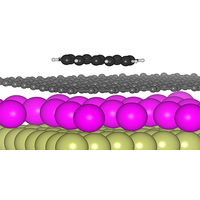
[Phys. Rev. Lett. 115, 236101] Published Tue Dec 01, 2015
26 Nov 13:57
by Yong Chan Jeong, Sang Yong Song, Youngjae Kim, Youngtek Oh, Joongoo Kang and Jungpil Seo

The Journal of Physical Chemistry C
DOI: 10.1021/acs.jpcc.5b05908

12 Nov 12:48
by Jian-Qiang Zhong, Zhunzhun Wang, Jia Lin Zhang, Christopher A. Wright, Kaidi Yuan, Chengding Gu, Anton Tadich, Dongchen Qi, He Xing Li, Min Lai, Kai Wu, Guo Qin Xu, Wenping Hu, Zhenyu Li and Wei Chen

Nano Letters
DOI: 10.1021/acs.nanolett.5b03520


