So it turns out that when people across the Seattle region plan ahead and change their transportation habits, we can prove to ourselves that we don’t need SR 99 to go through downtown after all. After months of news stories about how terrible traffic would be once the Viaduct closed for good, traffic during the first couple commutes was not much worse than it was before.
We should be celebrating this accomplishment, because people all across the region had to work together to make this happen. It is empowering to know that we don’t need a new car tunnel or a nine-lane waterfront road, that we can change our habits to reduce our dependence on cars and burning oil. Cars are a major cause of preventable death and serious injury in our region, and transportation is our biggest source of greenhouse gasses. But it’s so easy to feel defeated because reducing driving just seems like an impossible lift.
These demonstrations are important because we have far too little faith in our collective ability to change, and that’s holding us back from addressing the massive challenges ahead of us. This pessimism led state Democrats to invest billions in a too-good-to-be-true car tunnel solution to the Alaskan Way Viaduct rather than investing in non-driving methods to move people and goods through the region. The same pessimism led Seattle voters to back that tunnel (well, the lack of a cohesive vision for an alternative didn’t help). A lot of people who care about addressing climate change still supported the tunnel because they just couldn’t imagine that our region could survive without two north-south freeways through downtown.
Worse, leaders were so pessimistic about our ability to change that they allowed the Viaduct to remain in heavy use for 18 years knowing full well that it would collapse in an earthquake. We got lucky, but that was not a gamble worth taking.
So it’s not just important that traffic wasn’t so bad Monday and Tuesday, it’s important that the people of our region take time to recognize and celebrate what this accomplishment represents.
And this is not the first time we’ve done this. In fact, Seattle has proven this point several times before during extended Viaduct closures. The problem is that as time goes on, people tend to slip back into old driving habits, especially if the method they chose to replace their car trip proved not all that great. So if the past repeats itself, you should expect traffic to creep up over the next week or so.
But it didn’t need to be this way. Imagine how different things would be if we had fully invested in transit and a connected bike network rather than digging a massive car tunnel. Today, as people look for ways to avoid driving their typical SR 99 routes, they could have had light rail to West Seattle and Ballard, more express bus routes to more neighborhoods across the region and bike lanes to and through downtown that are separated from car traffic most or all the way. Basically, people across the region could have had so many more tools to work with when piecing together a new way to get around.
Instead, we chose the car tunnel. And we’re about to make another point cities across the world have proven many times before: Traffic will still suck once the tunnel opens. Because you can’t just bury car dependency in the ground. You need to rise above it with modes that actually fit in densely-packed areas: Transit, biking and walking. You also need to build affordable housing oriented around transit access rather than highways so lower-income folks aren’t simply pushed into the places with the worst traffic to bear the burden of dysfunctional car-oriented planning.
We don’t have a time machine to go back and change the tunnel decision. But we can learn from it and from this week’s demonstration that people can change their driving habits. The next generation of leadership in our city and state need to have faith in the people they represent and should ditch the pessimism of previous leaders. There are a lot of great land use and housing bills hitting desks in Olympia right now, and they could be a very good start. Seattle’s City Council is debating big city rezone plans right now, and they have a chance to believe in the people and push for the boldest options to create the most housing that is affordable for everyone. This is no time to water things down to appease people afraid of change. We know we can change when we need to.
Last year, Mayor Jenny Durkan and SDOT snoozed on a lot of opportunities to make sure bus and bike lanes were all connected and in place before the SR 99 shutdown began. But they can still take action this year to catch up. People this week have shown their eagerness for biking, walking and transit options to get around. Now it is on the mayor to deliver. She can’t go back and change major past decisions to invest in the tunnel or build light rail to West Seattle and Ballard more quickly, but she can paint key sections of the Basic Bike Network to help folks get from SE Seattle to downtown or from the Elliott Bay Trail to Pier 66 or from the Westlake Bikeway to 2nd Ave, to name a couple examples. And she can paint more bus lanes to make sure transit can get around major traffic pinch points.
The need for these improvements won’t go away when the tunnel opens. The shift away from driving is a longterm need for our region and the world. The supposed downsides to building better biking, walking and transit infrastructure is all in our heads. If we don’t need the Alaskan Way Viaduct flying cars over downtown, surely we can also get by without a lane here and some parking spots there.
When a driver hits a pedestrian or cyclist, a handful of media tropes shift blame to the victims and leave readers with the impression that nothing can be done about it.
A new analysis of 200 articles covering bike and pedestrian deaths in a two-month period last year [PDF] reveals that the media “consistently” faults the dead rather than the survivor, who is often the only witness with whom cops speak.
“Through grammatical choices and by selectively including some bits of information but not others, local news coverage subtly, but consistently, blames vulnerable road users for crashes,” lead author Kelcie Ralph, an assistant professor at Rutgers, wrote in the summary paper, which was presented at the Transportation Research Board annual conference this week in Washington, D.C.
Here are a few of the problems she and her research team identified:
#1. Lack of agency for drivers
The language used by journalists verbally absolved the drivers. Of the sentences analyzed, only 65 percent named an “agent” responsible for hitting the pedestrian or cyclist. In 35 percent of the cases, the wording implied the crash “just happened.”
Even when an agent was described as inflicting a blow, it was the car — not the driver — that was singled out in 81 percent of those cases.
#2. Focusing on the victim’s actions
The behavior of the victim, not the driver, was typically the reporter’s focus. Of the sentences analyzed, 73 percent focused on the pedestrian or cyclist’s behavior, while just 11 percent focused on the driver’s behavior and another 13 percent on the vehicle.
The typical article would state, “One of the riders was hit by a vehicle that was turning left.” Instead of, “A vehicle that was turning left hit one of the riders.”
#3. Offering “counterfactuals”
The report referred to bits of information we would probably call “victim-blaming” as “counterfactuals.”
“These statements imply that the [vulnerable road user] would not have been hit if they had acted differently, for example stating that the victim was wearing dark clothing or crossing outside a crosswalk,” the authors write.
Just under half of the articles —48 percent — had at least one counterfactual. These statements “shift blame toward the victim,” the research team wrote.
#4. Treating the incident as isolated, rather than systemic
Very few of the articles analyzed connected the incident to relevant wider issues. For example, only 8 percent of the articles mentioned other crashes in the area and only 7 percent mentioned any road design features that might have influenced the crash.
The authors instead recommend journalists use a “public health framing” to cover bike and pedestrian crashes.
“Linking each instance to the epidemic of (vulnerable road user) deaths will help bring about meaningful solutions,” they wrote.
#5. Not consulting experts
None of the 200 articles included comments from planners, engineers, or road safety experts. These are the kind of people who could help connect the crashes to wider concerns, like unsafe road design.
#6. Using the term “accident”
Finally, despite the Associated Press advising journalists to avoid the term “accident,” it was still the favored term in the articles, appearing in 47 percent of cases. “Crash” was the second most-used term; it appeared in 45 percent of the articles.
“Referring to a crash as an ‘accident’ obscures the preventable nature of collisions and is no longer recommended,” the team wrote.
Ralph’s study was just the latest in a rash of academic research pointing out flaws in the way reports cover pedestrian and cycling deaths.
We’d like to extend a slightly belated congratulations to Mats Järlström, whom you may know as the engineer in Oregon who was fined for identifying himself as an engineer.
We first wrote about this story, which Strong Towns founder and president Chuck Marohn called “an embarrassing mess,” in 2017. To recap: Järlström, a resident of Beaverton, OR, who has a degree in electrical engineering from Sweden and decades of experience as an engineer—albeit not a civil engineer—became interested in his city’s yellow-light timing after his wife received an automated ticket in 2013 for supposedly running a red light. He began studying the underlying math, and concluded that the timing formula didn’t adequately account for drivers who were making a right turn instead of proceeding straight. This potentially created a safety hazard. Over the ensuing couple of years, Järlström proposed a modified formula, corresponded with the original formula’s creator and the Institute of Transportation Engineers (ITE) about his findings, and began to speak publicly about the issue.
This drew the ire of Oregon’s State Board of Examiners for Engineering and Land Surveying, which decided to fine Järlström $500 for calling himself an “engineer” despite not holding a Professional Engineer (PE) registration in the state of Oregon. Järlström challenged the fine in court and won a temporary injunction.
Photo via Mats Järlström and Institute for Justice
The federal court entered a permanent injunction against the state engineering board, citing a “history of overzealous enforcement actions.” Järlström is now free to speak about traffic-light timing and to present his findings, and so is any other private citizen who wishes to do likewise. The court also invalidated Oregon’s restriction on the use of the title “engineer” by those not licensed as PEs as a violation of the First Amendment.
What’s the Purpose of Licensing?
It’s one thing to require only licensed engineers to work on a public project where there is a safety concern. This is common sense: I want to know before I drive on a bridge that the designer of the bridge had the relevant expertise, in the same way I want my doctor to have a medical license. (As an urban planner and writer who is not an engineer, I would strongly urge you, dear reader, to stay off any bridge I design over anything bigger than a puddle.)
It’s another thing entirely to go after non-licensed engineers for simply saying “I am an engineer” and expressing an opinion on an engineering matter. Most people with engineering expertise and advanced degrees do not have a PE license, simply because it’s not necessary for their specialty or line of work. That doesn’t mean they’re unqualified to speak.
Of course, the sort of credential-based gatekeeping on display in Oregon’s censure of Järlström serves a completely different purpose. By creating an additional barrier to the practice of engineering—even informal, unpaid advocacy, with no safety risks to consider—the licensing requirement inflates the prestige and importance of the professional credential in Oregon, to the ostensible benefit of those who hold it.
But what about when mistakes or groupthink go unchallenged for years because of this sort of bunker mentality within professional organizations? Whose interests are served then? Not the public’s.
The Bigger Picture: Who is an Expert on What?
The implications of this issue are bigger than just Järlström’s case, and bigger than this lawsuit. The story got our attention especially in the first place because Strong Towns’s own founder and president, Chuck Marohn, has himself been the target of an threat against his engineering license.
In 2015, an opponent of Chuck’s views on the subject of infrastructure spending filed a complaint against his PE license in the state of Minnesota, accusing him of “misconduct on the website/blog Strong Towns” for things he had written critical of the engineering profession, and specifically of professional organizations like the American Society of Civil Engineers (ASCE). Chuck wrote about this incident here, in the essay, “Can You Be an Engineer and Speak Out for Reform?”
We received outspoken support at that time from multiple corners, including the Union of Concerned Scientists. The complaint was soon closed with a finding of “no violation.” But the intent of the complaint was clear: to intimidate and silence Strong Towns.
The offending statements on this blog were not about the technical details of roadway or bridge or pipe design. They were not any sort of libel against the competence of licensed engineers to determine those details. Rather, Chuck Marohn and Strong Towns have consistently been critical of the engineering profession for things that are, fundamentally, political choices and questions of priorities and values. For whom should infrastructure be safe and “forgiving”? Whose safety and comfort can be sacrificed for the sake of traffic flow and speed? How much public money should be dedicated to infrastructure and how should that spending be prioritized?
In no way are these even questions about which you have to be an engineer at all to have something of value to say. These are fundamental questions about what kind of world we want to build for ourselves. They’re questions that answer to many different forms of expertise, including that of engineers—who are the best-positioned to tell us some things about those questions: what it will cost to build and maintain a certain type of world, and what kind of risks will be statistically inevitable consequences of the way we choose to build.
Aggressive gatekeeping in the engineering profession doesn’t serve the public. It doesn’t promote robust debate, either about big-picture policy questions, or about the details that affect our lives every day—like whether a traffic signal is actually timed appropriately.
Järlström’s victory is not just a victory for free speech; it’s a victory for engineering.
Pedestrians won’t get “Walk” signals at thousands of intersections thanks to a decision by a powerful group of engineers in Washington on Thursday.
The National Committee on Uniform Traffic Control Devices — which establishes rules for road signs, signals and markings — opted to not require the “signal heads” for pedestrians — signs that display the “walk” or “don’t walk” signal — at every intersection, despite pressure from an insurgent group of progressive engineers.
“Engineers may continue to not install pedestrian signal heads … this is our transportation profession,” engineering consultant Bill Schultheiss, one of the insurgents, tweeted after the ruling.
And in the end, the @ncutcd decided against changing the #MUTCD. Vote gets majority, but fails to get 2/3 majority to pass.
Engineers may continue to not install pedestrian signal heads….this our transportation profession. #Ethicshttps://t.co/8fc3QDkvRJ
Some of the engineers on the committee were worried about the cost, Schultheiss said, which range from $5,000 to $50,000, if the rule change made transportation agencies feel they needed to install crosswalks, sidewalks and curb ramps as well. In some cases, the signal heads may have required a little bit of utility work as well.
Opponents said they were concerned about requiring those things in rural areas where there weren’t many pedestrians.
As we recently reported, based on research in suburban Rockford, Ill., intersections in rural and suburban areas need more protection. And even a few pedestrians per day adds up to repeated exposure that results in needlessly lost lives.
Of course when we discuss cost of infrastructure we are making policy decisions and value judgments regarding who is important and who’s life has value.
Our design decisions are *social engineering* the behavior of society https://t.co/0UKUDLypvW
The NCUTCD’s decision comes at a time when pedestrian deaths are on the rise. About 6,000 people were killed while walking last year, a nearly 50-percent increase over the last five years.
“The committee not passing requirement to provide pedestrian signal when installing new traffic signal is very disappointing,” Dongho Chang, Seattle’s lead traffic engineer and one of the engineers who pushed for the change, told Streetsblog in an email. “We’ll continue to work with members that have concerns to change their perspectives.”
If the changes would have been approved they would have become part of the Manual on Uniform Traffic Control Devices, which is used as a guideline on every road project in America. NCUTCD said it is not sure when the next edition of the manual will be published.
At 10pm tonight, the main segment of the viaduct closes forever. The Battery Street Tunnel (and the corresponding Western Ave. ramps) will remain open for another 3 weeks. It’s part civic eyesore, part scenic drive, and part important piece of transit infrastructure. Seattle will never be the same.
The SR99 tunnel is not a replacement on any of those counts, but we won’t even get that for three weeks. In the meantime, the car capacity of downtown plummets. Thanks to a lack of leadership for several years at many levels, transit will also suffer just as we ask it to do more in this entirely foreseeable ordeal.
The general advice is to stay away, but most transit service will continue to operate. Several new options may also help at the margins. And you still want to get around, so here’s a guide to service from least to most hosed.
Biking is unlikely to get slower, although the City’s uneven interest in your safety remains. Generalized gridlock reduces unsafe auto speeds and will therefore make many bike rides more pleasant. There are some minor adjustments to bike paths around the viaduct.
Sound Transitrail is mostly immune to congestion. Link crowding will be a problem, as the agency bought barely enough railcars to handle a normal rushhour. There will be one additional train in reserve to relieve crowding. If station access usually keeps you off the train, in effect your transit fare now counts towards your Uber/Lyft/ReachNow fare if traveling to or from most Link stations. Regrettably, this promotion does not extend to parking-limited Sounder service that has additional capacity.
Metro in-city routes and streectars will suffer from the expected increase in general congestion because many of the area’s key chokepoints lack dedicated bus lanes. In particular, most cars coming south on Aurora Ave. will get off at Denny and contend with core bus lines there. There will be one additional block of bus lane northbound, but E Line riders are forgiven for finding that inadequate. The taxi promotion also includes a few Metro hubs like Northgate.
Buses that use I-5 lack any sort of HOV or bus lane for significant stretches, especially north of downtown. I-5 will likely bear the brunt of diversion from SR99. WSDOT, never missing an opportunity to miss the point, is somehow temporarily removing HOV restrictions from a southbound segment between Mercer and Corson St., parts of which carries virtually all I-5 corridor buses.
However, it’s buses that use the viaduct today that, obviously, will the bear the brunt of the changes. From the West Seattle Bridge, they will travel north on 4th Ave and south on 1st Avenue through Sodo, before ending up on 3rd through downtown, as before. A temporary bus lane will speed up the exit from Spokane St. onto 4th Avenue, but trips will be slower than the old route. OneBusAway will not reflect the new routes. The reroutes start at 8pm tonight, so savor your last trip above it all today.
In response, the nation's largest public school district has sourced 400 high-paid scabs to cross the picket line, raising $3 million to pay "teachers, campus aides, special education assistants, nurses and teachers aides" sourced through at least five temp agencies.
The 400 will be joined by 2,000 non-teachers-union LAUSD employees with teaching credentials who do not currently teach (these employees may end up sympathy striking instead). 4,400 more scabs are lined up and ready to go if the strike continues.
The scabs will be paid steep premiums for crossing the picket line: for example, union K-12 substitute teachers make $190/day, while the scabs who replace them will make $227-$315/day.
The school board is also hoping that parents will cross the picket line and volunteer in schools. Parents who want to help support the teachers can join We Are Public Schools instead.
In theory, any L.A. Unified employee who is not a UTLA member is supposed to report to work during a teachers strike. But workers in some of the five other employee unions in L.A. Unified may choose not to cross the picket line.
The unions have different stances on the issue.
SEIU Local 99, which represents close to 30,000 service employees including teacher assistants, bus drivers, food service workers, gardeners and custodians, has warned members that their jobs may be at risk if they choose to strike, but is asking members at schools to let the union know if at least 80% on a given campus plan to join a sympathy strike.
“We are still assessing how many school sites will participate in sympathy strikes,” SEIU 99 spokeswoman Blanca Gallegos said in an email Thursday. “We are using the 80% threshold as a way to ensure that workers are protected through strength in numbers.”
What Anita Radini noticed under the microscope was the blue—a brilliant blue that seemed so unnatural, so out of place in the 1,000-year-old dental tartar she was gently dissolving in weak acid.
It was ultramarine, she would later learn, a pigment that a millennium ago could only have come from lapis lazuli originating in a single region of Afghanistan. This blue was once worth its weight in gold. It was used, most notably, to give the Virgin Mary’s robes their striking color in centuries of artwork. And the teeth that were embedded with this blue likely belonged to a scribe or painter of medieval manuscripts.
Who was that person? A woman, first of all. According to radiocarbon dating, she lived around 997 to 1162, and she was buried at a women’s monastery in Dalheim, Germany. And so these embedded blue particles in her teeth illuminate a forgotten history of medieval manuscripts: Not just monks made them. In the medieval ages, nuns also produced the famously laborious and beautiful books. And some of these women must have been very good, if they were using pigment as precious and rare as ultramarine.
If pigments can be preserved in tartar—the gunky yellow stuff on teeth that dental plaque hardens into—that means that fibers, metals, and other dyes could be, too. “This is genuinely a big deal,” says Mark Clarke, a technical art historian at Nova University Lisbon who was not involved in the new study. You could imagine identifying metalworkers, carpenters, and other artisans from the particles embedded in tartar, Clarke says. “It’s opening up a new avenue in archaeology.”
Radini and her co-author, Christina Warinner, did not set out to study the production of illuminated manuscripts. Radini, now at the University of York, was initially interested in starch granules in tartar as a proxy for diet, and Warinner, a microbiome researcher at the Max Planck Institute, wanted to study the DNA of ancient oral bacteria. But the blue particles were too striking to ignore.
The semiprecious rock lapis lazuli is ground up to create a pigment called ultramarine, tiny particles of which can be found in dental tartar. (Christina Warinner)
“Can you imagine the kind of cold calls we had to make in the beginning?” says Warinner. “‘Hi, I’m working with this thing on teeth, and it’s about 1,000 years old, and it has blue stuff in it. Can you help me?’ People thought we were crazy. We tried reaching out to physicists, and they were like, ‘I don’t know what you’re talking about.’ We tried reaching out to people working in art restoration, and they were like, ‘Why are you working with plaque?’” She eventually reached physicists at the University of York who helped confirm the blue did indeed come from the mineral lazurite, derived from lapis lazuli.
But art experts were still skeptical. Some dismissed the idea that a woman could have been a painter skilled enough to work with ultramarine. One suggested to Warinner that this woman came into contact with ultramarine because she was simply the cleaning lady.
Warinner eventually reached out to Alison Beach, a historian at Ohio State University who studies female scribes in 12th-century Germany. Over the past couple of decades, Beach and other scholars have cataloged the overlooked contributions of women to medieval book production. The challenge, Beach says, is that while most manuscripts with signatures are signed by men, the vast majority of manuscripts are unsigned. But a small number of surviving manuscripts are signed by women, and scholars have found correspondence between monks and nuns about book production.
Beach even came across a letter dated to the year 1168, in which a bookkeeper of a men’s monastery commissions sister “N” to produce a deluxe manuscript using luxury materials such as parchment, leather, and silk. The monastery where sister “N” lived is only 40 miles from Dalheim, where the teeth with lapis lazuli were found. Beach also identified a book using lapis lazuli that was written by a female scribe in Germany around a.d. 1200. The pigment would have traveled nearly 4,000 miles from Afghanistan to Europe via the Silk Road. All the evidence suggests that female scribes were indeed making books that used lapis lazuli pigment in the same area and around the same time this woman was alive.
An illuminated page from the Scivias, a 12th-century book written by the nun Hildegard of Bingen and painted by two anonymous artists. The blue pigment comes from lapis lazuli (Heidelberg University Library / Cod. Sal. X,16 / page 2r)
The team considered a number of alternative ways lapis lazuli could have gotten into the woman’s dental plaque. Could the particles have come from repeated kissing of an illuminated manuscript? This practice didn’t become popular until three centuries after this woman likely died. Could it have come from lapis ingested as medicine, as suggested in Greek and Islamic medical texts? There’s little evidence that prescription was followed in 12th-century Germany. The lapis lazuli particles were also especially fine, which requires a laborious grinding process. This detail in particular suggests that the stones were purposefully made into pigment.
The team concluded that two scenarios are most likely: The woman was a painter who could have ingested ultramarine paint while licking her brush to a point, or she breathed in the powder while preparing pigment for herself or someone else. You can almost begin to picture her, Beach says, sitting by herself laboring over a manuscript day after day. “For a medieval historian,” she adds, “this kind of clear material evidence of something from the life of an individual person is so extraordinary.”
Cynthia Cyrus, a professor at Vanderbilt who has also studied medieval scribes, told me that reading the paper was “the highlight of my day.” Like many monasteries, she noted, the one where this woman was buried was eventually destroyed in a medieval fire. There’s little evidence of what life was like there. But the woman’s teeth suggest that it could have been a site of highly skilled book production.
Warinner is continuing to study the particles embedded in old tartar. She and others have found everything from insect parts and the pollen of exotic ornamental flowers to opium, bits of wool, and milk proteins—all of which tell stories about what people ate and how they lived. The detritus of everyday life accumulates in the gunk that modern dentists are so vigilant about scrubbing off. “They aren’t thinking of future archaeologists,” Warinner jokes.
Ford Motors will adopt a technology that allows similarly equipped cars to communicate with each other and potentially reduce pedestrian and driver deaths, but skeptical safety experts say the system could merely create more distracted drivers and endanger the pedestrians it is designed to help.
The technology, called C-V2X, would allow vehicles to communicate with each other — or with infrastructure and even pedestrians’ cell phones. The goal is to reduce crashes by beaming signals to vehicles and passers-by. But pedestrian safety experts think it could allow drivers to simply become careless.
“You don’t want people thinking they don’t have to look for pedestrians,” said Sally Flocks, executive director of the Atlanta-based advocacy group PEDS. “I’m not opposed to the technology, I just don’t think it will solve the pedestrian safety problem.”
The biggest problem, Flocks added, is that some pedestrians don’t want to walk around with cell phones so they can be alerted to potentially reckless drivers, who are supposed to be looking out for them. Also, smartphone use is often lower in impoverished communities where a disproportionate number of crashes occur already.
Automobile manufacturers have been promising safer cars since Ralph Nader published “Unsafe at any Speed” in 1965. Cars have since become larger, but pedestrian and driver deaths are up nationwide, possibly due to a false sense of security drivers feel from larger vehicles, plus the dangerous distraction posed by cell phones.
Other experts say that better road design — which is a function of government, not America’s car makers — would benefit pedestrians more than any high-tech gizmos inside today’s cars.
“I would like to see streets that accommodate all users safely, rather than just planning for cars,” said Kate Kraft, Executive Director of the pedestrian advocacy group America Walks. “We know what to do to make roads safer, we’re just not doing it. There’s no political will for it.”
She added that technological advancements cannot be considered a stand-in for better road designs and regulations on driving such as speed control.
Whatever your opinion, Ford says the C-V2X system allows vehicles to communicate with traffic management infrastructure such as stop signs and traffic lights and pedestrians’ cell phones through wireless sensors — similar to the technology self driving cars will use. Cars equipped with C-V2X will only be able to communicate with cars that have the same technology however, and any communication between cars and pedestrians relies on pedestrians to have previously downloaded V2X software onto their phones — and then to have the phones on hand when they are walking. Ford says it will start equipping cars with the technology in 2022.
The C-V2X system is similar to the vehicle communication system DSRC championed by Toyota, which uses WiFi technology. C-V2X uses much of the same technology as DSRC, but the two systems are unable to communicate with each other. Leading automakers are leaning towards adopting C-V2X, according to Forbes, a possible first step towards a single, unifying industry standard.
My wife just finished the book Left Neglected and thought the premise was unique enough to tell me about it twice. The main character suffers from a condition called “left neglect” where, because of a neurological injury, they are unable to perceive that there is a left. It’s not that they can’t hear or feel things from the left, but that they do not involuntarily recognize that there is even such a thing as left.
She gave me some examples from the book—people would be speaking and the person with left neglect couldn’t figure out where they were, even though they were standing right there on their left. And as she told me this, it was hard for me not to, metaphorically speaking, draw some parallels to some of my colleagues in the engineering profession. Except instead of left neglect, I’d call it human neglect.
You can tell an engineer that people are there. They can even take steps to acknowledge the presence of humans when prompted. But none of it is intuitive. And the results show it.
I’m going to focus on one today because I keep getting routine updates from a video I posted years ago on the Diverging Diamond Interchange (DDI). The video keeps getting passed around engineering circles as a joke, as a way to laugh at Strong Towns and discredit me. These are nearly always behind a paywall (although the sympathetic sometimes send me excerpts), but these conversations often lead to an increase in comments on the YouTube page.
For example, this was posted last week by someone identifying themselves as Luke Popez:
Seven years later....YOU WERE WRONG. About all of it. Diverging diamond has reduced fatalities by 60%.
Here’s a another in that same period from someone identified as Callie Masters:
This guy wants a highway intersection to be as friendly as a teddy bear's picnic spot. Keep your nervous kids at home! We're trying to drive fast here!!
And from James Lemay:
Turns out you were totally wrong about everything.
I was wrong about everything, the diverging diamond is safer than what it replaced, people want to drive fast so stop being such a ninny. These are very interesting assertions, especially since they respond to a contention that I never made. And THAT is the problem.
So many traffic engineers suffer from human-neglect, an inability to perceive humans in their designs. Even when forced to accommodate pedestrians— their pet term for humans—they still don’t intuitively perceive them.
My diverging diamond video was responding to an engineer who had recorded a video to show off the pedestrian-friendly design of the diverging diamond. That engineer asserted throughout the video that the DDI was pedestrian-friendly. To make his case, he noted the Jersey barrier, raised domes for the vision-impaired, decorative brick, push button crossings, and the beautiful view of the interstate, among other features.
This was then, and remains today, totally ludicrous. My video points this out. The DDI design is quintessential checklist engineering: an approach that goes through the motions of meeting each requirement for pedestrian access, but—due to human-neglect—is despotic for people outside of a motor vehicle.
My highest aspiration in making this video was that my fellow engineers would start to recognize the difference between a checklist approach and an actual design that considers humans. (I’ll admit I had some lower aspirations as well.) Not only has that not happened, but these continued responses just demonstrate the widespread human-neglect the profession suffers from.
Engineer: The DDI is pedestrian friendly.
Me: No, it’s actually despotic for humans that are not in a vehicle.
Engineer: You’re wrong. It increases traffic flow and there are fewer crashes per through movement.
This is silly, and it’s inane and unbecoming to suggest that I’m somehow wrong on this because it meets engineering metrics. Of course it does. I’ve never suggested it didn’t. In fact, let me state this clearly in the hopes that it will help some of you traffic engineers:
The DDI is a brilliant design if your goal is to improve traffic flow without increasing the width of the interchange. It will handle more vehicles-per-hour, especially during peak times, and it will do so with improvements to traffic safety. It can also be engineered to accommodate pedestrians in ways that are safer than non-DDI interchanges.
All of this is true, and I’ve never argued that it wasn’t. Here’s what else is true: the DDI is not pedestrian-friendly. Not in the least.
Pedestrian: a person walking along a road or in a developed area
Friendly: kind and pleasant
Jersey barriers, reflective markings, and decorative brick do not magically transform something so despotic into something kind and pleasant. They might make it slightly less despotic—and that’s arguable—but they do not make it friendly. If you want to argue with me on the DDI, if you want to laugh at me and claim I’m wrong, stop creating straw men to beat up, and instead make an argument as to why this interchange is kind and pleasant to someone on foot.
The sad thing is, I don’t think most of these engineers can, not because they are wrong—and they ARE wrong—but because they suffer from human-neglect. This affliction makes them incapable of even knowing they are wrong because they are not perceiving humans beyond the checklists they have created for themselves.
And these are the same people, with the same affliction, who are designing the stroads through our neighborhoods as well. We all deserve better.
Robert Crosland, the Preston Junior High School teacher, smiled as the verdict was read and afterward spoke publicly for the first time since the March ordeal.
“I would just like to thank all of the support that I’ve received,” he said. “I’d like to thank this community for staying behind me. It’s really what got me through all of this.”
Shane Reichert, an attorney representing Crosland, explained that what matters is not what people think about animals but what the law defines: "Regardless of whether it's a puppy, an elk, a deer, a coyote, a mouse or a rat, it doesn't matter in the eyes of the law. There is no distinction in the law between them and ... domestical animals."
Thanking the jury, Reichert air quoted the word "puppy" to emphasize how meaningless it is in legal terms to distinguish them from the live vermin usually fed to reptiles.
Here's the video, which, be warned, shows the cop shooting a tiny, obviously harmless dog. The dog survived.
"An internal investigation conducted by the Faulkner County Sheriff’s Office found Wallace’s actions did not violate any policies or laws," of course, but they changed their minds and fired him after the media found out.
Wallace was a K9 officer.
Seeing these two stories back to back reminded me that the worst thing about the age of Trump is that it makes a virtue of cruelty. Casual cruelty, considered cruelty, cruelty from top to bottom. Flashes of cruelty where the cruelty is why, with no justification made beyond whatever impassive, contemptuous explanation of legality or policy gets it off the hook. Cruelty thrives at the margins — children, women, minorities, foreigners, animals — and now it goes without shame. The effect of the cameras and the internet is not to restrain cruelty but to free it and make clear the absense of consequences. When retaliation comes, it will be cruel.
Kudos to outlets like Kotaku and Comicbook.com for their straightforward reports on the hounding pro Overwatch player Ellie received, but Jesus Christ, people, aren’t you as exhausted by this as I am?
At the end of December, “Ellie” was announced as a new member of Second Wind, a team in Overwatch‘s official Contenders minor league. And lo, the toxic Internet of folks with far too much sexism on their hands kicked into immediate gear. As Kotaku explains:
[…] on Twitter, Reddit, and YouTube spun to life with a fury. “Who is Ellie?” many fans asked, with some pointing to her relatively low account level and sudden appearance on Overwatch’s ranked ladder as being grounds for suspicion. Some speculated that she was a longtime player who’d switched over to a smurf account in order to maintain privacy, an idea that dovetailed with her apparent decision to not give out her legal name. In contrast, every other player on a Contenders roster has their full name listed alongside their gaming handle on the official Overwatch Contenders website.
Ask yourself if any of this would have happened if Ellie had emerged with the moniker “Elio.”
Ellie did her best to counter the people who devoted their limited life energy to questioning her existence because something something girls and video games. Surely this pro lady gamer must actually be … a man.
Some fans believed the mystery about Ellie’s name called her entire identity into question, including her gender. Ellie is one of very few women in Blizzard’s Overwatch Contenders league, and some fans speculated that she could be any number of notable male players impersonating a woman. In answer to these rumors, Ellie played Overwatch on stream and even brought on one player she was suspected of being, a top-500 player named Punisher, to prove that they were different people.
It’s not enough to stream and be present with the player who’s imagined to be impersonating you because a GIRL PLAYING VIDEO GAMES, PRO? WHEN I, A GREAT THINKING MIND ON REDDIT, AM NOT MYSELF A PRO? A FEMALE? This would never happen on Ferenginar!
Ellie’s efforts weren’t enough, of course. They’re never enough.
A handful of other Overwatch pros even got involved, with Atlanta Reign player Daniel “Dafran” Francesca speculating during a stream that “someone is playing on this account, and Ellie is talking right beside them.”
Listen, “Dafran”—I know this might blow your mind, but not everyone has so much investment in the video game Overwatch that they’re out to pull off a gender long con for reasons unknown. How, exactly, does this alleged hoax even benefit a “fake” Ellie? Some guy cooks up an elaborate scheme to go pro in a minor league as a woman, because that is obviously so well-received and full of perks, when they are in fact secretly not a woman. This guy is apparently a glutton for harassment and doxx threats? He dreams about having his every move questioned and his safety compromised for the entirety of his gaming career? Weird kink but cool story, Danny.
Let’s take your theory one step further. To drive home the idea that the man playing as a lady is, in fact, a lady, with all those rewards and accolades that come from being one in gaming circles, they draft a “real” female to serve as their voice? That seems like some spectacular coordination, as well as the incredible fete of finding a woman who wants to sit next to you, a man, playing Overwatch pro as they, a female, also know exactly what to say about gameplay in real-time. Seems totally legit and plausible and like a thing that people might do with their free time.
Or maybe, just maybe, we should apply Occam’s razor and conclude that the explanation that requires the least amount of speculation is likely correct here. Explanation one: woman is good at video game, goes pro, does not reveal legal name due to decades of harassment suffered by women in gaming. Explanation two: man masquerades as woman going pro for unknown reasons, finds actual woman to voice “him” on stream, apparently hopes to be doxxed and threatened for his efforts, then quits the whole thing when the inevitable comes about.
Ellie, meanwhile, tweeted out screenshots of what appear to be Discord chat logs of a high-ranked (and banned) Overwatch player named Haunt arguing in favor of doxxing her, “just to figure shit out.”
I mean, why on Earth would Ellie have wanted to keep her real name obscured in the first place? Can you even imagine what might have possibly motivated her, “Haunt”?
Eventually, Ellie did what all of this harassment and hounding was designed to have her do: she left Second Wind.
Second Wind’s owner Justin Hughes later elaborated on Ellie’s departure:
“When we brought her onto the team, people acted like we had brought on a symbol of empowerment,” Hughes wrote. “I get that people meant well, but on one side, we had people questioning her legitimacy, issuing threats, etc. while on the other hand, we had people acting like they had found their Messiah. Between needing a player to live up to huge expectations and having to question their own safety, it seems that the OW community isn’t ready to just view a player as just a player. We wanted a player, but it seemed like the public wanted something else.”
I’m not really sure I’m digging the “both sides” justification here, Justin, though it’s worth highlighting that perhaps some people saw Ellie as a symbol of empowerment and a “Messiah” because there are so few pro female Overwatch players? I know I’m going out on a limb, but I’d say “issuing threats” is weighted more heavily here as to why Ellie quit than being seen as a symbol of empowerment.
There are several terrible elements in play, the first being that Ellie felt threatened and had to abandon what must have been an exciting opportunity in her life, the second being that the baying Internet hordes won this round. But an even worse resounding impact from how the Ellie situation played out is that female players may be even more hesitant to go pro, and pro teams may be even more hesitant to bring on female players.
Ultimately, as Kotaku points out, “Esports is not a meritocracy; it’s a male-dominated scene in which gender essentialism runs rampant, and in which women are often made to feel unwelcome.” How sad is it that we’re still here, even with a game like Overwatch? Overwatch is the most gender-diverse first-person shooter in the world; around five million women play the game.
Yet it’s beyond belief that Ellie, one woman out of five million women, might be good enough for the pros? That’s the thing: it isn’t. People putting forward preposterous conspiracies about Ellie being a man have to know they’re spewing bullshit; there’s obviously no gain in that scenario. They question her, and threaten her, because she’s better than millions of other men who weren’t offered a spot in Blizzard’s Contenders. And those who are already pro question her because A GIRL CLIMBED THE LADDER TO OUR TREEHOUSE FORT? Girls are notoriously poor at navigating ladders! A female is as good as I am? What next, will they be wanting to wear clothes?
Seeing headlines about what happened with Ellie don’t even induce outrage in me, just exhaustion and disgust. I’ve lived too long on the Internet. The situation isn’t surprising or shocking in the slightest, and that should be the outrage.
In yet another partial court defeat, the Ballard Missing Link of the Burke-Gilman Trail has once again been thrown into question this week after King County Superior Court Judge Samuel Chung sided with the city on two out of three of the major challenges to its environmental megastudy of the trail route. But that isn’t enough.
We are still trying to learn what exactly this means for the project, which is currently scheduled to begin construction early next year. So stay tuned. UPDATE: The City Attorney’s Office told the Seattle Times they disagree with the decision and plan to appeal it.
Previous court decisions required the city to conduct a massive environmental impact statement (“EIS”), the kind of study typically required of megaprojects on a much larger scale than a short stretch of biking and walking trail. The 829-page study took years to complete at significant cost. It’s safe to say that this is the most-studied section of trail in state history. Maybe in the nation?
Because the city conducted the EIS, trail opponents’ only legal path was to argue that the city’s study, which the Seattle Hearing Examiner approved, was legally inadequate. This should have been a pretty tough bar to clear, but they did it. Appellant attorney Josh Brower continues to surprise with his ability to win just enough to block or delay this project. This is the second time he has won small pieces of his cases against the trail in King County Superior Court.
On questions of safety and parking, the judge found the study adequate. So that’s the good news. But on the question of economic impact, the judge found the study inadequate. Specifically, the judge “identified the potential for increased costs of insurance” as the basis for the ruling, according to a Cascade Bicycle Club statement. Cascade has been involved in the legal fight for many years, intervening on the city’s behalf.
“We believe this can be resolved and that the City can move forward with getting construction back on track,” the statement says.
The question of increased insurance costs has been floated for many years as a reason to block the trail. It’s always been a somewhat baffling argument because the trail is safety project designed to provide folks biking and walking with a separated and protected space to do so. It also feels strange that the whims of a private insurance company could decide whether the city can build a trail on public right of way. But here we are. It has been an argument against the trail for so long that it is discouraging that the city did not address it well enough in its massive study to satisfy the court.
The case is moving to King County Superior Court Judge Roger Rogoff starting in January.
I have a question into the city about what it would take to satisfy the judge’s concern and what the timeline for that could be. I will update when I hear back.
In the meantime, here’s the full statement from Cascade:
While the members, leadership and staff of Cascade Bicycle Club are disappointed in the overall outcome of the ruling today in King County Superior Court, it is clear that Judge Samuel Chung agreed that the bulk of the Missing Link Environmental Impact Statement (EIS) was sufficient. Specifically, he ruled that the EIS was sufficient in the areas of traffic analysis and safety as well as the review of any loss of parking. Conversely, Judge Chung identified the analysis of economic impacts—specifically the potential for increased costs of insurance—as the single basis for ruling the EIS deficient. We believe this can be resolved and that the City can move forward with getting construction back on track.
“Unfortunately the real cost of this obstruction campaign is borne by the over 300 people a year who suffer injuries on the Missing Link,” says Richard Smith, Executive Director of Cascade Bicycle Club. “For over 20 years, a few deep-pocketed individuals have delayed while the community of Ballard has waited for their preferred route.”
Since the Environmental Impact Statement was completed in 2013, thousands of residents and businesses have weighed in on the EIS and subsequent design process saying they want to ‘Complete the Missing Link!’ During the EIS comment process alone, 77 percent of the 4,500 respondents indicated a preference to locate along the preferred alternative, which runs along NW 45th St., Shilshole Ave. NW and NW Market St.
A new report on global traffic deaths illustrates exactly why the U.S. trails the developed world on traffic safety: we drive too much and our laws are too permissive of deadly behavior.
The global report from the World Health Organization — which reviewed laws and crashes in 175 nations — explains that U.S.’s traffic fatality rate is 12.4 deaths per 100,000 — or about 50 percent higher than similar nations in Western Europe, plus Canada, Australia and Japan.
About 1.3 million people are being killed globally by traffic crashes every year, a huge proportion of them pedestrians. Traffic deaths are now the leading cause of death globally for those between the ages of 5 and 29.
Previous studies have revealed how much more driving Americans do, with roughly 8,800 kilometers per capita, versus 4,300 in Canada, 7,000 in Germany and less than 1,700 in Japan.
But the World Health Organization’s international comparisons show the United State’s safety policies are seriously out of line with the rest of the developed world. Here’s a look:
Bad seat belt laws
U.S. law does not require seatbelt use in the back seat, unlike the overwhelming majority of the world. Seat belts decrease injury and death risk by 50 percent in the front seat and 25 percent in the back seat, according to the U.N. health organization.
The U.S.’s seat-belt-wearing rate has improved to 90 percent. But peer nations are doing better. In Canada, the seat belt wearing rate is 95 percent. That means our non-compliance rate is double that of Canada.
Drunk driving laws
Our drunk driving laws are also too lenient compared to peer nations and compared to WHO recommendations. Many studies have shown that driving is impaired at lower blood alcohol concentration levels than 0.08. WHO recommends enforcing drunk driving laws at a low 0.05 BAC, like most of Western Europe, plus Canada, Australia, Brazil and China.
Canada, for example, also imposes stricter penalties on drivers caught violating the law. Some of the countries, like Sweden, with the best traffic safety records, control alcohol sales strictly.
Car standards
The U.S. also lags world leaders in vehicle safety, falling short of the standards established by United Nations. We have reported extensively, for example, about how the U.S (under Trump) has resisted adding safety features to vehicles that would help protect pedestrians in crashes, even as their fatality rates soar.
Speed demons
Finally, the U.S. fails to control driver speed as well as other nations. For speed control laws to work even moderately well, the WHO says urban street speeds must be strictly limited to about 31 miles per hour. In the U.S., localities often can’t adjust their speed limits but need state-level permission, another red flag for WHO. Worse, many localities don’t even start handing out tickets until drivers exceed the posted speed limit by more than 10 mph.
Canada, Western Europe, Australia, even China and Mexico have stricter controls on speeding than we do. Some safety officials in the U.S. like the National Transportation Safety Board have sounded the alarm that lack of progress on speeding is a major factor in the U.S.’s deteriorating traffic safety record. In recent years, we’ve actually gone backward with 30 states raising speed limits on highways to 70 mph since 1995, often with deadly results.
The WHO’s 2018 Global Status of Road Safety report highlights other safety failures as well. Our motorcycle helmet laws are worse than Russia and India. Our child restraint laws, which only apply to children until age 4, are more lenient than the WHO recommends and worse than all of Western Europe.
The findings comport with what Canadian traffic safety expert Neil Arason told Streetsblog about why Canada’s traffic safety record is so much better than the U.S. Our laws are just too lenient — we value “freedom” over safety (people’s lives) — and we don’t have enough alternatives to driving, like high-quality urban transit.
For a fight that was ultimately over what counts as a “safe street,” things got weird. The Baltimore Fire Department released a somewhat baffling nine-minute documentary that tried and failed to suggest how bike lanes would get in their way (“I’m glad I saw the video because it showed me those trucks can get to those fires,” council president Bernard C. “Jack” Young told the Baltimore Sun). The video also seemed to vaguely threaten the leader of the city’s bike advocacy organization. A public hearing in July ended with a near-brawl featuring a white firefighter grabbing the neck of a black city planner. (The firefighter was later charged with assault.)
Now, a new report by the Volpe Center at the U.S. DOT on behalf of the National Association of City Transportation Officials suggests that there’s a more peaceful solution for Baltimore, and indeed any American city trying to balance emergency access and safe bicycle infrastructure: Just make the fire trucks smaller.
And not just firefighting equipment, but lots of heavy-duty vehicles, including garbage trucks and commercial freight trucks. These machines make up just 4 percent of all vehicles of American roads, but are disproportionately involved in deadly collisions: specifically, 7 percent of pedestrian fatalities and 11 percent of bike fatalities. Last year, even as traffic deaths dipped slightly overall, the number of fatal incidents involving big trucks rose by 9 percent.
“A vehicle with smaller blind spots better allows a median-height driver to see people in a bike box or a crosswalk, especially children,” the report states. “For the 50% of drivers who are below median height, the blind spots are actually larger than shown.” (Volpe Center/NACTO)
There’s a connection between those numbers and vehicle size, the report explains. Gigantic cabs reduce driver visibility, blotting out people and objects right along the vehicle and delaying reaction times to coming collisions. Larger vehicles are also heavier, have longer braking distances, and hit people and other vehicles with more destructive force. Designing urban streets with the biggest vehicles in mind—with wide lanes, high speed limits, and few protections for pedestrians or cyclists—reinforces a transportation paradigm that’s unsafe for the least-armored users.
Passenger vehicles are no exception. A recent Detroit Free Press investigation showed how the expanding footprint of SUVs and pickup trucks is driving up traffic fatality rates.
San Francisco’s new Ferrara Apparatus fire engines boast improved maneuverability over standard vehicles. (Volpe Center/NACTO)
Smaller, nimbler trucks with a few key design tweaks could make a dent in those numbers, the report states. Focusing on heavy-duty emergency response vehicles, it highlights the example of San Francisco’s fire department, which recently purchased a set of new fire engines that are eight feet shorter than the standard 33-foot length, have a 25 percent smaller turn radius, and boast an equally robust fire-fighting capacity as any standard shiny red pumper.
Up front in the cab, teardrop-shaped windows or extra “peep” holes in the passenger door could dramatically reduce driver blind spots on heavy-duty vehicles. Milwaukee’s new snow plow fleet shows the potential, with county officials reporting: “With the peep window on the passenger side door, they can see what’s happening…without leaning toward the window.”
“Low-entry cabs and additional ‘peep’ windows in truck cabs let drivers see adjacent people and objects,” the report states. (Volpe Center/NACTO)
Such vehicles are in wide use in Europe and Asia, where narrower city streets have encouraged more compact designs for heavy-duty trucks. “Aerial ladder fire trucks used in major European and Asian cities can reach just as high, despite being only two-thirds as long and having only half of the turn radius as common American models,” the report states. “Some models of pumper fire trucks are up to 30 percent smaller, and have a turn radius up to 50 percent less than more typically procured models.”
Another potential safety improvement: Don’t send a truck unless you have to. In the U.S., only 3 to 5 percent of fire department calls nationally are related to building fires, according to the report. Dispatching a 80-ton fire-fighting vehicle to respond to a possible heart attack doesn’t necessarily make sense. American cities could take a page from international peers that use smaller vehicles—even motorcycles and bikes—to respond to less-urgent medical calls. (And perhaps to those poor kittens caught in trees.)
Part of the challenge is that, in the U.S., there aren’t that many small vehicles on the market that serve heavy-duty and emergency needs. But local governments could collectively agree to demand more options from manufacturers, much as a band of cities did last year to expand electric trucks and buses in their fleets. ”A critical mass of coordinating city fire departments… could likely influence the design of future fire apparatus offered in the U.S.,” the report states.
Back in Baltimore, the city council quietly approved the proposed changes to the fire code in October. But the larger political conflagration over shared streets won’t be contained anytime soon. If nothing else, this report serves as a reminder to fire departments and transportation planners alike that, despite appearances, they have a common purpose: saving lives. Smaller trucks that do the job just as well would seem to accomplish everyone’s goals.
A year ago, Techdirt wrote about the interesting economics of bike-sharing services in China. As the post noted, competition is fierce, and the profit margins slim. The real money may be coming from gathering information about where people riding these bikes go, and what they may be doing, and selling it to companies and government departments. As we warned, this was something that customers in the West might like to bear in mind as these Chinese bike-sharing startups expand abroad. And now, the privacy expert Alexander Hanff has come across exactly this problem with the Berlin service of the world's largest bike-sharing operator, Mobike:
data [from the associated Mobike smartphone app] is sent back to Mobike's servers in China, it is shared with multiple third parties (the privacy policy limits this sharing in no way whatsoever) and they are using what is effectively a social credit system to decrease your "score" if you prop the bike against a lamp post to go and buy a loaf of bread.
Detailed location data of this kind is far from innocuous. It can be mined to provide a disconcertingly complete picture of your habits and life:
through the collection and analysis of this data the Chinese Government now likely have access to your name, address (yes it will track your address based on the location data it collects), where you work, what devices you use, who your friends are (yes it will track the places you regularly stop and if they are residential it is likely they will be friends and family). They also buy data from other sources to find out more information by combining this data with the data they collect directly. They know what your routines are such as when you are likely to be out of the house either at work, shopping or engaging in social activities; and for how long.
As Hanff points out, most of this is likely to be illegal under the EU's GDPR. But Mobike's services are available around the world, including in the US. Although Mobike's practices can be challenged in the EU, elsewhere there may be little that can be done.
And if you think the surveillance made possible by bike sharing is bad, wait till you see what can be done with larger vehicles. As many people have noted, today's complex devices no longer have computers built in: they are, essentially, computers with specialized capabilities. For example, electric cars are computers with an engine and wheels. That means they are constantly producing large quantities of highly-detailed data about every aspect of the vehicle's activity. As such, the data from electric cars is a powerful tool for surveillance even deeper than that offered by bike sharing. According to a recent article from Associated Press, it is an opportunity that the authorities have been quick to seize in China:
More than 200 manufacturers, including Tesla, Volkswagen, BMW, Daimler, Ford, General Motors, Nissan, Mitsubishi and U.S.-listed electric vehicle start-up NIO, transmit position information and dozens of other data points to [Chinese] government-backed monitoring centers, The Associated Press has found. Generally, it happens without car owners' knowledge.
What both these stories reveal is how the addition of digital capabilities to everyday objects -- either indirectly through smartphone apps, as with Mobike, or directly in the case of computerized electric vehicles -- brings with it the risk of pervasive monitoring by companies and the authorities. It's part of a much larger problem of how to enjoy the benefits of amazing technology without paying an unacceptably high price in terms of sacrificing privacy.
A short film shot entirely on an iPhone has won the prestigious 2018 Turner Prize in Britain. Established in 1984, the prize is presented every year to a British visual artist, and it’s the UK’s most publicized art award.
Titled Bridgit and created by artist Charlotte Prodger over the course of a year, the film features Prodger’s narration over a series of short clips showing things such as the Scottish countryside from a train, cargo ships from a boat, and a cat playing with a lamp.
Here’s a 1m46s excerpt from the 32-minute short film:
Prodger tells The Guardian she used an iPhone “because of that ease of use and the way you can use it while you are going about the world. For me, everything is in there.”
Prodger’s film was the “most profound use of a device as prosaic as the iPhone camera that we’ve seen in art to date,” judge and Tate Britain director Alex Farquharson tells The Guardian.
Apple CEO Tim Cook was quick to celebrate Prodger’s win using his company’s device:
Congratulations to Charlotte Prodger, winner of Britain’s prestigious Turner Prize. A first for a film shot on iPhone, and another milestone in the democratization of photography and filmmaking. https://t.co/zlQbelQIPb
Federal Communications Commission Chairman Ajit Pai has admitted that around 500,000 comments submitted during the net neutrality public comment period were linked to Russian email addresses. Pai noted in a court filing that most of the comments were...
We typically divide the electoral map into red and blue states, and class is a feature, if not the key feature, in that divide. What we are witnessing is nothing less than a great inversion of America’s political geography. Dating back to FDR and the New Deal, the blue-collar working class once provided the backbone of the Democratic electorate, but today, states with larger working-class populations have swung solidly into the Republican camp. And, blue states have become those where the knowledge, professionals, and cultural workers that make up the creative class predominate.
That’s the key takeaway from an analysis of the connection between class and American politics I conducted with Patrick Adler and Charlotta Mellander. Our analysis looked at the role of class (defined as the kinds of work people do) and voting in the last three presidential elections.
We looked at the correlations between the share of workers that make up the three major classes—the blue-collar working class, the knowledge-based creative class, and the even larger service class—and state voting patterns. The table below details the top states (including Washington, D.C.) with the largest share of the three major classes.
Top Five States With the Highest Share of Workers From Each Class
Creative
Service
Working
Rank
State
Share
State
Share
State
Share
1
Washington, D.C.
59.0%
Nevada
55.8%
Wyoming
30.5%
2
Massachusetts
38.9%
Florida
52.8%
Indiana
29.3%
3
Maryland
36.7%
Hawaii
52.1%
North Dakota
29.1%
4
Connecticut
36.6%
New Mexico
50.0%
Kentucky
28.5%
5
Virginia
34.9%
Montana
49.2%
Alabama
27.5%
Then, we drilled down further examining the correlations between state-by-state voting patterns and the 22 major occupational groups, and the more than 800 individual occupations that make up these classes. As usual, I note that correlation does not mean causation, but only points to associations between variables. Still, the patterns we document suggest the powerful role of class in defining America’s political geography.
States with larger working-class populations positively correlated with voting for Republican presidents. This correlation saw a sizable jump in 2012 and increased again in 2016, but more modestly. This is the culmination of a long-running shift, first identified in the 1970s, by Republican strategist Kevin Phillip’s identification of the so-called “silent majority” of socially conservative blue-collar voters.
How Occupational Class Has Correlated With Vote in Presidential Elections
Democratic
Republican
State-Level Occupational Class
Obama 2008
Obama 2012
Clinton 2016
McCain 2008
Romney 2012
Trump 2016
Creative Class
.46
.66
.72
-.46
-.66
-.73
Working Class
-.63
-.75
-.77
.64
.75
.79
Service Class
.40
.38
.32
-.40
-.39
-.33
Creative classes correlate with voting for Democratic presidents across the three most recent presidential elections. Again, we see a big jump in 2012 and a smaller one in 2016. These correlations are similar in strength to other markers of class, like education and income. More affluent states with greater shares of college graduates skew blue, while less economically advantaged states with less-educated populations trend red. This blue, creative-class pattern is in line with John Judis and Ruy Texiera’s idea about the increasingly liberal orientation of “ideopolis” cities in which knowledge workers cluster.
But the pattern for service-class locations is more mixed. The service class is the largest class by far, composed of more than 70 million members—more than 45 percent of the workforce—whose members toil in low-wage, precarious work in retail shops, office work, and food service. States with greater shares of service-class workers lean slightly Democratic, but not nearly to the degree creative-class heavy states fall into the Democratic camp or working-class heavy states line up for the Republicans.
In the 2016 election, for example, the service class of the workforce was much more modestly correlated with Clinton support and more modestly negatively correlated with Trump support. Part of the reason is that service-class jobs are more spread out across the nation, and part of it is that service-class jobs tend to cluster alongside professional and knowledge-based jobs in larger cities and metro areas.
How Occupational Composition Correlated With Political Vote in the 2016 Presidential Election
Occupational Group
Clinton
Trump
Business & finance
.74
-.75
Arts, design, entertainment, & media
.68
-.73
Computers & math
.65
-.67
Legal occupations
.63
-.62
Management
.59
-.64
Protective service
.56
-.45
Life, physical, & social science
.45
-.54
Community & social services
.27
-.38
Architecture & engineering
.16
-.26
Education, training, & library
.14
-.20
Building & grounds cleaning
.05
-.09
Personal care & service
.05
-.11
Healthcare support
.00
.09
Food preparation & service
-.03
-.07
Farming, fishing, & forestry
-.11
.06
Office & administrative support
-.22
.23
Healthcare practitioners
-.33
.47
Sales
-.39
.45
Product occupations
-.45
.52
Construction & extraction
-.57
.45
Transportation & material moving
-.64
.71
Installation, maintenance, & repair
-.84
.83
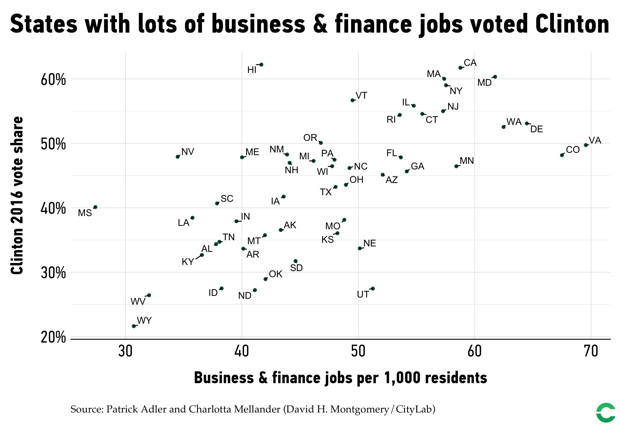
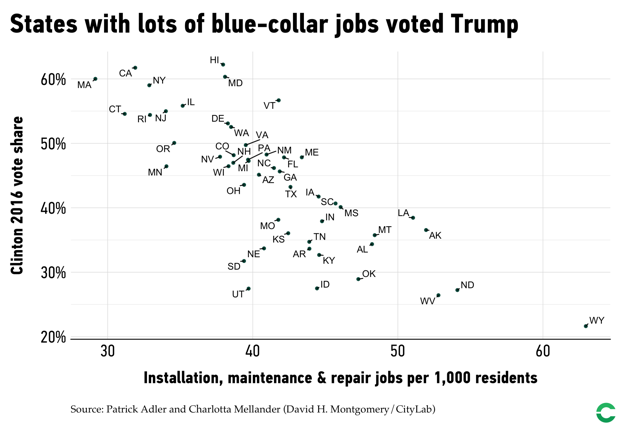
See how business and finance jobs correlated with the Clinton vote, compared to how installation, maintenance, and repair jobs correlated with the Trump vote.
America’s class-based political geography comes into sharper view when we look at the 22 major occupational groups that make up these classes. States with large shares of working-class occupations like installation; maintenance and repair; and construction and extraction are solidly red. Interestingly, the occupations which are most closely connected to blue states are among the very highest paying professions, such as business and finance, followed by arts, design, entertainment and media; and computers and math occupations.
Locations with larger shares of working-class occupations again show up solidly in the Republican party. But now a couple of interesting cross-class patterns become apparent. Two service-class occupational geographies line up more modestly in the Democratic column. States with larger shares of higher wage, more unionized occupations like protective services and community and social service occupations, and states with lower-wage, less-unionized jobs like healthcare support and personal care and service occupations, both trend blue. And there is also one creative-class geography that lines up red: doctors and healthcare practitioners. This may reflect their opposition to Obama’s healthcare reforms.
Our class-based political geography becomes even more interesting when we zero in on the more than 800 specific occupations that comprise the U.S. economy. The red state pattern is relatively straightforward. Support for Trump is highly correlated with the state-wide share of blue-collar working class occupations like welders, tractor trailer drivers, bus and truck mechanics, and so on. But Trump support is also correlated with larger shares of service class occupations like cafeteria cooks, parts salespeople, and tellers. Only a few creative-class occupations, such as radiologic technologists and occupational health and safety technicians, correlate with Trump support.
Occupations Most Correlated With Trump Votes
Occupation
Class
Correlation
Welders, Cutters, Solderers, and Brazers
Working
.74
Heavy and Tractor-Trailer Truck Drivers
Working
.71
Cooks, Institution and Cafeteria
Service
.68
Parts Salespersons
Service
.68
Bank Tellers
Service
.67
Industrial Machinery Mechanics
Working
.66
Welding, Soldering, and Brazing Machine Setters, Operators, and Tenders
Working
.64
Tire Repairers and Changers
Working
.64
Bus and Truck Mechanics and Diesel Engine Specialists
Working
.63
Water and Wastewater Treatment Plant and System Operators
Working
.60
Electrical Power-Line Installers and Repairers
Working
.59
Morticians, Undertakers, and Funeral Directors
Service
.59
First-Line Supervisors of Mechanics, Installers, and Repairers
Working
.57
Chemical Equipment Operators and Tenders
Working
.56
Surgical Technologists
Creative
.55
Maintenance Workers, Machinery
Working
.55
Electric Motor, Power Tool, and Related Repairers
Working
.55
Radiologic Technologists
Creative
.54
Occupational Health and Safety Technicians
Creative
.54
Meter Readers, Utilities
Service
.53
The pattern for blue states is a bit more mixed. Clinton support was highly correlated with creative class occupations like medical scientists, market researchers, lawyers, and computer and information system managers. But Clinton support also correlated with some service-class occupations like manicurists/pedicurists and preschool teachers. The only working class occupations to be correlated with the Clinton vote are bus drivers and other transit workers.
Occupations Most Correlated with Clinton Votes
Occupation
Class
Correlation
Manicurists and Pedicurists
Service
.71
Medical Scientists, Except Epidemiologists
Creative
.66
Preschool Teachers, Except Special Education
Creative
.63
Parking Lot Attendants
Service
.63
Bus Drivers, Transit and Intercity
Working
.61
Market Research Analysts and Marketing Specialists
Creative
.60
Self-Enrichment Education Teachers
Creative
.58
Lawyers
Creative
.57
Marketing Managers
Creative
.57
Computer and Information Systems Managers
Creative
.55
Travel Agents
Service
.54
Public Relations and Fundraising Managers
Creative
.54
Producers and Directors
Creative
.53
Computer Systems Analysts
Creative
.53
Financial Specialists, All Other
Creative
.53
Landscape Architects
Creative
.53
Software Developers, Systems Software
Creative
S.52
Personal Financial Advisors
Creative
S.52
Financial Managers
Creative
.52
Architects, Except Landscape and Naval
Creative
.50
It appears that service-class geographies are most up for grabs politically. Indeed, as states with a large working-class share have largely abandoned it, the Democratic party’s future would seem to lie in a cross-class coalition of the service and creative class areas and voters.
Job categories like retail sales, customer service, personal-care aides, maids and housekeepers, food service workers and more employ millions upon millions of Americans. These jobs are disproportionately held by women, immigrants, and people of color. These are precisely the kinds of occupations and workers that could be galvanized into a Democratic coalition by policies aimed at higher minimum wages, job upgrading, affordable housing, accessible and affordable healthcare, protecting immigrant and minority rights, and a more robust social safety net for less advantaged groups.
The Largest Occupations Not Correlated With Vote Share ( Most Ubiquitous Occupations)
Occupation
Class
Correlation
Employment
Retail Salespersons
Service
-.03
4,571,060
Customer Service Representatives
Service
-.04
2,723,850
Secretaries and Administrative Assistants, Except Legal, Medical, and Executive
Service
-.10
2,320,250
General and Operations Managers
Creative
-.07
2,198,270
Stock Clerks and Order Fillers
Service
.09
2,035,360
Personal Care Aides
Service
.05
1,497,740
Secondary School Teachers, Except Special and Career/Technical Education
Creative
-.07
1,013,660
Carpenters
Working
-.08
680,690
Middle School Teachers, Except Special and Career/Technical Education
Creative
-.03
627,930
Bartenders
Service
.02
605,610
Substitute Teachers
Creative
.08
603,010
Packaging and Filling Machine Operators and Tenders
Working
-.09
391,400
Medical and Health Services Managers
Creative
.07
333,120
Sales Representatives, Wholesale and Manufacturing, Technical and Scientific Products
Service
.08
330,460
Dental Assistants
Service
-.05
329,760
Production, Planning, and Expediting Clerks
Service
.00
323,240
Child, Family, and School Social Workers
Creative
.07
302,560
Heating, Air Conditioning, and Refrigeration Mechanics and Installers
Working
-.10
296,190
Civil Engineers
Creative
.04
289,780
Educational, Guidance, School, and Vocational Counselors
Creative
.07
262,380
Forging such cross-class coalitions is an idea that is making headway among some Democratic strategists. Political consultant Stanley Greenberg has pointed to the advantages of using occupation, as opposed to educational level, as a basic building block of a new Democratic electoral coalition. “For the first time, we are asking occupation to try to get at this—and so, I think there really is potential for Democrats to gain here,” he told the New York Times.
When was the last time you heard a major Democratic politician talk about the day-to-day struggles of retail workers, clerical workers, personal care workers, nurses’ aides, orderlies, or bartenders in the same way they talk about the struggles of auto workers or steel workers? Maybe it’s time they should.
CityLab editorial fellow Claire Tran contributed research and editorial assistance to this article.
So, yeah, you still have the right to resell your Apple products. You're just not going to do it in the largest marketplace in the United States. This CNBC article delivers the bad news like it's good news.
In a new agreement between tech giants Amazon and Apple, shoppers will soon see a selection of the latest Apple products on Amazon.com, Amazon told CNBC in statement.
The agreement means the latest Apple products like the iPhone XR, XS and XS Max will be available on Amazon.
Both companies issued statements about improving customer experiences, but nothing about this sounds like a better deal for consumers. It's a paywalled garden guarded by Apple and Amazon that will keep all but a select few resellers from participating. Being an Apple reseller/repairer is pay-to-play.
First, Apple has to be convinced you'll do more for it than it will do for you. Then you have to pay for the privilege of being allowed to exercise your first sale rights.
Independent shops pay Apple a fee in return for "authorized" status, which gets them exclusive access to Apple training and guidebooks and the ability to buy parts directly from Apple. But authorized repair shops are only "authorized" to do a select few repairs; if a customer comes in with other easily fixable problems, the repair shop must ship the phone to Apple.
This "improvement" of "customer experience" means more old Apple products will be headed for landfills than other people's homes. Jason Koebler of Motherboard interviewed John Bumstead -- a reseller who buys old MacBooks from recyclers and, until recently, sold the refurbs on Amazon. Bumstead was just informed he was no longer welcome at Amazon, thanks to the new deal with Apple.
Bumstead had a good thing going -- something that worked for him and the environment. But Amazon's refurb program -- as modified by Apple -- only wants to deal with people who have the capability to feed a bunch of money to Apple before reselling used devices.
Amazon currently has its own “certified” refurbisher program called “Amazon Renewed” that will be unaffected by the new deal with Apple. But the requirements to sell Apple products under that program are impossible to hit for any small business: They must prove to Amazon that they spend at least $2.5 million dollars every 90 days buying Apple products “directly from a national wireless carrier or retailer with over $5 billion in annual sales (Example: Verizon, AT&T, or Target) or the manufacturer (Apple.)” This means that only big companies with direct relationships with corporate giants can meet the requirements.
This doesn't do much for customers seeking affordable Apple products. Apple continues to set the literal gold standard with its phone and laptop pricing. Severely curtailing the options Amazon customers have for affordable devices doesn't sound like an "improved customer experience," but those are the empty words both companies are using to sell this.
Now, Apple and Amazon are free to handle refurb sales however they wish. There may be a "right to first sale" just like there's First Amendment speech protections, but the actions of private companies don't infringe on that right. They're free to de-platform anyone for almost any reason. You can resell your Apple stuff. You just can't do it here.
I'd say it isn't wise for Apple to take such an antagonistic stance against its customers, but its aggressively anti-consumer efforts haven't made much of a dent in customer goodwill. It may attract the occasional attention of regulators, but not often enough to result in a softened stance on resale or repair. The problem is Apple's actions make things worse for customers who have never purchased its products. Homogenizing marketplaces rarely results in better prices and its anti-right-to-repair efforts are funneling customers towards a select few outlets and preventing device owners from enjoying the privileges of ownership.
Let me describe what I hear as I sit in a coffee shop writing this article. It’s late morning on a Saturday, between the breakfast and lunch rushes. People talk in hushed voices at tables. The staff make pithy jokes amongst themselves, enjoying the downtime. Fingers clack on keyboards, and glasses clink against wood and stone countertops. Occasionally, the espresso machines grind and roar. The coffee shop is quiet, probably as quiet as it can be while still being occupied. Even at its slowest and most hushed, the average background noise level hovered around 73 decibels (as measured with my calibrated meter).
That’s not dangerous—noise levels become harmful to human hearing above 85 decibels—but it is certainly not quiet. Other sounds that reach 70 decibels include freeway noise, an alarm clock, and a sewing machine. But it’s still quiet for a restaurant. Others I visited in Baltimore and New York City while researching this story were even louder: 80 decibels in a dimly lit wine bar at dinnertime; 86 decibels at a high-end food court during brunch; 90 decibels at a brewpub in a rehabbed fire station during Friday happy hour.
Restaurants are so loud because architects don’t design them to be quiet. Much of this shift in design boils down to changing conceptions of what makes a space seem upscale or luxurious, as well as evolving trends in food service. Right now, high-end surfaces connote luxury, such as the slate and wood of restaurants including The Osprey in Brooklyn or Atomix in Manhattan.
This trend is not limited to New York. According to Architectural Digest, mid-century modern and minimalism are both here to stay. That means sparse, modern decor; high, exposed ceilings; and almost no soft goods, such as curtains, upholstery, or carpets. These design features are a feast for the eyes, but a nightmare for the ears. No soft goods and tall ceilings mean nothing is absorbing sound energy, and a room full of hard surfaces serves as a big sonic mirror, reflecting sound around the room.
The result is a loud space that renders speech unintelligible. Now that it’s so commonplace, the din of a loud restaurant is unavoidable. That’s bad for your health—and worse for the staff who works there. But it also degrades the thing that eating out is meant to culture: a shared social experience that rejuvenates, rather than harms, its participants.
Luxury didn’t always mean loud, and there are lessons to be learned from the glamorous restaurants of the past, including actual mid-century-modern eateries. From the 1940s through the early 1990s, fine-dining establishments expressed luxury through generous seating, plush interiors, and ornate decor. But more important, acoustic treatments themselves were a big part of that luxury.
Surfaces that today’s consumers now consider old-fashioned were still relatively new and exciting in the interwar and postwar periods. Just as stainless-steel tabletops, slate-tile floors, and exposed ductwork seem au courant today, so did wall paneling and drop ceilings with acoustic tiles in the 1950s and ’60s.
Architects also had different conceptions of what ideal work and leisure spaces should sound like. In the early to mid-20th century, designers were startled to discover that they might have some control over the aural impression of a physical space. Just as automobiles and kitchen appliances were seen as technological solutions to problems of everyday life, so ambient noise shifted from a symbol of progress in the machine age to a problem it produced—one that demanded a solution.
Early acoustics materials focused on absorbing sound—soaking up sonic energy rather than reflecting it. That approach produced its own idiosyncratic soundscape. As the science historian Emily Thompson explains in her book The Soundscape of Modernity, absorptive materials removed reverberation, producing “clear and direct” sound. “In a culture preoccupied with noise and efficiency,” Thompson writes, “reverberation became just another form of noise, an unnecessary sound that was inefficient and best eliminated.”
Absorptive design found its way first into schools and offices, where acoustics products were marketed as essential to creating quieter interiors and thus more efficient and less distraction-prone workers (or students). These products were advertised as “sound-conditioning” devices that would purify an environment of “unnatural” sounds. In catalogs for commercial and home interiors, sound-absorptive surfaces were linked directly to comfort, sophistication, and luxury.
Today’s interior designs are often seen as throwbacks to classic mid-century-modern spaces—sparse and sleek, with hardwood floors and colorful Danish chairs with tapered legs seated beside long, light-colored wood tables. The contemporary revival of this style tends to highlight these features to excess. However, photographsofrestaurants from the 1950s through the 1970s reveal that interiors were opulent in the more luxurious lounges and supper clubs. Trends that today’s diners associate with luxury, such as hard surfaces and open kitchens, were, in mid-century, mainly relegated to lowbrow spaces such as cafés, cafeterias, and diners. The finest eateries—such as French and specialty restaurants, exclusive lounges, and cocktail bars—were the most highly ornamented and plush. Even high-modernist interiors made extensive use of soft goods, including cloth tablecloths, heavy drapes, carpeted floors, and upholstered seating. Across the board, mid-century restaurants had low ceilings, often with acoustic ceiling tiles.
Until the mid-1970s, fine dining was associated with ornate, plush fussiness, not stark minimalism. In her book Smart Casual: The Transformation of Gourmet Restaurant Style in America, the design historian Alison Pearlman attributes this choice to the influence of top-rated French restaurants such as Manhattan’s Le Pavillon. Pearlman writes of the decor: “Abundant flower displays, chandeliers and/or sconces, velvet curtains and/or damask wall treatments, tablecloths, and formally structured place settings of fine china and crystal were still typical.” Those choices produced a different acoustic environment: “Sound levels were low enough to magnify not only the tink-tink of glasses and silver but also the manners faux pas.”
Since then, Pearlman argues, restaurants have become more and more casual, severing the link between luxurious interiors and highbrow taste. It started in the mid-1970s, when highly rated restaurants began to integrate lowbrow influences such as country-farmhouse decor, along with the atmosphere and casual serving styles of cafés and brasseries. Pearlman traces the origin of highbrow minimalism to the restaurant Michael’s, which opened in Santa Monica, California, in 1979. Sparsely decorated inside a modernist house from the 1930s, Michael’s also began to sever the link between fussy table service and fine dining: Its cheery, attentive staff all wore Ralph Lauren polo shirts.
Another feature of today’s restaurants that greatly increases the loudness inside are open kitchens—where the making of the food is on full display. This design used to be relegated to the lowly diner. But fine-dining restaurants began to expose their kitchens during the 1970s and early ’80s; Pearlman attributes the trend to Wolfgang Puck (though he didn’t invent the idea). Puck’s restaurant Spago, which opened in 1982, was one of the first high-profile restaurants to feature a centrally located brick oven, and was met with widespread critical acclaim. Other design trends that increased the volume of eating establishments also got their start at this time, including the communal table and full-service bar dining.
Bars and restaurants continued to merge through the 1990s and 2000s, and that’s a big reason restaurants, on the whole, got noticeably louder. Bars are raucous, and they present a different dining atmosphere from typical sit-down restaurants. As the bar and dining area began to occupy the same space, their clientele and atmospheres combined, and the result was a lot louder than either one alone. Open-concept restaurants and warehouse-style gourmet food courts have made dining out more casual and communal, but getting rid of the walls, ceilings, and soft goods that once defined luxury have also made them noisier.
Restaurant critics and journalists havelongcomplainedabout noisy restaurants (San Francisco Chronicle food reporters have carried around sound-level meters since the late 1990s), but in recent years the clamor against clamor has reached new heights. Like the open office, the loud restaurant seems to have overstayed its welcome.
That’s because loud restaurants are more profitable.
According to Pearlman, the haute-casual dining trend also helps restaurateurs run bigger and more successful businesses. Constructing interiors out of hard surfaces makes them easier (and thus cheaper) to clean. Eschewing ornate decor, linens, table settings, and dishware makes for fewer items to wash or replace. Reducing table service means fewer employees and thus lower overhead. And as manywritershavenoted, loud restaurants also encourage profitable dining behavior. Noise encourages increased alcohol consumption and produces faster diner turnover. More people drinking more booze produces more revenue. Knowing this, some restaurateurs even make their establishments louder than necessary in an attempt to maximize profits.
Beyond the cost in dollars, diners also pay this price in other ways. Noise levels such as the ones I recorded are linked to unhealthy food choices and excessive alcohol consumption, for one. But they also pose an occupational hazard to the staff members who have to withstand such loudness for hours at a time. For those working back-to-back shifts, exposure to these high sound levels could even violate occupational work and safety laws.
The merger of fine and casual dining seems to show no signs of abating. As a result, even moderately quiet restaurants have become few and far between. Things have gotten so bad, there’s even an app for helping potential diners find quieter places to eat. The culinary establishment once aimed to dismantle the stuffiness and high cost of dining out by blurring the line between casual and fine dining, eliminating classist dress codes, and make dining a more collective experience. But ironically, that democratization of eating out has produced a new and more hidden tyranny: making people tolerate unhealthy, distracting noise for good food—and then duping them into spending more, drinking more (along with the risk of vulnerable situations that can result from alcohol), and shouting over the din to socialize. By comparison, the worst thing that could happen at one of the upscale establishments of old was using the wrong fork or running afoul of the dress code.
I’m not calling for the return of stuffy, socially stratified fine dining. After all, today’s elite restaurants are often quite pricey, and people are eating out more than ever. Rather, I’d welcome a return of a more relaxed and serene dining experience, one in which I can hear my dinner companion, avoid drinking too much, and dodge a stress headache following an after-work drink.
That change might be harder than it sounds. It took decades for quiet, contemplative dining to give way to today’s raucousness. That’s because the physical construction of restaurants had to change in tandem with the culture supporting it.
Architectural acoustics—a field that integrates architecture, building construction, and the physics of sound—is part building engineering (mitigating noise and vibrations) and part design. In the latter, more glamorous role, acousticians deploy a wide range of materials and construction techniques to sculpt pleasant-sounding spaces that service a building’s function, be it a restaurant or a concert hall. Unfortunately, acoustics is oftenan afterthought, something used to correct errors after construction if noise proves annoying. By then, it’s too late.
That’s because every aspect of a building’s design impacts the way it sounds: how the HVAC system is routed, the kind of wall insulation, the thickness of windows, and even how the electrical outlets are sealed. It’s a fussy, nuanced effort that’s inseparable from the architecture and construction of the space itself. A restaurant or shop that’s loud because the ceilings are too high or because there’s nothing separating kitchen or bar noise from areas for table seating has space-planning problems. They can’t be fixed by hanging some fiberglass panels to dampen the noise.
Acousticians can be expensive, and many retail designers figure that they can get away without one. Worse, commercial architectural acoustics has historically involved designs that offend architects and business owners—think of those dowdy dropped ceilings of mid-century schools and offices. For glossy retail spaces and fancy restaurants, they were too much of a drag. But then again, so were hoity-toity fine-dining establishments 40 years ago, when the shift to today’s dining din began.
There is hope, however. Inspired by the need for new solutions in tricky spaces such as open offices, industrial design for acoustics has evolved dramatically in recent years. A whole new slate of ceilings, walls, and even acoustic furniture has become available. Quiet doesn’t need to mean ugly anymore. That means choosing “good” design over the comfort and well-being of patrons is no longer a suitable excuse for restaurateurs. It’s time to take loud off the menu.
An Australian developer named Mark Watkins painstakingly reverse-engineered the proprietary data generated by Continuous Positive Airway Pressure (CPAP) machines and created Sleepyhead, a free/open piece of software that has become the go-to tool for thousands of sleep apnea sufferers around the world who want to tune their machines to stay healthy.
CPAP machines can require extensive tinkering to deliver exactly the right amount of air to their users; too little air and the patient can become chronically oxygen-deprived, leading to very serious health risks including early mortality. Too much air pressure can also kill you.
CPAP machine manufacturers like Resmed scramble the data generated by the machines and expect patients to physically transport the data on SD cards to their doctors' offices, which doctors use to tune the machines. This process is slow, expensive, and cumbersome, and time-starved docs are unreliable CPAP mechanics (there is a real shortage of sleep specialists).
Enter Mark Watkins and Sleepytime, whose existence is spread by word of mouth on forums for apnea sufferers, and these communities help one another interpret the data generated by the machines and make small adjustments to dial in the right settings.
However, Sleepytime may be illegal. CPAP machines -- like many other medical devices -- use digital rights management (DRM) to restrict access to their internals, which are a mix of copyrighted software and uncopyrightable data. Section 1201 of the DMCA bans bypassing access controls for copyrighted works, for any purpose, on penalty of 5 year prison sentences and $500,000 fines (for a first offense!). Watkins is Australia, but unluckily for him, the US government insisted on similar copyright laws as a condition of the US-Australia Free Trade Agreement in 2004.
In 2015, the US Copyright Office granted an exemption to the DMCA that permits bypassing DRM in medical devices, including CPAP systems (the FDA filed comments in the docket saying they didn't oppose the exemption).
But appearances are deceiving. The DMCA is an exceptionally poorly drafted rule: not only does it allow medical device manufacturers to abuse copyright to limit patients' access to their own data, but the exemptions that might act to correct these abuses are extremely limited and don't mean what you might think they mean.
The Copyright Office takes the view that it can only grant "use" exemptions to DMCA 1201, but not "tools" exemptions. That means that if you somehow get ahold of Sleepytime, the Copyright Office generously allows you to use Sleepytime. But the Copyright Office can't make distributing or contributing to Sleepytime legal. By hosting Sleepytime, Github is exposed to both criminal and civil liability, and anyone who contributed bug-fixes to Sleepytime is likewise at risk. Giving a copy of Sleepytime to a friend is an offense, and charging them for it (for example, as part of home nursing services) is a felony.
Sleepytime is a perfect parable of the problems of late-stage capitalism: overworked doctors under commercial pressures contribute to an epidemic of underserved patients with potentially life-threatening conditions; the manufacturers who profit off of those patients spend engineering dollars to ensure that they can't help themselves (and that doctors have to pay for site licenses for their decoding software), and so tens of thousands of people around the world have to rely on the willingness of a single person to risk his freedom and finances to write public-spirited software to jailbreak them out of the manufacturer's walled garden.
Watkins started the SleepyHead project seven years ago because he was interested in the “forbidden secrets” of his CPAP machine’s SD card. Since he first got started, SleepyHead has become a lifeline for the sleep apnea community.
“As time progressed, I became increasingly disgusted at how the CPAP industry is using and abusing people, and it became apparent there was a serious need for a freely available, data focused, all-in-one CPAP analysis tool,” he said.
Today is World Toilet Day, a reminder of the shameful reality that billions of people lack access to safe toilets and clean water. But the failures of sanitation are not confined to the developing world. In cities around the United States, groups from pregnant women to taxi drivers and people experiencing homelessness suffer from the lack of public restrooms. One solution common in European cities—the pay toilet, which charges a small fee for use—is largely absent from the American landscape, and in fact, is banned in many cities and states.
Initially, pay-toilet bans were a triumph over sexism. But in light of advances in restroom design and the neglect of sanitation under the status quo, local governments in the U.S. should consider lifting pay-toilet bans.
Assemblywoman March Fong Eu breaks a porcelain toilet with a sledgehammer on the steps of the California State Capitol in Sacramento, April 26, 1969. She was protesting pay toilets in public places. (Walter Zeboski/AP)
In 1969, California Assemblywoman March Fong Eu smashed a porcelain toilet with an axe in front of the California state capitol, protesting the misogyny of restrooms that charged entrance fees for stalls but not urinals. She was not alone in her frustration. The grassroots organization CEPTIA—the Committee to End Pay Toilets in America—mobilized against pay toilets, putting out a quarterly newsletter (the Free Toilet Paper) and exchanging warring pamphlets with Nik-O-Lok, the leading pay-toilet manufacturer. The group won a citywide ordinance banning pay toilets in Chicago in 1973, followed by bans in Alaska, California, Florida, Illinois, Iowa, Michigan, Ohio, New Jersey, New York, Tennessee, and Wyoming.
In the decades since CEPTIA disbanded, however, pay-toilet bans have proven to be a Pyrrhic victory. The committee’s vision of free toilets for all never came to pass. Cities have persistently refused to construct public restrooms, and existing facilities have fallen into disrepair. Citing the difficulty of keeping bathrooms safe and clean, municipalities are often unwilling or unable to pay. Even assuming that funds are available for initial construction of public toilets, the maintenance and operating costs are a deterrent.
By contrast, in cities from Europe to India to Latin America, small entrance fees help to cover the costs of keeping facilities in good condition. Creating a similar revenue stream to defray operating costs would likely make pay toilets more attractive to U.S. municipalities. For example, fees could offset the costs of hiring restroom attendants—an excellent, but expensive, way to keep bathrooms safe. Pay toilets also redistribute the operating costs of restrooms. Free toilets are, of course, taxpayer-funded, while under pay-toilet schemes, tourists who use urban infrastructure also contribute to its functioning.
And, recognizing sanitation as a fundamental right, much can be done to make pay toilets accessible to people who are homeless or in poverty. Fees should be capped, and token schemes, which already exist for food and other services, could be introduced. Getting tokens into the hands of people who need them is unlikely to be as challenging as it has been to persuade cities to invest in facilities that generate no revenue.
Cities and states should thus consider repealing their pay-toilet bans, or, at a minimum, carve out exemptions for major urban centers—as New York State has done for the city—and commit to reinvesting funds from pay toilets in the upkeep of those facilities. (New York City opened an automated pay toilet in Madison Square Park in 2008 and is planning another near Cadman Plaza in Brooklyn.)
In CEPTIA’s time, as a newspaper noted, “no one [had] yet invented (or dared to install) pay urinals.” Mercifully, that has changed. This discriminatory design flaw can be fixed by charging a fee at the restroom entrance rather than at individual stalls. Because cisgender women, on average, use the bathroom more frequently than cisgender men, charging the same fees to use men’s and women’s rooms will impose greater costs on many women. But women also suffer disproportionately from the lack of restrooms in public spaces, and the benefits of reliable restroom access might well be worth more than a few cents per visit to many. Homeless people who menstruate suffer doubly; the absence of safe spaces where they can attend to personal hygiene is damaging to both physical and mental health.
The last surviving vespasienne (public urinal) on the Boulevard Arago in Paris, shown in 2016. In the 1960s, the Paris city government decided to start replacing vespasiennes with public pay toilets equipped with attendants. (Charles Platiau/Reuters)
Cities that are serious about equality and inclusion can, and should, increase the ratio of women’s to men’s facilities in restrooms; provide free menstrual products, which are as necessary to sanitation for people who need them as the toilet paper already provided for free; and consider the many compelling arguments for gender-neutral restrooms. These steps would do more for “potty parity” than eliminating pay toilets has accomplished.
Sanitation is unquestionably a human right, but the abolition of pay toilets has not led to its realization in American cities. Ultimately, opponents of pay toilets won Americans a rhetorical right to sanitation without a way to exercise it. Without access to clean and safe public bathrooms, as Harvey Molotch has written, “human needs go unmet” in American cities, deeply compromising the health and dignity of our most vulnerable citizens. It is precisely because of the urgency of fulfilling the human right to sanitation that no viable solution, including pay toilets, should be off the table.
Progressive organizer Annabel Park told the story that made me start to wonder. “I can’t stop thinking about this woman I met while doorknocking for Beto in Dallas,” Annabel wrote on social media a few days before the midterm elections.
“She lived in a sprawling low-income apartment complex. After I knocked a couple of times, she answered the door with her husband just behind her. She looked petrified and her husband looked menacing behind her. When I made my pitch about Senate candidate Beto O’Rourke, her husband yelled, ‘We’re not interested.’ She looked at me and silently mouthed, ‘I support Beto.’ Before I could respond, she quickly closed the door.”
Annabel told me afterwards, “It’s been on my mind. Did she get beaten? That was my fear.”
There’s a form of voter intimidation that widespread and unacknowledged;. It’s the husbands who bully and silence and control their wives, as witnessed by dozens of door-to-door canvassers across the country I heard from.
I started asking around and found that a lot of get-out-the-vote ground troops had witnessed various forms of such bullying, intimidation and silencing in relation to this election and in earlier elections, too.
Wives asked their husbands directly who the two were going to vote for. Many seemed cowed. Husbands answered the door and refused to let the wife speak to canvassers, or talked or shouted over her, or insisted that she was going to vote Republican even though she was a registered Democrat, or insisted there were no Democrats in the house because she had never told him she was one. A friend in Iowa told me, “I asked the woman who answered the door if she had a plan for voting, and a man appeared, behind her, and said, quite brusquely, ‘I’m a Republican’. Before I could reply, he shut the door in my face.”
Another friend reported, “A woman I texted in Michigan told me, ‘I am not allowed’ to vote for the candidate.” Many canvassers told me those experiences were common. I did not find stories of the reverse phenomenon – wives dominating their husbands, or husbands pushing their wives to vote for the Democratic candidate. Of course I talked to people canvassing for Democrats, and domestic violence takes place across the political spectrum, but the bullying seemed to be mostly either to oblige the wife to lean to the right or to not participate at all.
“The wife spotted me and jumped up from her table to intercept me at the door before I could knock,” one canvasser from California told me.
Without saying any words, the wife softly put both hands out in front of her body, palms facing me. She moved her hands from side to side as though to tell me, “No thank you, please go away without making a noise.”
She was one of many who appeared to be afraid of their husbands.
Going door-to-door is an extraordinary experience. You see demographics break down into actual faces, stories, shabby or manicured front yards, see subdivisions and slums, see people who are clear and fierce or indifferent or confused about the upcoming election. You meet people where they are, and where some of them are is in fear of the man of the house.
My friend Melody had a Nevada man who never turned off his leaf-blower roar at her over the din, “This is a RED house! This house is Republican!”
Melody told me: “I say I’ve come by to speak to Donna. ‘No, she doesn’t want to speak to you.’ I consider saying, ‘Looks like this house is kind of purple, since Donna is a Democrat.’ But then I think, ‘Maybe he doesn’t know. Maybe she just goes into that booth and votes the way she wants without telling him.’ But what if she doesn’t go into a booth? What if they vote at the kitchen table? Does he supervise her ballot? Is she afraid to fill it out according to her own wishes rather than his?”
No one knows to what extent this domination may prevent women from voting according to their own beliefs and agendas or participating at all.
Of course there are plenty of right-wing women who are enthusiastically voting for the conservative of their choice, but when you look at the enormous gender gaps between Democrats and Republicans or hear the myriad door-to-door stories, you recognize that there are many marriages between Democratic women and Republican men, and many Republican men who intend to control their wives’ political expression.
The problem matters for voting rights whether or not it influences outcomes, and it’s also a reminder that many women are not free and equal in their domestic lives. Yet another canvasser reported that one of those husbands, this time in Turlock, California, told her, “And if she needs to know how to vote, I’ll just take her in the back and beat her.” He was sort of joking but sort of not.
This ordinary, ugly scenario raises another question, about whether voting by mail takes away the privacy of the voting booth and the ability for women to act on their beliefs without consequences. And it’s a reminder of why women’s long quest for the vote in the US and elsewhere was such a radical thing. Insisting women should vote was insisting that we should be equal and independent participants in public life, with the right to act on our own behalf and in our own interests.
The women’s suffrage movement clashed with laws that defined women as, essentially, the property or wards of their husbands who had the right to control their bodies, their labor, their earnings, and their assets. It clashed with custom, which held that women’s sphere was private life and role was deference and obedience to the man of the house. Despite the last of those laws ending in the 1990s (when the last US state recognized marital rape as a crime), that clash is not in the past tense.
Last week, Mark Harris, a preacher fond of Ephesians 5:22 – “Wives, submit yourselves unto your own husbands, as unto the Lord” – won North Carolina’s ninth congressional district, and Ohio Republicans made more attempts to take away women’s right to control their fertility. The conservative agenda is, of course, what you could call marriage inequality, an asymmetrical relationship in which men hold disproportionate power.
The right to vote according to your own conscience and agenda is not really so different than the right to control your own body or have equal access and rights in the workplace. It’s a right that we’re meant to have because the laws say we’re all equal. But we’re not. As with the myriad Republican measures to prevent citizens from voting on the large scale – Crosscheck, voter ID laws, limits on polling places and voting hours – this domestic tyranny is an attempt to limit who decides what this country should be.
Rebecca Solnit is a Guardian US columnist. She is the author of Men Explain Things to Me and The Mother of All Questions
Big library systems struggling with the task of sorting interbranch requests for distribution on the library's delivery vehicles can buy a $2 million Lyngsoe Systems Compact Cross Belt Sorter, whose conveyor takes precisely hand-placed materials down a line of bins, scanning each item and tipping it into a bin destined for the right branch.
Washington State's King County pioneered the Lyngsoe system in America, and their example prompted a consortium of the New York and Brooklyn Public Libraries to buy their own, to excellent effect.
Using the Lyngsoe is a physical art: the belt passes at 1.5m/s and each item has to be precisely aligned for scanning and deposit into the correct bin; human sorters have to quickly and carefully handle a very heterogenuous set of materials: DVDs, oversized hardcovers, floppy manga collections, etc.
In a first-of-its-kind competition, the King County and NY library workers faced off against each other in a head-to-head match to see who could sort the most materials, a race that sounds like a cross between gymnastics and juggling.
Matthew Taub's Atlas Obscura writeup of the sorting competition makes for a fascinating counterpoint to the insider horror stories from Amazon's warehouses, the biggest difference being whether the automation has been procured to help workers make a difficult task easier (the libraries) or to work them right up to the point of physical impossibility to wring every last penny of value out of their labor (Amazon).
Then, as sudden as the “thwack” of a perfectly placed book, the machine halts. The sorters can’t even raise their exhausted arms to celebrate. Their total is 12,330 books in one hour—that’s, astonishingly, over 96 percent of the machine’s capability. As someone calls for tequila, Cortez just tries to catch his breath. “I wish I could clap,” he says, hunched and panting, “but my arms are gone.” King County isn’t due to compete for a few hours, and the specter of their last-ups looms over every recited statistic and sweaty bro-hug. As if preparing for the worst, Magaddino surprises the team by announcing that the NYPL has selected them for a leadership award. It’s nice, but not what they came for. They want to be champions. No one knows it yet, but the outcome will be decisive, a blowout, even—12,330 to King County’s 10,007. The series is locked up at three apiece. That makes next year Game 7.
by Bernice Yeung, ProPublica, Mark Greenblatt and Mark Fahey, Newsy, and Emily Harris, Reveal from The Center for Investigative Reporting
by Bernice Yeung, ProPublica, Mark Greenblatt and Mark Fahey, Newsy, and Emily Harris, Reveal from The Center for Investigative Reporting
Andy Leisher didn’t like what he was seeing on the security cameras from his post at the front desk of the Ramada Inn in Janesville, Wisconsin. On the closed-circuit television in front of him, Leisher watched as a man in his 30s kissed what appeared to be a teenager in the motel hot tub.
It put him on alert. “It just felt awkward,” Leisher said of the scene. “She just seemed really young, and he seemed really old. Or too old to be with her.”
When Leisher, a part-time pastor, confirmed that the girl was 16, he called the police. A few hours later, police arrested 31-year-old Bryan Kind, and he was charged with having sex with a child and possession of child pornography. He’s pleaded not guilty.
After collecting Kind’s cellphones, Janesville police also found naked photos of a girl from Maryland, and they sent the information to authorities there.
It wasn’t news to the Baltimore County Police Department. About a month before the May 2017 arrest, the department closed its investigation into Kind on allegations that he had sex with a 13-year-old girl.
It went on Baltimore County’s books as a success, another rape case cleared.
But Kind had walked free. He wasn’t charged with any crime. The Police Department hadn’t arrested him, even though it had a thick investigative file on him.
Across the country, dozens of law enforcement agencies are making it appear as though they have solved a significant share of their rape cases when they simply have closed them, according to an investigation by Newsy, Reveal from The Center for Investigative Reporting and ProPublica based on data from more than 60 police agencies nationwide.
They are able to declare cases resolved through what’s known as exceptional clearance. Federal guidelines allow police to use the classification when they have enough evidence to make an arrest and know who and where the suspect is, but can’t make an arrest for reasons outside their control.
Although criminal justice experts say the designation is supposed to be used sparingly, our data analysis shows that many departments rely heavily on exceptional clearance, which can make it appear that they are better at solving rape cases than they actually are.
Because exceptional clearance data is not readily accessible to the public, we read through hundreds of police reports and sent more than 100 public records requests to the largest law enforcement agencies in the country. We analyzed data for more than 70,000 rape cases, providing an unprecedented look at how America’s police close them.
Nearly half of the law enforcement agencies that provided records cleared more rapes through exceptional means than by actually arresting a suspect in 2016, the data analysis shows.
The Baltimore County Police Department, for example, reported to the public that it cleared 70 percent of its rape cases in 2016, nearly twice the national average. In reality, the department made arrests about 30 percent of the time, according to its internal data. The rest were exceptionally cleared.
About a dozen departments that provided data had twice as many exceptional clearances as arrests in 2016. To the public, this effectively made it seem as though they had solved three times the number of rapes that they actually had.
Loading...
Source: Released agency records obtained through Freedom of Information Requests; FBI Summary Uniform Crime Report data; FBI National Incident-Based Reporting system data.
For example, the Oakland Police Department in California cleared 60 percent of rapes reported in 2016, according to agency data. For every case they resolved through arrest, Oakland police cleared more than three by exceptional means, data provided by the department shows.
In Hillsborough County, Florida, home to Tampa, the Sheriff’s Office cleared 12 percent of rapes in 2016 by arrest. It cleared more than three times as many by exceptional means.
In Austin, Texas, where two out of three cleared rape investigations were closed by exceptional means in 2016, Police Chief Brian Manley said the high numbers are driven by the fact that so few victims decide to cooperate with police.
“It’s the unfortunate reality of sexual assault in this country,” he said.
Officials from Baltimore County, Oakland and Hillsborough County declined to comment about their exceptional clearance rates.
Cassia Spohn is the director of Arizona State University’s School of Criminology and Criminal Justice and a co-author of seminal research on exceptional clearance. She said agencies’ overuse of exceptional clearance is “misleading at best and duplicitous at worst.”
“The public is concerned about the degree to which the police are able to arrest individuals who commit serious violent crimes,” Spohn said. “And if the vast majority of those clearances do not involve the arrest of a suspect, what does that say about that law enforcement agency?”
In November 2015, the stepfather of a 13-year-old girl from the suburbs of Baltimore went to the local Child Advocacy Center, run by the Police Department, to report that Bryan Kind, a 29-year-old man, was using a mobile app to chat with his stepdaughter in a way that he found alarming and inappropriate.
The case that emerged would become an example of how police departments close investigations by exceptional clearance without having fully exhausted all available avenues. It also represents a case in which the classification was used improperly.
The stepfather’s report originally was made to Cpl. Stacey McDaniel of the Howard County Police Department, who took on the investigation. Over the course of nearly a year, she collected evidence and hours of videotaped interviews in an effort to support the claim that Kind was having sex with the teen.
A review of the police file shows that although the girl initially denied having sex with Kind, McDaniel was patient in developing a relationship with the girl over time. After three conversations over about seven months, the teen eventually felt comfortable sharing details about their relationship with the detective.
McDaniel learned that in the summer of 2014, when the girl was 12, she started using a mobile app called Kik to message Kind, whom she’d met online. Their online romance flourished based on what she says were shared interests, such as cooking and car shows, which the girl watched on YouTube.
They both also liked Shakespeare. “We would always relate ourselves to Romeo and Juliet. It’s like, ‘When you’re here, oh everything’s fine and I would die without you,’” the teen told McDaniel.
When the teen’s parents found out about her online chatting with Kind, they took away her phone and messaged Kind to tell him to stop talking to their daughter. But Kind began sending her handwritten letters, she told police. For a while, the girl borrowed her friends’ phones at school to chat with Kind until he sent her a new one, which she kept under her mattress.
In June 2015, Kind offered to drive 10 hours from Gladwin, Michigan, to see the girl. About a month later, the teen said he visited again and they went to Wendy’s for lunch and then to a motel, where they had sex, according to the police report. Afterward, they went to a pizza place nearby and he dropped her off at her house. They met up again at the motel the next day and had sex again, she said.
Almost two months later, Kind returned to see the girl, who cut middle school to meet him. They had lunch at Applebee’s and played mini golf. Then they went to the same motel as before.
In addition to earning the teen’s trust, McDaniel also collected emails that Kind and the teen had sent each other and found the motel where they allegedly had sex. The detective subpoenaed the guest registry for the motel to show that Kind paid for a room in cash on the three days the girl recalled him taking her there.
But it turned out that the motel where the alleged crimes had taken place was outside McDaniel’s jurisdiction. About a year into the investigation, she was forced to turn it over to the neighboring law enforcement agency, the Baltimore County Police Department. Howard County police declined to comment or make McDaniel available for an interview.
The Circuit Court of Baltimore County, which houses the Baltimore County Sheriff's Office.
(Joanna Tillman for Reveal)
Despite receiving a thorough and documented investigation, Baltimore County police let the case falter. The case file went to Detective Dana Kaczynski, who did not interview the suspect or attempt to arrest him.
His efforts were focused on reaching the girl’s family. The detective called her mother, who told him that her daughter was doing well, and she would speak with her family about moving forward with the investigation.
Over the next six months, Kaczynski tried calling the teen’s mother several more times. He never heard back, so he sent a letter.
“As I have investigated these types of cases for many years, I understand the impact and stress on the family,” the detective wrote in April 2017. “Since I have not heard from you, my intention is to suspend my investigation for now. It can, however, be reopened in the future, if desired.”
About two weeks after sending the letter, the detective closed the case, and on the final page of the police report, it says the case was cleared by exceptional means.
In doing so, the department was able to present the case to the public as solved.
In recognition that crime investigation is complicated, law enforcement is able to forego making arrests — even when officials have enough evidence to do so and know who the suspect is — if there are specific circumstances out of their control.
These exceptional circumstances include situations in which the suspect dies or already has been arrested elsewhere. In rape cases, the most common reasons police clear cases this way are because a victim won’t cooperate or a prosecutor declines to take the case forward, experts say. Police also are supposed to have probable cause to make an arrest.
In the Kind case, there was a known suspect and evidence, but a victim who did not want to cooperate with police. When Baltimore County reviewed the case at our request, spokesman Shawn Vinson said the department in fact didn’t have probable cause to make an arrest. This would make the case an improper use of exceptional clearance.
Instead, the department could have suspended the case or left it open for further investigation. In either scenario, it wouldn’t have been able to present it as cleared.
The Baltimore County Police Department did not make Kaczynski available for comment.
Ultimately, the suspect went on to be accused of having sex with another underage girl in Wisconsin.
Tom McDevitt is a retired lieutenant with the Philadelphia Police Department who helped develop a national model for handling sex crimes. He reviewed the Kind investigative file generated by both police departments in Maryland.
He said more could have been done before closing the case by exceptional means. For example, either department could have interviewed the suspect to see whether they could elicit a confession or gotten a search warrant to seize his phone and computer.
“You’ve got to look at these cases, that every single one of them has a potential to be a serial rapist,” he said.
Vinson acknowledged that the Baltimore County Police Department “could have taken extra steps in this case,” though he would not say what those specific steps should have been.
He said the agency reopened the investigation following our queries into how it was handled. However, the victim still has not expressed a willingness to participate in the investigation or prosecution, Vinson said, so the case has been suspended.
Kind did not respond to requests for comment directed to him or his attorney about the allegations made against him in Wisconsin or Maryland. He told a detective in Wisconsin that he didn’t have sex with the girl there.
Beyond the Kind case, there are wider concerns about the way the Baltimore County Police Department is handling rape cases. A lawsuit filed in September by two women alleges that the department has tried to put an overly positive spin on its clearance rates by misclassifying rape cases as either a “suspicious circumstance” or closing too many cases by exceptional means.
The Police Department has not yet filed a legal response to the allegations related to how it closes cases and declined to discuss its use of exceptional clearance, citing the pending lawsuit.
In Austin, the Police Department touts its high clearance rates to illustrate to the public and local politicians that it is effective in solving crimes.
In June 2016, Brian Manley went before the City Council to ask for more money for his department. Using slides and statistics, he showed how the department’s case clearances for violent crimes, including rape, “far exceed” the national average. He also noted that clearance rates are a “very critical and appropriate measure of our performance.”
At a February 2017 meeting, a city councilman asked Manley — then the interim police chief — how he should interpret police clearance rates.
“Clearance rates show the effectiveness of the work we’re doing,” Manley said. “So if we had a lower clearance rate than the national average, or if we saw a drop, then maybe we don’t have enough resources dedicated to a certain unit.”
“We want a high clearance rate,” he said.
The headquarters of the Austin Police Department in Austin, Texas.
(Ilana Panich-Linsman for Reveal)
But Sgt. Elizabeth Donegan said the department’s use of exceptional clearance provides a false impression to the public. She had a firsthand view of how the department operated as a supervisor of its Sex Crimes Unit for nine years.
Her superiors pressured her to close more rape cases by exceptional means, she said in an interview.
“I had been told on two different occasions from the same commander under two different lieutenants that I needed to go back in and look at these cases that were suspended and change the clearance code because we were not up to the national average of exceptional clearance in Austin,” she said.
Donegan says she never changed the clearance numbers as she was asked.
“It gives a false sense to the community that this case has been thoroughly investigated and it’s closed,” said Donegan, who retired last year as a sergeant in the Sex Offender Apprehension and Registration Unit. “It’s not truthful.”
In 2011, Donegan was transferred out of the Sex Crimes Unit. The next year, the share of rapes cleared by exceptional means jumped more than 50 percent, our data analysis shows.
Donegan says there’s a culture within policing that overemphasizes closing cases because these numbers are presented to the public, and they’re the metric by which the department and police chief often are judged.
A nationally recognized trainer on sexual assault investigations, Donegan said clearance rates are the wrong measure for judging good police work. “All of these numbers at the end really mean nothing if we haven’t done a thorough investigation,” she said.
The Austin Police Department acknowledged that our analysis, which found the increase in exceptional clearances between 2011 and 2012, is accurate. The department said the rates jumped after it discovered some cases were being misclassified as suspended instead of exceptionally cleared because victims didn’t cooperate with the investigation.
“We are responsible for reporting appropriately, so it was the right thing to do to make that change,” Manley said.
Manley said that just prior to our interview, he confirmed with the Texas Department of Public Safety that his department is using the correct criteria to clear cases.
State officials, however, said they had not reviewed the Austin Police Department’s cases and merely provided the department with a definition of exceptional clearance.
As for Donegan’s claims that she was asked to reclassify cases, Manley said he believes she is trustworthy, but there was a “difference of opinions on what the appropriate way to clear cases were,” Manley said.
Sgt. Elizabeth Donegan.
(Zach Cusson/Scripps)
In the past six years, the Austin Police Department has exceptionally cleared more than 1,400 rape cases, according to our analysis. Manley confirmed the findings.
Austin’s handling of sexual assault cases is currently under scrutiny after a class-action lawsuit called into question the operations of both the Police Department and district attorney’s office.
Marina Conner, a student at the University of Texas at Austin, is one of the women who brought the case. She says she was raped in 2015 in a parking garage by a man who tried to sell her drugs after a night out with friends. She was drunk, and he slammed her head against a wall before raping her, she said.
“I remember crying,” she said. “I remember saying ‘Stop’ and ‘No,’ and I remember the pain mostly.”
She had a sexual assault forensic exam done. On the form, under “Impressions from the exam,” the examiner wrote “sexual assault,” among other findings.
Conner reported the crime to the police. Law enforcement officials found her alleged assailant, and he told them that he’d had consensual sex with Conner.
Her case eventually was rejected by the district attorney.
The Travis County district attorney’s office told Conner that it turned down her case because there was no DNA evidence found in the rape kit, she said. She said prosecutors were concerned about the “CSI effect,” or the expectation by a jury that DNA evidence is necessary to get a conviction.
Margaret Moore, the district attorney in Travis County, declined to discuss Conner’s case, citing pending litigation. In a statement, Moore said, “Probable cause to arrest does not equate with sufficient evidence to go forward with prosecution in any type of complaint.”
When prosecutors decline cases in which police have identified a suspect and have probable cause to make an arrest, the police can exceptionally clear the case. That’s how the Austin Police Department classified Conner’s case in 2017. In doing so, it was able to put forward to the public that her case had been solved.
When we told Conner how her case was closed, she was outraged.
“It sounds like a good thing if you tell someone a case was cleared — it doesn’t sound like I was violently raped and my rapist is still out there,” she said. “Makes me feel like I am being silenced, makes me feel like they’re trying to sweep rapes under the rug.”
For decades, the federal government has been trying to transition to a more sophisticated crime tracking system that advocates say will give policymakers a better understanding of national trends. It also will bring greater transparency to how rape cases are cleared and why.
But the more refined system creates another way for departments to make rape cases disappear.
The National Incident-Based Reporting System now is in use by about 40 percent of law enforcement agencies, many of them small to midsize. It collects more granular data that allows users to distinguish exceptional clearances from arrests, and it requires agencies to explain why they are closing cases that way.
But this more robust system doesn’t track cases classified as unfounded, which means police have deemed reports false or baseless. Law enforcement agencies have been criticized for misusing this designation for decades, leading to scandals in Baltimore, Philadelphia, New Orleans and elsewhere.
The government task force that created the new system of crime data collection specifically recommended in 1985 that the Bureau of Justice Statistics continue to track unfounded cases. Neither the bureau nor the FBI could explain why the recommendation was not followed.
Erica Smith oversees the unit at the Bureau of Justice Statistics dedicated to implementing the more sophisticated crime statistics system. She said dropping unfounded cases from the data collection is unacceptable and she will work to get the federal government to correct the problem.
“This was not on my radar at all,” Smith said. “If we’re losing a really critical piece of information in that process, I will not have done my job appropriately.”
Our investigation found that the updated system routinely reports zero unfounded reports for the police agencies that use it.
When we obtained records directly from 19 law enforcement agencies, beyond what they report to the new system, we found that seven had unfounded case rates above 10 percent. That’s higher than what previous research has shown to be the national average.
The Prince William County Police Department in Virginia, for example, showed no unfounded cases in the government’s updated system in 2016. However, internal department records show that it classified nearly 40 percent of all rape cases as unfounded, the highest rate of any of the 19 departments from which we received records.
In an interview, Prince William County Police Chief Barry M. Barnard acknowledged his department had an unusually high rate of unfounded cases. As a result of our queries, he has asked for a formal review of 39 cases designated as unfounded in 2017.
More than 10 percent of rape cases had been misclassified as unfounded, the review found. However, he said he is confident that the cases were investigated properly.
“I think we have some work to do,” he said. “When should a case be made unfounded? When should it not? When should it be cleared this way? When should it be kept active? I think we need to put those definitions into our sexual assault response policies. And we need to train our staff, and then we’re going to have regular reviews of our unfounded cases.”
The FBI has not responded to multiple requests for comment on the apparent flaw in its data collection system for unfounded cases.
Experts say they’re concerned that the way data is collected is distorting how police approach rapes and other crimes.
“The act of data collection is shaping behavior,” said David Jaros, a law professor at the University of Baltimore and a former criminal defense attorney. “So much of how sex offense cases are handled is based on the incentives of the actors dealing with them.”
Jaros said there are organizational pressures for law enforcement agencies to make their crime and clearance rates look good, increasing the appeal of exceptional clearances and labeling cases as unfounded. Prosecutors’ offices are equally under pressure to keep their conviction rates high, even if it means passing on more cases than they should, he said.
Corey Rayburn Yung, a law professor at the University of Kansas who studies criminal law procedure and sex crimes, said “statistics-driven policing” has created scandal after scandal when it’s discovered that law enforcement agencies have gamed their numbers related to how they process rape cases.
Yung said rape is particularly susceptible to manipulation because it is underreported and doesn’t have the same kind of external checks that other major crimes do. Murder can be checked against vital health statistics, for example, and robbery can be tracked independently using insurance data.
The overuse of exceptional clearance is just the latest example of how law enforcement can make rape cases go away, he said.
“This pattern has happened over and over,” Yung said of rape crime statistics subterfuge. “Usually, the department cleans house, brings in new people, and it happens again.”
Jemel Roberson was working as an armed security guard at Manny's Blue Room Bar in the Chicago suburb of Robbins early Sunday morning when he asked a group of intoxicated men to leave the bar. The men came back to the bar and one with a gun began shooting. The 26-year-old security guard fired back and caught one of the men outside of the bar. He had the suspect down on the ground at gunpoint when two Midlothian police officers responding to 911 calls arrived on the scene. One of the officers shot and killed Roberson.
"He had somebody on the ground with his knee in back, with his gun in his back like, 'Don’t move,'" witness Adam Harris said.
Soon after, witnesses said, an officer responding to the scene fired at Roberson — killing him.
"Everybody was screaming out, 'Security!' He was a security guard," Harris said. "And they still did their job, and saw a black man with a gun, and basically killed him."
The Cook County medical examiner's office ruled the death a homicide and both officers have been placed on administrative leave. Roberson was studying to be a police officer. The NRA has yet to comment.
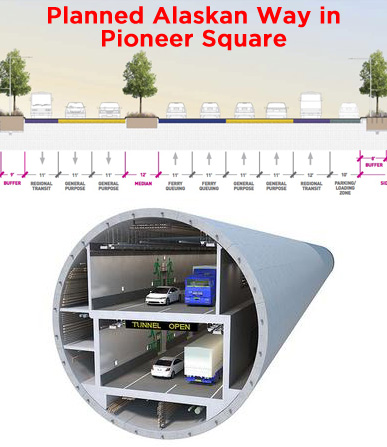
!["I [suspect] that we are throwing more and more of our resources, including the cream of our youth, into financial activities remote from the production of goods and services, into activities that generate high private rewards disproportionate to their social productivity. I suspect that the immense power of the computer is being harnessed to this 'paper economy', not to do the same transactions more economically but to balloon the quantity and variety of financial exchanges." --James Tobin, July 1984](https://imgs.xkcd.com/comics/technical_analysis.png "\"I [suspect] that we are throwing more and more of our resources, including the cream of our youth, into financial activities remote from the production of goods and services, into activities that generate high private rewards disproportionate to their social productivity. I suspect that the immense power of the computer is being harnessed to this 'paper economy', not to do the same transactions more economically but to balloon the quantity and variety of financial exchanges.\" --James Tobin, July 1984")







 Robert Crosland, the Preston Junior High School teacher, smiled as the verdict was read and afterward spoke publicly for the first time since the March ordeal.


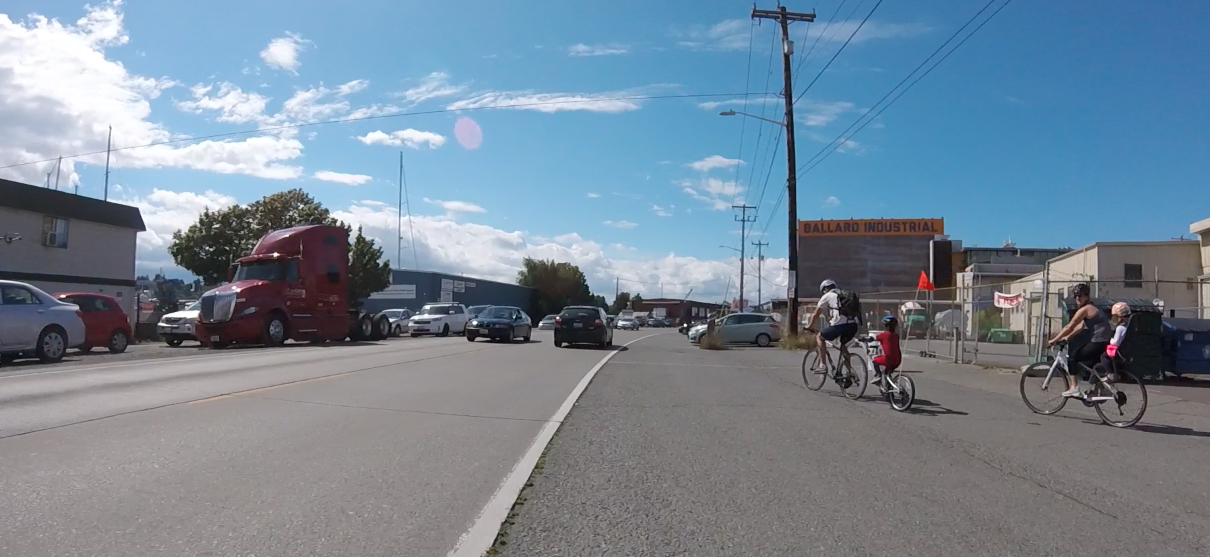


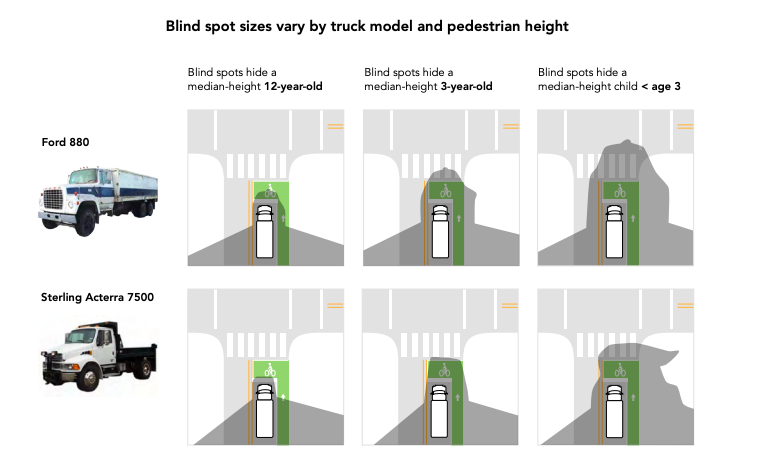
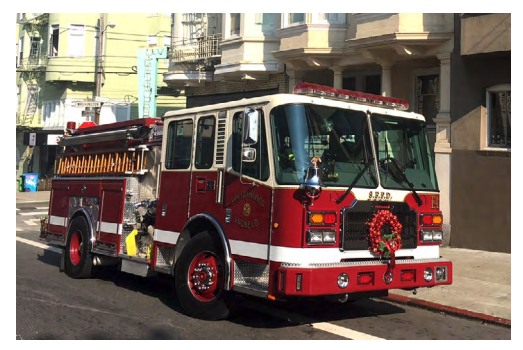
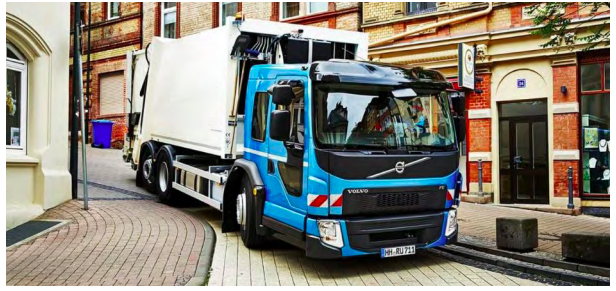

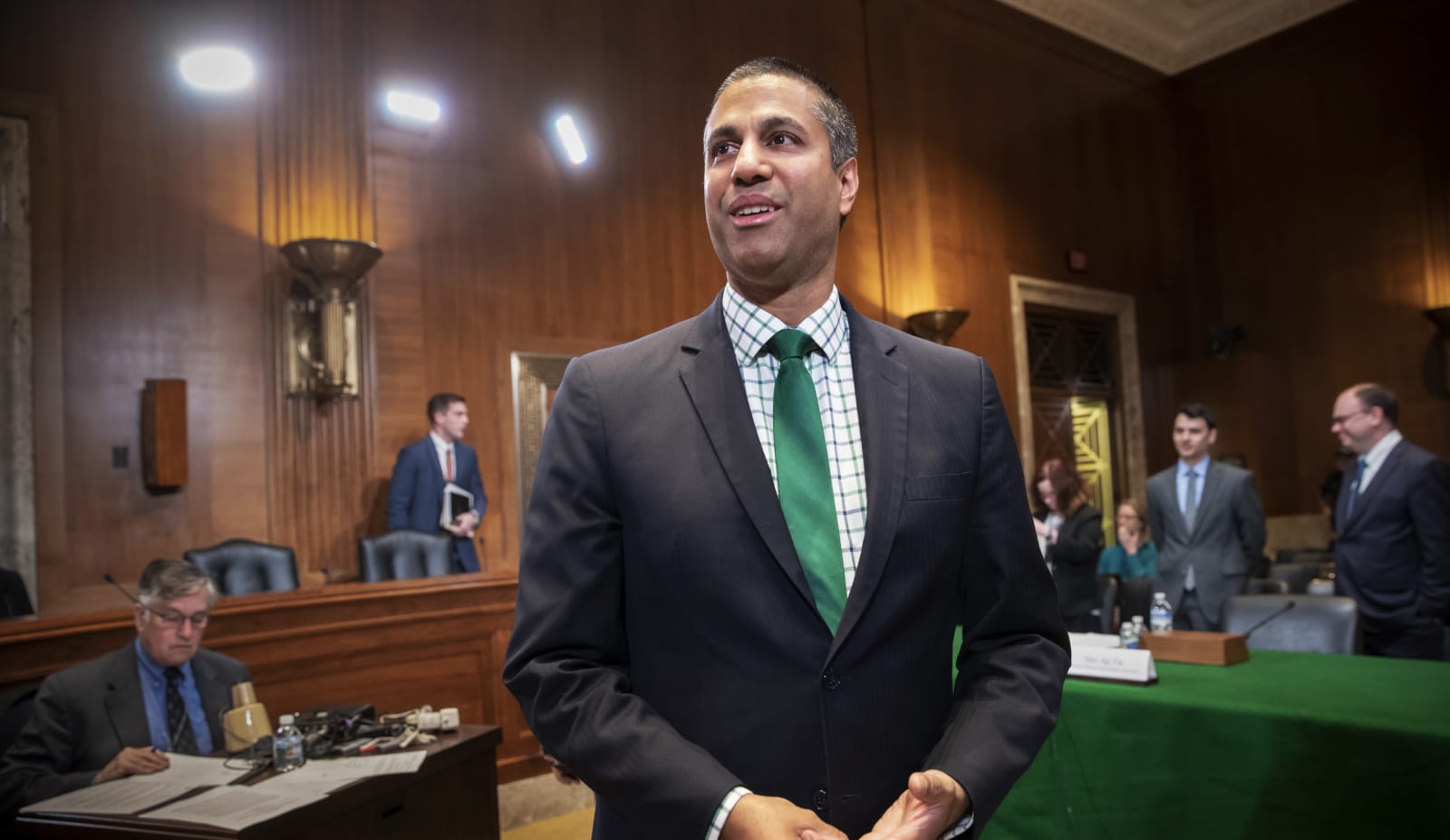 Federal Communications Commission Chairman Ajit Pai has admitted that around 500,000 comments submitted during the net neutrality public comment period were linked to Russian email addresses. Pai noted in a court filing that most of the comments were...