Shared posts

13 Nov 23:46

The Sneaky Way Clothing Brands Hooked Men on Stretch Jeans

by Amanda Mull

Clothing brands have been smuggling spandex onto the legs of unsuspecting men.

“I definitely didn’t explicitly understand what I was buying,” Austin Ray, a 36-year-old writer in Atlanta, told me. What he was buying were Gap Soft Wear Jeans in Straight Fit with GapFlex, which is a nine-word phrase to describe a two-word trend: stretch jeans. “Apparently I didn’t think too hard about what those words meant,” he said.

My friend David Covucci, a 34-year-old Brooklyn editor, also didn’t understand exactly what he was getting into when he picked a pair of Banana Republic Rapid Movement Denim jeans off a clearance rack, but the pants immediately felt different to him. “I knew something was up, but I didn’t Google until I got home,” he said.

If you wear women’s clothing, it might come as a surprise that a little bit of stretch is a relatively new concept for most men. Stretchy jeans have been common in women’s fashion for at least 20 years, but they’ve only found traction in the men’s mass market in the past five. Now nearly every major menswear brand offers at least one stretch option, and many go beyond the product’s tight-fit reputation with looser cuts.

To sell these jeans to men, though, brands face a conundrum common in the fashion and personal-care industries: How do you convince guys to buy something they believe is for women? In the case of stretch denim, brands have found success by obfuscating what their product actually is, allowing them to recast stretch pants as a tool of masculinity. Whether it’s GapFlex, Rapid Movement Denim, Wrangler’s Advanced Comfort, or just not mentioning the new fabrication at all, the theory seems to be that what men don’t know about their jeans can’t hurt them. Intentionally or not, these branding decisions have helped change the modern idea of what it means to look like a man.

Denim is traditionally 100 percent cotton, but mixing in 1 or 2 percent elastane (the generic name for Lycra or spandex) fibers gives jeans a softer feel and helps ease the adversarial relationship between the durable, rugged textile and tender bits of the human body. This particular fabrication is the relatively new result of advances in textile production, and it found its first home on the consumer market in the mid-2000s, when women’s fashion shifted its focus to skinny jeans and away from a more relaxed, boot-cut look. Women embraced the change quickly. You could be trendy and also be sitting down. It was a revelation.

Men, who saw fashion bend toward slim fits for them soon after it did for women, have been considerably more resistant to the change, which is what has prompted the euphemistic trickery from brands. For something as innocuous as slightly less restrictive pants, stretch jeans have caused a lot of hand-wringing among men’s-fashion types over the past couple of years. Much of it is bound up in what constitutes an appropriate performance of manhood, and whether suffering for fashion, something long considered a feminine burden, is something masculinity requires.

[Read: How cycling clothes opened doors for women]

In opposition to stretch jeans stood the popularity of selvedge denim, an old-fashioned manufacturing method whose stiff, rough product found an ardent following among menswear enthusiasts online that hit a fever pitch a few years ago—long after women had largely embraced the ability to painlessly sit down. According to Matt Sebra, the style director of GQ magazine, the popularity of selvedge required men to buy into an overtly masochistic idea of what it means to be authentic and masculine. “You get this stiff-ass pair of jeans and people would tell you, ‘Oh, wear them every day for six months and don’t wash them,’” Sebra says. “The first two weeks, you’d need the jaws of life to get out of them, and you were just sweaty and scratched up.”

Nancy Deihl, a professor of fashion history at New York University, echoed Sebra’s feeling that the slow embrace of elastane among men was at least in part the result of how it violated the belief that masculinity requires testing and achievement. “Stretch jeans go against ideas of male authenticity—the Marlboro Man image that jeans are supposed to have,” she says.

So, the thinking went, what if the jeans were no longer stretch—what if they were centered around the practical advantages of having a full range of motion?

There are two main ways that clothing companies have chosen to rebrand sitting comfortably as an activity for men. The first is recoding stretch denim as an aid in athletic performance, even though modern fashion jeans aren’t intended to be worn for anything resembling exercise. It’s difficult to parse what kind of rapid motion Banana Republic expects its customers to undertake in Rapid Movement denim, for example, but evoking ideas of athleticism is a common tactic for brands trying to make a case to men for a historically feminine product, according to Ben Barry, the chair of the Ryerson School of Fashion. Invoking athleticism also helps conjure the comfort and ease of athleisure, which is used in other parts of men’s fashion—dress shoes with flexible, cushioned soles, for example—to promise buyers a more casual experience in disguise.

Nathaniel Freeman, Banana Republic’s head of men’s denim, told me the name sprang out of fit testing for the line, during which “a team member put the garment on and started doing lunges down the hall, telling everyone how comfortable and flexible they were.” (Other stretch-jean makers wouldn’t comment on their gendered brand strategies.) It was smart of Banana Republic to go with that impulse, according to Barry. “Associating stretch denim with sports lets men know it allows high performance, that it’s a fabric that’s staked in athletic wear, that it’s purely about durability and breathability,” he says. That gives wearers some distance from the show-off nature of women’s skinny jeans. “Of course it’s not about showing off or revealing the body, which would be associated with femininity,” Barry says.

Sebra agrees that drawing an association between sleeker silhouettes and sports helps men get over the trepidation they might have about displaying their bodies. “The idea of men’s bodies being shown off or illustrated through their clothes is a concept that’s relatively new to a lot of men because there are still so many hang-ups about the male form,” he says. In that sense, athletically euphemized stretch jeans might even be a bit of a gateway drug—the thing that helps men interested in fashion get over the hump and get comfortable with clothes that actually fit.

[Read: A brief history of unisex fashion]

As Barry points out, though, there’s nothing inherent in slim jeans that’s masculine or feminine. “Fashion upholds gender binaries by associating silhouettes, fabrics, and colors with masculinity or femininity. The ways in which fashion has gendered styles as masculine and feminine shift across history and geography, or even among simultaneous subcultures,” he says. Take, for example, revolution-era France or the United States during the 1970s: Men in tights and ultra-tight pants, respectively, were the aesthetic norm.

So in trying to reimagine stretch denim as athletic, brands take part in a long tradition of shifting what we expect masculinity and femininity to look like. Those boundaries are always in flux, even if the concepts feel fairly static to the casual observer. Think about how quickly the personal-grooming standards denoted by the term metrosexual became commonplace among straight men, and how antiquated that term already feels just 15 years later. Sometimes people are ready for a change and they just need to find a way to talk about it.

The other idea that marketers have invoked to bring men over to the dark side of stretch pants is comfort, which appeals to a slightly less active, slightly less aesthetically concerned conception of modern masculinity. For men who wish they could wear their sweatpants to the office, both traditional brands and upstarts like the Kickstarter darling Alday are here to give them the opportunity. In doing that, they indulge the masculine belief that men should think about how they look as little as possible. There’s clearly a market for such a product: Alday’s Kickstarter sought to raise $15,000, but it ended up with more than $67,000 in support from backers who want to try a denim product that’s knitted like pajamas.

For plenty of men, that’s an intriguing proposition. Once they experience the difference between stretch and conventional denim, there’s no going back. Ray was delighted to find out that his jeans were more forgiving, even if he hadn’t expected it when he bought them online. “I remember I walked into the living room and was basically yelling at my wife about how much I loved them,” he says. “She confirmed to me they looked like regular jeans, and I was good with that.”

Covucci, on the other hand, had a moment of trepidation. “I wondered, ‘Did I buy jeggings? Am I a stretch-jeans guy?’” he says. It turns out he is. “They’re more comfortable, and it’s 2018. I’m a man on the go.”

12 Nov 22:06

Indirect Detection

I'm like a prisoner in Plato's Cave, seeing only the shade you throw on the wall.
06 Nov 18:19

North Dakota tribes issue thousands of IDs to stop voter suppression

by Justine Calma

If North Dakota tribal members show up to the polls today without proper ID, indigenous leaders are determined to make sure they’re still able to exercise their right to vote.

The Supreme Court recently declined to hear an appeal of the state’s new, restrictive voter ID law, which requires the listing of a valid residential address. Since many tribal members use P.O. boxes, the law has the potential to disenfranchise a large portion of the state’s Native community. But organizations have been rallying to help tribal members meet the requirement, even as late as Election Day.

“It’s an absolutely critical election. We won’t sit quietly and let our people be denied their right to vote,” Standing Rock Tribal Chairman Mike Faith said in a statement.

Story continues below

More in this series :

In the days leading up to the midterm election, indigenous leaders rallied to issue thousands of new ID cards for would-be voters. The campaign, dubbed #StandingRockTheVote, is the result of a partnership between several North Dakota tribes and nonprofit advocacy organizations fighting voter suppression. As of last week, the Standing Rock Sioux, Turtle Mountain Chippewa, and Three Affiliated Tribes had distributed more than 2,000 new ID cards to their members free of charge so that they won’t be turned away at the polls. Through a GoFundMe page, the group raised more than $230,000 for the initiative in 17 days. The Native American Rights Fund also donated $50,000.

“We are modeling how we can work together to ensure our Native vote is as a large as possible,” said Phyllis Young, an enrolled member of the Standing Rock Sioux Tribe and a field organizer for the coalition that is mobilizing voters.

Young is working alongside Four Directions, a nonprofit that supports Native voting rights, and Lakota People’s Law Project, which works to protect Lakota land and resources. Together they’ve devised a “failsafe” plan to make sure no native voters fall through the cracks on Election Day.

For anyone who still doesn’t have a qualifying ID when they show up to vote, tribal officials and volunteers will be present at polling places to issue documents on the spot that comply with voting laws. As long as voters in need of ID can verify their tribal membership and point out where they live on a map, officials will help them find a corresponding residential address and issue a letter verifying their eligibility.

Matt Samp, an organizer at Four Directions says his group successfully tested the method of issuing documents on the spot at the state auditor’s office last week. It’s a technique that hasn’t been tried before this year — and can work, in part, because North Dakota is the only state that doesn’t require voter registration.

“Our first effort has been getting people new IDs. We don’t want to have to use this letter one time, but if we have to we have it,” Samp said. “I shouldn’t have to be on the ground doing this, but that’s the law they made, so we’re complying with it.”

In 2016, members of the Turtle Mountain Band of Chippewa sued the state over the residential address requirement, arguing that the rule would disproportionately impact Native American voters who faced additional barriers to securing the necessary ID. Some critics contended that the law was aimed at suppressing the Native vote. Eighty-three percent of Sioux County, where the Standing Rock reservation is located, voted for Democratic candidate Heidi Heitkamp for in 2012. She ended up winning her Senate seat by just 3,000 votes, and her victory is largely attributed to the support she received from the indigenous community.

Daniel Hovland, chief judge for the U.S. District Court in North Dakota, initially ruled that the new voter ID law placed “excessively burdensome requirements” on the state’s Native American voters. That decision allowed people with mailing addresses on their IDs to vote in the primaries. But the state appealed, and a higher court sided with them this September, putting the restrictive law back into play for the midterm election. The Spirit Lake Tribe filed another suit in federal court asking for emergency relief from the mandate, but Judge Hovland denied their emergency request last week, on the grounds that such a last-minute change would cause “confusion.”

It’s unclear what the new law (and the efforts to issue new IDs to tribal members) might mean for the election. Heitkamp is running for reelection in a close race against Republican candidate Kevin Cramer. Although Heitkamp has been vocal about some issues important to tribes in North Dakota — like addressing the issue of missing and murdered indigenous women — she received criticism for failing to back Standing Rock opposition to the Dakota Access Pipeline. Heitkamp’s campaign website also says she supports oil and coal.

But just because of Heitkamp’s stances have left a sour taste with some Native American voters doesn’t mean they won’t show up at the polls. Because of the lengths Young, Samp, and others have gone to get out the vote, Native Americans are now expected to have a higher-than-normal turnout in the North Dakota election on Tuesday.

“We’re trying to turn a challenge into an opportunity,” says Daniel Nelson, Program Director at the Lakota People’s Law Project, adding that the sentiment on the ground is actually pretty jubilant. “Democracy is alive and well at Standing Rock.”

This story was originally published by Grist with the headline North Dakota tribes issue thousands of IDs to stop voter suppression on Nov 6, 2018.

06 Nov 18:15

American Meritocracy Is Killing Youth Sports

by Derek Thompson

The state of youth sports in America is either booming or suffering, depending on which box score you’re checking.

You could follow the money. Kids’ sports is a nearly $17 billion industry, which makes it larger than the business of professional baseball and approximately the same size as the National Football League. Or you could follow the kids. The share of children ages 6 to 12 who play a team sport on a regular basis declined from 41.5 percent in 2011 to 37 percent in 2017, according to a recent report from the Aspen Institute. Going back to 2008, participation is lower across categories, including baseball, basketball, flag football, and soccer, in some cases by a lot: Baseball is down about 20 percent.

The decline of youth sports participation is the sort of phenomenon that seems exquisitely tailored to exacerbate fears about the state of American childhood. One might suspect that the falloff is the result of children gravitating to video games, television, and other electronic distractions that don’t require an open field or a court. Perhaps athletics is just another legacy institution that can’t compete for attention anymore, like church, community centers, and bowling leagues.

But dig into the numbers, and a more complex, two-track story emerges. Among richer families, youth sports participation is actually rising. Among the poorest households, it’s trending down. Just 34 percent of children from families earning less than $25,000 played a team sport at least one day in 2017, versus 69 percent from homes earning more than $100,000. In 2011, those numbers were roughly 42 percent and 66 percent, respectively.

This isn’t a story about American childhood; it’s about American inequality.

[Read: What’s lost when only rich kids play sports]

“Kids’ sports has seen an explosion of travel-team culture, where rich parents are writing a $3,000 check to get their kids on super teams from two counties, or two states, away,” said Tom Farrey, the executive director of Aspen’s Sports & Society program. Expensive travel leagues siphon off talented young athletes from well-off families, leaving behind desiccated local leagues with fewer players, fewer involved parents, and fewer resources. “When these kids move to the travel team, you pull bodies out of the local town’s recreation league, and it sends a message [to those] who didn’t get onto that track that they don’t really have a future in the sport.” The result is a classist system: the travel-team talents and the local leftovers.

Unsurprisingly, the leftovers often lose interest. As Chris Moore, the executive officer of the U.S. Youth Soccer Association, told The New York Times, “If you can’t make a travel team, some kids may say, ‘What’s the point?’ and quit playing altogether.”

In short, the American system of youth sports—serving the talented, and often rich, individual at the expense of the collective—has taken a metal bat to the values of participation and universal development. Youth sports has become a pay-to-play machine.


Declining athletic participation is a prime example of how the choices even benevolent rich households make can hurt poorer families—especially their children.

As a general rule, rich parents in the United States don’t just spend more money on their kids; they spend a larger share of their income on their kids. (One could say that enrichment spending on children is a luxury good.) If you divide American households into five quintiles by income, the richest group earns about five times as much as the poorest, but spends about seven times as much on kids—about $9,300 to $1,300 per child. Income inequality, vast at the household level, is even vaster at the child-investment level.

It’s commendable for all parents—rich or poor—to love, and desperately want to help, their children. But not all expressions of love are harmless. In his 2017 book, Dream Hoarders, the economist Richard Reeves wrote that economic mobility in the U.S. has been declining in the past few decades in part because of “opportunity hoarding.” For example, rich parents may pull special levers to get their kids into hyper-select schools, or elite internships, or exclusive entry-level jobs. In so doing, they—in effect— snatch precious opportunities away from the less fortunate.

[Read: The case against high-school sports]

Parenting doesn’t have to be a zero-sum game, but it often is. As Matthew Stewart wrote in an Atlantic cover story this year on the new aristocracy, those in the nation’s upper-middle class have “taken their money out of productive activities and put it into walls”—physical walls and social barriers—that make it harder for any child not born into privilege to reach the same level of success.

In youth sports, many affluent parents have taken their children out of local gyms, put them onto planes, and shut the air-lock door behind them. “Many of the parents are not doing it with the intention to harm anyone, since they’re just trying to help their child,” Farrey said. “But they don’t think about the kids they’re leaving behind. They’re not thinking about what makes sense for the whole community.”

Well-off parents dedicate so much time and money to kids’ sports partly because of the college system, which dangles tantalizing rewards for the most gifted teenage athletes. In the 1990s, Division 1 and Division 2 colleges distributed about $250 million a year in full and partial scholarships to student athletes. Today that figure has grown to more than $3 billion. This scholarship jackpot gives some children from lower-income families a chance to attend schools they might not otherwise afford. But it also sends a clear message to richer parents looking to enhance their kids’ eventual application: Sports matter. As soon as some children enter second or third grade, their parents scramble to place them on youth travel teams, which will set them up for middle-school travel teams, which will set them up for high-school athletic excellence, which will make them more competitive for admissions and scholarships at select colleges.


The predictable rejoinder to the inequality of kids’ sports is basically: The system works just fine. Many famous athletes come from poor backgrounds, and some of them owe their careers to specialized super teams. Besides, one might argue, even though super teams for gifted and sufficiently wealthy young people might leave disadvantaged kids behind, this is simply the price that society must pay for excellence. It’s a version of a familiar conservative economic argument about the general economy: The U.S. has the world’s smartest people, because we celebrate success and punish indolence; so we should cut taxes on the rich and unwind collectivist welfare programs, which only dampen the nation’s competitive mojo.

But just as Europe offers alternative models for balancing equality and efficiency in the overall economy, it also offers alternative models for youth sports.

[Read: Hypercompetitive youth soccer is tough on kids].

For example, Norway’s youth-sports policies are deliberately egalitarian. The national lottery, which is run by a government-owned company called Norsk Tipping, spends most of its profit on national sports and funnels hundreds of millions of dollars to youth athletic clubs every year. Parents don’t need to shell out thousands to make sure their kids get to play. And play is an operative word: Norwegian leagues value participation over competition so much that clubs with athletes below the age of 13 cannot even publish game scores. Remarkably, teams that release their scores online can face expulsion from the Norwegian confederation of sports.

It might seem like any country’s athletic prowess would atrophy under such socialist and anticompetitive policies. Instead, Norway is an athletic juggernaut. In the last Winter Olympics, the country won 39 medals—the most of any country in the history of the Games and nearly twice as many as the United States. It did so with a smaller population than Minnesota’s.


The U.S. sees itself as a land of winners bred by a culture of fierce competition that rewards success. But in youth sports, that competition doesn’t happen—excuse the metaphor—on a level playing field.

One way to address the class-related participation problem in youth sports is to tone down the competition that leads wealthy parents to pay for elite traveling leagues and unintentionally degrade the local leagues. In other words: Follow the Norwegian model.

Look at U.S. youth ice hockey, where participation has grown to an all-time record, according to the Sports & Fitness Industry Association. Among several possible factors—the NHL expanded recently into southern and western states, and the youth hockey organization banned body checking among players under 12— USA Hockey also recently eliminated national championships at the peewee (under-12) level to discourage parents from building super teams. “We felt it would be hypocritical for our sports to offer up an event that encourages people in the field to start to put together super teams at an early age,” said Ken Martel, the technical director of development at USA Hockey. At first, mothers and fathers complained, but “once it was eliminated, just crickets. People like it.”

Hockey parents thought they needed to win. But they were happy enough for their kids to just play.

01 Nov 22:57

Missing Link design nearly complete, construction to begin this winter (unless the court intervenes)

by Tom Fucoloro

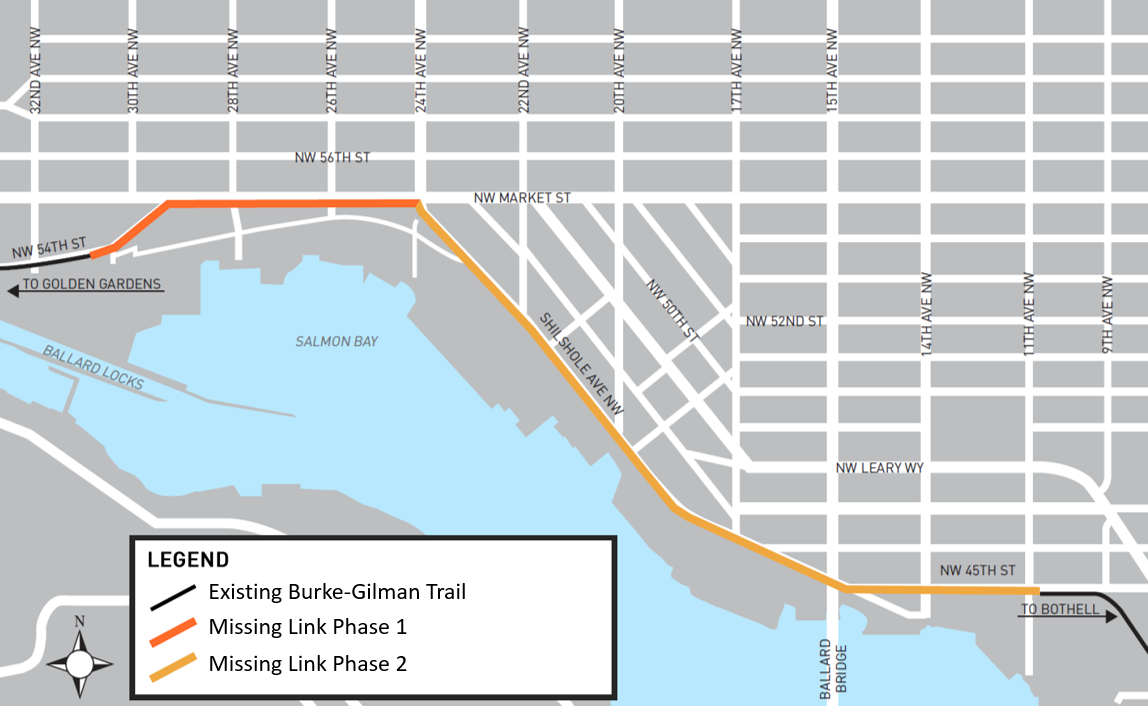
Barring a court order, construction on the Ballard Missing Link of the Burke-Gilman Trail is scheduled to begin this winter. So while an appeal is still working its way through the courts, the city is moving forward with a construction plan that would have the trail fully open by the end of 2020. That’s 18 years after the Seattle City Council first voted to build this segment.

The work has beed divided into two phases that will overlap. The first section, from the Locks to 24th and Market, is scheduled to begin construction in just a few months. If all goes as planned, it would be open in about a year. Construction on the second phase, from Market St. to Fred Meyer, is set to begin in the summer and would open in autumn of 2020.

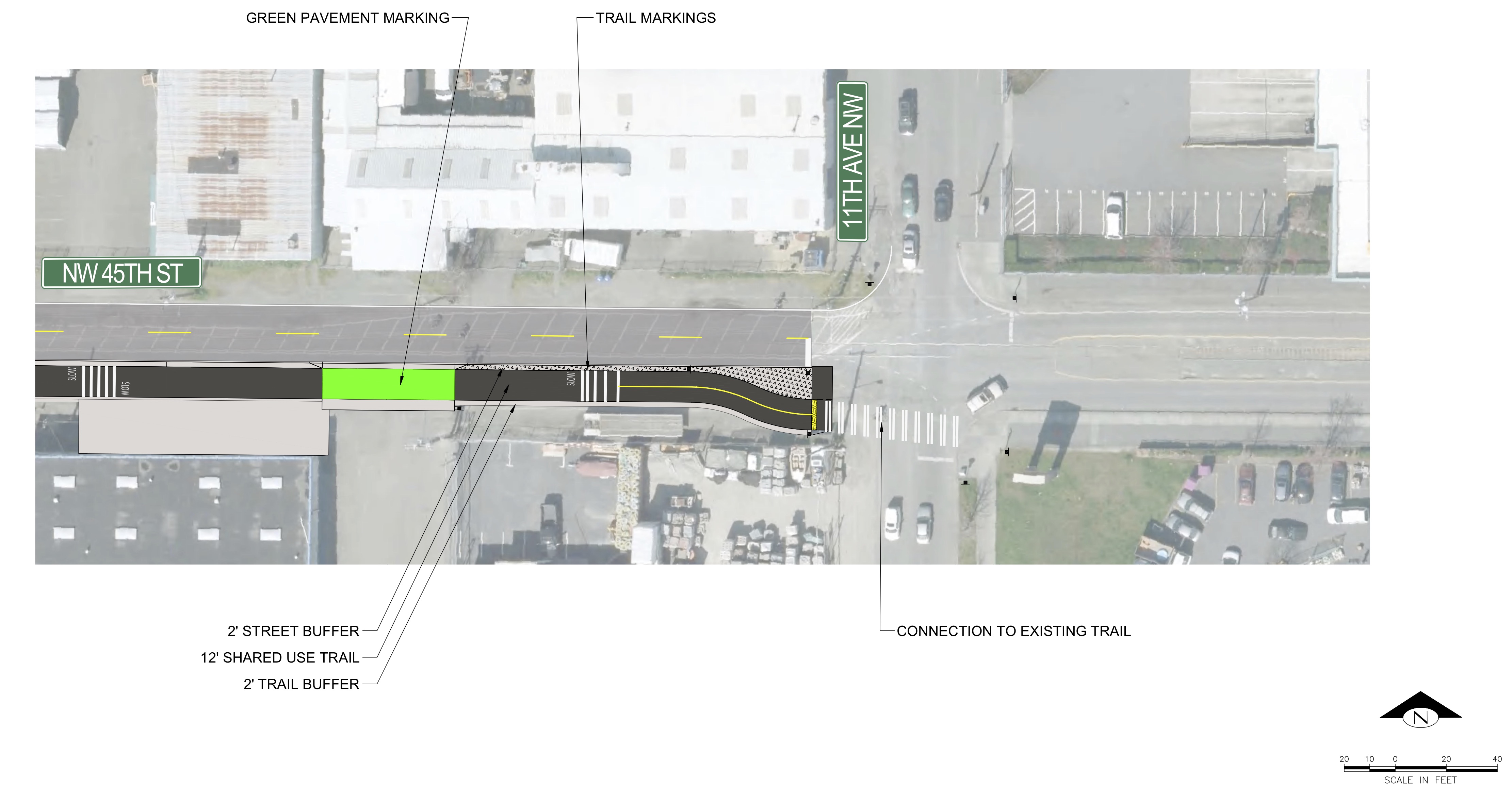
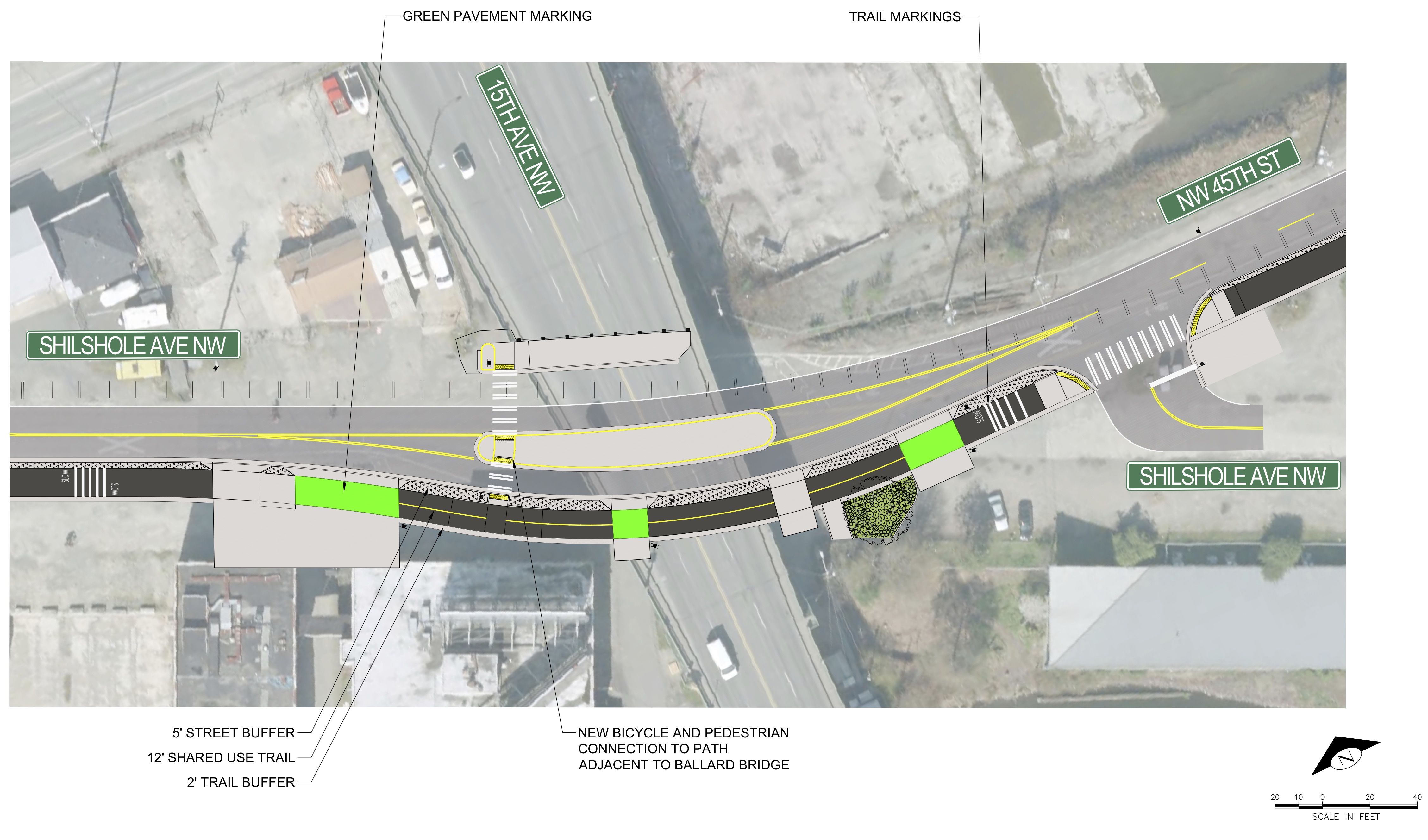
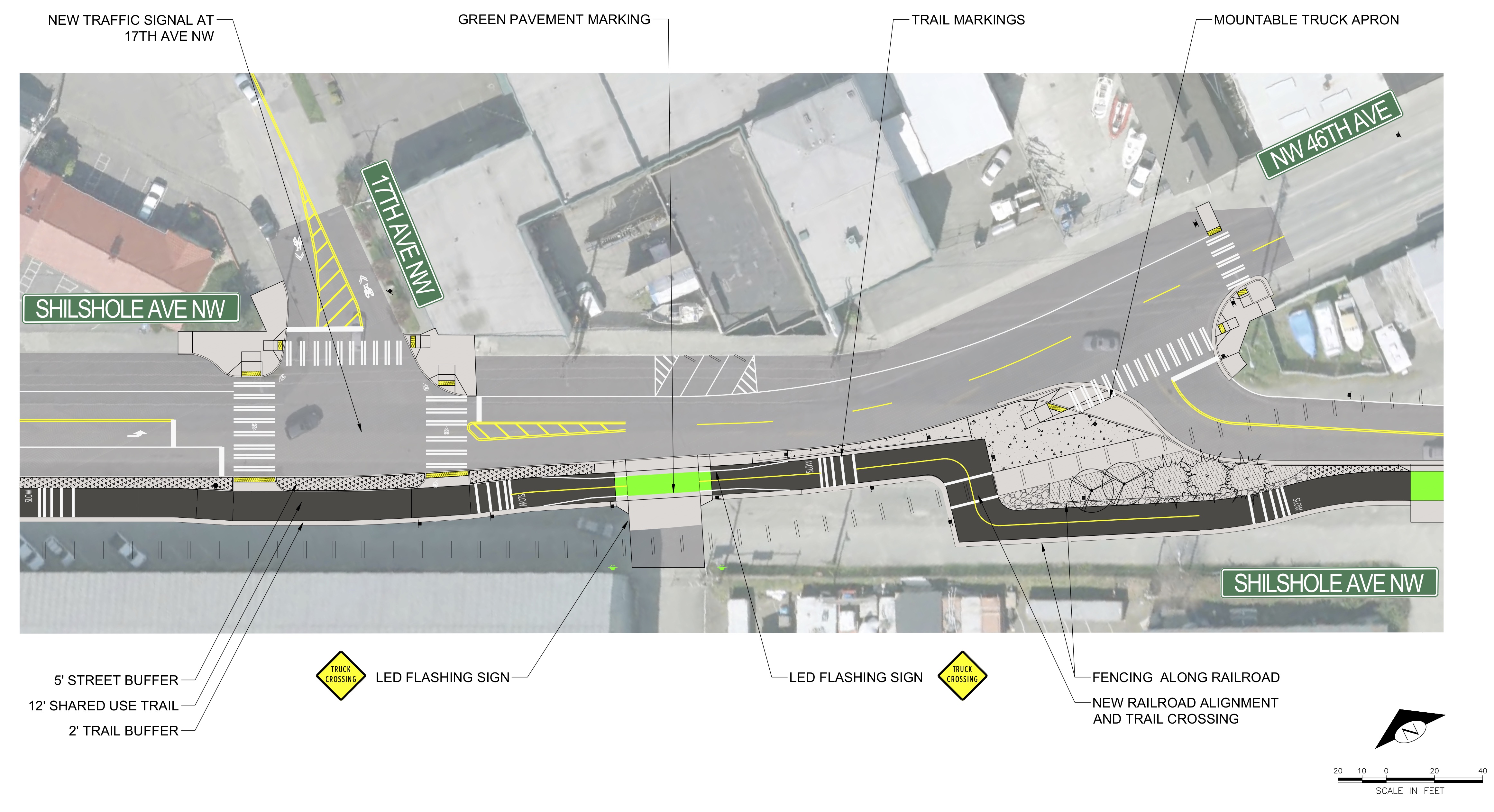
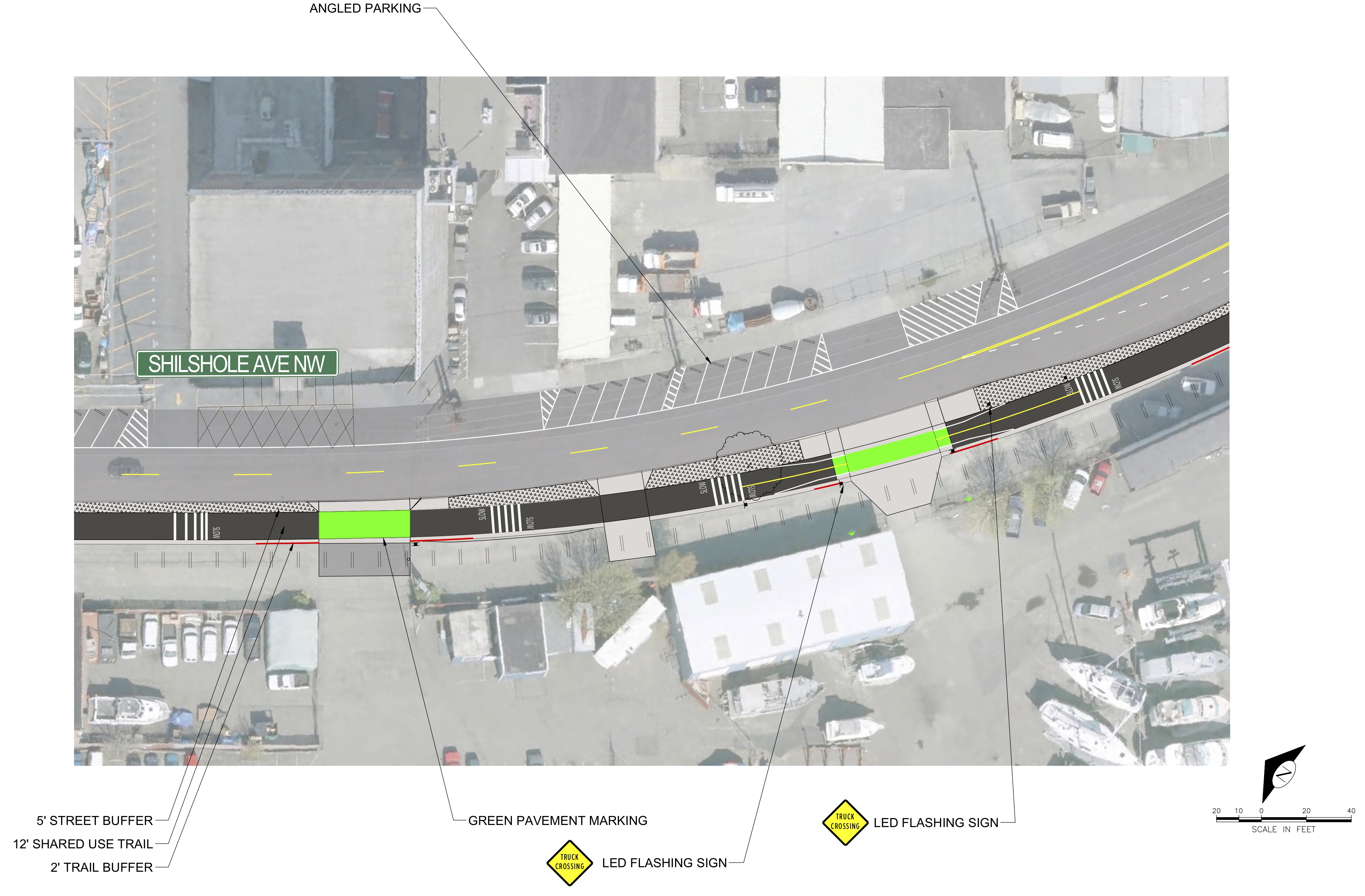
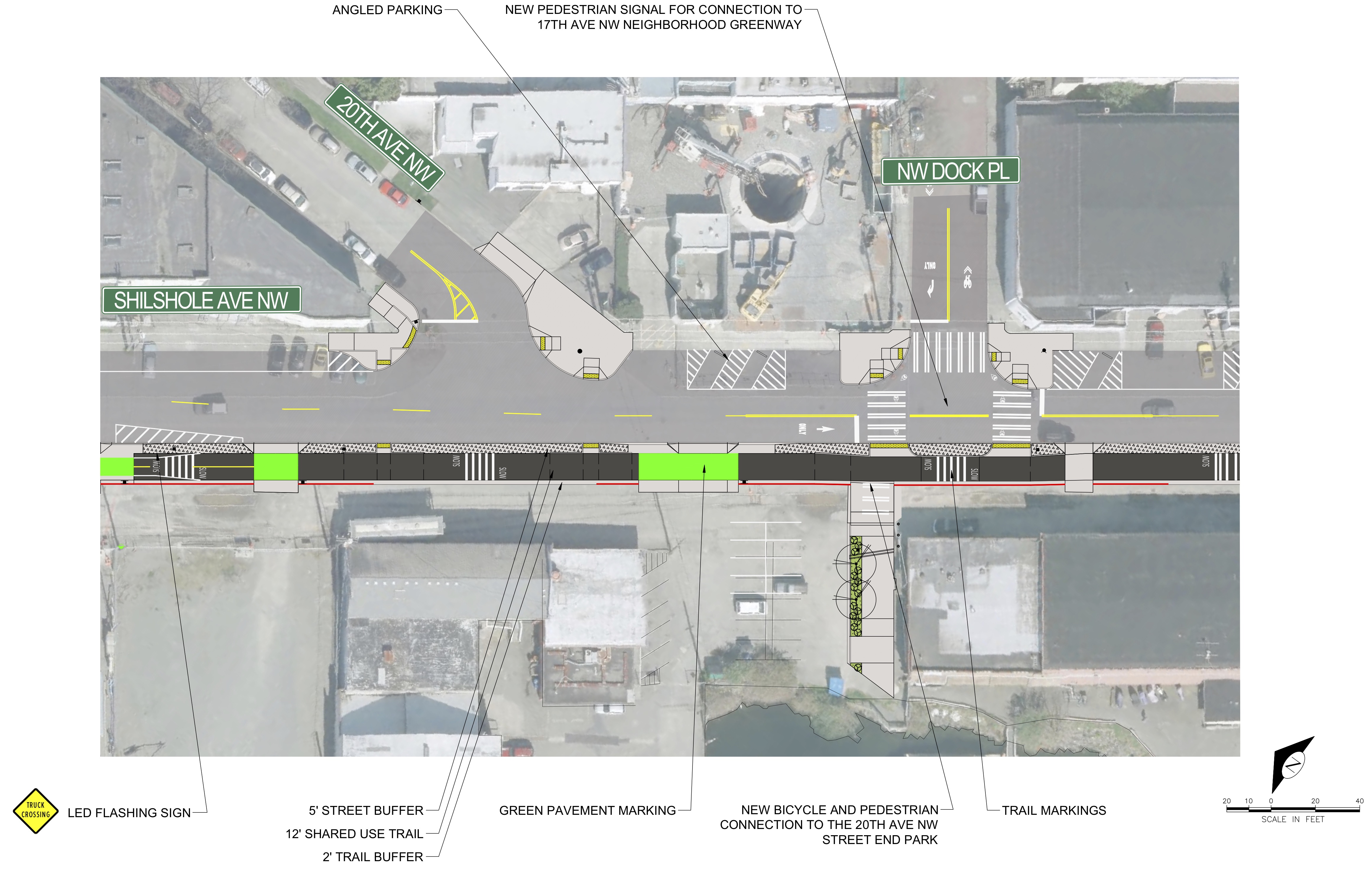
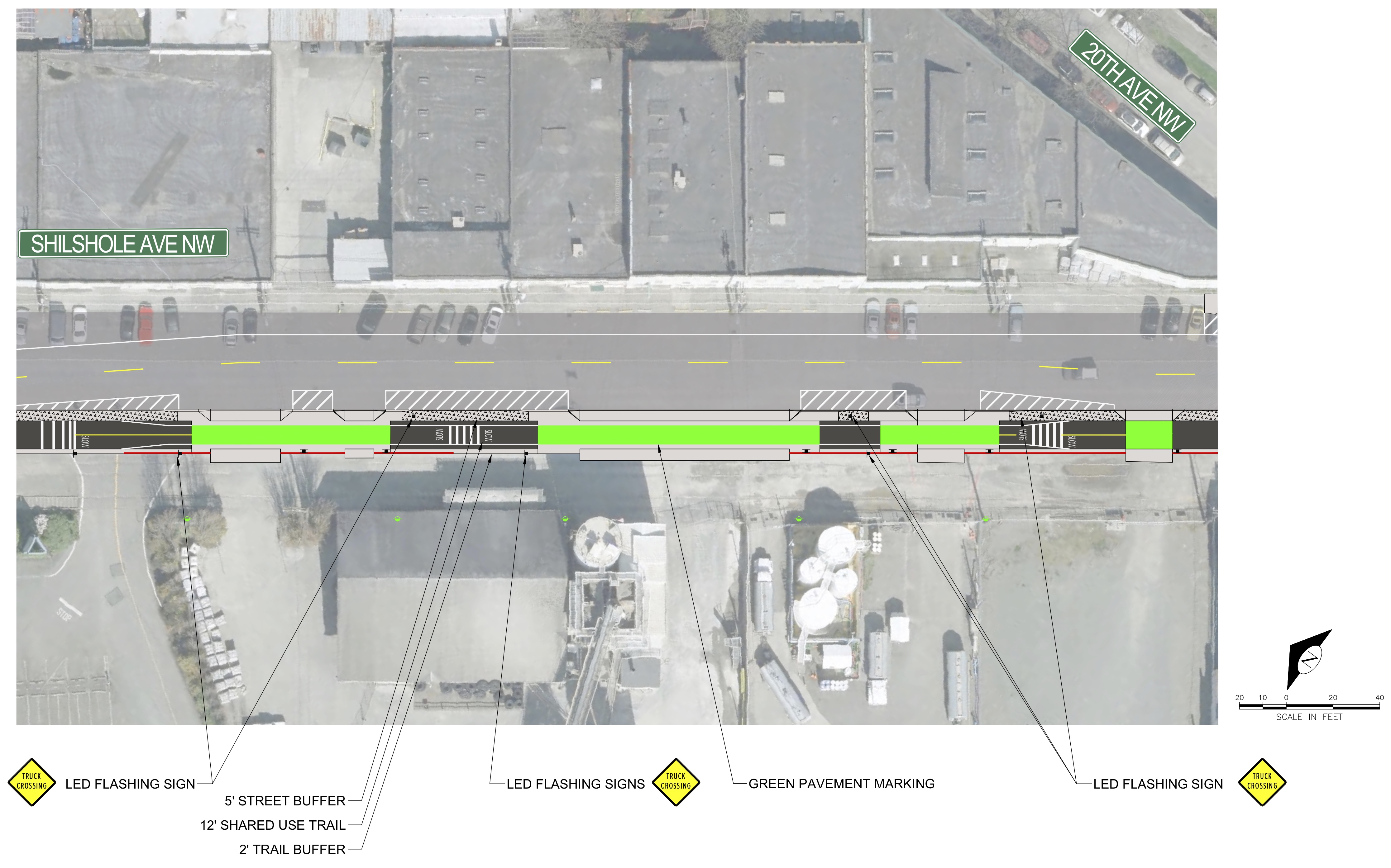
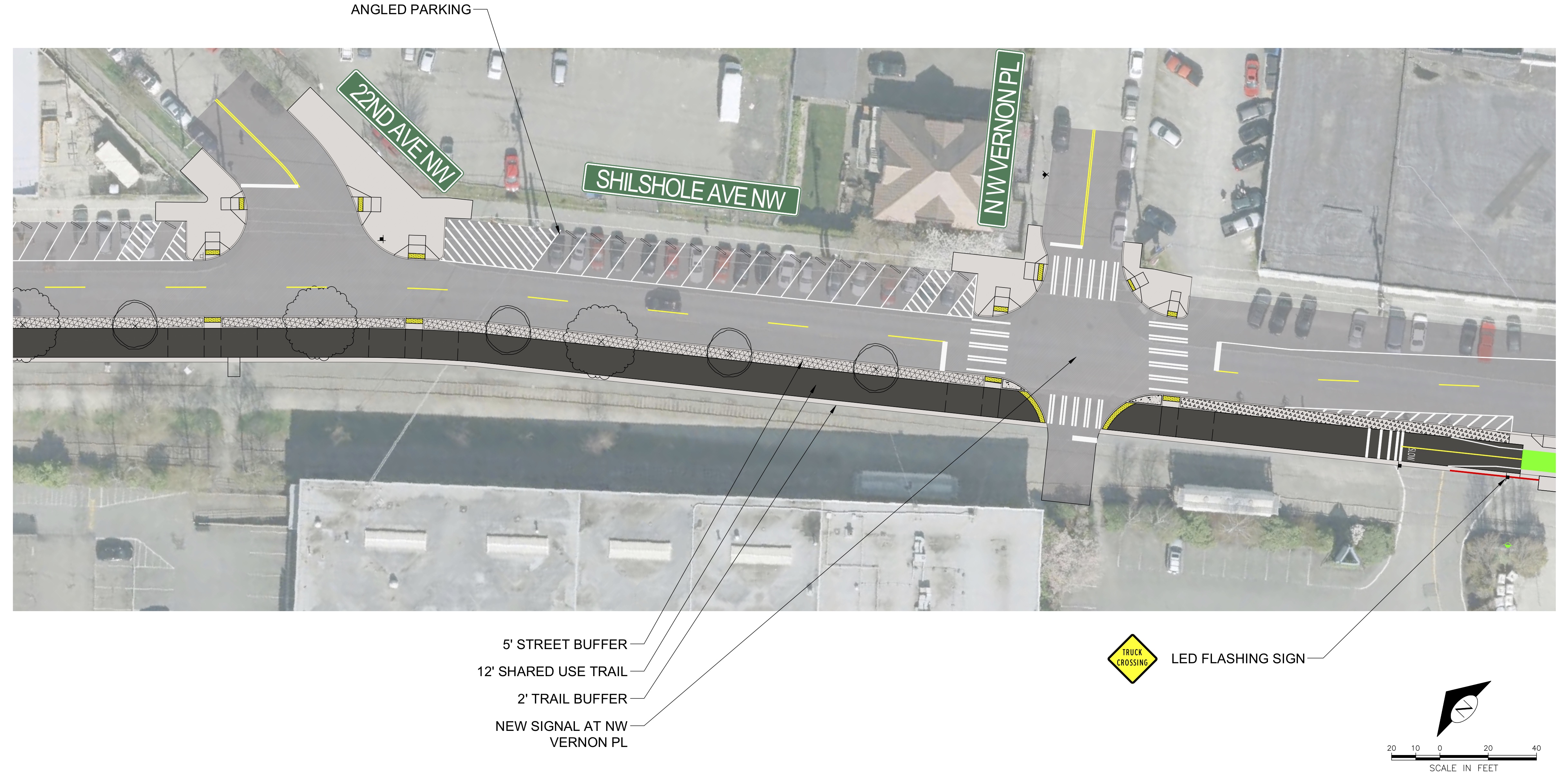
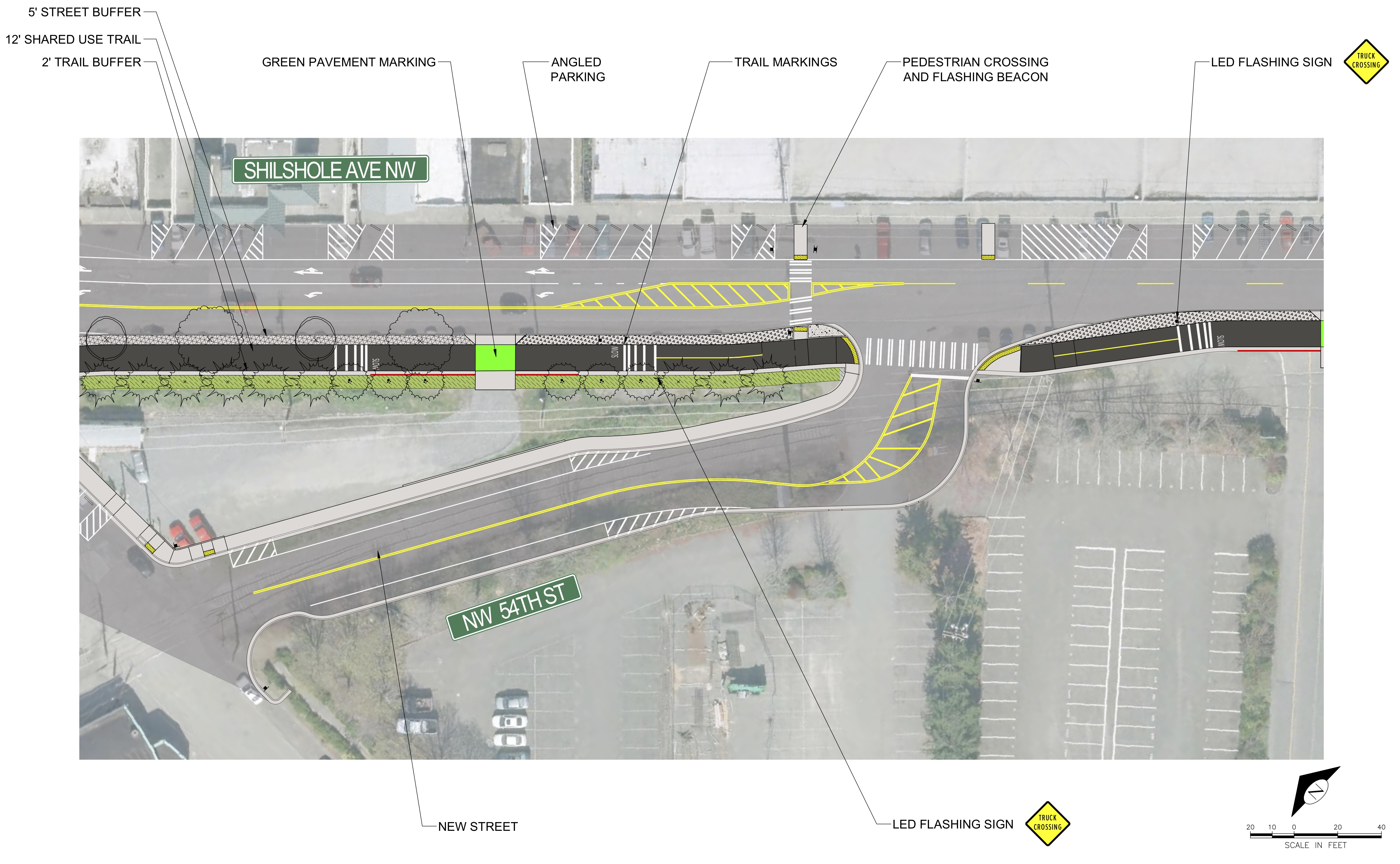
The biggest sticking point of the whole route is the industrial driveway crossings along Shilshole. The latest design includes green paint and flashing LED signs warning trail users about trucks.

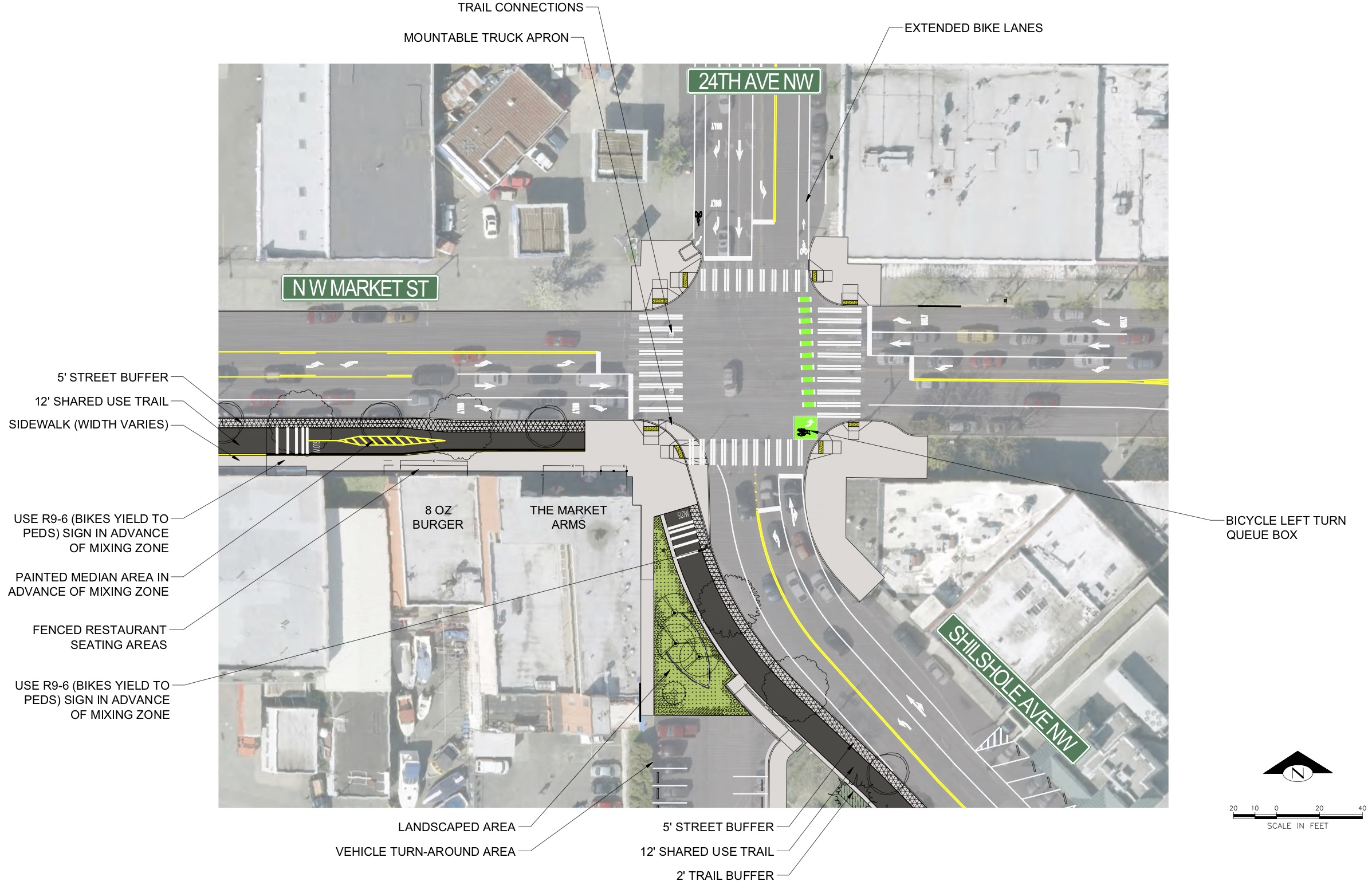
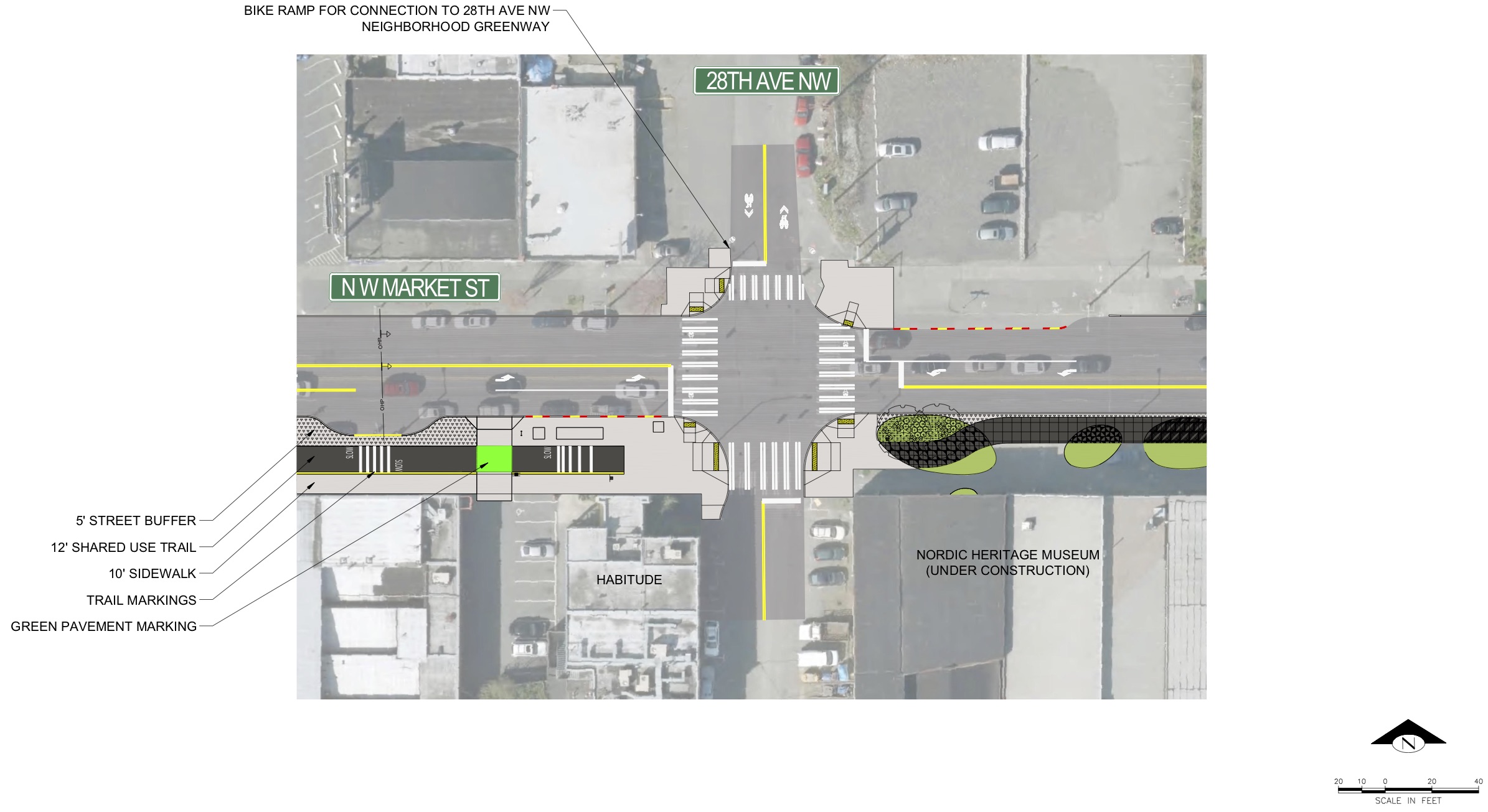
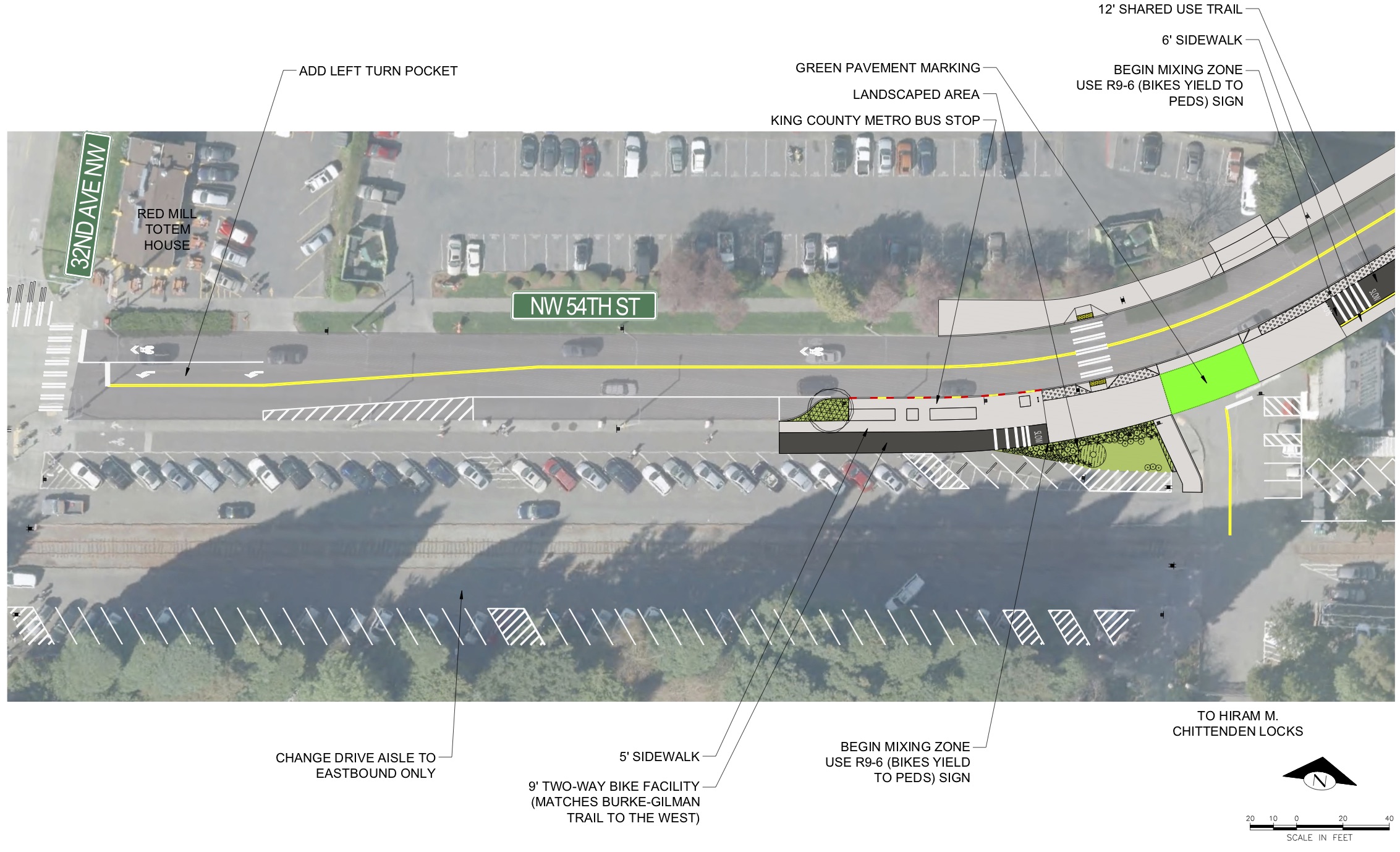
Many crosswalks have been significantly improved, as well. And there is now a biking and walking path to the 20th Ave NW Street End Park on Salmon Bay, which I did not even know existed. So that’s very cool. Here are the latest designs moving from east to west:

An appeal is still in process in King County Superior Court, where the appellants have a pretty tough case to make. They would need to convince the court that the Environmental Impact Statement and/or the Seattle Hearing Examiner process that ruled in the city’s favor were in some way legally inadequate. For example, the court recently denied an appellant argument that the Hearing Examiner was biased because he was promoted shortly after deciding in the city’s favor (the judge said that if an examiner pursuing career advancement were considered bias, that would “taint virtually all decision making by that body.”). Let’s hope the rest of the appellants’ arguments are similarly ineffective.

Because after this much delay, it would not be wise to assume this project will be completed until crews are pouring the cement. This is the closest the trail has ever been to construction, but appellants are still fighting hard.

Here’s the latest project update from SDOT:

Design of the Burke-Gilman Trail Missing Link is nearly complete! The final design reflects ideas that we heard from key stakeholders, including an 11-member Design Advisory Committee (DAC), as well as community members from the Ballard area to design and refine the Missing Link and complete a multimodal corridor that supports all users.

We expect construction of the Missing Link will be split into two phases (see the map and construction timeline below).

  • Phase 1, including the portions of the corridor on NW 54th St and NW Market St, is expected to begin construction in early 2019.
  • The project team is continuing to work with property and business owners to further refine the design for Phase 2, which includes the portion of the corridor on Shilshole Ave NW and NW 45th St. Design for Phase 2 is expected to be complete by 2019, with construction expected to begin in mid-2019.

You can view the latest Missing Link design plans on the project website.

If you were not able to attend our outreach events, you can view event summaries and the complete outreach summary in our project library.

What is the Burke-Gilman Trail Missing Link project?
The Burke-Gilman Trail is a regional, mixed-use facility that runs from Golden Gardens Park in Seattle to the Sammamish River Trail in Bothell. The trail is complete except for a 1.4-mile segment through the Ballard neighborhood, known as the “Missing Link.”

The scope of the Burke-Gilman Trail Missing Link project has evolved from a multi-use trail to a full multi-modal corridor that will accommodate all users for generations to come. Completing the Missing Link will create a safe, direct, and defined multi-use trail for persons of all abilities. It will also improve predictability for motorized and non-motorized users along the alignment and maintain truck and freight access to the industrial and water-dependent businesses within the Ballard Interbay Northend Manufacturing and Industrial Center (BINMIC).

Through extensive community engagement during design, we’ve learned more about the corridor improvements that stakeholders would like to see. In addition to the trail, additional improvements include new street paving along Market St, new traffic signals on Shilshole, improved pedestrian crosswalks and sidewalks, a new access road, and new stormwater infrastructure.

The Missing Link has been included in the City’s comprehensive plan since the early 1990s, and is identified as one of the City of Seattle’s top-rated trail priorities in the 2014 Bicycle Master Plan.

30 Oct 18:43

FCC Falsely Declares Community Broadband An 'Ominous' Attack On Free Speech

by Karl Bode

Absent any hard data to support their claims, you may have noted that the Trump FCC often just makes up some shit.

Like that time FCC boss Ajit Pai tried to claim that net neutrality somehow aids dictators. Or that time Pai's office just made up a DDOS attack to try and downplay massive public backlash to his historically unpopular policies. There's often no real-world data that can defend blindly kissing the rings of widely-loathed telecom monopolies, so bullshit tends to be the weapon of choice when Pai's FCC embraces whatever handout to Comcast and friends is on the menu this week.

The latest case in point: during a speech at the ISP-backed and scientifically-sounding Media Institute, FCC Commissioner Mike O’Rielly took a moment to broadly declare that community owned and operated broadband providers are an "ominous" threat to free speech:

"I would be remiss if my address omitted a discussion of a lesser-known, but particularly ominous, threat to the First Amendment in the age of the Internet: state-owned and operated broadband networks."

We've long noted how community broadband networks are often an organic response to the expensive, slow, or just-plain unavailable service that's the direct product of a broken telecom market and regulatory capture. While you'll occasionally see some deployment duds if the business models aren't well crafted, studies have shown such networks (there's 750 and counting now in the States) offer cheaper, faster service than many incumbents. This direct threat to incumbent revenues is a major reason why ISP lobbyists have passed protectionist laws in more than 21 states trying to block your town's ability to even consider the option.

If you thought O'Rielly would provide hard evidence of these networks' "ominous" affront to free speech, you'd be mistaken. The closest O'Rielly gets to evidence is a 2015 white paper crafted for an ISP-funded think tank claiming that because these ISPs' TOS include routine language restricting harassment and hate speech (language every private ISP also includes in their TOS and AUP), community-run ISPs' are more likely to censor user speech:

"The closest O’Rielly gets to supporting evidence appears to be a 2015 white paper written by Professor Enrique Armijo for the ISP-funded Free State Foundation. That paper similarly alleges that standard telecom sector language intended to police “threatening, abusive or hateful” language somehow implies community-run ISPs are more likely to curtail user speech."

Of course the implication is that government-run networks must be bad because hey, it's the government. Forgotten in this false narrative is the fact that on the local level, the government is obviously you and I, and these networks are a direct, democratic response to decades of frustration at the obvious failures of the telecom market. And if you talk to folks that actually have some expertise on this subject (like I did over at Motherboard), they'll tell you that because these ISPs actually have a vested interest in the communities they serve, they're far more responsive to user complaints:

"Municipal broadband experts say the argument has no basis in fact.

"There is no history of municipal networks censoring anyone's speech,” Christopher Mitchell, a community broadband expert and Director of the Institute for Local Reliance, told Motherboard.

“In our experience, the Terms of Service from municipal ISPs have been similar to or better than those of for-profit ISPs in terms of benefiting subscribers,” he added. “And when concerns have been raised about related issues...the municipal ISPs have listened to public sentiments far more than any large cable or telephone company has."

O'Rielly also fails to mention that incumbent ISPs like Comcast routinely argue that absolutely everything the public demands of it (from expanding broadband to adhering to net neutrality) violate its First Amendment rights (an argument new Supreme Court Justice Brett Kavanaugh has already supported). Whereas municipally-run ISPs likely won't be allowed to tap dance around First Amendment lawsuits as government-linked entities mandated to avoid speech regulation.

But the biggest irony here is that one of the ISPs targeted by O'Rielly for non-existent free speech violations is EPB broadband in Chattanooga, which was just ranked by Consumer Reports as one of the best ISPs in the nation in terms of value, speed, and service quality. Comcast tried to unsuccessfully sue EPB out of existence. And as long as we're getting vexed about your rights, both AT&T and Comcast also lobbied legislators to pass a law in Tennessee restricting voter-approved broadband networks like these from expanding, even if voters approve it at the ballot box.

Ultimately, Chattanooga's service forced these ISPs to do the one thing they had been hoping to avoid: compete on both service speed and price. That's not to say local-government owned broadband should be the only solution embraced, but it's obviously one of several ways you can actually prod lumbering, pampered mono/duopolies to actually give a damn.

And of course that's the real problem in O'Rielly's mind: that locals would dare impede on Comcast's god-given right to buy itself a geographical monopoly over an essential service, nickel-and-diming consumers until they grew so frustrated they're forced to get into the broadband business themselves.

Of course ISPs could prevent this by simply offering better, faster, and cheaper service. But it's far easier and cheaper to try and buy laws restricting consumer rights, and to have your favorite public official mindlessly demonize something that is, at the end of the day, a legitimate, organic public response to a broadband competition and availability problem ISPs like AT&T, Verizon, and Comcast would prefer regulators ignore.


Permalink | Comments | Email This Story
24 Oct 23:38

Seattle’s new program will more quickly scrape the wreckage of people’s lives off our streets

by Tom Fucoloro

Two stories have been floating around in my head in the past 24 hours, the cognitive dissonance so deafening it’s hard to think about anything else. One is the news that Mayor Jenny Durkan has purchased five trucks and funded a program to more quickly respond to and clear the scenes of traffic collisions. The other is a powerful story Owen Pickford wrote at The Urbanist about a devastating moment 17 years ago when he was riding in the backseat of a friend’s station wagon. They collided with a box truck while making a left turn.

The feeling of autumn compounds the mood I get from this memory–its fuzzy edges and vivid snippets. There was yelling just before we were hit. Afterwards, I think my door wouldn’t open and I slid across the backseat, exiting on the driver’s side. I saw a friend on his phone. I laid down on the ground.

I’m unsure how long it took for the paramedics to arrive. They asked if I was hurt and I said I couldn’t breathe. There was an ambulance ride. Then at some point, my mom was standing next to my bed. She told me that one of my friends had died and I remember crying.

My friend, who was killed, sat in the front seat directly ahead of me. He was a few fractions of a second further, directly in the path of the oncoming vehicle. I had broken ribs, a partially collapsed lung, a lacerated liver, and internal bleeding.

Owen, Executive Director of The Urbanist, shared his powerful story this week. Everyone should read it in full.

The pain, both physical and emotional, that Owen has endured and continues to endure due to this one traffic collision is immense. Yet his friend was only one out of the 42,196 people who died in U.S. traffic collisions that year. And Owen was only one of hundreds of thousands of people who were seriously injured that year, and one of millions who had a friend or family member killed or seriously injured.

One year later, a childhood friend of mine died along side his friend in a car crash in the suburbs of St. Louis. Losing Ryan and Greg devastated the community. But they were just two of the 43,005 people killed on U.S. streets that year.

Between 32,000 and 44,000 people have died every year since. From Owen:

All of the 35,000 deaths each year in our streets include painful personal stories like the one I’ve recounted. These deaths are not accidents. Traffic violence is caused by public policy. It’s the result of our collective decisions about street design, speed limits, and land use. We know how to minimize crashes but we fail to care.

After a day of thinking about Owen’s story and feeling oddly uneasy about Seattle’s new Incident Response Team, I think I’ve figured out why. It’s because these trucks and the SDOT crew members operating them are going to be tasked with showing up to terrible scenes of death, injury and heartbreak to scrape the debris and remains of shattered lives off the pavement more quickly so that people driving in traffic are not inconvenienced by the devastating reality of our car-centric transportation system.

The press release for the team celebrates that they will be “helping to promptly remove debris in the street; move vehicles out of the traffic lane following a crash; assist stranded motorists; respond to traffic signal issues and fallen critical signs; and provide emergency traffic control during incidents.” Being able to respond better to collisions is not a bad idea. But the press release leaves out the part where crews have to spread out kitty litter to soak up the thick mixture of leaking motor oil and a community member’s blood.

This is a very troubling image to think about, which is why our society does all it can to hide it. We’re even celebrating the creation of a new program to clean this up faster.

But hiding it doesn’t make it go away.

While the city is investing in this new response team, the Mayor is delaying safe streets projects that could prevent fatal and serious injury collisions in the first place. Ride the Ducks is still operating on our streets and in Lake Union. We are still designing neighborhood streets that have multiple lanes in each direction despite our city’s extensively-documented success at reducing serious collisions through road diet and bike lane projects. We are still programming traffic signals to skip their walk phases and using high-tech “adaptive signals” to steal even more time from people walking so drive times can be barely shorter.

Why take political heat from neighbors who get angry about road safety changes when we can just send a truck out to clear the crash debris instead?

24 Oct 17:47

San Francisco spends $3.1m/year on homeless toilets and $65m/year cleaning up poop

by Cory Doctorow

San Francisco's housing crisis is also (of course) a homelessness crisis, and homelessness crises beget public defecation crises -- and San Francisco has a serious public defecation crisis.

The city spends $65 million/year cleaning up the streets, a figure that is so high because of the quantities of feces, urine, and dirty needles that find their way onto San Francisco's streets. And despite the $65 million, San Francisco's streets are very, very dirty.

People poop. Even if there isn't a toilet for them to poop in, they still poop. Where there are no toilets, there is still poop.

Pit Stops are toilets provided for homeless people to use, complete with secure needle disposal boxes. They get used a lot: 50,000 flushes in August across 24 toilets, which cost the city $3.1 million/year (mostly labor -- the toilets are kept clean and sanitary). The $3.1 million seems like a lot, until you realize it's less than 5 percent of what the city is (under)spending to clean up the poop that doesn't get into the toilets. And neighborhoods with Pit Stops have a lot less public poop. People poop, and they prefer to poop in toilets.

Writing in Mission Local, Joe Eskenazi calls for a "Marshall plan for toilets": " Rather than solely heed the reductive call for more power-washers and more money literally going down the drain, this city should take the intuitive step: To prevent filth on the streets, provide toilets. To prevent needles underfoot, provide deposit boxes."

Whenever the problems of homelessness come up, someone is always there to say, "You can't solve this problem by throwing money at it." It's true! You can spend an infinite amount of money on shelter beds and social workers without making a dent in homelessness. On the other hand, if you just build housing and let homeless people live in it, you can virtually end homelessness for pennies of what these fancier programs cost.

Likewise public poop: you can spend as much money as you want on power-washing, steam-cleaning and cops to chase away defecating homeless people and there will still be poop everywhere. But if you give people toilets, they will poop in them. People poop, and they prefer to poop in toilets.

San Francisco, meanwhile, puts a jaw-dropping $65 million toward cleaning its streets; Mayor Mark Farrell dolloped an additional $12.8 million into street-cleaning in the latest budget cycle alone.

It is, frankly, difficult to say this glut of street-cleaning funds is money well-spent. Without providing people with a place to relieve themselves, putting ever more money into street-cleaning is a bit like buying a bigger bucket instead of patching the hole in the boat.

As we noted last week, cleaning the streets is reactive. Even Mayor London Breed’s headline-grabbing “poop patrols” are merely proactively reactive. Power-washing filth off the streets will always be a necessity in this and every city. But, even viewed merely as a spreadsheet item and giving no consideration to human dignity, Pit Stops aren’t just an expense — they’re an investment. In June of 2014, there were 742 requests for steam-cleaning in the Tenderloin. Three years and multiple Pit Stops later, in June of last year, there were 298.

San Francisco needs a Marshall Plan — for toilets [Joe Eskenazi/Mission Local]

(via JWZ)

24 Oct 17:35

Why It's Cheaper to Ship Goods From Beijing Than New Jersey

by Jayme Smaldone

Last week, President Donald Trump declared his intention to exit a 144-year-old international postal agreement known as the Universal Postal Union. If he follows through, Trump will be helping the American small businesses that so many politicians woo on the campaign trail, only to abandon once in office.

I run a 12-person business in Rahway, New Jersey, called Mighty Mug. We make a patented travel mug that won’t fall over when knocked, which we ship to every state in the country.

Shipping has become almost invisible to the average American consumer; many assume it should be free when making a purchase. But it certainly isn’t invisible to businesses like mine. We pay the U.S. Postal Service $6.30 to deliver one mug, and we provide free shipping for larger orders despite the cost because consumers expect it.

Almost anyone who makes a desirable product faces the threat of knockoffs eating into his or her market. We are no exception, but we were still shocked to see counterfeit Mighty Mugs pop up like weeds two years ago through an array of e-commerce sites. Not only were those counterfeits cheaper; they also came with free shipping—much of it through air mail, which is the most expensive form of transport—all the way from China.

It turns out that Chinese counterfeiters can offer free shipping because they pay only about $1.40 to send a mug 8,000 miles from China to an American home, or five times less than what we pay. Let the absurdity of that situation sink in for just a moment, and then consider that we can’t ship a mug across the street for $1.40. And if I were to ship one Mighty Mug to China, the U.S. Postal Service would charge me $22.00—or $62.50 with tracking. As the weight of the package increases, so does the problem: We pay up to $17.61 to mail a four-pound package, but a shipper in China pays $3.67.

The culprit is the Universal Postal Union, or UPU, which a century and a half ago set the conditions for global mail exchange. The UPU required postal authorities to give equal treatment to foreign and domestic mail, and established a uniform flat rate to mail a letter anywhere in the world. At the time of signing, it was revolutionary: No longer would senders have to calculate postage for each leg of a journey from country to country. The UPU also created a system known as “terminal dues,” which provided discounted rates for shipments of items up to 4.4 pounds, with the largest discounts going to shippers in developing countries.

Despite being the world’s second-largest economy, China is still classified as a developing country, getting the same subsidized rates as countries such as Cuba and Botswana. What this amounts to, in essence, is a massive undue subsidy paid for by U.S. ratepayers in the form of higher shipping costs.

These subsidies were not much of a problem in the past, when consumers generally bought household products from street-level retail establishments. Now they shop online, and mail has become the primary pipeline for products to travel from a business to a home. There is no efficiency that we or any business can implement to overcome the shipping subsidy that the UPU framework creates. This situation has helped fuel an avalanche of knockoffs online.

Because we have a patent on our product, we can request the removal of knockoff listings, but it’s a game of whack-a-mole. As of today, we have removed more than 1,800 knockoffs, most shipping directly from China, with still more to go. We even use a cutting-edge AI-driven system to detect and take down fraudulent listings—the smartest solution to the dumbest problem imaginable.

Beyond losing direct-to-consumer sales, the UPU has also caused us to lose major retail and distribution opportunities. When potential partners do a simple web search and find knockoff items selling at 50 percent to 75 percent of our price, they stay away. Why stock a Mighty Mug in your store if customers are likely to just buy the cheaper version online?

I spent the past year raising awareness of the UPU and its discriminatory rate structure; my side project was speaking to as many businesses, trade associations, reporters, and government officials as I could get in front of. When I complained to a postal employee about the rates, he suggested that I start shipping products directly from China to take advantage of the situation. Then he told me not to waste my time trying to fix the situation as this issue was “above the president.”

But Mighty Mug is far from the only company dealing with this problem. Other CEOs came out of the woodwork to say that they, too, were fed up, and the National Association of Manufacturers raised the issue directly with the administration. The overall effect of discounted rates on U.S. businesses is difficult to measure, but in the 2017 fiscal year, the U.S. Postal Service lost $170 million on inbound packets from China, and that cost is expected to balloon in the 2018 fiscal year to roughly $300 million.

Since the president announced his plan to leave the UPU last week, I have seen media outlets struggle to figure out how it fits within the broader Trump trade narrative. Is this anti-consumer? Anti-China?

That sort of speculation misses the mark. Sometimes you see a problem that shouldn’t exist, and you simply do your best to try to fix it. What the president did is good for consumers—who may not even realize they’re buying lower-quality knockoffs— good for postal ratepayers, good for the postal service, good for the country, and good for the planet if it discourages wasteful international shipping. It will also go a long way to keeping me and my 12 workers on the job.

24 Oct 17:31

We've Been Trapped in ‘Uberland’

by Tanvi Misra

In 2009, Uber was born out of a simple idea: Tap a button, get a ride. As it grew popular, the platform, and the ride-hailing model it helped pioneer, seemed like it would go beyond just meeting a transportation need: It seemed to have the potential to solve problems of transit access and cater to people whom cab drivers may have discriminated against in the past.

Today, the company is a global presence worth billions. Uber and other transportation network companies (TNCs) such as U.S. rival Lyft have not only spawned a global mobility revolution and generated a vast number of jobs, they’ve kicked up a lot of disruption. In the last 10 years, Uber has—to borrow Facebook’s now-infamous former maxim—moved fast and broken things. A lot of things. It has misled drivers, broken local laws, and allegedly created a toxic working environment for women employees. Many promises have gone unmet.

Along the way, Uber has earned a place as the most visible public face of the gig economy, and the promises and perils that represents. Alex Rosenblat, a technology ethnographer and researcher at the Data & Society Research Institute in New York City, has been along for this ride, trying to understand the significance of the company—not just for the transportation and technology sectors, but for society as a whole.

For four years, Rosenblat rode with Uber drivers in 25 cities in the U.S. and Canada, and she monitored messages on online forums where drivers congregate. In a new book, Uberland, she details her observations, and argues that the employment model Uber and other TNCs helped establish has ushered in a new era of work—one in which the lines between labor and leisure, worker and consumer have been purposefully blurred. It’s an environment where algorithms, not people, shape human behavior, with concerning consequences.

CityLab caught up with Rosenblat to discuss some of the big themes that emerge in her research.

For me, some of the most fascinating parts of Uberland are the stories you’ve included from your time riding with Uber drivers. What’s the biggest thing you’ve learned from that?

What I would find largely is that a lot of people started out doing it in a more supplementary earning capacity. You get people who are working part-time and people who are working full-time—who occupationally identify as drivers.

If you’re someone who is just trying to pay an extra bill or trying to save some vacation money, you have a very different stake in this work than an occupational driver who is trying to support their family and two kids. They’re more affected by rate changes and other policies and practices that Uber implements for its workforce.

There’s been a misleading idea—prompted in part by the sharing-economy rhetoric—that the people who were doing this work are doing it for play money. This comes out of a longer history of how we feminize work when we call it “sharing” or “social”—it gets associated with the long history of work women do for free, because they’re expected to contribute in these non-monetizable ways. But what I found is that even the drivers who were doing it in a more supplementary capacity were paying serious bills [with their earnings]—health insurance, rent, tuition, or trying to start their own business.

Generally speaking, this work works best for people who least rely on it.

One argument you make in the book is that because these groups of drivers have variable interests and needs, they are sort of pitted against each other. It’s hard to come together to collectively bargain, despite the ongoing efforts to unionize drivers in some places.

Exactly. Uber has scaffolded the conditions of work that a majority of part-timers can tolerate. But when there’s a rate cut, it’s very different if you rely on it for 60 to 70 hours a week.

This business model also has a really high churn rate. After six months on the job, 68 percent of drivers leave. Think about what it means to bargain with an algorithm or to gain any kind of solidarity if you’re looking at a workforce with really variable motivations and who might leave after six months.

What does it mean to have an algorithm as a boss? Uber’s platform claims to be a neutral middleman that connects open drivers to passengers who need a ride. It has presented itself as sort of a credit-card processor—just making a transaction more efficient. But you’ve found that there’s a lot more under the surface.

What Uber was doing was saying, “Hey, we have a pretty hands-off role here: All we’re doing is connecting people.” So you get Uber classifying drivers as “independent contractors” and billing them as entrepreneurs which, in the years following the Great Recession, was a really promising rallying cry. But when I started to do more research I found that drivers were actually managed by algorithmic bosses. They were just harder to see.

You have this app that is recording such granular detail on your behavior and can also engage with you in precise ways. Uber will notify drivers when they brake too quickly or accelerate too fast. That seems to contradict the idea that Uber is just a transaction processor.

Another thing is that Uber communicates where there is high demand in real time or predictively. Here’s an algorithm that can help us create better efficiencies between supply and demand, right? But drivers get frustrated if they, for example, are told by their manager to relocate to a particular place at a particular time and they know they have to drive for 20 minutes. Then they get there and they get no fares for 20 or 30 minutes. That doesn’t have the same weight as a neutral recommendation, or even one that’s where the stakes are low—like when Netflix recommends you try a rom-com and you don’t enjoy it. When your manager recommends that you will earn more if you do the following thing and then that doesn’t happen, it has a different implication. A person’s livelihood is at stake.

Tell me more about the effect of these nudges Uber sends its drivers.

You might get notices that are fairly innocuous. They may say, “Just stay online—your next passenger is going to be awesome!” If you’re a very tired driver at that moment and you’re relying on this income, that might be tempting. You might continue to push yourself to stay online longer even though you’re fatigued.

Some nudges are easier for drivers to dismiss, but it’s the range of nudges that is so fascinating. If you don’t behave in particular ways, a passenger might rate you badly, and you could be “deactivated”—a technology word that means suspended or fired. They might tolerate bad passenger behavior, for example, because they’re worried that the passenger will ding them with a low rating. They have to struggle with the passengers who asked to seat more passengers than there are seat belts in the car.

So instead of saying,Here’s an employee handbook,” the app is like, “Five-star drivers behave in the following ways.” Some evaluation role falls to passengers for rating drivers, based on the expectations that Uber would scaffold for them. All of this was basically to avoid the appearance of a direct supervisory relationship between Uber and its drivers.

There’s a series of rules that aren’t explicit but affect the decisions that you’re going to make. That makes it really difficult to say that drivers are entrepreneurs who can make full and informed decisions about the rides they take.

How does all this affect a driver’s earnings?

Well, they have almost no ability to bargain with the algorithm. Even when drivers have sustained protests over prices that Uber has set, even if there has been some mild concession, those features or changes have often just been implemented later.

It’s not just prices. It’s whether you can accept or reject or curate what kind of dispatches you’re willing to receive. In some markets, drivers are co-opted into providing UberPool rides with their UberX vehicles, for example. A lot of drivers dislike UberPool because it tends to be more work for no particular gain.

My broader experience has been that drivers often do not know their full range of expenses going in. In the beginning, they quote to me that they’re earning what Uber or Lyft has advertised—$30 an hour. They keep track of gas, but they may not be attentive to wear and tear in their vehicles, for example. They also have to pay taxes. As independent contractors, maybe they don’t account for that.

There have been a lot of competing ideas about what they might earn. It takes not only drivers but investigative journalists and economists to figure out what’s really going on at the end of the day. Lawrence Mishel of the Economic Policy Institute surmised from all the different sources of information that drivers were taking home $11.77 per hour after expenses, but not accounting for retirement savings or health care costs—which you have to think about as independent contractor.

Are riders being misled?

One day, this driver named Heather was checking the passenger app. She noticed right outside of her house, there were a couple of cars at 2 a.m. in a fairly remote area, per the screen. The app also indicated that the nearest driver was a 17-minute ride away, even though it showed this cluster of sedans right next to her pickup location. So she writes to Uber support and they explained that this is just a visual effect—think of it as more of a screen saver, the number or driver partners who are searching for fares, they say. And then when I asked Uber’s PR team whether the little black cars clustering in the passenger app generally represent the accurate location and number of drivers there, they said, “Yeah.”

That wasn't an accident; it was a dark design. And it had a deceptive effect on consumers around the world. When I published an article on how the cars on your screen may not exist in real-life locations, it went viral. So many passengers were under the impression that they could trust what they saw on their screen. It turned out that this was a deceptive design practice to persuade a rider to choose Uber for another alternative.

It was really an early warning about a much more extensive effort to deceive that was uncovered by Mike Isaacs at The New York Times, who wrote about “Greyballing”—how Uber uses the personal information of passengers to identify regulators.

At the crux of your book is the discussion of how Uber’s model has blurred boundaries between workers and consumers.

One of the most dissonant moments in my research was reading in a lawsuit in which drivers had sued to be classified as employees rather than independent contractors. One of Uber’s arguments against this was that drivers were actually just consumers of their app, just like passengers. That equivocation between a passenger and a worker was fascinating to me—I was floored.

The practices of experimentation that are common across Silicon Valley have a different implication when it comes to managing a workforce: Experimenting on your news feed is different than experimenting on your pay, for example. If you follow their logic, anyone who consumes a service can expect to be manipulated by algorithms in similar ways.

What is your sense of moves by local governments to regulate Uber and similar companies?

It becomes a little more challenging for regulators to demand more from these companies, because they provide valuable services.  

At the same time, we’re at a moment of change: Facebook is testifying before Congress about its role in disrupting democracy. It’s becoming clear that these seemingly neutral services that have operated in a Wild West of regulation have destabilizing effects on society, even while delivering wonderful popular benefits.

At a local level, Uber has created new transportation services. Cities have trouble grappling with this, in part, because they can’t get the data they need on those services—who is using them and how is it affecting public transit investment and usage. But if we look more broadly at how they’re affecting society we have to reckon with the norms that they bring.

New York City is a regulatory anomaly, because drivers have to get licensed through the Taxi and Limousine Commission (TLC), which then gets access to data on its activities. Moreover, they’ve relied on their city charter to demand even more data from [ride-hailing] companies in ways that other cities have been unable to do. They were able to find out how much drivers were earning; they figured out that [Uber] is earning $375 million in fees and commissions each year after expenses. That’s amazing compared to cities that can’t even figure out how many cars are on the road.

There’s a massive information gap. I think the lesson not just for cities, but across the whole range of regulatory regimes is to demand more data and potentially set up their own way of getting it. Maybe you shouldn’t only rely on the company. Hire researchers, commission studies, and investigate other way to find out what’s happening with these services. Because they’re so important and they’re also potentially disruptive.

23 Oct 18:27

College Sports Are Affirmative Action for Rich White Students

by Saahil Desai

Quick, think of a college athlete. Chances are the person who comes to mind is a football or basketball player at a powerhouse Division I school like Louisiana State University or the University of Kentucky. Maybe the player resembles, say, Joel Embiid, who turned a chiseled, 7-foot frame into a full-ride scholarship at the University of Kansas before ascending to NBA stardom.

But the typical student athlete looks a lot more like Matteo DiMayorca, a Harvard junior recruited to play offensive tackle on the college’s football team. DiMayorca isn’t angling for a future career in the NFL, and after a nagging string of knee injuries, he’s transitioned into a managerial role on the team. He has been playing football since the fourth grade, but he says he only seriously started considering playing in college as a junior in high school. “With the help of my parents,” DiMayorca says, “I put together a highlight tape, sent out emails, and reached out to a couple of coaches.” That summer, he attended football camps put on by colleges to register on coaches’ radars. And then, the offer letters started trickling in: First from Colgate University, and then Harvard, where he applied early action.

The most visible college athletes—the ones running across bar-TV screens or in full-color photographs on newspaper sports pages—tend to be black. Indeed, college football and basketball players skew disproportionately African American. But, says Kirsten Hextrum, a professor of educational leadership at the University of Oklahoma, “the black men in these two sports are not the reality of who has access to college sports.”

By the National Collegiate Athletic Association’s own estimate, 61 percent of student athletes last year were white. At elite colleges, that number is even higher: 65 percent in the Ivy League, not including international students, and 79 percent in the Division III New England Small College Athletic Conference, which includes elite liberal-arts colleges like Williams College and Amherst College. As Harvard heads to court to fend off allegations that it discriminates against Asian American applicants, the plaintiffs behind the case have released to the public reams and reams of data analyzing the school’s admissions process. They allege that one factor used in admissions, called “personal rating,” systematically disadvantages Asian American students. But tucked into the 168-page analysis of Harvard’s admissions data is a curious statistic about another nonacademic factor considered by the school: athletics.

All applicants to Harvard are ranked on a scale of one to six based on their academic qualifications, and athletes who scored a four were accepted at a rate of about 70 percent. Yet the admit rate for nonathletes with the same score was 0.076 percent—nearly 1,000 times lower. Similarly, 83 percent of athletes with a top academic score got an acceptance letter, compared to 16 percent of nonathletes. Legacy admissions policies get a lot of flak for privileging white applicants, but athletes have a much bigger effect on admissions, and make up a much bigger percentage of the class. And it’s not just Harvard—in 2002, James Schulman and former Princeton University President William Bowen looked at 30 selective colleges and found that athletes were given a 48 percent boost in admissions, compared to 25 percent for legacies and 18 percent for racial minorities.

Read: What the Harvard trial is really about

Put another way, college sports at elite schools are a quiet sort of affirmative action for affluent white kids, and play a big role in keeping these institutions so stubbornly white and affluent. What makes this all the more perplexing, says John Thelin, a historian of higher education at the University of Kentucky, is that “no other nation has the equivalent of American college sports.” It’s a particular quirk of the American higher-education system that ultimately has major ramifications for who gets in—and who doesn’t—to selective colleges.


When it comes to college athletics, football and basketball command the most public attention, but in the background is a phalanx of lower-profile sports favored by white kids, which often cost a small fortune for a student participating at a top level. Ivy League sports like sailing, golf, water polo, fencing, and lacrosse aren’t typically staples of urban high schools with big nonwhite populations; they have entrenched reputations as suburban, country-club sports. According to the NCAA, of the 232 Division I sailors last year, none were black. Eighty-five percent of college lacrosse players were white, as well as 90 percent of ice-hockey players.

And the cost of playing these sports can be sky high. “There are high economic barriers to entering in this highly specialized sports system,” Hextrum says. “White people are concentrated in areas that are resource rich and have greater access to those economic resources.” Getting good enough at a sport to have a shot at playing collegiately often necessitates coaching, summer camps, traveling for tournaments, and a mountain of equipment. One in five families of an elite high-school athlete spend $1,000 a month on sports—the average family of a lacrosse player spends nearly $8,000 a year. Kids from low-income families participate in youth sports at almost half the rate of affluent families, according to a report from the Aspen Institute. It’s no surprise, then, that per The Harvard Crimson’s annual freshman survey, 46.3 percent of recruited athletes in the class of 2022 hail from families with household incomes of $250,000 or higher, compared to one-third of the class as a whole.

But there are other, more veiled factors that may also boost the numbers of white college athletes. For one, many elite colleges—including Ivy League schools and smaller Division III colleges—don’t offer athletic scholarships, so they can’t give low-income sports stars a free ride like big, Division I schools can. Michele Hernandez Bayliss, a private college counselor and a former assistant admissions dean at Dartmouth College, walked me through the process: Over the summer, coaches compile lists of the athletes they want, which they then share with the admissions office. “Most of the recruiting happens in the early rounds. Once coaches have their list, they would rather wrap up the whole process early rather than wait until the spring,” Hernandez said. That the recruited athletes are chosen early on is seemingly mundane, but it warps the process in favor of wealthier kids who can send in early-decision applications to selective schools without fretting about the size of the financial-aid package they’ll receive.

In a recently published study in the Harvard Educational Review, Hextrum interviewed 47 athletes at an unnamed elite, Division I college about how they earned a coveted spot at the university. As she writes, there are all sorts of hidden advantages that “secure greater access to elite colleges for white middle-class communities via athletic participation.” Athletes often get noticed by making visits to the college and sending coaches intensely curated portfolios highlighting their prowess. Affluent kids, “due to their community and social networks, are better at navigating this process,” she told me. And in some cases, she found, cozy relationships between high-school and college coaches can facilitate access for students: “There were instances where if you knew someone who knew someone, you could use that advantage to get a shortcut route into athletics.”


At schools like the University of Alabama and Ohio State University with storied teams that gin up media attention rivaling the big leagues, athletics is a cash cow: In 2017, the Ohio State athletics program brought in $167 million in revenue. Yet, according to the NCAA, at all but 20 colleges, athletics programs lose more money than they make. That raises a baffling question: Why are colleges willing to lower their admissions standards to recruit the best athletes when their expensive sports programs are unlikely to return the investment?

For some colleges, it’s a ploy to burnish their national reputation by getting their name out there, on the field or on the court. And, in some cases, it works: After Florida Gulf Coast University made a David-and-Goliath-like run to the March Madness Sweet 16 in 2013, the school saw a 27.5 percent jump in applicants the following year.

Read: The March Madness application bump

Incidental marketing aside, sports can also make a college seem more attractive to its students. Athletics, Thelin says, “is one of the few unifying activities that can bring the school together. Football, especially.” And, he told me, college sports can nurture loyalty to an institution years after a student leaves campus, and perhaps inspire one to donate money to the school.

But how many people are really going to lacrosse games and sailing meets and the other sporting events that don’t typically have graduates reaching for their checkbook? Part of it is the power of tradition: For more than a century, colleges—starting with elite schools in the Northeast—have fixated on physical activity and sports as a way to mold young, impressionable students to their making. That continues today: “Strong academic colleges often like to at least offer the prospect of the sound mind, sound body,” Thelin says. And, still, colleges need to field a minimum number of sports to join a particular conference, such as the Ivy League, which prevents them from putting all their cards on the table for high-profile sports exclusively.

As Harvard’s admission policies go through the wringer, college sports has largely evaded scrutiny, even among the plaintiffs accusing the school of discrimination. “People are complaining about minority students,” Hernandez says, “but athletes are taking up almost a fifth of the class [at Harvard], and they’re lowering the academic standards quite a bit.”

Granted, athletes at elite schools are far from brain-dead jocks—they work long, grueling hours to balance their academic workload with games, practices, and travel, and have to maintain a certain grade point average to stay eligible to play their sport. But, as the Harvard case seems poised to inch its way to the Supreme Court, where a majority of justices could roll back affirmative action, it’s worth considering how other admissions practices put a thumb on the scale for white students. The processes that funnel rich white athletes to selective colleges aren’t going anywhere in the short term, but in a possible future in which colleges can no longer consider race in admissions, there could be renewed public pressure for these schools to clear the musty cobwebs of the admissions process that undermine their self-proclaimed ethos as America’s engines of social mobility.

“It’s curious to me that these elite universities are holding on to these policies, because I think they expose the contradictions of what universities do in admissions,” says the Harvard professor Natasha Warikoo. “They’re blatantly privileging already privileged groups.”

22 Oct 22:59

Beverly Hills Has Financed Its Metro Fight With $13 Million In Local Taxes

by Laura Bliss

Earlier this month, students, parents, and friends of Beverly Hills High School staged a walkout to protest the Purple Line, a new Metro extension that’s set to travel under the school.

The protest was more like a field trip: The students got permission slips signed by their parents and were ferried on district school buses to the nearby park, where they chanted and displayed pre-printed signs with slogans like Save Our School, Health And Safety First, Trump the Metro. According to one letter to the editor in a local weekly, the PTA served snacks.

This “made-for-TV” rally, to borrow the words of the L.A. Times, was not the school’s first act of resistance against the Purple Line. Since 2012, with four separate lawsuits, Beverly Hills Unified School District has been fighting to stop the $9 billion plan by L.A. County Metro to extend a subway line that runs from downtown to Koreatown nine more miles to Westwood via Beverly Hills. The approved alignment would route the train beneath the high school, which serves the residents of one the most affluent communities in the L.A. region.

The school’s legal battle has largely hinged on claims that air pollution from the construction could endanger the health of students, and that drilling could spark a methane explosion from the oil and gas pockets that sit underground. (Much of mid-city and West L.A. sits on top of an old oil field.)

So far, these arguments have failed to derail the project: Funded by voter-backed sales tax funds and two federal grants, the Metro’s voluminous environmental, engineering, and safety reviews held up in court multiple times. After decades of talk and planning, the construction phase that will eventually reach Beverly began a few miles from campus last Monday.

The back-and-forth between Metro and Beverly Hills in county and federal courts has been well-documented in the local media. Less scrutinized has been how the district, guided by the Board of Education, has been bankrolling its anti-subway legal campaign. At least $13 million in school bond proceeds, fed by a voter-backed ballot measure to reconstruct aging school facilities, have financed the ongoing battle.

That’s according to seven years’ worth of performance audits of Measure E, which authorized the district to issue $334 million in general obligation bonds after Beverly Hills county voters approved it in 2008. Its original purpose was described as such:

Funds received from the sale of the bonds shall be used for the specific purposes set forth in this Measure including modernizing school facilities; making structural seismic repairs; upgrading, repairing and reconstructing classrooms, infrastructure, multi-use, gyms, libraries, science and technology labs, roofing, plumbing, heating, ventilation and electrical systems.

The district badly needed upgrades back in 2008; all of its five Spanish-style campuses date back to the 1920s. To give a sense of what’s still needed, an additional $385 million bond measure to finance capital improvements to school was passed by voters in June 2018, in order to “improve aging Beverly Hills schools, upgrade and replace inefficient heating, cooling, and electrical systems, classrooms, libraries and science labs, deteriorating restrooms and leaky roofs, and provide modern classroom technology and science equipment,” according to the Los Angeles County Registrar.

Some new construction, though not much, has been completed on district campuses since Measure E was passed. One middle-school auditorium has been renovated; some classroom work has been done. Meanwhile, the scope of the projects have widened. The use of bond proceeds for the district’s subway legal battle has equalled, and sometimes exceeded, its spending on these types of projects, according to audits conducted over the years by various firms.

For the financial year that ended in June 2012, for example, “when measured by individual school sites and projects, the largest Measure E expenditure … was approximately $1.7 million for legal and other professional services for matters related to the MTA’s proposal to construct a subway tunnel underneath BHUSD property,” stated the performance audit for that year.

In the financial year ending in June 2014, the district spent $2.3 million on MTA legal fees, which totaled about 15 percent of its overall Measure E spending that year. The following year, the district upped its legal ante to $3.2 million, which totaled 29 percent of the school bond proceeds spent.  

The figures below come from several years of audits available on the school district’s website. Note that the 2010-2011 figure includes fees for a separate lawsuit involving the district.

FY 2010-2011: $2.7 million
FY 2011-2012: $1.7 million
FY 2012-2013: $1.5 million
FY 2013-2014: $2.4 million
FY 2014-2015: $3.2 million
FY 2015-2016: $.5 million
FY 2016-2017: $1.1 million
Estimated total: $13 million

According to multiple bond counsel and public finance experts, it is uncommon for school districts to spend bond proceeds on litigation that may not be related to the scope of the bond’s original purpose. “The further you get from the actual project, the harder it is to make that connection,” said Scott Ferguson, a public finance lawyer at the San Francisco-based firm Jones Hall.

Spending such significant amounts, in particular, “raises red flags, without a question,” said one high-ranking state finance official who asked not to be named.

Leaders of Beverly Hills Unified first sued Metro in county court in 2012, arguing that Metro’s original, $13.8 million impact review had violated various state environmental and procedural laws. Apart from fears of an explosion, the district’s main concern was that tunneling under the school could damage property and impinge on the school’s future construction plans. (As of recently, that includes an underground parking lot.)

But there have been other subway fears aired—and stoked—by local politicos and libertarian-leaning publications, including threats of terrorist attacks and the theory that the project serves Democratic electeds in the pocket of real estate developers. After a judge upheld Metro’s extensive review, the school filed similar claims against the Federal Transit Administration in 2013. Three years later, a district judge ruled that aspects of the review had to be supplemented, but that subway construction could otherwise move forward. Metro complied.

In January 2018, the district filed another lawsuit against the FTA and Metro, seeking an injunction in order to require the agencies to “conduct a proper environmental analysis, evaluate the serious health effects the Project and associated construction next to campus will have on the students, and prohibit the FTA from obligating federal funds to the Project until the agencies have fully complied with federal law,” according to a press release.

Metro spokesperson Dave Sotero has asserted that the project’s reviews are fully sound, legally compliant, and most importantly, indicate that the chosen route is the safest overall. “We will not build an unsafe project that jeopardizes the health and welfare of the public,” he told the Beverly Press last month.

The type of bond used by Beverly Hills was designed “to ensure that the proceeds from the sale of school facilities bonds are used for specified school facilities projects only,” according to the California Constitution and Education Code. This does not necessarily discount the use of proceeds for litigation. But, normally, such expenses would be for lawsuits or legal work that pertain directly to the capital improvements outlined by the project’s purpose and which voters approved, such as settling an environmental dispute or an issue raised by a construction contractor.

“If there are issues that require the services of lawyers to straighten out something that the district is told by the voter to do, then that makes sense,” said Dale Scott, a California financial advisor with expertise in school bonds who said he has never worked with Beverly Hills Unified. “But if it’s not related somehow, it’s hard to see how you get there.”

The district asserts that Metro’s tunneling underground could disrupt its future plans and overall autonomy. “The existence of tunnels and tunnel easements under the campus effect [sic] both short term current construction efforts and the ability to modernize, restructure and construct new buildings at the High School,” Romi Azevedo, the director of communications for the district, told CityLab via email. “Legal expenses for litigation to protect the campus from both the short term and long term effects are proper bond expenditures.”

But Metro has stated that the district’s remodeling plans could be fully accommodated throughout the subway’s construction. Furthermore, multiple performance audits of its use of Measure E funds have raised concerns about the relationship between the two. Different auditing firms have made repeated recommendations to the district to clarify the connection between the subway fight and the rehabilitation and renovation of its campuses.

The Metro Red Line’s Hollywood/Western station in Los Angeles. Disputes over the route of the Purple Line have persisted for several years. (Reed Saxon/AP)

The audit for the 2009-2010 financial year states, “we would caution the District that the amount of legal fees paid be closely monitored so that Measure E funds can be maximized in their direct application toward facilities modernization and construction purposes.”

The audit for the 2011‐12 financial year directs the school board to “include MTA‐related litigation and any other legal and related matters in a District list of authorized projects authorized for Measure E use, including the rationale for the relationship between the legal matter and the construction and modernization projects to be funded by Measure E.”

The most recent audit for the 2016-2017 financial year states, “We also identified legal fees charged to the Bond program where it is unclear whether the scope of work performed was allowable per ballot language.”

Based on a review of public project documents, no list or rationale seems to have been ever publicly produced, according to Beverly Hills Weekly editor Josh Gross. His paper has been publishing quarterly public records requests of the districts’ substantial legal expenses since 2013 (past issues are available online). “I never saw a list like that,” he said. The district did not supply any such document upon request.

The district did solicit and obtain at least two legal opinions from outside counsel authorizing the use of these millions of dollars in bond proceeds for its legal crusade against Metro. These are referenced, though not republished, in the public audits. “According to two legal opinions provided to the District, such expenditures are legitimate Measure E bond expenditures because the construction that is impacted by the subway project is eligible to be funded by Measure E bond funds,” stated the 2012-2013 financial year audit.

The district has relied on a variety of specialty law firms over the years to advise on the issuance of their bonds, including Jones Hall. However, David Kasnocha, a partner at San Francisco-based Stradling Yocca Carlson & Rauth, the law firm most recently brought on as bond counsel to the district, said that while prior legal counsel may have OK-ed the use of bond dollars for battling Metro, his firm’s position was that the school should stop.

“It’s not appropriate, because that battle was not a bond-financed project,” he said. “A transportation dispute is not a bond-funded, school district project.”

The school has not discontinued financing its legal battle with bond-backed dollars. According to the latest spending records published by the Weekly, in the first quarter of 2018 alone, the district paid out $363,497.40 to Kasowitz, Benson, Torres LLP, the firm representing the district on their latest MTA lawsuit. That firm may sound familiar, thanks to Marc Kasowitz’s former role as personal lawyer to President Donald Trump. (Kasnocha pointed out that the district may be using funds from a past issuance of bond proceeds for litigation, rather than the most recent round, which would mean that it has not necessarily flouted his firm’s advice.)

The Citizens’ Oversight Committee that is meant to oversee and report on the district’s use of the bond money, appointed in accordance with California state law, has also raised several concerns over the money, especially in regards to the subway melée. According to the last annual report regarding financial year 2016-2017, published over the summer, the committee counted $14,227,000, or nearly 9 percent of total bond expenditures, spent on the MTA fight from the start of the bond measure.

The committee members raised concerns over this growing sum, as well as over transparency issues. They noted in their report that its requests for the same legal opinions authorizing the use of Measure E funds for litigation have not been met by the Board of Education. They made the impact of these legal fees plain in the concluding statement of their report:

The District’s MTA litigation was unsuccessful on appeal. As a result, the District filed a Federal law suit in January 29, 2018 asserting that adjustments to the proposed subway tunnel should be made. The District does not have a budget for this litigation. Legal expenditures reduce bond funds available for construction.

The outgoing president of Beverly Hills Unified’s Board of Education, Lisa Korbatov, has often been at the center of publicity around these years of lawsuits. At a community meeting on October 4, Korbatov described appealing in person to President Trump to halt the subway construction. Her last name has come up in connection to the president before: Her husband helped broker the hazy transference of a Beverly Hills mansion to Trump. At the same meeting, Korbatov helped drum up support for the student rally on Friday, and took partial credit for the previously anonymous “Stop the Purple Threat” website, devoted to opposing Purple Line construction. It features a petition, contacts for writing local representatives, and promotional videos that feature such lines as, “Beverly is a family. Metro is a plague.”

Korbatov directed requests for an interview to the school district.

The idea of a subway extension serving the wealthy West Side of L.A. has been around for decades, and has faced resistance at every turn. At this point, many of the Purple Line’s detractors in Beverly Hills insist that they do not oppose the subway itself: They just prefer an alignment along busy Santa Monica Boulevard that avoids the sensitive area of the high school.

“We think expansion is great and it’s good for everyone,” said Sean Toobi, a senior at Beverly Hills High who serves as a student liaison to the Board of Education. However, even though there are subways that travel below schools all over the world (including in L.A.), the risks posed by the Purple Line route to Beverly Hills’ future student body are too great, he believes. “Nothing should come above the students and their health and safety.”

Asked about whether he saw the litigation as a waste of school resources, Toobi said that the lawsuits have produced some good outcomes, despite the losses. But he added that he sees more potential in a class action lawsuit from students and families themselves, rather than more appeals from the district. There’s talk brewing now of such a collective legal effort.

So it seems Beverly Hills is not giving up its subway fight yet. And though the use of bond dollars for it has been reported on by media outlets here and there—and quite consistently by one of the community’s local weeklies—no one has brought a lawsuit against the Board of Education or the District to stop it. That would be the legal remedy, according to Kasnocha.   

“The remedy is not newspaper articles or wringing your hands,” he said. “It’s a legal action asserting that these actions were unlawful and seeking an injunction until a court can decide yes or no.”

22 Oct 22:42

Puyallup considers sidewalk biking ban ‘because we’ve got people riding around, dealing heroin’

by Tom Fucoloro

Puyallup City Councilmember Jim Kastama (right) proposed a ban on sidewalk biking due to “a recent increase in criminal activity by persons riding bicycles on the sidewalks located in the CBD-Core.”

Puyallup City Council is considering a ban on people over the age of 12 riding a bike on a sidewalk, city-owned parking lot or alley in the city’s downtown in part due to “a recent increase in criminal activity by persons riding bicycles on the sidewalks located in the CBD-Core,” according to a whereas clause in the ordinance proposal by Councilmember Jim Kastama (PDF).

Though bill sponsors said they were concerned about pedestrian safety during an October 2 meeting (video), targeting people suspected of drug dealing seemed to be at least part of the desire for the proposed ban.

“My understanding was that our law enforcement officials are asking for this because we’ve got people riding around, dealing heroin,” said Councilmember Cynthia Jacobsen during the meeting. “That’s kind of a tough thing to say from the dais, but that was my understanding.”

Puyallup Police Chief Scott Engle said he does support a sidewalk biking ban, but for pedestrian safety.

But this proposal follows a dramatic Council action to use zoning laws to severely limit the locations of facilities that serve people experiencing homelessness in Puyallup. The ordinance effectively make it illegal to open a facility anywhere outside a small industrial area in the northeast corner of town, the News Tribune reported. Earlier this year, Councilmember Kastama also led a successful effort to get rid of public toilets because they were used by people experiencing homelessness.

Kastama’s sidewalk biking ban proposal lists “criminal activity” as one of the reasons, and during the meeting he described a rather specific demographic as the target of his ordinance.

“For some strange reason, there are a lot of adult men on BMX bikes but nevertheless they are wreaking somewhat havoc in the pedestrian areas,” he said. Councilmember Robin Farris questioned Kastama’s motivation behind the proposal during the meeting.

“The comment about adult men on BMXes can lead people to think that this may be motivated by something other than public safety,” she said.

Under Washington State law, sidewalk biking is allowed, but people biking are required to yield to people walking. State law does allow municipalities to ban sidewalk biking in downtown areas, but this is the first time I am aware of a sidewalk biking ban being used to explicitly target a certain subset of people. And it’s definitely the first time I’ve heard of anyone seeing a sidewalk biking ban as a way to stop drug dealing.

Councilmember Jacobsen asked Police Chief Engle to clarify his position during the October 2 meeting.

“Is part of this because of the drug trade and all the frankenbicycles and all the driving around and doing stuff with drugs?” she asked.

“There are certainly people we have arrested that have been on bicycles who have been in possession of narcotics,” said Engle. But that’s not why he supports the law, he said. “I support this from a public safety perspective.”

But especially with such a specific demographic of people clearly targeted by the ordinance author, this law seems to open the door to unequal enforcement. All over the country, from Chicago to Tampa, police regularly enforce bicycle laws more heavily on people of color. Especially for low-income people, an unpaid ticket can turn into a court summons and then a warrant for arrest. And many instances of police use-of-force begin with very low-level contacts like traffic stops that then escalate.

“I don’t see this as a reach out of the police department for every single person who is riding downtown,” said Engle during the meeting. “You hire police officers to make good decisions, and I expect our officers to use discretion and make good decisions.”

Mayor John Palmer said downtown Puyallup streets probably do not feel safe for many people “because there are no bike lanes in the downtown core.” He said the city will look into other options for addressing the issue, like maybe a sidewalk speed limit.

Map of proposed bike routes in the Puyallup Active Transportation Plan.

“I don’t want to do anything to infringe bike riding in Puyallup,” he said. He mentioned the need for bike connections to Sound Transit service and the Foothills Trail, and pointed to the Active Transportation Plan the city adopted last year that includes bike lanes. “I hope we can start implementing that plan.”

But the plan calls for few bike routes in the downtown core. And until Puyallup’s downtown streets have bike lanes, many people will choose to bike on the sidewalk because they feel safer there. It is nearly always faster to bike in the street, so the small percentage of people who feel comfortable in mixed traffic are likely already doing so. Making sidewalk biking illegal without providing a safer option forces people to either break the new law or stop biking entirely.

The Council is focused on the budget for the next couple weeks, but the sidewalk biking ordinance could come back up next month. Mayor Palmer, Councilmember Robin Farris and Puyallup Police Public Information Officer Ryan Portmann said the proposal as written is too broad. For example, it would extend far beyond just sidewalks, including alleys and city-owned parking lots. It’s not clear whether the city even has the legal authority to ban biking in those places, since bikes are vehicles under state law and can go anywhere vehicles are allowed other than designated limited access freeways. But the extent of the ban area is also rather broad, extending far beyond the handful of downtown blocks with heavy pedestrian activity.

“I would literally have to walk my bicycle from my house to City Hall,” said Councilmember Farris.

Mayor Palmer said the next step is for the City Manager to bring the Council some other options for the ordinance, likely in November or December. Though the Council could propose and adopt an ordinance all in one meeting, it is rare for them to do so.

People who want to comment on the ordinance can email the whole Council at city.council@ci.puyallup.wa.us. People can also provide public comment before the Council meetings, though the date for discussing this proposal is to be determined.

19 Oct 23:39

California tenants receive rent-hike threats that will only be rescinded if rent-control initiative fails

by Cory Doctorow

Tenants in California have received threatening letters from their landlords promising massive rent hikes if Proposition 10 (previously), which restores rent control, passes.

It's part of a national, lavishly financed attack on pro-tenancy measures, which has coincided with the entry of large private equity firms into the rental property market, skyrocketing rents and evictions, and a calamitous decline in the safety and quality of rental housing.

In Boston, landlord lobbyists killed a modest measure that would produce public statistics on evictions and educate tenants about their rights in law. Oregon has a new super PAC that is pre-emptively campaigning against any future rent control measures; New York City's bid to freeze rent on rent-stabilized apartments was killed by a seven-figure lobbying campaign.

Paid California signature-gatherers have been caught lying to people they approach, telling them that a pro-rent-control measure was anti-rent-control.

Opponents of rent control often cite a Stanford business-school study that purported to show that rent control has the opposite of the intended effect, but that study has deep flaws, and also shows that rent control prevents evictions of existing tenants, especially people on fixed incomes and families struggling to get by.

These efforts are part of a massive attack corporate landlords have been waging on rent control across the state. And though they claim to be speaking for the mom-and-pop landlords of California, the leaders of this campaign are some of the largest property owners in the country. Blackstone, the world’s largest real estate management firm, has spent nearly $7 million to defeat Prop 10. Other top donors include Equity Residential, the third-largest apartment owner in the country, and AvalonBay Communities, the twelfth-largest property owner. These mostly Wall Street–based moguls have pooled as much as $60 million (with as much as $2 million raised in the last week alone) primarily to fund an enormous advertising blitz, eclipsing the $22 million raised by the coalition of over 150 housing advocacy, community, political, and faith-based organizations that, along with the California Democratic Party, has rallied around the ballot initiative.

If Proposition 10 passes, it would be not only the most significant attempt to roll back state limitations on rent control, but also the greatest success to date of the burgeoning national tenants’ rights movement—and real estate groups are responding with full force. Rent control, which is illegal in 27 states, has become a campaign issue across the country, and the landlord lobby has been rushing to squelch tenants’ rights campaigns wherever they spring up.

The Deceptive, Shameful, Lucratively Funded War Against Rent Control [Sophie Kasakove/New Republic]

18 Oct 21:58

The Nerd That Ate Seattle

by Gregory Scruggs

A Seattleite in 2018 may wake up in a swanky new urban apartment, board a streetcar, work at a brain research institute, eat lunch in an Amazon office building, check out Captain Kirk’s chair at a pop-culture museum, munch on chocolate popcorn in the restored Cinerama, and catch the Seahawks game all in a day. The common thread of this lifestyle? Paul Allen.

The Microsoft co-founder died on Monday at 65 of non-Hodgkin’s lymphoma, a disease he had battled since 1982. More than three decades after he made his fortune with private-school classmate Bill Gates, Allen became his hometown’s biggest philanthropist through charitable investments in arts and science, owner of two professional sports franchises, and the financial backer of a for-profit real estate firm that plays a leading role in Seattle’s staggering growth spurt.

On Tuesday, veteran local columnist Knute Berger wrote, “Seattle will always be a Paul Allen city.” Berger may have meant that turn of phrase sentimentally, but as the “accidental billionaire” became the city’s preeminent—if intensely private—philanthropist and real estate developer, his legacy also reveals something broader about the twinned nature of Seattle and its native software son, whose fortune inadvertently led to the creation of Amazon’s downtown campus: The rich white nerd helped beget a city of rich white nerds.

Allen’s post-Microsoft pursuits were as varied as the polymath’s passions: a brain-science research institute, a shipwreck-hunting submarine, African elephant conservation, space exploration, heritage airplanes, and cliché ultrarich pursuits like luxury yachts. But for the city where he made his fortune, that legacy manifests itself in the wholesale transformation of several neighborhoods, commissioning a starchitect-designed museum for his personal sci-fi and music memorabilia, and saving the Seattle Seahawks from leaving town in 1996.

“He was to Seattle what Carnegie was to Pittsburgh,” said land use attorney and author Charles Wolfe, who provided legal services to Vulcan, Allen’s real estate arm, for the Seahawks practice facility.

Where Carnegie built libraries, Seattle’s gifts reflect certain fin-de-millennium values. Allen’s bequest includes big-ticket civic infrastructure like a permanent home for the Seahawks and Seattle Sounders at CenturyLink Field and Frank Gehry’s curvy and colorful Museum of Popular Culture (formerly known as the Experience Music Project), which the late New York Times architecture critic Herbert Muschamp described as “like something that crawled out of the sea, rolled over and died.” (Allen also funded the more modest Living Computer Museum.)

Allen’s philanthropy tinkered with the city’s cultural life in ways that delighted for his largess and rankled for his peripatetic approach. He sprinkled money throughout the Northwest’s network of arts non-profits, only to simultaneously pull the plug on all his grantees in 2014 and then open an art gallery to showcase the masterworks in his private collection, only to then close that gallery a little over one year later. In 2015, he started the Seattle Art Fair, an event inspired by this West Coast Medici’s pilgrimages to the Venice Biennale. In 2017, he bankrolled Upstream, a music festival to showcase the contemporary Pacific Northwest sound—an upper left counterpart to SxSW—that left the local music scene conflicted about generous gig fees which came with a creeping sense of corporate welfare. It’s unclear if those recent pillars of the Seattle cultural calendar will go the way of the now-defunct art gallery.

Allen’s influence was most profound through Vulcan, the for-profit enterprise tasked with implementing his business and charitable interests. The company has gobbled up local real estate and spit out millions of square feet of tech company offices and apartments largely geared toward tech workers. Their presence is most significant in South Lake Union, where a former constellation of warehouses, parking lots, and cheap apartments has exploded into Amazon’s high-rise campus bejeweled with tropical gardens encased in glass spheres, a growth explosion without adequate infrastructure that has made Seattle into a cautionary tale for cities bidding to host Amazon HQ2.

Turning South Lake Union into Amazonia was not Paul Allen’s original intention. In fact, the saga began with a charitable act that could have been Allen’s biggest civic contribution, but was foiled by democracy. In the 1980s, local journalists proposed transforming a portion of down-on-its-heels South Lake Union into a marquee downtown park, a civic amenity Seattle lacked. As support for the idea grew, Allen put up $20 million to acquire land and offered to pay for maintenance in perpetuity, provided voters funded construction. The Seattle electorate turned down the proposal twice, convinced it was a public subsidy to a rich person’s park, as the surrounding real estate—which Allen also acquired—was likely going to become a high-end new neighborhood anchored by biotech companies.

Opponents’ belief that a “no” vote would freeze South Lake Union in time proved woefully inaccurate. The affluence came anyway in a Vulcan building frenzy, and without a flagship public space for the city. While some critics believe Allen should have financed the entire endeavor and not left it up to the voters, University of Washington urban historian Margaret O’Mara disagrees. “If he had bankrolled the whole thing just the same as if Bezos bankrolled some massive project today, you can’t win for losing,” she told CityLab. “There’s always some worry that a deep pocketed billionaire is controlling the built environment.” Peter Steinbrueck, who served on Seattle City Council from 1997-2007 during the South Lake Union gestation and watched the billionaire and his real estate arm hold the upper hand, told CityLab that “Vulcan and Allen were a very dominant force for a decade when I was in city hall and chair of the Planning, Land Use, and Development committee.”

Vulcan espouses a triple-bottom-line ethos and Steinbrueck credits the company for being a “New Age developer” willing to spend extra especially on environmental standards, where it bills itself as the world’s first salmon-safe developer, but for an enterprise with Allen’s financial backing, Steinbrueck is left unimpressed. “Vulcan’s investments have not been world-changing,” he said. “I wish [South Lake Union] could have been the most sustainable, green urban district in North America.”

Allen’s deep pockets made Vulcan the city’s most prominent developer at a time of deep civic angst over runaway growth. The company was instrumental in negotiating the so-called “grand bargain” to upzone certain neighborhoods in exchange for inclusionary zoning. It also donated to defeat the short-lived “head tax” to pay for affordable housing and homelessness services, a social crisis that many pin on the outsized footprint of companies like Amazon—a presence that Vulcan built, albeit responding to Amazon’s insatiable demand for real estate.

Vulcan’s social bona fides have come under scrutiny for their investment in the historically black Central District.

Last year, a coalition of artists and activists issued an open letter to Vulcan and Paul Allen on the eve of Upstream, which the company produced, calling on the company and its financier to live up to the festival’s mission to “give emerging local artists the resources they need to navigate and thrive in the new music economy,” by investment in local community land trusts and committing to affordable housing above legally required minimums. (Vulcan did not respond to a request for an interview, referring CityLab to a public statement on their founder’s passing.)

Vulcan’s size makes it a prime target for anti-displacement activists, but blaming the Allen-spawned company for all of Seattle’s ongoing gentrification fingers a prominent boogeyman rather than the region’s failure to build a regional mass-transit system, widespread single-family zoning within city limits, and city government’s unwillingness to charge developer impact fees beyond inclusionary zoning.

Central District community leaders, who have already seen the neighborhood decline from over 70 percent black to less than 20 percent black, are particularly wary about Vulcan’s redevelopment of a suburban-style shopping center (home to a beloved local grocery store that catered to African-American customers) into a new mixed-use block with 500 units. Donald King, an architect who lives in the neighborhood, served on the project’s community advisory board. (His firm also worked on CenturyLink Field and he later consulted with Vulcan for a fee on how it could incorporate Afrocentric designs into the new project.)

“If there was a scale, I would say Vulcan is 80 percent business and 20 percent social consciousness,” he said—a proportion that makes them more responsive than most local real estate developers. King credited Vulcan for adopting nearly every feasible proposal from the community advisory group, including a 24-hour promenade through the heart of the project and affordable micro-businesses for minority entrepreneurs. The company also pursued tax credits to keep 20 percent of the development’s rental housing affordable, higher than the percentage required by the “grand bargain” that Vulcan helped negotiate. Even as the head tax debate raged in May, Vulcan employees helped build a “tiny house village”—a popular stopgap measure for Seattle’s homelessness crisis.

Nevertheless, King sees Allen’s investment in Seattle as constrained by the demands of for-profit real estate, as opposed to a more altruistic approach like seeding a land trust. “A gift of the land would be the most positive and effective way to engage the community in actual ownership and development,” he said.

Instead, much of what Vulcan—and by extension Allen —have built in Seattle consists of market-rate housing, which under current market conditions has helped create a city more like Paul Allen, mostly male, mostly white software developers.

“[Vulcan’s] end product ultimately serves the well-to-do white nerd demographic because that’s the demand,” King said. “[Allen’s] legacy and who continues that is going to be an important factor for Seattle.”

16 Oct 00:41

A dating website for Trump supporters leaked its customers' data ON DAY ONE

by Cory Doctorow

Donalddaters.com is an app for people who want to have sex with white supremacists; it launched today and promptly leaked all 1600 of its users' data: "users' names, profile pictures, device type, their private messages — and access tokens, which can be used to take over accounts."

The data was accessible from a public and exposed Firebase data repository, which was hardcoded in the app. Shortly after TechCrunch contacted the app maker, the data was pulled offline.

Donald Daters, a dating app for Trump supporters, leaked its users’ data [Zack Whittaker/Techcrunch]

15 Oct 20:03

Washington State Laughs At Federal Attack On State Net Neutrality Laws

by Karl Bode

In the wake of the FCC's net neutrality repeal, nearly half of the states in the union are now in the process of passing new net neutrality rules. Some states are pushing for legislation that mirrors the discarded FCC rules, while others (including Montana) have signed executive orders banning states from doing business with ISPs that engage in anti-competitive net neutrality violations.

Of course incumbent ISPs saw this coming, which is why giant ISPs like Verizon and Comcast successfully lobbied the FCC to include language in its repeal that tries to preempt state authority over ISPs entirely. But this effort to ban states from protecting consumers (not just from net neutrality violations) rests on untested legal ground, which is why some ISPs are also pushing for fake net neutrality laws they hope will preempt these state efforts.

So far, some states aren't taking the FCC's threats very seriously, despite California being sued by both major ISPs and the Department of Justice. Washington State Governor Jay Inslee this week had some choice words for the Ajit Pai FCC:

“Bring it on. If the president sues us, we’ll be ready."

That sentiment was mirrored by Washington State Senator Rep. Drew Hansen at a panel in Seattle on Wednesday:

"At the state level, we’re still, to some extent, a functioning democracy and if you get a broad bipartisan coalition around standing up for a free and open internet, as it turns out, you can actually get that written into state law,” Hansen said."

While the worry is that the DOJ and ISP lawsuit against California will set precedent that ruins other state efforts on this front, numerous lawyers I've been speaking to over the last few weeks say the heart of these lawsuits rests on some very unsound legal footing. In short, when the FCC gave up its authority to seriously regulate broadband providers, it also gave up its authority to tell states what to do. As such, the preemption language ISPs convinced the FCC to embed in its "Restoring Internet Freedom" proposal isn't likely worth the paper it was printed on:

"An agency that has no power to regulate has no power to preempt the states, according to case law,” Stanford Law professor Barbara van Schewick said.

“When the FCC repealed the 2015 Open Internet Order, it said it had no power to regulate broadband internet access providers,” van Schewick said. “That means the FCC cannot prevent the states from adopting net neutrality protections because the FCC’s repeal order removed its authority to adopt such protections."

At best, lawyers believe the DOJ's lawsuit against California will only delay the state's law until the courts settle the looming, separate lawsuit against the FCC by 21 state AGs. So even if the broadband industry and FCC win that case, the attempt at state preemption isn't likely to stand. Even if it does, the broadband industry also has to find a way to prevent any future Congress and FCC from just passing tough rules again, which is why the industry is having their most loyal political allies (like Tennessee's Marsha Blackburn) push bogus net neutrality laws they write with a specific aim at crushing tougher state or federal efforts.

But even in the deepest swamps of DC a majority of politicians aren't dumb enough to sign off on such incredibly unpopular legislation, a sentiment that's only likely to grow after the midterms. Meanwhile, as ISPs (and the politicians paid to love them) continue to whine about the state effort to craft "discordant and fractured" state level laws, remember that none of this would be happening if those same politicians hadn't dismantled popular, modest, federal level net neutrality (and privacy) rules at the behest of giant, widely-despised telecom monopolies.


Permalink | Comments | Email This Story
12 Oct 00:00

As election looms, Mormon church tells women to leave social media for 10 days

by Rob Beschizza

In a year of unprecedented involvement by women in politics, as candidates, as votes and as subjects of political debate and rancor, the Church of Jesus Christ of Latter Day Saints has an interesting proposal: women should quit social media for 10 days, right before the election.

With a major election less than a month away, Nelson’s timing was particularly unfortunate for women involved in politics. Parker is a member of Mormon Women for Ethical Government, a left-leaning group founded in the wake of the 2016 election to encourage LDS women to become politically involved. She is helping to organize a nonpartisan “voter prep party” in her neighborhood where women will gather to review the issues, with the goal of boosting turnout in the midterms. Her group had planned to distribute sample ballots and other mateials online before the party, but now they are handing out invitations and information by hand and hoping for the best.

Tax them.

11 Oct 23:55

The Good and Bad of a Proposed Minimum-Density Housing Bill in Washington State

by Daniel Herriges

The Urbanist reported recently that a Washington State lawmaker plans to introduce draft legislation that would establish a minimum housing density within walking distance of certain kinds of high-frequency transit (not firmly defined yet, but likely to be rail or bus stations with 15-minute or better frequency). State Senator Guy Palumbo, who represents a swath of Seattle's northern suburbs, says his legislation will be an effort to deal with the fallout of Seattle's failure to provide enough housing to meet demand, pushing new development out to the suburban fringe: 

“At a high level, if Seattle was taking enough growth, we’d have downward pressure on prices,” Senator Palumbo said, adding the result is “massive problems in South Snohomish and in North Pierce County.”

 “In [my district] we’re at the epicenter of Seattle not taking growth,” Senator Palumbo said. “Everybody has to drive to qualify because they can’t afford to live in Seattle. People are getting pushed out father. Lake Stevens, Marysville, Arlington…”

In effect, Palumbo wants to pick up the ball where California's failed SB827 dropped it, and run with it.

Whether this is a good idea is one of those policy questions that elicits a certain cognitive dissonance in me as a Strong Towns advocate. It sits in the clouded space between the answers to "How should the world be in theory?" and "How should we get there from the way it is now?" 

On the pro side, this is a good-faith, and bold, attempt to address a real problem:

1. It recognizes the need to make productive use of existing and future transit investments. It is insane to spend billions on high-capacity transit and then allow relatively few people and businesses to actually locate next to the stations.

2. It recognizes that Washington State, and in particular the Seattle area, has a housing affordability crisis.

3. Finally, it recognizes that single-family-only zoning is one of the primary causes of that crisis. Limiting the majority of neighborhoods to nothing but single-family homes (about 80% of the land zoned for homes in Seattle proper) is a straightjacket with numerous destructive consequences, including:

• Fiscally unproductive land use

• Environmental harm as more people live in remote, car-dependent suburbs

• Reduced economic mobility, as low-income people are pushed to locations with less access to jobs and opportunity, and mansions replace modest homes in in-demand neighborhoods (such as those near light-rail stations).

On the con side, this is a top-down, incredibly indelicate approach to addressing a complex problem. The Urbanist cites Palumbo's proposed density quotas based on distance from transit as follows:

·       1/4 mile radius would need to allow 150 dwelling units per acre;

·       1/2 mile radius would need to permit 45 dwelling units per acre;

·       1 mile radius would need to allow 14 dwelling units per acre.

For context, a block of all single-family homes typically comes out to 10 or fewer dwelling units per acre (often far fewer). 

There is so much not taken into account here. Density alone is an incredibly reductive measure of what it is that makes transit succeed, and a reductive measure of what makes a place financially productive and successful. The relationship between density and transit ridership is complex. "Transit stations" can have remarkably different existing land use and market conditions. These areas are not created equal, nor are they equally suited for residential development.

Palumbo's bill would dramatically upzone some neighborhoods. This is not necessarily a bad thing, but this kind of upzoning of very limited, prescribed areas can create powerful incentives for land speculation which distorts prices. What happens if you suddenly allow 150 units per acre in a location where the market right now will only support 115, as one of the commenters on The Urbanist's article suggests? Will a developer step in and build the 115? Or will one have an incentive to buy up land and sit on it for a bigger payday in the future? Will any windfall profits from a piece of land that is suddenly worth ten times as much be recaptured for public benefit, and if so, how? And for what benefit?

This kind of huge upzoning of small pockets of a city risks unleashing a flood of cataclysmic money into locations where the state has effectively created a large amount of artificial land value based on speculation, not proven demand. The state, through its power to regulate land use and invest in infrastructure, has a power which should be used judiciously: the power to juice development in some locations and starve others of it. This can prevent genuine market feedback from allowing people to live where people want to live.

But We Have to Do Something, Right?

Of course, the status quo also prevents people from living where people want to live, through restrictive, exclusionary zoning. So what should we do?

Strong Towns has repeatedly proposed a general answer, though each place is different and the specifics will be different. Our answer is that all neighborhoods should be free to evolve to the next increment of development. Most recently, we recommended this for Austin, Texas, after the failure of its attempt to overhaul its land development code.

No neighborhood should be placed under glass. Every neighborhood should be able to evolve organically: from single-family to a mix including duplexes and triplexes, then over time to apartment buildings and more intense mixed use.

I am not arguing at all that Palumbo should not pursue his bill: I think he should. It can achieve a lot of good. This is also not an argument that local control of land use should be sacrosanct: it shouldn't. Unfettered local control all too easily leads to a Prisoner's Dilemma, in which each individual city pursuing the interests of its own residents leads to a crippling housing shortage and a leapfrogging pattern of fiscally unsustainable suburban growth. We've seen this story in Seattle. We've seen it in San Francisco. We've seen it in Austin. Et cetera.

And there is value in a dramatic, sweeping proposal like this, because it helps to move the Overton Window when it comes to how we regulate land use in our cities. It's exciting to see first California, and now Washington, taking up the fundamental broken-ness of our development pattern.

But it's time for some real sophistication to enter the discourse. Let's craft policies that remove the straightjacket from our cities, but are also rooted in a very real understanding of the need for local responses to local feedback, instead of a one-size-fits-all understanding of what makes for a good city.

This isn't easy work. It might be slower work. But it's the work that will make our neighborhoods strong and resilient in the long run.

(Cover photo: Wikimedia Commons)


11 Oct 23:49

Meet Helen, 5, detained by Trump, forced to sign away her rights in court.

by Xeni Jardin

“On Helen’s form, which was filled out with assistance from officials, there is a checked box next to a line that says, “I withdraw my previous request for a Flores bond hearing.” Beneath that line, the five-year-old signed her name in wobbly letters.”

What the Trump administration is doing to these thousands of children is morally repulsive. We have to stop it.

Here's an excerpt from a New Yorker feature on Helen, “a smart, cheerful five-year-old girl” seeking asylum from Honduras. She ends up in court, separated from her parents. The organization helping her is lupenet.org, and you should support their work.

Helen reunited with her mother.

They managed to get Helen reunited with her mother, and out of Trump's brown kid prisons. But here's what happened to her:

In July, Helen fled Honduras with her grandmother, Noehmi, and several other relatives; gangs had threatened Noehmi’s teen-age son, Christian, and the family no longer felt safe. Helen’s mother, Jeny, had migrated to Texas four years earlier, and Noehmi planned to seek legal refuge there. With Noehmi’s help, Helen travelled thousands of miles, sometimes on foot, and frequently fell behind the group. While crossing the Rio Grande in the journey’s final stretch, Helen slipped from their raft and risked drowning. Her grandmother grabbed her hand and cried, “Hang on, Helen!” When the family reached the scrubland of southern Texas, U.S. Border Patrol agents apprehended them and moved them through a series of detention centers. A month earlier, the Trump Administration had announced, amid public outcry over its systemic separation of migrant families at the border, that it would halt the practice. But, at a packed processing hub, Christian was taken from Noehmi and placed in a cage with toddlers. Noehmi remained in a cold holding cell, clutching Helen. Soon, she recalled, a plainclothes official arrived and informed her that she and Helen would be separated. “No!” Noehmi cried. “The girl is under my care! Please!”

Noehmi said that the official told her, “Don’t make things too difficult,” and pulled Helen from her arms. “The girl will stay here,” he said, “and you’ll be deported.” Helen cried as he escorted her from the room and out of sight. Noehmi remembers the authorities explaining that Helen’s mother would be able to retrieve her, soon, from wherever they were taking her.

Later that day, Noehmi and Christian were reunited. The adults in the family were fitted with electronic ankle bracelets and all were released, pending court dates. They left the detention center and rushed to Jeny’s house, in McAllen, hoping to find Helen there. When they didn’t, Noehmi began to shake, struggling to explain the situation. “Immigration took your daughter,” she told Jeny.

“But where did they take her?” Jeny asked.

“I don’t know,” Noehmi replied.

The details from the sham legal process are nauseating.

Excerpt:

According to a long-standing legal precedent known as the Flores settlement, which established guidelines for keeping children in immigration detention, Helen had a right to a bond hearing before a judge; that hearing would have likely hastened her release from government custody and her return to her family. At the time of her apprehension, in fact, Helen checked a box on a line that read, “I do request an immigration judge,” asserting her legal right to have her custody reviewed. But, in early August, an unknown official handed Helen a legal document, a “Request for a Flores Bond Hearing,” which described a set of legal proceedings and rights that would have been difficult for Helen to comprehend. (“In a Flores bond hearing, an immigration judge reviews your case to determine whether you pose a danger to the community,” the document began.) On Helen’s form, which was filled out with assistance from officials, there is a checked box next to a line that says, “I withdraw my previous request for a Flores bond hearing.” Beneath that line, the five-year-old signed her name in wobbly letters.

Summer went on, with no sign of Helen’s return. Noehmi and Jeny contacted LUPE (La Unión Del Pueblo Entero), a nonprofit community union based in the Texas Rio Grande Valley, to ask for help getting Helen released.

Continued:

Founded by the famed activists César Chávez and Dolores Huerta in 1989, lupe fights deportations, provides social services, and organizes civil mobilizations on behalf of more than eight thousand low-income members across south Texas; Jeny, employed as an office cleaner, was one such member. Tania Chavez, a strategy leader for the organization, met with the family to hear their story.

You need to read the entire story.

There's a positive update to share. Helen made it back to her mom. LUPE and the community of people online who read about her case took action. Other kids need help, too.

Click Here to Support LUPE’s Immigration Legal Defense Work.
If you're a registered voter, you need to vote in November. Stop this racist atrocity.

[A photo taken of Helen during her time in custody. Photograph via The New Yorker, Courtesy Eugene Delgado]

11 Oct 23:27

Beverage industry campaign gets 'sugar hit' from Seattle Chamber

by By Joel Connelly, SeattlePI

The beverage industry's campaign to block more taxing of sugary soft drinks gets a "sugar hit" in the form of an endorsement from the Seattle Metropolitan Chamber of Commerce.

11 Oct 20:16

The Cow-Milking Robots Keeping Small Farms in Business

by Elodie Reed

Ever since Nate Tullar was a toddler, when adults asked him what he wanted to be when he grew up, he knew what to tell them. In the ’50s, Tullar’s grandparents, George and Barbara, had bought Tullando Farm, a dairy farm located along the Connecticut River in Orford, a town in northwest New Hampshire, and started out milking a dozen cows; his parents, Rendell and Karen, had taken up the business after them. Tullar grew up milking and feeding cows, and showing them at fairs. He knew he would be a dairy farmer, too.

These days, this kind of career conviction is one—perhaps the only—logical reason for a young person to become a dairy farmer, especially at the small-scale dairy operations of the Northeast and Midwest. The high cost of barns, farm equipment, and cows, plus volatile prices for milk and feed, reward larger operations that can spread production costs over more animals. In 1987, 202,068 farms produced about 144 billion pounds of milk, according to the U.S. Department of Agriculture; by 2017, just 40,219 farms made 215 billion pounds of milk. While dairy farms had a median of 80 or fewer cows in 1987, that figure increased to 900 cows more than a quarter-century later. Nowadays, dairies in the West and Southwest can have 15,000 or 20,000 milking cows, Dave Swartz, an assistant director of programs for animal systems with Penn State Extension told me.

Tullando Farm is among the smaller-scale farms that stayed in business. I visited Tullar, who is 38, on a grey summer day. He greeted me in a Red Sox shirt, Carhartt pants, steel-toed boots, and a red hat, in the Tullando Farm office. Inside hung a yellow and blue banner, stamped with the Tullars’ name, 1956 establishment date, and their enduring motto: “In Cows We Trust.”

While Tullar was growing up, he watched his parents and grandparents expand their herd size, build new barns, and embrace the latest technologies. In 2000, Tullar graduated from the University of New Hampshire’s dairy-management program to begin working full-time at the farm. The dairy’s schedule included six- or seven-hour sessions milking over 400 cows, three times a day. Tullar was on the morning shift—“from four to ten,” he said.

Tullar gradually began helping his parents manage the dairy while his younger sister, Emily Gray, kept track of finances. Tullando Farm has a long history of taking progressive steps to stay in the dairy business, which is why, in addition to adopting best practices for soil health, cattle genetics, and animal comfort, the Tullars decided to computerize as much as their operation as possible. In 2012, they built an enormous new free-stall barn with thermostat-controlled fans and curtains, automated manure-scrapers, and spinning, bristly yellow brushes that cows rub up against when they need a scratch.

Nate Tullar checks on a milking robot in the high-tech milking parlor his family has used at Tullando Farm since 2014. (Greta Rybus)

In 2014, the Tullar family completed the last, and perhaps most dramatic, step in their long-term improvement plan: They bought eight cow-milking robots called Astronauts, invented by the Dutch company Lely in 1992. For three, 24-hour days after the robots’ arrival, Lely employees helped Tullando Farm herd every one of their 480 cows into and out of the new milking machines, three times each day, to get the animals acquainted. At three months, everything was working the way it was supposed to. These days, a number of European and North American manufacturers sell robotic milkers, which are used by an estimated 4.5 percent of dairy operations in the United States (including Tullando Farm), Joao Costa, an assistant professor at the University of Kentucky who researches dairy-precision technology, told me.

Over the four years since then, changes in the global economy and a glut in the domestic market have placed extra pressure on those, like the Tullars, who have weathered the industry’s longer-term restructuring. Historically, strong prices lead to increased milk production one year, oversupply lowers the price the next two years, then prices rebound. But three years ago, Europe eliminated a quota system that had limited the amount of fluid milk farmers could produce. That action, combined with Russia’s 2014 embargo on European Union products, decimated demand abroad for U.S. dairy products—and it came as people in the U.S. were drinking less milk. All this interrupted the normal three-year cycle for federal milk prices. Other recent events, such as President Trump’s trade war and Canada’s, China’s, and Mexico’s retaliatory tariffs on U.S. dairy, haven’t improved matters. Last week, however, the Trump administration agreed to sign the new United States-Mexico-Canada Trade Agreement, which is expected to open up more Canadian dairy market access for U.S. farmers by 2020.

Milk pours into a holding container inside the Lely Astronaut. (Greta Rybus)

U.S. dairy cooperatives—businesses owned and operated by member dairy farmers to market their milk—have had to close membership to new farmers and in some cases, even dump surplus milk. “We’ve never really had an extended four-year cycle where there weren’t things we could do in the U.S.,” Bob Wellington, an agricultural economist and a vice president at the northeast dairy cooperative Agri-Mark, said.  

Increasingly, many farms can’t offer job security for young people like Tullar. “The problem is they don’t have the income to support the kids coming back on the farm,” Wellington said. He added that some Agri-Mark farmers earn an income low enough to make them eligible for food stamps. After a member farmer committed suicide this past winter, Wellington included a list of mental health and suicide prevention resources in Agri-Mark’s February membership letter.


Despite the fraught economics (and emotions), there remain young farmers who are willing to take the risk. Some work second jobs off the farm. Others diversify with value-added products like meat, maple, or yogurt, or they invest in their own bottling plant to direct-market milk in the old-timey glass jugs that speak directly to a certain kind of consumer’s buy-local, know-your-food, support-your-farmer tendencies.

Nate Tullar continues his family legacy. On my tour of Tullando Farm, we passed a giant red cow statue that stood just outside the farm office—a gift from Lely. Just inside the barn and across the aisle from some chewing cows, I spotted a stationary red-and-gray machine that looked like R2-D2; Tullar told me it was an out-of-commission pusher that, when working, keeps feed within reach of cows’ mouths. As for the Astronauts, Tullar led me to the center of the barn and into the long, narrow milking parlor so I could see them in action. While the machinery’s pumping power and chemical supplies lived on the floor above, the eight red, refrigerator-like housings for the milk lined either side of the first-floor aisle.

[The unequal geography of the gig economy]

Next to each Astronaut case, a horizontal gap in the wall offered a window into the automated milking process. A cow walked into the stall-like enclosure and stuffed her face in some grain while the rear gate closed behind her. Next, the robotic arm swung beneath her belly and cleaned her udder with spinning brushes and peroxide disinfectant. Red lasers located her four teats before cups suctioned onto each one. She continued eating as the robot pumped the milk. Eventually, one by one, the teat cups dropped off and the cow received an iodine spray. The stall’s front gate then opened and the cow went on her way.

Nate Tullar walks through his grandparents' old pasture. (Greta Rybus)

“Before we put in the robots, we didn’t have enough help,” Tullar said. While the Lely Astronauts required a “substantial investment”—between $150,000 and $200,000 for each robot, not including barn costs—Tullar said they make up for four full-time employees. Using an app on his phone, which tracks the black transponders that hang from each cow’s neck like a bell, Tullar knows what’s going on with his animals at all times: when they’re sick, in heat, or moving around too much for the robot teat cups to get a good grip. And now, instead of herding them and hooking up the milking machines by hand, he has the time to walk among and observe his free-roaming cows, who like to come up and ask for a pat.

“We need to be more efficient as an industry, and that is a really good way to do so,” Costa told me. Dairies have struggled to retain employees, as farms often can’t match wages at warehouses or fast-food chains, and robots help solve that problem. In the future, Costa expects technology to not only perform the manual jobs and take down data for farmers, but to integrate all that information and make management decisions easier and faster. “We’re going to depend less on human labor,” he said.

Amid all this change, Tullar is trying to hang onto some semblance of what his grandparents started. What keeps him from despairing about the equipment repairs going undone, robots still to be paid off, and the stubbornly low milk prices, he said, is pretty simple: the tractor, the fields, the cows. Just before the rain came that August afternoon, I followed Tullar past an unlatched barbed wire fence, through tall grass and wildflowers and into one of his grandparents’ old pastures bordering the river and cornfields. He called out, “C’mon girls!” at the 20 dry cows grazing along the tree line and waited for them to trot over. Gathered in a loose semi-circle, Tullar’s herd pressed their wet noses to his arms, his legs, his face. “They just wish I had grain,” he said, but I wasn’t so sure that was true. I didn’t see them nuzzle the robots like that.

11 Oct 20:10

Floridians who missed voter registration deadline because of Hurricane Michael are out of luck

by Paola Rosa-Aquino

Hurricane Michael slammed into the Florida Panhandle Wednesday afternoon. The third strongest storm to ever hit the United States, it brought 155 mph winds, heavy rainfall, and towering storm surges. While Floridians in Michael’s path were searching for refuge from the storm’s imminent fury, thousands of would-be voters missed the state’s October 9 voter-registration deadline.

In response, a coalition of civil rights groups including the Advancement Project, the Lawyers’ Committee for Civil Rights Under Law, and the American Civil Liberties Union has filed an injunction in federal court against the state. Florida officials refused to further extend the registration deadline, despite issuing mass evacuations and closing down offices in preparation for Hurricane Michael. There have also been mounting complaints about “a mess” in the online registration system — with glitches that could have disenfranchised thousands of eligible voters. The lawsuit calls for the voter-registration deadline to be extended by at least one week statewide.

“Our lawsuit is about protecting the right to vote for people impacted by Hurricane Michael in a moment where state officials have been unresponsive and unwilling to do the right things,” Kristen Clarke, president and executive director of the Lawyers’ Committee for Civil Rights Under Law, told Grist. “It is unreasonable to expect that anyone in Florida will have an opportunity to register and vote when you’re in the storm’s path.”

Considering Florida has a long-standing history of razor-close elections, as well as the high stakes of November’s upcoming election — where climate-related issues like toxic algae blooms and now Hurricane Michael are expected to take center stage — voters who were unable to register could have some political influence on the environmental burdens they and other Floridians face.

According to a new analysis by the Union of Concerned Scientists out earlier this month, the same communities that suffer from the burden of socioeconomic distress and environmental segregation — such as exposure to air toxins — also often face restrictive electoral laws. Researchers made the connection by examining Congressional election turnout and compared the effect of both socioeconomic, environment, as well as institutional factors on turnout.

“These cumulative inequalities add up and make it very difficult for those who are most in need of protecting their interests in their community from actually having a voice in the political process,” said Michael Latner, lead author of the analysis and a Union of Concerned Scientists fellow.

Researchers found that the lowest voter turnout happens in vulnerable communities and communities of color. “You get this cumulative effect such that you’ve got environmental injustice inequalities — that is, the burdens of environmental pollution and degradation — more concentrated among people of color and economically burdened communities,” Latner told Grist.

The areas affected by Hurricane Michael are some of Florida’s poorest. Gulf County and Franklin County have some of the highest poverty rates in the state at 23.5 percent and 23.1 percent, respectively. (Florida’s overall poverty rate stands at 14 percent, per the U.S. Census.) Calhoun County, just inland of where the storm made landfall, has a poverty rate of 21 percent. It’s also the county with the lowest median household income in the state — less than $32,000 per year.

“People who are economically depressed, in many ways, have less of a voice,” said Donita Judge, senior attorney and co-director of the Power and Democracy Program at the Advancement Project, one of the groups that brought suit against the state. “When some communities catch a cold, poor communities catch pneumonia. It’s always worse for them to overcome.”

This is not an isolated instance. Back in 2016, civil rights groups also sued the state after its refusal to extend the voter registration deadline during Hurricane Matthew. “Everybody has had a lot of time to register,” said Florida Governor Rick Scott at the time. Scott is currently on the ballot for one of the state’s two seats in the Senate.

But Scott’s response ignores the fact that, historically, there are spikes in voter registration rates right as a deadline approaches. In 2016, after a court ordered an additional one-week extension of the statewide deadline to accommodate those affected by Matthew, more than 100,000 additional Floridians registered.

Of course, Florida is not the only state facing allegations of voter suppression. Texas, which has some of the worst voter registration and voter participation rates, rejected 2,400 online voter registrations before the October 9 deadline. In Georgia, 53,000 voter registrations — of which nearly 70 percent belonged to African-Americans — are in limbo after the state’s Republican candidate for governor, who is also its current secretary of state, began overseeing an “exact match” registration verification process.

On Sunday, Florida’s Secretary of State Ken Detzner authorized election supervisors in select counties to accept paper registration applications whenever their offices reopen. But considering that prolonged recovery efforts follow soon after devastating hurricanes, civil rights groups feel this “limited, confusing, and inconsistent” solution was insufficient.

As human-induced climate change continues unchecked, disasters the likes of Michael are becoming the norm. “From Hurricane Katrina to Hurricane Michael, these past few years make clear that climate change is having an impact on our country,” Clarke of the Lawyers’ Committee for Civil Rights Under Law said. “Election officials should do a better job at having emergency plans in place that safeguard the rights of voters.”

This story was originally published by Grist with the headline Floridians who missed voter registration deadline because of Hurricane Michael are out of luck on Oct 11, 2018.

09 Oct 16:50

Senator Warren Proposes Half-Trillion Dollar Housing Investment

by Doug Trumm

Remember how the federal government has a four trillion dollar annual budget, but somehow has only peanuts left over for low-income housing? The US government spends more subsidizing the mansions of the rich via the mortgage interest tax deduction than it spends on low-income housing.

That could all change if Senator Elizabeth Warren (D-Massachusetts) got her way. Last month, Senator Warren introduced the the American Housing and Economic Mobility Act. Over the course of a decade, the bill would invest half a trillion dollars in affordable housing–building as many 3.2 million homes for low- and middle-income Americans.

Part of the novelty of Warren’s approach is that the conditions on its sizable grants would create an incentive to reform local zoning and land use regulations so that affordable apartments are easier to build under the law.

“An eligible entity desiring a grant under this section shall submit to the Secretary an application that demonstrates that the eligible entity has carried out, or is in the process of carrying out, initiatives that facilitate the expansion of the supply of well-located affordable housing,” the bill states. It goes on to state that favored urbanist policies like by-right development, reducing or eliminating parking requirements, instituting density bonuses, permitting accessory dwelling units, and introducing inclusionary zoning are ways to meet that condition.

The sad truth is apartments are simply illegal across much of the country, even in urbanized areas. Even with much greater resources, affordable housing providers are going to need suitable sites to build at a reasonable scale. That’s why it’s smart for a housing bill to tackle both problems.

With the housing affordability and homelessness crisis in full swing, lawmakers across the country are zeroing in on this issue, both at the federal and state level. Last week, I covered a minimum density bill by State Senator Guy Palumbo (D-Maltby) that would push local jurisdictions to zone for transit-oriented development.

Philip Tegeler, the executive director of the Poverty and Race Research Action Council, had nothing but praise in an interview with Rachel M. Cohen of The Intercept.

“Much of the housing discussion has been about affordability, production, and tenant protections, which are all really important issues,” Tegeler said. “What’s so powerful about Warren’s bill is that it aims to tackle all those things, and it also looks at how are we going to structure our society going forward. Fair housing is really embedded in the legislation, and that’s why I find it so creative.”

Warren isn’t the only Democratic Senator with a major housing bill. Two other 2020 presidential hopefuls in Corey Booker (New Jersey) and Kamala Harris (California) introduced housing bills of their own. Next to Warren’s both seem modest, but they’d both be improvements in their own right.

Senator Harris was the first to bring forward a bill, the Rent Relief Act, which created a refundable tax credit for rent-burden renters. Senator Booker also centered his bill, the HOME (Housing, Opportunity, Mobility, and Equity) Act, on refundable tax credits, but–like Warren–he sought to create a linkage to ending exclusionary zoning to unlock the credits. 

Cohen quoted Portland housing activist Henry Kraemer who co-wrote a policy paper on ending the apartment ban with Seattle-based housing organizer Laura Loe Bernstein. Kraemer appreciated all three bills and what their being brought forward means for elevating the housing debate.

“Maybe more than any other politician, Elizabeth Warren helped set the tone and agenda for the party’s economic work around the country,” Kraemer said. “To see her saying now that these historic inequities in housing and soaring rents and mortgages are huge problems — well, that’s a big, big deal.”

And with Republican lawmakers all but admitting they don’t really care about the national debt with passage of massive deficit-expanding tax cuts for the wealthiest households and corporations, now is the time to make sound investments in what really matters to the future of this country. Getting housing right is one of those essential policies.

Contact your US Senators to urge them to take action on furthering housing justice, ending the apartment ban, and alleviating the affordability crisis. Tell them to back Senator Warren’s bill.

08 Oct 23:29

Bus Lane Enforcement Cameras Are Better Than Cops: Report

by Ethan Goffman

This story was original published by Mobility Lab. It is reprinted here under a content-sharing agreement.

Bus-only lanes are one of the most effective ways to improve bus service. However, they do no good if constantly impinged on by traffic, as happened with Washington, DC’s recent experiment with a priority bus lane to replace a shut-down portion of Metrorail. This largely failed when “parked cars freely blocked the right of way” while trucks “weaved in and out of traffic” according to the Washington Post.

The good news: enforcement is relatively easy and at little cost. We just have to actually do it.

A 2017 report from the National Capital Region Planning Board found that enforcement cameras mounted to the front of buses are the most effective tool. These cameras help levy hefty fines on people driving who violate the bus-only lane—usually around $200 or $250.

A benefit-cost analysis reveals that painting a white line on the pavement to denote the bus-only lanes coupled with bus mounted cameras has the highest return on investment, with $1 invested returning nearly $8 in “travel time savings and fleet saving benefits,” according to the report.

The next best option — painted white lines with stationary cameras mounted on traffic lights — plummets to a return on investment of $1 yielding $5 in benefits.

Yet the two most common enforcement strategies – police enforcement and red paint – are the most expensive and offer the least benefit. This is because police enforcement is much more expensive than enforcement cameras and because red paint costs an astonishing $308,000 per mile to install.

The report also details important steps jurisdictions should take before and after implementing a bus-only lane to ensure that it runs smoothly.

Since different government agencies design the bus lane, run the bus, and enforce the law, interagency cooperation is critical from the beginning. The report therefore calls for “cooperation between state, regional, and local agencies, and between traffic engineering and transit service planning officials, at all phases of implementation.” Because legislation is often needed to allow cameras and enforcement, early action from local and/or state lawmakers is important.

An educational campaign is also crucial, beginning prior to implementation — for instance via informational pamphlets — and continuing throughout, such as in changes to driver manuals. It’s important for drivers to know the rules of the bus lanes, like which lanes may allow right turns for automobiles. And targeted police enforcement is important during the first few weeks of any plan to make sure it gets off to a smooth start.

Once the plan is up and running, continuous monitoring is needed to make sure that cars and other vehicles stay away from bus lanes and buses make good time. Repeat offenders in particular must be dealt with, since these individuals are likely willful violators, rather than simply making errors. The report mentions the possibility of points on a driver’s license as an additional deterrent.

Another aspect of enforcement, left out of the report, is that fines of $200, while onerous for most people, can be easily laughed off by wealthy individuals. A growing body of scholarship is showing how fines particularly hit low-income individuals, often resulting in incarceration and a cycle of failure. Jurisdictions therefore might want to consider community service as an option that deters people of all income levels equally.

Finally, of course, every jurisdiction has individual circumstances that call for flexibility. For instance, DC already has many stationary cameras in place, as we mentioned in a recent article, so perhaps the city could use those in enforcement and install cameras on buses only as needed. On the other hand, the report does suggest red paint as an option for bus lanes with low enforcement. So the formula of bus-mounted cameras and white stripes will not necessarily be the best in every situation.

Currently, DC’s bus service is mired in traffic, with “average speeds reaching less than 10 miles per hour on most corridors and less than five miles per hour in downtown D.C. during peak periods” according to the report. New York City and San Francisco, meanwhile, are the flagship cities that have implemented bus-only lanes with strong enforcement mechanisms.

We know how to implement bus-only lanes. “It comes down to whether jurisdictions are truly invested” in transit, Pete Tomao of the Coalition for Smarter Growth told me. It’s time for DC to overcome its timidity and take serious action. Indeed, cities across the country should be taking advantage of bus-only lanes to alleviate traffic and help the environment.

04 Oct 22:39

Car Activists See 35th Avenue NE as a Blueprint to Thwart Safety Upgrades

by Chris Priest


“You’re a liar,” an enraged, middle-aged man shaking a red sign with the words “SAVE 35th” in white block letters screamed as a young woman expressed support for traffic improvements to 35th Avenue NE in Seattle’s Bryant/Ravenna/Wedgwood neighborhood. “You lie!” he kept yelling as she tried to go over data related to how bike lanes and pedestrian improvements reduce speeds and accidents. “This is fake news!” This occurred in front of the local library, when the two sides of the issue met during a community event.

Normally you’d think residents would applaud an attempt by the city to make their neighborhood safer, but this project, like projects across the city that have suddenly become political firestorms, removes parking and adds bike lanes. These two issues have overwhelmed any other aspect, benefit or consideration. Almost overnight, businesses who feared losing free parking on public streets had red placards in their windows asking residents to “SAVE 35th – save our parking”.

A few residents then got involved and mobilized a petition opposed to the improvements. How they converted a project originally inspired by the community into controversy is the epitome of how these groups have thwarted progress all over the country. And this is not by accident, the Save 35th group enlisted the assistance of social media consultants and a representative from Keep LA Moving, John Russo. Mr. Russo and others have provided guidance to the group and it is this template that is being used to stop the implementation of bike lanes, pedestrian improvements, and road diets in our city and all over the country.

Editor’s note:  Recently, the Save 35th group won even more concessions from Mayor’s Durkan office. A fourth parking study was performed in an attempt to appease them, and now, Mayor Durkan has hired a mediator (John Howell from Cedar River Group) at a cost of $14,000 (despite an apparent conflict of interest due to ties with a Save 35th leader) to give them even more of a chance to air their opinions. It’s intended that Mr. Howell will meet with those opposed and those for the safety improvements and attempt to reach an agreement that somehow satisfies everybody.

Some history though before we discuss how in the world we got here. In 2012, residents of four neighborhoods in north Seattle began a process to enhance 35th Avenue NE. They formed committees, developed concepts and detailed ideas. They performed public outreach, staffed tables at community events and held ‘coffee talks’ where experts explained design and engineering concepts. So successful was this, they won a local neighborhood grant from the city to hire consultants to further their plans. Again, they did so well, in 2016, the Seattle Department of Transportation (SDOT) took over and again, held public meetings, solicited feedback, setup online surveys and questionnaires, and engaged the community. The 2014 Bicycle Master Plan for the city included bike lanes on 35th.

Then, in late 2017, SDOT released their design documents, and it is then, and only then, that businesses flew into action and certain residents started attending public meetings and other community events.

The problem was, they hadn’t been paying attention. They hadn’t been bothered to get involved with the plans for 35th until businesses and concerned neighbors began making them aware of it on NextDoor and other social media sites, and of course, the red signs went up.

But with the history of the project, the incredible amount of community involvement, the public outreach, the designs and the plans, they had to figure out a way to make it seem like they’d never been engaged, that a paving project was now, all the sudden, changing the neighborhood.

This first tactic was almost natural because for many of them, it was true. They’d ignored the surveys and the postcards on their doorsteps, shewed away the nice people at their door and said no thank you to the people holding clipboards in front of the grocery store. So, they argued that this was all happening too fast, and we needed to slow down and work as a community to develop a new plan–one that would keep all parking and not add bike lanes.

At first, the Save 35th group was unashamedly all about not losing parking. It was all over their signs and their notices. They invented a number–that the plans would reduce parking by sixty-percent–and splashed it over everything (they’ve never been able to explain where this figure came from–even after repeated requests).

They were also unabashedly opposed to bike lanes. They did not care about any data to the contrary. Even though 35th is the only street that goes north to south without interruption (all other streets stop and start randomly), they argued cyclists could just use side streets. In now deleted social media posts and tweets, they taunted cyclists and made fun of bike lanes. Then, unfortunately, they made fun of the wrong people and had to delete their Twitter account completely after a collection of mothers who cycle took them to task for a particularly sexist tweet. They also removed their ratings from Facebook and comments had to be approved. But, they remained adamantly opposed–even going so far as to brag about holding up bike lanes on a connecting street (NE 65th Street) where a cyclist died.

It’s important too to note that these are Seattleites. These people overwhelmingly caucused for Bernie Sanders in 2016 and have environmental stickers on their Leafs, Bolts and Priuses. In any other instance, they lament that lack of facts and science in public policy, and urge lawmakers and public officials to be inclusive and progressive. How ironic then that these same people, when faced with overwhelming data that slated safety improvements would reduce collisions, improve livability, and make the neighborhood safer, called it ‘fake news’ and ‘lies’.

And this was their next tactic. When they were faced with the history and could not argue that improvements had come out of the blue and no one had tried to tell them, they turned to calling everything a falsehood. When all facts are questionable, there are no facts. Every piece of data was not good enough. If city officials pointed out that safety plans had helped other cities reduce accidents, it was not Seattle. When representatives pointed out how improvements helped diminish collisions on other streets in the city and the neighborhood, it was not 35th. By constantly moving the target, no data was ever enough.

And, it didn’t hurt that they refused to believe any facts. Any time SDOT provided a study, it was bogus; when an engineer explained how rechannelization reduced speeds without drastically effecting travel times, she was ‘cherry picking facts.’ Actual data from traffic and parking studies – multiple studies performed by engineers – were packed with lies and untruths, to the point where they would call people liars and scammers and hacks for the city hall.

A natural progression from constructing an environment where you don’t believe facts is to move into playing on people’s fears and concerns, and this was where they went next. They began spouting anything that they knew would scare people, especially the elderly – you won’t be able to park anywhere near your destination; rogue cyclists will run you down as you try to get out of your car; children will have to exit school buses into busy streets; and runaway commuters will be gunning through side streets at 50 mile-per-hour. They went so far as to claim that the improvements did not include any pedestrian improvements (the plans include extensive ADA improvements, as well as sidewalk widening, curb bulbs, fixing buckling and cracked areas, and improving intersections). Another one they used a lot was that the changes – any changes – will cause congestion on 35th and that will send commuters on to other streets.

Despite its growth, Seattle is still a commuter city as well – millions of people flood in every work day and flood out every night, and they only see roads as ways to get to their destination. Our city has been for decades designed to accommodate this setup, and it’s done nothing to promote safety, livability and inclusiveness.

And that last issue, inclusiveness, is where they went next. People for the bike lanes were ‘ableists’ and ‘young tech bros’, and improvements (regardless of a myriad of pedestrian and vehicle safety improvements) would only benefit the fit and the young, and make it more difficult for the elderly and the disabled. Despite numerous elderly and handicapable people speaking out about how the improvements would help them, from a woman explaining that she cannot drive due to her disabilities but can operate an electric-assist bike, to another woman detailing that she feels unsafe in her motorized wheelchair on 35th because of the speeds cars drive on it, it did not matter.

Those opposed to the improvements flipped the issue–realizing improvements would help more people and make the street safer for more people, they turned an advantage into a disadvantage. They targeted churches and community centers, stood out in front with their petitions, and preyed upon their concerns and fears. They told neighbors they wouldn’t be able to find parking at the library or the post office anymore, that they’d have to park miles away from their destination and walk all the way, and that the improvements would actually make the street more dangerous.

And this was something Russo from Keep LA Moving advised them to do–frame it so they are the ones actually worried about safety, not SDOT. Not only that, despite the studies and data showing the street would be safer, they argued no one cared about vulnerable people. They filled their posts and notices with the word ‘safety’. They invented ways to argue that safety improvements would make the road less safe: crazy cyclists, too much happening on the road (cyclists, pedestrians and cars), less visibility (removing parking actually improves visibility), and of course, congestion causing drivers to scream through side streets running down children and cats like a game of Death Race 2000.

The problem has been and remains that they have no data–no studies, no engineering, no science–to support any of this. And they don’t need it. Once they’d told half-truths and untruths, and really got people scared, they launched a communication blitz aimed at the mayor’s office. They had 3,000 signatures (none of which have been verified and many are admittedly from outside the neighborhood and city) and they bombarded the mayor with calls, emails and meeting requests. She took notice. She sought to appease them. She agreed to ‘relook’ at parking studies (there had already been three) and take their concerns into consideration.

This is what is happening in Seattle right now and all over the country. The people with no facts, no statics, no science, and no engineering are getting their way. Mayor Durkan has stopped safety improvements on other streets (despite the fact that studies have shown they really do improve safety for all users) and she’s underfunded and delayed significant transportation plans that would offer more transportation options and reduce accidents. She’s putting me and my friends and family in greater danger to appease people with no basis for their concerns and no facts to support their contentions.

This is how we ruin cities, neighborhoods and communities. Our leaders lack vision. They crumble under the weight of difficult decisions. They let bias and prejudice determine policy. They do not invest in the future and they let fears hold back their potential. The problem is, we pay for it. Our roads become more congested, our infrastructure and bridges fail, our communities become less safe and less enjoyable, improvements become more expensive, and we lose lives pointlessly.

We’ve seen this before. We’re living it right now. Hopefully by recognizing these tactics and developing plans ahead of time to deal with them, other communities and other neighborhoods can follow a better path and implement safety improvements for everyone in the community.

04 Oct 17:52

Burger King’s ‘AI-written’ ads show we’re still very confused about artificial intelligence

by James Vincent

Each of Burger King’s new ads starts with an anachronistic burst of noise from a dial-up modem and a solemn warning: “This ad was created by artificial intelligence.” Then, over shots of glistening burgers and balletic fries, a robotic-sounding narrator deploys exactly the sort of clunky grammar and conceptual malapropisms we expect from a dumb AI.

“The chicken crossed the road to become a sandwich. Burger King encouraged the chicken,” says the voice. “The Whopper lives in a bun mansion, just like you,” it chirps.

They’re good ads! And, of course, they’re lies. In a press release, Burger King claims the videos are the work of a “new deep learning algorithm,” but an article from AdAge makes it clear that humans — not machines — are...

Continue reading…

27 Sep 18:45

A Non-Scandalous, Non-Ideological Case Against Brett Kavanaugh

by Conor Friedersdorf

The fight over Brett Kavanaugh’s Supreme Court nomination has lately been dominated by hotly contested allegations that he behaved badly toward women while drinking heavily in high school and college.

On that controversy I won’t comment prior to upcoming hearings. Yet the sustained attention it has cast on the nominee’s unusually rarified educational background has left me increasingly averse to his confirmation for reasons that have nothing to do with his accusers or their claims.

Kavanaugh attended Yale Law School––a fine institution. I do not object to confirming a Yale Law graduate to the Supreme Court. Nor would I oppose confirming a graduate of Harvard Law to the Supreme Court.

In a patrician mood I’d even take two of each.

But I do worry about a Supreme Court where literally all 9 members received their respective legal educations at either Harvard or Yale Law.

Behold the status quo:

  • Clarence Thomas attended Holy Cross and Yale Law.
  • Sonia Sotomayor attended Princeton and Yale Law.
  • Samuel Alito attended Princeton and Yale Law.
  • Elena Kagan attended Princeton, Oxford, and Harvard Law.
  • Neil Gorsuch attended Georgetown Preparatory School––the same elite high school as Brett Kavanaugh1––Columbia, and Harvard Law.
  • Ruth Bader Ginsburg attended Cornell, Harvard Law, and Columbia Law.
  • Stephen Breyer attended Stanford, Oxford, and Harvard Law.
  • John Roberts attended Harvard and Harvard Law.

By way of comparison, the Supreme Court in 1980 counted three Harvard Law graduates, two Yale Law graduates, and one graduate each of law schools at St. Paul College, Northwestern, Howard, and Stanford. Go back farther and many more institutions are represented.

Why is today’s tally objectionable?

One needn’t doubt the value that an Ivy-League-educated jurist can bring to the bench to see that diminishing marginal returns are upon us, even as the gains from diversity of educational background go untapped.

As Jonathan Turley wrote during the Neil Gorsuch nomination fight, “When you virtually exclude all but two of the nation’s 160 law schools as sources for justices, it not only reduces the number of outstanding candidates but guarantees a certain insularity in training and influences on the court. This bias is not only elitist but decidedly anti-intellectual.”

He made a similar argument after President Obama put jurists from Harvard and Yale on the court:

There is no objective basis for favoring these two schools. Annual rankings from law schools on publication or reputation or student scores show relatively small differences in the top law schools. The actual scores of the small pool of students in the top tier vary by only a few points. While Harvard and Yale are routinely ranked in the top spots, the faculties and student bodies are not viewed as manifestly superior to such competitors as Stanford, Chicago, Michigan or other top schools…

The favoritism shown Harvard and Yale should be viewed not just as incestuous but as scandalous. It undermines educational institutions across the country by maintaining a clearly arbitrary and capricious basis for selection. It also runs against the grain of a nation based on meritocracy and opportunity. If there is one place in the world that should be free of such baseless bias, it is the Supreme Court of the United States.

Among the consequences: a high court where every sitting justice has spent their entire professional careers seeing the American legal system through the lens of someone with numerous personal, social and institutional connections to the country’s most powerful, well-connected elites.

A new jurist might have added a contrasting perspective.

But Kavanaugh has never known a time without such connections, even counting his youth before law school. The son of a judge and a lobbyist, raised in Bethesda, Maryland, a tony suburb of Washington, D.C., he attended a private high school largely populated by the sons of its elites, one that already counts a sitting Supreme Court justice as an  alum. As an undergraduate he went to Yale. He has lectured at Harvard.

Put another way, there is no possible nominee who’d do less to remedy this flaw in the institution than the man put forward by Donald Trump, who got elected attacking the insularity of Washington elites.

Jonathan Chait captures the absurdity of it all:

Trump is reportedly fixated on appointing a justice from an Ivy League institution, ideally Harvard or Yale … His administration systematically disregards science and expertise; its officials statements frequently contain misspellings; his entire persona is based on insulting the intelligence of the American public in the belief that even the crudest lies will go undetected by his infinitely credulous tribal fan base. You might hope that this relentless anti-intellectualism would have at least the tiny side benefit of social populism.

But no. Trump is delivering both a relentless assault on the American mind while at the same time promoting the worst forms of old-fashioned credentialist elitism. It is… perfectly consistent with the tone of the entire presidency, which has managed to retain all the ugly aspects of populism while jettisoning all its compensating features.

Another consequence is a jurist with relatively compromised impartiality. After all, Kavanaugh has accumulated a lifetime of ties to Washington insiders through his upbringing, schooling, long residence in the Swamp, and work for both Ken Starr and a quintessentially establishment law firm. And his wife, Ashley Estes, was personal secretary to President George W. Bush, previously worked for him in Texas, and subsequently worked for his foundation. None of those resume line items are discrediting to Kavanaugh or his wife, but they do enmesh the nominee in endless conflicts of interest born of personal ties as he rules on matters near and dear to the Washington elite.

Why choose all that baggage?

If Kavanaugh’s nomination fails, it won’t be for the reasons discussed in this article. Other matters loom larger. And the GOP leadership’s supposed aversion to Washington elites who were acculturated at fancy northeastern colleges is as dubiously earnest as it is highly selective.

Still, if Kavanaugh’s nomination is defeated, America would benefit from a replacement nominee who boasts not only the imprimatur of the Federalist Society (a better bet than whatever heuristic Trump would employ in its absence!) but also at least some background in institutions and corners of life that are somewhat more removed from governing elites and their insular interests, with the distinct acculturation, perspective, and comportment that results. The same advice holds if the next person nominated to the Supreme Court is chosen by a Democratic president. As attentive readers might guess, the last such nominee, Merrick Garland, went to Harvard and Harvard Law.


  1. Observes John Cassidy, “If the Senate Republicans go ahead and confirm [Kavanaugh] next week, or shortly thereafter, it will be the second time in eighteen months that a graduate of Georgetown Preparatory School, one of the most exclusive private prep schools in the country, has been elevated to the Supreme Court. In a sprawling country of three hundred and twenty-eight million people that likes to see itself as a land of equal opportunity, this would be a mockery.”
27 Sep 18:10

Christine Blasey Ford Is Her Own Expert Witness

by Sarah Zhang

“How are you so sure that it was he?”

Ever since Christine Blasey Ford, a 51-year-old psychology professor, alleged she was sexually assaulted by Brett Kavanaugh more than 30 years ago, people have, again and again, questioned how she could be sure of her memory. And today, she finally got to explain—with the precision of a scientist, with the authority of a professor. Because that is who she is.

That question early on from Senator Dianne Feinstein—“How are you so sure it was he?”—was one she must have been anticipating.“The same way I’m sure I’m talking to you right now. Basic memory functions,” Ford answered, and then she explained how neurotransmitters such as norepinephrine and epinephrine affect memory. “The trauma-related experience is locked there, whereas other details kind of drift,” she concluded in her answer.

This is indeed how memory of a traumatic experience works. Memory does not function like a videotape. A victim will zero in on certain details. “The emotion is so strong that the fragments can become untethered from time and place,” as The New York Times reports. “They may persist in memory even as other relevant details—the exact date, the conversation just before the attack, who else was in the room—fall out of reach.”

[The Kavanaugh-Ford hearing is about the tyranny of male power.]

The details that fell out of reach in Ford’s case included the exact year of the assault and the exact location—all of which have been seized upon to discredit her memory. But the other details she recalled in her testimony were incredibly vivid: Kavanaugh’s hand on her mouth, the music drowning out her calls for help. When Senator Patrick Leahy asked her about the strongest memory she had from the incident, she said it was the laughter: “Indelible in the hippocampus is the laughter.” The hippocampus is the area of the brain where new memories are formed. The stronger the emotion at the time, the more vivid the memory.

As Feinstein very deliberately pointed out in her introduction, Ford is a professor affiliated with Palo Alto University and Stanford University. She holds master’s degrees from Stanford and Pepperdine University and a Ph.D. from the University of Southern California. While at USC, according to the Times, she developed a test for children coping with trauma. There’s no way she could have known, but she had been preparing for this hearing for decades.

The Republicans on the Senate Judiciary Committee chose to cede their time and questions to a sex-crimes prosecutor named Rachel Mitchell. Mitchell asked Ford to go over in exacting detail her letter to Feinstein and her text messages to a Washington Post reporter. She questioned whether Ford’s anxiety and PTSD were caused by something else.

“I think that’s a great question,” Ford said, much like a professor answering a student in class.“The etiology of anxiety and PTSD is multifactorial.” She proceeded to explain the risk factors and biological predisposition of the disorders.

Over and over, she answered questions from Democratic senators and from Mitchell by appealing to her own authority as a scientist. She talked about the “fight or flight” she experienced after the assault. She answered a question about how she has been affected by acknowledging that “the sequelae of sexual assault varies by person.”

It was unusual for the Republicans to bring in a prosecutor to ask questions on their behalf. Democrats criticized it, saying the setup gave the appearance of putting Ford on trial. If the proceedings did indeed look like a trial, Ford seemed like her own expert witness.

26 Sep 21:40

The Comeback of the Mid-Sized American City

by Mick Cornett

Below is an adapted excerpt from the book The Next American City.

A major urban migration is underway. Since 2000, more than 5.5 million Americans have left just our three largest cities for smaller cities like my own Oklahoma City. Many metros like mine have grown significantly faster than our nation’s top 10 metros. Even smaller cities between 250,000 and 1,000,000 like Boise, Fort Collins, Madison, and Fayetteville have grown over 10 percent in a half-decade. Think of it: One in ten citizens of many cities like these have moved there in just the last few years.

How, why, and where this is happening are crucial things to understand, especially in these trying political times. When little seems to be going smoothly on the national political stage, it is more pressing than ever to look to the people and places that are getting things done.  

Escaping the cycle of boom and bust

Personally, I have seen this change up-close in the rebirth of my hometown. Over the last fifteen years, I was fortunate to serve Oklahoma City as mayor.

For generations, we rode the waves of boom and bust, and our fortunes rose and fell with the price of a barrel of oil. After suffering the bombing of the Alfred P. Murrah Federal Building in 1995, we might have let our city plummet into permanent despair. But Oklahomans responded to that crisis as Americans do. We joined hands, stood together, and dared the world to tear us apart.

In the 23 years since, we revived the downtown “ditch” the grown-ups called the river. We redesigned our downtown and our basic infrastructure around people rather than the automobile—constructing enough sidewalks and trails to walk to Dallas if we laid them in a line.

For a long time, one of the best-known things about Oklahoma was its perpetual loss of so many of its hard-working people and families to the verdant vineyards, vibrant economy, and the promise of a better life in California. This is the story John Steinbeck told in his classic novel The Grapes of Wrath. But in the years since the Great Recession, thousands more people moved from California to Oklahoma City than vice versa. The trend continues year after year, and the new residents are more than welcome. With apologies to Steinbeck, I call it the Wrath of Grapes.

A generation ago, many places like mine felt as if they were in a permanent state of decline. For many other mid-sized American cities—among them, New Orleans, Albuquerque, Des Moines, Sacramento, Buffalo, Louisville, Chattanooga, and Charleston—that is no longer the case.  

Using what we have to become what we want to be

But why? Why are formerly forgettable cities finding a new footing in the global economy and attracting new residents by the thousands? For a new reason and an old one.

The new reason: In an increasingly digital and global economy, talented and ambitious people have a choice. They no longer need to move to one of a few centers of power to pursue their life's work.

The old reason: Americans vote with their feet. We need livability. Affordability.  Balance in our lives. Americans want to take big risks and dream about the future—but we want to succeed in places we can afford to fail.

Responding to these forces, growing families and businesses are giving our mid-sized cities a big push into the 21st Century.

You might have seen some coverage of this trend recently. An Economist article recently noted that almost half of San Francisco and Silicon Valley respondents to a recent survey plan to leave the area in the next five years. Hillbilly Elegy author JD Vance proudly announced his return to his home state Ohio as part of his “Rise of the Rest” venture capital fund with AOL founder Steve Case.

Investors’ attention and headline-friendly studies help make the case. But the big idea behind this change is really quite simple. With or without outside help, many of our mid-sized metros are igniting local turnarounds, working with the resources and ideas they have to build the places they want to become.   

The urban turnaround: a great American legacy

Nearly all of our great cities tell their own version of the “turnaround” story. Even the cities we think of now as our top innovation capitals were rocked by the forces of globalization in very recent history. Across the second half of the twentieth century, families and companies made for the suburbs. Populations shifted south and west, and blue-collar urban jobs started moving overseas.

In those days, many experts believed the era of American urbanism might be over forever. Between 1950 and 1980, Boston’s population shrank by nearly 30 percent. In Seattle in the 1970s, unemployment reached as high as 25 percent, and a pair of business leaders famously put a billboard on the way to the airport that read: “Will the last person leaving Seattle turn out the lights.” Times were dark, but Seattle and Boston have found their way, raised their standards, diversified their economy, and become global cities our nation can be proud of.

Today, the same big trends that put Boston and Austin, Seattle and Portland, Atlanta, Nashville, and Denver on a better path are available now to cities like my own. And entirely new tools are available to us.

Not just the Midwest: mid-sized cities, coast to coast

I’d like for you to think of this new Middle America not as the Midwest, but as the constellation of cities where most of our citizens live, work, and play. Those smaller cities with populations between ten thousand and a million people that a majority of Americans call home.

Now, a range between ten thousand and a million residents might seem quite wide, but just ask anyone from Indianapolis or Columbus (both about 850,000 residents) whether they feel more at home in Manhattan, New York, or Manhattan, Kansas. The ability of smaller cities to compete on a global stage is stronger now than ever. The point is this: What unites these cities across that range of population is that they have generated the power to create an energetic urban lifestyle at a price that New York and San Francisco just can’t compete with. It is entirely possible to create a truly innovative company with a truly global reach that attracts world-class talent in a place far away from the country’s cultural and economic capitals. Walkable, bikeable communities are springing up in the most surprising places. And talented professionals in their 20s and 30s are investing in urban-minded communities where they know they can get in on the ground floor.

For many companies, there is a distinct advantage in working away from the spotlight. In these emerging mid-market dynamos like Chattanooga, Provo, or Boise, you are in a place where your ideas can truly take flight, and yet you have the time and space to allow your personal life to soar. These cities are plenty big for ambitious ideas to scale, yet small enough to embrace change and act fast when the moment is right.

Stronger at home—and abroad

This increase in the number of epicenters of American innovation is a vital step towards recovering our country’s international greatness and re-igniting the American Dream. While the federal government seems increasingly incapable of addressing these existential concerns, our mid-sized metros that put progress above party and engage citizens from all walks of life still can.

Building our ballast of strong cities can improve our ability to compete abroad. Unlike Japan, the U.K., France, and many other countries, the U.S. can compete against India and China in part because—like them—we have many capitals of commerce, culture, industry, and innovation. The more great cities we have the better.

And with an array of great cities, growing and changing across the map, our superstar cities will be better able to play their unique roles in growing our economy, pressing toward the future, and deepening our global ties. Our over-concentration on a few top metros in recent years has not played to our long-term advantage. But it is a trend we can correct, and the work is already underway.

The four hidden middles of American life

So how do we keep it all going?  How do we build on this mid-sized momentum?

For certain, we need federal and state policies that encourage local leadership. We need more investors like JD Vance and Steve Case to take a real look at the technology and talent that our nation’s smaller cities are producing. Cities like mine can’t reach their full potential without ideas and investment from the outside.

But the biggest changes have to come from within. During my decade and a half as mayor, I visited dozens of mayors and cities. On those trips, I started noticing these changes in their earliest stages. The most ambitious projects, the most innovative companies, the most exciting changes, and the most inspiring leaders were showing up in the “middles” in our country more often than at the tops.

So at the local level, the way to accelerate these positive changes in our dynamic mid-sized cities is to invest in what I call the four hidden middles of American life.

  • The first middle is the metros themselves—smaller cities of outsized accomplishment.
  • The second is our nation’s midsize companies are growing at an incredible clip—in an age when teams of twenty can build a company that takes on the world.
  • The third middle is our country’s middle class. While they are often out of the spotlight, they still form the backbone of our economy and the foundation of our future. Millions of the families have already made their move—but millions more can now find the life and work they seek in smaller, more affordable places.
  • And the fourth middle is the pragmatic, productive, visionary middle-of-the-aisle politics that is getting things done in smaller cities like my own and raising standards for millions of public servants at the local level.

For our quality of life, national prosperity, and competitiveness worldwide, this is a trend we should all get behind.

From The Next American City by Mick Cornett with Jayson White, published by G.P. Putnam’s Sons, an imprint of Penguin Publishing Group, a division of Penguin Random House LLC. Copyright (c) 2018 by Mick Cornett.