If she were a less loathsome person, Pam Bondi begging to be spared until the summer and apparently thinking Trump would give a shit what she wanted would be sad:
On Wednesday morning, Attorney General Pam Bondi descended the sun-splashed steps of the White House with President Trump, smiling at him just before entering the presidential limousine for a two-mile ride to the Supreme Court.
It was on that short ride in “The Beast” when Bondi learned she was being removed from her job.
During the drive, Trump told her, “I think it’s time,” she would later tell an associate.
The ensuing hours were as awkward and chaotic as Bondi’s 14-month tenure as the nation’s top law-enforcement official. Trump and Bondi briefly sat near each other during the Supreme Court hearing on birthright citizenship, but the president soon switched chairs. Later, Bondi would ask Trump if she could keep her job until the summer. The president declined.
I would also be happier about Bondi being fired if Trump’s primary issue with her wasn’t that she wasn’t lawless enough. But for very small victories I’ll still accept yet another hack discovering that there’s nothing Trump likes more than humiliating his most servile lickspittles.
Dinner in Paris generally starts at 8 pm, especially in restaurants, and I get ravenously hungry between lunch and dinner.
Parisians do dine rather late – often not until 9:30 pm or later, and that’s an awfully long stretch. So French people visit their local pâtisserie for an afternoon snack, known as le goûter, although nowadays Parisians often call it le snack.
Le snack is often nothing more than a buttery financier or a tender madeleine. At home, French children at home are often given a split piece of baguette with a bar of dark chocolate tucked inside to keep them happy until dinner.
But my snack of choice is invariably les chouquettes: Cream puffs covered with crunchy nuggets of sugar, then baked until golden-brown. The eggy, pillowy puffs are piled uneventfully behind the counter and sold in crisp little paper sacks, each one holding about 100 grams, or about 10. I found that engaging the counter person in a few words of niceties will often mean that before the ends of the bag are twisted shut, an extra puff will be tossed in as a little gift for l’américain.
Nothing is easier to make than chouquettes and you can bake them right with ingredients you likely already have on hand. The only thing you’ll need to find is pearl sugar, which gives the puffs their signature crunch. Some tell me you can buy it at Ikea stores, or you can find it at King Arthur or on Amazon. If you have sugar cubes, you can crush those up into rough chunks and use those, although they’re not quite the same. And if you’re like me, and like chocolate, you could press some chocolate chips into a few of the puffs before baking.
This is one of my favorite of all French snacks and I can polish away a whole bag, or tray, in no time. These are best made and eaten right away, or later the same day – if they last that long!
From The Sweet Life in ParisShaping the mounds of dough is easiest to do with a pastry bag, although you can use two spoons or a spring-loaded ice cream scoop.Pearl sugar is available in the U.S .from King Arthur and at G. Detou in Paris, and is also available from French companies such as Daddy (called perles de sucre) and Vahiné (sucre chouquettes). You can approximate pearl sugar by crushing sugar cubes in a sturdy zip-top freezer bag with a rolling pin or hammer.
Course Dessert
Cuisine French
Servings 6 servings
Ingredients
1 cup (250ml) water
1/2 teaspoon salt
2 teaspoons sugar
6 tablespoons (90g) unsalted butter cut into small chunks
1 cup (140g) flour
4 large eggs at room temperature
Glaze: 1 egg yolk mixed with 1 teaspoon milk
Pearl sugar
Instructions
Preheat the oven to 425 degrees (220 C.) Line a baking sheet with parchment paper or a silicone baking mat. (Depending on the size of your baking sheets, it may take two.)
Heat the water, salt, sugar, and butter in a small saucepan, stirring, until the butter is melted. Remove from heat and dump all the flour in at once. Put the pan back on the heat and stir rapidly until the mixture is smooth and pulls away from the sides of the pan.
Allow dough to cool for two minutes, then briskly beat in the eggs, one at a time, until smooth and shiny.
Using two spoons, scoop up a mound of dough with one spoon roughly the size of an unshelled walnut, and scrape it off with the other spoon onto the baking sheet. You can also use a pastry bag fitted with a plain 1/2-inch tip and pipe them.
Place the mounds evenly-spaced apart on the baking sheet(s). Brush the top of each mound with some of the egg glaze then press the pearl sugar over the top and sides of each mound. Use a lot. Once the puffs expand rise, you’ll appreciate the extra effort (and sugar.)
Bake the cream puffs until puffed and well-browned, about 25 to 30 minutes. If they get too dark midway through baking, lower the heat of the oven to 375ºF (190ºC) and continue baking. (If you want to make them crispier, you can poke a hole in the side with a knife after you take them out of the oven to let the steam escape.)
Notes
Storage: The cream puffs are best eaten the same day they’re made. Once cooled, they can be frozen in a zip-top freezer bag for up to one month. Defrost at room temperature, then warm briefly on a baking sheet in a moderate oven, until crisp.
First, an update on last week. After the shocking result in which an unknown independent candidate, Calin Georgescu, pulled off a major upset and came in first with 23%, there has been a challenge to the Romanian Supreme Court about the integrity of the election. On Friday, they postponed their decision on that challenge until Monday. So today’s legislative election is taking place under a significant cloud of uncertainty. So today’s voters don’t know whether they’ll choose be choosing between a mainstreamish center-Right candidate and a conspiratorial tiktok Putinist for President next week or starting over with a new first round Presidential election the week after that.
One might think the likely impetus behind this challenge had to do with the first place candidate, but from what I can tell that doesn’t appear to be the case:
The court ruling itself on Monday will be based on a somewhat peculiar point. It is studying allegations that votes from one candidate, who dropped out a week before the election in support of Lasconi, were illegally transferred to her on election night. The court on Thursday ordered a check and recount of all ballots — nearly 9.5 million — and could decide to cancel the first round if it finds that the order of the candidates was influenced by fraud.
Given that Lasconi only beat the favorite and Social Democratic party leader Ciolacu by a couple thousand votes for second place, something like this may have been consequential. I have no idea how this “transfer” allegedly happened. We’ll find out tomorrow I suppose.
Voting in today’s legislative election will wrap up in a few hours. All 330 seats in the Chamber of Deputies and 136 seats in the Senate are up. Seats are allocated by party list PR across 43 constituencies–Romania’s 41 counties, the municipality of Bucharest, and the diaspora. To be seated, a party list must cross either the 5% national threshold or the a 20% threshold in the relevant constituency, with higher thresholds for multiparty coalition lists and lower thresholds for parties representing ethnic minorities.
Polling, which we now have reason to take with a grain of salt after last week’s result, suggests that the Social Democrats are leading with around 30% (of course Ciolacu was polling similarly, and he couldn’t crack 20%). The reactionary right wight populist threat is primarily in the form of the Alliance of the Union of Romanians, who are one of three parties (along with a traditional center-right party currently in Government and a Lasconi’s reformist center-right party) vying for second place, although AUR actually held a narrow lead in the only poll of the last few weeks. AUR’s result in the first round of the presidential election was a disappointment, as their candidate came in 4th, but if the voters for Georgescu know what they’re doing, they should be supporting AUR or SOS Romania, a possibly even further right party hovering right around that 5% threshold in polling.
If I were looking for a way to be optimistic about this election, I might speculate that last week’s shocking result might motivate the apolitical but not insane demographic to turn out to vote in higher numbers today. Romania is generally a low-turnout country to there’s room for substantial movement on this front. That said, I’m not really feeling the optimism. The best case scenario is probably a continuation of the current coalition of the Social Democrats and the mainstream center right National party seems at least theoretically possible, although they’ll probably have to invite another coalition partner or two. The downside risk is of course substantial and terrifying.
Independent presidential candidate Robert F. Kennedy Jr. has confirmed that among his potential vice-presidential prospects is New York Jets quarterback Aaron Rodgers, who in private conversations shared deranged conspiracy theories about the 2012 Sandy Hook school shooting not being real.
CNN knows of two people with whom Rodgers has enthusiastically shared these stories, including with Pamela Brown, one of the journalists writing this piece.
Brown was covering the Kentucky Derby for CNN in 2013 when she was introduced to Rodgers, then with the Green Bay Packers, at a post-Derby party. Hearing that she was a journalist with CNN, Rodgers immediately began attacking the news media for covering up important stories. Rodgers brought up the tragic killing of 20 children and 6 adults by a gunman at Sandy Hook Elementary School, claiming it was actually a government inside job and the media was intentionally ignoring it.
When Brown questioned him on the evidence to show this very real shooting was staged, Rodgers began sharing various theories that have been disproven numerous times. Such conspiracy theories were also later at the center of lawsuits brought by victims’ families when they sued conspiracy theorist Alex Jones on the matter.
It’s not exactly news that this guy is a reprehensible piece of shit but this is incredibly vile.
This year’s national championship game is of no small interest to the LGM community. On the side of the Washington Huskies we can no doubt count Scott and DJW as firm adherents. Paul is of course an enthusiastic supporter of the Michigan Wolverines, and obviously the golem of bile, vicious resentment, and scorn that we affectionately call “Loomis” will cheer against the Huskies under nearly any plausible set of circumstances.
As for my part… I’ll confess it’s tougher than I had anticipated. I share Erik’s raw hatred of all things Washington (probably more rather than less so because of my time at UW) and I have no particularly strong anti-Michigan feelings. My feelings are colored, however, by the impending and altogether undeserved death of the Pac-12. The Pacific conference has been made the target of fun by folks in this region of the world (the border between Big 10 and SEC country) largely because its teams have quite justly scheduled one another for nine games a year, usually meaning that the best squads have eliminated one another from championship contention before the playoff selection window. To have a Pac-12 team win in the final year of the conference was my most sincere hope at the beginning of the season, and while arguably a Huskies victory is more nightmare than dream, it does tend to put an emphatic exclamation point on the idea that Pac-12 football was something important, something that mattered, and that it’s a shame that we let USC and UCLA kill the conference in an effort to shut Oregon and Washington out of the southern California recruiting market. Weighed against this, of course, is the fact that if Washington wins Washington fans will never, ever shut the fuck up about beating Oregon twice this year.
Tough call. Tough, tough call, so tough that I myself may not actually watch much of the game. Still, notwithstanding the withering denunciation sure to spill forth from Loomis… I think I have a slight preference for the Huskies in this particular contest. May the toll of this treason weigh heavy on my everlasting soul…
Let’s this serve as an open thread for the national championship game.
Y'all ever open a book on a new subject, read a little bit, and have to put it back so you can process the way in which your mind was just expanded?
The textile book: okay here is some of the ways that textiles are important to human life
me: Okay!
The textile book: Clothes separate the vulnerable human body from the conditions of the outside world, and in doing so absorb the sweat and debris of human existence, accumulating wear and tear according to the lives we live. In this way, various lifestyles and professions are represented by clothing, and the clothing of a loved one retains the imprint of their physical body and their life being lived, as though the clothes absorb part of the wearer’s soul
Me: …oh
The textile book: The process of weaving a garment and the process of a child being formed in its mother’s womb are often referred to using the same language. Likewise, when a baby is born, a blanket or other textile material is the first material object it encounters and protects it. Textiles can create the idea of two things being inextricable, as with being “woven together,” or can create the sense of separateness, as with a curtain or veil that separates two rooms or spaces, even separating the living from the dead, or separating two realities, such as a performance ending when the curtain falls
Me: …oh God
The textile book: Odysseus’s wife Penelope undid her weaving in secret every night to delay the advances of her suitors. In this way she was able to turn back the passage of time to allow her husband to come home. Likewise the Lakota tell a story of an old woman embroidering time by embroidering a robe with porcupine quills. If she finishes the embroidery, the world will come to an end, but her faithful dog pulls out the quills whenever her back is turned, turning back the clock and allowing existence to continue.
me: …is…is…is that why we refer to the fabric of space and time?
The textile book: The technological revolution of textile making is sadly underappreciated. The textile arts are possibly the most fundamental human technology, as once people created string and rope, they could create nets for catching fish and small animals, and bags and baskets for carrying food. In the earliest prehistoric times, the first string or cord perhaps came from sinew, found in the body of an animal. Because of this perhaps the body of a living being could be understood as made of a textile material. Indeed textiles have the function of preserving life, as with a surgeon stitching back together the human body or bandages being placed on a wound. Textile technologies are being used to create life-changing implants to restore function to injured parts of the body, as though a muscle or tendon can be woven and made in this way. Cloth can be used to create a parachute that will save a human’s life as they plummet out of the sky. Ultimately, the textile technologies are used to enter new parts of the universe. [Photo of an astronaut and details explaining the astronaut’s suit]
Leonard Leo’s slush fund is funded lavishly even by the standards of Republican institutions that provide ongoing material benefits to the 1%:
A top source of funding for conservative groups — including some connected to legal activist Leonard Leo — escalated giving by 27% in 2022, according to tax records.
But groups with ties to Leo, including the Federalist Society and the 85 Fund’s Honest Elections Project, collectively received far less than the previous year, according to the tax records from DonorsTrust Inc.
DonorsTrust raised $303 million, a 72% drop from the year before, but still increased giving to $242 million — up $52 million from a year prior, according to its 2022 tax filing obtained by Bloomberg News. The names of its contributors aren’t required to be disclosed, but the more than 1,100 recipients of its largess are.
A quarter billion a year is one hell of a lot of boxes of ziti. Clarence Thomas is probably complaining to Harlan Crow that he’s getting stiffed as we speak.
We’ve often shown old American made little films about this or that place in this series, but we’ve never had one on a Mexican made film of this nature. So here’s one about Mexico City in 1951.
The scariest part of the recently disclosed GOP economic agenda, however, has largely gone under the radar. It’s the plan to hold the debt ceiling hostage next year, which could easily precipitate a global financial catastrophe.
Republicans have withheld their support from raising the debt limit before, usually framing their hostage-taking as a commitment to fiscal restraint. But the debt ceiling has nothing to do with new spending; rather, it’s a somewhat arbitrary statutory cap on how much the government can borrow to pay off bills that it has already incurred, through tax and spending decisions that Congress has already made. Refusing to raise the debt limit is like going to a restaurant, ordering the lobster and a $500 bottle of wine, and then declaring yourself financially responsible because you skipped out on the check.
Actually, it’s worse than that.
[…]
In a Bloomberg Government article last week, the four Republican lawmakers interested in serving as House Budget Committee chairman in the next Congress all said they’d refuse to raise the debt ceiling next year unless Democrats agreed to entitlement cuts and work requirements on safety-net programs — that is, measures Dems would find abhorrent. This would set the stage for another high-stakes showdown.
Of course, if Krysten Sinema actually gave a shit about governing this is one weapon that could easily be taken away from Republicans, but I think we all know that she doesn’t. One downside of systems that diffuse political responsibility is that they’re more likely to produce avoidable crises.
Jack Kerouac by photographer Tom Palumbo. Creative Commons license.
This year is the 100th anniversary of Jack Kerouac’s birth. I’ve never liked his books, but he and others provided a spark of light for teenage me in what seemed to be a dull world.
I didn’t fit into the predominant narrative of the 1950s, in which I was to expect a career as a housewife, maybe becoming a teacher or nurse if I was determined to work outside the home. But why do that when home and pleasing a husband was plenty?
One of my ambitions was to grind my own telescope. I lived in the suburbs of New York City, and the American Museum of Natural History offered telescope grinding workshops. It was, though, more expensive than my parents could afford, and the weekly sessions, with the commute, probably more than I had time for.
But New York University offered an alternative, a Junior Astronomy Club. I recall it met once a month, on Friday nights. I took the bus and subway into the city with a friend and stayed overnight at her house, which was more convenient to the bus routes.
New York University is located in Greenwich Village, which was then the center of the Beat movement on the East Coast. Coffee and craft shops abounded. I still have a necklace that I bought there. I saved up my money for a custom-made pair of sandals. We went to the coffee shops after the JAC meetings. It was thrilling, another world that said I didn’t have to be entrapped by a guidance counselor’s lack of vision.
My parents supported my ambitions, but the external world, mainly my high school, had no room for the directions I wanted to go. The Beats were breaking an alternative path – theirs was not mine either, but the fact that it was different gave me breathing room and hope.
I read Simone de Beauvoir’s “The Second Sex,” and I intuited that Kerouac and his buddies were not my ideal. But they wrote and spoke of things outside the limits presented to me. I suspect that their travels helped me to say yes to future moves far from home.
This article reminded me of those times. This in particular resonated.
Yet Jack’s original vision was wildly hopeful. With a “vanguard of fed-up Black beboppers,” he could imagine the Beat Generation’s forming a great procession that would lead the world “out from under the shadow of the atomic bomb” into a future of joy and “apocalyptic love,” as he explained in a letter to his skeptical acquaintance Alan Harrington in December 1948.
It gets complicated from there. Kerouac became disillusioned, and I started to wonder why we nonconformists had all settled on wearing black tights as a symbol of our nonconformity. Freed from a future I didn’t want, I began to think about what I did want.
As other young people realized those freedoms, things looked good for a while – the Civil Rights Act of 1964, and what seemed like the kind of opening up of society that the Beats had anticipated. And then it went bad with Vietnam and the hippies.
So happy birthday, Jack! You were part of my journey, and I’ll always appreciate that.
I don’t want to give anybody a heart attack this early in the AM, but it appears that Donald J. Trump has engaged in massive ongoing tax fraud in the great state of New York:
The New York State attorney general, Letitia James, accused Donald J. Trump’s family business late Tuesday of repeatedly misrepresenting the value of its assets to bolster its bottom line, saying in court papers that the company had engaged in “fraudulent or misleading” practices.
Still, the filing marked the first time that the attorney general’s office leveled such specific accusations against the former president’s company. Her broadside ratchets up the pressure on Mr. Trump as he seeks to shut down her investigation, which he has called a partisan witch hunt. Ms. James is a Democrat.
The filing outlined what Ms. James’s office termed misleading statements about the value of six Trump properties, as well as the “Trump brand.” The properties included golf clubs in Westchester County, N.Y., and Scotland, flagship buildings such as 40 Wall Street in Manhattan and Mr. Trump’s own penthouse home in Trump Tower.
Ms. James’s filing argued that the company misstated the value of the properties to lenders, insurers and the Internal Revenue Service. Many of the statements, the filing argued, were “generally inflated as part of a pattern to suggest that Mr. Trump’s net worth was higher than it otherwise would have appeared.”
Ms. James highlighted details of how she said the company inflated the valuations: $150,000 initiation fees into Mr. Trump’s golf club in Westchester that it never collected; mansions that had not yet been built on one of his private estates; and 20,000 square feet in his Trump Tower triplex that did not exist.
“We have uncovered significant evidence that suggests Donald J. Trump and the Trump Organization falsely and fraudulently valued multiple assets and misrepresented those values to financial institutions for economic benefit,” Ms. James said in a statement.
It is unusual for such specific and serious allegations to emerge in court papers — filed less than an hour before a midnight deadline to respond to Mr. Trump’s effort to avoid being questioned — instead of in a formal complaint. Ms. James’s lawyers said that the release of the details would not hamper their investigation, and added that the office was also looking into other conduct not discussed in the filing.
A friend who knows about this kind of thing summarizes:
There seem to be three main areas where they cheated:
Kudos to them for finding three. Many would have found one or two.
1. Overvalued assets/income when applying for loans 2. Undervalued assets/income when paying taxes 3. Overvalued assets that they were donating to governments (e.g. properties they couldn’t develop so were ceding to the state)
It’s hard not to be extremely cynical about all this, but it’s worth reminding ourselves that this story by itself would destroy the political future of any ordinary man.
Over at The Ringer I wrote about the fortieth anniversary of Elvis Costello’s Get Happy!!, a remarkable record released in the aftermath of a humiliating controversy that nearly cratered his career, but may ultimately may have saved have saved his life. Check it out if this sounds like something you’d be into!
By age 24, Costello was well established as a genius auteur whose mastery of song form situated him alongside not only the major figures of the rock era, but also connected him to the larger traditions of Tin Pan Alley and the Grand Ole Opry. He threw off great tunes at such a rate that he couldn’t release them all, so they were farmed out to icons like Dave Edmunds and George Jones. His momentum so unbridled it could not be stopped and could hardly be contained. There was only one person who could halt the inextricable rise of Elvis Costello.
What I’m about to say might sound crazy, but hear me out. It is my considered theory that 1)Bernie Sanders and Elizabeth Warren would both be infinitely preferable to Donald Trump and 2)both would be far to the left of the median votes in both houses of Congress even in the most optimistic scenario. Strange but true:
Regardless, your position on these matters will not change three brute facts: (1) There are not very many people in this country who are eager to spend copious amounts of time, money, and attention on progressive politics. (2) There are not very many politicians in America who are as responsive to the demands and desires of such people as Bernie Sanders and Elizabeth Warren. (3) As a consequence of the first two points, Bernie and Warren supporters cannot win much of anything without each other.
[…]
There are some “normie” suburban Democrats who are receptive to a social democratic message when it comes from Warren and her allies, but not when it comes from Bernie or his. And the reverse is true of some disaffected, non-college-educated voters who’ve given up on both parties. A movement that cultivates a comradely attitude between Bernie and Warren activists will be one that is better able to cohere the candidates’ disparate bases into a faction large enough to compete for hegemony within the Democratic Party. A movement that cultivates internecine conflict for its own sake — which is to say, for cathartic, expressive, or media brand-building purposes — will allow meek centrists to inherit the (increasingly uninhabitable) Earth.
Cultivating intra-left solidarity does not mean keeping silent about substantive conflicts, or sincerely liking or respecting everyone to the left of Amy Klobuchar. But it does mean making some effort to interpret other progressives’ actions and intentions with charity, and keeping in mind that the world is shot through with ambiguity, that all us our prisoners to your own subjectivity, and thus, that people can earnestly share most of our values without sharing our perception of any given event. And it means — once you’ve extended such charity and epistemic modesty, and arrived at the unavoidable conclusion that a supposed ally is just an incontrovertible jerk or hack or wrecker — at least considering whether saying as much serves a constructive political purpose, or just a cathartic, personal one. In simpler terms, it means not filling Elizabeth Warren’s mentions with snake emoji.Twitter may reward brawling factionalists. But the American political system rewards movements with numbers. And no faction of the U.S. left has much hope of building that kind of movement without all of the others.
It’s fine to have a clear preference for one or the other, even a strong one. But to completely lose perspective just makes it all the more likely that the next lesson will have to be “Joe Biden would both be infinitely preferable to Donald Trump and somewhat to the left of the median votes in both houses of Congress even in the most optimistic scenario.”
Born in 1918 in New York City, Stang broke into radio pretty early, doing child radio shows in the city. As he grew up, well, he was both quite short and with a very distinctive voice. This set him up very well as a comedic force in the entertainment industry. He played up his height, but the voice, that was the gold. He was appearing on The Goldbergs by 1940. In 1941, he was doing commercials for CBS Radio, but his voice was so strange and cracking that the director thought it wasn’t great for this purpose, but that writers could develop a whole persona around him. He spent the rest of the 40s developing these ideas and slowly becoming more prominent. When Eddie Firestone, Jr. joined the Marines in 1943, Stang replaced him on the popular show That Brewster Boy. He became a sidekick on various shows by leading comedians, including Eddie Cantor, Henry Morgan, and Milton Berle. He had minor roles in a number of films as well.
It was really TV that made Stang a thing. This was a medium and time well-designed for him. A more natural inheritor of the radio show than Hollywood, his height and voice could always get a laugh. Berle hired him to play a character on his Texaco Star Theater show in 1953, in which he routinely insulted Berle. He had frequent guest appearances of all sorts of shows, especially variety shows and game shows. He also had more prominent film appearances after this, including in The Man with the Golden Arm in 1955 and It’s a Mad, Mad, Mad, Mad World. He also was in the first Arnold Schwarzenegger film, 1969’s Hercules in New York. Moreover, Stang’s voice was really perfect for animation voiceover. He was the voice for T.C. in the Hanna-Barbera show Top Cat and for Shorty in Popeye, a character actually based on Stang’s persona. He was the voice for the Honey Nut Cheerios Bee in the 1980s commercials for the cereal, and before that for Alcoa’s aluminum window screens and Chunky candybars. He remained working through the 90s, making all sorts of guest appearances, animation voices, and commercials. Probably his last well-known role was as the photographer in the extremely forgettable 1993 version of Dennis the Menace that starred Walter Matthau.
Stang died of pneumonia in 2009. His wife JoAnne, who was an entertainment journalist who wrote a lot of features of famous Hollywood people for magazines, died in 2017 and is also buried here.
Let’s watch some of Stang’s work:
Arnold Stang is buried in Newton Cemetery, Newton, Massachusetts, right down the row from Howard Zinn.
If you’re in Chicago and you want to see me engage in a competitive live lit bout (vs. the great Jeremy Owens of You’re Being Ridiculous) come to the Hideout Inn next Tuesday at 7pm. Venue information and link to purchase tickets is here (and live/working).
On June 11, 1352, a series of trials were held against laborers from Wiltshire, England who had violated a 1349 ordinance that decreed that all laborers much accept the wages they had received in 1346. This is a rare specific date when we can look at the economic impact of the Black Death and how the workers who survived sought to take advantage to improve their financial standing.
The impact of the bubonic plague upon Europe was truly amazing. Somewhere between 75 and 200 million people died in Eurasia, mostly in Europe between 1347 and 1351, killing between 30 and 60 percent of Europe’s population. World population actually plunged by about 25 percent and did not return to the pre-plague levels until the mid 16th century. In areas such as southern France, southern Spain, and Italy, historians estimate that up to 80 percent of the population died. About 40 percent of Egypt’s population died. It was 50 percent in Paris and 60 percent in Hamburg and London. And of course, waves of plague, not quite as deadly as the initial round but still devastating, rolled through Europe every few years into the 17th century. Half of Naples died in a 1656 outbreak, as an example.
The impacts of the Black Death upon society were far-reaching. In short, it destabilized everything. The authority of priests declined and fundamentalist religious movements sprung up that began challenging the church generally and began laying the way for the Reformation. Anti-Semitic attacks rose. The impact on family structure can hardly be overstated in areas where a large majority of people died. The Plague not only decimated workers, but for those who survived, it gave them more power due to the labor shortage. The farm economy at the backbone of medieval Europe was effectively destroyed. This caused a great deal of consternation to landlords, nobles, and the crown. Writings appeared that nostalgically longed for the days when peasants knew their place and demanded nothing, a very different world than after 1348. One lord in Norfolk, England lost sixty percent of his workers as peasants demanded better conditions and sometimes left the land entirely. Moreover, dead peasants paid no rent and did not labor. Inflation rose as the survivors each had more gold and silver for themselves as a portion of the economy–after all, the coins didn’t die of plague. Slowly, landlords moved away from labor-intensive grain production and more toward livestock, which required fewer workers.
In England, the state responded by attempting to freeze labor in place, though it was largely fighting a losing battle. The 1349 law referenced above ordered servants and hired laborers to accept the same wages they had received in 1346. It also required craftsmen and tradesmen to charge the same prices they had in the same year. Evidently, this law was not closely followed, for in 1351, the Statue of Laborers was created that created the ability to prosecute workers for violating the law. And there were a lot of violations. In 1352, 642 people were prosecuted in Wiltshire alone. The documents survive and we have quite a bit of information. A man named John Laurok left the service of a man in Oxfordshire. He was fined six pence. Quite a few people were paid in grain at rates significantly higher than 1346, sometimes receiving twice as much. Richard the Cobbler of Clack Mount charged more for his shoes. When the bailiff went to arrest him, he fled, so when he finally was arrested, he faced a contempt of court charge in addition to violating the economic laws. He plead guilty and was fined two marks (twenty-six shillings and eight pence).
Many women were also charged. Brewing was a largely female job at this time and 24 percent of the cases were brewers or tapsters, also a female position. Four women–Edith Paiers, Alice Dounames, Edith Lange, and Isbael Purs–were all fined six pence each for receiving an extra six pence for reaping corn into sheaves. What is also notable is that this was a law–not surprisingly–that punished workers but not the people paying them. Only one person in Wiltshire was charged with offering higher wages to induce a worker to violate the law.
Some workers were acquitted. William le Coupere of Elcombe accepted offers of extra money from several men, violating the law. But the jury acquitted him, even though the official record notes that he lied under oath about it.
In other parts of Europe, the ability to keep labor in place was better organized. Catalonia for instance had already placed new restrictions on peasants and used violence and harsh financial penalties to allow them no new rights or mobility during the plague. But more nations struggled with the newfound labor demands. France for instance had enacted a similar law in 1349 but had to revise it in 1351 to permit a wage increase of 1/3 because it was just not a workable law due to peasants just ignoring it because they could.
The other thing notable about all of this is that nearly everything has a labor history. Work is a central part of our lives. It might be as important as breathing and eating but it is a central organizing principle of nearly every society that has ever existed on this planet. That work can take place in a variety of forms, but work is as important to our society as marriage or education or ceremonies around death.
I borrowed from John Aberth, ed., The Black Death: The Great Mortality of 1348-1350: A Brief History with Documents, for the writing of this post. It includes the material from England. I highly recommend this reader for teaching relevant topics. I used it in my Global Environmental History course last fall. This is also a useful site with lots of detailed information about the economic impact of the plague. I borrowed a little bit of detail from here, but there’s much more.
The students of Dumbledore’s Army had many badges. A gold coin that called them first to lessons and then to war. Scar tissue that ran across the back of many of their hands. I must not tell lies.
Another: the sound of clacking footsteps on stone sent each and every one of them scattering, even years after. The only people bold enough to walk loudly were not safe.
Parvati went out on the anniversary of not the battle but the day she left Gryffindor Tower for the DA and the Room of Requirement. She bought a pair of heels, their red as loud as the sound they made on hard floors.
Dennis Creevey sent her Muggle sneakers for Christmas and she wore those when she needed to be stealthy (scuffed purple and white peeking out from beneath her robes) but she wore the heels on office days, interrogations, on nights out, because she wanted to be unafraid, because she wanted to be the scariest thing in the room.
Every member of the DA was offered a spot in the Aurors. They considered that last year of occupation to be a sufficient resume. After two weeks of living quietly at home, in peacetime, jumping at noises her parents didn’t even hear, Parvati Patil signed up for basic training with the Aurors.
They taught her charms and curses she had learned from the other end of crueler teachers’ wands. After a seminar on resisting torture, Parvati went up to teacher (a jovial, jowly little man) and handed him the seminar handout she’d been given. She’d scrawled it over with notes and corrections, with advice and torture techniques they hadn’t covered.
Parvati smiled at him, knowing his eyes were seizing over her fine cheekbones, her pretty eyes, her lovely cursive, and then she went and locked herself in a broomcloset and tried to decide if she wanted to laugh or cry. Either way, she wanted to do it so hard that she couldn’t breathe.
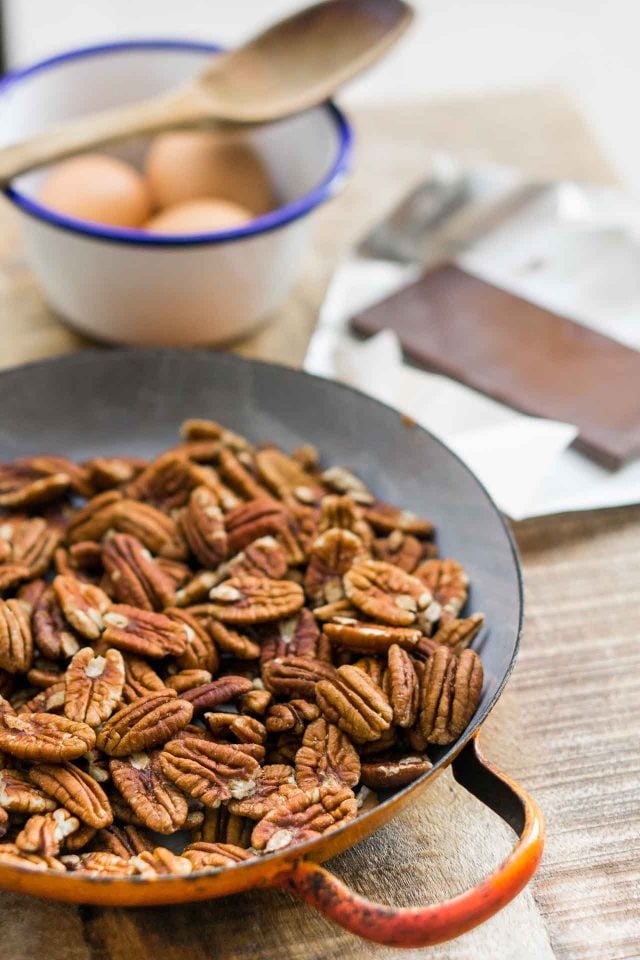
Pecans are the great American nut and at no time of the year are they more in demand than around the holidays. There are a lot of different nuts grown in the United States; walnuts, almonds, pistachios, and hazelnuts, but a pie made with toasted pecans is a holiday tradition and every year I have the urge to make one.
Recently an American membership-only storeopened in France, and while there are many French hypermarchés (mega-stores), this one caused a splash, particularly amongst Americans, because they have things like big rolls of their famous plastic wrap with that superlative cutter, IPA beers, and from what I hear, big bags of pecans.
There’s always been Metro, a similar mega-store that carries more restaurant-supply items. But there’s a huge refrigerator filled with every kind of French cheese (and butter) that you can imagine, sold whole (like an entire wheel of Brie) or butter in large blocks, and they give you down jackets to wear because you want to spend so much time in there. It really is that cold. But you need to be a professional to go there.
I don’t have room for an entire wheel of Brie – and I’m not talking about in my stomach (which I’d be up for trying…), but in my refrigerator – but I do have room for pecans, which I stockpile as the holidays get closer and closer. Over the years, I’ve made Ginger Pecan Pie and Chocolate Pecan Pie with my precious pecans that I haul back from the States because I’m not schlepping out to the boonies on the outskirts of Paris to get a bag of pecans when I can carry them 5500 miles over the Atlantic. (And sometimes pay extra in luggage fees.) That makes sense. Right?
For many people who live in Willacy County, the most important thing about the facility is that it pays guards close to $20 an hour. Other jobs in town pay less than half that.
David Correa Gomez, the city of Raymondville’s economic development coordinator, says the region is impoverished and badly needs good-paying jobs.
“If we take a step back, it’s very important to take two steps forward to compensate,” he said.
Asked whether he had any hesitations about going back into business with a company that the county once said failed to provide safe and adequate care for inmates, Guerra says “absolutely not.”
He says MTC has not offered the city any explicit assurances that it has taken steps to address the failures documented at Willacy leading up to the riots.
“Not at the moment,” Guerra says. “But we have an extreme amount of confidence in MTC because they’re highly reputable in the U.S. in terms of the operations. They have the background and the credentials to back it up.”
“We were unfortunate to have the riot in 2015,” he says, “but things happen.”
Opponents of the facility say this is a false choice between jobs and immigration detention.
“To put money on the table and to say, ‘If you lock up your brothers and sisters, we will improve the quality of your street’ is a completely false setup,” says Christina Patiño Houle, an organizer with a local advocacy group, Equal Voice Network. “To position the well-being of the few, against the well-being of the collective, I think is an absolutely false dichotomy.”
I don’t disagree, but when jobs are lacking, a lot of people are going to see the choice in that very framing and unless you can offer good jobs, they are unlikely to be moved by moral arguments. We see the same issue in the “jobs versus environment” debate, another false choice, but one that is compelling when people need to put food on the table for their children.
This is why I think my call for a federally guaranteed job is not something that is an isolated demand. Rather, it helps to solve all sorts of problems by giving workers choices. When they don’t have to worry so much about eating and housing, they are more open to making choices around their work that might eschew working for private prisons engaging in ethnic cleansing or that might say that we don’t want to pollute our communities. That changes everything by giving workers power over their lives. Capitalists, especially these private prison capitalists, rely on poor communities to provide the labor for their evil tasks. Fight that and it’s a morally good quest on a number of levels.
I adore Luke Skywalker. He’s a farm boy with a heart of gold who rebuilds the Jedi Code into something better than it was– and that revival and rebuilding culminates in him loving and forgiving Vader. It’s a triumph for Luke that has little to do with whether or not Anakin deserves anything, and I love it.
The Jedi Code, among other things, calls for ‘selfless love,’ yeah? That’s the line Anakin throws to Padme, talking about compassion. But the Jedi focused too hard on the ‘selfless’ and forgot the ‘love’ in ways that made them aloof, brittle, and cold. Anakin focused too hard on the ‘love’ and forgot the selfless– he fell into a terrible, passionate, destructive spiral that doomed everything he cherished because teenaged him was a whiny idiot.
But Luke takes in all the things he has been taught– from Yoda, from Obi Wan, from Han and Leia, his aunt and uncle. He’s told he has to kill Vader, that there is no room here for forgiveness, compassion, mercy, or faith, and he calmly refuses to listen. It’s in his decision to go to Cloud City despite Yoda’s warnings, and it’s also in his decision to surrender himself to his father’s mercies, on the faith that there is still Light in him.
And, very importantly to me, when Luke surrenders himself to Vader he is harming no one and risking no one else’s lives. He realizes he can’t be of any help to Han and Leia (because he’s a giant Force beacon of ‘rebels here!’). He has no mission whose success hinges on him. He believes there is Light in Vader, and he is willing to risk his own life on that gamble, but he doesn’t risk anyone else’s, and that’s so important.
Luke’s story in that final movie is astonishingly unimportant to the outcome of the battle, which I think is an amazing choice for their protagonist. If Luke died and failed. nothing would happen. Han and Leia would still get the shields down. The rebel fleet would still blow the battle station. Luke’s battle is an emotional and an internal one– to stand against the Dark, to not Fall. His goal is someone else’s redemption and his methods are extraordinary passive. His success hinges on his patience, his faith, and, in the end, the last remnants of his father’s love and life. He wins by believing in other people, even when they really don’t deserve it, and he wins by being willing to die for that faith. I love it. I love Luke. He’s great. He’s a giant silly goober who had no reason to think that plan would work, and I love him. What a softie.
But despite me loving that being Luke’s story, in my AU(s) (and I’m almost done with a second one here, coming soon to a theatre near you), I find it really hard to save Vader, myself. In the ‘switched at birth’ one you’re referencing here, it’s hard to imagine a Luke who just lost Alderaan forgiving anyone, so my Vader didn’t make it through that story.
But mostly I’m just not as kind as Luke. Eh. I’d make a bad Jedi anyway.
As every musical theatre aficionado knows already, Hamilton is the historic hip-hop sensation that has captured the hearts and ears of fans across the internet. Getting a ticket is hard, but the soundtrack’s on Spotify, and most have had to settle for that. Your prayers have been answered today, Hamilton fandom: The show has a national tour in the works!
Hamilton already announced an upcoming stint in Chicago, starting this September 27th at the PrivateBank Theater. Word on the street had it that other cities could end up on the docket as well. As of today, we now know that the show will tour in San Francisco at the SHN Orpheum Theater in March 2017, and then in Los Angeles’ Hollywood Pantages Theater from August 11 to December 30, 2017. After that, the show plans to tour other cities as well.
The New York production plans to run indefinitely in the interim, and the producers plan to explore a production in London—so, yes, that’s right, there are auditions happening across the planet now for this show. Polish up those resumes, actors!!
The only downside? 2017 sounds so incredibly far away, and Boston still isn’t on the list of planned cities (that’s where I live, folks). I might not get to see Hamilton for a while yet. But I can be patient! It’s going to be worth it!




















.png)

