Shared posts

24 Jan 02:53

NOAA US Temperatures Are Fake News

by tonyheller

‘You should, in science, believe logic and arguments, carefully drawn, and not authorities.’

– Richard Feynman

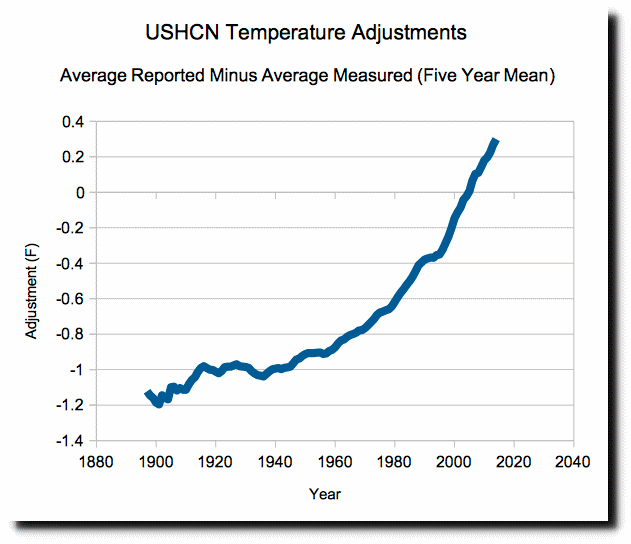
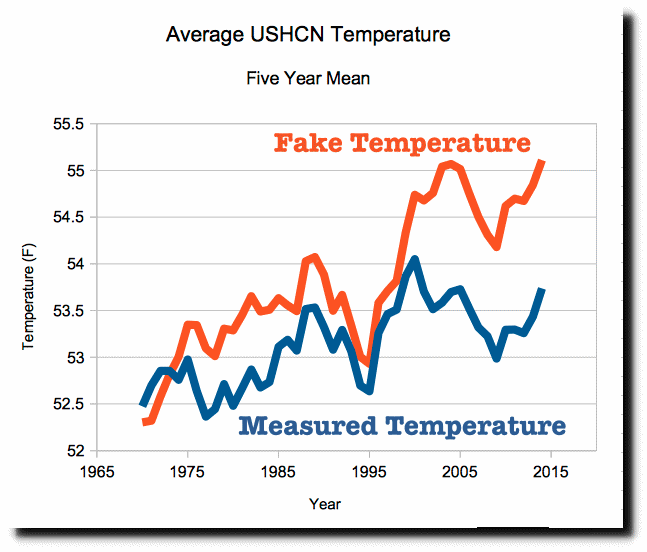
NOAA thermometers show little warming in the US since 1895, and the hottest decade was the 1930’s. But NOAA doesn’t report actual measured temperatures to the public, rather they report temperatures which have been tampered with by a small handful of employees, as seen in the red line below.

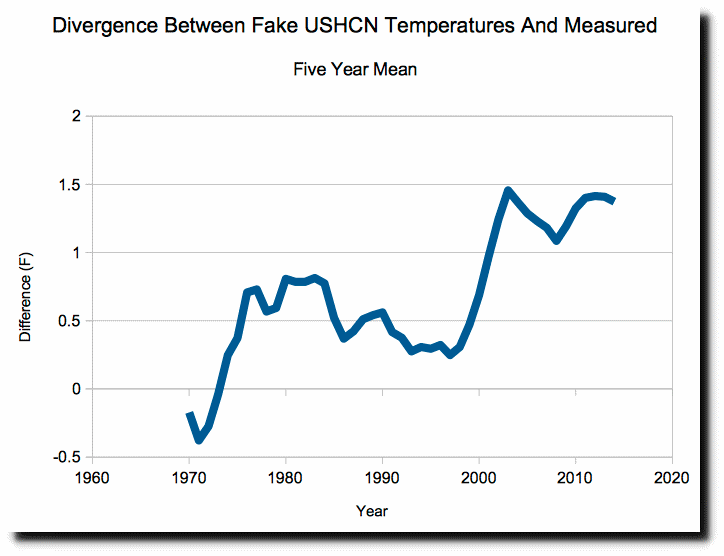
The hockey stick of data tampering is seen below. NOAA creates 1.5F warming by simply altering the data.


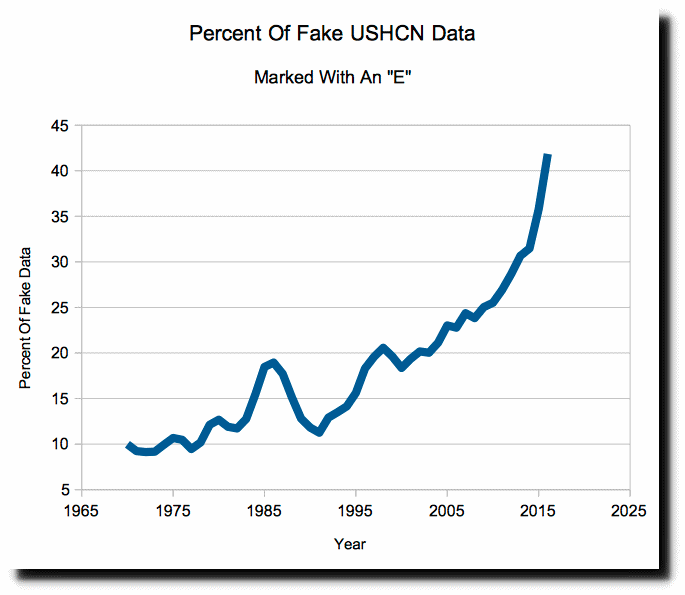
Most of this hockey stick has occurred since 1970, and is due to (quite literally) fake data. NOAA is losing lots of monthly station data. If a station doesn’t report in a particular month, NOAA simply makes the data up for that station. In the 1970’s about 10% of the data was fake, but now more than 40% of NOAA temperatures are fake.

Since the cold 1970’s, thermometers show the US warming about 1.2F. But NOAA’s fake data has warmed nearly three degrees. And fake data now comprises nearly half of the US temperature record.

The fake data completely corrupts the US temperature record.

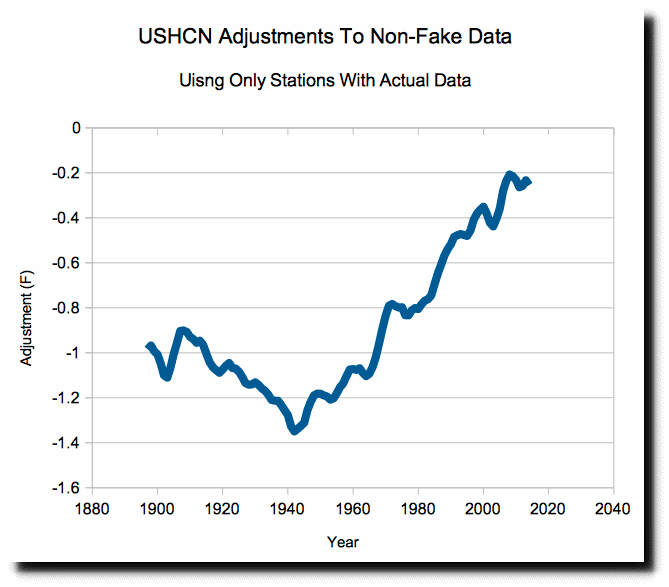
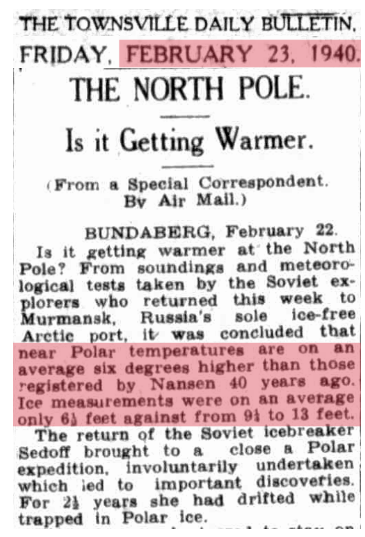
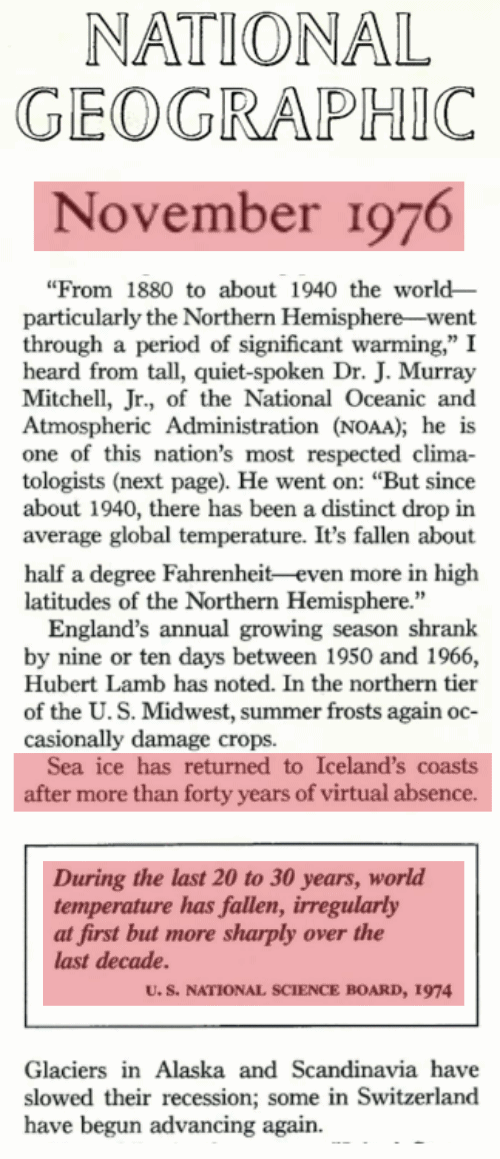
But the story gets even uglier. If we remove the fake data and only look at the adjustments to actual thermometer data, even more nefarious activity is exposed. NOAA massively cooled the hot years of the 1920’s through the 1950’s to make the heat disappear, with the maximum data tampering occurring around 1940.

Government climate scientists plotted to remove the 1940’s warmth, and discussed it in E-mails.

di2.nu/foia/1254108338.txt

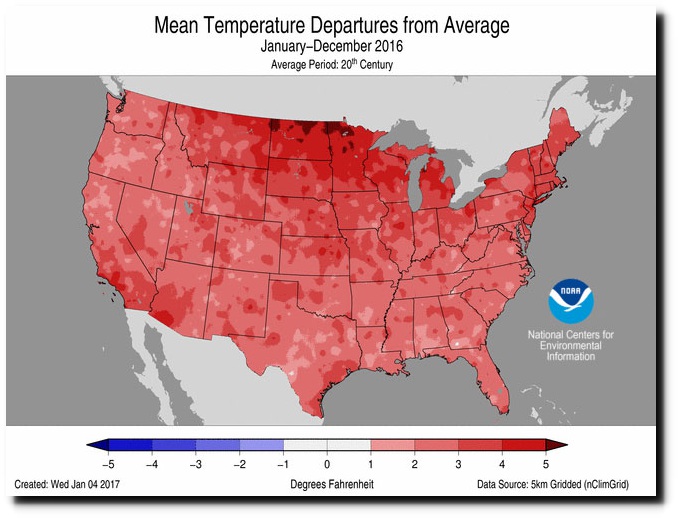
Their data tampering allows NOAA to create red hot graphs like this one, in an effort to make people believe the US is heating out of control.

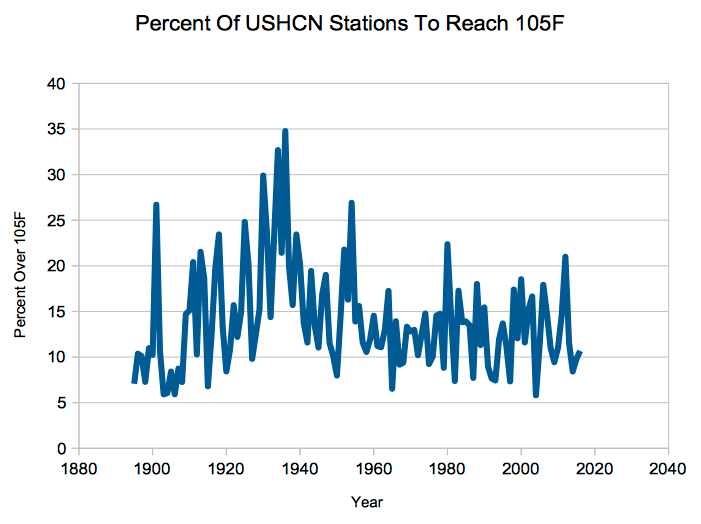
But 2016 wasn’t a hot year in the US. The area of the US affected by very hot weather was near a record low.

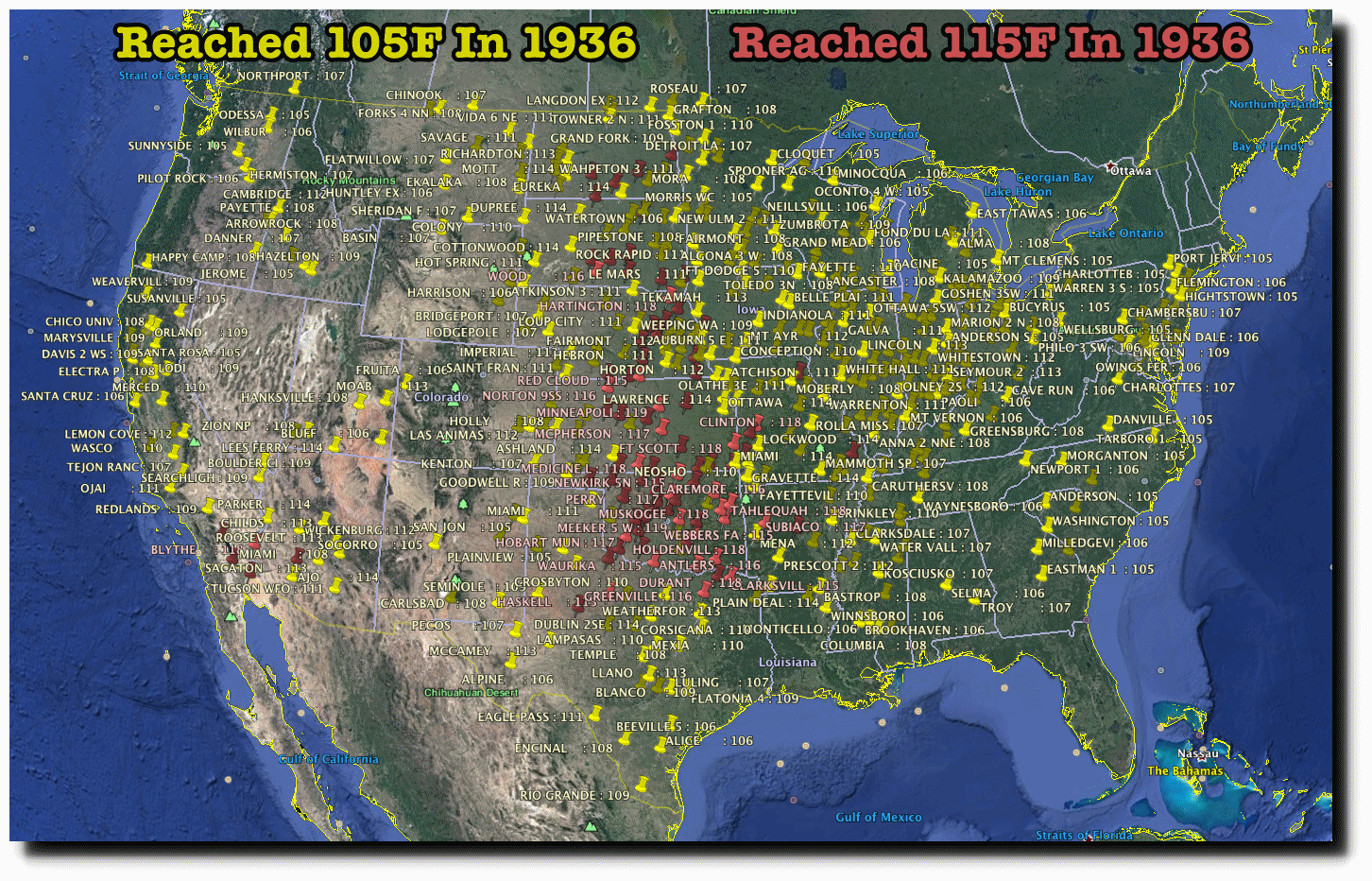
Eighty years ago, 105F temperatures were widespread throughout the US, except for New England and Florida.


But now, only a tiny percentage of the US reaches 105F.

NOAA, like almost every other government agency, has been corrupted by the Obama White House. In seven days we take our country back.

20 Jan 09:18

Donald Trump is blowing up Paul Ryan’s agenda

by James Pethokoukis

Will Washington Republicans steamroll Donald Trump? Some conservatives think so. Their logic: Trump is a policy amateur and political novice — one surrounding himself with other political novices like former Breitbart boss Steve Bannon — who lost the popular vote. The self-described billionaire also starts his term as a historically unpopular incoming president with a meager 40 percent approval rating. Then there’s his attention span, or rather the lack of one.

But if Trump is going to be a weak, distracted, and acquiescent president, no one seems to have persuaded Trump of this. As his inauguration approaches, Trump and his close surrogates continue fiercely attacking (or at least undermining) key portions of the congressional GOP agenda, especially that of House Speaker Paul Ryan. For example, the GOP seemed to have settled on a “repeal and delay” strategy to replace ObamaCare. At his news conference last week, however, Trump said the health law would be repealed and replaced “essentially simultaneously.” He is also promising to soon unveil a replacement that would provide “insurance for everybody.” Do tell.

The Ryan Republicans want to reform Medicare and other middle-class entitlements as part of their effort to balance the federal budget and keep those programs solvent. At a CNN “town hall” meeting last week, Ryan argued that Medicare is the “biggest part of the debt crisis in the future, and it is something that we have to deal with.” A few days later, incoming White House Chief of Staff Reince Priebus told ABC News’ George Stephanopoulos that “there are no plans in President-elect Trump’s policies moving forward to touch Medicare and Social Security.”

But the true heart of the GOP policy agenda is tax reform. Cutting taxes is what Republicans do. And the House GOP has a detailed plan to sharply lower personal and business tax rates that has been analyzed and scored by outside budget groups. Post-election investor enthusiasm for Trumponomics has been partly based on the notion that the proposal was pretty much buttoned-down and would get passed relatively quickly by Congress and signed by Trump.

And now Trump may have just scuppered the plan by blasting a key feature. In an interview with The Wall Street Journal, Trump had nothing positive to say about the GOP’s “border adjustment” idea to tax imports and exempt exports. He called it “complicated’ and added, “Anytime I hear border adjustment, I don’t love it. Because usually it means we’re going to get adjusted into a bad deal. That’s what happens.”

If the border adjustment feature is scrapped, it leaves Republicans with a massive budgetary hole in their economic plan, since border adjustment was supposed to raise some $1.2 trillion over a decade. Remember, Republicans have been touting their tax cut plan as not increasing the debt. Moreover, these estimates already include the possibility of more tax revenue from faster growth. Scored on a “static” rather than “dynamic” basis, the GOP tax plan might lose more than $3 trillion over a decade. And Republicans still say they want to balance the federal budget…

The border adjustment provision is supposed to be a less risky way to satisfy Trump’s various protectionist demands than outright tariffs and punitive border taxes. As one analyst from the Tax Foundation, a group that scored the House plan, told the Journal, “If you take out the border adjustment, you have to really think about an entirely different reform.”

Meanwhile, Team Trump seems more enthused about tariffs, guaranteeing women six weeks of paid maternity leave, and hectoring U.S. companies who want to offshore jobs. That stuff probably isn’t why stocks rallied after the election. Nor does it have much to do with the agenda congressional Republicans have been crafting when out of power during the Obama years.

We may find out sooner rather than later who is going to roll over whom. And whose agenda will represent the ever-evolving Republican Party.

19 Jan 23:06

When did Asians Evolve?

by evolutiontheorist

When did Asians evolve?

Humanity's path out of Africa
Humanity’s path out of Africa

The history of humanity’s long sojourn across the globe has resulted in, more or less, three main super-clades, or races: Sub-Saharan Africans, Caucasians, and Asians. The words we use for these are not perfect (“Caucasian” is particularly imprecise,) but do the job well enough.

Genetic distance map of 18 human groups, by Saitou Naruya https://en.wikipedia.org/wiki/Mongoloid#/media/File:Neighbor-joining_Tree-2.png
Genetic distance map of 18 human groups, by Saitou Naruya

The Asian super-clade has three main branches: Melanesians (and Aborigines,) who traveled south into the Pacific; the Native Americans, who settled North and South America some 13-40,000 years ago; and of course the East Asians, like the Chinese, Japanese, and Polynesians.

(Amusingly, Indians, though they clearly live in Asia, are part of the Caucasian clade because they are more closely related to Middle Easterners and Europeans than Chinese people. As a result, Indians were–for a while—recorded as “white” on US censuses, though today they are recorded as “Asian.”)

People are fond of saying that the SS African race contains the greatest genetic diversity (as well it might, due to the inclusion of groups like the Pygmies and Bushmen, who may have split off from other human groups over 100,000 years ago,) but the Asian race has the greatest pre-Columbian geographic/environmental range, stretching from Australia and Polynesia to Siberia and Greenland, from Mongolia to Patagonia.

Asian, Australian, and Melanesian ethic groups (including Indian, Middle Eastern, and Chinese) from Haak et al's dataset
Locations of Asian, Australian, and Melanesian ethic groups (including Indian, Middle Eastern, and Chinese) from Haak et al’s dataset

Trying to offer a single, coherent description of the physical appearances of such a diverse range of peoples is nearly impossible. They range in skin tone from almost white to as black as most of Africa; in stature from slight, Pygmy-like Negritos to the formidable Comanches (who in the 1800s were among the world’s tallest measured people;) and in average reported IQs from >105 to >65. (Okay, IQ isn’t appearance.)

We will be able to speak much more meaningfully about appearances when we address each of the sub-races.

Here are the relevant portions from Haak et al’s lovely dataset:

nativeamerican eskimoonge eastasian

On the left, we have the Native American DNA, from the depths of the Amazonian rainforest to the tribes of upstate New York. The olive green section are the Inuit/Eskimo and related Russian groups. The Inuit (who appear to have wiped out the earlier Dorset people,) share a great deal of DNA with other Siberians, eg the Yakuts (a Turkic people) and the Nganasan, (who speak a highly divergent language of the Samoyedic branch of the Uralic family, which also includes the Finnish, Hungarian, and Sami languages–language is a very bad guide to genetics.)

The pale peach are the Onge, who live in India’s Andaman Islands; purple the people of Papua New Guinea and Australia.

The very yellow part is all of the groups normally thought of as “East Asian,” like Japanese, Chinese, and Thai. Yellow is most dominant in the aboriginal people of Taiwan (who were there before the Chinese started migrating there in the past few hundred years,) and are the ancestors of the (not pictured) Polynesian peoples of Hawaii, Easter Island, and New Zealand. (I think they picked up some Melanesian DNA on the way.)

And on the right we have the various peoples of Siberia and central Asia.

I think it an open question whether the Melanesians and Aborigines ought to be properly classed with the other Asians, or awarded their own clade.

I totally stole this from Razib Khan, didn't I?
I stole this from Razib Khan, didn’t I?

According to Masatoshi Nei, a biology professor at Pennsylvania State University,[131]  the ancestors of today’s Asians and Caucasians split into two separate groups around 41,000 years ago, (give or take 15,000 years,) and their ancestors split from the ancestors of modern Africans–the “Out of Africa Event”–around 114,000 years ago, (give or take 34,000 years.)


The Daily Mail reports:

BERLIN (AP) — The human populations now predominant in Eurasia and East Asia probably split between 36,200 and 45,000 years ago, according to a study released Thursday.

Researchers used new techniques to analyze genetic samples from the shin bone of a young man who died at least 36,200 years ago near Kostenki-Borshchevo in what is now western Russia. The study, published in the journal Science, concludes that Kostenki man shared genetic sequences with contemporary Europeans, but not East Asians.

A separate study published last month in the journal Nature determined that a 45,000-year old sample found in Siberia contained sequences ancestral to both modern East Asians and Europeans.

Meanwhile:

In a genetic study in 2011, researchers found evidence, in DNA samples taken from strands of Aboriginal people’s hair, that the ancestors of the Aboriginal population split off from the ancestors of the European and Asian populations between 65,000 and 75,000 years ago—roughly 24,000 years before the European and Asian populations split off from each other. These Aboriginal ancestors migrated into South Asia and then into Australia…

A different study found:

The first complete sequences of the Y chromosomes of Aboriginal Australian men have revealed a deep indigenous genetic history tracing all the way back to the initial settlement of the continent 50 thousand years ago, according to a study published in the journal Current Biology today.

The Native Americans much more conveniently split off around 25,000 years ago.

Or in other words:

Also credit Robert Lindsay

So on the one hand, race is biological and real, and on the other, it’s a social construct. Australian Aborigines are more closely related to other Asians than to, say, Europeans or Africans, but the Chinese are more closely related to Europeans than to Aborigines.

nature-siberian-neanderthals-17.02.16-v2One reason why Australians and other Melanesians appear so divergent from other Asian populations maybe their Denisovan (or other human) DNA. Most (if not all) human groups appear to have picked up DNA from some other, non-Homo Sapiens source. Europeans, East Asians, and Native Americans all have a small percent of Neanderthal DNA. Africans, IIRC, have a small % of some local African homin. And Melanesians/Australians have a small % of Denisovan DNA (Denisovans were a less-well-known cousin of the Neanderthals.)


17 Jan 23:37

2017 ends on a cooler note: Gore remains less accurate than no-change after 9 years

by admin

We have updated the Climate Bet chart with the December 2016 global temperature anomaly data from UAH. (Click on the small chart to the right for a more detailed image.) 2016 was a warm El Niño year, but ended with a sharply cooler month at 0.24°C; somewhat closer to Professor Armstrong’s no-change forecast of 0.159°C than to Mr Gore’s IPCC dangerous warming trend figure for December 2016 of 0.443°C.

With the data in for 9 of the Climate Bet’s 10 years, the cumulative absolute error of the dangerous warming trend that the IPCC and Mr Gore warned that we should expect is nearly 23% greater than the error of the scientific no-change forecast that is the basis of Professor Armstrong’s bet. The no-change forecast has been more accurate in 78 of the 108 months of The Bet to-date.

Despite 30 months of The Bet in which the warming trend was more accurate, the cumulative error of the Gore/IPPC dangerous warming projection has been larger than Armstrong/no-trend forecast for all but two months of the bet so far.

13 Jan 06:44

Conservatives Over-Generalize; Liberals Under-Generalize

by evolutiontheorist

This is a theory about a general trend.

Liberals tend to be very good at learning specific, detailed bits of information, but bad at big-picture ideas. Conservatives tend to be good at big-picture ideas, but bad at specific details. In other words, liberals are the guys who can’t see the forest for the trees, while conservatives have a habit of referring to all trees as “oaks.”

Or all sodas as Cokes:

popvssodamap2

Waitress: What would y’all like to drink?
Lady: Oh, I’ll have a Coke.
Waitress: All right, what kind of Coke?
Lady: Diet Pepsi.

When conservatives speak of general trends among people, liberals are prone to protesting that “Not all X are like that.” For liberals, the fact that one guy might be an exception to a general trend is important enough to mention in any discussion. Liberals who want to un-gender pregnancy discussion, because “men can get pregnant, too,” are a perfect example of this. (See my previous post about TERFS.)

This post was inspired by a friend’s complaint that “Trump keeps saying untrue things,” to which I responded that the Hillary also says lots of untrue things. It seems to me that there is a distinct pattern in the kinds of untruths each camp engages in.

Source
Source

If you ask the average conservative to define the races of man, he’d probably tell you: black, white, and Asian. Give him a crayon and a map of the world, and he’d probably produce something like this:

Ask the average liberal to define the races of man, and he’ll tell you that race is a social construct and that there’s more genetic variation within races than between them.

Diagram of Trans-species polymorphisms, from Evo and Proud

Both of these statements are basically correct, (but see here) but in different ways. The Conservative misses the within-racial variety (and may draw the racial borders incorrectly, eg, assuming that north Africans or Australians are Black.) And the Liberal misses that race is actually a real thing, and that the issue of genetic between vs. within also holds true for different species (see: species is a social construct,) and yet we still recognize that “dog” is a useful word for describing a real category of things we encounter in the real world.

Conservatives are prone to saying things like, “Blacks commit more crime than whites,” and liberals are prone to responding that the majority of black people aren’t criminals.

nope-the-claim-trump-says-clinton-acid-washed-her-email-4623517I find that it helps a lot in understanding people if I give them the benefit of the doubt and try to understand what they mean, rather than get hung up on the exact words they use.

NBC perhaps went too far down this path when they claimed that Trump had lied for saying Clinton “acid washed” her email server, when in fact she had used an app called BleachBit. Sure, bleach is a weak base, not an acid, but I don’t think Trump was actually trying to discuss chemistry in this case.

When the newsmedia claimed that the Syrian refugees pouring into Germany would be “good for the German economy,” this was obviously false. Yes, some Syrians are exceptionally bright, hardworking, motivated people who will do their best to benefit their new home. But most refugees are traumatized and don’t speak the local language. Few people would argue that the Syrian educational system turns out grads with test scores equal to the German system. It’s one thing to take refugees for pure humanitarian reasons, because you care about them as people. It’s another thing to pretend that refugees are going to make the average German richer. They won’t.

When Trump says there is so much wrong with black communities, so much poverty and violence, he is, broadly speaking, correct. When Hillary says there is so much good in black communities, like black businesses and churches, she is, narrowly speaking, also correct.

Of course, as Conway et al caution [warning PDF]:

Prior research suggests that liberals are more complex than conservatives. However, it may be that liberals are not more complex in general, but rather only more complex on certain topic domains (while conservatives
are more complex in other domains). Four studies (comprised of over 2,500 participants) evaluated this idea. … By making only small adjustments to a popularly used dogmatism scale, results show that liberals can be significantly more dogmatic if a liberal domain is made salient. Studies 2–4 involve the domain specificity of integrative complexity. A large number of open-ended responses from college students (Studies 2 and 3) and candidates in the 2004 Presidential election (Study 4) across an array of topic domains reveals little or no main effect of political ideology on integrative complexity, but rather topic domain by ideology interactions. Liberals are higher in complexity on some topics, but conservatives are higher on others.


11 Jan 11:15

For 15 Years, New Orleans Was Divided Into Three Separate Cities

by Sarah Laskow

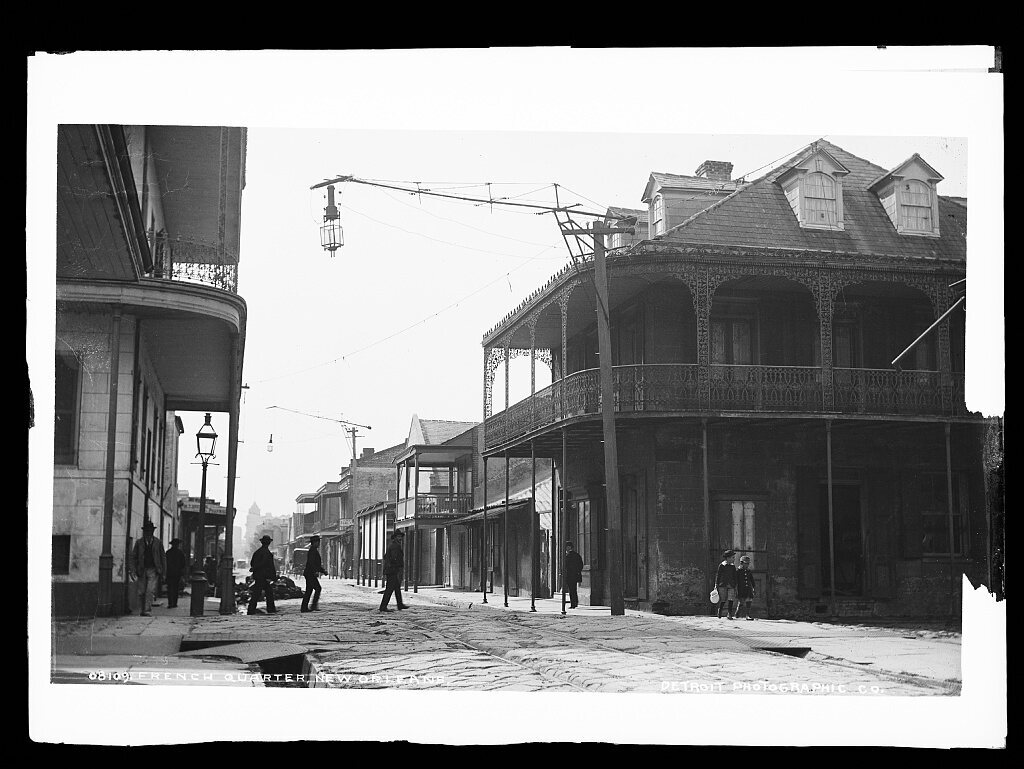
In 1803, when the United States bought New Orleans, along with the rest of the land in the Louisiana Purchase, the city had only about 8,000 people living in it. Planned on a tight grid, the city stretched just eleven blocks along a curve of the Mississippi River and six blocks back from the levee, to Rampart Street.

A little more than three decades later, New Orleans had become a world port, and in 1836 edged out New York City as the busiest export center in the United States. The population had grown to more than 60,000 people—many of them Anglo-Americans who, to the alarm of the city’s Francophone natives, had flocked to the port to make their fortunes.

Today, New Orleans trades on the languid charm of its French and Spanish past to lure visitors to its historic center, but in the early 19th century, American newcomers to the city had no patience for Louisiana's old guard, known as creoles, whom they saw as Catholic, corrupt, and overly permissive to the city’s large population of slaves and free people of color.

But in New Orleans, the American upstarts lacked the political power to change the city’s ways as fast as they would like. Instead, in 1836, the city’s Anglo-Americans convinced the state legislature to split New Orleans into pieces—three semi-autonomous municipalities divided along ethnic lines. For more than 15 years, the city was divided, while the Americans consolidated their power and re-shaped the city to their own ends.

article-image

The idea of dividing New Orleans between the Francophone old guard and the Anglophone newcomers first came up in the 1820s, when rival military factions would challenge each other’s authority, edging towards but never quite exploding into violent conflict. In his book Louisiana in the Age of Jackson, Joseph G. Tregle, Jr., the Louisiana historian who has studied this period most closely, tells how American-led sections of the militia would refuse to follow orders from foreign French officers who still held military positions. When Americans held command, the French would reciprocate.

At times, different factions of the militia would march through the streets, showing off their defiance and power, and it was during one such conflict that a local American editor, R.D. Richardson, started calling for the city to be split along ethnic lines. A rival French editor, who had fought for Napoleon, responded by offering five dollars to anyone who’d give Richardson a good whap over the head.

There were two main areas in which the entrenched French creoles made the incoming Americans crazy. The first was infrastructure: when the U.S. bought the Louisiana territory, New Orleans had no paved roads, no street signs, and no colleges. Much of the population was illiterate, and justice was dispensed according to the French legal code: Tregle calls the place “a colonial backwash of French and Spanish imperialism.”

article-image

The second was the permissive culture: Sunday in New Orleans means sitting at a café and going out dancing or perhaps to a horse race. In this city, black and white people mingled more freely than elsewhere in America, and even slaves had more leeway to move freely than in other cities.

All this shocked the Protestant, Puritan-minded American settlers, many of whom came from places in the South where the movement of black people was highly restricted and regulated. (Meanwhile, the native creole population was appalled by the crude Americans, who they called Kaintucks and vulgar Yankees.) The Anglo-American settlers tried to change everything from the city’s laws to the looser culture, but even as they gained power of New Orleans’ commercial life, they did not have enough political power to mold the city as they would have liked.

After the conflicts of the 1820s, the newcomers kept trying to split the city—if they couldn’t fix the whole place, at least they could control part of it. About a decade later, in 1836, Anglo-Americans finally got their way. New Orleans was divided into three municipalities, one Anglophone and two Francophone.

article-image

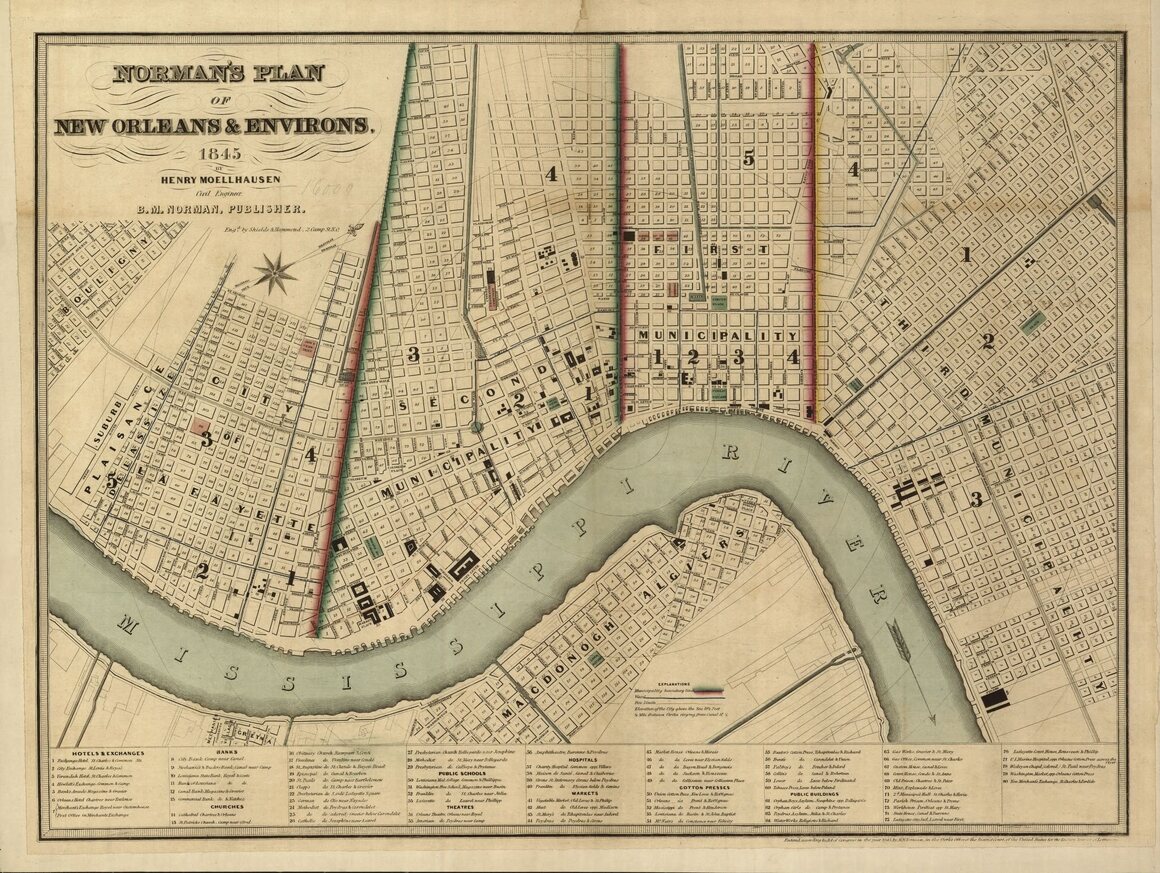
The three sections of split New Orleans roughly correspond to the today’s Central Business District, French Quarter, and Marigny neighborhood. The Second Municipality, which the Americans controlled, began at Canal Street and went upriver, past the place where the Pontchartrain Expressway cuts through the city today. The First Municipality included all of the French Quarter, from Canal to Esplanade Avenue, and the Third Municipality stretched downriver from there, through the Marigny towards today’s Bywater neighborhood. Each municipality had its own police force, its own schools, its own infrastructure, and services. In the First Municipality, English was the language of commerce and government; in the other two, French dominated.

When this story is told quickly, it’s usually said that New Orleans was a place neatly divided between old and new, French and English, a more multiracial society and a white one, with Canal Street as the clear border. But according to the work of Tregle and later historians, the divide was not initially so stark as legend might have it.

When Americans started moving to New Orleans, they moved first to the French Quarter, on the upriver side, closer to Canal Street. Only once that section of town filled up did they continue building into Faubourg Ste. Marie, the newer suburb on the far side of Canal. It was always desirable to live in the French Quarter, where by the 1830s Chartres Street had become a major commercial thoroughfare, dotted with American shops selling books, jewelry, and other goods. On the other side of Canal Street, it was common for prominent Francophone creoles to make their home in Ste. Marie, too. To the extent that there was a clear dividing line between the old and new populations, it was at St. Louis Street, close to the center of the city.

article-image

But once the city was divided in three political entities, the distinctions between the Second Municipality and the other two started to grow. Trade in the Second Municipality thrived, and bustling warehouses and insurance companies started going up on Camp and Magazine streets.

The growing economy led to a housing boom, where Greek revival architecture mixed with the brick-faced warehouses of a northeastern port city; one traveler noted that the American part of the city “lacked that mellowness of age and charm of the bizarre which set old New Orleans apart.” Whatever it lacked in beauty, though, it made up for in wealth and city services: the Second Municipality soon had a modern school system, as well as new wharves, gas lights, and paved streets.

On the other side of town, the area below Jackson Square was suffering, as poverty increased and the old French houses aged. The Third Municipality, sometimes called the “The Dirty Third,” was in particularly bad shape, since the waste of the rest of the city floated downriver to pollute its shores, air, and water. By the time the city was reunited, in 1852, its wealth had concentrated upriver: Tregle found that by 1860 the area upriver of St. Louis Street had 76 percent of the city’s taxable property.

article-image

More than any other American city at the time, New Orleans could claim to be a diverse place where people of color had more freedom than elsewhere in the South. But during the period where white newcomers divided New Orleans, the American values and laws that were shaping both the city and the new state of Louisiana were reducing those freedoms quickly. The American values imported to New Orleans included not just an emphasis on better infrastructure and education, but on more legally encoded racism, that was strictly enforced.

“On the upper side of town...white inhabitants were often times more hostile to the very notion of free people of color,” writes Richard Campanella, a contemporary historian who studies New Orleans geography. The white Americans who were gaining power were uncomfortable with the rights that slaves and free people of color had in the city and sought to restrict their movements and freedoms. There was also a second major wave of white people coming to the city, who saw themselves as being in conflict with the black population. During the 1830s, immigrants from Ireland and Germany flocked to New Orleans and made it a majority white city for the first time: in 1835, white workers protested black employment in certain desirable jobs.

As much as the division allowed trade to thrive and infrastructure to improve in parts of New Orleans, it was mostly to the benefit of white, American-born people. When the city did merge back into one city, it was only because the Anglo-Americans had enough power to control not just commerce but city politics, too. With the influx of immigrants, they outnumbered the Francophone old guard. The immigrant-heavy suburb of Lafayette was incorporated into the city, becoming today’s Garden District. Only once the Anglo-Americans could shift the whole city to their own ways did they let it become whole again.

08 Jan 01:52

How Cab Drivers Changed the London Landscape

by Linda Rodriguez McRobbie
article-image

On a cold, snowy night in January 1875, Captain G. C. Armstrong couldn’t get a cab.  

Cabs at the time were single-horse, two-wheeled hackney carriages, with a small interior that barely protected the fare from the elements and a seat at the top rear that didn’t protect the driver at all. Because it was illegal to leave a cab unattended, drivers were expected to “sit on the box” in all kinds of dreadful weather, as the brilliant Cabbie Blog explains, or pay someone to watch their cab while they nipped off to the pub for some warmth, food, and probably drink.

On this particular snowy night, Captain Armstrong – a baronet who was also the editor of The Globe – wanted a cab to take him from his home to his offices in Fleet Street. So he sent his servant round to the cab stand to fetch him one. But though there were cabs, there were no cabdrivers; those, the servant found, were all in the pub, sheltering from the storm blowing outside. And they were, to a man, too drunk to drive. When the servant returned home without a cab, he got an earful – and Captain Armstrong got an idea. Why were there no places where a cabdriver could get dry and warm without having to pay for a pint – possibly too many pints – and someone to watch his cab?

article-image

Within a month, Armstrong had teamed up with a group of like-minded philanthropic worthies, including the 7th Earl of Shaftsbury, and started the Cabmen’s Shelter Fund. Their idea was to build small shelters at existing cab stands where cabdrivers could take a break from the elements and grab something to eat or a warm (and non-alcoholic) drink. The proposed shelters, outlined in an article that appeared in the February 20, 1875 edition of the Illustrated London News, would be no more than 17 feet long by six feet wide, and 10 and a half feet tall, leaving just enough room inside for 10 to 13 (thin) men. There were railings on the roof to tether a hansom cab’s horses, and the shelters would have facilities for cooking and water. By the end of the year, at least 21 shelters – all painted the same shade of glossy hunter green, with black roofs and trims – were built and doing a brisk business in tea and coffee, chops and sausages, and bread and butter.

Even if the details of the Armstrong story aren’t quite accurate, says Jimmy Jenkins, a cabdriver for 42 years and the current director of the Cabmen’s Shelter Fund, there is a kernel of truth. Cabmen were often forced into pubs to get out of the weather, and they did sometimes drink too much; a group of worthies did form to deal with this problem in a very Victorian way. And, of course, as the story illustrates, it wasn’t solely for the benefit of the downtrodden cabman, his body buffeted by icy winds and driving rain and blisteringly cold snow, that the shelters were built.

“You got to remember, this was started by the aristocracy and it was to their benefit to have cabs. It’s quite logical really, it was for their benefit, really – they could get home quicker,” explained Jenkins, who on the phone sounds a bit like a pre-Hollywood Michael Caine. “This is what it’s all about: It was beneficial for the aristocracy because they could get home quicker, and they had more access to taxis.”

article-image

The story of London – its rich, poor and aspiring – can be told, in part, by its transportation. Hackney coaches for hire have been a part of the urban streetscape since the time of Elizabeth I, when wealthy aristos would rent out their carriages to less-wealthy aristos; the first taxi rank, according to the London Vintage Taxi Association, was established outside the Maypole in the Strand in 1674, with liveried coachmen and standard rates. The hackneys’ standards fell as their numbers rose; by the 1760s, there were at least 1,000 “hackney hell carts” clattering down London’s fetid streets. By the 1830s, the word “cab” entered the Londoner’s vocabulary with the introduction of the two-wheeled French-style “cabriolet,” and the cabriolet – with its exposed seat on the top – was the style that would dominate through the end of the century.

Cabmen did have a raw deal, and by the 1870s many people knew it. Several cities, including Birmingham, had already introduced similar shelters for the benefit of their cabmen, and in 1873, plans were afoot to build a “cabmen’s room” at the new Kingston railway station, just outside of London in Surrey. If the philanthropically-minded citizens trying to build the room raised enough money, the article from the November 15, 1873 Surrey Comet reported, they could make the “room” big enough to shelter the horses as well.

The idea to build a similar shelter in London first appeared in Lloyds’ Weekly Newspaper in early December 1874 (which may undermine the veracity of Captain Armstrong’s tale); the article described how a cabdriver trying to keep warm in London’s wet winters had to choose between waiting “out of doors with his blue fingers to his lips, or his arms flapping against the breast of his greatcoat, or else he must go into a public-house and pay for the privilege of warming himself by buying ‘something to drink’ that he does not want.” By the end of the month, according to a December 31st article in the London Evening Standard, a charity was formed and already appealing to the public for donations. 

article-image

The cost was put at £75 per shelter, according to the Evening Standard, including the gas and water facilities; other sources say the building cost was as much as £200. While donation would pay for the initial outlay, the shelters were expected to be self-sufficient within a few months of opening – cabmen would pay a small “subscription” fee of not more than 6 pence a week to keep the place staffed and working. To deal with the problem of who watched the cabs, the first two cabs in the stand would stay “live,” their drivers ready to take a fare, and keep an eye on the cabs whose drivers were having a bite or a cuppa. (This, notably, is still the case today.)

This being Victorian London, the shelters also served a social and moral purpose, to raise the status of the cabdriver in society. They all maintained the same strict standards of conduct: Cabmen were prohibited from gambling or playing cards, and in some shelters they were asked not to discuss politics. The explicit purpose of the shelters wasn’t only to keep London’s cabbies out of the elements, but also to keep them out of the pubs, so drinking alcohol was right out of the question.

By December 1903, there were 45 cabmen’s shelters scattered throughout Greater London, serving some 4,000 cabmen every day, according to the Fund’s 28th annual report, reported in The London Daily News. Though the project clearly worked, it wasn’t quite the self-perpetuating scheme the Fund’s creators had hoped; for one thing, as Cabbie Blog points out, the shelters lost money during the summer months, when the weather wasn’t so terrible. Even then, the Fund lamented, “It is a matter of regret that the work should be carried on under the disadvantages of insufficient income.” The number of cabmen’s shelters continued to rise, however, although it’s unclear how many there were at the height of their popularity; some figures claim 61, others 65, while Jenkins put the number at 114. 

article-image

But in that year, 1903, the London’s crowded streets would change in a way that would eventually doom the shelters: The first gas-powered motorcars, French imports, began prowling the roadways. The next 15 years saw the motorcar taxi trade grow in fits and starts (the name “taxi” came from the “taximeter”, the device that measured the distance the vehicle travelled). After the disastrous, deprived years of World War I, the motorcar dominated the cab trade and the need for cabmen’s shelters was necessarily decreased; the last horse on London’s streets was taken out of service in 1947.

“Basically, a horse could only go so far before having a rest… that’s why there were so many shelters,” explained Jenkins. “If a driver was taking a fare, for instance, from St. James [central London] up to Highgate [north London], that’s a six or seven-mile journey for a horse dragging a carriage. The driver would know he could go to Highgate there would probably be a shelter there, rest his horse and get a drink himself.” But after motorcars entered the picture, “You didn’t need so many shelters, you could get about quicker and you didn’t need to water a horse.” Many shelters fell into disuse; the Blitz’s nightly bomb raids between 1940 and 1941 did for the rest.

There are now only 13 cabmen’s shelters left standing; 12 of them are still operational. Eight of those are Grade II listed, meaning that they cannot be demolished or altered without permission from the local government, but all, Jenkins said, are cared for under English Heritage, which protects other important sites such as Stonehenge and Dover Castle. In the early 1990s, the Heritage of London Trust helped the Fund refurbish seven of the shelters.

article-image

Jenkins has been in charge of the Fund for the last eight years, and in his tenure has overseen the refurbishment and modernization of seven of the shelters. Some of the shelters have been moved completely – Russell Square’s shelter used to be Leicester Square’s shelter – and the Temple shelter, next up for refurbishment and sitting squarely where the proposed pedestrian Garden Bridge is expected to be installed, is being moved.

“The last one we just finished which was St. George’s Square had an almost total rebuild,” said Jenkins. “They have to be brought up to be modernized to conform with health regulations, food and hygiene regulations.” This has also meant some changes to the interior size; in renovated shelters, there is only enough room for about eight cabdrivers (the shelters are still only open to cabdrivers, although the non-driving public can order take-out at the window).

The cost for the St. George’s Square renovations came to around £40,000, Jenkins said. The Fund’s income comes largely from rents paid by the shelter-keepers to the Fund, although Jenkins said that the Fund subsidizes the shelters’ electricity, gas, and water bills. Since Jenkins began, rents have doubled and he says they’ll be going up again, to £150 a week, in 2017. But shelter-keepers are staying at their posts: The longest-serving shelter keeper has been at the Pont Street shelter for more than 30 years.

article-image

Rents aren’t the only source of revenue for the Fund. In recent years, the Fund saw a big boost from a deal with Universal Studios, which licensed the design for the shelter to use in its Wizarding World of Harry Potter attraction. Where the shelters sell bacon sarnies and paper cups of coffee to cab drivers in London, in Orlando, they sell cuddly stuffed Hedwigs and plastic souvenir cups of butterbeer to Harry Potter-mad tourists.

While the future for the London black cab might seem bleak, with the advent of cheap car-hire Uber, London’s mayor has recently pledged support to the embattled black cabs, setting aside £65 million to help the cabs become more energy efficient and forcing all cabs to accept credit card. But even if there weren’t any black cabs, to give up on a living link to the forces that moulded London’s city streets is unthinkable, said Jenkins: “Why would you want to give away your heritage, why would you want to give up something that has been passed down to you? Surely it’s better to preserve something like that.“

06 Jan 00:57

Turkey Arrests American Pastor as Terrorist

by Gallagher

Behold the mighty power of the Gülenists: they lurk behind every threat to the Turkish state (and its glorious leader, Erdogan). They can even subvert Evangelical pastors into their Islamic network—or so says the Turkish government. Sohrab Ahmari’s important piece in the Wall Street Journal tells the story of an American pastor and his wife, Andrew and Norine Brunson, who have lived and worked in Turkey for the past 23 years without incident but were detained in October in Izmir. Norine was released after two weeks, but Andrew has been transferred to a special counterterror prison and charged with “membership in an armed terrorist organization.” By which, apparently, they mean the Gülenists.

As Ahmari points out, “Brunson’s treatment is also symptomatic of growing Christian persecution in Turkey”:

“Turkish President Erdogan sees anti-Christian conspiracy theories as an effective strategy for galvanizing popular support for his one-man rule,” says Aykan Erdemir, a former member of the Turkish Parliament and a senior fellow at the Washington-based Foundation for Defense of Democracies.

A pro-government columnist in July claimed that Mr. Gülen’s mother is Jewish and his father an Armenian. Mr. Gülen himself “is a member of the Vatican Council” who “uses the methods of the Jesuit Order that captured the Vatican.” Another columnist the same month asked whether Gülenists might be hiding “in churches.” Still another tabloid doctored photographs to suggest Mr. Gülen is a Roman Catholic prelate.Mr. Erdogan’s defenders insist the president has no say over what’s printed in the papers. But that’s hard to believe in a country where the state has banned at least 120 news outlets in six months. Nor is the government’s own rhetoric much better. At an anti-coup rally in August, Prime Minister Binali Yildirim denounced Turkey’s enemies as a “crusaders’ army.”

Pastor Brunson’s story also highlights an under-recognized dynamic: the significance of American missionary ties to the Middle East. These are longstanding: American missionaries were some of the main sources through which Americans learned of the mass slaughter of Armenians in 1915; ties to the region kept the U.S. from declaring war on the Ottoman Empire when it entered World War I; and the American missionary colleges played an important role in the development of early Arab nationalism, to list just a few examples.

But long gone are the times when missionaries’ accounts filled the New York Times. Missionary work now generally occurs far from elite circles. That does not mean it does not continue—and continue to have an impact on politics and policy. As Walter Russell Mead wrote in 2015:

Evangelical missionaries aren’t fashionable topics today, and missionary history is almost totally neglected by the educational establishment, but the almost 200 years of American foreign missions has been one of the most consequential long-term movements in American history.

American missionaries played a crucial role in the rise of Christianity in East and South Asia, sub-Saharan Africa, the Pacific Islands and of Protestantism in Central and South America—an epic tale of courage, sacrifice (and occasional follies and missteps) that, for most Americans under 50, is completely unknown and untold. In the 19th and 20th centuries, missionaries opened professional doors to women both here and abroad, helped lead lead the the attack on segregation in the United States upon their return (to say nothing of the anti-slavery movement), and spread ideas about democracy, development, and medical education around the world. Missionaries and their children have also been closely involved with American foreign policy and diplomatic service.You can spend a lifetime in elite American schools and colleges without knowing that any of this ever happened—or that more than 100,000 Americans are serving abroad in this capacity today. This is one of many ways that Americans are losing touch with some of the important values and movements that shaped and continue to shape this country and the world.

While the persecution of Christians in Turkey is a new story (and one that may or may not grow, depending on what direction Erdogan, with his increasing power, steers the country), the persecution of Christians in the Middle East has been at a crisis level for several years. This makes mainstream liberals uncomfortable for several reasons, and tends to be downplayed in the pages of major newspapers as a result. But accounts of it filter back to mainstream Americans through thousands of communities tied to missionaries like Pastor Brunson.

This may go some way toward explaining the different opinions Jacksonians and coastal elites have of the Islamist threat from the Middle East, with latter tending to see the problem as largely contained and the former seeing it as reaching crisis proportions. Whatever you may think of each camp’s perspective, it’s hard to call the heartlanders less informed on this issue.
29 Dec 01:06

Looking Back

by Thomas Sowell

Any honest man, looking back on a very long life, must admit — even if only to himself — being a relic of a bygone era. Having lived long enough to have seen both "the greatest generation" that fought World War II and the gratingest generation that we see all around us today, makes being a relic of the past more of a boast than an admission.

Not everything in the past was admirable. Poet W.H. Auden called the 1930s "a low dishonest decade." So were the 1960s, which launched many of the trends we are experiencing so painfully today. Some of the fashionable notions of the 1930s reappeared in the 1960s, often using the very same discredited words and producing the same disastrous consequences.

The old are not really smarter than the young, in terms of sheer brainpower. It is just that we have already made the kinds of mistakes that the young are about to make, and we have already suffered the consequences that the young are going to suffer, if they disregard the record of the past.

If you want to understand the fatal dangers facing America today, read "The Gathering Storm" by Winston Churchill. The book is not about America, the Middle East or nuclear missiles. But it shows Europe's attitudes and delusions — aimed at peace in the years before the Second World War — which instead ended up bringing on that most terrible war in all of human history.

Black adults, during the years when I was growing up in Harlem, had far less education than black adults today — but far more common sense. In an age of artificial intelligence, too many of our schools and colleges are producing artificial stupidity, among both blacks and whites.

The first time I traveled across the Atlantic Ocean, as the plane flew into the skies over London I was struck by the thought that, in these skies, a thousand British fighter pilots fought off Hitler's air force and saved both Britain and Western civilization. But how many students today will have any idea of such things, with history being neglected in favor of politically correct rhetoric?

You cannot live a long life without having been forced to change your mind many times about people and things — including in some cases, your whole view of the world. Those who glorify the young today do them a great disservice, when this sends inexperienced young people out into the world cocksure about things on which they have barely scratched the surface.

In my first overseas trip, I was struck by blatantly obvious differences in behavior among different groups, such as the Malays and the Chinese in Malaysia — and wondered why scholars who were far more well-traveled than I was seemed not to have noticed such things, and to have resorted to all sorts of esoteric theories to explain why some groups earned higher incomes than others.

There are words that were once common, but which are seldom heard any more. The phrase "none of your business" is one of these. Today, everything seems to be the government's business or the media's business. And the word "risque" would be almost impossible to explain to young people, in a world where gross vulgarity is widespread and widely accepted.

Back when I taught at UCLA, I was constantly amazed at how little so many students knew. Finally, I could no longer restrain myself from asking a student the question that had long puzzled me: "What were you doing for the last 12 years before you got here?"

Reading about the decline and fall of the Roman Empire, and the widespread retrogressions of Western civilization that followed, was an experience that was sobering, if not crushing. Ancient history in general lets us know how long human beings have been the way they are, and dampens giddy zeal for the latest panaceas, despite how politically correct those panaceas may be.

When I was growing up, we were taught the stories of people whose inventions and scientific discoveries had expanded the lives of millions of other people. Today, students are being taught to admire those who complain, denounce and demand.

The first column I ever wrote, 39 years ago, was titled "The Profits of Doom." This was long before Al Gore made millions of dollars promoting global warming hysteria. Back in 1970, the prevailing hysteria was the threat of a new ice age — promoted by some of the same environmentalists who are promoting global warming hysteria today.

25 Dec 14:01

Americans are Moving Less

by Timothy Taylor
Americans are moving less. Here's an illustration from the US Census Bureau. The blue bars show the total number of movers (measured on the left-hand axis), while the red line shows the percentage of Americans who moved (measured on the right-hand axis). Back in the 1940s and 1950s, it wasn't unusual to have 20% of Americans move in a year, but now it's down to about 12%.

Moving in America

The Census Bureau has also released a bunch of statistical tables on the various dimensions of geographic mobility, for those with a need to graze through the data. "Geographical Mobility: 2015 to 2016" focuses on the changes in the last year, while "CPS Historical Migration/Geographic Mobility Tables" offers a longer term view.

For example, one figure shows that between the 2002-3 and 2015-16 measurements, the share of moves that were 50 miles or less rose from 32.3% of all moves to 42.3% of all moves. The main offsetting decline was in moves of between 200 to 499 miles, which fell from 20.7% of all moves back in 2002-3 to 13.8% in 2015-16.

Another shows that Compared with the answers in 1998-1999, a large share of movers say that their reason is to establish their own household, be closer to work, or find cheaper housing. On the other side, a smaller share of movers say that the main reason was to own, rather than rent, or because they wanted a new or better home or apartment

It's hard to know if the decline in labor force mobility is a real problem. The difficulty is that explaining why the fall has occurred has proven difficult, for reasons I've discussed in "Less Migration Within the United States" (August 24, 2011) and "Updates on the US Migration Puzzle" (August 6, 2013).

Basically, the problem is that a lot of the explanations that might seem to make sense don't work very well on closer examination. For example, this trend to lower rates of moving has been going on since the 1980s, so it's clearly not related to a specific recession or recovery. It's also not related to patterns like an aging US population, or rising incomes, or patterns of jobs or homeownership. The decline in moving isn't notably greater after adjusting for these kinds of factors.

One possible explanations is that the US has become more similar across regions, so there is just less motivation to move. Another is that information  has become more available between regions, so people are less likely to move when just looking for work, and instead wait until they have a job in hand before moving.

Other hypothesis are potentially more concerning.  It may be that the the lower rate of moving is because over time the US economy is becoming less flexible and dynamic, in the sense that rates of job creation and destruction are declining, as discussed in Are US Labor Markets Becoming Less Fluid?" (January 9, 2015). A related factor could be that the role of new firms in job creation has been declining, as discussed in "The Decline of US Entrepreneurship" (August 4, 2014). I've heard some arguments that a number of big US cities which used to be magnets for in-migration from the rest of the country have experienced big run-ups in housing prices over time, which makes people less likely to relocate to those areas unless they already have a higher-paying job in hand.

When people move, they don't just change their own situation. They also provide a connection and a trustworthy flow of information back to others at their place of origin, which sometimes leads to additional moves. Sure, it's the 21st century and you can learn all sorts of things about a different location with a web search. But a personal connection to someone who knows you, and your location, as well as the new location, is still a meaningful piece of information.

22 Dec 23:53

Coal jobs were lost to automation, not trade

by ssumner

A commenter named dwb left this comment:

The “technological change” that killed coal jobs is the 1-2-3 punch of cheap natural gas, low electricity demand, and Obama’s war on fossil fuels.

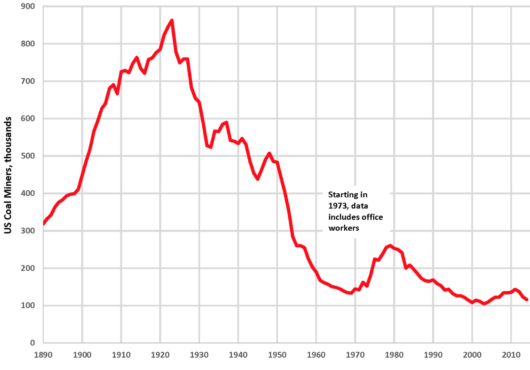
At least he doesn’t blame trade.  Even so, this is basically false—except for very recently, coal jobs have been lost to automation. Here’s employment in the coal industry:

screen-shot-2016-12-21-at-12-03-08-pm

It’s even worse than it looks, as office jobs were added in 1973, creating an artificial surge in the data.  If you just count actual miners, the job losses have been far worse.  But even this graph shows a loss from 870,000 jobs to about 110,000, slightly worse than in steel.

So you might assume that our coal industry is being overwhelmed by imports, right?  No, over the past 5 years we’ve been net exporters of coal, in the range of 7% to 12% of total production.

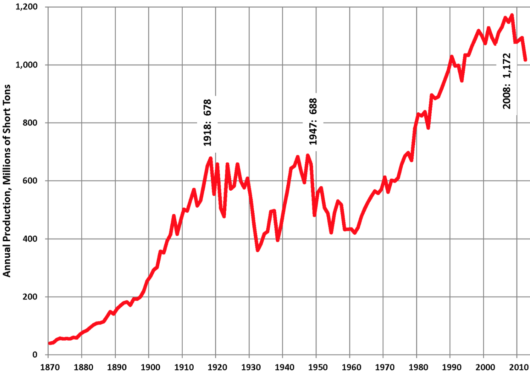
If it’s not imports, then production must be being hammered by competition from oil and gas, right?  Not really, as the following graph shows, the coal industry has been increasing production in recent decades, until the past few years when competition from oil and gas really did eat into production:

screen-shot-2016-12-21-at-12-08-16-pm

So why have so many coal jobs disappeared?  The answer is simple, automation. We are producing nearly twice as much coal as when I was young, and we are doing so with far fewer workers.

Some commenters think that job loss due to automation is less painful than job loss due to trade.  In fact, they are equally painful.  Jobs lost to automation don’t occur gradually over time, through attrition, they occur in waves, often during recessions. Thus in steel, 1000s of jobs are lost when US Steel or Bethlehem shut down old mills, and Nucor and Chaparral open new more efficient mills in other parts of the country. Lots of steel jobs lost in Pittsburgh are replaced with a smaller number gained in Texas.

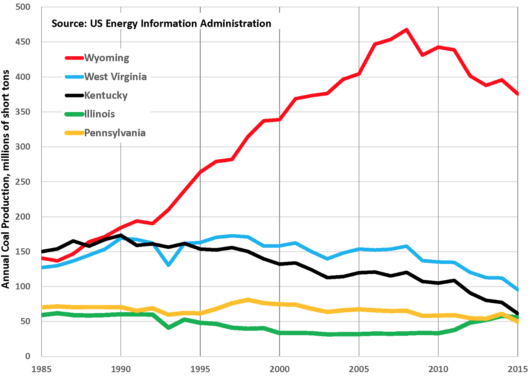
Something similar happens in coal.  Big new strip mines in Wyoming use huge shovels that replace 100 workers in a West Virginia mine that shuts down.  Here’s the production of coal by state:

screen-shot-2016-12-21-at-12-14-21-pm

If Wyoming were another country, the West Virginia miners would be screaming at their representatives that they need “protection” from cheap Wyoming imports. But because Wyoming is as American as apple pie, nobody advocates tariffs, even though the economic issues are exactly the same as when Ohio steel is impacted by Chinese imports.

I see an orgy of sanctimonious commentary in the media about how we have to pay more attention to the suffering of Ohio steel workers and West Virginia coal miners.  OK, but how many of those pundits realize that the interests of those two groups are diametrically opposed?  If Trump pursues a protectionist policy to help steel, it will hurt American coal exports.  TPP would be a boom to West Virginia, while threatening Ohio manufacturers.

But at a deeper level, the problems facing coal and steel are exactly the same.  In the US, and indeed almost everywhere in the world, automation is rapidly reducing employment in mining and manufacturing.  That problem is not going to go away, indeed with advances in robotics it will get even worse.  Trump can make a few symbolic moves (Carrier, weaker environmental laws, etc.) which will save a handful of jobs, and cost other jobs that are invisible to the public, but it won’t change anything fundamental. It will just give us a dirtier, hotter planet.  And rust belt workers will still be angry.

It’s always comforting to demagogue the issue by blaming foreigners for our woes; but they are doing the same—blaming other foreigners, including us.


22 Dec 23:25

Californians See Their First Pension Cut

by Harry Zieve Cohen
Whig Zhou

这系统不死才怪

For years, we’ve been warning this day was coming: California pensioners in the small town of Loyalton have just been told that their benefits will be cut in 2017. Fox Business reports (h/t Pension Tsunami):

For the first time in its 85-year history, the California Public Employees Retirement System, CalPERS, is drastically cutting benefits for public retirees. Starting January 1st, four retired City of Loyalton public employees will have their pensions cut 60 percent.  For 71-year-old Patsy Jardin, that means her pension will drop from about $49,000 a year to a little more than $19,000.

In an interview with the FOX Business Network, Patsy asked, “How am I going to make it now? What am I going to do?”Fellow Loyalton retiree John Cussins is asking the same question since his pension will also drop 60 percent, to $1,523 a month.

Three years ago, Loyalton pulled out of CalPERS for current employees after being told that its accounts were only 40 percent funded even though the city had reliably paid its dues to the system. Now, CalPERS openly admits it’s punishing current Loyalton retirees for that decision.

This is just the beginning. CalPERS is only 65 percent funded overall, after failing to realize its expected 7.5 percent return. Fox explains what’s likely to happen next:

CalPERS is actually considering cutting its “discount rate” to just 6.4% to reflect what it expects to be smaller returns in the future.  That will require cities, towns and other municipal entities in the CalPERS system to pay more money to cover their employees. Some may have to raise taxes to do it. Others may opt to leave CalPERS just as Loyalton did.

CalPERS appears to be using Loyalton to send a signal to others considering pulling out of the fund. But neither staying nor leaving is a good option here. Either benefits will be drastically cut or taxes will go up to fund them. The only alternative would be a federal bailout, and with a GOP-controlled Congress and White House, there’s a fat chance of California getting that.

22 Dec 23:13

Chesterfield's Crooked Spire in Chesterfield, England

St. Mary and All Saints Church's spire.

St. Mary and All Saints Church was built in the late 13th century. It is the largest church in Derbyshire, built in local stone in a Decorated Gothic style. Altogether it's a church much like any other in England, unremarkable except for its strangely crooked tower. The 228-foot-high spire leans, spectacularly, nine feet from centre and is visibly twisted in a Tim Burton-esque fashion.

The wooden framed spire was added to the stone tower in the early 1360s. It was initially believed that the twisting was a result of all the skilled craftsmen having died off in the Black Plague, leaving only unskilled laborers to construct the church spire.

The theory now is that the distortion was caused by the lead covering added to the wood shingles some years after initial construction. During the day, the south side of the tower heats up in the sun, causing the lead there to expand faster than that on the north side. This imposes a twisting movement due to the pattern in which the 33 tonnes of lead were applied. Also, in the 14th century it was common to use unseasoned timber during construction as seasoned wood was too hard to work with the hand tools available at the time. This would cause the wood to warp with the shingles, further facilitating the twist.

As usual, folklore provides much more interesting reasoning for the strange phenomenon. Several local legends hold the Devil responsible. In one tale, a blacksmith was fitting a horseshoe to the Devil’s hoof and knocked a nail into the soft part of his foot. The Devil then jumped over the town in pain, knocking the spire out of shape as he passed.  Another story has the Devil sitting on the spire and wrapping his tail around it. The people of the town rang the church bells and the Devil, frightened by the noise, tried to escape with his tail still wound round the spire, causing it to twist.

Another, somewhat cheeky story is that that a virgin from Chesterfield once married in the church and the building was so surprised that the spire turned around to look at the bride. The legend is that that if another virgin from Chesterfield marries in the church, the spire will straighten up again (in some versions it is specifically a virgin from a particular part of the town or even from the nearby city of Sheffield, depending on who the teller wants to wind up).

22 Dec 11:52

What would a Communist South Africa have been like?

by Martin Plaut

James Myburg, who runs the excellent Politicsweb site has posted this thoughtful article.

Its aim is to look at the ANC’s relationship with the South African Communist Party and their views on Western democracy.

In so doing he raises the question of how the country would have emerged if the SACP had been the driving force.

Martin


Who is the real ANC?

James Myburgh |
22 December 2016
mandela-londonJames Myburgh on the roots of liberal and Western misunderstanding of the liberation movement
For close to fifty years the truth of Nelson Mandela’s membership of the South African Communist Party in the early 1960s – and to a somewhat lesser extent Walter Sisulu’s – was attended by a “bodyguard of lies.”

Mandela denied his membership of the Communist Party in his Treason Trial testimony in 1960 and at the Rivonia Trial in 1964 (as did Sisulu). This denial was repeated in Mandela’s autobiography published in 1993 and perpetuated by Anthony Sampson in his authorised biography of Mandela published in 1999.

Shortly before he died Walter Sisulu told his biographer that he had indeed joined the SACP in 1955, after an initiation period in 1954, and been co-opted on the Central Committee in 1956.

In the two years before Mandela’s death books by Stephen Ellis and Irina Filatova established that Mandela too had been a member of the SACP’s Central Committee at the critical time of the turn to armed struggle in the early 1960s. This was confirmed by both the SACP and ANC in statements issued after Mandela’s death in December 2013.

It remains unclear when, and under what circumstances, Mandela joined the Party but the 1975 prison manuscript of his autobiography suggested an earlier and deeper conversion to Marxist-Leninism than previously assumed.

Ellis and Filatova’s uncovering of this secret history has certainly forced a revision in the standard accounts of the ANC’s turn to the armed struggle in the early 1960s. But its relevance for our understanding of post-apartheid politics remains unclear to many.

Once the evidence to the contrary became overwhelming the claim that ‘Mandela was never a member of the Communist Party’ switched over to the challenge, ‘So what if he was?’

The answer to this lies, partly at least, in how we interpret two of the most important historical documents of the liberation movement: Mandela’s statement from the dock at the Rivonia Trial in April 1964 (“the Statement”), and The Road to South African Freedom: The Programme of the SACP (“the Programme”) adopted some eighteen months before.

Mandela’s statement from the dock

The SACP’s decision to embark on the path of armed struggle was first taken by a conference of the Party in December 1960, having earlier received the green light to do so from the Soviet Union and Communist China, with Mandela and Sisulu in attendance.

Mandela had then played the central role in persuading the ANC’s National Executive Committee to agree to the formation of Umkhonto we Sizwe in mid-1961 as an organisation separate from the ANC. MK had launched its first sabotage operations, and released its manifesto, on 16 December 1961. Party members had monopolised positions in the MK High Command in its first years.

Mandela had, while operating underground, moved to Lilliesleaf farm in Rivonia soon after its purchase by the SACP on 21 August 1961. On the 10th of January 1962 he had embarked on his Africa tour, returning briefly to Rivonia on the 24th of July that year. Two days later he travelled down to Durban. On the way back to Johannesburg on the 5th August he was arrested by the police just outside Howick after the police had been tipped off by CIA agent Donald Rickard about his whereabouts.[1]

Although Mandela represented himself in the trial that began on 22nd October 1962 he was assisted by Advocate Bob Hepple, a member of the SACP Central Committee at this time. On 7th November he was sentenced to a five year jail term by the magistrate for incitement and leaving the country without a passport.

In July 1963 Lillieslief farm was raided by the police and a number of conspirators arrested. Among the documents seized were a series of draft lectures in Mandela’s handwriting titled “Part One (How to be a Good Communist)”, “Chapter Two (Dialectical Materialism)” and “Political economy”.

The following year Mandela and nine others were brought to trial on charges of sabotage and furthering the objects of Communism. The lead counsel was Advocate Bram Fischer QC, another member of the SACP Central Committee. He was assisted by Vernon Berrange, Arthur Chaskalson and George Bizos.

The defence strategy, as Mandela later put it, involved admitting to what the state already knew from the copious documentation seized at Rivonia but denying what it didn’t or what was dangerous to the cause. The later clearly included the precise extent of Communist influence on the ANC and MK and, where possible, the Party membership of the accused. Instead, emphasis was placed upon the ANC leadership’s historic commitment to a non-racial democracy (which was certainly true of Albert Luthuli’s position.)

A document prepared by defence attorneys for the guidance of counsel in the case stated that, “Throughout the whole of its history the A.N.C. has stood for equal rights for all races in this country. It has clung to the principle that there should be no oppression of any race by another; and that there should be no discrimination against any human being on the ground of his race or colour.”

The argument to be made was that the obduracy of successive white governments to these reasonable demands had pushed the “patience and forbearance” of the African majority to breaking point, hence the formation of MK.

On 20 April 1964 Mandela made his famous statement from the dock. This was a speech drafted in consultation with various people including his lawyers and his co-accused. In his biography of the young Mandela David James Smith says that he was speaking “in a sense, not just for himself but for all the accused and indeed, for the entire liberation movement. He would take the chance of this platform, with the whole world listening, to make a thorough statement of their aims and their beliefs.” In his memoirs one of his co-accused, Ahmed Kathrada, commented: “Of course we had read the address beforehand, discussed and unanimously approved it.”

While admitting to be a socialist attracted to the idea of a classless society, in his speech, Mandela denied being a member of the Communist Party. He presented himself as an African Nationalist and an African Patriot and placed this ideology in contra-distinction with the ideas of his Communist allies. He commented that while Communists may regard “the parliamentary system of the West as undemocratic and reactionary” he was an “admirer of such a system.”

“The Magna Carta, the Petition of Rights and the Bill of Rights, are documents which are held in veneration by democrats throughout the world. I have great respect for British political institutions, and for the country’s system of justice. I regard the British Parliament as the most democratic institution in the world, and the independence and impartiality of its judiciary never fail to arouse my admiration. The American Congress, that country’s doctrine of separation of powers, as well as the independence of its judiciary arouse in me similar sentiments.”

He added that he had been influenced in his thinking by both West and East and sought to borrow the best of both in his search for a political formula (Sisulu said something very similar in his evidence). He then turned to how he had come to write the documents on ‘How to be a Good Communist’ and ‘Dialectical Materialism’ that had been presented as exhibits in the trial. He claimed that an old friend – whom he would name as Moses Kotane in his 1993 autobiography – had long been trying unsuccessfully to persuade him to join the SACP:

“In order to convince me that I should join the Communist Party he, from time to time, gave me Marxist literature to read, though I did not always find time to do this…. I saw him on several occasions at Lilliesleaf Farm, and on one of the last of these occasions he was busy writing with books around him. When I asked him what he was doing, he told me that he was busy writing lectures for use in the Communist Party, and suggested that I should read them. There were several lectures in draft form.

After I had done so, I told him that they seemed far too complicated for the ordinary reader…. in that the language was obtuse and they were full of the usual Communistic clichés and jargon… He said it was impossible to simplify the language, without losing the effect of what the author was trying to stress. I disagreed with him, and then he asked me to see whether I could re- draft the lectures in the simplified form suggested by me. I agreed to help him, and set to work in an endeavour to do this, but I never finished the task as I later became occupied with other practical work which was more important. I never again saw the unfinished manuscript until it was produced at the trial.”

In response to the prosecution’s suggestion that “Umkhonto was the inspiration of the Communist Party” which had sought to exploit the “imaginary grievances” of the African population for its own nefarious ends Mandela spoke sincerely and movingly of the cruelties and injustices of white supremacy, and the severe disabilities that black Africans suffered from under this system. He then turned to what it was that the ANC and MK were fighting for:

“We [the African people] want a just share in the whole of South Africa; we want security and a stake in society. Above all, my lord, we want equal political rights – because without them our disabilities will be permanent. I know this sounds revolutionary to the Whites in this country, because of the majority of voters will be Africans. This makes the white man fear democracy. But this fear cannot be allowed to stand in the way of the only solution which will guarantee racial harmony and freedom for all.

It is not true that the enfranchisement of all will result in racial domination. Political division, based on colour, is entirely artificial, and when it disappears, so will the domination of one colour group by another. The A.N.C. has spent half a century fighting against racialism. When it triumphs, as it certainly must, it will not change that policy.

This then is what the A.N.C. is fighting. Our struggle is a truly national one. It is a struggle of the African people, inspired by our own suffering and our own experience. It is a struggle for the right to live.

During my lifetime I have dedicated my life to this struggle of the African people. I have fought against White domination, and I have fought against Black domination. I have cherished the ideal of a democratic and free society in which all persons; live together in harmony and with equal opportunities. It is an ideal which I hope to live for, and to see realised. But my lord, if needs be, it is an ideal for which I am prepared to die.”

In his authorised biography of Mandela Sampson wrote that these “words reverberated round the world, providing a manifesto for anti-apartheid campaigners everywhere”; David James Smith that “If it is not the greatest political speech of the last 100 years, it is certainly among the most significant.”

As Rian Malan has noted the words from this speech still echo today: “Type Mandela’s name into Google, and you come upon millions of essays, articles and book-length hagiographies depicting Madiba in exactly the way he presented himself in that speech: a black liberal, driven to take up arms by a white supremacist state that seemed utterly impermeable to calls for dialogue.”

The SACP’s Road to South African Freedom

Although far less well known in the West the Road to South African Freedom is, in its own way, as influential as Mandela’s statement. The background to it is as follows:

At the SACP’s conference in December 1960, at which the turn to violence was decided upon, two Central Committee members, Michael Harmel and Moses Kotane, had been appointed to prepare a draft statement of the policy and programme of the SACP for discussion.

In his prison manuscript Mandela states that fairly soon after moving to Lilieslief he was joined by Harmel who had been “given an important political assignment and he needed a quiet and safe place where he could work full time.” This assignment was probably the finalisation of the SACP’s draft programme.

A draft was completed and adopted by the Central Committee and was subsequently circulated to members in early 1962. Bob Hepple was brought on board to assist later in the year, and according to his account, a substantially revised version was produced by Harmel and Kotane in a three week period between August and September 1962. By this time Mandela was in prison. In his trial a few years later Fischer admitted in his statement to the court to drawing up a rough draft of the introduction.

The Road to South African Freedom: The Programme of the South African Communist Party was then adopted at a conference in Johannesburg in October 1962. According to former Central Committee member Bartholomew Hlapane’s testimony as a state witness in Fischer’s trial those in attendance included: Joe Slovo, Ruth Slovo, Michael Harmel, Rusty Bernstein, Hilda Bernstein, Bob Hepple, Fred Carneson, Moses Kotane, Duma Nokwe, Dan Tloome, Walter Sisulu, Govan Mbeki, Ahmed Kathrada, Billy Nair, M.P. Naicker, Stephen Dlamini, Joe Matthews, Mark Shope, and others whose names he did not know.

In his account Hepple says Kotane, Sisulu, JB Marks, MP Naicker, Govan Mbeki, Joe Slovo and Rusty Bernstein were elected to the Central Committee at this conference and they immediately co-opted Nokwe, Shope, Harmel, Fischer, First, and Carneson.

The Programme was subsequently distributed by the Party as a pamphlet, and published in the African Communist early the following year (see here – PDF). When the police raided Lilieslief farm in Rivonia on 11 July 1963 – arresting Sisulu, Mbeki, Kathrada, Bernstein, Hepple, Raymond Mhlaba and Dennis Goldberg on the spot – they also seized numerous copies of the Programme in draft and final form.

The 1962 Programme, which was primarily drafted by Harmel, applied Lenin’s Theory of Imperialism internally to South Africa through the thesis of Colonialism of a Special Type. In essence this said that the white minority in South Africa had acquired all its wealth, and advantages, through the brutal robbery and exploitation of the black majority over the previous 300 years.

While the Programme envisaged an eventual transition to socialism this was not seen as the priority in the present. It stated that “As its immediate and foremost task, the South African Communist Party works for a united front of national liberation. It strives to unite all sections and classes of oppressed and democratic people for a national democratic revolution to destroy White domination. The main content of this Revolution will be the national liberation of the African people.”

The expectation of the SACP theoreticians was that the overthrow of white rule in South Africa was imminent. As Harmel had put in an African Communist article earlier in 1962 “the doom of the White colonialists of South Africa and the victory of the oppressed people of this country” was becoming ever-nearer and more certain. The Programme itself stated: “the vicious type of colonialism embodied in the present Republic of South Africa cannot long endure. Its downfall and the victory of the South African democratic revolution are certain in the near future.”

Perhaps for this reason the Party was now willing to declare its real goals. It is as a result very clear from the Programme (in contrast to the more ambiguously phrased Freedom Charter) that this first revolution – which would both precede and make possible a later transition to socialism – involved not just the extension of political rights to the previously disenfranchised and the abolition of legislation that discriminated against the black majority, but a fundamental racial reordering of society.

The idea that white South Africans had acquired their wealth wrongly justified the seizure of their land, positions, and property, so that this could be returned to ‘the people’ from whom it had supposedly been taken. The “immediate tasks” of the National Democratic Revolution proposed by the Programme envisage the Africanisation of the state and private sector, the nationalisation of much of the economy, and the takeover of white-owned farmland.

The Programme also clearly planned for a fundamental assault on the institutions, principles and rights basic to Western liberal democracy, following the initial seizure of power. The existing state and governmental institutions would be ‘destroyed’, ‘disloyal’ officials would be purged from the state and judiciary, ‘counterrevolutionary propaganda’ would be forbidden, and the ‘utmost vigilance’ exercised against those trying to restore ‘white colonialism’. It contains the striking statement that in order to preserve and extend the gains of this revolution a “vigorous and vigilant dictatorship must be maintained by the people against the former dominating and exploiting classes.”

Much of the vicious political repression, so characteristic of communist seizures of power, is thus front-loaded into this initial national revolution. The difference here is that would have been directed not at the middle class as a whole (the ‘national bourgeoisie’ being a leading force of the revolution) but at the white minority who then made up most of that class.

The Road to South African Freedom is an incredibly powerful and brilliantly written manifesto less for socialism than revolutionary African nationalism. Though not quite complete at this point the conflation of race and class so characteristic of later ANC/SACP ideology – not to mention anti-colonial nationalism / Marxist-Leninism (including Chinese Communism) more generally – is evident throughout the document.

The oppressed classes are equated with the black African majority (‘the people’) and the ‘exploiting classes’ (more-or-less) with the white minority as a group. The commitment of the liberation movement to ‘non-racialism’ extended to those few whites who actively made common cause with the oppressed. Such ‘white democrats’ were regarded as being ‘part and parcel of the people’; the great bulk of the white population, including liberal opponents of apartheid, were not.

Analysis

In the many memoirs and accounts dealing with the Rivonia trial that have been written it is difficult to find any reference to the Road to South African Freedom and its adoption. Bob Hepple’s book is one of the few exceptions, but even it elides what the Programme was actually proposing (as does Stephen Clingman in his biography of Bram Fischer).

This is odd for a number of reasons. Firstly, setting aside the question of Mandela’s membership of the Party, this was the actual policy and programme of the organisation to which almost all of the accused belonged. Several of them had attended the conference at which the Programme had been formally adopted. The accused’s lead counsel, Bram Fischer, had even drafted parts of it.

Secondly, the Programme represents not just the foundational document of SACP ideology but of later ANC ideology as well. The concepts of Colonialism of a Special Type and the National Democratic Revolution were incorporated in the ANC’s own programme in its 1969 Strategy & Tactics. In 1989 the SACP commented that “The 1962 programme has made an indelible contribution to the scientific analysis of the situation in South Africa, and to practical revolutionary work for national liberation. It has proved to be a major guiding light over more than a quarter of a century of struggle, inspiring the work of party and non-party militants alike.”

While the collapse of communism in 1989 pulled the rug from underneath any possible transition to socialism, ANC leaders remained wedded to the nationalist components of the Programme even as they may have left the SACP. Its enduring influence can be seen, for instance, in President Thabo Mbeki’s famous “I am an African” (1996) and “Two Nations” (1998) speeches.

In terms of ideology and programme the liberation movement remained openly committed after 1994 to the analysis of South African history and society contained in ‘Colonialism of a Special Type’ and the goals of the National Democratic Revolution. This is reflected in the innumerable laws passed by successive ANC governments enforcing escalating levels of racial discrimination against South Africa’s racial minorities, and particularly its white minority.

While these two documents contain extraordinarily powerful and eloquent denunciations of the injustices of white rule they represent two completely incompatible visions of what the accused as a whole were actually fighting for. For as long as Mandela and Sisulu’s membership of the Party in the early 1960s remained unknown or disputed they could be regarded as representing different strands of opinion in the liberation movement – liberal African nationalist and Communist.

We now know, thanks to the research of Ellis and Filatova, that much the same Party leadership that drafted and adopted the Road to South African Freedom also collectively decided upon the defence strategy in the Rivonia Trial expressed in Mandela’s Statement (and Sisulu’s testimony).

If one picks up the thread beginning with the falsehood that he had never been a member of the Communist Party the plausibility of much of what Mandela then says about his political beliefs in his Statement also unravels. His expressed admiration for the institutions of Western democracy seems designed to mislead, in the context, and are inconsistent with his own court testimony in the Treason Trial in 1960 (let alone the Party’s Programme).

His account of how he came to write his notes on “How to be a Good Communist” and “Dialectical Materialism” also come across as contrived, though no doubt the Party leaders did debate the best way of conveying Marxist-Leninist ideas in jargon free language.[2]

Though he was in prison by the time it was formally adopted the final version of the party’s Programme does raise questions over the famous final paragraphs of Mandela’s speech. It is obviously not possible to support both the imposition of a “vigorous and vigilant dictatorship” on a country and the ideal of a “free and democratic society”. These are concepts which are simply irreconcilable.

Conclusion

While the Programme represented properly adopted SACP (and later ANC) policy – to which almost all the accused were committed as Party members – the Statement was clearly intended to designed to, on the one hand, appeal to and win over liberal Western public opinion to the ANC/SACP’s cause and, on the other, draw attention away from the actual declared intentions of the accused.

It did this extraordinarily successfully. To this day it remains the framework through which Western opinion (mis)understands the ideology and beliefs of both Mandela and the ANC. The Statement thus arguably represents one of the greatest feats of political misdirection of the Twentieth Century.

This was brought home to me during a recent trip to Washington DC where I spoke to a number of people with an interest in South Africa.

One informed observer I spoke to, noted that the ANC tended to be understood in the US purely through Nelson Mandela, or more accurately, Morgan Freeman’s portrayal of Mandela. The (liberal) Washington establishment had a very unrealistic view of South Africa (to the extent that it had one at all) and was unable to grasp basic concepts such as that the ANC viewed itself as a liberation movement. To bring up notions of the “National Democratic Revolution” and “Colonialism of the Special Type” in such circles was to invite blank and disbelieving stares.

There appeared to be some confusion in the Obama administration too over why the South African government kept on sticking them in the eye over matters such as AGOA and investment protections given the immense goodwill they felt towards the ANC.

For South Africa the legacy is somewhat different, though not unrelated. In the early to mid-1990s there was a huge lack of understanding in the media and civil society around the ANC’s actual ideology and aims, and its capacity for rhetorical dishonesty. I remember my own sense of confusion in 1997 as a parliamentary researcher for the DP trying to reconcile the Western ‘myth’ of Mandela and the ANC with the racial nationalist agenda of the ruling party as it surfaced.

One result of this naiveté and lack of realism over what the ANC actually stood for was that there was far less suspicion around the liberation movement’s bona fides when it came to liberal democracy and non-racialism than there should have been.

The Constitution that ended up being adopted between 1993 and 1996 was one designed to empower an ANC leadership (which regarded itself as a virtuous ‘elect’) to transform society, not to fetter it with meaningful restraints. The flaws in the original constitutional design –the weak checks and balances in the system, the lack of protections for racial minorities — go a considerable distance to explain South Africa’s current predicament.

This article is based upon a paper presented to a roundtable on the life and work of the late Stephen Ellis at the African Studies Association’s annual conference, Washington DC on 13 December 2016.

Select bibliography

Rusty Bernstein, Memory against Forgetting: Memoirs from a Life in South African Politics, 1938–1964 (New York: Viking, 1999)

Stephen Ellis External Mission: The ANC in Exile, 1960–1990, (Jonathan Ball: Johannesburg, 2012)

Irina Filatova and Apollon Davidson, The Hidden Thread: Russia and South Africa in the Soviet Era (Johannesburg & Cape Town: Jonathan Ball, 2013)

Bob Hepple, Young Man with a Red Tie: A Memoir of Mandela and the Failed Revolution, 1960–1963 (Johannesburg: Jacana, 2013)

Ahmed Kathrada, Memoirs, (Cape Town: Struik, 2005)

Elinor Sisulu, Walter and Albertina Sisulu: In Our Lifetime (Claremont: David Philip, 2002), 112; Nelson

Mandela, Long Walk to Freedom (London: Abacus, 1995

Anthony Sampson, Mandela: The Authorised Biography (New York: Alfred A. Knopf, 1999)

David James Smith, Young Mandela: The Revolutionary Years (New York: Little, Brown, 2010),

Footnotes:

[1] Anthony Sampson, Nelson Mandela: The authorised biography, 1999. James Sanders, “How the CIA trapped Mandela”, Sunday Times (London) 15 May 2016

[2] In his memoir Rusty Bernstein says he was the one who had lent Mandela the Chinese booklet called ‘How to be a Good Communist’ written by Liu Shao Chi.


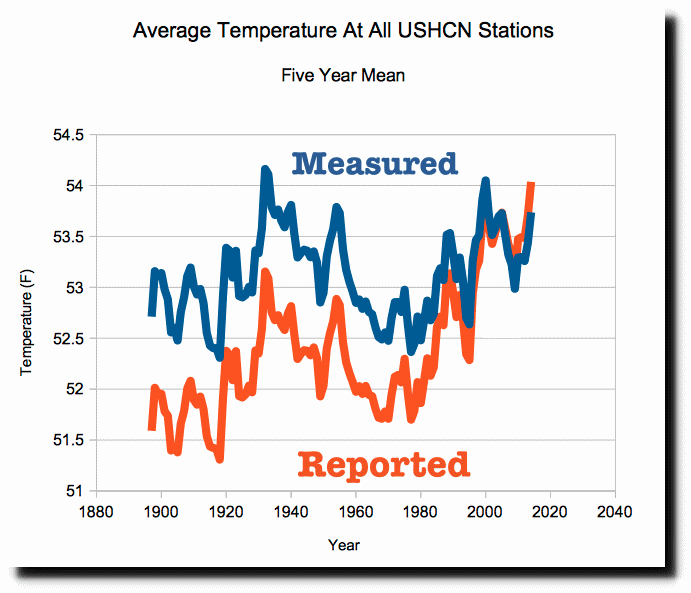
19 Dec 13:29

‘Equal Pay Day’ this year was April 12 — the next ‘Equal Occupational Fatality Day’ will be on February 19, 2027

by Mark Perry
deaths blsdeaths

Every year the National Committee on Pay Equity (NCPE) publicizes its “Equal Pay Day” to bring public attention to the gender pay gap. According to the NCPE, “Equal Pay Day” fell this year on April 12, and allegedly represents how far into 2016 women will have to continue working to earn the same income that the men earned last year, supposedly for doing the same job. See Obama’s “Presidential Proclamation” this year for “National Equal Pay Day, 2016,” where he perpetuates the myth that women get paid less than men for doing the exact same work. Hopefully, we’ll see an end next year to the bogus annual proclamations from the White House that spread incomplete and misleading statistics about the gender earnings gap.

Inspired by Equal Pay Day, I introduced “Equal Occupational Fatality Day” in 2010 to bring public attention to the huge gender disparity in work-related deaths every year in the United States. “Equal Occupational Fatality Day” tells us how many years into the future women will be able to continue to work before they will experience the same number of occupational fatalities that occurred for men in the previous year.

The Bureau of Labor Statistics (BLS) just released data today on workplace fatalities for 2015, and a new “Equal Occupational Fatality Day” can now be calculated. As in previous years, the chart above shows the significant gender disparity in workplace fatalities in 2015: 4,454 men died on the job (92.4% of the total) compared to only 367 women (7.6% of the total). The “gender occupational fatality gap” in 2015 was again considerable — more than 12 men died on the job last year for every woman who died while working.

Based on the BLS data for 2015, the next “Equal Occupational Fatality Day” will occur more than 10 years from now ­­– on February 19, 2027. That date symbolizes how far into the future women will be able to continue working before they experience the same loss of life that men experienced in 2015 from work-related deaths. Because women tend to work in safer occupations than men on average, they have the advantage of being able to work for more than a decade longer than men before they experience the same number of male occupational fatalities in a single year.

Economic theory tells us that the “gender occupational fatality gap” explains part of the “gender pay gap” because a disproportionate number of men work in higher-risk, but higher-paid occupations like coal mining (almost 100% male), fire fighters (94.1% male), police officers (86.4% male), correctional officers (76.2% male), logging (97.2% male), refuse collectors (89.6%), truck drivers (94.9%), roofers (97.7% male), highway maintenance (98.0%), commercial fishing (100%) and construction (97.3% male); see BLS data here. The table above shows that for the ten most dangerous occupations based on fatality rates per 100,000 workers by industry and occupation in 2014 (data not yet available for 2015) men represented more than 91% of the workers in those occupations for all of the ten occupations except for farming, which is 76.2% male.

On the other hand, women far outnumber men in relatively low-risk industries, often with lower pay to partially compensate for the safer, more comfortable indoor office environments in occupations like office and administrative support (72.2% female), education, training, and library occupations (73.4% female), and healthcare (75.1% female). The higher concentrations of men in riskier occupations with greater occurrences of workplace injuries and fatalities suggest that more men than women are willing to expose themselves to work-related injury or death in exchange for higher wages. In contrast, women, more than men, prefer lower risk occupations with greater workplace safety, and are frequently willing to accept lower wages for the reduced probability of work-related injury or death. The reality is that men and women demonstrate clear gender differences when they voluntarily select the careers, occupations, and industries that suit them best, and those voluntary choices contribute to differences in pay that have nothing to do with gender discrimination.

Update: Here’s a related quote from Camile Paglia about men’s important, but mostly underappreciated role in the labor market and the importance of their willingness to do the dangerous work that makes us all better off:

Indeed, men are absolutely indispensable right now, invisible as it is to most feminists, who seem blind to the infrastructure that makes their own work lives possible. It is overwhelmingly men who do the dirty, dangerous work of building roads, pouring concrete, laying bricks, tarring roofs, hanging electric wires, excavating natural gas and sewage lines, cutting and clearing trees, and bulldozing the landscape for housing developments. It is men who heft and weld the giant steel beams that frame our office buildings, and it is men who do the hair-raising work of insetting and sealing the finely tempered plate-glass windows of skyscrapers 50 stories tall.

Bottom Line: Groups like the NCPE use “Equal Pay Day” to promote a goal of perfect gender pay equity, probably not realizing that they are simultaneously advocating an increase in the number of women working in higher-paying, but higher-risk occupations like fire-fighting, roofing, construction, farming, and coal mining. The reality is that a reduction in the gender pay gap would come at a huge cost: several thousand more women will be killed each year working in dangerous occupations.

Further, the proponents of “Equal Pay Day” are promoting a statistical falsehood by suggesting that women working side-by-side with men in the same occupation for the same company are making something like 25% less than their male counterparts, which causes them to have to work an additional 70 days (and 14.5 weeks) to achieve “equal pay.” The NCPE’s statement that “because women earn less, on average, than men, they must work [25%] longer for the same amount of pay,” implies that gender wage discrimination is behind the gender pay gap. Of course that would imply that some corrective action by government is necessary to address the gender pay gap, even though most studies find that there is no gender earnings gap after factors like hours worked, child birth and child care, career interruptions, and individual choices about industry and occupation are considered. For example, a 2009 study by the Department of Labor concluded:

This study leads to the unambiguous conclusion that the differences in the compensation of men and women are the result of a multitude of factors and that the raw wage gap should not be used as the basis to justify corrective action. Indeed, there may be nothing to correct. The differences in raw wages may be almost entirely the result of the individual choices being made by both male and female workers.

Conclusion: I hereby suggest, that after adjusting for all factors that contribute to gender differences, Equal Pay/Earnings Day actually fell on about December 31 last year. Or maybe the first week of January…. but NOT the second week of April. Women should be embarrassed by the statistical falsehood that is annually promoted by NCPE’s Equal Pay Day that suggests that gender discrimination in the labor market burdens them with 14.5 additional weeks of work to earn the same as their male counterparts – when that’s not even remotely true.

Finally, here’s a question I pose for the NCPE every year: Closing the “gender pay gap” can really only be achieved by closing the “occupational fatality gap.” Would achieving the goal of perfect pay equity really be worth the loss of life for thousands of additional women each year who would die in work-related accidents?

14 Dec 11:43

Fortune 500 firms 1955 v. 2016: Only 12% remain, thanks to the creative destruction that fuels economic prosperity

by Mark Perry
fortune

What do the companies in these three groups have in common?

Group A: American Motors, Brown Shoe, Studebaker, Collins Radio, Detroit Steel, Zenith Electronics and National Sugar Refining.

Group B: Boeing, Campbell Soup, Deere, General Motors, IBM, Kellogg, Procter and Gamble and Whirlpool.

Group C: Facebook, eBay, Home Depot, Microsoft, Google, Netflix, Office Depot and Target.

All of the companies in Group A were in the Fortune 500 in 1955, but not in 2016.

All of the companies in Group B were in the Fortune 500 in both 1955 and 2016.

All of the companies in Group C were in the Fortune 500 in 2015, but not 1956.

The list of Fortune 500 companies in 1955 is available here and for 2016 here (based on sales the fiscal year ended on or before Jan. 31, 2016). Comparing the 1955 Fortune 500 companies to the 2016 Fortune 500, there are only 60 companies that appear in both lists (see companies in the graphic above). In other words, only 12% (and fewer than 1 in 8) of the Fortune 500 companies in 1955 were still on the list 61 years later in 2016, and more than 88% of the companies from 1955 have either gone bankrupt, merged with (or were acquired by) another firm, or they still exist but have fallen from the top Fortune 500 companies (ranked by total revenues). Many of the companies on the list in 1955 are unrecognizable, forgotten companies today (e.g. Armstrong Rubber, Cone Mills, Hines Lumber, Pacific Vegetable Oil, and Riegel Textile).

In my report last year on the 2015 Fortune 500 companies, there were 61 companies in the group that existed in both 1955 and 2015, but Alleghany (No. 499 last year) dropped from the Fortune 500 list this year because its sales fell and it now ranks No. 509.

Economic Lessons: The fact that nearly 9 of every 10 Fortune 500 companies in 1955 are gone, merged, or contracted demonstrates that there’s been a lot of market disruption, churning, and Schumpeterian creative destruction over the last six decades. It’s reasonable to assume that when the Fortune 500 list is released 60 years from now in 2076, almost all of today’s Fortune 500 companies will no longer exist as currently configured, having been replaced by new companies in new, emerging industries, and for that we should be extremely thankful. The constant turnover in the Fortune 500 is a positive sign of the dynamism and innovation that characterizes a vibrant consumer-oriented market economy, and that dynamic turnover is speeding up in today’s hyper-competitive global economy.

According to a report released earlier this year by Innosight (“Corporate Longevity: Turbulence Ahead for Large Organizations“) based on almost a century’s worth of market data, corporations in the S&P 500 Index in 1965 stayed in the index for an average of 33 years. By 1990, average tenure in the S&P500 had narrowed to 20 years, fell to 18 years in 2012 and is forecast to shrink to 14 years by 2026. At the current churn rate, about half of the S&P 500 firms will be replaced over the next 10 years as we enter “a stretch of accelerating change in which lifespans of big companies are getting shorter than ever” according to Innosight.

Another economic lesson to be learned from the creative destruction that results in the constant churning of Fortune 500 (and S&P 500) companies over time is that the process of market disruption is being driven by the endless pursuit of sales and profits that can only come from serving customers with low prices, high quality products and services, and great customer service. If we think of a company’s annual sales revenues as the number of “dollar votes” it gets every year from providing goods and services to consumers, we can then appreciate the fact that the Fortune 500 companies represent the 500 companies that have generated the greatest dollar votes of confidence from us as consumers – like Walmart (No. 1 this year at $482 billion in “dollar votes” for 2016, and No. 1 in 9 of the last 12 years), ExxonMobil (No. 2 at $246 billion), Apple (No. 3 at $233 billion), GM (No. 8 at $152 billion) and Ford (No. 9 at $150 billion).

As consumers, we should appreciate the fact that we are the ultimate beneficiaries of the Schumpeterian creative destruction that drives the dynamism of the market economy and results in a constant churning of the firms who are ultimately fighting to attract as many of our dollar votes as possible. The 500 top winners of that competitive battle in any given year are the firms in the Fortune 500, ranked not by their profits, assets or number of employees, but by what is ultimately most important in a market economy: their dollar votes (sales revenues).

fortunea

Update: In a comment below the post, John Dewey points out that Fortune changed its methodology for the Fortune 500 starting 1995. Between 1955 and 1994, only manufacturing and industrial companies were included. Staring in 1995, both manufacturing and service firms (including retailers like Walmart and financial services firms) were included in the Fortune 500. To account for the change in methodology, an analysis of the change in Fortune 500 firms before and after the change is displayed above.

In the 1955 to 1994 period when only manufacturing firms were considered, there were only 188 Fortune 500 firms in 1955 that survived to be included in the list in 1994, while there were 347 new firms included in 1994 that weren’t on the list in 1955. That’s an average annual turnover rate of 8.5 new firms in the Fortune 500.

In the 1995 to 2016 period when both manufacturing and service firms were considered, there were only 153 Fortune 500 firms in 1995 that survived to be included in the list in 2016, while there were 312 new firms included in this year that weren’t on the list in 1995. That’s an average annual turnover rate of 14.1 new firms in the Fortune 500, and almost twice the turnover rate of the earlier period. At that rate, half of today’s Fortune 500 firms would be replaced over the next 18 years, by 2034, and all of today’s Fortune 500 would be replaced by new firms in 2051. If the turnover rate accelerated to 20 firms per year, half of today’s firms would be replaced by 2028, and the entire Fortune 500 today would be replaced by all new firms in only 25 years, or by 2041.

Despite the change in Fortune’s methodology, the main points above hold: a) there is significant turnover in both the Fortune 500 and the S&P 500 companies, b) that turnover is accelerating over time for both groups, c) the composition of both the Fortune 500 and S&P 500 will be much different in 10 years and 20 years than today, and d) consumers will be the main beneficiaries of the Schumpeterian creative destruction that drives the significant and accelerating turnover in those two groups of 500 firms, as companies engage in intense, cut-throat competition unified by a single goal: deliver maximum value to the consumer to survive, thrive and prosper as a company.

The post Fortune 500 firms 1955 v. 2016: Only 12% remain, thanks to the creative destruction that fuels economic prosperity appeared first on AEI.

12 Dec 23:07

Just When You Thought Gavin Couldn’t Get Any More Cynical With His Climate Fraud

by tonyheller

With the end in sight to his scam, Gavin has unloaded yet another round of fraud on the American people. Since the election, he has reduced pre-1975 warming, and increased post-1975 warming.

novemberdecember2016giss

graph.png (1130×600)

This is on top of him nearly tripling warming since the year 2000.

nasa-2000-2012-2016-1

Data.GISS: GISTEMP HISTORY

Gavin has almost tripled warming during a time when satellites show almost no warming

screen-shot-2016-12-05-at-3-55-52-am

Wood for Trees: Interactive Graphs

12 Dec 07:48

Tibetan mastiff

by gcochran9

tibetan-mastiff

The Tibetan Mastiff can take high altitude better than generic dogs, or so breedists would like you to think. Some of the genetics changes are similar to those seen in human Tibetans – regulatory changes in EPAS1, for example. Domesticated dogs haven’t lived in Tibet all that long – but wolves have. The Tibetan Mastiff picked up some of those useful variants from local wolves, even though the amount of admixture wasn’t large. Adaptive introgression, just as Tibetans seem to have acquired their high-altitude version of EPAS1 from Denisovans.

Andean Indians didn’t have any archaic humans around to steal adaptations from. They have had to develop their own altitude adaptations (in a relatively short time), and they aren’t as effective as the Tibetan adaptations.

Naturally you are now worrying about sad Inca puppies – did they suffer from hypoxia? There are canids in South America, like the maned wolf and the bush dog, but they are probably too divergent to be able to hybridize with dogs. The chromosomes are different, so pre-Columbian dogs probably couldn’t acquire their alleles. Moreover, the dogs of the Amerindians seem to have done poorly in competition with Eurasian dogs: I know of only a few breeds [the Carolina Dog, for example] that are known to have significant pre-Columbian ancestry. Perhaps Amerindian dogs were also scythed down by Eurasian diseases.


12 Dec 05:33

A Simple Equation to Describe Intelligence

by Shelly Fan, Singularity Hub
Shelly Fan, Singularity Hub
According to Dr. Joe Tsien, a leading neuroscientist at Augusta University in Georgia, the key lies in one simple, unassuming equation: N = 2i1.At its core, Tsien's theory of connectivity describes how our billions of neurons flexibly assemble to not only gather knowledge, but to crystalize concepts and extrapolate from learned ideas to reason about things we have not yet experienced.
07 Dec 06:17

Europe’s Wood Burning “Disastrous” for the Environment

by Jamie

Europe may fancy itself a global green leader, but many of its “eco-friendly” policies don’t stand up well to close scrutiny. Take, for example, the EU’s predilection for burning wood to help meet its self-imposed renewable energy targets. As New Scientist reports, lax oversight over where this wood is sourced may mean that this supposedly green policy is actually increasing emissions:

The EU gets 65 per cent of its renewable energy from biofuels – mainly wood – but it is failing to ensure this bioenergy comes from sustainable sources, and results in less emissions than burning fossil fuels. Its policies in some cases are leading to deforestation, biodiversity loss and putting more carbon dioxide in the atmosphere than burning coal.

“Burning forest biomass on an industrial scale for power and heating has proved disastrous,” says Linde Zuidema, bioenergy campaigner for forest protection group Fern. “The evidence that its growing use will increase emissions and destroy forests in Europe and elsewhere is overwhelming.”

Europe has a long history with this foolish green policy. Brussels can categorize burning wood chips and wood pellets as technically carbon neutral so long as the forests being felled to source all of this wood are responsibly and sustainably replanted. But, as is the case with any energy supply chain, it’s not as cut and dry (no pun intended) as that.

Negligence and outright malfeasance can make this source of biomass a decidedly brown energy source. For one thing, you need to be able to monitor replanting in order to assure the so-called lifecycle of the wood you’re burning is carbon-neutral. For another, you need to account for the various emissions produced by the machines cutting all of this wood down, the transportation of that wood to processing facilities, the actual processing itself, and—in some cases—the trans-Atlantic shipment those pellets or chips ultimately embark on (much of Europe’s biomass comes from wood sourced from the southeast United States).If we wanted to be glib, we could simply point to the fact that burning wood is hardly the sort of future-focused energy strategy that a supposedly environmentally-conscious bloc ought to be embracing. But a closer examination vindicates that initial impression—that wood pellets and wood chips sound like dubious renewables—and exposes yet another example of downright foolish green policymaking in Europe.
03 Dec 14:21

The Most Outrageous Leftist Reactions To A Dictator's Death

by Joseph Klein

Fidel Castro, the ruthless Cuban dictator who considered himself a socialist “revolutionary,” passed away last Friday. The Left wasted no time paying tribute to Castro as a savior to his people, who brought them social justice in the face of U.S. imperialism. Some progressives like President Obama were a bit more muted, choosing to honor Castro’s memory while simply ignoring his atrocious human rights record. 

While the Left has turned Castro into a quasi-mythical figure, Juan Reinaldo Sanchez, Castro’s longtime bodyguard, chronicled the real Fidel Castro in his book, “The Double Life of Fidel Castro: My 17 Years as Personal Bodyguard to El Líder Maximo.” Sanchez wrote how Castro “lived in comfort” while “his people suffered.” Sanchez estimated that Castro’s net worth was $168 million. Compare Fidel Castro’s massive wealth to the Gross Domestic Product per capita in Cuba of 6156.62 US dollars, which was last recorded in 2013, and the Cubans’ average monthly wage of $20. Even with the free education and medical care added in that Fidel Castro and his supporters have often boasted about, the discrepancy between Fidel’s own personal wealth and the economic condition of the average Cuban hardly represent social justice in practice. 

Upon Castro’s death, President Obama issued a statement that treated the dictator with the dignity he certainly did not deserve. Obama called Fidel Castro a “singular figure,” who “altered the course of individual lives, families, and of the Cuban nation.” 

Fidel Castro and his brother Raul surely did alter the course of Cubans’ lives, but in a manner that Obama would like us all to forget. The Castro regime executed or imprisoned thousands of Cubans for just exercising their basic rights of freedom of expression and conscience. According to the Cuba Archive, from January 1, 1959 through December 31, 2014, there were at least 3116 executions by firing squad and 1166 other extrajudicial killings. 315 people died as a result of medical negligence or denial of medical care while in prison or detention. 

Obama said in his statement that his administration had “worked hard to put the past behind us” in forging a new relationship with Cuba. That would be all well and good except that Fidel’s brother Raul has not put the past behind him. He is continuing the ways of the repressive regime that Fidel developed to extinguish any opposition. Yet Obama has unabashedly endeavored to improve diplomatic and commercial relations without demanding any loosening of restrictions on the Cuban peoples’ exercise of their basic human rights.  

Praise for Fidel Castro poured in from world leaders following news of his death. Some were no surprise, such as President Nicolas Maduro, leader of the imploding country of Venezuela, who said "revolutionaries of the world must follow his legacy." Ironically, Cuba is suffering economically today in part because of its dependence on Venezuela for fuel subsidies, whose own economy is in free fall. Evidently, the legacies of both “revolutionary” socialist countries are leading each to follow the other into the abyss. 

However, it was not just leaders of socialist and repressive regimes who regarded Fidel Castro with great admiration. In a statement issued by his spokesperson, outgoing United Nations Secretary General Ban Ki-moon described the Cuban dictator as an "emblematic figure of the Cuban revolution.” The statement extolled Castro as “a strong voice for social justice in global discussions at the UN General Assembly and international and regional forums.” Of course, such "see no evil, hear no evil" statements that diverge from any semblance of the truth are par for the course at the UN.

The liberal Canadian Prime Minister Justin Trudeau was effusive in his praise of the dead dictator. He said, “Fidel Castro was a larger than life leader who served his people for almost half a century. A legendary revolutionary and orator, Mr. Castro made significant improvements to the education and healthcare of his island nation. I know my father was very proud to call him a friend and I had the opportunity to meet Fidel when my father passed away. It was also a real honour to meet his three sons and his brother President Raúl Castro during my recent visit to Cuba.”

Brazil's former President Luiz Inacio Lula da Silva, a founding member of the Workers' Party who has been under investigation for possible corruption, said that Castro was the "greatest of all Latin Americans. He encouraged dreams of freedom, sovereignty and equality."

The United Kingdom’s far left Labour opposition leader Jeremy Corbyn extolled Fidel Castro’s "heroism" and said he was a “champion of social justice.”

Not to be outdone by her leftist comrades abroad, Green Party’s presidential candidate Jill Stein tweeted that "Fidel Castro was a symbol of the struggle for justice in the shadow of empire.”  This is the same woman who believes that recounts in the three battleground states of Wisconsin, Michigan and Pennsylvania are necessary, three weeks after the conclusion of the presidential election, because “We deserve elections we can trust.”  She apparently sees no double standard in heaping praise on one of the world’s most repressive leaders, who represented the very antithesis of democracy and free elections. 

Former presidential hopeful Rev. Jesse Jackson called Castro a "freedom fighter" and "poor people's hero."

Democrat Rep. Barbara Lee, who has visited Cuba more than 20 times, said she was “very sad for the Cuban people” when she learned of Castro’s death. “We need to stop and pause and mourn his loss.”

Former President Jimmy Carter remarked how he and his wife “remembered fondly” their visits with Fidel Castro in Cuba “and his love of his country.” This is the same Jimmy Carter who has gone out of his way to attack the democratic state of Israel and who thinks that the U.S. government should acknowledge Hamas as a "legitimate political actor." Castro apparently was not the only murderer whom Carter admired.

Some of the same left-wing media that have hurled vicious baseless charges against President-elect Donald Trump turned Castro into a virtual saint.  In an ABC Special Report during Nightline, for example, Jim Avila said that Castro “was considered, even to this day, the George Washington of his country among those who remain in Cuba.” This is the same Jim Avila who reported on election night “there is a real fear among Latinos in this country right now because it appears that Donald Trump is going to win.” The Cuban-Americans in Miami who voted for Donald Trump and sang in the streets upon learning of Fidel Castro’s death would beg to differ with Avila’s reporting. As for those Cubans still residing in Cuba, their real voice cannot be heard as long as the repressive regime carried on by Fidel’s brother Raul remains in power.

MSNBC’s Chris Matthews recalled what a “romantic figure” Castro was when he came to power and how in high school “we rooted like mad for the guy” who “was almost like a folk hero to most of us.” Funny how all of the blood of the Cuban people on Castro’s hands since those heady days did not dim Matthews’ fond memories of his “folk hero.”

U.S. Rep. Ileana Ros-Lehtinen, who fled Cuba with her family when she was 8 and eventually became the first Cuban-American elected to Congress, saw nothing in Castro to romanticize. Responding scornfully to the praise of world leaders such as Prime Minister Trudeau, she said, “you did not lose a loved one to an execution squad. You did not lose a loved one to the gulags in Cuba. The only thing that Fidel has been successful in, has not been health nor education, or human rights or democracy, it's been holding onto power -- which is easy to do when you don't have elections.”

Those on the Left who are constantly complaining about the unfairness of the U.S. electoral system and are protesting against President-elect Trump are hypocritically singing the praises of a Cuban dictator who brutally oppressed his own people. That’s the price for achieving “social justice,” they argue. The problem with this argument is that the average Cuban citizen today is living under harsh economic conditions while remaining under severe political and civil restraints. As Winston Churchill once said, “Socialism is a philosophy of failure, the creed of ignorance, and the gospel of envy, its inherent virtue is the equal sharing of misery.”


03 Dec 01:09

The New Yorker Exposes a Fake News Fraud

by Jason Willick

A viral Washington Post story breathlessly circulated by media mandarins condemning the influence of “fake news” on the U.S. presidential election turns out to have been… fake news. The New Yorker’s Adrian Chen has published a devastating takedown of the key source in the Washington Post piece, an anonymous group called PropOrNot, which supplied the explosive claim that “stories planted or promoted by the [Russian] disinformation campaign were viewed more than 213 million times.” Chen:

A close look at the report showed that it was a mess. “To be honest, it looks like a pretty amateur attempt,” Eliot Higgins, a well-respected researcher who has investigated Russian fake-news stories on his Web site, Bellingcat, for years, told me. “I think it should have never been an article on any news site of any note.”

The most striking issue is the overly broad criteria used to identify which outlets spread propaganda. According to PropOrNot’s recounting of its methodology, the third step it uses is to check if a site has a history of “generally echoing the Russian propaganda ‘line’,” which includes praise for Putin, Trump, Bashar al-Assad, Syria, Iran, China, and “radical political parties in the US and Europe.” When not praising, Russian propaganda includes criticism of the United States, Barack Obama, Clinton, the European Union, Angela Merkel, nato, Ukraine, “Jewish people,” U.S. allies, the mainstream media, Democrats, and “the center-right or center-left, and moderates of all stripes.”

These criteria, of course, could include not only Russian state-controlled media organizations, such as Russia Today, but nearly every news outlet in the world, including the Post itself. […]

To PropOrNot, simply exhibiting a pattern of beliefs outside the political mainstream is enough to risk being labelled a Russian propagandist. Indeed, the list of “propaganda outlets” has included respected left-leaning publications like CounterPunch and Truthdig, as well as the right-wing behemoth Drudge Report. The list is so broad that it can reveal absolutely nothing about the structure or pervasiveness of Russian propaganda.

This takedown—and you really ought to read the whole thing—doesn’t just come from some no-name journalist out to build a contrarian name for himself. Chen is an authority on the subject. He was the author of the widely cited and scrupulously researched exposé that appeared in the New York Times last June showing that much of the internet’s trolling activity was emanating from one office building in St. Petersburg, Russia.

At the end of the piece, Chen twists the knife: “Like the most effective Russian propaganda, the report weaved together truth and misinformation.” That it was shared and promoted so enthusiastically by the very same people pronouncing most loudly that Trump supporters had been duped by phony news stories on a large scale underscores the fact that everyone, including those who consider themselves thoughtful and well-educated, is vulnerable to confirmation bias and motivated reasoning.

The anti-Trump political establishment has good reason to be concerned about the campaign that just occurred, which included no shortage of paranoia, conspiracy theorizing, and norm-breaking. But the worst thing that it could do is discredit itself further by falling prey to these same temptations.

01 Dec 22:26

Sons of low-income parents are more likely to grow up to be poor than daughters

by MilesCorak

Children of low-income parents are more likely than not to grow up to be low-income adults. This is true for both boys and girls, but more so for boys.

the-intergenerational-cycle-of-low-income-for-boys-and-girls

(Click on the image to enlarge.)

This figure shows the rankings of children from low-income Canadian families, what fraction stand on each of the 100 rungs defined to equally divide the population across their adult income distribution. Their parents stood on exactly the bottom 5th rung of their income ladder, and the likelihood of them not advancing very much or even falling lower is clearly evident.

If adult incomes were completely independent of family income background, then we would expect 1 percent of these children to be on each of the 100 divisions of their income distribution. If this were the case children of low-ranking parents would be as likely to rise to middle incomes, or even to the very top, as they would be to stay on the same rung as their parents, or fall lower.

But in fact, this cohort of Canadians (those born in the 1960s) are much more likely to be the low-ranking adults of the next generation and are more likely to repeat the experiences of their parents.

This inter-generational cycle of low-income is more likely for boys. Although there is considerable upward rank mobility among these children, men raised by parents who were outranked by 95 percent of their counterparts are most likely to fall even lower, to be outranked by 99 percent of their cohort. Their chances of falling to the bottom 1 percent are more than 4 percent.

They are most likely to remain in the bottom 10 percent of the income distribution. Although an intergenerational cycle of low-income is also the most likely outcome for women, the chances are significantly lower, hovering in the neighbourhood of 2 percent for each of the rungs up to about the 10th.

[ This post is an edited excerpt from a forthcoming paper I have written called “‘Inequality is the root of social evil,’ or maybe not? Two stories about inequality and public policy”, which is published in the December 2016 issue of Canadian Public Policy. If you have any feedback please feel free to let me know in the comments section. ]

01 Dec 13:42

In Case You Were Tempted To Have Any Respect for Arizona's State-run Universities: Professor Says Human Extinction in 10 Years is "A Lock"

by admin
Whig Zhou

呵呵,暖球党终于把自己也骗傻了~

From New Zealand:

There's no point trying to fight climate change - we'll all be dead in the next decade and there's nothing we can do to stop it, a visiting scientist claims.

Guy McPherson, a biology professor at the University of Arizona, says the human destruction of our own habitat is leading towards the world's sixth mass extinction.

Instead of fighting, he says we should just embrace it and live life while we can.

"It's locked down, it's been locked in for a long time - we're in the midst of our sixth mass extinction," he told Paul Henry on Thursday.

....

"I can't imagine there will be a human on the planet in 10 years," he says.

"We don't have 10 years. The problem is when I give a number like that, people think it's going to be business as usual until nine years [and] 364 days."

He says part of the reason he's given up while other scientists fight on is because they're looking at individual parts, such as methane emissions and the melting ice in the Arctic, instead of the entire picture.

"We're heading for a temperature within that span that is at or near the highest temperature experienced on Earth in the last 2 billion years."

Instead of trying to fix the climate, Prof McPherson says we should focus on living while we can.

"I think hope is a horrible idea. Hope is wishful thinking. Hope is a bad idea - let's abandon that and get on with reality instead. Let's get on with living instead of wishing for the future that never comes.

01 Dec 05:34

More Stunning Arctic Sea Ice Fraud

by tonyheller

We are used to seeing historical reconstructions like this one published in Nature, showing Arctic sea ice diminishing steadily since 1950.

 screen-shot-2016-11-30-at-3-12-22-am-down

Reconstructed changes in Arctic sea ice over the past 1,450 years

This graph from Cryosphere Today shows the same thing. Ice diminishing since 1950.

seasonal-extent-1900-2010

seasonal.extent.1900-2010.png (1296×1057)    seasonal sea ice extent timeseries

Pierre Gosselin dug up this document from the DOE in 1985, which shows the exact opposite. There was a large increase in Arctic sea ice after 1950.

screen-shot-2016-11-30-at-2-38-03-am-down

DOE 1985

The post-1950 increase in ice was extended by the 1990 IPCC Report until 1979.

screen-shot-2016-11-30-at-2-42-14-am-down

IPCC 1990 Chapter 7

Combining the two graphs, it becomes clear there was very little net ice loss from 1925 to 1979, and a sharp increase after 1955.

screen-1shot-2016-11-30-at-2-38-03-am-down

Comparing the Cryosphere Today graphs and the 1985 DOE graph, they show no correlation. The DOE document showed a large amount of ice loss from 1925 to 1950, and the Cryosphere Today document showed a sharp increase.

screen-shot-22016-11-30-at-2-38-03-am-down

Either the earlier sources are fraudulent, or the more recent ones are. And as is almost always the case, it appears the more recent documents are the culprit.

In 1958, the New York Times reported half of Arctic sea ice was lost in the first half of the century, and that the Arctic would soon be ice-free.

screen-shot-2016-11-30-at-4-00-26-am

The Changing Face of the Arctic– The New York Times

In 1940, Soviet explorers reported Arctic sea ice had shrunk in thickness by nearly 50%.

screen-shot-2016-11-30-at-4-21-50-am

23 Feb 1940 – THE NORTH POLE

The subsequent cooling and increase in sea ice was also well established.

screen-shot-2016-11-30-at-7-57-48-am-down

National Geographic : 1976 Nov, Page 576

This fits right in with the well established pattern of collusion and fraud by government climate scientists working to make the warmth of that era and subsequent cooling disappear.

screen-shot-2016-11-30-at-4-13-10-am

http://di2.nu/foia/1254108338.txt

29631-1

Make no mistake about it, catastrophic global warming is the biggest fraud in science history. There is overwhelming evidence of fraud and collusion between government funded agencies.

30 Nov 04:23

In Fiji, ants have learned to grow plants to house their massive colonies

by Annalee Newitz

High in the trees on the Fiji islands, ants in the species Philidris nagasau are doing something extraordinary. They've brought in seeds from several species of a large, lumpy fruit from a plant known as Squamellaria and carefully planted them in the nooks and crannies of the tree bark. Once the plant takes root in the tree and begins to grow, the ants climb inside its young stalks and fertilize it. But then the real action starts. As the fruit swells, the ants move inside, carving tunnels and rooms into the fleshy interior. When the colony expands, it may include dozens of these fruits, which look like strange tumors sprouting from tree branches.

Though researchers have known for a while that ant colonies can live inside fruits, a new study in Nature Plants reveals that this housing arrangement is far more complex and ancient than we knew. University of Munich biologists Guillaume Chomicki and Susanne S. Renner went to Fiji to observe the ants and found that they inhabited six different species of Squamellaria. Each of these species evolved to grow in tree bark using a specialized root system called a foot. When the plants are still young, the ants enter a small cavity in the stalk called a domatium to fertilize it. Though the researchers never directly observed how the ants did the fertilizing, they speculate that basically the ants are pooping in there.

Read 4 remaining paragraphs | Comments

21 Nov 00:49

One Argument for the Electoral Vote System

by David Friedman
An advantage of the present system that I have not seen discussed is that it reduces the problem of vote fraud. Stealing votes is easiest in a state dominated by a single party, the sort of place where the Republican poll watchers probably work for the Democrats or vice versa. With the electoral college system, there is no point to stealing votes in such a state, since the dominant party is going to get all of its electoral votes anyway. With a straight majority vote system, on the other hand, each party has an incentive to steal all the votes it can wherever it can.

Even with the electoral vote system, the problem still exists in any state where one party controls a large area, such as a major city, but the other  has enough support elsewhere to make the overall result uncertain. I still remember, long ago when I lived in Chicago, being told that the reason the downstate votes had not come in yet was that they were waiting to see how many they had to steal to outweigh the efforts of the Chicago machine.
21 Nov 00:29

Why has regional convergence stopped in the United States?

by Tyler Cowen

It does seem it is skill-based technical change, which rewards high-talent urban clusters, and in the broader equilibrium, also lowers geographic mobility.  That is the theme of the job market paper of Elisa Giannone from the University of Chicago, here is the abstract:

Skilled-Biased Technical Change and Regional Convergence,” (Job Market Paper)

Poorer US cities were catching up with richer ones at an annual rate of roughly 1.4% between 1940 and 1980. However, wage convergence across US cities went from 1.4% a year between 1940 and 1980 to 0% a year between 1980 and 2010. This paper quantifies the contributions of skill-biased technical change (SBTC) and agglomeration economies to the end of cross-cities wage convergence within the US between 1980 and 2010. I develop and estimate a dynamic spatial equilibrium model that looks at the causes of the decline in spatial wage convergence. The model choice is motivated by novel empirical regularities regarding the evolution of the skill premium and migration patterns over time and across space. The model successfully matches the quantitative features of the decline in US regional wage convergence, as well as other stylized facts on US economic growth. Moreover, the model also reproduces the convergence and the divergence in the skill ratio across US cities and other features on quantities, such as the secular decline in within US migration after 1980. Finally, the counterfactual analysis suggests that SBTC explains the approximately the 80% of the decline of regional convergence between 1980 and 2010 among high skill workers.

Here are her other papers.

The post Why has regional convergence stopped in the United States? appeared first on Marginal REVOLUTION.

17 Nov 02:41

The accuracy of stereotypes

by James Thompson


immigrants in Denmark


Are immigrants more likely to claim benefits, or is this a stereotype?

A stereotype is a preliminary insight. A stereotype can be true, the first step in noticing differences. For conceptual economy, stereotypes encapsulate the characteristics most people have noticed. Not all heuristics are false.

Here is a relevant paper from Denmark.

Emil O. W. Kirkegaard and Julius Daugbjerg Bjerrekær. Country of origin and use of social benefits: A large, preregistered study of stereotype accuracy in Denmark. Open Differential Psychology.

https://www.researchgate.net/publication/309913792_Country_of_origin_and_use_of_social_benefits_A_large_preregistered_study_of_stereotype_accuracy_in_Denmark


This study is interesting, in that it was pre-registered, so its absence would have been noticed.  It compares stereotypes against actual data to get a test of accuracy. I was particularly struck by how the authors studied the answers at each wave of data collection, and tracked down those who gave perplexing answers, then refining their survey questions to reduce misunderstandings.

The paper also points out an unremarked aspect of stereotypes: they may be too weak. Stereotypes have to show a correlation with the facts, and be good predictors. You have to get the slope right, and also the intercept. It is not enough to have a vague notion that immigrants are on benefits, you ought to be able to estimate how many are on benefits.  A stronger stereotype would be a more accurate perception of reality.

A nationally representative Danish sample was asked to estimate the percentage of persons aged 30-39 living in Denmark receiving social benefits for 70 countries of origin (N = 766). After extensive quality control procedures, a sample of 484 persons were available for analysis. Stereotypes were scored by accuracy by comparing the estimates values to values obtained from an official source. Individual stereotypes were found to be fairly accurate (median/mean correlation with criterion values = .48/.43), while the aggregate stereotype was found to be very accurate (r = .70). Both individual and aggregate-level stereotypes tended to underestimate the percentages of persons receiving social benefits and underestimate real group differences.
In bivariate analysis, stereotype correlational accuracy was found to be predicted by a variety of predictors at above chance levels, including conservatism (r = .13), nationalism (r = .11), some immigration critical beliefs/preferences, agreement with a few political parties, educational attainment (r = .20), being male (d = .19) and cognitive ability (r = .22). Agreement with most political parties, experience with ghettos, age, and policy positions on immigrant questions had little or no predictive validity.
In multivariate predictive analysis using LASSO regression, correlational accuracy was found to be predicted only by cognitive ability and educational attainment with even moderate level of reliability. In general, stereotype accuracy was not easy to predict, even using 24 predictors (k-fold cross-validated R2 = 4%).
We examined whether stereotype accuracy was related to the proportion of Muslims in the groups. Stereotypes were found to be less accurate for the groups with higher proportions of Muslims in that participants underestimated the percentages of persons receiving social benefits (mean estimation error for Muslim groups relative to overall elevation error = -8.09 %points).
The study was preregistered with most analyses being specified before data collection began


Figure-10-Mean-stereotype-and-real-values

The observed correlation of .7 is big, and useful. A majority of immigrants from Syria, Somalia and Kuwait are on benefits, as are those from Iraq and Lebanon. Even more to the point, if the benchmark is 25% for Danish citizens, then there are 19 countries with higher benefit rates. More positively, there are countries with lower rates, presumably because they are younger and employed. The data plot does not give us any guide to numbers from each country. However, later in the paper it is shown that immigrant population size is not relevant in judging benefit rates accurately.

The best predictor of having accurate stereotypes was cognitive ability (81% of simulations), followed by educational attainment (74% of simulations). Respondents underestimate the number of Muslims on benefits.

This is a very good paper. Data handling is exceptional, and well explained. There are lots of Figures and Tables. The sample is large and representative. The results have been looked at carefully, to identify those who participated without paying much attention to the questions. The data are available for re-analysis.

The high accuracy of aggregate stereotypes is confirmed. If anything, the stereotypes held by Danish people about immigrants underestimates those immigrants’ reliance on Danish benefits.


https://www.researchgate.net/publication/309913792_Country_of_origin_and_use_of_social_benefits_A_large_preregistered_study_of_stereotype_accuracy_in_Denmark

17 Nov 01:27

After TPP, Australia Looks To China On Trade

by Sean Keeley

Trade winds are quickly shifting, as Australia moves to embrace China’s alternatives to the Trans-Pacific Partnership (TPP). Financial Times reports:

Australia is throwing its weight behind China’s efforts to pursue new trade deals in the Asia-Pacific region amid a growing acknowledgement the US-led Trans-Pacific Partnership agreement is dead in the wake of Donald Trump’s election victory. 

Steven Ciobo, Australia’s trade minister, told the Financial Times that Canberra would work to conclude new agreement among 16 Asian and Pacific countries that excludes the US. He said Australia would also support a separate proposal, the Free Trade Area of the Asia-Pacific, which Beijing hopes to advance at this week’s Asia Pacific Economic Co-operation summit in Peru.“Any move that reduces barriers to trade and helps us facilitate trade, facilitate exports and drive economic growth and employment is a step in the right direction,” Mr Ciobo said Wednesday.  

As we noted this past week, the election of Donald Trump and the imminent demise of TPP have given China an opening to pitch its own trade deals. Australia is the first major U.S. ally to peel off and publicly announce its intention to sign on to China’s deals. Others may soon follow suit, as China makes a renewed push to finalize the Free Trade Area of the Asia-Pacific (FTAAP), which has been under discussion for over a decade, and the Regional Comprehensive Economic Partnership (RCEP), which China has been developing since 2012.

The United States will be present at discussions about FTAAP in Peru this year, but given the current circumstances it is unlikely to join in. If China does negotiate a successful deal, it will be a major economic and diplomatic achievement for Beijing, potentially allowing Beijing to set the rules of the road for Pacific trade for the foreseeable future.Throughout his campaign, Donald Trump took a harsh rhetorical stance against free trade, much to the delight of his base, while the Left has been animated by a protectionist backlash as well. Yet the abdication of U.S. leadership on free trade is set to give Beijing a major victory at Washington’s expense. The Trump Administration will need to pursue an alternative strategy to restore U.S. credibility and ensure that the United States remains relevant in the Pacific.