Shared posts

28 Sep 12:56

Neue USGS-Studie*: Hitze speichernder Beton und Asphalt beeinträchtigen US-Klimastationen immer mehr

Bild rechts: Die USHCN-Station der University of Arozona Tucson mitten auf einem Parkplatz. Wenige Monate, nachdem dieses Photo bei WUWT erschienen war, wurde die Station geschlossen. Man beachte die undurchlässige Oberfläche rings um die Station.

Das Wichtigste an dieser Studie ist, dass sie die Prozentzahl von Stationen quantifiziert, die Schauplatz immer weiterer Bodenversieglung mit undurchlässigen Oberflächen um sie herum waren. Wie ich schon vor längerer Zeit erläutert habe, agieren derartige Oberflächen als Wärmesenken, was zu höheren Nachttemperaturen führt, wenn diese Oberflächen die gespeicherte Energie von der Sonne als Infrarot wieder abgeben. Dies wärmt die Luft um die Thermometer herum und verzerrt die Tiefsttemperatur aufwärts.

In dieser Studie belegen die Autoren, dass sie über 32% aller USHCN-Stationen gefunden haben, um die herum undurchlässige Oberflächen (ISA) zwischen 2001 und 2011 um über 20% zugenommen haben. Als der 1000 m-Radius, für welches Gebiet jede Station repräsentativ sein soll, der Stationen untersucht worden ist, ergab sich bei über der Hälfte aller Stationen (52%; über 600) eine Zunahme von ISA von mehr als 20% innerhalb mindestens 1% der Gitterpunkte innerhalb dieses Radius'.

Dies zeigt, dass in Städten wie Las Vegas, wo es während der letzten 50 Jahre eine gravierende Infrastruktur-Zunahme gegeben hatte, die Minimum-Temperatur immer wärmer wird (hier), was die Mitteltemperatur, die zum Auffinden des „Signals der globalen Erwärmung“ herangezogen wird, nach oben verzerrt. Die NOAA wäre gut beraten, diese Stationen auszusondern, die auf diese Weise beeinträchtigt worden sind. Aber man hält stur an diesen falschen Daten fest und besteht darauf, dass man diese „adjustieren“ kann, damit sie genau werden. Dazu sage ich: Blödsinn! Da die USA so dicht mit tausenden Wetterstationen überzogen sind, ist es weitaus besser, Rausch- und nicht perfekte Daten auszusondern und nur jene Stationen heranziehen, die nicht durch zunehmende Infrastruktur verzerrte Werte aufweisen, also nur die besten Stationen mit tadellosen Daten.

Wenn man genau das tut, findet man einen statistisch signifikanten niedrigeren 30-Jahre-Trend:

Die neue Studie:

Änderungen der aus Satellitenbildern abgeleiteten Ausbreitung undurchlässiger Oberflächen bei Stationen des US Historical Climatology Network USHCN

Kevin Gallo,  George Xian

Abstract

Der Unterschied zwischen einer undurchlässigen, [30 m gridded] Oberfläche (ISA) zwischen 2001 und 2011 wurde evaluiert innerhalb von Radien von 100 bzw. 1000 m um die Stationen, die das USHCN ausmachen. Die Größe der Gebiete im Zusammenhang mit den beobachteten Zunahmen der ISA über bestimmte Grenzen hinaus wurde für die Klimastationen dokumentiert. Über 32% der USHCN-Stationen waren Schauplatz einer Zunahme der ISA von ⩾20% zwischen 2001 und 2011 in mindestens 1% der Gitterboxen innerhalb eines Radius' von 100 m um die Station. Während jedoch das erforderliche Gebiet in Verbindung mit ISA-Änderungen von ⩾1% auf ⩾10% zunahm, ist die Anzahl der Stationen, die eine ISA-Zunahme von ⩾20% aufwiesen, zwischen 2001 und 2011 auf 119 gesunken (9% der Stationen). Die Untersuchung des 1000 m-Radius' um jede Station ergab, dass über 52% (über 600) Stationen Schauplatz einer ISA-Zunahme von ⩾20% innerhalb mindestens 1% der Gitterboxen innerhalb jenes Radius'. Da jedoch das erforderliche Gebiet im Zusammenhang mit ISA-Änderungen auf ⩾10% zugenommen hatte, sank die Anzahl der Stationen, bei denen man eine ISA-Zunahme von ⩾20% beobachtet hatte, zwischen 2001 und 2011 auf 35 (weniger als 3% der Stationen). Die gridded ISA-Daten bieten eine Gelegenheit, die Umgebung von Klimastationen zu charakterisieren mittels eines konsistent gemessenen Indikators einer Oberfläche. Periodische Evaluationen von ISA-Änderungen bei USHCN-Stationen und anderen Netzwerken mit Stationen werden gefordert um sicherzustellen, dass die lokale Umgebung um die Stationen sich nicht signifikant geändert hat dergestalt, dass die Messungen an der Station beeinflusst werden.

Link: https://wattsupwiththat.com/2016/09/22/new-usgs-study-shows-heat-retaining-concrete-and-asphalt-have-encroached-upon-us-climate-stations/

Übersetzt von Chris Frey EIKE

28 Sep 12:56

Autonomes Fahren: "Wer ist schuld?"

by ZEIT ONLINE: Mobilitaet - Dietmar H. Lamparter
In vier Jahren sollen Autos von allein fahren, verspricht die Industrie. Doch so einfach geht das nicht. Ein Gespräch mit Reinhard Kolke, Technikexperte des ADAC
28 Sep 12:56

Park.io – automating tasks to make $125k per month

28 Sep 12:53

Neue Serie ‚SharePoint Grundlagen‘: Strukturen von Sites und Farmen in SharePoint verstehen (mit Video)

by Thomas Maier
Wer mit SharePoint täglich arbeitet, benötigt auch ein gewisses Verständnis von den Strukturen des Systems. Wichtig ist dabei zunächst einmal das Wissen um die hierarchische Struktur, die vorgibt, wer mit welcher Rolle auf welche Ressourcen Weiterlesen Author information Thomas Maier Thomas Maier, der „SharePoint Schwabe": Nutzen Sie alle Räume Ihrer SharePoint Villa bevor Sie anbauen! Mit meinen Artikeln möchte ich Ihnen dabei helfen. Wenn Sie schnell die Lücke zwischen „genutzt“ und „vorhanden und bezahlt“ verkleinern möchten, stehen wir, die PTM, Ihnen mit unseren...

[Den vollständigen Beitrag finden Sie auf der Website]
28 Sep 12:52

Bidirectional Replication is coming to PostgreSQL 9.6

28 Sep 12:51

Geschwächte iTunes-Backup-Verschlüsselung: Apple stellt Fix in Aussicht

Apple

Eine Schwachstelle macht Brute-Force-Angriffe auf verschlüsselte iTunes-Backups von iOS-10-Geräten weniger zeitintensiv. Apple ist das Problem bekannt – und betont, dass iCloud-Backups davon nicht betroffen sind.

28 Sep 12:50

Flexible Arbeitszeit: "Am Freitag sind wir nicht da!"

by ZEIT ONLINE: Beruf - Katja Kasten
Die Mitarbeiter von Bike Citizens in Graz und Berlin arbeiten nur von Montag bis Donnerstag. Das funktioniert ziemlich gut, sagt Unternehmensgründer Andreas Stückl.
28 Sep 12:49

Tipps und Apps zur Optimierung deiner Remote-Arbeit

by Andreas Weck

Remote-Arbeit nimmt zu – und sie benötigt Regeln und Technik. Diese Infografik liefert Tipps.

Remote-Worker müssen ein hohes Maß an Selbstdisziplin aufbringen

Allein im Homeoffice: Mitarbeiter, die nicht vor Ort präsent sind, haben öfter das Gefühl, dass ihr Beitrag nicht gewürdigt wird. Hier müssen Führungskräfte gegensteuern. (Foto: Shutterstock.com)
Allein im Homeoffice: Mitarbeiter, die nicht vor Ort präsent sind, müssen sich noch besser organisieren. (Foto: Shutterstock.com)

Technologische Errungenschaften wie das High-Speed-Internet haben es ermöglicht, dass einige Menschen ihr Tagwerk von überall aus erledigen können. Egal ob von einer Reise in San Francisco, von Tokio oder vom heimischen Schreibtisch aus – „Remote“-Arbeit nimmt zu. Doch braucht es für dieses Konzept auch gewisse Regeln und einiges an technischen Schnick-schnack, um effizient und effektiv arbeiten zu können.

In einer Infografik hat Ooma diverse Tipps und Apps zusammengetragen, die die Produktivität eines jeden Einzelnen hochhalten. So nennt das Unternehmen ein Programm namens „Cold Turkey“, das dabei hilft, sich nicht allzu sehr von Facebook, Instagram und Co. während des Arbeitstages ablenken zu lassen. „Cold Turkey“ (zu deutsch: „Kalter Entzug“) blockt sämtliche Benachrichtigungen deiner Social-Media-Apps.

Neben derartigen Tipps verrät die Infografik zudem einige spannende Statistiken. Sie zeigt auf, welche Ausgaben der durchschnittliche Remote-Worker spart, wenn er nicht mehr jeden Tag mit dem Auto oder dem Nah- und Fernverkehr den Arbeitsweg antreten muss. Wer die Infografik in voller Größe betrachten möchte, kann sie mittels eines Klicks darauf öffnen.

Tipps und Apps zur Optimierung deiner Remote-Arbeit. (Inforafik: Ooma)

In diesem Zusammenhang findet ihr diese zwei t3n-Artikel sicherlich auch interessant: Heimarbeit zum Wohlfühlen: 10 Beispiele für ein außergewöhnliches Homeoffice und Arbeiten im Homeoffice: Mit diesen Regeln vergesst ihr auch zu Hause nicht die Etikette.

26 Sep 11:58

Microsoft soll 2017 mehrere Flaggschiff-Smartphones mit Windows 10 Mobile präsentieren

by Albert Jelica

Microsoft Lumia 950 XL

Kürzlich hat der bekannte Microsoft-Insider Nawzil Najeep eine recht interessante Notiz auf Facebook verfasst, in der er Windows Phone-Fans dazu aufruft, nicht die Hoffnung zu verlieren. Darin erklärt er, dass Microsoft den Smartphone-Markt nicht verlassen werde und fasst einige interessante Zitate von Microsoft-Chef Satya Nadella und Terry Myerson zusammen. Es geht um Microsofts Strategie für dieses und das nächste Jahr und soll ins Gedächtnis rufen, dass viele Fragen von Fans bereits längst beantwortet wurden.

Er zieht daraus einige interessante Schlüsse, welche durchaus nachvollziehbar sind, selbst, wenn man nicht direkt bei Microsoft arbeitet und in die Zukunft der mobilen Windows-Plattform eingeweiht ist.

Microsofts Strategie

Im Juli 2015 hat Microsoft-Chef Satya Nadella größere Änderungen angekündigt, was die eigene mobile Strategie betrifft.

Ich fühle mich unseren eigenen Geräten verpflichtet, darunter auch Smartphones. Aber, wir müssen unsere Bestrebungen im Smartphone-Markt fokussieren während wir versuchen, ihn zu zu erfinden. Wir bewegen uns weg vom eigenen Smartphone-Geschäft, um ein lebendiges Windows-Ökosystem zu etablieren, das auch eine eigene Gerätefamilie von Microsoft inkludiert.

– Satya Nadella

Die kurzfristige Strategie (2015 bis 2015)

Auf kurze Sicht werden wir ein effektiveres Smartphone-Portfolio präsentieren und damit auf den Markt eilen mit der neu formierten Windows und Devices-Sparte. Wir planen, unseren Fokus auf drei Kundensegmente zu reduzieren, wo wir einen einzigartigen Beitrag am Markt leisen und uns unterscheiden können durch unsere Hard- und Software. Wir werden Unternehmenskunden die besten Management-Möglichkeiten, die beste Sicherheit und Produktivität bieten, Käufern von günstigeren Geräten bekommen alles, was sie brauchen und wir werden Windows Fans ein Flaggschiff geben, das sie lieben.

– Satya Nadella

Es ist unschwer zu erkennen, dass sich Microsoft-Chef bei dieser Beschreibung auf das aktuelle Lumia-Lineup bezog. Das Lumia 550, Lumia 650 und Lumia 950 sowie 950 XL finden hier beinahe direkte Erwähnung, wenn sie auch zur damaligen Zeit nicht einmal angekündigt waren.

Die viel wichtigere Frage lautet aber, ob Microsoft diese Strategie auch im Jahr 2017 fahren wird. Die Antwort darauf lautet: Nein.

Die langfristige Strategie (2017)

Auf lange Sicht werden Microsoft-Geräte für Innovationen stehen, neue Gerätekategorien kreieren und für das Windows-Ökosystem die Möglichkeit bieten, sich noch breiter aufzustellen. Die Neuerfindung wird vor allem die Mobilität des Benutzererlebnisses betreffen über die gesamte Gerätefamilie, auch Smartphones.

– Satya Nadella

Daraus folgert Microsoft-Insider Nawzil, womöglich auch basierend auf eigene Informationen, dass Microsoft im nächsten Jahr mehrere Flaggschiff-Smartphones mit Windows 10 Mobile präsentieren werde. Die OEMs werden sich unterdessen um günstigere Smartphones kümmern.

„Neue Microsoft-Flaggschiffe kommen 2017“

Microsoft Surface Book Review Test Deutsch

Die Aussagen von Terry Myerson, Chef der Windows und Devices-Sparte, sollen dies bestätigen. Er hatte Anfang dieses Jahres mehrfach versichert, dass Microsoft Windows 10 Mobile nicht aufgeben werde.

Ich verstehe, dass ihr Sorgen von einigen Partnern hört zu Microsofts Ambitionen im Smartphone-Markt. Lasst mich dazu sehr klar sagen: Wir fühlen uns verpflichtet, Windows 10 auf mobilen Geräten mit ARM-Prozessoren anzubieten. Wir arbeiten aktuell an der nächsten Generation unserer Produkte und ich wollte nochmals bestätigen, dass wir uns um Windows 10 Mobile kümmern. Wir glauben an den Wert dieses Produkts für Unternehmenskunden und wir haben vor, die Windows 10 Mobile-Plattform noch für viele Jahre zu unterstützen. Wir haben Geräte in Planung, um diese Strategie zu unterstützen und auch unsere OEM-Partner werden ein erweitertes Lineup an Smartphones bereitstellen.

– Terry Myerson, April 2016

Ich möchte versichern, dass eure Investition in Windows-Smartphones nicht gefährdet ist. Die Mobilität des Windows 10-Benutzererlebnisses bleibt kern unserer More Personal Computing-Ambitionen. Wir werden weiterhin die Lumia-Geräte aktualisieren und unterstützen sowie auch die Entwicklung von neuen Windows 10-Smartphones von Herstellern, wie HP, Acer, Alcatel, VAIO und Trinity und selbst neue großartige Geräte entwickeln. Wir werden weiterhin an Windows 10 für kleinere Displays arbeiten. Wir werden weiterhin Investitionen machen in wichtige Bereiche, wie Sicherheit, Management und Continuum, von denen wir wissen, dass sie wichtig sind für Unternehmenskunden, aber auch Endkunden, die eine bessere Produktivität erwarten. Und wir werden helfen, die Nachfrage nach Windows-Smartphones zu steigern.

– Terry Myerson, Mai 2016

Schlusswort: Klingen so die Worte von jemandem, der aufgibt?

Nawzil, der selbst behauptet, für Microsoft Kuwait zu arbeiten, rechnet fest damit, dass im Jahr 2017 mehrere Flaggschiff-Smartphones von Microsoft erscheinen werden. Während er öfters sehr gut zu den Geschehnissen informiert war, kann man dieser Aussage nicht mit Sicherheit vertrauen.

Liest man aber allein die Aussagen von Nadella und Myerson, die mehrfach darauf hingewiesen haben, dass Innovationen im Smartphone-Bereich kommen werden, dass man an eigenen Geräten arbeitet und, dass man Windows 10 Mobile keineswegs aufgeben will, dann lässt sich daraus bereits viel schlussfolgern.

Ob die lang-ersehnten Microsoft-Geräte nun Anfang 2017, Ende 2017 oder später kommen, geht daraus zwar nicht hervor, aber die Worte klingen definitiv nicht so, als würde Microsoft die Plattform leichtfertig aufgeben.


Quelle: Facebook

Der Beitrag Microsoft soll 2017 mehrere Flaggschiff-Smartphones mit Windows 10 Mobile präsentieren erschien zuerst auf WindowsArea.de.

26 Sep 11:56

Kein Richterbonus für Ex-Flugbegleiter

by Udo Vetter

Wenn ein Richter in einem früheren Beruf besondere Kenntnisse erworben hat, kann das sein Einstiegsgehalt erhöhen. Allerdings reicht nicht jeder Job hierfür aus, zum Beispiel die Tätigkeit als Flugbegleiter. Dies hat das Bundesverwaltungsgericht nun in letzter Instanz entschieden.

Der heutige Berliner Richter war jahrelang als Flugbegleiter und Fluggastabfertiger tätig. Diese Arbeit habe seine sozialen Kompetenzen geschärft, meint er. Nach dem Besoldungsgesetz kann Berufserfahrung den Verdienst erhöhen. Aber nur, wenn die frühere Tätigkeit dem Richter berufsbezogene soziale Kompetenzen vermittelt hat.

Das ist nach Auffassung der Richter hier nicht der Fall. Für den Richterberuf seien folgende Fähigkeiten prägend: Erfassung komplexer Lebensverhältnisse, Vermittlungs-, aber auch Entcheidungsfreude sowie Teamfähigkeit. Das vermittele nicht automatisch jede Berufstätigkeit, die Kontakt zu Menschen mit sich bringt. Der bloße Kundenkontakt durch Dienstleistungen reiche jedenfalls nicht aus (Aktenzeichen 2 C 29.15).

Flattr this!

26 Sep 11:53

Cloud Computing Design Patterns

26 Sep 08:40

SharePoint-App für Windows 10 Mobile und Android als Preview verfügbar

by Wolfgang Miedl
Zur SharePoint 2016-Premiere im Mai kündigte Microsoft auch eine neue SharePoint-App an, im Juni erschien dann die erste Version – allerdings nur für iOS. Jetzt folgen nahezu zeitgleich die Versionen für Windows 10 Mobile und Weiterlesen Author information Wolfgang Miedl Microsoft-Beobachter seit Windows 1.0. Gründer von SharePoint360.de. Enthusiast für Themen rund um Collaboration und Kommunikation im Allgemeinen und die Microsoft-Business-Plattformen von SharePoint bis Office 365 im Speziellen. Publisher und Blogger. | The post SharePoint-App für Windows 10 Mobile...

[Den vollständigen Beitrag finden Sie auf der Website]
26 Sep 08:22

Office Delve Preview nun für Windows 10 & Windows 10 Mobile erhältlich

by Albert Jelica

delve-windows-10-desktop

Neben SharePoint hat Microsoft gestern eine weitere Anwendung für Windows 10 Mobile im Store veröffentlicht, welche Teil des Office 365 Business-Abonnements ist.

Delve ist nun nämlich ebenfalls als Preview für Windows 10 und Windows 10 Mobile erhältlich. Die Anwendung kann mit einem Office 365 Business-Account genutzt werden.

Wer Delve nicht kennt, dem sei es im Folgenden kurz erklärt: Es ist im Prinzip ein LinkedIn für den eigenen Betrieb. Der Dienst ermöglicht es, Bescheid zu wissen, woran Kollegen derzeit arbeiten, welche Fähigkeiten und Kompetenzen sie besitzen. Sucht man im Unternehmen also eine Person, die bei einer gewissen Aufgabe durch ihre Expertise behilflich sein kann, hilft Delve dabei, diese zu finden. Das Mitarbeiterprofil zeigt auf einen Blick die Kontaktdaten, den Tätigkeitsbereich sowie die eigenen Fähigkeiten an.

Genauso wichtig ist allerdings die Möglichkeit, über Delve gewisse Dokumente zu finden. Der Dienst schlägt nämlich Dokumente vor, an denen die eigenen Kollegen kürzlich gearbeitet haben, mit denen man öfters zusammenarbeitet. Zudem wird bei jeden Mitarbeiterprofil eine Liste der zuvor verwendeten Dokumente angezeigt. Das kann ebenfalls eine große Hilfe dabei sein, ein Projektdokument aufzufinden, das beispielsweise bei der Arbeit daran als Entwurf genutzt, irgendwo gespeichert und nach langer Zeit plötzlich doch wichtig geworden ist. Wenn man sich an die Person erinnern kann, mit der am Dokument gearbeitet wurde, kann man es dadurch finden.

Wer Delve im Unternehmen aktiv nutzt, den wird sicherlich freuen, dass nun auch über Windows 10 und Windows 10 Mobile darauf zugegriffen werden kann.

\Download


via mspu

Der Beitrag Office Delve Preview nun für Windows 10 & Windows 10 Mobile erhältlich erschien zuerst auf WindowsArea.de.

26 Sep 08:20

Vectr: Kostenloses Vektorgrafik-Tool

by Jessy Kösterke

Kostenlos Vektorgrafiken erstellen und mit Freunden oder Kollegen teilen? Das und vieles mehr verspricht Vectr.

Adobe Illustrator ist ein Bearbeitungstool, das besonders für Vektorgrafiken geeignet ist. So ein komplexes Tool bringt aber auch Nachteile mit sich. Vor allem für Anfänger kann die Vielfalt an Funktionen zur Herausforderung werden und am Ende viel Einarbeitungszeit kosten. Dazu kommt: Illustrator kostet nicht nicht nur Zeit, sondern auch Geld. Wer also die Vielfältigkeit von Illustrator nicht benötigt und dennoch Vektorgrafiken erstellen will, für den könnte Vectr eine Alternative werden.

Vektor-Editor: Vectr

(Screenshot: vectr.com)

Vectr ist ein kostenloses Vektorgrafik-Tool, das sowohl lokal auf Mac, Windows, Linux und Chromebook als auch als Webapp genutzt werden kann. Die Funktionen und das Interface sind in beiden Versionen identisch. Am 13. September hat Vectr die Beta-Phase verlassen und die Entwicklung soll vorerst ausgereift sein. Das Interface erinnert an Illustrator in vereinfachter Version. Um Designs zu speichern, solltet ihr euch vorher registrieren oder einloggen – mit Facebook, Twitter oder Google. Im Anschluss erwartet dich ein kurzes Intro-Video, das dir die Funktionen von Vectr zeigt.

Im Gegensatz zu Illustrator befindet sich die Ebenen-History links, ebenso die Seiten. Direkt daneben sind die Tools, dazu zählen das Textwerkzeug, der Pen und alle Pfad-Tools. In der rechten Spalte habt ihr die Möglichkeit, Schatten, Farbe, Kontur und Transparenz anzupassen. Die Vielfalt von Illustrator solltet ihr allerdings nicht erwarten. Neben den Standardfunktionen wurde mit dem letzten Update das Interface überarbeitet, Funktionen wie das „Layer Hiding“ und der Pen verbessert sowie über 100 Bugs gelöst.

Vectr punktet spätestens beim Speichern einer Datei. Hier könnt ihr die Grafiken als png, jpg oder svg speichern. Zusätzlich könnt ihr die Größen nochmal anpassen und die Datei via Facebook, Twitter oder URL teilen.

Was dich erwartet

Die Entwickler versprechen viel für die Zukunft. Auf der Vectr-Roadmap kann jeder den aktuellen Stand einsehen und sich am Prozess beteiligen. Momentan wird unter anderem an den Curves, Firefox Support und dem Import von eigenen Grafiken gearbeitet. Wie bei jeder Webapp wird leider auch für Vectr eine Internetverbindung benötigt. Aber auch daran arbeiten die Entwickler. Momentan ist Vectr kostenlos, und das soll es auch bleiben. Es wird allerdings an einer Pro-Version gearbeitet, die vermutlich etwas kosten wird.

26 Sep 08:16

Two years spent spamming spammers back

26 Sep 08:16

The Democratization of Censorship

by BrianKrebs

John Gilmore, an American entrepreneur and civil libertarian, once famously quipped that “the Internet interprets censorship as damage and routes around it.” This notion undoubtedly rings true for those who see national governments as the principal threats to free speech.

However, events of the past week have convinced me that one of the fastest-growing censorship threats on the Internet today comes not from nation-states, but from super-empowered individuals who have been quietly building extremely potent cyber weapons with transnational reach.

underwater

More than 20 years after Gilmore first coined that turn of phrase, his most notable quotable has effectively been inverted — “Censorship can in fact route around the Internet.” The Internet can’t route around censorship when the censorship is all-pervasive and armed with, for all practical purposes, near-infinite reach and capacity. I call this rather unwelcome and hostile development the “The Democratization of Censorship.”

Allow me to explain how I arrived at this unsettling conclusion. As many of you know, my site was taken offline for the better part of this week. The outage came in the wake of a historically large distributed denial-of-service (DDoS) attack which hurled so much junk traffic at Krebsonsecurity.com that my DDoS protection provider Akamai chose to unmoor my site from its protective harbor.

Let me be clear: I do not fault Akamai for their decision. I was a pro bono customer from the start, and Akamai and its sister company Prolexic have stood by me through countless attacks over the past four years. It just so happened that this last siege was nearly twice the size of the next-largest attack they had ever seen before. Once it became evident that the assault was beginning to cause problems for the company’s paying customers, they explained that the choice to let my site go was a business decision, pure and simple.

Nevertheless, Akamai rather abruptly informed me I had until 6 p.m. that very same day — roughly two hours later — to make arrangements for migrating off their network. My main concern at the time was making sure my hosting provider wasn’t going to bear the brunt of the attack when the shields fell. To ensure that absolutely would not happen, I asked Akamai to redirect my site to 127.0.0.1 — effectively relegating all traffic destined for KrebsOnSecurity.com into a giant black hole.

Today, I am happy to report that the site is back up — this time under Project Shield, a free program run by Google to help protect journalists from online censorship. And make no mistake, DDoS attacks — particularly those the size of the assault that hit my site this week — are uniquely effective weapons for stomping on free speech, for reasons I’ll explore in this post.
Google's Project Shield is now protecting KrebsOnSecurity.com

Google’s Project Shield is now protecting KrebsOnSecurity.com

Why do I speak of DDoS attacks as a form of censorship? Quite simply because the economics of mitigating large-scale DDoS attacks do not bode well for protecting the individual user, to say nothing of independent journalists.

In an interview with The Boston Globe, Akamai executives said the attack — if sustained — likely would have cost the company millions of dollars. In the hours and days following my site going offline, I spoke with multiple DDoS mitigation firms. One offered to host KrebsOnSecurity for two weeks at no charge, but after that they said the same kind of protection I had under Akamai would cost between $150,000 and $200,000 per year.

Ask yourself how many independent journalists could possibly afford that kind of protection money? A number of other providers offered to help, but it was clear that they did not have the muscle to be able to withstand such massive attacks.

I’ve been toying with the idea of forming a 501(c)3 non-profit organization — ‘The Center for the Defense of Internet Journalism’, if you will — to assist Internet journalists with obtaining the kind of protection they may need when they become the targets of attacks like the one that hit my site.  Maybe a Kickstarter campaign, along with donations from well-known charitable organizations, could get the ball rolling.  It’s food for thought.

CALIBRATING THE CANNONS

Earlier this month, noted cryptologist and security blogger Bruce Schneier penned an unusually alarmist column titled, “Someone Is Learning How to Take Down the Internet.” Citing unnamed sources, Schneier warned that there was strong evidence indicating that nation-state actors were actively and aggressively probing the Internet for weak spots that could allow them to bring the entire Web to a virtual standstill.

“Someone is extensively testing the core defensive capabilities of the companies that provide critical Internet services,” Schneier wrote. “Who would do this? It doesn’t seem like something an activist, criminal, or researcher would do. Profiling core infrastructure is common practice in espionage and intelligence gathering. It’s not normal for companies to do that.”

Schneier continued:

“Furthermore, the size and scale of these probes — and especially their persistence — points to state actors. It feels like a nation’s military cyber command trying to calibrate its weaponry in the case of cyberwar. It reminds me of the US’s Cold War program of flying high-altitude planes over the Soviet Union to force their air-defense systems to turn on, to map their capabilities.”

Whether Schneier’s sources were accurate in their assessment of the actors referenced in his blog post is unknown. But as my friend and mentor Roland Dobbins at Arbor Networks eloquently put it, “When it comes to DDoS attacks, nation-states are just another player.”

“Today’s reality is that DDoS attacks have become the Great Equalizer between private actors & nation-states,” Dobbins quipped.

UM…YOUR RERUNS OF ‘SEINFELD’ JUST ATTACKED ME

What exactly was it that generated the record-smashing DDoS of 620 Gbps against my site this week? Was it a space-based weapon of mass disruption built and tested by a rogue nation-state, or an arch villain like SPECTRE from the James Bond series of novels and films? If only the enemy here was that black-and-white.

No, as I reported in the last blog post before my site was unplugged, the enemy in this case was far less sexy. There is every indication that this attack was launched with the help of a botnet that has enslaved a large number of hacked so-called “Internet of Things,” (IoT) devices — mainly routers, IP cameras and digital video recorders (DVRs) that are exposed to the Internet and protected with weak or hard-coded passwords. Most of these devices are available for sale on retail store shelves for less than $100, or — in the case of routers — are shipped by ISPs to their customers.

Some readers on Twitter have asked why the attackers would have “burned” so many compromised systems with such an overwhelming force against my little site. After all, they reasoned, the attackers showed their hand in this assault, exposing the Internet addresses of a huge number of compromised devices that might otherwise be used for actual money-making cybercriminal activities, such as hosting malware or relaying spam. Surely, network providers would take that list of hacked devices and begin blocking them from launching attacks going forward, the thinking goes.

As KrebsOnSecurity reader Rob Wright commented on Twitter, “the DDoS attack on @briankrebs feels like testing the Death Star on the Millennium Falcon instead of Alderaan.” I replied that this maybe wasn’t the most apt analogy. The reality is that there are currently millions — if not tens of millions — of insecure or poorly secured IoT devices that are ripe for being enlisted in these attacks at any given time. And we’re adding millions more each year.

I suggested to Mr. Wright perhaps a better comparison was that ne’er-do-wells now have a virtually limitless supply of Stormtrooper clones that can be conscripted into an attack at a moment’s notice.

A scene from the 1978 movie Star Wars, which the Death Star tests its firepower by blowing up a planet.

A scene from the 1977 movie Star Wars, in which the Death Star tests its firepower by blowing up a planet.

SHAMING THE SPOOFERS

The problem of DDoS conscripts goes well beyond the millions of IoT devices that are shipped insecure by default: Countless hosting providers and ISPs do nothing to prevent devices on their networks from being used by miscreants to “spoof” the source of DDoS attacks.

As I noted in a November 2015 story, The Lingering Mess from Default Insecurity, one basic step that many ISPs can but are not taking to blunt these attacks involves a network security standard that was developed and released more than a dozen years ago. Known as BCP38, its use prevents insecure resources on an ISPs network (hacked servers, computers, routers, DVRs, etc.) from being leveraged in such powerful denial-of-service attacks.

Using a technique called traffic amplification and reflection, the attacker can reflect his traffic from one or more third-party machines toward the intended target. In this type of assault, the attacker sends a message to a third party, while spoofing the Internet address of the victim. When the third party replies to the message, the reply is sent to the victim — and the reply is much larger than the original message, thereby amplifying the size of the attack.

BCP38 is designed to filter such spoofed traffic, so that it never even traverses the network of an ISP that’s adopted the anti-spoofing measures. However, there are non-trivial economic reasons that many ISPs fail to adopt this best practice. This blog post from the Internet Society does a good job of explaining why many ISPs ultimately decide not to implement BCP38.

Fortunately, there are efforts afoot to gather information about which networks and ISPs have neglected to filter out spoofed traffic leaving their networks. The idea is that by “naming and shaming” the providers who aren’t doing said filtering, the Internet community might pressure some of these actors into doing the right thing (or perhaps even offer preferential treatment to those providers who do conduct this basic network hygiene).

A research experiment by the Center for Applied Internet Data Analysis (CAIDA) called the “Spoofer Project” is slowly collecting this data, but it relies on users voluntarily running CAIDA’s software client to gather that intel. Unfortunately, a huge percentage of the networks that allow spoofing are hosting providers that offer extremely low-cost, virtual private servers (VPS). And these companies will never voluntarily run CAIDA’s spoof-testing tools.
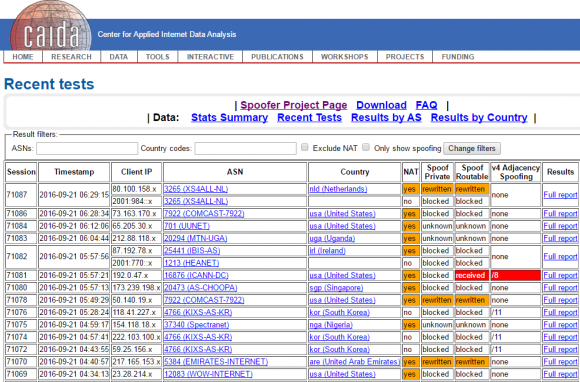
CAIDA's Spoofer Project page.

CAIDA’s Spoofer Project page.

As a result, the biggest offenders will continue to fly under the radar of public attention unless and until more pressure is applied by hardware and software makers, as well as ISPs that are doing the right thing.

How might we gain a more complete picture of which network providers aren’t blocking spoofed traffic — without relying solely on voluntary reporting? That would likely require a concerted effort by a coalition of major hardware makers, operating system manufacturers and cloud providers, including Amazon, Apple, Google, Microsoft and entities which maintain the major Web server products (Apache, Nginx, e.g.), as well as the major Linux and Unix operating systems.

The coalition could decide that they will unilaterally build such instrumentation into their products. At that point, it would become difficult for hosting providers or their myriad resellers to hide the fact that they’re allowing systems on their networks to be leveraged in large-scale DDoS attacks.

To address the threat from the mass-proliferation of hardware devices such as Internet routers, DVRs and IP cameras that ship with default-insecure settings, we probably need an industry security association, with published standards that all members adhere to and are audited against periodically.

The wholesalers and retailers of these devices might then be encouraged to shift their focus toward buying and promoting connected devices which have this industry security association seal of approval. Consumers also would need to be educated to look for that seal of approval. Something like Underwriters Laboratories (UL), but for the Internet, perhaps.

THE BLEAK VS. THE BRIGHT FUTURE

As much as I believe such efforts could help dramatically limit the firepower available to today’s attackers, I’m not holding my breath that such a coalition will materialize anytime soon. But it’s probably worth mentioning that there are several precedents for this type of cross-industry collaboration to fight global cyber threats.

In 2008, the United States Computer Emergency Readiness Team (CERT) announced that researcher Dan Kaminsky had discovered a fundamental flaw in DNS that could allow anyone to intercept and manipulate most Internet-based communications, including email and e-commerce applications. A diverse community of software and hardware makers came together to fix the vulnerability and to coordinate the disclosure and patching of the design flaw.

deathtoddosIn 2009, Microsoft heralded the formation of an industry group to collaboratively counter Conficker, a malware threat that infected tens of millions of Windows PCs and held the threat of allowing cybercriminals to amass a stupendous army of botted systems virtually overnight. A group of software and security firms, dubbed the Conficker Cabal, hashed out and executed a plan for corralling infected systems and halting the spread of Conficker.

In 2011, a diverse group of industry players and law enforcement organizations came together to eradicate the threat from the DNS Changer Trojan, a malware strain that infected millions of Microsoft Windows systems and enslaved them in a botnet that was used for large-scale cyber fraud schemes.

These examples provide useful templates for a solution to the DDoS problem going forward. What appears to be missing is any sense of urgency to address the DDoS threat on a coordinated, global scale.

That’s probably because at least for now, the criminals at the helm of these huge DDoS crime machines are content to use them to launch petty yet costly attacks against targets that suit their interests or whims.

For example, the massive 620 Gbps attack that hit my site this week was an apparent retaliation for a story I wrote exposing two Israeli men who were arrested shortly after that story ran for allegedly operating vDOS — until recently the most popular DDoS-for-hire network. The traffic hurled at my site in that massive attack included the text string “freeapplej4ck,” a reference to the hacker nickname used by one of vDOS’s alleged co-founders.

Most of the time, ne’er-do-wells like Applej4ck and others are content to use their huge DDoS armies to attack gaming sites and services. But the crooks maintaining these large crime machines haven’t just been targeting gaming sites. OVH, a major Web hosting provider based in France, said in a post on Twitter this week that it was recently the victim of an even more massive attack than hit my site. According to a Tweet from OVH founder Octave Klaba, that attack was launched by a botnet consisting of more than 145,000 compromised IP cameras and DVRs.

I don’t know what it will take to wake the larger Internet community out of its slumber to address this growing threat to free speech and ecommerce. My guess is it will take an attack that endangers human lives, shuts down critical national infrastructure systems, or disrupts national elections.

But what we’re allowing by our inaction is for individual actors to build the instrumentality of tyranny. And to be clear, these weapons can be wielded by anyone — with any motivation — who’s willing to expend a modicum of time and effort to learn the most basic principles of its operation.

The sad truth these days is that it’s a lot easier to censor the digital media on the Internet than it is to censor printed books and newspapers in the physical world. On the Internet, anyone with an axe to grind and the willingness to learn a bit about the technology can become an instant, self-appointed global censor.

I sincerely hope we can address this problem before it’s too late. And I’m deeply grateful for the overwhelming outpouring of support and solidarity that I’ve seen and heard from so many readers over the past few days. Thank you.

26 Sep 08:16

Digital Offers: Master Microsoft Office for just $49

by WindowsCentralShop

Understanding Microsoft Office and how it all works is very important when looking for a job. Don't get left behind at the interview table because you don't know how to use formulas in Excel or analyze data with ease. With Microsoft offering so many apps under the Office umbrella, it can be hard to learn them all, especially if you don't know where to begin. Luckily, getting started doesn't have to be hard.

For just $49 you can get access to a year of amazing Microsoft Office information to help you master the suite of apps. From the basic features and functions to data analyzing, you'll have access to it all.

The courses in this bundle include:

  • Microsoft Excel Course Section 1: Foundation
  • Section 2: Orientation & efficiency
  • Section 3: Administration
  • Section 4: Data Handling
  • Section 5: Data Analysis
  • Section 6: Presentation

But that isn't it. There is more than 100 hours of learning material from in-depth data handling to formatting options, and much more. The bundle also includes:

26 Sep 08:15

Nordrhein-Westfalen: Großbanken sollen 10 Milliarden Euro Steuern hinterzogen haben

by ZEIT ONLINE: Wirtschaft -
Die nordrhein-westfälischen Finanzämter gehen Hinweisen auf Steuerhinterziehung nach. Auf der Liste stehen auch internationale Banken wie J.P. Morgan, Barclays und HSBC.
26 Sep 08:14

f.lux könnte im Windows Store erscheinen

by Albert Jelica

f-lux

Seit dem Windows 10 Anniversary Update können Entwickler auch ihre Desktop-Apps im Windows Store veröffentlichen und zwar dank des Desktop App Converters, welcher unter dem Codenamen Project Centennial bei Microsoft entwickelt worden war.

Ein Nutzer hat nun bei den Entwicklern der Software f.lux nachgefragt, ob diese darüber nachdenken, ihre Anwendung ebenfalls im Windows Store zur Verfügung zu stellen. Als Antwort hat dieser ein einfaches „Ja“ zurückbekommen. Man hat also zumindest diese Option bereits bedacht. Ob die Anwendung tatsächlich im Windows Store erscheinen wird, geht daraus allerdings nicht hervor und allzu große Hoffnungen sollten sich Nutzer nun nicht machen. Schließlich lautete die Frage des Nutzers auch, ob man darüber nachdenke. Konkrete Pläne resultieren daraus nicht.

f.lux ist eine sehr bekannte Software, die es Nutzern erlaubt, die Wärme des Displays automatisch oder auch manuell einzustellen. Dies ist vor allem nachts praktisch, da die wärmeren Farbtöne die Augen schonen und nicht allzu grell wirken. Wer nachts länger arbeitet, dürfte mit der Software womöglich bereits Erfahrungen haben.

Eine Veröffentlichung im Windows Store wäre für die Entwickler insofern praktisch, als, dass sie Bei der Auslieferung von Updates keine eigene Implementierung benötigen, sondern diese direkt über den Store durchführen können. Zudem können Desktop-Apps auf gewisse Funktionen des Systems zugreifen, beispielsweise Live-Tiles und Benachrichtigungen im Info Center.

Microsoft plant selbst mit Redstone 2 diese Funktion ins System zu implementieren, jedoch hat sich diese bislang in keiner Insider Build eingefunden. Microsofts Feature, das zukünftig im Info-Center zu finden sein soll, erfüllt etwa denselben Zweck wie f.lux.


Quelle: mspu

Der Beitrag f.lux könnte im Windows Store erscheinen erschien zuerst auf WindowsArea.de.

26 Sep 08:14

iPhone-7-Verkaufszahlen angeblich um 25 Prozent unter iPhone-6s-Niveau

by Jörn Brien

Apple hat keine Verkaufszahlen zu den neuen iPhones bekanntgegeben. Eine GfK-Schätzung legt jetzt nahe, dass die Verkäufe des iPhone 7 um 25 Prozent unter denen des iPhone 6s lagen.

Schwache Verkaufszahlen beim iPhone 7

Die Gerüchte um einen Rückgang der Verkaufszahlen der neuen iPhone-Generation gab es schon lange, sie hatten sich noch verschärft, als Apple ankündigte, erstmals nicht die iPhone-7-Verkäufe nach dem Startwochenende preiszugeben. Einige Berichte hatten in den vergangenen Tagen aber vermuten lassen, dass es doch nicht so schlecht um die Verkaufszahlen stand, wie befürchtet. Dass das wiederum offenbar gar nicht so ist, legt jetzt eine Schätzung der Marktforscher der GfK nahe – die hätte eigentlich gar nicht an die Öffentlichkeit geraten dürfen.

Schleppender Verkauf? iPhone 7 und 7 Plus und die kabellosen AirPods. (Bild: Apple)

Konkrete Zahlen gab es nicht, die geleakte Schätzung der Verkaufszahlen des iPhone 7 seitens der GfK soll auf Untersuchungen der Distributionskanäle, sogenannte Channel-Checks, beruhen, wie Businessinsider berichtet. Demnach sollen um 25 Prozent weniger iPhone 7 verkauft worden sein als iPhone 6s in einem Vergleichszeitraum des Vorjahres. Das iPhone 7 Plus wurde offenbar nicht erwähnt. Die Verkaufszahlen wurden zudem nur in Europa und Asien erhoben, nicht aber in den USA. Der Bericht ist nicht einsehbar. Die Information über den Rückgang im Jahresvergleich stammt von Menschen, die das geheime Papier gesehen haben wollen.

iPhone-7-Bericht weder bestätigt noch dementiert

Die GfK hat via Twitter verlautbart, dass weder ein solcher Bericht zu den iPhone-7-Zahlen noch die möglicherweise darin enthaltenen Verkaufszahlen und Markteinschätzungen bestätigt oder kommentiert würden. Da damit die Zahlen aber nicht dementiert wurden, und sie sich mit einem ähnlichen Bericht des taiwanischen IT-Portals Digitimes decken, nach dem Apple seine asiatischen Chippartner gewarnt habe, dass die Chipaufträge im ersten Quartal 2017 um 20 Prozent sinken würden, gab die Apple-Aktie am Freitag nachbörslich um fast zwei Prozent nach.

Passend zum Thema: iPhone 7 Plus ausverkauft – das diamantschwarze Modell wird Apple aus den Händen gerissen

26 Sep 08:13

Office Delve preview app now available for Windows 10 Mobile

by John Callaham

Microsoft has launched the Office Delve preview app for Windows 10 Mobile devices, after previously launching the app for Windows 10 PCs and tablets earlier this summer. The document update notification app is meant for subscribers of Office 365 business and school plans.

26 Sep 08:10

EliasDB – A graph-based database

26 Sep 08:10

Some cities are taking another look at LED lighting after AMA warning

26 Sep 08:06

2 major reasons why modern C++ is a performance beast

26 Sep 08:01

Assessing the Reliability of the MH370 Burst Frequency Offset Data

by Jeff Wise

north-and-south-routes

Last week we discussed what we know about the first hour of MH370’s disappearance, based on primary radar data and the first Inmarsat BTO value. Today I’d like to talk about the BFO data and what it can tell us about MH370’s fate.

As longtime readers of this blog well know, the Burst Frequency Offset (BFO) is a type of metadata that measures how different the frequency of an Inmarsat signal is from its expected value. It is an important value to a communications satellite operator like Inmarsat because if the value gets too large, the system will be operating outside its approved frequency limit. One cause of such a change would be if a satellite begins wandering in its orbit, which indeed was the case with MH370. The fact that the Satellite Data Unit (SDU) aboard MH370 did not properly compensate for drift in the Inmarsat satellite overhead is the reason the BFO data contains a signal indicating what the plane was doing.

While each of the BTO values recording during the seven “pings” tells us fairly precisely how far the plane was from the satellite at that time, the BFO data points taken individually do not tell us much about the plane was doing. Taken together, however, they indicate three things:

  1. After the SDU logged back on with Inmarsat at 18:25, the plane took a generally southern course. If we didn’t have the BFO data, we wouldn’t know, from the BTO data alone, whether the plane followed a path to the north or to the south (see above.)
  2. The plane had turned south by 18:40. The BFO value at the time of the first incoming sat phone call at 18:40 indicates that the plane was traveling south.
  3. At 0:19:37 the plane was in a rapid and accelerating decent.

However, as I’ve previously described, if all of these things were true, then the plane would have been found by now. So at least one of them must be false. In the course of my interview with him, Neil Gordon said that the ATSB is firmly convinced that #3 is true, and that as a result he suspects that #2 is not. Specifically, he points out that if the plane were in a descent at 18:40, it could produce the BFO values observed. Thus it is possible that the plane did not perform a “final major turn” prior to 18:40 but instead loitered in the vicinity of the Andaman Islands or western Sumatra before turning and flying into the southern ocean. If this were the case, it would result in the plane turning up to the northeast of the current search area. An example of such a route has been described by Victor Iannello at the Duncan Steel website.

It is worth nothing that such a scenario was explicitly rejected as unlikely by the Australian government when they decided to spend approximately $150 million to search 120,000 square kilometers of seabed. The reason is that it was deemed unlikely that the plane would just happen, by chance to be descending at the right time and at the right rate to look like a southward flight. For my part, I also find it hard to imagine why whoever took the plane would fly it at high speed through Malaysian airspace, then linger for perhaps as much as an hour without contacting anybody at the airline, at ATC, or in the Malysian government (because, indeed, none of these were contacted) and then continuing on once more at high speed in a flight to oblivion.

Well, is there any other alternative? Yes, and it is one that, though historically unpopular, is becoming imore urgent as the plane’s absence from the search area becomes increasingly clear: the BFO data is unreliable. That is to say, someone deliberately altered it.

There are various ways that we can imagine this happening, but the only one that stands up to scrutiny is that someone on board the plane altered a variable in the Satellite Data Unit or tampered with the navigation information fed back to the SDU from the E/E bay. Indeed, we know that the SDU was tampered with: it was turned off, then logged back on with Inmarsat, something that does not happen in the course of normal aircraft operation. It has been speculated that this depowering and repowering occurred as the result of action to disable and re-enable some other piece of equipment, but no one has every come up with a very compelling story as to what that piece of equipment might be. Given the evident problems with the BFO data in our possession, I feel we must consider the possibility that the intended object of the action was the SDU itself.

When I say BFO tampering has been “historically unpopular,” what I mean is that almost everyone who considers themselves a serious MH370 researcher has from the beginning assumed that the BFO data was generated by a normally functioning, untampered-with SDU, and this has limited the scenarios that have been considered acceptable. For a long time I imagined that search officials might know of a reason why tampering could not have occurred, but I no longer believe this is the case. When I questioned Inmarsat whether it was possible that the BFO data could have been spoofed, one of their team said “all Inmarsat can do is work with the data and information and the various testings that we’ve been doing.” And when I raised the issue with Neil Gordon, he said, “All I’ve done is process the data as given to me to produce this distribution.” So it seems that the possibility of BFO spoofing has not been seriously contemplated by search officials.

If we allow ourselves to grapple with the possibility that the BFO data was deliberately tampered with, we quickly find ourselves confronting a radically different set of assumptions about the fate of the plane and the motives of those who took it. These assumptions eliminate some of the problems that we have previously faced in trying to make sense of the MH370 mystery, but introduce new ones, as I’ll explore in upcoming posts.

26 Sep 08:00

Luftverkehr: Air Berlin will offenbar 1.000 Mitarbeiter entlassen

by ZEIT ONLINE: Wirtschaft -
Bei Deutschlands zweitgrößter Airline sollen künftig weniger Flugzeuge zum Einsatz kommen. Hauptaktionär Etihad verhandelt derzeit mit Tui und der Lufthansa.
26 Sep 08:00

Die Pleite dieser Großreederei könnte Händlern das Weihnachtsgeschäft versauen

by Jörn Brien

Weil die Großreederei Hanjin pleite ist, hängen Smartphones, Computer oder Kühlschränke im Wert von zwölf Milliarden Euro auf den Schiffen fest. Ist das Weihnachtsgeschäft in Gefahr?

Weihnachtsgeschäft: Kommen Geschenke an?

Hanjin, die siebtgrößte Reederei der Welt, hat einen Schuldenberg in der Höhe von rund 4,8 Milliarden Euro aufgetürmt. Jetzt hat die Großreederei Insolvenz angemeldet und in Südkorea und den USA Antrag auf Gläubigerschutz gestellt. Warum das eine Gefahr für den Black Friday in den USA und das Weihnachtsgeschäft in Europa bedeutet? Die rund 100 Schiffe von Hanjin, die 500.000 Container mit einer Fracht im Wert von zwölf Milliarden Euro an Bord haben sollen, können aufgrund der finanziellen Schieflage der Reederei nicht in die Häfen einlaufen. Die Händler kommen nicht an ihre Waren.

Hanjin-Pleite bedroht Weihnachtsgeschäft in den USA und Europa. (Foto: hyku / flickr.com, Lizenz: CC-BY-SA)

Kühlschränke, Fernseher, Computer, Smartphones oder Autoreifen – all dies könnte im schlimmsten Fall knapp werden. Eine Nachbestellung deutlich vor Weihnachten wird schwierig, da Seereisen aus Asien nach Europa, inklusive Vor- und Nachlauf des Transports, etwa zwei Monate dauern können, wie die Zeitung Die Welt berichtet. Besonders betroffen von der Pleite und den möglichen Frachtausfällen sind südkoreanische Elektronikhersteller wie Samsung oder LG.

Weihnachtsgeschäft: Samsung und LG betroffen

Die Kommentare der Branchenvertreter sind bisher widersprüchlich. Während ein Manager bei LG Electronics Deutschland einen „uneingeschränkten Zugriff auf das komplette deutsche Produktportfolio“ sieht, äußert sich ein südkoreanischer Kollege vorsichtiger. Er sei sich nicht sicher, ob die Nachfrage bedient werden könne, zitiert Die Welt den Chef der Hausgerätesparte des Technikkonzerns, Cho Sung-jin. Auch Samsung befürchtet laut Berichten aus Südkorea, dass Waren im Wert von 34 Millionen Euro von Hanjin-Gläubigern beschlagnahmt werden könnten.

26 Sep 07:57

"Tatort" Münster: Gestehen Sie, Kollege!

by ZEIT ONLINE: Film - Carolin Ströbele
Professor Boerne hat eine Leiche im Keller. Und auch Kommissar Thiel verheimlicht etwas. In unserem "Tatort" Münster müssen beide eine schwere Ehekrise bewältigen.
26 Sep 07:57

Snap Spectacles: Snapchat stellt Sonnenbrille mit Kamera vor

Snapchat hat eine Sonnenbrille mit eingebauter Kamera vorgestellt, die auf Knopfdruck zehn Sekunden lange Filmschnipsel erstellt und mit dem Smartphone synchronisiert. Der Blickwinkel der Snapchat Spectacles soll dem menschlichen Sehen entsprechen. (Snapchat, Foto)
26 Sep 07:57

SharePoint Preview-App erscheint für Windows 10 Mobile

by Albert Jelica

SharePoint Windows 10 Mobile, iOS, Android

Vor einigen Monaten sind die ersten Hinweise auf eine offizielle SharePoint App für Windows 10 Mobile aufgetaucht und seit August ist die Anwendung nun im Windows Store gelistet. Herunterladen konnte man diese bislang jedoch nicht.

Dies hat sich nun geändert, denn Version 0.8.3.0 der SharePoint App für Windows 10 Mobile ist nun auch im Windows Store erhältlich. Hierbei handelt es sich noch um eine Preview, sodass Fehler noch auftreten können und manche Funktionen wohl noch nicht korrekt implementiert sind.

Die Anwendung erlaubt es, mit dem eigenen SharePoint Online-Konto im Unternehmen zu verbinden, jedoch wird in der Beschreibung nicht die Möglichkeit genannt, auch SharePoint Server 2013 oder 2016 zu verwenden. Das bedeutet, dass die mobile Windows-App für SharePoint nur von Ofice 365 Business-Kunden genutzt werden kann und nicht von jenen, die SharePoint 2013 oder 2016 auf ihrem eigenen Unternehmensserver ausführen. Die iOS-App bietet diese Funktionalität nämlich, die Windows 10 Mobile-App anscheinend nicht.

Ansonsten gibt es wenige Unterschiede zwischen der iOS und der Windows-App bis natürlich auf das Design. Mehrere Accounts werden unterstützt, die Seiten können angezeigt und aufgerufen werden und auch Team-Seiten sind in die App integriert. Daneben sind individuelle Kontakt-Tabs ebenfalls vorhanden, genau wie unter iOS.

Kürzlich von Kollegen oder einem selbst verwendete Dateien werden selbstverständlich auch angezeigt und man hat vollen Zugriff auf die eigenen Dokumente dank der neuen Integration der OneDrive-App. Dateien können auch direkt aufgerufen und mittels Office Mobile direkt am Smartphone bearbeitet werden.

Sollte ein Dokument nicht auf den ersten Blick auffindbar sein, hilft Microsofts Enterprise-Suche, welche die Ergebnisse in Seiten, Dateien und Kontakte sortiert.

Die offizielle SharePoint App für Windows 10 Mobile könnt ihr unter dem folgenden Link aus dem Windows Store herunterladen:

\Download


Danke an alle Tippgeber!

Der Beitrag SharePoint Preview-App erscheint für Windows 10 Mobile erschien zuerst auf WindowsArea.de.