Turkish President Recep Tayyip Erdogan once again waded into controversy on Monday when he told a mostly female audience at a summit on justice for women that women are not equal to men
"You cannot put women and men on an equal footing," he said. "It is against nature. They were created differently. Their nature is different. Their constitution is different."
Erdogan, a devout Muslim, said women's role in society is clear:
"Our religion has defined a position for women: Motherhood. Some people can understand this, while others can't," he said. "You cannot explain this to feminists because they don't accept the concept of motherhood." Read more...
Forget playing games for cash -- if you really want to raise the stakes, try losing your actual blood when you lose in the virtual world. That's the concept behind Blood Sport, a crowdfunded project that modifies game controllers to drain your body...
A long time ago, in a galaxy far, far away, a sci-fi TV show tried to make it big on CBS. It failed, miserably.
Starstruck, a Star Wars-inspired sitcom, aired on CBS only once in 1979 before it was inevitably forgotten to the cruel wheels of time. However, thanks to the show's faithful visual effects artist Chuck Cirino, the pilot has resurfaced on Reddit for all nerds to enjoy.
Complete with cheesy effects, campy costumes and feathered '70s hair, the TV flop is 26 minutes of pure, nostalgic heaven.
The Expendables series has shown diminishing returns both for fans and execs. The third movie diverted its focus away from the aging action heroes that were the driving force behind the series to begin with, and also fell vicim to pre-release piracy. (The industry is still debating the effect that leak had on the box office.) The Expendables 3 was also PG-13, and the downgraded level of intense action that followed that ratings change wasn’t viewed well by fans. Sylvester Stallone seems to get it, however, and says that the attempt to broaden the series’ appeal was “a horrible miscalculation” that will be rectified in the future. Will an R-Rated Expendables 4 be the course correct the series needs?
The Expendables 3 hits blu on November 25, with an extended, unrated version on disc. Promoting that release to Crave Online, Stallone said that future films starting with a theoretical The Expendables 4 will be R-rated in theaters.
Absolutely unequivocally yes. I believe it was a horrible miscalculation on everyone’s part in trying to reach a wider audience, but in doing such, diminish the violence that the audience expects. I’m quite certain it won’t happen again.
A fourth film seems all but assured at this point, but there’s nothing set in stone yet. Stallone is asked about ideas such as taking the team back to WWII, and he explains his idea of playing with the formula a bit, even if he probably wouldn’t go that far:
I have actually entertained the idea of putting the group into such an unnatural environment that it, in an of itself, creates extra suspense and tension: the “fish out of water” scenario. That environment might not be time travel, but nearly just as jarring.
He also mentions that Antonio Banderas did most of the work for his Expendables 3 character. (“His true personality is naturally dynamic so all I did was say “be yourself and pretend you’re a mercenary,” and the rest including the dialog was all his.”)
If you tried to visit Craigslist late Sunday night, you probably had a very weird experience. Instead of arriving at that sultry sea of classifieds, you were probably sent to DigitalGangster.com. Then, you were likely redirected to YouTube, where a very strange animated rap video filled your ears with lyrics about freedom, privacy, and net neutrality.
In upper Alaska, after the day's work was completed and supper had been eaten, it was time for those around the fire to lean close and listen. It was time to share a story.
Storytelling is the timeless art of the of the Iñupiat people, who have lived in northern Alaska for thousands of years. Like many other Native people, the stories were rich histories passed through generations. But as Native Alaskans move into urban areas and away from their traditional upbringing, where can those legends still live?
A short answer could be video games. While many Native people across America have seen their imagery and art appropriated in media, a small studio teamed up with leaders from the Cook Inlet Tribal Counsel to create Never Alone, a game that accurately reflects the Iñupiat people and their history. It's a game that tells the story of a young girl, Nuna, searching for the cause of a terrible blizzard laying waste to her village. Along the way she receives help from spirits who inhabit the land, nature and wildlife Read more...
Several weeks after Colin Farrell and Vince Vaughn were announced as two of the four leads for True Detective Season 2, the other two main cast members have been finally been confirmed.
Taylor Kitsch and Rachel McAdams will play detectives Paul Woodrugh and Ani Bezzerides, while Kelly Reilly joins the cast as Jordan, wife of Frank Semyon (Vaughn). Get the latest True Detective Season 2 cast info, including new plot details, after the jump.
HBO revealed the True Detective Season 2 cast details in a press release. The cast and characters are:
Colin Farrell as Ray Velcoro, a compromised detective whose allegiances are torn between his masters in a corrupt police department and the mobster who owns him.
Vince Vaughn as Frank Semyon, a criminal and entrepreneur in danger of losing his empire when his move into legitimate enterprise is upended by the murder of a business partner.
Rachel McAdams as Ani Bezzerides, a Ventura County Sheriff’s detective whose uncompromising ethics put her at odds with others and the system she serves.
Taylor Kitsch as Paul Woodrugh, a war veteran and motorcycle officer for the California Highway Patrol, running from a difficult past and the sudden glare of a scandal that never happened.
Kelly Reilly as Jordan, Frank Semyon’s wife, a former D-list actress who is a full partner in his enterprises and ambitions.
Additionally, True Detective Season 2 has a new logline: “Three police officers and a career criminal must navigate a web of conspiracy in the aftermath of a murder.”
None of the new cast members will come as a surprise if you’ve been paying attention to the True Detective Season 2 casting process. Kitsch’s name was first floated over the summer, McAdams’ offer arrived in September, and Reilly’s involvement was first reported in October. But hey, it’s still nice to get confirmation.
Shooting on True Detective Season 2 is already underway in California. The new season will consist of eight hourlong episodes, with Justin Lin directing the first two installments. Series creator Nic Pizzolatto returns to pen all the episodes.
I love animals, but elephants are some of my favorites. They are soulful, smart and sweet to their species and others. This video provides facts about the intelligence of elephants and lists some common behaviors in the context of their brain capacity and function. I continue to hope for a world in which these noble animals are free of captivity, habitat destruction, cruelty and poaching.
You don't have to worry about quantities of Geometry Wars 3: Dimensions depleting during this week's launch, but pre-ordering the $14.99 twin-stick shooter wouldn't hurt if you're looking for a couple extra levels.
As explained on Sierra's website,...
Hackaday Prize judge, hacker extraordinaire, and generally awesome dude [Sprite_TM] spends a lot of time at his computer, and that means a lot of time typing on his keyboard. He recently picked up a board with the latest fad in the world of keyboards, a board with individually addressable LEDs. He took this board to work and a colleague jokingly said, ‘You’ve had this keyboard for 24 hours now, and it has a bunch of LEDs and some arrow keys. I’m disappointed you haven’t got Snake running on it yet.” Thus began the quest to put the one game found on all Nokia phones on a keyboard.
The keyboard in question is a Coolermaster Quickfire Rapid-I, a board that’s marketed as having an ARM Cortex CPU. Pulling apart the board, [Sprite] found a bunch of MX Browns, some LEDs, and a 72MHz ARM Cortex-M3 with 127k of Flash and 32k of RAM. That’s an incredible amount of processing power for a keyboard, and after finding the SWD port, [Sprite] attempted to dump the Flash. The security bit was set. There was another way, however.
Coolermaster is actively working on the firmware, killing bugs, adding lighting modes, and putting all these updates on their website. The firmware updater is distributed as an executable with US and EU versions; the EU version has another key. Figuring the only difference between these versions would be the firmware itself, [Sprite] got his hands on both versions, did a binary diff, and found only one 16k block of data at the end of the file was different. There’s the firmware. It was XOR encrypted, but that’s obvious if you know what to look for.
The firmware wasn’t complete, though; there were jumps to places outside the code [Sprite] had and a large block looked corrupted. There’s another thing you can do with an executable file: run it. With USBPcap running in the background while executing the firmware updater, [Sprite] could read exactly what was happening when the keyboard was updating. With a small executable that gets around the weirdness of the updater, [Sprite] had a backup copy of the keyboard’s firmware. Even if he bricked the keyboard, he could always bring it back to a stock state. It was time to program Snake.
The first part of writing new firmware was finding a place that had some Flash and RAM to store the new code. This wasn’t hard; there was 64k of Flash free and 28K of unused RAM. The calls to the Snake routine were modified from the variables the original firmware had. If, for example, the original keyboard had a call to change the PWM, [Sprite] could change that to the Snake routine.
Snake is fun, but with a huge, powerful ARM in a device that people will just plug into their keyboard, there’s a lot more you can do with a hacked keyboard. Keyloggers and a BadUSB are extremely possible, especially with firmware that can be updated from a computer. To counter that, [Sprite] added the requirement for a physical condition in order to enter Flash mode. Now, the firmware will only update for about 10 seconds after pressing the fn+f key combination.
There’s more to playing Snake on a keyboard; Sprite has also written a new lighting mode, a fluid simulation thingy that will surely annoy anyone who can’t touch type. You can see the videos of that below.
An anonymous reader points out this story at Ars about a new trojan on the scene. Researchers have unearthed highly advanced malware they believe was developed by a wealthy nation-state to spy on a wide range of international targets in diverse industries, including hospitality, energy, airline, and research. Backdoor Regin, as researchers at security firm Symantec are referring to the trojan, bears some resemblance to previously discovered state-sponsored malware, including the espionage trojans known as Flame and Duqu, as well as Stuxnet, the computer worm and trojan that was programmed to disrupt Iran's nuclear program. Regin likely required months or years to be completed and contains dozens of individual modules that allowed its operators to tailor the malware to individual targets.
There's an excellent moment in Joss Whedon's horror-comedy Cabin in the Woods, where the stereotypical stoner, Marty, pulls up in his rundown auto drinking coffee from a mug. Except, it's not a mug at all but rather a giant retractable water bong. As is true with most awesome props, the smoke mug has become reality.
We all have those days when we're feeling down. Life isn't going our way and we want to feel better about ourselves. If you use Facebook, a recent study researches at The Ohio State University suggests looking up friends who are complaining about their problems.
Widely proscribed around the world for its recreational uses, cannabis is being used in a number of different therapeutic ways to bring relief for severe medical conditions. Products using cannabinoids, the active components of the cannabis plant, have been licensed for medical use. Sativex, for example, which contains an equal mixture of the cannabinoids tetrahydrocannabinol (THC) and cannabidiol (CBD), is already licenced as a mouth spray for multiple sclerosis and in the US, dronabinol and nabilone are commercially available for treating cancer-related side effects.
Now, in a study published in Molecular Cancer Therapeutics, we’ve also shown that cannabinoids could play a role in treating one of the most aggressive cancers in adults.
There are more than 85 cannabinoids, which are known to bind to unique receptors in cells and which receive outside chemical signals. These receptors feed into signalling pathways, telling cells what to do. Recent studies have shown that some cannabinoids have potent anti-cancer action. For example, both THC and CBD have been shown in a number of laboratory studies to effectively induce cell death in tumour cells by modifying the faulty signalling pathways inside these cells. Depending on the cell type this can disrupt tumour growth or start to kill it.
The psychoactivity associated with some cannabinoids, principally THC (which gives people a cannabis high), is also mediated via the same receptors. Because these receptors are found in the highest abundances in brain cells, it follows that brain tumours also rich in these receptors may respond best to cannabinoids.
We wanted to investigate the anti-cancer effects of Sativex in glioma cells. High-grade glioma is an aggressive cancer, with very low long-term survival rates. Statistics show that just over a third (36%) of adult patients in the UK with glioma live for at least a year, while the five-year survival rate is 10%.
Depending on the individual, treatment can consist of surgery, radiotherapy, and/or chemotherapy with the drug temozolomide. However, due primarily to the intricate localisation of the tumour in the brain and its invasive behaviour, these treatments remain largely unsuccessful.
However, as our study showed, combining radiotherapy with cannabinoid treatment had a big effect.
Finding the right dose
We first had to perform lab tests on cells to optimise the doses of the cannabinoids, and showed that CBD and THC combined favourably.
We found that to achieve a 50% kill rate of glioma cells, a dose of 14mM (millimolar – a measure of amount-of-substance concentration) of CBD or 19mM of THC would be needed if each was used singularly. However, when used in combination, the concentrations required to achieve the same magnitude of cell kill is significantly reduced to just 7mM for each. This apparent reduction in the doses of the cannabinoids, in particular THC, without a loss of overall anti-cancer action is particularly attractive as unwanted side effects are also reduced.
Once we had these results, we then tested the impact of combining the cannabinoids with irradiation in mice with glioma. The efficacy of this treatment was tracked using sophisticated MRI technology – and we determined the effects on tumour growth of either CBD and THC together, irradiation, or the combination of both. The drugs were used at suboptimal doses to allow us to see if there was any improvement in the therapy from combining them.
Balancing anti-cancer with psychoactive
In principle, patients treated with THC could experience some psychoactive activity. But the secret to successfully exploiting cannabinoids as a treatment for cancer is to balance the desired anti-cancer effects with the less desirable psychoactive effects. This is possible, as some cannabinoids seem to function independently of the receptors and so do not engage the adverse effects. CBD is one such cannabinoid. The doses of THC we selected were below the psychoactive level, but together with CBD it partnered well to give the best overall anti-cancer effect.
Our results showed that the dose of irradiation we used had no dramatic effect on tumour growth, whereas CBD and THC administered together marginally reduced tumour progression. However, combining the cannabinoids with irradiation further impeded the rate at which tumour growth progressed and was virtually stagnant throughout the course of the treatment. Correspondingly, tumour sizes on the final day of the study were significantly smaller in these subjects compared with any of the others.
The results are promising. There may be other applications but for now it could provide a way of breaking through glioma and saving more lives.


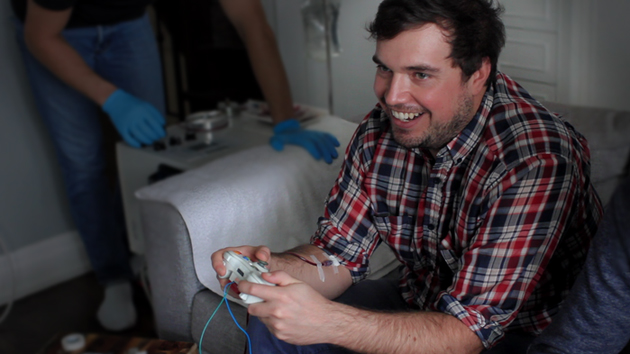 Forget playing games for cash -- if you really want to raise the stakes, try losing your actual blood when you lose in the virtual world. That's the concept behind Blood Sport, a crowdfunded project that modifies game controllers to drain your body...





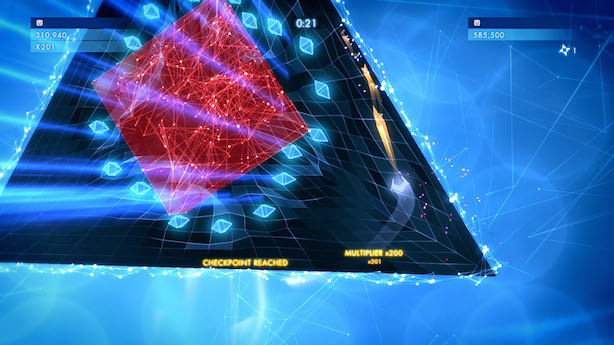 You don't have to worry about quantities of Geometry Wars 3: Dimensions depleting during this week's launch, but pre-ordering the $14.99 twin-stick shooter wouldn't hurt if you're looking for a couple extra levels.
As explained on Sierra's website,...
You don't have to worry about quantities of Geometry Wars 3: Dimensions depleting during this week's launch, but pre-ordering the $14.99 twin-stick shooter wouldn't hurt if you're looking for a couple extra levels.
As explained on Sierra's website,...
 The firmware wasn’t complete, though; there were jumps to places outside the code [Sprite] had and a large block looked corrupted. There’s another thing you can do with an executable file: run it. With