Shared posts

09 Feb 18:07

Versatile Self-Adapting Boronic Acids for H-Bond Recognition: From Discrete to Polymeric Supramolecules

by Irene Georgiou, Simon Kervyn, Alexandre Rossignon, Federica De Leo, Johan Wouters, Gilles Bruylants and Davide Bonifazi

TOC Graphic

Journal of the American Chemical Society
DOI: 10.1021/jacs.6b11362
06 Feb 20:41

Cycloparaphenylenes and Their Catenanes: Complex Macrocycles Unveiled by Ion Mobility Mass Spectrometry

Cycloparaphenylenes and Their Catenanes: Complex Macrocycles Unveiled by Ion Mobility Mass Spectrometry

Cycle upon cycle: Solvent-free MALDI ion-mobility mass spectrometry is used to analyze an insoluble product mixture of cycloparaphenylenes. For the first time, monocycles and isomeric catenanes can be detected in a simple reaction mixture, where only monocycles could be expected.

[Communication]
Wen Zhang, Ali Abdulkarim, Florian E. Golling, Hans Joachim Räder, Klaus Müllen
Angew. Chem. Int. Ed., February 01, 2017, DOI: 10.1002/anie.201611943. Read article

02 Feb 15:34

Bis(Aminoaryl) Carbon-Bridged Oligo(phenylenevinylene)s Expand the Limits of Electronic Couplings

Bis(Aminoaryl) Carbon‐Bridged Oligo(phenylenevinylene)s Expand the Limits of Electronic Couplings

Bridge the gap: Electronic communication (charge transfer and spin coupling) over long covalent distances are achieved by using “pole-like” carbon-bridges between oligophenylene and vinylene units. This communication is demonstrated by using bis(triarylamine)-substituted carbon-bridged oligo(para-phenylenevinylene) cores in their radical cation and dication states.

[Communication]
Paula Mayorga Burrezo, Nai-Ti Lin, Koji Nakabayashi, Shin-ichi Ohkoshi, Eva M. Calzado, Pedro G. Boj, María A. Díaz García, Carlos Franco, Concepciò Rovira, Jaume Veciana, Michael Moos, Christoph Lambert, Juan T. López Navarrete, Hayato Tsuji, Eiichi Nakamura, Juan Casado
Angew. Chem. Int. Ed., January 31, 2017, DOI: 10.1002/anie.201610921. Read article

02 Feb 15:33

Bright, Stable, and Biocompatible Organic Fluorophores Absorbing/Emitting in the Deep Near-Infrared Spectral Region

Bright, Stable, and Biocompatible Organic Fluorophores Absorbing/Emitting in the Deep Near‐Infrared Spectral Region

Deep into NIR: A class of bright and stable small-molecule organic fluorophores absorbing and emitting at around 880 nm and 915 nm, respectively, was developed. The dyes are suitable for in vitro and in vivo imaging, and make available the red end of the biological NIR spectral window for microscopic studies. They are also potentially valuable for a range of material-based applications.

[Communication]
Zuhai Lei, Xinran Li, Xiao Luo, Haihong He, Jing Zheng, Xuhong Qian, Youjun Yang
Angew. Chem. Int. Ed., January 31, 2017, DOI: 10.1002/anie.201612301. Read article

02 Feb 12:52

High-Yield Alkylation and Arylation of Graphene via Grignard Reaction with Fluorographene

by Demetrios D. Chronopoulos, Aristides Bakandritsos, Petr Lazar, Martin Pykal, Klára Čépe, Radek Zbořil and Michal Otyepka

TOC Graphic

Chemistry of Materials
DOI: 10.1021/acs.chemmater.6b05040
31 Jan 13:49

Dithieno-Fused Polycyclic Aromatic Hydrocarbon with a Pyracylene Moiety: Strong Antiaromatic Contribution to the Electronic Structure

by Chaolumen, Michihisa Murata, Atsushi Wakamiya and Yasujiro Murata

TOC Graphic

Organic Letters
DOI: 10.1021/acs.orglett.6b03819
31 Jan 13:44

Hydrogen-adduction to open-shell graphene fragments: spectroscopy, thermochemistry and astrochemistry

Chem. Sci., 2017, 8,1186-1194
DOI: 10.1039/C6SC03787A, Edge Article
Open Access Open Access
Creative Commons Licence&nbsp This article is licensed under a Creative Commons Attribution 3.0 Unported Licence.
Gerard D. O'Connor, Bun Chan, Julian A. Sanelli, Katie M. Cergol, Viktoras Dryza, Richard J. Payne, Evan J. Bieske, Leo Radom, Timothy W. Schmidt
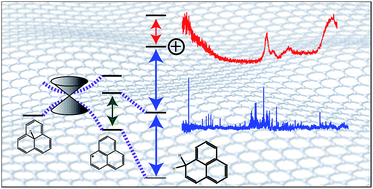
H-Adducted graphene fragments are interrogated with lasers, revealing excited state bond dissociation energies and ionization energies.
The content of this RSS Feed (c) The Royal Society of Chemistry
31 Jan 13:44

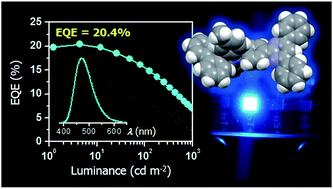
Pyrimidine-based twisted donor-acceptor delayed fluorescence molecules: a new universal platform for highly efficient blue electroluminescence

Chem. Sci., 2017, 8,953-960
DOI: 10.1039/C6SC03793C, Edge Article
Open Access Open Access
Creative Commons Licence&nbsp This article is licensed under a Creative Commons Attribution 3.0 Unported Licence.
In Seob Park, Hideaki Komiyama, Takuma Yasuda
High-efficiency deep blue thermally activated delayed fluorescence (TADF) emitters consisting of acridan-pyrimidine donor-acceptor motifs are developed.
The content of this RSS Feed (c) The Royal Society of Chemistry
29 Jan 20:36

An Electron Acceptor with Porphyrin and Perylene Bisimides for Efficient Non-Fullerene Solar Cells

An Electron Acceptor with Porphyrin and Perylene Bisimides for Efficient Non‐Fullerene Solar Cells

Within arm's reach: A star-shaped porphyrin-based molecule with four perylene bisimide arms (PBI-Por) was designed as a non-fullerene electron acceptor for application in solar cells. The combination of a donor polymer with PBI-Por in a solar cell resulted in a photoresponse from λ=300 to 850 nm, with a maximum external quantum efficiency (EQE) of almost 0.70, and a promising power conversion efficiency of 7.4 %.

[Communication]
Andong Zhang, Cheng Li, Fan Yang, Jianqi Zhang, Zhaohui Wang, Zhixiang Wei, Weiwei Li
Angew. Chem. Int. Ed., January 27, 2017, DOI: 10.1002/anie.201612090. Read article

25 Jan 21:25

Metallacyclopentadienes: synthesis, structure and reactivity

Chem. Soc. Rev., 2017, 46,1160-1192
DOI: 10.1039/C6CS00525J, Review Article
Wangyang Ma, Chao Yu, Tianyang Chen, Ling Xu, Wen-Xiong Zhang, Zhenfeng Xi
This review provides a comprehensive overview of the preparation, structure and reactivity of five-membered metallacyclopentadienes.
The content of this RSS Feed (c) The Royal Society of Chemistry
25 Jan 20:54

Rigidification or interaction-induced phosphorescence of organic molecules

Chem. Commun., 2017, 53,2081-2093
DOI: 10.1039/C6CC09288H, Feature Article
Massimo Baroncini, Giacomo Bergamini, Paola Ceroni
This feature article presents the principles and most recent examples of organic molecules in which long lived and highly intense room-temperature phosphorescence is switched on by rigidification of the matrix in a crystal or in a polymer or by interaction with other molecules.
The content of this RSS Feed (c) The Royal Society of Chemistry
25 Jan 10:28

Recent advances in organic thermally activated delayed fluorescence materials

Chem. Soc. Rev., 2017, 46,915-1016
DOI: 10.1039/C6CS00368K, Review Article
Zhiyong Yang, Zhu Mao, Zongliang Xie, Yi Zhang, Siwei Liu, Juan Zhao, Jiarui Xu, Zhenguo Chi, Matthew P. Aldred
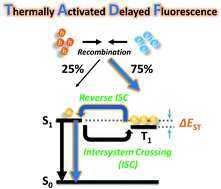
Thermally activated delayed fluorescence: harvesting dark triplet excitons to generate bright emissive singlet excitons.
The content of this RSS Feed (c) The Royal Society of Chemistry
19 Jan 12:21

Enhanced intersystem crossing in core-twisted aromatics

Chem. Sci., 2017, 8,1776-1782
DOI: 10.1039/C6SC05126J, Edge Article
Open Access Open Access
Creative Commons Licence&nbsp This article is licensed under a Creative Commons Attribution 3.0 Unported Licence.
Kalaivanan Nagarajan, Ajith R. Mallia, Keerthi Muraleedharan, Mahesh Hariharan
Core-twisted aromatics exhibit enhanced intersystem crossing upon photoexcitation when compared to their planar analogs.
The content of this RSS Feed (c) The Royal Society of Chemistry
13 Jan 08:42

One-Pot Synthesis of Rotationally Restricted, Conjugatable, BODIPY Derivatives from Phthalides

by Mayca del Río, Fernando Lobo, J. Cristobal López, Ainhoa Oliden, Jorge Bañuelos, Iñigo López-Arbeloa, Inmaculada Garcia-Moreno and Ana M. Gómez

TOC Graphic

The Journal of Organic Chemistry
DOI: 10.1021/acs.joc.6b02426
12 Jan 06:46

Complexation and Electronic Communication between Corannulene-Based Buckybowls and a Curved Truxene-TTF Donor

by Maria Gallego, Joaquin Calbo, Rafael M Krick-Calderon, Paula Pla, Ya-Chu Hsieh, Emilio Manuel Pérez, Yao-Ting Wu, Enrique Orti, Dirk M Guldi, Nazario Martin

Abstract

The association behavior of an electron-donating, bowl-shaped, truxene-based tetrathiafulvalene (truxTTF) with two corannulene-based fullerene fragments, C32H12 and C38H14, is investigated in several solvents. Formation of 1:1 complexes is followed by absorption titrations and complemented by density functional theory (DFT) calculations. The binding constants are in the range log Ka=2.9–3.5. DFT calculations reveal that the most stable arrangement is the conformation in which the 1,3-dithiole ring of truxTTF is placed inside the concave cavity of the corannulene derivative. This arrangement is confirmed experimentally by NMR measurements, and implies that a combination of π–π and CH–π interactions is the driving force for association. Time-dependent DFT calculations reproduce the experimental UV/Vis titrations and provide a detailed understanding of the spectral changes observed. Femtosecond transient absorption studies reveal the processes occurring after photoexcitation of either C32H12 or C38H14 and their supramolecular associates with truxTTF. In the case of truxTTF⋅C38H14, photoexcitation yields the charge-separated state truxTTF.+⋅C38H14.− with a lifetime of approximately 160 ps.

Thumbnail image of graphical abstract

Pitch a curve: The association behavior of a bowl-shaped, truxene-based tetrathiafulvalene (truxTTF) with corannulene-based fullerene fragments is investigated. These π-extended corannulene derivatives are revealed to be suitable systems for the formation of 1:1 supramolecular complexes with bowl-shaped electron-donor molecules, in which intermolecular photoinduced electron transfer occurs, mimicking the related buckyballs (see figure).

12 Jan 06:44

Looking at Photoinduced Charge Transfer Processes in the IR: Answers to Several Long-Standing Questions

by Bogdan Dereka, Marius Koch and Eric Vauthey

TOC Graphic

Accounts of Chemical Research
DOI: 10.1021/acs.accounts.6b00538
10 Jan 08:16

Facile Synthesis of Polycyclic Pentalenes with Enhanced Hückel Antiaromaticity

Facile Synthesis of Polycyclic Pentalenes with Enhanced Hückel Antiaromaticity

Polycyclic pentalenes with phenanthrene-type π extensions were prepared from 1,4-bis(bromoaryl)-1,3-butadiynes by successive transannular cyclizations of the in situ generated tetrakisdehydro[16]annulenes. These polycyclic pentalenes show not only high thermal stability, but also intriguing absorption and redox properties, due to the pronounced Hückel antiaromaticity.

[Communication]
Hiroya Oshima, Aiko Fukazawa, Shigehiro Yamaguchi
Angew. Chem. Int. Ed., January 09, 2017, DOI: 10.1002/anie.201611344. Read article

10 Jan 08:11

Luminescent Superbenzene with Diarylamino and Diarylboryl Groups

by Ryohei Kurata, Kensuke Kaneda and Akihiro Ito

TOC Graphic

Organic Letters
DOI: 10.1021/acs.orglett.6b03596
01 Jan 20:24

Guest-Induced Modulation of the Energy Transfer Process in Porphyrin-Based Artificial Light Harvesting Dendrimers

by Dajeong Yim, Jooyoung Sung, Serom Kim, Juwon Oh, Hongsik Yoon, Young Mo Sung, Dongho Kim and Woo-Dong Jang

TOC Graphic

Journal of the American Chemical Society
DOI: 10.1021/jacs.6b11804
31 Dec 09:54

Annulated Isomeric, Expanded, and Contracted Porphyrins

by Tridib Sarma and Pradeepta K. Panda

TOC Graphic

Chemical Reviews
DOI: 10.1021/acs.chemrev.6b00411
31 Dec 09:44

Synthesis of Fully Arylated (Hetero)arenes

Chem. Commun., 2016, Accepted Manuscript
DOI: 10.1039/C6CC09550J, Feature Article
Shin Suzuki, Junichiro Yamaguchi
Multiply arylated arenes are privileged structures with highly useful functions and fascinating optoelectronic and biological properties. This feature article reports the synthesis of fully arylated (hetero)arenes bearing more than two...
The content of this RSS Feed (c) The Royal Society of Chemistry
31 Dec 09:31

β-Hexaalkylporphycenes: Positional Effect of Alkyl Groups toward Design and Control of Structural and Photophysical Properties in Isomeric Hexaethylporphycenes

by Narendra N. Pati, B. Sathish Kumar and Pradeepta K. Panda

TOC Graphic

Organic Letters
DOI: 10.1021/acs.orglett.6b03428
22 Dec 10:20

One-Step Annulative π-Extension of Alkynes with Dibenzosiloles or Dibenzogermoles by Palladium/o-chloranil Catalysis

One‐Step Annulative π‐Extension of Alkynes with Dibenzosiloles or Dibenzogermoles by Palladium/o‐chloranil Catalysis

Extending circumstances: An efficient one-step annulative π-extension reaction of alkynes provides facile access to diarylphenanthrenes and related nanographene precursors. In the presence of a cationic palladium/o-chloranil catalyst system, a variety of diarylacetylenes are transformed through the use of dibenzosiloles or dibenzogermoles as π-extending agents into 9,10-diarylphenanthrenes with good functional-group tolerance.

[Communication]
Kyohei Ozaki, Keiichiro Murai, Wataru Matsuoka, Katsuaki Kawasumi, Hideto Ito, Kenichiro Itami
Angew. Chem. Int. Ed., December 21, 2016, DOI: 10.1002/anie.201610374. Read article

22 Dec 10:09

Pyridine-Catalyzed Radical Borylation of Aryl Halides

by Li Zhang and Lei Jiao

TOC Graphic

Journal of the American Chemical Society
DOI: 10.1021/jacs.6b11813
22 Dec 10:05

Separation and Selective Formation of Fullerene Adducts within an MII8L6 Cage

by Wolfgang Brenner, Tanya K. Ronson and Jonathan R. Nitschke

TOC Graphic

Journal of the American Chemical Society
DOI: 10.1021/jacs.6b11523
20 Dec 15:49

Sizing the role of London dispersion in the dissociation of all-meta tert-butyl hexaphenylethane

Chem. Sci., 2017, 8,405-410
DOI: 10.1039/C6SC02727J, Edge Article
Open Access Open Access
Creative Commons Licence&nbsp This article is licensed under a Creative Commons Attribution 3.0 Unported Licence.
Soren Rosel, Ciro Balestrieri, Peter R. Schreiner
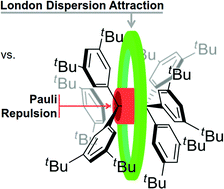
The structure and dynamics of enigmatic hexa(3,5-di-tert-butylphenyl)ethane was characterized via NMR spectroscopy for the first time.
The content of this RSS Feed (c) The Royal Society of Chemistry
19 Dec 18:20

Real-time analysis of Pd2(dba)3 activation by phosphine ligands

Chem. Commun., 2017, 53,854-856
DOI: 10.1039/C6CC08824D, Communication
Eric Janusson, Harmen S. Zijlstra, Peter P. T. Nguyen, Landon MacGillivray, Julio Martelino, J. Scott McIndoe
Real-time UV-Vis/ESI-MS monitoring of Pd2(dba)3 activation provides insight into active species and the effect of activation protocol on their formation.
The content of this RSS Feed (c) The Royal Society of Chemistry
15 Dec 08:44

Benzo-Fused Double [7]Carbohelicene: Synthesis, Structures, and Physicochemical Properties

Benzo‐Fused Double [7]Carbohelicene: Synthesis, Structures, and Physicochemical Properties

Carbon-rich compounds: An all-carbon double [7]helicene has been synthesized by regioselective cyclodehydrogenation. The compound represents the highest homolog of the double carbohelicenes. The twisted conformers D7H-1 and D7H-2 were separated by recrystallization, and their double helicene structures were elucidated by X-ray crystallography.

[Communication]
Yunbin Hu, Xiao-Ye Wang, Pi-Xian Peng, Xin-Chang Wang, Xiao-Yu Cao, Xinliang Feng, Klaus Müllen, Akimitsu Narita
Angew. Chem. Int. Ed., December 14, 2016, DOI: 10.1002/anie.201610434. Read article

14 Dec 07:00

Porphycenes and Related Isomers: Synthetic Aspects

by Gonzalo Anguera and David Sánchez-García

TOC Graphic

Chemical Reviews
DOI: 10.1021/acs.chemrev.6b00345
06 Dec 11:29

Iron-Catalyzed Oxidative C−C and N−N Coupling of Diarylamines and Synthesis of Spiroacridines

Iron‐Catalyzed Oxidative C−C and N−N Coupling of Diarylamines and Synthesis of Spiroacridines

Let us count the ways… Catalysis by iron–hexadecafluorophthalocyanine enabled the aerobic coupling of diarylamines to form 2,2′-bis(arylamino)biaryl compounds, tetraarylhydrazines, or 5,6-dihydrobenzo[c]cinnolines. The chemoselectivity of these transformations was controlled by acid or base additives (see picture).

[Communication]
Raphael F. Fritsche, Gabriele Theumer, Olga Kataeva, Hans-Joachim Knölker
Angew. Chem. Int. Ed., December 05, 2016, DOI: 10.1002/anie.201610168. Read article