Journal of the American Chemical Society
DOI: 10.1021/jacs.8b04818


We report the study of a Dy-based metal-organic framework (MOF), with unprecedented magnetic properties. The compound is made of nine-coordinated DyIII magnetic building blocks (MBBs) with poor intrinsic single-molecule magnet behaviour. However, the MOF architecture constrains the MBBs in a one-dimensional structure that induces a ferromagnetic coupling between them. Overall, the material shows a magnetic slow relaxation in absence of external static field and a hysteretic behaviour at 0.5K. Low temperature magnetic studies, diamagnetic doping and ab-initio calculations highlight the crucial role played by the Dy-Dy ferromagnetic interaction. Overall, we report an original magnetic object at the frontier between single-chain magnet and single-molecule magnet that host intra-chain couplings that cancel quantum tunneling between the MBBs. This compound evidences that bottom-up approach via MOF design can induce spontaneous organization of MBBs able to produce remarkable molecular magnetic material.

Prompted by the recent rapid growth of interest in circularly polarized luminescence (CPL) of organic molecules, we have collected all the reliable CPL, as well as the corresponding circular dichroism (CD), data measured in fluid solutions. To analyze the correlation between CPL and CD, we employed the absorption and luminescence dissymmetry factors (gabs and glum) of the π–π* transition reported for chiral organic molecules of various categories, including planar chiral cyclophanes and helicenes, axially chiral biaryls and spiro compounds, and point- and axially chiral BODIPY derivatives. In rigid π-systems, the absorption and fluorescence spectra are often mirror images of each other with a small Stokes shift, reflecting the minimal conformational relaxation in the emissive excited state, which should also affect the chiroptical properties in the excited state and be better sensed by CPL. However, no comprehensive efforts have hitherto been made to correlate the two relevant chiroptical properties, i. e. CPL versus CD, and also to quantitatively elucidate the effects of conformational relaxation in the excited state on the CPL behavior. The global linear regression analysis of all the reported gabs and glum values, though fairly scattered (see TOC), led us to a quantitative relationship: |glum|=0.81×|gabs| (r2=0.60), which demonstrates that the CPL dissymmetry factor is proportional to, and smaller than, the CD dissymmetry factor. A closer look revealed that the slope of the plot, or the proportional coefficient, is a critical function of the class of compounds, varying from 0.99 for cyclophanes to 0.93 for biaryls, to 0.77 for BODIPYs, and then to 0.61 for helicenes/helicenoids. The scattered glum–gabs plot and the general trend glum≤gabs appear to be inherent to the CPL of organic molecules in their isolated states, originating from the conformational flexibility, vibrational contribution, and Stokes shift that differ in each category.

Another view: The absorption and luminescence dissymmetry factors (gabs and glum) of the π–π* transition of chiral organic molecules of various categories, including planar chiral cyclophanes and helicenes, axially chiral biaryls and spiro compounds, were analyzed quantitatively. It was found that in general the circularly polarized luminescence (CPL) dissymmetry factor is proportional to, and smaller than, the circular dichroism (CD) dissymmetry factor.
Single-ion magnets (SIMs), exhibiting slow magnetization relaxation in the absence of the magnetic field, originate from their single spin-carrier centre. In pursuit of high-performance magnetic properties, such as high spin-reversal barrier and high blocking temperature, various metal centres were investigated to establish SIMs, including 3d and 5d transition metal ions, 4f lanthanide ions, and 5f actinide ions, which possess unique zero-field splitting and magnetic properties. Therefore, proper ligand field is of great importance to different types of metals. In the given great breakthroughs since the first SIM, [Pc2Tb]− (Pc=dianion of phthalocyanine), was reported, strategies of ligand field design have emerged. In this review, the developments of SIMs with different metal centres are summarized, as well as the possible strategies.

How molecular magnetism works: A summary of single-ion magnets (SIMs) including the development of 3d, 5d, 4f, and 5f metal-based SIMs and the possible ligand field strategies for high-performance SIMs constructions.
Semiquinones (SQ) are generated in photosynthetic organisms upon photoinduced electron transfer to quinones (Q). They are stabilized by hydrogen bonding (HB) with the neighboring residues, which alters the properties of the reaction center. We designed, synthesized, and investigated resorcin[4]arene cavitands inspired by this function of SQ in natural photosynthesis. Cavitands were equipped with alternating quinone and quinoxaline walls bearing hydrogen bond donor groups (HBD). Different HBD were analyzed that mimic natural amino acids, such as imidazole and indole, along with their analogues, pyrrole and pyrazole. Pyrroles were identified as the most promising candidates that enabled the cavitands to remain open in the Q state until strengthening of HB upon reduction to the paramagnetic SQ radical anion provided stabilization of the closed form. The SQ state was generated electrochemically and photochemically, whereas properties were studied by UV/Vis spectroelectrochemistry, transient absorption, and EPR spectroscopy. This study demonstrates a photoredox-controlled conformational switch towards a new generation of molecular grippers.

Quintessential: Quinone-based resorcin[4]arene cavitands were prepared as bioinspired photoredox switches. Upon reduction to the paramagnetic bis(semiquinone) radical anions, they undergo a conformational change from an open to a closed form stabilized by hydrogen bonding. The study reveals a novel strategy for the design of molecular grippers controlled by electrical charge or light, of interest to the future development of artificial molecular machines.

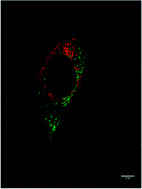
The design of original twisted charge transfer antennae in which a non-planar geometry is enforced thanks to one or two bulky ortho-Me substituents allows us to prepare the corresponding ultra-bright TbIII and DyIII bioprobes. The brightness of the TbIII derivative compares well with that of the benchmark Tb-Lumi4 complex. The first bio-imaging experiments with a DyIII luminescent bioprobe are also reported.
La conception de nouvelles antennes biphényle présentant une rotation bloquée due à l′introduction de groupements méthyle encombrant en position ortho nous a permis de préparer des complexes de TbIII et de DyIII extrêmement brillants. La brillance du complexe de TbIII est du même ordre de grandeur que le celle du Tb-Lumi4, composé de référence dans le domaine. Les premières expériences d'imagerie biologique avec un complexe de DyIII sont également décrites.

Twist and bright: The design of original twisted charge-transfer antennae in which a non-planar geometry is enforced due to one or two bulky ortho-Me substituents allowed the preparation of the corresponding ultra-bright TbIII and DyIII bioprobes. The brightness of the TbIII derivative compares well with that of the benchmark Tb-Lumi4 complex. The first bio-imaging experiments with a DyIII luminescent bioprobe are also reported.

A new class of light-controlled molecular switches based on an azodicarboxamide chromophore is described by S. Amirjalayer, S. Woutersen, W. J. Buma et al. in their Communication (DOI: 10.1002/anie.201709666). These switches work like the crankshaft of a bicycle and, as switching requires a very small volume, will function even in rock-solid spatial constraints. The pedalo-like switching is observed in real time by using time-resolved vibrational spectroscopy to monitor the light-induced dynamics.

 Open Access
   This article is licensed under a Creative Commons Attribution 3.0 Unported Licence.
Open Access  This article is licensed under a Creative Commons Attribution 3.0 Unported Licence.
Open Access  This article is licensed under a Creative Commons Attribution 3.0 Unported Licence.
  This article is licensed under a Creative Commons Attribution 3.0 Unported Licence.
Open Access  This article is licensed under a Creative Commons Attribution 3.0 Unported Licence.
Open Access  This article is licensed under a Creative Commons Attribution 3.0 Unported Licence.

Supramolecular approaches toward the fabrication of functional materials and systems have been an enabling endeavor. Recently, halogen bonding has been harnessed as a promising supramolecular tool. Herein we report the synthesis and characterization of a novel halogen-bonded light-driven axially chiral molecular switch. The photoactive halogen-bonded chiral switch is able to induce a self-organized, tunable helical superstructure, that is, cholesteric liquid crystal (CLC), when doped into an achiral liquid crystal (LC) host. The halogen-bonded switch as a chiral dopant has a high helical twisting power (HTP) and shows a large change of its HTP upon photoisomerization. This light-driven dynamic modulation enables reversible selective reflection color tuning across the entire visible spectrum. The chiral switch also displays a temperature-dependent HTP change that enables thermally driven red, green, and blue (RGB) reflection colors in the self-organized helical superstructure.

Color switch: A novel halogen-bonded light-driven axially chiral molecular switch is able to induce a self-organized, tunable helical superstructure when doped into an achiral liquid-crystal host. Both light- and temperature-driven dynamic modulation of the helical superstructure has enabled red, green and blue reflections to be achieved for the first time employing the halogen-bonded chiral molecular switch.
Here we present a synthetic procedure for regioselectively functionalizing the tetrahydronaphtho[2,1-a]azulene (THNA) photoswitch in its seven-membered ring (position C10). Bromination of the C10–C11 positions occurred with excellent selectivity when using carbondisulfide as solvent at room temperature. Elimination of HBr provided a C10 bromo-substituted THNA that could be arylated by Suzuki cross-coupling reactions. A series of arylated compounds was prepared and subjected to switching studies. Upon irradiation, the five-membered ring underwent ring-opening to a product that at room temperature underwent almost instantaneous ring-closure. By following the conversion at low temperature by UV/Vis absorption spectroscopy, we could elucidate the influence of aryl donor and acceptor groups. Thus, with a donating methoxyphenyl substituent, the ultrafast ring-closure reaction was even further enhanced.

Make and do: The synthesis of arylated tetrahydronaphtho[2,1-a] (THNA) photoswitches was achieved by a bromination–elimination–cross-coupling procedure. Upon irradiation, the THNA derivatives undergo ring-opening to vinylheptafulvene-like structures, which undergo fast thermal ring-closures to a mixture of THNA isomers by a rate that relies on the electronic character of the aryl group. The ring-closures could be described by a linear free-energy relationship.

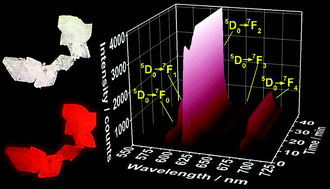
Temperature-dependent luminescence of a dinuclear EuIII/TbIII complex with a seven-coordinate structure is demonstrated. The dinuclear complex is composed of two lanthanide ions, six tetramethylheptanedionate ligands, and a bidentate phosphine oxide linker ligand. The dinuclear structure of the complex was characterized by single-crystal XRD. Intrinsic 4f–4f emission quantum yields of the dinuclear EuIII and TbIII complexes were 66 and 61 %, respectively. The luminescence color of the dinuclear EuIII/TbIII complex changed from red to green with increasing temperature. The thermosensing range based on the ratio of luminescence intensity (AEu/ATb) was 100–450 K. The temperature-dependent luminescence is due to the presence of a ligand-to-metal charge-transfer state.

Temperature-dependent luminescence of a dinuclear EuIII/TbIII complex was demonstrated. The unexpected luminescence color change from red to green with increasing temperature (see figure) was exploited for thermosensing in the temperature range 100–450 K. The temperature-dependent luminescence properties are due to the presence of a ligand-to-metal charge-transfer state.