02 Dec 20:59
Chem. Soc. Rev., 2017, 46,452-463
DOI: 10.1039/C6CS00714G, Review Article
Dorian S. N. Parker, Ralf I. Kaiser
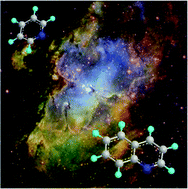
The chemical evolution of extraterrestrial environments leads to the formation of nitrogen substituted polycyclic aromatic hydrocarbons (NPAHs) via gas phase radical mediated aromatization reactions.
The content of this RSS Feed (c) The Royal Society of Chemistry

01 Dec 20:47

Worth its salt: An efficient regioselective ortho-chlorination of anilines is described. A secondary ammonium chloride salt is employed as the organocatalyst and the reaction can be conducted at room temperature without protection from air and moisture. This catalytic protocol has broad substrate scope, is scalable, and was applied to the efficient synthesis of a potent c-Met kinase inhibitor. DCDMH=1,3-dichloro-5,5-dimethylhydantoin.
[Communication]
Xiaodong Xiong, Ying-Yeung Yeung
Angew. Chem. Int. Ed., November 30, 2016, DOI: 10.1002/anie.201607388. Read article
30 Nov 13:25
by Alexander S. Dudnik, Thomas J. Aldrich, Nicholas D. Eastham, Robert P. H. Chang, Antonio Facchetti and Tobin J. Marks

Journal of the American Chemical Society
DOI: 10.1021/jacs.6b10023

28 Nov 20:22
by Prince Ravat, Peter Ribar, Michel Rickhaus, Daniel Häussinger, Markus Neuburger and Michal Juríček

The Journal of Organic Chemistry
DOI: 10.1021/acs.joc.6b02246

28 Nov 20:20
by George Bepete

Nature Chemistry.
doi:10.1038/nchem.2669
Authors: George Bepete, Eric Anglaret, Luca Ortolani, Vittorio Morandi, Kai Huang, Alain Pénicaud & Carlos Drummond
Aggregation usually prevents dissolution of graphene in water. Now, hydroxide ion adsorption has been shown to allow the stabilization of true single-layer graphene in water — with no surfactant required — so long as the liquid is degassed beforehand. The resulting aqueous dispersions can contain high concentrations of exfoliated graphene that are stable for several months.
27 Nov 09:49
by Johann Bosson, Geraldine M. Labrador, Simon Pascal, François-Alexandre Miannay, Oleksandr Yushchenko, Haidong Li, Laurent Bouffier, Neso Sojic, Roberto C. Tovar, Gilles Muller, Denis Jacquemin, Adèle D. Laurent, Boris Le Guennic, Eric Vauthey, Jérôme Lacour
Abstract
The physicochemical properties of cationic dioxa (1), azaoxa (2), and diaza (3) [6]helicenes demonstrate a much higher chemical stability of the diaza adduct 3 (pKR+=20.4,  =−0.72 V) compared to its azaoxa 2 (pKR+=15.2,
  =−0.45 V) and dioxa 1 (pKR+=8.8,
  =−0.12 V) analogues. The fluorescence of these cationic chromophores is established, and ranges from the orange to the far-red regions. From 1 to 3, a bathochromic shift of the lowest energy transitions (up to 614 nm in acetonitrile) and an enhancement of the fluorescence quantum yields and lifetimes (up to 31 % and 9.8 ns, respectively, at 658 nm) are observed. The triplet quantum yields and circularly polarized luminescence are also reported. Finally, fine tuning of the optical properties of the diaza [6]helicene core is achieved through selective and orthogonal post-functionalization reactions (12 examples, compounds 4–15). The electronic absorption is modulated from the orange to the far-red spectral range (560–731 nm), and fluorescence is observed from 591 to 755 nm with enhanced quantum efficiency up to 70 % (619 nm). The influence of the peripheral auxochrome substituents is rationalized by first-principles calculations.

In rainbows: The physicochemical properties of cationic dioxa, azaoxa, and diaza [6]helicenes demonstrate remarkably high chemical stabilities, fluorescence from orange to the far-red regions with non-negligible quantum yields and lifetimes, and circularly polarized luminescence in the same ranges. Selective post-functionalization of the diaza [6]helicene introduces peripheral auxochrome substituents, the influence of which on the optical properties of the compounds is rationalized by first-principles calculations (see figure).
24 Nov 09:21

Light it up: A dearomative strategy based on the visible-light-promoted para-cycloaddition of arenophile with arenes and in situ diimide reduction was developed that provides access to 1,3-cyclohexadienes or unsaturated 1,4-diamines. These products are complementary to known dearomative processes and are amenable to further diversification.
[Communication]
Mikiko Okumura, Stephanie M. Nakamata Huynh, Jola Pospech, David Sarlah
Angew. Chem. Int. Ed., November 23, 2016, DOI: 10.1002/anie.201609686. Read article
24 Nov 09:19
Chem. Commun., 2016, 52,14478-14481
DOI: 10.1039/C6CC08099E, Communication
Ram B. Ambre, Quentin Daniel, Ting Fan, Hong Chen, Biaobiao Zhang, Lei Wang, Marten S. G. Ahlquist, Lele Duan, Licheng Sun
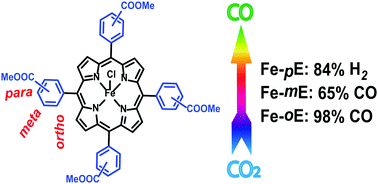
Dramatic effects of ortho, meta and para substituents on the catalytic performances of Fe-porphyrin for CO2 reduction to CO have been investigated.
The content of this RSS Feed (c) The Royal Society of Chemistry

24 Nov 09:18
by Yi Liu, Akimitsu Narita, Joan Teyssandier, Manfred Wagner, Steven De Feyter, Xinliang Feng and Klaus Müllen

Journal of the American Chemical Society
DOI: 10.1021/jacs.6b10369

24 Nov 09:17
by Tatiana V. Esipova, Héctor J. Rivera-Jacquez, Bruno Weber, Artëm E. Masunov and Sergei A. Vinogradov

Journal of the American Chemical Society
DOI: 10.1021/jacs.6b09157

17 Nov 20:46
by Katarzyna Rybicka-Jasińska, Wenqian Shan, Katarzyna Zawada, Karl M. Kadish and Dorota Gryko

Journal of the American Chemical Society
DOI: 10.1021/jacs.6b09036

16 Nov 20:28
by Norihito Fukui, Hideki Yorimitsu, Atsuhiro Osuka
Abstract
A meso–meso-linked diphenylamine-fused porphyrin dimer and its methoxy-substituted analogue were synthesized from a meso–meso-linked porphyrin dimer by a reaction sequence involving Ir-catalyzed β-selective borylation, iodination, meso-chlorination, and SNAr reactions with diarylamines followed by electron-transfer-mediated intramolecular double C−H/C−I coupling. While these dimers commonly display characteristic split Soret bands and small oxidation potentials, they produced different products upon oxidation with tris(4-bromophenyl)aminium hexachloroantimonate. Namely, the diphenylamine-fused porphyrin dimer was converted into a dicationic closed-shell quinonoidal dimer, while the methoxy-substituted dimer gave a meso–meso, β-β doubly linked porphyrin dimer.

Dynamic duo: Diarylamine-fused meso–meso-linked porphyrin dimers were synthesized from a meso–meso-linked porphyrin dimer. They exhibited characteristically split Soret bands and high oxidation potentials that are due to effective perturbation by the fused diarylamine units. Depending on the peripheral substituents, oxidation of these dimers provided different products.
16 Nov 20:27
by Masashi Uebe, Tatsuhisa Kato, Kazuyoshi Tanaka, Akihiro Ito
Abstract
The electronic and molecular structures of 9,10-diamino-substituted anthracenes with different N-substituents have been re-examined. In particular, different N-substituents influence both the electronic and molecular structures of the oxidized species of 9,10-diaminoanthracenes. The anthrylene moiety of 9,10-bis(N,N-di(p-anisyl)amino)anthracene retains its planarity during the course of two successive one-electron oxidations, whereas 9,10-bis(N,N-dimethylamino)anthracene and 9,10-bis(N-p-anisyl-N-methylamino)anthracene undergo a substantial structural change to a butterfly-like structure through a two-electron oxidation process. The structural changes observed for the oxidized states are ascribed to significant differences in the frontier molecular orbitals of the above-mentioned three kinds of 9,10-diaminoanthracenes due to different extents of mixing between the amine-localized and anthrylene-localized orbitals.

Substituent effects on oxidation: 9,10-Diaminoanthracenes with N-substituents have been re-examined. Substituent variation influences electronic and molecular structures of the oxidized species (see graphic). Structural changes observed for the oxidized states may be ascribed to significant differences in the frontier molecular orbitals of 9,10-diaminoanthracenes due to mixing of amine- and anthrylene-localized orbitals.
16 Nov 20:26

“Lock ’em up!” Two tert-butyl groups affect the conformational flexibility and emissive properties of a hexabenzoovalene. In their Communication (DOI: 10.1002/anie.201607740), M. Mastalerz et al. describe “locking up” of a flexible green-emitting hexabenzoovalene by oxidative cyclodehydrogenation, and release of the conformationally “locked” orange-emitting adduct by selective dealkylation.
[Cover Picture]
Kevin Baumgärtner, Ana Lucia Meza Chincha, Andreas Dreuw, Frank Rominger, Michael Mastalerz
Angew. Chem. Int. Ed., November 15, 2016, DOI: 10.1002/anie.201610633. Read article
16 Nov 20:19
by Chihiro Maeda, Mototsugu Takata, Asami Honsho and Tadashi Ema

Organic Letters
DOI: 10.1021/acs.orglett.6b03054

David and -1 others like this
14 Nov 20:32
Chem. Soc. Rev., 2017, 46,431-451
DOI: 10.1039/C6CS00393A, Review Article
P. Prieto, A. de la Hoz, A. Diaz-Ortiz, A. M. Rodriguez
Computational chemistry may explain and rationalize the impact of microwave irradiation in organic synthesis.
The content of this RSS Feed (c) The Royal Society of Chemistry

09 Nov 21:51
by Wei Zhang, Wenzhen Lai and Rui Cao

Chemical Reviews
DOI: 10.1021/acs.chemrev.6b00299

07 Nov 22:59
by Lawrence T. Scott

The Journal of Organic Chemistry
DOI: 10.1021/acs.joc.6b02113

03 Nov 08:08

Towards α-graphyne: A ring carbo-mer of naphthalene, C32Ar8 (Ar=p-n-pentylphenyl), was obtained as a stable blue chromophore in 19 steps. The two carbo-benzenes o-C18Ar4(C≡C−SiiPr3)2 and C18Ar6 are also described. The carbo-naphthalene bicycle is locally aromatic according to structural and magnetic criteria. The stability and aromaticity of this smallest fused molecular fragment of α-graphyne allows prediction of the same properties for the carbon allotrope itself.
[Communication]
Kévin Cocq, Nathalie Saffon-Merceron, Yannick Coppel, Corentin Poidevin, Valérie Maraval, Remi Chauvin
Angew. Chem. Int. Ed., November 02, 2016, DOI: 10.1002/anie.201608300. Read article
22 Oct 15:24
by Matthieu Teci, Michael Tilley, Michael A. McGuire, Michael G. Organ
Abstract
The conversion of commercially available anilines into biaryl and biarylacetylene products was realized by using a telescoped, three-reactor flow diazotization/iododediazotization/cross-coupling process. The segmented flow stream created by off-gassing during the Sandmeyer sequence was restored to a continuous column of reaction solution by using a specially designed continuous-flow unit controlled by custom software created in-house. The resultant aryl iodide was then combined with a stream of cross-coupling solution that fed into the final reactor. The system proved versatile as modifications to the diazotization/iododediazotization sequence could be made rapidly to account for any substrate specificity (e.g., solubility problems), leading to a wide substrate scope of Suzuki–Miyaura and Sonogashira cross-coupled products.

Coupling under continuous flow: A versatile, high-yielding, flow process for the conversion of a wide variety of commercially available anilines into biaryl and biarylacetylene products is described. The system proved versatile as modifications to the diazotization/iododediazotization sequence could be made rapidly to account for any substrate specificity (e.g., solubility problems), leading to a wide substrate scope of Suzuki–Miyaura and Sonogashira cross-coupled products.
21 Oct 07:55
J. Mater. Chem. C, 2016, 4,10367-10370
DOI: 10.1039/C6TC03344J, Paper
Christie L. Cutting, Monojit Bag, D. Venkataraman
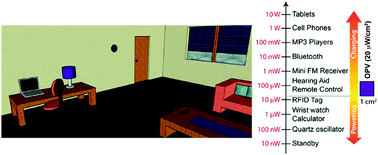
A new home for organic photovoltaics.
The content of this RSS Feed (c) The Royal Society of Chemistry
21 Oct 07:54
by Christopher J. Brassard, Xiaoguang Zhang, Christopher R. Brewer, Peiye Liu, Ronald J. Clark and Lei Zhu

The Journal of Organic Chemistry
DOI: 10.1021/acs.joc.6b01907

21 Oct 07:44

Twist of fate: Bis(dibenzo[a,i ]fluorenylidene) (see scheme) has a closed-shell singlet ground state, but the amount of the 90° twisted, antiferromagnetic triplet diradical increases in the temperature range 300–500 K. The exchange coupling Jex/h c was determined to be 3551 cm−1, which corresponds to a singlet–triplet energy splitting of 9.6 kcal mol−1.
[Communication]
Curt Wentrup, Michèle J. Regimbald-Krnel, Dennis Müller, Peter Comba
Angew. Chem. Int. Ed., October 20, 2016, DOI: 10.1002/anie.201607415. Read article
21 Oct 07:42

Patterned is the new black: Black phosphorus (BP) underwent organic functionalization based on liquid exfoliation (see picture). The treatment of BP with electron-withdrawing 7,7,8,8-tetracyano-p-quinodimethane (TCNQ) led to electron transfer from BP to the organic dopant, whereas the noncovalent interaction of BP with a perylene diimide (PDI) was mainly due to van der Waals interactions and dramatically improved the stability of the flakes.
[Communication]
Gonzalo Abellán, Vicent Lloret, Udo Mundloch, Mario Marcia, Christian Neiss, Andreas Görling, Maria Varela, Frank Hauke, Andreas Hirsch
Angew. Chem. Int. Ed., October 20, 2016, DOI: 10.1002/anie.201604784. Read article
20 Oct 06:20
by Ruijie D. Teo, Jae Youn Hwang, John Termini, Zeev Gross and Harry B. Gray

Chemical Reviews
DOI: 10.1021/acs.chemrev.6b00400

20 Oct 06:19
by Roberto Paolesse, Sara Nardis, Donato Monti, Manuela Stefanelli and Corrado Di Natale

Chemical Reviews
DOI: 10.1021/acs.chemrev.6b00361

19 Oct 13:03
Marika Żyła-Karwowska, Dr. Halina Zhylitskaya, Dr. Joanna Cybińska, Prof. Tadeusz Lis, Prof. Piotr J. Chmielewski and Prof. Marcin Stępień

Supercharged snowflakes: 73 rings were assembled in two steps to produce a ruffled heteroaromatic sheet with hexagonal symmetry (see picture). This nanographene-like system underwent ten consecutive reductions, thus demonstrating a distinctly electron-deficient character. In addition to its charge-storage capability, the extended fused network stabilized a complex chlorobenzene clathrate in the solid state.
Read more now
19 Oct 07:37
by Qipu Dai, Peihe Li, Nuannuan Ma and Changwen Hu

Organic Letters
DOI: 10.1021/acs.orglett.6b02724

19 Oct 07:32
by Semin Lee, Etienne Chénard, Danielle L. Gray and Jeffrey S. Moore

Journal of the American Chemical Society
DOI: 10.1021/jacs.6b08752

19 Oct 07:32
by James E. M. Lewis, Joby Winn, Luca Cera and Stephen M. Goldup

Journal of the American Chemical Society
DOI: 10.1021/jacs.6b08958