13 Apr 13:31
Chem. Commun., 2017, 53,4969-4972
DOI: 10.1039/C6CC07628A, Communication
S. Khorasani, M. A. Fernandes
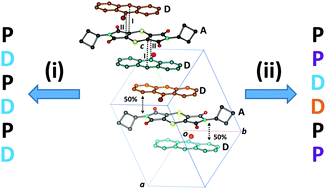
Solid-state Diels-Alder reaction in a 2 : 1 donor to acceptor charge-transfer complex leads to a synthetic co-crystal composed of product and unreacted donor. Analysis of close contacts and DFT energy calculations indicate that the reaction occurs cooperatively where the arrangement of molecules shown in (ii) is favoured.
The content of this RSS Feed (c) The Royal Society of Chemistry

04 Apr 07:13
by Kuai Wang, Ling-Guo Meng and Lei Wang

Organic Letters
DOI: 10.1021/acs.orglett.7b00292

cxl, cun and 4 others like this
03 Apr 21:31
by Kyohei Ozaki, Wataru Matsuoka, Hideto Ito and Kenichiro Itami

Organic Letters
DOI: 10.1021/acs.orglett.7b00684

03 Apr 21:29
by Carin C. C. Johansson Seechurn, Theresa Sperger, Thomas G. Scrase, Franziska Schoenebeck and Thomas J. Colacot

Journal of the American Chemical Society
DOI: 10.1021/jacs.7b01110

31 Mar 23:15
by Gonzalo Abellán, Milan Schirowski, Konstantin F. Edelthalhammer, Michael Fickert, Katharina Werbach, Herwig Peterlik, Frank Hauke and Andreas Hirsch

Journal of the American Chemical Society
DOI: 10.1021/jacs.7b00704

31 Mar 09:27

Spoilt for choice: Boron-, phosphorus-, and silicon-centered 4,8,12-triazatriangulenes were synthesized. The key step involved the efficient incorporation of the heteroatom into a nitrogen-containing macrocyclic precursor through electrophilic C−Li and C−H substitution (see scheme).
[Communication]
Soichiro Nakatsuka, Hajime Gotoh, Keisuke Kinoshita, Nobuhiro Yasuda, Takuji Hatakeyama
Angew. Chem. Int. Ed., March 29, 2017, https://doi.org/10.1002/anie.201701246 Read article
31 Mar 09:25

Chlorophyll analog: An amphiphilic BF2-azadipyrromethene (aza-BODIPY) dye 1 forms two types of aggregates with distinct optical properties and nanoscale morphologies through competing cooperative self-assembly pathways. The observed rod-like morphology and exciton characteristics for the aza-BODIPY-based J-aggregates are comparable to those of natural chlorophyll dye assemblies.
[Communication]
Zhijian Chen, Yong Liu, Wolfgang Wagner, Vladimir Stepanenko, Xiangkui Ren, Soichiro Ogi, Frank Würthner
Angew. Chem. Int. Ed., March 29, 2017, https://doi.org/10.1002/anie.201701788 Read article
31 Mar 09:21

Closing the circle: Palladium-catalyzed 2- or 4-fold C−H arylation of unactivated arenes was developed to access substituted triphenylene frameworks.
[Communication]
Bijoy P. Mathew, Hyun Ji Yang, Joohee Kim, Jae Bin Lee, Yun-Tae Kim, Sungmin Lee, Chang Young Lee, Wonyoung Choe, Kyungjae Myung, Jang-Ung Park, Sung You Hong
Angew. Chem. Int. Ed., March 30, 2017, https://doi.org/10.1002/anie.201700405 Read article
31 Mar 09:21

Looking to the stars: In 1985 the fullerenes were discovered through experiments aimed at understanding the formation of carbon chains found in interstellar space. Thirty years later spectroscopic experiments have confirmed the presence of C60+ in diffuse clouds of molecules and dust and given the first answer to a long standing astronomical puzzle.
[Review]
John P. Maier, Ewen K. Campbell
Angew. Chem. Int. Ed., March 30, 2017, https://doi.org/10.1002/anie.201612117 Read article
31 Mar 08:16

As captivating as a butterfly: Different strategies toward stable superbenzoquinone (SBQ) derivatives were explored, and stable 4-tert-phenyl-substituted SBQ-Ph was obtained by appropriate kinetic blocking. SBQ-Ph (see structure) has an open-shell singlet ground state with moderate diradical character and adopts a butterfly-like geometry in the single crystal.
[Communication]
Guangwu Li, Hoa Phan, Tun Seng Herng, Tullimilli Y. Gopalakrishna, Chunchen Liu, Wangdong Zeng, Jun Ding, Jishan Wu
Angew. Chem. Int. Ed., March 30, 2017, https://doi.org/10.1002/anie.201700441 Read article
29 Mar 09:11
RSC Adv., 2017, 7,18690-18695
DOI: 10.1039/C7RA02699D, Paper

Open Access
Yousuke Ooyama, Toshiaki Enoki, Joji Ohshita, Takuya Kamimura, Shuwa Ozako, Taro Koide, Fumito Tani
We demonstrate that a cyclic free-base porphyrin dimer and its inclusion complex with fullerene C60 possess the ability to generate singlet oxygen (1O2) under visible light irradiation.
The content of this RSS Feed (c) The Royal Society of Chemistry

28 Mar 05:41

Collect. Select. Reflect: para-Selective C−H borylation of benzamide and pyridine adducts is controlled by a combination of iridium and bulky aluminum-based Lewis acid catalysts. Variously substituted (hetero)arylboronates were prepared, which are versatile synthetic intermediates for complex multi-substituted aromatic compounds.
[Communication]
Lichen Yang, Kazuhiko Semba, Yoshiaki Nakao
Angew. Chem. Int. Ed., March 27, 2017, https://doi.org/10.1002/anie.201701238 Read article
22 Mar 19:34
by Ralf Einholz, Treliant Fang, Robert Berger, Peter Grüninger, Andreas Früh, Thomas Chassé, Reinhold F. Fink and Holger F. Bettinger

Journal of the American Chemical Society
DOI: 10.1021/jacs.6b13212

18 Mar 00:17
by Chuan Gao, Zhou-Lin Luan, Qi Zhang, Shun Yang, Si-Jia Rao, Da-Hui Qu and He Tian

Organic Letters
DOI: 10.1021/acs.orglett.7b00393

17 Mar 06:35
by Xiao-Song Xue, Pengju Ji, Biying Zhou and Jin-Pei Cheng

Chemical Reviews
DOI: 10.1021/acs.chemrev.6b00664

10 Mar 12:45
by Alla Pogoreltsev, Yuri Tulchinsky, Natalia Fridman and Mark Gandelman

Journal of the American Chemical Society
DOI: 10.1021/jacs.6b12360

09 Mar 07:36
by Xiaoxiao Qiao, Qiqi Li, Richard N. Schaugaard, Benjamin W. Noffke, Yijun Liu, Dongping Li, Lu Liu, Krishnan Raghavachari and Liang-shi Li

Journal of the American Chemical Society
DOI: 10.1021/jacs.6b12530

05 Mar 20:39
by Xiaohua Zheng, Lei Wang, Qing Pei, Shasha He, Shi Liu and Zhigang Xie

Chemistry of Materials
DOI: 10.1021/acs.chemmater.7b00228

05 Mar 20:36
by Michael Y. Wong, Eli Zysman-Colman
The design of thermally activated delayed fluorescence (TADF) materials both as emitters and as hosts is an exploding area of research. The replacement of phosphorescent metal complexes with inexpensive organic compounds in electroluminescent (EL) devices that demonstrate comparable performance metrics is paradigm shifting, as these new materials offer the possibility of developing low-cost lighting and displays. Here, a comprehensive review of TADF materials is presented, with a focus on linking their optoelectronic behavior with the performance of the organic light-emitting diode (OLED) and related EL devices. TADF emitters are cross-compared within specific color ranges, with a focus on blue, green–yellow, orange–red, and white OLEDs. Organic small-molecule, dendrimer, polymer, and exciplex emitters are all discussed within this review, as is their use as host materials. Correlations are provided between the structure of the TADF materials and their optoelectronic properties. The success of TADF materials has ushered in the next generation of OLEDs.

The emergence of thermally activated delayed fluorescence (TADF) organic compounds has brought about an evolution in the design of OLED emitter design. These materials harvest both singlet and triplet excitons in the device for light emission. This comprehensive review critically examines organic TADF emitters and hosts used in electroluminescent devices.
03 Mar 12:45
by Simon Krautwald, Máté J. Bezdek and Paul J. Chirik

Journal of the American Chemical Society
DOI: 10.1021/jacs.7b00445

02 Mar 09:22
by Ryo Shintani, Nana Misawa, Tomohiro Tsuda, Ryo Iino, Mikiya Fujii, Koichi Yamashita and Kyoko Nozaki

Journal of the American Chemical Society
DOI: 10.1021/jacs.7b00344

02 Mar 09:21
by Huihui Kong, Sha Yang, Hongying Gao, Alexander Timmer, Jonathan P. Hill, Oscar Díaz Arado, Harry Mönig, Xinyan Huang, Qin Tang, Qingmin Ji, Wei Liu and Harald Fuchs

Journal of the American Chemical Society
DOI: 10.1021/jacs.6b10936

28 Feb 22:11
Chem. Sci., 2017, 8,3821-3831
DOI: 10.1039/C6SC05103K, Edge Article
Open Access
Nathan T. La Porte, Jose F. Martinez, Svante Hedstrom, Benjamin Rudshteyn, Brian T. Phelan, Catherine M. Mauck, Ryan M. Young, Victor S. Batista, Michael R. Wasielewski
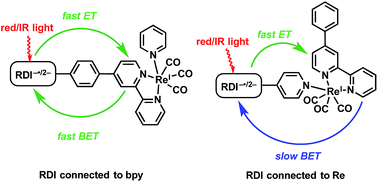
Photoinduced electron transfer dynamics are described for a set of dyads comprising rylenediimide anion chromophores and a Re(bpy)(CO)3 metal center.
The content of this RSS Feed (c) The Royal Society of Chemistry

26 Feb 15:26
by Tomáš Šolomek, Natalia E. Powers-Riggs, Yi-Lin Wu, Ryan M. Young, Matthew D. Krzyaniak, Noah E. Horwitz and Michael R. Wasielewski

Journal of the American Chemical Society
DOI: 10.1021/jacs.7b00233

24 Feb 09:36
by Hiroyuki Kaida, Tsuyoshi Goya, Yuji Nishii, Koji Hirano, Tetsuya Satoh and Masahiro Miura

Organic Letters
DOI: 10.1021/acs.orglett.7b00323

23 Feb 13:31
by Alex Yong Sheng Eng, Zdeněk Sofer, Daniel Bouša, David Sedmidubský, Štěpán Huber, Martin Pumera
Hydrogen is a clean fuel with high specific energy and its handling and storage are important toward fuel cell research. Particularly, high-density hydrogen storage is crucial for the viability of future hydrogen-powered devices. This leads to the search for suitable methods; one such option is chemical storage in light materials with large surface areas, such as graphene. Here, the bulk production of graphane by Birch reduction of halogenated (Cl/Br/I) graphene precursors is reported as a potentially scalable procedure. Prior treatment with strong hydrohalic acids is used to remove oxygen-groups and to substitute these with halogens, resulting in effective hydrogenation. An unprecedented level of hydrogen storage is obtained from the iodinated-graphene starting material at 7.44 wt%, far above the U.S. Department of Energy's 2020 system target of 5.5 wt% and close to its ultimate 7.5 wt% goal. As the stored hydrogen is chemisorbed on the graphane scaffold it is stable at both room temperature and on atmospheric exposure, where neither temperature control nor pressure regulation is required. Hydrogen may then be desorbed at elevated temperatures above 400 °C.

Bulk graphane is prepared from halogenated graphene precursors (X = Cl/Br/I), giving levels of stored hydrogen in the material close to the theoretical limit. The graphane produced is stable in air and hydrogen can be subsequently desorbed at elevated temperature. High density hydrogen storage makes graphane a possible option for future hydrogen-powered devices.
23 Feb 10:25
by Nadzeya A. Kukhta, Demetrio A. da Silva Filho, Dmytro Volyniuk, Juozas Vidas Grazulevicius and Gjergji Sini

Chemistry of Materials
DOI: 10.1021/acs.chemmater.6b05158

16 Feb 16:51
by Mohamed Kadri, Jingran Hou, Vincent Dorcet, Thierry Roisnel, Lazhar Bechki, Abdellah Miloudi, Christian Bruneau, Rafael Gramage-Doria

Weak Zn⋅⋅⋅N interactions have been exploited in homogeneous palladium catalysis. The selective binding between pyridine-containing compounds and zinc-containing scaffolds (porphyrin or salphen) prevents undesired catalyst inhibition, thus increasing the activity of the palladium-phosphane catalyst. The picture illustrates how a magician uses the “Zn⋅⋅⋅N weak interactions” trick to increase the performance of the palladium catalyst inside an Erlenmeyer flask under the watchful eye of a bunny. More information can be found in the Full Paper by R. Gramage-Doria et al. (DOI: 10.1002/chem.201604780).
13 Feb 23:20
![A Naphtho‐Fused Double [7]Helicene from a Maleate‐Bridged Chrysene Trimer](http://onlinelibrary.wiley.com/store/10.1002/anie.201610793/asset/image_n/anie201610793-toc-0001.png?v=1&s=0f8e5fb649de3cda7efbf7d270cafc3a497435d1 "A Naphtho‐Fused Double [7]Helicene from a Maleate‐Bridged Chrysene Trimer")
It takes only five consecutive steps from unsubstituted chrysene to obtain an all-kata-annulated arene tetracarboxylate, in which two heptahelicene segments are joined together. The bishelicene is formed in the achiral meso configuration, with the two helices having opposite pitches.
[Communication]
Marli Ferreira, Guillaume Naulet, Hugo Gallardo, Pierre Dechambenoit, Harald Bock, Fabien Durola
Angew. Chem. Int. Ed., February 09, 2017, DOI: 10.1002/anie.201610793. Read article
09 Feb 18:19
by Hayato Tsuji and Eiichi Nakamura

Accounts of Chemical Research
DOI: 10.1021/acs.accounts.6b00595





![A Naphtho‐Fused Double [7]Helicene from a Maleate‐Bridged Chrysene Trimer](http://onlinelibrary.wiley.com/store/10.1002/anie.201610793/asset/image_m/anie201610793-toc-0001-m.png?v=1&s=add853bee2fcc7e40d9520721ba25453d72d8582 "A Naphtho‐Fused Double [7]Helicene from a Maleate‐Bridged Chrysene Trimer")