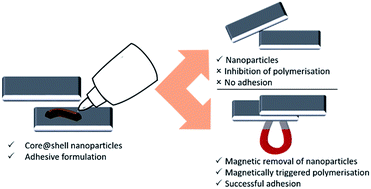
Journal of the American Chemical Society
DOI: 10.1021/jacs.8b09208
SHANGHAI—For the past decade, Mu-Ming Poo, the director of the Institute of Neuroscience in Shanghai, has been on a quest to make monkeys that can be used to study human disease. Today, researchers in his institute announced a major milestone: the births of Zhongzhong and Huahua, the first two monkey clones created using the same technique behind Dolly the sheep.
Their names together form “Zhonghua,” meaning the Chinese nation or people, a nod to their national importance. China has invested heavily in primate research in recent years—as the United States and Europe have pulled back.
After Dolly’s birth in 1996, scientists quickly figured out how to clone mice, pigs, dogs, cats, cows, and more. But primates long proved elusive. In 2003, after scientists at the University of Pittsburgh used 716 eggs and failed to create a single clone, it was suggested that primate cloning—and by extension human cloning—is impossible using this method.
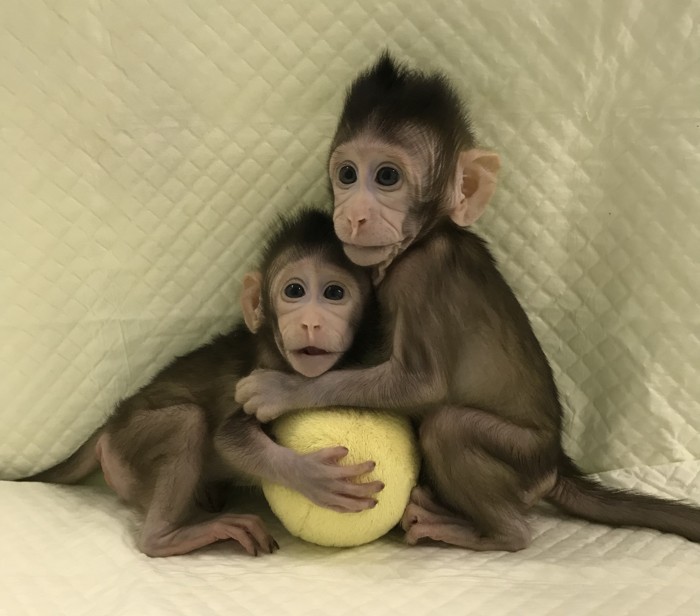
In a recent interview in Poo’s office in Shanghai, he told me that human cloning is absolutely not his intention. That, he said, requires its own ethical debate. But he wants to use cloning to the expand the number of genetically modified monkeys, which are becoming easier to make using CRISPR.
For example, in 2016, scientists at the Institute of Neuroscience in Shanghai created monkeys with a mutated form of the gene MECP2, which is linked to autism spectrum disorder. The genetically modified creatures ran in circles and avoided other monkeys—behaviors that may echo children with the MECP2 mutation.
Yet, says Poo, the monkeys led to “very little” progress in understanding the disorder. “It is a feasibility demonstration that we can manipulate genes in monkeys, but it’s not a disease model,” he says. Different monkeys had copies of the gene in different parts of their genome, and their resulting behaviors varied. The technique used to create the MECP2 monkeys did not give scientists enough control. Similar problems can arise with CRISPR, a gene-editing technique that has been widely adopted in different organisms across the world. You can’t test new drugs on monkeys whose manifestations of disease are so different from one another.
With cloning, it is possible to genetically modify monkey cells in a dish, grow the cells in large numbers, and then create clones from them. The last step requires taking DNA out of the genetically modified cells and putting it into an egg—a procedure called somatic-cell nuclear transfer. Zhongzhong and Huahua were created this way, as was Dolly the sheep. (In 1999, scientists created Tetra the cloned monkey by splitting an eight-cell embryo into two, similar to the way twins are normally formed. This technique can create only a limited number of genetically identical monkeys.)
Unlike previous groups who have tried to clone primates unsuccessfully, Qiang Sun at the Institute of Neuroscience in Shanghai added two complex molecules after transferring the DNA. These molecules seem to alter the expression of genes—in particular, by unblocking genes necessary to reprogram a differentiated cell (whose fate has already been determined) into a stem cell (that can turn into anything). The molecules had been used before in other animals like mice but never successfully in primates.
The DNA from which Zhongzhong and Huahua were cloned came from fetal fibroblasts, a type of cell in connective tissue. The team also tried using DNA from adult-monkey cells, but the only two monkeys cloned this way died shortly after birth.
The cloning efficiency is still low—though comparable to that in other animals. To create Zhongzhong and Huahua, the team transferred fibroblast DNA into 127 eggs. Of those, 109 developed into embryos, and 79 were transferred into 21 surrogate monkey mothers. There were six pregnancies and just two live births. Given these numbers, cloning genetically modified monkeys will remain very expensive.
Cloned and genetically modified monkeys, says Christopher Navara, a biologist at the University of Texas at San Antonio, “could be very useful for studies of some diseases, but less so for others.” Childhood disease could be studied in young monkeys immediately. Aging-related disease like Alzheimer’s or Parkinson’s would take decades, though. Crab-eating macaques, the species to which Zhongzhong and Huahua belong, live to 25 to 30 years.
It’s also unknown whether cloning creates other health problems. While concerns about Dolly’s premature aging may have been overblown, clones can be abnormal at birth. And no one knows what health issues may be specific to primates. That’s why Anthony Perry of the University of Bath is cautious about using clones of genetically modified primates to study human disease. “You wouldn’t use this approach with all these unknowns,” he says. “If you want to make a genetic model of disease, the last thing you want is use a model you don’t now much about.”
Zhongzhong and Huahua may soon tell us what how cloning affects primates. They are just two for now, but the Institute of Neuroscience expects more clones to be born in the coming months.
 Open Access
   This article is licensed under a Creative Commons Attribution 3.0 Unported Licence.
Huawhat is the point of this study.


Manganese catalysis: The first base-metal catalyst that enables the synthesis of aromatic N-heterocycles from alcohols and amino alcohols is described. The manganese-catalyzed synthesis of pyrroles proceeds under mild conditions (78 °C) at low catalyst loadings whereas related Co and Fe complexes are inactive. These investigations emphasize the importance of manganese catalysts for demanding dehydrogenations.
[Communication]
Fabian Kallmeier, Beata Dudziec, Torsten Irrgang, Rhett Kempe
Angew. Chem. Int. Ed., May 16, 2017, https://doi.org/10.1002/anie.201702543 Read article
Huaazo compound is amazing! A paper just came out from NCB, and here is another one.
Dr. Johannes Broichhagen, Natalie R. Johnston, Yorrick von Ohlen, Helena Meyer-Berg, Dr. Ben J. Jones, Prof. Dr. Stephen R. Bloom, Prof. Dr. Guy A. Rutter, Prof. Dr. Dirk Trauner and Dr. David J. Hodson

Blues and twos: An “azologue” of BETP, a ligand-dependent allosteric activator of the glucagon-like peptide-1 receptor, acts as a synthetic photoswitch. This allows the levels of cAMP, Ca2+, and insulin to be optically controlled in living cells by using blue light.
Dr. Venkateswarlu Yarlagadda, Paramita Sarkar, Dr. Sandip Samaddar and Dr. Jayanta Haldar

The glycopeptide antibiotic Dipi-van, with a zinc-binding dipicolyl moiety, is highly active against vancomycin-resistant bacteria as it binds to pyrophosphate groups of cell-wall lipids by the formation of zinc complexes while maintaining its inherent binding ability for the pentapeptide termini of cell-wall precursors. Cell-wall biosynthesis is thus inhibited.