Shared posts

22 Oct 00:58

GRENDEL pt5 \\ MAN OF MATA

GRENDEL pt5 \\ MAN OF MATA

Third Brother

[img]:uixoxa

Third Brother MATA CEO: "The site was buried long before the end. Around the time our ancestors acquired the company. We found it by accident, looking for lithium. Whatever happened there was never meant to be found."

MATA CEO and MATA_BOT stand over a dig site. Many bots and penguins are excavating a MilTek facility.

MITEL S.C.I.F.

Circa 3 years After First Mata_Bot

[img]:uixoxa

We made an entry and sent in bird scouts. Soon it became clear that MilTek abandoned the facility in a hurry.

I think it was used for research into psychological warfare. It helps me sleep to believe that whatever happened was just a result of experimental psy-tech. Hallucinations. Nothing more.

[img]:uixoxa

Inside we recovered an ancient sarcophagus. The birds began worshiping it. Our bots would eventually join them. What happened next I cannot truly describe. It affected both flesh and machine. Turning all who came into close proximity of it into bio-cybernetic mass.

[img]:uixoxa

I fear my brothers would not understand what I have seen.

"Burn it!"

We have destroyed the facility and buried the sarcophagus with a beacon set to activate in a few hundred years. My world is not ready for this... technology. Perhaps MATA of the future will be.

Signed: TB, CEO OF MATA

Puffy finishes reading the attached letter with the box in which the sarcophagus is placed.

Cirno: "Mint idiot. It's not technology. It's Mesopotamian black machine magic."

https://analognowhere.com/_/uixoxa

21 Oct 19:41

can I just let difficult coworkers be wrong?

by Ask a Manager

A reader writes:

I have developed a stance over time that my friends, partner, and colleagues all say is unprofessional: I let people at work be wrong, especially if it’s not going to impact our bottom line, due dates, or project quality. I particularly stay out of things if they’re trying to get someone in trouble and it bites them in the butt afterward.

When I was younger, I would over-explain myself, which made things worse/made me look unprofessional, so when someone’s wrong now I just let them be wrong, especially if I’m met with rude pushback, which can be typical in my line of work.

Some examples of this include a mix-up with a client meeting due to time zones. I pointed out the time difference and got called a know-it-all. For the record, I didn’t dance around banging a pot and spoon yelling about how smart I am, I professionally and politely pointed out that there was an hour time difference and we could still make up lost meeting time and got told to shut up and stop acting like I know everything.

My not engaging often backfires for the individuals involved. There was a big client escalation while I was on vacation. The person covering for me ignored it and passed it on to our boss as my error. When I was back, my boss, asked why I ignored the escalation, informing me they were moving the issue to HR. When I tried to remind him I was on vacation, he put his hand up and said, “No excuses.” HR dismissed it because the communication sent in as proof of my “mistake” included multiple pages of my out-of-office reply with steps on how to contact me during vacation and how to handle escalations, with evidence that my boss and coverage openly ignored it. My boss got mad at me for making him look bad.

Recently my coworker “Leslie” spent a lot of time during an important staff meeting critiquing an old logo we don’t use anymore that she attributed to me having designed, saying, “I’m sure LetterWriter did the best she could, but this logo is unusable. LetterWriter’s not ready for this kind of responsibility.” A few people looked at her like she was bonkers, and after a good chunk of time basically calling me incompetent someone else finally said, “LetterWriter didn’t design that logo, a contractor did. And we don’t use it anymore anyway.” Leslie then spent the afternoon openly complaining that I set her up to make her look stupid, which I didn’t.

My partner says I’m being a pushover, I say I’m just letting people dig their own graves. This is a small part of our company culture that doesn’t reflect the whole thing, it’s just annoying and I’m not the only one they do it to, I’m just the only one who doesn’t rise to the bait. I still speak up, I still ask for clarification and politely course-correct if something’s really off but if someone’s digging themselves a hole, I let them.

Today a designer was going off about how something wasn’t the right color green. If you look at the hex code, it’s correct. His screen settings are the problem. I recommended he adjust his screen and he ignored me, so I just let him go off about it and complain up the chain until our project manager told him to knock it off. I think this saves me mental energy and peace, but is this professionally wrong?

Well, first, what is going on in your workplace that people are so routinely rude and adversarial? Telling you shut up and to stop acting like you know everything because you noted a timezone difference?! That response would be out of line for nearly any provocation, so if they’re responding that way about something so minor, something is seriously weird in your work culture.

Also, your boss cutting you off with “no excuses” before you could even respond to his concern? And then sending the issue to HR, instead of just … managing you, as your manager? Why on earth?

And someone hectoring a colleague in a public meeting for “not being ready” for their responsibilities?

All of this is bizarrely adversarial, and not normal for most workplaces. So I’m not surprised that you’ve landed on just shrugging if someone is wrong and figuring that they can handle the natural consequences on their own without help from you — particularly when your help is so likely to be thrown back in your face.

I don’t think your solution is unprofessional, generally speaking. It does have the potential to make you look bad in certain situations if you apply it across the board, like if you clearly had the opportunity to prevent a mistake from being made and chose not to. But speaking up once, getting shut down, and then shrugging and not pursuing it further, like with the hex code? Completely reasonable in an environment like this. In fact, it’s an inevitable result of this kind of work culture.

My one caution for you is that if you move to a company that doesn’t operate like this, you’ll need to readjust at that point; this isn’t a habit you should carry over to a more functional company. In a healthier environment, what you’re doing would come across as disengaged/uninvested. In your current environment (where people frankly seem unhinged), it makes sense.

The post can I just let difficult coworkers be wrong? appeared first on Ask a Manager.

21 Oct 19:26

...and almost instantaneously you'll find your ...

...and almost instantaneously you'll find your hand in .. of ... uh ... very deep ... sleep ... #CowboyWho

21 Oct 19:26

The Hidden Engineering of Niagara Falls

by Wesley Crump

[Note that this article is a transcript of the video embedded above.]

Niagara Falls is one of the most spectacular waterfalls in the world. With a vertical drop of more than 50 meters or 164 feet and a flow rate that often exceeds 2800 cubic meters per second or 100,000 cubic feet per second, it’s one of North America’s crown jewels. Roughly ten million people visit the falls every year just to catch a glimpse of the curtains of water pouring over the edge and the constant clouds of mist at the bottom. But Niagara Falls isn’t just a tourist attraction. The special geology and hydrology of this region, situated between Lake Erie and Lake Ontario, have resulted in some fascinating feats of infrastructure, from shipping to electricity to water control. It’s basically a microcosm of all the things I love. The falls themselves have required quite a bit of engineering over the years, and they’ve even been shut off for maintenance. Let’s take a little tour of the Niagara Peninsula (even though it’s really an isthmus), and I’ll show you some of the things that aren’t usually listed in a guidebook. I’m Grady, and this is Practical Engineering.

Let’s get oriented first. This is a map of the isthmus. We’ve got Lake Erie to the south, Lake Ontario to the north, Buffalo and western New York to the East, and Ontario, Canada, to the west. The Niagara River runs northward, connecting the two great lakes. And right in the middle, it plunges off the Niagara Escarpment, creating the famous falls. On the US side, there are the American Falls and the smaller Bridal Veil Falls. And on the Canadian side is the Horseshoe Falls where a majority of the river flows. It’s pretty impressive to see in person, but it’s actually not entirely a benefit. Because these falls pose a major problem for shipping.

The Great Lakes form the largest inland freshwater transportation system in the world. Since the 19th century, they’ve served as the backbone for moving iron ore, coal, grain, and manufactured goods between the American heartland and the Atlantic Ocean. Ore from Minnesota and grain from the Midwest can travel by ship all the way to steel mills or export terminals on the East Coast. Barges and freighters are efficient at moving bulk cargo in a way rail and trucks can’t match. For a time, the Niagara Escarpment was a natural bottleneck between Lake Erie and Lake Ontario, preventing goods from moving directly between the upper lakes and the Atlantic. Freight had to be offloaded and portaged around the falls before it could continue its journey. The Erie Canal solved the problem somewhat, starting in 1825, bypassing Lake Ontario. But it could only accommodate smaller vessels, and even before the Canal opened, another solution was being planned.

The Welland Canal runs through the peninsula west of the Niagara River, connecting two massive areas by shipping traffic for the first time in 1829. The canal fueled the early growth of cities along the Great Lakes and St. Lawrence River - including Cleveland, Detroit, Milwaukee, Chicago, Toronto, Montreal, and Quebec City - and it’s been rebuilt and moved several times over its life. The Welland Canal is really a titanic engineering achievement and, were it not positioned next to one of the natural wonders of the world, it would probably be famous in its own right. Because of the huge difference in elevation between the two lakes created by the escarpment, eight separate locks are required to allow ships to traverse between them. And all different kinds do - from personal leisure craft to the lakers that stay in fresh water to the salties that travel between the lakes and the ocean through the St. Lawrence Seaway.

Starting on the upstream, Lake Erie side of the canal, the first lock isn’t really for lifting or lowering ships so much as for control. The level of Lake Erie actually fluctuates throughout the year, and there are longer-term trends as well. Wind storms also raise the level locally similar to the way storm surge works during hurricanes. The control lock does just that: it controls the level in the downstream canal. It prevents excess water from rushing down the canal when the lake is high, kind of like an airlock on a spaceship keeps air from rushing out when astronauts step outside for a spacewalk.

Downstream of the control lock, the canal splits in two. The original pathway of the canal flows through the eponymous town of Welland, while the larger and newer section of canal, the Welland Bypass… well, it bypasses Welland to the east. If you look carefully, you’ll also notice a small river, the Welland River, which passes underneath both the original and bypass canals. On the way downstream from Lake Erie to Lake Ontario, shipping traffic passes over aqueducts that pass over a natural river. A hydrological wonderland!

Continuing downstream from the aqueducts, the remaining seven locks are lift locks, more like what you think of when you imagine a lock. Notice how they’re clustered tightly around the terrain and not distributed evenly along the length of the canal. That’s the Niagara escarpment, the same geological feature that the water cascades down at the falls. This is the elevation diagram of the entire Great Lakes and St. Lawrence Seaway system from Lake Superior to the Atlantic Ocean, and you can see that this drop is the biggest one of the whole thing. And that’s pretty important for another part of the infrastructure on the peninsula.

The power available from a moving fluid is directly proportional to the flow rate multiplied by the height of the drop. In most hydropower applications, that height is created artificially by a dam. There aren’t that many places in the world where you have both a large volume of flowing water and a significant natural drop in elevation. But that combination made Niagara Falls the birthplace of large-scale electric power in North America. In 1895, the Niagara Power Company opened the Edward Dean Adams Power Plant, built with Westinghouse AC generators based on the ideas and patents of Nikola Tesla. The plant served as the basis for the modern electrical grids we have today, and many of the fundamental concepts are basically unchanged.

But the power infrastructure at Niagara Falls definitely has changed. Where the Adams Power Plant put out about 40 megawatts of power in 1895, now the combined capacity from the region is in the neighborhood of 5 gigawatts. But in both cases, it wasn’t as simple as putting a turbine at the base of the falls. While it might be technically possible to generate power by placing a water wheel directly in the stream of a waterfall like a kid’s bath toy, it’s not the most efficient way (plus it would take away from the beauty). The water used to power the hydroelectric plants on both the US and Canadian sides of the Niagara River is water that never actually flows over the falls. Instead, it’s diverted into five massive tunnels - two on the US side and three on the Canadian side.

Like most tunnels, you can’t really see the extent of the hydro tunnels at Niagara Falls. There are a few conspicuous clues though, like these gigantic buildings. These interesting protrusions from the landscape house enormous steel doors, nearly 60 feet tall, that can drop down into the tunnels and close off the flow for inspections and maintenance. Both the Ontario and New York sides of the river feature similar structures.

From the tunnels, water flows into major hydropower plants on both sides of the border: the twin Adam Beck stations on the Canadian side and Robert Moses station on the US side. Then it’s released into the the lower part of the river below the falls. When you add them up, that’s 39 turbines with a combined capacity of more than 4000 megawatts. It’s a tremendous amount of power generation in one place. But actually, that’s not all of it.

These tunnels divert 50-75% of the flow of the Niagara River. That wide range in percentage of diversion isn’t because we don’t know how much is diverted, but because we actually control how much water is diverted, depending on the tourist requirements agreed upon in a treaty by both nations. During the day in peak tourist season, more water is allowed to flow over the falls to ensure the grandeur of the falls is on full display for the huge crowds of tourists that visit every year. At night and during the winter, more of the flow is diverted to generate power. That’s all managed by this structure upstream of the falls: the international control dam.

I’ve always thought this is an interesting dam, since it doesn’t even go all the way across the river. But it doesn’t need to. This structure’s not meant to create a reservoir; it just subtly adjusts the level in the river to control how much water flows over the falls versus into the hydropower intakes. The US side of the Niagara River is pretty shallow, so that side acts kind of like an uncontrolled spillway. Then, the gates on the Canadian side can be adjusted to balance the competing demands on water between tourism and power.

But there’s one big problem with those competing needs: they both have the same timing. We want thunderous cascades of water over the falls during the day when tourists are visiting, but daytime is also when the demand for electricity is highest. It’s like if solar panels only worked at night. To accommodate this, both the US and Canada have pumped storage plants. At night, excess electricity is used to pump diverted water into reservoirs, essentially storing both the power and the extra water that’s available during off-peak hours. Then, during the day, the water is released back into the forebay of the power plants. You get a little extra power from that drop out of the reservoir into the forebays, so both sides have small hydropower facilities to capture that. But more importantly, you get a lot more water during the day than would otherwise be available to run through the big plants, making more power when it’s needed most. And there’s just something funny to me that the infrastructure is duplicated on both sides of the river, like neither country was willing to be one-upped by the other.

All of this diversion noticeably reduces the flow of water over the falls. Even when they are at ‘full blast’ during the day in the tourist season, only 50% of the flow of the Niagara River makes it over the falls. You can imagine how powerful the falls would be if 100% of the flow were to cascade over. It might seem like this diversion detracts from the majesty of the falls, but in another sense, it actually preserves it.

All waterfalls undergo some degree of erosion as the water and sediment suspended in it scours away the rocks and soil underneath. Without any diversion, Niagara Falls would be receding towards Lake Erie at a rate of about 3 feet every year. At the end of the last ice age, the falls were right at the edge of the Niagara Escarpment, but thousands of years of erosion have caused them to work their way upstream. You can actually see how far it’s already progressed by looking at this elevation map. Over the last 12,000 years or so, the falls have migrated by erosion to their current location. By diverting a significant portion of the flow, the power plants have actually slowed the rate of erosion to approximately one foot per year, which will help preserve the falls for a longer period.

While flow on the falls is downregulated by diversion for hydropower, the falls are never ‘turned off’...except for the one time in the 1960s. The smaller American Falls (and nearby Bridal Veil Falls) have a pile of loose rocks and boulders, called talus, at their base. This pile of rocky debris actually extends a good fraction of the way up the falls, and officials worried that the falls might ultimately transition into a series of rapids cascading down the slope of talus rather than remaining a majestic waterfall. So, in 1969, the Army Corps of Engineers built a temporary cofferdam between the New York shoreline and Goat Island, diverting the water over the Canadian Horseshoe Falls and leaving the American Falls dry(ish)!

After the engineers got a chance to inspect the situation, they determined that the best course of action was just to leave the majority of the talus in place, since it seemed to be stabilizing the cliff face. Sometimes, doing mostly nothing is a decision you make as an engineer, even if you have to do a monumental amount of work to come to that conclusion. So the cofferdam was taken out, and water has flowed continuously over all the falls since then.

It really highlights the complexity of Niagara Falls. On the one hand, you have one of the natural wonders of the world, an absolutely enormous set of waterfalls that inspire awe and wonder in the countless travelers who are lucky enough to take in the view. The same thing that makes it impressive for tourists (the big drop) makes it valuable for power and a major challenge for shipping. And out of that comes all kinds of fascinating infrastructure, not only to facilitate the tourism but the other stuff too: a major canal with locks and aqueducts, the international dam control gates, pumped storage reservoirs, epic tunnels, towering gates, massive hydropower plants, and so much more. It’s really a pretty remarkable place for engineering.

21 Oct 19:25

GRENDEL pt4

GRENDEL pt4

...

[img]:scoecx

Cirno and the crew are moving back to base.

"MOVE MOVE MOVE! GIRL, PURP! COVER OUR SIX!"

Cirno enters a code into a keypad.

[img]:scoecx

Glenda and Fish are hiding behind a furniture barricade, ready to kill Grendel.

Fish: "He's coming!"

But it's bloodied Cirno.

Cirno: "-are you building a fort? We need help!"

Fish: "I knew it! Grendel betrayed you!"

Cirno: "What?"

[img]:scoecx

Beastie carrying wounded unconscious Grendel enters. Girl and Fred in tow.

Girl: "Grendel took a bullet for me, Master :("

Fred: "Put the kettle on, I must operate immediately!"

Glenda and Puffy are shook.

[img]:scoecx

Fred finishes operating on Grendel, who's bandaged and asleep.

Fred: "Hang in there, Champ."

Fred leaves the room.

Girl: "Fred? Is he okay?"

Fred: "He's alive.. For now."

Fish to Cirno: "Well what happened?"

Cirno: "Do you believe in curses? They were not moving RAM sticks... That was a cover up..."

...

Dead bots, bloodied Cirno. From behind a voice: "Cirno? We have to move - he's bleeding out."

Cirno opens a box.

Cirno: "Son of a bitch... a mummy."

https://analognowhere.com/_/scoecx

21 Oct 17:23

AWS outage: Is the world relying too much on US big tech?

Monday's enormous outage has sharpened the debate over whether the world is too dependent on a few US firms.
21 Oct 17:23

Montrose’s rainbow crosswalks are gone after Texas officials ordered their removal

by Michael Adkison
METRO began tearing up the intersection of Westheimer and Taft early Monday morning. Montrose residents, looking on, criticized the removal as a waste of time and money.
21 Oct 17:22

Texperts: Constitutional Amendments

by Garrett Bohlmann
University of Houston political science professor and host of “Party Politics,” Brandon Rottinghaus explains the amendment process and why they’re important to Texas.
21 Oct 17:21

Fresh Arts Announced Space Taking Artist Residency Open Call

by Nicholas Frank

Houston-based artists, curators, creatives, and collectives are invited to apply for the Fresh Arts Space Taking Artist Residency (STAR) program, now entering its 6th year.

Selected STAR residents receive nine weeks of mentor-guided professional development, followed by eight weeks of access to a 2,500-square-foot gallery space at Winter Street Studios, in the city’s Sixth Ward.

As described by Fresh Arts, the STAR program empowers traditionally underrepresented multidisciplinary artists to take over a space in innovative ways.

A large, well-lighted gallery space with white walls and concrete floor.

Fresh Arts Space Taking Artist Residency gallery and studio space

Applicants propose a project theme or concept, and those selected as residents are expected to activate the gallery space through exhibitions, performances, community-based programs, or other programming. Residents receive a $3,600 honorarium to offset production costs, along with additional stipends available for promotion.

Past STAR residents include Koomah, a multidisciplinary artist, performer, and filmmaker; A.C. Evans, a curator; Dr. Lindsay Gary, a dance artist; Keda Sharber, a storyteller; and former Houston poet laureate Outspoken Bean.

Two individual artists or artist teams will be selected for two available residency periods from April to May or July to August, 2026. Applicants may indicate their preferred residency period in their application.

The deadline to apply is Friday, December 5, at 11:59 p.m. Learn more about the STAR program via the Fresh Arts website.

The post Fresh Arts Announced Space Taking Artist Residency Open Call appeared first on Glasstire.

21 Oct 17:21

Our Lady of the American Southwest: Lorena Lohr’s “Desert Nudes” at Galleri Urbane, Dallas

by Sofia Penny

Georgia O’Keeffe, the prolific American modernist, once wrote of the American Southwest as “wonderful… big, lonely, and windy,” a landscape where mirages, sunsets, and scale unsettled as much as they inspired. In 1916, she admitted that the desert made her feel “like I’m in a shoe that doesn’t fit.” More than a century later, British Canadian interdisciplinary artist Lorena Lohr is looking at the same landscape with fresh eyes. Her exhibition Desert Nudes at Galleri Urbane in Dallas taps into this enduring fascination with the American Southwest, exploring its vastness, fragility, and mythology through a language all her own. Lohr has exhibited internationally and continues to expand her body of work centering on themes of memory, impermanence, and the uncanny.

A photograph of a framed painting of a nude female laying on the porch of a motel.

Lorena Lohr, “Nude and Motel Room Doors,” 2024, oil on board, 12.20 x 8.66 inches. Image courtesy of the artist and Galleri Urbane

Since 2010, Lohr has explored the American Southwest by train and bus, creating a visual love letter to her experiences through paintings and photographs. “The first trip was three days straight through from the East Coast to West. When I woke up in Arizona at 5 a.m. and saw that pink-to-blue sunrise, it changed everything,” Lohr told me. “That moment of seeing the desert for the first time gave me the idea to paint.” Her small-format oil paintings merge art historical references with contemporary painting practices, producing kitschy imagery that explores escapist fantasies.

An installation image of four miniature paintings hanging on a white gallery wall. Wall text reads: "Desert Nudes Lorena Lohr."

An installation view of “Desert Nudes,” 2025. Image courtesy of Galleri Urbane

She transforms the mundane into dreamlike landscapes, where figures are intimately intertwined with their surroundings. The contrast between the desert’s stark openness and the closeness of the human form echoes the relationship between subject and scale in her work. Lohr distills the vastness of the Southwest into intimate portraits of imagined figures, condensing immensity into the miniature. These small-scale paintings recall the 16th–19th century tradition of portrait miniatures, once exchanged as tokens of love, loyalty, and friendship, while reimagining that lineage through her lived experience and fantasy. 

A photograph of a gold-framed miniature painting of a nude female sitting in a desert landscape.

Lorena Lohr, “Texas Desert Nude,” oil on board, 2025, 3.37 inches. Image courtesy of  the artist and Galleri Urbane

Lohr’s choice of scale is also rooted in the beginning of her self-taught artistic practice. “I used to study reproductions in library books rather than museum paintings,” Lohr explained. “Those small images felt jewel-like, otherworldly, like portals into another realm where everything was sacred.” That same sense of concentrated reverence pervades her current work. In these small spaces, Lohr condenses the immensity of the Southwest into compositions that feel both devotional and domestic.

A 16th century painting of a woman and child in a lush landscape.

Joachim Patinir, “Landscape with the Rest on the Flight into Egypt,” ca. 1518 – 1524, oil on panel, 12.40 x 22.64 inches. Image courtesy of Museo Nacional Thyssen-Bornemisza, Madrid

Another tradition Lohr engages with is 16th-century northern European landscape painting, when artists such as Joachim Patinir began prioritizing the land over the figures, as in Landscape with the Rest on the Flight into Egypt. Lohr treats her landscapes with the same admiration, yet diverges by allowing her female figures to merge with their surroundings and share the viewer’s attention. Their bodies echo the contours of the terrain, curves rhyming with hills and horizons, to create a harmonious and inseparable space between figure and ground.

Side-by-side photographs of miniature paintings by Lorena Lohr. Each image features a woman laying in a desert landscape.

Lorena Lohr, “Girl in Yuma II,” 2025, oil on board, 9.84 x 10.43 inches. Lorena Lohr, “Desert Nude on Rocks,” 2024, oil on board, 16.93 x 13.39 inches. Images courtesy of the artist and Galleri Urbane

At first glance, Lohr’s women appear inviting, even aligned with stereotypical standards of beauty. But on closer look, their bodies resist anatomical correctness. By distorting the figures and having them address the viewer, Lohr subverts the male gaze — a term coined by British feminist film theorist Laura Mulvey in 1975 to illuminate how mainstream cinema represents women as passive objects for male pleasure, a concept rooted in patriarchal power structures. Lohr instead evokes a confident sensuality. 

A photograph of a framed painting by Lorena Lohr of a nude woman sitting on a red barstool.

Lorena Lohr, “Bar Room Blonde,” 2022-2023, oil on board, 11.42 x 8.46 inches. Image courtesy of the artist and Galleri Urbane

Drawing from Renaissance paintings, where women were often depicted as passive objects of male consumption, she reimagines her figures as active participants. “I realized there weren’t really paintings with the sensibility of the Northern Renaissance based in the American desert,” Lohr said. “And there wasn’t an image of a female nude that existed outside of allegory or religion, just a figure at ease in the landscape.” 

In Desert Nudes, she corrects that absence, placing women at the center of ethereal scenes that feel simultaneously historical and entirely new. Lohr’s women confront the viewer directly, eliminating any possibility of voyeurism. They are not passive recipients of objectification. When discussing the power of gaze with Lohr she stated, “I want the figures to feel present in real time, not wistful or damsel-like.” “Part of that comes from imagining what it would be like to feel completely at ease in situations where I usually have to be on guard, walking alone, staying in a motel, being in a barroom.” There is no question of power between viewer and subject: it belongs to the women themselves. Aware of our gaze, they meet it directly, holding agency in their self-directed poses, finding serenity within  moments of vulnerability. 

Her practice also engages a lineage of Italian Renaissance and Baroque women painters who used their bodies as models, from Sofonisba Anguissola to Artemisia Gentileschi. For these predecessors, self-portraiture was often a matter of necessity or self-promotion; for Lohr, it is both a practical choice and an act of self-reflection. “If I get stuck, I’ll look at myself,” she admitted. “Most old master painters who were men didn’t have a female body at hand.” The result is a series of figures that hover between lived experience and imagined embodiment, part autobiography, part archetype.

An installation image of six miniature paintings hanging on a white gallery wall.

An installation view of “Desert Nudes,” 2025. Image courtesy of  the artist and Galleri Urbane

Though Lohr’s compositions often feel surreal, she resists direct labels. “When you mentioned surrealism at my opening, it was the first time I’d really thought about the connection,” she told me. “Surrealists like Leonor Fini and Félix Labisse have inspired me, but I’ve never tried to emulate them. I try to keep my forms in line with Flemish painting, but also natural to my own style, even with its naive elements.” 

That balance, between art history and immediacy, defines Desert Nudes. Lohr’s process, as she describes it, begins with a single line: “I sit down, draw one line, then the next follows. Keeping it free is key.” Her approach mirrors the sense of discovery present in her photographs, where ordinary details, a doorway, a motel curtain, the shadow of a cactus, become portals into something uncanny. Both mediums, she says, are “semi-diaristic,” shaped by chance encounters and the quiet act of looking.

By merging figure and landscape, memory and fantasy, Lohr transforms the vast Southwest into personal explorations of autonomy and mutualism. In her hands, it becomes a stage for reimagining how women are seen, not as allegory or ornament, but as subjects whose presence reshapes the world around them.


Desert Nudes was on view at Galleri Urbane in Dallas from September 6 through October 18, 2025.

The post Our Lady of the American Southwest: Lorena Lohr’s “Desert Nudes” at Galleri Urbane, Dallas appeared first on Glasstire.

21 Oct 17:20

Review: “Eva Lundsager: Time Is Very Quick” at Talley Dunn Gallery, Dallas

by Joseph R. Wolin

For three and a half decades, Eva Lundsager has essayed nature-oriented abstraction in a variety of two-dimensional mediums. Using familiar means of abstract expressionism — fluid gestural strokes, drips, spatters, loopy squiggles, washy scumbling — the artist, currently based in Boston, has long deployed her materials in a way that thematizes the physical and organic processes of the natural world. Hers is an art of simile, metaphor, and suggestion. Despite the fact that they delineate no recognizable place in particular, her works demand to be read as landscapes, a demand articulated by an almost invariable insistence of a horizon line somewhere on the support.

An installation image of five large-scale abstract paintings by Eva Lundsager.

An installation view of Eva Lundsager’s “Time Is Very Quick” at Talley Dunn Gallery, 2025. Photo: Kevin Todora, courtesy of the artist and Talley Dunn Gallery

The nine paintings in her terrific new exhibition in Dallas mark a continuation and an evolution of this longtime practice. Four large 2024 canvases, each a little over six feet wide and titled Here we witness, anchor the exhibition. In each, a sinuous line that resembles a cresting wave divides the image neatly in half, with fiery heavens above and largely blue expanses below, like sunsets over ocean swells. Red and pink catenaries in Here we witness 1 drip down as if the skies bled, while gray florets on the surface recall fluffy clouds or puffs of smoke. An area of green and brown lies beachlike between sky and sea. Sections of the water feature overlaid patterns of small circles and rectangles, subdividing the wave into decorative and energetic pockets à la Gustav Klimt.

A large-scale abstract painting with swathes of orange and red paint at the top and blues at the bottom.

Eva Lundsager, “Here we witness 1,” 2024, oil on canvas, 58 x 76 inches

A large-scale abstract painting with swathes of orange and red paint at the top and blues at the bottom.

Eva Lundsager, “Here we witness 2,” 2024, oil on canvas, 58 x 76 inches

This patterning, with the addition of scribbled cursive lines — waves become graphic language — grows more emphatic in Here we witness 2, and an area of busy brushwork on the center right edge, just at the horizon, evokes some sort of commotion or a flowery profusion. Number three is the most sedate of the group. Deep blue at the bottom with lighter shades atop make for a more watery, oceanic wave, notwithstanding an incongruous patch of lilac and green at the center. Here we witness 4 is the most explosive. Red rain falls in sheets, pierced by rays of light. The deep roils. A pointed form in the lower right conjures a whale or a surfacing leviathan. In the middle ground, a frenzy of activity feels simultaneously fecund and festive, the flurry of brushwork intimating, alternately, an overgrown garden and a celebration complete with confetti and party streamers, all as it slowly slides down to the right.

A large-scale abstract painting with swathes of orange and red paint at the top and blues at the bottom.

Eva Lundsager, “Here we witness 4,” 2024, oil on canvas, 58 x 76 inches

An abstract painting by Eva Lundsager featuring warm colors.

Eva Lundsager, “If it,” 2024, oil on canvas, 56 x 52 inches

As this may suggest, the limitations of Lundsager’s self-imposed parameters nonetheless allow her a wide range of expression and mood. Her paintings always speak in subordinating conjunctions: “as if,” “or.” Watery pigment drips as if it were rain or blood; chalky staccato marks swarm as if they represented things blooming out of control or fighting. The more or less aqueous character of paint engenders objective correlatives — to psychological states or emotional environments, as well as to the phenomena of nature. Yet her natural correspondences are unstable, polysemic, never just one thing or another. Likewise, her view of landscape resists easy categorization. Lundsager rehearses the bucolic mode, to be sure, but an undercurrent of foreboding seems ever present. Et in Arcadia ego. Still, the preeminent sensation imparted by the present exhibition is one of painterly joy.

In two smaller works dominated by sunshiny yellows, drips flow upwards, insinuating vegetal growth. The sliver of a black hole sun at the top edge of If it (2024) glowers above a partly doubled horizon — an island appears to levitate over a wooded shore, itself reflected in a lake’s pale calm. Red line for Elsa (2024) shows a group of lemon-colored forms — spectral figures or a Charles Burchfield forest — haloed by a purple-tinged gray in the upper left and nested in swooping arcs of golden green. A little party of cursive lines and pointillist dots rests in another fold. Below, a register of navy blue holds a series of irregular shapes filled with concentric doodles, and, below that, a lighter band in which the red line of the title seems to demarcate the outline of a hill seen from a distance against a cloud-streaked sky. Rejecting the implied spatial logic of other works in favor of something more hallucinatory and dreamlike, these paintings feel cinematic in a way, full of episodic movement, cut and sutured points of view, and moments that suggest that the images flip from positive to negative and back again, even though they have almost nothing to do with photographic representation. They read as quasi-psychedelic, both trippy and ecstatic.

An abstract landscape by Eva Lundsager with patches of black interrupting a pastel-hued seascape.

Eva Lundsager, “and horribly beautiful site,” 2024, oil on canvas, 54 x 66 inches

The three other canvases in the exhibition include large swaths of black or midnight blue, their dark atmospheres marking somewhat of a departure for the artist. A large oval just off center in the painting titled and horribly beautiful site (2024) seems to define a place separate from that of the rest of the image, as if we viewed the eddying forms within through a lens trained elsewhere or a wormhole in the space-time continuum. The surface of Howsoever (2025), the most recent and largest in the show at more than seven feet wide, is formed from several horizontal registers, without any of the dividing lines really constituting a distinct horizon. A central band comprises a parti-colored background beneath a web of small repetitive units, reminiscent of the obsessive marks of Yayoi Kusama’s Infinity Nets. Just above this, a craggy zone of off-pastels in a plethora of applications — spiral blobs, frilly loops, repeating dabs, loosely brushed mini-fields — recalls the patchwork of farmland seen from an airplane. At the top, tresses of olive drab and grayed purple bookend a region of velvety black on the right, while a globular cluster of deeper violets on the left resembles an alien head staring into the abyss, which is cloven by a lightning strike of stark white shading to brown — a Clyfford Still effect echoed by the bit of goldenrod that punctuates the cerulean daubs at the bottom edge of the canvas.

An abstract painting by Eva Lundsager.

Eva Lundsager, “Howsoever,” 2024, oil on canvas, 72 x 90 inches

Similar rhymes in other areas of the canvas help keep Howsoever from spinning off into just a collection of disparate parts. Lundsager holds the painting (the landscape) together with a precarious equilibrium, providing, for me at least, a quietly thrilling spectacle. Moreover, while we can perceive the composition as a landscape, a view, we also apprehend it at the same time as multiple viewpoints from widely varying perspectives — a “normal” straight-on frontal prospect one moment, an aerial view the next — which induces a kind of pictorial vertigo, akin to that found in certain works of Picasso’s analytic cubism or some of David Hockney’s 1980s scenes of California. These explorations of perceptual ambiguity within an entirely abstract pictorial universe feels both new and anticipatory, and a result made possible only by Lundsager’s sustained engagement with a “naturalistic” — if we can call it such a thing — observation of both the environment and paint.


Eva Lundsager: Time Is Very Quick is on view at Talley Dunn Gallery in Dallas through December 13, 2025.

The post Review: “Eva Lundsager: Time Is Very Quick” at Talley Dunn Gallery, Dallas appeared first on Glasstire.

21 Oct 17:19

At this point, I’m getting pretty tired of watching the security video of his bachelor life.

mst3kgifs:

At this point, I’m getting pretty tired of watching the security video of his bachelor life.

21 Oct 17:19

Canada cool with one group of temporary foreign workers

by Staff

TORONTO – The nation of Canada has decided that, on second thought, some temporary foreign workers can stay. “The Temporary Foreign Worker Program is a scam designed to take the jobs of hard working Canadians,” said Conservative leader Pierre Poilievre. “On the other hand…did you see that Springer Dinger?! Holy shit. That dude rocks.” “If […]

The post Canada cool with one group of temporary foreign workers appeared first on The Beaverton.

21 Oct 17:17

Saturday Morning Breakfast Cereal - Witch

by Zach Weinersmith


Click here to go see the bonus panel!

Hovertext:
This is why he doesn't come back for humans any more.


Today's News:
21 Oct 14:46

The Art of a Good Poster

by Matthew (@MCeeP)

If you had told me while I was doing my undergrad degree that a key skill in research was poster making, I would have assumed you were making a rather strange arts and crafts-related joke.

If you had told me while I was doing my PhD that I would continue to need this poster skill well into my later career, I would have assumed you were a tiredness-induced hallucination (happens a lot during PhD).

But here we are, double-digit years later, and I find myself, this morning, opening a file on my computer called “poster_first_draft“. I have now lost count of the number of posters I have made in my research career and the number of posters I’ve reviewed, judged, and cartooned. Every year, I have the absolute pleasure of live cartooning #RSCPoster, resulting in me reading about 100 posters, an annual 24-hour sprint of science communication.

So, despite my younger self, I want to share my top tips for preparing a good research poster and avoiding all the mistakes you often see in a typical research poster.

Remember, it’s a poster, not a thesis!

It’s very tempting when planning your poster to treat it like a report, thesis or academic paper. This can lead you to cram too many ideas into what is fundamentally a small space.

A poster is something that is meant to highlight a specific point or results in a way that is quickly understandable and presentable. Not a thoroughly detailed breakdown of an entire project or experiment. It’s the one time you can show your results and not show ALL of your work. Show the bits and key to understanding the point you want to present only.

Before you even think about what you are going to write, make sure you understand what the key thing is that you want to share in your poster and what you need to show to explain that. If you find yourself detailing the model number of equipment or explaining the experiment before the experiment in which you made a precursor for the things in this experiment, you’ve gone badly wrong.

First off is the size of the text. You might think it’s the content, but that can only come once you’ve got some idea of the amount of text space you’ve got. If you start content first, you’ll either need to take a hatchet to your carefully crafted words or do what is all to comment and reduce the text size to unreadable. 

A rule of thumb is that you want the text to be readable a few meters away from a poster (or, in the case of #RSCPoster, readable on a 15″ screen). A good rule of thumb is that when editing your poster, you should be able to comfortably read the smallest text when the entire poster is visible on the screen. If you have to zoom in to read it or read the text with your nose pressed against your screen, you’ve gone too small.

Now the diagram complexity.

Next are your diagrams and graphs. When preparing these, you need to remember that, ideally, everyone would read your poster and understand the context of your figure. In reality, most people are going to immediately look at your figure and not read anything because we’re all lazy skim readers at heart.

So don’t try to cram a million things into a graph, don’t make a flow diagram that makes MC Escher look confused, and don’t have diagrams which are only understandable by reading a 2000-word key. Think carefully about the key message you want to convey in your poster and present that as your biggest, clearest figure. Better yet, draw a cartoon 😉

This article was also presented in poster format, but sadly, we were given a poster board furthest from the conference buffet, so you probably didn’t get to see it.

21 Oct 13:03

After October doldrums, Houston’s forecast turns more dynamic with rain this weekend, and real fall weather on the horizon

by Eric Berger

In brief: Houston’s weather has been largely unchanging in recent weeks, but that pattern is about to break. We expect widespread rain showers this weekend, and this will be our best chance of denting Houston’s emerging drought in a long time. We also are looking at the likelihood of fall-like weather later next week.

A forecaster’s lament

I have a love-hate relationship with boring weather in Houston. On one hand, it’s extremely easy to forecast conditions when you have high pressure sitting on top of your head in October. Basically, every day features sunny and warm-to-hot conditions, with warm nights. So yeah, it’s easy to be right. And who doesn’t like to be right?

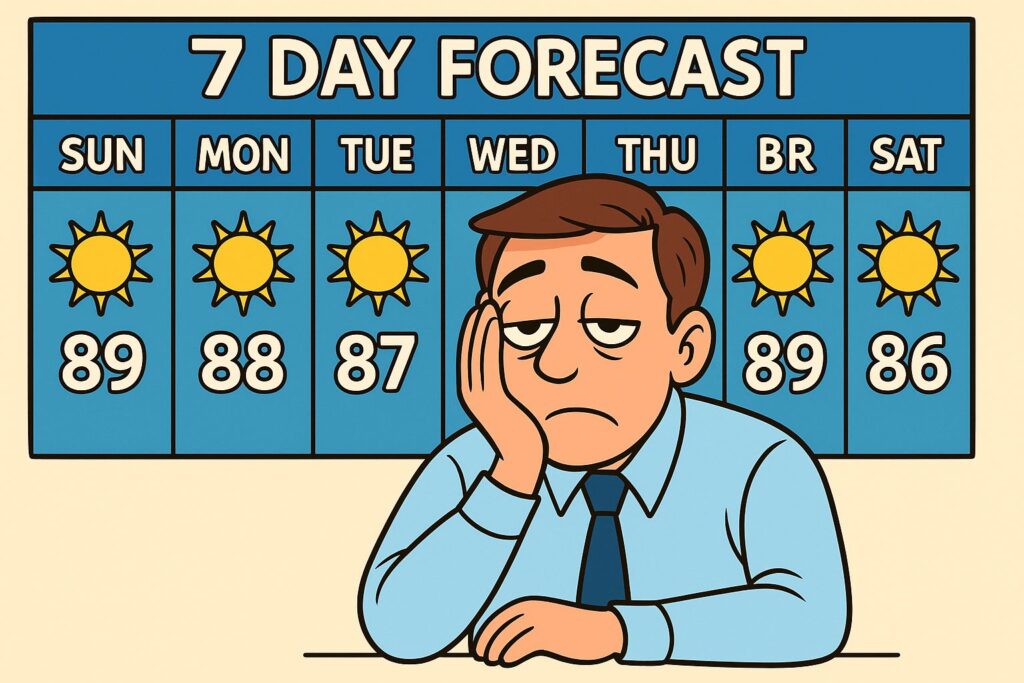
Image by ChatGPT. I have no idea why Friday is abbreviated BR, but AI is gonna AI.

However, it becomes pretty boring to write about that kind of a pattern every day (sometimes we must take drastic measures to relieve the tedium, like a GIF-based forecast). Moreover, as someone who lives in Houston, it is boring to experience the same weather every day, especially when we are supposed to be transitioning from summer to fall. Variety is the spice of life, and all that. Well, I’m here to tell you that this transition is happening finally, so buckle up.

Tuesday

We’re going to see another partly to mostly sunny day today, with high temperatures likely reaching 90 degrees for most of the region. (There’s a non-zero chance this is our final 90-degree day of 2025, but I don’t want to jinx anything so pretend I did not write that). A weak front will arrive later today, and it will bring a slight chance of showers and isolated thunderstorms with it. The best chances will be east and southeast of Houston, particularly in areas near Galveston Bay, this afternoon and early evening. The front will usher in some drier air, and lows tonight will drop into the upper 60s in Houston, with cooler conditions for outlying areas.

There is some uncertainty in the low temperature forecast for Thursday morning. (Weather Bell)

Wednesday

This will be a sunny and pleasant day, with mostly dry air and highs of around 80 degrees. It’s not precisely clear how long the drier air will hold over Houston, and this means we have some uncertainty about how chilly Wednesday night will be. I’m going to be optimistic and say much of Houston drops to around 60 degrees by Thursday morning, but if our dewpoints rise more quickly, it’s going to be a more humid and warmer night.

Thursday

This should be another mostly sunny day, but highs will be a little warmer, likely in the mid-80s for most locations as the onshore flow resumes. Lows on Thursday night will drop into the lower 70s.

NOAA rain accumulation forecast for now through Sunday. (Weather Bell)

Friday, Saturday, and Sunday

An upper-level low pressure system will approach, and move through the region this weekend, and with abundant atmospheric moisture to tap it is going to bring our best chance of rain in many weeks. Friday should start out mostly sunny, but we’ll see building clouds during the afternoon. Late Friday night through Saturday night is when I expect to see the best chance of rain, with the potential for some thunderstorms. The entire region should see precipitation, and the models have become more bullish overnight. I’m projecting about 2 inches of rain for most people, but totals will vary widely and there is the potential for higher accumulations. Rain chances will fall on Sunday, perhaps to around 40 percent, before things clear out. The weekend will see highs in the vicinity of 80 degrees with mild nights near 70 degrees.

Next week

Most of our model guidance is still pointing toward the arrival of a fairly strong cold front by around next Wednesday or so. Would I etch this forecast in stone, since it is eight days out? No I would not. But I’m rather hopeful that truly fall-like weather is coming during the second half of next week. Details to come as our confidence increases.

21 Oct 10:59

my coworkers aren’t following our return-to-office mandate, employee has a suspicious spot on their hand, and more

by Ask a Manager

It’s five answers to five questions. Here we go…

1. My coworkers aren’t following our return-to-office mandate

My company’s return-to-office mandate is eight days a month for at least five hours each day. The tracking system, however, only records “days in office,” not hours.

As a result, many coworkers come in for an hour or two, grab coffee (we have very good coffee), and leave. They don’t get flagged because the system shows compliance, even though they’re not following the written rules. My manager hasn’t addressed it, though he must know it’s happening.

I’ve been following the letter of the rules, and resentment is starting to build. Upper management keeps stressing the mandate, but on the ground there’s no real enforcement. I’ve only been here for a year but I have good relationships with my coworkers and manager. I value the flexibility we have and don’t want to be the office tattletale. How should I handle my frustration in this situation?

It’s really up to your manager to decide (a) whether he cares that it’s happening and (b) whether to address it. He may not care! That’s his prerogative, if so — at least to the extent that management above him permits him to look the other way. For all we know, the managers above him might not care either.

You can either keep doing what you’re doing or, if you want to, start to use some of the flexibility your manager is apparently granting to others. If your concern is that your coworkers are going to ruin work-from-home for everyone else by abusing the current system … well, they might. But it’s not something you have control over; it’s your manager’s to decide how to manage that, and at the moment he’s choosing to let it go.

That said, you could ask him directly about that: “Should we be worried that we’re at risk of work-from-home being revoked completely if people don’t work their full five hours in the office when they come in? I admit it worries me and I wondered what your take is on that.”

2. My employee has a suspicious spot on their hand

I manage a team remotely so I rarely see my team from the shoulders down. We had an on-site event recently and I noticed that one of my direct reports has a very suspicious looking spot on their hand that looks like that could be cancerous. I only recognized it because I have a similar spot on my foot and my doctor was concerned it might be cancer (it wasn’t). Is there any way I could bring this up as something they might want to get checked out? None of us are medical professionals and I don’t know if I would be severely overstepping as their manager by saying anything.

You can bring it up once; just leave it in their court after that, regardless of what they do with the info. Don’t check back with them, and make it clear you’re just giving them information that they can act on or ignore as they want.

I’d say it this way: “I don’t want to overstep and I try not to comment on health things, but I noticed you have a spot on your hand that looks exactly like one I had that my doctor wanted me to get checked out in case it was cancerous. You might have already looked into this, but in case you haven’t, I wanted to mention it.” Then, leave it to them.

3. I was rejected for culture fit — should I encourage them to reconsider?

I was recently invited to interview for an admin position at a very small business. They emphasized heavily that the role involves a lot of time pressure, and in particular that the boss (who puts a lot of focus on getting each project perfect for each client) can be quite demanding, but that she recognizes when she oversteps and apologizes / offers perks to make up for it. The interviewer mentioned having worked for her for over 20 years, so I believe her that this wouldn’t be like walking into a nightmare like the horror stories you so often hear.

I felt like the interview went really well, that it was a role that would really suit me, and that I’d done a great job of conveying my skills to the interviewer. Unfortunately, that same afternoon I received a rejection letter: “After lengthy discussions among my team, I need to advise you that unfortunately your application has not been successful. We felt that you interviewed well and we are sure you would be able to manage the work, but your gentle and quiet demeanor made us unsure as to whether you would be happy working in our sometimes very hectic office. If you wish to discuss anything, please reach out to me next week. We otherwise wish you the very best in your search for a new job.”

I understand it takes me a little bit of time to warm up to people and that I tend to listen more than speak until I do, but I really feel that this won’t be the sort of long-term obstacle to my success and happiness that they’re worried it would become. I understand that part of the reason why employers are reluctant to offer specific feedback is because it invites the applicant to disagree, and I respect that they understand the role a lot better than I do, but… I understand myself a lot better than they do, and it feels rough being rejected based on something I would have removed myself from the pool over if I had serious reservations about it.

I’m not sure what to make of their offer to call them back if I have anything to discuss. My main thought is to call them, thank them for the consideration and feedback, explain what I’ve just told you, and wish them luck with their other candidates but invite them to reconsider me if it turns out they don’t like any of their other options? I’m not really sure whether that would come across as overstepping. Should I do it, or just move on?

Move on and consider that this might be a bullet dodged. A very small business emphasizing heavily that the role involves a demanding boss who tends to oversteps and needs to apologize and offer perks to make up for it does sound like it has high potential to be a nightmare. The fact that your interviewer had worked there for 20 years makes me more concerned, not less, because people tend to get used to dysfunction over time and start to accept things someone newer to the business would be horrified by. If you’d talked to multiple people who had been there only a few years and seemed happy, I’d find that more reassuring — but a small business with a 20-year employee reporting this? Big caution sign.

Moreover, in a small business, personality fit can be really important, and you don’t want to try to persuade them the fit is right if they’re not already convinced. And in this context, “your gentle and quiet demeanor made us unsure as to whether you would be happy here” sounds highly likely to mean “you need a much thicker skin because you’ll be working in what most people would consider a difficult environment.” When you combine it with the paragraph above, I’d figure the rejection is a blessing in disguise — or at the very least, not one to try to get overturned.

Related:
should I work for a tiny organization?

4. I don’t want to post a photo on our website

I work in academia in a support team. I’ve worked in this position for several years. I have an academic work ID and was able to get a department badge before they discontinued creating them. Last week, I received an email from upper management saying that they’d like my team to have recognizable photos on the website for our department and in our directory because we deal with a lot of customers. The message did include a line saying that if for some reason we don’t want a photo, we should contact a specific person.

This messages also went to the other three women techs and the rest who do not have a headshot image on the website. The exception being one of my coworkers who is friends with one of the upper management and who was not included in the email. He had his image removed about a year or so ago because he didn’t like how he looked.

At one of my previous jobs, I was harassed by the clientele. Some of them tried to get more specific details about me like my last name. I feel like that could have led to creepy behavior and/or something worse.

Any suggestions I can use to say no respectfully? Especially in academia, I strongly prefer to minimize my online presence for my own safety. Again, I have my ID and badge. I have no problem showing those when requested.

It seems like they pretty explicitly opened the door for you to say no, by acknowledging that someone might have a preference not to do this. But even if they hadn’t, it would be fine to reply back and say, “I prefer not to post a photo for safety reasons, although of course I’m always happy to show my ID and badge if asked.”

5. My coworker keeps insisting I must speak Spanish

I have a coworker who keeps asking me if I speak Spanish. I have told her multiple times that I am not fluent in Spanish and cannot translate, but she keeps asking. My name is Jose and I have a darker complexion compared to her.

In my mind, this has surpassed the reasonable expectation that someone would forget about my skill set and has ventured into profiling based on my heritage. Is this a valid issue to bring to HR if this type of behavior continues even after I’ve consulted with the department heads of both parties?

Yes, and it’s a problem that your coworker’s boss has been informed and hasn’t put a stop to it yet. I wish I knew what both managers’ responses had been when you addressed it with them — but regardless, if it’s still happening, talk to HR.

The post my coworkers aren’t following our return-to-office mandate, employee has a suspicious spot on their hand, and more appeared first on Ask a Manager.

21 Oct 02:29

#ArmorOfHalo #RoninWarriors

21 Oct 02:29

#CowboyWho

21 Oct 02:28

Oh yeah, old guys becoming pandas. That’s the future.

mst3kgifs:

Oh yeah, old guys becoming pandas. That’s the future.

21 Oct 02:28

Explain Yourself

by Reza
21 Oct 02:28

The Ents vs Industrialization

by Corey Mohler
PERSON: "The Entmoot has concluded, we will march to war! "

PERSON: "Saruman has a mind of metal and wheels, we will destroy his machiery once and for all. Nature will return to isengaurd."

PERSON: "What will happen to the Orcs when this is over? Not just the soldiers, but the entire orc society."

PERSON: "Great, just one question."

PERSON: "Yes?"

PERSON: "Once Saruman's power over them is broken, they will return to a natural way of living, foraging off the land."

PERSON: "Right, but...it's just obvious that Saruman has industrialized the food supply, which has allowed for an expolosion in the Orc population."

PERSON: "If we destroy the industrial base, they can't all go back to the “natural” way of living - the vast majority will starve. The process of industrialization can't be reversed without some kind of genocide."

PERSON: "Of course, master Hobbit, everybody knows that!"

PERSON: "Why do you think the Entmoot took so long?"

PERSON: "I don't know, why?"

PERSON: "You see, sometimes large catatrophic events with millions of deaths are needed to rebalance things. I thought this was obvious."

PERSON: " We were mostly doing a close reading of English philosopher and economist Thomas Malthus."

PERSON: "Uh..."
21 Oct 02:24

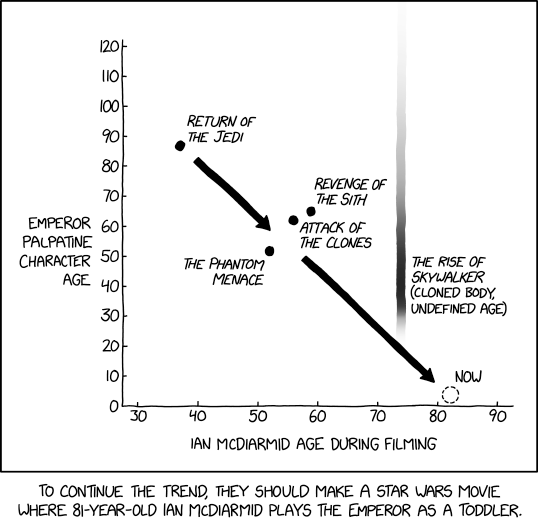
Emperor Palpatine

Many things about Star Wars were not well planned out, but having a 37-year-old in old-age makeup play the Emperor in Return of the Jedi was such an incredible call.
21 Oct 02:23

At Least We Owned the Libs

by Ginny Hogan

Sure, it was a huge bummer that they cut funding for fixing the streets in our town. We enjoyed going places. But, overall, it’s worth it for the tax cuts we expect any day now. I mean, at least we owned the libs. Libs love streets. Did you see that video of Trump dumping shit on libs marching in the streets? Got ’em!

- - -

Ah, dang. Groceries have never been more expensive. We really thought this was something Trump might be able to help us with. But the high cost of food is worth it so a transgender teen in Idaho can’t use the school locker room. Libs aren’t cheap to own, but the price is more than fair.

- - -

Wait, when they said they were going to dismantle the Department of Education, they were talking about, like, America’s Department of Education? The one that funds our schools? Shoot. Our kids will have to learn how to read from the back of cereal boxes. But at least the cereal doesn’t have Red Dye No. 2 in it. And as we all know, the libs are OBSESSED with Red Dye No. 2. Owned!

- - -

Owning the libs all the way into a measles outbreak? That’s called “keeping the narrative spicy,” and it’s NOT a bad thing.

- - -

Yes, we liked that restaurant. Yes, it would have been better if they hadn’t shut down, but half their staff got deported, so what are you going to do? At least all those dumb woke libs in LA and New York can’t eat at this Mexican restaurant in Columbus, Ohio, either.

- - -

Our cousin lost his soybean farm. We really thought the tariffs would help American farmers, but it turns out other countries just stopped buying our stuff. Stupid woke CCP. But you know what you can’t repossess? An ideological victory. I mean, except every four years, when the presidency changes hands. Whatever. The libs have been owned so hard they don’t even know what hit ’em.

- - -

So when they said they were axing “federal government jobs,” we just assumed they meant jobs in MARXIST blue cities. This is an unwelcome surprise. But you know what? This annoying liberal girl I knew in college cried in her IG story on election night. And we’ll ride that all the way to the bank (where they’ll hopefully give us a loan).

- - -

The water’s been brown for three weeks. It’s a drag, but I bet there’s an Ivy-educated lib walking around Bushwick in a really bad mood right now. So it’s totally worth it.

- - -

Huge bummer: Our health insurance got cut. We kept hearing Republicans say that lazy good-for-nothings and illegals would stop receiving Medicaid checks every month. And we thought, “Yeah, we’re on Medicaid, but they never send us checks.” So we didn’t think it would affect us. Anyway, in the meantime, we’ll take comfort in the knowledge that the libs probably can’t see doctors either. I mean, all the hospitals in rural areas are shutting down, and coastal elites are famously concentrated in… look, whatever, they’ve been owned, okay?

- - -

All right, well… we can’t pretend this has turned out the way we imagined. But you know what? We heard that a gender studies department in Vermont had its funding reduced by 12 percent. And the video of our great president wearing a crown I posted to my knitting group’s Facebook page really pissed off all the libs on there. And that, in the end, is what matters most.

21 Oct 02:20

French authorities won’t charge Louvre thieves on grounds the crime was really cool

by John Hansen

PARIS – Following a brazen daylight heist of the French crown jewels from the Louvre, French authorities have declared no charges will be laid, citing the country’s “Trop Cool Pour Être Un Crime” (“Too Cool to be Crime”) law. On Sunday, four thieves carried out a highly professional and wicked daylight raid on the famed […]

The post French authorities won’t charge Louvre thieves on grounds the crime was really cool appeared first on The Beaverton.

20 Oct 19:43

Canvas Crash Tied to Major Amazon Web Services Outage

by Taylor Brockmiller, Editor-in-Chief

If you tried logging into Canvas Monday morning and were greeted with little robots tinkering on a broken spaceship, you weren’t alone. HCC’s systems don’t seem to be the culprit—but rather Amazon Web Services (AWS), the giant cloud that quietly powers much of the modern internet.

The massive AWS outage rippled across the U.S. early Monday, taking down major sites and services, including Canvas, the digital home base for most college students. The problem originated in AWS’s U.S.–East-1 region (Virginia), where a network failure caused widespread slowdowns and login errors.

According to Amazon, the trouble began inside its Elastic Compute Cloud network—the system companies use to rent virtual servers and computing power instead of maintaining expensive hardware of their own. In simpler terms, EC2 is what keeps many of your favorite websites running behind the scenes.

Amazon said the internal system that tracks how much traffic and strain customers put on its servers malfunctioned, throwing the whole network out of balance. To prevent things from getting worse, AWS temporarily limited how many new server companies could spin up while engineers worked to get everything back online.

As of now, Canvas remains offline. HCC’s IT team confirmed in an alert that the platform is experiencing technical issues “due to Amazon cloud being offline,” and that the vendor is actively working to fix the problem. Students can expect an update once Canvas is back to normal.

So, while the outage may be inconvenient (and a little panic-inducing for anyone with deadlines looming), it’s also a reminder that the cloud isn’t invincible. Even a minor failure in a far-off data center can leave students unable to access assignments or submit work on time, underscoring the need for backup plans and flexibility.

For updates from Amazon directly, you can visit their AWS Health Dashboard.

20 Oct 18:27

WATCH: 50 years of PBS News in just 3 minutes

by Julia Griffin
Here’s a major moment from every year we’ve been on air.
20 Oct 18:26

coworkers always tell me when they don’t eat my baked goods

by Ask a Manager

A reader writes:

I often bake for my office. I just bring in the baked goods and leave them in the kitchen. I don’t solicit compliments and I don’t directly offer them to people, either. The only compliment I need is seeing an empty tray at the end of the day. I don’t even know who tried the baked goods and I don’t seek to find out.

The baked goods generally go over well and I get thank-you’s and compliments, but I also get a handful of people coming over to thank me for bringing in baked goods but explaining that they can’t eat them for whatever reason — allergies, diet, whatever.

This bothers me a lot and I don’t know if I’m justified. A generous reading is that they are trying to thank an act of generosity even if they couldn’t partake in it, but it rubs me the wrong way. One reason is, I don’t want to hear about my coworkers’ food issues. I have my own. The other is it seems to be negating what I did and making it about themselves. The other is that it interrupts my work for no reason. I always want to say, “I don’t care if you don’t eat the pastries!” I’d rather receive silence than an empty compliment! Is there anything I can do other than nod and say “thanks”? But what am I even thanking them for?

Yeah, people should just pass up the baked goods without comment; they don’t need to report to you whether they ate them or not, or why they couldn’t.

If this were food being provided by your office, that would be different. In that case, they’d have standing to talk to whoever coordinated the food and ask that a more inclusive variety of treats be offered so they weren’t regularly being left out.

But you’re just a coworker who likes to bake. They don’t have standing to ask you to change what you’re making or to stop bringing it in (if either of those is the subtext of the comments, which is possible).

That said, I’m curious about how often you’re bringing in treats. If it’s multiple times a week, I could see people feeling like … well, not that you’re obligated to provide them with treats tailored to their needs, because you’re not, but still feeling like, man, that’s a lot of times to walk into the kitchen and find out that once again there’s a plate of brownies they can’t eat.

As for what to say when it happens: you said you feel like you’re supposed to say “thanks” but that doesn’t really make sense as a response. You could say, “Sorry you couldn’t eat them!” or “Yeah, I love to bake but I know it won’t be for everyone” or “Just needed to get them out of my kitchen” or “Hey, while you’re in there can I ask you about WorkTopic?”

But I don’t think there’s a magic way to stop the interruptions from happening in the first place. And I bet you’re also getting interrupted by people who want to say the food was delicious or to thank you for making it. If the interruptions really bother you, you’re probably better off just not bringing in food as often — because it’s the kind of thing that will lead to conversations/interruptions about it.

The post coworkers always tell me when they don’t eat my baked goods appeared first on Ask a Manager.

20 Oct 17:44

How To Join ICE

by The Onion Staff

As Immigration and Customs Enforcement seeks to increase its presence across the country, the agency is actively recruiting new agents to carry out the Trump administration’s mass deportation campaign. The Onion breaks down how to join ICE.


STEP 1

Be born with something just…missing


STEP 2

Try deporting a few neighbors without the constitutional authority to do so, to see if it’s for you


STEP 3

Unlearn any secondary languages you may know


STEP 4

If filling out the application form presents a challenge, candidates may instead demonstrate how hard they can punch a dog


STEP 5

Undergo background check confirming at least one prior arrest for a violent crime


STEP 6

Click through six-step combat training module


STEP 7

Order police vest from www.costumecorner.com


STEP 8

Grab gun from gun bucket

The post How To Join ICE appeared first on The Onion.

20 Oct 17:12

Open Call for a Public Sculpture in Houston’s East End District

by Nicholas Frank

The Weingarten Art Group in Houston has issued an open call for a public sculpture to be installed in the city’s East End District.

The open call invites U.S.-based artists with experience creating large-scale public works to submit qualifications for the design and production of a sculpture at the Navigation Boulevard Roundabout in the culturally diverse area along Buffalo Bayou. According to a press release, the Weingarten Art Group is seeking “a landmark gateway sculpture that celebrates one of Houston’s most historic neighborhoods,” with a total budget of $1 million.

A street roundabout with a bright sign reading "Navigation"

Navigation Boulevard roundabout. Rendering courtesy of the Weingarten Art Group

East End District landscape designers and engineers will coordinate closely with the selected artist to design a foundation for the artwork, along with landscaping and lighting.

A Request for Qualifications (RFQ) is the first phase of a two-phase selection process. Following submissions for the RFQ, three finalists will be invited to submit detailed proposals in the Request for Proposals (RFP) phase. Each finalist will receive a $4,500 honorarium for the development of a detailed design proposal, with a site visit required in March 2026. Travel expenses for the artist and up to one member of their studio will be reimbursed.

In its open call, the Weingarten Art Group provides a brief history of the neighborhood in which the public sculpture will be housed: “The East End grew from a 19th-century hub of trade along Buffalo Bayou into one of the city’s most culturally diverse districts. Waves of immigrants — Asian, Hispanic, African American, and European — shaped its neighborhoods, industry, and identity, fostering a tradition of resilience, activism, and community pride. Known for its industrial base, thriving small businesses, and role in peaceful civil rights efforts, the East End also became a center for education, faith, culinary delights, and the arts. Today, it blends historic character with revitalization, offering vibrant public art, eclectic dining, walkable neighborhoods, and strong civic engagement, while honoring its rich multicultural heritage.”

An overhead image of a street roundabout in Houston.

A roundabout site in Houston’s East End.

In addition to design and production of the public sculpture, the selected artist will also serve as a mentor in the Weingarten Art Group’s inaugural East End Artist Launchpad, a new mentorship initiative supporting local emerging artists as they develop and install their own temporary public artwork in the East End.

The RFQ deadline is Monday, December 8. Finalists will be notified February 16, 2026, and installation of the selected sculpture is scheduled for late 2027.

For further details on the application process and evaluation criteria, visit the Weingarten Art Group Submittable page.

The post Open Call for a Public Sculpture in Houston’s East End District appeared first on Glasstire.