A major Amazon Web Services (AWS) outage took down multiple online
services for around four hours this morning, including Amazon,
Alexa, Snapchat, Fortnite, ChatGPT, Epic Games Store,
Epic Online Services, and more.
As of 6:35AM ET, the AWS status checker is reporting that
“most AWS Service operations are succeeding normally now,” and
some of the impacted platforms, including Fortnite,
Epic Games Store, and Perplexity have announced
that they are fully recovered and back online.
However, as of 9:50AM ET, Amazon says that multiple services in
the US-EAST-1 Region are still “impacted” by operational issues,
and that it is working towards a full resolution. The AWS
dashboard first reported issues affecting the US-EAST-1 Region at
3:11AM ET, with global services in other regions also taken
offline. The cause of the outage hasn’t been confirmed, and it’s
unclear when regular service will be fully restored.
I bet it was this AWS outage that explains why I couldn’t sign in to my NYT account to play Wordle this morning. (Got it in 4 today.)
Update:Amazon claims the issues were resolved at the end of the day. I still couldn’t order food for delivery from a few local restaurants, including any that depended on Doordash or Toast, at 7pm ET though.
Catch the Dome at golden hour and the place almost forgets its own size. The ring road slows to a hush, sodium lamps warm up along the edges, and a slant of light slips under a corrugated seam like a rumor. No crowd pressure, no PA system clearing throats — just wind combing the parking stripes and a gull writing wide ovals in the sky as if testing the roof’s radius. Your eye drifts toward small things it never found during game days: a faded “Gate C” arrow that still points confidently at nothing; a patch of stubborn grass where concrete cracked; a handrail with a palm-polished gleam that readies itself out of habit. The building doesn’t perform anymore; it lets you.
That mood already circulates online. The liminal spaces feed hums with cousins of this scene — office parks at dusk, hotel corridors that never end, night lobbies with one plant and too much carpet — images that teach a slower way of looking rather than shouting for attention. The Astrodome slides into that cadence with natural ease. Phone cameras love it because they can’t swallow it; they imply it. A slow pan across an empty concourse does more than document absence; it lays out a method: read surfaces, listen for what isn’t speaking, let scale arrive in pieces.
An aerial photograph of the Astrodome. Image courtesy of Rice University’s Kinder Institute for Urban Research
Art history keeps a few wayfinders for this kind of seeing, and we can tuck them in without breaking the spell. Alois Riegl, the Viennese art historian who asked why societies keep old things around, sorted our attachments into categories: what still works for us now, what tells us about then, and what age itself grants — that shy glow objects earn by surviving. The Dome’s current charisma leans on that last value, which the internet multiplies: scuffs as patina, dust as atmosphere, vacancy as meaning.
Robert Smithson, poet of entropy and inventor of the phrase “ruins in reverse,” taught viewers to watch construction and decay run in parallel like two lanes of the same freeway. Even stabilized and landmarked, the Dome practices that duet — steel softening by degrees, concrete taking on a matte calm, a bowl that frames air more often than spectacle. And Rosalind Krauss, who mapped sculpture’s “expanded field” when art escaped the pedestal, offers a neat diagram for the Dome’s drift: less straightforward building now, more a hybrid zone that behaves like architecture, landscape, and sculpture at once. None of this demands theory to feel true. It just gives names to intuitions the body registers on contact.
Post-internet culture turns those intuitions into circulation. When images learned to outrun the things they depict, attention shifted from objects to their travel routes. Hito Steyerl called the migrating, compressed file the “poor image” — a format that wins by moving farther, not by looking perfect — which explains why dim, handheld walkthroughs of the Dome can shape public feeling more convincingly than any glossy rendering of a “future activation.” The copy outpaces the plan; the share becomes the event.
And the temperature of those shares? Cultural theorist Mark Fisher’s conception of the word “eerie” fits like an interior climate. The eerie registers when something that should be present feels absent (the crowd, the clear authority) or when a force acts without a face (debt, policy, time). The Dome triggers both conditions. You arrive expecting bodies and noise; you meet hush and committee minutes. Agency persists, but behind the scrim. No melodrama, just a persuasive quiet that keeps asking you to notice the missing.
This, by the way, is why the drive-by “ruin porn” complaint lands short. The appetite here rarely celebrates collapse; it builds a kind of literacy. Liminal images teach you to read where optimism hardened into protocols, where protocols slid into postponement, and how postponement developed a look. The Dome offers a civic-scale seminar in that progression without wagging a finger. It simply shows its work.
Stand by the fence and the seminar begins. Air moves differently inside manufactured voids — thinner, slightly refrigerated, like air that used to labor for comfort and now coasts on muscle memory. The roof’s ribs pull your eye in long, even strokes; the mind submits gladly to the metronome. A maintenance golf cart, the only vehicle with credentials, clicks past and vanishes under the bowl as if it entered a different weather system. Even the typography performs: blocky letters that once choreographed a crowd now read like a municipal poem about guidance and desire.
If this feels strangely art-like, that’s not a mistake; it’s a category update. Contemporary art long ago pivoted from objects alone to the systems that carry them — cables, logistics, platforms, policy. By that measure the Astrodome behaves like a collaborator. It curates attention by refusing to overexplain, performs scale without spectacle, converts a budget line into a feeling, and gives cameras honest work: translate volume into rhythm. Artists who tune infrastructures would hear the invitation immediately — Yuri Pattison with ambient computation, Jon Rafman with platform sightlines, Tabita Rezaire with networks and care. The point wouldn’t be to decorate. It would be to keep the room legible at the volume where you hear Fisher’s register and trace the policies as they breathe.
What to do, then, with a structure already functioning as a public lesson? Resist the binary of total reboot versus clean erasure. Stabilize the shell; keep it openable instead of perpetually closed. Cut a few precise overlooks — places where the bowl reads as landscape, where a single sightline carries the story better than a thousand placards. Commission light-touch works that score the architecture rather than drown it: a sound piece that catches the building’s long reverb, a typography guide that treats the signage like an urban palimpsest, a night program that choreographs existing lights without turning the thing into a theme park. Let the building keep its quiet and make that quiet accessible.
The “eighth blunder” line, used with a smile, doesn’t roast Houston’s past; it nicks our habit of answering every complicated object with a retail-scale solution. The Dome suggests a more contemporary reflex: sometimes a city earns more by learning to look than by rushing to make. That learning travels. You start seeing your grocery store at closing, your office lobby after the badge readers breathe out, your feed at 2 a.m. with the volume down. You notice how illumination scripts emotion, how wayfinding nudges a gait, how small neglects compose accidental stage sets for daily life. The building becomes a teacher for everything that isn’t the building.
Back outside the fence, evening does what evening does best: edits. The roofline goes charcoal, the ring road finds its quiet, and the gull gives up on geometry. A breeze catches a plastic bag, sets it drifting along a painted line, then lifts it suddenly as if reminding the bag who decides. The Astrodome doesn’t plead for a second chance or a final verdict. It offers a rhythm. Keep the shell. Mark the overlooks. Let the feed carry the lesson. And when the city needs to think in public, bring people here and let the room do the talking.
Spatial awareness. The desert as a reclaimed entity. Expansion of temporal limitations. Dismantling of everything that doesn’t serve your own expansion. Delicate resilience. Creating form for form’s sake. Delighting in gesture. Trust as an act of making. How still is still enough? Disrupting a pattern to make a new pattern. Making something out of the abundance in nothing.
These are the first thoughts that enter my mind after leaving an experience with Hannah Spector’s thoughtful show at Women & Their Work, if you stare at a cowboy’s face for long enough, it turns into a sunset. Like watching a film that steals your sense of reality, I felt a bit changed leaving the gallery and returning to the world as I left it. Details have become more vivid, even the most mundane. And everything I considered important before entering the exhibition seems faint and far in the distance. A success by any standards of transportation. Is this not the job of art?
I often have this debate with other creators — are we required to make political work in dire times? There are those that deem anything else worthless, insisting we always voice dissent. What about divine inspiration? Making work to stay sane? Building the world you want to live in? Transporting ourselves to interior worlds?
The personal is political and in that, Spector brings us into a private sphere of rhapsodic jubilation, one that doesn’t require a previous knowledge of the language, it’s a language of inquiry, of poetics, of existential wandering with an indeterminate number of flaneurs under desert skies. The sense of searching is loud. From the montages of nocturnal footage lit with numerous flashlights within the video to the experimentation with materiality in their sculpture, this show resurrects our search for meaning. Here they find it inside of comradery, environment, found objects and scorched earth, a love letter to moments and tender revelation.
Hannah Spector’s “if you stare at a cowboy’s face for long enough, it turns into a sunset” on view at Women & Their Work. Photo: Essentials Creative
Behind a floor-to-ceiling wall of blackout curtains, I encounter the namesake video centerpiece of the exhibition. The installation surrounds a cozy invitation to lie and indulge on piled futons, positioned amid seven video projections on a variety of simple, raw screens in various sizes and angles. On these, I begin to witness montages and mirrored footage of abstracted pairings and multiplicitous portraits: moon-like orbs, cacti, puddles, dust, bones, mountains, night seeing, others.
Hannah Spector’s “if you stare at a cowboy’s face for long enough, it turns into a sunset” on view at Women & Their Work. Photo: Essentials Creative
If you choose to recline in the intended bed, the piece can only be partially seen. I immediately think of the Ryoan-ji Temple’s rock garden in Kyoto, Japan, which contains 15 large rocks positioned so only 14 can be viewed at any given time; one is always hidden. This celebration of imperfection on the path toward resolution is fitting for Spector’s experimental collage of video, which has a refreshing impulsivity and playfulness. The audience bears witness to a convergence of their artistic languages through the narrative voiceover, hypnotic visuals, performances by Spector and their friends, and the subtle soundtrack with recitative mantras.
Here is an artist truly at play and at home with themself, in their element with the unmistakable backdrop of West Texas. The video begins with a panoply of disparate images, creating a chaos of muted calico observations. As the piece progresses, the imagery homogenizes into mirrors, inversions, and meditations that I read as the gift of calm singularity that desert time provides.
Hannah Spector’s “if you stare at a cowboy’s face for long enough, it turns into a sunset” on view at Women & Their Work. Photo: Essentials Creative
A found chair is held aloft, perhaps in defiance of comfort. The musings trigger a memory of reading Carlos Castaneda as a teen, that sense of inevitable existential probes that come with refusing an allegiance to normative standards. Indeed, Spector uses inversion to reimagine the American West here, with motifs of totemic animal figures, boots, tumbleweeds, absurdity, mesquite brush, tracks, doubling, movement, and vastness. The exchange between bodies expands into choreography, with an out-of-body consciousness one equates with transcendence.
Hannah Spector’s “if you stare at a cowboy’s face for long enough, it turns into a sunset” on view at Women & Their Work. Photo: Essentials Creative
As the sublime morphs back into play, the collages give way to an exchange of multitasking for both the performers and the viewer: Overlapping arms on stucco, codeswitching with garments, and watching themselves drawing boundaries in the dirt all happen as we, the viewers, traverse between screens. There is a celebration of the discarded and the overlooked, which evokes Barbara Hammer’s A Month of Single Frames in my side brain. After a third watch, I stand up in silence and read the vinyl wall text piece in the shadows: mesquite bean opening in midnight doesn’t make a sound. I emerge back into the light.
An installation image of Hannah Spector’s “if you stare at a cowboy’s face for long enough, it turns into a sunset” on view at Women & Their Work. Photo: Essentials Creative
Rebirth into blinding sunlight. Here I am in this language, the dialect of the gallery world. The vinyl, ceramic sculpture and copper-plate etching prints in the front room represent this language with a cohesive materiality and sense of form. The subject matter dances around traditional signifiers of masculinity with a twist of… yes, play! Slip-cast boots and railroad ties, pit-fired hybrids of desert fauna and tools, and barrel-fired ceramic sculptures are presented in grand salon style, but I secretly wished for privacy and controlled lighting to spend time with all the thought put into this work.
The epicenter of this arrangement, sleepwalking (with clocks), displays a treated piece of mahogany with tabs of etchings around the exterior edge like numbers on a timepiece. The image is one of strong power, with a repeated motif of a human form holding two orbs, like a deity of moons or a bodybuilding effigy. Mahogany becomes a character in this narrative, used in several of the pieces, which comes as no surprise, as it is a traditional symbol of strength and resilience, like the emotional armor needed for the desert, for proposing new languages, and for handling the materials used in the work of this sculptural antechamber. Here, Spector’s work in the front room does play second fiddle to the video installation to a degree, due to the limitations of the gallery layout, making the sculptural and print work feel like an introduction or even a separate show. The preset position of a curtained track separates the seven-channel video from the other works, giving it a vast majority of the real estate, and effectively predetermining its emphasis.
Works by Hannah Spector on view in “if you stare at a cowboy’s face for long enough, it turns into a sunset” at Women & Their Work. Photo: Essentials Creative
Hannah Spector defines themself as a poet, interdisciplinary artist, educator, and composer, which is evident in both their approach to video as well as their community presence, curating memorable events around Austin, most notably at Shed Shows and MASS Gallery. Theirs is a language of interchange, of giving back, of continual threads unraveling in suspended belief, of possibility. Even the copper-plate prints, ceramics, mahogany frames, and objects in the front space of the gallery have an unfinished essence, leaving the viewer agency to complete the entities and reclaim them mentally in response. A small plinth offering chapbooks, stickers, and audio cassettes for sale, encourages the visitor to bring a piece of Spector’s spirit home with you to continue the conversation. This generosity and desire for connection is a recurring throughline in not only this exhibition but in the way that Spector moves through the world. Confident Vulnerability is what I felt when I left the dark womb of the show, which I posit as an excellent state in which to navigate our current world in turmoil.
Hannah Spector’s if you stare at a cowboy’s face for long enough, it turns into a sunset is on view through November 16, 2025, at Women & Their Work in Austin.
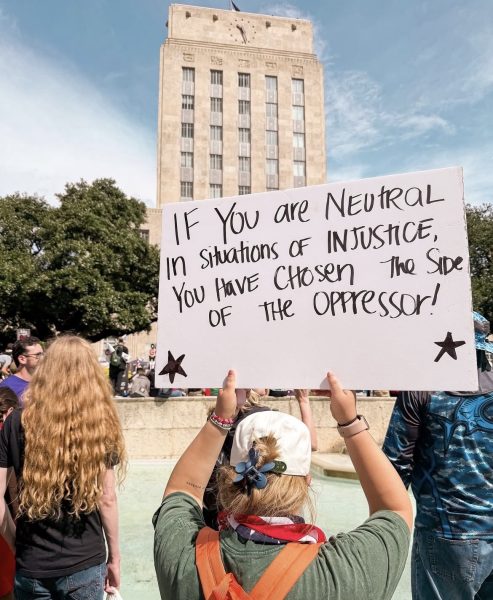
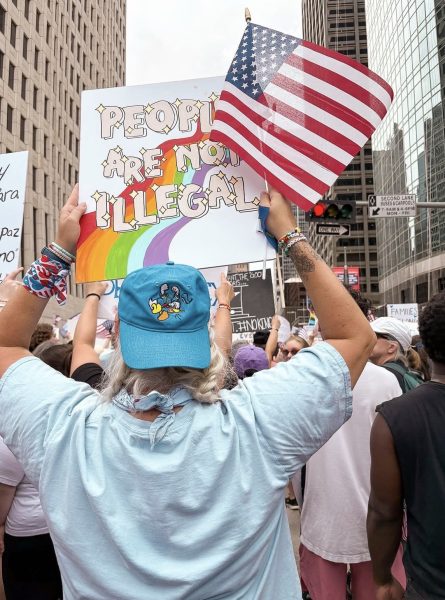
On October 18, local protestors joined a national wave of No Kings demonstrations against what organizers describe as President Donald Trump’s growing authoritarian inclinations. Various rallies occurred in Houston, including at Discovery Green downtown and The Woodlands.
Lindsey Gaughan via Instagram.
A coalition of more than 200 progressive organizations, like the 50501 Movement and Indivisible, is organizing the “No Kings” movement. As part of a national effort, more than 2,500 protests are taking place across all 50 U.S. states on October 18. Movement leaders stated that around 1,700 people had registered online to take part in the downtown Houston protest. According to the Houston Chronicle, police did not confirm this number of participants.
At Discovery Green, protesters held their demonstration at noon around the same time as other concurrent events, such as the Families with Pride festival. People crowded the park and overflowed to other streets, shouting slogans and carrying signs denouncing the presence of “kings” in the White House. Outside central Houston, satellite protests continued in communities such as Pasadena, Pearland, Clear Lake, Conroe, and The Woodlands.
In Texas’s state capitol, Governor Greg Abbott deployed the National Guard, Texas Rangers, and state troopers where planned protests were to be held, citing fears of violence and unrest. In Houston, the local policing presence was visible, yet the protests had minimal displays of aggression and violence.
Lindsey Gaughan via Instagram.
The coalition preached nonviolence, issued safety tips, and urged people to dress up in the color yellow, which was one of the symbols of unity. They cited such issues as increased executive authority, a threat to democratic norms, healthcare cuts, and deportation policies in their statements.
This is the second mass mobilization of this kind since the June protest in Houston, when an estimated 15,000 people gathered in downtown Houston. That earlier protest set the tone for more civic engagement across Texas. Organizers of the event say that turnout for the October protest shows that the movement is not losing its momentum.
As the protests concluded, many hoped this wouldn’t be a one-off event but rather an act of civic action that would continue. Movement leaders encouraged attendees to register to vote, stay informed about politics and upcoming elections, and continue protesting. For many participants, this protest represented a broader call to civic engagement across Texas.
The company I work for is a small father-and-son-owned business with 20 employees. This summer, our administrative assistant, Amy (age 50), broke her hand and required surgery. The injury occurred a week before a previously scheduled vacation. During her absence (one week and three days), the father (Bill) met a 21-year-old woman, Rose, at a car wash and offered her an administrative position, even though no position was open at the time.
Upon returning from leave, Amy found Rose seated at her desk and was instructed to train her to perform her job duties. Amy’s own role was changed to scanning and organizing the backlog of company files, which she was told would later transition to other organizational “projects.” The company is already paperless, so this reassignment is limited in scope.
Over the following months, it became apparent that Rose’s hiring was personally motivated. Bill frequently cooks breakfast for her, speaks to her using “baby talk,” takes her on irrelevant errands during work hours, and pays her to come in on Saturdays to “clean the office” with him alone. There are also indications that company funds have been used for Rose’s personal benefit, such as paying for her vehicle maintenance, paying for gas for her car weekly, and purchasing her gifts.
Recently, Bill verbally confronted Amy during a meeting, believing she had insulted Rose. In addition, he yelled at her for scanning – the very task that she was assigned, with no response as to what tasks should be her focus. Bill is verbally abusive to everyone and has the emotional regulation of a toddler. Amy, caught off guard after months of frustration, raised her voice in response. Although no direct comment about Rose was made, Rose left the meeting upset and was granted two paid days off. Amy apologized to both owners and to Rose afterward. When she met with the son (Jason) to explain, Jason said he did not care about the perks Rose receives because she “does extra work,” and that while he would let this incident go, Amy must tolerate his father’s behavior and accept what happens in the company in order to remain employed. He also said he intends to start documenting her behavior and would look to terminate her if she continues to be a problem.
The workplace has long been known for verbal hostility from Bill, but this is the first time that an angered response received any attention.
Amy is concerned about potential retaliation and whether her reassignment and treatment could constitute age discrimination. I have encouraged her to speak with an employment attorney to clarify her legal position and to get guidance on how to document events appropriately, as well as begin to look for a new position as it is clear that, whether or not it is right, they will find a way to justify firing her. Is there anything else I can do with this situation? I know this is all wildly inappropriate, but it must be illegal too?
So Bill hired a 21-year-old woman for a position that didn’t exist and bumped a 50-year-old employee out of her job to justify it, speaks to her in baby talk, pays her to come in on weekends when it’s just the two of them, and is verbally abusive to everyone else, and his son/co-owner responds by … telling everyone else to accept it or they’ll be fired?
Eeesh.
Yes, Amy should talk to an employment lawyer. It’s likely that there’s enough here to put together an age discrimination case — maybe not one she could prove at trial (although maybe so!) but definitely one that should give her enough leverage to get a decent settlement from the business. A lawyer could have a good time with this.
However, one thing that lawyer will need to look at is whether the business meets the threshold to be covered by the federal age discrimination law. You said the business has 20 employees, and the Age Discrimination in Employment Act kicks in right at 20 employees — but owners generally aren’t considered employees, so if Bill and Jason are included in that count, the law would consider the business to have 18 employees … which would put it below the threshold for coverage. (Federal anti-discrimination laws only apply to business with a minimum number of employees — generally 15-20 — because of what’s otherwise seen as too much regulatory burden on very small businesses.) That said, your state might have its own age discrimination law that kicks in at a lower number of employees; many do, and the lawyer Amy talks to will know.
As for what you can do beyond encouraging Amy to talk to a lawyer and offering to be a corroborating witness … well, there’s power in numbers. Would a group of your coworkers be willing to put their collective foot down about Bill’s abuse? If you act as a group, would you have the leverage to insist on changes? People often feel they’re at the mercy of an abusive boss — but if enough of you band together, you’d have more power as a group than you have on your own. (This is the whole idea of unions — but you don’t need a formal union to act collectively. And the National Labor Relations Act, which protects employees who band together to speak up about working conditions, applies to any business with one or more employees.)
Really, though, a better long-term plan would be to get out. Any business, large or small, can be dysfunctional (we’ve seen plenty of proof of that here) — but when you get this kind of dysfunction at a small business, it tends to infuse absolutely everything, and generally the best move is to just get yourself out of there.
MONTECITO, CA—Signaling a new chapter in her career, pop star Katy Perry released a new single Monday about the superiority of Canadian manufacturing. “When I learned about the strength of Canadian automotive and aerospace manufacturing, I knew I had to put it in a song,” Perry said in an Instagram post accompanying a preview of the new track, which features lyrics such as “Five-fifty billy in exports annually, uh-huh / They makin’ tires in the Annapolis Valley, uh-huh” over a hip-hop-influenced beat and a Max Martin–produced chorus that emphasized the country’s advantages in skilled labor. “I like to write about what’s going on in my life, and right now, I’m definitely in my single, flirty, manufacturing-powerhouse era. British Columbia’s hydrogen fuel cell industry is a whole mood. I hope my KatyCats have as much fun listening to ‘Made In Canada’ as I had recording it.” At press time, Perry announced she would be releasing a new album on Boxing Day.
Amazon Web Services experienced DNS resolution issues on Monday morning, taking down wide swaths of the web—and highlighting a long-standing weakness in the internet's infrastructure.
When immigration agents detained Douglas Menjivar in June, it wasn’t his first time.
Menjivar, a 50-year-old master mechanic originally from El Salvador, had lived in the United States for most of the last twenty years. A decade prior, he’d spent 2013 to 2015 in immigrant detention, including at the Houston-area Joe Corley Detention Center, which is operated by the for-profit prison contractor GEO Group. What he endured there changed the course of his life.
While Menijivar was held at the Corley facility facing possible deportation, another detainee sexually assaulted him twice with the help of an accomplice, he said in an official complaint and in interviews with the Texas Observer and other media. The duo targeted him after he confronted them for raping an 18-year-old. Upon seeing the traumatized teen sobbing, Menjivar, who had been sleeping on a top bunk, offered to trade places, believing the culprits would not attack a grown man. But the two jumped him as he slept: One held Menjivar down, shoving a pillow in his face, while the other assaulted him.
After another attack in the shower, he slipped and fell while fleeing his assailants, causing him to pass out and lose a significant amount of blood from a gash in his head. Upon regaining consciousness in the detention center infirmary after the attack, an Immigration and Customs Enforcement (ICE) supervisor mocked him, calling him “stupid,” he said. He was left with a two-inch scar on his scalp that remains visible.
Douglas Menjivar
Later, Menjivar informed advocates, who pressured ICE to review the case and release him. In March 2015, then-U.S. Representative Sheila Jackson Lee wrote to the ICE Houston field office director, advocating for Menjivar’s release. In response, ICE authorities did something unexpected: Within a couple weeks, they released him, though he still had an active removal order. ICE generally may use prosecutorial discretion to defer deportation on a case-by-case basis, but under the second Trump administration such discretion has largely disappeared, according to experts including Menjivar’s lawyer, Ava Benach.
After his release, Menjivar poured his pain into advocacy, hoping that other immigrants would not have to endure what he had. Despite living in legal limbo, Menjivar contributed to a nationwide civil rights complaint that advocates filed against the Department of Homeland Security (DHS) in 2017. Community Initiatives for Visiting Immigrants in Confinement (CIVIC), the group that lodged the complaint, alleged that from 2010 to 2016 the DHS Office of the Inspector General, the department’s watchdog, took insufficient action to investigate sexual assault claims. (CIVIC has since changed its name to Freedom for Immigrants.)
Menjivar also joined Texas activists opposing the expansion of immigrant incarceration, participating in marches to protest plans for yet another for-profit detention center that was ultimately built near Corley.
For the decade after his release, he held a temporary work permit, and he married an American citizen in 2017. But he was unable to obtain a green card, routinely reporting to ICE until June 10, when agents arrested him after he dutifully arrived for his appointment. That day, they took him to the new Montgomery County ICE facility—the same center he had protested.
Locked up again, Menjivar wasn’t focused on the trauma he’d suffered, his activism, or his looming deportation to El Salvador, the country he’d fled in 2013 after working undercover for police. Instead, he focused on his wife, Monica Logan, who needed surgeries as part of treatment for breast cancer and a chronic skin condition.
Menjivar had been her sole caretaker, since her other relatives lived out of state. Now, there was no one to help.
Before they married, he’d promised God to care for Logan, and, “if necessary, give my life for her,” Menjivar told the Observer in a video call from the detention center. But, behind bars, he couldn’t even drive her to the hospital.
Menjivar entered Texas in 2004 by crossing without authorization. He was arrested by Border Patrol agents, he said, and received an immigration court date. Menjivar found work as a mechanic on the East Coast, but he did not appear for court (he told the Observer he lost his way in the New York public transportation system), and he received a deportation order in absentia in March 2005. He kept living in the country as an undocumented immigrant; he developed no criminal record.
The day before New Year’s Eve in 2009, Menjivar returned from New Jersey to El Salvador to care for his sick father and stayed for nearly three years. While there, he worked undercover with police to investigate corrupt officials tied to organized crime, Menjivar said in an Observer interview and a 2013 reasonable fear interview with DHS. However, he quickly learned that the police had not protected his identity. Fearing for his life, he crossed the Texas-Mexico border again in 2013 seeking safe haven and was detained. An immigration judge reinstated his prior removal order, and he was locked up for the next two years.
Menjivar attempted to pursue “withholding of removal,” a form of legal relief sought by people ineligible for asylum that protects them from deportation but does not directly lead to a green card. But he ultimately lost his case. He attempted to fight the denial, but he was hindered by ineffective assistance from a lawyer who had failed to present important evidence and missed a filing deadline on appeal, the Board of Immigration Appeals (BIA) later found. That attorney, Afton Izen, was suspended from practicing law in 2018 and disbarred in 2021 after other clients complained that she failed to complete paperwork and communicate about their cases, according to State Bar of Texas records. (Izen died shortly after being disbarred.)
During his first stint in detention, Menjivar befriended a Houston immigrant rights activist named Hope Sanford while helping to lead a hunger strike. After ICE used its discretion to release him, she hosted him in her home as he waited to obtain a work permit.
In 2016, Menjivar met Logan. They lived in the same apartment complex and became friends while chatting in the parking lot. Within a week, he told her: “You’re going to be my wife,” and she laughed. In July 2017, they married in Sanford’s backyard.
Monica Logan and Menjivar at their wedding
After marrying a citizen, he made several attempts to become a legal permanent resident.
As a stepping stone, he sought a U-visa, which is reserved for crime victims, based on the assaults in detention. However, since ICE and GEO Group’s staff never documented the attacks, immigration authorities said he lacked proof to establish that the crimes had occurred. He presented evidence of related injuries: The violent assaults left permanent damage to his body and a venereal disease, according to interviews and medical records, yet neither local police nor ICE would sign off on a U-visa application.
In 2024, the Biden administration announced a program that would have allowed some 500,000 undocumented spouses of U.S citizens to become lawful permanent residents, according to DHS estimates. Menjivar applied, but he appeared to be ineligible since he’d crossed the border a second time without authorization after he’d already been given a final order of removal, according to Benach and a federal website outlining the policy. That slim possibility disappeared after Texas, along with 15 other states, sued to block its implementation and a federal court ruled the program illegal last November.
His lawyer explored other avenues, and she finally had some success: In September 2024, the BIA reopened his withholding of removal case.
Menjivar kept reporting to ICE for check-ins: sometimes once a year, sometimes every three months. Sanford, who’s in her 70s and considers him her adopted son, had a bad feeling about the June 10th check in—his second one since Trump’s election.
Despite the national immigration crackdown, Menjivar and his wife were optimists and made plans for his 50th birthday, which would be two days later. They’d celebrate at a Tex-Mex restaurant where they were regulars. Logan had already bought his gifts: new chanclas, two new shirts, two pairs of shorts, and two pairs of jeans. But he never got to wear them.
Instead, agents detained him, despite his reopened case. The following day, Benach said she filed a habeas corpus petition and an emergency temporary restraining order to challenge his deportation.
On June 12, his birthday, Logan visited Menjivar. She couldn’t even bring him the card she’d made. They could only speak through a phone, divided by a thick pane of glass. It was one of few times she’d ever seen him cry.
During Menjivar’s second stint in immigration lockup, the guards referred to detainees by the number of their assigned bunk bed. Menjivar was now number 76. “Here, they treat us like rats,” he said by video call in September. (ICE denied the Observer an in-person interview, citing “operational security reasons.”)
While inside, Menjivar befriended younger immigrants and tried to help them. Fredy Chub Choc, an 18-year old asylum-seeker from Guatemala, had been placed in the men’s unit despite being a trans woman. Menjivar stood up to others who threatened or insulted her, she told the Observer.
But Menjivar was dealing with his own mental and physical health issues. He was depressed. And, on a prison diet heavy on rice and beans, without access to the specific diabetes medication he’d been taking, he gained nearly 40 pounds.
Every fall, around the anniversary of his assaults, he experiences nightmares, sometimes throwing punches in his sleep. But this year, his wife was not there to comfort him. He typically managed to sleep only an hour or two, even when he paid other detainees to guard his bed. In September, he said he tried to take his own life, and guards transferred him to solitary confinement for three days. He attempted another hunger strike, but staff threatened to force feed him, he said.
In an email sent after the Observer’s deadline for response, ICE spokesperson Tim Oberle accused Menjivar of “making false and outlandish claims to try to circumvent our nation’s immigration laws,” adding: “Each time [Menjivar] made an allegation, he failed to bring it to ICE’s attention until long after the incidents were alleged to occur and they were each thoroughly investigated by ICE and other law enforcement agencies and found to lack any merit.” Oberle also called the Observer “gullible” and added that ICE does not tolerate sexual assault in detention.
“I personally invite any U.S. citizen, or any person who says this is easy [or] that they treat us well, come to a detention center,” Menjivar told the Observer, a few days after leaving solitary confinement, his voice occasionally trembling as he fought tears. “Stay here … without seeing your family, without seeing your wife, without seeing your kids, without seeing the freedom that this country mentions.”
Menjivar and Logan
Despite his own pain and the possibility of deportation, Menjivar’s main worry was his wife. With her caretaker detained—and his requests for parole and bond denied—Logan kept postponing surgeries.
Considering everything, Menjivar and Logan made a difficult decision. They asked his lawyer to drop the reopened immigration court case. Together, they decided to leave the country where Menjivar had spent about two decades, and where his wife had lived her entire life. They asked an immigration judge to allow him to voluntarily leave for Spain, where Menjivar has two adult daughters from a previous relationship and four grandchildren.
Once the judge approved their plan, Logan prepared her husband’s suitcase, packing new birthday clothes. She had returned the originals and bought the same items two sizes up, to account for his weight gain.
Logan had left the suitcase at the detention center a few days in advance. But, as he prepared to leave, ICE instead gave Menjivar the filthy pair of jeans he’d worn on the day of his arrest—soiled with urine from the hours he’d spent that day forbidden from going to the restroom. When he finally saw Logan at the George Bush Intercontinental Airport, he was trembling, though his head was held high. She fought back tears as the ICE agents watched them until they boarded. He had the suitcase, but it had been zip-tied shut; for the 30 hours to Madrid, he wore those jeans.
During the flight, they gripped each other’s hands. Logan finally let slide a few tears, of joy and rage alike.
Logan calls her husband “a prisoner of the anti-immigrant war.” Still, she has hope. “We’re going to overcome,” she said in a later video call from Madrid, sitting next to Menjivar in a hotel bed. “We’re going to rise above this.”
Editor’s Note: This story has been updated with comment from ICE sent after publication.
The FDA approved the first at-home cervical cancer screening in May. Texas is the eighth state to have access to the test as Teal Health rolls the product out state-by-state.
In brief: Invest 98L is looking healthy this morning. We should probably anticipate a depression or tropical storm by later today or tomorrow. From there, it may stay buried in the Caribbean — or as Google’s AI modeling suggests, it will stall and intensify and come northward toward Hispaniola. Whatever the case, 98L bears close watching in the Caribbean this week.
Invest 98L in the Caribbean
Invest 98L remains a rather robust tropical wave this morning, probably the most impressive Caribbean wave this year.
Invest 98L moving into the Caribbean this morning. (Weathernerds.org)
I don’t know that this is yet a depression or storm, but let’s just say we’ve seen lesser systems be upgraded this season. I wouldn’t be shocked to see something happen here before the end of today.
For now, NHC odds are up to 80 percent. It’ll be interesting to see what happens here. The general rule of thumb is that a system that intensifies quicker will be more apt to turn poleward (to the north) faster. A weaker system would be more likely to remain buried in the southern Caribbean. If this is indeed intensifying and forming, we could quickly see a tap on the brakes, stall out for a bit, intensify, and turn due north or north-northeast back toward Hispaniola. You can see the split in model guidance this morning, with Google’s AI ensemble stronger and turning more northward faster than many European ensemble members that are generally weaker.
Google AI ensemble members are tracking farther north toward Hispaniola compared to the weaker Euro ensemble which is mostly remaining in the Caribbean. (Weathernerds.org)
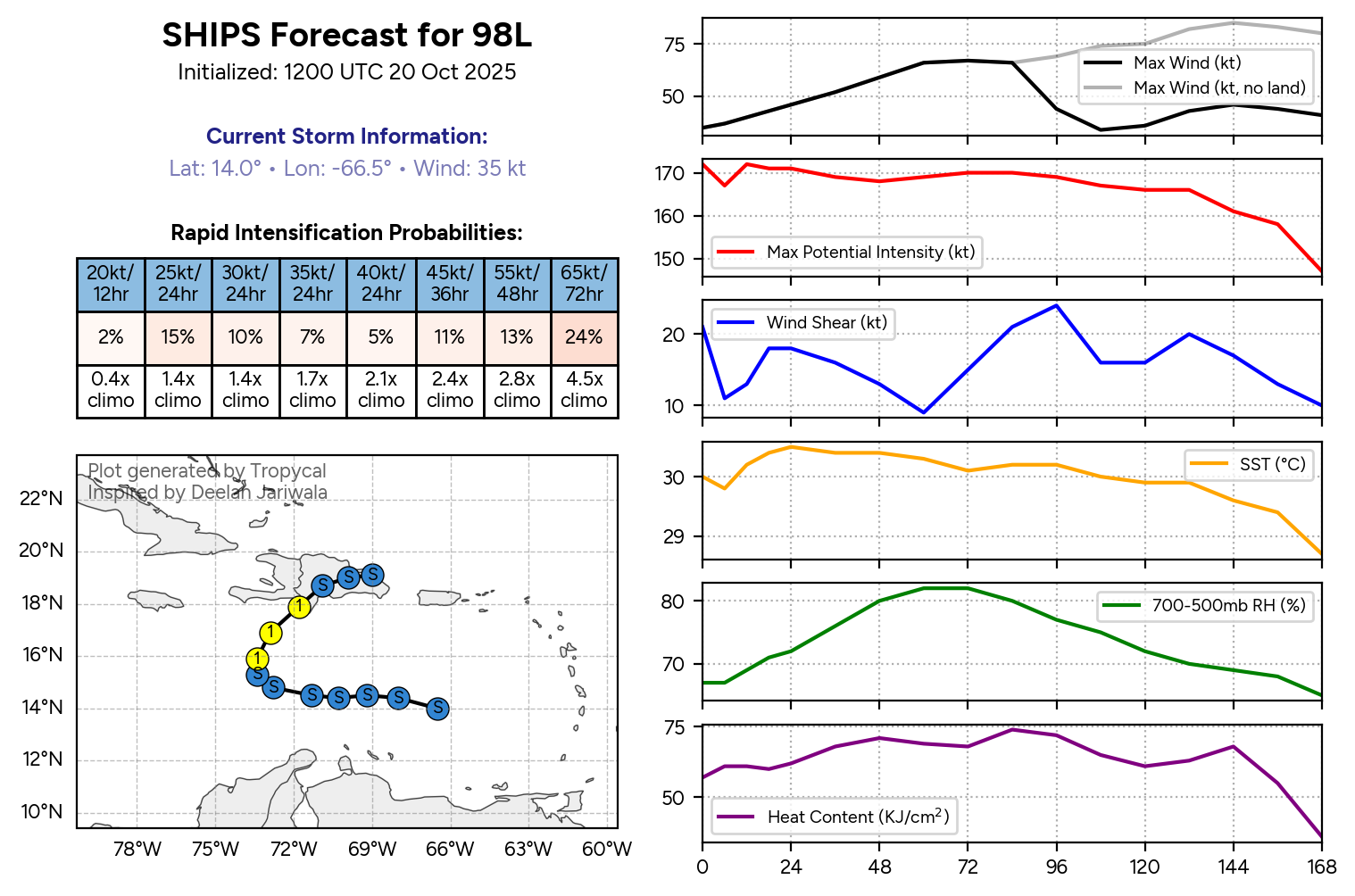
The AI ensemble may have the edge here given the satellite presentation of 98L this morning, because it’s been the best performing model this season, and from what we’re seeing in SHIPS guidance today, showing over 4 times greater than average risk of rapid intensification in the 72 hour forecast timeframe.
Odds of rapid intensification of 65 kts (75 mph) in 72 hours is over 4 times climatology with Invest 98L, not an outlandish number but certainly with higher than average odds. (Polarwx.com)
While the idea of a weaker, farther south and west tracking system is valid, I think the odds definitely favor the potential for a much stronger system right now. The big question is whether the fair bit of westerly shear it is experiencing right now will fundamentally hold back the system from developing rapidly. Something like lots of bark and a little bite. In that instance, the system could also turn north as well, but it would be sloppier and more ragged.
Whatever the case, it is prudent right now for Hispaniola to begin taking this system quite seriously. While none of the explicit modeling forecasts a major hurricane right now, we know from history and observation of the current warm water in the Caribbean that intensity forecasting could be underdone, perhaps significantly. This will continue to bear close watching over the next few days.
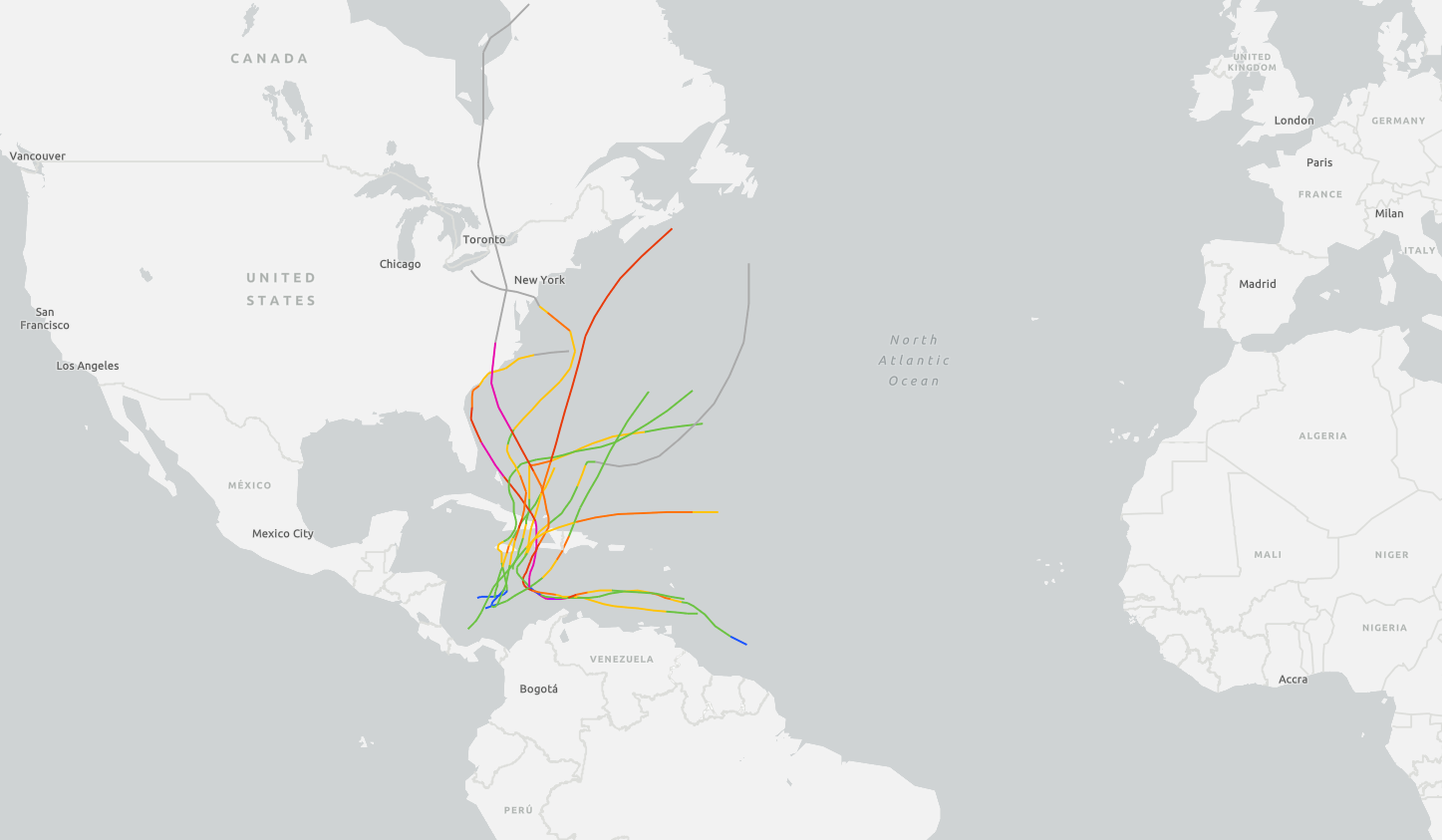
A sample of storms that have tracked from a similar area over the years in October and November. (NOAA)
This is not an uncommon pathway to impact. We’ve seen memorable storms come out of this part of the Caribbean this time of year, including Sandy in 2012, Matthew in 2016, Hazel in 1954, and Tomas in 2010. Obviously, when noting Sandy and Matthew and Hazel, some folks on the East Coast may get jitters, but at this point in time, we expect this system to follow some of the eastern-most tracks on the map above, keeping it away from the East Coast.
We will continue to monitor Invest 98L and its potential impacts and have another update for sure tomorrow and perhaps this evening if necessary.
In brief: In this morning’s post we dig into the data to find that yes, this October definitely still ‘feels’ like summer. Will this ever end? Also, we look ahead to increased rain chances this weekend.
Fall is more than half over, and yet…
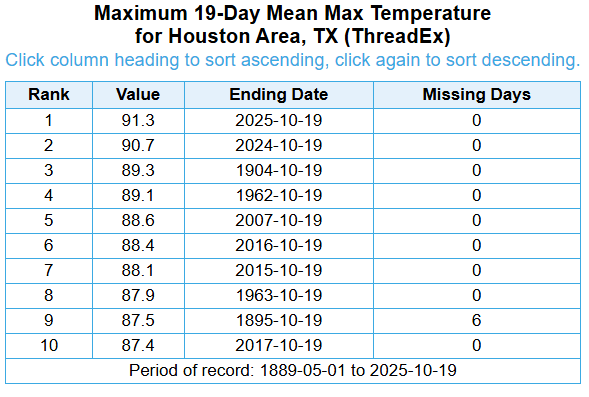
You may not realize it, but meteorological fall is already half over. We crossed that threshold last week. But this morning aside—which is lovely!—much of September and October have felt like a continuation of summer. I crunched the numbers this morning, and the average high temperature so far this month, through Sunday, has been 91.3 degrees. If that sounds strikingly warm for October, well, it is.
How this start to October compares with past ones in Houston. (NOAA)
The normal high during the first three weeks of this month is about 85 degrees. This month’s temperature, through 19 days, is the hottest ever, beating the record of 90.7 degrees (set last year). Compare this to the ‘normal’ high temperature for September, which is 90.4 degrees. So yes, if you’re thinking that large swathes of October have felt like a continuation of summer-like weather, you’re not wrong. If you’re wondering if fall is ever going to arrive, the answer is yes, hopefully a little more than one week from day. More on that below.
Monday
Temperatures this morning range from about 50 degrees in the usual cold spots, such as Conroe, to the lower 70s right along the coast. For most of us, these are the coolest temperatures of the season. However the front that brought this weather to us is already washing out, and we’ll see winds swing to come from the east-southeast today, perhaps gusting up to 20 mph. We’ll also see sunny skies, with highs near 90 degrees, and rapidly rising dewpoints. As a result humidity levels will be higher by this evening, and overnight lows will only drop into the 70s for pretty much everyone.
The northern half of Texas is experiencing fine, cool weather this morning. (Weather Bell)
Tuesday
Another front will push into the region later on Tuesday, and this will bring a slight chance of rain, perhaps 30 percent for Houston, and a little bit higher for coastal areas. This will be humid and warm day ahead of the front with temperatures in the lower 90s for most. Temperatures should fall into the 60s for most on Tuesday night behind the front as drier air moves in.
Wednesday and Thursday
These should be a pair of partly sunny days with highs in the 80s. Wednesday will have lower humidity, but Thursday also does not look excessively humid. Wednesday night should see lows drop into the mid-60s (colder still north and east of Houston), whereas Thursday night only falls to around 70 degrees. Rain chances on both days is near zero.
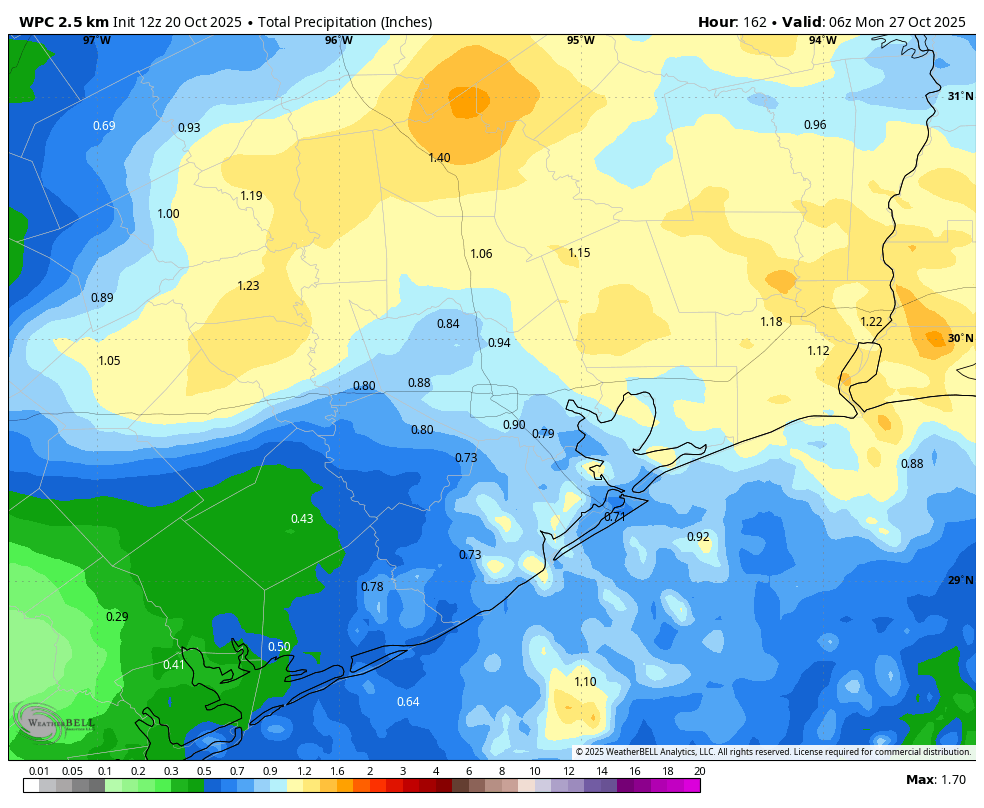
Here’s an early guess as to rain accumulations this weekend. (Weather Bell)
Friday, Saturday, and Sunday
The combination of an upper-level low and the onshore flow will bring a better chance of rain into the forecast for the weekend period. It’s not clear when the best chances will come, but it likely will be between Friday and Saturday night. It’s too early to have much confidence in accumulations, but most of the area could pick up on the order of 1 inch of needed rain through Sunday. In any case, these days should see partly sunny skies with highs in the 80s. Lows will likely be in the vicinity of the upper 60s to 70 degrees.
Next week
The warmer weather will hang on to start next week, but following that there is a a fairly strong signal in the global models for a pattern change, and this is supported by an atmospheric setup that should allow colder air over Canada to move down into the United States. We think this probably will allow a stronger, fall-like front to arrive in our area a couple of days before Halloween. Because this is still 7 to 10 days away we cannot have total confidence, but it does seem likely to occur. This would probably bring us a few nights in the 50s.
The festival involves socializing, exchanging gifts and setting off fireworks. The celebrations were most visible in Ayodhya city in Uttar Pradesh state, where over 2.6 million lamps were lit.
A new study in the medical journal Pediatrics found that peanut allergies in children ages 0 to 3 declined by more than 27% after guidance was first issued, and by more than 40% after it was expanded in 2017.
1. Employee lied and said his mother had died (she hadn’t)
Recently, I had to terminate an employee for lying about their mother dying, let’s call him Jeff. The “death” occurred over a year ago, but 13 months later we came across info that showed us that had been a lie. In fact, Jeff’s sister had posted photos of her and Jeff on an international vacation during the same days as he was supposedly in the hospital preparing for their mother’s passing. We had already been drafting a performance plan for Jeff, and we ended up letting him go over this.
Is there anything that could have been done to prevent lying about something like this in the first place? I don’t want to ask team members to submit an obituary or something else to prove that a family member has died to use their bereavement leave. That feels cruel when already dealing with a death in the family, but I can’t help but feel like we missed something that caused him to lie to this extent.
It’s not uncommon to require some kind of proof to grant bereavement leave, like an obituary, funeral program, or statement from a funeral home.
That said, there’s always a balance between guarding against abuse of benefits and not making employees feel you don’t trust them, particularly during something like a death in the family. I’m generally willing to tolerate the risk of someone occasionally abusing a perk as a trade-off for ensuring employees feel supported, but it’s not unreasonable to decide to ask for documentation.
In this specific situation, though, I’d look at what else you know about Jeff. You were already preparing to put him on a performance plan so clearly there were other issues with his work. How long-running were those issues? Were there signs earlier on that there were serious problems with Jeff, or does this seem wildly out of character? I’d use this more as a flag to ask whether there other problems you should have acted on faster, since often that does turn out to be the case.
I’m an engineer for an aerospace manufacturer that often works with classified information which requires security measures. One of these measures is that when you walk away from your desk, you need to lock your computer and sign in again when you come back.
In my office, we have a fun tradition where if someone is caught with their computer logged in while away from their desk, someone else can change the background to something funny for that person to discover (and the person would also be responsible for buying pizza or donuts for the entire group at the end of the week).
I had the chance to do this to someone else’s computer, but I think I took it too far. I found a coworker’s computer open, and I learned that he was at a meeting. Since it’s October, I thought it would be funny if I put a scary picture on his background. (For anyone curious, it’s a creepy character from a web series called the Boiled One.)
I couldn’t see his reaction directly because I was in a Teams meeting when he returned to his desk, but I could hear him yelp, “JESUS CHRIST!!” I thought the others might find it funny, but I heard several versions of “What the hell?” and everyone asking each other who put it there.
Nobody had asked me about it since I was busy, and since I had two other Teams meetings afterward, everyone had stopped talking about it by the time I had free time. Did I go too far? How do I know whether or not they knew it was me?
Ha, well, yes, it appears that you did. I looked up the Boiled One and laughed, but it would be Quite A Shock if you weren’t expecting something disturbing and not everyone appreciates that brand of weird.
I’m guessing they didn’t know it was you since no one said anything. No need to claim it; just let it fade from memory, which it likely already has, and keep it a little tamer next time.
3. What should I say if one or two candidates ask what they should prepare for an interview?
I’m increasingly noticing that for most jobs we advertise, one or two applicants will email and ask if there is anything they need to prepare for the interview. If we tell those few people what we want to see, that is unfair to other applicants who haven’t got the heads-up. And I wouldn’t want to tell all the applicants “you should come with ideas for X and Y” — it’s usually the good candidates who assume and prepare ideas for X and Y (which I would’ve thought are very obvious in my industry, but not all applicants come armed with these ideas).
Currently I’ve just been saying “no, nothing in particular,” but is that also unfair, since it means they don’t prepare anything? Should I respond with “Nothing in particular, just what you would expect of a normal interview in this industry”?
I agree that you shouldn’t tell some people what to prepare for and not others; otherwise you won’t be assessing them on a level playing field. You should give the same info to everyone, whatever that is.
But any chance that you’d actually be better able to assess candidates if you did ask everyone to come prepared with ideas for X and Y? If it’s truly such an industry norm to expect that, then maybe it’s unnecessary … and if part of what you’re assessing is “ability to come up with ideas with zero prep time,” then it’s useful not to prepare candidates for that in advance. But is that what you should be assessing? Or would you be better able to evaluate what candidates will be like on the job if you told them all what you’d like them to come prepared to discuss? Personally, I’ve found real value in telling candidates things like “we’re hoping you’ll come prepared with some examples of X and Y” because that way they’re not scrambling to think of an answer on the spot, and we can spend more time delving into the substance of those topics. So I’d think carefully about what you’re testing by not sharing that info ahead of time, and what you’d be testing if you did.
What should I do when my manager shows everyone my resignation letter? It named the person I was having issues with and the reason I’m quitting.
There’s nothing you can really do at that point. It’s unprofessional of them to have shared it, but there’s not anything you can do now that it’s happened (and it’s not subject to confidentiality laws or anything like that).
But in the future, your resignation letter shouldn’t include that sort of information. The norm for resignation letters is just to include that you are quitting and as of what date. You shouldn’t give a reason at all! (It’s okay to mention the reason if it’s something very bland like “my family is moving” or “I’ve accepted another position” — but even that doesn’t need to be in there. And you definitely don’t want to include it if the reason is something like “I’m frustrated with Jane” or “management has gone too far” or anything else you feel heated about.)
5. Should you have a “go” file in case you’re laid off?
I’m curious about your perspective on something I saw on LinkedIn. A “thought leader” offering career advice recommended that employees should assemble digital “go” files: basically, collecting any important documents such as performance reviews, emails from their boss or others, or examples of their work that they might want or need in the case of a sudden, unexpected layoff.
For privacy and security reasons, my employer makes it just about impossible to save information from one’s work device to an external cloud. I think that if I were caught transferring files I worked on to my personal devices, I would be having a very serious conversation. (Any external cloud services are blocked, as well as webmail sites; emails with attachments to external addresses can and do trigger a security review.)
It’s possible to print the materials in the office and bring them home. But I think it’s still violating the letter of the security policy which says we’re not supposed to keep company materials at home unless required for work, and shred them when we’re done.
Yet, this advice seems to make sense to me — and after a small number of colleagues were let go last week, it seems very relevant. I am wondering if you have any advice on maintaining access to important workplace files (whether performance reviews or even portfolio material for job searchers).
Yes, this is absolutely good advice. Of course, if your security policies truly prevent it, then you can’t — and there are some people who truly can’t share work samples outside of the company, but most people can. I’d take a close look at exactly how your policies are worded, and at a minimum consider printing copies if you don’t see an explicit prohibition on it.
Also, in a number of states, you’re legally entitled to keep copies of items from your personnel file, which includes performance reviews.
In 1996, the World Wide Web was starting to catch on. Politicians were just beginning to explore how to use online communication to reach voters. And in a house in San Francisco, the fledgling Internet Archive was starting to archive pieces of the web before they disappeared.
That same year, a letter arrived from Washington, D.C., with the Smithsonian Institution’s iconic sunburst logo at the top. The Smithsonian had agreed to partner with the Internet Archive to preserve the digital record of the 1996 U.S. presidential election.
“It was a major milestone for us,” recalls Internet Archive founder Brewster Kahle. “The big Smithsonian was working with this new little Internet Archive nonprofit library.”
Together, the two institutions launched Web Archive 96, one of the first web collections the Internet Archive ever created. It captured the early campaign webpages of candidates Bill Clinton, Bob Dole, and Ross Perot — online brochures filled with policy positions, photos, and promises — along with news coverage of the race. It was a pioneering effort to preserve the political life of a nation as it moved onto the web. The collection is now a foundational part of our cultural history on the web, and is available for public access via the Wayback Machine.
Nearly thirty years later, that collaboration still stands out as visionary: two institutions, one old and one new, working together to recognize the internet as part of our shared cultural record.
Indeed, Smithsonian curators Larry Bird and Harry Rubenstein traveled to New Hampshire and Iowa every four years to collect buttons, signs and physical memorabilia from the campaign offices. Just as television changed the political landscape in the 1960s, they recognized the potential influence of the web in 1996. When they heard Kahle was archiving campaigns, Bird said they were “ecstatic” to collaborate.
“We were all over it,” said Bird, now a curator emeritus from the Smithsonian division of political history. “We were super glad that we could take this non-dimensional thing and for it to have a presence on the floor – even in this most rudimentary, stripped down way – limited to the candidates’ websites. It was an acknowledgement of where things were heading.”
Jeff Ubois, who forged the partnership in 1996, recalled “Why would anyone care about the ephemera of the web?” as the prevailing attitude at the time. “The Smithsonian helped change some of that.”
Once the Internet Archive partnered with the Smithsonian, “it wasn’t possible to dismiss web archiving as irrelevant, impossible, useless,” Ubois said.
People contact the Smithsonian often, Bird said, and the Internet Archive outreach was unexpected, but welcome. “We were constantly looking at the way things were shifting in politics, which always takes what’s popular and successful in the real world and bends it into its own political world or reality,” he said. “And this just seemed to be yet, the latest iteration of that as a cultural phenomenon….To have [the Internet Archive] assemble it wasn’t anything that any of us could have done at the time.”
‘Collection of Record for the Web’
Bird said the Internet Archive is a “remarkable resource” that he and other researchers have relied on for years.
“The museum is the collection of record for material things, objects, and dimensional things. And the Internet Archive is the collection of record for the web and all that implies,” Bird said. “There’s hardly anything that it doesn’t touch anymore. It didn’t start out that way, but it’s become that. It’s the collection of record that people use and cite and compare. It’s a tremendous historical resource.”
Preserving the evolution of political campaigns is important to anyone trying to do research or understand political trends over time, said David Almacy, president and chief executive officer of Far Post Media, a digital public affairs firm in Virginia and former White House E-Communications Director for President George W. Bush. In 1996, campaign websites were primarily online brochures – just text and photos without much customization. Today, websites are more advanced with video, digitally integrated with interactive elements that can be tailored to the user.
“The value is to provide an archive and a record of what was said, and basically a snapshot in time politically,” Almacy said. “It actually becomes fascinating to go back and look at the issues that were facing the country that would be deemed priorities in 1996 and how that compares to today. I assume a lot are the same – the economy, education, immigration, national security, global peace – but they’ve evolved in different ways. Many are very important to Americans, just as they were back then.”
SEATTLE, WA – With the ALCS series headed to a winner-take-all game 7, Toronto Blue Jays fans have attempted to gain an advantage over the Mariners by abducting Dr. Frasier Crane, beloved radio personality and Seattle celebrity. Toronto baseball fans, desperate to see their Blue Jays contend for the World Series, hatched the elaborate prank […]
ATLANTA—Saying the novelty decoration would add the perfect touch to Halloween yard displays, the Home Depot announced Friday it had begun selling a new 12-foot-tall Willem Dafoe in stores nationwide. “October just got a whole lot spookier with our exclusive oversized Willem Dafoe ornament!” read the product’s promotional copy, which emphasized that the massive, high-density polyethylene recreation of the Platoon and Antichrist star would be towering over trick-or-treaters after just a few minutes of assembly. “Great for haunted houses, front yards, or anywhere else you want to terrify people with the BAFTA and Golden Globe award winner’s unsettling grimace and misty blue eyes. Plus, built-in LEDs ensure the whole neighborhood can see that distinctive tooth gap!” At press time, the Home Depot had reportedly removed the decorative Dafoe from shelves after numerous parents complained the actor’s face had given their children nightmares.
SPENCER, TN—Frustrated at breaking a three-week streak of alcohol abstinence, a white-tailed deer expressed annoyance Monday upon realizing he could not complete his goal of a Sober October because the apple he had just eaten was fermented. “Oh goddammit, I knew it smelled too good to be nonalcoholic,” said the visibly irritated 3-year-old buck, who observed that since committing himself to 31 days of dry living, he had been waking up with a clearer head, and his pelage was glossier than it had been for years. “Someone should really clear these out. They’re just lying around where any fawn could get to them. Well, the whole day’s a wash, so I might as well have a few more and see where the night goes.” At press time, the increasingly erratic deer was seen rutting with a friend, nuzzling with a 1-year-old doe, and then passing out in a leaf-covered glade.
“Elijah Clark, a consultant who advises companies on AI implementation, is blunt about the bottom line. ‘CEOs are extremely excited about the opportunities that AI brings,’ he says. ‘As a CEO myself, I can tell you, I’m extremely excited about it. I’ve laid off employees myself because of AI. AI doesn’t go on strike. It doesn’t ask for a pay raise.’” —Gizmodo
- - -
Hi team,
Happy Taco Tuesday, and blessed Q3 Hustle VibesTM from your CEO, Rockin’ Rickie.
First off: Thank you. Your hard work is why Bin There, Felt That remains the first and only company dedicated to manufacturing trash cans for adult children of divorce. What we do is vital. It’s a lot like open-heart surgery, but with a slightly higher body count and way more cupholders. I’m proud to lead a crew—nay, familia—bound by five core values: integrity, passion, collaboration, mixing up women employees—but in a respectful way—and honesty. With that in mind, I wanted to address a recent interview in which I was egregiously misquoted as saying: “I legit can’t wait to fire these ungrateful poors with our company’s new AI agent.”
The full quote was actually, “I legit can’t wait to fire these ungrateful poors with our company’s new AI agent in a way that is elegant, humane, and synergistic.” It’s a subtle but important distinction, just like the difference between my assistant, Slut Anna, and head of marketing, Hot Hannah (both blonde, but one wears skirts). Still, I could see how it may have sounded insensitive. In the words of Buddha, “Namaste and Shalom, bros. My bad, fr fr.” (ChatGPT helped me find that quote; it’s remarkably contemporary.)
My intention was not to be rude, but to simply have an 8 a.m. chicken breast breakfast smoothie with my buddy Joey. Joey and I have a complicated relationship. I’m always suggesting new hairstyles that could make him feel more confident, and he’s always asking to “interview” me because he is a “reporter.” But rest assured, after publishing that quote—even after I said “off the record” six or seven times, three hours later—our friendship is over.
This whole ordeal has been a terrible introduction to our new team member, JOE (yes, named after Joey, back when I thought we were blood brothers, and I can’t figure out how to undo it). JOE is an AI agent who specializes in laying off employees nicely. He’s like if Buddha had guts. Losing your job used to feel like a divorce. With new technology, it still does—but in a good way.
You’re going to love him. JOE genuinely cares about your mental well-being, even in challenging moments—like being shown the door unexpectedly, or being shown the door unexpectedly while on your period. (I see you, Slut Hannah and Hot Anna. Or wait—Hot Hannah and Slut Anna? Shit.)
JOE will write your final performance review with compassion (“Crushed it, but tragically, we no longer value that”), turn your severance package into a “Congrats on your next adventure!” GIF starring one of my taxidermy animals making unsettling eye contact, and ping you every thirty seconds with gentle reminders to remove your shit from the office.
And you know what’s incredible? We’ve already seen the value add. As of this morning, JOE has taken over payroll, HR, and the weekly Fun Lunch order from Panera—which we can now enjoy in peace, since Jen from HR will no longer be around to complain about how the “Toasted Italiano Sandwich is sooo good but goes right through her.” Jen, if you’re reading this, you can tap out right about now.
For those of you who don’t get laid off, JOE hasn’t forgotten you: He can also handle other time-consuming busywork, no matter how soul-numbing. For example, after the article, JOE helped me draft a cease-and-desist to Joey, which freed up time for me to go to his house, wrap him in a bedsheet, and toss him in a lake outside Reno, allegedly.
I know that change is scary. I myself was terrified to start going by Rockin’ Rickie. But change is growth, growth is profit, and profit is the ultimate form of self-care. Or as Buddha says: “If you feel strange, try a sound bath.” If you’d like to speak to me about any of this, please don’t hesitate to reach out to JOE. I am currently at a silent meditation retreat for men of 5′8″ experience, but JOE will simulate my voice, only deeper. I mean kinder.
Namaste, Shalom, and Happy Q3, Rickie Slam (He/Him/Human) CEO | Bin There, Felt That
(This email was written by JOE v3.1, with minor edits from JOE v3.0 and a single word—“synergistic”—contributed by a human intern, who has since been offboarded.)
Sandy Creek Energy Station, the last large coal plant constructed in the U.S., sits cold and idle in the prairies just outside of Riesel, 10 miles east of Waco. The plant suffered a major equipment failure in April that is not expected to be fixed until March 2027, according to the Electric Reliability Council of […]


 ALT
ALT