It’s “where are you now?” month at Ask a Manager, and all December I’m running updates from people who had their letters here answered in the past. Here are four updates from past letter-writers.
Since our job is very flexible in terms of how to manage/create your off-of-direct-customer-facing-service schedule, I think coworkers were getting a little opportunistic about the lack of oversight in order to create these very ideal (for them) schedules. I kind of mentally handed back the scheduling to the people who wanted a lot of accommodation or to cut up our normal scheduling blocks (wanting to work an opening shift 9-10:30 instead of 9-12 like before). I ended up following the advice that the reasons I don’t want to fill in all the gaps aren’t important, stopped trying to justify myself at all, and said some variation of “that doesn’t work for me” or “I can’t do that.” The schedule went through 15+ rounds of version changes but I got my one closing a week and one opening, and while I have the majority of the late afternoon/early evening slots, I’ll take it.
We also have a new boss who has implemented a kind of review of our scheduling and who does the most substituting, covering, etc. so I’m hopeful that might be a factor in limiting this sort of behavior going forward. My coworker with the most scheduling limitations has also agreed to keep to this schedule for our usual duration (one year) so we won’t have to revisit this again until the spring. I think I’ll be better prepared to stand up for myself this go around.
I took your advice and reached out to my boss’s boss via Teams but he never got back to me. So I decided I would call him, instead. But before I even had a chance to call him, our HR department reached out to me asking if they could talk to me. Apparently, someone else in my department had filed a complaint with HR about boss’s nephew (HR did not specify the person’s identity or the nature of the complaint) and HR was investigating so they wanted to talk to me as his “supervisor.” I told them everything I knew (about the favoritism, etc.) and I explained how I wasn’t really his supervisor in any real sense of the word, all I did was approve his timecards and that my boss was his supervisor in every other way. They thanked me for being candid about the situation and that was it.
A week or two later, at our next staff meeting, my boss announced that the nephew was transferring to a new department effective immediately. He is still with our organization in that other department and is doing good work from what I hear. I and my co-supervisor still do not have any other direct reports. We both have the title of supervisor, but we really function more as team leads. This is not the case with supervisors in other departments at our organization, I don’t know why my department is different.
No one in my department, including my boss, has ever brought up the HR investigation, FYI.
Not a very exciting update, but I think my organization handled this appropriately. I just wonder why this was ever allowed to happen in the first place.
The good news is that I took your advice, and things got much better for Jane … at least for a while. I pulled back from doing a lot of unrecognized overtime, which reflected better on her with the contract employees and people at the office level. The bad news is that I got several reprimands from my corporate-level boss for not working those additional hours and for being “out of sync with the culture of my cohort.” (Remember, even though on the office level Jane and I appeared the same to contract employees, on the corporate level we were on different strands or cohorts.) It also gave me far, far too much work to do within the hours allowed, which caused others to fall behind.
Eventually, it became too much, and I took another position with another company. Apparently, my former company never hired another person to replace me. Rather, they assigned additional work to others in my cohort. I’m still friends with Jane (as well as people from my own cohort), and I’ve learned that many contract employees and office-level managers are miserable because my replacements are not customer service-oriented or responsive to their needs. At the same time, those who took over my work are now forced to work many extra hours just to do the bare minimum. And this makes more work for Jane. It’s a bad situation. I am glad I am out, but I do feel for Jane and the others who are still stuck there.
I don’t have much of an update about implementing the advice you gave; shortly after I sent in my letter, the coworker in question moved to another job. I’ll admit that my frustration with this issue was related to a lot of other issues with that job, so I’ll use this space to brag about the fact that I landed my dream job! It’s part-time, so I’m still at the other job, but I’m so beyond happy that I’m right in my niche and part of a supportive team that wants to use my expertise. I definitely used a lot of your resume and interview tips, so you get credit for this one for sure!
Big Tech joins the race to build the world's heaviest airplane (permalink)
I have a weird fascination with early-stage Bill Gates, after his mother convinced a pal of hers – chairman of IBM's board of directors – to give her son the contract to provide the operating system for the new IBM PC. Gates and his pal Paul Allen tricked another programmer into selling them the rights to DOS, which they sold to IBM, setting Microsoft on the path to be one of the most profitable businesses in human history.
IBM could have made its own OS, of course. They were just afraid to, because they'd just narrowly squeaked out of a 12-year antitrust war with the Department of Justice (evocatively memorialized as "Antitrust's Vietnam"):
The US government traumatized IBM so badly that they turned over their crown jewels to these two prep-school kids, who scammed a pal out of his operating system for $50k and made billions from it. Despite owing his business to IBM (or perhaps because of this fact), Gates routinely mocked IBM as a lumbering dinosaur that was headed for history's scrapheap. He was particularly scornful of IBM's software development methodology, which, to be fair, was pretty terrible: IBM paid programmers by the line of code. Gates called this "the race to build the world's heaviest airplane."
After all, judging software by lines of code is a terrible idea. To the extent that "number of lines of code" has any correlation with software quality, reliability or performance, it has a negative correlation. While it's certainly possible to write software with too few lines of code (e.g. when instructions are stacked on a single line, obfuscating its functionality and making it hard to maintain), it's far more common for programmers to use too many steps to solve a problem. The ideal software is just right: verbose enough to be legible to future maintainers, streamlined enough to omit redundancies.
This is broadly true of many products, and not just airplanes. Office memos should be long enough to be clear, but no longer. Home insulation should be sufficient to maintain the internal temperature, but no more.
Ironically, enterprise tech companies' bread and butter is selling exactly this kind of qualitative measurement for bosses who want an easy, numeric way to decide which of their workers to fire, and leading the pack is Microsoft, whose flagship Office365 lets bosses assess their workers' performance on meaningless metrics like how many words they type, ranking each worker against other workers within the division, with rival divisions and within rival firms. Yes, Microsoft actually boasts to companies about the fact that if you use their products, they will gather sensitive data about how your workers perform individually and as a team, and share that information with your competitors!
But while tech companies employed programmers to develop this kind of bossware to be used on other companies' employees, they were loath to apply them to their own workers. For one thing, it's just a very stupid way to manage a workforce, as Bill Gates himself would be the first to tell you (candidly, provided he wasn't trying to sell you an enterprise Office 365 license). For another, tech workers wouldn't stand for it. After all, these were the "princes of labor," each adding a million dollars or more to their boss's bottom line, and in such scarce supply that a coder could quit a job after the morning scrum and have a new one by the pre-dinner pickleball break:
Tech workers mistook the fear this dynamic instilled in their bosses for respect. They thought the reason their bosses gave them free massage therapists and kombucha on tap and a gourmet cafeteria was that their bosses liked them. After all, these bosses were all techies. A coder wasn't a worker, they were a temporarily embarrassed founder. That's why Zuck and Sergey tuned into those engineering town hall meetings and tolerated being pelted with impertinent questions about the company's technology and business strategy.
Actually, tech bosses didn't like tech workers. They didn't see them as peers. They saw them as workers. Problem workers, at that. Problems to be solved.
And wouldn't you know it, supply caught up with demand and tech companies instituted a program of mass layoffs. When Google laid off 12,000 workers (just before a $80b stock buyback that would have paid their wages for 27 years), they calmed investors by claiming that they weren't doing this because business was bad – they were just correcting some pandemic-era overhiring. But Google didn't just fire junior programmers – they targeted some of their most senior (and thus mouthiest and highest-paid) techies for the chop.
Today, Sergey and Zuck no longer attend engineering meetings ("Not a good use of my time" -M. Zuckerberg). Tech workers are getting laid off at the rate of naughts. And none of these bastards can shut up about how many programmers they plan on replacing with AI:
And wouldn't you know it, the shitty monitoring and ranking technology that programmers made to be used on other workers is finally being used on them:
Naturally, the excuse is monitoring AI usage. Microsoft – along with all the other AI-peddling tech companies – keeps claiming that their workers adore using AI to write software, but somehow, also have to monitor workers so they can figure out which ones to fire because they're not using AI enough:
This is the "shitty technology adoption curve" in action. When you have a terrible, destructive technology, you can't just deploy it on privileged people who get taken seriously in policy circles. You start with people at the bottom of the privilege gradient: prisoners, mental patients, asylum-seekers. Then, you work your way up the curve – kids, gig workers, blue collar workers, pink collar workers. Eventually, it comes for all of us:
As Ed Zitron writes, tech hasn't had a big, successful product (on the scale of, say, the browser or the smartphone) in more than a decade. Tech companies have seemingly run out of new trillion-dollar industries to spawn. Tech bosses are pulling out all the stops to make their companies seem as dynamic and profitable as they were in tech's heyday.
Firing workers and blaming it on AI lets tech bosses transform a story that would freak out investors ("Our business is flagging and we had to fire a bunch of valuable techies") into one that will shake loose fresh billions in capital ("Our AI product is so powerful it let us fire a zillion workers!").
And for tech bosses, mass layoffs offer another, critical advantage: pauperizing those princes of labor, so that they can shed their company gyms and luxury commuter busses, cut wages and benefits, and generally reset the working expectations of the tech workers who sit behind a keyboard to match the expectations of tech workers who assemble iPhones, drive delivery vans, and pack boxes in warehouses.
For tech workers who currently don't have a pee bottle or a suicide net at their job-site, it's long past time to get over this founder-in-waiting bullshit and get organized. Recognize that you're a worker, and that workers' only real source of power isn't ephemeral scarcity, it's durable solidarity:
"Red Team Blues": "A grabby, compulsive thriller that will leave you knowing more about how the world works than you did before." Tor Books http://redteamblues.com.
"Chokepoint Capitalism: How to Beat Big Tech, Tame Big Content, and Get Artists Paid, with Rebecca Giblin", on how to unrig the markets for creative labor, Beacon Press/Scribe 2022 https://chokepointcapitalism.com
"The Reverse Centaur's Guide to AI," a short book for Farrar, Straus and Giroux about being an effective AI critic. LEGAL REVIEW AND COPYEDIT COMPLETE.
"The Post-American Internet," a short book about internet policy in the age of Trumpism. PLANNING.
A Little Brother short story about DIY insulin PLANNING
This work – excluding any serialized fiction – is licensed under a Creative Commons Attribution 4.0 license. That means you can use it any way you like, including commercially, provided that you attribute it to me, Cory Doctorow, and include a link to pluralistic.net.
Quotations and images are not included in this license; they are included either under a limitation or exception to copyright, or on the basis of a separate license. Please exercise caution.
"When life gives you SARS, you make sarsaparilla" -Joey "Accordion Guy" DeVilla
READ CAREFULLY: By reading this, you agree, on behalf of your employer, to release me from all obligations and waivers arising from any and all NON-NEGOTIATED agreements, licenses, terms-of-service, shrinkwrap, clickwrap, browsewrap, confidentiality, non-disclosure, non-compete and acceptable use policies ("BOGUS AGREEMENTS") that I have entered into with your employer, its partners, licensors, agents and assigns, in perpetuity, without prejudice to my ongoing rights and privileges. You further represent that you have the authority to release me from any BOGUS AGREEMENTS on behalf of your employer.
The advocacy group cited the city’s collaboration with federal immigration authorities, the removal of Montrose’s rainbow crosswalks and Whitmire’s attendance at a Republican fundraiser as justification.
CINCINNATI—Saying the man’s reputation was unlikely ever to recover from the embarrassment, sources confirmed Tuesday that local accountant Josh Hunter had completely humiliated himself at his company’s holiday party by telling his coworkers he appreciated them. “It’s normal to have a couple of drinks during the festivities, but Josh made a total ass of himself by telling everyone in the room what he really thought of their admirable work ethic and superior communication skills,” said Hunter’s colleague Lisa Gallegos, adding that the shameful anecdotes about him insisting they were the most talented people he had ever had the opportunity to work with would be repeated behind his back for years to come. “It was kind of funny at first, but things quickly spiraled out of control when he said he appreciated our moral support as he went through a difficult time earlier in the year. We had to put him in an Uber after he repeatedly made disturbing remarks about how he considered us to be some of his best friends.” At press time, the company’s HR department was reportedly fielding multiple complaints from employees who claimed Hunter had deliberately affirmed them as coworkers and as people.
by By Natalia Contreras, Votebeat and The Texas Tribune
The decision will make Dallas County the largest jurisdiction in the U.S. where ballots are hand-counted. Voters will still be able to vote at any countywide vote center during early voting.
On September 9 at 6:51 p.m., Harris County Judge Lina Hidalgo exited an ongoing budget meeting in protest. “Shame on you,” she scolded her colleagues—namely her fellow Democratic Commissioners Lesley Briones and Adrian Garcia, but also Republican Commissioner Tom Ramsey—after they refused to fund several early childhood education programs and a juvenile probation program. It appeared to be a continuation of a feud that had only deepened since the “GOP three,” as Hidalgo has dubbed them, forced through major pay increases for Harris County law enforcement.
At the time, Hidalgo left unsaid another reason she had to leave early: a concert featuring the trademark orchestral film scores of German composer Hans Zimmer, which was set to begin at 7:30 p.m. at the nearby Toyota Center. Later that night, Hidalgo confirmed on Instagram that she was indeed in attendance: “Food for the soul after fighting to keep colleagues from decimating county services for residents,” she wrote on her Instagram story. “We live to fight another day!”
For Hidalgo’s critics—of which today there are many, left and right—the optics of sidestepping her responsibilities as the top elected official in Texas’ most populous county to attend a concert was further proof that the once-longshot candidate-turned-shining Democratic star, erstwhile beacon of Texas’ blueing electorate, was not only ill-suited for the job. She didn’t even seem to want it anymore. Six days later, the 34-year-old, Colombia-born Hidalgo confirmed her critics’ suspicions, announcing she would not seek reelection. For the Houston Chronicle’s editorial board, the lessons from her tenure, which will last eight years, were simple: In Texas, the oddly titled county judge is indeed the county’s top executive, but the role’s power largely depends on goodwill among the other four members of what’s called the commissioners court. In other words, she should have played nicer, or at least smarter, with her colleagues. “Hidalgo was never a politician,” the board wrote. “Unfortunately, being a politician was her job.”
There’s some truth to this, but only in the way any other platitude (“everything happens for a reason”; “don’t bite the hand that feeds you”) purveys the obvious while smacking of sanctimony. And whereas progressives are right to emphasize the right’s high-powered propaganda mill that sought to tear Hidalgo to shreds—including by weaponizing her public transparency about her mental health—this also fails to appraise the county judge for what she was, or at least what she became.
Advertisement
With Houston progressives fated to suffer at least two more years of humiliation under 76-year-old blue-dog Democrat Mayor John Whitmire, watching feebly as the commissioners court blusters toward austerity, it’s worth lingering on Hidalgo’s double-edged legacy: a meteoric rise and a stumbling decline, a wave of Democratic empowerment followed by a striking bout of impotence.
As a Latina immigrant elected in her mid-twenties, Hidalgo faced unique headwinds that can’t be ignored when reckoning with her time in office, yet what she did with the power she won must still be judged on its own merits.
While much of the country may have learned of Hidalgo’s political decline in mid-September when TheNew York Timespublished its story on her choice not to run again, Hidalgo’s regime was, for the true believers in her office, already on uncertain ground during her 2022 reelection bid.
Then-District Attorney Kim Ogg, also nominally a Democrat, who assumed office in 2017, had announced what many saw as a politically motivated investigation into three of the judge’s former staffers for allegedly steering a COVID-19 contract to a political ally. (One of Hidalgo’s first acts in 2019 was to bolster the local public defender’s office and snub Ogg’s request for more prosecutors, arguably paving the war path that ended in Ogg’s 2024 primary ouster.) Multiple former Hidalgo staffers, who requested anonymity because they still work in local government, recalled a heavy sense of paranoia in Hidalgo’s office and on the campaign trail, as she tried to get out from under the ethics case that lingered for almost three years, until eventually even Attorney General Ken Paxton moved to drop it.
In what was one of the country’s most expensive local races, and the main proxy for the Texas state government versus its blue municipalities, Hidalgo narrowly prevailed in 2022 with a sub-2-percent margin—roughly the same difference by which she originally ousted a popular moderate Republican incumbent, Ed Emmett, as a well-educated neophyte to politics and government back in the blue-wave days of 2018.
Her narrow reelection was a bright spot in an otherwise dispiriting ’22 cycle for Democrats in Houston and Texas altogether. To Ginny Goldman, a former senior advisor to Hidalgo and longtime progressive strategist, the win could be attributed to the fact that Hidalgo shepherded the county through times of crisis—typically the most prominent role of the county judge in the disaster-prone Houston area. She acted as emergency executive during the ITC chemical fire in 2019, and, soon thereafter, the worst days of the COVID-19 pandemic and Winter Storm Uri, whose death toll exceeded even Hurricane Harvey’s. Before long, she would shepherd the county through derecho- and Hurricane Beryl-induced power outages and a chemical explosion in Deer Park.
Through it all, the right attacked her often for little more than her communicative style. In 2019, for instance, Republicans lambasted her for having the audacity to speak both English and Spanish at press conferences; by 2025, this had become a common occurrence across the commissioners’ court.
“She is a natural at communicating during disaster, which is when people most want the government to step in and keep them safe,” said Goldman.
Hidalgo speaks at a March 2019 press conference after a Houston-area petrochemicals storage facility caught fire. (Godofredo A. Vasquez/Houston Chronicle via AP)
Still, Hidalgo’s mandate to govern had never looked shakier, despite Dems having secured a super-majority on the commissioners court. If once she was a political outsider, Hidalgo now suffered from the same lack of enthusiasm as your typical establishment Democrat.
Her office had already drifted far from its roots. Following her upset victory in 2018, she and her aides hit the ground running. In the two months leading up to the swearing-in ceremony in January 2019, Hidalgo, plus soon-to-be Precinct 2 Commissioner Adrian Garcia and Precinct 1 Commissioner Rodney Ellis, met every week to discuss their shared priorities. Her team continued knocking on thousands of doors, asking people how the government could help everyone live with dignity. Along with more than 200 other civic organizations, Hidalgo scheduled “Talking Transition” workshops anyone could show up to help define her priorities.
The plan was to build “Lina’s Army,” as her team dubbed it, out of these newly activated residents.
In short order, the trio of Dem commissioners injected funds into that cash-starved public defender system, developed a plan to increase the minimum wage for county employees, and earmarked funds for equitable flood infrastructure by prioritizing low-income communities that had long been left behind.
More than that, Hidalgo strove to make good on a campaign promise: to build a “county that works for everyone.” Harris County government had, for decades, been ruled behind closed doors by the business elite, and for a brief moment under Hidalgo the walls between the government and the masses had never seemed so permeable. Hidalgo even promised to never take campaign donations from any contractors, a pledge no other county commissioner ever joined in on (and on which she later reneged).
While her style of governance in her first term was not exactly populist, it was intentionally grounded in progressive ideals. But even that wouldn’t last.
Entering her second term, Hidalgo’s style became ever more insular and technocratic, her decision-making more divorced from the grassroots.
“It was kind of a natural response” to the right-wing campaign against her, said Ben Hirsch, co-director of West Street Recovery, a progressive Houston nonprofit focused on climate change resilience. West Street and Hidalgo didn’t always have an easy relationship. In fact, as early as 2019 the group was critical of Hidalgo’s governing strategy regarding the county’s flood control infrastructure, which the group believed prioritized well-off areas over low-income neighborhoods. But they did have a working relationship in her first term.
Gradually, though, Hidalgo’s camp stopped showing up to West Street’s community events. From late 2021 onward, “It was clear Hidalgo’s office was more closed” to outside advocates, Hirsch said—that is, at least until this last budget fight, when the two were thrust onto the same side against the funding cuts.
In Hirsch’s view, Hidalgo’s relationship with the grassroots was always somewhat tenuous. “I personally really like her,” he said, “but she was never a movement candidate.” While she was sympathetic to local progressive groups, she didn’t always fully buy into their various agendas. That, of course, didn’t stop her powerful Republican critics from branding her as a left-wing radical. “Sometimes I wish the Lina that Ken Paxton thinks existed actually existed,” Hirsch said.
Take, for instance, the Houston ISD bond election in 2024. While public energy against the state takeover of HISD escalated across Harris County led by parents, public ed advocates, and allies like the Houston Federation of Teachers, local Democrats and Republicans found rare common ground in opposing the massive $4.4-billion bond measure for the state-run HISD.
Hidalgo, meanwhile, was one of the only local elected officials to come out in favor of the bond, ostensibly lending her support to the highly controversial state-appointed superintendent Mike Miles. “I will continue to advocate for increased community involvement, meaningful engagement and, most importantly, the end of the TEA takeover,” Hidalgo said then in a statement. “At the same time, I believe crucial investments are needed in our schools and cannot wait.”
The bond proposal became the school district’s first to fail in 28 years, a resounding victory for the 58 percent of Houstonian voters who, in part, had reasoned that signing off on Miles’ bond agenda would only strengthen the takeover. But Hidalgo could claim no part in it.
“This is what happens when you remove yourself from engaging with organized groups of people,” Goldman, who left Hidalgo’s employ at the end of 2022, told the Observer.
In the first year of her second term, Hidalgo’s staff also fled for the exits. Between January and August of 2023, Hidalgo lost about a third of her 30-some staffers, according to interviews and a review of LinkedIn profiles. Most went to work for the newest Democratic commissioner, Lesley Briones, who won Precinct 4 in 2022 thanks to the court’s redrawing of county maps. Today, a handful of these staffers remain there, representing the office that has rankled Hidalgo perhaps more than any other since Ogg’s. Early that same August, Hidalgo also announced she would take a leave of absence to receive treatment for clinical depression, before returning that October.
Hidalgo awaits the arrival of Vice President Kamala Harris in Houston in November 2023. (Reginald Mathalone/NurPhoto via AP)
All this led up to Hidalgo’s escalating feud with the “GOP three” (two of whom, again, are Democrats), the budget fight over childcare and raises for county law enforcement, and, ultimately, her announcement that she wouldn’t seek a third term.
Early childcare had been a central subject in Hidalgo, Garcia, and Ellis’ agenda back in 2018, but this year’s rollout of a “penny tax” ballot initiative—which would have added one cent to the property tax rate to create and improve childcare facilities and assist families with childcare costs—was cobbled together at the last minute. A previous iteration of Hidalgo’s childcare initiative had been paid for by COVID-19 stimulus money that was set to run out; Hidalgo released a proposal to extend the policy with a new tax but didn’t consult any county commissioners beforehand, according to The Texas Tribune.
Jesse Ayala, who joined Hidalgo’s office in March to help organize the effort, reportedly knew the rollout was rushed and that Garcia and Briones wouldn’t support a tax increase when their names were set to be on the 2026 ballot. On August 7, the other commissioners killed the proposal and censured Hidalgo for violating decorum in one fell swoop—a month before the Hans Zimmer concert incident, which was prompted by commissioners’ continued refusal to consider the judge’s proposals on various early childhood programs.
After multiple requests, Hidalgo’s office did not provide comment or make her available for an interview for this story.
It’s a discouraging fact of history that progressives on the court enjoyed more power with a 3-2 Democratic majority than today’s 4-1 margin—just as it’s a deflating fact that Hidalgo was once seen as a possible candidate for higher office or a federal cabinet position. Not so long ago, the Dem commissioners appeared to have a collective vision for the county. At the height of Trump 1.0, Garcia, the odd-duck Democrat (a former cop and county sheriff) beside the more-liberal commissioners Ellis and Hidalgo, couldn’t risk the optics of being the only one to side with the two Republicans. Two Democrats siding with one Republican, however, offers the patina of bipartisanship.
Enter Briones, whose “both-and” policy approach has often lead to toxic contradictions: Together, she and Garcia delivered massive raises for Harris County constables—who run a glorified protection racket for wealthy Houston neighborhoods and rarely tackle serious crimes—while initiating the longest county-wide hiring freeze since the Great Recession, cutting myriad department programs including pollution control by hundreds of thousands of dollars and relying on one-time financial transfers to make the numbers work.
The freeze and cuts passed rather quietly in late September, despite the protestations of Hidalgo and Ellis. The pair had lost significant ground after a memorable moment in which Hidalgo, on the day the penny-tax effort imploded, brought dozens of children to the chamber to appeal to the commissioners. The gambit was widely condemned, given that the children, some of whom were in foster care, had no idea what Hidalgo was throwing them into. “It’s one thing for them to be a visual; it’s another thing for them to be a prop,” Ayala, then still in Hidalgo’s employ, told the Chronicle.
When I watched the footage of that afternoon, with Hidalgo begging the kids to come closer to the dais, the children shuffling uncomfortably, unsure what to do, my thoughts turned to Lina’s Army—and the deferred plan to build out a culture of continuously organized participatory democracy. How alone she must have felt, beckoning for an army that did not come.
If there’s one lesson we might draw from Hidalgo’s tenure, it’s that a single election does not change an entire culture. Even the most well-intended technocrat, left to her own devices, might stumble into the familiar trappings of the good ol’ boy system, which exists beyond any of the good ol’ boys themselves. No one, not even Houston Democrats’ brightest star, could change that on her own.
With the rise of AI slop and overall “enshittification,” it is increasingly the case that the internet is failing to address the public’s needs. What we need is sewer socialism for the digital realm — and it can start at the municipal level.
Community-owned ISPs generally provide cheaper entry-level broadband access than their corporate counterparts. (Matt Jonas / Digital First Media / Boulder Daily Camera via Getty Images)
On January 1, socialist mayors will take office in both New York City and Seattle. That’s a total constituency of nearly ten million Americans. While Zohran Mamdani and Katie Wilson will necessarily be focused on fulfilling their campaign promises around addressing the cost-of-living crisis, their administrations will have the unique opportunity to serve as laboratories for the kind of imaginative policymaking the country badly needs.
One area that could especially benefit from an infusion of political creativity is tech policy. At the moment, the internet is in bad shape. The popularity of words like “slop” and “enshittification” — referring both to AI-generated content and increasingly poorly functioning websites and search engines — gives a sense of how degraded our digital lives have become. Meanwhile, many Silicon Valley capitalists have moved to the Right. Some openly supported Donald Trump’s bid for a second term, contributing hundreds of millions of dollars to the effort. Most swore their allegiance to Trump after he won, donating to the inauguration and heaping words of praise on the president-elect. The “tech oligarchy,” as it has come to be called, is now a MAGA coalition partner.
As the most powerful and dynamic faction of American capital, this is a troubling development. Socialist mayors certainly can’t single-handedly overturn the tech oligarchy. But they can kick-start policy innovations that sketch the outlines of an alternative technological blueprint for their constituents. The power of the tech giants is sustained — at least in part — through the limitations they place on our collective imagination. Their dominance is so absolute that it becomes hard to envision a different way of living with the internet.
Taking practical steps toward upending the status quo in New York and Seattle — which are, incidentally, two of the biggest tech industry hubs outside the Bay Area — would show that another internet is possible and offer encouragement to communities across the country. More ambitiously, it could also erode the influence of the tech oligarchy by nurturing a set of digital experiments that lie outside of their control.
There will be no shortage of thoughtful people in both the Mamdani and Wilson administrations who might undertake such experiments. Mamdani seems particularly attuned to the importance of technology, having enlisted the prominent anti-monopolist Lina Khan as a cochair of his transition team and appointed a technology advisory committee that includes the renowned scholars Ruha Benjamin and Alondra Nelson.
The sewer socialists made the case that municipal ownership of systems like sanitation, water, and power could deliver services more efficiently and more equitably than private ownership.
Of course, the immediate task in New York and Seattle will be to deliver on the affordability agenda of the two campaigns. This is not the time for every socialist in the country to start waving their wish list. Still, for those of us who have the luxury of not being in the trenches, it’s a good time to start talking about what a specifically socialist approach to municipal government might look like, especially when it comes to technology.
Fortunately, we have a historical precedent to help us think through this question. As Eric Blanc has argued, the experience of Milwaukee’s “sewer socialists” in the early twentieth century holds lessons for our current moment. Significantly, sewer socialism is a tradition that Mamdani himself has cited as inspiration. “Sewer socialism, to me, represents a belief that the worth of an ideology can only be judged by its delivery,” he said in an interview earlier this year.
The basic insight of sewer socialism is bringing people into your politics by improving their lives in obvious ways. “You win someone’s trust through an outcome” is how Mamdani puts it. The sewer socialists of Milwaukee made the case that municipal ownership of systems like sanitation, water, and power could deliver services more efficiently and more equitably than private ownership. They solved practical problems for their constituents while constructing working examples of a postcapitalist political economy in miniature.
The same method can be applied to the internet. Call it “digital sewer socialism.” Socialist elected officials in New York, Seattle, and beyond can craft policy interventions that increase the quality of life for residents by addressing the difficulties that arise in their relationship with technology. These interventions can be carried out in such a way that, by modeling socialist principles, they win wider support for socialist ideas.
Assembling the Digital Sewer Socialist Stack
Digital sewer socialism might be pursued in various ways. One idea is a local “stack” of publicly and cooperatively owned institutions that provide services of different kinds. Such a stack would have to be assembled piecemeal based on what’s politically viable at any given time. Even so, an integrated approach could help coordinate distinct efforts into a coherent vision. The goal would be the construction of an alternative digital ecosystem that, at least at the local level, can begin to displace the corporate internet.
This ecosystem would be engineered to prioritize different outcomes than those sought by Silicon Valley. Empowerment instead of extraction. Democracy instead of oligarchy. More concretely, the guiding mission of the sewer socialist stack would be twofold: to guarantee the efficient and equitable distribution of digital resources while bringing digital infrastructure, in all its forms, under democratic management. Residents must have the things they need to lead dignified lives and the opportunity to participate in the decisions that affect them.
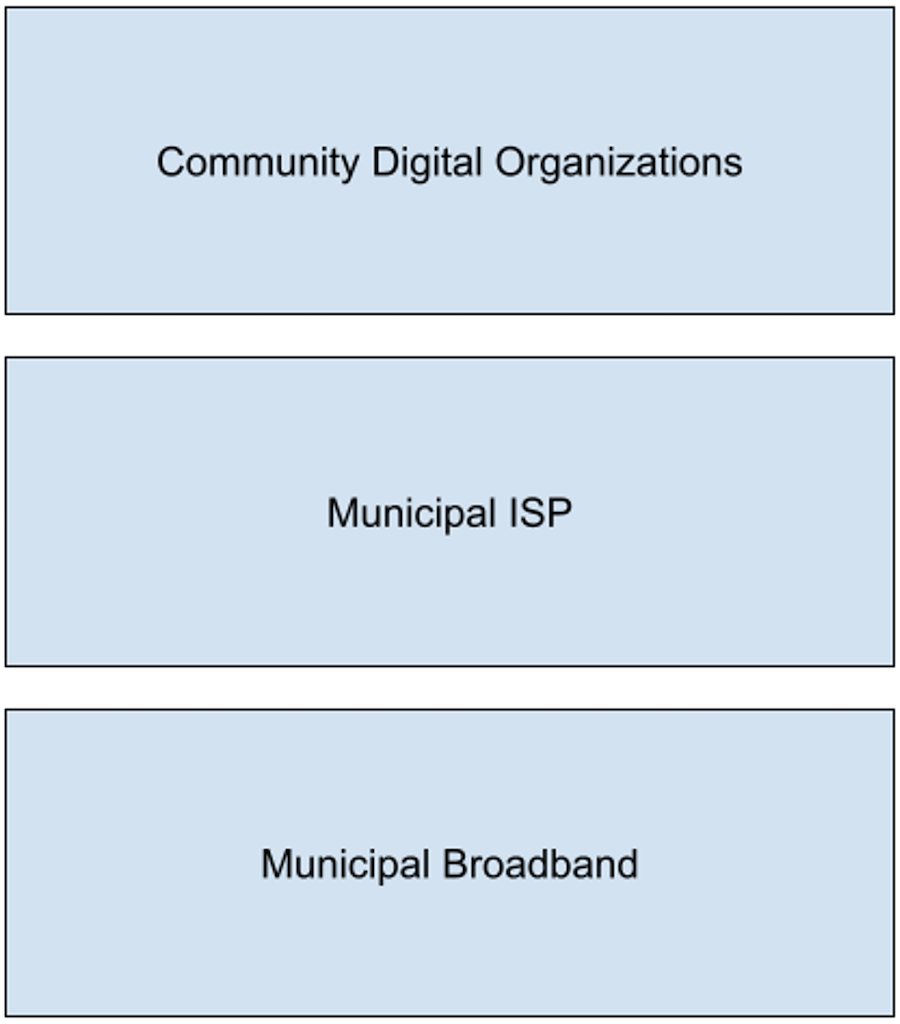
The sewer socialist stack would be composed of three layers:
The bottom layer is the city’s broadband infrastructure. This is the physical network of cables and equipment that connects households and businesses to the internet. In the sewer socialist stack, the network is owned and operated by the municipal government.
This ownership structure is already quite common. In fact, hundreds of communities across the country have publicly owned broadband networks. But just because the infrastructure is publicly owned doesn’t mean the municipality also acts as an internet service provider (ISP). One popular model for municipal broadband is an “open access network,” where the network is public but the ISPs that use it to connect consumers to the internet are private.
In fact, the New York City Internet Master Plan, released by Bill de Blasio’s administration in 2020, is a proposal for just such a network. It calls for leveraging city-owned assets like utility poles and rooftops to build out an open-access network for both fixed and mobile broadband, with the aim of ensuring affordable, high-speed internet service for all New Yorkers.
The goal would be an alternative digital ecosystem that, at least at the local level, can begin to displace the corporate internet.
The initiative was cancelled by Mayor Eric Adams in 2022. But the City Council recently enacted a bill requiring city hall to develop a new Internet Master Plan, with the preliminary version to be published no later than November 1, 2026. An “internet advisory board” will be tasked with reviewing draft proposals and making recommendations, with the mayor selecting three of its eight members. The bill was originally introduced by Councilmember Jennifer Gutiérrez, who endorsed Mamdani in the primary, and its cosponsors included all four Democratic Socialists of America (DSA) members on the city council.
The legislation will give the Mamdani administration an opportunity to put forward a municipal broadband strategy in its first year. Through the mayor’s choice of personnel in his technology department — currently known as the Office of Technology and Innovation — as well as his appointments to the internet advisory board, he can shape the city’s new Internet Master Plan. He should use this influence to revive de Blasio’s emphasis on the public ownership of broadband infrastructure, but with an important addition: he should also push for the formation of a municipal ISP.
The city shouldn’t just own the network, in other words. It should be directly involved in the provision of internet service.
Death to the Tyrant Comcast
There are both practical and political reasons for taking this step. Practically, research suggests that community-owned ISPs generally provide cheaper entry-level broadband access than their corporate counterparts. This is because they tend to prioritize social needs, such as quality of service and universal connectivity, rather than profit. The most famous municipal ISP is run by Chattanooga’s local power utility EPB, which traces its origins to the New Deal. It has twice won the top spot in Consumer Reports’s ranking of ISPs nationwide, based on consumer satisfaction surveys.
As a public utility, a municipal ISP can also establish a minimum standard of access. Establishing such a “floor” is especially crucial in lower-income areas, where systematic underinvestment by telecom companies means that even those residents who have the option to buy home broadband service and can afford to do so often endure slow speeds and price-gouging. This practice, known as “digital redlining,” contributes to a crisis of connectivity among working-class Americans. De Blasio’s report noted that nearly 20 percent of New York City residents — more than 1.5 million people — have neither a mobile nor a fixed broadband connection. Nationally, the same percentage of American households lack internet connection at home. This is a scandal, given how important the internet has become for tasks that are required for working-class survival, from accessing government services to applying for jobs.
The most famous municipal internet service provider is run by Chattanooga’s local power utility, which traces its origins to the New Deal.
The best way to address the connectivity crisis is to provide a public option for internet service. In the sewer socialist stack, this function is performed by the municipal ISP that occupies the stack’s middle layer. While a municipal ISP can be paired with an open-access network, it operates on a different logic. The goal of open-access networks is to stimulate more competition in a local broadband market, which can help bring down costs in cities like New York that are dominated by one or two ISPs. But competition is a crude mechanism: it tends to work best for customers who are worth competing for. Many working-class households will remain unprofitable customers no matter how much competition exists. This is where a municipal ISP can be particularly useful.
Beyond its practical value, a municipal ISP also has political benefits. Foremost among them is the fact that a public enterprise can offer communities control over how it is run — something no amount of competition among private firms can ever provide. Democratic governance of a utility can be implemented in a range of ways, from elected governing boards to participatory planning processes. What matters is that residents are involved in decisions about how internet service is being provisioned. Public ownership enables social goals to be pursued directly, rather than relying on the slow and unpredictable mechanism of nudging private firms in a particular direction through incentives.
People Versus Platforms
But digital sewer socialism shouldn’t confine itself to the systems that enable connectivity. It should also take up the more challenging task of changing how we use the internet. In the sewer socialist stack, this undertaking would be performed by an array of community digital organizations (CDO) at the stack’s highest layer. These are cooperative ventures of various kinds, governed democratically by their members for their mutual benefit.
Consider the case of Mensakas, a bike delivery cooperative in Barcelona. It belongs to an international federation called CoopCycle that produces an application for managing orders and coordinating jobs. Mensakas also benefits from public sector support in the form of contracts from the local and regional government. We might imagine similar cooperatives appearing in American cities, offering worker-managed alternatives to the corporate “gig” delivery platforms like DoorDash. Sympathetic municipalities could help nurture this development by funneling a portion of their procurement budget to cooperatives.
For instance, city-owned grocery stores might hire cooperatives to deliver groceries to home-bound seniors. In fact, New York City already has a cooperative that operates primarily as a government contractor: the Drivers Cooperative, which has a contract with the Metropolitan Transportation Authority to provide “paratransit” services to people with disabilities.
There are many other possible forms that CDOs might take. The residents of a particular building, block, or neighborhood might create small, self-governing social networks using software like Smalltown, which aims to offer an online equivalent to classic civil-society “third places” like churches and bars. Another idea is a community “tech hospital” that takes advantage of recently passed “right-to-repair” laws to fix phones and laptops and redistribute refurbished equipment.
The real challenge is how to build and sustain organizations that are structured in such a way to expand people’s collective power over the technological conditions of their lives.
CDOs might also devote themselves to the matter of deepening civic engagement, such as through the creation of online forums that enable residents to discuss and propose policy measures, and even come to decisions about how to allocate the city’s resources, drawing on similar efforts in Barcelona and Taiwan.
Most of the work to be done, however, is not technical but political. The real challenge is how to build and sustain organizations that are structured in such a way to expand people’s collective power over the technological conditions of their lives. This power will necessarily be limited and contradictory; worker cooperatives, for instance, still have to survive within capitalist markets, even if they can be insulated from competitive pressures through public support.
The wager of digital sewer socialism is that this is a price worth paying, provided that its institutions are seen as points of departure for an ongoing process. If the worth of an ideology is judged by its delivery, as Mamdani suggests, then municipal broadband, municipal ISPs, and CDOs can help broaden the social base of the Left. This, in turn, can open pathways for the ideology to be more fully realized. If replacing capitalist entities with democratically managed ones visibly improves people’s digital lives, they may be more inclined to support similar transformations in the rest of society.
Shock is giving way to organizing as opponents of a proposed 520-acre data center near Ross prepare for the Lacy Lakeview City Council’s first vote Tuesday to partner on the project. Some 100 residents from Ross, Lacy Lakeview and Greater Waco gathered at the Ross Volunteer Fire Department on Sunday to pool information and plan […]
The final language of the annual bill that funds the US military is in. It removes provisions that would have helped ensure service members’ ability to fix their own equipment.
The Houston City Council At-Large Position 4 special runoff, one of the most crucial in the city, will take place in Houston, Texas, on December 13, defining the city’s political environment.
The runoff followed the resignation of Letitia Plummer, who had resigned to run for Harris County judge. Out of a preliminary list of 15 candidates, two opponents impressed: Alejandra Salinas, a progressive attorney who championed equity, inclusion, and legal protections of marginalized communities, and Dwight Boykins, a longtime public servant and former council member who deeply understands the Houston neighborhoods and has a long record of engaging with the community.
Salinas prevailed in a close call in the November general ballot, winning by a slim 21.9% over Boykins, who received 21.0%. Salinas has strength in fundraising and the backing of labor groups, civil-rights organizations, and progressive leaders. However, Boykins contrasts with his notable leadership qualities, a record of public service, and a cross-community backing.
In addition to the candidates, the race has shed light on other matters, such as housing affordability, community safety, infrastructure, and access to basic city services. Local groups and organizations that advocate voter engagement have emphasized the importance of voting in the runoff, citing low turnout in local elections that directly affect the daily lives of residents. With the city of Houston constantly expanding and diversifying, the result of this race is likely to shape the city in terms of addressing equity, representation, and long-term policy priorities in the future.
Voting started on December 1 and will run until December 9; the polls on Election Day open on December 13. The battle is intense as the runoff will decide who will lead in the at-large District 4 constituencies in Houston until January 2028.
The city is at the crossroads as Houstonians resume their civic schedules after Thanksgiving. Will they opt for a new legal-focused leadership with its reformation and integration, or well-trodden continuity with its roots in the neighborhood? One way or the other, December 13 will in some way shape the future of Houston.
1. To look something up quickly and then spend twenty minutes fact-checking the AI summary, only to find out that it was absolutely wrong.
2. To search for directions and two hours later end up with five items in your Amazon cart.
3. To receive results as ten-second videos that present a sponsored product as the only possible answer to your question.
4. To attempt to look up basic information about someone you recently met, you have to go through a sequence of “background check” sites, each showing a dramatic loading bar while it pretends to search. After fifteen minutes, it subtly suggests that criminal records may have been found, and you can view them now in exchange for a modest $24.95 monthly subscription.
5. To ask the internet for knowledge and receive a series of articles that mostly remind you what your question was, then repeat the same three facts you already knew, padded out with more ad space than information.
6. To start typing a weird question and stop halfway through because you don’t want the algorithm to decide this is who you are now, and then immediately panic, knowing it probably logged it before you erased it.
7. To attempt to find useful information and instead take part in the solidification of the internet as an ad-delivery business, where you’re given no option but to be the product. While your attention is being auctioned off, the communities you once loved have become rage-bait and engagement traps, and focusing on anything longer than a few seconds feels near impossible. And you think about how different it all was: when pages loaded quickly, half the internet wasn’t locked behind paywalls, and the word “content” mostly lived inside tables. You used to defend the search engine, blaming users when they said it couldn’t find what they were looking for. Your friends called you the “Google wizard.” Now you can’t even find a simple news article you read last week, and you can’t help but feel deeply sad, realizing the internet that shaped you has been destroyed piece by piece.
BOERNE, TX—Providing an underwhelming new dining option for those returning to visit family in the area, people who grew up in a small Texas suburb were informed this week that their hometown had unveiled a disappointing local microbrewery. “You like those IPAs, right? They supposedly got lots of those,” said one family member, revealing that the Tree Ring Brewing Company had a large but disappointing selection of craft beers along with outdoor seating amidst the scenic backdrop of Interstate 10. “And if you’re hungry, they’ve got a full menu of [cooked-from-frozen food with zero vegetarian options]. You’ll love their cute metal holders for tacos. So neat. Plus, this guy you went to high school with plays live music on Thursdays. He mostly does covers [something you’ll be grateful for when you hear his originals]. We can dine a little later because they stay open until 8 p.m.!” At press time, family sources confirmed they would suggest going to the underwhelming microbrewery every single time you were in town.
PHILADELPHIA—In an effort to earn extra income after Congress rescinded $1.1 billion in funds from the Corporation for Public Broadcasting, Fresh Air host Terry Gross reportedly conducted an interview Thursday via Bluetooth during an Uber shift. “And what can you tell us about how bull riding has changed since—oh shit, that was my exit. Yep, that was my exit,” said Gross, who used an iPhone perched on the dashboard of her 2013 Honda Civic hatchback to speak with a guest on her radio program while chauffeuring Uber riders through the streets of downtown Philadelphia. “Are you Allison? Did you call for an Uber?” continued the two-time Peabody Award–winning interviewer. “And Curtis, a question for you. What was it like the first time you stepped into a rodeo arena, knowing you were the only person of color competing that day? If it’s too hot back there, there’s a control knob in the middle. I can get you close to the stadium, but honestly, you’re better off having me drop you a few blocks away and then walking. We’ll be right back after a short break.” According to listeners, Gross was later forced to cut short a segment on Dutch elm disease after accidentally rear-ending a police car.
I’m on vacation. Here are some past letters that I’m making new again, rather than leaving them to wilt in the archives.
1. I saw my coworker buying a beer during work hours
I saw a coworker at the pharmacy near our office this morning (9:45 a.m.) buying a 40-ounce can of beer. I was confused at first and I couldn’t figure out what to make out of it, but then I also remembered that this coworker always falls asleep in meetings.
I wasn’t sure if I should have approached her (I didn’t want her to think I’m being nosy). I do not want to jump to conclusions because I also thought she might have bought the beer for someone else (i.e., a homeless person in NYC or whatever). She got back at her desk around 10:15ish without the bag. I also saw her sleeping at her desk (pen in hand, head down) at noon today.
In terms of her quality of work, my team and I stopped going to her because we never get good answers from her anyway. I also overheard her team members question her ability in doing a project. Is this something that I should report in case she needs help or in case this requires disciplinary action?
The fact that you saw a coworker buying a beer before work is not, in itself, damning. She could have been buying it for after work or, as you say, for someone else. Who knows.
If she’s sleeping on the job or otherwise not performing her work in a way that affects you, or if she’s coming to work smelling like alcohol and/or appearing intoxicated, you should absolutely talk to your manager about those things. But “my coworker sucks at her job” and “I saw that same coworker buying a beer” is not enough of a connection to report someone for being drunk at work — that’s just too much speculation. Focus on the things you know for sure.
There’s an intern at my office who signs off all her emails with “Stay gold.” For example, an email from her might read, “Thanks for sending me the TPS reports! Stay gold, Jane.” I asked her about it and she confirmed it’s from the quote “Stay gold, Ponyboy” from the book The Outsiders. We work in a pretty casual industry so it’s most likely that people will write it off as a weird quirk, but I’m afraid that if she tried using that sign-off in a more formal industry or office that people would think it’s unprofessional. Should I encourage her to start using a more common sign-off?
First, this is hilarious.
But yeah, that’s going to come across weirdly in many (most?) offices, and as an intern she won’t have the capital built up to make it read “amusing quirk” rather than “inexperienced worker who doesn’t take work seriously / has no sense of professional norms.”
If you’re her manager or oversee any of her work, it would be a kindness to talk to her about professional sign-offs.
3. Telling my boss his wife messed up his business travel
I used to work as an executive assistant to a person who did a lot of business travel, but also did a lot of travel for his side-business activities. This was all legit, above board kind of stuff and his main job was aware of it.
As his assistant, I handled all the business stuff: booking flights, doing expense claims, all that jazz. However, his wife handled the side-business travel and I was instructed to liaise with her to coordinate schedules and handle any times when business travel would occur in conjunction with side-gig travel. His spouse was awesome, really organized and a great person to work with, but this was still a little bit awkward. It became more awkward when she made a mistake and booked travel for him at a time he was required to be somewhere else for his main job. I double, triple, and quadruple checked all of our email correspondence and it was for sure something that had gotten mixed up on her end, I am confident in that. So I was between a rock and a hard place: it wasn’t MY mistake but I was probably going to wear it because how am I supposed to present all the evidence to my boss that his spouse, his partner in life for over 20 years, the mother of his children, was the one that made the error that was sort of a costly mistake? He and I had a great working relationship, great communication, he had my back, all in all he was a great person to work for.
I ended up just doing my best to fix it and make everything work out, but it never sat right with me that I had to sort of pretend that it was my fault. I think that if I had tried to present everything to him that it WASN’T my mistake might have just made me look like a jerk or be really self-serving. Did I only have those two choices: screw-up or jerk? Or was there a third option that I just didn’t realize?
You were being way too delicate! It wouldn’t have been a jerky move to tell your boss that his wife mixed something up, because you wouldn’t have said it in a jerky way. You would have just matter-of-factly told him, “Hmmm, it looks like Jane booked you in Atlanta on the 20th when you need to be in San Diego. I’ll let her know.” Your brain was going way overboard with the “partner in life for over 20 years, mother of his children” thing. It’s just a routine business thing, not particularly sensitive information.
If I were your boss and I found out that you were pretending something was your fault because you thought I’d dislike you if you told me my spouse had messed something up … well, I’d actually be really concerned. I’d worry about your judgment, or whether I’d somehow given you the impression that I was too fragile to hear normal business stuff, or whether my spouse had done something to scare the crap out of you. I’d wonder what else you might be sugarcoating, and what else I might want to know that you might not tell me.
It’s worth looking at whether you’re being overly delicate with your current colleagues/manager, because this is a strange instinct! This is just normal business stuff, not anything you needed to dance around or hide.
I just started a new job at what appears to be a great company. On my first day, I learned that my new company is owned by the company my father works for. I also learned that interaction between the companies is expected to increase, and while it’s not probable, it’s possible that I could end up working with my father. At least one of the higher-up members in my division even knows him. (Aside: this company definitely has no concerns about relatives working together.)
The problem is that my father and I have not spoken for three years. I might be able to have a very distant professional relationship with him, but, to be frank, almost any interaction at all would make me want to quit.
It’s known that my father works for the parent company, but no one knows that we have had an intense falling out. Should I mention this to my team lead? I’d obviously couch it in professional verbiage, a la “My father works for [parent company], but we do not get along. If at all possible, I’d prefer that any work that might involve him or his team be delegated to someone else.”
This is literally my second day on the job, and I’m worried about coming across as full of drama. I’m also worried that even though it was my father who disowned me, my reporting our soured relationship will make me look bad, but I specifically want them to know that this goes beyond the potential awkwardness of working with family so that they never intentionally put us together. And, finally, I’m so new to the company that I have no metric with which to gauge how reactions to this information would go.
Yes, mention it to your manager. Your wording is good, but I’d tweak it to this: “I hadn’t realized the extent to which [this company] works with [parent company], but now that I do, I feel I should let you know that my father works for [parent company] and we’ve been estranged for several years. I wouldn’t want that to cause any awkwardness in a work context, so I’m hoping that if we ever have work that might involve him or his team, it could be assigned to someone else.”
Companies generally don’t want to invite family drama into their work, and it’s pretty likely that if there’s a way to keep you from having to work with your dad, they’ll try to accommodate that. (There might not be, of course, but it’s a reasonable thing to flag.) You’re not going to come across as full as drama as long as you don’t … come across as full of drama. In other words, if you conduct yourself professionally and maturely (as opposed to, say, complaining about him all the time, sobbing in meetings when his company name is mentioned, etc.), that’s not going to be outweighed by having a difficult family connection.
And remember, lots of people have tough family dynamics. You’re not weird or dramatic for having one too.
The Temporary Foreign Worker (TFW) Program allows Canadian employers to hire foreign workers to fill temporary jobs when qualified Canadians are not available, and that’s why it is completely uncontroversial and nobody has any issues with it. Still, we wanted to get to the bottom of whether this program is truly working for Canadians, so […]
LOS GATOS, CA—In an attempt to fend off growing competition from Paramount and Netflix, Plex CEO Keith Valory announced Monday that the streaming platform had submitted a $35 bid for Warner Bros. Discovery. “We believe the Harry Potter and DC universes will prove excellent additions to our slate of free-to-stream titles including Petticoat Junction and Party Mamas,” said Valory in a press release, calling the deal a “significant upgrade” on their initial offer of $15 and adding that the company was willing to pay the $35 in four installments over the next 10 years, or $6 up front plus $2 in stock options. “Plex has become synonymous with free-to-watch, ad-supported entertainment in recent years, reaching over 10 million Google searches in 2023. Where else other than Tubi can you watch reruns of Rucker’s Reno alongside films like USS Indianapolis: Men Of Courage? We think Warner Bros. shareholders will be very pleased by our handsome offer. We are unwilling to go beyond this. David Zaslav, the ball is in your court.” At press time, executives were hoping to sweeten the deal by throwing in a half-eaten bag of SunChips.
Several European broadcasters including Ireland, Spain, and the Netherlands announced a boycott of the 2026 Eurovision Song Contest after Israel was allowed to participate, arguing it’s inappropriate given the humanitarian suffering in Gaza. What do you think?
“What if Israel is planning to sing an apology song?”
Rhiannon Salkin, Systems Analyst
“Big deal, I’ve been accidentally boycotting Eurovision my whole life.”
Vikram Joshi, Cupcake Froster
“I can’t in good conscience watch Eurovision regardless of who’s performing.”
Two years later and I have a doozy of an update about this company.
So, after the last letter, I was working at a new company that happened to employ a lot of people who had left the Email Layoffers. We kept in touch with a lot of people at that company and it was pretty quiet for a year or so, though they kept eliminating positions and letting people go every few months. They did begin to do layoffs over Zoom meetings after my letter got published.
First a small, petty update: I went to an industry conference over the summer. While talking to some colleagues from a leading organization in our field (one you would not want to burn bridges with) when I mentioned I used to work for the Email Layoffers. They told me that a year prior, their org signed with EL as a client, and this was such a big deal that the co-CEOs who stepped in to “save the company” decided to personally manage the project. After onboarding them and planning out the project, the co-CEOs ghosted. They missed meetings, dodged emails, and didn’t update the communication documents. Then, halfway through the project, the co-CEOs finally responded to an email … and informed my colleague that they were changing the contract to instead produce a much cheaper, lower-effort product that was completely at odds with the results the org actually wanted. Think: they ordered bespoke teapots, and they were told they’d be receiving dropshipped flasks instead. Apparently, even the dropshipped flasks had quality issues, and were delivered late. Unsurprisingly, they did not renew their contract.
Around this same time, the co-CEOs were asking the manager of one of the production teams to teach them how to use chatGPT. Normal enough, if a little late for our tech-adjacent industry. Except they wanted him to show them how to make chatGPT do his job. At one point, the CEO’s called this employee to one of their houses so he could talk them through a chatGPT process. They were being weirdly dodgy about why they wanted to learn chatGPT so suddenly.
Then, a few months later, our old coworkers told us The Big News.
The team responsible for the majority of the company’s output was concerned about the way our industry was changing in the face of AI. They were interested in taking on different work and had made a plan to upskill team members in a different, more AI-proof skillset, their managers supported it, and so they scheduled a time to meet with the CEOs and propose their plan. They also partnered with the manager who was teaching the CEOs how to use AI.
Alison, they laid off every single member of their production team and that team’s managers, and I am not exaggerating. In a zoom meeting where they were all planning to propose changes to the department. This included people who had worked for the company for 10-15 years, and people who were on or had just returned from maternity leave. The company right now is two CEOs, a single marketing person, an HR worker, sales, and project managers. They sold work they literally had nobody to complete. Then, over the next few weeks, they reached out to almost every single person they had laid off, asking if they could do some contract work so they could actually deliver the work they had sold. They misspelled people’s names in half of these emails. As far as I know, no one accepted the offer. Eventually they listed a few positions … for $10k-20k less than the old team was paid.
After that, of course, the Glassdoor reviews came in.
And the CEOs started responding to them.
One employee left a review, detailing that they had just fired half of their employees and planned to replace them with contractors and AI. The CEOs responded with a typo-laden multi-paragraph rebuttal that was weird and aggressive. It came off as very petty and uncomfortable. They also responded to a review that said “[CEOs] will lay you off right before Christmas without warning” saying, they “wish this employee had come to them with their concerns before leaving this review.” Um, how could they? You laid them off! They also called Glassdoor “a safe haven for slanderous claims and anonymous opinions,” which of course has become a meme among us ex-employees. Then a smattering of vague 5-star reviews came in, clearly from current employees told to help with the DIY damage control efforts. An industry publication wrote about the layoffs from the lens of companies going all-in on AI without thinking about the consequences, interviewing one of the people who were laid off. The surviving sales team posts on LinkedIn about hustle culture, with weird passive-aggressive tones about people who “can’t make it in the industry.” (We work in a pretty chill industry. You don’t have to hustle that hard).
Since then, the CEOs have been unusually quiet online. More 1-star reviews came in on Glassdoor and they stopped responding. They’ve trashed their reputation in our industry and we’re all wondering whether they’ll try to sell or just shut down. We will see!
Hollywood is increasingly looking to Saudi Arabia for financing as other sources of money have dried up in the aftermath of the Covid-19 pandemic, though the kingdom’s controversial human rights record makes the relationship potentially problematic. What do you think?
“Let’s see movie critics try and leave a bad review now.”
Trevor Hopkins, Credibility Appraiser
“Do we want a ‘Space Jam 3’ or not?”
Miles Kempfer, Whistle Tester
“So now when I burn fossil fuels, I’m supporting the arts.”
President Trump continues to make misleading statements about affordability despite the Consumer Price Index indicating an increase in costs for many goods and services. The Onion assesses the veracity of the president’s claims.
Claim: The cost of living is low.
True: The cost of living is much lower than what it will be in a few months.
Claim: Trump has brought prices down.
False: We’re pretty sure he means the value of the U.S. dollar.
Claim: Trumponomics is the solution to runaway inflation.
False: Trumponomics is a 1996 CD-ROM game published by Maxis.
Claim: Affordability is a hoax perpetrated by Democrats.
False: Democrats would never run on a salient issue.
Claim: The price of Kellogg’s Stranger Things Demogorgon Crunch cereal has never been lower.
False: Kellogg’s Stranger Things Demogorgon Crunch cereal only cost a nickel in 1901.
Claim: It costs less to feed a family now than this time last year.
True: Remember, one of your kids died of measles.
Claim: The Trump economy has ushered in unprecedented prosperity for everyday Americans.
True: The White House’s economic agenda has been a boon for mom-and-pop hedge funds.
Claim: At Taco Bell, you can add sour cream to the regular bean burrito and it tastes basically the same as the Burrito Supreme.
True: It’s missing some other premium ingredients, but all you’re tasting is the cream anyway.
“A federal vaccine committee took a major step toward Health Secretary Robert F. Kennedy Jr.’s goal of remaking the childhood vaccine schedule, voting to end a decades-long recommendation that all newborns be immunized at birth against hepatitis B, a highly infectious virus that can cause severe liver damage.” — The New York Times
- - -
Hi, it’s me, Bobby Kennedy Jr., a man who sounds incredibly unvaccinated. Please, don’t get up. I just took an ice bath in your trash can out back. Not with the garbage, of course. I emptied the garbage back into your pantry—you can and should eat garbage, it helps strengthen your immune system. I found a doctor in Tucson who proved it before he disappeared. Anyway, I just came by to tell you: I hate your kids—I mean, vaccines—and I, um, want them all gone. Yeah, I want vaccines gone.
Do you have a towel? I tried drying myself off with your cat, but it got away. Look, I know you don’t understand how I’m suddenly the guy making decisions about everybody’s kids when I look and talk like a guy who should never be around a kid ever again, but you need to know that I’m doing what’s best for your children. All I want is to get rid of them. I mean, um, vaccines. Get rid of vaccines. Damnit, I gotta stop doing that.
If you don’t have a towel, I’d at least love some clothes. I pissed all over mine before I took my trash-can ice bath. It keeps predators away if you piss yourself. You should actually cover yourself in your own urine at least once a week; it’s a great way to fight off dementia. What was I saying? Right. I want your kids dead. And it’s not just me—I have the full-fledged support of the entire GOP and the president to make sure we find a way to kill your kids. Shit, vaccines. Kill vaccines. That’s what we’re doing. Ignore the other thing I said.
Go ahead, take a look. It’s okay to stare. This is what the peak male physique looks like. You’re shaking your head? Sure, like you know what you’re talking about. There are entire forums that agree with me. Whatever, it doesn’t matter. I’m in charge. I decide who lives and who dies. And I’m mostly focused on the latter.
By the way, I ate the squirrel you’ve been raising for food in your yard. What’s that? You don’t raise squirrels? Wow, free-range squirrel meat! No wonder I can’t feel my legs. Nature’s cocaine. That’s what they say. The doctor in Tucson used to say that.
Okay, let’s review: I do not care at all about your or anyone else’s children and—in fact—I would like all the children of this country to suffer. There. Nailed it.
Wait, no, I mean vaccines. Whatever I said, I meant it to be about vaccines.













 ALT
ALT