Shalom Goldberg
Shared posts
The New Intolerance of Student Activism
Great Job, Internet!: Here’s how Richard Scarry books have been updated for more P.C. times

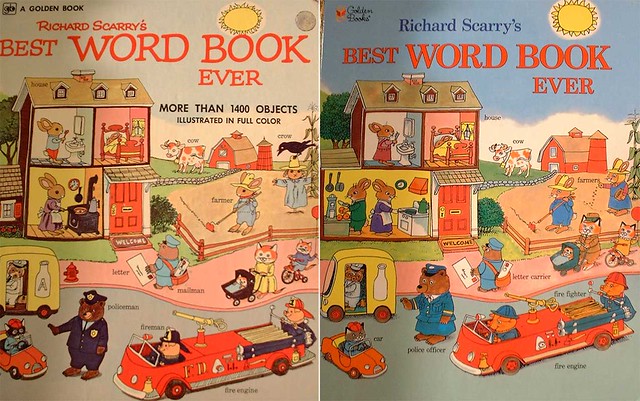
It’s always interesting to see how beloved children’s products change over time, from Barbie’s wider hips to Thomas The Tank Engine’s marketing explosion. Mental Floss has an interesting look at one specific product—Richard Scarry’s Best Word Book Ever—that’s actually fairly uplifting. Using Alan Taylor’s Flickr set, which documents two versions of the book—one from 1963 and one from 1991—the site examines how the book has become more P.C. over time, removing Native American headdresses from mice, adding a menorah and a Hanukkah mention to a page about holidays, and changing labels so that a “pretty stewardess” is now a “flight attendant” straight up.
The most recent edition of Richard Scarry’s Best Word Book Ever was published in 1999, meaning more interesting updates have probably been made since.
Why History Gives Obama the Benefit of the Doubt on Iran
Shalom GoldbergI think the part that speaks to me most is this - we have engaged in a lot of wars recently instead of diplomacy. It hasn't worked out so good.

On Friday, The Atlantic ran an exchange of views among Jeffrey Goldberg, Peter Beinart, and David Frum about the plusses and minuses of the new Iran deal.
To oversimplify: Peter Beinart thought the deal was more good than bad, David Frum thought it was nearly all bad, and Jeffrey Goldberg could see merits on both sides but thought on balance that the deal might be the best of flawed alternatives.
In case you’ve been wondering what the debate would have been like with four participants, wonder no more. And if you’re wondering why I care, given that the Mideast is not my normal beat, here’s why:
— There’s a backward-looking reason: I’ve been interested in Iran since I first visited in the 1970s. Also, I worked for a president whose final two years were wrapped up with, and ultimately destroyed by, the effects of the Iranian Revolution; who believed deeply in nuclear non-proliferation; and who probably would have been reelected if not for his failed “Desert One” mission to rescue American hostages in Iran—some of whom I knew.
— There’s a forward-looking reason too: In the years since the foreseeably disastrous U.S. invasion of Iraq, the next-most frequently discussed potential arena for U.S. combat has been Iran. For reasons I laid out in an Atlantic cover story back in 2004, I contend that anyone who has looked at the realities understands that the fantasy of a successful “preemptive” strike against Iran has always been pure, reckless fantasy, an extension of the “cakewalk” delusions that led us into the Iraq War. Moreover, from the American perspective I argue that there is far more to gain than lose in strategies to bring Iran in from its pariah status. (For more on the argument, see the Iran postings collected here, and this.)
To oversimplify my hypothetical fourth-man argument: If I were in the debate I would have agreed with Peter Beinart, completely disagreed with David Frum, and agreed most heartily with the parts of Jeffrey Goldberg’s writing in which he was agreeing with Beinart.
I’d go further. On reflection, I think this is a far better deal than most rational observers thought obtainable—especially considering that “our side’s” negotiators included not simply the U.S. and its normal Western allies but Russia and China as well. I also think that the agreement does more to avert a nuclear-armed Iran than any real-world (not tough-talk fantasy-world) alternative would do.
I know this won’t be the case, but in the upcoming congressional debate I think the burden of proof should be on the opponents to explain what arrangements, in the real world, would have done more to advance American interests and delay or deter the prospect of Iran getting the bomb.
Let’s consider, briefly, facts and judgments.
* * *
Facts: There is one simple-seeming factual point that President Obama emphasized in his thoroughgoing defense of the Iran deal at his news conference a few days ago, and that (my one-time professor) Graham Allison has examined in even more thoroughgoing fashion here, here, here, and here. That point is: If you don’t like this deal, what’s your better idea?
More specifically: What is your better real-world idea, one that could actually come about, not your applause line for a speech or your snappy summary on a cable-TV hit?
Most of the “Oh, we should have been tougher—that would have done the trick!” rhetoric, including David Frum’s in this Atlantic exchange, abstracts away from several realities. Of these, the most important is that the U.S. can’t get its way just because Tom Cotton, Lindsey Graham, Bill Kristol, or Ted Cruz thinks it should (as Peter Beinart argued here). Iran is smaller, weaker, and poorer than the United States. But that doesn’t mean it will just accede—a lesson the United States might have learned from its dealings with Vietnam, Cuba, and various Middle Eastern states over the years. Negotiations are what both sides agree to, not what tough guys on one side think that side should demand.
Moreover, Russia and China, while somewhat poor in per-capita terms, are very far from small and weak. The most amazing part of U.S. debate on this deal is how rarely anyone notices that Vladimir Putin’s Russia and Xi Jinping’s China, the opposite of strategic allies of the United States right now, have been shoulder to shoulder with the Western negotiating team so far. Is the thought that because an American hardliner, or for that matter one from Israel, tells them they’re too lily-livered, they’ll suddenly snap to? That’s an argument you might make on a talk show or in an op-ed, but not if you’ve dealt with either country.
For more on the facts, apart from Graham Allison’s careful parsing of the deal, I direct you to the roundtable of the Bulletin of the Atomic Scientists. (E.g. from Siegfried Hecker, former director of Los Alamos Labs: “Much hard work lies ahead to make it a historic opportunity. Even so, the Iran nuclear deal was hard-won and is better than any other reasonably achievable alternative.” Or from Sharon Squassoni, director of the Proliferation Prevention Program at CSIS: “The Vienna agreement with Iran ... is a lumbering, 159-page tome of historic dimensions. ... Still, the level of detail, nuance, and overlapping obligations is impressive. Some of the details are astonishing.”—which she means in a good way. Or from Kingston Reif, of the Arms Control Association: “Many observers, including this author, doubted whether such an agreement could be reached. While a final judgment on the deal must await its implementation, what has been achieved to date is remarkable and historic.”) Or consider this analysis from the Molad institute about why the deal is more advantageous for Israel than any real-world alternative. Or this from Steven Metz.
Maybe these people are wrong. But if so, let’s hear some details of a better approach. Let’s hear a realistic alternative. Rather than, “Oh, that Obama is so weak. He just should have been strong.”
* * *
Judgment: Of course, provable facts take us only so far into the future. Judgment about appropriate risks and rewards inevitably comes into play. And here I argue: The historical balance weighs very heavily against the judgment of those opposing the deal. Those who have lined up against similar deals, in the past, have usually been wrong. This doesn’t prove that opponents are wrong now, but it’s worth thinking about.
I’m not even talking about recent historical judgment concerning this same part of the world. Virtually every opponent of the new Iran deal was also a proponent of invading Iraq 12 years ago. In both cases, Iraq and Iran, the very same people thought that the threat was imminent and grave, that diplomacy was ineffective, and that a hard line was called for. This group notably included David Frum, who at the time was a speechwriter for George W. Bush. (Before you ask: I was a speechwriter for Jimmy Carter while the movement to overthrow the shah was gaining momentum in 1978.)
So far, I have found exactly two public figures who have opposed or questioned the Iran deal and who did not also support the Iraq War: They are Senator Robert Menendez of New Jersey and, disappointingly, former-Senator-now-presidential-candidate Jim Webb of Virginia. In all other cases, people who are alarmist about Iran in 2015 are the same ones who were alarmist about Iraq in 2003.
* * *
The more important point about judgment concerns the long record of agreements of this sort. Many of them have been controversial; some have been enacted and some have not. But in most cases, I contend, the skeptical opponents have been proven, by history, to have been wrong. Let’s consider: There has been one major case in which the proponents of diplomacy were proven naive, the advocates of a tougher line were right, and the talk of compromise ended in ashes. That was of course Munich in 1938.
If you think that every adversary is Hitler’s Nazi Germany, that every pro-negotiation Western diplomat is Neville Chamberlain, and that every hardline opponent is Winston Churchill, then you’re likely to see every negotiated agreement as a mistake. But consider a few other examples:
The League of Nations vote, 1920: Senator Henry Cabot Lodge and his allies campaigned ferociously against Woodrow Wilson’s advocacy of American entry into the League of Nations after World War I. The opponents won; the League of Nations entry failed; a bitter and vengeful peace of Versailles, minus U.S. participation, followed. Might the history of 1930s Europe have been different otherwise? Who knows. But I don’t find any historian of the era saying, Thank God for the foresight of Henry Cabot Lodge.
The partial test-ban treaty, 1963: A few months after the modern world’s closest brush with nuclear disaster, during the Cuban Missile Crisis of of 1962, John Kennedy gave his famous speech at American University urging negotiations with the Soviet Union to reduce the nuclear threat. The main result was an agreement in the summer of 1963 to ban atmospheric nuclear tests. Barry Goldwater based part of his rise to the Republican nomination in 1964 on his opposition to this “dangerous” treaty. On this, as on some other points, Goldwater was wrong.
The Panama Canal treaty, 1978: Jesse Helms, already a senator from North Carolina, became a national figure through his opposition to the treaty that transferred operational control of the canal to Panama. Strom Thurmond, then a senator from South Carolina, said that it would lead to the communist encirclement of the United States. Negotiations for the transfer had actually begun under Gerald Ford, but they were frozen during the 1976 election because of Republican Party criticism. Jimmy Carter completed the treaty (I was there, in Panama, for the transfer ceremony) and got it through the Senate. The Republicans made it a campaign issue in 1978 and 1980. Every one of their fears and warnings has proven wrong.
Law of the Sea Treaty, 1960s-onward: The United States participated in the drafting of a Law of the Sea treaty, but for the usual reasons has never ratified it. E.g., Jeane Kirkpatrick, the Reagan administration’s UN ambassador, said during the George W. Bush administration that “it was a bad bargain,” and that “its ratification will diminish our capacity for self-government, including, ultimately, our capacity for self-defense.” Now some 160+ other nations have ratified the treaty, but not the United States—and one perverse result is to deny one grounds for protest against China’s expansion into the South and East China Seas. Without going into all the details, the treaty opponents look as wise as Henry Cabot Lodge.
Some other treaties of the Cold War era, notably the ABM treaty and the Salt I and Salt II treaties of the 1970s, now seem enmeshed in the arcana of that era (though I remember taking part in heated debates on all of them). Here’s the point: Looking back, very few people could say that they represented irresponsible, naively gullible deals with the enemy. And virtually no one would say that about the Non-Proliferation Treaty of the 1960s.
* * *
Let’s raise this to a higher principle. In modern times, executive-branch judgment in decisions to go to war has often been flawed. In two consequential cases—a Democratic administration’s judgment about going to war in Vietnam, and a Republican administration’s judgment about invading Iraq—the result, more than mere flaw, was strategic disaster.
But for Republican and Democratic administrations alike, judgment about accepting the risks of negotiated agreement has generally proven sound. The one gross counter-example is Munich. But to state the obvious: That wasn’t an American agreement; it involved the unique evils of Hitler and Nazism; and it was nearly 80 years ago. Counting examples from modern American diplomacy, even with full skepticism about abuse of executive power, there are more reasons to trust administrations’ judgment about treaties than to mistrust them.
* * *
We’ll hear the case, we’ll consider the arguments, we’ll allow for the unknown. But on the facts, it would be good to hear a better alternative from people who oppose the deal. And on judgment, for now the benefit of the doubt is with the administration rather than its critics.
This article was originally published at http://www.theatlantic.com/international/archive/2015/07/history-obama-iran-deal-success/398915/

Ferguson's Conspiracy Against Black Citizens

Despite the uncertainty surrounding the killing of Michael Brown, many black residents of Ferguson, Missouri, immediately thought that he was the victim of a wrongful death at the hands of police officer Darren Wilson, who shot him after a scuffle.
This week, the Department of Justice concluded that there is no evidence to disprove Officer Wilson's claim that he feared for his life during the encounter. And the federal agency also presented context that explains why so many black residents assumed foul play and took to the streets in protest: For years, Ferguson's police force has meted out brutality, violated civil rights, and helped Ferguson officials to leech off the black community as shamelessly as would mafia bosses.
So far, a disproportionate amount of press attention has focused on racist emails circulated by Ferguson officials, causing two to be fired and one to be placed on leave. While the correspondence in question is deeply offensive and worthy of condemnation, it is nowhere close to the most objectionable transgression documented in the DOJ report, which ought to prompt multiple Ferguson officials to resign in disgrace and provoke condemnations from across the political spectrum. Nearly every page shocks the conscience.
Ferguson officials repeatedly behaved as if their priority is not improving public safety or protecting the rights of residents, but maximizing the revenue that flows into city coffers, sometimes going so far as to anticipate decreasing sales tax revenues and urging the police force to make up for the shortfall by ticketing more people. Often, those tickets for minor offenses then turned into arrest warrants.
Police officers were judged not only on the number of stops they made, but on the number of citations they issued. "Officers routinely conduct stops that have little relation to public safety and a questionable basis in law," the report states. "Issuing three or four charges in one stop is not uncommon. Officers sometimes write six, eight, or, in at least one instance, fourteen citations for a single encounter." Some officers compete to see who can issue the most citations in a single stop.
In one email, the police chief, who also oversees the municipal court, brags to the city manager about how much revenue it is generating. Ignoring that conflict of interest is a recipe for a justice system that bleeds the powerless of their meager resources.
Ferguson's municipal court judge, Ronald Brockmeyer, who is appointed by the city council, is well aware that his job performance is evaluated partly based on how much revenue he generates from the bench. One 2011 internal report in Ferguson notes that Judge Brockmeyer made a list of “what he has done to help in the areas of court efficiency and revenue.” The next year, a city council member suggested that he should not be reappointed, arguing that he "does not listen to the testimony, does not review the reports or the criminal history of defendants, and doesn’t let all the pertinent witnesses testify before rendering a verdict.”
If you think those shortcomings disqualified him, think again.
The report continues:
The Council member then addressed the concern that “switching judges would/could lead to loss of revenue,” arguing that even if such a switch did “lead to a slight loss, I think it’s more important that cases are being handled properly and fairly.” The City Manager acknowledged mixed reviews of Judge Brockmeyer’s work but urged that the Judge be reappointed, noting that “...it goes without saying the City cannot afford to lose any efficiency in our Courts, nor experience any decrease in our Fines and Forfeitures.”
Establishing these glaring perverse incentives—effectively compromising the city's criminal-justice system to increase revenue—is enough to disgrace Ferguson's leaders all on its own, whether one regards them as civic imbeciles or moral cretins. But the consequences of these misdeeds and other transgressions against residents can only be fully understood with stories of Ferguson's many victims.
While I recommend reading the whole DOJ report—I'd gladly see it assigned to every high schooler, college student, and state legislator in America—I'll focus the rest of this post on those stories and a few other particularly alarming findings. As you read on, keep in mind that this is but a selection of horrors from the DOJ report, which describes a tiny selection of all police misconduct stories in Ferguson.
One passage describes the way that Ferguson officials have criminalized being too poor to pay a ticket:
In 2013 alone, the court issued over 9,000 warrants on cases stemming in large part from minor violations such as parking infractions, traffic tickets, or housing code violations. Jail time would be considered far too harsh a penalty for the great majority of these code violations, yet Ferguson’s municipal court routinely issues warrants for people to be arrested and incarcerated for failing to timely pay related fines and fees. Under state law, a failure to appear in municipal court on a traffic charge involving a moving violation results in a license suspension. Ferguson has made this penalty more onerous by only allowing the suspension to be lifted after payment of an owed fine is made in full.
Here's how Ferguson officials wreak havoc on people's lives over the tiniest of infractions:
We spoke... with an African-American woman who has a still-pending case stemming from 2007, when, on a single occasion, she parked her car illegally. She received two citations and a $151 fine, plus fees. The woman, who experienced financial difficulties and periods of homelessness over several years, was charged with seven Failure to Appear offenses for missing court dates or fine payments on her parking tickets between 2007 and 2010. For each Failure to Appear, the court issued an arrest warrant and imposed new fines and fees.
From 2007 to 2014, the woman was arrested twice, spent six days in jail, and paid $550 to the court for the events stemming from this single instance of illegal parking. Court records show that she twice attempted to make partial payments of $25 and $50, but the court returned those payments, refusing to accept anything less than payment in full. One of those payments was later accepted, but only after the court’s letter rejecting payment by money order was returned as undeliverable. This woman is now making regular payments on the fine. As of December 2014, over seven years later, despite initially owing a $151 fine and having already paid $550, she still owed $541.
Older folks face an extra burden, but seem to get no slack:
A 90-year-old man had a warrant issued for his arrest after he failed to timely pay the five citations FPD issued to him during a single traffic stop in 2013. An 83-year-old man had a warrant issued against him when he failed to timely resolve his Derelict Auto violation. A 67-year-old woman told us she was stopped and arrested by a Ferguson police officer for an outstanding warrant for failure to pay a trash-removal citation. She did not know about the warrant until her arrest, and the court ultimately charged her $1,000 in fines, which she continues to pay off in $100 monthly increments despite being on a limited, fixed income. We have heard similar stories from dozens of other individuals and have reviewed court records documenting many additional instances of similarly harsh penalties, often for relatively minor violations.
Here's an incident that caused a Ferguson resident to lose a job he had held for years:
In the summer of 2012, a 32-year-old African-American man sat in his car cooling off after playing basketball in a Ferguson public park. An officer pulled up behind the man’s car... and demanded the man’s Social Security number and identification. Without any cause, the officer accused the man of being a pedophile, referring to the presence of children in the park, and ordered the man out of his car for a pat-down, although the officer had no reason to believe the man was armed. The officer also asked to search the man’s car.
The man objected, citing his constitutional rights. In response, the officer arrested the man, reportedly at gunpoint, charging him with eight violations of Ferguson’s municipal code. One charge, Making a False Declaration, was for initially providing the short form of his first name (e.g., “Mike” instead of “Michael”), and an address which, although legitimate, was different from the one on his driver’s license. Another charge was for not wearing a seat belt, even though he was seated in a parked car. The officer also charged the man both with having an expired operator’s license, and with having no operator’s license in his possession.
Here is a small part of the evidence that the city is racially biased against black residents:
... with respect to speeding charges brought by FPD, the evidence shows not only that African Americans are represented at disproportionately high rates overall, but also that the disparate impact of FPD’s enforcement practices on African Americans is 48% larger when citations are issued not on the basis of radar or laser, but by some other method, such as the officer’s own visual assessment.
These disparities are also present in FPD’s use of force. Nearly 90% of documented force used by FPD officers was used against African Americans. In every canine bite incident for which racial information is available, the person bitten was African American.
... African Americans are 68% less likely than others to have their cases dismissed by the court, and are more likely to have their cases last longer and result in more required court encounters. African Americans are at least 50% more likely to have their cases lead to an arrest warrant, and accounted for 92% of cases in which an arrest warrant was issued by the Ferguson Municipal Court in 2013. Available data show that, of those actually arrested by FPD only because of an outstanding municipal warrant, 96% are African American.
Our investigation indicates that this disproportionate burden on African Americans cannot be explained by any difference in the rate at which people of different races violate the law. Rather, our investigation has revealed that these disparities occur, at least in part, because of unlawful bias against and stereotypes about African Americans. We have found substantial evidence of racial bias among police and court staff in Ferguson. For example, we discovered emails circulated by police supervisors and court staff that stereotype racial minorities as criminals, including one email that joked about an abortion by an African-American woman being a means of crime control.
Here's an occasion when the Ferguson police department violated the Fourth Amendment:
... in July 2013 police encountered an African-American man in a parking lot while on their way to arrest someone else at an apartment building. Police knew that the encountered man was not the person they had come to arrest. Nonetheless, without even reasonable suspicion, they handcuffed the man, placed him in the back of a patrol car, and ran his record. It turned out he was the intended arrestee’s landlord. The landlord went on to help the police enter the person’s unit to effect the arrest, but he later filed a complaint alleging racial discrimination and unlawful detention. Ignoring the central fact that they had handcuffed a man and put him in a police car despite having no reason to believe he had done anything wrong, a sergeant vigorously defended FPD’s actions, characterizing the detention as “minimal” and pointing out that the car was air conditioned.
Here is a second example of a Fourth Amendment violation:
In October 2012, police officers pulled over an African-American man who had lived in Ferguson for 16 years, claiming that his passenger-side brake light was broken. The driver happened to have replaced the light recently and knew it to be functioning properly. Nonetheless, according to the man’s written complaint, one officer stated, “let’s see how many tickets you’re going to get,” while a second officer tapped his Electronic Control Weapon (“ECW”) on the roof of the man’s car. The officers wrote the man a citation for “tail light/reflector/license plate light out.” They refused to let the man show them that his car’s equipment was in order, warning him, “don’t you get out of that car until you get to your house.” The man, who believed he had been racially profiled, was so upset that he went to the police station that night to show a sergeant that his brakes and license plate light worked.
Here are a third and fourth example:
... in November 2013, an officer approached five African-American young people listening to music in a car. Claiming to have smelled marijuana, the officer placed them under arrest for disorderly conduct based on their “gathering in a group for the purposes of committing illegal activity.” The young people were detained and charged—some taken to jail, others delivered to their parents—despite the officer finding no marijuana, even after conducting an inventory search of the car.
Similarly, in February 2012, an officer wrote an arrest notification ticket for Peace Disturbance for “loud music” coming from a car. The arrest ticket appears unlawful as the officer did not assert, and there is no other indication, that a third party was disturbed by the music—an element of the offense. See Ferguson Mun. Code § 29-82 (prohibiting certain conduct that “unreasonably and knowingly disturbs or alarms another person or persons”). Nonetheless, a supervisor approved it. These warrantless arrests violated the Fourth Amendment because they were not based on probable cause.
Another objectionable incident happened in March 2013:
... officers responded to the police station to take custody of a person wanted on a state warrant. When they arrived, they encountered a different man— not the subject of the warrant—who happened to be leaving the station. Having nothing to connect the man to the warrant subject, other than his presence at the station, the officers nonetheless stopped him and asked that he identify himself. The man asserted his rights, asking the officers “Why do you need to know?” and declining to be frisked. When the man then extended his identification toward the officers, at their request, the officers interpreted his hand motion as an attempted assault and took him to the ground. Without articulating reasonable suspicion or any other justification for the initial detention, the officers arrested the man on two counts of Failure to Comply and two counts of Resisting Arrest.
Some officers from the Ferguson police department are so poorly trained and ignorant of the law that they openly related their unconstitutional behavior to DOJ investigators:
In our conversations with FPD officers, one officer admitted that when he conducts a traffic stop, he asks for identification from all passengers as a matter of course. If any refuses, he considers that to be “furtive and aggressive” conduct and cites—and typically arrests—the person for Failure to Comply. The officer thus acknowledged that he regularly exceeds his authority under the Fourth Amendment by arresting passengers who refuse, as is their right, to provide identification ... Further, the officer told us that he was trained to arrest for this violation.
Some unconstitutional practices were institutionalized in a process best described as legitimacy-through-official-sounding-jargon. Consider the "wanted" designation:
FPD and other law enforcement agencies in St. Louis County use a system of “wanteds” or “stop orders” as a substitute for seeking judicial approval for an arrest warrant. When officers believe a person has committed a crime but are not able to immediately locate that person, they can enter a “wanted” into the statewide law enforcement database, indicating to all other law enforcement agencies that the person should be arrested if located. While wanteds are supposed to be based on probable cause ... they operate as an end-run around the judicial system. Instead of swearing out a warrant and seeking judicial authorization from a neutral and detached magistrate, officers make the probable cause determination themselves and circumvent the courts.
... If officers enter wanteds into the system on less than probable cause, then the subsequent arrest would violate the Fourth Amendment. Our interviews with command staff and officers indicate that officers do not clearly understand the legal authority necessary to issue a wanted. For example, one veteran officer told us he will put out a wanted “if I do not have enough probable cause to arrest you.” He gave the example of investigating a car theft. Upon identifying a suspect, he would put that suspect into the system as wanted “because we do not have probable cause that he stole the vehicle.” Reflecting the muddled analysis officers may employ when deciding whether to issue a wanted, this officer concluded, “you have to have reasonable suspicion and some probable cause to put out a wanted.”
At times, FPD officers use wanteds not merely in spite of a lack of probable cause, but because they lack probable cause. In December 2014, a Ferguson detective investigating a shooting emailed a county prosecutor to see if a warrant for a suspect could be obtained, since “a lot of state agencies won’t act on a wanted.” The prosecutor responded stating that although “[c]hances are” the crime was committed by the suspect, “we just don’t have enough for a warrant right now.” The detective responded that he would enter a wanted. There is evidence that the use of wanteds has resulted in numerous unconstitutional arrests in Ferguson.
* * *
It's worth briefly pausing, amid this parade of official misconduct, ignorance of the law, and Constitutional violations to reflect on the fact that all of them are coming out of a municipality of just 21,000 residents. You can fit 41,000 at Wrigley Field. "Between July 1, 2010, and June 30, 2014," the report states, "the City of Ferguson issued approximately 90,000 citations and summonses for municipal violations."
* * *
Okay, back to the parade of horrors. Police sometimes complain that Ferguson residents are unwilling to call and report crimes or to cooperate as witnesses. There are surely occasions when this complaint is fully justified, but the behavior of the police has also alienated the community in totally understandable ways that relate very specifically to cooperating with law enforcement.
For instance:
... a woman called FPD to report a domestic disturbance. By the time the police arrived, the woman’s boyfriend had left. The police looked through the house and saw indications that the boyfriend lived there. When the woman told police that only she and her brother were listed on the home’s occupancy permit, the officer placed the woman under arrest for the permit violation and she was jailed. In another instance, after a woman called police to report a domestic disturbance and was given a summons for an occupancy permit violation, she said, according to the officer’s report, that she “hated the Ferguson Police Department and will never call again, even if she is being killed.”
Or consider this incident:
... a young African-American man was shot while walking on the road with three friends. The police department located and interviewed two of the friends about the shooting. After the interview, they arrested and jailed one of these cooperating witnesses, who was 19 years old, on an outstanding municipal warrant.
Ferguson residents have a right to capture video of on-duty police officers in public places. But Ferguson police regularly intimidate or retaliate against folks with cameras.
For example:
In June 2014, an African-American couple who had taken their children to play at the park allowed their small children to urinate in the bushes next to their parked car. An officer stopped them, threatened to cite them for allowing the children to “expose themselves,” and checked the father for warrants.
When the mother asked if the officer had to detain the father in front of the children, the officer turned to the father and said, “you’re going to jail because your wife keeps running her mouth.” The mother then began recording the officer on her cell phone. The officer became irate, declaring, “you don’t videotape me!” As the officer drove away with the father in custody for “parental neglect,” the mother drove after them, continuing to record. The officer then pulled over and arrested her for traffic violations. When the father asked the officer to show mercy, he responded, “no more mercy, since she wanted to videotape,” and declared “nobody videotapes me.” The officer then took the phone, which the couple’s daughter was holding. After posting bond, the couple found that the video had been deleted.
After all the bad behavior reviewed so far, we still haven't even mentioned excessive force complaints. To no one's surprise, Ferguson police have a problem there too. When you see the acronym ECW, that means "electronic control weapon."
Think tasers.
Ferguson police use them often. For example:
... in August 2010, a lieutenant used an ECW in drive-stun mode against an African-American woman in the Ferguson City Jail because she had refused to remove her bracelets. The lieutenant resorted to his ECW even though there were five officers present and the woman posed no physical threat.
Another example:
In September 2012, an officer drive-stunned an African-American woman who he had placed in the back of his patrol car but who had stretched out her leg to block him from closing the door. The woman was in handcuffs. In May 2013, officers drive-stunned a handcuffed African-American man who verbally refused to get out of the back seat of a police car once it had arrived at the jail. The man did not physically resist arrest or attempt to assault the officers.
According to the man, he was also punched in the face and head. That allegation was neither reported by the involved officers nor investigated by their supervisor, who dismissed it.
And here's a third taser incident for good measure:
In January 2013, a patrol sergeant stopped an African-American man after he saw the man talk to an individual in a truck and then walk away. The sergeant detained the man, although he did not articulate any reasonable suspicion that criminal activity was afoot. When the man declined to answer questions or submit to a frisk—which the sergeant sought to execute despite articulating no reason to believe the man was armed—the sergeant grabbed the man by the belt, drew his ECW, and ordered the man to comply. The man crossed his arms and objected that he had not done anything wrong. Video captured by the ECW’s built-in camera shows that the man made no aggressive movement toward the officer. The sergeant fired the ECW, applying a five-second cycle of electricity and causing the man to fall to the ground.
The sergeant almost immediately applied the ECW again, which he later justified in his report by claiming that the man tried to stand up. The video makes clear, however, that the man never tried to stand—he only writhed in pain on the ground. The video also shows that the sergeant applied the ECW nearly continuously for 20 seconds, longer than represented in his report. The man was charged with Failure to Comply and Resisting Arrest, but no independent criminal violation.
Ferguson police also turn their dogs loose to bite black people—it's nearly always black people:
... in every canine bite incident for which racial information is available, the subject was African American. This disparity, in combination with the decision to deploy canines in circumstances with a seemingly low objective threat, suggests that race may play an impermissible role in officers’ decisions to deploy canines.
Here's a specific example of sending a police dog to bite a black person:
In December 2011, officers deployed a canine to bite an unarmed 14-year-old African-American boy who was waiting in an abandoned house for his friends. Four officers, including a canine officer, responded to the house mid-morning after a caller reported that people had gone inside. Officers arrested one boy on the ground level. Describing the offense as a burglary in progress even though the facts showed that the only plausible offense was trespassing, the canine officer’s report stated that the dog located a second boy hiding in a storage closet under the stairs in the basement. The officer peeked into the space and saw the boy, who was 5’5” and 140 pounds, curled up in a ball, hiding. According to the officer, the boy would not show his hands despite being warned that the officer would use the dog. The officer then deployed the dog, which bit the boy’s arm, causing puncture wounds.
According to the boy, with whom we spoke, he never hid in a storage space and he never heard any police warnings. He told us that he was waiting for his friends in the basement of the house, a vacant building where they would go when they skipped school. The boy approached the stairs when he heard footsteps on the upper level, thinking his friends had arrived. When he saw the dog at the top of the steps, he turned to run, but the dog quickly bit him on the ankle and then the thigh, causing him to fall to the floor. The dog was about to bite his face or neck but instead got his left arm, which the boy had raised to protect himself. FPD officers struck him while he was on the ground, one of them putting a boot on the side of his head. He recalled the officers laughing about the incident afterward.
The lack of sufficient documentation or a supervisory force investigation prevents us from resolving which version of events is more accurate. However, even if the officer’s version of the force used were accurate, the use of the dog to bite the boy was unreasonable. Though described as a felony, the facts as described by the officer, and the boy, indicate that this was a trespass—kids hanging out in a vacant building. The officers had no factual predicate to believe the boy was armed. The offense reports document no attempt to glean useful information about the second boy from the first, who was quickly arrested. By the canine officer’s own account, he saw the boy in the closet and thus had the opportunity to assess the threat posed by this 5’5” 14 year old. Moreover, there were no exigent circumstances requiring apprehension by dog bite. Four officers were present and had control of the scene.
This next dog example captures the level of illogic that is sometimes contained in Ferguson police reports:
In November 2013, an officer deployed a canine to bite and detain a fleeing subject even though the officer knew the suspect was unarmed. The officer deemed the subject, an African-American male who was walking down the street, suspicious because he appeared to walk away when he saw the officer. The officer stopped him and frisked him, finding no weapons. The officer then ran his name for warrants. When the man heard the dispatcher say over the police radio that he had outstanding warrants—the report does not specify whether the warrants were for failing to appear in municipal court or to pay owed fines, or something more serious—he ran. The officer followed him and released his dog, which bit the man on both arms. The officer’s supervisor found the force justified because the officer released the dog “fearing that the subject was armed,” even though the officer had already determined the man was unarmed.
Residents hoping for more just treatment when they get their day in court are often disappointed. The sentence that best sums of the dysfunction of the Ferguson municipal court is this one: "Ferguson, unlike other courts in the region, does not include any information about its operations on its website other than inaccurate instructions about how to make payment." This would be comical if not for the fact that failure to pay frequently causes people to be arrested, even when what they're paying is a fine for a simple code violation or ticket.
Says the report:
It is often difficult for an individual who receives a municipal citation or summons in Ferguson to know how much is owed, where and how to pay the ticket, what the options for payment are, what rights the individual has, and what the consequences are for various actions or oversights. The initial information provided to people who are cited for violating Ferguson’s municipal code is often incomplete or inconsistent. Communication with municipal court defendants is haphazard and known by the court to be unreliable. And the court’s procedures and operations are ambiguous, are not written down, and are not transparent or even available to the public on the court’s website or elsewhere.
Indeed, there is an incentive to keep residents ignorant until such time as a failure to pay results in additional fines that will ultimately enrich the city further. Matters that can be resolved elsewhere require an in-person appearance in Ferguson. For example, some speeding tickets require an appearance. But resolving them isn't always as easy as just showing up to the hearing:
... speeding tickets often fail to indicate the alleged speed observed, even though both the fine owed and whether a court appearance is mandatory depends upon the specific speed alleged. Evidence shows that in some of these cases, a person has appeared in court but been unable to resolve the citation because of the missing information. In June 2014, for instance, a court clerk wrote to an FPD officer: “The above ticket . . . does not have a speed in it. The guy came in and we had to send him away. Can you email me the speed when you get time.”
Separate and apart from the difficulties these omissions create for people, the fact that the court staff routinely add the speed to tickets weeks after they are issued raises concerns about the accuracy and reliability of officers’ assertions in official records.
And what if you're poor and a warrant for your arrest is mistakenly issued? Tough luck:
... it appears that if a person is aware of an outstanding warrant but believes that the warrant was issued in error, that person can petition the Municipal Judge to cancel the warrant only after the bond is paid in full. If a person cannot afford to pay the bond, there is no opportunity to seek recourse from the court.
The city council is aware that many poor people just cannot afford to pay the hefty fines they're given for infractions like failure to wear a seat belt, but the officials have so far been derelict in their duty to offer some solution to this problem:
We have heard directly from individuals who could not afford to pay their fines—and thus accumulated additional charges and fines and had warrants issued against them—that they requested a community service alternative to monetary payment but were told no such alternative existed. One man who still owes $1,100 stemming from a speeding and seatbelt violation from 2000 told us that he has been arrested repeatedly in connection with the fines he cannot afford to pay, and that “no one is willing to work with him to find an alternative solution.” City officials have recognized the need to provide a meaningful community service option. In August 2013, one City Councilmember wrote to the City Manager and the Mayor that, “[f]or a few years now we have talked about offering community service to those who can’t afford to pay their fines, but we haven’t actually made it happen.” The Councilmember noted the benefits of such a program, including that it would “keep those people that simply don’t have the money to pay their fines from constantly being arrested and going to jail, only to be released and do it all over again.”
Recall that the population of Ferguson is about 21,000 people. "According to the court’s own figures, as of December 2014, over 16,000 people had outstanding arrest warrants that had been issued by the court," the report notes. That is staggering. As is this figure: "Of the 460 individuals arrested during traffic stops solely for outstanding warrants, 443 individuals—or 96%—were African American."
What happened when they posted bond?
Information provided by the City reveals a haphazard bond system that results in people being erroneously arrested, and some people paying bond but not getting credit for having done so. Documents describe officers finding hundred dollar bills in their pockets that were given to them for bond payment and not remembering which jail detainee provided them; bond paperwork being found on the floor; and individuals being arrested after their bonds had been accepted because the corresponding warrants were never cancelled. At one point in 2012, Ferguson's Court Clerk called such issues a “daily problem.”
City officials, their friends, and their family members are highly unlikely to be in that situation. In fact, they frequently just get their traffic tickets taken care of no problem:
Even as Ferguson City officials maintain the harmful stereotype that black individuals lack personal responsibility—and continue to cite this lack of personal responsibility as the cause of the disparate impact of Ferguson’s practices— white City officials condone a striking lack of personal responsibility among themselves and their friends. Court records and emails show City officials, including the Municipal Judge, the Court Clerk, and FPD supervisors assisting friends, colleagues, acquaintances, and themselves in eliminating citations, fines, and fees.
* * *
There is so much more that I haven't touched on here. Like I said up top, this report ought to prompt multiple Ferguson officials to resign in disgrace and provoke condemnations from across the political spectrum. Ferguson may as well be an elaborate conspiracy against its black residents. The fact that some city officials in supervisory positions sent racist emails around using their city accounts is, in context, the least surprising part of this story (though it bears mentioning that there are instances of Ferguson city, court, and police employees egregiously mistreating people of all races). Their animus isn't so total as to crowd out other kinds of misconduct.
What else could be expected when "FPD appears to intentionally not treat allegations of misconduct as complaints even where it believes that the officer in fact committed the misconduct." A sampling of those incidents will serve as our conclusion:
In one incident, for example, a supervisor wrote an email directly to an officer about a complaint the Police Chief had received about an officer speeding through the park in a neighboring town. The supervisor informed the officer that the Chief tracked the car number given by the complainant back to the officer, but assured the officer that the supervisor’s email was “[j]ust for your information. No need to reply and there is no record of this other than this email.”
In another instance referenced above, the district manager of a retail store called a commander to tell him that he had a video recording that showed an FPD officer pull up to the store at about midnight while two employees were taking out the trash, take out his weapon, and put it on top of a concrete wall, pointed at the two employees. When the employees said they were just taking out the trash and asked the officer if he needed them to take off their coats so that he could see their uniforms, the officer told the employees that he knew they were employees and that if he had not known “I would have put you on the ground.” The commander related in an email to the sergeant and lieutenant that “there is no reason to doubt the Gen. Manager because he said he watched the video and he clearly saw a weapon—maybe the sidearm or the taser.” Nonetheless, despite noting that “we don’t need cowboy” and the “major concern” of the officer taking his weapon out of his holster and placing it on a wall, the commander concluded, “[n]othing for you to do with this other than make a mental note and for you to be on the lookout for that kind of behavior.”
... In another case, an officer investigating a report of a theft at a dollar store interrogated a minister pumping gas into his church van about the theft. The man alleged that he provided his identification to the officer and offered to return to the store to prove he was not the thief. The officer instead handcuffed the man and drove him to the store. The store clerk reported that the detained man was not the thief, but the officer continued to keep the man cuffed, allegedly calling him “f*****g stupid” for asking to be released from the cuffs. The man went directly to FPD to file a complaint upon being released by the officer. FPD conducted an investigation but, because the complainant did not respond to a cell phone message left by the investigator within 13 days, reclassified the complaint as “withdrawn,” even as the investigator noted that the complaint of improper detention would otherwise have been sustained, and noted that the “[e]mployee has been counseled and retraining is forthcoming.”
In still another case, a lieutenant of a neighboring agency called FPD to report that a pizza parlor owner had complained to him that an off-duty FPD officer had become angry upon being told that police discounts were only given to officers in uniform and said to the restaurant owner as he was leaving, “I hope you get robbed!” The allegation was not considered a complaint and instead, despite its seriousness, was handled through counseling at the squad level.
Little wonder that black people in Ferguson took to the streets after the killing of Michael Brown. Sooner or later, some event was bound to push them over the edge into protest, and even if Officer Wilson acted totally unobjectionably in that encounter, it wouldn't change the fact that the general lack of confidence expressed in municipal and police leadership was well-founded. A DOJ investigation was long overdue, and so are major reforms. The full DOJ report can be found here.
This article was originally published at http://www.theatlantic.com/national/archive/2015/03/ferguson-as-a-criminal-conspiracy-against-its-black-residents-michael-brown-department-of-justice-report/386887/

Freeman Dyson on the PhD Degree
From this interview:
"Oh, yes. I’m very proud of not having a Ph.D. I think the Ph.D. system is an abomination. It was invented as a system for educating German professors in the 19th century, and it works well under those conditions. It’s good for a very small number of people who are going to spend their lives being professors. But it has become now a kind of union card that you have to have in order to have a job, whether it’s being a professor or other things, and it’s quite inappropriate for that. It forces people to waste years and years of their lives sort of pretending to do research for which they’re not at all well-suited. In the end, they have this piece of paper which says they’re qualified, but it really doesn’t mean anything. The Ph.D. takes far too long and discourages women from becoming scientists, which I consider a great tragedy. So I have opposed it all my life without any success at all. . ."
The Huge Threat to Capitalism That Republicans Are Ignoring

Over the weekend, the New York Times published a jaw-dropping story about how Wall Street investment banks are slyly manipulating commodities markets to make billions at the expense of consumers.
Is that description too abstract? Here's the lead example:
Hundreds of millions of times a day, thirsty Americans open a can of soda, beer or juice. And every time they do it, they pay a fraction of a penny more because of a shrewd maneuver by Goldman Sachs and other financial players that ultimately costs consumers billions of dollars.
The story of how this works begins in 27 industrial warehouses in the Detroit area where a Goldman subsidiary stores customers' aluminum. Each day, a fleet of trucks shuffles 1,500-pound bars of the metal among the warehouses. Two or three times a day, sometimes more, the drivers make the same circuits. They load in one warehouse. They unload in another. And then they do it again.This industrial dance has been choreographed by Goldman to exploit pricing regulations set up by an overseas commodities exchange, an investigation by The New York Times has found. The back-and-forth lengthens the storage time. And that adds many millions a year to the coffers of Goldman, which owns the warehouses and charges rent to store the metal. It also increases prices paid by manufacturers and consumers across the country. Tyler Clay, a forklift driver who worked at the Goldman warehouses until early this year, called the process "a merry-go-round of metal."
Only a tenth of a cent or so of an aluminum can's purchase price can be traced back to the strategy. But multiply that amount by the 90 billion aluminum cans consumed in the United States each year -- and add the tons of aluminum used in things like cars, electronics and house siding -- and the efforts by Goldman and other financial players has cost American consumers more than $5 billion over the last three years, say former industry executives, analysts and consultants.
Kevin Drum writes:
Did you follow that?
Some genius at Goldman apparently had a brainstorm after reading the detailed rules that determine the spot price of aluminum. They figured that if storage times could be artificially lengthened, prices would go up and Goldman could make a killing. So they bought an aluminum storage business with the explicit goal of making customers wait a longer time for their aluminum. And they made a killing. The Times hastens to add that Goldman has done nothing illegal. Of course not. Why bother when "special exemptions" granted by the Federal Reserve and "relaxed regulations" approved by Congress allow you to make billions legally?
Preventing this sort of thing ought to be a high priority for anyone who wants to see free-market capitalism succeed in America. So long as our economic system resembles what Adam Smith described -- the profit motive benefiting everyone, as if by an invisible hand -- much of the American public can be counted on to support politicians who campaign as unapologetic capitalists, even if people are rewarded unequally, based on the value their labor is producing.
But if "capitalism" starts to be associated in the public mind with Wall Street profiting by deliberately slowing down industrial productivity (or with Mitt Romney making millions by buying companies and gaming the tax implications of shuttering them), Americans are not going to support capitalism. They're going to regard it as a rigged system that only profits wealthy insiders.
In the short term, Republicans and Democrats alike benefit by allying themselves with the wealthy insiders. Like the GOP, President Obama has benefited from Wall Street money. But in the longer term, enough stories like this New York Times scoop will destroy Republicans, because rhetorically, they're the ones insisting that the market is beneficial and more or less fair, even as a transparently corrupt financial sector consumes a larger percentage of the overall economy.
I'm emphatically for free markets. I have the highlighted copy of The Constitution of Liberty to prove it. But the party of free markets has a self-interested obligation to attack crony capitalism. The party has been failing for years. Democrats have too, but they have less to lose.
"Many of us already view the financial industry as little more than a gigantic shakedown of the American public," Drum writes. "But even so, there are still days when we can be dumbfounded by the sheer scale and gall of their machinations." It isn't enough for the right to point to faulty government regulations and bailouts that have abetted financial-industry shakedowns.
Republicans need to wean themselves from certain donors and make fixing American capitalism a priority, and to go on the offensive against Democrats for their part in Wall Street dysfunction, if they're going to persuade voters that the party of free market capitalism is worth supporting.
A good place to start: rules of the road that make increasing productivity more profitable than decreasing it.
I prefer a theoretical Republican solution to a theoretical Democratic solution, but if Democrats have an actual desire to regulate Wall Street, and Republicans have nothing, that's no choice at all. The GOP has to start attacking Wall Street misbehavior even when it doesn't take the most obvious form: a direct, explicit bailout check from taxpayers to the most well-connected banks.
Earlier this year, George Will wrote, "By breaking up the biggest banks, conservatives will not be putting asunder what the free market has joined together. Government nurtured these behemoths by weaving an improvident safety net and by practicing crony capitalism. Dismantling them would be a blow against government that has become too big not to fail. Aux barricades!"
Co-sign.

    
|
Excited Children Take Photo With Their Favorite Nashville Predators

Yesterday was Predators community day, as Preds prospects fanned out to area schools, food banks and hospitals. A good time was had by all, except perhaps these two.

|
|
Some good baseball today in Cleveland: Indians reliever Cody Allen just misses the strike zone, and

Some good baseball today in Cleveland: Indians reliever Cody Allen just misses the strike zone, and the Blue Jays' Rajai Davis just misses with this swing.

|
|
