The Journal of Physical Chemistry C
DOI: 10.1021/acs.jpcc.6b02506
The hierarchical assembly of well-organized submoieties could lead to more complicated superstructures with intriguing properties. We describe herein an unprecedented polyrotaxane polythreading framework containing a two-fold nested super-polyrotaxane substructure, which was synthesized through a uranyl-directed hierarchical polythreading assembly of one-dimensional polyrotaxane chains and two-dimensional polyrotaxane networks. This special assembly mode actually affords a new way of supramolecular chemistry instead of covalently linked bulky stoppers to construct stable interlocked rotaxane moieties. An investigation of the synthesis condition shows that sulfate can assume a vital role in mediating the formation of different uranyl species, especially the unique trinuclear uranyl moiety [(UO2)3O(OH)2]2+, involving a notable bent [O=U=O] bond with a bond angle of 172.0(9)°. Detailed analysis of the coordination features, the thermal stability as well as a fluorescence, and electrochemical characterization demonstrate that the uniqueness of this super-polyrotaxane structure is mainly closely related to the trinuclear uranyl moiety, which is confirmed by quantum chemical calculations.

More than radioactive: A uranyl-based metal–organic rotaxane framework containing an unprecedented two-fold nested super-polyrotaxane substructure is prepared through sulfate-directed hierarchical polythreading of 1D polyrotaxane chains and 2D polyrotaxane networks. This special assembly mode actually affords a new way of supramolecular chemistry instead of covalently linked bulky stoppers to construct a stable interlocked rotaxane moiety (see figure).
Fullerenes C60, C70, and C84 may be readily encaged within a hydrogen-bonded dimeric capsule, based on two concave cyclotriveratrylene (CTV) scaffolds, each containing three self-complementary 2-ureido-4-[1H]-pyrimidinone (UPy) subunits. NMR spectroscopy and circular dichroism studies, complemented by dispersion-corrected DFT calculations, are reported with the aim of characterizing such capsule–fullerene complexes both structurally and energetically. Six fullerenes are considered: in agreement with experiments, calculations find that encapsulation is most favorable for C84 (on a par with C90), and follows the trend C60<C70<C76<C78<C84≈C90. As also found by NMR spectroscopy, the most stable capsules are formed by monomers of identical stereochemistry with UPy and the OMe groups of CTV in a mutual anti orientation and UPy–CTV ethylene linkers within the capsular surface plane. Up to C78, encapsulation is favored by increasing host–guest contacts, but the trend is thereafter increasingly inhibited by growing capsule strain.

Catch a fullerene! Supramolecular dimeric capsules (see figure), based on cyclotriveratrylene equipped with self-complementary ureidopyrimidinone moieties, show selectivity towards C84 and C70 over C60. Combining theory and experiment, the molecular basis of such selectivity is explored.

Nature advance online publication 06 July 2016. doi:10.1038/nature18306
Authors: Hsinhan Tsai, Wanyi Nie, Jean-Christophe Blancon, Constantinos C. Stoumpos, Reza Asadpour, Boris Harutyunyan, Amanda J. Neukirch, Rafael Verduzco, Jared J. Crochet, Sergei Tretiak, Laurent Pedesseau, Jacky Even, Muhammad A. Alam, Gautam Gupta, Jun Lou, Pulickel M. Ajayan, Michael J. Bedzyk, Mercouri G. Kanatzidis & Aditya D. Mohite
Three-dimensional organic–inorganic perovskites have emerged as one of the most promising thin-film solar cell materials owing to their remarkable photophysical properties, which have led to power conversion efficiencies exceeding 20 per cent, with the prospect of further improvements towards the Shockley–Queisser limit for a single‐junction solar cell (33.5 per cent). Besides efficiency, another critical factor for photovoltaics and other optoelectronic applications is environmental stability and photostability under operating conditions. In contrast to their three-dimensional counterparts, Ruddlesden–Popper phases—layered two-dimensional perovskite films—have shown promising stability, but poor efficiency at only 4.73 per cent. This relatively poor efficiency is attributed to the inhibition of out-of-plane charge transport by the organic cations, which act like insulating spacing layers between the conducting inorganic slabs. Here we overcome this issue in layered perovskites by producing thin films of near-single-crystalline quality, in which the crystallographic planes of the inorganic perovskite component have a strongly preferential out-of-plane alignment with respect to the contacts in planar solar cells to facilitate efficient charge transport. We report a photovoltaic efficiency of 12.52 per cent with no hysteresis, and the devices exhibit greatly improved stability in comparison to their three-dimensional counterparts when subjected to light, humidity and heat stress tests. Unencapsulated two-dimensional perovskite devices retain over 60 per cent of their efficiency for over 2,250 hours under constant, standard (AM1.5G) illumination, and exhibit greater tolerance to 65 per cent relative humidity than do three-dimensional equivalents. When the devices are encapsulated, the layered devices do not show any degradation under constant AM1.5G illumination or humidity. We anticipate that these results will lead to the growth of single-crystalline, solution-processed, layered, hybrid, perovskite thin films, which are essential for high-performance opto-electronic devices with technologically relevant long-term stability.

A series of green butterfly-shaped thermally activated delayed fluorescence (TADF) emitters, namely PXZPM, PXZMePM, and PXZPhPM, are developed by integrating an electron-donor (D) phenoxazine unit and electron-acceptor (A) 2-substituted pyrimidine moiety into one molecule via a phenyl-bridge π linkage to form a D–π–A–π–D configuration. Changing the substituent at pyrimidine unit in these emitters can finely tune their emissive characteristics, thermal properties, and energy gaps between the singlet and triplet states while maintaining frontier molecular orbital levels, and thereby optimizing their optoelectronic properties. Employing these TADF emitters results in a green fluorescent organic light-emitting diode (OLED) that exhibits a peak forward-viewing external quantum efficiency (EQE) close to 25 % and a slow efficiency roll-off characteristic at high luminance.

Butterfly-shaped TADF emitters: Optoelectronic properties of green butterfly-shaped TADF emitters on the basis of pyrimidine/phenoxazine hybrids are finely optimized by simply changing the substituent at the pyrimidne unit. Devices employing these emitters exhibit a peak forward-viewing EQE close to 25 % and a slow efficiency roll-off characteristic at high luminance (see figure).

 Open Access
   This article is licensed under a Creative Commons Attribution-NonCommercial 3.0 Unported Licence.
Thin-walled, hollow carbon nanospheres with a hydrophobic interior and good water dispersability can be synthesized in two steps: First, metal nanoparticles, coated with a few layers of graphene-like carbon, are selectively modified on the outside with a covalently attached hydrophilic polymer. Second, the metal core is removed at elevated temperature treatment with acid, leaving a well-defined carbon-based hydrophobic cavity. Loading experiments with the dye rhodamine B and doxorubicin confirmed the filling and release of a cargo and adjustment of a dynamic equilibrium (cargo-loaded versus release). Rhodamine B preferably accumulates in the interior of the bubbles. Filled nanobubbles allowed constant dye release into pure water. Studies of the concentration-dependent loading and release show an unusual hysteresis.

Hollow carbon nanobubbles: Water-dispersible, carbon-based nanobubbles, synthesized by metal templating, spontaneously take up cargo by hydrophobic interactions. The slow release of the cargo follows an unexpected out-of-equilibrium (hysteretic) behavior.
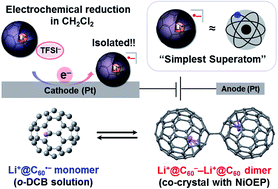
Although the major isomers of M@C82 (namely M@C2v(9)-C82, where M is a trivalent rare-earth metal) have been intensively investigated, the lability of the minor isomers has meant that they have been little studied. Herein, the first isolation and crystallographic characterization of the minor Y@C82 isomer, unambiguously assigned as Y@Cs(6)-C82 by cocrystallization with Ni(octaethylporphyrin), is reported. Unexpectedly, a regioselective dimerization is observed in the crystalline state of Y@Cs(6)-C82. In sharp contrast, no dimerization occurs for the major isomer Y@C2v(9)-C82 under the same conditions, indicating a cage-symmetry-induced dimerization process. Further experimental and theoretical results disclose that the regioselective dimer formation is a consequence of the localization of high spin density on a special cage-carbon atom of Y@Cs(6)-C82 which is caused by the steady displacement of the Y atom inside the Cs(6)-C82 cage.

It takes two: The dimerization of a pristine metallofullerene is observed for the first time in the crystal structure of the labile minor isomer of Y@C82, unambiguously assigned as Y@Cs(6)-C82. In contrast, under identical conditions the major isomer Y@C2v(9)-C82 does not form dimers, indicative of a cage-symmetry-induced process which can be rationalized by considering the localization of spin densities on the fullerene cages.
Open Access   This article is licensed under a Creative Commons Attribution 3.0 Unported Licence.
Open Access  This article is licensed under a Creative Commons Attribution-NonCommercial 3.0 Unported Licence.
Open Access  This article is licensed under a Creative Commons Attribution 3.0 Unported Licence.
  This article is licensed under a Creative Commons Attribution 3.0 Unported Licence.
Open Access  This article is licensed under a Creative Commons Attribution-NonCommercial 3.0 Unported Licence.
Open Access  This article is licensed under a Creative Commons Attribution 3.0 Unported Licence.

Golden dual fullerenes are hollow gold cages that are triangulations of a sphere and topologically isomorph to the well know fullerenes according to Euler's polyhedral formula. This also relates the (111) fcc gold layer to the graphene surface, the gold nanowires to the carbon nanotubes, and the Mackay icosahedra well known in cluster growth simulations to the halma transforms of the fullerene C20. In the picture C60 and its golden dual Au32 are shown with the background of Auckland's skyline. More information can be found in the Full Paper by P. Schwerdtfeger et al. (DOI: 10.1002/chem.201601239).
Invited for the cover of this issue is the group of Peter Schwerdtfgeger at Massey University in Auckland. The image depicts C60 and its golden dual Au32 against the background of Auckland's skyline. Read the full text of the article at 10.1002/chem.201601239.

“L'art pour l'art, et la science pour la science…there is so much exciting and interesting new science yet to be discovered…” Read more about the story behind the cover in the Cover Profile and about the research itself on page ▪▪ ff. (DOI: 10.1002/chem.201601239).
β,β-(1,4-Dithiino)subporphyrin dimers 7-syn and 7-anti were synthesized by the nucleophilic aromatic substitution reaction of 2-bromo-3-(4-methoxyphenylsulfonyl)subporphyrin 4 with 2,3-dimercaptosubporphyrin 5 under basic conditions followed by axial arylation. Additions of C60 or C70 to a dilute solution of 7-anti (ca. 10−6 m) in toluene did not cause appreciable UV/Vis spectral changes, while similar additions to a concentrated solution (ca. 10−3 m) resulted in precipitation of complexes. In contrast, dimer 7-syn captured C60 and C70 in different complexation stoichiometries in toluene; a 1:1 manner and a 2:1 manner, respectively, with large association constants; Ka=(1.9±0.2)×106 m−1 for C60@7-syn, and K1=(1.6±0.5)×106 and K2=(1.8±0.9)×105 m−1 for C70@(7-syn)2. These association constants are the largest for fullerenes-capture by bowl-shaped molecules reported so far. The structures of C60@7-anti, C70@7-anti, C60@7-syn, and C70@7-syn have been determined by single-crystal X-ray diffraction analysis.

β,β-(1,4-Dithiino)subporphyrin dimers were synthesized and their complexation behaviors with fullerenes were investigated. The syn dimer captures both C60 and C70 with high association constants (ca. 106 m−1) in toluene solution, with 1:1 and 2:1 complexation stoichiometries, respectively. The anti dimer forms a supramolecular complex with both C60 and C70 in the solid state; the fullerenes are sandwiched between each subporphyrin unit of two anti dimers.
Golden fullerenes have recently been identified by photoelectron spectra by Bulusu et al. [S. Bulusu, X. Li, L.-S. Wang, X. C. Zeng, PNAS 2006, 103, 8326–8330]. These unique triangulations of a sphere are related to fullerene duals having exactly 12 vertices of degree five, and the icosahedral hollow gold cages previously postulated are related to the Goldberg–Coxeter transforms of C20 starting from a triangulated surface (hexagonal lattice, dual of a graphene sheet). This also relates topologically the (chiral) gold nanowires observed to the (chiral) carbon nanotubes. In fact, the Mackay icosahedra well known in gold cluster chemistry are related topologically to the dual halma transforms of the smallest possible fullerene C20. The basic building block here is the (111) fcc sheet of bulk gold which is dual to graphene. Because of this interesting one-to-one relationship through Euler's polyhedral formula, there are as many golden fullerene isomers as there are fullerene isomers, with the number of isomers Niso increasing polynomially as  ). For the recently observed
  ,
,  , and
, and  we present simulated photoelectron spectra including all isomers. We also predict the photoelectron spectrum of
  . The stability of the golden fullerenes is discussed in relation with the more compact structures for the neutral and negatively charged Au12 to Au20 and Au32 clusters. As for the compact gold clusters we observe a clear trend in stability of the hollow gold cages towards the (111) fcc sheet. The high stability of the (111) fcc sheet of gold compared to the bulk 3D structure explains the unusual stability of these hollow gold cages.

The golden cage: The hollow golden cages found recently by photoelectron spectroscopy are topologically related to the carbon fullerenes (see figure). This one-to-one relationship also relates graphene to the exceptionally stable (111) sheet of fcc gold and the carbon nanotubes to gold nanowires.
The regio- and stereocontrolled synthesis of fullerene bisadducts is a topic of increasing interest in fullerene chemistry and a key point for the full exploitation of these derivatives in materials science. In this context, while the tether-directed remote functionalization strategy offers a valid approach to this synthetic challenge, no examples of such control have yet been reported using nontethered species. Presented here is a conceptually novel, supramolecular-directed functionalization approach in which noncovalent interactions between untethered residues have been used, for the first time, to amplify (>2800-fold) the regio-, stereo-, and atropselective formation of a C60 fullerene bisadduct racemate from a complex mixture of 130 bisadducts. Remarkably, both enantiomers, which present a sterically demanding cis-1 C60 addition pattern, represent the first examples of fullerene derivatives which combine central, axial, and helical chirality.

E pluribus unum: A conceptually novel, supramolecular-directed functionalization approach is presented in which noncovalent interactions between untethered residues have been used to amplify (>2800-fold) the regio-, stereo-, and atropselective formation of a C60 fullerene bisadduct racemate. Remarkably, both enantiomers represent the first examples of fullerene derivatives with combined central, axial, and helical chirality.

A novel class of dyes, namely benzoporphyrins, was synthesized and implemented into dye-sensitized solar cells. They feature complementary absorptions compared to N719, which renders them promising candidates for co-sensitization in DSSCs. Notably, metallated benzoporphyrins reveal a TiO2–nanoparticle attachment that is size and aggregation dependent. Therefore, unproductive energy-transfer events between the selectively attached dyes can be prevented. In light of the latter, an efficiency improvement of 39 % has been achieved upon selective adsorption of benzoporphyrins and N719 onto different layers of TiO2 photoelectrode.

The dream team: The complementary absorptions of benzoporphyrins and N719 renders them promising candidates for co-sensitization of DSSCs. More important is, however, the fact that metallated benzoporphyrins reveal a TiO2–nanoparticle attachment that is size and aggregation dependent. In light of the latter, an efficiency improvement of 39 % has been achieved upon selective adsorption of benzoporphyrins and N719 onto different layers of TiO2 photoelectrode (see figure).


New star-shaped benzotrithiophene (BTT)-based hole-transporting materials (HTM) BTT-1, BTT-2 and BTT-3 have been obtained through a facile synthetic route by crosslinking triarylamine-based donor groups with a benzotrithiophene (BTT) core. The BTT HTMs were tested on solution-processed lead trihalide perovskite-based solar cells. Power conversion efficiencies in the range of 16 % to 18.2 % were achieved under AM 1.5 sun with the three derivatives. These values are comparable to those obtained with today's most commonly used HTM spiro-OMeTAD, which point them out as promising candidates to be used as readily available and cost-effective alternatives in perovskite solar cells (PSCs).

Promising new candidates: Benzotrithiophenes (BTT) with different donor moieties are introduced as hole-transporting materials for perovskite solar cells. The incorporation of these new derivatives in photovoltaic devices leads to power conversion efficiencies (PCE) up to 18.2 %, thus paving the way to very efficient and highly versatile materials for light-energy conversion.
Density functional theory calculations have been used to explore the potential of Ru-based complexes with 1,3-bis(2,4,6-trimethylphenyl)imidazolin-2-ylidene (SIMes) ligand backbone (A) being modified in silico by the insertion of a C60 molecule (B and C), as olefin metathesis catalysts. To this end, we investigated the olefin metathesis reaction catalyzed by complexes A, B, and C using ethylene as the substrate, focusing mainly on the thermodynamic stability of all possible reaction intermediates. Our results suggest that complex B bearing an electron-withdrawing N-heterocyclic carbene improves the performance of unannulated complex A. The efficiency of complex B is only surpassed by complex A when the backbone of the N-heterocyclic carbene of complex A is substituted by two amino groups. The particular performance of complexes B and C has to be attributed to electronic factors, that is, the electronic-donating capacity of modified SIMes ligand rather than steric effects, because the latter are predicted to be almost identical for complexes B and C when compared to those of A. Overall, this study indicates that such Ru-based complexes B and C might have the potential to be effective olefin metathesis catalysts.

Catalysts with backbone: The introduction of fullerenes in the backbone of the 1,3-bis(2,4,6-trimethylphenyl)imidazolin-2-ylidene (SIMes) NHC ligand affords a new family of Ru-based olefin metathesis catalysts.


Modified Neutral Hydrogels Inclusion of 1 D and 2 D allotropes of carbon nanomaterials (single-walled carbon nanotubes (SWNTs) and graphene oxide (GO), respectively) within neutral hydrogel was investigated. The influence of hydrophobic end modulation on gelator structure was studied and the inclusion of SWNTs/GO in the hydrogel matrix was found to reinforce the mechanical stiffness of the composites compared with that of the native hydrogels. For the complete story see the Full Paper by K. Das et al. on page 5160 ff.