ACS Nano
DOI: 10.1021/acsnano.5b07846

 Open Access
   This article is licensed under a Creative Commons Attribution-NonCommercial 3.0 Unported Licence.
We quantum chemically explore the thermodynamics and kinetics of all 65 possible mechanistic pathways of the Bingel–Hirsch addition of dimethyl bromomalonate to the endohedral metallofullerene La@C2v-C82 that result from the combination of 24 nonequivalent carbon atoms and 35 different bonds present in La@C2v-C82 by using dispersion-corrected DFT calculations. Experimentally, this reaction leads to four singly bonded derivatives and one fulleroid adduct. Of these five products, only the singly bonded derivative on C23 could be experimentally identified unambiguously. Our calculations show that La@C2v-C82 is not particularly regioselective under Bingel–Hirsch conditions. From the obtained results, however, it is possible to make a tentative assignment of the products observed experimentally. We propose that the observed fulleroid adduct results from the attack at bond 19 and that the singly bonded derivatives correspond to the C2, C19, C21, and C23 initial attacks. However, other possibilities cannot be ruled out completely.

Fulleroid formation: Five experimentally observed but hitherto uncharacterized products in the Bingel–Hirsch (BH) addition of dimethyl bromomalonate to La@C2v-C82 were identified quantum chemically, only one of which is a fulleroid (see figure; white: C, dark red: La, green: Br, red: O, blue: H). Computational exploration also shows that the Bingel–Hirsch addition to La@C2v-C82 is not particularly regioselective, so at least ten products are expected, even under mild reaction conditions.

The development of flexible near-infrared (NIR) photovoltaic (PV) devices containing silicon meets the strong demands for solar utilization, portability, and sustainable manufacture; however, improvements in the NIR light absorption and conversion efficiencies in ultrathin crystalline Si are required. We have developed an approach to improve the quantum efficiency of flexible PV devices in the NIR spectral region by integrating Si nanowire arrays with plasmonic Ag nanoplates. The Ag nanoplates can directly harvest and convert NIR light into plasmonic hot electrons for injection into Si, while the Si nanowire arrays offer light trapping. Taking the wavelength of 800 nm as an example, the external quantum efficiency has been improved by 59 % by the integration Ag nanoplates. This work provides an alternative strategy for the design and fabrication of flexible NIR PVs.

Flexible friend: The quantum efficiency of flexible photovoltaic devices in the near-infrared spectral region has been improved by integrating Si nanowire arrays with plasmonic Ag nanoplates. The Ag nanoplates can directly harvest and convert NIR light into plasmonic hot electrons for injection into Si, while the Si nanowire arrays allow light trapping. The flexible devices show excellent durability over 50 flexing cycles.

High-temperature chlorination of pristine C98 fullerene isomers separated by HPLC from the fullerene soot afforded crystals of C98Cl22 and C98Cl20. An X-ray structure elucidation revealed, respectively, the presence of carbon cages of the most stable C2-C98(248) and rather unstable C1-C98(116), which represent the first isolated pentagon rule (IPR) isomers of fullerene C98 confirmed experimentally. The chlorination patterns of the chlorides are discussed in terms of the formation of isolated C=C bonds and aromatic substructures on the fullerene cages.

Two IPR isomers of the elusive C98 have been confirmed for the first time as chlorides, C98(248)Cl22 and C98(116)Cl20. Among 259 possible IPR isomers of C98, isomer C98(248) is the most stable, whereas C98(116) is rather unstable. Chlorination patterns of chlorides are stabilized by the formation of isolated C=C bonds and aromatic substructures.
Endohedral metallofullerenes (EMFs) have novel structures and properties that are closely associated with the internal metallic species. Benzyl radical additions have been previously shown to form closed-shell adducts by attaching an odd number of addends to open-shell EMFs (such as Sc3C2@Ih-C80) whereas an even number of groups are added to closed-shell EMFs (for example Sc3N@Ih-C80). Herein we report that benzyl radical addition to the closed-shell La2@Ih-C80 forms a stable, open-shell monoadduct instead of the anticipated closed-shell bisadduct. Single-crystal X-ray diffraction results show the formation of a stable radical species. In this species, the La−La distance is comparable to the theoretical value of a La−La covalent bond and is shorter than reported values for other La2@Ih-C80 derivatives, providing unambiguous evidence for the formation of direct La−La bond.

A stable fullerene radical La2@Ih-C80(C7H7) was synthesized and fully characterized. The stability of the radical is attributed to the localization of the unpaired electron inside the cage, as suggested by EPR spectroscopy and DFT calculations. Metal–metal bonding is indicated by the La−La distance, which is consistent with the calculated distance, and the localization of the SOMO on the La2 unit.
Open Access   This article is licensed under a Creative Commons Attribution 3.0 Unported Licence.
Open Access  This article is licensed under a Creative Commons Attribution-NonCommercial 3.0 Unported Licence.
Open Access  This article is licensed under a Creative Commons Attribution-NonCommercial 3.0 Unported Licence.
  This article is licensed under a Creative Commons Attribution 3.0 Unported Licence.
Open Access  This article is licensed under a Creative Commons Attribution-NonCommercial 3.0 Unported Licence.
Open Access  This article is licensed under a Creative Commons Attribution-NonCommercial 3.0 Unported Licence.
High-temperature chlorination of C100 fullerene followed by X-ray structure determination of the chloro derivatives enabled the identification of three isomers of C100 from the fullerene soot, specifically numbers 18, 425, and 417, which obey the isolated pentagon rule (IPR). Among them, isomers C1-C100(425) and C2-C100(18) afforded C1-C100(425)Cl22 and C2-C100(18)Cl28/30 compounds, respectively, which retain their IPR cage connectivities. In contrast, isomer C2v-C100(417) gives Cs-C100(417)Cl28 which undergoes a skeletal transformation by the loss of a C2 fragment, resulting in the formation of a nonclassical (NC) C1-C98(NC)Cl26 with a heptagon in the carbon cage. Most probably, two nonclassical C1-C100(NC)Cl18/22 chloro derivatives originate from the IPR isomer C1-C100(382), although both C1-C100(344) and even nonclassical C1-C100(NC) can be also considered as the starting isomers.

Chloride is key: Three isomers of C100 fullerene which obey the isolated pentagon rule (IPR) have been isolated and characterized by X-ray structure determination of their chloro derivatives. Although the IPR cages in C1-C100(425)Cl22 and C2-C100(18)Cl28/30 retain cage connectivities, Cs-C100(417)Cl28 transforms into the nonclassical (NC) isomer C1-C98(NC)Cl26 by loss of a C2 fragment (see picture; C=gray; Cl=green).
In this manuscript, we describe the single-step preparation of a cyclic tetramer of acenaphthylene through a Lewis acid-catalyzed aldol cyclization of 1-acenaphthenone. The previously unexplored cyclic tetramer material differs from the better-known cyclic trimer, decacyclene, due to the presence of a central eight-membered ring. This ring not only forces the molecule to distort significantly from planarity, but is also responsible for its unique electronic properties, including a decrease in the reduction potential (by about 0.4 eV) and optical gap (by about 0.73 eV), compared to the more planar decacyclene. The synthesized compound crystallizes into a unique packing structure with significant π-stacking observed between adjacent molecules. Furthermore, due to its saddle-like shape, the cyclic tetramer is able to form shape-complementary interactions between its concave surface and the convex outer surface of buckminsterfullerene to generate cocrystalline supramolecular assemblies.

What a catch! A cyclic tetramer of acenaphthylene was synthesized in a single step. The compound exhibits interesting electronic and structural properties when compared to the better-known cyclic trimer due to the presence of a central eight-membered ring. The saddle-like shape of cyclic tetramer allows it to form cocrystalline supramolecular assemblies with C60 in the solid state (see scheme).
Open Access  This article is licensed under a Creative Commons Attribution 3.0 Unported Licence.
Open Access  This article is licensed under a Creative Commons Attribution-NonCommercial 3.0 Unported Licence.
Active sites in carbon-catalyzed phosgene synthesis from gaseous CO and Cl2 have been identified using C60 fullerene as a model catalyst. The carbon atoms distorted from sp2 coordination in non-planar carbon units are concluded to generate active Cl2. Experiments and density functional theory calculations indicate the formation of a surface-bound [C60⋅⋅⋅Cl2] chlorine species with radical character as key intermediate during phosgene formation. It reacts rapidly with physisorbed CO in a two-step Eley–Rideal-type mechanism.

Active sites and reactive intermediates: Experiments and DFT calculations provide insight into the mechanism of carbon-catalyzed Cl2 activation and COCl2 formation. The structural resemblance between the C60 fullerene and active carbon catalysts showed that carbon sites distorted from sp2 coordination in non-planar units are the active sites, catalyzing the process via an active [C60⋅⋅⋅Cl2] complex.
In this work, the Bingel–Hirsch addition of diethylbromomalonate to all non-equivalent bonds of Sc3N@D3h-C78 was studied using density functional theory calculations. The regioselectivities observed computationally allowed the proposal of a set of rules, the predictive aromaticity criteria (PAC), to identify the most reactive bonds of a given endohedral metallofullerene based on a simple evaluation of the cage structure. The predictions based on the PAC are fully confirmed by both the computational and experimental exploration of the Bingel–Hirsch reaction of Sc3N@D5h-C80, thus indicating that these rules are rather general and applicable to other isolated pentagon rule endohedral metallofullerenes.

The Bingel–Hirsch (BH) addition of diethylbromomalonate to all non-equivalent bonds of Sc3N@D3h-C78 was studied using DFT calculations. A set of rules, the predictive aromaticity criteria (PAC), is proposed to identify the most reactive bonds of endohedral metallofullerenes. The PAC predictions are consistent with computational and experimental data, indicating their generality.
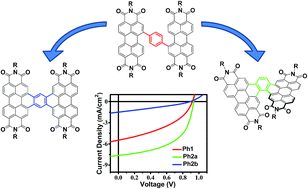
Secondary aliphatic amines add to a pole pentagon of [70]fullerene in the presence of N-fluorobenzenesulfonimide to form cyclopentadienyl-type adducts, C70(NSO2Ph)(NR1R2)4 (1), which can be converted into analogous C70 derivatives such as C70(NHSO2Ph)(NHTol)5 (2). Further addition reactions of either 1 or 2 take place selectively at the opposite pole pentagon of the C70 cage, thus forming curved π systems with a reduced number of π electrons, and the products include a dodecakis-adduct with a Vögtle belt motif.

Throw a curve: Secondary aliphatic amines add to [70]fullerene in the presence of NFSI (N-fluorobenzenesulfonimide) to form cyclopentadienyl-type adducts. The addition occurs at the pole pentagon and was confirmed by X-ray analysis. Further contraction of the π system took place at the other pole pentagon and led to curved π systems, including the 50 π electron Vögtle belt.
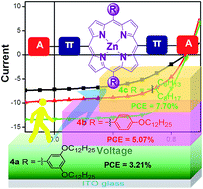
Self-assembly driven by crown ether complexation of zinc phthalocyanines equipped with one 18-crown-6 moiety and fullerenes bearing an ammonium head group afforded a novel donor–acceptor hybrid. In reference experiments, fullerenes containing a Boc-protected amine functionality have been probed. The circumvention of zinc phthalocyanine aggregation is important for the self-assembly, which required the addition of pyridine. From absorption and fluorescence titration assays, which provided sound and unambiguous evidence for mutual interactions between the electron donor and the electron acceptor within the hybrids, association constants in the order of 8.0×10⁵ M−1 have been derived. The aforementioned is based on 1:1 stoichiometries, which have been independently confirmed by Job’s plot measurements. In the excited state, which has been examined by transient absorption experiments, intermolecular charge separation evolves from the photoexcited zinc phthalocyanine to the fullerene subunit and leads to short-lived charge-separated states. Interestingly, photoexcitation of zinc phthalocyanine dimers/aggregates can also be followed by an intermolecular charge separation between vicinal phthalocyanines. These multicomponent supramolecular ensembles have also been shown by in-depth electrospray ionization mass spectrometry (ESI-MS) studies, giving rise to the formation and detection of a variety of non-covalently linked species.

Quite simple, isn’t it? Supramolecular electron donor–acceptor hybrids based on crown ether-functionalized zinc phthalocyanines and a C60 derivative bearing an ammonium group were investigated. In-depth ESI-MS investigations confirmed the existence of several supramolecular adducts. Titration experiments shed light on the stoichiometry, binding constants, and possible electron-transfer characteristics (see figure).


A fullerene was covalently attached to a (dA)20 template that serves as structural scaffold to self-assemble an ordered and mixed array of ethynyl-pyrene- and ethynyl-Nile-red-nucleoside conjugates. Fluorescence spectroscopy revealed evidence for energy transfer between the two different chromophores. Moreover, fluorescence quenching is significantly enhanced by the attached fullerene in mixed assemblies of different chromophore ratios. This indicates exciton dissociation by electron transfer from the photo-generated exciton on the chromophore stack to the fullerene. The fullerene–DNA-conjugate was integrated as a photo-active layer in solar cells that showed charge-carrier generation in the spectral regime of all three components of the conjugate. This work clearly demonstrates that DNA is suitable as structural element for chromophore assemblies in future organic optoelectronic devices, such as solar cells.

DNA in solar cells: A chromophore assembly of ethynyl Nile red and ethynyl pyrene, templated and ordered by a single-stranded DNA–fullerene conjugates, shows light-harvesting properties and photovoltaic activity. This work demonstrates that DNA is suitable as structural element for chromophore assemblies in future organic optoelectronic devices, such as solar cells
Genetic fusion of cargo proteins to a positively supercharged variant of green fluorescent protein enables their quantitative encapsulation by engineered lumazine synthase capsids possessing a negatively charged lumenal surface. This simple tagging system provides a robust and versatile means of creating hierarchically ordered protein assemblies for use as nanoreactors. The generality of the encapsulation strategy and its effect on enzyme function were investigated with eight structurally and mechanistically distinct catalysts.

Caught in a trap: Genetic fusion of cargo proteins to a positively supercharged variant of green fluorescent protein enables their quantitative encapsulation by engineered lumazine synthase capsids possessing a negatively charged lumenal surface.
Open Access  This article is licensed under a Creative Commons Attribution 3.0 Unported Licence.